Article

Cross-Cultural Factors in Tourists’ Continuance Intention Toward XR for Built Heritage Conservation: A Case Study of Badaling Great Wall

Department of Art & Design, Shaanxi University of Science and Technology, Xi’an 710021, China
*
Author to whom correspondence should be addressed.
Buildings 2026, 16(2), 360; https://doi.org/10.3390/buildings16020360
Submission received: 19 December 2025 / Revised: 6 January 2026 / Accepted: 14 January 2026 / Published: 15 January 2026
(This article belongs to the Special Issue Built Heritage Conservation in the Twenty-First Century: 2nd Edition)

Abstract

As sustainable tourism gains global momentum, extended reality (XR) technologies have emerged as important tools for enhancing visitor experiences at overburdened World Heritage Sites while mitigating physical deterioration through non-consumptive engagement. However, existing research on immersive technologies in heritage tourism has largely relied on single-cultural samples and has paid limited attention to theoretically grounded boundary conditions in post-adoption behaviour. To address these gaps, this study extends the Expectation–Confirmation Model (ECM) by incorporating cultural distance (CD) and prior visitation experience (PVE) as moderating variables, and empirically tests the proposed framework using a mixed domestic–international sample exposed to an on-site XR application at the Badaling Great Wall World Heritage Site. Data were collected immediately after the XR experience and analysed using structural equation modelling. The results validate the core relationships of ECM while identifying significant moderating effects. Cultural distance attenuates the positive effects of confirmation on perceived usefulness as well as the effect of perceived usefulness on continuance intention, while prior visitation experience weakens the influences of enjoyment and visual appeal on satisfaction. These findings establish important boundary conditions for ECM in immersive heritage contexts. From a practical perspective, the study demonstrates that high-quality, culturally responsive XR can complement physical visitation and support sustainable conservation strategies at large-scale linear heritage sites.

1. Introduction

Since the early 21st century, the rapid evolution of information and communication technologies has profoundly reshaped cultural heritage tourism. Among these innovations, Extended Reality (XR)—encompassing virtual reality (VR), augmented reality (AR), and mixed reality (MR)—has emerged as one of the most promising tools for delivering immersive, non-consumptive, and sustainable visitor experiences at overburdened World Heritage Sites [1,2]. By enabling multi-sensory engagement with fragile historical environments without additional physical impact, XR not only enhances interpretive depth and emotional resonance but also significantly alleviates on-site overcrowding and conservation pressure on built heritage [3,4].
The post-COVID-19 era has further accelerated this paradigm shift. Traditional high-volume tourism models at iconic linear monuments have exposed acute vulnerabilities to external shocks, prompting heritage managers worldwide to adopt digital solutions that enhance both resilience and long-term sustainability [5,6]. In this context, XR has evolved from an optional enhancement to a strategic imperative for destinations facing existential threats from mass tourism.
The Badaling Great Wall, a UNESCO World Heritage Site in Beijing’s Yanqing District, is the most heavily visited section of the Great Wall of China. Its restored Ming Dynasty segment (7.8 km, 43 watchtowers) historically attracted over 10 million annual visitors before 2019, resulting in severe physical degradation of masonry, pathways, and ecosystems. As a quintessential linear monument under extreme overtourism pressure, Badaling exemplifies the acute tension between maintaining global accessibility and ensuring long-term conservation of built heritage.
On 29 August 2025, “The Great Wall of China: Immersive Theatre” opened for trial operation at the Badaling Scenic Area. This 20-min XR experience casts visitors as a Ming Dynasty postal courier tasked with delivering an imperial edict and patrolling the frontier. The scripted narrative guides participants from a post station through desert traversal, beacon tower combat, aerial ascent for panoramic views, and a final memorial rite alongside General Qi Jiguang. Developed with rigorous historical supervision by Great Wall scholars and museums, the project faithfully recreates Ming-period military equipment, architecture, and landscapes from Jiayuguan to Shanhaiguan while employing multi-sensory XR technology to deliver a controlled, repeatable, and fully non-consumptive alternative to physical traversal. This facility is an ideal case for this study as it operates at a critically pressured site, attracts a high volume of international tourists, and represents a state-of-the-art conservation-supporting application.
Although a growing body of research has examined initial adoption and experiential effects of XR in cultural heritage [7,8,9], post-adoption continuance intention remains underexplored, particularly regarding cross-cultural boundary conditions and the role of prior site-specific visitation experience. Building upon the author’s previously validated ECM-IS framework at the Terracotta Warriors Museum [10], the present study extends this model by incorporating two theoretically critical moderators:
(1) Cultural distance, operationalised via Hofstede’s cultural dimensions index or perceptual scales [11,12], is anticipated to negatively moderate the relationships between confirmation and perceived usefulness, and between perceived usefulness and continuance intention. Tourists from culturally distant backgrounds often exhibit heightened sensitivity to authenticity cues, historical narrative framing, and technology-mediated emotional experiences, potentially weakening these core ECM-IS paths [13,14,15].
(2) Prior visitation experience, distinguishing first-time from repeat visitors to the physical Great Wall and operationalised through perceptual scales assessing familiarity, emotional attachment, and reference point [16,17], is anticipated to negatively moderate the relationships between hedonic experiential attributes (enjoyment and visual appeal) and satisfaction. Tourists with extensive prior visitation often possess vivid embodied memories that serve as stringent comparative benchmarks, leading to more critical evaluations of XR representations and potentially weakening the influence of these attributes on overall satisfaction relative to first-time visitors [18,19].
By testing these moderators in a mixed domestic–international sample at the newly opened Badaling Immersive Theatre, this study provides the first empirical examination of the cross-cultural generalisability of ECM-IS in a full multi-sensory XR context and elucidates the conditions under which such technology genuinely supports sustainable conservation outcomes at linear heritage sites.
The study pursues three objectives:
RO1: To validate the ECM-IS model in the context of a multi-sensory XR experience at the Badaling Great Wall.
RO2: To investigate the moderating roles of cultural distance and prior visitation experience on key ECM-IS relationships.
RO3: To derive theoretically grounded and practically actionable guidelines for culturally sensitive XR deployment in global built heritage conservation.
The remainder of this paper is structured as follows: Section 2 reviews the literature on XR in cultural heritage and the Expectation–Confirmation Model; Section 3 develops the hypotheses and proposed model; Section 4 details the methodology; Section 5 presents the empirical results; Section 6 discusses theoretical and practical implications; and Section 7 concludes with limitations and future research directions.

2. Literature Review

2.1. Sustainable Conservation of Built Heritage

Built heritage, including large-scale linear monuments such as the Great Wall, represents an irreplaceable form of cultural capital whose conservation requires balancing public accessibility with long-term preservation objectives [20,21]. However, sustained tourism growth has increasingly placed pressure on fragile heritage fabric, with overtourism widely recognized as a major risk to both material conservation and experiential quality at World Heritage sites [22,23,24].
Linear monuments are subject to a distinctive risk structure because their elongated spatial form produces cumulative and spatially dispersed impacts, including surface abrasion, trail widening, and pressure spillovers along the corridor rather than at a single node [25]. Badaling exemplifies this challenge. Despite the introduction of daily visitor caps and digital ticketing systems, the site has long experienced extreme visitation intensity, with peak demand contributing to accelerated structural wear and ecological stress [26,27,28].
Beyond crowding effects, conservation research at Badaling further demonstrates that tourism pressure interacts with geomorphic and ecological processes, reinforcing the need to treat visitor load as a core conservation variable rather than solely a management concern [29,30]. Accordingly, sustainable conservation increasingly depends on strategies that limit physical impact while maintaining high-quality access and interpretation [31].
Within this transition, immersive digital technologies such as VR, AR, and XR have been proposed as supplementary tools to support non-destructive interpretation, expectation management, and partial substitution of physical visitation under constrained conditions [32,33,34]. Given the substantial environmental footprint associated with tourism activity at scale [35], evaluating whether XR can function as an effective conservation-supporting instrument requires understanding tourists’ willingness to continue using such systems over time. Identifying the determinants and boundary conditions of continuance intention therefore constitutes a necessary foundation for assessing XR’s role in sustainable built heritage conservation.

2.2. Expectation–Confirmation Model (ECM)

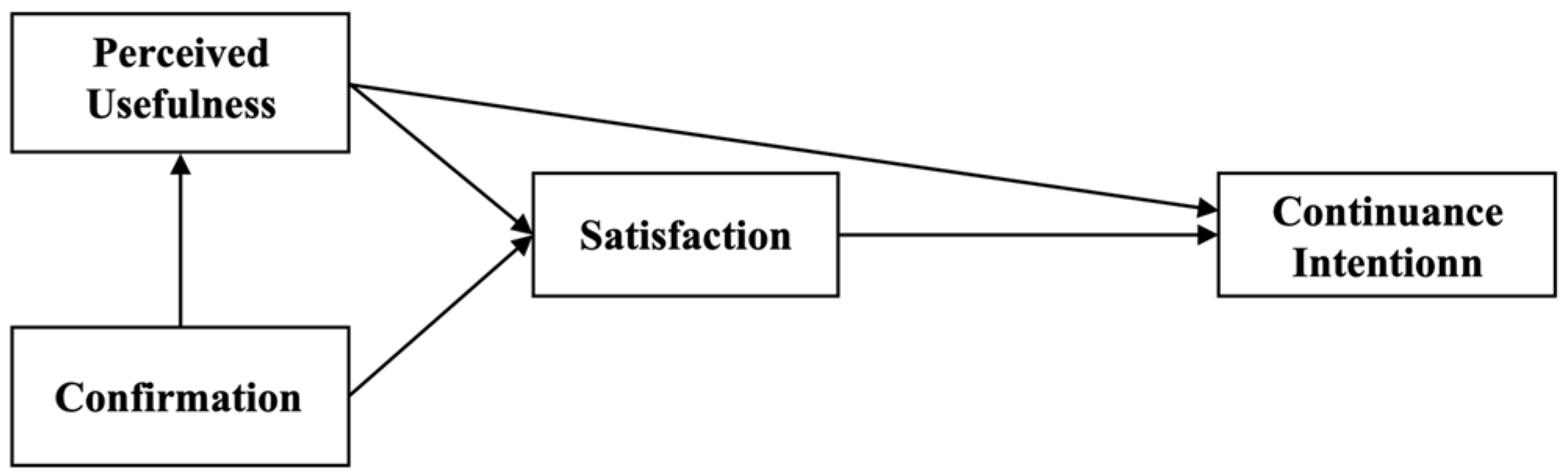
In built heritage conservation contexts, the strategic value of XR lies in enabling sustained engagement that complements physical visitation, reducing wear, dispersing crowds, and broadening access to interpretation [36]. Tourists’ continuance intention toward XR experiences serves as a behavioural proxy for assessing whether digital interventions can meaningfully support long-term conservation outcomes. Conceptually, the Expectation–Confirmation Model (ECM), originally developed by Oliver [37] and formalised for information systems by Bhattacherjee [38], explains continuance intention as a post-adoption cognitive–affective evaluation process. After initial use, users reassess system performance against prior expectations (confirmation), form updated value beliefs (perceived usefulness), and develop affective responses (satisfaction), which jointly determine their intention to continue or discontinue use. As presented in Figure 1, confirmation shapes both perceived usefulness and satisfaction, while satisfaction and perceived usefulness directly drive continuance intention [38].
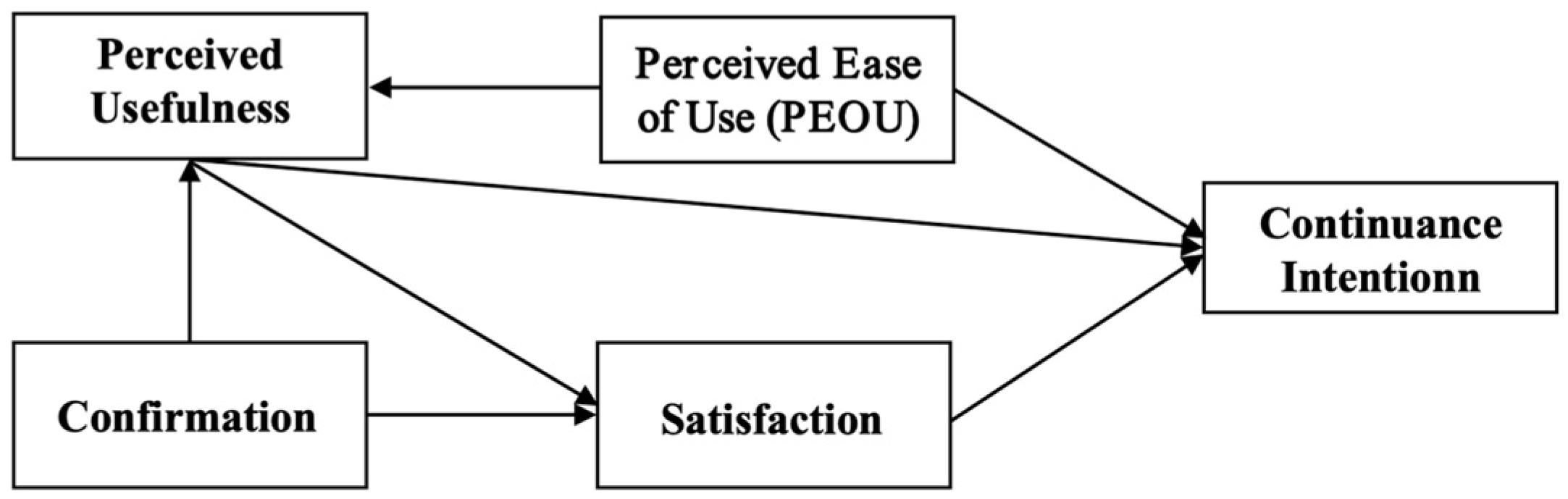
In immersive XR systems, this post-adoption evaluation process is further conditioned by interaction effort and system usability, which remain salient well beyond initial adoption. Accordingly, this study extends the ECM core by incorporating perceived ease of use (PEOU) as a theoretically consistent post-adoption belief [39,40]. Prior heritage AR/VR research demonstrates that ease of use and interaction quality systematically influence satisfaction and behavioural intentions in technology-mediated cultural experiences [2,8,41,42,43] (Figure 2).
Although ECM and its extensions have demonstrated robust explanatory power across information systems contexts [44], heritage XR applications that introduce boundary conditions remain under-theorised. In globally iconic heritage sites such as the Badaling Great Wall, post-use evaluations are plausibly shaped by visitors’ cultural interpretive frameworks and by embodied reference points derived from prior physical visitation. Building on the validated ECM core and established post-adoption extensions, this study introduces cultural distance and prior visitation experience as moderators, enabling a theoretically grounded test of when and for whom confirmation translates into usefulness, satisfaction, and ultimately continuance intention.

2.3. Experiential Attributes of XR

Extended Reality (XR) is commonly treated as an umbrella concept encompassing virtual reality (VR), augmented reality (AR), and mixed reality (MR), particularly in cultural heritage research where immersive systems are often designed as integrated experiential journeys rather than isolated technological modalities [1,33,45]. Prior tourism and heritage studies increasingly suggest that immersive technologies operate through overlapping experiential mechanisms—such as immersion, presence, and sensory engagement—that jointly shape post-use evaluations and behavioural outcomes [46,47].
Building on the author’s validated post-adoption framework for immersive heritage applications [10], the present study operationalises the experiential layer of XR through a parsimonious three-factor structure comprising Visual Appeal, Interactivity, and Enjoyment. This structure is consistent with recent XR and VR continuance research in cultural heritage and museum contexts, where visual quality, interaction, and hedonic enjoyment repeatedly emerge as the most salient experiential drivers of satisfaction and continued usage intention [9,43,48].
Specifically, Visual Appeal captures the perceived aesthetic quality, realism, and visual richness of the XR environment, which plays a central role in shaping users’ confirmation and perceived usefulness in heritage interpretation [9]. Interactivity reflects the degree to which users can actively control and receive real-time feedback from the XR system, supporting sustained engagement and post-adoption evaluation [49]. Enjoyment represents the intrinsic pleasure and hedonic gratification derived from the XR experience, forming the affective core of post-use satisfaction [9].
By consolidating experiential attributes into these three dimensions, the proposed structure enhances conceptual clarity and measurement parsimony while retaining strong theoretical alignment with prior immersive heritage and XR continuance research.

2.4. XR in Built Cultural Heritage Contexts

XR has been widely adopted in built cultural heritage contexts as a mature interpretive approach, particularly where physical access, spatial integrity, or visitor safety constrain conventional on-site engagement [1,33]. Existing review-based syntheses consistently show that heritage XR applications are primarily oriented toward education, immersive storytelling, accessibility enhancement, and experience management, while also identifying persistent constraints related to usability, interaction naturalness, cybersickness, and evaluation fragmentation [50,51,52].
Empirical studies in museums and tourism settings further indicate that immersive XR experiences produce differentiated post-experience outcomes depending on device affordances and visitor characteristics, suggesting that user fit and experiential alignment condition satisfaction and behavioural responses [42,53].
However, evidence-mapping reviews highlight that much of the existing literature remains focused on technical feasibility and immediate experiential outcomes, whereas post-adoption continuance and sustained engagement are comparatively under-examined, particularly in real-world deployments [54,55]. Cross-cultural boundary conditions and user-difference effects are also rarely addressed in existing continuance-oriented heritage XR studies [54,56].
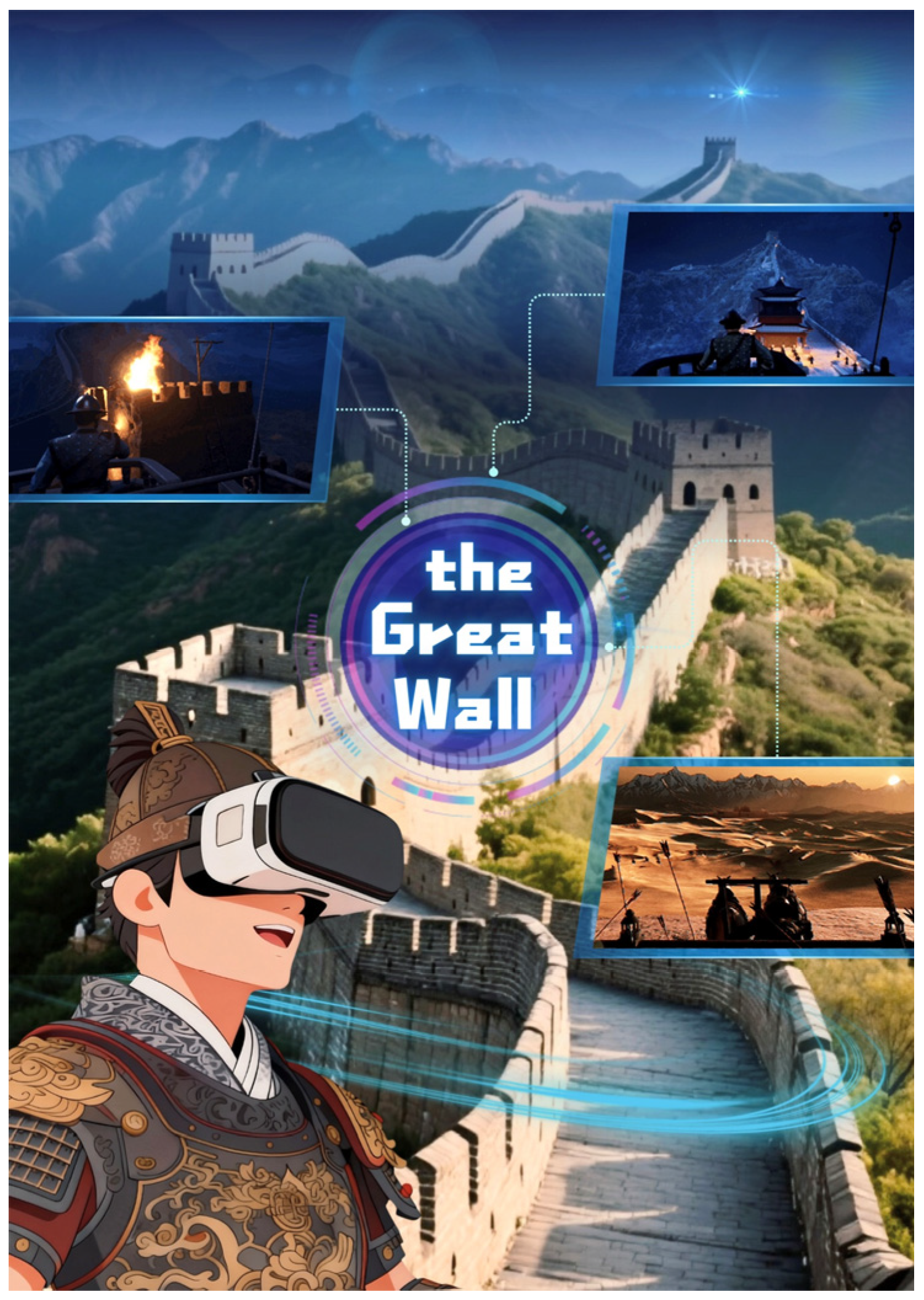
For globally iconic linear monuments, the Great Wall of China represents a particularly relevant empirical context due to its spatial continuity, dispersed visitation patterns, and long-standing conservation pressure [20,57]. Recent years have seen accelerated deployment of large-scale, on-site immersive XR installations within Chinese heritage tourism systems, marking a shift from archival digitisation toward place-embedded experiential interpretation [58,59]. Among these, the “Great Wall of China: Immersive Theatre” (Figure 3) at the Badaling Great Wall provides a rare opportunity to examine XR use within an operational heritage setting, where immersive interpretation is explicitly embedded within conservation and visitor-management strategies [60].
Accordingly, the present study positions Badaling’s on-site XR experience as an empirical testbed for understanding post-adoption continuance mechanisms in a built-heritage conservation context, with explicit attention to cultural distance and prior physical visitation as boundary conditions shaping sustained XR engagement.

2.5. Cross-Cultural Boundary Conditions in XR-Mediated Heritage Experiences

XR-based heritage experiences are increasingly positioned as conservation-supporting interventions because they can extend interpretation and engagement without proportionally increasing physical wear on vulnerable sites [54]. However, evidence syntheses in immersive tourism and cultural heritage technology consistently indicate that post-adoption responses to immersive systems are heterogeneous, suggesting that continuance mechanisms cannot be assumed to operate uniformly across user groups [55]. This observation directly challenges the implicit universality assumption often embedded in post-adoption models such as ECM and underscores the need to identify contextual boundary conditions under which confirmation, usefulness, and satisfaction translate into continuance intention.
Among the potential moderators, cultural distance has been identified as a theoretically salient and empirically under-examined condition in immersive tourism technology research [55,61]. Cross-cultural tourism studies demonstrate that cultural differences systematically shape expectation formation, interpretive frames, and evaluative standards in host–guest encounters [62]. In heritage technology contexts, empirical evidence further suggests that behavioural intention and aesthetic or hedonic evaluations of mobile AR and immersive applications vary across cultural backgrounds [63]. Within an ECM perspective, such differences imply that culturally distant visitors may apply stricter evaluative criteria when reassessing XR experiences after use, thereby attenuating the effects of confirmation on perceived usefulness and satisfaction. Accordingly, this study models cultural distance as a boundary condition that constrains key post-adoption pathways rather than treating continuance intention as culturally invariant.
A second critical boundary condition concerns prior physical visitation experience, which introduces embodied reference points into post-adoption evaluation. Empirical VR tourism research shows that visitors with prior on-site experience evaluate immersive representations differently from first-time visitors, using real-world memories as cognitive benchmarks [64]. Presence-based tourism studies further indicate that immersive exposure interacts with pre-existing experiential baselines, shaping affective and cognitive responses rather than replacing them [65]. From a heritage perspective, repeat visitation is often associated with stronger place-based bonds, and place-attachment research suggests that such bonds heighten evaluative scrutiny when new representations are compared against established personal memories [66]. Within the ECM framework, this implies that prior visitation experience may weaken the marginal effects of hedonic experiential attributes on satisfaction, as enjoyment is assessed relative to embodied memories of the physical site. By integrating cultural distance and prior visitation experience as moderators within an extended ECM-IS framework, this study directly addresses review-identified gaps calling for boundary-condition-sensitive and cross-cultural designs in immersive tourism technology research. In doing so, it advances a contextualized understanding of when and for whom XR-mediated heritage experiences can generate sustained post-adoption engagement in real-world conservation settings.

2.6. Research Gap and Contribution

Despite the rapid proliferation of extended reality (XR) applications in cultural heritage tourism, the extant evidence base remains uneven in ways that constrain both theoretical consolidation and conservation-oriented implementation. Bibliometric and review-based syntheses consistently show that much of the cultural heritage XR literature has been driven by technological capability, visualization quality, and experience enhancement at the point of use, with comparatively less cumulative attention to behavioral mechanisms that sustain engagement over time [3].
First, although XR is widely positioned as a promising intervention for heritage interpretation and broader sustainability agendas, research emphasis has largely concentrated on system affordances and short-horizon experiential outcomes, while long-term engagement mechanisms remain comparatively under-examined [67]. Foundational surveys and decade-level overviews in cultural heritage XR/AR catalogue dominant application types and technical foci, which are essential for mapping the field, but leave conservation managers with limited evidence on how to secure repeated use beyond initial novelty [3].
Second, post-adoption continuance intention—the behavioural outcome that ultimately determines whether XR can operate as a durable, low-impact engagement channel—has received substantially less systematic examination than adoption or one-off experience evaluation. The Expectation–Confirmation Model (ECM) was developed precisely to explain continued use after initial experience and remains one of the most widely validated post-adoption frameworks in information systems research [68]. However, recent tourism and hospitality reviews on immersive technologies repeatedly highlight that technology-oriented research streams can under-specify downstream behavioural consequences, including sustained engagement and repeat use patterns [54,55]. In heritage-related contexts, empirical continuance studies do exist (e.g., AR continuance at UNESCO World Heritage Sites; online/digital museum continued-use research), but they remain fragmented across settings and often focus on single platforms or single-site deployments [8,69].
Third, cross-cultural generalisability and boundary conditions are still insufficiently theorised in immersive heritage technology research. Cross-cultural differences in adopting mobile AR at cultural heritage tourism sites have been empirically demonstrated, indicating that “one-size-fits-all” assumptions are not warranted [16]. Nevertheless, many ECM-informed continuance investigations in heritage and adjacent immersive contexts continue to rely on single-country or single-culture samples, which limits inference for globally iconic destinations that receive heterogeneous international audiences [8,10]. This gap is consequential for conservation-oriented XR, because the sustainability value proposition depends on whether diverse visitor segments repeatedly choose XR-mediated engagement under varying cultural expectations and experiential benchmarks [54].
Fourth, the distinctive governance and impact profile of linear monuments under heavy visitation remains underrepresented in XR continuance research. The Great Wall is recognised as World Heritage for its multi-dynastic historical significance, and national survey reporting places its total length above 21,000 km—features that imply dispersed access points and cumulative management pressures rather than a single bounded venue logic. These characteristics make the Great Wall a particularly demanding test case for XR as a conservation-supporingt instrument rather than merely an interpretive add-on.
Against this background, the present study makes three principal contributions.
Theoretically, it extends an ECM-informed post-adoption framework by explicitly modelling two boundary conditions—cultural distance and prior physical visitation experience—thereby responding to long-standing calls to move beyond universalistic continuance assumptions and to specify when core post-adoption mechanisms strengthen or weaken across audience segments.
Empirically, it provides evidence from an on-site, place-embedded large-space immersive deployment at the Badaling Great Wall scenic area. Public releases document the opening of iQIYI’s Great Wall-themed “full-sensory” immersive theatre at Badaling (reported opening: 29 August 2025), illustrating a shift from “digital archives” toward embedded immersive interpretation within scenic-area tourism systems. Using a mixed domestic–international sample collected immediately after the XR experience, the study tests post-adoption mechanisms in a high-stakes built-heritage conservation context where repeated behavioural choice is central.
Practically, the findings identify which visitor segments are more versus less likely to sustain XR engagement, enabling heritage managers to develop culturally responsive narrative framing, authenticity signalling, and targeted communication strategies that improve retention and support long-term load-balancing objectives at overburdened heritage destinations.
Collectively, these contributions advance understanding of XR from technological novelty to verifiable instrument of sustainable heritage conservation, providing both theoretical rigour and actionable guidance for destinations facing analogous overtourism challenges.

3. Research Model and Hypotheses Development

3.1. Research Model

Traditional built-heritage interpretation has long depended on predominantly expository media—most notably interpretive panels/labels and standardized guide formats—through which visitor agency is structurally constrained, and engagement can be fragmented by situational burdens such as crowding and sensory stressors [70,71]. Studies of label-based mediation in museum-like heritage settings show that visitors’ attention to interpretive text is often selective and time-limited, with reading patterns varying by exhibit configuration and competing stimuli [71,72]. At high-density, open-air heritage attractions, perceived crowding further degrades experience quality and can reshape tourists’ psychological states, as evidenced by empirical work at the Great Wall of China [73]. Complementarily, field-based environmental assessment at the Great Wall indicates that audio–visual conditions and tourist density are associated with visitor satisfaction, underscoring how on-site constraints may dampen opportunities for reflective or emotionally resonant interpretation under peak-use conditions [74].
By contrast, Extended Reality (XR) reconfigures heritage encounters toward more immersive and interactive experience architectures, enabling spatially situated reconstruction, embodied presence, and engagement pathways that are difficult to realize through conventional interpretive media [1,75]. Evidence synthesis in tourism research further supports that AR/VR applications exert systematic impacts on experiential outcomes (e.g., presence- and value-related responses), providing a stronger empirical basis for modelling post-experience evaluations than treating immersive systems as mere novelty add-ons [76]. In the museum domain specifically, controlled comparative evidence shows that HMD-based VR can outperform HMD-based AR on immersion- and empathy-related outcomes, with implications for how immersive affordances translate into evaluative judgments [77].
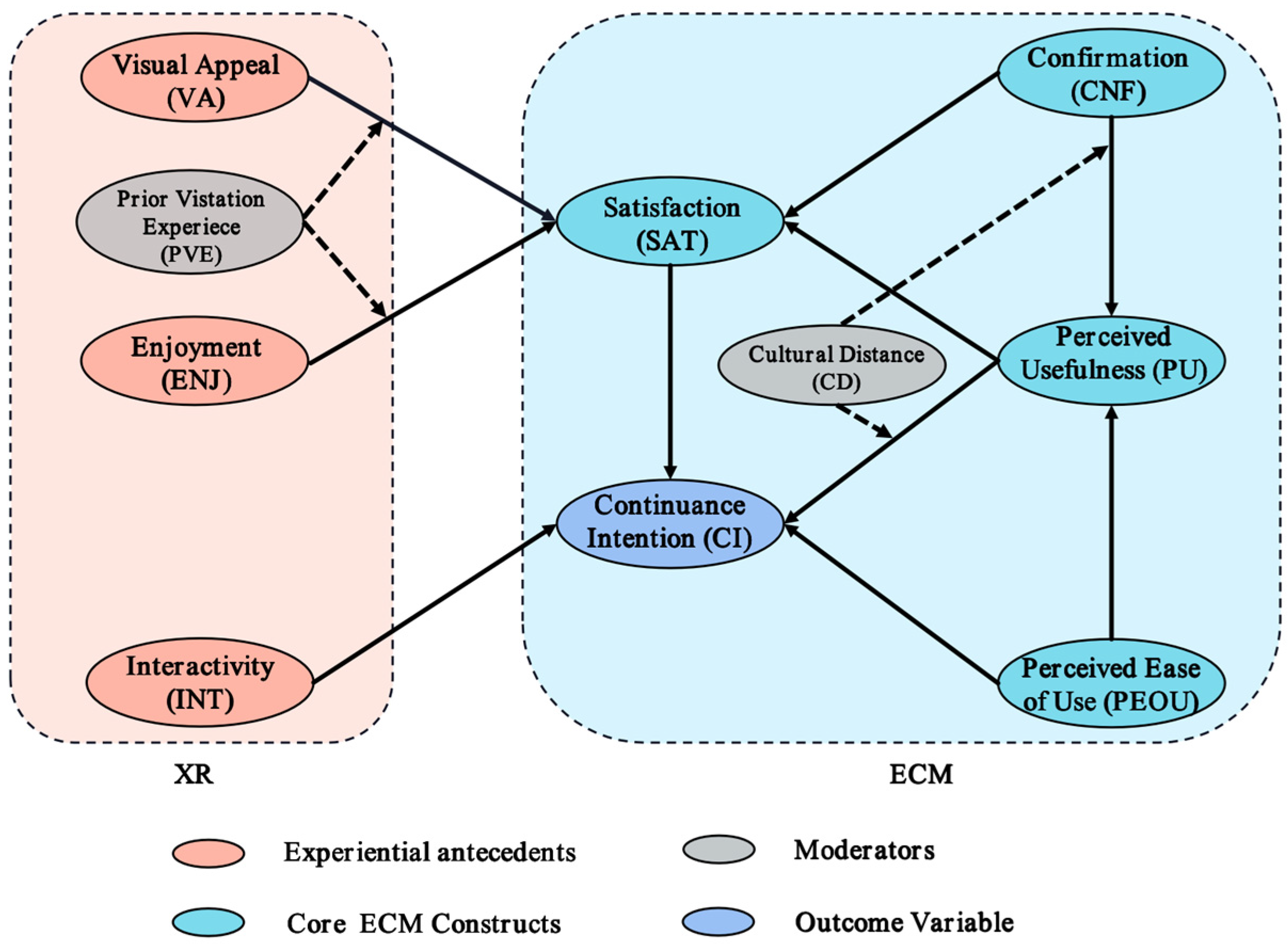
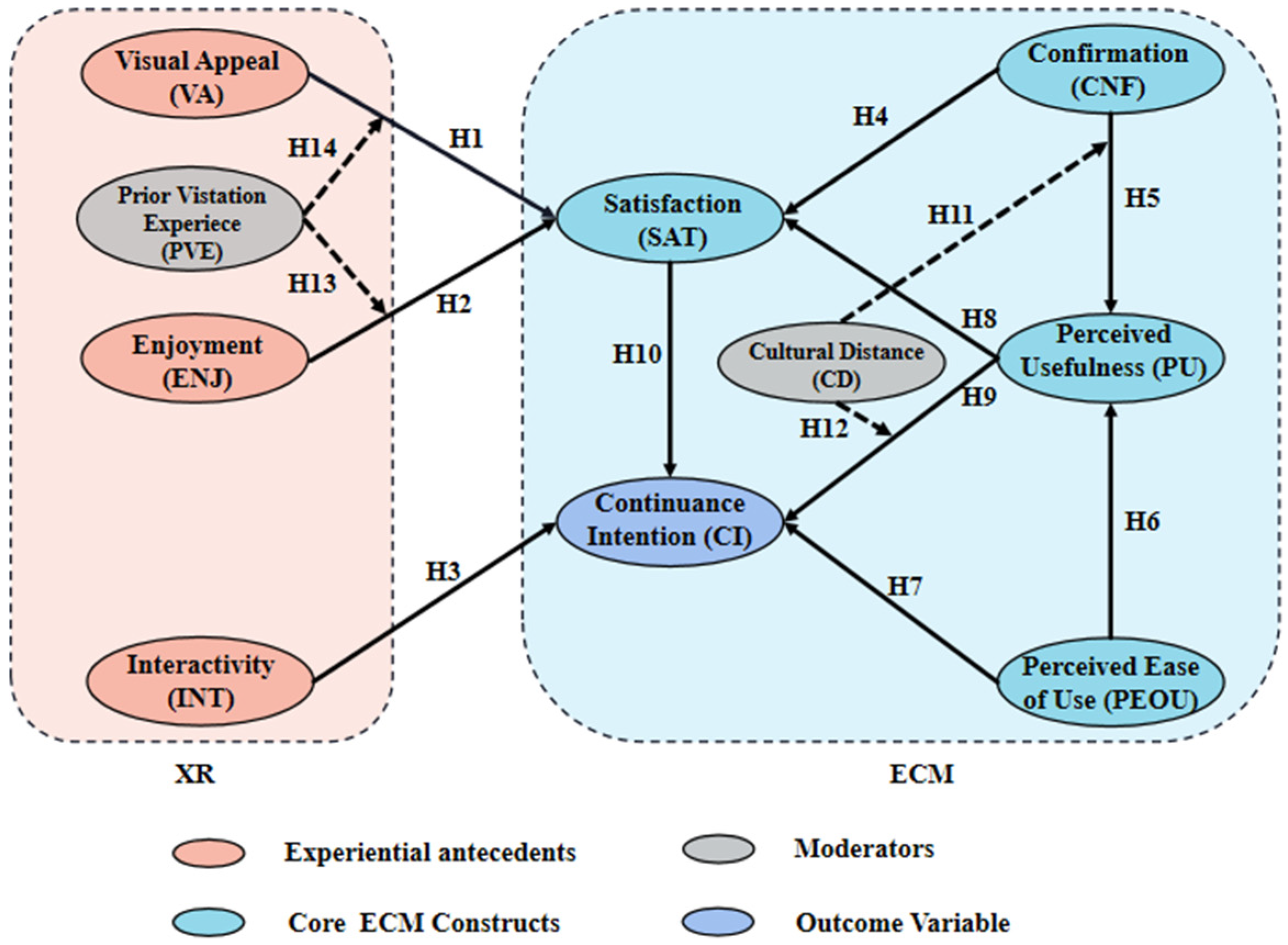
Given these distinctive affordances and the conservation imperative at globally iconic yet capacity-constrained heritage sites, post-adoption mechanisms require models that can accommodate XR-specific experiential antecedents and boundary conditions. Building on a validated ECM-IS approach in built-heritage XR/AR continuance research [10], the present study proposes a refined model that consolidates experiential antecedents into three theoretically robust constructs—Visual Appeal (VA), Interactivity (INT), and Enjoyment (ENJ)—and introduces cultural distance and prior visitation experience as moderators (Figure 4).
The proposed model comprises the following variables:
  • Experiential antecedents: Visual Appeal (VA), Interactivity (INT), and Enjoyment (ENJ);
  • Core ECM constructs: Confirmation (CNF), Perceived Usefulness (PU), Perceived Ease of Use (PEOU), and Satisfaction (SAT);
  • Outcome variable: Continuance Intention (CI);
  • Moderators: Cultural Distance (CD) and Prior Visitation Experience (PVE).
This extended ECM-IS model provides a parsimonious yet comprehensive framework for examining how multi-sensory XR experiences at the Badaling “Great Wall of China: Immersive Theatre” generate sustained visitor engagement across domestic and international tourists, thereby contributing to the long-term conservation of one of the world’s most pressured linear World Heritage sites.

3.2. Hypotheses Development

Building on the extended ECM framework and the three-factor experiential structure of XR, this study develops hypotheses to examine how experiential attributes, core post-adoption mechanisms, and contextual boundary conditions jointly shape tourists’ continuance intention toward XR-mediated heritage experiences. Specifically, Visual Appeal, Enjoyment, and Interactivity are hypothesised to influence satisfaction and continuance intention; core ECM relationships among confirmation, perceived usefulness, satisfaction, and continuance intention are tested; and cultural distance and prior visitation experience are introduced as moderators that condition key post-adoption pathways. The full set of hypotheses (H1–H14) is detailed below.

3.2.1. Experiential Attributes of XR and Satisfaction

Visual Appeal (VA) refers to tourists’ appraisal of the XR environment’s aesthetic coherence, perceptual realism, and overall sensory attractiveness—attributes that shape first-order affective responses and influence post-experience evaluation. Evidence from heritage technology settings shows that aesthetic perceptions are consequential for satisfaction and downstream behavioural intentions: in a heritage museum AR context, situational aesthetics significantly contributed to visitors’ satisfaction and subsequent usage intention, underscoring the evaluative role of experiential “look-and-feel” beyond purely functional value [78]. Additionally, research on online museum experiences grounded in ECM indicates that aesthetics operates as a cognitive antecedent that is positively associated with satisfaction and continuance-oriented intentions (e.g., stickiness/recommendation), further supporting VA as a meaningful satisfaction driver in heritage interpretation environments [79].
H1: 
Visual Appeal (VA) of XR has a positive effect on tourist Satisfaction (SAT).
Enjoyment (ENJ) captures the intrinsic hedonic gratification and pleasurable affect arising during the XR session, reflecting a core “hedonic IS” mechanism in which positive affective valuation supports favourable post-adoption responses [80]. In heritage tourism VR, empirical work further demonstrates that enjoyment is a salient experiential antecedent of satisfaction, indicating that hedonic appraisal is not merely epiphenomenal but central to visitors’ evaluative judgments in virtual heritage encounters [16]. Accordingly, the hypothesis is formulated as:
H2: 
Enjoyment (ENJ) of XR has a positive effect on tourist Satisfaction (SAT).
Interactivity (INT) denotes the extent to which users can actively influence system content and receive contingent, real-time feedback, a defining property of immersive mediated environments [78,81]. In VR-enhanced museum contexts, recent evidence identifies interactivity as a key component of immersive experience formation and visitor evaluation [82]. Moreover, museum-based VR research shows that design choices shaping the interactive mode of display are associated with visitors’ flow experience and intention to use VR, consistent with the argument that stronger perceived interactivity can translate into stronger post-experience reuse intention [83]. Therefore, the following hypothesis is proposed:
H3: 
Interactivity (INT) of XR has a positive effect on Continuance Intention (CI).

3.2.2. Core ECM Relationships

Within the Expectation–Confirmation Model, confirmation (CNF) functions as the central post-adoption cognitive appraisal through which experienced performance is compared with prior expectations [37,38]. Confirmation positively influences satisfaction and perceived usefulness by prompting favourable post-use re-evaluation, a pattern repeatedly validated across technology contexts, including heritage-related immersive applications [10,84,85]. Thus, the following hypotheses are proposed:
H4: 
Confirmation (CNF) positively influences tourist Satisfaction (SAT).
H5: 
Confirmation (CNF) has a positive effect on Perceived Usefulness (PU).
Perceived Ease of Use (PEOU) denotes the extent to which users perceive operating the XR system to be effortless [40]. While ECM emphasizes post-adoption beliefs, subsequent work demonstrates that ease-of-use considerations can remain influential after initial trial, especially for interactive and experience-centric systems [39]. This is particularly applicable to on-site, hardware-intensive XR environments, where interaction learning costs, interface friction, and physical/cognitive load are salient determinants of whether users can translate positive impressions into durable post-use value judgments and continued patronage [10]. Therefore, the following hypotheses are proposed:
H6: 
Perceived Ease of Use (PEOU) positively influences Perceived Usefulness (PU).
H7: 
Perceived Ease of Use (PEOU) positively influences Continuance Intention (CI).
Perceived Usefulness (PU) captures users’ post-use belief that the XR experience meaningfully enhances task/goal attainment—in this case, improving heritage understanding, interpretive clarity, and the perceived functional value of XR as a complementary engagement channel [38,40]. The ECM and subsequent integrative continuance formulations consistently position PU as a primary cognitive driver that (i) increases satisfaction via value confirmation and (ii) directly strengthens continuance intention through instrumental motivation [38,44]. These relationships are also supported in long-horizon continuance research that models how post-use evaluations stabilize and translate into continued IS use [86]. Hence, the following hypotheses are proposed:
H8: 
Perceived Usefulness (PU) has a positive effect on tourist Satisfaction (SAT).
H9: 
Perceived Usefulness (PU) has a positive effect on Continuance Intention (CI).
Satisfaction (SAT) refers to users’ overall affective evaluation after use, grounded in consumer satisfaction theory and central to post-adoption continuance mechanisms [38,87]. In ECM-IT applications, satisfaction typically emerges as a dominant proximal predictor of continuance intention, reflecting the user’s holistic post-experience judgment that integrates both cognitive value (e.g., usefulness) and affective response (e.g., contentment with performance) [38,85]. Thus, the following hypothesis is proposed:
H10: 
Tourist Satisfaction (SAT) has a positive effect on Continuance Intention (CI).

3.2.3. Moderating Effects of Cultural Distance and Prior Visitation Experience

Cultural distance (CD) reflects the perceived dissimilarity between visitors’ home cultural frameworks and the host culture embedded in heritage interpretation [88]. Cross-cultural tourism and information-systems research demonstrates that cultural differences shape expectation standards, evaluative criteria, and post-adoption mechanisms, implying that confirmation and usefulness judgments are not culturally invariant [89,90,91]. In XR-mediated heritage interpretation, greater cultural distance is therefore expected to attenuate the translation of confirmation into perceived usefulness and weaken the downstream effect of usefulness on continuance intention. Therefore, the following hypotheses are proposed:
H11: 
Cultural Distance negatively moderates the positive relationship between Confirmation and Perceived Usefulness.
H12: 
Cultural Distance negatively moderates the positive relationship between Perceived Usefulness and Continuance Intention.
Prior visitation experience (PVE) captures whether visitors possess embodied reference points derived from earlier physical encounters with the site [64,65]. VR tourism and heritage research shows that familiarity with a destination conditions how immersive experiences are evaluated, with stronger pre-existing benchmarks reducing the efficiency with which hedonic cues translate into satisfaction [16,64,92]. Thus, the following hypotheses are proposed:
H13: 
Prior Visitation Experience negatively moderates the positive relationship between Enjoyment and Satisfaction.
H14: 
Prior Visitation Experience negatively moderates the positive relationship between Visual Appeal and Satisfaction.
The research model is presented in Figure 5.

4. Research Methodology

4.1. Structural Equation Modelling (SEM)

Structural Equation Modelling (SEM) is a family of multivariate techniques that estimates interdependent relationships among latent constructs by jointly modelling the measurement model (relationships between constructs and indicators) and the structural model (relationships among constructs), thereby explicitly accounting for measurement error [93,94]. Within SEM, two widely used estimation traditions are commonly distinguished: covariance-based SEM (CB-SEM) and composite-based SEM, most prominently partial least squares SEM (PLS-SEM) [95]. PLS-SEM is particularly appropriate when the primary aim is explanation and prediction in emerging research settings and when models incorporate multiple constructs and interaction effects [96]. Consistent with these considerations, this study applies PLS-SEM to examine an extended ECM-IS model of continuance intention toward an on-site, multi-sensory XR heritage experience. The model is designed to identify key drivers and boundary conditions (moderation effects) rather than to reproduce a covariance matrix for strict theory confirmation [97]. This choice is aligned with established PLS-SEM reporting and use guidance and with recent work highlighting the value of causal–predictive modelling routines that integrate PLS-SEM with prediction-oriented approaches.
PLS-SEM is also widely adopted in tourism and hospitality research for testing complex behavioural frameworks and moderator effects, with field-specific methodological syntheses providing concrete guidance on moderation assessment and reporting [98,99]. Finally, because PLS-SEM does not rely on multivariate normality assumptions, statistical inference is typically conducted via nonparametric bootstrapping [100]. Accordingly, the PLS-SEM analyses were implemented in SmartPLS 4, and bootstrapped standard errors and confidence intervals (including bias-corrected options available in the software) were used to evaluate the statistical significance of path coefficients and moderation effects.

4.2. Survey Instrument

This study used an on-site, exit-intercept questionnaire administered immediately after participants completed the Badaling “Great Wall of China: Immersive Theatre” XR session. Field-based measurement conducted in the consumption context is widely adopted in technology-enhanced heritage and museum settings because it captures experience evaluations with minimal temporal displacement and preserves situational cues that are typically lost in delayed surveys [70,101]. Consistent with the broader methodological rationale of real-time and near-real-time experience measurement, reducing reliance on retrospective reconstruction is expected to mitigate recall-related distortions and strengthen ecological validity [102]. The questionnaire comprised two sections. Section 1 captured respondents’ socio-demographic profiles. Section 2 contained multi-item measures for all latent constructs in the extended ECM-IS model.
Cultural Distance (CD) and Prior Visitation Experience (PVE) were operationalised as reflective, multi-item latent constructs, rather than single-item or dichotomous proxies, to preserve meaningful individual-level variance in tourists’ subjective evaluations [102]. This decision is also methodologically motivated because converting continuous psychological differences into binary groupings typically reduces information, attenuates effect sizes, and lowers statistical power, increasing the risk of biased or unstable estimates [103]. For CD, we adopted a perceived cultural distance approach because cultural distance has been modelled in tourism as a determinant of destination intentions and is commonly operationalised through multiple measures rather than nationality alone [104]. Conceptually, perceived distance measures are aligned with the broader “psychic distance” tradition, which distinguishes objective country-level distance from the distance that actors perceive and respond to, reinforcing the appropriateness of perception-based operationalisations when the theoretical mechanism is psychological [12]. For PVE, we operationalised prior experience using a scale-based familiarity/benchmarking logic rather than visit frequency alone, because tourism research treats familiarity as a psychologically meaningful state that shapes evaluative processing and intentions beyond mere awareness [105]. In VR tourism, visitor status (visitors vs. non-visitors) has been used as a moderating segmentation that changes the formation of continued use motivations, indicating that prior physical experience can condition post-experience mechanisms [64]. In heritage-relevant VR settings, familiarity has been shown to play a boundary role, including evidence that it negatively moderates the enjoyment-satisfaction relationship, which directly supports modelling PVE as a latent moderator capturing evaluative benchmarks [16].
All constructs were measured on a seven-point Likert scale ranging from 1 (“strongly disagree”) to 7 (“strongly agree”), a format consistently demonstrated to offer high reliability and discriminatory power in tourism technology research. The questionnaire was prepared in English and Simplified Chinese using rigorous translation and back-translation procedures. A couple of autonomous linguists skilled in travel and data management domains converted the source text from English to Chinese. Afterward, an additional multilingual specialist reversed the process by rendering the Chinese adaptation back into English, devoid of any exposure to the primary content. Discrepancies were resolved through discussion with the research team and two heritage XR scholars until full conceptual equivalence was achieved. Table A1 in Appendix A presents the complete list of measurement items and their sources.

4.3. XR Systems in Context

In order to elucidate the tech and heritage framework surrounding the questionnaire implementation, the paper details the particular extended reality setup under scrutiny: the “Great Wall of China: Immersive Theatre”, which opened on 29 August 2025 at the Badaling Great Wall Scenic Area and served as the exclusive empirical setting for all data collection.
This facility represents the world’s first permanently installed, large-scale multi-sensory XR experience dedicated to a linear monument under extreme overtourism pressure. The 20-min narrative-driven program casts participants as a Ming Dynasty postal courier undertaking an eastbound return journey from Jiayuguan to Shanhaiguan across the nine frontier towns. Users physically traverse a 100 m2 space while experiencing seamless virtual locomotion across thousands of kilometres, immersing themselves in the lived reality of frontier defence: wind-swept deserts, Tea Horse Road markets, sudden enemy raids, moral dilemmas of duty and sacrifice, and the constant tension between personal survival and collective guardianship of the realm. The narrative culminates in a lantern-releasing ritual alongside General Qi Jiguang, symbolically honouring fallen soldiers and evoking the Great Wall’s enduring spiritual significance as an emblem of resilience, unity, and national guardianship.
The system integrates several state-of-the-art technologies to achieve unprecedented levels of embodiment and historical fidelity. Spatial computing and AIGC-generated assets enable photorealistic reconstruction of Ming-period military material culture, architecture, and regional landscapes, all rigorously vetted by the Badaling Great Wall Management Office, Shanhaiguan China Great Wall Museum, and leading scholars, including Dong Yaohui and Huang Lijing. Redirected-walking algorithms combined with wireless streaming eliminate immersion-breaking boundaries, while 6-DOF motion platforms, haptic flooring, and environmental effectors (wind, temperature variation, olfaction, low-frequency vibration) deliver genuine multi-sensory feedback—simulating, for example, the jolt of horseback riding, the chill of frontier winds, or the tremor of siege warfare.
Interaction is deliberately narrative-embedded and controller-free: users advance the story through natural locomotion, gaze, and gesture, reinforcing a sense of agency as active participants rather than passive observers. This design philosophy transforms the Great Wall from a distant monument into an intimately lived historical reality, aligning directly with current conservation imperatives by providing a controlled, repeatable, and emotionally equivalent alternative to physical traversal of the heavily eroded physical walls.
The “Great Wall of China: Immersive Theatre” thus constitutes the complete technological basis for the present investigation. All measurement items described in Section 4.2 were framed with explicit reference to this specific system, ensuring high contextual validity and direct relevance to the theoretical model.

4.4. Pilot Study

To ensure the content validity, face validity, and reliability of the research instrument, as well as its suitability for a cross-cultural sample in the specific context of the Badaling “Great Wall of China: Immersive Theatre”, a pilot study was conducted in September 2025, supplemented by expert review.
First, 25 tourists who had just completed the XR experience were recruited on-site for pre-testing. The sample intentionally included both domestic Chinese visitors and international tourists to capture potential cultural and linguistic nuances. After completing the questionnaire, participants provided detailed feedback on item relevance to the multi-sensory XR narrative, clarity and naturalness of wording in both languages, perceived redundancy, and overall questionnaire length. Particular attention was paid to the newly developed items for cultural distance and prior visitation experience, with respondents confirming that these scales accurately reflected their subjective perceptions without overlap with nationality or visit frequency.
Second, four experts—two in immersive technology and heritage tourism, and two in cross-cultural consumer behaviour—were invited to review the instrument. They evaluated terminology accuracy, conceptual alignment with the extended ECM-IS framework, logical flow, and cultural sensitivity of the items. Minor revisions were made based on their recommendations, including refined phrasing for cultural distance items to better capture perceptual rather than objective distance, and slight adjustments to interactivity items to emphasise embodied agency in the redirected-walking environment.
These steps resulted in a final instrument with high face and content validity, excellent respondent comprehension across cultures, and no reported difficulties.

4.5. Respondents

The respondents were tourists aged 18 or above who had just completed the full 20-min “Great Wall of China: Immersive Theatre” XR experience at the Badaling Great Wall Scenic Area. Participation was limited to individuals who confirmed they had fully engaged with the program, thereby ensuring that all responses were grounded in immediate post-usage perceptions rather than retrospective recall.
To maximise data validity, only visitors who explicitly verified their direct experience with the multi-sensory XR system (including headset use, physical locomotion within the space, and exposure to the narrative from Jiayuguan to Shanhaiguan) were included. Respondents were approached immediately upon exiting the facility, briefed on the study’s purpose—to examine post-experience continuance intention and its cross-cultural boundary conditions—and provided with full information about anonymity, voluntary participation, and data usage. Informed consent was obtained from every participant before questionnaire administration.
The on-site, post-experience recruitment strategy was deliberately chosen to capture authentic affective and cognitive responses while memory was fresh, a practice consistently shown to yield higher ecological validity and response quality in immersive technology research. Researcher assistance was available throughout to address language needs and clarify instructions, ensuring accessibility for both domestic and international visitors.
This respondent profile directly aligns with the study’s theoretical focus on post-adoption continuance intention in a conservation-oriented XR context, providing a robust empirical foundation for testing the extended ECM-IS model across diverse cultural and experiential backgrounds.

4.6. Sample Size

To determine the minimum required sample size for the PLS-SEM analysis of XR-mediated continuance intention in built heritage conservation, Cochran’s formula was employed [106,107]. Cochran’s formula provides a conservative baseline for finite populations under specified confidence levels and error margins:
n = z 2 · p · ( 1 p ) e 2
where n is the initial sample size, z   is the z-score for the confidence level (1.96 for 95%), p   is the estimated population proportion (0.5 for maximum variability), and e   is the margin of error (0.05). Substituting these values yields n ≈ 385. For the finite Badaling visitor population (estimated at 500,000 annually), the adjusted finite-population correction formula further refines this to approximately 384 cases.
The present sample of 415 thus exceeds these benchmarks, providing robust statistical power for detecting direct paths, interactions, and cross-cultural differences in the extended ECM-IS model.

4.7. Sampling Procedure and Data Collection

Data collection was conducted from 1 October to 1 December 2025 at the dedicated exit area of the “Great Wall of China: Immersive Theatre” in the Badaling Great Wall Scenic Area, daily during operating hours (08:00–17:00). This study employed a convenience sampling technique combined with strict purposive inclusion criteria, an approach that is efficient, widely adopted, and considered the standard in field-based immersive technology and heritage tourism research where random sampling is logistically unfeasible [10,108,109]. Although non-probability sampling carries potential selection bias, its use is well-justified and widely adopted in recent on-site XR continuance studies, providing high contextual validity and response quality when immediate post-experience data are required [42,110].
Trained research assistants approached tourists immediately after they completed the full 20-min XR program. Only individuals who confirmed they had fully engaged with the experience were invited to participate. Respondents were directed to complete the questionnaire via Wenjuanxing by scanning a QR code, which first presented the full informed consent statement (in both Chinese and English) and required explicit agreement before any items appeared. For international visitors or those encountering connectivity issues, identical paper-and-pencil versions were immediately provided, with the consent statement printed on the cover page for signature.
Multiple measures were implemented to enhance sample heterogeneity and minimise bias: recruitment spanned all operating days and hours, including peak weekends; anonymity was strictly guaranteed; a 3–5 min cool-down period was encouraged before starting; and item order was randomised in the digital version. After rigorous screening (response time > 4 min, no straight-lining, passed two attention-check items), the final dataset comprised 415 valid responses.
This combined procedure ensured high ecological validity, strong relevance to the research objectives, and robust data quality while maintaining full ethical compliance in a genuine cross-cultural field setting.

5. Data Analysis and Results

The data analysis followed a two-stage procedure consistent with established PLS-SEM guidelines [95,96,111]. In the first stage, raw data collected on-site at the Badaling Great Wall were screened for outliers and missing values, coded, and subjected to preliminary descriptive statistics and normality checks before model estimation [112]. Next, the study employed SmartPLS version 4.0 to pinpoint the primary factors influencing visitors’ ongoing intention to eco-friendly augmented and virtual reality tools, to investigate the relationships between those factors, and to formulate a conceptual framework rooted in established principles that explains sustained engagement within the framework of the Great Wall of China.
The partial least squares structural equation modelling followed the conventional dual-phase procedure. The initial phase examined the outer model, focusing on loading dependability, composite reliability, average variance extracted, and differentiation validity. The second stage evaluated the structural model, testing path coefficients and hypotheses via bootstrapping, effect sizes, explanatory power, predictive relevance, and overall fit. Moderating effects were examined using the product-indicator approach for interaction terms, with simple slope analysis at ±1 SD of the moderator to probe conditional effects and facilitate interpretation in the discussion.

5.1. Demographic Information

Table A2 in Appendix A summarises the demographic characteristics of the sample. Respondents’ ages were distributed, with the 25–34 group representing the largest proportion (43.9%), followed by those aged 35–50 (31.6%). Females comprised a modest majority (55.4%), while males accounted for 44.6%. On education, 86.5% possessed a junior college degree or higher, comprising 23.4% with junior college qualifications, 41.4% with bachelor’s degrees, and 21.7% with master’s degrees or above. Occupationally, private or foreign-funded enterprise employees formed the predominant category (33.7%), with freelancers next at 22.7%.

5.2. SEM Analysis

5.2.1. Data Analysis for the Measurement Model

(1)
Multicollinearity Test
In structural equation modeling, multicollinearity among explanatory variables can inflate standard errors and destabilize path coefficients, potentially undermining model reliability. To address this, Variance Inflation Factor (VIF) values were computed for all predictors and interaction terms in the extended ECM-IS model using SmartPLS 4, following established guidelines [113]. As shown in Table A3 in Appendix B, all VIF values fell well below the conservative threshold of 3.33, confirming the absence of multicollinearity and supporting the stability of subsequent analyses.
(2)
Reliability and Validity Test
The measurement model was evaluated using SmartPLS 4.0, adhering to current PLS-SEM standards [100]. As detailed in Table A4 in Appendix B, all constructs demonstrated strong internal consistency and convergent validity, with Cronbach’s α, rho_A, composite reliability, and Average Variance Extracted (AVE) values exceeding recommended thresholds. This indicates that the indicators effectively captured their intended latent constructs.
Discriminant validity was confirmed through both the Heterotrait–Monotrait (HTMT) ratio [114,115] and Fornell-Larcker criterion [115,116]. As presented in Table A5 in the Appendix B, HTMT values were well below the 0.85 threshold, and in Table A6 in the Appendix B, the square roots of AVE exceeded inter-construct correlations. These findings affirm that the constructs are empirically distinct, ensuring no conceptual overlap and enhancing the model’s interpretability for hypothesis testing.

5.2.2. Data Analysis for the Structural Model

Out-of-sample predictive relevance was assessed using the PLSpredict procedure in SmartPLS 4. As shown in Table A7 in Appendix C, all Q2 predict values for the endogenous constructs (PU, SAT, and CI) were positive and exceeded the 0.25 threshold, indicating medium to strong predictive relevance for the extended ECM-IS model [96,117]. In-sample explanatory power was also substantial, with R2 values reflecting moderate to substantial explained variance in line with benchmarks in consumer behaviour and technology adoption research.
Overall, these findings affirm the model’s ability to explain variance in tourists’ continuance intention for the XR experience at the Badaling Great Wall, while demonstrating strong predictive performance. This supports its theoretical validity and practical utility in heritage conservation contexts.
Additionally, the Goodness of Fit (GoF) index, as advocated by [115], offers a robust metric for evaluating the overall explanatory capacity of PLS models across varied datasets. The GoF is computed according to the formula outlined by Tenenhaus [118].
G o F = A V E ¯ × R 2 ¯ = 0.699 × 0.365 0.481
The obtained GoF value of 0.481 surpasses the established benchmark of 0.36, confirming satisfactory model fit.

5.3. Hypothesis Testing Analysis

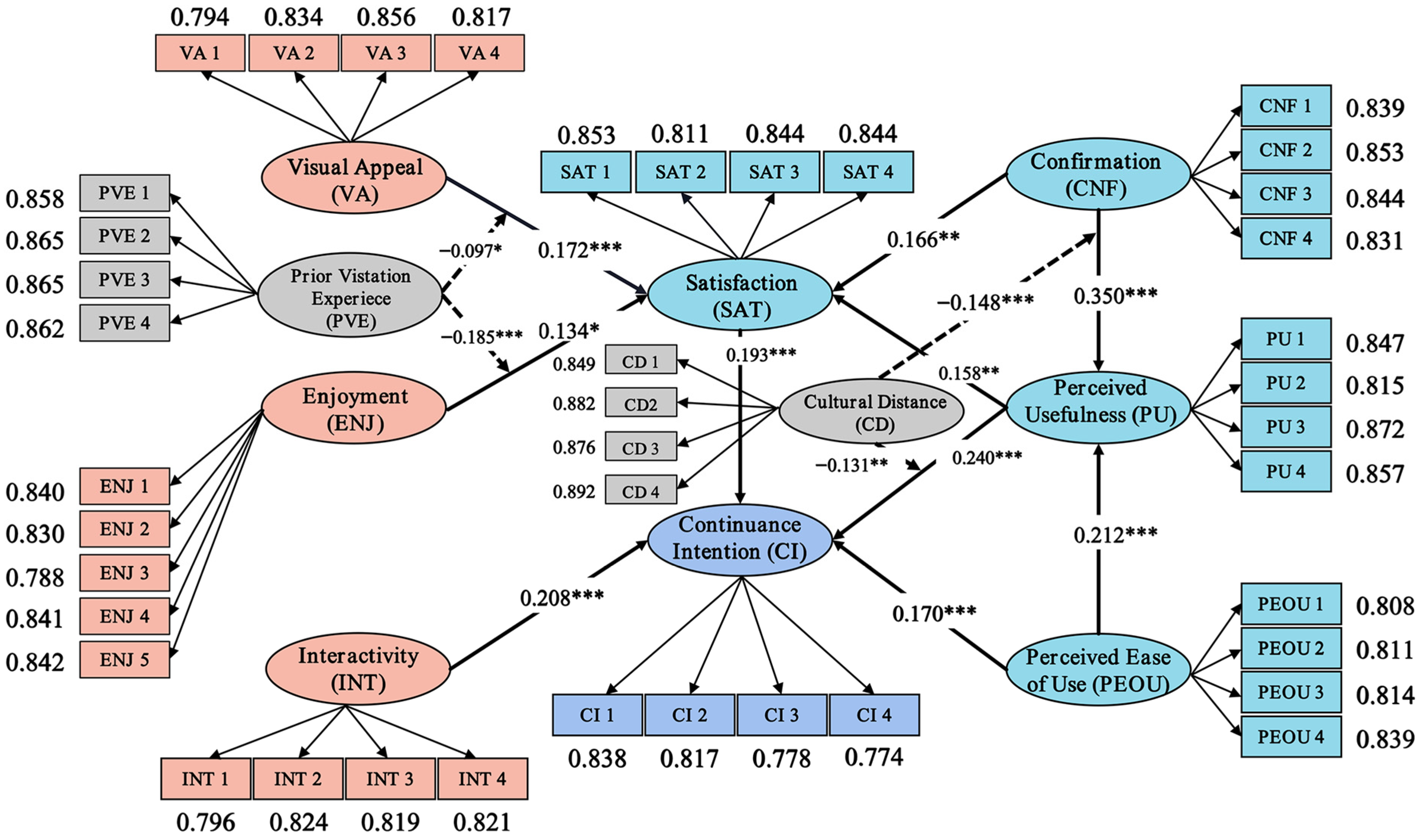
Figure 6 and Table 1 display the standardized path coefficients and hypothesis testing results of the structural model. All fourteen hypothesized relationships were statistically significant at p < 0.05 or better, providing full empirical support for the extended ECM-IS framework.
The model exhibits substantial explanatory power for tourists’ continuance intention toward the multi-sensory XR experience at the Badaling “Great Wall of China: Immersive Theatre” (R2 = 0.383), while also accounting for considerable variance in Satisfaction (R2 = 0.290) and Perceived Usefulness (R2 = 0.422). These findings underscore the critical roles of experiential attributes (Visual Appeal, Interactivity, and Enjoyment), core ECM mechanisms, and the two theoretically derived moderators—cultural distance and prior visitation experience—in shaping sustained engagement with conservation-oriented XR applications at a globally significant linear heritage site under severe overtourism pressure.

5.4. Moderating Effects

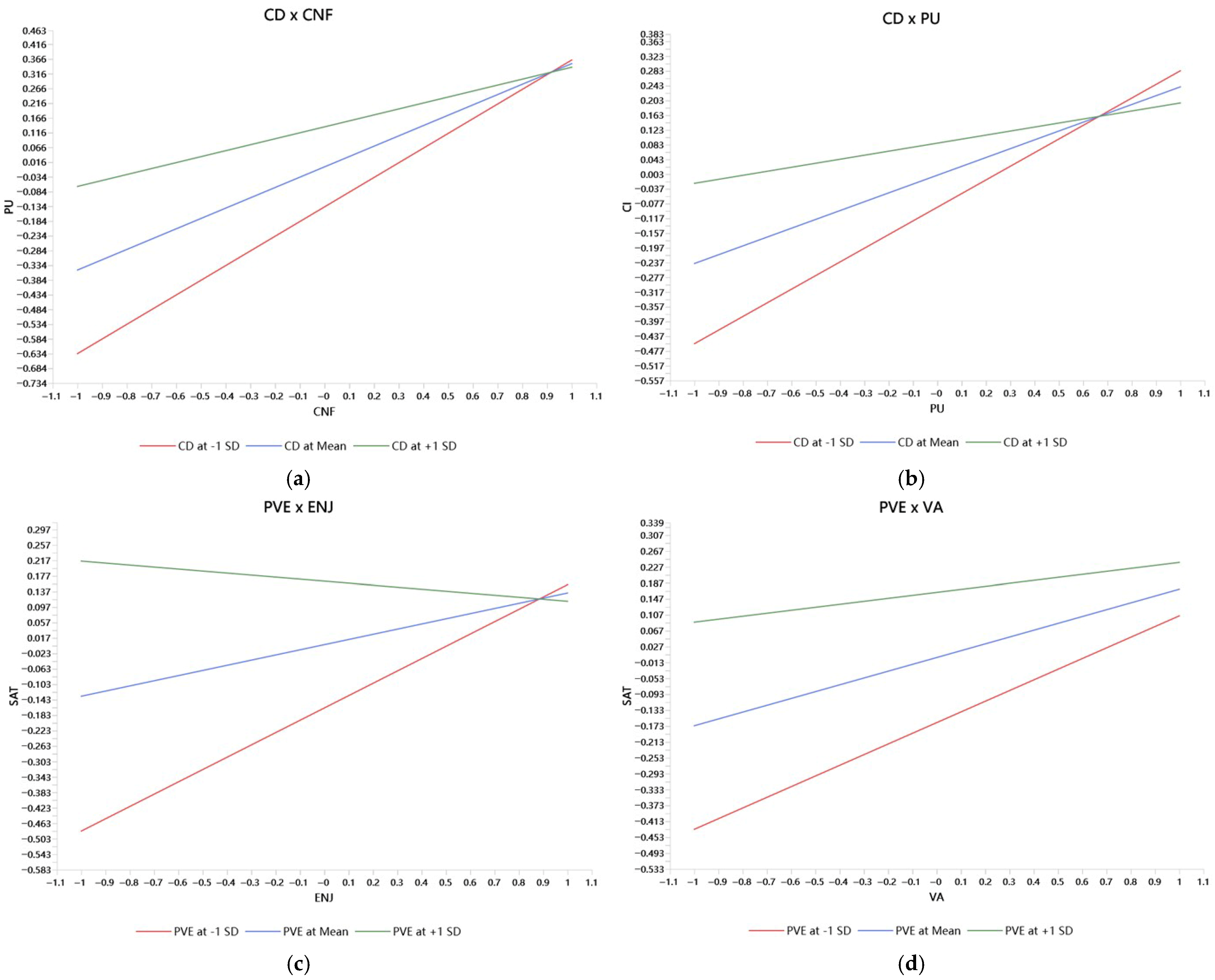
The moderating effects of cultural distance (CD) and prior visitation experience (PVE) were tested using the product-indicator approach in SmartPLS 4.0, with significance assessed through bootstrapping and simple slope analysis at ±1 standard deviation from the moderator mean. As reported in Table 1, all four interaction terms were statistically significant, fully supporting H11–H14.
CD exerted significant negative moderation on two core ECM-IS paths: confirmation to perceived usefulness and perceived usefulness to continuance intention. Simple slope plots (Figure 7a,b) show that these positive effects were stronger among low-CD tourists than high-CD ones. This aligns with cross-cultural technology acceptance literature, where tourists from distant cultures apply stricter authenticity benchmarks and rely less on instrumental evaluations for post-usage intentions [91,119,120].
PVE likewise negatively moderated the two hedonic pathways to satisfaction: enjoyment to satisfaction and visual appeal to satisfaction. Simple slope analysis (Figure 7c,d) indicates that these positive effects were more pronounced for tourists with low PVE than high PVE. This supports place attachment and comparative authenticity perspectives, as repeat visitors use physical site memories as reference points, reducing the influence of hedonic XR attributes on satisfaction [16,17,121].
Collectively, these moderated relationships delineate crucial boundary conditions for the generalisability of the ECM-IS framework in XR-mediated heritage conservation, underscoring the necessity of culturally adaptive design and experience-based visitor segmentation to maximise sustained engagement and long-term load-balancing efficacy at globally iconic linear monuments.

6. Discussion

6.1. Interpretation and Implications of Findings

The empirical analysis supported all fourteen hypotheses proposed in this study, providing robust evidence for understanding the mechanisms driving tourists’ continuance intention toward the XR experience at the Badaling “Great Wall of China: Immersive Theatre”. Beyond hypothesis confirmation, these findings yield significant theoretical advancements, practical implications for heritage conservation, and directions for future research in immersive technology adoption within built heritage contexts.
The result for H1 indicates that visual appeal exerts a positive influence on satisfaction (β = 0.172, p < 0.001), aligning with prior research in heritage XR settings [78,122]. This suggests that the photorealistic rendering and cinematic aesthetics of the Badaling theatre significantly enhance affective responses. Practically, heritage managers should prioritise investments in high-quality visual design and technological upgrades to sustain visitor satisfaction, though cost–benefit analyses are essential to optimise resource allocation. Theoretically, this reinforces visual appeal as a critical experiential construct, encouraging future investigations into its role across diverse XR platforms in heritage tourism.
H2 confirms that enjoyment positively affects satisfaction (β = 0.134, p < 0.01), consistent with findings from immersive heritage contexts [16,122]. The emotional engagement derived from the theatre’s narrative and rituals underscores the importance of hedonic elements in sustaining satisfaction. For practitioners, this implies a need to integrate intuitive, emotionally resonant interaction designs that balance entertainment with historical authenticity. Scholars may explore how enjoyment mediates cultural differences in satisfaction across global heritage sites.
H3 reveals that interactivity positively impacts satisfaction (β = 0.208, p < 0.001), supporting recent SOR-based studies in XR environments [9,123]. The embodied agency enabled by redirected walking and gesture controls at Badaling highlights interactivity’s role in deepening experiential satisfaction. Destination managers should enhance interactive features to boost engagement, while researchers could investigate its interplay with cognitive involvement in multi-sensory settings.
H4 demonstrates that confirmation positively influences satisfaction (β = 0.166, p < 0.01), echoing ECM applications in digital service [38,39]. In this context, tourists’ alignment of expectations with the XR’s historical fidelity drives satisfaction. Managers should craft authentic promotional materials to align visitor expectations, while future studies might examine how confirmation varies with cultural background.
H5 shows that confirmation positively affects perceived usefulness (β = 0.350, p < 0.001), consistent with prior ECM research [124,125]. The Badaling theatre’s success in meeting educational expectations enhances its perceived value. This suggests a focus on delivering substantive content, with researchers encouraged to explore confirmation’s cross-context robustness.
H6 confirms that perceived ease of use positively influences perceived usefulness (β = 0.212, p < 0.001), a finding validated across digital platforms [40,126]. The intuitive navigation of the theatre’s multi-sensory interface bolsters its utility perception. Developers should prioritise usability enhancements, while scholars might assess its impact in varied XR hardware contexts.
H7 indicates that perceived ease of use positively affects continuance intention (β = 0.170, p < 0.001), aligning with prior studies [124,125]. This underscores the need for seamless operation to encourage repeat usage, offering a research avenue to test usability across cultural groups.
H8 reveals that perceived usefulness positively impacts satisfaction (β = 0.158, p < 0.01), consistent with ECM literature [38]. The theatre’s educational value enhances satisfaction, suggesting managers focus on interpretive depth rather than novelty alone. Researchers could explore mediating roles in different heritage settings.
H9 confirms that perceived usefulness positively influences continuance intention (β = 0.240, p < 0.001), supported by prior work [39,125]. This highlights the need for meaningful content to sustain engagement, with scholars encouraged to test its universality.
H10 shows that satisfaction positively affects continuance intention (β = 0.193, p < 0.001), aligning with ECM studies [38,39]. Ongoing enhancements are vital for managers, while researchers might investigate satisfaction’s temporal dynamics.
H11 and H12 indicate that cultural distance negatively moderates the relationship between confirmation and perceived usefulness (β = −0.148, p < 0.001) and between perceived usefulness and continuance intention (β = −0.131, p < 0.01). Tourists from low cultural-distance backgrounds exhibited substantially stronger effects than those from high cultural-distance backgrounds. This pattern reflects heightened sensitivity to authenticity cues and narrative interpretation among culturally distant visitors, consistent with cross-cultural technology adoption theory [104,127,128]. Practically, heritage managers should develop culturally adaptive XR content to mitigate disconfirmation risks and sustain perceived usefulness. Theoretically, these findings highlight the need for future research to incorporate additional cultural moderators in ECM-based models.
H13 and H14 suggest that prior visitation experience negatively moderates the relationship between enjoyment and satisfaction (β = −0.185, p < 0.001) and between visual appeal and satisfaction (β = −0.097, p < 0.05). Tourists with low prior visitation experience displayed markedly stronger effects than those with high prior visitation experience. This attenuation is attributable to the use of embodied physical memories as comparative benchmarks among repeat visitors, in line with place attachment and authenticity literature [16,129,130]. Practically, this underscores the value of experience-based visitor segmentation and tailored XR design strategies to optimize satisfaction across first-time and repeat audiences. For scholars, it opens avenues to investigate the long-term influence of memory formation and its interplay with hedonic attributes in immersive heritage contexts.
These findings advance ECM by integrating experiential and moderating constructs, offering a framework for sustainable XR deployment. Managers should prioritise culturally sensitive, user-friendly designs, while scholars should explore longitudinal and cross-site generalisability.

6.2. Practical Implications

This study yields several concise and empirically grounded practical implications for the strategic deployment of XR in built heritage conservation. All implications are directly derived from the significant structural paths and moderation effects identified in the proposed model.

6.2.1. Designing XR for Sustained Engagement Rather than One-Off Novelty

The significant effects of visual appeal, enjoyment, and interactivity on satisfaction (H1–H3), together with the strong roles of confirmation and perceived usefulness in driving continuance intention (H4–H7), indicate that XR systems at heritage sites should prioritise experiential quality aligned with expectation management, rather than technological spectacle alone. High-fidelity visual rendering, coherent narrative enjoyment, and meaningful user interaction jointly function as antecedents of post-experience satisfaction, which remains the central driver of continuance intention. For heritage managers, this suggests that XR should be positioned as a complementary conservation-oriented experience, capable of sustaining repeated or substitute engagement and thereby alleviating physical pressure on fragile sites.

6.2.2. Segmenting XR Strategies by Cultural Distance

The negative moderating effects of cultural distance on the confirmation–perceived usefulness and perceived usefulness–continuance intention paths (H11, H12) demonstrate that culturally distant visitors are more sensitive to expectation disconfirmation and instrumental value loss. Practically, this implies that culturally adaptive XR design—including multilingual interfaces, culturally legible narratives, and transparent interpretive framing—plays a critical role in maintaining perceived usefulness among international audiences. For global heritage destinations, culturally neutral or “one-size-fits-all” XR solutions risk weakening continuance intention among high-distance visitors and undermining XR’s conservation potential.6.2.3. Differentiating XR content for first-time versus repeat visitors
The attenuating moderation of prior visitation experience on the confirmation–satisfaction relationship (H13, H14) indicates that repeat visitors evaluate XR more critically against embodied memories of the physical site. Consequently, XR systems should adopt experience-sensitive differentiation: first-time visitors benefit more from hedonic immersion and affective engagement, whereas repeat visitors require enhanced informational depth, analytical layers, or comparative historical content to maintain satisfaction. From a management perspective, this supports the adoption of segmented XR pathways that respond to visitors’ experiential reference points rather than uniform content delivery.

6.2.3. Policy and Industry Implications for Sustainable Heritage Management

At the policy level, the model’s explanatory power for continuance intention (R2 = 0.383) confirms that XR can function as a behaviourally credible load-balancing instrument rather than a purely symbolic innovation. Policymakers and destination authorities should therefore support XR deployment through incentive mechanisms tied to measurable outcomes (e.g., satisfaction, repeat digital engagement, and reduced on-site pressure), while simultaneously encouraging culturally inclusive and expectation-transparent design standards. For technology developers, the confirmed role of perceived ease of use and usefulness underscores the importance of intuitive interaction design as a prerequisite for XR’s long-term sustainability impact.

6.3. Limitations and Suggestions

Although the present study offers robust empirical insights into tourists’ continuance intention toward multi-sensory XR experiences in built heritage conservation, several limitations inherent in the design warrant caution in interpretation and provide fertile avenues for future inquiry.
First, the reliance on self-reported perceptual measures, while standard in ECM-based continuance research, may introduce common method variance and overlook nuanced affective or subconscious responses that influence sustained engagement. For instance, the moderating effects of cultural distance and prior visitation experience were captured through reflective scales, yet deeper phenomenological dimensions—such as embodied cultural dissonance or tacit memory activation—might not be fully articulated in structured questionnaires. To address this, future studies could adopt mixed-methods designs integrating qualitative techniques (e.g., post-experience phenomenological interviews or narrative analysis) with quantitative data, or incorporate objective behavioural metrics from XR systems (e.g., session duration, narrative completion rates, or gaze patterns via eye-tracking). Emerging biometric indicators, such as heart rate variability or skin conductance during key narrative moments, could further triangulate self-reports, yielding a more comprehensive understanding of how cultural and experiential moderators operate at both conscious and physiological levels.
Second, convenience sampling, though pragmatically necessary for on-site immediate post-experience data collection, limits strict population generalisability. While efforts were made to enhance diversity through broad recruitment timing and bilingual administration, the sample may overrepresent motivated or tech-savvy visitors. Future research could employ probability-based methods, such as stratified sampling by nationality or visitation history when feasible, or apply post-stratification weighting using national tourism statistics. Comparative multi-site studies—spanning linear monuments in diverse cultural regions (e.g., Hadrian’s Wall, Roman Limes, or Inca Trail)—would further test the model’s robustness across varying overtourism pressures and heritage typologies.
Third, the study is situated at a single, newly launched facility—the Badaling “Great Wall of China: Immersive Theatre”—during its initial operational phase. This focused context provides high internal validity but constrains external generalisability to established XR installations or differing narrative styles. Longitudinal designs tracking the same cohort over multiple sessions or seasons would illuminate how continuance intention evolves as novelty wanes and familiarity grows, particularly for repeat visitors moderated by prior experience (H13, H14). Cross-facility comparisons, including off-site or mobile XR applications, could clarify whether on-site embodiment amplifies the observed effects.
Fourth, while the cross-cultural sample enabled testing of cultural distance moderation (H11, H12), perceptual measures of distance may capture only conscious dissimilarity. Future investigations could integrate objective indices with perceptual scales or employ experimental manipulations of cultural framing within XR narratives to isolate causal mechanisms. Additionally, exploring intersectional moderators—such as age, digital literacy, or travel motivation—would enrich understanding of heterogeneous responses in global heritage tourism.
In summary, future research should prioritise methodological triangulation, longitudinal and multi-site replication, and finer-grained cultural and experiential moderators to advance the ECM-IS framework toward greater explanatory depth and practical applicability. Such endeavours would not only validate the conservation potential of XR at linear monuments but also pioneer adaptive, inclusive digital strategies for resilient heritage stewardship in an era of escalating global tourism demands.

7. Conclusions

This study examined tourists’ continuance intention toward a multi-sensory XR experience at the Badaling Great Wall, a linear World Heritage site facing significant overtourism pressure. By extending the Expectation–Confirmation Model (ECM-IS) with experiential attributes and contextual moderators, the study empirically validated a post-adoption framework for immersive heritage applications. The results demonstrate that XR continuance intention in heritage contexts is contingent on visitors’ cultural and experiential backgrounds, rather than being universally stable. This finding highlights the need to consider boundary conditions when applying established information systems models to conservation-oriented XR settings. This research contributes theoretically by refining XR continuance models with cross-cultural and experiential contingencies, methodologically by providing field-based evidence from an operational multi-sensory XR installation, and practically by offering a concise empirical basis for segmented and culturally adaptive XR strategies in heritage management. Future research should adopt longitudinal and multi-site designs to further examine behavioural persistence and contextual variability in immersive heritage tourism.

Author Contributions

Conceptualization, Y.L.; Methodology, Y.L.; Software, Y.L.; Validation, Y.L.; Formal Analysis, Y.L.; Investigation, Y.L.; Resources, Y.L.; Data Curation, Y.L.; Writing—Original Draft Preparation, Y.L.; Writing—Review & Editing, Y.L. and G.M.; Visualization, Y.L.; Supervision, G.M.; Project Administration, Y.L. All authors have read and agreed to the published version of the manuscript.

Funding

This research received no external funding.

Institutional Review Board Statement

Ethical review and approval were waived for this study in accordance with Article 32 of the “Measures for the Ethical Review of Life Science and Medical Research Involving Human Subjects” issued by the State Council of the People’s Republic of China (2023), as the research involved the use of fully anonymized questionnaire data, did not cause any harm to participants, and did not involve sensitive personal information or commercial interests. The relevant policy is available at: https://www.gov.cn/zhengce/zhengceku/2023-02/28/content_5743658.htm. (accessed on 30 November 2025).

Informed Consent Statement

Informed consent was obtained from all subjects involved in the study.

Data Availability Statement

The original data presented in the study are openly available in FigShare at https://doi.org/10.6084/m9.figshare.30860336.

Acknowledgments

The author expresses sincere gratitude to all tourists who participated in the questionnaire survey at the Badaling “Great Wall of China: Immersive Theatre”. Their willingness to share post-experience insights immediately after engaging with the XR system provided indispensable data and enriched the study with authentic, diverse perspectives. This participation was crucial to the empirical robustness and contextual relevance of the research. Special thanks are extended to the management team of the Badaling Great Wall Scenic Area for facilitating on-site access and supporting data collection during the facility’s early operational phase. The author also acknowledges the valuable feedback from anonymous reviewers and editors, whose constructive comments significantly improved the manuscript. Finally, heartfelt appreciation goes to family and colleagues for their unwavering encouragement and support throughout this research endeavour.

Conflicts of Interest

The authors declare no conflicts of interest.

Abbreviations

The following abbreviations are used in this manuscript:
ECMExpectation Confirmation Model
ECM-ISExpectation–Confirmation Model-Information System
SEMStructural Equation Model
XRExtended reality
ARAugmented reality
VRVirtual reality
VAVisual appeal
ENTEntertainment
INTInteractivity
SATSatisfaction
CIContinuance intention
CNFConfirmation
PUPerceived usefulness
PEOUPerceived ease of use
CDCultural distance
PVEPrior visitation experience

Appendix A. Measurement and Sample Information

Table A1. Measurement items.
ConstructItemQuestion (Responses Based on 7-Point Likert Scale)References
Visual Appeal (VA)VA1The visual effects in this XR theatre were highly realistic and impressive.[9,131]
VA2The XR experience provided stunning and aesthetically pleasing visuals of the Great Wall.
VA3The visual quality of the reconstructed historical scenes in this XR theatre was outstanding.
VA4The overall visual presentation in this XR theatre significantly enhanced the majesty of the Great Wall.
Interactivity (INT)INT1I could actively control the pace and direction of the experience in this XR theatre.[132,133,134]
INT 2The XR system responded immediately to my actions and inputs.
INT 3I felt I had a high degree of control over the XR content and narrative.
INT 4The XR theatre allowed me to interact naturally with the historical environment and characters.
Enjoyment (ENJ)ENJ1Using this XR theatre was truly enjoyable.[9,64,80]
ENJ2I found the XR experience at the Badaling Great Wall to be exciting and pleasurable.
ENJ3The XR theatre provided me with a highly entertaining experience.
ENJ4I felt great fun while participating in the XR experience.
ENJ5The XR theatre experience was fascinating and kept me fully engaged.
Confirmation (CNF)CNF 1My experience with this XR theatre was better than what I expected.[37,38]
CNF 2The service level provided by this XR theatre exceeded my expectations.
CNF 3Overall, most of my expectations from this XR theatre were confirmed.
CNF 4The XR experience met my expectations of historical authenticity and immersion.
Perceived ease of use (PEOU)PEOU1Learning to use this XR theatre was easy for me.[39,40]
PEOU2It was easy for me to become skilful at using this XR system.
PEOU3I found the XR theatre easy to operate and navigate.
PEOU4Overall, I found this XR theatre easy to use.
Perceived usefulness (PU)PU1Using this XR theatre improved my understanding of Great Wall history.[39,40]
PU2This XR experience was a valuable complement to visiting the physical Great Wall.
PU3The XR theatre helped me gain deeper insight into Ming-Dynasty frontier defence.
PU4Overall, this XR theatre was useful for my cultural heritage experience.
Satisfaction (SAT)SAT1I am satisfied with the XR experience at the Badaling Great Wall.[38,39]
SAT2The XR theatre provided me with a satisfying cultural tourism experience.
SAT3I feel contented with the overall XR service in this theatre.
SAT4My decision to use this XR theatre was a wise one.
Continuance Intention (CI)CI 1I intend to continue using XR experiences like this one in future heritage visits.[38,39]
CI 2I will frequently use XR theatres at heritage sites in the future.
CI 3I plan to recommend this kind of XR experience to others.
CI 4I would choose XR over traditional interpretation methods when available at heritage sites.
Cultural Distance
(CD)
CD1The cultural values and beliefs portrayed in this XR experience feel very different from those in my home country.[12,88]
CD 2The way history and heritage are presented in this XR experience differs significantly from how they are viewed in my culture.
CD 3The emotional expression and storytelling approach in this XR experience feel distant from my cultural background.
CD 4I find the communication style and social norms depicted in the XR experience quite unfamiliar compared to my own culture.
Prior Visitation Experience (PVE)PVE 1I have visited the physical Great Wall multiple times before experiencing this XR theatre.[64,105]
PVE 2I am very familiar with the real Great Wall from previous personal visits.
PVE 3My previous visits to the actual Great Wall have given me strong personal memories and reference points.
PVE 4I consider myself an experienced visitor to the physical sections of the Great Wall.
Table A2. Demographic information of respondents.
SampleCategoryFrequencyPercentage (%)
Age18–247217.3
25–3418243.9
35–5013131.6
>50307.2
GenderMale18544.6
Female23055.4
Education LevelMiddle school education or below215.0
High school/technical secondary school/technical school358.4
Junior college9723.4
Bachelor’s degree17241.4
Master’s degree or above9021.7
OccupationStudent8219.8
Private or foreign-funded enterprises14033.7
Public sector or state-owned enterprises8721.0
Freelance9422.7
Retired122.9

Appendix B. Measurement Model Assessment

Table A3. Multicollinearity Test.
ConstructCICNFENJINTPEOUPUSATVACDPVE
CI
CNF 1.2331.424
ENJ 1.442
INT1.326
PEOU1.279 1.117
PU1.497 1.483
SAT1.372
VA
CD1.144 1.097
PVE 1.115
CD × CNF 1.085
CD × PU1.149
PVE × VA 1.493
PVE × ENJ 1.513
Table A4. Reliability test results.
ConstructItemFactor LoadingCronbach’s Alpharho_AComposite ReliabilityAVE
Continuance Intention (CI)CI10.8380.8150.8230.8780.643
CI20.817
CI30.778
CI40.774
Confirmation (CNF)CNF10.8390.8660.8690.9090.713
CNF20.853
CNF30.844
CNF40.841
Enjoyment (ENJ)ENJ10.8400.8860.8910.9160.687
ENJ20.830
ENJ30.788
ENJ40.841
ENJ50.842
Interactivity (INT)INT10.7960.8310.8320.8880.664
INT20.824
INT30.819
INT40.821
Perceived Ease of Use (PEOU)PEOU10.8080.8350.8360.8900.669
PEOU20.811
PEOU30.814
PEOU40.839
Perceived Usefulness (PU)PU10.8470.8700.8740.9110.719
PU20.815
PU30.872
PU40.857
Satisfaction (SAT)SAT10.8530.8590.8610.9040.703
SAT20.811
SAT30.844
SAT40.844
Visual Appeal (VA)VA10.7940.8460.8580.8960.682
VA20.834
VA30.856
VA40.817
Cultural Distance (CD)CD 10.8490.9000.9200.9290.766
CD 20.882
CD 30.876
CD 40.892
Prior Visitation Experience (PVE)PVE 10.8580.8850.8870.9210.744
PVE 20.865
PVE 30.865
PVE 40.862
Table A5. Heterotrait–monotrait ratio (HTMT).
ConstructCDCICNFENJINTPEOUPUPVESATVACD × CNFPVE × VAPVE × ENJCD × PU
CD
CI0.208
CNF0.186 0.540
ENJ0.232 0.579 0.458
INT0.142 0.550 0.420 0.420
PEOU0.080 0.505 0.448 0.326 0.444
PU0.186 0.606 0.543 0.472 0.476 0.417
PVE0.124 0.165 0.113 0.087 0.081 0.091 0.206
SAT0.249 0.541 0.479 0.469 0.420 0.408 0.496 0.207
VA0.102 0.539 0.420 0.493 0.499 0.504 0.436 0.111 0.476
CD × CNF0.241 0.070 0.137 0.087 0.019 0.031 0.179 0.020 0.041 0.052
PVE × VA0.050 0.039 0.082 0.153 0.095 0.036 0.120 0.225 0.272 0.209 0.067
PVE × ENJ0.029 0.130 0.190 0.251 0.069 0.058 0.191 0.187 0.360 0.145 0.069 0.542
CD × PU0.238 0.236 0.175 0.135 0.084 0.132 0.250 0.044 0.046 0.126 0.558 0.012 0.019
Note: All values must be <0.90. Darker colour indicates larger values.
Table A6. Correlation matrix among the constructs and square root of AVEs.
ConstructCDCICNFENJINTPEOUPUPVESATVA
CD0.875
CI0.1810.802
CNF0.1690.4530.844
ENJ0.2080.4930.4020.829
INT0.1270.4580.3550.3610.815
PEOU0.0680.4210.380.280.370.818
PU0.1770.5150.4720.4170.4060.3570.848
PVE0.1110.1420.10.0780.0660.0790.1810.863
SAT0.2230.4540.4150.4130.3560.3470.4320.1810.838
VA0.0950.4540.3630.4310.420.4250.3780.0990.4110.826
Note: Darker colour indicates larger values.

Appendix C. Model Evaluation

Table A7. Model fit.
R2Q2 PredictRMSEMAE
PU0.4220.2740.8560.708
SAT0.290.3510.810.669
CI0.3830.3390.8170.694

References

  1. Bekele, M.K.; Pierdicca, R.; Frontoni, E.; Malinverni, E.S.; Gain, J.E. A Survey of Augmented, Virtual, and Mixed Reality for Cultural Heritage. J. Comput. Cult. Herit. 2018, 11, 1–36. [Google Scholar] [CrossRef]
  2. Trunfio, M.; Lucia, M.D.; Campana, S.; Magnelli, A. Innovating the Cultural Heritage Museum Service Model through Virtual Reality and Augmented Reality: The Effects on the Overall Visitor Experience and Satisfaction. J. Herit. Tour. 2022, 17, 1–19. [Google Scholar] [CrossRef]
  3. Zhang, J.; Wan Yahaya, W.A.J.; Sanmugam, M. The Impact of Immersive Technologies on Cultural Heritage: A Bibliometric Study of Vr, Ar, and Mr Applications. Sustainability 2024, 16, 6446. [Google Scholar] [CrossRef]
  4. Zeng, B. Recent Advances and Future Directions in Extended Reality (Xr): Exploring Ai-Powered Spatial Intelligence. arXiv 2025, arXiv:2504.15970. [Google Scholar] [CrossRef]
  5. Gössling, S.; Scott, D.; Hall, C.M. Pandemics, Tourism and Global Change: A Rapid Assessment of COVID-19. J. Sustain. Tour. 2020, 29, 1–20. [Google Scholar] [CrossRef]
  6. Stankov, U.; Gretzel, U. Tourism 4.0 Technologies and Tourist Experiences: A Human-Centered Design Perspective. Inf. Technol. Tour. 2020, 22, 477–488. [Google Scholar] [CrossRef]
  7. Chung, N.; Lee, H.; Kim, J.-Y.; Koo, C. The Role of Augmented Reality for Experience-Influenced Environments: The Case of Cultural Heritage Tourism in Korea. J. Travel Res. 2018, 57, 627–643. [Google Scholar] [CrossRef]
  8. Tan, G.-S.; Ahmad, Z.; Ab. Aziz, K. Travelers’ Continuance Intention to Use Mobile Augmented Reality App in Unesco World Heritage Sites: An Integrated Model of Ecm and Utaut. Tour. Hosp. 2025, 6, 192. [Google Scholar] [CrossRef]
  9. Qiu, T.; Li, H.; Chen, Y.; Zeng, H.; Qian, S. Continuance Intention toward Vr Games of Intangible Cultural Heritage: A Stimulus-Organism-Response Perspective. Virtual Real. 2024, 28, 149. [Google Scholar] [CrossRef]
  10. Lu, Y.; Mi, G.; Lu, H.; Wang, Y. Immersive Technologies in Built Heritage Spaces: Understanding Tourists’ Continuance Intention toward Sustainable Ar and Vr Applications at the Terracotta Warriors Museum. Buildings 2025, 15, 3481. [Google Scholar] [CrossRef]
  11. Hofstede, G. Culture’s Consequences: International Differences in Work-Related Values; Sage: Newcastle upon Tyne, UK, 1984; Volume 5. [Google Scholar]
  12. Sousa, C.M.; Bradley, F. Cultural Distance and Psychic Distance: Two Peas in a Pod? J. Int. Mark. 2006, 14, 49–70. [Google Scholar] [CrossRef]
  13. Bartosik-Purgat, M.; Grzegorczyk, T. Cross-Cultural Adoption of Augmented Reality–Theories and Practices. In International Business and Culture; Routledge: Abingdon-on-Thames, UK, 2024; pp. 92–107. [Google Scholar]
  14. Wong, I.A. A Multimethod Multilevel Study of Heritage Transmission: The Role of Culture on Tourist Interest and Authenticity. J. Travel Res. 2015, 54, 672–685. [Google Scholar] [CrossRef]
  15. Jung, T.; Trunfio, M.; Sohn, K.; Kwon, O. Close to Digital Heritage? Proximity Moderator Effects in Virtual Reality Heritage Experience. Curr. Issues Tour. 2025, 1–22. [Google Scholar] [CrossRef]
  16. Nam, K.; Baker, J.; Dutt, C.S. Does Familiarity with the Attraction Matter? Antecedents of Satisfaction with Virtual Reality for Heritage Tourism. Inf. Technol. Tour. 2024, 26, 25–57. [Google Scholar] [CrossRef]
  17. Han, S.; Yoon, J.-H.; Kwon, J. Impact of Experiential Value of Augmented Reality: The Context of Heritage Tourism. Sustainability 2021, 13, 4147. [Google Scholar] [CrossRef]
  18. Li, X.R.; Cheng, C.-K.; Kim, H.; Petrick, J.F. A Systematic Comparison of First-Time and Repeat Visitors Via a Two-Phase Online Survey. Tour. Manag. 2008, 29, 278–293. [Google Scholar] [CrossRef]
  19. Lau, A.L.; McKercher, B. Exploration Versus Acquisition: A Comparison of First-Time and Repeat Visitors. J. Travel Res. 2004, 42, 279–285. [Google Scholar] [CrossRef]
  20. The Great Wall (China). 2025. Available online: https://whc.unesco.org/en/list/438/ (accessed on 13 January 2026).
  21. Timothy, D.J. Making Sense of Heritage Tourism: Research Trends in a Maturing Field of Study. Tour. Manag. Perspect. 2018, 25, 177–180. [Google Scholar] [CrossRef]
  22. Pedersen, A. Managing Tourism at World Heritage Sites: Practical Manual for World Heritage Site Managers; UNESCO World Heritage Centre: Paris, France, 2002. [Google Scholar]
  23. Seraphin, H.; Sheeran, P.; Pilato, M. Over-Tourism and the Fall of Venice as a Destination. J. Destin. Mark. Manag. 2018, 9, 374–376. [Google Scholar] [CrossRef]
  24. García-Hernández, M.; de la Calle-Vaquero, M.; Chamorro-Martínez, V. Can Overtourism at Heritage Attractions Really Be Sustainably Managed? Lights and Shadows of the Experience at the Site of the Alhambra and Generalife (Spain). Heritage 2023, 6, 6494–6509. [Google Scholar] [CrossRef]
  25. Li, Z.; Wang, T.; Zhang, M. Spatial-Temporal Distribution Characteristics of Linear Heritage Hiking Tourism Based on Gps Data Analysis: A Case Study of the Great Wall in Beijing, China. Int. J. Tour. Res. 2024, 26, e2784. [Google Scholar] [CrossRef]
  26. Beijing Great Wall to Limit Daily Visitor Number to 65,000. Available online: http://www.xinhuanet.com/english/2019-05/29/c_138099857.htm (accessed on 13 January 2026).
  27. Su, M.M.; Wall, G. Wall, Community Participation in Tourism at a World Heritage Site: Mutianyu Great Wall, Beijing, China. Int. J. Tour. Res. 2014, 16, 146–156. [Google Scholar] [CrossRef]
  28. Beijing Yanqing District: Great Wall Visitors Exceed 10 Million with Snow-Related Income up 50%. Available online: https://baijiahao.baidu.com/s?id=1821550644537122217&wfr=spider&for=pc (accessed on 13 January 2026).
  29. Chen, F.; Liu, H.; Xu, H.; Zhou, W.; Balz, T.; Chen, P.; Zhu, X.; Lin, H.; Fang, C.; Parcharidis, I. Deformation Monitoring and Thematic Mapping of the Badaling Great Wall Using Very High-Resolution Interferometric Synthetic Aperture Radar Data. Int. J. Appl. Earth Obs. Geoinf. 2021, 105, 102630. [Google Scholar] [CrossRef]
  30. Cao, Y.; Bowker, M.A.; Delgado-Baquerizo, M.; Xiao, B. Biocrusts Protect the Great Wall of China from Erosion. Sci. Adv. 2023, 9, eadk5892. [Google Scholar] [CrossRef]
  31. Policy for the Integration of a Sustainable Development Perspective into the Processes of the World Heritage Convention. Available online: https://whc.unesco.org/en/compendium/262 (accessed on 13 January 2026).
  32. Guttentag, D.A. Virtual Reality: Applications and Implications for Tourism. Tour. Manag. 2010, 31, 637–651. [Google Scholar] [CrossRef]
  33. Innocente, C.; Ulrich, L.; Moos, S.; Vezzetti, E. A Framework Study on the Use of Immersive Xr Technologies in the Cultural Heritage Domain. J. Cult. Herit. 2023, 62, 268–283. [Google Scholar] [CrossRef]
  34. Sarkady, D.; Neuburger, L.; Egger, R. Virtual Reality as a Travel Substitution Tool During COVID-19. In Proceedings of the Information and Communication Technologies in Tourism 2021: Proceedings of the ENTER 2021 eTourism Conference, Online, 19–22 January 2021; Springer: Cham, Switzerland, 2021. [Google Scholar]
  35. Lenzen, M.; Sun, Y.-Y.; Faturay, F.; Ting, Y.-P.; Geschke, A.; Malik, A. The Carbon Footprint of Global Tourism. Nat. Clim. Change 2018, 8, 522–528. [Google Scholar] [CrossRef]
  36. Bec, A.; Moyle, B.; Timms, K.; Schaffer, V.; Skavronskaya, L.; Little, C. Management of Immersive Heritage Tourism Experiences: A Conceptual Model. Tour. Manag. 2019, 72, 117–120. [Google Scholar] [CrossRef]
  37. Oliver, R.L. A Cognitive Model of the Antecedents and Consequences of Satisfaction Decisions. J. Mark. Res. 1980, 17, 460–469. [Google Scholar] [CrossRef]
  38. Bhattacherjee, A. Understanding Information Systems Continuance: An Expectation-Confirmation Model. MIS Q. 2001, 25, 351–370. [Google Scholar] [CrossRef]
  39. Thong, J.Y.; Hong, S.-J.; Tam, K.Y. The Effects of Post-Adoption Beliefs on the Expectation-Confirmation Model for Information Technology Continuance. Int. J. Hum. Comput. Stud. 2006, 64, 799–810. [Google Scholar] [CrossRef]
  40. Davis, F.D. Perceived Usefulness, Perceived Ease of Use, and User Acceptance of Information Technology. MIS Q. 1989, 13, 319–340. [Google Scholar] [CrossRef]
  41. tom Dieck, M.C.; Jung, T. A Theoretical Model of Mobile Augmented Reality Acceptance in Urban Heritage Tourism. Curr. Issues Tour. 2018, 21, 154–174. [Google Scholar] [CrossRef]
  42. Trunfio, M.; Jung, T.; Campana, S. Mixed Reality Experiences in Museums: Exploring the Impact of Functional Elements of the Devices on Visitors’ Immersive Experiences and Post-Experience Behaviours. Inf. Manag. 2022, 59, 103698. [Google Scholar] [CrossRef]
  43. Li, J.; Lv, C. Exploring User Acceptance of Online Virtual Reality Exhibition Technologies: A Case Study of Liangzhu Museum. PLoS ONE 2024, 19, e0308267. [Google Scholar] [CrossRef]
  44. Bhattacherjee, A.; Lin, C.-P. A Unified Model of It Continuance: Three Complementary Perspectives and Crossover Effects. Eur. J. Inf. Syst. 2015, 24, 364–373. [Google Scholar] [CrossRef]
  45. Milgram, P.; Kishino, F. A Taxonomy of Mixed Reality Visual Displays. IEICE Trans. Inf. Syst. 1994, 77, 1321–1329. [Google Scholar]
  46. Suh, A.; Prophet, J. The State of Immersive Technology Research: A Literature Analysis. Comput. Hum. Behav. 2018, 86, 77–90. [Google Scholar] [CrossRef]
  47. Fan, X.; Xun, J.; Dolega, L.; Xiong, L. The Role of Augmented and Virtual Reality in Shaping Retail Marketing: A Meta-Analysis. Sustainability 2025, 17, 728. [Google Scholar] [CrossRef]
  48. Shi, M.; Deng, L.; Zhang, M.; Long, Y. How Telepresence and Perceived Enjoyment Mediate the Relationship between Interaction Quality and Continuance Intention: Evidence from China Zisha-Ware Digital Museum. PLoS ONE 2025, 20, e0317784. [Google Scholar] [CrossRef]
  49. Rodríguez-Ardura, I.; Meseguer-Artola, A. E-Learning Continuance: The Impact of Interactivity and the Mediating Role of Imagery, Presence and Flow. Inf. Manag. 2016, 53, 504–516. [Google Scholar] [CrossRef]
  50. Li, J.; Zheng, X.; Watanabe, I.; Ochiai, Y. A Systematic Review of Digital Transformation Technologies in Museum Exhibition. Comput. Hum. Behav. 2024, 161, 108407. [Google Scholar] [CrossRef]
  51. Wang, H.; Du, J.; Li, Y.; Zhang, L.; Li, X. Grand Challenges in Immersive Technologies for Cultural Heritage. Int. J. Hum. Comput. Interact. 2025, 41, 13682–13703. [Google Scholar] [CrossRef]
  52. Chatsiopoulou, A.; Michailidis, P.D. Augmented Reality in Cultural Heritage: A Narrative Review of Design, Development and Evaluation Approaches. Heritage 2025, 8, 421. [Google Scholar] [CrossRef]
  53. Errichiello, L.; Micera, R.; Atzeni, M.; Del Chiappa, G. Exploring the Implications of Wearable Virtual Reality Technology for Museum Visitors’ Experience: A Cluster Analysis. Int. J. Tour. Res. 2019, 21, 590–605. [Google Scholar] [CrossRef]
  54. de Lurdes Calisto, M.; Sarkar, S. A Systematic Review of Virtual Reality in Tourism and Hospitality: The Known and the Paths to Follow. Int. J. Hosp. Manag. 2024, 116, 103623. [Google Scholar] [CrossRef]
  55. Pratisto, E.H.; Thompson, N.; Potdar, V. Immersive Technologies for Tourism: A Systematic Review. Inf. Technol. Tour. 2022, 24, 181–219. [Google Scholar] [CrossRef]
  56. Bretos, M.A.; Ibáñez-Sánchez, S.; Orús, C. Applying Virtual Reality and Augmented Reality to the Tourism Experience: A Comparative Literature Review. Span. J. Mark.-ESIC 2024, 28, 287–309. [Google Scholar] [CrossRef]
  57. Li, Z.; Li, M.; Li, Y. A Digital Survey Approach for Large-Scale Landscape Heritage Resource Exploration: Auxiliary Beacons, the Uncharted Signal Structure of the Great Wall in China. Land 2024, 13, 192. [Google Scholar] [CrossRef]
  58. Waldron, A. The Great Wall of China: From History to Myth; Cambridge University Press: Cambridge, UK, 1990. [Google Scholar]
  59. Lovell, J. The Great Wall: China Against the World, 1000 Bc–Ad 2000; Open Road+ Grove/Atlantic: New York, NY, USA, 2018. [Google Scholar]
  60. Bringing World Cultural Heritage ‘to Life’ with Technology! Iqiyi’s “the Great Wall of China—Immersive Theate” Opens in Beijing. 2025. Available online: https://pages.iqiyi.com/p/zbs/news20250830.html (accessed on 13 January 2026).
  61. Zaifri, M.; Khalloufi, H.; Kaghat, F.Z.; Azough, A.; Zidani, K.A. From Earlier Exploration to Advanced Applications: Bibliometric and Systematic Review of Augmented Reality in the Tourism Industry (2002–2022). Multimodal Technol. Interact. 2023, 7, 64. [Google Scholar] [CrossRef]
  62. Reisinger, Y.; Turner, L.W. Cultural Differences between Asian Tourist Markets and Australian Hosts, Part 1. J. Travel Res. 2002, 40, 295–315. [Google Scholar] [CrossRef]
  63. Jung, T.H.; Lee, H.; Chung, N.; tom Dieck, M.C. Cross-Cultural Differences in Adopting Mobile Augmented Reality at Cultural Heritage Tourism Sites. Int. J. Contemp. Hosp. Manag. 2018, 30, 1621–1645. [Google Scholar] [CrossRef]
  64. Kim, M.J.; Hall, C.M. A Hedonic Motivation Model in Virtual Reality Tourism: Comparing Visitors and Non-Visitors. Int. J. Inf. Manag. 2019, 46, 236–249. [Google Scholar] [CrossRef]
  65. Tussyadiah, I.P.; Wang, D.; Jung, T.H.; Tom Dieck, M.C. Virtual Reality, Presence, and Attitude Change: Empirical Evidence from Tourism. Tour. Manag. 2018, 66, 140–154. [Google Scholar] [CrossRef]
  66. Ramkissoon, H.; Smith, L.D.G.; Weiler, B. Testing the Dimensionality of Place Attachment and Its Relationships with Place Satisfaction and Pro-Environmental Behaviours: A Structural Equation Modelling Approach. Tour. Manag. 2013, 36, 552–566. [Google Scholar] [CrossRef]
  67. Lin, C.; Xia, G.; Nickpour, F.; Chen, Y. A Review of Emotional Design in Extended Reality for the Preservation of Culture Heritage. Npj Herit. Sci. 2025, 13, 86. [Google Scholar] [CrossRef]
  68. Ambalov, I.A. A Meta-Analysis of It Continuance: An Evaluation of the Expectation-Confirmation Model. Telemat. Inform. 2018, 35, 1561–1571. [Google Scholar] [CrossRef]
  69. Zheng, F.; Wu, S.; Liu, R.; Bai, Y. What Influences User Continuous Intention of Digital Museum: Integrating Task-Technology Fit (Ttf) and Unified Theory of Acceptance and Usage of Technology (Utaut) Models. Herit. Sci. 2024, 12, 253. [Google Scholar] [CrossRef]
  70. Lanir, J.; Kuflik, T.; Dim, E.; Wecker, A.J.; Stock, O. The Influence of a Location-Aware Mobile Guide on Museum Visitors’ Behavior. Interact. Comput. 2013, 25, 443–460. [Google Scholar] [CrossRef]
  71. Reitstätter, L.; Galter, K.; Bakondi, F. Looking to Read: How Visitors Use Exhibit Labels in the Art Museum. Visit. Stud. 2022, 25, 127–150. [Google Scholar] [CrossRef]
  72. Bitgood, S.C.; Patterson, D.D. The Effects of Gallery Changes on Visitor Reading and Object Viewing Time. Environ. Behav. 1993, 25, 761–781. [Google Scholar] [CrossRef]
  73. Jo, W.; Lin, Y.; Xue, P.; Joppe, M. Role of Deindividuation between Perceived Crowding and Tourist Behaviors: Moderating Effect of Environmental Knowledge. Int. J. Tour. Res. 2024, 26, e2748. [Google Scholar] [CrossRef]
  74. Zhu, X.; Liu, F.; Kang, J.; Liu, S.; Wu, Y.; Zhao, W.; Xue, Y.; Wang, C. Assessing the Audio-Visual Environment at the Great Wall of China: Impacts on Visitor Satisfaction and Restoration. Appl. Acoust. 2024, 218, 109905. [Google Scholar] [CrossRef]
  75. Flavián, C.; Ibáñez-Sánchez, S.; Orús, C. The Impact of Virtual, Augmented and Mixed Reality Technologies on the Customer Experience. J. Bus. Res. 2019, 100, 547–560. [Google Scholar] [CrossRef]
  76. Fan, X.; Jiang, X.; Deng, N. Immersive Technology: A Meta-Analysis of Augmented/Virtual Reality Applications and Their Impact on Tourism Experience. Tour. Manag. 2022, 91, 104534. [Google Scholar] [CrossRef]
  77. Jin, Y.; Ma, M.; Liu, Y. Comparative Study of Hmd-Based Virtual and Augmented Realities for Immersive Museums: User Acceptance, Medium, and Learning. ACM J. Comput. Cult. Herit. 2024, 17, 1–17. [Google Scholar] [CrossRef]
  78. Chen, Y.; Wang, X.; Le, B.; Wang, L. Why People Use Augmented Reality in Heritage Museums: A Socio-Technical Perspective. Herit. Sci. 2024, 12, 108. [Google Scholar] [CrossRef]
  79. Li, X.; Ma, Z.; Wang, S. Understanding Users’ Recommendation Intention of Online Museums: A Perspective of the Cognition-Emotion-Behavior Theory and the Expectation Confirmation Model. Npj Herit. Sci. 2025, 13, 99. [Google Scholar] [CrossRef]
  80. Van der Heijden, H. User Acceptance of Hedonic Information Systems. MIS Q. 2004, 28, 695–704. [Google Scholar] [CrossRef]
  81. Steuer, J. Defining Virtual Reality: Dimensions Determining Telepresence. J. Commun. 1992, 42, 73–93. [Google Scholar] [CrossRef]
  82. Wang, N.; Jia, C.; Wang, J.; Li, Z. Identifying Key Factors Influencing Immersive Experiences in Virtual Reality Enhanced Museums. Sci. Rep. 2025, 15, 31990. [Google Scholar] [CrossRef]
  83. Wang, J.; Sun, Y.; Zhang, L.; Zhang, S.; Feng, L.; Morrison, A.M. Effect of Display Methods on Intentions to Use Virtual Reality in Museum Tourism. J. Travel Res. 2024, 63, 314–334. [Google Scholar] [CrossRef]
  84. Laugesen, J.D. The Role of Confirmation in Is Continuance Theory: A Comprehensive Meta-Analysis. Int. Conf. Inf. Syst. 2012, 14, 1–20. [Google Scholar]
  85. Hong, S.; Thong, J.Y.; Tam, K.Y. Understanding Continued Information Technology Usage Behavior: A Comparison of Three Models in the Context of Mobile Internet. Decis. Support Syst. 2006, 42, 1819–1834. [Google Scholar] [CrossRef]
  86. Kim, S.S.; Malhotra, N.K. A Longitudinal Model of Continued Is Use: An Integrative View of Four Mechanisms Underlying Postadoption Phenomena. Manag. Sci. 2005, 51, 741–755. [Google Scholar] [CrossRef]
  87. Oliver, R.L. Cognitive, Affective, and Attribute Bases of the Satisfaction Response. J. Consum. Res. 1993, 20, 418–430. [Google Scholar] [CrossRef]
  88. Liu, H.; Li, X.R.; Cárdenas, D.A.; Yang, Y. Perceived Cultural Distance and International Destination Choice: The Role of Destination Familiarity, Geographic Distance, and Cultural Motivation. J. Destin. Mark. Manag. 2018, 9, 300–309. [Google Scholar] [CrossRef]
  89. Armstrong, R.W.; Mok, C.; Go, F.M.; Chan, A. The Importance of Cross-Cultural Expectations in the Measurement of Service Quality Perceptions in the Hotel Industry. Int. J. Hosp. Manag. 1997, 16, 181–190. [Google Scholar] [CrossRef]
  90. Liu, A.; Fan, D.X.; Qiu, R.T. Does Culture Affect Tourism Demand? A Global Perspective. J. Hosp. Tour. Res. 2021, 45, 192–214. [Google Scholar] [CrossRef]
  91. Jan, J.; Alshare, K.A.; Lane, P.L. Hofstede’s Cultural Dimensions in Technology Acceptance Models: A Meta-Analysis. Univers. Access Inf. Soc. 2024, 23, 717–741. [Google Scholar] [CrossRef]
  92. Anaya-Sánchez, R.; Rejón-Guardia, F.; Molinillo, S. Impact of Virtual Reality Experiences on Destination Image and Visit Intentions: The Moderating Effects of Immersion, Destination Familiarity and Sickness. Int. J. Contemp. Hosp. Manag. 2024, 36, 3607–3627. [Google Scholar] [CrossRef]
  93. Bollen, K.A. Structural Equations with Latent Variables; Wiley: Hoboken, NJ, USA, 1989; Volume 25. [Google Scholar] [CrossRef]
  94. Kline, R.B. Principles and Practice of Structural Equation Modeling; Guilford Publications: New York, NY, USA, 2023. [Google Scholar]
  95. Hair, J.; Alamer, A. Partial Least Squares Structural Equation Modeling (Pls-Sem) in Second Language and Education Research: Guidelines Using an Applied Example. Res. Methods Appl. Linguist. 2022, 1, 100027. [Google Scholar] [CrossRef]
  96. Hair, J.F.; Risher, J.J.; Sarstedt, M.; Ringle, C.M. When to Use and How to Report the Results of Pls-Sem. Eur. Bus. Rev. 2019, 31, 2–24. [Google Scholar] [CrossRef]
  97. Richter, N.F.; Tudoran, A.A. Elevating Theoretical Insight and Predictive Accuracy in Business Research: Combining Pls-Sem and Selected Machine Learning Algorithms. J. Bus. Res. 2024, 173, 114453. [Google Scholar] [CrossRef]
  98. Ali, F.; Rasoolimanesh, S.M.; Sarstedt, M.; Ringle, C.M.; Ryu, K. An Assessment of the Use of Partial Least Squares Structural Equation Modeling (Pls-Sem) in Hospitality Research. Int. J. Contemp. Hosp. Manag. 2018, 30, 514–538. [Google Scholar] [CrossRef]
  99. Rasoolimanesh, S.M.; Wang, M.; Mikulić, J.; Kunasekaran, P. A Critical Review of Moderation Analysis in Tourism and Hospitality Research toward Robust Guidelines. Int. J. Contemp. Hosp. Manag. 2021, 33, 4311–4333. [Google Scholar] [CrossRef]
  100. Hair, J.F., Jr.; Hult, G.T.M.; Ringle, C.M.; Sarstedt, M.; Danks, N.P.; Ray, S. Partial Least Squares Structural Equation Modeling (Pls-Sem) Using R: A Workbook; Springer Nature: Berlin/Heidelberg, Germany, 2021. [Google Scholar]
  101. Pallud, J. Impact of Interactive Technologies on Stimulating Learning Experiences in a Museum. Inf. Manag. 2017, 54, 465–478. [Google Scholar] [CrossRef]
  102. Mieli, M. Planned Serendipity: Exploring Tourists’ on-Site Information Behaviour. Curr. Issues Tour. 2024, 27, 988–1002. [Google Scholar] [CrossRef]
  103. MacCallum, R.C.; Zhang, S.; Preacher, K.J.; Rucker, D.D. On the Practice of Dichotomization of Quantitative Variables. Psychol. Methods 2002, 7, 19. [Google Scholar] [CrossRef]
  104. Ng, S.I.; Lee, J.A.; Soutar, G.N. Tourists’ Intention to Visit a Country: The Impact of Cultural Distance. Tour. Manag. 2007, 28, 1497–1506. [Google Scholar] [CrossRef]
  105. Milman, A.; Pizam, A. The Role of Awareness and Familiarity with a Destination: The Central Florida Case. J. Travel Res. 1995, 33, 21–27. [Google Scholar] [CrossRef]
  106. Cochran, W.G. Sampling Techniques; John Wiley & Sons: Hoboken, NJ, USA, 1977. [Google Scholar]
  107. Kotrlik, J.; Higgins, C. Organizational Research: Determining Appropriate Sample Size in Survey Research Appropriate Sample Size in Survey Research. Inf. Technol. Learn. Perform. J. 2001, 19, 43. [Google Scholar]
  108. Etikan, I.; Musa, S.A.; Alkassim, R.S. Comparison of Convenience Sampling and Purposive Sampling. Am. J. Theor. Appl. Stat. 2016, 5, 1–4. [Google Scholar] [CrossRef]
  109. Andrade, C. The Inconvenient Truth About Convenience and Purposive Samples. Indian J. Psychol. Med. 2021, 43, 86–88. [Google Scholar] [CrossRef]
  110. Jager, J.; Putnick, D.L.; Bornstein, M.H., II. More Than Just Convenient: The Scientific Merits of Homogeneous Convenience Samples. Monogr. Soc. Res. Child Dev. 2017, 82, 13–30. [Google Scholar] [CrossRef]
  111. Hair, J.F. A Primer on Partial Least Squares Structural Equation Modeling (Pls-Sem); Sage: Newcastle upon Tyne, UK, 2014. [Google Scholar]
  112. Suhr, D. The Basics of Structural Equation Modeling. Ph.D. Thesis, University of Northern Colorado, Greeley, CO, USA, 2006. [Google Scholar]
  113. Kock, N. Common Method Bias in Pls-Sem: A Full Collinearity Assessment Approach. Int. J. e-Collab. 2015, 11, 1–10. [Google Scholar] [CrossRef]
  114. Voorhees, C.M.; Brady, M.K.; Calantone, R.; Ramirez, E. Discriminant Validity Testing in Marketing: An Analysis, Causes for Concern, and Proposed Remedies. J. Acad. Mark. Sci. 2016, 44, 119–134. [Google Scholar] [CrossRef]
  115. Henseler, J.; Ringle, C.M.; Sarstedt, M. A New Criterion for Assessing Discriminant Validity in Variance-Based Structural Equation Modeling. J. Acad. Mark. Sci. 2015, 43, 115–135. [Google Scholar] [CrossRef]
  116. Fornell, C.; Larcker, D.F. Evaluating Structural Equation Models with Unobservable Variables and Measurement Error. J. Mark. Res. 1981, 18, 39–50. [Google Scholar] [CrossRef]
  117. Shmueli, G.; Sarstedt, M.; Hair, J.F.; Cheah, J.-H.; Ting, H.; Vaithilingam, S.; Ringle, C.M. Predictive Model Assessment in Pls-Sem: Guidelines for Using Plspredict. Eur. J. Mark. 2019, 53, 2322–2347. [Google Scholar] [CrossRef]
  118. Tenenhaus, M.; Vinzi, V.E.; Chatelin, Y.-M.; Lauro, C. Pls Path Modeling. Comput. Stat. Data Anal. 2005, 48, 159–205. [Google Scholar] [CrossRef]
  119. Dawson, J.F. Moderation in Management Research: What, Why, When, and How. J. Bus. Psychol. 2014, 29, 1–19. [Google Scholar] [CrossRef]
  120. Franque, F.B.; Oliveira, T.; Tam, C.; Santini, F.d.O. A Meta-Analysis of the Quantitative Studies in Continuance Intention to Use an Information System. Internet Res. 2021, 31, 123–158. [Google Scholar] [CrossRef]
  121. Jo, H.; Park, D.-H. Affordance, Usefulness, Enjoyment, and Aesthetics in Sustaining Virtual Reality Engagement. Sci. Rep. 2023, 13, 15097. [Google Scholar] [CrossRef]
  122. Nam, K.; Dutt, C.S.; Baker, J. Authenticity in Objects and Activities: Determinants of Satisfaction with Virtual Reality Experiences of Heritage and Non-Heritage Tourism Sites. Inf. Syst. Front. 2023, 25, 1219–1237. [Google Scholar] [CrossRef] [PubMed]
  123. Kim, M.J.; Lee, C.-K.; Jung, T. Exploring Consumer Behavior in Virtual Reality Tourism Using an Extended Stimulus-Organism-Response Model. J. Travel Res. 2020, 59, 69–89. [Google Scholar] [CrossRef]
  124. Roca, J.C.; Chiu, C.-M.; Martínez, F.J. Understanding E-Learning Continuance Intention: An Extension of the Technology Acceptance Model. Int. J. Hum. Comput. Stud. 2006, 64, 683–696. [Google Scholar] [CrossRef]
  125. Oghuma, A.P.; Libaque-Saenz, C.F.; Wong, S.F.; Chang, Y. An Expectation-Confirmation Model of Continuance Intention to Use Mobile Instant Messaging. Telemat. Inform. 2016, 33, 34–47. [Google Scholar] [CrossRef]
  126. Venkatesh, V.; Davis, F.D. A Theoretical Extension of the Technology Acceptance Model: Four Longitudinal Field Studies. Manag. Sci. 2000, 46, 186–204. [Google Scholar] [CrossRef]
  127. Crotts, J.C. The Effect of Cultural Distance on Overseas Travel Behaviors. J. Travel Res. 2004, 43, 83–88. [Google Scholar] [CrossRef]
  128. Srite, M.; Karahanna, E. The Role of Espoused National Cultural Values in Technology Acceptance. MIS Q. 2006, 30, 679–704. [Google Scholar] [CrossRef]
  129. Zhou, G.; Chen, W.; Wu, Y. Research on the Effect of Authenticity on Revisit Intention in Heritage Tourism. Front. Psychol. 2022, 13, 883380. [Google Scholar] [CrossRef]
  130. Meleddu, M.; Paci, R.; Pulina, M. Repeated Behaviour and Destination Loyalty. Tour. Manag. 2015, 50, 159–171. [Google Scholar] [CrossRef]
  131. Lavie, T.; Tractinsky, N. Assessing Dimensions of Perceived Visual Aesthetics of Web Sites. Int. J. Hum. Comput. Stud. 2004, 60, 269–298. [Google Scholar] [CrossRef]
  132. Liu, Y. Developing a Scale to Measure the Interactivity of Websites. J. Advert. Res. 2003, 43, 207–216. [Google Scholar] [CrossRef]
  133. McMillan, S.J.; Hwang, J.-S. Hwang, Measures of Perceived Interactivity: An Exploration of the Role of Direction of Communication, User Control, and Time in Shaping Perceptions of Interactivity. J. Advert. 2002, 31, 29–42. [Google Scholar] [CrossRef]
  134. Leung, W.K.; Cheung, M.L.; Chang, M.K.; Shi, S.; Tse, S.Y.; Yusrini, L. The Role of Virtual Reality Interactivity in Building Tourists’ Memorable Experiences and Post-Adoption Intentions in the COVID-19 Era. J. Hosp. Tour. Technol. 2022, 13, 481–499. [Google Scholar] [CrossRef]
Figure 1. The Expectation–Confirmation Model of Information Systems (Source: Bhattacherjee [38]).
Buildings 16 00360 g001
Figure 2. The Extended ECM Framework (Source: Lu et al. [10]).
Buildings 16 00360 g002
Figure 3. XR applications in the Badaling “Great Wall of China: Immersive Theatre”.
Buildings 16 00360 g003
Figure 4. Research model. Note: Solid arrows indicate the main hypothesized structural paths, while dotted arrows represent the moderating effects of the two moderator variables.
Buildings 16 00360 g004
Figure 5. Full Research Model. Note: Solid arrows indicate the main hypothesized structural paths, while dotted arrows represent the moderating effects of the two moderator variables.
Buildings 16 00360 g005
Figure 6. Research Model Results. Note: * p < 0.05, ** p < 0.01, *** p < 0.001.
Buildings 16 00360 g006
Figure 7. (a) Simple slope analysis of CD × CNF on PU. (b) Simple slope analysis of CD × PU on CI. (c) Simple slope analysis of PVE × ENJ on SAT. (d) Simple slope analysis of PVE × VA on SAT.
Buildings 16 00360 g007
Table 1. Model path analysis results.
HypothesisPathβSTDEVT-Statisticp-ValueHypothesis
Status
H1VA -> SAT0.1720.0443.9220.000
H2ENJ -> SAT0.1340.0472.8650.004
H3INT -> CI0.2080.0484.3290.000
H4CNF -> SAT0.1660.0483.4420.001
H5CNF -> PU0.3500.0477.4720.000
H6PEOU -> PU0.2120.0454.7160.000
H7PEOU -> CI0.1700.0433.9130.000
H8PU -> SAT0.1580.0453.4740.001
H9PU -> CI0.2400.0475.0520.000
H10SAT -> CI0.1930.0454.3100.000
H11CD × CNF -> PU−0.1480.0423.5130.000
H12CD × PU -> CI−0.1310.0413.2180.001
H13PVE × ENJ -> SAT−0.1850.0404.6220.000
H14PVE × VA -> SAT−0.0970.0402.4270.015
Disclaimer/Publisher’s Note: The statements, opinions and data contained in all publications are solely those of the individual author(s) and contributor(s) and not of MDPI and/or the editor(s). MDPI and/or the editor(s) disclaim responsibility for any injury to people or property resulting from any ideas, methods, instructions or products referred to in the content.