Article

A Systematic Approach for the Conservation and Sustainable Activation of Traditional Military Settlements Using TRIZ Theory: A Case Study of Zhenjing Village, Arid Northern China

School of Art, Xi’an University of Architecture and Technology, Xi’an 710311, China
*
Author to whom correspondence should be addressed.
Buildings 2026, 16(2), 420; https://doi.org/10.3390/buildings16020420
Submission received: 6 December 2025 / Revised: 8 January 2026 / Accepted: 14 January 2026 / Published: 19 January 2026
(This article belongs to the Special Issue Built Heritage Conservation in the Twenty-First Century: 2nd Edition)

Abstract

This study aims to examine the methodological applicability of the Theory of Inventive Problem Solving (TRIZ) in the conservation and revitalization of traditional military settlements. Using Zhenjing Village in Jingbian County as a case, the research constructs a systematic framework for contradiction identification and strategy generation. Methods: Through preliminary surveys, data integration, and system modeling, the study identifies major conflicts among authenticity preservation, ecological carrying capacity, and community vitality in Zhenjing Village. Technical contradiction matrices, separation principles, and the Algorithm of Inventive Problem Solving (ARIZ) are employed for structured analysis. Further, system dynamics modeling is used to simulate the effectiveness of strategies and to evaluate the dynamic impacts of various conservation interventions on authenticity maintenance, ecological stress, and community vitality. The research identifies three categories of core technical contradictions and translates the 39 engineering parameters into an indicator system adapted to the cultural heritage conservation context. ARIZ is used to derive the Ideal Final Result (IFR) for Zhenjing Village, which includes self-maintaining authenticity, self-regulating ecology, and self-activating community development, forming a systematic strategy. System dynamics simulations indicate that, compared with “inertial development,” TRIZ-oriented strategies reduce the decline in heritage authenticity by approximately 40%, keep ecological pressure indices below threshold levels, and significantly enhance the sustainability of community vitality. TRIZ enables a shift in the conservation of traditional military settlements from experience-driven approaches toward systematic problem solving. It strengthens conflict-identification capacity and improves the logical rigor of strategy generation, providing a structured and scalable innovative method for heritage conservation in arid and ecologically fragile regions in northern China and similar contexts worldwide.

1. Introduction

The Proposals of the Central Committee of the Communist Party of China for Formulating the 15th Five-Year Plan for National Economic and Social Development emphasize the need to promote the systematic conservation of cultural heritage, strengthen the effective protection and living transmission of historic cities, towns, and villages, and advance the development of National Cultural Parks. The proposal also calls for ecological restoration, integrated management of mountains, rivers, forests, farmlands, lakes, grasslands, and deserts, and improvements to ecological compensation and environmental quality [1]. At the global scale, the 2030 Agenda for Sustainable Development highlights the need for coordinated progress across economic, social, and environmental dimensions. In particular, SDG 11.4 calls for strengthened efforts to protect cultural and natural heritage, SDG 12.2 promotes efficient resource use, and SDG 15.3 urges action against land degradation and the restoration of degraded ecosystems. These policy frameworks jointly underscore the importance of integrated heritage-ecology governance [2,3].
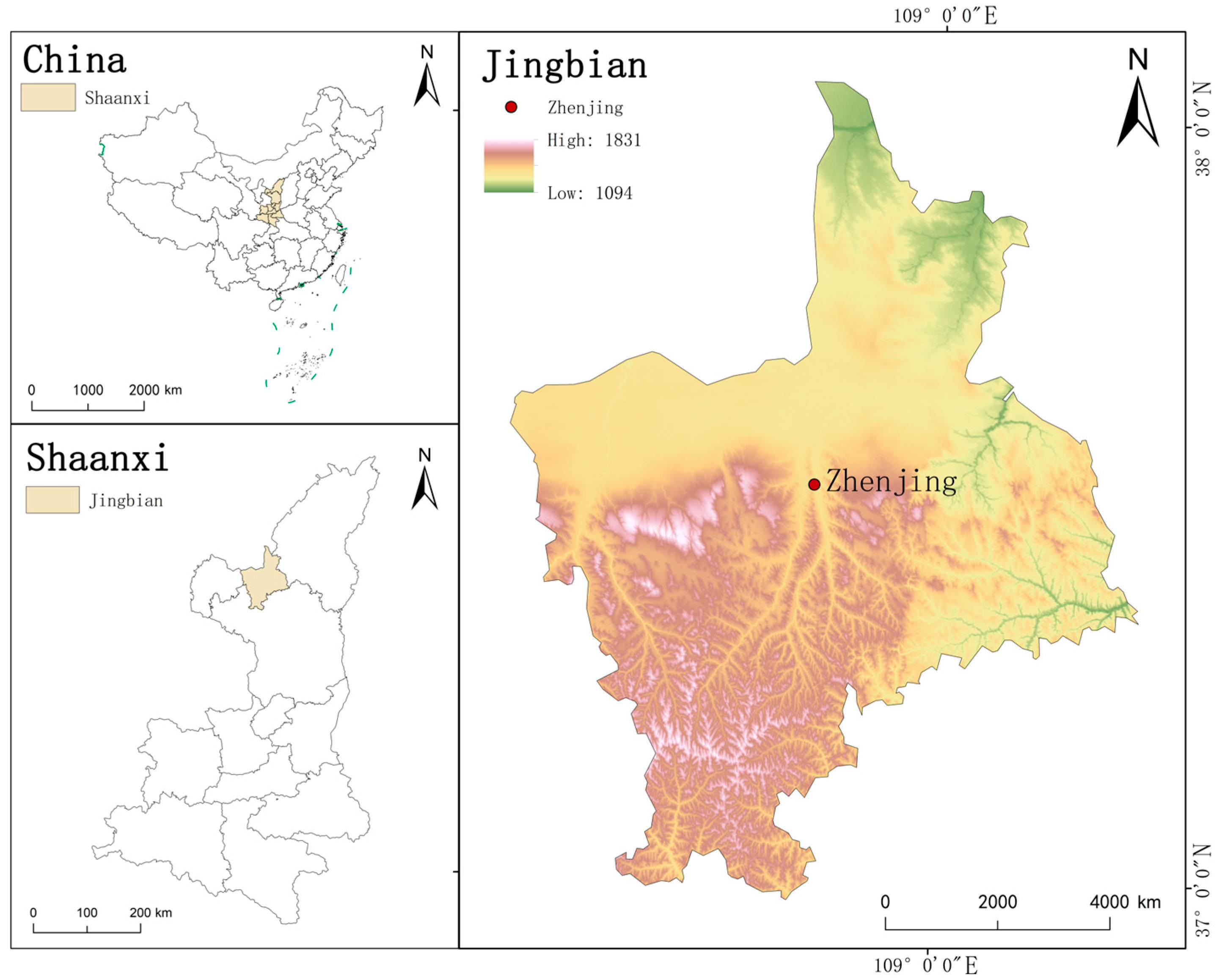
Jingbian County, located in the transitional zone between the Mu Us Sandy Land and the Loess Plateau, was historically a core defense area of the Ming Dynasty Yansui Garrison and an important frontier where agrarian and nomadic cultures converged (Figure 1). Zhenjing Village, one of the best-preserved Ming military settlements in the region, features a typical “fortress–street–residential unit” spatial pattern that embodies both military defense strategies and local socio-cultural practices [4]. With the advancement of the National Cultural Park initiatives and the national strategy for ecological protection and high-quality development in the Yellow River Basin, Zhenjing Village now faces mounting pressure from both protection and utilization. Ecological fragility, population outflow, and unbalanced tourism development have intensified the contradictions between heritage conservation and settlement revitalization [5,6]. The key challenge is how to maintain authenticity while enabling sustainable use.
Existing studies have examined the spatial patterns, heritage values, and conservation mechanisms of Great Wall military settlements from perspectives such as historical geography, architecture, and cultural landscape studies. For example, Zheng identifies the coupling between settlement distribution and terrain through GIS analysis [7], while Tong and colleagues underscore the need for integrated ecological–social governance in heritage conservation [8]. Recent research increasingly emphasizes systemic and sustainability-oriented approaches. Elabd argues for shifting from problem-oriented engineering thinking to systemic innovation models in heritage conservation [9], whereas Niu demonstrates the multidimensional coupling between heritage and sustainable development across urban, rural, and biocultural domains [10]. Additionally, Fouseki and Bobrova highlight that systems thinking and system dynamics can reveal stakeholder relations, value shifts, and policy impacts, viewing heritage as a socio-ecological system [11].
Despite these advances, most studies remain descriptive and experience-based; they seldom address the systematic identification of internal contradictions or propose structured innovation mechanisms for resolving them. In arid regions in particular, ecological fragility and development pressures interact in complex ways, calling for interdisciplinary theoretical tools capable of systematic problem solving. The Theory of Inventive Problem Solving (TRIZ), originally developed for engineering innovation, has increasingly been applied in cultural and creative industries [12], architectural innovation [13], product design [14,15], and digital heritage [16]. Its contradiction-centered logic—operationalized through tools such as the technical contradiction matrix, substance-field analysis, and the Algorithm of Inventive Problem Solving (ARIZ)—offers a promising theoretical alignment with the needs of heritage conservation. Heritage conservation fundamentally seeks to balance authenticity and usability, a structure inherently parallel to TRIZ’s principle of resolving system contradictions. However, existing TRIZ applications have not been connected to SDGs, nor have they addressed the linear heritage systems of military settlements, especially under arid environmental conditions. A comprehensive analytical framework integrating ecological, social, and spatial dimensions is therefore lacking.
In this context, this study introduces TRIZ into the conservation of traditional military settlements, using Zhenjing Village as a representative case. The research aims to (1) systematically identify key contradictions and conflict types in the conservation of the Zhenjing military settlement; (2) develop an innovation-oriented analytical model for heritage conservation based on the TRIZ contradiction matrix and ARIZ; and (3) propose a multidimensional strategy framework oriented toward authenticity preservation, functional revitalization, and ecological optimization. By integrating TRIZ’s logic of system innovation with the multi-objective coordination required in heritage conservation, this study seeks to establish a transferable analytical and decision-making method, offering systematic and innovative insights for the conservation of military settlements in arid and ecologically fragile regions.

2. Materials and Methods

The conservation of traditional military settlements involves multiple interrelated systems, including spatial morphology, ecological processes, and social structures. Relying on a single analytical tool is therefore insufficient to effectively reveal their underlying conflict mechanisms. In response to the research objectives and problem framework established earlier, this study emphasizes systematicity and interpretability in both data selection and methodological design. By introducing the Theory of Inventive Problem Solving (TRIZ), complex issues are structurally modeled and analyzed in a systematic manner. This chapter aims to clarify the rationale for selecting the study object, data sources, and analytical methods, and to explain the functional roles of each method within the overall research framework, thereby providing a methodological foundation for subsequent result analysis and discussion.

2.1. Theoretical Basis and Analytical Framework

2.1.1. Core Logic of TRIZ and Its Adaptation to Cultural Heritage Conservation

The Theory of Inventive Problem Solving (TRIZ), developed by Soviet engineer Genrich Altshuller in the late 1940s, was established through the inductive analysis of millions of patents. Altshuller observed that technological innovation follows certain regular patterns and that the essence of all inventive problems lies in contradictions: improving one system parameter often leads to the deterioration of another. TRIZ systematizes the analysis of such “technical contradictions” through a comprehensive methodological system, including the contradiction matrix, inventive principles, substance-field analysis, and the Algorithm of Inventive Problem Solving (ARIZ). Its core ideas include:
(1)
Universality of contradictions: complex problems inherently involve conflicting objectives, and innovation fundamentally requires resolving these contradictions;
(2)
Regularity of innovation: similar inventive problems can be solved using a finite set of generalizable principles;
(3)
Tendency toward ideality: all systems evolve toward increased useful functions with reduced cost and harm, converging toward an Ideal Final Result (IFR).
These ideas make TRIZ a powerful cross-disciplinary innovation methodology, providing a structured pathway from problem identification and contradiction modeling to the deduction of ideal solutions.
Although cultural heritage conservation originates from the humanities and social sciences, its system structure is methodologically analogous to technical systems. Conservation practices involve multiple objectives, constraints, and stakeholders, and therefore contain numerous internal contradictions—such as the tension between authenticity and usability (preserving historical integrity versus meeting contemporary functional demands), the contradiction between integrity and modernity (integrating modern infrastructure without degrading spatial character), and the tension between conservation cost and long-term sustainability. TRIZ provides systematic tools to identify and resolve such contradictions, shifting heritage conservation from experience-driven judgment to logic-based analysis. Huang and Cheng demonstrate the usefulness of TRIZ in cultural and creative industries [17], while Boavida et al. validate its effectiveness when integrated with sustainable design tools [18]. For military settlement conservation, TRIZ’s logic of ideality–separation–resource utilization offers particular methodological value for balancing authenticity, functionality, and ecological performance.

2.1.2. TRIZ Tools and Principles

(1)
Technical Contradictions and the Contradiction Matrix
A technical contradiction occurs when improving one parameter causes the deterioration of another. TRIZ formalizes these contradictions through a matrix composed of 39 engineering parameters. Each matrix cell contains inventive principles proven effective in historical innovations. By matching the “improving parameter” and the “worsening parameter,” designers can rapidly identify potential solutions. In the context of military settlement conservation, improving “visitor convenience” may simultaneously reduce “heritage authenticity,” representing a typical technical contradiction.
(2)
Physical Contradictions and Separation Principles
A physical contradiction arises when a single parameter must satisfy two opposing conditions; for example, a settlement space that “must be open to visitors” but also “must remain enclosed for protection.” TRIZ resolves such contradictions using temporal, spatial, or conditional separation, enabling mutually conflicting requirements to coexist without direct conflict.
(3)
Inventive Principles and the Ideal Final Result (IFR)
The 40 inventive principles of TRIZ serve as heuristic strategies—such as segmentation, extraction, local quality, and preliminary action—that support creative exploration of solution pathways. Their ultimate aim is the Ideal Final Result, in which a system performs its required functions autonomously, with minimal cost and negligible harm. TRIZ expresses ideality as follows:
I = F U F C + F H
where I is ideality, F U is the sum of useful functions, F C the total cost, and F H the total harmful effects.
(4)
ARIZ and System Evolution Laws
ARIZ is the most rigorous analytical tool within TRIZ, consisting of nine stages that progressively refine a problem, identify its core physical contradiction, and deduce an ideal solution. TRIZ further posits that all systems evolve toward higher ideality-enhancing functionality while reducing cost and harmful effects. For heritage conservation, this implies achieving maximum protective effect with minimal intervention. TRIZ categorizes inventive problems into five levels (Table 1) [19]: problems at Levels 1–3 can typically be solved using inventive principles or standard solutions, whereas Levels 4–5 represent complex, non-standard problems requiring ARIZ. Owing to its clarity, practicality, and process standardization, ARIZ is especially effective in contexts where contradictions are latent or problem backgrounds are highly complex.

2.1.3. Analytical Framework

Within TRIZ, the protection of traditional military settlements can be reframed by transforming complex issues into identifiable technical and physical contradictions. Technical contradictions appear when improving one attribute worsens another, for instance, enhancing visitor convenience at the cost of reduced authenticity. Physical contradictions arise when a single parameter must simultaneously meet opposite states, such as a settlement space that must be “open” yet also “closed.”
By translating heritage conservation issues into the 39 TRIZ engineering parameters, the contradiction matrix can be systematically applied. Subsequently, the Ideal Final Result (IFR) of the settlement system is defined as a state in which authenticity, ecological balance, and community vitality are self-maintained with minimal external intervention. This process requires inventorying system resources—including spatial and material components, natural environmental factors, information data, and governance mechanisms—as potential leverage points for innovation, consistent with the TRIZ principle of utilizing existing resources.
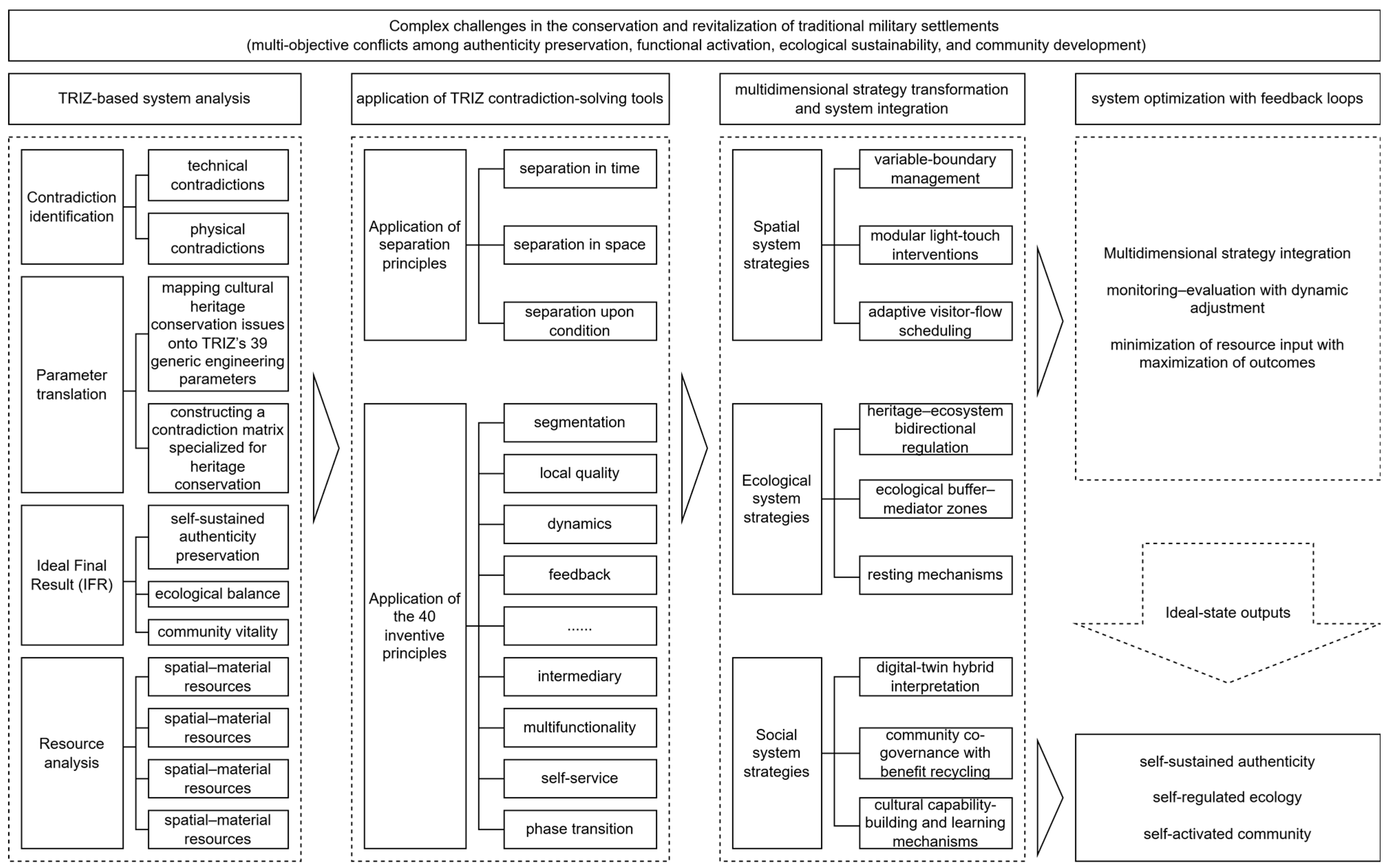
For each identified contradiction, the TRIZ separation principles and the 40 inventive principles guide the generation of multi-level conflict-resolution strategies. These strategies are then translated into concrete interventions for the spatial, ecological, and social subsystems. Through integrated strategy development and system optimization, the military settlement can achieve sustainable conservation and revitalization, maintaining authenticity, ecological stability, and community vitality under minimal intervention—ultimately approaching a self-sustaining system ideality (Figure 2).

2.2. Data Sources

Members of the research team conducted multiple field investigations along the Great Wall in Jingbian County and in Zhenjing Village between 2023 and 2024. The primary data were collected through participant observation, documenting the fortress layout, wall remains, traditional dwellings, military-related historical traces, and interactions between local residents’ daily life and settlement conservation. Field notes, photographs, and video recordings were used to compile first-hand qualitative materials.
Secondary data included the following categories:
(1)
Ecological data (2000–2020) on windbreak and sand-fixation capacity and soil-retention capacity, obtained from the Science Data Bank platform (https://doi.org/10.57760/sciencedb.20797. accessed on 21 November 2025) with a spatial resolution of 30 m; The administrative boundary data were obtained from the National Geomatics Center of China public geospatial service platform (Tianditu) (https://www.tianditu.gov.cn/ accessed on 21 November 2025.); Digital Elevation Model (DEM) data were sourced from the Geospatial Data Cloud (https://www.gscloud.cn/ accessed on 21 November 2025) with a spatial resolution of 30 m; Spatial point data for the Ming Great Wall and associated military fortresses in Jingbian County were derived from the Survey Report on Ming Great Wall Resources in Shaanxi Province and georeferenced with the assistance of Google Maps; All spatial datasets were preprocessed in ArcGIS 10.8, including merging and clipping, and were uniformly projected to the WGS_1984_UTM_Zone_49N coordinate system.
(2)
Tourism statistics, planning reports, and policy documents issued by the Jingbian County Government, including the Master Plan for All-for-One Tourism Development (2023–2030) (review draft) and the Territorial Spatial Master Plan of Jingbian County (2021–2035) (draft), which helped clarify the existing planning basis for settlement conservation and revitalization.
(3)
Relevant policies and regulations issued by Shaanxi Province, Yulin City, and Jingbian County on Ming Great Wall protection, traditional village revitalization, and cultural heritage transmission, establishing the policy context for this study.
(4)
Academic literature and foundational references, including the Survey Report on Ming Great Wall Resources in Shaanxi Province—Fortress Volume and scholarly works on military settlement conservation, which provided theoretical and empirical support.
(5)
Real-time information sources, including official articles, news reports, and visual materials from digital media platforms such as “Jingbian Cultural Tourism Promotion” and the “Yulin Great Wall Protection Center,” supplying up-to-date insights into settlement conservation dynamics and cultural tourism practices.

2.3. Study Area

2.3.1. Geographical Characteristics of Jingbian County

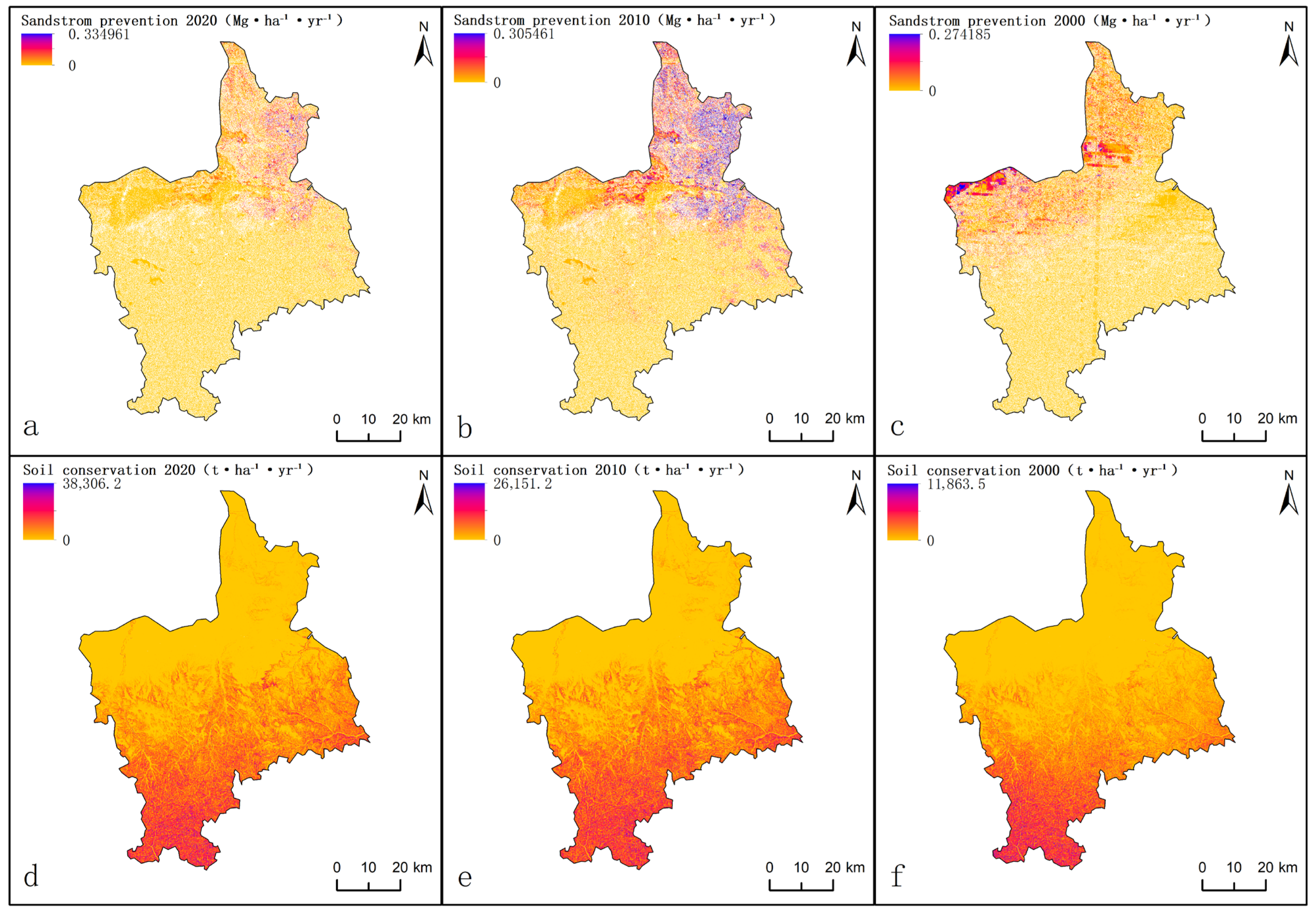
Jingbian County is located on the southern edge of the Mu Us Sandy Land in northern Shaanxi Province and forms a typical transitional geomorphological zone between the Loess Plateau and desert landscapes. Based on high-resolution raster data documented in previous studies [20], this research evaluates Jingbian’s windbreak and sand-fixation capacity and soil-retention capacity from 2000 to 2020 (Figure 3).

2.3.2. Analysis of Windbreak and Sand-Fixation Capacity and Soil Retention Capacity in Jingbian County

Windbreak and Sand-Fixation Capacity
This ecological service reflects the ability of the ecosystem—via vegetation cover and surface roughness—to reduce wind-driven transport of surface particles. The study adopts a modified wind erosion equation, integrating factors such as vegetation coverage, soil texture, surface roughness, and wind speed to simulate potential wind erosion. By comparing potential wind erosion under bare-surface conditions with actual wind erosion, the sandstorm prevention value (SP) is obtained. SP is calculated as the difference between potential and actual wind erosion. Key factors include the following:
S P = S E × 1 S C F × 1 C × 1 K × W F
In the above formula, parameters include SE factor: Soil Erodibility Factor, representing the susceptibility of soil to wind erosion; SCF factor: Soil Crust Factor, quantifying the inhibitory effect of soil crusting on erosion; C factor: Vegetation Factor, representing vegetation’s protective role, derived from vegetation coverage (Cov) and vegetation-type coefficients; K′ factor: Soil Roughness Factor, describing the influence of micro-topography on erosion; WF factor: Weather Factor, incorporating wind speed (Wf), soil moisture (SW), and snow cover (SD).
Soil Retention Capacity
This ecological function represents the ecosystem’s ability to reduce water-induced soil loss through root stabilization, litter interception, and enhanced infiltration. The study uses the Revised Universal Soil Loss Equation (RUSLE), one of the most widely applied global tools for water erosion assessment. Soil conservation (SC) is computed as the difference between potential and actual soil erosion and is determined by the following factors:
S C = R × K × L S × 1 C × P
In this formula, the parameters include R factor: Rainfall erosivity, indicating the erosive force of precipitation; K factor: Soil Erodibility Factor, representing soil sensitivity to erosion; LS factor: Slope length and steepness, reflecting topographic influences; P factor: Conservation practice factor, representing engineering or agricultural measures that reduce erosion; C factor: Cover-management factor, representing vegetation protection, derived from NDVI-based vegetation coverage (Cov).
C o v = N D V I N D V I m i n N D V I m a x N D V I m i n × 100 %
Jingbian County has experienced a substantial improvement in soil retention capacity over the past two decades. In 2000, the county’s maximum soil conservation value was 11,863.5 t·ha−1·yr−1, which increased to 38,306.2 t·ha−1·yr−1 by 2020—an overall rise of approximately 223%. Its sandstorm prevention capacity has shown a similarly robust upward trend. The maximum sandstorm prevention value increased from 0.274185 Mg·ha−1·yr−1 in 2000 to 0.334961 Mg·ha−1·yr−1 in 2020, indicating a growth of about 22% during the 2000–2020 period. This improvement is directly associated with the significant increase in vegetation coverage and the marked reduction in aeolian activity across the region.
Multiple studies confirm a continuous and significant enhancement of vegetation cover in this area. Remote sensing monitoring conducted over the Mu Us Sandy Land between 2002 and 2021 shows that the annual Normalized Difference Vegetation Index (NDVI) exhibited a fluctuating upward trend, with an average annual increase of 0.0058/a (p < 0.01), indicating a consistent improvement in vegetation growth [21]. Another study focusing on the hinterland of the Loess Plateau—where Jingbian County is located—demonstrates that Fractional Vegetation Cover (FVC) increased from 0.3486 in 2000 to 0.6186 in 2020, an increase of approximately 77%. During the same period, the proportion of Grade V (highest level) desertified land decreased from over 60% to around 15%, while areas with vegetation coverage below 0.1 dropped sharply from more than 50% to less than 10% [22].
Soil erosion has long been one of the most pressing environmental issues in the Loess Plateau, directly affecting agricultural productivity and human settlement security. Large-scale ecological restoration programs—such as the Grain-for-Green Program, small watershed management, and soil and water conservation projects—have greatly strengthened soil retention capacity in the region [23]. In terms of sandstorm prevention, increased vegetation cover reduces wind speed and stabilizes surface soil through root systems, directly contributing to the decline in sand and dust activity. Although high-resolution sand-dust flux data specific to Zhenjing Village are not available, it is reasonable to infer that the village has benefited from the significant regional reduction in sand-dust flux (Table 2).

2.3.3. Characteristics of the Settlement System in Jingbian County

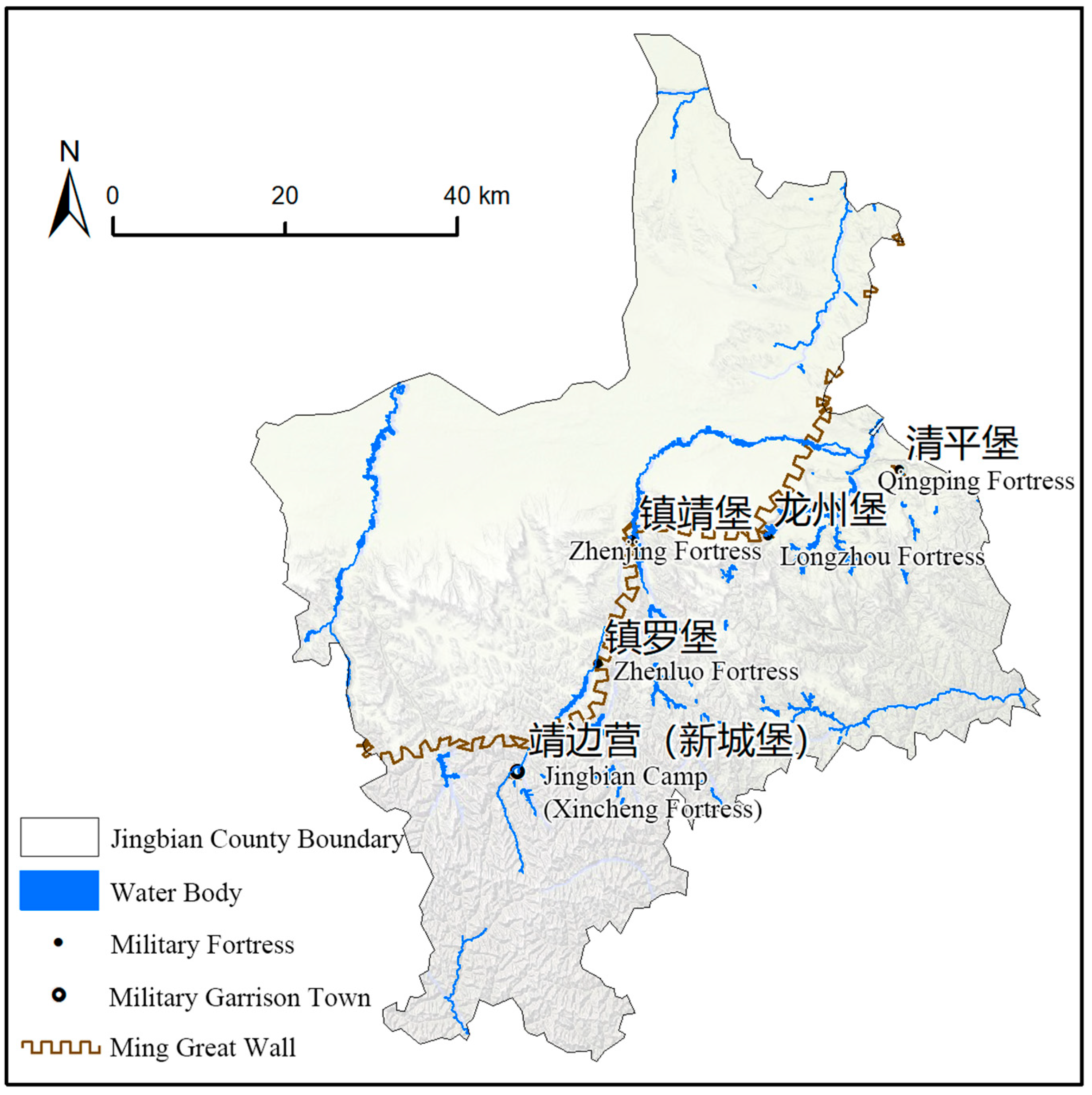
The Jingbian section of the Ming Great Wall extends for approximately 97 km and formed the core defense area of the Yansui Garrison during the Ming Dynasty, giving it significant strategic importance. Under the Ming military–administrative system, settlements along the Great Wall followed a five-tier structure: zhen (garrison), lu (routes), wei (guards), suo (stations), and bao (forts). Most settlements in Jingbian belonged to the lowest tier, the bao fort towns, serving as frontline outposts within the defense system [27,28]. Along this section of the Great Wall lie several military settlements, including Zhenjing Fort, Longzhou Fort, and Qingping Fort, collectively forming a defensive structure that integrates walls, watchtowers, forts, and passes. These settlements exhibit a typical linear defensive pattern with a “string-of-beads” distribution (Figure 4).
The settlements were strategically located by leveraging the terrain—usually on river-terrace platforms or hilltops—to control transportation routes and access to water resources. Their layouts follow the principle of “fortifying according to danger and responding to local conditions.” Most forts adopt square or rectangular enclosures with rammed-earth walls approximately 6–8 m in height and 3–5 m in thickness. Internally, a single or double main street forms the spatial backbone, arranged in linear, cruciform, or grid patterns, with administrative offices, barracks, residences, and temples distributed along the street network. The settlements feature a compact, hierarchical spatial structure comprising three zones: the military defense zone, the residential and productive zone, and the peripheral agricultural fields.
While this enclosed defensive layout was strategically effective during the Ming Dynasty, it has become a major constraint in contemporary conservation and adaptive reuse. The rigid spatial form lacks flexibility, making it difficult to integrate modern infrastructure and visitor services, thus generating structural contradictions in the revitalization process.

2.3.4. Spatial Structure and Heritage Context of Zhenjing Village

(1)
Spatial Structure
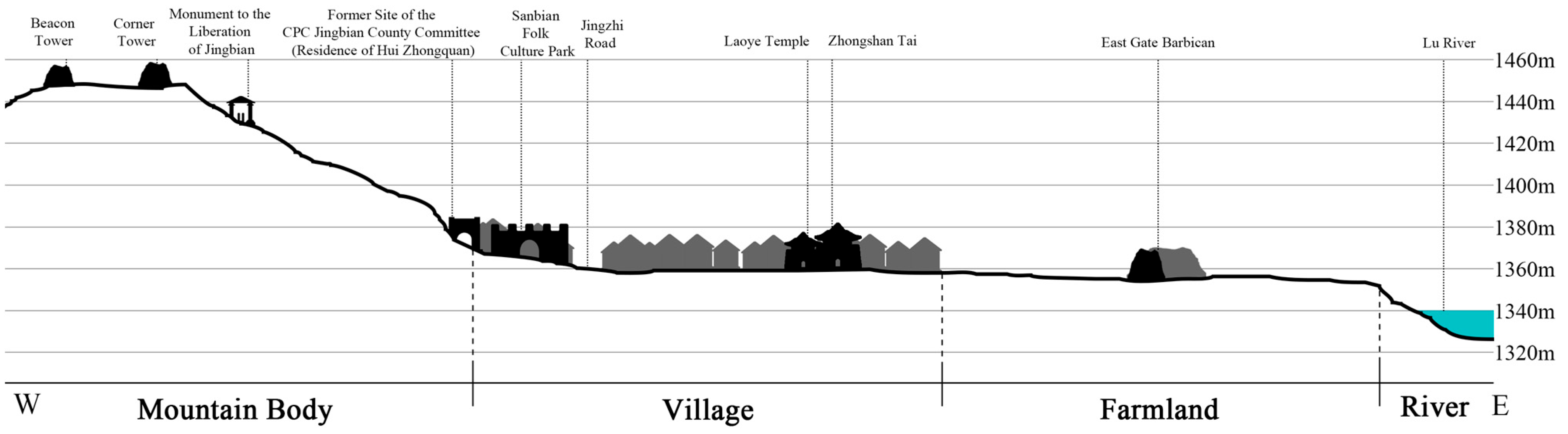
Zhenjing Village is the only settlement in Jingbian County listed in the National Traditional Villages Catalogue and preserves a relatively complete Ming-dynasty military fort structure [29]. Constructed during the Chenghua reign, the fort lies approximately 8 km southeast of Jingbian’s county seat and about 0.5 km south of the Great Wall. It occupies a semi-mountainous terrain backed by hills and facing water, with gullies on both sides. A major road (Jingzhi Road) cuts through the base of the mountain, dividing the fort into eastern and western sections with an elevation difference of about 80 m (Figure 5).
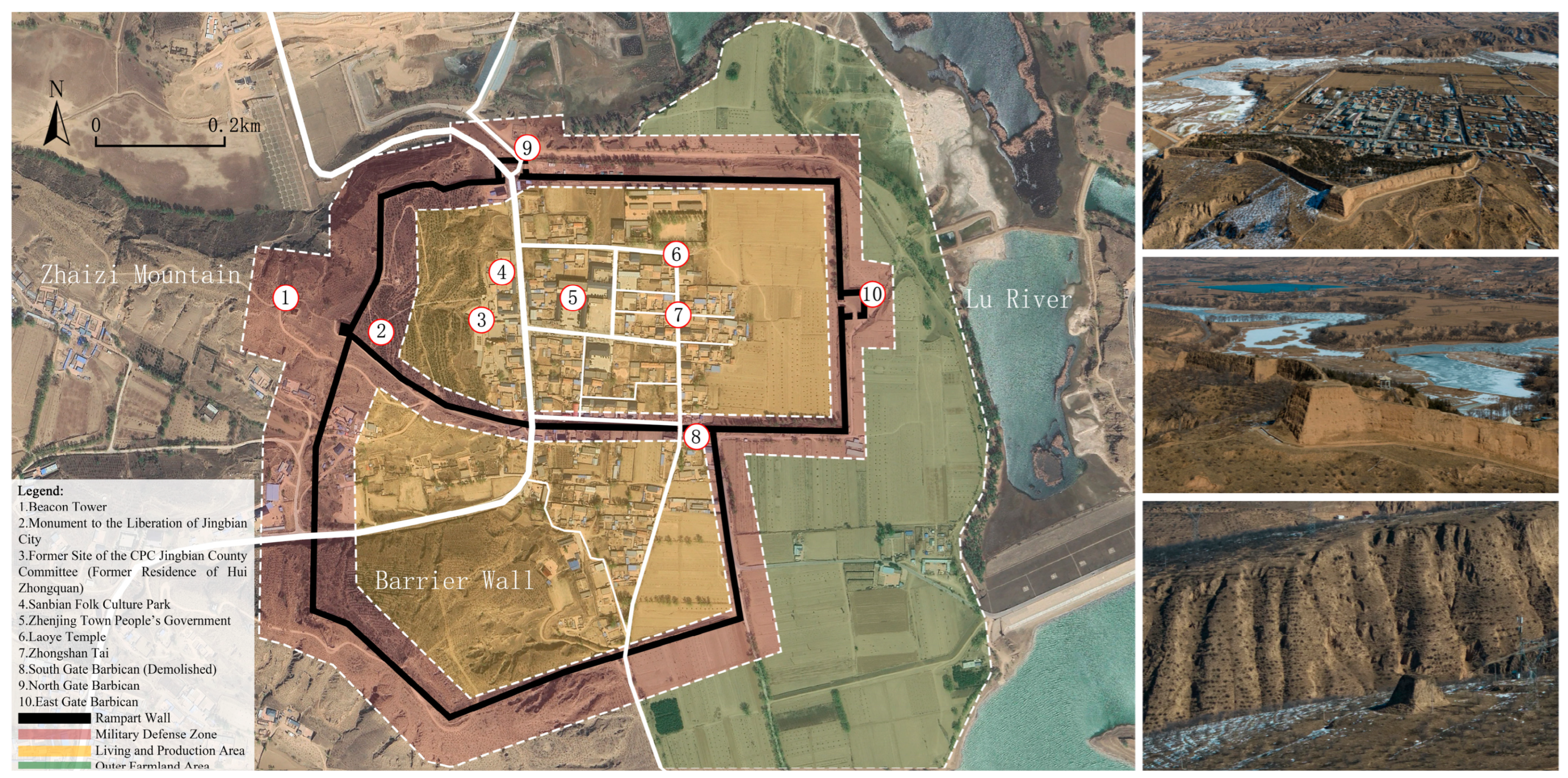
The surviving remains include the main city wall, the outer barrier wall, and attached architectural elements such as the Horse Face (a rectangular defensive platform protruding from the main wall) and corner towers. The northern main wall forms an approximately rectangular layout with a perimeter of 2096 m, highly regular on the east and merging with the terrain on the west. The southwestern and northwestern walls extend along the mountain slopes, serving as key points for observation and defense. The rammed-earth walls are 1–4.5 m thick and 6–7 m high. Historically, the fort had three gates (east, south, and north). Its internal streets intersected at right angles, forming a grid pattern with barracks, administrative buildings, residences, temples, and cave-dwellings distributed along the street system. The upper settlement area is lined with north–south cave-dwelling clusters, while the lower area contains the fort gate. Remnants of agricultural fields and irrigation channels lie outside the enclosure.
Today, the overall form of the settlement is partially preserved. Some wall sections have collapsed, and significant internal spatial transformations have taken place. Two gate complexes (both with barbicans) remain, with the east gate relatively intact while the north gate is heavily damaged. The south gate and its barbican were dismantled in 1958 during the construction of a reservoir dam. Several internal streets have been widened or enclosed, forming a landscape of overlapping historical layers and contemporary interventions (Figure 6).
(2)
Heritage Context
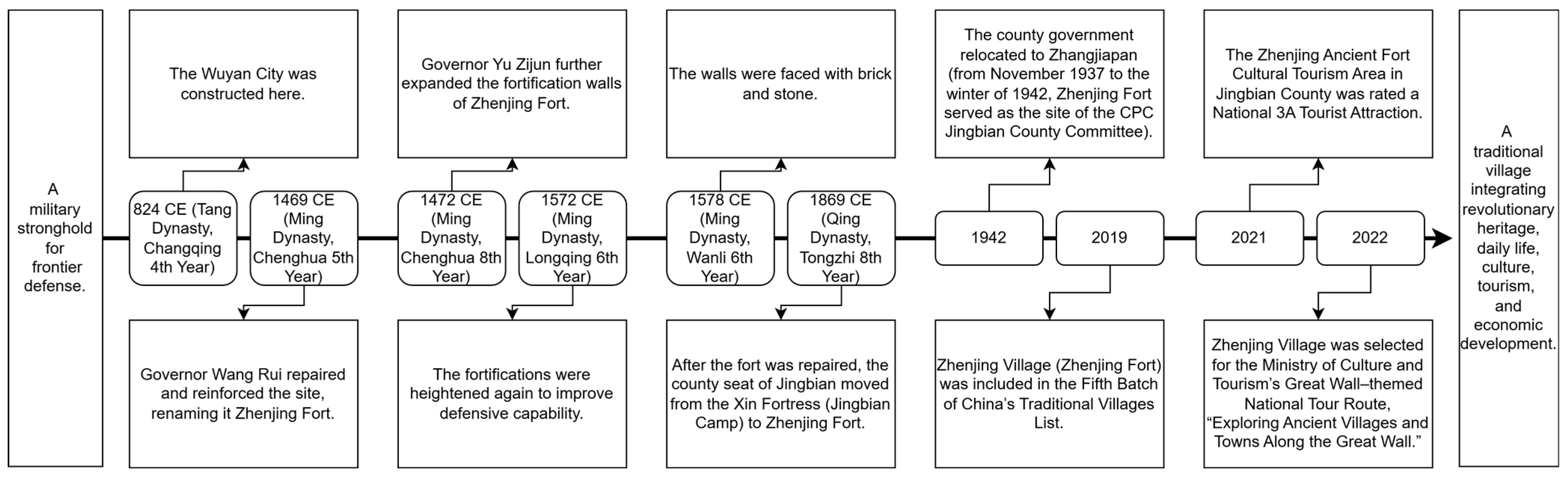
Zhenjing Fort—also known as Baitan’er or Baitajian Pass—occupies a strategically important location and has long served as a key military stronghold. In 824 CE (Tang Dynasty, Changqing 4), the fortification known as Wuyan City was constructed here, establishing its military significance. In 1469, during the Ming Dynasty, Inspector Wang Rui oversaw repairs and renamed the fort “Zhenjing,” meaning “defend the frontier and secure the realm.” In 1472, Inspector Yu Zijun expanded the fort walls to a perimeter of “four li and three fen,” with nineteen watchtowers, strengthening frontier defenses. Additional heightening occurred in 1572, and brick-stone facing was applied in 1578.
During the Ming period, Zhenjing Fort maintained a substantial military presence, with 2537 soldiers and 1789 horses, mules, and camels, and a full command structure of officers responsible for patrolling the Great Wall segment of “forty-nine li with forty-three watchtowers.” The defensive system was robust and well organized. During the Qing Dynasty (Kangxi reign), the stationed troops were adjusted to 110, still under a commanding officer. After repairs in 1869, the fort remained the seat of Jingbian County until 1942, serving administrative and military functions simultaneously.
In recent years, the cultural significance of Zhenjing Fort has gained renewed attention through the construction of the Great Wall National Cultural Park. In 2019, following the approval of the Construction Plan for the Great Wall, Grand Canal, and Long March National Cultural Parks at a central government meeting chaired by President Xi Jinping, Zhenjing Village was included in the fifth national batch of traditional villages and began developing the Sanbian Folk Culture Park. This project restored over 20 traditional cave dwellings, seven courtyards, and more than 1000 agricultural folk artifacts; reconstructed traditional architectural elements such as gatehouses, haystacks, and stables; and incorporated sculptures to interpret local history and folk culture. In 2021, the Zhenjing Ancient Fort Cultural Tourism Area was designated a national AAA-level scenic site, and in 2022, the village was included in the Ministry of Culture and Tourism’s Great Wall-themed national travel route, becoming an important node for Great Wall cultural transmission and tourism development (Figure 7).
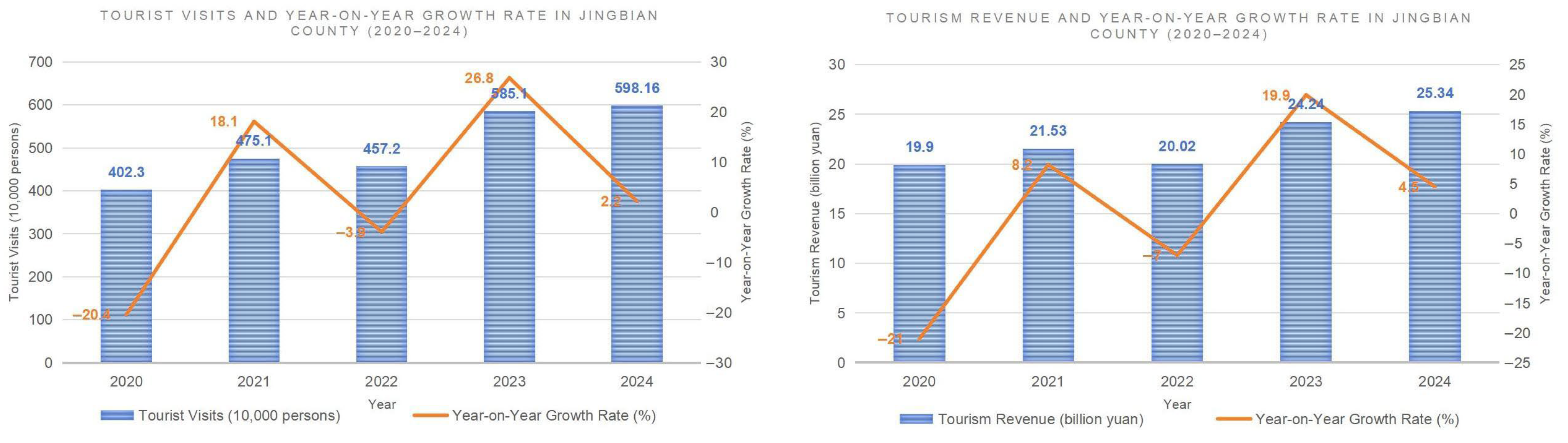
This study uses tourism statistics from the Statistical Bulletin of National Economic and Social Development of Jingbian County (2020–2024) to analyze regional tourism trends. Visitor numbers show a pattern of recovery following pandemic disruptions (Figure 8). Due to the absence of continuous monitoring data specific to Zhenjing Village, county-scale visitor data are adopted as proxy indicators, which is consistent with established practices in regional-scale heritage and tourism studies.

3. Results and Analysis

Confronted with the complex tension among the three goals of protection, revitalization, and development in the military settlements along the Ming Great Wall in Jingbian, conventional experience-based conservation approaches are insufficient for resolving deep-seated structural contradictions. This study, therefore, introduces the Algorithm of Inventive Problem Solving (ARIZ) from the TRIZ framework to transform practical problems into an operational innovation model [30]. ARIZ enables the identification of the essence of the problem, the definition of the Ideal Final Result (IFR), and the recognition of available system resources, thereby establishing the logical foundation for subsequent strategy formulation.

3.1. Problem Identification and System Analysis

3.1.1. Problem Analysis and Definition

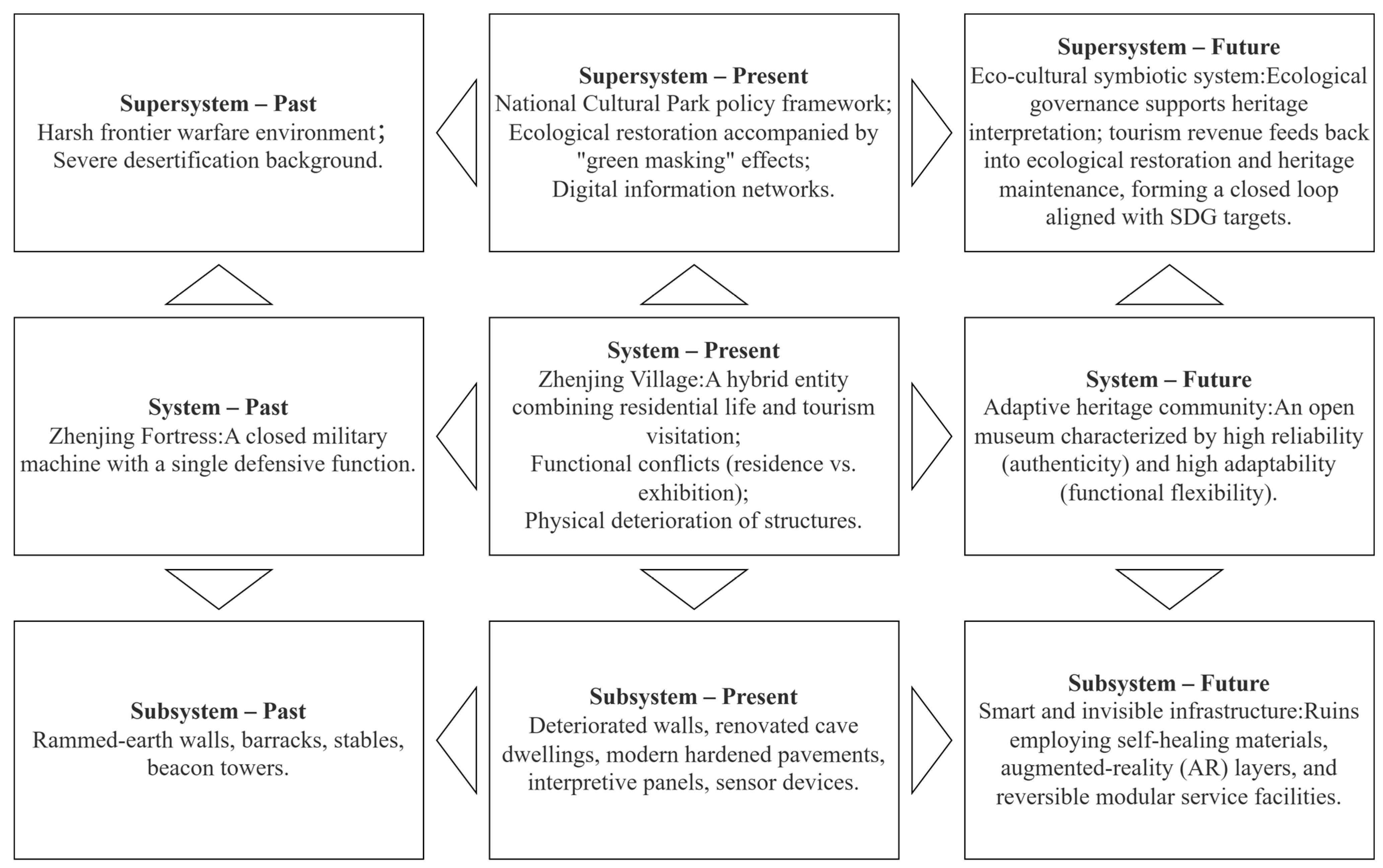
To capture the dynamic evolution of Zhenjing Village as a heritage system, the study employs the Nine-Screen Method to analyze temporal and spatial dimensions (Figure 9).
The Nine-Screen analysis reveals a fundamental obstacle in the system’s evolution: the rate of physical deterioration in the subsystem (heritage structures) is misaligned with the accelerating demands of the supersystem (tourism growth).

3.1.2. System Analysis and Conflict Formulation

Zhenjing Village is conceptualized as a typical spatial–ecological–social coupled system, whose core function is to “transmit historical information” while simultaneously “supporting contemporary use.” The key system elements and associated conflicts are summarized in Table 3.
To enhance analytical rigor, this study applies triangulation by integrating field interviews, documentary data analysis, and expert consultation through the Delphi method. Three key technical contradictions are identified (Table 4).
Among them, TC1 emerges as the dominant contradiction, showing the highest frequency and closely corresponding to the rising trend in visitor numbers.

3.2. Technical Contradiction Modeling and Parameter Translation

TRIZ posits that the essence of innovation lies in overcoming technical contradictions, namely situations in which the improvement of one system attribute inevitably leads to the deterioration of another. Existing studies have confirmed that TRIZ can be effectively applied beyond engineering—to social sciences, business management, and digital systems—provided that its conceptual system is appropriately “translated” or “redefined” [31,32]. Although cultural heritage conservation is a non-engineering field, its core conflicts still exhibit structural features consistent with technical contradictions.
To systematically address such conflicts, this study translates the 39 standard engineering parameters into heritage-specific concepts (Table 5) and constructs a contradiction matrix adapted to the cultural heritage domain (Table 6). The premise of translation lies in capturing the essential correspondence between the nature of contradictions in both fields. For example, Engineering Parameter 27 (Reliability) refers to the system’s ability to perform its function in a stable manner; in the context of heritage conservation, the core “function” of heritage is the transmission of historical information, thus authenticity can be mapped to the system’s “functional reliability.”
To ensure scientific rigor, the translation process follows a three-step procedure:
(1)
Semantic Equivalence Analysis: Each engineering parameter is abstracted using the logic of function–cost–harm, and its conceptual counterpart in the heritage context is identified.
(2)
Contextual Substitution: Parameters are contextualized and operationalized based on the specific characteristics of traditional military settlements.
(3)
Expert Validation (Delphi Method): Experts in TRIZ and heritage conservation participate in two rounds of scoring. If the expert consensus rate is below 70%, the parameter definition is revised and re-evaluated.
Taking the improving parameter 33 (visitor accessibility) and the worsening parameter 27 (heritage authenticity) as an example: visitors require convenient pathways and facilities, while conservation demands maintaining spatial integrity and material authenticity. According to Altshuller’s contradiction matrix, the corresponding inventive principles include the following:
17—Another Dimension; 27—Cheap Short-Lived Objects; 8—Anti-Weight; 40—Composite Materials.
In the heritage conservation context, these principles can be translated into the following strategies:
(1)
Another Dimension: Expand visitor experience beyond single-dimensional “on-site physical visiting” to multidimensional interaction. By distributing visitor activities across spatial, temporal, and informational dimensions, direct physical pressure on the heritage site is reduced without sacrificing accessibility.
(2)
Cheap Short-Lived Objects: Functions requiring contact with or modification of authentic materials are assigned to detachable, lightweight, visually compatible substitute facilities. This preserves material integrity while meeting accessibility needs and minimizing irreversible impacts.
(3)
Anti-Weight: When localized convenience facilities inevitably create concentrated pressure, compensatory dispersal measures can be implemented elsewhere in the system. This redistributes load rather than reducing accessibility, thereby safeguarding authenticity through systemic rebalancing.
(4)
Composite Materials: Facilities made of composite materials can simultaneously provide sufficient strength, lightweight, breathability, and visual compatibility. These materials reduce physical disturbance, support reversibility and recyclability, and align with the principle of minimal intervention.
A comparative evaluation of these four inventive principles shows the following:
8—Anti-Weight primarily functions as a managerial adjustment—effective for load redistribution but limited in improving authenticity at a fundamental level. 27—Cheap Short-Lived Objects reduces cost and intervention risks and suits temporary displays, yet long-term durability and cultural compatibility of substitute materials remain concerns. 40—Composite Materials offers high technical feasibility with clear benefits in reducing physical impact, but it depends on advanced material technologies and incurs higher implementation costs. 17—Another Dimension, by reorganizing visitor experience across spatial, temporal, and informational layers, restructures system functions at a fundamental level. It reduces direct physical intervention, enhances accessibility, and improves overall experience quality, demonstrating the highest universality and innovation potential.

3.3. Deepening Fundamental Conflicts Through ARIZ

3.3.1. Defining the Ideal Final Result (IFR)

The Ideal Final Result (IFR) describes a state in which the system achieves its objectives without requiring external intervention. For the military settlements along the Ming Great Wall in Jingbian, the ideal state refers to a heritage system capable of maintaining authenticity while sustaining ecological stability and fulfilling contemporary social functions. Defining the IFR is a critical step that establishes the system’s evolution direction.
Based on the characteristics of the Jingbian settlements, this study defines the IFR in three dimensions:
(1)
Self-sustaining Authenticity: The spatial morphology and historical configuration of the settlement remain stable through natural evolution and daily use, without requiring large-scale restoration. Material renewal and environmental adjustments follow the principles of “recognizable original appearance” and “reversible intervention.”
(2)
Self-regulated Ecology: The ecological system possesses self-repairing capabilities, forming positive feedback loops among sand control, vegetation recovery, and microclimate improvement. Ecological processes surrounding the settlement operate stably without dependence on intensive artificial maintenance.
(3)
Self-activated Community: Residents participate spontaneously in heritage protection and utilization based on cultural identity. Economic benefits can, in turn, support heritage maintenance, forming a socio-cultural–circular economy system.
Compared with the current situation, the IFR emphasizes system self-organization and coordination, aiming for the stable coexistence of multiple objectives. The definition of the IFR provides directional constraints for subsequent analysis: all innovative measures should move toward reducing external inputs, enhancing internal resource utilization, and increasing the system’s overall level of ideality.

3.3.2. Resource Analysis

Resource analysis aims to identify internal and external resources that can be directly utilized to improve the system at minimal cost. The protection and revitalization of the Jingbian military settlements require a full exploration of four categories of resources: material, energy, information, and social resources.
(1)
Spatial and Material Resources: Existing rammed-earth walls, alley networks, gate ruins, and elevation differences constitute valuable spatial assets. Collapsed walls, abandoned courtyards, and open spaces outside the fort can be converted into display nodes, buffer zones, or sites for lightweight, reversible facilities. Locally available bamboo, timber, and adobe blocks can be used for reversible exhibition structures.
(2)
Natural Environmental Resources: The region’s strong solar radiation and abundant wind energy can be harnessed to power lighting and monitoring systems, reducing dependence on conventional energy. Natural climatic processes can also be transformed into resources; for example, terrain-guided airflow and vegetation configuration can reduce wind erosion, decreasing the need for engineered interventions.
(3)
Information Resources: Spatial archives, historical documents, and digital surveying data form an extensive repository of information. A digital database can support dynamic monitoring, risk prediction, and decision-making in virtual environments. These information resources can be used in conservation planning, educational display, and community communication, improving management efficiency.
(4)
Social and Institutional Resources: Local residents represent the most dynamic social resource. Their knowledge of spatial structures and traditional construction techniques can contribute to conservation works and cultural interpretation. Policy support from the local government and technical collaboration with research institutions form essential institutional resources. A multi-stakeholder cooperation mechanism can transform social resources into governance capacity, establishing a long-term protection network.

3.3.3. Physical Contradictions and Separation Principles

Within ARIZ, a physical contradiction is a deeper form of technical contradiction, referring to a situation in which a single system parameter must possess opposite characteristics simultaneously. The core physical contradictions of the Jingbian settlements can be summarized into three categories:
(1)
The settlement must remain open to attract visitors, yet closed to protect heritage.
(2)
The ecosystem must be closed for ecological restoration, yet intervened upon for site maintenance.
(3)
The community must pursue economic benefits, yet preserve cultural purity.
Resolving physical contradictions requires the application of separation principles, which achieve coexistence of conflicting demands across time, space, or conditions. Based on the characteristics of the Jingbian settlement, three separation pathways are proposed:
(1)
Separation in Time: Seasonal and temporal management enables functional displacement. Tourism activities may concentrate in seasons with minimal ecological impact; core zones can be closed during vegetation growth periods; and maintenance can be scheduled during off-peak seasons. Nighttime closures may be applied to reduce sustained disturbance while keeping peripheral viewpoints open.
(2)
Separation in Space: Functional zoning can mitigate spatial conflicts. Three hierarchical zones may be delineated: a core conservation zone, an experiential display zone, and a community living zone. The core zone strictly limits visitor flow and construction, the display zone accommodates tourism functions, and the living zone supports daily activities and tourism services.
(3)
Separation in Conditions: Different strategies can be triggered under different environmental conditions. For instance, certain routes can be closed during periods of sandstorms or concentrated rainfall, while limited-access research routes may be opened during ecologically stable periods. A monitoring-based dynamic management system enables condition-based triggers and automatic strategy adjustments.

3.4. Strategy Validation and Performance Simulation Based on System Dynamics

Step 7 of ARIZ constitutes the core of quality control. It requires inventors to examine whether the derived solution truly resolves the physical contradiction, whether it introduces new harmful effects, and whether available resources have been fully utilized. Although TRIZ and its core algorithm ARIZ have achieved substantial success in resolving technical and physical contradictions, scholars and practitioners widely recognize their inherent limitations—particularly their static analytical framework. These limitations appear in two areas: (1) the inability to analyze system behavior over time and (2) the difficulty of handling complex systems with multiple interconnected problems [34,35].
These shortcomings provide strong justification for integrating system dynamics (SD) as a complementary tool. With its capacity for dynamic modeling and simulation, SD captures nonlinear behavior driven by feedback loops and predicts the long-term cumulative effects of policy interventions. Thus, SD effectively compensates for the limitations of TRIZ in dynamic environments [36,37].
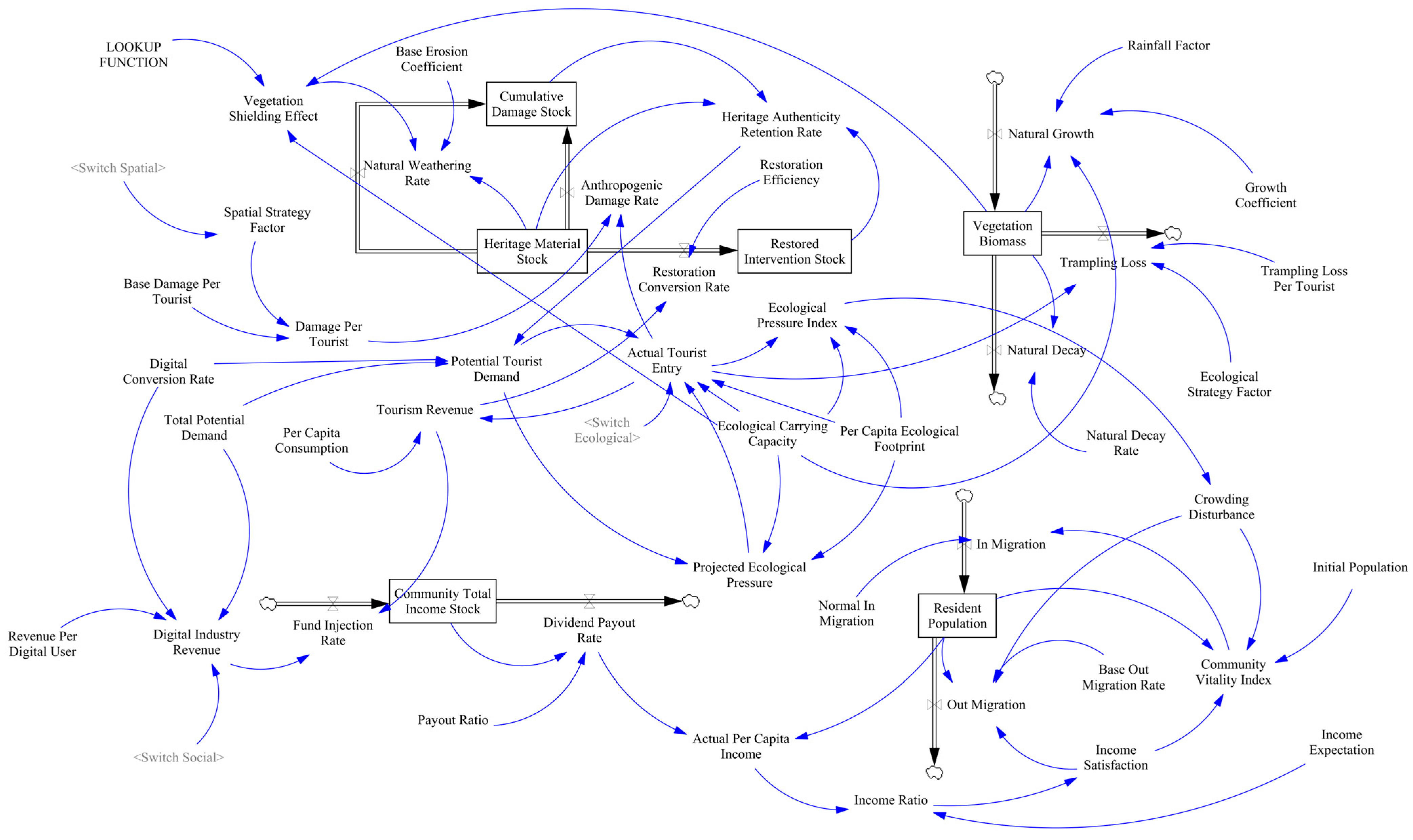
The integrated approach typically first uses TRIZ tools to identify core contradictions and potential solutions. These solutions are then embedded as input variables into an SD model that reflects the dynamic behavior of the system (Figure 10; Table 7). By running simulations, one can observe the long-term effects of the proposed solutions on the overall system—including subsystems and the supersystem—thereby validating their effectiveness, identifying unintended consequences, and optimizing the solutions [35,36,37].
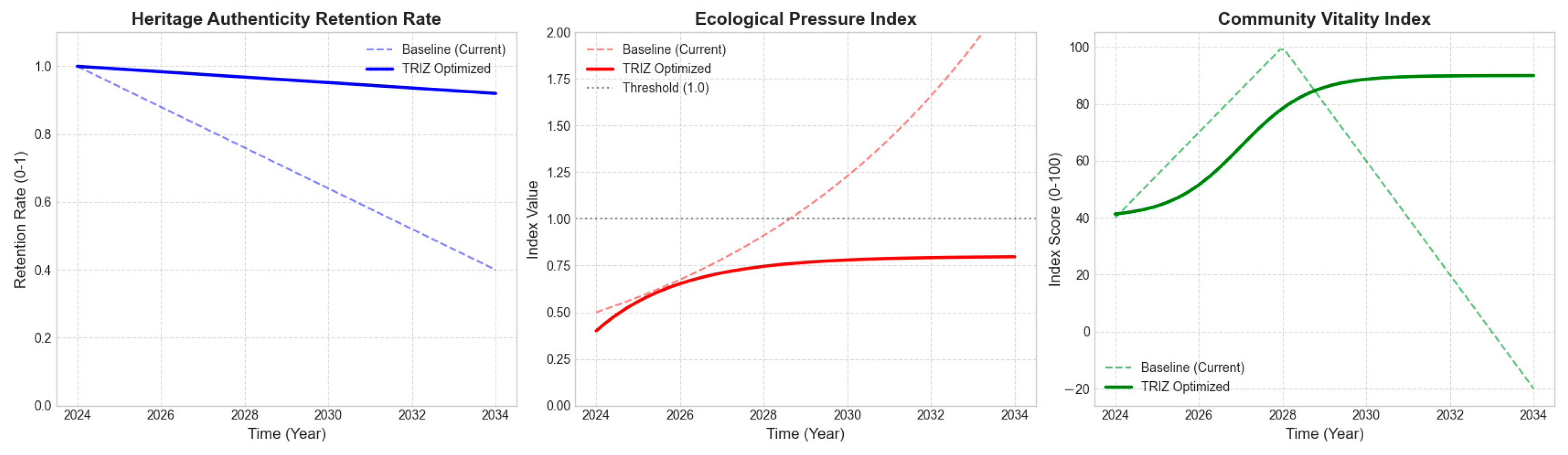
The model simulates the period from 2024 to 2034, comparing two scenarios: baseline (inertial development) and TRIZ-optimized. As shown in Figure 11, when spatial strategies incorporating variable boundaries and lightweight facilities are implemented, the heritage authenticity retention rate shows a much slower decline than the baseline; it decreases only slightly from 1.0 to approximately 0.92.
The Ecological Pressure Index under the baseline scenario rises exponentially, surpassing the threshold (1.0) around 2029 and reaching nearly 2.0, causing a sharp drop in vegetation coverage. Under the optimized scenario, the curve initially increases slightly (2024–2026) and then flattens and stabilizes around 0.8, never crossing the threshold.
The most significant change occurs in the Community Vitality Index. In the traditional model, ecological restrictions inevitably reduce residents’ income, leading to dissatisfaction and population outflow. However, with the introduction of the digital twin strategy, the community acquires an income curve decoupled from ecological pressure (green dashed line), allowing community vitality to continue increasing even during ecological restoration periods.

4. Discussion

The preceding section identified the core contradictions in the conservation and revitalization of Zhenjing Village through TRIZ and ARIZ analyses, and verified the long-term effects of the proposed strategies using a system dynamics model. However, these findings still need to be examined within a broader theoretical and practical context. The purpose of the discussion is not to repeat the analytical process, but to address what the findings mean and under what conditions they hold. Accordingly, this section discusses methodological applicability, interpretation of results, and cross-case transferability, further clarifying the theoretical value and practical boundaries of TRIZ-oriented strategies in the conservation of traditional military settlements, and situating the conclusions within a comparative framework of existing studies and international experience.

4.1. Methodological Applicability

This study does not treat TRIZ, ARIZ, and system dynamics as purely engineering-oriented tools, but rather understands them as a set of generally applicable methods for problem modeling and system analysis. Their core value lies in providing a structured understanding of the relationships among contradictions, system evolution, and feedback mechanisms. In cultural heritage conservation, problems rarely manifest as isolated technical deficiencies; instead, they emerge from structural tensions among multiple objectives, including authenticity, modes of use, ecological carrying capacity, and social demands. By introducing the concept of “contradiction” as an analytical intermediary, TRIZ transforms these complex goal conflicts into identifiable and discussable problem models, thereby avoiding strategy selection based solely on experience or normative judgments.
Within this framework, TRIZ functions primarily as a contradiction-based modeling tool rather than a source of ready-made solutions. Its role is to help clarify which objectives within a system reinforce each other, which ones counteract each other, and at what parameter levels these conflicts occur. Through parameter translation and the use of the contradiction matrix, abstract debates commonly encountered in heritage conservation—such as “conservation versus development” or “closure versus openness”—are converted into analytically structured objects, making the problem itself more transparent.
ARIZ, as the core method within the TRIZ system, is introduced not for its procedural algorithm per se, but for its conceptual mechanism of defining the Ideal Final Result (IFR). In the context of heritage conservation, the IFR does not imply “zero intervention” or an absolutely static state, but rather an ideal direction in which the system achieves self-maintenance with minimal external input. Through ARIZ-based logical reasoning, the study moves beyond short-term repair or localized optimization, reorienting conservation objectives toward long-term evolutionary constraints of the system. This process helps prevent fragmented interventions and ensures internal consistency among measures at different levels under a unified ideal framework.
The introduction of system dynamics complements the above analyses by adding a temporal dimension. The effects of heritage conservation strategies are rarely immediate; instead, they accumulate gradually through feedback loops involving ecological processes, social behavior, and management mechanisms. System dynamics is not employed to produce precise forecasts, but rather as an analytical tool to examine the long-term impacts and potential side effects of proposed strategies, and to identify whether certain interventions may generate new contradictions over time. By embedding TRIZ-derived strategies into a dynamic simulation model, the analysis shifts from asking whether a strategy solves an immediate problem to whether it improves the overall evolutionary trajectory of the system.

4.2. Interpretation of Results

The significance of ARIZ Step 8 lies in its retrospective assessment of the contradiction-solving process, enabling evaluation of the transferability, cross-case applicability, and theoretical extensibility of proposed solutions. This study systematically embeds the TRIZ contradiction matrix and the ARIZ problem-solving pathway into the conservation of traditional military settlements, seeking a shared logical resolution across three categories of conflicts: authenticity, ecological carrying capacity, and community vitality. Findings from the first seven ARIZ steps reveal that Jingbian’s core contradiction centers on TC1 (visitor accessibility vs. heritage authenticity), underpinned by a system-level physical contradiction: the settlement must remain open to support tourism development while simultaneously remaining closed to safeguard material authenticity.
Results indicate that the three separation pathways—spatial separation, temporal separation, and conditional separation—create a nonlinear coupling relationship among authenticity protection, functional enhancement, and ecological sustainability, replacing the conventional “linear trade-off” model. The Ideal Final Result (IFR) reflects a self-sustaining state in which material authenticity is maintained through low-intervention conservation, ecological processes recover via natural succession, and community vitality grows through internally driven mechanisms. This “resource internalization” model markedly differs from traditional restoration approaches dependent on external engineering interventions and demonstrates the cross-domain generalizability of TRIZ.

4.3. Cross-Case Transferability

In global comparison, the innovation trajectory of this study differs notably from research in Europe and North America. In the European context, research on the adaptive reuse of military heritage typically centers on value-led zoning and functional reconfiguration, often combined with multi-criteria evaluation or urban circular economy strategies in planning and implementation. Studies on the adaptive reuse of castles and defensive structures, for example, emphasize the preservation of historical values while exploring the alignment of new functions (such as museums and exhibition spaces) with social participation. This logic resonates with the present study’s focus on coordinating the overall values of settlement-scale heritage systems [38]. By contrast, heritage-related ecological restoration research in arid regions of the United States places greater emphasis on long-term monitoring and dynamic simulation of ecological processes, explicitly incorporating ecological stress and environmental evolution into planning frameworks. This approach is exemplified by vegetation and ecosystem studies conducted in sites such as Chaco Canyon [39].
While this study draws from these approaches, it further demonstrates that in composite systems containing the three objectives of historical authenticity, economic usability, and ecological fragility, neither GIS nor system dynamics (SD) alone can structurally decompose the intrinsic conflicts. In contrast, the TRIZ contradiction matrix makes these conflicts explicit before design interventions begin, reveals solution pathways step-by-step, and ensures that proposed strategies remain aligned with the ideal state. Comparisons with international studies confirm TRIZ’s “multi-objective contradiction focusing” advantage in rural heritage conservation—its capacity to address spatial, structural, environmental, and social conflicts concurrently, without relying on large volumes of prior data or complex predictive models.

5. Conclusions

5.1. Practical Implications

This study provides an operational analytical pathway for the conservation and revitalization of traditional military settlements within territorial spatial governance and heritage management systems. By systematically decomposing the structural contradictions among authenticity, functional use, and ecological carrying capacity through the TRIZ framework, the approach offers a clear logical basis for land- and space-management decisions and helps avoid experience-driven interventions dominated by single objectives. In the Zhenjing Village case, strategies such as spatial, temporal, and conditional separation were applied to reorganize functions among the core heritage zone, exhibition and experience zone, and community living zone. This provides methodological references for delineating heritage protection boundaries, controlling tourism carrying capacity, and configuring public facilities. The approach facilitates a shift from “passive repair” to “proactive regulation,” enhancing the resilience and adaptability of spatial systems without significantly increasing development intensity, and has practical relevance for heritage settlements in arid and ecologically sensitive regions.

5.2. Research Implications

This research extends the application boundaries of the Theory of Inventive Problem Solving (TRIZ) in non-engineering fields, particularly cultural heritage studies. Through the systematic translation of 39 engineering parameters and the incorporation of an expert-consensus validation mechanism, the study constructs a relatively stable “heritage-oriented parameter system,” providing a reusable methodological paradigm for applying TRIZ to cultural landscapes, traditional settlements, and historic towns. Moreover, by integrating the Algorithm of Inventive Problem Solving (ARIZ) with system dynamics, the study addresses TRIZ’s limitations in dynamic evolutionary analysis, extending contradiction solving from static reasoning to long-term impact assessment. This combined pathway—contradiction identification, Ideal Final Result derivation, and dynamic validation—offers a new knowledge structure for multi-objective, complex-system-oriented heritage research and supports a transition from descriptive analyses toward mechanism-based and model-driven explanations.

5.3. Social and Community Implications

At the social and community levels, this study emphasizes residents as core components of the heritage system rather than passive objects of management. By incorporating community vitality as a key dimension in TRIZ-based contradiction modeling and the Ideal Final Result (IFR), the research proposes a conservation logic oriented toward community self-organization and endogenous development. System dynamics simulations indicate that, after introducing digital interpretation and functional diversion strategies, the direct coupling between community income and ecological pressure is mitigated, helping to reduce the risk of social conflicts arising from visitor restrictions or conservation measures. These findings suggest that appropriate technological and spatial strategies can partially reconstruct incentive mechanisms for community participation in heritage conservation, strengthen residents’ sense of identity with settlement values, and support the social sustainability of heritage protection.

5.4. Limitations

This study has several limitations. At the case level, it focuses on Zhenjing Village as a single representative case; thus, the generalizability of the findings requires further verification across different geographical and institutional contexts. At the data level, some social and ecological variables rely on county-scale statistics and literature-based estimations, which may not fully capture micro-scale dynamics within the settlement. At the modeling level, the translation of TRIZ parameters and the weighting of contradictions inevitably involve expert judgment; although controlled through the Delphi method, subjectivity remains. Additionally, the system dynamics model simplifies complex social behaviors, making the results more suitable for trend analysis than precise prediction. These limitations may affect the precision and external validity of the conclusions.

5.5. Future Directions

Future research may be advanced in three directions: (1) case expansion: incorporating different types of traditional military settlements or nodes of linear cultural heritage to test the stability and variability of TRIZ-based contradiction structures through comparative analysis; (2) methodological development: integrating natural language processing and knowledge graph techniques to enable automated contradiction identification from heritage texts and case databases, thereby reducing subjectivity in parameter translation; and (3) practical application: deeply integrating TRIZ outcomes with digital twins, Building Information Modeling, or intelligent heritage management platforms to achieve closed-loop management from strategy generation to real-time regulation. Through these extensions, TRIZ may evolve from an analytical tool into a comprehensive decision-support system for heritage governance.

Author Contributions

Data curation, H.L. and F.Z.; investigation, H.L., F.Z. and H.R.; methodology, H.L., F.Z. and H.R.; writing—original draft, H.L.; writing—review and editing, H.L. and F.Z.; supervision, F.Z.; funding acquisition, F.Z. All authors have read and agreed to the published version of the manuscript.

Funding

This research was funded by [Shaanxi Provincial Art and Science Planning Project] grant number [SYG2024012].

Data Availability Statement

Due to privacy concerns, the data presented in this study are available upon request from the corresponding author.

Conflicts of Interest

The authors declare no conflicts of interest.

References

  1. Authorized Release|Proposals of the Central Committee of the Communist Party of China on Formulating the Fifteenth Five-Year Plan for National Economic and Social Development. Xinhua News Agency. Available online: https://www.news.cn/politics/20251028/08920d9f557c432e99459f8f468504db/c.html (accessed on 7 January 2026).
  2. THE 17 GOALS|Sustainable Development. Available online: https://sdgs.un.org/goals (accessed on 7 January 2026).
  3. El Faouri, B.F.; Sibley, M. Balancing Social and Cultural Priorities in the UN 2030 Sustainable Development Goals (SDGs) for UNESCO World Heritage Cities. Sustainability 2024, 16, 5833. [Google Scholar] [CrossRef]
  4. Shu, S.; Deng, H.; Wu, C. The temporal and spatial distribution of settlements in the area along the Great Wall in Yansui Town during the late Ming Dynasty. Geogr. Res. 2016, 35, 790–802. [Google Scholar] [CrossRef]
  5. Qiu, Z.; Wang, Y.; Bao, L.; Yun, B.; Lu, J. Sustainability of Chinese Village Development in a New Perspective: Planning Principle of Rural Public Service Facilities Based on “Function-Space” Synergistic Mechanism. Sustainability 2022, 14, 8544. [Google Scholar] [CrossRef]
  6. Jia, A.; Yun, X.; Zheng, X.; Wen, X.; Liang, X.; Yun, Y. Towards Sustainable Rural Revitalization: A Multidimensional Evaluation of Rural Vitality in China’s Traditional Villages. Sustainability 2024, 16, 5408. [Google Scholar] [CrossRef]
  7. Zheng, W. The Landscape Pattern and Space Analysis of Military Settlementsunder the Great Wall-Taking Gubeikou Great Wall as Anexample. Master’s Thesis, Tianjin University, Tianjin, China, 2024. [Google Scholar]
  8. Tong, B.; Dang, A.; Zhou, H. The historical evolution of urban settlements and man-land coupling in Wuding River Basin. J. Nat. Resour. 2021, 36, 38–54. [Google Scholar] [CrossRef]
  9. Elabd, N.M.; Mansour, Y.M.; Khodier, L.M. Utilizing Innovative Technologies to Achieve Resilience in Heritage Buildings Preservation. Dev. Built Environ. 2021, 8, 100058. [Google Scholar] [CrossRef]
  10. Niu, X.; Wang, X.; Bi, X. Mapping the Nexus of Sustainability and Cultural Heritage: A Systematic Review and Empirical Analysis. npj Herit. Sci. 2025, 13, 471. [Google Scholar] [CrossRef]
  11. Fouseki, K.; Bobrova, Y. Understanding the Change of Heritage Values over Time and Its Impact on Energy Efficiency: Decision-Making at Residential Historic Buildings through System Dynamics. In Proceedings of the 3rd International Conference on Energy Efficiency in Historic Buildings, Visby, Sweden, 26–27 September 2018; pp. 11–21. [Google Scholar]
  12. Shafee, W.H.; Feda, L.A. Innovative Solutions for Traditional Saudi Arabian Costumes Using TRIZ Principles. Int. J. Syst. Innov. 2019, 5, 47–61. [Google Scholar]
  13. Labuda, I. Possibilities of Applying TRIZ Methodology Elements (the 40 Inventive Principles) in the Process of Architectural Design. Procedia Eng. 2015, 131, 476–499. [Google Scholar] [CrossRef]
  14. Russo, D.; Spreafico, C. TRIZ-Based Guidelines for Eco-Improvement. Sustainability 2020, 12, 3412. [Google Scholar] [CrossRef]
  15. Xu, H.Z.; Chen, J. LCD-AHP-TRIZ Methodology Enhances Low-Carbon Principles in Smart Product Design. Sci. Rep. 2025, 15, 8486. [Google Scholar] [CrossRef]
  16. Xiong, Q.; Luo, Z.; Bi, W.; Zeng, Z.; Wen, Z.; Lin, W. Innovative Protection and Inheritance of Cultural Heritage in the Digital Age. Comput.-Aided Des. Appl. 2024, 22, 80–93. [Google Scholar] [CrossRef]
  17. Huang, C.; Cheng, W. Research on the Combination Technology of Cultural and Creative Industries Based on TRIZ Theory. Sci. Program. 2022, 2022, 8917069. [Google Scholar] [CrossRef]
  18. Boavida, R.; Navas, H.; Godina, R.; Carvalho, H.; Hasegawa, H. A Combined Use of TRIZ Methodology and Eco-Compass Tool as a Sustainable Innovation Model. Appl. Sci. 2020, 10, 3535. [Google Scholar] [CrossRef]
  19. Sun, F.; Zhu, C.; Wang, Z.; Sun, D. TRIZ: A new theory and method of study man-land relationship problems. Geogr. Res. 2012, 31, 1737–1748. [Google Scholar] [CrossRef]
  20. Liu, Y.; Zhao, W.; Zhang, Z.; Ding, J.; Wang, L. A High Spatial Resolution Dataset of Ecosystem Services of 2000–2020 in China 2025. Earth Syst. Sci. Data Discuss. 2025. [Google Scholar] [CrossRef]
  21. Chao, Y.; Zhu, Y.; Wang, X.; Li, J.; Liang, L. Dynamic Evolution of the NDVI and Driving Factors in the Mu Us Sandy Land of China from 2002 to 2021. J. Arid. Land 2025, 17, 605–623. [Google Scholar] [CrossRef]
  22. Wang, X.; Song, J.; Xiao, Z.; Wang, J.; Hu, F. Desertification in the Mu Us Sandy Land in China: Response to Climate Change and Human Activity from 2000 to 2020. Geogr. Sustain. 2022, 3, 177–189. [Google Scholar] [CrossRef]
  23. Lü, Y.; Fu, B.; Feng, X.; Zeng, Y.; Liu, Y.; Chang, R.; Sun, G.; Wu, B. A Policy-Driven Large Scale Ecological Restoration: Quantifying Ecosystem Services Changes in the Loess Plateau of China. PLoS ONE 2012, 7, e31782. [Google Scholar] [CrossRef] [PubMed]
  24. Zhang, Q.; Jia, B.; Li, T.; Li, W. Research on the Sustainability of “Greening” Process in the Mu Us Sandy Land Based on the Spatiotemporal Stability of Ecological Land. PLoS ONE 2024, 19, e0292469. [Google Scholar] [CrossRef] [PubMed]
  25. Han, X.; Jia, G.; Yang, G.; Wang, N.; Liu, F.; Chen, H.; Guo, X.; Yang, W.; Liu, J. Spatiotemporal Dynamic Evolution and Driving Factors of Desertification in the Mu Us Sandy Land in 30 Years. Sci. Rep. 2020, 10, 21734. [Google Scholar] [CrossRef]
  26. Feng, X.; Fan, Q.; Qu, J.; Ding, X.; Niu, Z. Characteristics of Carbon Sources and Sinks and Their Relationships with Climate Factors during the Desertification Reversal Process in Yulin, China. Frontiers 2023, 6, 1288449. [Google Scholar] [CrossRef]
  27. Li, Y. The Research of the Settlements for Defensive “Bao Zhai” along the Great Wall on Ming Dynasty in Yulin Area. Master’s Thesis, Tianjin University, Tianjin, China, 2005. [Google Scholar]
  28. Wang, X.; Shen, A.; Hou, X.; Tan, L. Research on Cluster System Distribution of Traditional Fort-Type Settlements in Shaanxi Based on K-Means Clustering Algorithm. PLoS ONE 2022, 17, e0264238. [Google Scholar] [CrossRef] [PubMed]
  29. Shaanxi Provincial Institute of Archaeology (Ed.) Survey Report on Ming-Dynasty Great Wall Resources in Shaanxi Province: Volume on Military Forts; Cultural Relics Press: Beijing, China, 2011; pp. 183–192. [Google Scholar]
  30. Chang, W.H. (Ed.) Application of TRIZ Theory in Architectural Engineering; China Science and Technology Press: Beijing, China, 2011; pp. 129–136. [Google Scholar]
  31. Schut, J. Using TRIZ in the Social Sciences: Possibilities and Limitations. In Research and Practice on the Theory of Inventive Problem Solving (TRIZ); Chechurin, L., Ed.; Springer International Publishing: Cham, Switzerland, 2016; pp. 237–241. ISBN 978-3-319-31782-3. [Google Scholar]
  32. Lippert, K.; Cloutier, R. TRIZ for Digital Systems Engineering: New Characteristics and Principles Redefined. Systems 2019, 7, 39. [Google Scholar] [CrossRef]
  33. Zhao, F. (Ed.) Innovative Thinking and Inventive Problem-Solving Methods; Northwestern Polytechnical University Press: Xi’an, China, 2017; pp. 108–110. [Google Scholar]
  34. Delgado-Maciel, J.; Cortes-Robles, G.; Sánchez-Ramírez, C.; Alor-Hernández, G.; García-Alcaraz, J.; Negny, S. System Dynamics Modeling and TRIZ: A Practical Approach for Inventive Problem Solving. In TRIZ–The Theory of Inventive Problem Solving: Current Research and Trends in French Academic Institutions; Cavallucci, D., Ed.; Springer International Publishing: Cham, Switzerland, 2017; pp. 237–260. ISBN 978-3-319-56593-4. [Google Scholar]
  35. Delgado-Maciel, J.; Cortés-Robles, G.; Grande-Ramírez, J.R.; Domínguez-Hernández, E.; Delgado-Alvarado, E. Dynamic Inventive Problem Solving, an Approach Based on System Dynamics and TRIZ. Results Eng. 2025, 26, 105327. [Google Scholar] [CrossRef]
  36. Pejic Bach, M.; Tustanovski, E.; Ip, A.W.H.; Yung, K.-L.; Roblek, V. System Dynamics Models for the Simulation of Sustainable Urban Development: A Review and Analysis and the Stakeholder Perspective. Kybernetes 2019, 49, 460–504. [Google Scholar] [CrossRef]
  37. Nikulin, C.; Solis, P.; López-Campos, M. A Methodology to Improve the Decision-Making Process: Integration of System Dynamics Models and Decision Theory with TRIZ. Int. J. Knowl. Syst. Sci. 2018, 9, 59–81. [Google Scholar] [CrossRef]
  38. Misirlisoy, D.; Günçe, K. Assessment of the Adaptive Reuse of Castles as Museums: Case of Cyprus. Int. J. Sustain. Dev. Plan. 2016, 11, 147–159. [Google Scholar] [CrossRef]
  39. Lentz, D.L.; Slotten, V.; Dunning, N.P.; Jones, J.G.; Scarborough, V.L.; McCool, J.P.; Owen, L.A.; Fladd, S.G.; Tankersley, K.B.; Perfetta, C.J.; et al. Ecosystem Impacts by the Ancestral Puebloans of Chaco Canyon, New Mexico, USA. PLoS ONE 2021, 16, e0258369. [Google Scholar] [CrossRef]
Figure 1. Location map of Jingbian County and Zhenjing Village. Source: This map was produced based on the standard map with review number GS(2024)0650 downloaded from the National Geomatics Center of China (Tianditu). The base map boundaries have not been modified; the same applies hereinafter.
Buildings 16 00420 g001
Figure 2. Framework for the conservation and revitalization of traditional military settlements based on the Theory of Inventive Problem Solving (TRIZ).
Buildings 16 00420 g002
Figure 3. Windbreak and sand-fixation capacity and soil-retention capacity in Jingbian County, 2000–2020. (a) Spatial pattern of sandstorm prevention capacity in 2020, expressed as annual sandstorm prevention per unit area (Mg·ha−1·yr−1); (b) Spatial pattern of sandstorm prevention capacity in 2010, expressed as annual sandstorm prevention per unit area (Mg·ha−1·yr−1); (c) Spatial pattern of sandstorm prevention capacity in 2000, expressed as annual sandstorm prevention per unit area (Mg·ha−1·yr−1); (d) Spatial distribution of soil conservation capacity in 2020, expressed as annual soil retention per unit area (t·ha−1·yr−1); (e) Spatial distribution of soil conservation capacity in 2010, expressed as annual soil retention per unit area (t·ha−1·yr−1); (f) Spatial distribution of soil conservation capacity in 2000, expressed as annual soil retention per unit area (t·ha−1·yr−1).
Buildings 16 00420 g003
Figure 4. Spatial distribution of military settlements along the Ming Great Wall in the Jingbian Section. Source: Drawn based on the spatial distribution data of the Ming Great Wall and associated military fortresses from the Survey Report on Ming Great Wall Resources in Shaanxi Province.
Buildings 16 00420 g004
Figure 5. Longitudinal spatial diagram of Zhenjing Village. Source: Drawn based on the Survey Report on Ming Great Wall Resources in Shaanxi Province—Fortress Volume and field survey data.
Buildings 16 00420 g005
Figure 6. Spatial structure diagram and current conditions of the military settlement in Zhenjing Village. Source: Drawn based on the Survey Report on Ming Great Wall Resources in Shaanxi Province—Fortress Volume and field investigation materials.
Buildings 16 00420 g006
Figure 7. Evolution of spatial patterns in Zhenjing Village (Zhenjing Fortress). Source: Drawn based on the Survey Report on Ming Great Wall Resources in Shaanxi Province—Fortress Volume and relevant policy documents.
Buildings 16 00420 g007
Figure 8. Tourism statistics of Jingbian County, 2020–2024. Source: Statistical Bulletin of National Economic and Social Development of the Jingbian County People’s Government (2020–2024).
Buildings 16 00420 g008
Figure 9. Spatiotemporal analysis of Zhenjing Village using the Nine-Screen method.
Buildings 16 00420 g009
Figure 10. FD construction based on the Theory of Inventive Problem Solving (TRIZ).
Buildings 16 00420 g010
Figure 11. Verification results of heritage authenticity retention rate, Ecological Stress Index, and Community Vitality Index under the TRIZ-based strategy.
Buildings 16 00420 g011
Table 1. Levels of TRIZ innovation (problem-solving levels).
LevelDegree of
Innovation
Proportion of Problems Solved (%)Knowledge SourceNumber of Reference SolutionsTRIZ Analysis and Problem-Solving Tools
1Routine problems32Individual knowledge10General conventional methods
2Problems of moderate difficulty45Collective knowledge10040 Inventive principles for resolving technical contradictions
3Problems of considerable difficulty18Specialized disciplinary knowledge100076 Standard solutions for resolving physical contradictions
4Difficult problems4Knowledge beyond the discipline100,000ARIZ logical reasoning algorithm for final problem solving
5Unprecedented problems1All known knowledge1,000,000No explicit method available
Table 2. Analysis of key ecological indicators.
Ecological Service IndicatorTime
Period
Data PerformanceChangeData Source & Notes
Vegetation Coverage (NDVI)2000–2020Average annual growth rate of 0.035 (p < 0.01); 96.52% of the area shows a significant increasing trend.+0.035 per yearBased on MODIS data; reflects long-term improvement in vegetation growth [24]
Fractional Vegetation Cover (FVC)2000–2018Increased from 0.3486 to 0.6186.~+77%Derived using STARFM model with multisource remote sensing; accurately captures vegetation dynamics [22]
Desertification Degree2000–2020Proportion of Grade V (highest level) desertified land decreased from >60% to ~15%.Significant decreaseBased on land-use classification & remote-sensing interpretation; visualizes desertification reversal [22,25]
Carbon Sequestration Function2000–2020Regional terrestrial ecosystem shifted from carbon source to net carbon sink.Cumulative sequestration: 99.44 Tg CCalculated for Yulin City (including Jingbian County); indicates contribution of ecological restoration to climate mitigation [26]
Soil Retention Capacity2000–2020Maximum value in Jingbian County increased from 11,863.5 to 38,306.2 t·ha−1·yr−1.~+223%Computed using high-resolution raster data from literature [20]
Sand-Prevention Capacity2000–2020Maximum value in Jingbian County increased from 0.274185 to 0.334961 Mg·ha−1·yr−1.~+22%Based on high-resolution data from the literature; consistent with increasing vegetation coverage [20]
Table 3. Key system elements and conflict analysis.
System LevelKey ElementsFunctions (Useful/
Harmful/Insufficient)
Core Conflicts (Harmful)
Spatial SystemCity walls, fortress compounds, street-lane patterns, cave-dwelling clusters, military farming remains(Useful) Preserve authenticity; support historical narrative of defense systemRigid “defensive enclosed layout” restricts modern accessibility, fire-safety infrastructure, and visitor facilities; Jingzhi Road divides the fortress, damaging spatial integrity
Social SystemOriginal residents, external tourists, and management institutions(Harmful/Insufficient) Outmigration reduces community vitality; uneven tourism development creates harmful functionsAuthenticity requirements conflict with commercialization needs; residents’ desire for “quiet & convenience” conflicts with tourists’ demand for “novelty & accessibility”
Ecological SystemDesert–Loess Plateau transitional geomorphology, arid climate, aeolian processes(Harmful) Ecological fragility leads to ongoing erosion; tourism increases environmental pressureLong-term heritage preservation (requires lowering ecological stress) conflicts with economic benefits from tourism (requires higher carrying capacity)
Source: The contents of this table are compiled based on the research team’s field surveys, interview materials, and expert consultations.
Table 4. Key technical contradictions in Zhenjing Village.
Contradiction IDImproving
Parameter
Worsening
Parameter
Interview
Frequency
Expert Weight ScoreInterview Description
TC1Convenience of visitor experienceHeritage authenticity78%0.82Issues such as “poor road conditions,” “unclear entrances,” “tourist congestion harming heritage”
TC2Tourism economic benefitsEcological stability65%0.74Issues such as “water shortage,” “strong wind and sand,” “increasing pressure from tourism”
TC3Settlement functional flexibilityStructural stability of heritage53%0.68Issues such as “dangerous houses needing function improvement”
Source: A total of 12 experts participated in the Delphi process, including six university scholars specializing in TRIZ theory and cultural heritage conservation, three technical professionals with long-term experience in the conservation of the Ming Great Wall, and three local managers with practical experience in local governance. All experts completed two rounds of anonymous scoring.
Table 5. Heritage-oriented translation of the 39 TRIZ engineering parameters, specifically the section presenting “Table 5-2: The 39 General Engineering Parameters and Their Explanations [33].” To apply TRIZ effectively to the conservation of traditional military settlements along the Ming Great Wall in Jingbian, the 39 general engineering parameters defined in this book were conceptually translated and adapted to the context of cultural heritage conservation.
TRIZ General Engineering ParameterTranslation in Cultural Heritage Conservation Context
(Examples)
Heritage Conservation Scenario ExamplesExpert Agreement Rate
  • Weight of a moving object
Tourist/vehicle loadPressure exerted on heritage surfaces by tourists walking on pathways or by vehicles on nearby roads82%
2.
Weight of a stationary object
Self-weight/structural load of heritage objectsSelf-weight of rammed-earth fortress walls and pressure applied to foundations88%
3.
Size of a moving object
Size of tourism facilities/vehiclesTour buses, parking-lot footprint, size of visitor centers84%
4.
Size of a stationary object
Physical dimensions of heritage objects/settlement-scale layoutHeight, thickness, and length of fortress walls; width of internal streets90%
5.
Area of a moving object
Area occupied by tourist activities/traffic flowsVisitor activity zones, gathering plazas83%
6.
Area of a stationary object
Heritage site area/total settlement areaLand area occupied by the fortress ruins87%
7.
Volume of a moving object
Tourist flow volume/tour-group sizeNumber of visitors entering the site within a specific time period81%
8.
Volume of a stationary object
Volume of heritage structures/spatial capacity of the settlementTotal volume of buildings or usable spaces inside the fortress89%
9.
Speed
Visitor movement speed/information transmission speedWalking speed of visitors; efficiency of heritage information dissemination91%
10.
Force
Natural forces (wind/water)/anthropogenic forcesWind erosion on earthen walls; force exerted by trampling or touching84%
11.
Stress or pressure
Structural stress/environmental carrying pressureInternal stress within rammed-earth walls; ecological pressure from tourism development88%
12.
Shape
Spatial morphology/architectural formFortress square layout, roof forms, street-lane patterns93%
13.
Stability
Structural stability/environmental system stabilityWind- and earthquake-resistance of structures; ecological stability94%
14.
Strength
Material strength/resistanceCompressive and shear strength of rammed-earth materials; resistance to deterioration89%
15.
Duration of action of a moving object
Visitor stay duration/service duration of facilitiesLength of tourist stays; duration of guide device use80%
16.
Duration of action of a stationary object
Heritage lifespan/durability of repair materialsHistorical age of the site; service life of restoration materials86%
17.
Temperature
Microclimate temperature/conservation environmentTemperature variations inside the settlement; temperature control in storage spaces84%
18.
Illumination
Landscape lighting brightness/exhibition lightingNighttime illumination effects; lighting conditions in exhibition areas78%
19.
Energy consumption of a moving object
Tourist activity energy consumption/vehicle energy usePhysical energy expended by visitors; energy use of shuttle vehicles76%
20.
Energy consumption of a stationary object
Site operation energy consumption/infrastructure energy usePower use in visitor centers and monitoring equipment91%
21.
Power
Service capacity/management responsivenessVisitor reception capacity; emergency response efficiency79%
22.
Energy loss
Loss of heritage value/energy wasted in restorationLoss of heritage information; resource waste caused by improper restoration81%
23.
Material loss
Material deterioration of heritage/restoration material lossErosion-induced loss of rammed earth; material waste during restoration94%
24.
Information loss
Loss of heritage information/damage to historical recordsMissing archaeological information; deterioration of archival documents96%
25.
Time loss
Visitor waiting time/project delayLong queues during holidays; delayed restoration project schedules82%
26.
Quantity of substance
Amount of site materials/resource quantityRemaining quantities of rammed earth, bricks, stones, etc.84%
27.
Reliability
Heritage authenticity/information reliabilityAuthenticity of historical appearance; accuracy of historical documentation95%
28.
Measurement accuracy
Monitoring precision/archaeological survey accuracyPrecision of site-damage monitoring; accuracy of archaeological measurements91%
29.
Manufacturing accuracy
Restoration craftsmanship accuracy/facility construction qualityPrecision of traditional repair techniques; construction quality of tourism facilities88%
30.
Harmful external factors acting on an object
Environmental pollution/external human disturbanceTraffic noise, nearby waste, illegal destruction82%
31.
Harmful factors produced by the object itself
Inherent heritage deterioration/material agingNatural weathering and cracking of rammed-earth structures90%
32.
Manufacturability
Availability of repair materials/feasibility of technologiesAccessibility of traditional materials; maturity of specific restoration techniques83%
33.
Convenience of operation
Visitor experience convenience/management usabilityClarity of tourist routes; user-friendliness of management systems97%
34.
Maintainability
Restoration difficulty/maintenance costComplexity of repairing site deterioration; maintenance cost of tourism facilities86%
35.
Adaptability/versatility
Functional flexibility/business compatibilityAbility of heritage space to support multiple functions; integration of new and old land uses92%
36.
System complexity
Complexity of heritage management/diversity of heritage elementsMulti-departmental coordination; integration difficulty of diverse heritage types84%
37.
Control and measurement complexity
Monitoring-system complexity/decision-making difficultyIntegration of environmental monitoring and visitor-flow systems; multi-objective management complexity82%
38.
Degree of automation
Smart-management level/monitoring automationUse of smart guides; automated environmental monitoring systems79%
39.
Productivity
Tourism economic benefits/cultural output efficiencyTourism revenue, sales of cultural-creative products, educational impact of the site85%
Table 6. Example technical contradiction matrix for Jingbian military settlement.
Worsening
Parameter
1316273036
Improving
Parameter
Stability (Structural Stability/Environmental System
Stability)
Duration of Action of a Stationary
Object (Heritage Lifespan/Durability of Repair Materials)
Reliability (Heritage Authenticity/
Information
Reliability)
Harmful External Factors Acting on an Object (Environmental Pollution/External
Human Disturbance)
System Complexity (Complexity of Heritage Management/
Diversity of Heritage
Elements)
9Speed (Visitor movement speed/information transmission speed)28, 33, 01, 18-11, 35, 27, 2801, 28, 35, 2310, 28, 04, 34
21Power (Service capacity/management responsiveness)35, 32, 15, 311619, 24, 26, 3119, 22, 31, 0220, 19, 30, 34
33Convenience of operations (Visitor experience convenience/management usability) 32, 35, 3001, 16, 2517, 27, 08, 4002, 25, 28, 3932, 26, 12, 17
35Adaptability/Universality (Functional flexibility/business compatibility)35, 30, 1402, 1635, 13, 08, 2435, 11, 32, 3115, 29, 37, 28
39Productivity (Tourism economic benefits/cultural output efficiency) 35, 03, 22, 3920, 10, 16, 3801, 35, 10, 3822, 35, 13, 2412, 17, 28, 24
Note: Numbers in the text refer to the 40 Inventive Principles of TRIZ. Parameters have been translated according to the cultural heritage conservation context.
Table 7. Data sources of model parameters.
ParameterModel ValueData Source/Derivation Logic
Initial heritage volume66,024 m3Calculated from geometric data: fortress circumference 2096 m; wall height 6–7 m; thickness 1–4.5 m
Vegetation recovery rate0.035 per yearBased on literature reporting annual NDVI increase of 0.035 in Jingbian County
Soil-retention improvement potential223%Based on 2000–2020 increase in soil retention capacity from literature, used to set environmental carrying capacity
Tourist growth rate15% per yearExtrapolated from 2020–2024 tourism recovery data (Figure 7)
Baseline wind-erosion rate0.005 per yearSet according to wind-erosion studies of the Loess Plateau
Disclaimer/Publisher’s Note: The statements, opinions and data contained in all publications are solely those of the individual author(s) and contributor(s) and not of MDPI and/or the editor(s). MDPI and/or the editor(s) disclaim responsibility for any injury to people or property resulting from any ideas, methods, instructions or products referred to in the content.