Digital Technologies for Lifecycle Sustainability Compliance Verification in Construction Management: A Systematic Review and Governance Framework

Abstract
1. Introduction
Research Questions and Analytical Propositions
2. Research Methodology
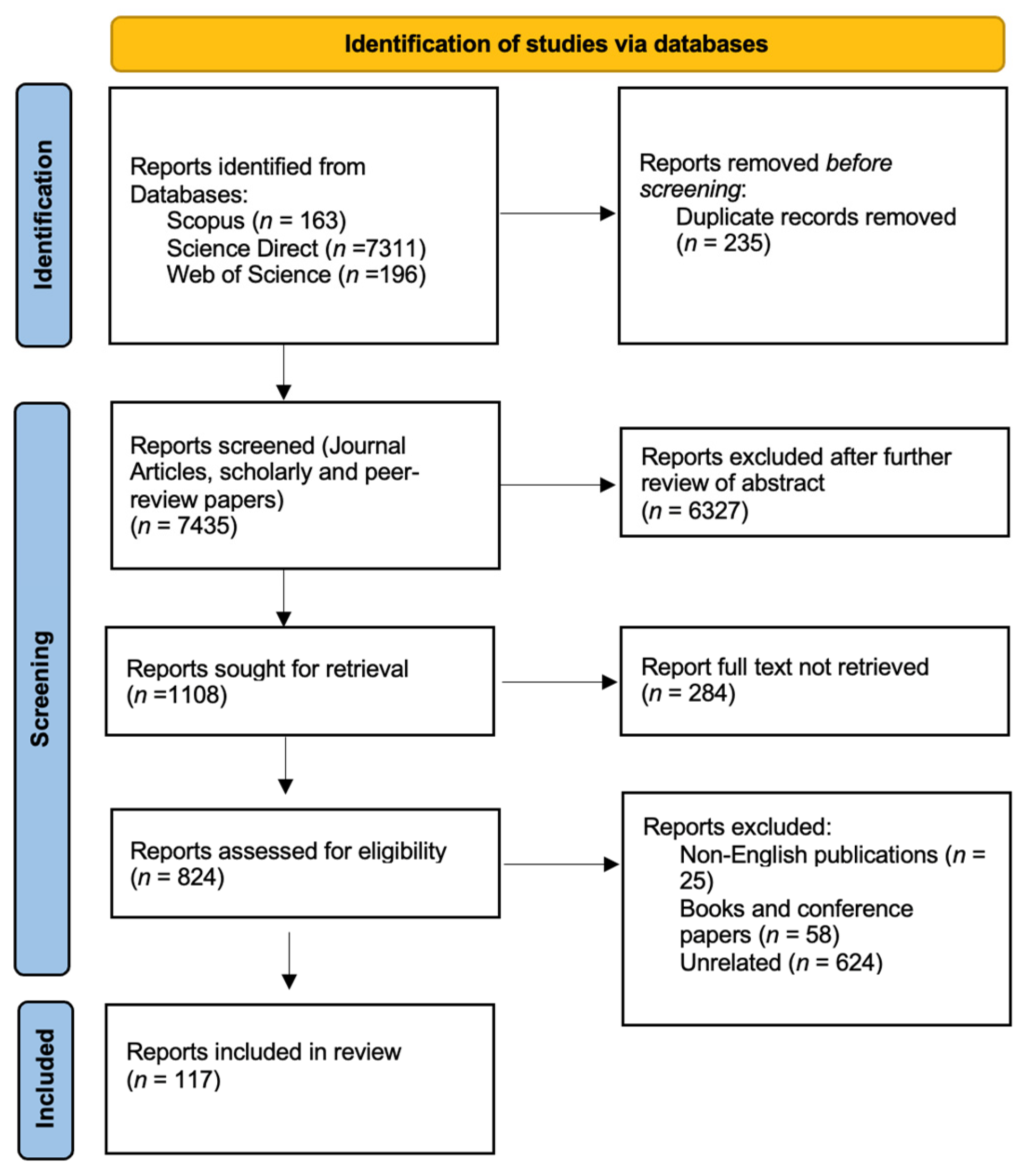
2.1. Literature Identification and Screening
- “Digital construction technologies”
- “BIM” OR “digital twin”
- “Sustainability compliance” OR “sustainability monitoring”
- “Construction management”
- “Embodied carbon” OR “material reuse” OR “waste diversion” OR “energy performance”
2.2. Structured Analytical Coding Procedure
- Publication year and study type;
- Primary sustainability compliance domain addressed;
- Dominant digital technology investigated;
- Lifecycle stage emphasis (design, procurement, construction, commissioning, operation);
- Construction management relevance;
- Reported sustainability verification limitation;
- Proposed digital monitoring or compliance mechanism.
2.3. Methodological Quality Appraisal and Interpretive Weighting
- Clarity of research objective;
- Adequacy of methodological description;
- Reliability of data sources;
- Direct construction management applicability;
- Specificity of digital technology application;
- Relevance to sustainability compliance verification.
2.4. Descriptive Evidence Mapping
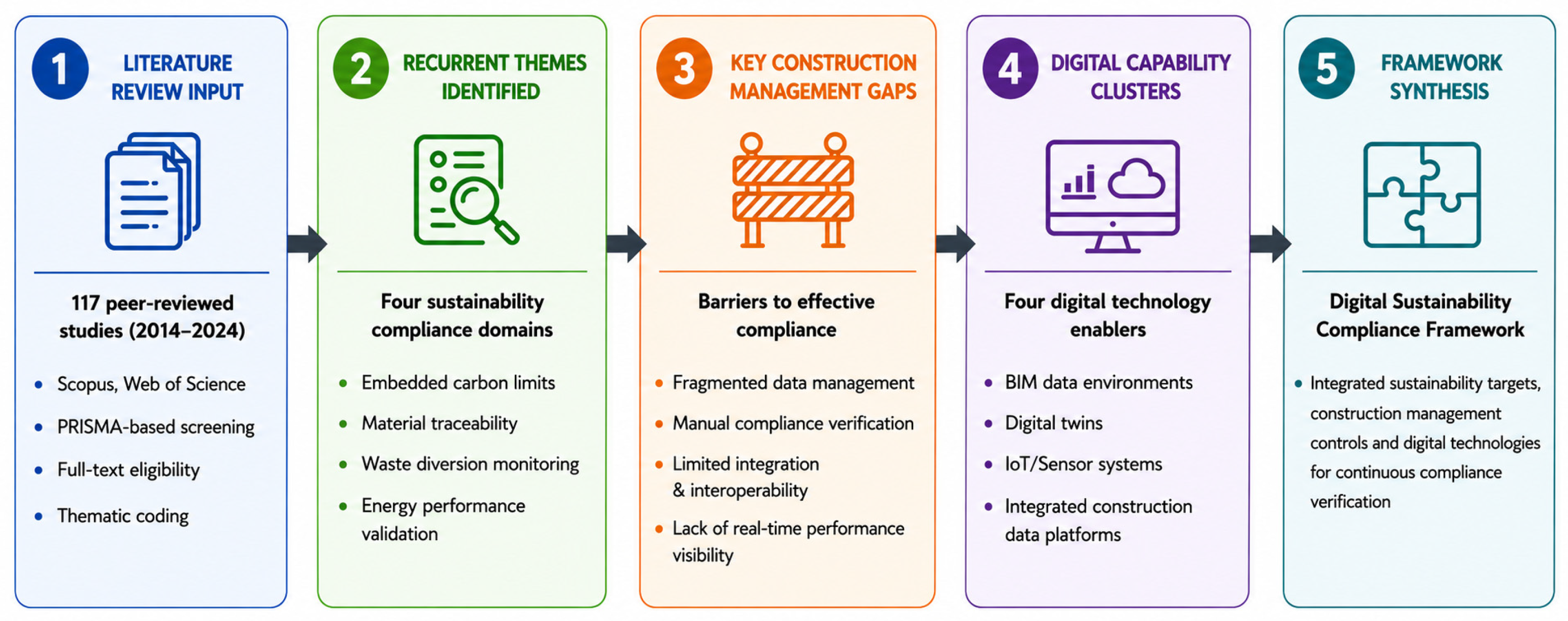
2.5. Comparative Thematic Synthesis
3. Descriptive Profile of the Reviewed Literature
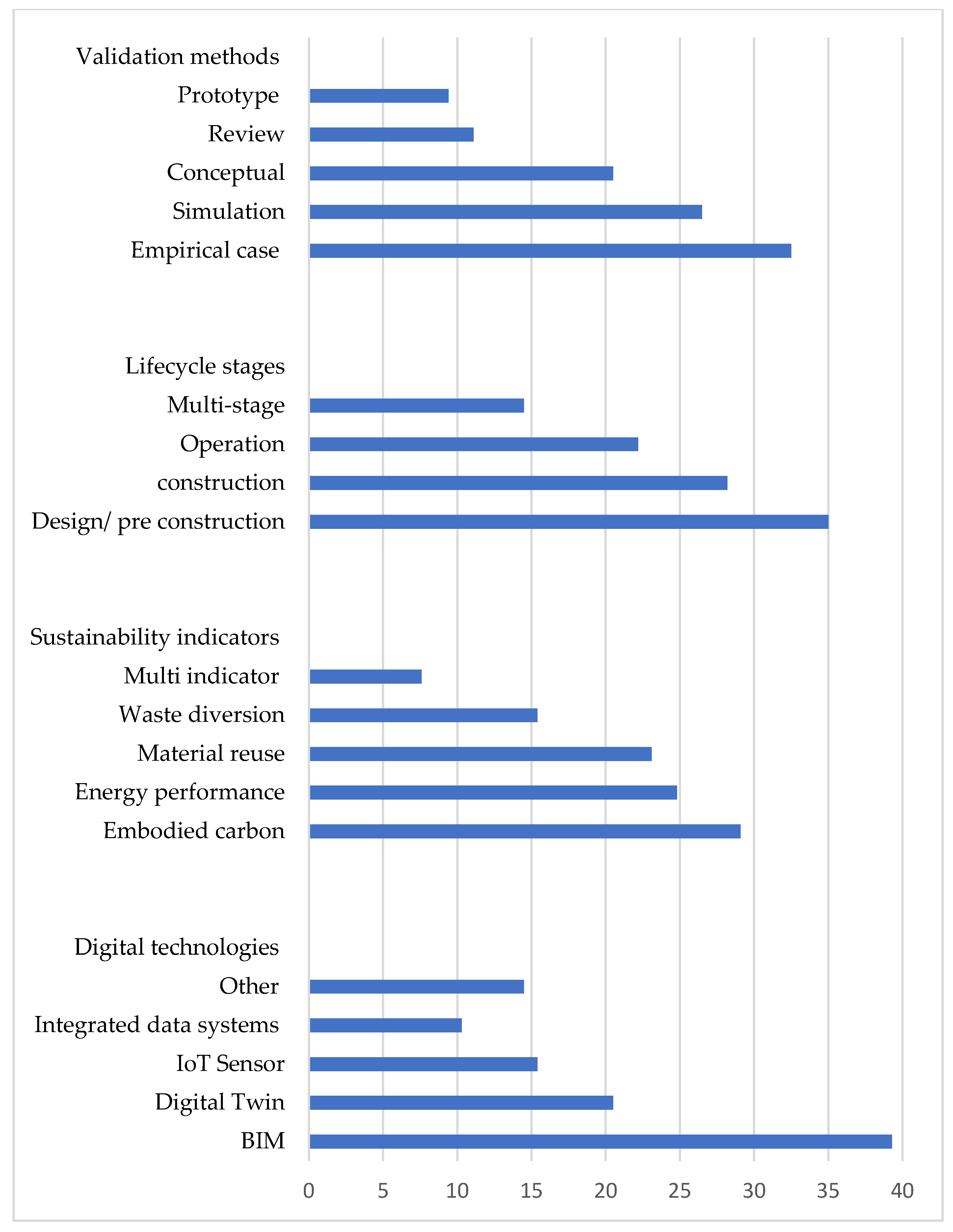
3.1. Distribution by Digital Technology Type
3.2. Distribution by Sustainability Compliance Domain
3.3. Distribution by Project Lifecycle Stage
3.4. Distribution by Study Validation Approach
4. Current Digital Technology Trajectories in Construction Sustainability Verification
5. Construction Management Verification Domains for Digital Sustainability Compliance
5.1. Embodied Carbon Verification
5.2. Material Reuse Traceability
5.3. Waste Diversion Monitoring
5.4. Energy Performance Validation
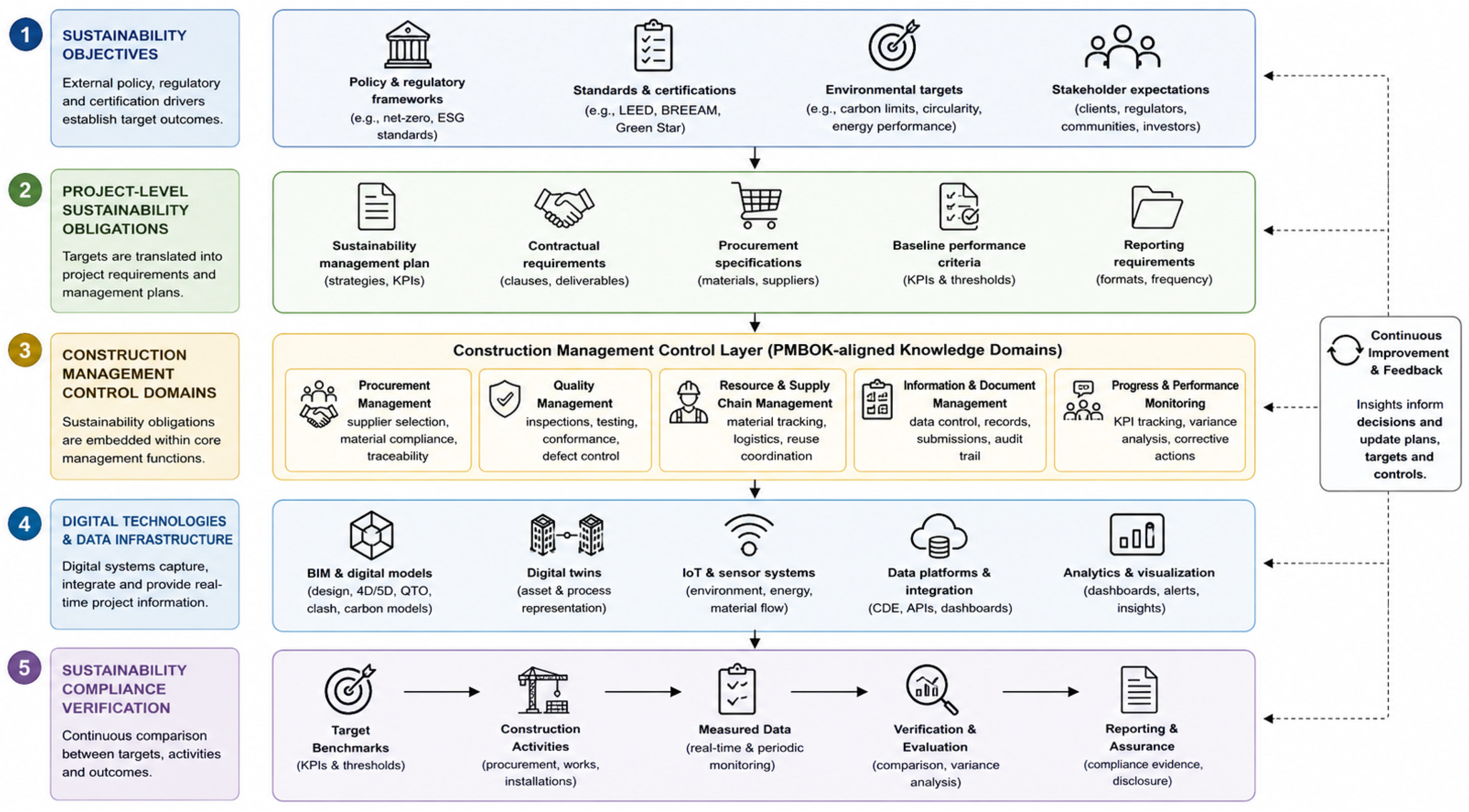
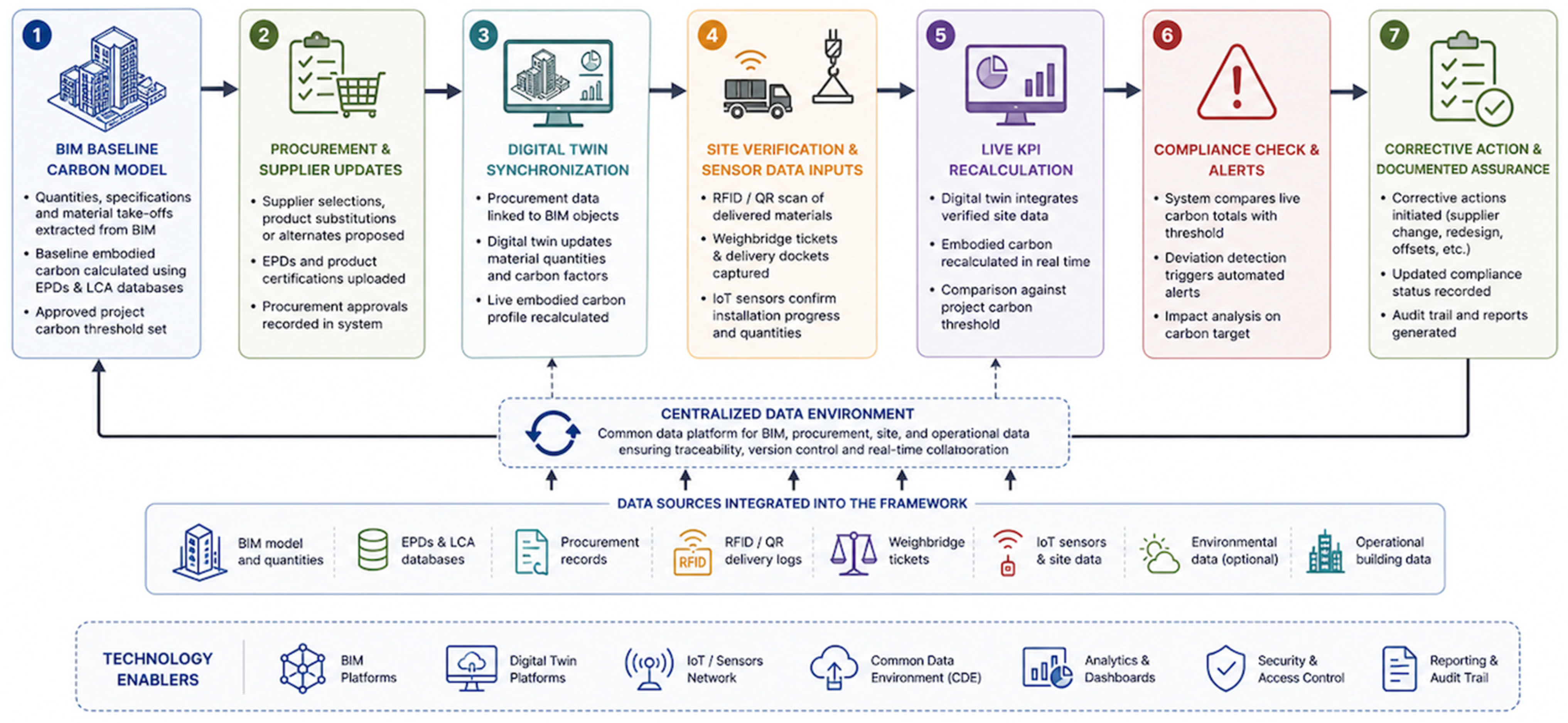
6. Digital Sustainability Compliance Framework
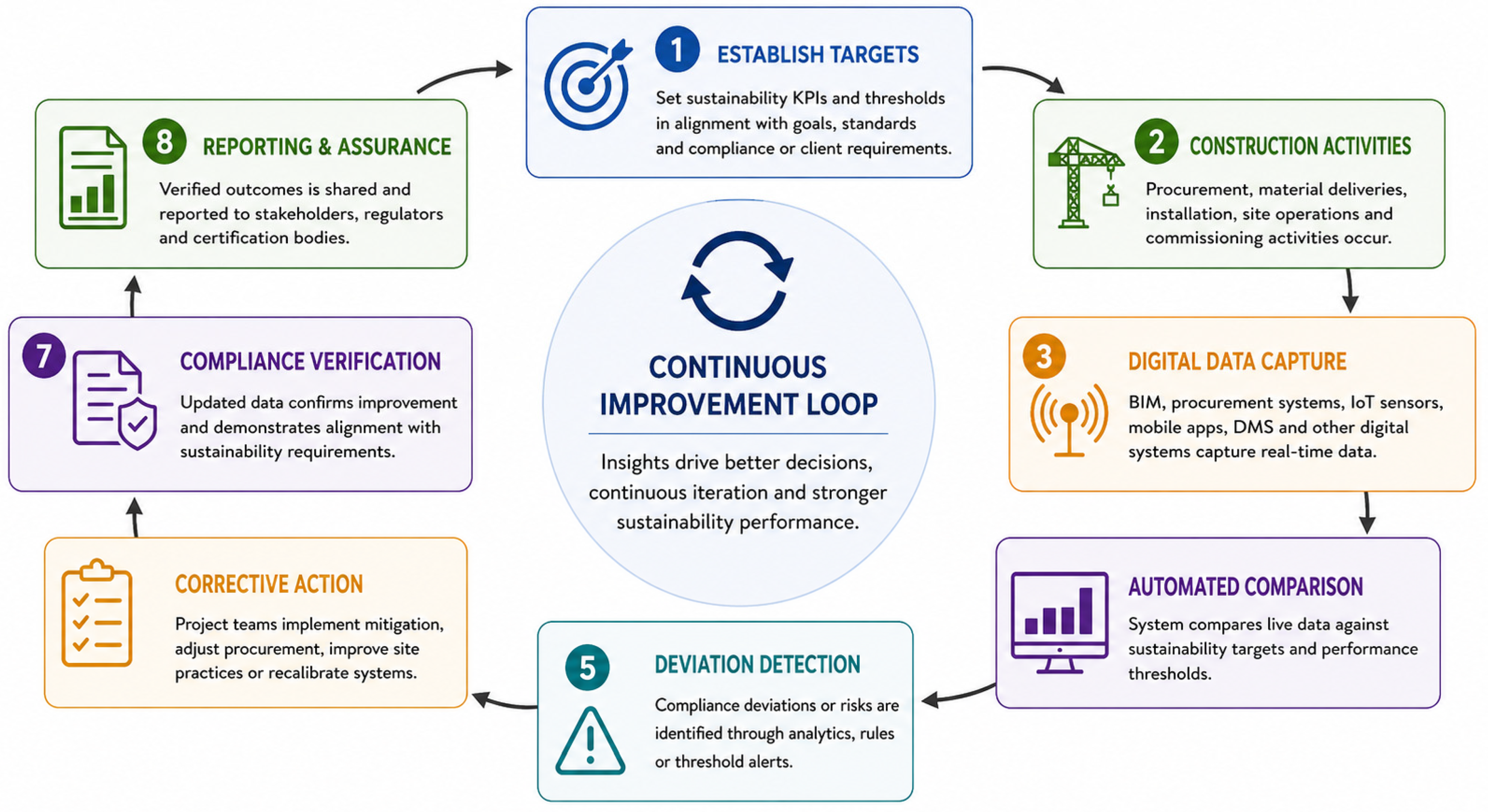
Illustrative Hypothetical Application of the Framework
7. Discussion
7.1. Sustainability Compliance as a Construction Management Control Challenge
7.2. Digital Technologies as Construction Governance Infrastructures
7.3. Implications of the Digital Sustainability Compliance Framework
7.4. Comparative Contribution to Existing Digital Sustainability Frameworks
7.5. Research Limitations and Future Research
8. Conclusions
Supplementary Materials
Author Contributions
Funding
Data Availability Statement
Conflicts of Interest
References
- Nemati Aghdam, M.; Dixit, M.K. A systematic review of methods and frameworks integrating environmental sustainability and resilience in building design and construction. Build. Environ. 2026, 293, 114381. [Google Scholar] [CrossRef] [Scilit]
- Dharmarathna, D.; Graham, P.; Bunster, V. Unpacking the evolution of Green Star rating tools and their certification trends in Australian building projects. J. Build. Eng. 2025, 111, 113328. [Google Scholar] [CrossRef] [Scilit]
- Global_Alliance_for_Buildings_and_Construction, U.N.E.P., Global Status Report for Buildings and Construction: Beyond Foundations–Mainstreaming Sustainable Solutions to Cut Emissions from the Buildings Sector. 2024. Available online: https://www.unep.org/resources/report/global-status-report-buildings-and-construction-20242025 (accessed on 22 January 2026).
- Intergovernmental_Panel_of_Climate_Change. Chapter 6: Cities, Settlements and Key Infrastructure. 2022. Available online: https://www.ipcc.ch/report/ar6/wg2/chapter/chapter-6/ (accessed on 20 January 2026).
- World_Green_Building_Council. The Net Zero Carbon Buildings Commitment. 2026. Available online: https://worldgbc.org/thecommitment/?_sfm_signatory_type=cities (accessed on 20 January 2026).
- Aigbavboa, C.; Kissi, E. 3–Understanding digital construction management. In Digital Management of Construction Costs; Woodhead Publishing: Sawston, UK, 2025; pp. 27–38. [Google Scholar] [CrossRef] [Scilit]
- Zou, X.; Tan, Y.; Zhang, G.; Hou, L. Bim-based sustainability analysis for building green retrofit: A systematic review. Energy Build. 2026, 354, 116982. [Google Scholar] [CrossRef] [Scilit]
- Padovano, A.; Sammarco, C.; Balakera, N.; Konstantinidis, F. Towards sustainable cognitive digital twins: A portfolio management tool for waste mitigation. Comput. Ind. Eng. 2024, 198, 110715. [Google Scholar] [CrossRef] [Scilit]
- Chen, Z.-S.; Chen, K.-D.; Govindan, K.; Antwi-Afari, M.F. Evaluating digital transformation readiness in prefabricated construction supply chains: A multi-level model and fairness-aware optimization approach. J. Ind. Inf. Integr. 2025, 45, 100831. [Google Scholar] [CrossRef] [Scilit]
- Zheng, B.; Yang, Y.; Chi, H.-L.; Luk, C.; Chan, A. Development of a BIM-based application for visualizing the reuse and recycling potential of modular building systems. J. Build. Eng. 2025, 45, 100831. [Google Scholar] [CrossRef] [Scilit]
- Aragón, A.; Alberti, M.G. Limitations of machine-interpretability of digital EPDs used for a BIM-based sustainability assessment of construction assets. J. Build. Eng. 2024, 96, 110418. [Google Scholar] [CrossRef] [Scilit]
- Dong, B.; Shahbaz, A.; Karavasilis, T.L. Integration of cyber-physical systems and digital twins in structural engineering: Applications, challenges and future advancements. J. Build. Eng. 2026, 119, 115259. [Google Scholar] [CrossRef] [Scilit]
- Xu, J.; Teng, Y.; Pan, W.; Zhang, Y. BIM-integrated LCA to automate embodied carbon assessment of prefabricated buildings. J. Clean. Prod. 2022, 374, 133894. [Google Scholar] [CrossRef] [Scilit]
- Huang, B.; Zhang, H.; Ullah, H.; Lv, Y. BIM-based embodied carbon evaluation during building early-design stage: A systematic literature review. Environ. Impact Assess. Rev. 2025, 112, 107768. [Google Scholar] [CrossRef] [Scilit]
- Munro, M.; Kanavaris, F.; Orr, J. A critical review of embodied carbon classification schemes for concrete. Case Stud. Constr. Mater. 2024, 21, e04021. [Google Scholar] [CrossRef] [Scilit]
- Dharmarathna, D.; Bunster, V.; Graham, P. Barriers and drivers of sustainable building adoption and influencing factor dynamics: A systematic review and meta-analysis. Renew. Sustain. Energy Rev. 2026, 226, 116361. [Google Scholar] [CrossRef] [Scilit]
- Liu, Z.; Zhou, L.; Qian, Q.K.; Visscher, H.; Zhang, G. Towards sustainable development: Analyzing policy frameworks and barriers in China’s green construction transition. Sustain. Energy Technol. Assess. 2025, 82, 104499. [Google Scholar] [CrossRef] [Scilit]
- Sotorrío Ortega, G.; Otero Seseña, S.; Cobo Escamilla, A.; Tenorio Ríos, J.A. Assessment of industrialised construction through sustainability tools. Results Eng. 2024, 24, 103663. [Google Scholar] [CrossRef] [Scilit]
- Opoku, A.; Deng, J.; Elmualim, A.; Ekung, S.; Hussien, A.A.; Buhashima Abdalla, S. Sustainable procurement in construction and the realisation of the sustainable development goal (SDG) 12. J. Clean. Prod. 2022, 376, 134294. [Google Scholar] [CrossRef] [Scilit]
- Green_Building_Council_Australia. Green Star in Focus. Available online: https://www.gbca.au/ (accessed on 20 January 2026).
- Taha, O.S.; Alshibani, A.; AlTuraik, A.S.; Mahmoud, M.A.; Mohammed, A.; Hassanain, M.A. Digital technologies and sustainability barriers in heavy construction: A structural equation modeling study on triple-bottom-line outcomes. Results Eng. 2025, 28, 107808. [Google Scholar] [CrossRef] [Scilit]
- Hong, T.; Koo, C.; Kim, J.; Lee, M.; Jeong, K. A review on sustainable construction management strategies for monitoring, diagnosing, and retrofitting the building’s dynamic energy performance: Focused on the operation and maintenance phase. Appl. Energy 2015, 155, 671–707. [Google Scholar] [CrossRef] [Scilit]
- Almeida, R.; Chaves, L.; Silva, M.; Carvalho, M.; Caldas, L. Integration between BIM and EPDs: Evaluation of the main difficulties and proposal of a framework based on ISO 19650:2018. J. Build. Eng. 2023, 68, 106091. [Google Scholar] [CrossRef] [Scilit]
- Abbas, A.; Din, Z.U.; Farooqui, R. Integration of BIM in Construction Management Education: An Overview of Pakistani Engineering Universities. Procedia Eng. 2016, 145, 151–157. [Google Scholar] [CrossRef] [Scilit]
- Hasselsteen, L.; Otovic, A.P.; Birgisdóttir, H.; Kanafani, K. Linking predictive modelling of site-level resource use with life cycle assessment of construction-phase emissions for managing carbon limits. Dev. Built Environ. 2026, 25, 100875. [Google Scholar] [CrossRef] [Scilit]
- Jaberi, M.; Dautremont, C.; Poirier, E.A. An evaluation of digital capabilities to enable a sustainable built asset industry: Developing a Consolidated Sustainability Matrix to inform digital use cases and practices. J. Build. Eng. 2025, 114, 114421. [Google Scholar] [CrossRef] [Scilit]
- Wang, W.; Hao, S.; He, W.; Mohamed, M.A. Carbon emission reduction decisions in construction supply chain based on differential game with government subsidies. Build. Environ. 2022, 222, 109149. [Google Scholar] [CrossRef] [Scilit]
- Institute, P.M. The Standard for Project Management and a Guide to the Project Management Body of Knowledge (PMBOK® Guide), 7th ed.; Project Management Institute: Newtown Square, PA, USA, 2021. [Google Scholar]
- Zhang, Q.; Li, J.; Du, B. Carbon emission transfer and shared responsibility allocation in the supply chain: Evidence from the construction sector in China. Sustain. Prod. Consum. 2025, 55, 285–296. [Google Scholar] [CrossRef] [Scilit]
- Yevu, S.K.; Owusu, E.K.; Chan, A.P.C.; Sepasgozar, S.M.E.; Kamat, V.R. Digital twin-enabled prefabrication supply chain for smart construction and carbon emissions evaluation in building projects. J. Build. Eng. 2023, 78, 107598. [Google Scholar] [CrossRef] [Scilit]
- World_Green_Building_Council. Bring Embodied Carbon Upfront. Coordinated Action for the Building and Construction Sector to Tackle Embodied Carbon. Available online: https://worldgbc.s3.eu-west-2.amazonaws.com/wp-content/uploads/2022/09/22123951/WorldGBC_Bringing_Embodied_Carbon_Upfront.pdf (accessed on 22 January 2026).
- Haigh, R. A game-theoretic approach to stakeholder decision-making in the adoption of composite materials in sustainable building design. Int. J. Constr. Manag. 2026, 1–18. [Google Scholar] [CrossRef] [Scilit]
- Ding, Z.; Wen, X.; Zuo, J.; Chen, Y. Determinants of contractor’s construction and demolition waste recycling intention in China: Integrating theory of planned behavior and norm activation model. Waste Manag. 2023, 161, 213–224. [Google Scholar] [CrossRef] [Scilit]
- Leon-Romero, L.P.; Aguilar-Fernandez, M.; Luque-Sendra, A.; Zamora-Polo, F.; Francisco-Marquez, M. Characterization of the information system integrated to the construction project management systems. Heliyon 2024, 10, e31886. [Google Scholar] [CrossRef] [Scilit]
- Zhao, Q.; Shi, H.; Zhou, L.; Lv, G. Automated BIM generation for MEP systems from CAD data using multi-drawing graph integration. Autom. Constr. 2025, 180, 106542. [Google Scholar] [CrossRef] [Scilit]
- Bibri, S.E.; Huang, J. AI and AI-powered digital twins for smart, green, and zero-energy buildings: A systematic review of leading-edge solutions for advancing environmental sustainability goals. Environ. Sci. Ecotechnol. 2025, 28, 100628. [Google Scholar] [CrossRef] [Scilit]
- Rodriguez-Amigo, A.; Fernandez-Alvarado, J.F.; Fernandez-Rodriguez, S. Case of study on a sustainability building: Environmental risk assessment related with allergenicity from air quality considering meteorological and urban green infrastructure data on BIM. Sci. Total Environ. 2022, 838, 155910. [Google Scholar] [CrossRef] [Scilit]
- Karapanagiotis, P.; Kottagaha, W.M.K.; Rovere, D.; Bokhorst, J.A.C.; Valdata, A.; Emmanouilidis, C. Enabling interoperable human–AI teaming for automation in construction and manufacturing via Digital Twins and Sliding Work Sharing ontologies. J. Ind. Inf. Integr. 2025, 48, 100962. [Google Scholar] [CrossRef] [Scilit]
- PRISMA. Welcome to PRISMA. Available online: https://www.prisma-statement.org/ (accessed on 15 January 2026).
- de Almeida Vittori Ferreira, M.; Morgado, C.; Estellita Lins, M.P. Organizations and stakeholders’ roles and influence on implementing sustainability requirements in construction projects. Heliyon 2024, 10, e23762. [Google Scholar] [CrossRef] [Scilit] [PubMed]
- Elmousalami, H.; Maxy, M.; Hui, F.K.P.; Aye, L. AI in automated sustainable construction engineering management. Autom. Constr. 2025, 175, 106202. [Google Scholar] [CrossRef] [Scilit]
- You, K.; Chen, K.; Xue, F. Automated scan-to-BIM for construction digital transformation: Conceptual framework, processing methods and best-practice guidelines. Autom. Constr. 2026, 182, 106755. [Google Scholar] [CrossRef] [Scilit]
- Zhang, W.; Wang, Z.; Yang, Z.; Cai, Z. BIM-based construction scheduling optimization through graph neural network-driven spatial semantic reasoning. J. Ind. Inf. Integr. 2026, 51, 101088. [Google Scholar] [CrossRef] [Scilit]
- Rehman, I.U.; Mazher, K.M.; Wuni, I.Y. Systematic review of 4D BIM benefits in construction projects. Results Eng. 2025, 28, 107091. [Google Scholar] [CrossRef] [Scilit]
- Guo, Q.; Su, S.; Gan, V.J.L.; Liu, C.; Feng, J.; Ding, W. Daily construction carbon emissions and costs assessment from an interaction perspective: Integration of BIM and agent-based modeling. Environ. Impact Assess. Rev. 2026, 116, 108109. [Google Scholar] [CrossRef] [Scilit]
- Cho, J.; Lee, J.; So, B.-D.; Kim, J.-H.; Yu, J.-D.; Yeon, J. BIM-driven digital risk twins for tunnel reinforcement maintenance. Autom. Constr. 2026, 182, 106710. [Google Scholar] [CrossRef] [Scilit]
- Chacón, R.; Posada, H.; Ramonell, C.; Jungmann, M.; Hartmann, T.; Khan, R.; Tomar, R. Digital twinning of building construction processes. Case study: A reinforced concrete cast-in structure. J. Build. Eng. 2024, 84, 108522. [Google Scholar] [CrossRef] [Scilit]
- Ma, T.; Xiao, F.; Zhang, C.; Zhang, J.; Zhang, H.; Xu, K.; Luo, X. Digital twin for 3D interactive building operations: Integrating BIM, IoT-enabled building automation systems, AI, and mixed reality. Autom. Constr. 2025, 176, 106277. [Google Scholar] [CrossRef] [Scilit]
- Yilei, H. A Review of Approaches and Challenges of BIM Education in Construction Management. J. Civ. Eng. Archit. 2018, 12, 401–407. [Google Scholar] [CrossRef] [Scilit]
- Haigh, R.; Ameri Sianaki, O. Traditional and Advanced Curing Strategies for Concrete Materials: A Systematic Review of Mechanical Performance, Sustainability, and Future Directions. Appl. Sci. 2025, 15, 11055. [Google Scholar] [CrossRef] [Scilit]
- Boje, C.; Guerriero, A.; Kubicki, S.; Rezgui, Y. Towards a semantic Construction Digital Twin: Directions for future research. Autom. Constr. 2020, 114, 103179. [Google Scholar] [CrossRef] [Scilit]
- Li, Z.; Zheng, H.; Liu, S.; Huang, W.; Ding, X.; Chen, X. Information scene-augmented mapping for smart bearing whole life cycle digital twin. J. Ind. Inf. Integr. 2026, 50, 101021. [Google Scholar] [CrossRef] [Scilit]
- Petri, I.; Amin, A.; Ghoroghi, A.; Hodorog, A.; Rezgui, Y. Digital twins for dynamic life cycle assessment in the built environment. Sci. Total Environ. 2025, 993, 179930. [Google Scholar] [CrossRef] [Scilit]
- Liew, E.F.Y.; Ong, D.E.L.; Peerun, M.I. Mapping the future of sustainable construction: Review on digitalisation and life cycle assessment trends in Asia-pacific. Energy Build. 2026, 350, 116547. [Google Scholar] [CrossRef] [Scilit]
- Haigh, R. A Life Cycle Assessment of HDPE Plastic Milk Bottle Waste Within Concrete Composites and Their Potential in Residential Building and Construction Applications. Urban Sci. 2025, 9, 116. [Google Scholar] [CrossRef] [Scilit]
- Kocaer, O. Environmental assessment of waste-derived materials in 3D concrete printing and cast-in-place construction through a BIM-integrated multi-scale life cycle assessment framework. J. Build. Eng. 2026, 120, 115554. [Google Scholar] [CrossRef] [Scilit]
- Parece, S.; Resende, R.; Rato, V. BIM-based life cycle assessment: A systematic review on automation and decision-making during design. Build. Environ. 2025, 282, 113248. [Google Scholar] [CrossRef] [Scilit]
- Haigh, R.; Sandanayake, M.; Bouras, Y.; Vrcelj, Z. A life cycle assessment of cardboard waste in low stress grade concrete applications. Environ. Manag. 2024, 354, 120428. [Google Scholar] [CrossRef] [Scilit]
- Parece, S.; Resende, R.; Rato, V. A BIM-based tool for embodied carbon assessment using a Construction Classification System. Dev. Built Environ. 2024, 19, 100467. [Google Scholar] [CrossRef] [Scilit]
- Muta, L.F.; Giuzio, G.F.; Melo, A.P.; Buonomano, A. Design misdirection: How BIM modeling granularity compromises energy performance assessment in integrated BIM-to-BEM workflows. Energy Build. 2026, 351, 116739. [Google Scholar] [CrossRef] [Scilit]
- Pei, W.; Wang, X.; Yuan, P.F.; Stouffs, R. From lifecycle material tracking to urban-scale material stock modeling: A tool for building material assessment from low-LOD BIM models. Resour. Conserv. Recycl. 2026, 226, 108659. [Google Scholar] [CrossRef] [Scilit]
- Yildizbasi, A.; Celik, S.E.; Arioz, Y.; Chen, Z.; Sun, L.; Ozturk, C. Exploring the synergy between circular economy and emerging technologies for transportation infrastructure: A systematic literature review. J. Clean. Prod. 2025, 486, 144553. [Google Scholar] [CrossRef] [Scilit]
- Gobbo, É.; Nia, E.M.; Straub, A.; Stephan, A. Exploring the effective reuse rate of materials and elements in the construction sector. J. Build. Eng. 2024, 98, 111344. [Google Scholar] [CrossRef] [Scilit]
- Zhu, H.; Huang, M.; Ji, P.; Xiao, F.; Zhang, Q.-B. Transforming the maintenance of underground infrastructure through Digital Twins: State of the art and outlook. Tunn. Undergr. Space Technol. 2025, 161, 106508. [Google Scholar] [CrossRef] [Scilit]
- Boje, C.; Hahn Menacho, Á.J.; Marvuglia, A.; Benetto, E.; Kubicki, S.; Schaubroeck, T.; Navarrete Gutiérrez, T. A framework using BIM and digital twins in facilitating LCSA for buildings. J. Build. Eng. 2023, 76, 107232. [Google Scholar] [CrossRef] [Scilit]
- Ren, Y.; Hu, Y.; Zhang, K.; Zhang, Y.; Qin, Z. Assessing the role of digital governance construction in sustainable development: Evidence from China’s resource-based cities. J. Environ. Manag. 2025, 393, 127058. [Google Scholar] [CrossRef] [Scilit] [PubMed]
- Amarasinghe, I.; Liu, T.; Stewart, R.A.; Mostafa, S. Paving the way for lowering embodied carbon emissions in the building and construction sector. Clean. Technol. Environ. Policy 2024, 27, 1825–1843. [Google Scholar] [CrossRef] [Scilit]
- Zhang, Y.-C.; Liu, J.-B.; Wang, S.-Y. The impact of carbon trading policy on embodied carbon emission in China’s construction Industry: Evidence from a quasi-natural experiment. J. Clean. Prod. 2025, 522, 146354. [Google Scholar] [CrossRef] [Scilit]
- Santos, A.K.; Ferreira, V.M.; Dias, A.C. Promoting decarbonisation in the construction of new buildings: A strategy to calculate the Embodied Carbon Footprint. J. Build. Eng. 2025, 103, 112037. [Google Scholar] [CrossRef] [Scilit]
- Robati, M.; Daly, D.; Kokogiannakis, G. A method of uncertainty analysis for whole-life embodied carbon emissions (CO2-e) of building materials of a net-zero energy building in Australia. J. Clean. Prod. 2019, 225, 541–553. [Google Scholar] [CrossRef] [Scilit]
- Abushama, K.; Hawkins, W.; Pelecanos, L.; Ibell, T. Optimisation of embodied carbon and construction cost of concrete, steel and timber piles. Dev. Built Environ. 2025, 22, 100656. [Google Scholar] [CrossRef] [Scilit]
- Pomponi, F.; Moncaster, A. Embodied carbon mitigation and reduction in the built environment—What does the evidence say? J. Environ. Manag. 2016, 181, 687–700. [Google Scholar] [CrossRef] [Scilit] [PubMed]
- Marcos-Martinez, R.; Soonsawad, N.; Emami, N.; Schandl, H.; Whitten, S.; Fasanella, Y.; Miatto, A. Embodied impacts of Australian building materials highlight trade-offs for sustainability policy. Cell Rep. Sustain. 2026, 3, 100580. [Google Scholar] [CrossRef] [Scilit]
- Ng, W.L.; Mulya, K.S.; Wong, K.Y.; Tan, H.; Bao, Z.; Chen, L.; Yap, P.S.; Jiang, P.; Woon, K.S. Decarbonization in green building rating systems: A systematic review on embodied and operational carbon credits. J. Environ. Manag. 2026, 401, 128757. [Google Scholar] [CrossRef] [Scilit]
- The Australian Government Submission to the United Nations Framework Convention on Climate Change. Available online: https://www.dcceew.gov.au/sites/default/files/documents/national-inventory-report-2023-volume-1.pdf (accessed on 24 January 2026).
- Abd El-Hameed, A.K. Digital technologies as supporting tools for resource circularity in the construction industry: A review reflecting on the building lifecycle. J. Build. Eng. 2025, 114, 114420. [Google Scholar] [CrossRef] [Scilit]
- Kathiravel, R.; Feng, H. Structural and embodied carbon performance optimization for low carbon buildings through BIM-based integrated design. J. Build. Eng. 2024, 98, 111008. [Google Scholar] [CrossRef] [Scilit]
- Geng, L.; Li, S.; Farsangi, E.N.; Xu, X.; Tam, V.W.Y. How do digital technologies reduce carbon emissions in the construction industry? A systematic review. Energy Build. 2026, 350, 116605. [Google Scholar] [CrossRef] [Scilit]
- Li, Y.; Pittau, F.; Masera, G. Global embodied carbon in buildings: Meta-analysis and science-based decarbonization through technological solutions. J. Build. Eng. 2026, 117, 114909. [Google Scholar] [CrossRef] [Scilit]
- Haigh, R. A Decade Review of Research Trends Using Waste Materials in the Building and Construction Industry: A Pathway towards a Circular Economy. Waste 2023, 1, 935–959. [Google Scholar] [CrossRef] [Scilit]
- Shooshtarian, S.; Wong, P.S.P.; Caldera, S.; Jayarathna, C.; Ryley, T.; Maqsood, T.; Zaman, A.; Caceres Ruiz, A.M. Circular economy policies and the use of recycled materials in the Australian built environment. J. Environ. Manag. 2025, 389, 126108. [Google Scholar] [CrossRef] [Scilit]
- Liu, J.; Ye, G.; Wu, P.; Li, Y.; Zhu, J. Material flow analysis of construction and demolition waste recycling under circular economy. Clean. Waste Syst. 2025, 11, 100303. [Google Scholar] [CrossRef] [Scilit]
- Haigh, R. A Review and Thermal Conductivity Experimental Program of Mattress Waste Material as Insulation in Building and Construction Systems. Constr. Mater. 2024, 4, 401–424. [Google Scholar] [CrossRef] [Scilit]
- Mahmoud, M.; Li, Y.; Adham, M.; Chen, W. Automated material-aware BIM generation using deep learning for comprehensive indoor element reconstruction. Autom. Constr. 2025, 175, 106196. [Google Scholar] [CrossRef] [Scilit]
- Aftab, U.; Agliata, R. Material passports for digital and circular construction: A bibliometric and thematic analysis. J. Clean. Prod. 2026, 543, 147651. [Google Scholar] [CrossRef] [Scilit]
- Çetin, S.; Raghu, D.; Honic, M.; Straub, A.; Gruis, V. Data requirements and availabilities for material passports: A digitally enabled framework for improving the circularity of existing buildings. Sustain. Prod. Consum. 2023, 40, 422–437. [Google Scholar] [CrossRef] [Scilit]
- Ajayi, S.O.; Oyedele, L.O.; Akinade, O.O.; Bilal, M.; Alaka, H.A.; Owolabi, H.A. Optimising material procurement for construction waste minimization: An exploration of success factors. Sustain. Mater. Technol. 2017, 11, 38–46. [Google Scholar] [CrossRef] [Scilit]
- Tavares Gomes, N.; Miranda de Souza Tavares, K.; da Silva Barroso, L.; de Castro Xavier, G.; Rangel Garcez de Azevedo, A.; Neves Monteiro, S.; Pinto Ribeiro, R. Application of construction and demolition waste in mortars and after heat treatment: A review. J. Mater. Res. Technol. 2026, 40, 3689–3720. [Google Scholar] [CrossRef] [Scilit]
- Chen, R.; Wu, H.; Li, J.; Wang, H.; Li, L.; Sun, L.; Ren, F. Identifying hundredfold carbon emission gaps in multiple resource recycling routes of construction waste via process and hybrid life cycle assessment. Waste Manag. 2025, 207, 115107. [Google Scholar] [CrossRef] [Scilit] [PubMed]
- Commission, E. EU Construction and Demolition Waste Protocol and Guidelines. Available online: https://ec.europa.eu/growth/content/eu-construction-and-demolition-waste-protocol-0_en (accessed on 22 January 2026).
- Cheng, B.; Huang, J.; Lu, K.; Li, J.; Gao, G.; Wang, T.; Chen, H. BIM-enabled life cycle assessment of concrete formwork waste reduction through prefabrication. Sustain. Energy Technol. Assess. 2022, 53, 102449. [Google Scholar] [CrossRef] [Scilit]
- Fazeli, A.; Mohandes, S.R.; LeNguyen, K.; Banihashemi, S. Advanced digital solutions for construction waste management: A 4D BIM integrated scenario analysis. Green Technol. Sustain. 2026, 4, 100318. [Google Scholar] [CrossRef] [Scilit]
- Su, S.; Yang, Y.; Besklubova, S.; Song, J.; Kong, X.T.R.; Zhong, R.Y. Digital Twin-Enabled Reverse Supply Chain for Building Demolition Waste Management. Comput. Ind. Eng. 2026, 211, 111605. [Google Scholar] [CrossRef] [Scilit]
- Su, S.; Yu, C.; Jiang, Y.; Kang, K.; Zhong, R.Y. Trading building demolition waste via digital twins. Autom. Constr. 2023, 156, 105105. [Google Scholar] [CrossRef] [Scilit]
- Zhaurova, M.; Horttanainen, M.; Child, M.; Soukka, R. Reducing indoor CO2 levels in office buildings via CCUS: An LCA perspective for energy and emission reduction. Energy Build. 2026, 357, 117133. [Google Scholar] [CrossRef] [Scilit]
- Khovalyg, D.; Berquand, C.A.; Vergerio, G.; Barthelmes, V.M.; Chatterjee, A.; Becchio, C.; Licina, D. Energy, SBS symptoms, and productivity in Swiss open-space offices: Economic evaluation of standard, actual, and optimum scenarios. Build. Environ. 2023, 242, 110565. [Google Scholar] [CrossRef] [Scilit]
- Yin, R.; Liu, J.; Piette, M.A.; Xie, J.; Pritoni, M.; Casillas, A.; Yu, L.; Schwartz, P. Comparing simulated demand flexibility against actual performance in commercial office buildings. Build. Environ. 2023, 243, 110663. [Google Scholar] [CrossRef] [Scilit]
- Cozza, S.; Chambers, J.; Deb, C.; Scartezzini, J.-L.; Schlüter, A.; Patel, M.K. Do energy performance certificates allow reliable predictions of actual energy consumption and savings? Learning from the Swiss national database. Energy Build. 2020, 224, 110235. [Google Scholar] [CrossRef] [Scilit]
- Desai, S.; Gunay, B.; Ouf, M.; Liu, W.; Coady, J. Rethinking building energy performance gap: A workflow for bridging measured, modeled, designed, and optimized strategies–a review with real-world examples. Energy Build. 2026, 355, 117065. [Google Scholar] [CrossRef] [Scilit]
- Almatared, M.; Abuhussain, M.; Andleeb, Z.; Bashir, F.M. Adaptive reinforcement learning algorithm for real-time energy optimization in building digital twins with heterogeneous IoT sensor networks. Autom. Constr. 2026, 182, 106714. [Google Scholar] [CrossRef] [Scilit]
- Liu, Z.; Li, M.; Ji, W. Development and application of a digital twin model for Net zero energy building operation and maintenance utilizing BIM-IoT integration. Energy Build. 2025, 328, 115170. [Google Scholar] [CrossRef] [Scilit]
- Murali, D.; Suresh, M.; Martin, H.; Raman, R. Aligning net zero carbon-built environments with sustainable development goals: Topic modelling approach to integrating technologies and policies. Build. Environ. 2025, 281, 113156. [Google Scholar] [CrossRef] [Scilit]
- Zhang, C.; Behrens, P.; Myers, R.J. Aligning circular economy and low-carbon economy for a sustainable built environment. Cell Rep. Sustain. 2026, 3, 100609. [Google Scholar] [CrossRef] [Scilit]
- Hasan, S.; Işık, Z.; Demirdöğen, G. A BIM-enabled framework for evaluating mega construction projects through sustainable development goal indicators. Ain Shams Eng. J. 2026, 17, 104148. [Google Scholar] [CrossRef] [Scilit]
- Kineber, A.F.; Singh, A.K.; Fazeli, A.; Mohandes, S.R.; Cheung, C.; Arashpour, M.; Ejohwomu, O.; Zayed, T. Modelling the relationship between digital twins implementation barriers and sustainability pillars: Insights from building and construction sector. Sustain. Cities Soc. 2023, 99, 104930. [Google Scholar] [CrossRef] [Scilit]
- Geremicca, F.; Fascetti, A.; Brigham, J.C.; Bilec, M.M. Digital twins for sustainable buildings: From framework to strategy guidelines and application. Energy Build. 2026, 359, 117332. [Google Scholar] [CrossRef] [Scilit]
- Nguyen, T.D.H.N.; Ly, D.H.; Jang, H.; Dinh, H.N.N.; Ahn, Y. Digital twin framework to enhance facility management for relocatable modular buildings. Autom. Constr. 2025, 176, 106249. [Google Scholar] [CrossRef] [Scilit]
- Gonçalves, M.; Freire, F.; Garcia, R. Understanding key factors driving circularity in plastic systems through material flow analysis: Findings from Portugal. J. Clean. Prod. 2026, 551, 147941. [Google Scholar] [CrossRef] [Scilit]




| Appraisal Criterion | Assessment Purpose | High/Moderate Satisfactory Studies (%) | Review Weighting Implication |
|---|---|---|---|
| Clear research objective | Explicit digital sustainability or construction management aim | 91% | retained for full synthesis |
| Adequate methodological transparency | Sufficiently described empirical/conceptual method | 84% | stronger evidentiary weighting |
| Reliable data/source basis | Empirical evidence, structured review basis, or validated framework logic | 79% | prioritised in analytical comparison |
| Construction management applicability | Direct relevance to project delivery/control systems | 76% | prioritised for framework development |
| Digital technology specificity | BIM, DT, IoT, data systems clearly operationalised | 88% | retained for technology synthesis |
| Sustainability verification relevance | Explicit monitoring/compliance/assurance discussion | 73% | prioritised in compliance domain coding |
| Sustainability Domain | Primary Construction Management Issue | Common Current Verification Method | Reported Limitation in Literature | Relevant Digital Technologies | Compliance Verification Opportunity |
|---|---|---|---|---|---|
| Embodied carbon | Procurement management, supplier approval, material substitutions, change control | Design-stage LCA reports, EPD documentation, supplier declarations | Static assessments become inaccurate when procurement changes occur during delivery | BIM-linked embodied carbon databases, procurement data integration, digital twins | Continuous carbon traceability against live procurement and installed material records |
| Material reuse | Resource coordination, procurement traceability, subcontractor compliance, supply chain documentation | Supplier certifications, recycled content declarations, manual sustainability submissions | Fragmented sourcing evidence and limited visibility of actual installed reused materials | BIM material passports, digital procurement records, supply chain databases | Real-time verification of reused/recycled material compliance across procurement and installation |
| Waste diversion | Site logistics, environmental quality management, contractor reporting, waste documentation | Weighbridge dockets, waste contractor reports, recycling certificates | Retrospective and fragmented reporting limits corrective intervention during construction | BIM waste forecasting, digital waste tracking systems, logistics-enabled digital twins | Continuous comparison between predicted waste generation and actual diversion outcomes |
| Energy performance | Commissioning assurance, systems verification, post-handover reporting, operational accountability | Design-stage simulation, periodic commissioning reports, post-occupancy audits | Persistent performance gap between modelled and measured outcomes | BIM-IoT integration, building digital twins, sensor analytics platforms | Continuous validation of measured energy performance against design sustainability targets |
| Analytical Variable | Category | Number of Studies (n) | Percentage (%) |
|---|---|---|---|
| Digital technology | BIM | 46 | 39.3 |
| Digital Twin | 24 | 20.5 | |
| IoT/Sensors | 18 | 15.4 | |
| Integrated data platforms | 12 | 10.3 | |
| Other/mixed digital systems | 17 | 14.5 | |
| Sustainability indicator | Embodied carbon | 34 | 29.1 |
| Energy performance | 29 | 24.8 | |
| Material reuse | 27 | 23.1 | |
| Waste diversion | 18 | 15.4 | |
| Multi-indicator reporting | 9 | 7.6 | |
| Lifecycle stage | Design/pre-construction | 41 | 35.0 |
| Construction execution | 33 | 28.2 | |
| Operation/post-handover | 26 | 22.2 | |
| Multi-stage integrated | 17 | 14.5 | |
| Validation method | Empirical case study | 38 | 32.5 |
| Simulation/model study | 31 | 26.5 | |
| Conceptual framework | 24 | 20.5 | |
| Review/comparative study | 13 | 11.1 | |
| Pilot prototype/demo | 11 | 9.4 |
| Existing Framework Category in the Literature | Dominant Digital Technology Orientation | Primary Lifecycle Stage Emphasis | Principal Analytical Focus | Limitation in Relation to Construction Management Sustainability Verification |
|---|---|---|---|---|
| BIM-based lifecycle assessment frameworks | BIM + embodied carbon/LCA databases | Design and pre-construction | Material carbon estimation, environmental simulation | Predominantly static design-stage analysis with limited verification once procurement and construction changes occur |
| BIM-based circular material and material passport systems | BIM + digital material inventories | Design, demolition, end-of-life planning | Material composition, reuse and recycling documentation | Narrow resource tracking focus with limited integration into project-wide management controls |
| Digital twin operational sustainability frameworks | Digital twins + IoT + building performance analytics | Post-handover and facility operation | Energy optimisation, occupancy analytics, building systems monitoring | Operationally focused with limited attention to construction-stage sustainability obligations |
| Digital construction monitoring systems | Site sensors, progress tracking, logistics platforms | Construction execution | Productivity, progress, logistics, site control | Sustainability KPIs are rarely treated as primary monitored variables |
| Standalone sustainability reporting/certification systems | Manual documentation platforms, audit reporting tools | Periodic project milestones | Compliance evidence submission and certification | Retrospective, document-heavy, and weak in real-time intervention capability |
| Proposed Digital Sustainability Compliance Framework | BIM + digital twins + sensor systems + integrated construction data platforms | Design → procurement → construction → commissioning → operation | Lifecycle sustainability governance and continuous compliance verification | Addresses fragmented monitoring across multiple construction management functions |
| Sustainability Indicator | PMBOK-Aligned Construction Management Knowledge Domain | Project Delivery Control Activity | Typical Manual Compliance Approach | Proposed Digital Verification Mechanism |
|---|---|---|---|---|
| Embodied carbon thresholds | Procurement management; Cost management; Integration management | Supplier selection, material substitutions, procurement approval, cost trade-offs | LCA documentation, EPD reviews, manual reporting | BIM carbon-linked procurement model with digital twin material updates |
| Material reuse targets | Resource management; Procurement management; Stakeholder management | Recycled material sourcing, subcontractor declarations, supply chain coordination | Supplier declarations, post-construction sustainability submissions | BIM material passports integrated with digital supplier records |
| Waste diversion rates | Quality management; Communications management; Resource management | Site waste logistics, contractor reporting, disposal documentation | Waste tickets, recycling certificates, periodic audits | Digital waste tracking linked to BIM quantities and logistics monitoring |
| Energy performance benchmarks | Quality management; Integration management; Risk management | Commissioning, systems testing, operational verification, occupancy monitoring | Design simulation and post-handover audit | BIM-IoT digital twin with live operational performance comparison |
Disclaimer/Publisher’s Note: The statements, opinions and data contained in all publications are solely those of the individual author(s) and contributor(s) and not of MDPI and/or the editor(s). MDPI and/or the editor(s) disclaim responsibility for any injury to people or property resulting from any ideas, methods, instructions or products referred to in the content. |
© 2026 by the authors. Licensee MDPI, Basel, Switzerland. This article is an open access article distributed under the terms and conditions of the Creative Commons Attribution (CC BY) license.
Share and Cite
Haigh, R.; Chan, M.; Yang, W. Digital Technologies for Lifecycle Sustainability Compliance Verification in Construction Management: A Systematic Review and Governance Framework. Buildings 2026, 16, 2113. https://doi.org/10.3390/buildings16112113
Haigh R, Chan M, Yang W. Digital Technologies for Lifecycle Sustainability Compliance Verification in Construction Management: A Systematic Review and Governance Framework. Buildings. 2026; 16(11):2113. https://doi.org/10.3390/buildings16112113
Chicago/Turabian StyleHaigh, Robert, Melissa Chan, and Wei Yang. 2026. "Digital Technologies for Lifecycle Sustainability Compliance Verification in Construction Management: A Systematic Review and Governance Framework" Buildings 16, no. 11: 2113. https://doi.org/10.3390/buildings16112113
APA StyleHaigh, R., Chan, M., & Yang, W. (2026). Digital Technologies for Lifecycle Sustainability Compliance Verification in Construction Management: A Systematic Review and Governance Framework. Buildings, 16(11), 2113. https://doi.org/10.3390/buildings16112113