Article

Research on Influencing Factors and Accident-Causing Mechanisms of Railway Cable-Stayed Bridge Construction Safety Based on Fuzzy DEMATEL-ISM

School of Civil Engineering, Central South University, Changsha 410083, China
*
Author to whom correspondence should be addressed.
Buildings 2026, 16(11), 2077; https://doi.org/10.3390/buildings16112077
Submission received: 11 March 2026 / Revised: 7 May 2026 / Accepted: 20 May 2026 / Published: 23 May 2026
(This article belongs to the Section Building Structures)

Abstract

Railway cable-stayed bridge construction is characterized by high complexity and substantial safety risk. Deficiencies in safety control may result in serious accidents (e.g., collapse and falls), causing significant casualties and economic losses; therefore, clarifying risk interactions and accident-causing mechanisms is essential. This study proposes a fuzzy DEMATEL–ISM approach in which fuzzy sets capture uncertainty in experts’ linguistic assessments. DEMATEL quantifies influence strengths and causal relationships among factors, and ISM constructs a multi-level hierarchy to explain accident causation. Twenty safety influencing factors are identified and grouped into five categories: management, human, material and equipment, construction technology, and environmental conditions. The obtained accident-causing mechanism comprises seven hierarchical levels: L1: collapse and fall accidents, L2: direct factors, L3–L5: indirect factors, and L6–L7: root factors. This mechanism is a chain of events that leads to an accident, with the nodes improper prestressing, structural deformation and differential settlement. These key nodes can be avoided by reinforcing safety management system implementation, daily supervision and inspection, and education and training on the subject of safety to ensure the safety of railway cable-stayed bridge construction.

1. Introduction

China features highly diverse geomorphological conditions, including plateau–valley terrains in western regions and dense river networks in the southeast. With the rapid expansion of the national railway network in recent years, increasingly stringent requirements have been imposed on the crossing capacity, structural adaptability, and construction efficiency of railway bridges [1]. Since the beginning of the 21st century, substantial progress has been achieved in railway cable-stayed bridge construction in China, with main spans exceeding 1000 m, which has promoted cable-stayed bridges as an important solution for long-span railway crossings [2,3]. Safety risks can arise at every stage of the building of a whole railway cable-stayed bridge, such as planning, design, construction, and maintenance, but this study focuses on the construction stage. With the rapid growth in project scale and span length, the difficulty and complexity of the construction process of railway cable-stayed bridge have also been increasing; during the construction stage, accidents such as equipment failures, components falling, and collapse of work platforms occur frequently, resulting in casualties and property damage [4].
Recent research on the risk management of railway cable-stayed bridge construction gathered results on establishing risk analysis methods, including expert survey scoring, AHP, sensitivity analysis, Monte Carlo simulation, Bayesian network analysis, social network analysis, meta-analysis and dynamics simulation [5,6,7,8,9,10,11]. However, this research is still limited to some extent. First, most traditional methods are highly reliant on the judgement of an expert, questionnaire evaluations, checklists, and listing of static factors, and the results might be influenced by subjective bias that limits their robustness and reproducibility [8,9]. Second, despite recent attempts to determine the interrelations between different factors of safety risks using correlation, social network analysis and simulation of system dynamics, the system of influencing factors in the case of railway cable-stayed bridge building is not fully explained yet, and the mechanism of accident causation remains poorly defined, especially in terms of the interdependence, causal connection, and propagation of multiple factors [10,11]. In response to these research gaps, this study introduces triangular fuzzy numbers into the DEMATEL-ISM framework to construct a fuzzy DEMATEL-ISM model [12]. A triangular fuzzy number is a three-parameter representation used to convert experts’ judgments into quantitative values while reflecting the uncertainty and vagueness inherent in subjective assessments, DEMATEL (Decision-Making Trial and Evaluation Laboratory) is used to quantify the strength and direction of causal relationships among influencing factors, and ISM (Interpretive Structural Modeling) is used to transform complex inter-factor relationships into a multi-level hierarchical structure. The fuzzy DEMATEL-ISM model identifies critical influencing factors, enabling the establishment of a multi-level factor structure to analyze accident mechanisms. The objectives of this study include: (1) the establishment of a safety influencing-factor system for the construction of railway cable-stayed bridges; (2) the determination of causes and effects based on fuzzy DEMATEL; (3) the presentation of the hierarchical transmission routes of accident occurrence by ISM; (4) demonstration of the applicability of the proposed framework through the ZJ extra-large cable-stayed bridge case.

2. Literature Review

Cable-stayed bridges are composite structural systems composed of three primary components, namely, pylons, main girders, and stay cables, and they are typically characterized as highly flexible and high-order statically indeterminate structures.
The deck system is mainly formed by a stiffened girder subjected mainly to compression and bending, while the supporting system is mainly formed by steel cables, where the stay cables are mainly under tension and the towers are mainly under compression. An essential feature of this type of bridge is that the stay cables anchored to the pylons act as elastic intermediate supports to the girder spans, reducing sectional bending moments, decreasing girder self-weight and increasing the span-carrying capacity of the main girder [13]. Due to the high degree of static indeterminacy and flexibility, the stress state and deformation response of cable-stayed bridges are very sensitive to construction conditions, temporary system transformations and external environmental disturbances. For railway cable-stayed bridges, construction control is closely associated with stay-cable force, structural deformation, and geometric alignment, which are the main parameters determining the structural state during construction and the final bridge configuration [3,13]. Studies on bridge construction safety management and construction-stage structural control have also emphasized that structural response, deformation, monitoring data, prestressing-related effects, material quality, operational processes, and construction-stage risks need to be effectively controlled to ensure construction-stage reliability and target structural performance [7,14]. Accordingly, systematic research on risk identification, assessment, and control for cable-stayed bridge construction is essential to improve construction safety and ensure the intended structural performance.
Currently, related research on the construction safety management of railway cable-stayed bridges mainly focuses on the following aspects. First, reliability-based and risk-ranking approaches have been used to support bridge safety assessment and maintenance decision-making. Mark G. Stewart et al. [15] summarized and ranked bridge-related risks and recommended time-dependent reliability analysis to support decisions on maintenance strategies and structural safety inspection. Second, multi-criteria evaluation methods have been widely applied to construct risk indicator systems and determine factor weights. Zhang Xiangqun et al. [16] employed the Analytic Hierarchy Process (AHP) combined with the Delphi method to quantify risk factors and establish a risk assessment model. Peng Keke [17] integrated AHP, the Delphi method, and cloud theory to build a risk indicator evaluation system considering construction conditions, construction techniques, operational management, and structural design. Third, uncertainty-oriented and data-driven methods have been introduced to improve the reliability of risk evaluation. Jelena M. Andric et al. [18] proposed an integrated framework combining the Fuzzy Analytic Hierarchy Process (FAHP), fuzzy knowledge representation, and fuzzy logic techniques to investigate bridge accidents and identify potential hazards. Li Qingfu et al. [19] collected construction-stage risk factors through questionnaires and expert consultation and applied factor analysis using SPSS22 to extract significant risk indicators.
To sum up, current studies have mainly concentrated on the identification and assessment of construction safety risks in railway cable-stayed bridges, whereas the interaction mechanisms and hierarchical propagation paths among influencing factors remain insufficiently characterized.

3. Materials and Methods

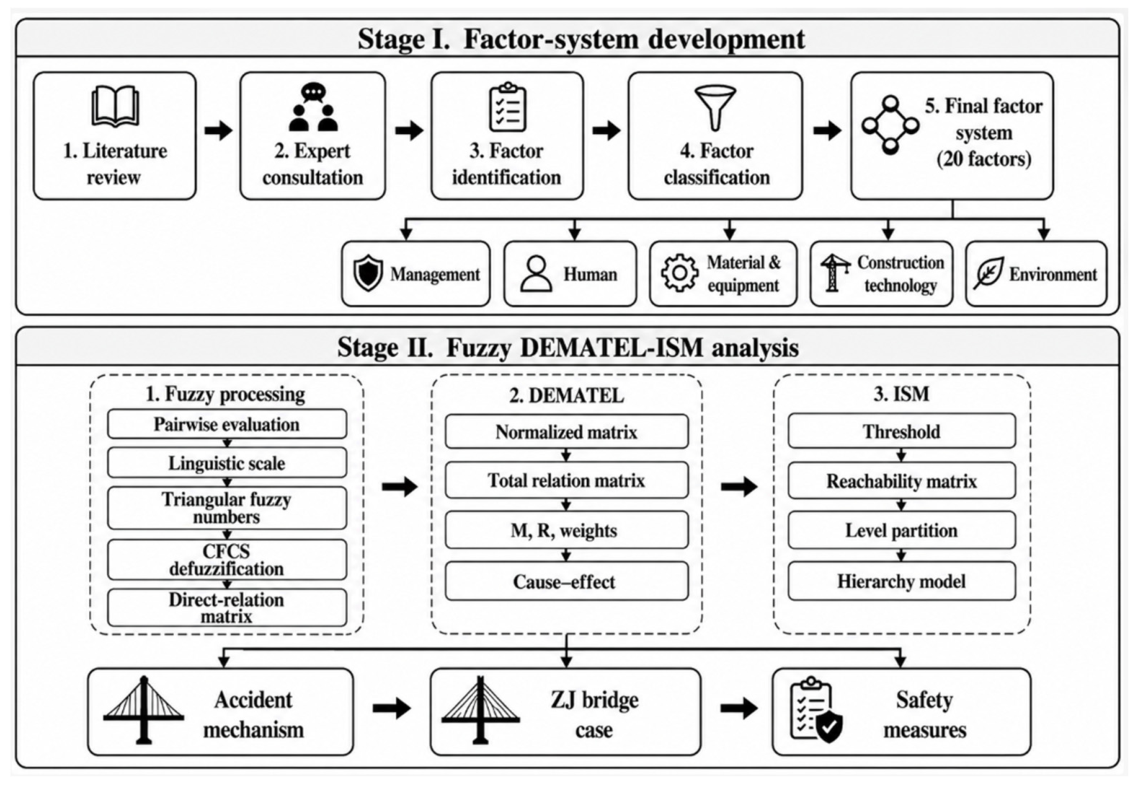
This study is based on a two-stage methodological model that will be used to explore the safety influencing factors and accident-causing mechanisms of railway cable-stayed bridge construction. In stage I, the candidate influencing factors are identified through a systematic literature analysis and then further narrowed down by consulting experts to come up with a complete set of factors. And in stage II, a fuzzy DEMATEL-ISM technique is utilized to model the intricate relationship between these factors and expose their hierarchical transmission mechanism. According to the defuzzified total relation matrix, DEMATEL is used to measure the strength and direction of inter-factor influences, as well as separate cause and effect groups, whereas ISM is applied to break down the system into a multi-level hierarchical structure. And a case analysis of the ZJ extra-large cable-stayed bridge is used to apply the fuzzy DEMATEL-ISM model. By this integrated framework, important driving forces and key nodes in the chain of accidents can be recognized, which offers an orientation-based foundation for specific safety control measures, and the overall methodology flow chart is presented in Figure 1.

3.1. Identification of Influencing Factors of Railway Cable-Stayed Bridge Construction Safety Based on Literature Analysis

To objectively identify the influencing factors of construction safety for railway cable-stayed bridges, a literature search was conducted using the CNKI, Web of Science, and Wanfang databases with keywords such as “railway cable-stayed bridge construction”, “safety influencing factors”, and “accident-causing mechanisms”. The literature was further screened according to the following criteria: First, the study object should be related to railway bridges, cable-stayed bridges, large bridge construction, or bridge construction safety management. Second, the study should provide explicit safety risk factors, accident-causing factors, construction hazard indicators, or risk evaluation indices that could be used for factor extraction. Third, the research content should be associated with the construction stage, while studies focusing solely on operation, maintenance, or post-disaster assessment without construction-stage relevance would be excluded. Fourth, duplicate publications, studies with vague factor definitions, and studies not directly related to construction safety would be removed. Based on these criteria, the retained studies were used to extract and summarize the preliminary safety influencing factors listed in Table 1.

3.2. Selection of Influencing Factors of Railway Cable-Stayed Bridge Construction Safety Based on Expert Interviews

To further refine and improve the initial list of influencing factors identified from the literature, an expert evaluation panel composed of 20 professionals was established, including government officials (4), university researchers (4), design institute engineers (2), construction company personnel (6), and representatives of the project owner (6).
Based on expert feedback, redundant or inappropriate factors were removed or adjusted. The final set of safety influencing factors for railway cable-stayed bridge construction is shown in Table 2, comprising 20 factors grouped into five categories: management, personnel, materials and mechanical equipment, construction technology, and environmental conditions.

3.3. Fuzzy DEMATEL-ISM Model

The Decision-Making Trial and Evaluation Laboratory (DEMATEL) method has been extensively applied for analyzing the relations between factors in complex systems. Based on the direct influence matrix, the indices including influence degree, dependence degree, prominence and causality are derived by DEMATEL to quantify the intensity and orientation of interactions and identify the critical influential factors in system [30,31]. The Interpretive Structural Modeling (ISM) is a systematic structural modeling approach for elucidating complicated relations between multiple factors in a hierarchical way. Relations between factors are converted into a reachability matrix, and the relative positions of factors are determined by research sets, preceding sets, and intersection sets. Thus, the multi-level structure of a complex is revealed and the direct, indirect and original influencing factors are distinguished. For construction safety analysis, the accidents are typically not induced by a single factor but by the progressive transmission and accumulation of multiple interactive factors; hence, the structural interpretation of how latent causes develop into intermediate unsafe conditions and eventually result in safety accidents is provided by ISM.
Despite their merits, both methods exhibit inherent limitations when applied independently. DEMATEL generally relies on experts’ pairwise scoring to construct the direct influence matrix; the elicited judgments may be affected by differences in expertise, experience, and cognitive uncertainty, which can introduce subjectivity into the quantified influence strengths. ISM, although effective in revealing hierarchical relationships, is essentially qualitative in nature and does not provide an explicit quantification of influence intensity between factors, which may limit the identification of dominant causal drivers under complex coupling conditions [32].
To address these limitations, this study integrates triangular fuzzy numbers into DEMATEL and combines the resulting fuzzy DEMATEL with ISM to form a fuzzy DEMATEL-ISM framework. Specifically, fuzzy sets are used to represent linguistic expert evaluations and to capture uncertainty in pairwise influence assessments; the fuzzy evaluations are then defuzzified using the CFCS (Converting Fuzzy Numbers into Crisp Scores) method to obtain more stable and objective influence scores [33]. On this basis, DEMATEL is employed to quantify influence strengths and determine causal attributes among factors, while ISM is applied to decompose the system into a multi-level hierarchical structure. The integration of DEMATEL and ISM is achieved through the total relation matrix obtained from DEMATEL. Specifically, DEMATEL first quantifies the direct and indirect influence strengths among factors and generates the total relation matrix, T. This matrix provides a quantitative basis for determining significant relationships among factors. ISM then uses the DEMATEL-derived matrix, together with a predefined threshold, to construct the reachability matrix and to decompose the factor system into hierarchical levels. In this way, DEMATEL identifies the causal intensity and cause–effect attributes of the factors, while ISM converts these quantified relationships into a structural hierarchy that reveals accident propagation paths. The integrated fuzzy DEMATEL-ISM approach simultaneously overcomes the limitation of DEMATEL in hierarchical structuring and the lack of ISM in influencing quantification, thereby enabling a more rigorous and comprehensive analysis of safety influencing mechanisms.

3.4. Establishment of Fuzzy DEMATEL Model

The steps for constructing a fuzzy DEMATEL model are as follows [34]:
Step 1: Construct the triangular fuzzy direct influence matrix.
First, experts were invited to score the strength of the relationships between influencing factors, as shown in Table 2.
Then, according to the scoring conversion standard (Table 3), the direct influence matrix, Ak, of triangular fuzzy numbers is obtained.
A k = 0 X 12 k X 1 j k X 21 k 0 X 2 j k X i 1 k X i 2 k 0
where k = 1, 2, 3,…, m; I = j = 1, 2,…, n; and Xijk(lijk, mijk, rijk) represents the triangular fuzzy number of the score given by expert “k” for the influence degree of factor i on factor j.
Step 2: CFCS method for defuzzification.
(1) Standardization of triangular fuzzy numbers:
a i j k = l i j k m i n l i k m i n m a x b i j k = m i j k m i n m i k m i n m a x c i j k = r i j k m i n r i k m i n m a x m i n m a x = m a x r i k m i n r i k
where (lijk, mijk, rijk) are the left value, middle value and right value of the initial triangular fuzzy number; (aijk, bijk, cijk) are the left value, middle value and right value of the triangular fuzzy function after standardization; and min max is the difference between the maximum right value and the minimum left value.
(2) Calculate the standard value of the left-side value, α i j k , and the standard value of the right-side value, β i j k :
α i j k = b i j k 1 + b i j k a i j k β i j k = c i j k 1 + c i j k b i j k
(3) Calculate the total value of standardization:
w i j k = α i j k · 1 α i j k + β i j k 2 1 α i j k + β i j k
(4) Calculate the clear value, the average clear value and the direct influence matrix:
z i j k = min l i j k + w i j k · m i n m a x z i j = k = 1 m z i j k m B = z i j n × n
In the equation, zijk is the fuzzy clear value of the score given by expert “k” for the influence degree of factor i on factor j, zij is the average value of the fuzzy clear value of the score given by all experts, and B is the direct influence matrix.
(5) Calculate the direct influence matrix after fuzzification of the specification:
ε = m a x 1 < i < n j = 1 n z i j D = 1 ε Z
where ε is the maximum value of the sum of each row of elements in matrix B and D is the direct influence matrix after norm fuzzy transformation.
(6) Calculate the comprehensive influence matrix T:
T = D · I D 1
(7) Calculate the measurement elements and draw the causal relationship diagram of influencing factors:
D i = j = 1 n t i j , ( i = 1 ,   2 , , n ) C i = i = 1 n t i j , ( j = 1 ,   2 , , n ) M i = D i + C i R i = D i C i
where Di is the influence degree, Ci is the affected degree, Mi is the centrality degree, and Ri is the cause degree.

3.5. Establishment of ISM Model

(1) Establish the overall influence matrix, H, and the reachable matrix, X:
H = T + I x i j = 1 , h i j λ 0 , h i j < λ ( i , j = 1 ,   2 , , 3 ) X = x i j n × n
In the equation, λ is the threshold, which is usually taken as the sum of the means and standard deviations of all elements in the comprehensive influence matrix, T.
(2) Calculate the reachable matrix, U, preceding set, V, and intersection set, W:
U F i = F i | F i F , x i j 0 V F i = F i | F i F , x i j = 0 W F i = U F i V F i
When U(Fi) = W(Fi), the corresponding rows and columns are removed from the reachable matrix, X, until all influencing factors are drawn out, and the above repeated operation is stopped and a multi-level hierarchical structure model is drawn.

4. Model-Based Analysis of Safety Influencing Factors and Accident-Causing Mechanisms

It should be noted that the results presented in this section are not derived from a single bridge case; they are obtained from the 20-factor safety influencing system established in Section 3 and the expert evaluations of railway cable-stayed bridge construction safety. The results should be interpreted as general causal relationships and reflecting the relative importance of safety influencing factors in railway cable-stayed bridge construction. They can provide a general reference for typical railway cable-stayed bridge projects. However, these numerical values should not be regarded as invariable constants for all projects. For railway cable-stayed bridges constructed under special conditions, such as extreme climatic environments, high-altitude areas, or special construction methods, the direct influence matrix should be adjusted according to project-specific expert judgments, and the corresponding DEMATEL-ISM results may need to be recalibrated.

4.1. DEMATEL Analysis of Influencing Factors of Railway Cable-Stayed Bridge Construction Safety

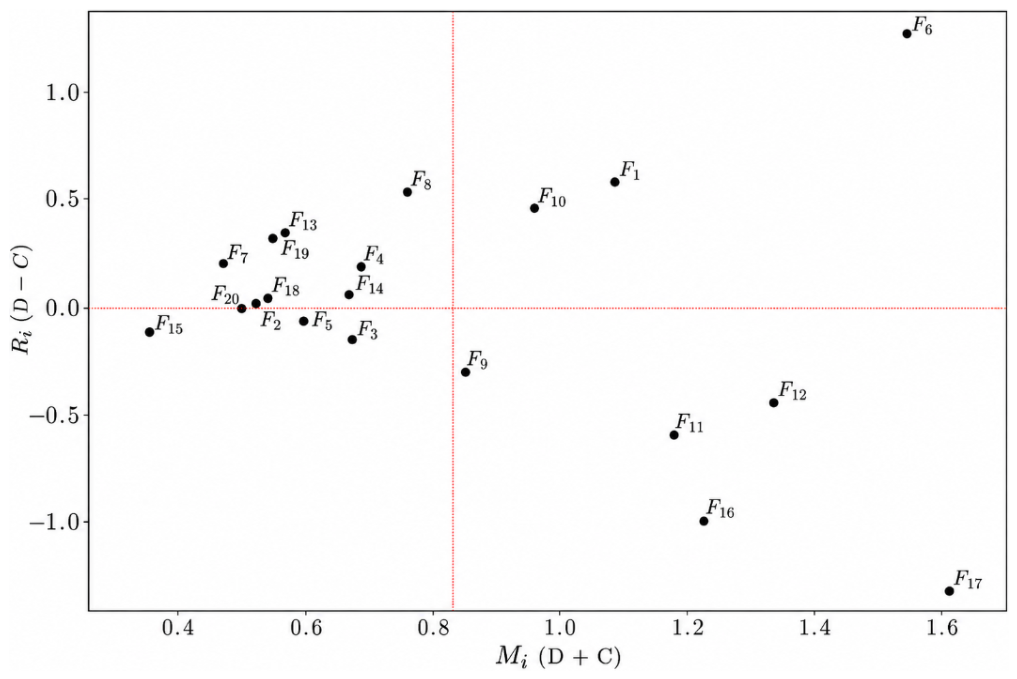
According to Equation (7), the comprehensive influence matrix, T, is obtained, and then the “four degrees” of influencing factors for railway cable-stayed bridge construction safety are calculated by using Equation (8). The results are shown in Table 4, and a Cartesian coordinate system diagram of the safety impact factors for railway cable-stayed bridge construction is presented (Figure 2). In Table 4, the weight reflects the relative importance of each factor in the overall influencing-factor system, and the sequence represents the descending ranking of factors according to their weights: a smaller sequence number indicates a higher relative importance. And in Figure 2, the horizontal axis represents the prominence degree, Mi, whereas the vertical axis represents the causal degree, Ri, Factors with positive Ri values are classified as cause factors, while factors with negative Ri values are classified as result factors.
It should be noted that, in Figure 2, the horizontal red reference line represents Ri = 0, which separates cause factors from result factors, and the vertical red reference line represents the average prominence degree of all factors, which is 0.8344. Factors located to the right of this vertical line have above-average prominence and therefore play more important roles in the overall system.
From Table 4 and Figure 2, it can be concluded that the influencing factors located in the first and second quadrants are cause factors. Among them, the top three in terms of influence are the implementation of regulations (F6), untimely supervision (F1), and operational level (F10). These factors have significant impacts on the entire system. The implementation of regulations (F6) ranks first with an influence degree of 1.40256. The influencing factors located in the third and fourth quadrants are result factors. The factors with larger absolute values are structural deformation (F17) and improper prestressing (F16). These two result factors are highly sensitive to changes in the cause factors, hence the need to pay sufficient attention during the management process to ensure the safety of railway cable-stayed bridge construction.
Overall, the DEMATEL results indicate that management and human factors are the main driving factors, whereas construction technology factors are more likely to appear as direct result factors in the accident chain. This pattern is considered generally applicable to typical railway cable-stayed bridge construction because it reflects common organizational, behavioral, technical, and environmental characteristics of such projects. Nevertheless, for projects exposed to extreme environments or unusual construction constraints, the relative influence values may change, and additional project-specific factors should be incorporated into the evaluation when necessary.

4.2. Multi-Level Hierarchical Structure Analysis of Influencing Factors in Railway Cable-Stayed Bridge Construction Safety

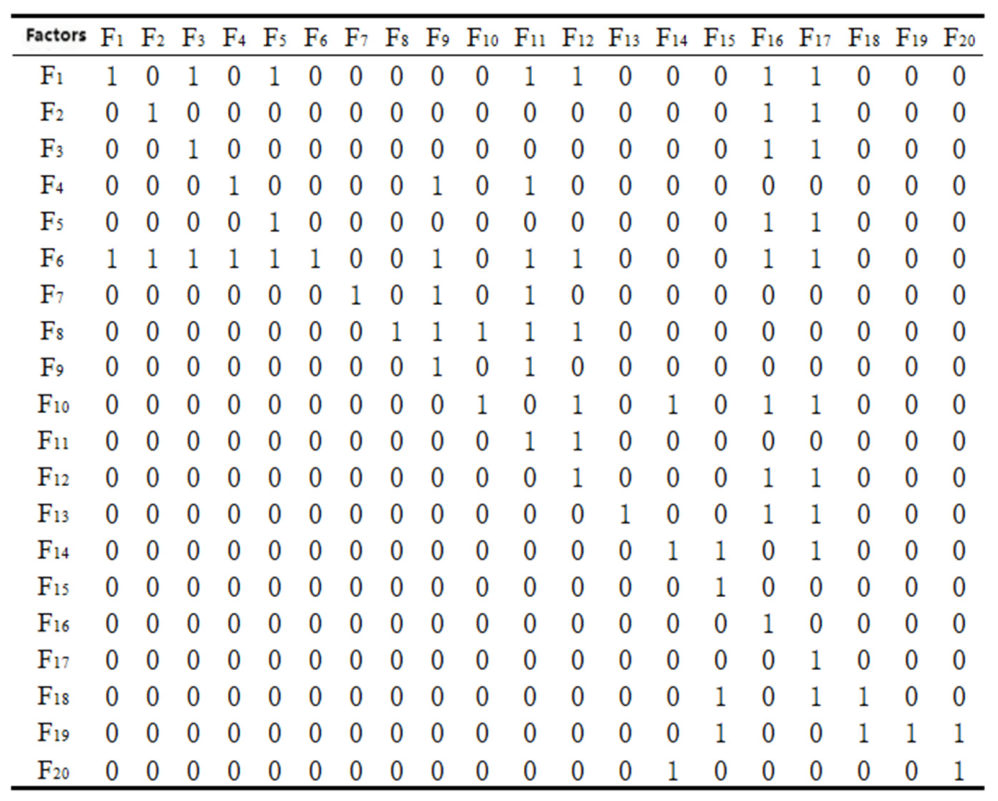
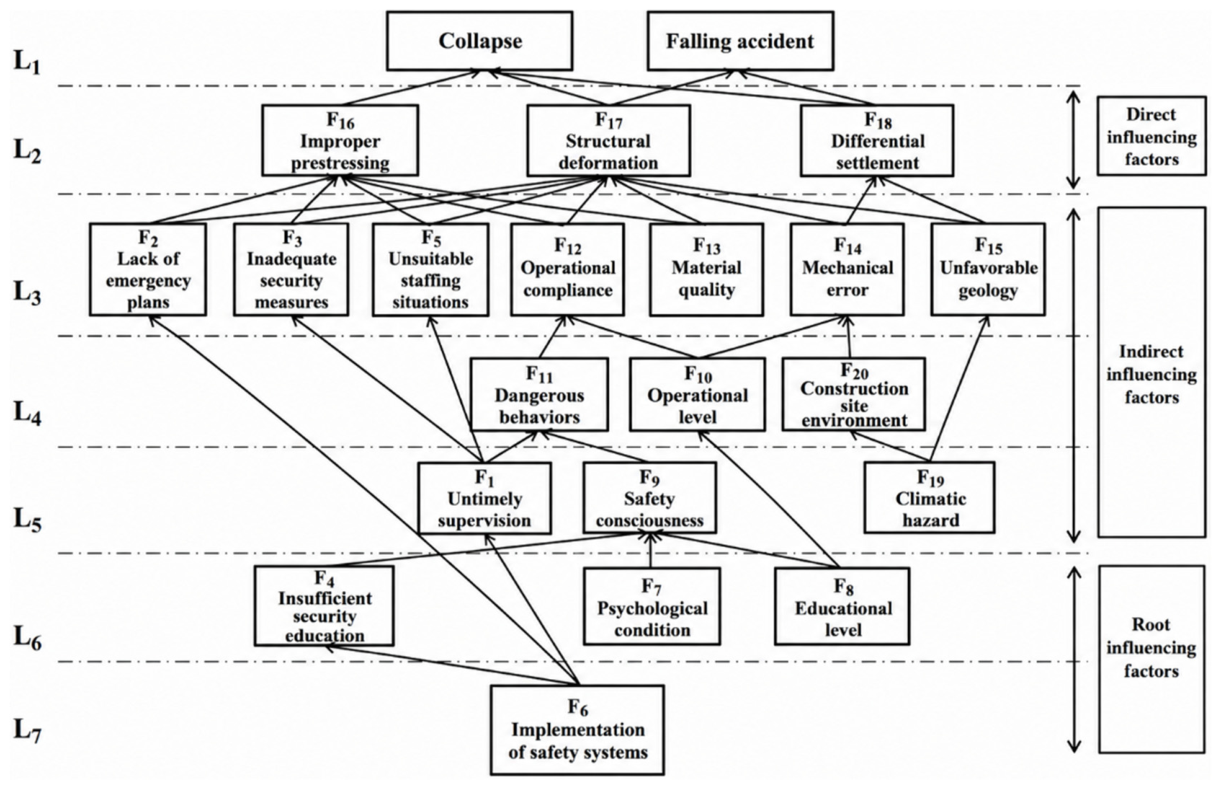
The comprehensive influence matrix, T, is calculated using Equation (7), and the overall influence matrix, H, and threshold are determined using Equation (9). Based on H, the reachable matrix, X, is obtained, as shown in Figure 3. Subsequently, according to Equation (10), the reachable set, U; the preceding set, V; and the intersection set, W, are calculated and used to adjust the multi-level hierarchical structure model for analyzing safety impacts on railway cable-stayed bridge construction [34], which helps in exploring and explaining the mechanisms of accident causation, as illustrated in Figure 4. This model consists of seven levels. By thoroughly discussing the impact of each level on safety incidents on railway cable-stayed bridges and the hierarchical effects of influencing factors at each level, the levels are merged and summarized: L1 represents safety accidents; L2 to L7 represent influencing factors, which are further categorized into three types based on their impact on safety accidents: direct influencing factors (L2), indirect influencing factors (L3 to L5), and root influencing factors (L6 to L7).
Regarding the accident-causing mechanisms, root influencing factors (F4: insufficient security education, F6: implementation of safety systems, F7: psychological condition, and F8: educational level) have a fundamental impact on the occurrence of safety accidents. Indirect influencing factors serve as a bridge between different aspects of the system, involving numerous factors listed in Table 2, except for construction technology. Direct influencing factors are the most direct causes of safety accidents during railway cable-stayed bridge construction, including F16 (improper prestressing), F17 (structural deformation), and F15 (differential settlement). The formation of direct influencing factors stems from the continuous accumulation and progressive effects of indirect and root influencing factors. For safety management personnel, if both root and indirect influencing factors can be identified and eliminated in advance, accidents will be reduced effectively.
As shown in Figure 4, the occurrence of construction safety accidents on railway cable-stayed bridges is the result of safety influencing factors accumulating through the chain of causes in the system. Safety management personnel should focus on key nodes in the causal chain (such as improper prestressing, structural deformation, and differential settlement) and develop targeted measures to reduce the occurrence of construction safety accidents.
Based on the DEMATEL analysis results in Table 4, the causal distribution in Figure 2, and the ISM hierarchical accident-causing mechanism in Figure 4, the strict implementation of safety management systems is a fundamental measure for preventing safety accidents during the construction of railway cable-stayed bridges. In addition, safety education and training should be strengthened to enhance the safety awareness of workers, while daily supervision and inspection should be intensified to reduce unsafe behaviors and non-compliant operations. Safety managers should ensure that construction workers possess sufficient technical skills, a stable psychological state, and sufficient educational and training backgrounds. Through the above measures, the root and indirect influencing factors can be controlled before they evolve into direct accident-causing factors, thereby supporting the safety of the construction stage.

5. Case Analysis

5.1. Project Overview

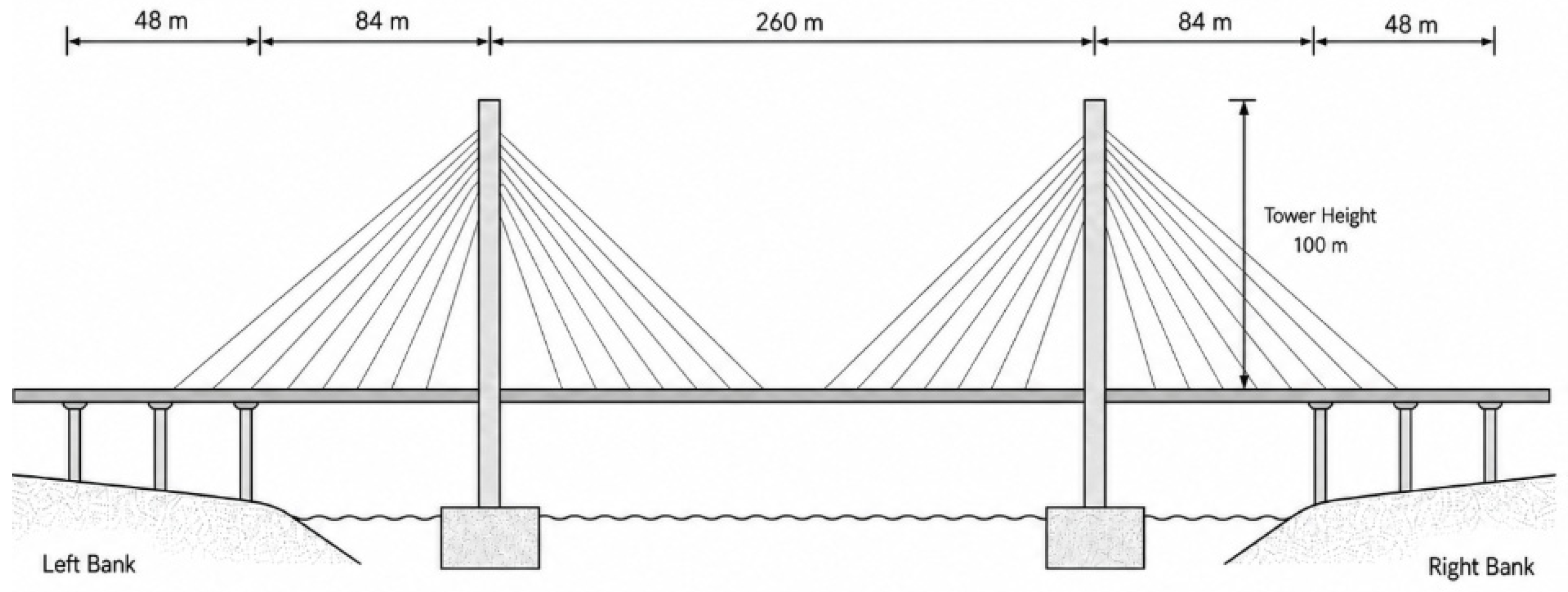
In this section, the ZJ extra-large cable-stayed bridge is selected as an application case to illustrate the practical use of the accident-causing mechanism identified in Section 4. The ZJ extra-large cable-stayed bridge has a total length of 2569 m and a double-track configuration with a track spacing of 5.0 m. The design speed is 350 km/h. The main bridge consists of a (48 + 84 + 260 + 84 + 48) m concrete cable-stayed system with twin towers and twin cable planes, featuring a 260 m main span and 100 m high H-shaped pylons. A schematic figure of the ZJ extra-large cable-stayed bridge is shown in Figure 5.

5.2. Identification of Construction Safety Influencing Factors

For the application of the proposed accident-causing mechanism to the ZJ extra-large cable-stayed bridge, the general influencing-factor system presented in Table 2 was adopted as the analytical basis. The case-applicable safety influencing factors were identified by comprehensively considering the DEMATEL-based importance and cause–effect results presented in Table 4 and Figure 2, the hierarchical transmission relationships illustrated in Figure 4, and the structural and construction characteristics described in Section 5.1. Accordingly, the safety influencing factors requiring priority control in the case project were determined through expert consultation, as summarized in Table 5. The factor identification for this case was not a direct repetition of the general factor system but a project-specific screening and refinement process under the proposed research framework.

5.3. Construction Safety Measures and Application Results

According to the mechanism of construction safety accidents for railway cable-stayed bridges proposed in this paper, the safety management personnel of the project deeply studied the causes of safety accidents and formulated effective safety guarantee measures based on an actual situation, as shown in Table 6.
The ZJ extra-large cable-stayed bridge project department rigorously adhered to the principle of safety and prevention foremost and established a dedicated safety production leadership team responsible for continuous on-site supervision and inspection. This organizational structure ensured clear accountability for safety performance and facilitated the effective enforcement of safety management protocols. Based on the specific technical and organizational characteristics of the project, systematic and comprehensive safety training programs were delivered to all managerial and operational personnel. These training programs were introduced as specific actions that are associated with the main outcomes of the fuzzy DEMATEL-ISM analysis. The model findings revealed that lack of safety education (F4), introduction of safety systems (F6), psychological status (F7) and educational level (F8) were root influencing factors, while safety consciousness (F9) and operational compliance (F12) were closely related result factors in the chain of accident-causing factors. Hence, the reinforcement of safety education and standardized operation training was aimed at managing the root factors that affected the safety awareness, hazard identification, and compliance behavior among workers. As per the project safety management records, there were no cases of safety accidents or serious injuries during the construction of the ZJ extra-large cable-stayed bridge, which implies that these measures offered practical assistance to enhance on-site control over safety.
In parallel, all special operations personnel were formally registered and required to maintain valid certifications, which were regularly reviewed under a dedicated supervisory mechanism. To eliminate risks associated with material defects and mechanical equipment failures, the project department assigned specialized personnel to oversee the procurement, supply, and quality assurance of construction materials and machinery. Robust control measures were implemented across the entire lifecycle, including design, manufacturing, transportation, assembly, commissioning, and routine maintenance, thereby substantially reducing the probability of equipment-related safety incidents.
These targeted and comprehensive safety interventions collectively contributed to the effective implementation of safety management systems and created a proactive safety culture within the project team. Safety managers and frontline workers demonstrated markedly improved risk perception, safety accountability, and compliance behavior. As a direct outcome, no safety accidents or severe injuries occurred throughout the entire construction of the ZJ extra-large cable-stayed bridge, despite the project’s complex construction environment and high-risk operational activities. Furthermore, all construction activities were completed on schedule, indicating that the safety management framework not only ensured worker protection but also supported the project’s overall efficiency, stability, and organizational performance.
These results confirm the practical value and applicability of the accident-causing mechanism model proposed in this study.

6. Conclusions

This paper investigated the safety influencing factors and accident-causing mechanisms of railway cable-stayed bridge construction by integrating triangular fuzzy numbers, DEMATEL, and ISM. Compared with previous studies that mainly focused on risk identification, factor ranking, or general bridge construction safety assessment, the main contribution of this study lies in establishing a mechanism-oriented analytical framework for railway cable-stayed bridge construction safety. The novelty of this study is recognized as follows: a fuzzy DEMATEL-ISM model was introduced to simultaneously address uncertainty in expert judgments, quantify causal relationships, and reveal hierarchical transmission paths; the accident-causing mechanism was interpreted from the perspective of root, indirect, and direct influencing factors, thereby providing targeted guidance for construction safety management.
(1) This paper uses the literature analysis method and expert interview method to identify 20 safety influencing factors of railway cable-stayed bridge construction, which are summarized into five categories: management factors, personnel factors, materials and equipment factors, construction technology factors, and environmental factors.
(2) Using the fuzzy DEMATEL-ISM model, a multi-level hierarchical structure of safety impact factors for railway cable-stayed bridge construction was constructed, clarifying the hierarchical logical relationships among these factors. Among them, F8 (educational level), F4 (insufficient security measures), F7 (psychological condition), and F6 (implementation of safety systems) were located in the root impact factor layer of L6 and L7, exerting significant influence on other safety impact factors for railway cable-stayed bridge construction.
(3) Based on the multi-level hierarchical structure of influencing factors, the causal mechanisms of construction safety accidents in railway cable-stayed bridges were analyzed. It was identified that F15 (different settlement), F16 (unreasonable prestressing), and F17 (structural deformation) are key nodes in the accident causality chain. Therefore, formulating targeted safety management measures based on these root causes can play a positive role in reducing the occurrence of safety accidents.
(4) Through the case analysis of the ZJ extra-large cable-stayed bridge, the safety management personnel formulated targeted safety measures according to the construction safety influencing factors and their generating mechanisms in railway cable-stayed bridges proposed in this paper, effectively improving the construction safety level.
Overall, the result of this paper is not limited to identifying safety risk factors but also lies in revealing the causal logic and hierarchical propagation mechanism among these factors. The proposed fuzzy DEMATEL-ISM framework provides a useful reference for risk prevention and safety control in typical railway cable-stayed bridge construction projects and provides a reference for reducing the occurrence of railway cable-stayed bridge construction safety risks and accidents.

Author Contributions

Conceptualization, J.Z. and J.H.; methodology, J.Z. and Z.G.; data curation, Y.H.; writing—original draft preparation, J.Z. and Z.G.; writing—review and editing, Q.W. and H.C.; supervision, Q.W. and H.C.; funding acquisition, Q.W. All authors have read and agreed to the published version of the manuscript.

Funding

This research was funded by the Natural Science Foundation of Hunan Province (Grant No. 2023JJ30707).

Data Availability Statement

The raw data supporting the findings of this study are available from the corresponding author upon reasonable request.

Conflicts of Interest

The authors declare no conflicts of interest.

References

  1. Qin, S.Q.; Gao, Z.Y. Developments and Prospects of Long-Span High-Speed Railway Bridge Technologies in China. Engineering 2017, 3, 787–794. [Google Scholar] [CrossRef]
  2. Wei, B.A.; Zhuo, Y.; Hu, Z.L.; Li, S.S.; He, X.H.; Xiao, C. Influence of site conditions on structural vulnerability of a super high three-tower cable-stayed bridge. Structures 2021, 34, 3882–3893. [Google Scholar] [CrossRef]
  3. Wen, Y.; Zhou, Z.W. Qualification of the Ernst formula for modeling the sag effect of super-long stay cables in the long-span railway cable-stayed bridges. Structures 2022, 45, 99–109. [Google Scholar] [CrossRef]
  4. He, W.; Duan, Y.; Deng, L.; Zhou, W. Risk Assessment and Early-Warning System for High-Speed Railway during the Construction and Operation of Underpass Bridges. J. Perform. Constr. Facil. 2016, 30, C4015003. [Google Scholar] [CrossRef]
  5. Guo, J.J.; Gu, Y.T.; Wu, W.H.; Chu, S.Y.; Dang, X.Z. Seismic Fragility Assessment of Cable-Stayed Bridges Crossing Fault Rupture Zones. Buildings 2022, 12, 1045. [Google Scholar] [CrossRef]
  6. Ge, Y.H.; You, Y. Safety Risk Assessment of Jacking Renovation Construction for Aging Bridges Based on DBN and Fuzzy Set Theory. Buildings 2025, 15, 1493. [Google Scholar] [CrossRef]
  7. Lin, J.R.; Zhang, J.P.; Zhang, X.Y.; Hu, Z.Z. Automating closed-loop structural safety management for bridge construction through multisource data integration. Adv. Eng. Softw. 2019, 128, 152–168. [Google Scholar] [CrossRef]
  8. Wu, Y.; Lu, P. Comparative Analysis and Evaluation of Bridge Construction Risk with Multiple Intelligent Algorithms. Math. Probl. Eng. 2022, 2022, 2638273. [Google Scholar] [CrossRef]
  9. Chen, T.T.; Leu, S.S. Fall risk assessment of cantilever bridge projects using Bayesian network. Saf. Sci. 2014, 70, 161–171. [Google Scholar] [CrossRef]
  10. Shan, Z.; Liang, Y.L.; Yu, Z.W.; Chen, H.H. Research on the Correlation of Safety Risk of Railway Bridge Construction Based on Meta-Analysis. Appl. Sci. 2024, 14, 3155. [Google Scholar] [CrossRef]
  11. Fu, X.; Yang, M.; Liu, H.Q.; Wang, L.T.; Li, Q. Risk Analysis and Simulation of Large Bridge Construction Based on System Dynamics. Buildings 2024, 14, 1488. [Google Scholar] [CrossRef]
  12. Sun, R.; Geng, X.X.; Zhao, L.; Wang, Y.C.; Guo, R.F. Research on the Risk-Inducing Factors of Prefabricated Building Design Change Based on Improved DEMATEL-ISM. Buildings 2023, 13, 3036. [Google Scholar] [CrossRef]
  13. Sheng, X.W.; Zheng, W.Q.; Zhu, Z.H.; Yan, A.G.; Qin, Y.P. Ganjiang Bridge: A High-Speed Railway Long-Span Cable-Stayed Bridge Laying Ballastless Tracks. Struct. Eng. Int. 2021, 31, 40–44. [Google Scholar] [CrossRef]
  14. Cho, T.; Lee, J.B.; Kim, S.S. Probabilistic risk assessment for the construction phases of a PSC box girder railway bridge system with six sigma methodology. KSCE J. Civ. Eng. 2011, 15, 119–130. [Google Scholar] [CrossRef]
  15. Stewart, M.G.; Rosowsky, D.V.; Val, D.V. Reliability-based bridge assessment using risk-ranking decision analysis. Struct. Saf. 2001, 23, 397–405. [Google Scholar] [CrossRef]
  16. Zhang, X.Q.; Wang, J.G.; Liu, M.H. Risk assessment study on bridge foundation in deep overlying stratum. Eng. Sci. 2012, 10, 38–43. [Google Scholar]
  17. Peng, K.K. Risk Evaluation for Bridge Engineering Based on Cloud-Clustering Group Decision Method. J. Perform. Constr. Facil. 2019, 33, 04018105. [Google Scholar] [CrossRef]
  18. Andric, J.M.; Lu, D.G. Risk assessment of bridges under multiple hazards in operation period. Saf. Sci. 2016, 83, 80–92. [Google Scholar] [CrossRef]
  19. Li, Q.; Lei, J.; Tian, W.; Yan, Y.; Zhang, H.; Zhang, H.; Xiang, Q. Risk estimation of large complex bridge construction based on factor analysis. In Proceedings of the 2019 2nd International Symposium on Traffic Transportation and Civil Architecture (ISTTCA 2019), Chengdu, China, 13–15 December 2019; p. 10. [Google Scholar]
  20. Saydam, D.; Frangopol, D.M.; Dong, Y. Assessment of Risk Using Bridge Element Condition Ratings. J. Infrastruct. Syst. 2013, 19, 252–265. [Google Scholar] [CrossRef]
  21. Santarsiero, G.; Masi, A.; Picciano, V.; Digrisolo, A. The Italian Guidelines on Risk Classification and Management of Bridges: Applications and Remarks on Large Scale Risk Assessments. Infrastructures 2021, 6, 111. [Google Scholar] [CrossRef]
  22. Petti, L.; Lupo, C.; De Gaetano, C.M. A Methodological Framework for Bridge Surveillance. Appl. Sci. 2023, 13, 4975. [Google Scholar] [CrossRef]
  23. Malerba, P.G. Bridge vulnerabilities and collapses: The Italian experience. Struct. Infrastruct. Eng. 2024, 20, 976–1001. [Google Scholar] [CrossRef]
  24. Wang, L.; Chen, R.; Dai, L.Z. Risk management strategy framework for bridge networks integrating sustainability and network connectivity. Structures 2025, 79, 109642. [Google Scholar] [CrossRef]
  25. Chen, M.D.; Mangalathu, S.; Jeon, J.S. Betweenness Centrality-Based seismic risk management for bridge transportation networks. Eng. Struct. 2023, 289, 116301. [Google Scholar] [CrossRef]
  26. Yang, D.Y. Deep Reinforcement Learning-Enabled Bridge Management Considering Asset and Network Risks. J. Infrastruct. Syst. 2022, 28, 04022023. [Google Scholar] [CrossRef]
  27. Mondoro, A.; Frangopol, D.M.; Soliman, M. Optimal Risk-Based Management of Coastal Bridges Vulnerable to Hurricanes. J. Infrastruct. Syst. 2017, 23, 04016046. [Google Scholar] [CrossRef]
  28. Moayyedi, S.A.; Yang, D.Y. Objective risk assessment for bridge management using weighted hazard scenarios. Struct. Infrastruct. Eng. 2025, 21, 2115–2127. [Google Scholar] [CrossRef]
  29. Wu, Y.; Wang, Y.G.; Liu, H.B.; Xie, L.P.; Jiao, L.L.; Lu, P.Z. Risk assessment of bridge construction investigated using random forest algorithm. Sci. Rep. 2024, 14, 20964. [Google Scholar] [CrossRef]
  30. Wang, L.L.; Cao, Q.G.; Zhou, L.J. Research on the influencing factors in coal mine production safety based on the combination of DEMATEL and ISM. Saf. Sci. 2018, 103, 51–61. [Google Scholar] [CrossRef]
  31. Tsai, S.B.; Zhou, J.; Gao, Y.; Wang, J.T.; Li, G.D.; Zheng, Y.X.; Ren, P.; Xu, W. Combining FMEA with DEMATEL models to solve production process problems. PLoS ONE 2017, 12, e0183634. [Google Scholar] [CrossRef] [PubMed]
  32. Qiao, W.G. Analysis and measurement of multifactor risk in underground coal mine accidents based on coupling theory. Reliab. Eng. Syst. Saf. 2021, 208, 107433. [Google Scholar] [CrossRef]
  33. Liu, W.; Hu, Y.H.; Huang, Q.C. Research on Critical Factors Influencing Organizational Resilience of Major Transportation Infrastructure Projects: A Hybrid Fuzzy DEMATEL-ISM-MICMAC Approach. Buildings 2024, 14, 1598. [Google Scholar] [CrossRef]
  34. Wang, X.D.; Hu, C.M.; Liang, J.; Wang, J.; Dong, S.Y. A Study of the Factors Influencing the Construction Risk of Steel Truss Bridges Based on the Improved DEMATEL-ISM. Buildings 2023, 13, 3041. [Google Scholar] [CrossRef]
Figure 1. Overall methodology flow chart.
Buildings 16 02077 g001
Figure 2. Cartesian coordinate system of influencing factors in railway cable-stayed bridge construction safety.
Buildings 16 02077 g002
Figure 3. The reachable set of railway cable-stayed bridge construction safety influence factors.
Buildings 16 02077 g003
Figure 4. The accident-causing mechanisms of railway cable-stayed bridge construction.
Buildings 16 02077 g004
Figure 5. Schematic figure of the ZJ extra-large cable-stayed bridge.
Buildings 16 02077 g005
Table 1. Preliminary influencing factors of railway cable-stayed bridge construction safety.
StudyInfluencing Factors
He Wei [4]
2016
Uneven settlement, geological conditions
Lin Jiarui [7]
2019
Safety supervision, structural failure, material quality, improper prestressing, uneven settlement, deformation, geological conditions
Wu Ying [8]
2022
Collapse accidents, material quality, operational level, management level, construction site condition, equipment failure
Chen Tung-Tsan [9]
2014
Improper prestressing, unsafe behaviors, safety education, improper management of the site environment, equipment failure
Shan Zhi [10]
2024
Untimely inspections, educational level, staffing situation, psychological condition, safety training, material quality, management level, safety awareness
Fu Xu [11]
2024
Prestressing, material quality, geological conditions, dangerous behaviors, equipment failure, supervision, environmental conditions, management level, emergency plans, inadequate security measures, implementation of safety systems
Taejun Cho [14]
2011
Prestressing force, operational level, material quality, construction technology
Mark G. Stewart [15]
2001
Safety consciousness, professional skills, construction technology, emergency plan, on-site management, geological conditions, climatic conditions, safety training, implementation of rules and regulations
Zhang Xiangqun [16]
2012
Geological conditions, collapse accidents, fire accidents, adverse weather, material quality, inadequate supervision
Peng Keke [17]
2019
Insufficient experience, psychological condition, climate-related hazards, material defects, mechanical error, fire accidents
Jelena M. Andric [18]
2015
Collapse accidents, operational errors, structural deformation, differential settlement, fire accidents, geological conditions, climate-related hazards, material quality
Li Qingfu [19]
2020
Fall accidents, improper equipment maintenance, mechanical error, climate-related hazards, educational level, inadequate supervision, safety training
Duygu Saydam [20]
2013
Daily supervision, material quality, structural failure, deformation
Giuseppe Santarsiero [21]
2021
Inspection, management level, structural deformation, environmental conditions, climate-related hazards, material quality, maturity of construction technology
Luigi Petti [22]
2023
Supervision status, implementation of regulations, quality of materials and equipment, climate-related hazards, inadequate safety measures
Pier Giorgio Malerba [23]
2024
Collapse accidents, material quality, construction technology, supervision, climate environment
Wang Lei [24]
2025
Climatic conditions, material quality, structural failure
Mengdie Chen [25]
2023
Climatic hazard, structural deformation, material quality
David Y. Yang [26]
2022
Environmental condition, equipment condition, structure deformation, implementation of safety systems,
Alysson Mondoro [27]
2017
Climatic hazard, collapse accidents, structural deformation, protect and maintain, protective measures
Seyyed Amirhossein Moayyedi [28]
2025
Structural deformation, climatic hazard, operational level, improper operation, work environment,
Wu Ying [29]
2024
Collapse accidents, environmental conditions, climatic hazard, poor maintenance, operational level, management level
Table 2. Influencing factors of railway cable-stayed bridge construction safety.
Category of Influencing FactorsNumberInfluencing Factors
ManagementF1Untimely supervision
F2Lack of emergency plans
F3Inadequate security measures
F4Insufficient security education
F5Unsuitable staffing situations
F6Implementation of safety systems
HumanF7Psychological condition
F8Educational level
F9Safety consciousness
F10Operational level
F11Dangerous behaviors
F12Operational compliance
Material and equipmentF13Material quality
F14Mechanical error
Construction technologyF15Differential settlement
F16Improper prestressing
F17Structural deformation
EnvironmentF18Unfavorable geology
F19Climatic hazard
F20Construction site environment
Table 3. Expert scoring conversion standard.
Degree of InfluenceScoreTriangular Fuzzy Number
None0(0.00, 0.00, 0.25)
Low1(0.00, 0.25, 0.50)
Middle2(0.25, 0.50, 0.75)
High3(0.50, 0.75, 1.00)
Significantly high4(0.75, 1.00, 1.00)
Table 4. DEMATEL analysis results for influencing factors of railway cable-stayed bridge construction safety.
FactorDiCiMiRiWeightSequenceFactor Properties
F10.832120.254221.086340.577900.065106Cause factor
F20.267880.254220.522100.013660.0312917Cause factor
F30.267880.406420.67430−0.138540.0404111Result factor
F40.434940.254220.689160.180720.0413010Cause factor
F50.267880.330320.59820−0.062440.0358513Result factor
F61.402560.118501.521061.284060.091152Cause factor
F70.357300.118500.475800.238800.0285119Cause factor
F80.644190.118500.762690.525690.045709Cause factor
F90.279660.576070.85573−0.296410.051288Result factor
F100.708450.254220.962670.454230.057697Cause factor
F110.298100.885581.18368−0.587480.070935Result factor
F120.450040.889201.33924−0.439160.080253Result factor
F130.450040.118500.568540.331540.0340714Cause factor
F140.358960.308740.667700.050220.0400112Cause factor
F150.120930.232950.35388−0.112020.0212120Result factor
F160.120931.111251.23218−0.990320.073844Result factor
F170.120931.485701.60663−1.364770.096271Result factor
F180.286090.254220.540310.031870.0323816Cause factor
F190.429380.118500.547880.310880.0328315Cause factor
F200.245820.254220.50004−0.00840.0299618Result factor
Table 5. Construction safety influencing factors of ZJ extra-large cable-stayed bridge.
Category of Influencing FactorsInfluencing Factors
Influencing factorsManagementInsufficient security education, implementation of safety systems, untimely supervision, lack of emergency plans, inadequate security measures
HumanOperational level, psychological condition, safety consciousness, educational level
Material and equipmentMaterial quality, mechanical error
Construction technologyImproper prestressing, differential settlement, structural deformation
EnvironmentUnfavorable geology, construction site environment
Table 6. Safety measures for construction of ZJ extra-large cable-stayed bridge.
Category of Influencing FactorsInfluencing FactorsSafety Measures
ManagementInsufficient security education; implementation of safety systems;
untimely supervision;
lack of emergency plans;
inadequate security measures
(1) Establish and improve the construction safety guarantee system.
(2) Establish safety management team.
(3) Strengthen the implementation of safety management system.
(4) Strengthen safety operation education and training, formulate emergency plan.
HumanOperational level;
psychological condition;
safety consciousness;
educational level
(1) Special operators licensed to work.
(2) Construction personnel safety education and training.
Material and equipmentMaterial quality;
mechanical error
(1) Strengthen material quality inspection.
(2) Strengthen machinery and equipment maintenance.
(3) Equipment testing frequency.
Construction technologyImproper prestressing;
differential settlement;
structural deformation
(1) Establish the construction guarantee measures of prestressed tension.
(2) Standardize the construction and operational process.
EnvironmentUnfavorable geology;
construction site environment
(1) Advance geological prediction.
(2) Strengthening environmental management at construction sites.
Disclaimer/Publisher’s Note: The statements, opinions and data contained in all publications are solely those of the individual author(s) and contributor(s) and not of MDPI and/or the editor(s). MDPI and/or the editor(s) disclaim responsibility for any injury to people or property resulting from any ideas, methods, instructions or products referred to in the content.