Article

Design of Low-Heat and Crack-Resistant Mass Concrete: Mix Proportioning and Influence of Critical Parameters

1
China Construction 4th Engineering Bureau 6th Co., Ltd., Hefei 230000, China
2
Tongji Architectural Design (Group) Co., Ltd., Shanghai 200092, China
*
Authors to whom correspondence should be addressed.
Buildings 2026, 16(10), 2028; https://doi.org/10.3390/buildings16102028
Submission received: 8 April 2026 / Revised: 1 May 2026 / Accepted: 14 May 2026 / Published: 21 May 2026
(This article belongs to the Special Issue Advances in Structural Systems and Construction Methods)

Abstract

Mass concrete is prone to cracking induced by high early-age temperature rise and significant shrinkage stress, which severely compromises structural durability and safety. Aiming to achieve “low temperature rise and high crack resistance,” this study systematically optimized raw material selection and conducted experimental investigations on mix proportioning and the influence of critical parameters. The proposed design was subsequently validated through a field application. The results indicate that a fly ash content of 35% effectively improves workability, mitigates early-age shrinkage and reduces the heat of hydration. The incorporation of a high-performance expansive agent not only retards the hydration process and delays the temperature peak but also generates compensatory expansion at early ages, significantly reducing shrinkage during the cooling phase. Additionally, a polypropylene fiber dosage of 1.2 kg/m3 was found to optimally balance workability with crack resistance enhancement, resulting in less than 5% reduction in early-age strength. Field applications demonstrate that the concrete with the optimized mix proportion exhibits excellent workability and rapid early strength development. Specifically, the expansive agent delayed the temperature peak to 78 h and generated significant chemical expansion, effectively compensating for shrinkage caused by cooling. The findings provide critical insights into the construction-stage behavior of mass concrete, enabling improved safety control through better prediction and mitigation of early-age thermal and shrinkage effects. This study offers theoretical and technical support for the design of mass concrete characterized by low temperature rise and high crack resistance.

1. Introduction

Mass concrete is a fundamental material in modern civil engineering, extensively employed in large-scale infrastructure such as high-rise buildings, dams, bridges, and nuclear power plants due to its structural integrity and durability [1,2,3]. However, a significant challenge arises from its inherent propensity for early-age thermal cracking, which is primarily driven by the exothermic nature of cement hydration, the low thermal conductivity of concrete, and the restrained boundary conditions prevalent in massive sections [4,5]. This temperature rise generates internal thermal gradients and stress, and when coupled with autogenous and drying shrinkage, can lead to cracking that severely compromises structural integrity, long-term durability, and service life [6,7,8].
The thermal and shrinkage behavior of mass concrete is a complex phenomenon influenced by a multitude of interrelated factors. The composition of the cementitious matrix is paramount. Ordinary Portland Cement (OPC), as the primary binder, releases substantial heat, predominantly from the hydration of tricalcium aluminate (C3A) and tricalcium silicate (C3S) [9]. Cement fineness (specific surface area) further accelerates early hydration kinetics, increasing both the rate and magnitude of temperature rise, albeit with potential benefits to early strength [10,11]. Consequently, research has extensively focused on modifying the binder system to mitigate thermal risks.
The partial replacement of cement with supplementary cementitious materials (SCMs) is a well-established strategy. Granulated Blast Furnace Slag (GBFS) and fly ash (FA) are particularly effective. GBFS exhibits latent hydraulic properties, reducing the peak hydration heat and delaying the time to reach maximum temperature, thus lowering the early-age thermal cracking potential [12,13]. Fly ash contributes through its pozzolanic reaction and micro-aggregate filling effect, leading to a denser microstructure, reduced permeability, and lower cumulative heat evolution over time [14,15]. Studies have shown that high-volume fly ash can progressively mitigate temperature rise and cracking potential [16,17]. The combined use of GBFS and fly ash has been demonstrated to synergistically enhance durability against sulfate attack and chloride migration [18].
Beyond SCMs, the use of specialized low-heat cements (LHC), characterized by a higher content of dicalcium silicate (C2S), offers a direct approach to reducing hydration heat. LHC has been successfully applied in major dam projects to control thermal stress and cracking risks [19,20,21]. However, its slower strength development necessitates careful design and sometimes combination with other SCMs [22].
The cracking resistance of concrete is not solely dependent on thermal properties but also on its mechanical response under restraint. The development of thermal stress is a direct indicator of cracking risk and is influenced by the concrete’s tensile strength, elastic modulus, creep, and coefficient of thermal expansion, all of which are time-dependent at early ages [23,24,25]. The Temperature Stress Testing Machine (TSTM) has become an invaluable tool for experimentally evaluating these parameters under controlled restraint and temperature conditions, providing insights into early-age cracking behavior [26,27,28].
Recent advancements have also introduced functional materials to actively control shrinkage and enhance crack resistance. High-performance expansive agents can generate chemical expansion to compensate for thermal and autogenous shrinkage, effectively inducing beneficial pre-compressive stress [29,30]. The incorporation of fibers, such as polypropylene fibers, provides a physical bridging mechanism that controls plastic shrinkage and mitigates crack propagation [31,32]. Furthermore, the development of self-healing agents, including cementitious capillary crystalline materials, offers a pathway to autonomously repair microcracks, thereby improving long-term durability [33,34].
The prediction and control of the temperature field remain critical. This involves considering the multi-physics coupling of hydration, temperature, humidity, and constraint [35]. Factors such as ambient temperature, casting temperature, cooling pipe layout, water temperature, and flow rate significantly influence the internal temperature distribution and the resulting inside-outside temperature difference [36,37,38]. Finite element analysis and numerical modeling have become essential for simulating these complex interactions and assessing cracking risks under realistic conditions [39,40,41]. In addition, recent advances in computer vision offer promising solutions for automated crack detection and characterization during concrete curing. Semantic segmentation models such as DeepLab and EfficientNet [42,43] have been successfully applied to concrete crack detection, enabling pixel-level identification of crack regions with high accuracy.
Although the use of fly ash, expansive agents, and polypropylene fibers has been widely reported for mass concrete, there is a persistent need for a holistic mix design approach that systematically integrates material selection, proportioning, and functional additives to achieve the dual objectives of “low temperature rise” and “high crack resistance” in mass concrete. Furthermore, robust validation through field monitoring is crucial to bridge the gap between laboratory findings and actual structural performance [44].
Therefore, aiming to achieve synergistic thermal control and crack resistance, this study conducts a systematic investigation encompassing optimized raw material selection, experimental mix proportioning, and field application validation. The influence of key parameters, including fly ash content, high-performance expansive agent, and polypropylene fibers, on workability, mechanical properties, hydration heat, and volumetric stability is thoroughly evaluated. By linking material design with construction-stage performance, this research provides critical insights into the early-age behavior of mass concrete and offers a practical basis for safety control during construction. The findings aim to provide a theoretical foundation and practical guidance for the design of high-performance, durable mass concrete structures.

2. Raw Materials: Selection and Control Parameters

Aiming at thermal control and crack prevention in mass concrete, this chapter discusses the rationale behind the selection of key constituents and their respective performance requirements. By analyzing the interaction mechanisms of cement, mineral admixtures, and functional materials, this section provides the necessary theoretical support for the mix design and field validation presented in later sections.

2.1. Cement

As the primary binder in concrete, cement plays a decisive role in governing the heat of hydration, which is a critical factor in managing thermal stress and cracking risks in mass concrete. The hydration behavior is fundamentally dictated by its mineral composition. Among the major clinker phases, tricalcium aluminate (C3A) exhibits the most rapid hydration rate and the highest heat output per unit mass. While tricalcium silicate (C3S) hydrates slightly slower than C3A, it contributes most significantly to the total heat release due to its high concentration. In contrast, dicalcium silicate (C2S) hydrates slowly with low heat evolution, primarily contributing to long-term strength development.
Beyond mineralogy, the alkali content is another pivotal parameter influencing crack resistance. Excessive alkali levels (typically exceeding 0.6%) accelerate early-age hydration, leading to a concentrated release of hydration heat. Furthermore, high alkalinity can alter the morphology of calcium silicate hydrate (C-S-H) gels, inducing a transition from an idealized acicular (needle-like) structure to a coarser rod-like morphology, thereby reducing the overall ductility of the concrete. Consequently, P·II 52.5 Portland cement with an alkali content restricted to below 0.6% was selected for this study. All technical properties of the selected cement comply with the national standard Common Portland Cement (GB175-2023) [45] (Table 1).

2.2. Mineral Admixtures

Fly ash was selected to serve a dual purpose: decreasing the cumulative heat of hydration and improving the long-term microstructural integrity of the concrete.
The integration of fly ash is a well-established practice for enhancing concrete performance. It contributes to a more compact microstructure through two main mechanisms: the physical micro-aggregate filling effect and the chemical pozzolanic activity, which consumes calcium hydroxide to form additional C-S-H gel. These mechanisms collectively improve impermeability and crack resistance. The technical indicators of the fly ash used in this research are presented in Table 2. Strict limits were imposed on ammonium and chloride ion concentrations, fulfilling the requirements of national standard Fly Ash Used for Cement and Concrete (GB/T 1596-2017) [46] and Limit and Test Method of Ammonium Ion Content Fly Ash (GB/T 39701-2020) [47] to prevent potential adverse effects on concrete properties.

2.3. Functional Materials

To specifically enhance the crack resistance, thermal control, and self-healing capacity of the concrete, several functional materials were incorporated into the mixture.

2.3.1. Polypropylene Fibers

Polypropylene (PP) fibers (Table 3) are utilized to effectively mitigate plastic shrinkage cracking through the interfacial bonding between the fibers and the concrete matrix. This is manifested by a significant reduction in total crack area, maximum crack width, and the overall frequency of cracks. The technical properties of the fibers must comply with Synthetic Fibers for Cement Concrete and Mortar (GB/T 21120-2018) [48]. For this project, a variety with a fiber length of 8–20 mm was selected to ensure optimal distribution and bridging capacity.

2.3.2. High-Performance Expansive Agent

A high-performance hydration heat-inhibiting composite expansive agent was employed. This specialized additive is a synergistically blended product comprising a hydration heat inhibitor and a calcium-magnesium composite expansive agent. It is designed to effectively retard the hydration rate of cement and lower the adiabatic temperature rise in the concrete. Furthermore, it provides stage-wise compensation for concrete shrinkage throughout the hydration process, thereby substantially reducing the risk of thermal and autogenous cracking. This study utilizes the HME-V model (Table 4), which meets the requirements specified in Calcium and Magnesium Oxides Based Expansive Agent for Concrete (T/CECS 10082-2020) [49] and Concrete Temperature Rise Inhibitor (JC/T 2608-2021) [50].

2.3.3. Inorganic Self-Healing Agent

The inorganic self-healing agent employed in this study is a cementitious capillary crystalline waterproofing (CCCW) material. The reaction between the CCCW agent and the cementitious matrix generates crystalline precipitates that fill the internal pores, thereby refining the microstructure and increasing the overall density of the material.
When cracks form in the matrix modified with cementitious capillary crystalline waterproofing (CCCW) materials and water infiltrates, the chemically active components in the CCCW agent are transported by water as a medium, penetrating deeper into the matrix via osmotic action. These active constituents promote the further hydration of unreacted cement particles or interact with existing hydration products to generate insoluble crystalline compounds. The resulting crystalline deposits effectively fill and seal the cracks, thereby restoring the structural integrity of the material. The performance of this self-healing agent (Table 5) meets the requirements specified in the national standard Cementitious Capillary Crystalline Waterproofing Materials (GB 18445-2012) [51].

2.4. Aggregates

The quality of aggregates exerts a decisive influence on the workability, mechanical strength, volumetric stability, and long-term durability of concrete. The quality control protocols primarily focus on clay (fines) content, particle size distribution, morphology, and alkali-aggregate reactivity.

2.4.1. Fine Aggregate

Naturally graded Zone II river sand with a fineness modulus ranging from 2.3 to 3.0 was selected as the fine aggregate. To mitigate adverse effects on the interfacial bonding strength and volumetric stability of the cement paste, the clay content and clay lump content were strictly limited to ≤2.0% and ≤1.0%, respectively. Furthermore, the chloride ion content was restricted to ≤0.01%, and the sand was required to be non-reactive regarding potential alkali-silica reactivity (ASR).

2.4.2. Coarse Aggregate

The coarse aggregate consisted of crushed limestone with a continuous grading of 5–31.5 mm. Optimized particle grading is essential for minimizing the required binder content and enhancing the packing density of the concrete. The content of elongated and flaky particles was restricted to ≤8%, and the crushing value was maintained below 10% to ensure high compressive strength and crack resistance. Additionally, the clay content and clay lump content were controlled within ≤1.0% and ≤0.1%, respectively, with a mandatory requirement for zero alkali-aggregate reactivity.

3. Experimental Study

To systematically investigate the influence of key mix design parameters on the performance of low-temperature-rise and crack-resistant mass concrete, a comprehensive series of experiments was conducted. This chapter evaluates the effects of various factors—including total binder content, water-to-binder (w/b) ratio, sand ratio, and the dosages of fly ash, high-performance expansive agent, fibers, and self-healing agents—on workability, mechanical properties, hydration heat characteristics, and volumetric stability. Based on the experimental findings, the optimal parameter combinations for different structural components were determined.

3.1. Specimen Design and Experimental Grouping

In accordance with the specific requirements of the engineering project, the ranges for critical parameters such as binder content and functional material dosages were preliminarily established, as detailed in Table 6. The experimental materials were supplied by Hefei Tiancheng Concrete Co., Ltd., Hefei, Anhui Province, China. All test mixtures were prepared using P·II 52.5 Portland cement as the primary binder to ensure consistency across the experimental groups.

3.2. Concrete Preparation and Performance Characterization

The preparation and experimental evaluation of the concrete specimens were conducted in strict accordance with the relevant national and industrial standards to ensure the reliability and reproducibility of the results. Initially, the workability of the fresh concrete was characterized immediately after mixing, with key parameters including slump, slump flow, air content, and apparent density being recorded. Subsequently, the mechanical performance was determined primarily through compressive strength testing at specified curing ages.
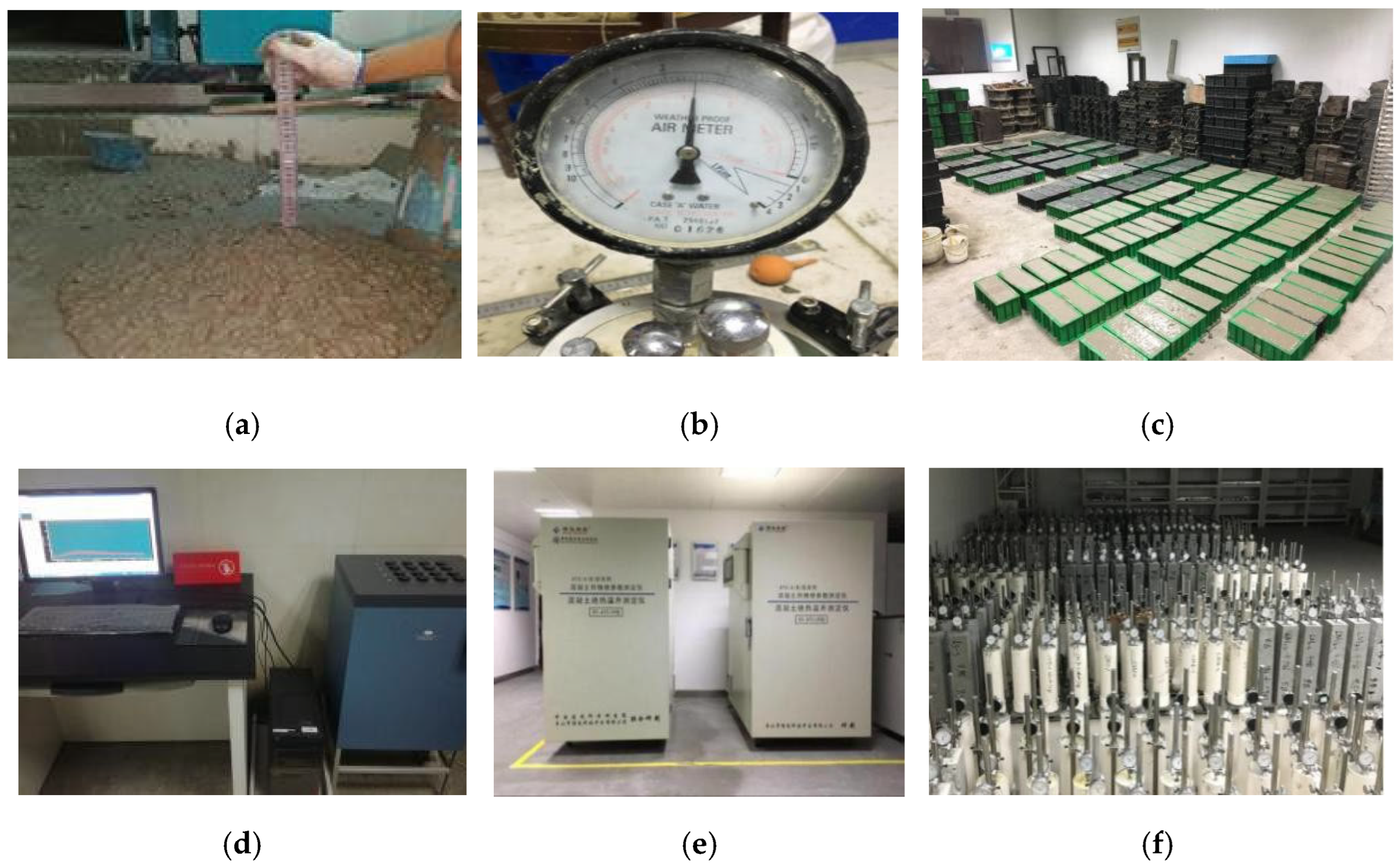
To systematically investigate the thermal behavior of the mass concrete, the hydration kinetics—specifically the heat evolution rate and cumulative heat of hydration—were measured, alongside the adiabatic temperature rise, which serves as a critical indicator for thermal stress analysis. Furthermore, the volumetric stability was evaluated by monitoring the autogenous volumetric deformation (autogenous shrinkage) to assess the material’s crack resistance potential during the early-age hydration phase. A comprehensive overview of the representative experimental procedures and testing setups is illustrated in Figure 1.

3.3. Experimental Results and Discussion

3.3.1. Influence of Binder Content, Sand Ratio, and Water-to-Binder Ratio

The influence of total binder content on the workability of fresh concrete was first investigated under the conditions of a fixed water consumption of 160 kg/m3, a fly ash content of 30%, and a sand ratio of 39%. Four mixtures (Groups 1#–4# in Table 6) with binder contents ranging from 380 kg/m3, 400 kg/m3, 420 kg/m3, 440 kg/m3 were evaluated, and the results are summarized in Table 7.
The results indicate that at a binder content of 380 kg/m3, the concrete exhibited slight aggregate exposure and poor coating properties (cohesiveness). In contrast, mixtures with a binder content of 400 kg/m3 or higher demonstrated excellent workability, characterized by a slump of 200 ± 10 mm and a slump flow exceeding 460 mm. Considering both workability and cost-effectiveness, 400 kg/m3 was preliminarily selected as the baseline binder content.
Subsequently, the effect of the sand ratio (38% vs. 40%) was examined based on the 400 kg/m3 binder dosage (Groups 5# and 6#). It was observed that increasing the sand ratio to 40% resulted in excessive viscosity, whereas reducing it to 38% led to insufficient coating of the aggregates. Consequently, an optimal sand ratio of 39% was determined to achieve the best balance between fluidity and cohesiveness.
Based on a binder content of 400 kg/m3, a sand ratio of 39%, a fly ash replacement level of 30%, and a water content of 160 kg/m3 (corresponding to Mix 2# in Table 6), the water-to-binder ratio was further adjusted to 0.40, 0.39, and 0.37 (corresponding to Mixes 2#, 7#, and 8# in Table 6). The results indicate that reducing the water-to-binder ratio significantly enhances compressive strength. As shown in Table 8, a 14-day compressive strength of 59.1 MPa was achieved at a ratio of 0.37. However, this reduction also leads to decreased workability of fresh concrete and is unfavorable for temperature control. Consequently, a water-to-binder ratio of 0.40 with a water content of 160 kg/m3 was selected for subsequent experiments.

3.3.2. Influence of Fly Ash Content

With the total binder content fixed at 400 kg/m3, the influence of fly ash replacement levels ranging from 25% to 45% was systematically investigated (Mixes 2#, 9#, 10#, 11#, and 12#).
As shown in Table 9, increasing the fly ash content led to a pronounced improvement in the workability of fresh concrete, as evidenced by higher slump and flow spread values. This enhancement is mainly attributed to the “ball-bearing effect” of fly ash particles. However, a gradual reduction in early-age compressive strength was observed with increasing fly ash content. At a replacement level of 35%, the 7-day and 14-day compressive strengths reached 41.1 MPa and 49.8 MPa, respectively, satisfying the early-strength requirements of C45 concrete. In contrast, when the fly ash content increased to 45%, a marked decrease in early strength occurred, with the 7-day compressive strength dropping to 33.9 MPa.
The results of autogenous deformation tests, summarized in Table 10, indicate that the autogenous shrinkage of concrete was significantly reduced as the fly ash content increased. Considering both the early-age strength requirements and the effectiveness in shrinkage mitigation, an optimal fly ash replacement level of 35% was therefore selected.

3.3.3. Influence of High-Performance Expansive Agent

Based on a total binder content of 400 kg/m3, a sand ratio of 39%, a water content of 160 kg/m3, and a fly ash replacement level of 35%, the effects of different dosages of a high-performance expansive agent (0%, 8%, and 10%, corresponding to Mixes 10#, 13#, and 14# in Table 6) on the fresh and mechanical properties of concrete were investigated.
As summarized in Table 11 and Table 12, the incorporation of the expansive agent exhibited no significant adverse effects on the fresh properties of concrete. When the expansive agent was used as an equivalent replacement for cement, the compressive strength at 7–14 days decreased by approximately 10–15%; however, this strength difference gradually diminished with increasing curing age.
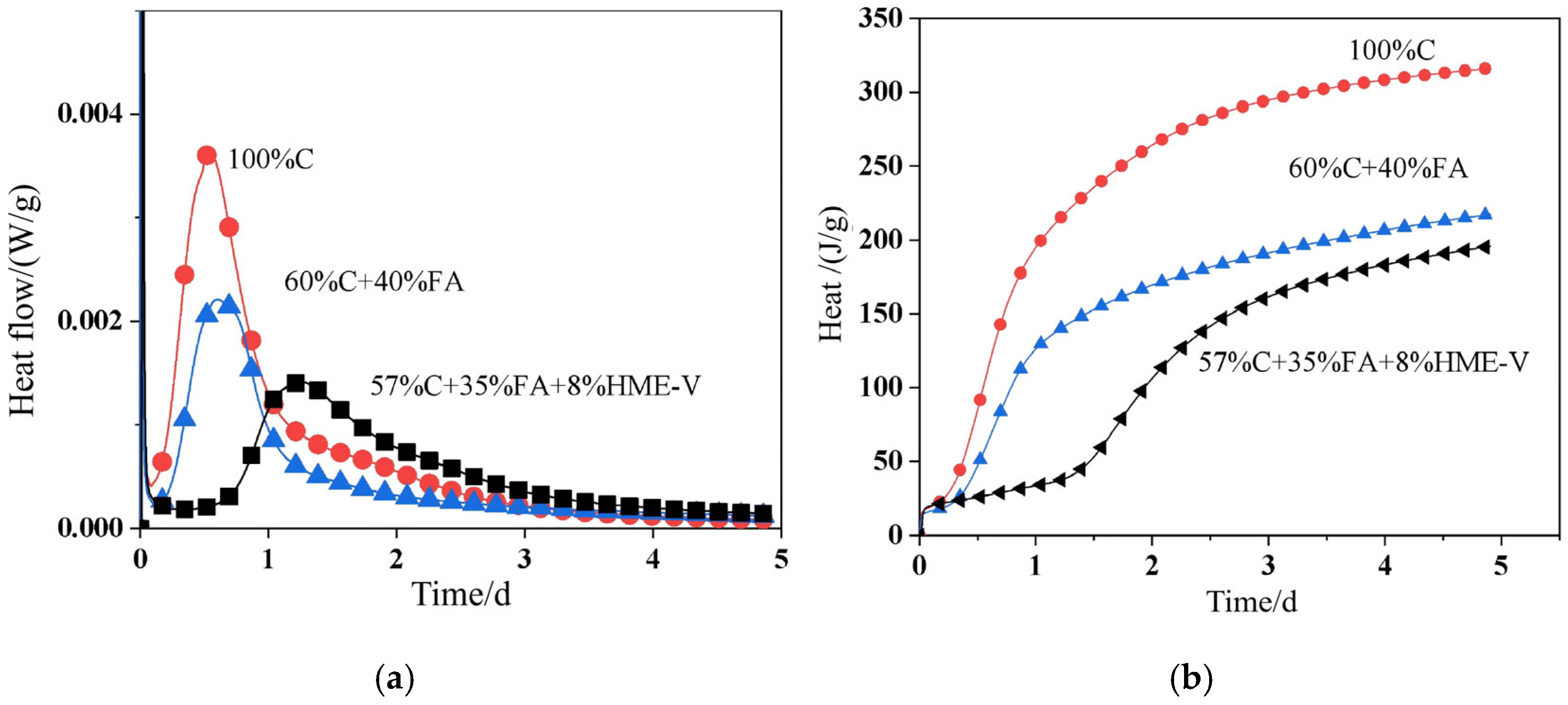
In terms of volumetric stability (Figure 2), the addition of the expansive agent transformed the autogenous deformation behavior of concrete from shrinkage to expansion. At dosage levels of 8% and 10%, the 7-day expansion reached 225.2 με and 270.1 με, respectively, effectively compensating for shrinkage. The incorporation of fly ash significantly reduced the hydration heat release rate and early cumulative heat evolution of concrete. Furthermore, the addition of the high-performance expansive agent (high-efficiency anti-cracking agent) further suppressed the early hydration heat release rate and total heat evolution. In combination with appropriate heat dissipation conditions, this led to a reduction in concrete temperature rise, thereby enhancing its resistance to cracking.
Considering both temperature control requirements and the need for shrinkage compensation, an expansive agent dosage of 8% was selected for the foundation slab, while a higher dosage of 10% was adopted for the sidewall concrete.

3.3.4. Influence of Polypropylene Fibers

The effects of polypropylene fiber contents of 1.0 kg/m3, 1.2 kg/m3, and 1.5 kg/m3 (corresponding to Mixes 15#~17# in Table 6) on the fresh and mechanical properties of concrete were investigated, as summarized in Table 13.
The results indicate that increasing the fiber content leads to reduced flowability and increased viscosity of fresh concrete. Meanwhile, the spatial dispersion and interfacial bridging effect of the fibers can limit the development of plastic shrinkage cracks and enhance the crack resistance of concrete. When the fiber dosage exceeded 1.2 kg/m3, workability deteriorated markedly. The incorporation of polypropylene fibers resulted in a slight reduction in early-age compressive strength (less than 5%); however, this effect was not significant. To achieve a balance between crack resistance enhancement and satisfactory workability for construction, an optimal fiber content of 1.2 kg/m3 was selected.

3.3.5. Influence of Inorganic Self-Healing Agent

The influence of incorporating a self-healing agent at a dosage of 2.0 kg/m3 (Mix 18#) was evaluated in comparison with the reference mixture (Mix 13#). The results are summarized in Table 14.
In terms of fresh properties, the addition of the self-healing agent had no noticeable adverse effect on the workability of fresh concrete. The inorganic self-healing agent is a cementitious capillary crystalline waterproofing agent. Its active chemicals react with the cement matrix to form insoluble crystals, which fill pores and microcracks. When water enters cracks, these reactions are reactivated, further sealing the cracks and improving compactness and durability. Regarding mechanical performance, the self-healing agent led to an approximately 8% reduction in early-age compressive strength at 7 days, while its influence on the 14-day strength was relatively minor.
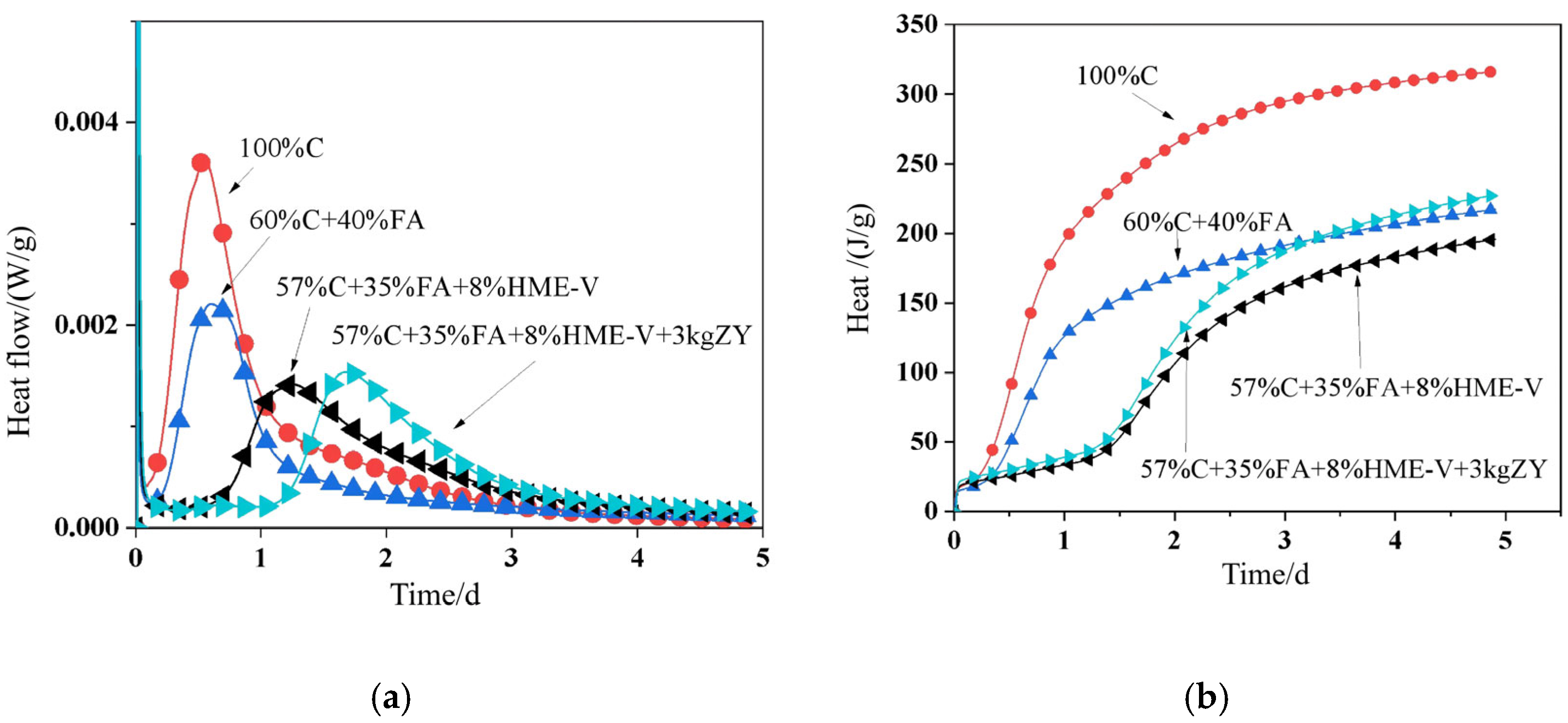
With respect to hydration heat characteristics, as illustrated in Figure 3, the self-healing agent significantly prolonged the hydration induction period and simultaneously increased both the peak hydration heat release rate and the cumulative heat evolution. Specifically, the induction period of cement hydration was extended by more than twofold, resulting in a setting time exceeding 24 h, and the cumulative heat release at 5 days increased by approximately 15% compared with the reference mixture.


4. Field Monitoring and Performance Evaluation

To verify the practical feasibility and effectiveness of the proposed low-temperature-rise, crack-resistant mass concrete proportions, the foundation slab of Section 2, Section 3 and Section 4 in a large-scale infrastructure project was selected as a representative case study. The slab thickness is 2.5 m, and the plan dimensions of Zone 2–4 are approximately 30.15 m × 17.57 m. Zone 2–4 is located at the corner of the entire foundation slab and represents only a part of the whole slab. Systematic monitoring and evaluation were conducted during the construction phase and early-age hardening period. The targeted slab was designed with a strength grade of C45 and a permeability rating of P8, imposing stringent requirements for thermal control and crack resistance.

4.1. Field Workability of Concrete

The workability of the fresh concrete was rigorously tested on-site in strict accordance with the Standard for Test Methods of Performance on Ordinary Fresh Concrete (GB/T 50080-2016) [52]. The experimental results demonstrated that the mixture maintained a consistent slump of 200 ± 20 mm and a slump flow ranging from 460 to 500 mm. The fresh concrete exhibited excellent workability, with no observable evidence of segregation or bleeding, thereby fully satisfying the stringent requirements for pumping and placement in mass concrete construction. Furthermore, the placement temperature was continuously monitored and successfully maintained within a stable range of 22.0–26.0 °C.

4.2. Mechanical Property Development of Hardened Concrete

In parallel with the field placement, concrete specimens were sampled and transferred to a standard curing room. The compressive strength was tested at various ages to evaluate the strength development characteristics of the mixture. The experimental results are summarized in Table 15.
As presented in Table 15, the concrete mixture exhibited a rapid early-age strength development. The 7-day compressive strength attained 84% of the design strength, and by 14 days, the strength had already surpassed the specified design value. These results indicate that the binder system possesses high early-age reactivity (hydration kinetics), which ensures sufficient structural capacity during the initial stages of construction.

4.3. Real-Time Monitoring and Analysis of Temperature Fields

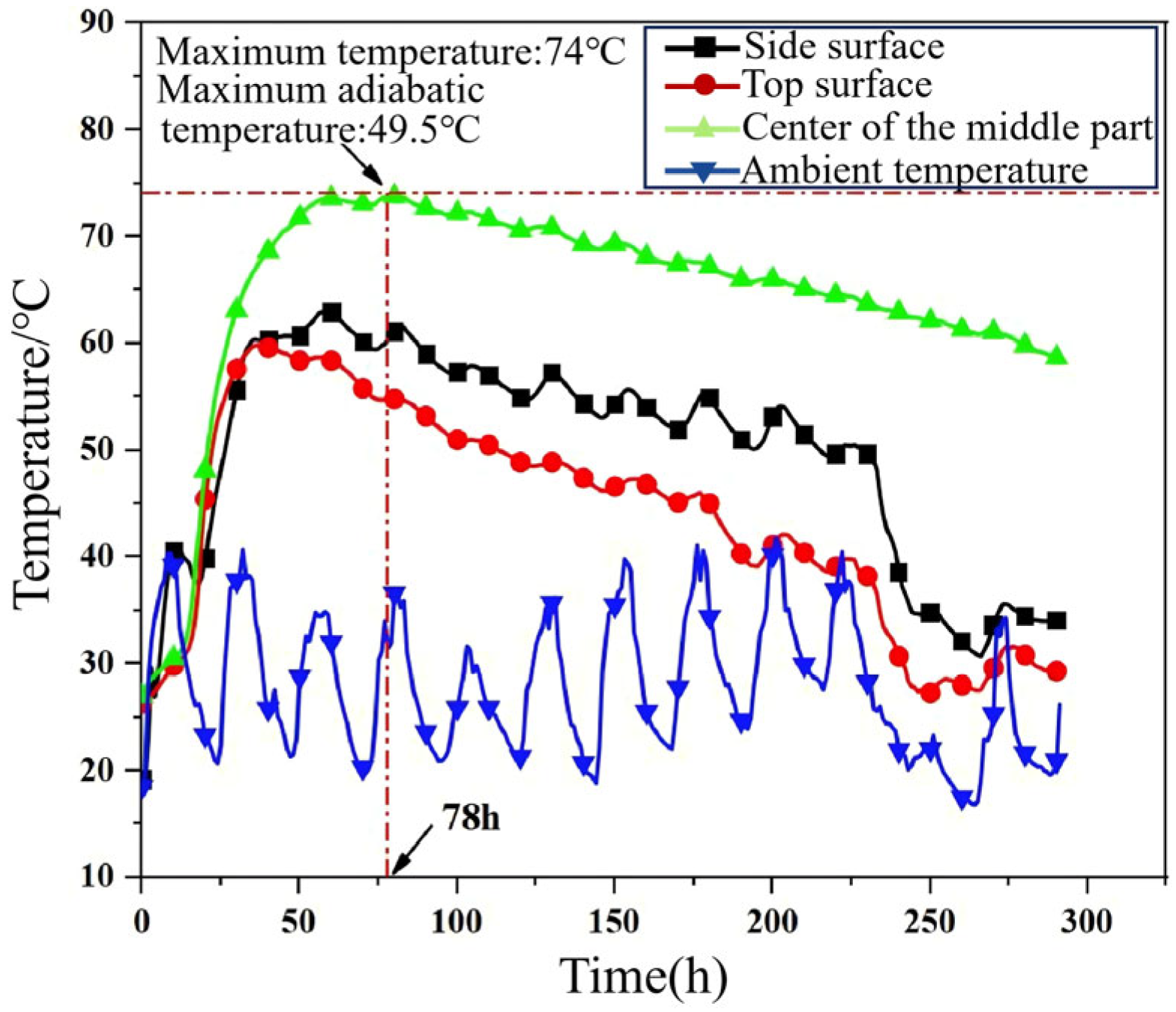
To capture the evolution of internal temperature within the concrete, automated wireless temperature sensors were embedded at the geometric center and critical sections of the foundation slab. Continuous real-time monitoring was conducted over a 14-day period, with the resulting temperature-time development curves illustrated in Figure 4.
The results indicate that the peak core temperature reached 74.0 °C, situated at the upper bound of the typical temperature rise range for mass concrete. This elevated thermal peak is primarily attributed to the high early-age reactivity of the cement, the total binder content, and the relatively high ambient temperatures during the placement phase.
The thermal peak occurred at 78 h post-casting, representing a significant delay compared to conventional mass concrete without thermal control measures. This delay demonstrates that the incorporation of a high-performance expansive agent (containing a hydration heat inhibitor) effectively retards the cement hydration process and postpones the occurrence of the peak temperature. Such retardation facilitates heat dissipation and mitigates the internal temperature gradient, thereby enhancing the crack resistance of the structure.

4.4. Evolution of Strain Fields and Volumetric Stability Analysis

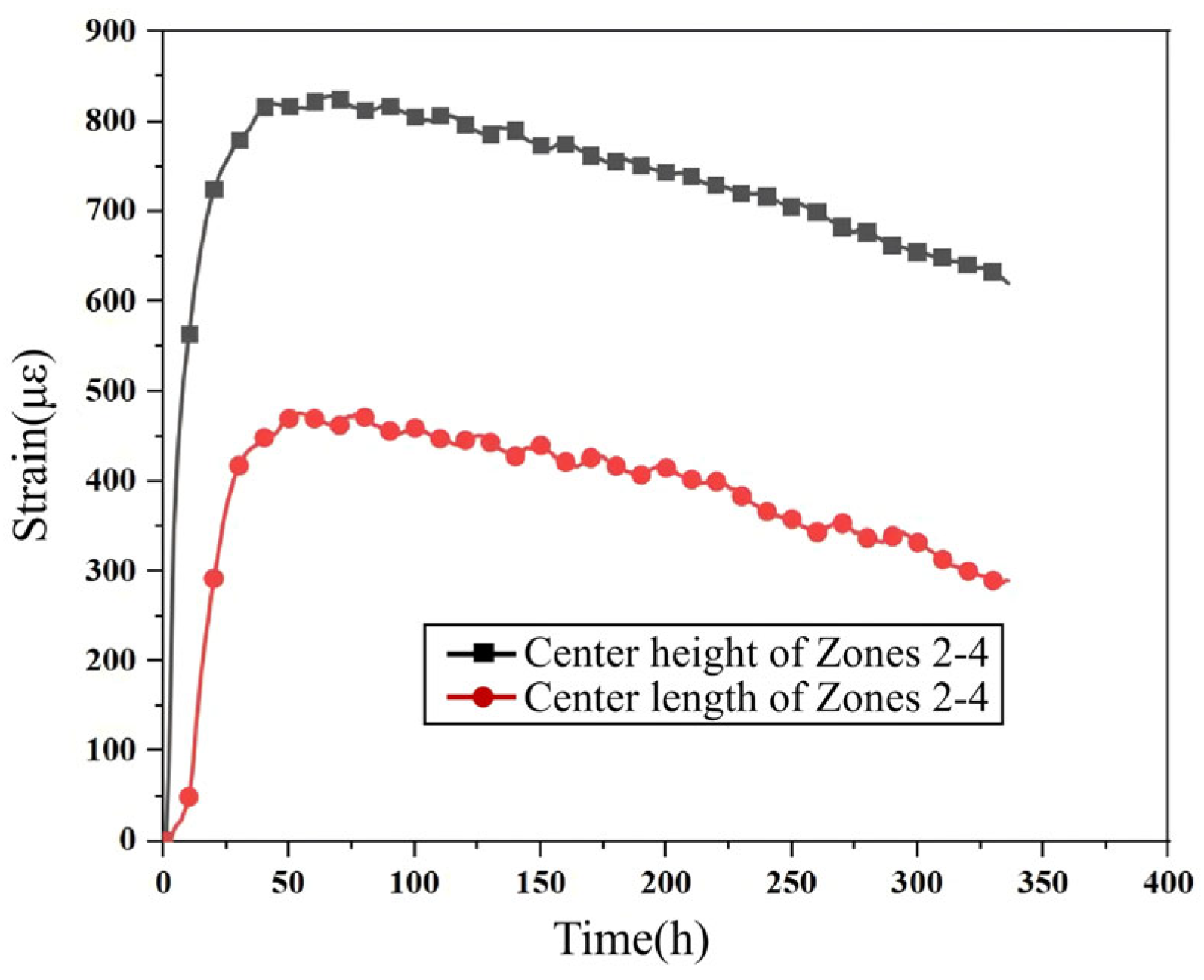
During the heating phase, as shown in Figure 5, significant expansive deformation was observed at the core of the foundation slab, with maximum strain values reaching 453 με and 821 με in the longitudinal and thickness directions, respectively. The corresponding unit thermal expansion strains were calculated as 10.6 με/°C and 7.3 με/°C. This deformation resulted from the synergistic effect of thermal expansion and the chemical expansion induced by the expansive agent. Such expansion facilitates the formation of pre-compressive stress within the concrete, which partially offsets the tensile stresses generated during subsequent cooling-induced shrinkage.
During the cooling phase, the unit shrinkage strain was approximately 7.4 με/°C, which is markedly lower than the expansion rate recorded during the heating stage. This disparity indicates that the expansive agent continued to provide compensatory shrinkage during the temperature drop period, effectively reducing the net shrinkage of the concrete and significantly mitigating the risk of cracking.

5. Conclusions

This study aims to achieve the synergetic enhancement of low temperature rise and crack resistance in mass concrete. Through systematic raw material selection, mix proportion optimization, and field verification, the influence of key design parameters was investigated. The primary conclusions are summarized as follows:
(1)
Fly ash effectively inhibits early-age shrinkage and reduces both the rate and cumulative heat of hydration, serving as a critical component for thermal control. However, increasing its dosage leads to a reduction in early-age strength. A fly ash content of 35% effectively improves workability, mitigates early-age shrinkage, and reduces the heat of hydration.
(2)
The high-performance expansive agent delayed early-age heat release and promoted compensatory expansion, thereby helping to offset autogenous and cooling-induced shrinkage. This indicates its potential role in coordinating temperature control and shrinkage compensation in mass concrete. However, the underlying expansive products were not directly characterized in this study and should be further verified through microstructural analysis.
(3)
Increasing the dosage of polypropylene fibers results in decreased fluidity and increased viscosity of the mixture. At the optimal dosage of 1.2 kg/m3, the fibers effectively suppress the initiation and propagation of plastic and early-age drying shrinkage cracks through a physical reinforcement mechanism, without significantly compromising workability or strength.
(4)
The field verification results demonstrate that the optimized concrete possesses excellent workability and satisfies the requirements for early-age strength development. Although the expansive agent successfully postponed the thermal peak to 78 h, the internal temperature remained relatively high, necessitating the integration of external thermal insulation measures. Strain monitoring confirms that the expansive agent significantly reduces net shrinkage, which, in synergy with fiber reinforcement, effectively enhances the overall crack resistance of the mass concrete structure. While the optimal dosages obtained herein are based on specific local materials, the underlying design principles are transferable to other concrete systems with appropriate verification.
This study is primarily an engineering-oriented experimental investigation and does not establish a theoretical or predictive model. Although it showed favorable laboratory and field performance, the present study did not fully quantify interaction effects among variables or establish a predictive optimization model. Future studies should further combine DoE-based experimental design and multi-objective optimization to improve the statistical robustness of mix proportioning for low-heat and crack-resistant mass concrete.

Author Contributions

Conceptualization, X.X. and Y.W.; methodology, X.X.; software, G.Z.; validation, Y.X.; formal analysis, Y.C.; investigation, G.Z.; resources, X.X.; data curation, X.X.; writing—original draft preparation, G.Z.; writing—review and editing, G.Z.; visualization, Y.X.; supervision, Y.W.; project administration, X.X. and Y.W. All authors have read and agreed to the published version of the manuscript.

Funding

This research received no external funding.

Data Availability Statement

The data presented in this study are available upon request from the corresponding author.

Conflicts of Interest

Author Guangyao Zhai, Yinguang Wang, Yanqiang Chen was employed by the company China Construction 4th Engineering Bureau 6th Co., Ltd. Author Xiaoliang Xu, Yang Xiao was employed by the Tongji Architectural Design (Group) Co., Ltd.

References

  1. El-Mir, A.; Assaad, J.J.; Nehme, S.G.; El-Hassan, H. Correlating strength and durability to time-temperature profiles of high-performance mass concrete. Case Stud. Constr. Mat. 2022, 16, e01055. [Google Scholar] [CrossRef]
  2. Hu, Y.; Chen, J.; Zou, F.; He, M.; Mao, J.; Liu, X.; Zhou, C.; Yuan, Z. A comparative study of temperature of mass concrete placed in August and November based on on-site measurement. Case Stud. Constr. Mat. 2021, 15, e00694. [Google Scholar] [CrossRef]
  3. Sayed-Ahmed, E.Y.; Abdelrahman, A.A.; Embaby, R.A. Concrete dams: Thermal-stress and construction stage analysis. Dams. Reserv. 2017, 28, 12–30. [Google Scholar] [CrossRef]
  4. Bofang, Z. Thermal Stresses and Temperature Control of Mass Concrete; Butterworth-Heinemann: Oxford, UK, 2014. [Google Scholar]
  5. Klausen, A.E.; Kanstad, T.; Bjontegaard, O. The cracking risk of hardening concrete exposed to realistic curing temperature regimes and restraint conditions-Experimental investigations of important parameters. Constr. Build. Mater. 2022, 338, 127662. [Google Scholar] [CrossRef]
  6. Hirozo Mihashi, H.; Leite, J.P.d.B. State-of-the-art report on control of cracking in early age concrete. J. Adv. Concr. Technol. 2004, 2, 141–154. [Google Scholar] [CrossRef]
  7. Barbara Klemczak, M.B.; Pilch, M.; Żmij, A. Analysis of Cracking Risk in Early Age Mass Concrete with Different Aggregate Types. Procedia Eng. 2017, 193, 234–241. [Google Scholar] [CrossRef]
  8. Vandevyvere, B.; Vandewalle, L.; Li, J.B. Improved simplified constitutive tensile model for fiber-reinforced concrete. Struct. Concr. 2023, 24, 4624–4644. [Google Scholar] [CrossRef]
  9. Bullard, J.W.; Jennings, H.M.; Livingston, R.A.; Nonat, A.; Scherer, G.W.; Schweitzer, J.S.; Scrivener, K.L.; Thomas, J.J. Mechanisms of cement hydration. Cem. Concr. Res. 2011, 41, 1208–1223. [Google Scholar] [CrossRef]
  10. Bentz, D.P. Blending different fineness cements to engineer the properties of cement-based materials. Mag. Concr. Res. 2010, 62, 327–338. [Google Scholar] [CrossRef]
  11. Binici, H.; Temiz, H.; Köse, M.M. The effect of fineness on the properties of the blended cements incorporating ground granulated blast furnace slag and ground basaltic pumice. Constr. Build. Mater. 2007, 21, 1122–1128. [Google Scholar] [CrossRef]
  12. Saeed, M.K.; Rahman, M.K.; Baluch, M.H. Early age thermal cracking of mass concrete blocks with Portland cement and ground granulated blast-furnace slag. Mag. Concr. Res. 2016, 68, 647–663. [Google Scholar] [CrossRef]
  13. Divsholi, B.S.; Lim, T.Y.D.; Teng, S. Durability Properties and Microstructure of Ground Granulated Blast Furnace Slag Cement Concrete. Int. J. Concr. Struct. M. 2014, 8, 157–164. [Google Scholar] [CrossRef]
  14. de Matos, P.R.; Junckes, R.; Graeff, E.; Prudencio, L.R. Effectiveness of fly ash in reducing the hydration heat release of mass concrete. J. Build. Eng. 2020, 28, 101063. [Google Scholar] [CrossRef]
  15. Wang, Q.; Yan, P.Y.; Feng, J.J. Design of high-volume fly ash concrete for a massive foundation slab. Mag. Concr. Res. 2013, 65, 71–81. [Google Scholar] [CrossRef]
  16. Xin, J.; Liu, Y.; Zhang, G.; Wang, Z.; Wang, J.; Yang, N.; Qiao, Y. Evaluation of early-age thermal cracking resistance of high w/b, high volume fly ash (HVFA) concrete using temperature stress testing machine. Case Stud. Constr. Mat. 2022, 16, e00825. [Google Scholar] [CrossRef]
  17. Zhao, Z.F.; Wang, K.J.; Lange, D.A.; Zhou, H.G.; Wang, W.L.; Zhu, D.M. Creep and thermal cracking of ultra-high volume fly ash mass concrete at early age. Cem. Concr. Comp. 2019, 99, 191–202. [Google Scholar] [CrossRef]
  18. Han, X.; Feng, J.J.; Shao, Y.X.; Hong, R.N. Influence of a steel slag powder-ground fly ash composite supplementary cementitious material on the chloride and sulphate resistance of mass concrete. Powder Technol. 2020, 370, 176–183. [Google Scholar] [CrossRef]
  19. Wang, L.; Yang, H.Q.; Zhou, S.H.; Chen, E.; Tang, S.W. Hydration, mechanical property and C-S-H structure of early-strength low-heat cement-based materials. Mater. Lett. 2018, 217, 151–154. [Google Scholar] [CrossRef]
  20. Chen, B.F.; Tang, G.Q.; Lu, X.C.; Xiong, B.B.; Guan, B.; Tian, B. Thermal property evolution and prediction model of early-age low-heat cement concrete under different curing temperatures. J. Build. Eng. 2024, 82, 108020. [Google Scholar] [CrossRef]
  21. Xie, J.; Wu, Z.M.; Zhang, X.H.; Hu, X.; Shi, C.J. Trends and developments in low-heat portland cement and concrete: A review. Constr. Build. Mater. 2023, 392, 131535. [Google Scholar] [CrossRef]
  22. Mori, K.; Fukunaga, T.; Sugiyama, M.; Iwase, K.; Oishi, K.; Yamamuro, O. Hydration properties and compressive strength development of Low Heat Cement. J. Phys. Chem. Solids 2012, 73, 1274–1277. [Google Scholar] [CrossRef]
  23. Kovler, K.; Roussel, N. Properties of fresh and hardened concrete. Cem. Concr. Res. 2011, 41, 775–792. [Google Scholar] [CrossRef]
  24. Yeon, J.H.; Choi, S.; Won, M.C. In situ measurement of coefficient of thermal expansion in hardening concrete and its effect on thermal stress development. Constr. Build. Mater. 2013, 38, 306–315. [Google Scholar] [CrossRef]
  25. Maruyama, I.; Teramoto, A.; Igarashi, G. Strain and thermal expansion coefficients of various cement pastes during hydration at early ages. Mater. Struct. 2014, 47, 27–37. [Google Scholar] [CrossRef]
  26. Amin, M.N.; Kim, J.S.; Lee, Y.; Kim, J.K. Simulation of the thermal stress in mass concrete using a thermal stress measuring device. Cem. Concr. Res. 2009, 39, 154–164. [Google Scholar] [CrossRef]
  27. Nguyen, D.H.; Nguyen, V.T.; Lura, P.; Dao, V.T.N. Temperature-stress testing machine—A state-of-the-art design and its unique applications in concrete research. Cem. Concr. Comp. 2019, 102, 28–38. [Google Scholar] [CrossRef]
  28. Ou, G.F.; Lin, Z.H.; Kishi, T.; Liu, L. Assessment and mitigation of early-age cracking for on-site concrete structures by a combined scheme using Temperature Stress Testing Machine (TSTM) and long-span restraining frame. Cem. Concr. Comp. 2024, 145, 105321. [Google Scholar] [CrossRef]
  29. Chaunsali, P.; Mondal, P. Influence of Calcium Sulfoaluminate (CSA) Cement Content on Expansion and Hydration Behavior of Various Ordinary Portland Cement-CSA Blends. J. Am. Ceram. Soc. 2015, 98, 2617–2624. [Google Scholar] [CrossRef]
  30. Ou, G.F.; Lin, Z.H.; Kishi, T. The practical application of a self-developed temperature stress testing machine in development of expansive concrete blended with calcium sulfoaluminate additives. Cem. Concr. Res. 2023, 164, 107045. [Google Scholar] [CrossRef]
  31. Zeiml, M.; Leithner, D.; Lackner, R.; Mang, H.A. How do polypropylene fibers improve the spalling behavior of in-situ concrete? Cement Concr. Res. 2006, 36, 929–942. [Google Scholar] [CrossRef]
  32. Shao, R.Z.; Wu, C.Q.; Li, J.; Liu, Z.X. Development of sustainable steel fibre-reinforced dry ultra-high performance concrete (DUHPC). J. Clean. Prod. 2022, 337, 130507. [Google Scholar] [CrossRef]
  33. Wang, L.; Ju, S.; Wang, L.; Wang, F.; Sui, S.; Yang, Z.; Liu, Z.; Chu, H.; Jiang, J. Effect of citric acid-modified chitosan on the hydration and microstructure of Portland cement paste. J. Sustain. Cem.-Based 2021, 12, 83–96. [Google Scholar] [CrossRef]
  34. Zhang, Y.; Zhang, Q.G.; Hou, D.S.; Zhang, J.R. Tuning interfacial structure and mechanical properties of graphene oxide sheets/polymer nanocomposites by controlling functional groups of polymer. Appl. Surf. Sci. 2020, 504, 144152. [Google Scholar] [CrossRef]
  35. Briffaut, M.; Benboudjema, F.; Torrenti, J.M.; Nahas, G. Effects of early-age thermal behaviour on damage risks in massive concrete structures. Eur. J. Environ. Civ. Eng. 2012, 16, 589–605. [Google Scholar] [CrossRef]
  36. Do, T.A.; Verdugo, D.; Tia, M.; Hoang, T.T. Effect of volume-to-surface area ratio and heat of hydration on early-age thermal behavior of precast concrete segmental box girders. Case Stud. Therm. Eng. 2021, 28, 101448. [Google Scholar] [CrossRef]
  37. Lu, X.C.; Chen, B.F.; Tian, B.; Li, Y.B.; Lv, C.C.; Xiong, B.B. A new method for hydraulic mass concrete temperature control: Design and experiment. Constr. Build. Mater. 2021, 302, 124167. [Google Scholar] [CrossRef]
  38. Hong, Y.X.; Lin, J.; Chen, W. Simulation of thermal field in mass concrete structures with cooling pipes by the localized radial basis function collocation method. Int. J. Heat Mass Transf. 2019, 129, 449–459. [Google Scholar] [CrossRef]
  39. Smolana, A.; Klemczak, B.; Azenha, M.; Schlicke, D. Early age cracking risk in a massive concrete foundation slab: Comparison of analytical and numerical prediction models with on-site measurements. Constr. Build. Mater. 2021, 301, 124135. [Google Scholar] [CrossRef]
  40. Xie, Y.D.; Qian, C.X. A novel numerical method for predicting the hydration heat of concrete based on thermodynamic model and finite element analysis. Mater. Des. 2023, 226, 111675. [Google Scholar] [CrossRef]
  41. Liu, X.H.; Zhang, C.; Chang, X.L.; Zhou, W.; Cheng, Y.G.; Duan, Y. Precise simulation analysis of the thermal field in mass concrete with a pipe water cooling system. Appl. Therm. Eng. 2015, 78, 449–459. [Google Scholar] [CrossRef]
  42. Luo, D.; Qiao, X.; Niu, D. A predictive model for the freeze-thaw concrete durability index utilizing the deeplabv3+ model with machine learning. Constr. Build. Mater. 2025, 459, 139788. [Google Scholar] [CrossRef]
  43. Kabir, H.; Wu, J.; Dahal, S.; Joo, T.; Garg, N. Automated estimation of cementitious sorptivity via computer vision. Nat. Commun. 2024, 15, 9935. [Google Scholar] [CrossRef]
  44. Sargam, Y.; Faytarouni, M.; Riding, K.; Wang, K.J.; Jahren, C.; Shen, J. Predicting thermal performance of a mass concrete foundation—A field monitoring case study. Case Stud. Constr. Mat. 2019, 11, e00289. [Google Scholar] [CrossRef]
  45. GB 175-2023; Common Portland Cement. State Administration for Market Regulation, Standardization Administration of the People’s Republic of China: Beijing, China, 2023.
  46. GB/T 1596-2017; Fly Ash Used for Cement and Concrete. General Administration of Quality Supervision, Inspection and Quarantine of the People’s Republic of China; Standardization Administration of the People’s Republic of China: Beijing, China, 2017.
  47. GB/T 39701-2020; Limit and Test Method of Ammonium Ion Content in Fly Ash. State Administration for Market Regulation, Standardization Administration of the People’s Republic of China: Beijing, China, 2020.
  48. GB/T 21120-2018; Synthetic Fibres for Cement Concrete and Mortar. State Administration for Market Regulation, Standardization Administration of the People’s Republic of China: Beijing, China, 2018.
  49. T/CECS 10082-2020; Calcium and Magnesium Oxides Based Expansive Agent for Concrete. China Association for Engineering Construction Standardization: Beijing, China, 2020.
  50. JC/T 2608-2021; Concrete Temperature Rise Inhibitor. Ministry of Industry and Information Technology of the People’s Republic of China: Beijing, China, 2021.
  51. GB 18445-2012; Cementitious Capillary Crystalline Waterproofing Materials. General Administration of Quality Supervision, Inspection and Quarantine of the People’s Republic of China; Standardization Administration of the People’s Republic of China: Beijing, China, 2012.
  52. GB/T 50080-2016; Standard for Test Methods of Performance on Ordinary Fresh Concrete. Ministry of Housing and Urban-Rural Development of the People’s Republic of China: Beijing, China; General Administration of Quality Supervision, Inspection and Quarantine of the People’s Republic of China: Beijing, China, 2016.
Figure 1. Concrete performance testing: (a) slump test; (b) air content measurement; (c) mechanical property testing; (d) isothermal microcalorimetry test; (e) adiabatic temperature rise test; (f) shrinkage deformation test.
Buildings 16 02028 g001
Figure 2. Results of hydration heat evolution tests (10#, 13#, 14#). (a) Hydration heat release rate; (b) Cumulative heat release.
Buildings 16 02028 g002
Figure 3. Results of hydration heat evolution tests (10#, 13#, 14#, 18#). (a) Hydration heat release rate; (b) Cumulative heat release.
Buildings 16 02028 g003
Figure 4. Real-time temperature monitoring data of foundation slabs in Zones 2–4.
Buildings 16 02028 g004
Figure 5. Real-time strain monitoring data of foundation slabs in Zones 2–4.
Buildings 16 02028 g005
Table 1. Basic performance requirements of cement.
TypeInitial Setting Time (min)Final Setting Time (min)Specific Surface Area m2/kgSoundnessChloride Ion Content (%)Alkali Content (%)Flexural Strength (MPa)Compressive Strength (MPa)
3d28d3d28d
P·II 52.5≥90≤390≤370Qualified≤0.06≤0.6≥4.5≥7≥25.0≥55.0
Table 2. Technical requirements for the fundamental properties of Fly Ash.
GradeFineness (%)Water Demand Ratio (%)Loss on Ignition (%)Activity Index (%)Ammonium Ion Content (mg/kg)
Class F, Grade II≤25.0≤105≤8.0≥70.0≤210
Table 3. Basic performance requirements of fibers.
TypeLength/mmEquivalent Diameter/μmTensile Strength/MPaElongation at Break/%Elastic
Modulus/MPa
Polypropylene (PP)8~20 mm5~100≥350≤40≥3000
Table 4. Basic performance requirements of high-performance expansive agent.
Type7d Restricted Expansion Rate in Water/%21d Restricted Expansion Rate in Air/%7d Hydration Heat Reduction Rate/%24d Hydration Heat Reduction Rate/%28d Compressive Strength Ratio/%
HME-V≥0.035≥−0.010≤15≥30≥90
Table 5. Basic performance requirements of cementitious capillary crystalline waterproofing material.
Moisture Content/%Fineness (Residue on 0.63 mm Sieve, %)Chloride Ion Content/%28d Compressive Strength/MPa28d Flexural Strength/MPa
≤1.5≤5≤0.1≥15.0≥2.8
Table 6. Experimental matrix and mix proportions of concrete groups.
IDMix Proportions (kg/m3)Total Binder
(kg/m3)
Fly Ash Content (%)Water-to-Binder RatioSand Ratio (%)
CementFly AshExpansive AgentFine Agg.Coarse Agg.WaterFiberSelf-Healing Agent
1#2661140710111016000380300.4239
2#2801200702109816000400300.4039
3#2941260694108616000420300.3839
4#3081320686107416000440300.3639
5#2801200702109816000400300.4038
6#2801200702109816000400300.4040
7#2801200704110015600400300.3939
8#2801200707110514800400300.3739
9#3001000702109816000400250.4039
10#2601400702109816000400350.4039
11#2401600702109816000400400.4039
12#2201800702109816000400450.4039
13#22814032702109816000400350.4039
14#22014040702109816000400350.4039
15#2281403270210981601.00400350.4039
16#2281403270210981601.20400350.4039
17#2281403270210981601.50400350.4039
18#22814032702109816002.0400350.4039
Table 7. Fresh concrete workability of mixes 1#–6#.
IDSlump (mm)Slump Flow (mm)Air Content (%)Description/Remarks
1#2004202.4Aggregate exposure, poor cohesiveness
2#2004602.5Good workability
3#2004702.4Good workability
4#2004802.6Good workability
5#1904302.7Aggregate exposure, poor cohesiveness
6#2204752.8Highly viscous compared to Group 2#
Table 8. Compressive strength of mixes 2#, 7#, and 8#.
Cement TypeID7d (MPa)14d (MPa)Water-to-Binder Ratio
P·II 52.52#42.351.90.40
7#44.553.90.39
8#47.259.10.37
Table 9. Fresh concrete workability of mixes 2#, 9#~12#.
IDWorkability of Fresh ConcreteCompressive Strength (MPa)Fly Ash Content (%)
Slump (mm)Slump Flow (mm)Air Content (%)7d14d
9#1904502.346.655.825
2#2004702.542.351.930
10#2005102.641.149.835
11#2205502.837.645.640
12#2205602.833.941.845
Table 10. Test results of autogenous volume deformation of mixes 9#, 10#, 12#.
ID1d3d5d7d10d14dFly Ash Content (%)
9#−44.2−49.6−50.2−53.8−77−94.225
10#−39.4−44.8−47.6−48.2−67.8−84.235
12#−21.6−25−29.4−36.2−44.2−56.845
Table 11. Fresh concrete workability of mixes 10#, 13#, 14#.
IDWorkability of Fresh ConcreteCompressive Strength (MPa)High-Performance Expansive Agent Dosage (%)
Slump (mm)Slump Flow (mm)Air Content (%)7d14d
10#2005102.641.149.80
13#2005102.538.547.48
14#1905002.337.646.910
Table 12. Test results of autogenous volume deformation of mixes 10#, 13#, 14#.
ID1d3d5d7d10d14dHigh-Performance Expansive Agent Dosage (%)
10#−39.4−44.8−47.6−48.2−67.8−84.20
13#83.9154.9198.1225.2225.4225.38
14#105.3195.1255.2270.1272.6272.510
Table 13. Fresh concrete workability of mixes 13#, 15#~17#.
IDWorkability of Fresh ConcreteCompressive Strength (MPa)Polypropylene Fibers Content (kg/m3)
Slump (mm)Slump Flow (mm)Air Content (%)7d14d
13#2005102.538.547.40
15#2004602.538.347.11.0
16#1904452.438.046.81.2
17#1603802.436.844.81.5
Table 14. Fresh concrete workability of mixes 13#, 18#.
IDWorkability of Fresh ConcreteCompressive Strength (MPa)Self-Healing Agent Content (kg/m3)
Slump (mm)Slump Flow (mm)Air Content (%)7d14d
13#2005102.538.547.40
18#1905152.635.246.62.0
Table 15. Compressive strength of concrete for foundation slabs in Zones 2–4.
Zones 2–47d14d
Compressive strength/MPa38.045.4
Strength ratio84%101%
Disclaimer/Publisher’s Note: The statements, opinions and data contained in all publications are solely those of the individual author(s) and contributor(s) and not of MDPI and/or the editor(s). MDPI and/or the editor(s) disclaim responsibility for any injury to people or property resulting from any ideas, methods, instructions or products referred to in the content.