Article

Eco-Efficient Thermal Rehabilitation of Residential Buildings in Northeast Brazil Through Thermal Modeling Considering Future Climate Needs †

by
Guilherme B. A. Coelho
1,2,*,
Paulina Faria
1 and
Nada Mowafy
1,3
1
CERIS, Departamento de Engenharia Civil, Faculdade de Ciências e Tecnologia, Universidade NOVA de Lisboa, 2829-516 Caparica, Portugal
2
Department of Built Environment, Faculty of Technology, Art and Design, Oslo Metropolitan University, 0130 Oslo, Norway
3
Civil Engineering Department, School of Engineering, The Knowledge Hub Universities (TKH)—Coventry University, Cairo 4762030, Egypt
*
Author to whom correspondence should be addressed.
This article is a revised and expanded version of our paper, G. B. A. Coelho and P. Faria, Reabilitação térmica eco-eficiente de edifícios residenciais no Nordeste do Brasil através de modelação térmica para combater necessidades climáticas futuras, in Congresso Internacional da Habitação no Espaço Lusófono (5CIHEL 2024), Lisbon, Portugal, 2–4 October 2024.
Buildings 2025, 15(9), 1497; https://doi.org/10.3390/buildings15091497

Submission received: 14 February 2025 / Revised: 9 April 2025 / Accepted: 15 April 2025 / Published: 28 April 2025

Abstract

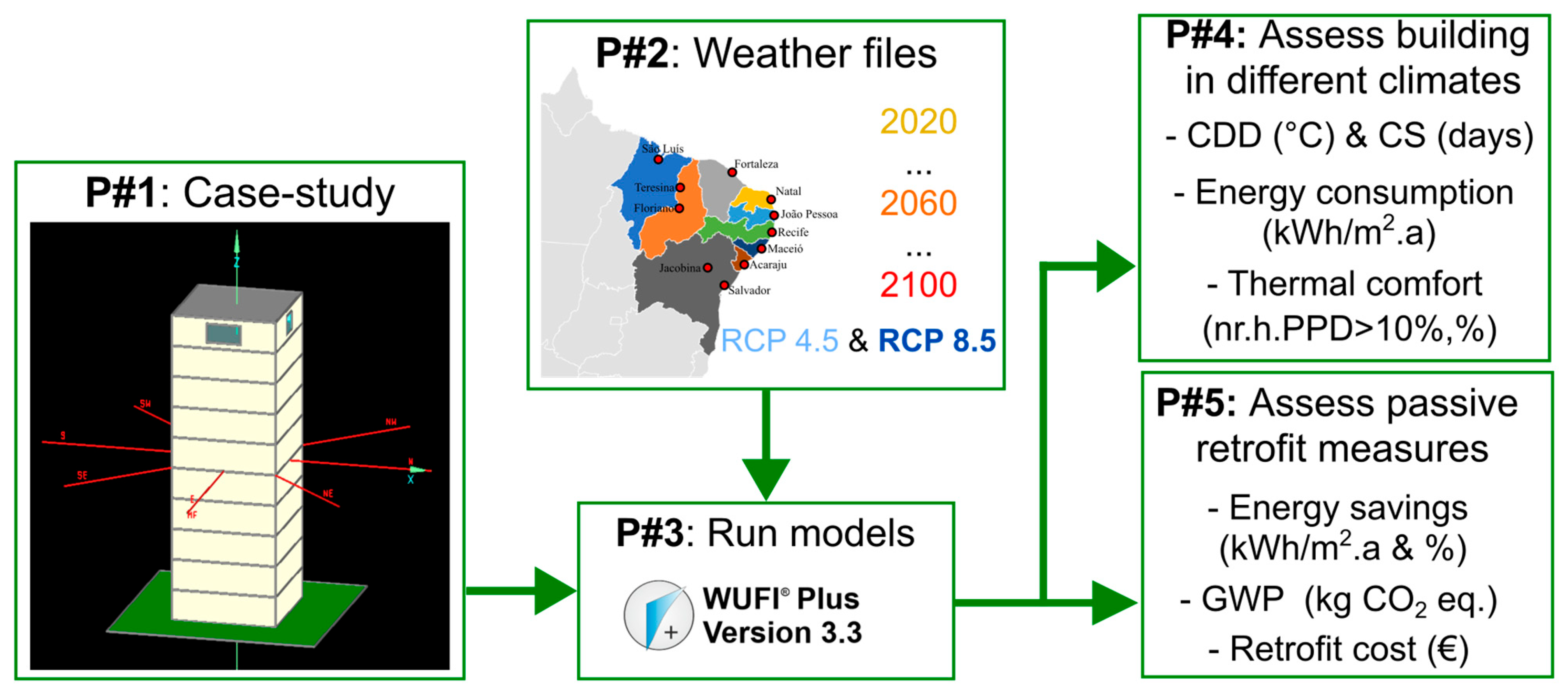
The outdoor climate is expected to undergo significant and extreme changes. These changes may lead to increased building requirements depending on their location. This is critical, as human beings tend to spend a large part of their time inside buildings. Accordingly, it is crucial to take future conditions into account to ensure an adequate indoor climate, simultaneously meeting the current drive for decarbonization of the built environment. One avenue is opting for thermally efficient building products and technologies with a lower carbon footprint to guarantee a comfortable indoor climate while minimizing energy consumption. This study focuses on the Northeast region of Brazil, specifically its nine states, given the usage of specific passive thermal strategies in new buildings that have high compensatory energy consumption. This is achieved through developing computational thermal models of a housing unit in a multi-family building, commonly constructed in several cities in this region. This thermal model was employed to analyze indoor thermal comfort, energy consumption, and carbon footprint. To account for future climate projections, the analysis includes scenarios based on Representative Concentration Pathways 4.5 and 8.5. The efficiency of certain sustainable passive rehabilitation is demonstrated in this region, highlighting the importance of adopting passive and efficient thermal measures appropriate to the region’s climate.
Keywords: bio-based thermal insulation; sustainability; thermal comfort; energy consumption; climate change; built environment bio-based thermal insulation; sustainability; thermal comfort; energy consumption; climate change; built environment