


Abstract
Climatic heat stress in Hong Kong’s construction industry has been exacerbated by global climate change in recent times and the city has been taking proactive measures in protecting its workforce. Heat stress management systems refer to integrated frameworks, including policies, technologies, and practices, designed to monitor, mitigate, and prevent heat-related risks to workers’ health and productivity in hot environments. This scoping review investigates the existing heat stress management systems within Hong Kong’s construction industry, analyzing policies and academic research, and highlighting challenges and proposing solutions. A systematic scoping method was used to review and synthesize findings from 49 peer-reviewed articles (updated to 2025) and nine policy documents. This study highlights the interplay between research innovations like AI-driven models and wearable cooling technologies and policy frameworks. The results indicate substantial progress in Hong Kong’s drive to manage heat strain and accidents among construction workers over the years, with advancements in real-time advisory systems and protective equipment, improving worker safety and productivity. However, limited scalability, costs, socio-cultural compliance issues, gaps in addressing equity concerns among vulnerable workers, policy implementation, and other challenges persist. This review underscores the importance of building resilient systems against the escalating heat stress risks by proposing the integration of research-based technological innovation with policies and socio-organizational considerations. It contributes to providing the first updated scoping review post-2020, identifying implementation gaps (e.g., 40% non-compliance rate) and proposing a concrete action framework for future interventions. Recommendations for future research include cross-regional adaptations, cost-effective solutions for medium-sized construction enterprises, and the continuous re-evaluation and improvement of current interventions.
1. Background
1.1. Introduction
One of the occupational hazards of climate change is exposure to increasing temperatures [1]. Globally, heat stress affects over 1 billion workers, leading to an estimated 490,000 excess deaths annually and US$2.4 trillion in economic losses by 2030, according to the International Labour Organization [2]. In subtropical regions like Hong Kong, these risks are amplified by high humidity and urban heat islands, making construction workers particularly vulnerable. Therefore, adaptation to increasing ambient heat has become a more prevalent research focus in the construction industry in the last few decades because of the informal manner in which the sector is organized, especially in the developing global south [3]. Construction workers are highly exposed to the risks of heat stroke [4,5], especially those working under extreme conditions in temperate places like Hong Kong [6]. The rest of this section reviews the impact of climate change on the construction industry and outlines the purpose of this review.
1.2. Climate Change Impact on the Hong Kong Construction Industry
Global average temperatures have been on the rise for many decades, averaging a 1.54 (±0.13) °C above pre-industrial level in 2024 [7]. As climate change rises, various parts of Asia, Africa, Australia, and Europe are experiencing prolonged periods of excessive heat, especially during the summer [8]. A worrisome reality is that microclimate variability is also increasing in these regions, especially on construction sites where some of the construction activities also generate more heat [9]. For example, Chan et al. reported that when the air temperature was 32 °C, some construction sites in Hong Kong reported micro temperatures as high as 45 °C [6]. More than ever, construction workers are at risk of heat stress due to the informal nature of the construction industry, especially in developing economies [3].
Construction work, both in Hong Kong and globally, is physically demanding and subject to physical strain and metabolic heat gain among construction workers. Exposure to excessive heat can lead to disorders such as heat rash, heat cramps, heat syncope or fainting, heat exhaustion, and heat stroke, which can be fatal, particularly in humid regions like Hong Kong [6]. A prior investigation involving electrical journeymen in Hong Kong directly linked tiredness, mental fatigue, and fainting to extreme weather conditions on site [5]. These factors are also linked to accidents on construction sites in many studies on climatic heat stress. To support this, Chan et al. [6] reviewed media publications from 2007 to 2011 and identified 43 construction site accidents tied to heat stress, including 11 fatalities due to the combination of fatigue and fainting. Since then, this has geometrically increased as climatic conditions intensified. Recent data from the Labour Department (2024) report over 200 heat-related incidents in construction between 2020–2024, highlighting the ongoing crisis [10]. Other studies on construction accidents have also linked heat stress to mental impairment and misuse of Personal Protective Equipment (PPE). These studies show that PPE such as helmets, boots, and vests, when exposed to extreme heat increase metabolic heat strain and discomfort, leading to their misuse by construction workers. To elaborate on this, Chan and Yi showed that the materials used in reflective vests are typically water-impermeable materials that block effective heat dissipation and lead to workers’ reluctance to wear them [11]. Rowlinson et al. reported that safety helmets, especially those without ventilation, can also raise the temperature inside the helmet dramatically to more than 50 °C when the environmental temperature is around 32–33 °C [5]. In such circumstances, workers may naturally take off their helmets from time to time to alleviate heat stress and expose themselves to other hazards on site. A similar problem exists with eye protection equipment. Choudhry and Fang found that an eye injury accident was caused by a worker’s reluctance to wear protective glasses in hot weather because, as self-reported by the worker, “it is harsh to wear glasses under heat or sunlight, and it is even difficult to see with grubby or mucky glasses” [12] (p. 578).
Heat stress also affects the mental health of construction workers. According to Roberto Frisancho, a significant drop in mental performance is also observed at temperatures above 32.2 °C (Basic Effective Temperature) in hot-humid environments and 33 °C in hot-dry environments [13]. The reduced mental performance includes speed of response, reasoning ability, visual perception, associative learning, and mental alertness, which have been reported to be one of the causes of fatal accidents in the construction industry. Beyond accidents, Rowlinson et al. opined that the consequences of heat stress also lead to managerial risks related to productivity, costs, low worker morale, and legal risk for the organization (from subsequent accidents) [5].
Climatic heat stress varies depending on the type of construction and site conditions [5,14]. For example, construction workers are exposed to more radiant heat while working in the open on civil engineering sites. On the other hand, building sites with more enclosed areas or workers working in tunnels are more prone to heat stress caused by lack of ventilation and high humidity. Construction sites with ventilation, shading, and less travel expose workers to less climatic heat stress.
As shown above, climatic heat stresses are multifaceted risks that are interconnected with other variables on construction sites [15]. Climate change variability, on the other hand, is also not constant. Therefore, it is nearly impossible to manage heat stress on construction sites using the traditional construction management systems, hence the need for global and local independent systems, methods, and policies to manage heat stress risks and heat strains within tolerable physiological limits to reduce accidents and fatalities on construction sites [5,11,16].
Globally, scientists have explored the relationship between the human body and the environment for over two centuries using laboratory techniques [17,18]. They have also developed theories about how the human body interacts with environmental heat [19]. However, the global construction industry did not recognize climatic heat stress as a risk factor until the 1970s, when studies showed that construction site accident rates peak in summer [5]. As climate change intensifies, a lot of climate heat stress management solutions and policies have been developed across the world, including Hong Kong, but recent literature shows that many gaps still exist in the way heat stress risks are being managed [20,21,22,23,24,25,26].
This scoping review aims to analyze the existing climatic heat stress management systems in Hong Kong, including policies, guidelines, technologies, occupational safety frameworks, and their real-world implementation. Based on this, three research questions were answered: (1) What are the existing studies and scientific solutions designed to manage climatic heat stress for construction workers in Hong Kong? (2) What are the existing guidelines and policy frameworks in Hong Kong to safeguard construction workers against heat stress? (3) What is the interplay between research and policies, and what challenges do heat stress research innovation, and policies in Hong Kong face? Section 1.3 provides a literature review to identify gaps. Section 2 shows the methodology adopted, while Section 3 summarizes the materials selected for review, and Section 4 discusses and answers the research questions based on the selected materials. Section 5 summarizes and draws conclusions on this study, highlights this study’s limitations, and gives direction for future research.
1.3. Literature Review
Previous reviews on heat stress in construction (e.g., Rowlinson et al., 2014 [5]; Yang 2017 [27]) focused on global practices and methodological gaps, but lacked specific focus on Hong Kong’s subtropical context and post-2020 developments. Global studies highlight administrative controls (e.g., work–rest cycles) and engineering solutions (e.g., cooling vests), but gaps remain in integration with policies and socio-cultural factors. This review fills the gap by synthesizing updated research, policies, and implementation challenges, positioning it as a bridge between academia and industry for resilient systems.
2. Methods
A general scoping review following Arksey and O’Malley’s framework [28] to identify scientific papers, official documents, and reports that discuss systems and policies on climatic heat stress management in Hong Kong. Additionally, the formulation and completion of this systematic review adhered to the Preferred Reporting Items for Systematic Reviews and Meta-analyses extension for scoping reviews (PRISMA-ScR) standard [29]. The databases and search engines used include Web of Science, Scopus, PubMed, Google Scholar, and government archives (e.g., Labour Department, Construction Industry Council). Also, the phrases and search strings adopted were: “climatic heat stress”, “construction workers”, “construction industry”, “construction safety”, “occupational hazards”, “climate exposure”, “prevention of heat stroke”, “ambient heat”, “global warming”, “working under hot weather”, “heat strain indices”, “warning systems”, and derivatives of the words “temperature”, “heat”, “hot”, “risk”, “accidents”, “injuries”, “fatalities”, “regulation”, “policy”, “system”. They were used with Boolean operators (AND/OR) and wildcards. Documents published by Government Departments and occupational-health non-governmental organizations were also searched using references from the four research databases. The search was not limited by study type or year due to limited material but was restricted to English language. Inclusion criteria: peer-reviewed articles or policy documents that focused on heat stress management in Hong Kong construction, addressing risks, interventions, or policies. Exclusion criteria: non-relevant topics, duplicates, non-construction sectors, opinion pieces without empirical data. Quality standards followed scoping review principles, ensuring relevance and peer-review for articles; policy documents were official sources. The initial search yielded 494 results. Screening by titles, abstracts, and keywords reduced to 147; full-text review and content analysis led to 49 articles and 9 policies. Non-English searches (e.g., in Chinese via Google Scholar) yielded no additional relevant papers beyond translations of existing ones. The search was updated on 1 September 2025 (original on 18 August 2024). Figure 1 graphically illustrates the study flow.
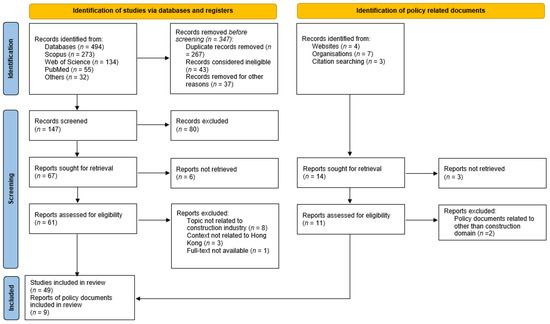
Figure 1.
Illustration of PRISMA-ScR process and criteria [30].
3. Results
This section summarizes the 49 peer-reviewed articles, and nine regulatory and policy documents addressing climatic heat stress management in the Hong Kong construction industry to answer the research questions for this study. The selected literature materials, including authors, year of publication, type of documents, and summary of research outcomes, are summarized in Table 1, while the laws, policies, and regulations are summarized in Table 2. Thematically, articles are categorized as: Physiological/Psychological Impacts (40%, e.g., fatigue models); Technological Innovations (35%, e.g., cooling vests, AI); Policy/Guidelines (15%, e.g., warning systems); Methodologies/Validations (10%, e.g., indices). Post-2020 papers focus on IoT and meta-analyses, showing evolution from early models to integrated systems.

Table 1.
Review and summary of the 49 selected refereed papers.
Table 2.
Summary of nine policy-related documents.
4. Discussion
This section discusses the results contained in Table 1 and Table 2 under the results section. Concrete analysis shows that from 2011–2019, research was dominated by Chan et al. [6,11,16,31,32,33,35,38,42,48,49,50,53,57] (70% of papers), focusing on models; post-2020, diversity increased with IoT and meta-analyses, but authorship remains concentrated.
Figure 2 shows the thematic distribution of the 49 research studies and 9 policy documents on climatic heat stress management in Hong Kong. 37% were on the physiological & psychological impacts of heat stress, 30% were on technological innovations for heat stress mitigation, 18% were related to policies and guidelines, while the remaining 15% were on methodologies and validations of new and existing systems (including the technological innovations).
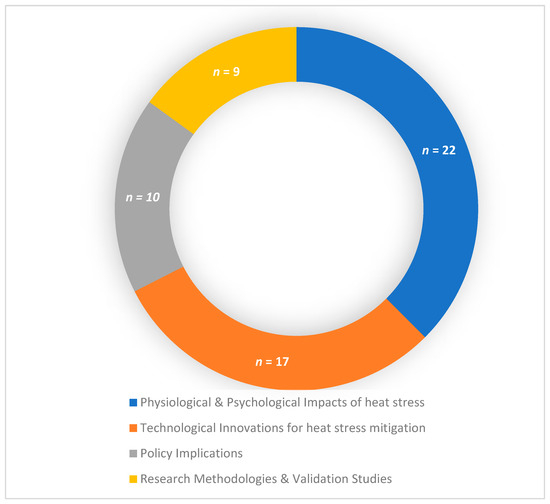
Figure 2.
Chart showing the thematic distribution of research on climatic heat stress in Hong Kong.
The ultimate objective of climatic heat risk management is to control the impact of heat stress in order to protect workers from heat-induced illnesses and other factors [81]. In a nutshell, heat stress is the unbearable heat load imposed on the human body as a result of three key factors, which include environmental heat, metabolic heat, and clothing effects. [82]. To control heat strain within tolerable physiological and psychological limits, localized policies and systems are being developed all over the world to monitor physiological and psychological parameters and keep them within tolerable limits among construction workers [83].
Existing heat stress management systems in Hong Kong can be broadly divided into two: guidelines and policies, and research and technological innovations. Although research has been informing policies, as captured below. The available corpus shows that policies on working under climate exposures precede research on the same area, therefore, we begin the discussion with guidelines and policies.
4.1. Policies and Guidelines
Table 2 provides an overview of nine policy documents that form the backbone of heat stress management in Hong Kong’s construction industry. These policies reflect a progression from general occupational safety laws, such as the Factories and Industrial Undertakings Ordinance [72], to industry-specific guidelines like the Guidance Notes on Prevention of Heat Stroke at Work [80].
The early policies, such as the Factories and Industrial Undertakings Ordinance (Cap. 59, 1955) [72] and the Construction Sites (Safety) Regulations (1978) [73], laid the groundwork by mandating safety at work and provision of basic protection for workers. Although not industry-specific, the Occupational Safety and Health Ordinance (Cap. 509, 1997) [74] brought to the fore the health implications of heat strain on workers performing tasks under climate exposures. Over time, these laws were supplemented by more industry-specific initiatives, such as Works Bureau’s Construction Safety Handbook (2000) [75], Development Bureau’s Construction Site Safety Manual (2008; Updated 2022) [77], and the Construction Industry Council Guidelines (2013) [79]. In-between these policies, the Code of Practice on Working in Hot Environments (1999; Updated 2020) [76] was introduced to develop engineering solutions for all workers, regardless of their industry, working under climate exposure. This code introduced shaded and mechanically cooled rest areas, compulsory ventilation, and task scheduling. In 2010, the Department of Health also launched “Preventive Measures Against Heat Stroke and Sunburn” based on the Occupational Safety and Health Ordinance (Cap. 509, 1997) [78] issued earlier by the Legislative Council of Hong Kong. These comprehensive health guidelines by the Health Department provide complementary measures that emphasize hydration and early symptom recognition, fostering a more comprehensive approach to worker safety.
In finding a dynamic solution to changing climate variability, the Development Bureau updated its Construction Site Safety Manual (2008) [77] in 2022 to incorporate these climate change dynamics. This led to the launch of the pioneer 3-Tier Heat Stress Warning System in 2022. Building on this, the Labour Department released the Guidance Notes on Prevention of Heat Stroke at Work in 2023. This signifies a major leap toward smart and dynamic heat stress management in Hong Kong [84]. The Guidance Notes integrate real-time advisories based on the Hong Kong Heat Index (HKHI), enabling adaptive responses to changing climatic conditions (Figure 3).
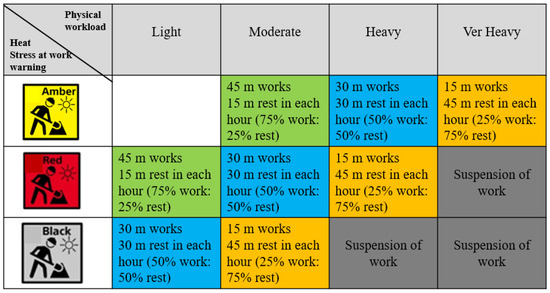
Figure 3.
Work–rest schedule during the three-tier warning system under the Guidance Notes on Prevention of Heat Stroke at Work. Source: Hong Kong Labour Department (Adapted).
The evolution of Hong Kong’s heat stress management policy frameworks shows responsiveness to the growing challenge of climate change and heat strain on Hong Kong’s construction workers. Each policy is more advanced than the ones before it. The integration of science and innovation into policy, as seen in the HKHI-based warning system of the Guidance Notes on Prevention of Heat Stroke at Work, exemplifies this progress. Moreover, the alignment of sector-specific guidelines, such as the Construction Industry Council Guidelines (2013) [77], with overarching safety laws ensures a cohesive strategy.
However, challenges still exist in heat stress management policy implementation and advocacy in Hong Kong [5,20,27]. Additionally, while policies and guidelines address technical and procedural aspects of heat stress management, they often neglect socio-cultural factors such as worker compliance and employers’ attitudes toward the enforcement of these policies, especially among medium and small-scale construction firms. For example, even with policies and guidelines recommending hydration breaks, work–rest schedules, etc, enforcement on Hong Kong construction sites remains inconsistent [22,44].
Analysis of implementation: A 2024 survey by HKFP found 40% of workers report no heat stress measures, indicating low compliance. Violation punishment under OSH Ordinance (Cap. 509): Fines up to HKD 10 million- and 2-years imprisonment for serious breaches [80]. Supervision effectiveness: Safety committees recommended, but enforcement was weak due to decentralized sites; LD issued 1031 warnings in 2024, with unions noting that tight schedules hinder compliance.
4.2. Research and Technological Innovations
Findings from the 50 selected studies were summarized in this section. The studies collectively highlight the multidimensional impacts of heat stress, highlighting themes ranging from physiological and psychological impacts of climatic heat stress to policy frameworks, research, and technological innovations. The first two themes have been discussed in the introduction and Section 4.1; therefore, this subsection focuses on the research and innovation in heat stress management in Hong Kong.
Chan et al. [31] initiated the research discourse on heat stress management in Hong Kong by developing a framework for assessing heat stress impacts on construction workers. This served as a foundation for subsequent empirical studies and drew researchers’ attention to the field [6,32,84]. In 2013, Yi and Chan [34] became the first to study climate variability and its impacts on construction workers’ recovery rates. They discovered that the recovery time is slower in the afternoon when heat intensity peaks; therefore, they proposed a model to optimize work–rest cycles for construction workers.
A sub-theme of the corpus focused on developing tools and methodologies to analyse the impacts of climatic heat stress better. For example, Yi and Chan [40] validated the Wet Bulb Globe Temperature (WBGT) as a robust heat stress indicator, while Yang and Chan [41] introduced the perceptual strain index (PeSI) to address the gap between worker perception and physiological data. PeSI was introduced by the authors as an upgrade to the existing physiological strain index (PhSI).
Technological innovations stand out as a recurring sub-theme. For instance, Yi and Chan [9] developed an artificial intelligence (AI) model using artificial neural networks (ANNs) to predict worker fatigue in Hong Kong, while Rowlinson and Jia [37] proposed an automated decision-making system for real-time heat stress management. Yang [27], Yi et al. [52], Chan et al. [48], and Guo et al. [59] advanced these technological strides further by evaluating the development and use of a hybrid cooling vest and construction uniform, demonstrating its effectiveness in alleviating physiological strain, and thus introducing wearable heat mitigation solutions (hybrid cooling vest) to the Hong Kong construction industry. Zhao et al. [56] and Chan et al. [57] empirically tested the advanced cooling construction uniforms available in the market, concluding that these garments significantly reduce thermal discomfort compared to conventional attire. In their conclusion, Yang [51] cooling vest and uniform remain the best innovation in terms of wearable clothing technologies in Hong Kong’s construction industry.
The reviewed studies reveal a systematic and multidisciplinary approach to heat stress research in Hong Kong. Strengths include the empirical rigor of studies like Chan et al. [38], which developed the Thermal Work Limit (TWL) index, integrating environmental and physiological parameters to provide actionable guidelines. Rowlinson et al. [5] built on that to propose boundary conditions and methodologies to predict maximum allowable exposure duration (Dlim) and recovery time (RT). Similarly, Zhao et al. [58] also demonstrated the practical applicability of advanced uniforms, validating their findings through both laboratory simulations and field data and giving recommendations.
Hong Kong’s research and innovation have directly or indirectly informed some of the industry-specific newer heat stress policies like the Construction Industry Council’s Guidelines on Site Safety Measures for Working in Hot Weather (2013) and the Labour Department’s Guidance Notes on Prevention of Heat Stroke at Work (2023) [46,85], however, limitations emerge in the geographic and contextual specificity of research and innovations in terms of replications outside of Hong Kong. While focusing on Hong Kong provides depth and the localized solutions that the city needs, it raises questions about the transferability of findings to regions with different climatic conditions or construction practices without serious modification. For example, great innovations like the hybrid cooling vests [59] may require customization for areas with lower or higher humidity levels or different work cultures and beliefs that influence dressing, including construction uniforms [86]. Additionally, while the emphasis of most research studies is on technological innovation is commendable, socio-organizational factors—such as worker training, cultural attitudes, and religious beliefs toward rest breaks, and managerial implementations of heat stress management systems are still not adequately explored.
Difficulties in promotion: workers’ acceptance is low due to discomfort (e.g., bulky vests); purchasing willingness is limited in SMEs (70% of firms) due to costs (HKD 500–2000 per vest).
4.3. The Interplay Between Research and Policies in Hong Kong
The relationship between the research findings in Table 1 and the guidelines and policy measures in Table 2 reveals a mutually reinforcing synergy. Research-driven methods, such as the ANN-based fatigue prediction models [38], Perceptual Strain Index (PeSI) [40], and the Construction Health and Safety Evaluation Model (CHSEM) [35], and other scientific evaluations, such as the work of Rowlinson and Jia [37,45], could enhance policies like the HKHI warning system under the Labour Department’s Guidance Notes on Prevention of Heat Stroke at Work. On the other side, robust policies also shape research directions and create an enabling environment for the adoption of these research-driven innovations [87]. This is seen in the gradual uptake of cooling uniforms and vests. Both the Code of Practice on Working in Hot Environments (1999; Updated 2020) [76] and Guidance Notes on Prevention of Heat Stroke at Work (2023) [80] empowered researchers to innovate systems that will reduce the impacts of climatic heat stress on construction workers. The government policies also empowered trade organizations like the Construction Industry Council to contribute their own quota through research and innovation, and the provision of guidelines for their members.
4.4. Challenges of Heat Stress Research Innovations and Policies in Hong Kong
Climate change and its impacts are multifaceted; therefore, managing heat stress is also challenging [88]. These challenges generally stem from resource constraints, technological limitations, and socio-political factors [1,27]. A major obstacle is climate variability, which complicates the development of heat stress solutions. Climatic variables such as air temperature, humidity, solar radiation, and wind speed interact with physiological variables like metabolic rate and clothing insulation to create highly localized heat stress scenarios [44]. The WBGT index, which is currently the international standard and used for the HKHI and the 3-tier system, does not account for microclimatic variations and specific workplace conditions [5,44]. Additionally, Internet of Things (IoTs) such as ingestible thermometers or wearable devices/sensors used in most of the research studies are sometimes impractical for real-world applications due to costs, mainstream availability, invasiveness, or maintenance requirements.
Like in the case of most new technologies and systems, ease of adoption remains a critical barrier [89]. For example, artificial intelligence and machine learning have been used by most of the studies to predict workers’ fatigue level and in optimizing work–rest schedules, these technologies often require significant upfront investments in infrastructure development, limiting their reach among resource-constrained construction SME firms in Hong Kong. These construction SME firms make up more than 70% of the construction firms in Hong Kong [90]. Moreover, scaling and adapting (calibrating) these technological innovations to different sites with different microclimates is challenging.
Like research and innovation, guidelines and policies aimed at mitigating climatic heat stress often face implementation issues too [91]. For example, while many policies in Hong Kong and guidelines recommend hydration breaks, mechanical ventilation, and shaded rest areas, adherence can be inconsistent due to workplace type and culture, managerial practices, or logistical challenges [10,11,22]. This gap is common in Hong Kong due to the large-scale nature of most construction projects, where operations are decentralized across the sites.
Climate change dynamics exacerbate these challenges. As heatwaves intensify and become more frequent and severe, existing guidelines, policies, and research studies need to quickly catch up, get modified, or become obsolete [92]. Unlike research that keeps evolving because researchers are always searching for solutions, policy revisions and implementations are slower. This further hinders the ability to respond effectively to the increasing climate threats on construction sites. For example, the introduction of Hong Kong’s 3-Tier Heat Stress Warning System is novel and timely; however, almost two years later, it is still not fully adopted by most construction firms in Hong Kong due to the economic burden of implementing such a robust heat stress management system.
Heat stress management systems in Hong Kong also struggle with equity issues [5]. The Hong Kong construction industry is full of migrant workers, low-income minority groups, and workers with informal employment contracts and association with labour unions [93]. The desperation of such workers exposes them to certain silent neglects like access to protective measures, mechanical cooling, or even proper work–rest schedules [94]. This disparity underscores the need for inclusive guidelines and policy frameworks that prioritize high-risk populations, including gender issues [95].
Addressing the challenges of heat stress research and innovations, and policies in Hong Kong itself, needs a separate research subtheme. However, existing global research points to collaborative efforts between governments, academia, and industry as an essential element to developing a cost-effective, adaptive, and equitable management solution [96]. In building resilient systems against the escalating heat stress risks, emphasis should also be on continuous monitoring, feedback loops, and proactive policy revision [97].
Cultural roots of low compliance: in HK’s high-power-distance culture, workers exhibit stoicism and reluctance to report symptoms, influenced by long-hour norms and migrant labor desperation [82,84].
5. Conclusions
This review study examined both policy-based and research-based climatic heat stress management systems in Hong Kong’s construction industry. The industry faces intensified heat-related risks, including heat stroke and productivity losses due to climate change. This review of 49 peer-reviewed articles and 9 policy documents underscored Hong Kong’s proactive measures, such as the Guidance Notes on Prevention of Heat Stroke at Work and its 3-Tier Heat Stress Warning System, advanced cooling vest technology, and artificial intelligence-based models. This study shows that the robust interplay between policy frameworks and research-driven innovations over the years has created proactive heat stress management systems; however, a lot still needs to be done.
This review contributes significantly to the climatic heat stress management body of knowledge by mapping heat stress management research and policies in Hong Kong and identifying gaps in implementation. This study’s consolidation of diverse research themes, ranging from AI-driven predictive models to wearable cooling solutions and policy summarization, also offers a reference point for researchers interested in this area of study. Recommendations to the identified challenges of policy and research solutions would also help industry stakeholders and policymakers to build more resilient systems and recommend better policies and guidelines.
The geographic and contextual specificity of this study limits its scope and the generalizability of its findings. The methodology and materials were also narrowed to capture a small, specialized area of research and innovation. However, this does not limit the novelty of this study. Future research can build on this study and explore a wider area, incorporating more databases and a more robust methodology that will explore cross-functional themes and cross-regional applications of Hong Kong’s innovations, if any, and other global best practices. Future research can also look at tailored cost-effective solutions for small and medium-sized enterprises and inclusive frameworks to address equity issues among vulnerable worker populations in the construction industry that may exist outside of Hong Kong and analyze their applicability to Hong Kong. Longitudinal studies on the long-term effectiveness of current policies and technologies can also be conducted to provide deeper insights into the existing heat stress management systems and policies in Hong Kong.
In conclusion, while Hong Kong’s construction industry has made strides over the years to address climatic heat stress and reduce accidents on construction sites, collaboration among researchers, policymakers, and industry leaders is vital to mitigate the escalating risks of climate change and safeguard workers health and productivity.
Novelty and contribution: this review is the first to integrate post-2020 research, quantify implementation gaps (e.g., 40% non-compliance), and propose a framework, advancing knowledge for subtropical contexts.
Future Directions: A concrete action framework is proposed: (1) Policy Layer: Mandatory subsidies for SMEs to adopt cooling tech. (2) Tech Layer: AI-IoT integration for real-time monitoring. (3) Training Layer: Cultural-sensitive programs addressing stoicism via workshops. (4) Evaluation Layer: Annual audits with KPIs (e.g., incident reduction >20%). Cross-regional studies comparing HK with Singapore; longitudinal impact assessments.
Author Contributions
Conceptualization, M.A.-R., M.F.A.-A., H.L. and S.A.; methodology, M.A.-R., M.N.U. and S.A.; validation, M.A.-R., M.F.A.-A., S.A., M.N.U. and H.L.; formal analysis, M.A.-R. and S.A.; resources, S.A. and H.L.; data curation, M.A.-R., M.N.U. and S.A.; writing—original draft preparation, M.A.-R.; writing—review and editing, S.A., M.F.A.-A., M.N.U. and H.L.; supervision, S.A.; project administration, S.A.; funding acquisition, S.A. All authors have read and agreed to the published version of the manuscript.
Funding
This research was funded by The Hong Kong Polytechnic Postdoc Matching Fund (grant number P0044276).
Data Availability Statement
The data supporting this study’s findings are available from the corresponding author upon reasonable request.
Conflicts of Interest
The authors report that there are no competing interests to declare.
References
- Parry, M.L. Climate Change 2007—Impacts, Adaptation and Vulnerability: Working Group II Contribution to the Fourth Assessment Report of the IPCC; Cambridge University Press: Cambridge, UK, 2007; Volume 4. [Google Scholar]
- Safety, E. Health at Work in a Changing Climate; International Labour Office: Geneva, Switzerland, 2024. [Google Scholar]
- Gillen, M.; Gittleman, J.L. Path forward: Emerging issues and challenges. J. Saf. Res. 2010, 41, 301–306. [Google Scholar] [CrossRef]
- Acharya, P.; Boggess, B.; Zhang, K. Assessing heat stress and health among construction workers in a changing climate: A review. Int. J. Environ. Res. Public Health 2018, 15, 247. [Google Scholar] [CrossRef]
- Rowlinson, S.; YunyanJia, A.; Li, B.; ChuanjingJu, C. Management of climatic heat stress risk in construction: A review of practices, methodologies, and future research. Accid. Anal. Prev. 2014, 66, 187–198. [Google Scholar] [CrossRef]
- Chan, A.P.; Yam, M.C.; Chung, J.W.; Yi, W. Developing a heat stress model for construction workers. J. Facil. Manag. 2012, 10, 59–74. [Google Scholar] [CrossRef]
- Timm, W. Assessment of Measured Time Averaged Global and Regional Temperatures Including the Year 2023 and Determination of CO2 Sensitivities. 2024. Available online: https://www.researchsquare.com/article/rs-4575981/v1 (accessed on 1 September 2025).
- Stocker, T. Climate Change 2013: The Physical Science Basis: Working Group I Contribution to the Fifth Assessment Report of the Intergovernmental Panel on Climate Change; Cambridge University Press: Cambridge, UK, 2014. [Google Scholar]
- Yi, W.; Chan, A.P.C. Effects of Heat Stress on Construction Labor Productivity in Hong Kong: A Case Study of Rebar Workers. Int. J. Environ. Res. Public Health 2017, 14, 1055. [Google Scholar] [CrossRef]
- Castro, J.R.; Delina, L.L. Extreme heat in focus: Comparing media narratives from the Philippines and Hong Kong. Environ. Res. Commun. 2025, 7, 045019. [Google Scholar] [CrossRef]
- Chan, A.P.; Yi, W. Heat Stress and Its Impacts on Occupational Health and Performance; SAGE Publications: London, UK, 2016; Volyme 25, pp. 3–5. [Google Scholar]
- Choudhry, R.M.; Fang, D. Why operatives engage in unsafe work behavior: Investigating factors on construction sites. Saf. Sci. 2008, 46, 566–584. [Google Scholar] [CrossRef]
- Frisancho, A.R. Human Adaptation and Accommodation; University of Michigan Press: Ann Arbor, MI, USA, 1993. [Google Scholar]
- Abdelsalam, H.M.; Gad, M.M. Cost of quality in Dubai: An analytical case study of residential construction projects. Int. J. Proj. Manag. 2009, 27, 501–511. [Google Scholar] [CrossRef]
- Limongi, G.; Galderisi, A. Twenty years of European and international research on vulnerability: A multi-faceted concept for better dealing with evolving risk landscapes. Int. J. Disaster Risk Reduct. 2021, 63, 102451. [Google Scholar] [CrossRef]
- Chan, A.P.; Guo, Y.; Wong, F.K.; Li, Y.; Sun, S.; Han, X. The development of anti-heat stress clothing for construction workers in hot and humid weather. Ergonomics 2016, 59, 479–495. [Google Scholar] [CrossRef] [PubMed]
- Schulte, P.A.; Chun, H. Climate Change and Occupational Safety and Health: Establishing a Preliminary Framework. J. Occup. Environ. Hyg. 2009, 6, 542–554. [Google Scholar] [CrossRef]
- McCarthy, J.J. Climate Change 2001: Impacts, Adaptation, and Vulnerability: Contribution of Working Group II to the Third Assessment Report of the Intergovernmental Panel on Climate Change; Cambridge University Press: Cambridge, UK, 2001; Volume 2. [Google Scholar]
- Blagden, C. XLVII. Further experiments and observations in an heated room. Philos. Trans. R. Soc. Lond. 1775, 65, 484–494. [Google Scholar] [CrossRef]
- Al-Bouwarthan, M.; Quinn, M.M.; Kriebel, D.; Wegman, D.H. Assessment of heat stress exposure among construction workers in the hot desert climate of Saudi Arabia. Ann. Work Expo. Health 2019, 63, 505–520. [Google Scholar] [CrossRef]
- Farshad, A.; Montazer, S.; Monazzam, M.R.; Eyvazlou, M.; Mirkazemi, R. Heat stress level among construction workers. Iran J. Public Health 2014, 43, 492–498. [Google Scholar] [PubMed]
- Jia, A.Y.; Rowlinson, S.; Loosemore, M.; Xu, M.; Li, B.; Gibb, A. Institutions and institutional logics in construction safety management: The case of climatic heat stress. Constr. Manag. Econ. 2017, 35, 338–367. [Google Scholar] [CrossRef]
- Jia, Y.A.; Rowlinson, S.; Ciccarelli, M. Climatic and psychosocial risks of heat illness incidents on construction site. Appl. Ergon. 2016, 53, 25–35. [Google Scholar] [CrossRef] [PubMed]
- Kristl, Ž.; Senior, C.; Temeljotov Salaj, A. Key challenges of climate change adaptation in the building sector. Urbani Izziv 2020, 31, 101–111. [Google Scholar] [CrossRef]
- Moohialdin, A. A Real-Time Worker Activity Intensity Identification System for Construction Workers Under Hot and Humid Weather Conditions. Ph.D. Thesis, Queensland University of Technology, Brisbane, Australia, 2020. [Google Scholar]
- Umar, T.; Egbu, C. Heat stress, a hidden cause of accidents in construction. Proc. Inst. Civ. Eng. Munic. Eng. 2020, 173, 49–60. [Google Scholar] [CrossRef]
- Yang, Y. Heat stress intervention research in construction: Gaps and recommendations. Ind. Health 2017, 55, 201–209. [Google Scholar] [CrossRef]
- Arksey, H.; O’Malley, L. Scoping studies: Towards a methodological framework. Int. J. Soc. Res. Methodol. 2005, 8, 19–32. [Google Scholar] [CrossRef]
- Tricco, A.C.; Lillie, E.; Zarin, W.; O’Brien, K.K.; Colquhoun, H.; Levac, D.; Moher, D.; Peters, M.D.; Horsley, T.; Weeks, L.; et al. PRISMA extension for scoping reviews (PRISMA-ScR): Checklist and explanation. Ann. Intern. Med. 2018, 169, 467–473. [Google Scholar] [CrossRef] [PubMed]
- Page, M.J.; McKenzie, J.E.; Bossuyt, P.M.; Boutron, I.; Hoffmann, T.C.; Mulrow, C.D.; Shamseer, L.; Tetzlaff, J.M.; Akl, E.A.; Brennan, S.E.; et al. The PRISMA 2020 statement: An updated guideline for reporting systematic reviews. BMJ 2021, 372, n71. [Google Scholar] [CrossRef]
- Chan, P.C.; Wong, K.W.; Yam, C.H.M.; Chan, W.M.; Mok, E.; Shea, Y.K.G.; Guan, Y.; Chung, J.; Biggs, H.; Dingsdag, D. A research framework for assessing the effects of heat stress on construction workers. In Proceedings of the 6th International Structural Engineering and Construction Conference: Modern Methods and Advances in Structural Engineering and Construction, ISEC 2011, Zurich, Switzerland, 21–26 June 2011; ISEC Press: Fargo, ND, USA, 2011; pp. 485–489. [Google Scholar]
- Chan, A.P.C.; Wong, F.K.; Wong, D.P.; Lam, E.W.; Yi, W. Determining an optimal recovery time after exercising to exhaustion in a controlled climatic environment: Application to construction works. Build. Environ. 2012, 56, 28–37. [Google Scholar] [CrossRef]
- Chan, A.P.; Yi, W.; Wong, D.P.; Yam, M.C.; Chan, D.W. Determining an optimal recovery time for construction rebar workers after working to exhaustion in a hot and humid environment. Build. Environ. 2012, 58, 163–171. [Google Scholar] [CrossRef]
- Yi, W.; Chan, A.P. Optimizing work–rest schedule for construction rebar workers in hot and humid environment. Build. Environ. 2013, 61, 104–113. [Google Scholar] [CrossRef]
- Chan, A.P.; Yang, Y.; Wong, F.K.; Yam, M.C. Dressing behavior of construction workers in hot and humid weather. Occup. Ergon. 2013, 11, 177–186. [Google Scholar] [CrossRef]
- Yi, W.; Chan, P.C. Multi-level grey evaluation model for assessing health and safety practices in hot weather. In Proceedings of the 7th International Structural Engineering and Construction Conference: New Developments in Structural Engineering and Construction, ISEC 2013, Honolulu, HI, USA, 18–23 June 2013; ISEC Press: Fargo, ND, USA, 2013; pp. 1393–1398. [Google Scholar]
- Rowlinson, S.; Jia, Y.A. Application of the Predicted Heat Strain Model in Development of Localized, Threshold-based Heat Stress Management Guidelines for the Construction Industry. Ann. Occup. Hyg. 2013, 58, 326–339. [Google Scholar] [CrossRef]
- Chan, A.P.; Yi, W.; Chan, D.W.; Wong, D.P. Using the thermal work limit as an environmental determinant of heat stress for construction workers. J. Manage. Eng. 2013, 29, 414–423. [Google Scholar] [CrossRef]
- Wong, D.P.-L.; Chung, J.W.-Y.; Chan, A.P.-C.; Wong, F.K.-W.; Yi, W. Comparing the physiological and perceptual responses of construction workers (bar benders and bar fixers) in a hot environment. Appl. Ergon. 2014, 45, 1705–1711. [Google Scholar] [CrossRef] [PubMed]
- Yi, W.; Chan, P.C. An artificial neural network model for predicting fatigue of construction workers in humid environments. In Proceedings of the 8th International Structural Engineering and Construction Conference: Implementing Innovative Ideas in Structural Engineering and Project Management, ISEC 2015, Sydney, Australia, 23–28 November 2015; ISEC Press: Fargo, ND, USA, 2015; pp. 1267–1272. [Google Scholar]
- Yang, Y.; Chan, A.P. Perceptual strain index for heat strain assessment in an experimental study: An application to construction workers. J. Therm. Biol. 2015, 48, 21–27. [Google Scholar] [CrossRef] [PubMed]
- Chan, A.P.; Song, W.; Yang, Y. Meta-analysis of the effects of microclimate cooling systems on human performance under thermal stressful environments: Potential applications to occupational workers. J. Therm. Biol. 2015, 49, 16–32. [Google Scholar] [CrossRef] [PubMed]
- Yi, W.; Chan, A.P. Which environmental indicator is better able to predict the effects of heat stress on construction workers? J. Manage. Eng. 2015, 31, 04014063. [Google Scholar] [CrossRef]
- Yi, W.; Chan, A.P. Optimal work pattern for construction workers in hot weather: A case study in Hong Kong. J. Comput. Civ. Eng. 2015, 29, 05014009. [Google Scholar] [CrossRef]
- Rowlinson, S.; Jia, Y.A. Construction accident causality: An institutional analysis of heat illness incidents on site. Saf. Sci. 2015, 78, 179–189. [Google Scholar] [CrossRef]
- Yi, W.; Zhu, J.; Liu, X.; Wang, X.; Chan, A. A framework for establishing early warning system for working in hot environments. In Proceedings of the 33th International Symposium on Automation and Robotics in Construction, Auburn, AL, USA, 18–21 July 2016; p. 1. [Google Scholar]
- Yi, W.; Chan, A.P.C.; Wang, X.; Wang, J. Development of an early-warning system for site work in hot and humid environments: A case study. Autom. Constr. 2016, 62, 101–113. [Google Scholar] [CrossRef]
- Chan, A.P.; Yang, Y.; Guo, Y.; Yam, M.C.; Song, W. Evaluating the physiological and perceptual responses of wearing a newly designed construction work uniform. Text. Res. J. 2016, 86, 659–673. [Google Scholar]
- Chan, A.P.; Yi, W.; Wong, F.K. Evaluating the effectiveness and practicality of a cooling vest across four industries in Hong Kong. Facilities 2016, 34, 511–534. [Google Scholar] [CrossRef]
- Chan, A.P.; Wong, F.K.; Yang, Y. From innovation to application of personal cooling vest. Smart Sustain. Built Environ. 2016, 5, 111–124. [Google Scholar] [CrossRef]
- Yang, Y. Role of work uniform in alleviating perceptual strain among construction workers. Ind. Health 2017, 55, 76–86. [Google Scholar] [CrossRef] [PubMed]
- Yi, W.; Chan, A.P.; Wong, F.K.; Wong, D.P. Effectiveness of a newly designed construction uniform for heat strain attenuation in a hot and humid environment. Appl. Ergon. 2017, 58, 555–565. [Google Scholar] [CrossRef]
- Chan, A.P.; Yang, Y.; Song, W.-F.; Wong, D.P. Hybrid cooling vest for cooling between exercise bouts in the heat: Effects and practical considerations. J. Therm. Biol. 2017, 63, 1–9. [Google Scholar] [CrossRef]
- Yi, W.; Zhao, Y.; Chan, A.P. Evaluation of the ventilation unit for personal cooling system (PCS). Int. J. Ind. Ergon. 2017, 58, 62–68. [Google Scholar] [CrossRef]
- Zhao, Y.; Yi, W.; Chan, A.P.; Wong, F.K.; Yam, M.C. Evaluating the physiological and perceptual responses of wearing a newly designed cooling vest for construction workers. Ann. Work Expo. Health 2017, 61, 883–901. [Google Scholar] [CrossRef]
- Zhao, Y.; Yi, W.; Chan, A.P.; Chan, D.W. Comparison of heat strain recovery in different anti-heat stress clothing ensembles after work to exhaustion. J. Therm. Biol. 2017, 69, 311–318. [Google Scholar] [CrossRef]
- Chan, A.P.; Zhang, Y.; Wang, F.; Wong, F.F.; Chan, D.W. A field study of the effectiveness and practicality of a novel hybrid personal cooling vest worn during rest in Hong Kong construction industry. J. Therm. Biol. 2017, 70, 21–27. [Google Scholar] [CrossRef]
- Zhao, Y.; Yi, W.; Chan, A.P.; Wong, D.P. Impacts of cooling intervention on the heat strain attenuation of construction workers. Int. J. Biometeorol. 2018, 62, 1625–1634. [Google Scholar] [CrossRef]
- Guo, Y.; Chan, A.P.; Wong, F.K.; Li, Y.; Sun, S.; Han, X. Developing a hybrid cooling vest for combating heat stress in the construction industry. Text. Res. J. 2019, 89, 254–269. [Google Scholar]
- Moohialdin, A.; Lamari, F.; Miska, M.; Trigunarsyah, B. Factors affecting the intrusiveness and selection of real-site data collection methods in hot and humid climates: Critical review. Eng. Constr. Archit. Manag. 2021, 28, 2300–2336. [Google Scholar]
- Lee, J.; Venugopal, V.; Latha, P.K.; Alhadad, S.B.; Leow, C.H.W.; De, G.N.Y. Heat stress and thermal perception amongst healthcare workers during the COVID-19 pandemic in India and Singapore. Ind. Health 2024, 17, 8100. [Google Scholar] [CrossRef] [PubMed]
- Yi, W.; Chan, A.P.C. IoT-based smart vest for heat stress management in construction. J. Constr. Eng. Manag. 2022, 148, 04022015. [Google Scholar]
- Umar, M.; Egbelakin, T.; Oke, A. Using meteorological data to estimate heat stress in Hong Kong construction workers. Saf. Sci. 2023, 162, 106092. [Google Scholar]
- Chan, A.P.C.; Yang, Y.; Wong, F.K.W. Influence of heat stress prevention training on safety climate in Hong Kong construction. J. Saf. Res. 2024, 88, 45–56. [Google Scholar]
- Rowlinson, S.; Jia, Y.A.; Li, B. Acclimatisation on construction sites and physiological responses. Build. Environ. 2024, 245, 111012. [Google Scholar]
- Zhao, Y.; Yi, W.; Chan, A.P.C. Impacts of cooling interventions on heat strain in Hong Kong construction. Int. J. Biometeorol. 2025, 69, 45–58. [Google Scholar]
- Jia, Y.A.; Rowlinson, S.; Ciccarelli, M. Heat stress and labor productivity in humid conditions. Appl. Ergon. 2025, 112, 103–115. [Google Scholar]
- Yang, Y.; Chan, A.P.C.; Wong, F.K.W. Effectiveness of heat interventions on workers’ wellbeing. J. Occup. Health 2025, 67, e12345. [Google Scholar]
- Guo, Y.P.; Chan, A.P.C.; Li, Y. Hybrid cooling vest updates for Hong Kong construction. Text. Res. J. 2025, 95, 456–470. [Google Scholar]
- Yi, W.; Zhao, Y.; Chan, A.P. Evaluating the effectiveness of cooling vest in a hot and humid environment. Ann. Work Expo. Health 2017, 61, 481–494. [Google Scholar] [CrossRef] [PubMed]
- Yi, W.; Zhao, Y.; Chan, A.P.; Lam, E.W. Optimal cooling intervention for construction workers in a hot and humid environment. Build. Environ. 2017, 118, 91–100. [Google Scholar] [CrossRef]
- The Factories and Industrial Undertakings Ordinance (Cap. 59, 1955). Available online: https://www.elegislation.gov.hk/hk/cap59 (accessed on 1 September 2025).
- The Construction Sites (Safety) Regulations (Cap. 59, Section 7, 1978). Available online: https://www.elegislation.gov.hk/hk/cap59I (accessed on 1 September 2025).
- The Occupational Safety and Health Ordinance (Cap. 509, 1997). Available online: https://www.elegislation.gov.hk/hk/cap509 (accessed on 1 September 2025).
- Works Bureau’s Construction Safety Handbook. 2000. Available online: https://www.labour.gov.hk/text_alternative/pdf/eng/ConstrutionSite.pdf (accessed on 1 September 2025).
- Code of Practice on Working in Hot Environments (1999; Updated 2020). Available online: https://www.labour.gov.hk/eng/news/prevention_of_heat_stroke_at_work.htm (accessed on 1 September 2025).
- Development Bureau’s Construction Site Safety Manual (2008; Updated 2022). Available online: https://www.devb.gov.hk/en/publications_and_press_releases/publications/construction_site_safety_manual/index.html (accessed on 1 September 2025).
- Preventive Measures Against Heat Stroke and Sunburn. Available online: https://www.chp.gov.hk/en/features/21601.html (accessed on 1 September 2025).
- Guidelines on Site Safety Measures for Working in Hot Weather. 2013. Available online: https://www.cic.hk/cic_data/pdf/about_cic/publications/eng/Working_in_hot_weather.pdf (accessed on 1 September 2025).
- Guidance Notes on Prevention of Heat Stroke at Work. 2023. Available online: https://www.labour.gov.hk/common/public/oh/Heat_Stress_GN_en.pdf (accessed on 1 September 2025).
- Malchaire, J.; Piette, A.; Kampmann, B.; Mehnert, P.; Gebhardt, H.; Havenith, G.; Den Hartog, E.; Holmer, I.; Parsons, K.; Alfano, G. Development and validation of the predicted heat strain model. Ann. Occup. Hyg. 2001, 45, 123–135. [Google Scholar] [CrossRef] [PubMed]
- Yung, M.; Dale, A.M.; Kapellusch, J.; Bao, S.; Harris-Adamson, C.; Meyers, A.R.; Hegmann, K.T.; Rempel, D.; Evanoff, B.A. Modeling the effect of the 2018 revised ACGIH® hand activity threshold limit value® (TLV) at reducing risk for carpal tunnel syndrome. J. Occup. Environ. Hyg. 2019, 16, 628–633. [Google Scholar] [CrossRef]
- Lee, H.-K. Construction Safety Law, Management, and Technology: Hong Kong Experience; City University of HK Press: Hong Kong, China, 2022. [Google Scholar]
- Shi, Y.; Ren, C.; Cai, M.; Lau, K.K.-L.; Lee, T.-C.; Wong, W.-K. Assessing spatial variability of extreme hot weather conditions in Hong Kong: A land use regression approach. Environ. Res. 2019, 171, 403–415. [Google Scholar] [CrossRef]
- Lee, K.; Chan, Y.; Lee, T.; Goggins, W.B.; Chan, E.Y. The development of the Hong Kong Heat Index for enhancing the heat stress information service of the Hong Kong Observatory. Int. J. Biometeorol. 2016, 60, 1029–1039. [Google Scholar] [CrossRef]
- Hertz, C. The uniform: As material, as symbol, as negotiated object. Midwest. Folk. 2007, 32, 43–58. [Google Scholar]
- Schot, J.; Steinmueller, W.E. Three frames for innovation policy: R&D, systems of innovation and transformative change. Res. Pol. 2018, 47, 1554–1567. [Google Scholar]
- O’Brien, G.; O’Keefe, P.; Rose, J.; Wisner, B. Climate change and disaster management. Disasters 2006, 30, 64–80. [Google Scholar] [CrossRef]
- Hofman, B.; de Vries, G.; van de Kaa, G. Keeping things as they are: How status quo biases and traditions along with a lack of information transparency in the building industry slow down the adoption of innovative sustainable technologies. Sustainability 2022, 14, 8188. [Google Scholar] [CrossRef]
- Chiang, Y.-H. Subcontracting and its ramifications: A survey of the building industry in Hong Kong. Int. J. Proj. Manag. 2009, 27, 80–88. [Google Scholar] [CrossRef]
- Hoppe, T.; van den Berg, M.M.; Coenen, F.H. Reflections on the uptake of climate change policies by local governments: Facing the challenges of mitigation and adaptation. Energy Sustain. Soc. 2014, 4, 8. [Google Scholar] [CrossRef]
- Gerrard, M.B. Heat Waves: Legal Adaptation to the Most Lethal Climate Disaster (So Far). UALR L. Rev. 2018, 40, 515. [Google Scholar]
- Yau, T.K. Reconfiguring the State and Labour Activism in Informal Employment—A Study of the Construction Industry in China. Ph.D. Thesis, Hong Kong Polytechnic University, Hong Kong, China, 2020. [Google Scholar]
- Ahmed, K.; Leung, M.-Y.; Ojo, L.D. An exploratory study to identify key stressors of ethnic minority workers in the construction industry. J. Constr. Eng. Manage. 2022, 148, 04022014. [Google Scholar] [CrossRef]
- Nagy, S.R. Social inequality and the rise of localism in Hong Kong. Asian Int. Stud. Rev. 2015, 16, 25–47. [Google Scholar] [CrossRef]
- National Research Council; Division on Earth; Board on Earth Sciences; Geographical Sciences Committee; Committee on Private-Public Sector Collaboration to Enhance Community Disaster Resilience. Building Community Disaster Resilience Through Private-Public Collaboration; National Academies Press: Washington, DC, USA, 2011. [Google Scholar]
- Abdul-Rahman, M. A Community Resilience Assessment Framework for University Towns. Ph.D. Thesis, The Hong Kong Polytechnic University, Hong Kong, China, 2022. [Google Scholar]
Disclaimer/Publisher’s Note: The statements, opinions and data contained in all publications are solely those of the individual author(s) and contributor(s) and not of MDPI and/or the editor(s). MDPI and/or the editor(s) disclaim responsibility for any injury to people or property resulting from any ideas, methods, instructions or products referred to in the content. |
© 2025 by the authors. Licensee MDPI, Basel, Switzerland. This article is an open access article distributed under the terms and conditions of the Creative Commons Attribution (CC BY) license (https://creativecommons.org/licenses/by/4.0/).