


Abstract
Building costs play a significant role in determining the affordability of a housing project, and these depend to a large extent on design choices. This paper is based on the premise that collaborative design processes, or co-design, used in collaborative housing (CH) in Europe reduce building costs and consequently increase the affordability of these housing projects. However, research remains scarce on the extent to which CH is an affordable solution from a design perspective compared to affordable mainstream housing (MH), in which no co-design is used. Therefore, this paper aims to fill this knowledge gap by assessing the impact of design choices on building costs in CH and MH. To this end, we developed a simulation model to compare the building costs of CH with MH based on their design choices. Findings indicate that CH represents a more affordable and space-efficient solution when compared to MH, if we look at the building costs per unit. This is because CH provides less expensive units while it includes larger common spaces and extra quality. These results help to refute existing claims about the unaffordability of CH design solutions.
1. Introduction
Building costs play a significant role in determining the affordability of a housing project [1,2,3]. They are understood as ‘expenditures incurred during the design and construction of a housing project’ [3] (p. 2). These include hard costs such as materials (structure, infrastructure, finishing, and fixtures), equipment, land, contract costs (labour, overhead, profit) and soft costs, namely fees, insurances and taxes. Nevertheless, building costs and other project-level factors, such as energy consumption and housing maintenance, are often overlooked in housing affordability studies, in contrast to context factors, such as market developments, demographic changes and subsidies [4]. These contextual factors, however, have no direct link to the actual construction of the housing estates and are, therefore, harder to influence by the (prospective) residents. Building costs, on the other hand, depend to a large extent on the design choices that shape the housing projects.
In this paper, affordable housing is assessed from a design perspective. We refer to housing projects designed to achieve affordable building costs and that comply with at least the minimum standards for adequate housing. We differentiate affordable from low-cost, as low-cost is linked to cheap building solutions, often low quality, and reduced upfront costs, whereas affordable takes into consideration concepts such as quality and life-cycle consequences. For instance, affordable design solutions may consider higher initial building costs, if these will be compensated on the long run, by savings on low-maintenance or energy costs. This study encompasses affordable housing solutions for low and middle-income households in line with [5] (p. 2) who defined affordable housing as ‘open to a broader range of household incomes than social housing’. This widening of the concept acknowledges the scope of the housing crisis, which is affecting not only the most vulnerable groups but also the middle-classes [5,6]. The geographic scope is Europe, although we include many design options linked to affordable housing design that are also applied and applicable outside Europe.
Affordable mainstream housing (MH) is conventionally supplied in a top-down fashion by either private developers or public housing providers. This type of housing project is developer- and architect-led, and future residents play no role in the design process, as they are usually unknown until they move in. The design criteria for MH are usually based on standard solutions to streamline the construction and keep building costs down.
In parallel, collective self-organised housing models, such as collaborative housing (CH) forms, are re-emerging, including cohousing initiatives, resident-led cooperatives, and self-built housing, among others [7]. In a nutshell, ‘CH refers to projects characterised by resident participation and collaboration with professionals in the design phase, aimed at creating housing projects in which residents intentionally share spaces.’ [3] (p. 2). This collaboration process is called co-design. On the one hand, some CH forms are often linked to well-educated middle-high classes [8,9]. Its tailor- or custom-made design approach [10,11], the additional construction of common spaces [12], and the time and resources required in self-organisation [12], are some (design) factors influencing this view. On the other hand, CH has been recently studied as an affordable housing solution, not only due to its alternative ownership models or collective self-management [13,14,15,16,17], but also due to co-design choices that may help to reduce building costs [3,18].
We propose that co-design decisions made in CH, if combined with design criteria used in MH to reduce building costs, can lead to solutions that are even more affordable than MH. However, to our knowledge, comparative studies considering the design decisions and associated costs in MH and CH are non-existent. Our study aims to fill this knowledge gap by assessing the impact of design choices on building costs in CH and MH, considering their different design processes.
To what extent and how do co-design decisions influence building costs in collaborative housing when compared to affordable mainstream housing design? To answer this question we start by identifying the main distinctive design features between affordable MH and CH through a literature review and an empirical study conducted by [3] on the design criteria of affordable CH. This first part provides the basis for the development of a simulation model in which we compare the different design scenarios and consequent building costs of CH in relation to MH. Then, by looking at the findings, we reflect on the influence of co-design decisions often used in CH on the building costs and, therefore, impacting the affordability of the project.
2. Distinguishing the Design Criteria behind Affordable—Mainstream Housing (MH) and Collaborative Housing (CH)
Literature linking design with building costs mainly refers to spatial and typological issues, i.e., the formal configuration and internal layouts of the building, and to construction approaches (e.g., quality of materials, economies of scale through prefabrication and standardisation, level of finishing) [19,20,21]. Building regulations indirectly affect costs [22], as far as they are based on specific standards that, in principle, cannot be disregarded. These standards and building codes are highly influenced by cultural values and expectations [22,23]. Besides these costs linked to design choices, there are others such as labour costs, and contractor and developers profit margins.
The design of affordable housing is intrinsically linked to the concept of Existenzminimum, which was applied to public housing in the interwar period based on design experimentation, spatial optimisation, and definition of minimum standards. The aim of Existenzminimum was to develop a standard dwelling, suitable for the circumstances of that time, considering the new household structures, lifestyles, and the technological advancements. This concept has been so pivotal in the architectural field that ‘[n]o interpretation can be made about the present and the immediate future of collective housing without taking into account the broad tradition that begins in the rationalist experiments of the Existenzminimum’ [24] (p. 13, translated by the authors from the original ‘No se puede hacer ninguna interpretación sobre el presente y el futuro inmeditato de la vivienda colectiva sin tener en cuenta la amplia tradición que arranca en los experimentos racionalistas del Existenzminimum’.). This concept was an approach to produce a standard solution, or the standard, as it became the basis for what we know today as MH. We can argue that, ironically, current MH represent an obsolete version of Existenzminimum, as MH is often deemed inadequate [25] and based on outdated layouts, where ‘people have to fit in rigid, pre-existing dwelling forms that are either the expression of obsolete forms of living or, more often, the product of speculative calculations that force people to fit in whatever dwelling forms are most profitable for the developers and easier to control for the bureaucrats.’ [26] (p. 23). Throughout the 20th century, ‘neo-liberal thinking included a move away from thinking about what dwellings and neighbourhoods should look like toward the efficiency of policies to make housing affordable.’ [27] (p. 11). This resulted in a progressive detachment of most affordable MH from any architectural or social value. For instance, between 1960 and 1975, the Netherlands (as with many other European countries) saw ’the construction of a large number of houses, sometimes entailing a certain schematism, by repeating previously tested formulas, or following theoretical principles regardless of the size and location of the action.’ [28] (p. 95). (Translated by the authors from the original ‘la construcción de gran cantidad de viviendas, a veces acarreando un cierto esquematismo, al repetir fórmulas previamente ensayadas, o seguir principios teóricos independientemente del tamaño y ubicación de la actuación.’).
MH is generally provided by either private developers or public housing entities. They act as the ‘substitute client’ [29] when a project is commissioned, since the end-users (i.e., the future residents) are usually unknown during the entire design and construction process. In such a conventional setup, a standard building of fully-equipped units is delivered finished and ready to accommodate the average one-family household: ‘most contract forms and building regulations are based on the one-family unit model.’ [8] (p. 70). To keep upfront building costs down, many developers and contractors opt for low-cost (and low-quality) materials, seeking ‘the cheapest way to make the most appealing (marketable) project.’ [30] (p. 130). In such a development process, ‘open bids can force architects and contractors in rivalling roles, where architects try to realise what they perceive as quality and contractors try to cut costs, leading to the pursuit of different goals instead of a shared ambition.’ [29] (p. 5).
Towers, blocks or slabs are often the chosen residential building typologies for dense urban centres, as they allow to maximise the number of dwellings per building [31]. This construction optimisation goes back to the 1920s, when Existenziminum was developed. In the Netherlands and France, for instance, the most typical collective housing typologies are the gallery slab or block [28,32], where units are aligned along an exterior open corridor. The tower has a high-rise configuration and a core with staircases and lifts, and it is generally associated with many European social housing estates. Unless building norms do not require it, MH is usually provided with car parking and individual storage. Spatial flexibility and more environmentally-friendly solutions (besides the regulatory minimum standards) are being considered in more innovative MH design solutions [24,33], but remain absent in most cases.
In recent decades, the re-emergence of CH has been challenging the more conventional modus operandi of housing provision through a more inclusive, resident-led and collaborative model, where end-users are actively involved. This represents a paradigm shift in housing provision and management [14], as the role of residents is redefined, who no longer are mere ‘consumers’, as well as the role of the involved professionals, namely architects or municipalities [14,34]. Housing becomes a collaborative process and product, combining the professionals’ expertise with a high level of resident participation. Such a process is often referred to as co-design, where ‘future users of a design participate as co-designers in the design process’ [35] (p. 41). At the same time, in most CH cases there is an intention to live together as a group, without hampering the households’ privacy [14,36,37]. Accordingly, CH, and more specifically cohousing, is usually characterised by higher quality and environmentally-friendly buildings and smaller-than-average private dwellings, which are complemented by common spaces [15,36,37].
Patterns in design decisions used in 16 European CH projects were uncovered by [3], not usually present in affordable MH, that played a decisive role in increasing affordability, and were only possible due to a co-design process and design trade-offs between the co-designers. These are mainly linked to a collective redefinition of minimum quality standards: minimising the surface area and infrastructure in private spaces, spatial flexibility, accepting unfinished spaces or surfaces, questioning (and updating) some building norms (e.g., regarding car parking), valuing environmentally-friendly and high energy-efficiency standards (to improve thermal comfort and long-term savings), hands-on construction tasks/self-building approaches (e.g., assembling kitchen cabinets, painting, flooring, carrying out small electronic works), as long as they are organised collectively and the time spent is not considered too much of a burden. The common spaces usually correspond to laundries, living rooms and kitchens. Buffer areas [16,38] or transition spaces between the private and the collective, such as corridors and porches, are also a design strategy to overcome the reduced surface areas in private units and to promote social interaction. In CH examples using the gallery typology, the corridors ‘are occasionally merged with “private” balconies and assume the function of meeting spaces.’ [3] (p. 7).
The above shows that collaborative processes and collective living arrangements lead to distinct design solutions from the MH ones. UP-4 Can Battló and La Borda are two examples that contextually showcase some of the design differences of MH and CH (see Appendix A at the end of the paper for more detailed information). These two housing projects are located in the same block in Sants (Barcelona, Catalonia); UP-4 Can Battló is a municipal social housing and the result of a conventional architect-led design approach, whereas La Borda is a resident-led cooperative housing based on co-design processes. Besides their location, they share the same target group (social/affordable housing), a similar building completion year (2017–2018), a similar project size (26–28 housing units), and a similar residential building typology (courtyard, compact, six-storey building). In the case of La Borda, some co-design decisions were additionally taken that contribute to reduce costs, namely opting for smaller private units complemented by shared facilities, no car parking, and unfinished surfaces and spaces that are to be completed through self-building approaches. Ten percent of the total area is allocated to common spaces (besides common circulation). Other co-design decisions ended up increasing the up-front building costs, such as the use of a timber structure and passive house elements (e.g., the greenhouse). However, these decisions were made in order to guarantee affordability in the long term, through low maintenance and energy cost savings.
There is no ‘formula’ to calculate or determine quality and space standards for CH, as the surface areas are dependent on the available land/space and residents’ needs. Notwithstanding, Bo i Gemenskap (‘Live in community’) or BIG, a group of Swedish women who focused on developing a cohousing model in Sweden, argued that reducing 10% of the surface area in a conventional apartment would allow inclusion of a significant area for common spaces without increasing building costs [39]. Furthermore, the quantitative analysis of CH in Europe conducted by [34] shows that the common areas in the CH projects with 30–50 units correspond to an average of 10% of the total built area.
From a purely design perspective, a CH layout may be similar to other mainstream (more alternative) collective housing forms, such as student-style housing, micro-housing or commercial co-living. This is because they are also based on minimum private living units combined with shared facilities, and spatial flexibility [40]. However, while these design decisions may contribute to reduce building costs and, in principle, increase the affordability of the housing projects, the (speculative) business model behind these market-led housing developments makes them unaffordable for large segments of the population, as some studies indicate [41,42]. Moreover, most of these housing forms do not involve the future residents in either the design process or housing management. This is due to the conventional top-down design process and temporary rental contracts, which condition any intervention from the inhabitants, pre- and post-occupancy. They ‘have to “fit” in a specific profile and a pre-established layout.’ [40] (p. 335).
In contrast, through a co-design process, residents in CH are able to decide on what is essential in their project and what is redundant and can be left out through a process of (re)defining their notions of minimum and quality [3]. CH projects turn out to be ‘much more needs-based, programmatically flexible and adapted to the recent Wohnkultur.’ [40] (p. 343). According to [3], this mainly applies to small-medium CH, where the participation levels of end-users in the design process are higher. This is line with [34], who state that the design of small to medium-sized projects is highly based the residents’ needs, whereas in larger scale CH the design is less specific, yet it reflects ‘qualities common to all’. Residents’ involvement in the design, efficient construction, spatial adaptability, ‘right-sized’ units and efficient common spaces are some design examples pointed out by [18] that keep costs down in CH.
Besides reducing building costs (and improving affordability), this represents a shift in the generalised idea of quality and standard. In this sense, due to the unconventional design criteria in CH, sometimes these models clash with the prevailing space standards and building regulations [3,11]. This often requires creative interpretations of (or an apparent compliance with) the building regulations. For instance, some CH projects are strategically designated as dorms or residential homes to take advantage of less restrictive building regulations, such as reduced number of required parking lots (e.g., Sargfabrik in Vienna, Austria), or ultimately use the outdoor parking as a garden (e.g., The Centraal Wonen in Delft, The Netherlands). To be officially approved, a cluster apartment, which is a set of minimum fully-equipped living units organised around open common spaces, must be licensed as conventional family-type apartments (e.g., Mehr als Wonen in Zurich, Switzerland). Moreover, the overall financing required for construction often ends up influencing the design solutions, as ‘[b]anks lend money based on what they understand. You may be required, for instance, to include laundry hook ups or more bathrooms just to get a construction loan.’ [30] (p. 133). Table 1 lists the main distinguishing design criteria of affordable MH and CH.

Table 1.
Distinguishing design criteria of affordable MH and CH (Source: Authors).
3. Building Costs Simulation Model
In this study, we develop a basic simulation model to compare the building costs of MH with those of CH. Simulation as a research technique allows modeling and testing of different scenarios or hypotheses [43,44] ‘without going through the ethical barriers, physical dangers, or financial expense of the actual conditions.’ [43] (p. 360). This is particularly relevant in the (housing) design field, considering the high costs of real-world construction. Moreover, ‘simulation research can help test, or at least enact (…) [a] conceptual system in an empirical venue’ or be used ‘in the development of broadly conceived design guidelines’ [43] (p. 363). Although the outcome of this study is not the formulation of design guidelines, the results may provide knowledge on some design generations useful to co-designers, who are interested in designing an affordable housing project.
At the same time, we acknowledge the methodological challenges of choosing such technique, such as the ‘completeness of data input, [and] accuracy of the replication’ [43] (p. 365). Hence, we stress the elementary nature of this simulation: rather than conducting a comprehensive analysis of all the factors that affect the final building costs in housing, the aim is to test some general assumptions linked to a number of design choices. In addition, assessing building costs through this simulation by merely looking at the numbers may be misleading. Therefore, we conduct the assessment from a design perspective, with a closer look at the effect of the different design choices on the building costs. Rather than comparing the building costs of two types of projects, the aim with this simulation is to assess the relative costs of two housing models. This part of the study is to be understood as an abstract exercise and the basis for a wider discussion about the fundamental differences behind the design of CH and MH. The previous analysis (presented in Section 2) provides the general design input for the simulation model.
The simulation was carried out from June to August 2022 in collaboration with Casper Mouissie, advisor at the building costs advisory company MBM Bouwkosten BV, based in Amsterdam, the Netherlands. In this study, we used the Dutch context as a reference and the prevailing Dutch building costs for social housing (as for June 2022). The Dutch approach to define space standards follows a more qualitative or performative formulation [23,25], unlike other EU countries that are rather prescriptive, with specific spatial requirements, such as Italy, Portugal or France [25]. The Dutch approach is adequate for the purpose of this study, as it does not restrict the design freedom to simulate different design scenarios. According to Casper Mouissie, who has professionally conducted building costs estimations for numerous Dutch social housing projects, in the Netherlands, social MH is generally delivered with low levels of finishing, minimum domestic services, no partition walls between kitchens and living rooms, and no car parking. These features resonate with CH (co-)design choices taken to reduce building costs (see previous section). Thus, we can apply the same construction and finishing standards in both housing models and conduct a more accurate comparison between them. This means that the level of finishing, the quality of materials, the infrastructural elements, and the sanitary and kitchen ware are the same. However, we considered different space standards when defining the surface areas for MH and CH. As mentioned above, the actual final numbers from the simulation are irrelevant, and serve for the relative assessment of the results. In this sense, this approach allows for the eventual development of design generalisations [43], rather than restricting the findings to the Dutch market at a specific point in time.
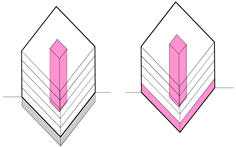
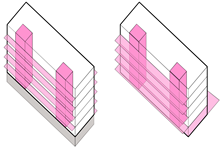
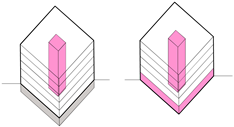
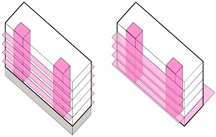
Figure 1 illustrates the different design solutions or scenarios applied in the simulation, and informs how findings are organised and presented. First, we chose two unit types to cover two plausible options when providing affordable housing designs: a more average (A) or family-type, which corresponds to a 2-bedroom unit (70 m2 in MH, and 60 m2 in CH); and a minimum type (M), a 1-bedroom/studio unit. The 1-bedroom unit type in MH has 50 m2; the studio in CH has 40 m2. At the same time, we selected two distinct residential building typologies, the tower (T) with one circulation core (with lift and staircase) and the gallery (G) with two circulation cores. We then assigned a typology to each unit type to end up with four ‘categories’ to be applied to MH and CH: the average-tower (AT), the average-gallery (AG), the minimum-tower (MT), and the minimum-gallery (MG).
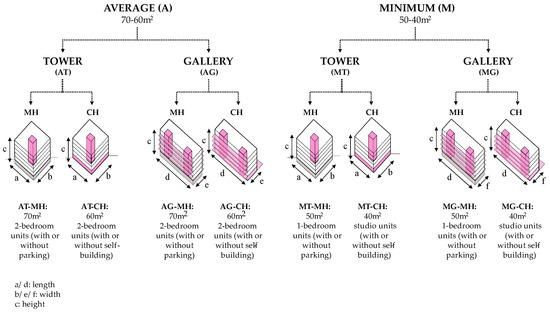
Figure 1.
Diagram illustrating the chosen typologies and dwelling types used in the simulation (Source: Authors).
To guarantee a fair comparison between the MH and CH models, the simulated buildings for each category share the same width, length, height and number of floors (resulting in the same gross floor area and volume). In addition, we made an overall effort to have the same or a similar gross floor area across all cases, to enable a comparative assessment between the four categories: AT and MT have the exact same configuration, whereas AG is slightly wider than MG.
We provide two variants for each model. In the MH cases, there is one variant that does not include car parking (as current social housing in the Netherlands rarely includes car parking), and another one that contemplates the construction of underground car parking (to illustrate the more conventional social housing in Europe). The CH cases distinguish CH that is conventionally built by a contractor (likewise MH) from CH that considers self-building approaches in some hands-on construction tasks, such as electricity installations, ceiling finishes, and partition walls. To translate these ‘self-building approaches’ into building costs, the calculation model included sub-contractors’ costs (which are higher than single contractor costs, used in the other options) and excluded the labour costs from the calculations. These variants were included to allow a more thorough analysis and to better ‘play’ with the design (e.g., by presenting the costs of underground car parking as a separate option, we can easily test a scenario where CH also contemplates parking). Finally, we included the following distinctive design features in CH, in relation to MH:
- Smaller private units (10 m2 smaller than MH) without laundries. AT-CH and AG-CH units have 15% less surface area than in the average MH units; in MT-CH and MG-CH units, this number increases to 20% in comparison to minimum MH.
- Smaller private balconies in the tower (T) typology (1.5 m2 smaller than MH).
- No private balconies in the gallery (G) typology. Calculations include the widening of the exterior gallery instead (from the standard 1.5 m to 2 m) and French balconies in the opposite façade.
- Extra common spaces (besides common entrance, storage and bike parking) to complement the private units, to reach a surface area of approximately 10% of the total area. These spaces include a common laundry (40 m2), and a common room with kitchen, living space, and two toilets (120 m2). These were selected because they may be considered the basic common spaces to be generally included in CH. To keep the simplicity of the model, the same amount and surface area of extra common spaces was applied to all CH options. The costs associated with these spaces include floor finish, ceiling finish, partition walls, wall finish (tiling + plaster spray), front doors, electricity, mechanical ventilation, furnishing banks, etc., washing machines etc. (in the laundry) and two toilets, and facilities kitchen/pantry (in the common room), and the market surplus.
- (Possibility to include) extra quality in the building envelope: extra quality of windows, extra quality of façade materials, and extra quality of thermal façade insulation.
- (Possibility to include) extra quality in the exterior garden: besides the standard provision of grass and tiles, extra elements that promote social interaction, such as benches and tables.
- The results were calculated using BudsyS software, a parametric system for estimating building costs based on design choices and building typologies in the software. Figure 2a,b demonstrate how the software simulates the building costs, considering the different design options for MH and CH.
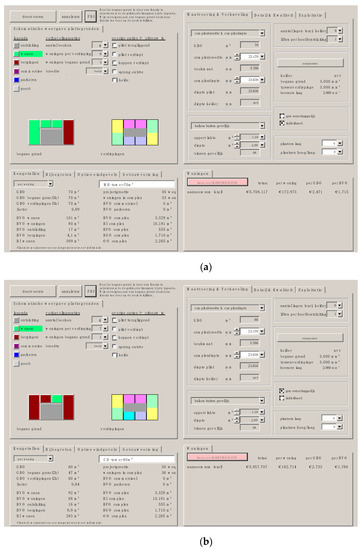 Figure 2. (a,b) Snapshots of the design specifications and resulting building costs for AT-MH and AT-CH, respectively.
 - Costs were estimated considering material costs (structure, infrastructure, finishing), contingency costs, general construction site costs, and contractor costs (labour, overhead, profit). Land costs, architectural and engineering fees, developer profit margins, and taxes were excluded from the model. The simulation model was structured to calculate the following results:
- Total costs (basic structure/shell).
- Total costs (whole construction).
- Costs per unit (cost of each unit + respective % of common spaces).
- Costs per m2 UFA/unit. UFA stands for usable floor area, i.e., the actual space that a household occupies within a building; it excludes lobbies, staircases, lifts, structure, and infrastructure, parking space.
- Costs per m2 GFA/unit. GFA stands for gross floor area, which is the total floor area within the building envelope, including the external walls.
4. Results: Comparing MH and CH Building Costs from a Design Perspective
This section presents the results of the conducted simulation to compare the building costs of CH and MH based on design decisions. Table 2 displays a simplified version of the results (see Appendix B at the end of the paper for the complete table). From this simulation exercise we derive the following insights:
Table 2.
Summary of the building costs simulation results (Source: courtesy of Casper Mouissie, edited by Authors).
- CH always accommodates more units than MH.
- MH presents the lowest total costs and per m2 UFA/unit, if parking is not considered. MH with parking has the highest total costs, but the lowest costs per m2 GFA/unit.
- CH presents the lowest costs per unit (even with ‘extra quality features’), but the highest per m2 UFA/unit.
- CH with self-building has the lowest costs per unit in comparison to all the options and has similar total costs and costs per m2 GFA/unit as those of MH.
CH with higher quality, delivered unfinished (with some hands-on tasks taken by the residents), present similar total costs as MH with lower quality, delivered finished, and built by a single contractor.
5. Discussion
The conducted simulation shows that depending on what we look at, the results are different; hence, we analysed the numbers (costs) without disregarding the underlying design decisions. If we focus on total costs and costs per m2 per unit, CH is costlier than MH. However, if we look at the costs per unit, CH solutions present lower building costs compared to MH. This is because CH units are smaller and can be built in a greater number within the same building volume, depending on the ratio of common-private areas.
The results of the simulation indicate that, from a design perspective, smaller units do not mean less space. CH provides, in fact, larger areas to the households, since smaller units are complemented with more shared spaces than MH. For instance, in the simulation, the CH units with 60 m2 have in fact 160 m2 of extra space (to be shared with other households), whereas in the comparable MH options households are entitled to privately use a total of 70 m2. In addition, the “merging” of private balconies with the exterior galleries in the AG-CH and MG-CH types, through the widening of the galleries, allows for building costs savings without compromising the usable space too much.
While some design decisions used in CH may be applicable to non-CH models, as we mentioned, such as combining smaller units with common spaces or spatial flexibility, others are more exclusive to CH, particularly self-building. The use of self-building in CH creates an additional impact on the costs. Carrying out some hands-on tasks represents a compromise that co-designers make to reduce costs at the expense of residents’ time and resources. At the same time, to compensate, residents may choose to add extra quality in the construction materials. These are common design trade-offs to keep costs down while increasing the housing quality, performance and long-term affordability [3].
In addition, as mentioned in Section 2, decisions such as excluding some spaces from the project, or reducing the level of finishing, also contribute to reduce costs. In the simulation, we considered minimum finishing levels and the option of not including parking in both CH and MH. This is because the model is based on the Dutch social housing standards. However, the same standards do not apply in other EU countries, where a more prescriptive approach is employed; higher finishing levels and the construction of car parking are examples of unavoidable features in many housing projects outside the Netherlands. This raises the issue of the adequacy of the existing regulatory framework in some EU countries to build CH projects. Currently, many examples of alternative layouts or specific (co-)design decisions often do not fit into the existing building regulations. This either constrains the possible design solutions or requires an extra effort to find creative ways of going around the legislation [3]. When linked to the concept of Existenzminimum, the design solutions applied in CH call for the reassessment of the current design standards in housing to include specific design parameters for CH, together with a ‘further harmonisation of building regulations in Europe’ [23].
Our results bring into light the risk of design solutions typically applied in CH being appropriated by market-driven developers who may want to profit from these types of buildings. This happened in the past, when the concept of Existenzminimum was perverted by developers and ‘the minimum dwelling unit—small, cheap, easy to build—became the gold mine of the capitalist housing market, and started to be reproduced and sold as a commodity, as an isolated element, originating the real estate logic of the city (Aureli, 2016).’ [40] (p. 333). Today, developers are taking advantage of the cost-efficiency of building shared and small housing and applying similar design criteria in commercial co-living projects [41].
Therefore, the design of CH and its link to affordability needs to be assessed in combination with other factors that help ensuring housing affordability. If a housing project is built according to spatial criteria that help to reduce building costs, but is based on speculative market-driven purposes, then affordability is at stake: affordability through design should never be detached from the overarching purpose behind affordable housing provision. Design can help to reduce costs and increase affordability; co-design may help even more. Nevertheless, it is the combination of these design criteria with non-speculative approaches that helps CH to guarantee long-term affordability.
6. Conclusions
Is collaborative housing an affordable housing design solution? Can CH be considered more affordable than mainstream housing, thanks to co-design? If so, under what conditions? This study assessed the impact of design decisions on building costs in CH, when compared to MH. We departed from the premise that CH, as a result of a co-design process, is even more affordable than affordable MH. This is because CH can combine the ‘mainstream’ design criteria used to reduce building costs with specific co-design decisions and trade-offs that can only be achieved through collaboration and active involvement of the end-users. We modelled a basic building costs simulation to compare MH with CH based on their design choices. For both models, we applied the same typologies, the same volume and shape, the same circulation surface areas, and the same construction and finishing standards. They mainly differ in their space and quality standards: CH considers smaller private units and larger common spaces than MH, with the possibility to increase the construction quality. Furthermore, we included the option of self-building approaches, which is commonly used in CH.
The simulation shows that the total costs of building a CH project are overall higher compared to MH. The same applies if we look at the gross surface areas per unit (m2 GFA/unit). However, CH accommodates more units; therefore, a direct comparison of these costs is not helpful for the purpose of this study. Focusing on the costs per unit, CH has lower building costs compared to MH. From this point of view, we may then conclude that CH is more affordable and space-efficient than MH, since CH provides units that cost less and includes extra common spaces and extra building quality. These results contribute to refute existing claims about the unaffordability of CH projects (see introduction).
Although co-design is a process to be conducted (and studied) on a case-by-case basis, this paper provides some design indicators for residents’ groups or design professionals in the field who aim to co-design an affordable CH project. We used the Dutch context as a reference for the building costs and standards for social housing in the Netherlands. Future simulations applying this model as a basis and considering other contexts (with different standards) can provide additional insights and complement this analysis. Adapting this model to a concrete CH project with specific co-design decisions may deepen the knowledge of the impact of co-design in building costs. Finally, relating to the concept of Existenzminimum, this study also highlights the need for updating housing design standards in general, and of formulating design standards for CH, to guarantee that minimum living conditions are met and that there is space for resident input in housing design.
Author Contributions
Conceptualization, S.B., V.G. and D.C.; Methodology, S.B., V.G. and D.C.; Software, S.B.; Formal analysis, S.B.; Investigation, S.B.; Writing—original draft, S.B.; Writing—review & editing, S.B., V.G. and D.C.; Supervision, V.G and D.C. All authors have read and agreed to the published version of the manuscript.
Funding
This research has been financed by the Portuguese foundation “Fundação para a Ciência e Tecnologia” (FCT), SFRH/BD/136257/2018.
Data Availability Statement
Data will be shared upon request and consideration of the authors.
Acknowledgments
The authors would like to express their deepest gratitude to Casper Mouissie, for his availability and patience to build and refine the building costs simulation model, without which this study would have been incomplete or even unaccomplished.
Conflicts of Interest
There is no conflict of interests to declare by the authors.
Appendix A
Table A1.
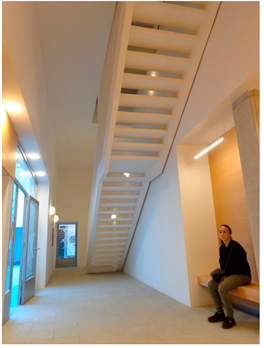
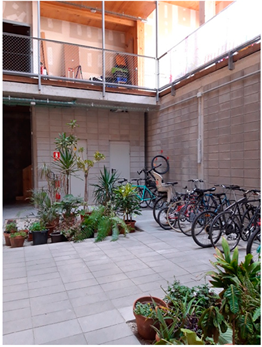
General Information about the Design Features and Costs of UP-4 Can Batlló (MH) and La Borda (CH).
Table A1.
General Information about the Design Features and Costs of UP-4 Can Batlló (MH) and La Borda (CH).
| MH Social Housing UP-4 Can Batlló | CH Resident-Led Cooperative La Borda | |
|---|---|---|
| General information | Location: Can Battló, Barcelona, Spain Design: Joana Ayxendri y Pilar Salinas Construction times: Jan 2015–May 2017 Move in: Feb 2018 Surface built area: 4786.90 m2 (3255.30 m2 + 1531.60 m2 of underground car parking) Number of units: 26 Typology: Compact, U-shape, courtyard-type 6-storey high + 2 underground parking (32 lots) + 1 commercial space | Location: Can Battló, Barcelona, Spain Design: Lacol Arquitectura + residents Construction times: June 2017–Dec 2018 Move in: Dec 2018 Surface built area: 2922 m2 (10% are common spaces) No car parking Number of units: 28 (+ guest unit) Typology: Compact, U-shape, courtyard-type 6-storey high (no car parking) +1 commercial space |
| Plot costs: public land (-) Total building costs: 3,089,291.26 € Building costs per m2: 645.36 €/m2 | Plot costs: public land (annual fee) Total building costs: 2,340,000.00 € (+ 120,000 € municipal subsidy for self-building) Building costs per m2: 841.88 €/m2 | |
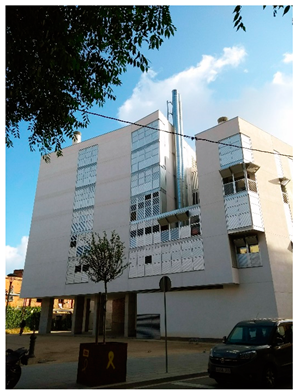 (a) Street view | 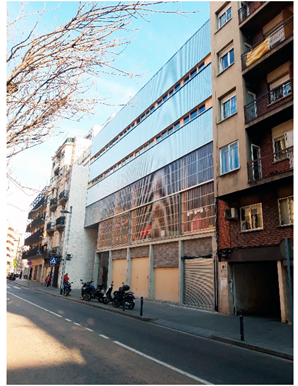 (b) Street view | |
 |  | |
| Construction methods and finishing levels | (c) Main entrance
| (d) Main entrance
|
| Private units | 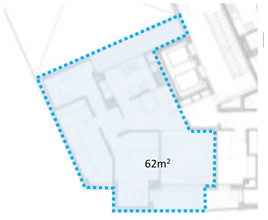 (e) floorplan of smallest private unit: 2-bedroom unit | 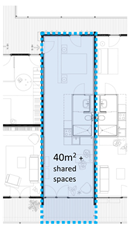 (f) floorplan of smallest private unit: studio |
|
|
Sources of Figures: (a), (b) and (d) main author, (c) image courtesy of Joana Ayxendr, (e) and (f) edited by authors.
Appendix B
Table A2.
Final Complete Results of the Building Costs Simulation (Source: Courtesy of Casper Mouissie, Edited by Authors).
Table A2.
Final Complete Results of the Building Costs Simulation (Source: Courtesy of Casper Mouissie, Edited by Authors).
 |  |  |  | |||||||||||||
|---|---|---|---|---|---|---|---|---|---|---|---|---|---|---|---|---|
| Average Tower (AT) | Average Gallery (AG) | Minimum Tower (MT) | Minimum Gallery (MG) | |||||||||||||
| MH/70 m² | CH/60 m² | MH/70 m² | CH/60 m² | MH/50 m² | CH/40 m² | MH/50 m² | CH/40 m² | |||||||||
| Parking | Self-build | Parking | Self-build | Parking | Self-build | Parking | Self-build | |||||||||
| nº private units | 33 | 33 | 36 | 36 | 41 | 41 | 43 | 43 | 45 | 45 | 53 | 53 | 45 | 45 | 52 | 52 |
| total user surface (m² UFA) | 2310 | 2310 | 2144 | 2144 | 2868 | 2860 | 2591 | 2591 | 2255 | 2255 | 2133 | 2133 | 2246 | 2246 | 2075 | 2075 |
| total residence area (m² GFA) | 3329 | 3939 | 3329 | 3329 | 3610 | 4395 | 3610 | 3610 | 3328 | 3938 | 3328 | 3328 | 2979 | 3725 | 2979 | 2979 |
| user surface per unit (m² UFA/unit) | 70 | 70 | 60 | 60 | 70 | 70 | 60 | 60 | 50 | 50 | 40 | 40 | 50 | 50 | 40 | 40 |
| residence area per unit (m² GFA/unit) | 101 | 119 | 92 | 92 | 88 | 107 | 84 | 84 | 74 | 88 | 63 | 63 | 66 | 83 | 57 | 57 |
| circulation area (m² GFA) | 570 | 570 | 570 | 570 | 268 | 268 | 268 | 268 | 570 | 570 | 570 | 570 | 249 | 249 | 249 | 249 |
| common spaces (m² GFA) | 135 | 135 | 321 | 321 | 123 | 123 | 408 | 408 | 187 | 187 | 321 | 321 | 152 | 152 | 312 | 312 |
| parking space (m² GFA) | excl | 532 | excl | excl | excl | 746 | excl | excl | excl | 532 | excl | excl | excl | 709 | excl | excl |
| net direct—basic structure (shell) | 3,987,281 | 4,526,311 | 4,104,214 | 3,085,305 | 4,603,706 | 5,399,302 | 4,688,326 | 3,884,078 | 4,450,984 | 5,040,317 | 4,767,109 | 3,497,596 | 4,550,357 | 5,358,911 | 4,816,066 | 3,691,579 |
| floor finish—screed | incl | incl | incl | incl | incl | incl | incl | incl | incl | incl | incl | incl | incl | incl | incl | incl |
| wall finish—wallpaper ready | incl | incl | incl | incl | incl | incl | incl | incl | incl | incl | incl | incl | incl | incl | incl | incl |
| ceiling finish—spray plaster | incl | incl | incl | 8574 | incl | incl | incl | 10,365 | incl | incl | incl | 8,531 | incl | incl | incl | 8,302 |
| installations cupboard | incl | incl | incl | incl | incl | incl | incl | incl | incl | incl | incl | incl | incl | incl | incl | incl |
| pipes underfloor heating | incl | incl | incl | incl | incl | incl | incl | incl | incl | incl | incl | incl | incl | incl | incl | incl |
| Bathroom—4000 | incl | incl | incl | 99,000 | incl | incl | incl | 118,250 | incl | incl | incl | 145,750 | incl | incl | incl | 143,000 |
| surcharge toilet in bathroom—1100 | incl | incl | incl | 32,400 | incl | incl | incl | 38,700 | incl | incl | incl | 47,700 | incl | incl | incl | 46,800 |
| surcharge for separate toilets—1100 | incl | incl | incl | 30,600 | incl | incl | incl | 36,550 | incl | incl | incl | 45,050 | incl | incl | incl | 44,200 |
| kitchen (open)—1700 | incl | incl | incl | 61,200 | incl | incl | incl | 73,100 | incl | incl | incl | 90,100 | incl | incl | incl | 88,400 |
| interior walls/layout | incl | incl | incl | 81,770 | incl | incl | incl | 65,455 | incl | incl | incl | 91,065 | incl | incl | incl | 73,190 |
| installations: plumbing | incl | incl | incl | - | incl | incl | incl | - | incl | incl | incl | - | incl | incl | incl | - |
| installations: heat generation | incl | incl | incl | - | incl | incl | incl | - | incl | incl | incl | - | incl | incl | incl | - |
| installations: electricity in the unit—3900 | incl | incl | incl | 91,260 | incl | incl | incl | 109,005 | incl | incl | incl | 134,355 | incl | incl | incl | 131,820 |
| installations: solar panels per unit—1500 | incl | incl | incl | 30,600 | incl | incl | incl | 36,550 | incl | incl | incl | 45,050 | incl | incl | incl | 44,200 |
| widening gallery due to outdoor space | na | na | na | na | na | na | na | na | na | na | na | na | na | na | na | na |
| balconies 5 m²/unit/French balconies—4700 | 7.5 m² | 7.5 m² | 5 m² | 169,200 | 7.5 m² | 7.5 m² | 5 m² | 202,100 | 7.5 m² | 7.5 m² | 5 m² | 249,100 | 7.5 m² | 7.5 m² | 5 m² | 244,400 |
| finishing entrance | incl | incl | incl | 64,700 | incl | incl | incl | 29,100 | incl | incl | incl | 64,000 | incl | incl | incl | 23,000 |
| central laundry room | na | na | 22 000 | 13,300 | na | na | 22,000 | 13,300 | na | na | 22,000 | 13,300 | na | na | 22,000 | 13,300 |
| central living room | na | na | 53,900 | 33,200 | na | na | 53,900 | 33,200 | na | na | 53,900 | 33,200 | na | na | 53,900 | 33,200 |
| common garden—basic | 25,000 | 25,000 | 25,000 | 12,500 | 25,000 | 25,000 | 25,000 | 12,500 | 25,000 | 25,000 | 25,000 | 12,500 | 25,000 | na | 25,000 | 12,500 |
| net direct—sub-complete | 4,012,281 | 4,551,311 | 4,205,114 | 3,813,610 | 4,628,706 | 5,424,302 | 4,789,226 | 4,662,253 | 4,475,984 | 5,065,317 | 4,868,009 | 4,477,297 | 4,575,357 | 5,358,911 | 4,916,966 | 4,597,891 |
| further plan elaboration/unforeseen—5% | 200,614 | 227,566 | 210,256 | 190,680 | 231,435 | 271,215 | 239,461 | 233,113 | 223,799 | 253,266 | 243,400 | 223,865 | 228,768 | 267,946 | 245,848 | 229,895 |
| general construction site costs | 599,159 | 708,973 | 599,167 | 599,167 | 649,803 | 791,125 | 649,825 | 649,825 | 599,064 | 708,862 | 599,064 | 599,064 | 536,149 | 670,504 | 536,149 | 536,149 |
| operational costs/profit and risk—11% | 529,326 | 603,664 | 551,599 | 506,380 | 606,094 | 713,531 | 624,636 | 609,971 | 582,873 | 663,019 | 628,152 | 583,025 | 587,430 | 692,710 | 626,886 | 590,033 |
| reservation price changes (50%) during construction—3% | 160,241 | 182,745 | 166,984 | 153,295 | 183,481 | 216,005 | 189,094 | 184,655 | 176,452 | 200,714 | 190,159 | 176,497 | 177,831 | 209,702 | 189,775 | 178,619 |
| SUBTOTAL excl. VAT (without extra quality in CH) | 5,501,622 | 6,274,259 | 5,733,120 | 5,263,132 | 6,299,519 | 7,416,178 | 6,492,243 | 6,339,816 | 6,058,171 | 6,891,178 | 6,528,784 | 6,059,747 | 6,105,535 | 7,199,772 | 6,515,624 | 6,132,586 |
| contract price per unit | 166,716 | 190,129 | 159,253 | 146,198 | 153,647 | 180,882 | 150,982 | 147,438 | 134,626 | 153,137 | 123,185 | 114,335 | 135,679 | 159,995 | 125,300 | 117,934 |
| contract price per m² UFA/unit | 2382 | 2716 | 2675 | 2455 | 2197 | 2593 | 2505 | 2447 | 2687 | 3056 | 3061 | 2841 | 2718 | 3206 | 3139 | 2955 |
| contract price per m² GFA/unit | 1653 | 1593 | 1722 | 1581 | 1745 | 1687 | 1798 | 1756 | 1820 | 1750 | 1962 | 1821 | 2050 | 1933 | 2187 | 2059 |
| extra quality façade openings | excl | excl | 18,200 | 18,200 | na | na | 20,700 | 20,700 | excl | excl | 16,100 | 16,100 | excl | excl | 21,500 | 21,500 |
| extra quality dense façade | excl | excl | 40,900 | 40,900 | na | na | 38,800 | 38,800 | excl | excl | 35,700 | 35,700 | excl | excl | 40,300 | 40,300 |
| additional façade insulation | excl | excl | 27,000 | 27,000 | na | na | 32,250 | 32,250 | excl | excl | 39,750 | 39,750 | excl | excl | 39,000 | 39,000 |
| extra quality common garden | na | na | 25,000 | 12,500 | na | na | 25,000 | 12,500 | na | na | 25,000 | 12,500 | na | na | 25,000 | 12,500 |
| net direct—sub-complete | 4,012,281 | 4,551,311 | 4,316,214 | 3,912,210 | 4,786,294 | 5,609,465 | 4,944,512 | 4,813,893 | 4,615,117 | 5,223,260 | 4,996,217 | 4,596,294 | 4,715,804 | 5,524,044 | 5,047,593 | 4,720,839 |
| further plan elaboration/unforeseen—5% | 200,614 | 227,566 | 215,811 | 195,610 | 239,315 | 280,473 | 247,226 | 240,695 | 230,756 | 261,163 | 249,811 | 229,815 | 235,790 | 276,202 | 252,380 | 236,042 |
| general construction site costs | 599,159 | 708,973 | 599,167 | 599,167 | 649,803 | 791,125 | 649,825 | 649,825 | 599,064 | 708,862 | 599,064 | 599,064 | 536,149 | 670,504 | 536,149 | 536,149 |
| operational costs/profit and risk—11% | 529,326 | 603,664 | 564,431 | 517,769 | 624,295 | 734,917 | 642,572 | 627,485 | 598,943 | 681,261 | 642,960 | 596,769 | 603,652 | 711,783 | 641,973 | 604,233 |
| reservation price changes (50%) during construction—3% | 160,241 | 182,745 | 170,869 | 156,743 | 188,991 | 222,479 | 194,524 | 189,957 | 181,316 | 206,236 | 194,642 | 180,658 | 182,742 | 215,476 | 194,343 | 182,918 |
| SUBTOTAL excl. VAT (with extra quality in CH) | 5,501,622 | 6,274,259 | 5,866,491 | 5,381,498 | 6,488,698 | 7,638,460 | 6,678,658 | 6,521,855 | 6,225,195 | 7,080,783 | 6,682,693 | 6,202,599 | 6,274,137 | 7,398,008 | 6,672,438 | 6,280,181 |
| contract price per unit | 166,716 | 190,129 | 162,958 | 149,486 | 158,261 | 186,304 | 155 318 | 151,671 | 138,338 | 157,351 | 126,089 | 117,030 | 139,425 | 164,400 | 128, 316 | 120,773 |
| contract price per m² UFA/unit | 2382 | 2716 | 2737 | 2511 | 2263 | 2671 | 2577 | 2517 | 2761 | 3140 | 3133 | 2908 | 2793 | 3294 | 3215 | 3026 |
| contract price per m² GFA/unit | 1653 | 1593 | 1762 | 1617 | 1797 | 1738 | 1850 | 1807 | 1870 | 1798 | 2008 | 1864 | 2106 | 1986 | 2240 | 2108 |
References
- Wetzstein, S. The global urban housing affordability crisis. Urban Stud. 2017, 54, 3159–3177. [Google Scholar] [CrossRef]
- Pittini, A.; Koessl, G.; Dijol, J.; Lakatos, E.; Ghekiere, L. The State of Housing in the EU; Housing Europe, the European Federation of Public, Cooperative and Social Housing: Brussels, Belgium, 2017. [Google Scholar]
- Brysch, S.; Czischke, D. Affordability through design: The role of building costs in collaborative housing. Hous. Stud. 2021, 37, 1800–1820. [Google Scholar] [CrossRef]
- Czischke, D.; Brysch, S. Collaborative Housing and Affordability: Understanding The Interplay between Collective Self-Organisation, Design and Affordability. In Proceedings of the International Conference European Network for Housing Research (ENHR), Tirana, Albania, 4–6 September 2017. [Google Scholar]
- Czischke, D.; van Bortel, G. An exploration of concepts and polices on ‘affordable housing’ in England, Italy, Poland and the Netherlands. J. Hous. Built Environ. 2018, 1–21. [Google Scholar] [CrossRef]
- Bresson, S.; Labit, A. How does collaborative housing address the issue of social inclusion? A French perspective. Hous. Theory Soc. 2020, 37, 118–138. [Google Scholar] [CrossRef]
- Lang, R.; Carriou, C.; Czischke, D. Collaborative Housing Research (1990–2017): A Systematic Review and Thematic Analysis of the Field. Hous. Theory Soc. 2020, 37, 10–39. [Google Scholar] [CrossRef]
- Tummers, L. Understanding co-housing from a planning perspective: Why and how? Urban Res. Pract. 2015, 8, 64–78. [Google Scholar] [CrossRef]
- Arbell, Y. Beyond Affordability: English Cohousing Communities as White Middle-Class Spaces. Hous. Theory Soc. 2022, 39, 442–463. [Google Scholar] [CrossRef]
- Droste, C. German co-housing: An opportunity for municipalities to foster socially inclusive urban development? Urban Res. Pract. 2015, 8, 79–92. [Google Scholar] [CrossRef]
- Tummers, L. The re-emergence of self-managed co-housing in Europe—A critical review of co-housing research. Urban Stud. 2016, 53, 2023–2040. [Google Scholar] [CrossRef]
- Sayers, K. Five Reasons Urban Cohousing Isn’t More Affordable. Available online: www.oururbanvillage.ca/five-reasons-urban-cohousing-isnt-more-affordable/ (accessed on 14 December 2022).
- Archer, T. The mechanics of housing collectivism: How forms and functions affect affordability. Hous. Stud. 2022, 37, 73–102. [Google Scholar] [CrossRef]
- Czischke, D. Collaborative housing and housing providers: Towards an analytical framework of multi-stakeholder collaboration in housing co-production. Int. J. Hous. Policy 2018, 18, 55–81. [Google Scholar] [CrossRef]
- Jarvis, H. Saving space, sharing time: Integrated infrastructures of daily life in cohousing. Environ. Plan. A 2011, 43, 560–577. [Google Scholar] [CrossRef]
- Williams, J. Designing Neighbourhoods for Social Interaction: The Case of Cohousing. J. Urban Des. 2005, 10, 195–227. [Google Scholar] [CrossRef]
- Cabré, E.; Andrés, A. La Borda: A case study on the implementation of cooperative housing in Catalonia. Int. J. Hous. Policy 2017, 18, 412–432. [Google Scholar] [CrossRef]
- Winter, J.; Durrett, C. Achieving affordability with cohousing. Communities 2013, 158, 34. [Google Scholar]
- Seeley, I.H. Cost Implications of Design Variables. In Building Economics; Springer: Berlin/Heidelberg, Germany, 1983; pp. 18–37. [Google Scholar]
- Chau, K.-W.; Wong, S.K.; Yau, Y.; Yeung, A. Determining optimal building height. Urban Stud. 2007, 44, 591–607. [Google Scholar] [CrossRef]
- Belniak, S.; Leśniak, A.; Plebankiewicz, E.; Zima, K. The influence of the building shape on the costs of its construction. J. Financ. Manag. Prop. Constr. 2013, 18, 90–102. [Google Scholar] [CrossRef]
- Mitchell, R.E. Cultural and health influences on building, housing, and community standards: Cost implications for the human habitat. Hum. Ecol. 1976, 4, 297–330. [Google Scholar] [CrossRef]
- Visscher, H.; Meijer, F. Building Regulations for Housing Quality in Europe. In Proceedings of the ENHR Conference 2006: Housing in an Expanding Europe. Theory, Policy, Implementation and Participation, Ljubljana, Slovenia, 2–5 July 2006; Urban Planning Institute of the Republic of Slovenia: Ljubljana, Slovenia, 2006. [Google Scholar]
- Montaner, J.M. Depois do Movimento Moderno: Arquitetura da Segunda Metade do Século XX; Gustavo Gili: Barcelona, Spain, 2001. [Google Scholar]
- Appolloni, L.; D’Alessandro, D. Housing spaces in nine European countries: A comparison of dimensional requirements. Int. J. Environ. Res. Public Health 2021, 18, 4278. [Google Scholar] [CrossRef]
- Burkhalter, L.; Castells, M. Beyond the Crisis: Towards a new urban paradigm. In Proceedings of the 4th International Conference of the International Forum on Urbanism (IFoU), Delft, The Netherlands, 26–28 November 2009. [Google Scholar]
- Elsinga, M.; Hoekstra, J.; Sedighi, M.; Taebi, B. Toward Sustainable and Inclusive Housing: Underpinning Housing Policy as Design for Values. Sustainability 2020, 12, 1920. [Google Scholar] [CrossRef]
- Moya, L. (Ed.) La Vivienda Social en Europa, Alemania, Francia y Paises Bajos Desde 1945; Mairea Libros: Madrid, Spaim, 2008. [Google Scholar]
- Van der Linden, V.; Dong, H.; Heylighen, A. The good client: How architect-client dynamics mediate attention to users. In Proceedings of the Professional Practices in the Built Environment, Reading, UK, 27–28 April 2017. [Google Scholar]
- Scotthanson, C.; Scotthanson, K. The Cohousing Handbook. Building a Place for Community; New Society Publishers: Gabriola Island, BC, Canada, 2005. [Google Scholar]
- Todorovic, M. New type of residential building configuration. Facta Univ. Ser. Archit. Civ. Eng. 2016, 14, 47–58. [Google Scholar] [CrossRef]
- Rigolon, A. European housing standards. Eur. Hous. Concepts 1990, 2010, 48–51. [Google Scholar]
- Bican, N.B. Comparative analysis of three innovative housing models in Copenhagen for social mix. A|Z ITU Mimar. Fakültesi Derg. 2020, 17, 37–53. [Google Scholar] [CrossRef]
- Ledent, G. Size matters. How does the number of dwellings affect housing co-production? J. Hous. Built Environ. 2022, 37, 889–907. [Google Scholar] [CrossRef]
- Van der Velden, M.; Mörtberg, C. Participatory design and design for values. In Handbook of Ethics, Values, and Technological Design: Sources, Theory, Values and Application Domains; Springer: Dordrecht, The Netherlands, 2015; pp. 41–66. [Google Scholar]
- Vestbro, D.U. Living Together-Cohousing Ideas and Realities around the World. In Proceedings of the International Collaborative Housing Conference, Stockholm, Sweden, 5–9 May 2010; Division of Urban and Regional Studies, Royal Institute of Technology in Collaboration with Kollektivhus NU: Stockholm, Sweden, 2010. [Google Scholar]
- Fromm, D. Seeding Community: Collaborative Housing as a Strategy for Social and Neighbourhood Repair. Built Environ. 2012, 38, 364–394. [Google Scholar] [CrossRef]
- Torres-Antonini, M. Our Common House: Using the Built Environment to Develop Supportive Communities. Ph.D. Thesis, University of Florida Gainesville, Gainesville, FL, USA, 2001. [Google Scholar]
- Vestbro, D.U.; Horelli, L. Design for gender equality: The history of co-housing ideas and realities. Built Environ. 2012, 38, 315–335. [Google Scholar] [CrossRef]
- Brysch, S. Reinterpreting Existenzminimum in contemporary affordable housing solutions. Urban Plan. 2019, 4, 326–345. [Google Scholar] [CrossRef]
- Rissik, L. XS > XL: The Emerging Concept of Commercial Co-Living and Its Influence on Users-Affordability and Developers-Profitability. Master’s Thesis, Delft University of Technology, Delft, The Netherlands, 2019. [Google Scholar]
- Qualive. Affordability, Convenience, and Flexibility—Which Thesis of Co-Living Holds Truth? Available online: https://www.qualive.co/post/affordability-convenience-and-flexibility-which-thesis-of-co-living-hold-truth (accessed on 5 February 2023).
- Groat, L.; Wang, D. Architectural Research Methods; John Wiley & Sons: Hoboken, NJ, USA, 2013. [Google Scholar]
- Sinha, R.; Paredis, C.J.; Liang, V.-C.; Khosla, P.K. Modeling and simulation methods for design of engineering systems. J. Comput. Inf. Sci. Eng. 2001, 1, 84–91. [Google Scholar] [CrossRef]
Disclaimer/Publisher’s Note: The statements, opinions and data contained in all publications are solely those of the individual author(s) and contributor(s) and not of MDPI and/or the editor(s). MDPI and/or the editor(s) disclaim responsibility for any injury to people or property resulting from any ideas, methods, instructions or products referred to in the content. |
© 2023 by the authors. Licensee MDPI, Basel, Switzerland. This article is an open access article distributed under the terms and conditions of the Creative Commons Attribution (CC BY) license (https://creativecommons.org/licenses/by/4.0/).