


Abstract
Solar Decathlon is a multi-disciplinary international competition that integrates energy-saving design strategies to design, build and operate zero-energy solar houses. This study focused on the 15 entries in the third Solar Decathlon China. It summarized their energy-saving design strategies into strategies of architectural design, equipment management, energy acquisition and intelligent regulation, and extracted a total of 22 key design elements. Based on the scoring results of the competition, this study analyzed the application of different design strategies with qualitative analysis; through quantitative analysis, 22 design elements were associated with the score, and the impact of different strategies on the score was comprehensively analyzed. As revealed in the data, design concept, functional structure and application type of renewable energy are significantly correlated with and have a great impact on the score; in contrast, building area and thermal buffer space are not significantly correlated with the score. On the basis of data analysis, this study provides a quantitative decision basis for the energy-saving design strategy of zero-energy buildings, and establishes an empirical model for the design of zero-energy solar buildings in Zhangbei County, Zhangjiakou City. This paper is helpful for the design practice and application of subsequent studies on ZEBs.
1. Introduction
Severe climate is a major challenge facing the world today, and environmental problems caused by the greenhouse effect occur frequently [1], problems which seriously threaten the living environment and endanger the lives of human beings [2]. The average annual CO2 equivalent emitted from 2010 to 2019 was 5600 ± 600 billion tons, 910 billion tons more than that from 2000 to 2009 [3]. It is the highest increase in ten-year average emissions since records began. Global greenhouse gas emissions are on a remarkable growth trend. In 2019, the greenhouse gas emission from global buildings were 12 gt CO2-equivalent, 21% of global greenhouse gas emissions. Residential buildings consumed 70% of the final energy needs of global buildings [4]. According to current energy consumption and emission intensity, the construction industry’s share of carbon emissions will reach 50% by 2050 [5]. Accordingly, the construction industry faces major challenges in energy conservation and emission reduction.
Zero-Energy Buildings (ZEBs) have significant advantages in energy conservation, consumption reduction and the improvement of use efficiency of renewable energy, which can save 60% to 75% of energy compared with traditional buildings. In terms of energy conservation and emission reduction, ZEB projects are not only suitable for exploring energy conservation and emission reduction in various climate zones [6,7,8], but also suitable for exploring energy conservation of various building types, including residential buildings [9], public buildings [10] and even communities [11,12]. In addition, ZEBs not only improve the performance of buildings, but also enhance the living comfort through continuous exploration and optimization [13]. Due to the advantages of energy conservation and emission reduction, the development of construction and renovation methods, and the policy support for studies on ZEBs [14,15], ZEBs have been rapidly promoted worldwide and the number of ZEB projects has increased significantly [16].
Traditional design methods of buildings are not completely applicable to net zero-energy buildings [17]. Therefore, it is necessary to explore suitable energy-saving design methods and application strategies for ZEBs. In general, two design strategies are applied to ZEBs: (1) to reduce the energy needs of the building (especially heating and cooling) through more energy-saving technologies, and (2) to meet the minimum energy needs using renewable energies and other technologies.
In terms of passive design, the early studies on passive technology focused more on improving the environment by way of building design (function and form) [18,19]. In contrast, since the definition of ZEB was gradually quantified, the studies on and design practice of passive technology have been gradually refined, and more and more scholars have worked to reduce the energy consumption of buildings by way of the optimization of enveloping enclosures, the adding of buffer space and the automation of lighting and shading. Bogdanovic et al. numerically simulated the energy need of a “passive house” with Trombe wall. It was shown that the Trombe wall is an effective means of utilizing solar energy and can provide an effective means for the design of passive houses in the Belgrade area [20]. Martin Thalfeldt explored the facade structure of “net zero energy buildings” in cold regions. It was concluded that the maximum percentage of triple Low-E glass in facade is 25% and that when the heat transfer coefficient of facade is lower than 0.16 W/(m2·K), the Estonian ultra-low energy requirement can be met [21]. Huo and HM evaluated shading performance with different sunshade angles, orientations, window wall ratios (WWRs) and locations based on EnergyPlus, and on this basis, analyzed the energy-saving performance of external Venetian blind shading (EVBS) of ZEBs (ZEB) in different climate zones in China. It was shown that EVBS displays significant energy-saving potential for the new ZEB, especially in southwest China [22]. Through refined and innovative studies, the passive design of ZEBs has shifted from utilizing technology to respond to climate to utilizing climate to develop technology.
Due to the growing population and the escalating demand for quality living, the application of active technology is becoming an increasingly important part of ZEB design. In terms of improving the energy efficiency of facilities, passive phase change materials (PCM) are integrated into the enveloping enclosure of ZEBs and applied to built-in walls, ceilings, floors, etc. in order to improve the system performance of heat preservation and insulation in buildings [23,24]. Stritih developed a composite wall filled with different PCMs with TRNSYS software. By way of integrating the wall into the ZEBs, it was revealed that PCMs in the wall can reduce the daily energy consumption of the building and contribute to the goal of the ZEB [25]. In addition, in terms of indoor lighting, using Light Emitting Diodes (LED) to replace old incandescent lamps also significantly contributes to energy conservation in buildings [26,27]. In the field of new energy applications, Suh and HS explored the possible renewable energy systems, such as photovoltaic system, solar thermal system and ground source heat pump system, and analyzed their efficiency. A combination of a photovoltaic system with additional photovoltaic modules and a geothermal system was finally chosen to achieve the goal of ZEB [28]. In addition, as the complementary energy of solar energy, wind energy is gradually being applied to the energy use of ZEBs [29,30]. It is also observed that the air source heat pump (ASHP) and ground source heat pump (GSHP) also have the potential of building energy conservation and greenhouse gas emissions reduction [30]. In terms of energy storage, vehicle to house (V2H) technology utilizes the idle batteries of electric vehicles as a grid storage tool to mitigate the power fluctuations of renewable energies and as a backup power in case of emergency [31]; heat and energy recovery ventilators are also being extensively studied to help achieve energy conservation [32]. In the field of active technologies, thermal storage, heating and cooling systems, and a renewable energy system can all be integrated into ZEBs, working together to achieve energy conservation [33].
In general, following a series of studies and development, zero-energy building has gradually formed a technical line based on passive technology, with high-performance building energy systems, heating, ventilating and air conditioning systems, and a renewable energy building system as the core, supplemented by an intelligent detection and control system to ensure its operation [34]. The study on ZEBs is gradually forming a system. However, due to the lack of a large number of concrete samples in the same climate zone for comparison and summarization, the popularity of ZEB is not high, even though the number of its demonstration projects is gradually increasing, and the study projects are mostly independent studies. Most of the studies focus on the physical performance of ZEBs in carrying out simulated assessments [35], but lack data tracking and detection, and multidimensional evaluation in environmental, economic and social aspects.
Solar Decathlon (SD) [36] provides an opportunity for the energy-saving design studies of regional ZEBs to experiment and practice. SD is a competition regarding solar building, design and engineering, initiated by the U.S. Department of Energy (DOE) in 2002 with universities worldwide as participants. Each team designs and builds a high-performance, full-size house with solar energy as the sole energy source. After the judgment according to ten criteria, the work with the best combination of perfect design, intelligent energy, diverse innovation and market potential is selected. Since its inception, SD has been held 21 times and has spawned regional competitions such as SDE/SDC around the world [37].
Based on the experimental platform of SD, the participating teams proposed and practiced innovative methods for energy-saving design of zero-energy houses through the design and study of individual cases. [38,39,40] With the popularity and promotion of ZEBs, SD has gradually attracted widespread attention and been recognized and widely discussed by more and more authorities in the field. Zhongqi Yu has summarized and compared the passive energy-saving design strategies in the two SDE competitions to provide a reference for subsequent studies on zero-energy houses [41]; with the entries of three SD competitions as examples, Deng Feng has discussed the technical route of zero-energy house design [42]; as well, Yeganeh Baghi has identified and classified technological innovations from past SD competitions, analyzed information on technological innovations of these projects and provided a way to classify innovations [43]. In addition, the organizing committee of the competition and relevant university institutions have carried out thematic academic conferences and salon forums on this basis [44,45,46] to provide a platform for people who are concerned about ZEBs to exchange and learn.
Solar Decathlon China (SDC) was introduced to China in 2011 with the cooperation and support of the U.S. Department of Energy and the Chinese government, and, to date, the SDC has held three competitions. Held in Zhangbei County, Zhangjiakou City, Hebei Province in 2021, the third SDC [47] took the three propositions of “sustainable development, intelligent interconnection, and healthy living” as its goal and required participants to design and build the solar-powered green and energy-saving eco-houses with both demonstration and promotion values.
Based on the experimental advantages of SDC, this study took 15 entries of the third Solar Decathlon China as samples. Based on the results of the competition, this study focused on the energy-saving design strategies of these entries and carried out qualitative and quantitative analysis for the practical application of design methods and the evaluation system. Accordingly, the paper explored the intrinsic relationship between project scores and design strategies, so as to establish an empirical model of zero-energy houses in Zhangbei County under the scoring criteria of the current SDC. Based on the statistical analysis of competition data, this paper provides a research angle for exploring energy-saving design strategies through practical performance, one which can be used to assist decision-making.
2. Methods
2.1. Research Framework
The house prototypes of 15 finalists in the current SDC (Figure 1, Table 1) would be judged by ten criteria, each scoring 100 points (Table 2). The first five are subjective reviews, evaluated by domestic and international experts in the field; the last five are objective ratings, scored through data monitoring, task completion, and media and public feedback, etc.
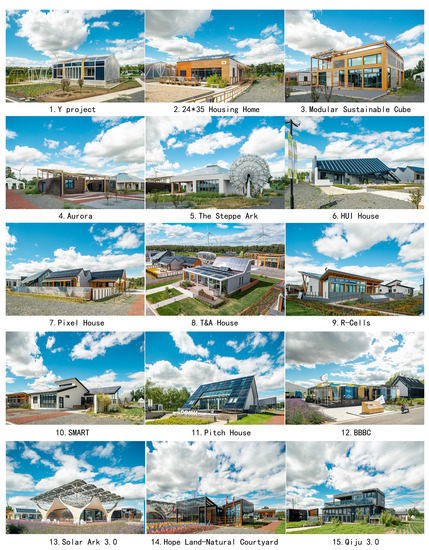
Figure 1.
Entries of the third Solar Decathlon China.

Table 1.
Entries and team information of the third Solar Decathlon China.
Table 2.
Evaluation indices of the third SDC competition.
This evaluation framework was successfully applied and the competition results were produced (see Figure 2).
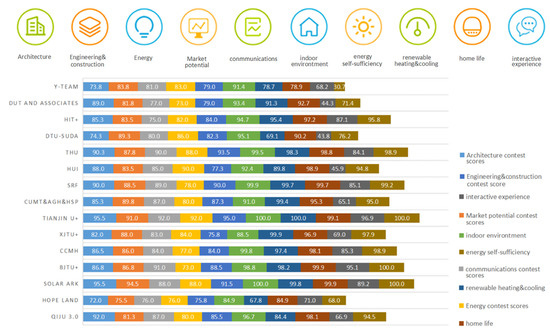
Figure 2.
Ten evaluation criteria and their scoring proportions.
In order to summarize the experience, provide reference and guide the design, the organizers provided a typed description and comparative analysis of six key strategies, namely, passive strategy consisting of building form, functional layout and passive climate regulation, and active design consisting of equipment regulation, energy integration and intelligent control. The 22 design elements derived from the six key strategies were processed with correlation analysis and multiple regression analysis, together with the scoring results of the ten items, to explore the orientation of the design strategies based on the competition results, so as to build the empirical model of the current competition to assist designers, users or investors in making more accurate decisions. Figure 3 shows the research framework of this paper.
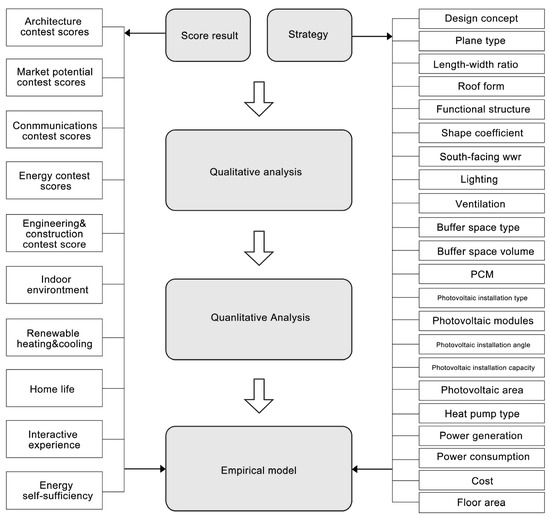
Figure 3.
Research framework.
2.2. Data Sources
Relevant documents and data information used in this study include:
- (1)
- The official web page’s schedule, rules and scoring criteria (documents provided by the organizing committee) of the third Solar Decathlon China [48,49,50];
- (2)
- The websites operated by each team [50,51,52,53,54,55,56,57,58,59,60,61,62,63,64] and the investigation for each team;
- (3)
- Academic papers on the competition [65,66,67].
3. Results and Discussion
3.1. Qualitative Analysis of Building Energy-Saving Strategies
3.1.1. Building Shape
The building design of SDC2021 was limited to a 20∗20 m area. Since the base is square, as for the design of the building shape, most teams chose a regular and concentrated geometry so as to ensure a good spatial form and physical properties within the area of 150–200 m2. The plane form (see Figure 4) can be divided into a centralized rectangular plane, a rectangular-derived plane, and a decentralized rectangular plane. The proportion of planes with a centralized rectangle as the basic prototype is as high as 13 out of 15 and the length-width ratio of the buildings ranges from 0.8 to 2.0, with most concentrating around 1. As is shown, the building plane and the shape of the building base have a very high similarity. These entries are divided into flat roof, single-pitch roof, double-pitch roof, and multi-pitch roof according to roof form (see Figure 5). Based on the form of energy access and the availability of space, most teams chose flat roofs and double-pitch roofs. The design of the building form largely determines the energy-saving property of the building. For the energy consumption of the building form, the smaller the building form coefficient, the better the building performance. Accordingly, most teams chose a relatively compact form for energy-saving reasons. From the data, the form coefficient of concentrated rectangular blocks varies from 0.49 to 0.8, while that of decentralized blocks is higher, at around 1.1. The works of top teams in the final results all have a smaller form coefficient, but the results do not show clear preference for floor area and length-width ratio.
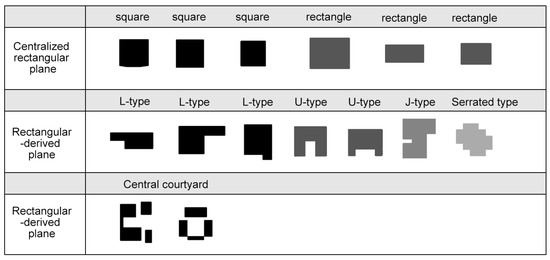
Figure 4.
Building plane form.
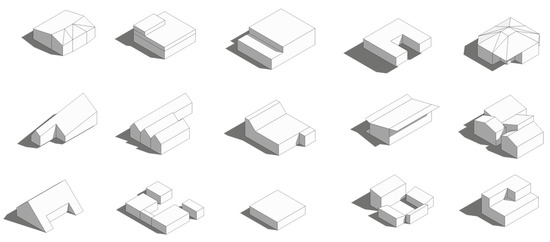
Figure 5.
Building plane shape.
3.1.2. Building Functions
The functional structure of the building is closely related to its design concept, which fundamentally determines the design layout of the building. Climate condition is an important proposition in building an energy-saving design. Building design can be cut into the concept from the angle of social relations, human settlements, technology and so on, and then concretely expressed through building form and function. The salient features of the teams’ concepts can be divided into four categories: regionalism, modularization, human-habitat and publicness (see Table 3). The teams show different design preferences in concepts. Regionalism emphasizes responding to the natural environment of the building; modularization emphasizes industrial systems; human-habitat emphasizes the comfortable living; and publicness emphasizes the sharing in the regional level. Therefore, in terms of the design layout of building functions, regionalism emphasizes north-south connectivity, and residential functions are closely linked with the lifestyle and behavior of local residents; modularization emphasizes regularity of form and combinability of functions; human-habitat emphasizes serving the demographic structure and exploring the living mode of a family of three or four generations together; and publicness emphasizes complete large space design and advocates multi-functionality of space.
Table 3.
Design concepts.
In terms of functional structure, the passive design conveys an energy-saving way of life. Functional structure explores the possibility of matching energy saving scale with human living scale. Only when energy saving becomes a living habit can energy saving be sustainable. the works of the 15 teams can be divided into three categories: nine-grid type, three-section type, and modular combination type (see Table 4). The square plane tends to adopt the nine-grid type, and encircles a private space with the atrium or living room as the center; the long rectangle plane tends to adopt the three-section type and, as the entrance is basically placed in the south, it basically adopts a left-center-right zoning pattern with the living room in the middle and the private space on both sides; for teams using the special modular unit design, the modular combination type is utilized, which fits the functional areas of different scales with units of different modules, and then splices and combines the functional units. Generally speaking, the nine-grid type is conducive to orderly spatial organization and flexible spatial units, and the three-section type facilitates spatial division with clear priorities. Accordingly, the two types become the two functional structures used most in this competition. The results of the competition show that the teams with higher scores in the “building” section mostly used the three-section type. From the perspective of sustainability, the three-section type in the area facilitates quantitative organization and horizontal topological extension through a linear approach, which is conducive to the reconfiguration of green living styles and has the potential for community publicity. Whether it is for new buildings to achieve zero-energy consumption or for existing buildings to achieve energy-saving reconstruction, the value of green energy-saving design is reflected. Therefore, the three-section type is more advantageous for providing comfortable spatial forms and improving building performance at the individual building level and even at the regional and community levels. And for the nine-grid and modular combination types, only two teams performed better.
Table 4.
Functional Layout.
3.1.3. Passive Climate Regulation
Zhangbei County, Zhangjiakou, China (114.70 longitude, 41.15 latitude) usually has long, warm and partly cloudy summers; winters are cold, dry, windy and mostly sunny. Year-round temperatures range from a high of 29 degrees Celsius in summer to a low of −15 degrees Celsius in winter. The annual average rainfall is 403.6 mm, rainfall is infrequent, mainly concentrated in summer. There are high levels of solar radiation, and the spring and winter wind speed is up to 3 m/s. Therefore, according to the climatic characteristics of the region, the design will mainly respond to the shading in summer, heat preservation in winter and the use of enriched solar resources. The dependence on active equipment can be effectively reduced through rational design of lighting, ventilation and thermal insulation, thereby achieving the purpose of reducing energy consumption.
Lighting, Shading and Ventilation
All the teams considered the passive approach for lighting, shading and ventilation in the preliminary phase of design. In terms of lighting, the lighting forms include side window lighting, skylight lighting and atrium lighting. For the works with side window lighting, the investigation reveals that the south-facing window wall ratio of all the teams ranged from 0.3 to 0.98. Skylights included both flat and angled skylights. Combining the functional layout and building form, Qiju3.0 and CUMT&AGH&HSP applied all three types of lighting, and nearly half of the teams used a combination of two. In terms of shading, automatic roller shading and louver shading were most commonly used. Tianjin U+ designed a v-shaped roof by combining the traditional Chinese concept of anti-sun shading with the eaves to achieve a certain shading effect; Solar Ark adopted the curved shape of self-developed concrete to meet the building’s lighting needs and also to create a good shading effect. In terms of ventilation, two out of three of the teams had a clear design for natural ventilation. Based on the analysis of the climate characteristics in Zhangbei County, Zhangjiakou City, these teams designed the building plane rationally, utilizing through-hall air for passive ventilation and reducing energy consumption for mechanical ventilation. In addition, combining the building concept and form, several teams considered the longitudinal ventilation design, which has good effect on ventilation and cooling in summer. However, passive lighting and ventilation cannot fully meet the year-round building comfort needs and need to be combined with appropriate temperature regulation strategies to regulate the indoor physical environment.
Passive Temperature Regulation
In terms of temperature regulation, three passive temperature regulation methods were used in the SDC: thermal buffer space, phase change material, and composite envelope enclosure. The teams applied multi-layered materials with better heat preservation and insulation to the envelope enclosure. For example, glued bamboo, wood panels and UHPC concrete [68] were used as framing materials; biomass straw bricks [69] and SIPs [70,71,72] were used to fill walls; EFTE film (EFTE film: A high quality building skin material made from artificial high strength fluoropolymer (ETFE), which has the characteristics of ductility, high light transmittance and sustainability) [73,74,75] was used as the adaptive facade of the building. The envelope enclosure of some teams is shown in Figure 6. Strengthening the envelope enclosure of the building is the most direct and effective way to store energy and prevent heat loss.
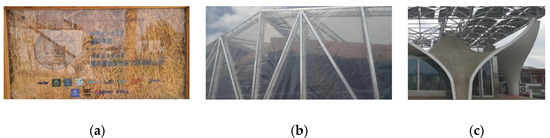
Figure 6.
Envelope enclosure of some teams: (a) HIT+ straw brick; (b) Y-Team EFTE adaptive façade; and (c) Solar Ark self-developed UHPC concrete.
Setting up a thermal buffer space can play a regulatory role in the larger temperature difference environment, so as to ensure that the indoor temperature is kept within a comfortable range. Most teams chose to make thermal buffer space in the form of enclosed sunrooms at entrances, atriums and on top of spaces with high insulation needs. In addition, some teams used a Trombe wall to store heat so as to provide energy to the room, thus reducing energy consumption. On this basis, DUT and Associates, THU, CCMH and Qiju 3.0 attached wax-based phase change materials to the envelope enclosure so as to further improve the building’s thermal storage capacity. Although phase change materials were less applied in the current competition, their combined use with solar system and thermal storage modules such as thermal buffer spaces allowed teams using phase change materials to have a positive performance in scoring the indoor environment item.
In terms of overall application, almost all teams used composite envelope enclosures, the vast majority used thermal buffer spaces and few teams used phase change materials. Several teams integrated the above three approaches in temperature regulation and obtained the top ranking. The application of passive temperature regulation strategies of each team is shown in Table 5.
Table 5.
Application of passive temperature regulation strategies.
3.1.4. HVAC System
Zhangbei County, Zhangjiakou City is located in a severely cold region, so it is difficult to ensure indoor comfort in winter through passive approaches only, and heating is needed in winter; meanwhile, due to the high altitude and large temperature difference between morning and evening, active design strategies become necessary to maintain the indoor physical environment. An HVAC system can improve indoor comfort by adjusting air temperature and humidity, and can be used in any area to make up for the comfort requirement which is difficult to reach under the climate conditions. An HVAC system includes air conditioning, fresh air intake and other equipment; in order to save energy, now more efficient equipment is used or optimization of the system is performed to reduce energy consumption. The application of an HVAC system is directly related to the monitoring data score in the competition, which involves temperature, humidity, CO2, and PM2.5 monitoring.
In terms of heating and cooling, an air conditioner was the most commonly used equipment, and for energy reasons, the team that installed each air conditioner used an integrated direct current air conditioner and a fresh air unit to improve its energy efficiency. Some teams adopted radiant cooling and radiant heating to replace heating and cooling through the air conditioner, with water used as an energy medium to lower or raise indoor temperatures through radiation from floors and ceilings. Cooling and heating radiant systems are usually used in conjunction with ground source pump systems and solar thermal systems, supplemented by heat sensing devices to control the temperature; meanwhile, the fresh air system is used to provide fresh air for the room, forming a fully-developed and efficient indoor temperature regulation system. In terms of thermal storage, solar energy is the main source of energy, heating air and water through the solar photothermal effect, and the Trombe Wall and pumps are used to circulate energy so as to provide heat to the building. In this competition, as to the design of HVAC system, most teams used three strategies to improve the indoor environment. First, in order to reduce the use of fossil energy, almost the entire building was electrified in the energy-saving design strategy; second, comprehensive and efficient equipment was introduced to improve the utilization efficiency of electrical energy; third, in order to reduce the consumption of electrical energy, the direct use of renewable energy became an important part of the HVAC system design. Table 6 shows the application of HVAC systems for each team.
Table 6.
Application of HVAC system.
The scoring results show that the teams using a HVAC system with the cooling/heating radiation approach received high rankings in the section of energy performance. The results of the data monitoring show that each team excelled in the section of CO2, PM2.5, temperature and humidity, basically scoring at or near full marks.
3.1.5. Lighting and Smart Home
Lighting and electrical appliances can reduce energy consumption through intelligent controls that turn off or operate at low power levels when not necessary. Lighting has a separate monitoring phase accounting for a score of one to four in the indoor environment item. In order to meet the lighting requirements and meanwhile to achieve energy-saving effect, all teams used energy-saving overhead lamps. In addition, to highlight the building features, Tianjin U+ used outdoor wall lights and CCMH created the building light effect at night through LED lights. Almost all works were equipped with smart home management systems (Tmall Genie, Baidu, Xiaomi, Midea and other smart devices) and lamps, refrigerators, and air cleaners were connected to the gateway through Bluetooth, controlled by the smart panel. As a result, the smart homes and lighting devices were regulated by intelligent systems. The energy consumption of the smart system can be finely regulated according to the switch of the user’s scenes (work mode, party mode, sleep mode, etc.), and the system can turn off the equipment that does not need to run with comfort ensured so as to reduce energy consumption to a certain extent.
3.1.6. Solar Energy System
Three types of solar photovoltaic modules were used in the current SDC: solar photovoltaic panel, photovoltaic film, and photovoltaic glass (Figure 7). The use of photovoltaic cell materials was dominated by monocrystalline silicon, and several teams used cadmium telluride and calcium titanite. In terms of conversion efficiency, the power generation efficiency of monocrystalline silicon photovoltaic modules ranges from 15% to 20% and the photovoltaic conversion rate of JA DeepBlue3.0 series modules used by Solar Ark is 24%. Photovoltaic film has a much lower photoelectric conversion rate than do ordinary photovoltaic panels due to its light transmission. Accordingly, the usefulness of photovoltaic film is lower than that of photovoltaic panels, but the light transmission and colorful colors of photovoltaic film can decorate buildings better. Solar photovoltaic modules can be applied in combination, with direct south-facing light for photovoltaic panels and diffuse north-facing light for photovoltaic film. Through the reasonable layout of photovoltaic modules with different performances, the multi-level, multi-link and multi-angle full utilization of sunlight can be realized to improve power generation. In addition to utilizing the photovoltaic properties of solar energy, photovoltaic integration technology has been widely explored thanks to its multidimensional use of energy. In this competition, one out of five teams applied photovoltaic-T technology, namely a photovoltaic module that integrates photovoltaic and photothermal effects. The technology can convert solar energy into electricity and meanwhile store heat so as to improve indoor comfort and also melt snow in the cold winter. HUI combined photovoltaic panels and evaporators to reduce the temperature of the panels and increase the efficiency of power generation.
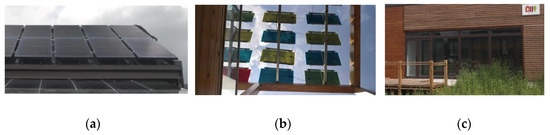
Figure 7.
Photovoltaic modules: (a) SRF photovoltaic panel; (b) HIT photovoltaic film; and (c) DUT photovoltaic glass.
For the installation of photovoltaic modules, the teams chose different installation methods, including BIPV and BAPV, based on their considerations for building shape and energy performance. For the specific construction, different installation inclination angles of photovoltaic panels were set according to the shape design and the direct sunlight angle in Zhangjiakou City. The installation angle for all teams was divided into four gradients of 15, 20, 35, and 45. CCMH, CUMT, AGH and HSP set the inclination angle to 45° based on the simulation of solar trajectory in Zhangjiakou City. Qiju 3.0 and BJTU+ set the angle to 15° and 10°, reserving small spaces for ventilation and cooling of photovoltaic panels so as to reduce energy loss in photovoltaic conversion. On the other hand, setting a small inclination angle leaves space and slope for snow melting during winter snowfall to avoid snow from shading the photovoltaic panels. Solar Ark placed the photovoltaic panels in an innovative way, in east-west 15°. From the perspective of energy, placing a southeast-facing photovoltaic panel can increase the photovoltaic panel area by 30% and add 3.5 h of power generation in the summer, increasing by 13% the power generation. Other teams chose different inclination angles due to their considerations of building shape and photovoltaic cell material. In addition to the application of traditional photovoltaic modules, THU also used Stirling machines to generate power, making itself the team with the highest power generation through utilizing solar energy, with an annual capacity of over 60,000 kWh. Most teams chose an installation capacity of around 15 kW, up to 28 kW. With different design combinations, each team could generate a considerable amount of power to meet the power demand of the whole house off-grid, and even sell the surplus electricity for profit. The energy payback period for each team was estimated to approximately range from 3 to 5 years.
The application of solar energy system is the most critical part of the competition, directly or indirectly affecting the scores of several items. On the whole, the top-ranked teams all had innovative and positive performances in solar energy systems. The application of solar system strategies for each team is shown in Table 7.
Table 7.
Application of solar system strategies.
3.1.7. Energy Storage System
The energy storage is an important part of the energy system. Most teams used batteries for power storage. SRF used a ladder storage system to store power in multiple dimensions through small vehicle storage, battery storage, and envelope enclosure storage, in a hierarchical manner. In addition, Solar Ark, Tianjin U+ and BJTU+ teams utilized the “Photovoltaic, Energy storage, Direct current and Flexibility system” system (a new energy system for buildings configured with building PV and building energy storage, which uses DC distribution system, and its power-using equipment has the power active response function) [76], using electric vehicles as power storage devices to store surplus power.
3.1.8. Other Renewable Energies
In the application of renewable energy, solar energy has been widely used in the design of ZEBs as the most accessible and transformative energy. However, the use of solar energy requires an environment with sufficient sunlight, and the number of sunny days in a year is limited. Therefore, to compensate and assist the power generation of solar system, some teams used wind turbine installations (Figure 8) to generate power from wind energy and combined it with solar energy. Tianjin U+ set up four wind turbines on the roof of the eave in combination with the building’s shape; Beijiao set up a wind turbine in the space between the photovoltaic panels and the roof for power generation; and Solar Ark set up a freestanding wind turbine in the northeast corner of the base. Based on the diverse and efficient use of renewable energy, only the three teams above received full marks in the item of energy self-sufficiency.
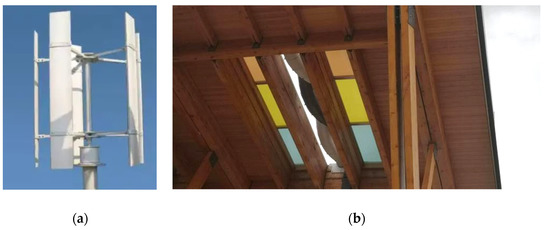
Figure 8.
Turbine power generation equipment. (a) Solar Ark Vertical Axis Wind Turbine; (b) Tianjin U+ Wind Turbine.
Zhangjiakou City has plentiful resource conditions, and geothermal energy is another renewable energy applied in the competition. Ground source heat pumps and air source heat pumps are used to heat the cold air in winter and cool the hot air in summer with the constant temperature deep in the soil. In addition, other renewable energies are only used by few teams due to their low efficiency in residential applications and difficulty in penetration, such as the biomass furnace used by DUT and Associates, the straw biomass wall used by HIT+, and the hydrogen water recycling system used by XJTU+ to recycle the cooling water and product water needed in the hydrogen fuel cell.
3.2. Quanlitative Analysis of Building Energy-Saving Strategies
3.2.1. Analysis of Competition Ranking
The mid-term evaluation mainly screened the finalist teams through the proposal drawings. After the construction, the final ranking was determined after a week-long evaluation of ten items. As can be observed in Table 8, seven teams dropped in ranking, two teams stayed the same and six teams moved up. Among them, Tianjin U+ ranked first in both mid-term and final. The comparison between the mid-term ranking and the final ranking shows that there is a significant difference between the design plans and the completed projects of ZEB, and that there is an error arising between the effectiveness of the design and the completion of the implementation of the energy-saving strategies of the teams. Energy-saving design strategies that are still effective after implementation can only contribute to a good ranking of zero-energy buildings in the end. Therefore, energy-saving design strategies need to be considered in terms of their utility, synergy and implementation.
Table 8.
Comparison of midterm and final rank of SDC2021 teams.
3.2.2. Analysis of Competition Scores
In the section of quantitative analysis, energy-saving design strategies for ZEBs and the ten scoring items were processed with correlation analysis, and further exploration was made based on qualitative analysis. This section pointed out the key factors in energy-saving strategies that affected the competition’s results, and explored the impact of the synergic effect of energy-saving strategies on each score. Then, an empirical model was established by combining the ranks.
The scoring results of this competition depended on different combinations of the above energy-saving strategies. Quantitative data analysis, including correlation analysis and multiple regression analysis, was processed to reveal the association between the strategies and the results. To verify the direct effect of score in each item on the overall results, the score of each item and the total score were processed with a correlation analysis (Table 9 and Table 10).
Table 9.
Correlation analysis of the score of five subjective items with the total score in SDC2021.
Table 10.
Correlation analysis of the score of 5 objective items with the total score in SDC2021.
Correlation analysis shows that among the five subjective items, energy contest scores have no significant correlation with the total score (p > 0.05) and in contrast the remaining four subjective items and five objective items have a significant positive correlation with the total score (p < 0.05 and the correlation coefficient R2 is positive). As indicated, the score of energy contest scores is contingent and not statistically significant. Therefore, the analysis of the energy contest scores will be excluded from the correlation analysis between the energy efficiency design strategies and the score of each item.
3.2.3. Correlation Analysis
By summarizing and sorting, this study divided the passive and active energy-saving design strategies applied in this competition into 22 design elements. The situation of each element is shown in Table 11.
Table 11.
Energy-saving design strategy.
Data analysis reveals (Figure 9) that among the twenty-two energy-saving design strategies, seventeen have a certain correlation with the scores of nine items except for energy contest scores. Among these seventeen strategies, design concept, south-facing window wall ratio, photovoltaic area, installation capacity and cost have a significantly positive correlation with the scoring items, and they contribute to the scoring results; plane form, roof form, functional structure, shape coefficient, lighting form, ventilation form, application type of renewable energy, photovoltaic module type and heat pump type have a significantly negative correlation with the scoring items and they restrain the scoring results. Although length-width ratio, thermal buffer space parameters, photovoltaic installation angle and cost are not significantly correlated with each score, they have clear design arrangements and practical applications among the teams’ design strategies. Therefore, this part of the design strategy will be summarized by summarizing the performance of the top five to draw design lessons.
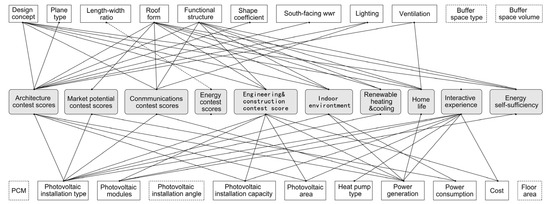
Figure 9.
Correlation results analysis.
In terms of the scores of items, eleven strategies are correlated with the construction scores, eight with the engineering scores, five with the interactive experience and communications contest scores respectively, four with the indoor environment, home life and energy self-sufficiency, three with renewable heating and cooling, and two with market potential contest scores. The number of correlations with energy-saving strategies is polarized in the subjective scoring items, while it is more even in the objective scoring items. As is indicated that there may be additional subjective influences not addressed in the 22 strategies that are included in the subjective items.
In terms of energy-saving design strategies, eight items are correlated with roof form, which are the largest group, seven with functional structure and application type of renewable energy and six with design concept. The remaining energy-saving design strategies are only correlated with one to three items. As is indicated that among the 22 energy-saving design strategies, roof form, functional structure, application type of renewable energy and design concept make a key impact. Therefore, the priority of the zero-energy design strategies decreases from dark to light, as shown in Figure 10. Three of the key elements are passive and one is active, indicating that for ZEB design, passive design strategies have a more significant advantage than active design strategies for the comprehensive evaluation of ZEBs. The principle of passive technology priority and active technology optimization should be considered in the design of zero-energy building.
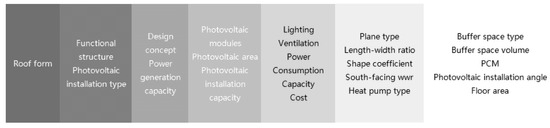
Figure 10.
The priority of the zero-energy design strategy.
3.2.4. Synergic Impact of Energy-Saving Strategies in ZEBs
The nine items, except for energy contest scores, were processed with the regression analysis with the design elements correlated in the regression analysis, revealing that only “architecture contest scores” is still correlated with the energy-saving strategy after the multiple regression analysis. As is shown that the synergic impact of various energy-saving design strategies is complex and most scoring items can’t show specific combination patterns by way of mathematical models.
The multiple regression analysis reveals (Table 12) that these ten strategies can explain 96.7% of the variation in architecture contest scores (regression coefficient R2 = 0.967). Design concept, floor type, roof form, ventilation, application type of renewable energy, and photovoltaic installation capacity have a significantly negative effect on the architecture contest scores with the synergistic effect of the correlated design strategies. Functional structure, south-facing window/wall ratios, lighting and photovoltaic area have no significant influence on architecture contest scores.
Table 12.
Linear regression analysis with architecture contest scores as the dependent variable.
The strategies that are still correlated are ordered according to the regression coefficient B value (absolute value) from largest to smallest, and it can be determined that: design concept > application type of renewable energy > roof form > plane form > ventilation > photovoltaic installation capacity (Table 13). Therefore, the designers should select strategies according to the above ranks.
Table 13.
Linear regression analysis with architecture contest scores as dependent variable and 6 related factors as independent variables.
3.3. Empirical Model of Energy-Saving Strategies for ZEBs in Zhangbei City
Based on the correlation analysis and regression analysis, the correlations and importance basis of the relevant strategies were obtained. Combined with the performance of the top five teams in this competition, an empirical model of the energy-saving design strategies for a zero-energy house in Zhangbei County was comprehensively established (Table 14).
Table 14.
Empirical model of energy-saving design strategies for zero-energy houses in Zhangbei City.
4. Conclusions
This study comprehensively reviewed the entries of SDC2021. It took SDC2021 as the research object and summarized 22 energy-saving design strategies. Based on a scoring system with ten items and the scoring results of the competition, the correlation analysis and regression analysis were processed and an empirical model of energy-saving design strategies in Zhangbei County was established according to the performance of the top five.
The main research results are as follows:
- (1)
- Among the 22 energy-saving strategies, 17 are correlated with the score of items to some degree. Among these 17 strategies, design concept, south-facing window wall ratio, photovoltaic area, installation capacity and cost all have a significantly positive correlation with the score of items; plane form, roof form, functional structure, shape coefficient, lighting form, ventilation form, the application type of renewable energy, photovoltaic module type and heat pump type all have a significantly negative correlation with the score of the items. Functional structure is correlated with 7 scores and makes the most significant impact on the final results among the 22 energy-saving strategies.
- (2)
- The synergistic application of energy-saving design strategies is complex and it is difficult to generalize it through mathematical models. Accordingly, the statistics of the synergistic effect of strategies in this competition only apply to the building items. The multiple regression results reveal that the correlation of each energy-saving strategy in the building scoring items decreases in the order of design concept, application type of renewable energy, roof form, ventilation, floor type, and photovoltaic installation capacity.
- (3)
- The qualitative and quantitative analysis reveals that the design of ZEBs in the climate conditions of Zhangbei County, Zhangjiakou City prefers regular building shape, three-section functional layout, multiple lighting and ventilation strategy, efficient equipment, and multidimensional use of renewable energy based on the ten scoring criteria of SDC2021.
Although SDC provides an ideal environment and a platform for experimentation for ZEB research, the study only focused on 15 samples of the current competition and the competition rules are limited, which leads to certain limitations of this study:
The study is based on the ten scoring criteria and the results of SDC2021, and its analysis and exploration are based on the evaluation of experts and objective data, lacking the investigation and user-comfort evaluations of non-participants.
Based on the qualitative and quantitative analysis, and the scoring system of this competition, the empirical model is only directed to Zhangbei County, Zhangjiakou City which is warm in summer and cold in winter and has limitations in reference when facing different design needs.
In general, in terms of energy, this competition has carried out a multi-stage energy-saving design about energy utilization, energy storage and energy recovery. In each stage, the teams can effectively reduce energy consumption from the perspective of improving energy efficiency by promoting direct utilization of energy, stepping utilization, reducing the form of energy conversion, and refining the way of energy use. These step-by-step progressive energy-saving ideas and design means are an important way to effectively reduce energy consumption.
For the natural environment, the selection of recyclable materials and the application of water recycling treatment system are the embodiment of low-carbon environmental awareness. The awareness of low-carbon environmental protection and the upgrading of materials and technologies are mutually reinforcing, and are effectively expressed through the design organization of the building. In terms of the human environment, the work of this SDC competition was mainly to design a housing prototype from the perspective of rural needs and future urban development. From a longer time-perspective, it encompassed not only the whole life cycle of the building, but also the life cycle of one generation, or even several generations. In the context of China’s rural revitalization policy, it aimed to explore a sustainable architectural prototype in architectural life as well as in human life and continuity. The consideration and expression of the sustainable relationship among human settlements’ quality, urban and rural development and building energy efficiency are the important values of this competition.
Author Contributions
Conceptualization, G.Y. and Y.L.; Data curation, Y.W.; Formal analysis, Y.C.; Funding acquisition, Y.L.; Investigation, Y.W.; Methodology, G.Y.; Project administration, Y.L.; Resources, Y.C.; Software, G.Y.; Supervision, Y.L.; Validation, G.Y., Y.L. and Y.W.; Visualization, Y.C.; Writing—original draft, Y.C.; Writing—review & editing, G.Y. and Y.C. All authors have read and agreed to the published version of the manuscript.
Funding
This research was funded by the Graduate Innovation Program of China University of Mining and Technology, grant number 2022WLJCRCZL303.
Data Availability Statement
The data presented in this study are available on request from the corresponding author. The data are not publicly available due to the data also forms part of an ongoing study.
Conflicts of Interest
The authors declare no conflict of interest.
Abbreviations
| SD | Solar Decathlon | WWR | Window Wall Ratio |
| SDC | Solar Decathlon China | ETFE | Ethyl tetrafluoroethylene copolymer |
| ZEBs | Zero-Energy Buildings | PV-PSC | Perovskite solar cells |
| NZEB | Net-Zero-Energy Building | PV-Si | Monocrystalline silicon solar cells |
| SIPs | Structural Insulated Panels | PV-CT | Cadmium telluride photovoltaic film |
| PCM | Phase change material | GLT | Glue-laminated timber |
| HVAC | Heating, ventilating and air conditioning | EPBT | Energy payback period time |
| BIPV | Building-integrated photovoltaic | ASHP | Air Source Heat Pump |
| BAPV | Building Attached Photovoltaic | GSHP | Ground Source Heat Pump |
| PV/T | Photovoltaic/thermal system | UHPC | Ultra-High Performance Concrete |
References
- Shakoor, A.; Ashraf, F.; Shakoor, S.; Mustafa, A.; Rehman, A.; Altaf, M.M. Biogeochemical Transformation of Greenhouse Gas Emissions from Terrestrial to Atmospheric Environment and Potential Feedback to Climate Forcing. Environ. Sci. Pollut. Res. 2020, 27, 38513–38536. [Google Scholar] [CrossRef]
- World Health Organization. Air Pollution; WHO: Geneva, Switzerland. Available online: https://www.who.int/healthtopics/air-pollution#tab=tab_1 (accessed on 10 November 2022).
- Wang, Z.; Yuan, J.-S.; Pombo. Major conclusions and implications of Climate Change 2022: Mitigation of Climate Change IPCC AR6. Adv. Clim. Change Res. 2022, 1–6. [Google Scholar]
- IPCC—Intergovernmental Panel on Climate Change. Available online: https://www.ipcc.ch/ (accessed on 10 November 2022).
- Rhodes, C.J. The 2015 Paris Climate Change Conference: COP21. Sci. Prog. 2016, 99, 97–104. [Google Scholar] [CrossRef] [PubMed]
- Liu, Q.; Tong, L.; Chen, T. Application of Nearly Zero Energy Buildings in Areas with Hot Summers and Cold Winters. In Proceedings of the 2015 4th International Conference on Energy and Environmental Protection (iceep 2015), Hebron, Palestine, 6–7 April 2016; Destech Publications, Inc.: Lancaster, UK, 2015; pp. 1514–1521. [Google Scholar]
- Feng, W.; Zhang, Q.; Ji, H.; Wang, R.; Zhou, N.; Ye, Q.; Hao, B.; Li, Y.; Luo, D.; Lau, S.S.Y. A Review of Net Zero Energy Buildings in Hot and Humid Climates: Experience Learned from 34 Case Study Buildings. Renew. Sust. Energ. Rev. 2019, 114, 109303. [Google Scholar] [CrossRef]
- Sun, X.; Gou, Z.; Lau, S.S.-Y. Cost-Effectiveness of Active and Passive Design Strategies for Existing Building Retrofits in Tropical Climate: Case Study of a Zero Energy Building. J. Clean. Prod. 2018, 183, 35–45. [Google Scholar] [CrossRef]
- Kosonen, A.; Keskisaari, A. Zero-Energy Log House—Future Concept for an Energy Efficient Building in the Nordic Conditions. Energy Build. 2020, 228, 110449. [Google Scholar] [CrossRef]
- O’Donovan, A.; Murphy, M.D.; O’Sullivan, P.D. Passive Control Strategies for Cooling a Non-Residential Nearly Zero Energy Office: Simulated Comfort Resilience Now and in the Future. Energy Build. 2021, 231, 110607. [Google Scholar] [CrossRef]
- Marique, A.-F.; Reiter, S. A Simplified Framework to Assess the Feasibility of Zero-Energy at the Neighbourhood/Community Scale. Energy Build. 2014, 82, 114–122. [Google Scholar] [CrossRef]
- Kumar, G.M.S.; Cao, S. State-of-the-Art Review of Positive Energy Building and Community Systems. Energies 2021, 14, 5046. [Google Scholar] [CrossRef]
- Adeli, M.M.; Farahat, S.; Sarhaddi, F. Increasing Thermal Comfort of a Net-Zero Energy Building Inhabitant by Optimization of Energy Consumption. Int. J. Environ. Sci. Technol. 2020, 17, 2819–2834. [Google Scholar] [CrossRef]
- Annunziata, E.; Frey, M.; Rizzi, F. Towards Nearly Zero-Energy Buildings: The State-of-Art of National Regulations in Europe. Energy 2013, 57, 125–133. [Google Scholar] [CrossRef]
- Zhang, S.; Wang, K.; Xu, W.; Iyer-Raniga, U.; Athienitis, A.; Ge, H.; Cho, D.W.; Feng, W.; Okumiya, M.; Yoon, G.; et al. Policy Recommendations for the Zero Energy Building Promotion towards Carbon Neutral in Asia-Pacific Region. Energy Policy 2021, 159, 112661. [Google Scholar] [CrossRef]
- Ullah, K.R.; Prodanovic, V.; Pignatta, G.; Deletic, A.; Santamouris, M. Technological Advancements towards the Net-Zero Energy Communities: A Review on 23 Case Studies around the Globe. Sol. Energy 2021, 224, 1107–1126. [Google Scholar] [CrossRef]
- Li, J.; Xu, W.; Cui, P.; Qiao, B.; Wu, S.; Zhao, C. Research on a Systematical Design Method for Nearly Zero-Energy Buildings. Sustainability 2019, 11, 7032. [Google Scholar] [CrossRef]
- Yi, Y.K.; Malkawi, A.M. Optimizing Building Form for Energy Performance Based on Hierarchical Geometry Relation. Autom. Constr. 2009, 18, 825–833. [Google Scholar] [CrossRef]
- Camporeale, P.E.; Mercader-Moyano, P. Towards Nearly Zero Energy Buildings: Shape Optimization of Typical Housing Typologies in Ibero-American Temperate Climate Cities from a Holistic Perspective. Sol. Energy 2019, 193, 738–765. [Google Scholar] [CrossRef]
- Bogdanovic, V.B.; Randjelovic, D.J.; Vasov, M.S.; Ignjatovic, M.G.; Stevanovic, J.N. Improving Thermal Stability and Reduction of Energy Consumption by Implementing Trombe Wall Construction in the Process of Building Design: The Serbia Region. Therm. Sci. 2018, 22, 2355–2365. [Google Scholar] [CrossRef]
- Thalfeldt, M.; Kurnitski, J.; Voll, H. Detailed and Simplified Window Model and Opening Effects on Optimal Window Size and Heating Need. Energy Build. 2016, 127, 242–251. [Google Scholar] [CrossRef]
- Huo, H.; Xu, W.; Li, A.; Lv, Y.; Liu, C. Analysis and Optimization of External Venetian Blind Shading for Nearly Zero-Energy Buildings in Different Climate Regions of China. Sol. Energy 2021, 223, 54–71. [Google Scholar] [CrossRef]
- Sharma, R.; Jang, J.-G.; Hu, J.-W. Phase-Change Materials in Concrete: Opportunities and Challenges for Sustainable Construction and Building Materials. Materials 2022, 15, 335. [Google Scholar] [CrossRef]
- Vigna, I.; Bianco, L.; Goia, F.; Serra, V. Phase Change Materials in Transparent Building Envelopes: A Strengths, Weakness, Opportunities and Threats (SWOT) Analysis. Energies 2018, 11, 111. [Google Scholar] [CrossRef]
- Stritih, U.; Tyagi, V.V.; Stropnik, R.; Paksoy, H.; Haghighat, F.; Joybari, M.M. Integration of Passive PCM Technologies for Net-Zero Energy Buildings. Sust. Cities Soc. 2018, 41, 286–295. [Google Scholar] [CrossRef]
- Pandharipande, A.; Caicedo, D. Smart Indoor Lighting Systems with Luminaire-Based Sensing: A Review of Lighting Control Approaches. Energy Build. 2015, 104, 369–377. [Google Scholar] [CrossRef]
- Montoya, F.G.; Pena-Garcia, A.; Juaidi, A.; Manzano-Agugliaro, F. Indoor Lighting Techniques: An Overview of Evolution and New Trends for Energy Saving. Energy Build. 2017, 140, 50–60. [Google Scholar] [CrossRef]
- Suh, H.S.; Kim, D.D. Energy Performance Assessment towards Nearly Zero Energy Community Buildings in South Korea. Sust. Cities Soc. 2019, 44, 488–498. [Google Scholar] [CrossRef]
- Kalder, J.; Allik, A.; Hoimoja, H.; Jogi, E.; Hovi, M.; Marss, M.; Kurnitski, J.; Fadejev, J.; Lill, H.; Jasinskas, A.; et al. Optimal Wind/Solar Energy Mix for Residential Net Zero-Energy Buildings. In Proceedings of the 8th International Scientific Conference Rural Development 2017: Bioeconomy Challenges, Akademija, Lithuania, 23–24 November 2017; Raupeliene, A., Ed.; Aleksandras Stulginskis University: Akademija, Lithuania, 2017; pp. 621–626. [Google Scholar]
- D’Agostino, D.; Mele, L.; Minichiello, F.; Renno, C. The Use of Ground Source Heat Pump to Achieve a Net Zero Energy Building. Energies 2020, 13, 3450. [Google Scholar] [CrossRef]
- ur Rehman, H.; Diriken, J.; Hasan, A.; Verbeke, S.; Reda, F. Energy and Emission Implications of Electric Vehicles Integration with Nearly and Net Zero Energy Buildings. Energies 2021, 14, 6990. [Google Scholar] [CrossRef]
- Mardiana-Idayu, A.; Riffat, S.B. Review on Heat Recovery Technologies for Building Applications. Renew. Sust. Energ. Rev. 2012, 16, 1241–1255. [Google Scholar] [CrossRef]
- Wang, Z.; Wang, F.; Liu, J.; Ma, Z.; Han, E.; Song, M. Field Test and Numerical Investigation on the Heat Transfer Characteristics and Optimal Design of the Heat Exchangers of a Deep Borehole Ground Source Heat Pump System. Energy Conv. Manag. 2017, 153, 603–615. [Google Scholar] [CrossRef]
- Cao, X.; Dai, X.; Liu, J. Building Energy-Consumption Status Worldwide and the State-of-the-Art Technologies for Zero-Energy Buildings during the Past Decade. Energy Build. 2016, 128, 198–213. [Google Scholar] [CrossRef]
- Bielek, M.; Bielek, B.; Hires, J. New Physical-Energy Quantification of Buildings in the Development of the Technology in Architecture for a Sustainable Society. In Proceedings of the Advanced Building Construction and Materials 2013, Kočovce, Slovakia, 26–27 September 2013; Palko, M., Deakova, K., Eds.; Trans Tech Publications Ltd.: Stafa, Switzerland, 2014; Volume 855, pp. 35–38. [Google Scholar]
- Solar Decathlon. Available online: https://www.solardecathlon.gov/ (accessed on 10 November 2022).
- Herrera-Limones, R.; Luis Leon-Rodriguez, A.; Lopez-Escamilla, A. Solar Decathlon Latin America and Caribbean: Comfort and the Balance between Passive and Active Design. Sustainability 2019, 11, 3498. [Google Scholar] [CrossRef]
- Jin, Y.; Li, J.; Wu, W. I-Yard 2.0: Integration of Sustainability into a Net-Zero Energy House. Appl. Sci. 2020, 10, 3541. [Google Scholar] [CrossRef]
- Lopez-Escamilla, A.; Herrera-Limones, R.; Luis Leon-Rodriguez, A.; Torres-Garcia, M. Environmental Comfort as a Sustainable Strategy for Housing Integration: The AURA 1.0 Prototype for Social Housing. Appl. Sci. 2020, 10, 7734. [Google Scholar] [CrossRef]
- Pasini, M.A.; Athienitis, A.K. Systems Design of the Canadian Solar Decathlon House. In ASHRAE Transactions. 2006 Annual Meeting, Quebec City, Canada. Volume 112, part 2 + CD-ROM; Amer Soc Heating, Refrigerating and Air-Conditioning Engs: Atlanta, GA, USA, 2006; Volume 112, p. 308. [Google Scholar]
- Yu, Z.; Gou, Z.; Qian, F.; Fu, J.; Tao, Y. Towards an Optimized Zero Energy Solar House: A Critical Analysis of Passive and Active Design Strategies Used in Solar Decathlon Europe in Madrid. J. Clean. Prod. 2019, 236, 117646. [Google Scholar] [CrossRef]
- Deng, F.; Tan, H. Research on the Technical route of zero-energy residential design—A case study of the works of the third International Solar Decathlon (SD) of Tongji University. Urban Archit. 2015, 31, 44–47. [Google Scholar] [CrossRef]
- Baghi, Y.; Ma, Z.; Robinson, D.; Boehme, T. Innovation in Sustainable Solar-Powered Net-Zero Energy Solar Decathlon Houses: A Review and Showcase. Buildings 2021, 11, 171. [Google Scholar] [CrossRef]
- SDC Organizing Committee Green Building Theme Exchange Notice. Available online: http://mp.weixin.qq.com/s?__biz=MzI0NzAyMDM5MA==&mid=2247503263&idx=1&sn=cb7147743e261cccb8291966ad88fa58&chksm=e9b4e396dec36a80b98143d34fe291090f58b436d6b52e6577f7e0f170df54cb9a40d3e2e4db#rd (accessed on 10 November 2022).
- SDC Organizing Committee "Sunshine Green Building Zero Carbon China" near Zero Energy Building Technology and Case Sharing Meeting. Available online: http://mp.weixin.qq.com/s?__biz=MzI0NzAyMDM5MA==&mid=2247503086&idx=1&sn=9d239a4e3035be907b72db8fad504a10&chksm=e9b4e2e7dec36bf13e7bee2eca63b1b53a2e6763b35e8a3240213efd576b0e109ede83729169#rd (accessed on 10 November 2022).
- SDC (CADE Live Notice|SDC x CADE JianZhuRen er—"zero Carbon, Experimental Project". Available online: http://mp.weixin.qq.com/s?__biz=MzI0NzAyMDM5MA==&mid=2247504434&idx=1&sn=9ec8d873657c7000b92708b09ede79e0&chksm=e9b4fc3bdec3752d912688e42a01612bc100a311f8c4f0ccc134042babe759e118a07a02a4d9#rd (accessed on 10 November 2022).
- Solar Decathlon China. Available online: https://scoring.sdchina.org.cn/ (accessed on 10 November 2022).
- SD China 2022 Rules Updates Summary. Available online: https://scoring.sdchina.org.cn/ (accessed on 10 November 2022).
- Scoring System 20200818. Available online: https://scoring.sdchina.org.cn/ (accessed on 10 November 2022).
- Y—Team Interview|Y—Team Team Reviewed & Y—Project Project is Introduced. Available online: http://mp.weixin.qq.com/s?__biz=Mzg3OTU0ODExNg==&mid=2247483864&idx=1&sn=5288eaaf29b279815a00b5364cacbac1&chksm=cf038263f8740b75e0855e8c19c6717848e0e6bf4ca767c5071288a17518846832a7a389771c#rd (accessed on 12 December 2022).
- 24 × 35 Housing Home 24 × 35 Housing Home Introduction. Available online: http://mp.weixin.qq.com/s?__biz=MzkzNjIzOTU5Nw==&mid=2247483779&idx=1&sn=6d35925e8756261ab5e8b1d87c9d000e&chksm=c2a08901f5d70017721c83142eadfa146c2b6d6653af13201c2c6e852f1ac50c78d827b9e891#rd (accessed on 12 December 2022).
- China International Decathlon CCMH2021 | CCMH Inclined House—Zero Carbon wisdom Solutions for the Future. Available online: http://mp.weixin.qq.com/s?__biz=Mzg3MzUyODUzNQ==&mid=2247485819&idx=1&sn=fd98f79cb9e3e76f434bc3382bddb39d&chksm=cedfe4c3f9a86dd5e4db8500b40e60ad81a3c78c8043f9643cfcdd2f79d79e31a671ddc05865#rd (accessed on 12 December 2022).
- SDC 2021, t. Welcome Aboard The prairie Ark | The Steppe Ark. Available online: http://mp.weixin.qq.com/s?__biz=MzI3ODMzNjg1MQ==&mid=2247485186&idx=1&sn=155cd9a3cdb09597557b68bf31857126&chksm=eb59c33edc2e4a28a3a237a92bf29e6d131b05684cc0ed7a90dc689f7201f26c065f69578bb1#rd (accessed on 12 December 2022).
- Qiju 3.0, T. Introduction to the “Zero-Carbon Habitat” Scheme. Available online: http://mp.weixin.qq.com/s?__biz=MzI4OTM1Mzg5OQ==&mid=2247488987&idx=1&sn=221991830a32cc05f97095b4240e3a42&chksm=ec312c1fdb46a509e8b16448f1468a957c5e951f7e2f747d4d30f4af0302c2514f494942f45e#rd (accessed on 12 December 2022).
- New Released|R—CELLS Life Curtilage. Available online: http://mp.weixin.qq.com/s?__biz=Mzg5MzQxMjMwNA==&mid=2247487315&idx=1&sn=73c2dc755e0f3a7deba060ac1d9f4d34&chksm=c02e79ecf759f0fa373f2af26b8ac3d4223b24f9ba090b693807a58b95af52628d5a77c80f9d#rd (accessed on 12 December 2022).
- Aurora, T. DTU-SUDA Team Aurora Program Introduction. Available online: http://mp.weixin.qq.com/s?__biz=Mzg5MjU1NTU4NQ==&mid=2247483965&idx=1&sn=b9d42365eccfe1058313512645fab4df&chksm=c03d1a13f74a9305fbbfc4d82bbdc0888e5dfcbb241f704bdd5b11ef8ae0d7f66613ac8b3e96#rd (accessed on 12 December 2022).
- HOPE LAND Instruction Manual. Available online: https://scoring.sdchina.org.cn/ (accessed on 10 November 2022).
- Ark, 3.0 s. Solar ark 3.0 Design Research|Variable type scene design and application. Available online: http://mp.weixin.qq.com/s?__biz=MzkxNDE5MzExMA==&mid=2247485978&idx=1&sn=767d1c1d060c0fa7d51ae68b983fa08b&chksm=c17365a3f604ecb5e3618a29963ba5532d3e20789a91891d4e13422dd1408e2177ff57c2262d#rd (accessed on 12 December 2022).
- Introduction to the T&A House Scheme. Available online: http://mp.weixin.qq.com/s?__biz=Mzg5MzUzMzIyMg==&mid=2247484984&idx=1&sn=b2f99a1641a0dc0ffa4ad0f0620289f0&chksm=c02c2b71f75ba26770276f905db6474cdcd776e2b365212fe2836571f88ea39b2b0a458e9ced#rd (accessed on 12 December 2022).
- TeamHIT&UCB Works Release, Together Approach Modular Sustainable Rubik’s Cube. Available online: https://mp.weixin.qq.com/s/eNUT7aNEVpFi61BHdoBk2w (accessed on 12 December 2022).
- HUI, T. Team HUI Entry—Introduction to HUI House. Available online: http://mp.weixin.qq.com/s?__biz=MzI0NzAyMDM5MA==&mid=2247487576&idx=2&sn=fa097bb8298eb2d50e4c4965ea35bf0f&chksm=e9b73e51dec0b74741c2b3a4245cc0ebb3d4be1449521bbaf48cb06d4b6114dabad0a1babf13#rd (accessed on 12 December 2022).
- XJTU+, T. Team XJTU+ Entry—SMART Introduction. Available online: http://mp.weixin.qq.com/s?__biz=MzA4Mjg2NzY5OQ==&mid=2247483991&idx=1&sn=97ffdd17b78537ce87326faeb073686c&chksm=9ffe66cba889efdd4edb46fa0e28f83e0d6af43253c37156cb30b35f380ba6f82219f01cf2ea#rd (accessed on 12 December 2022).
- SRF Introduces The Pixel House Solution. Available online: http://mp.weixin.qq.com/s?__biz=Mzg3ODMzOTQwNQ==&mid=2247485081&idx=1&sn=80599b6304d132f0c955e13e03b613a0&chksm=cf1472bbf863fbad9f985aeb1efd437f7a9e27f2b108e789927ce345354596269c5ae7060bc5#rd (accessed on 12 December 2022).
- TransAxis Y-Project Technical Introduction. Available online: http://mp.weixin.qq.com/s?__biz=Mzg3OTU0ODExNg==&mid=2247484586&idx=1&sn=7b03f40de1022b59f8eeb1a6d01ad577&chksm=cf038711f8740e0779429847502f8c7091a4ca123666b2a0b9be7ba531e2c760ffa69c711dfd#rd (accessed on 12 December 2022).
- Yao, G.; Chen, Y.; Xie, W.; Chen, N.; Rui, Y.; Luo, P. Research on Collaborative Design of Performance-Refined Zero Energy Building: A Case Study. Energies 2022, 15, 7185. [Google Scholar] [CrossRef]
- Hang, X.; Ning, X.; Chen, L.; Pei, T.; Zeyong, S.; Huan, M.; Chaochen, Z.; Yue, F. Exploration on integrated design of new energy small House returning to life—A case study of Pixel House in 2021 China International Solar Decathlon Competition. World Archit. Rev. 2022, 37, 64–67. [Google Scholar] [CrossRef]
- Li, B.; Guo, W.; Liu, X.; Zhang, Y.; Caneparo, L. The Third Solar Decathlon China Buildings for Achieving Carbon Neutrality. Buildings 2022, 12, 1094. [Google Scholar] [CrossRef]
- ChunPing, G.; Guang, Y.; Wei, S. Ultrahigh Performance Concrete-Properties, Applications and Perspectives. Sci. China-Technol. Sci. 2015, 58, 587–599. [Google Scholar] [CrossRef]
- Li, K.; Wang, X.; Li, H.; Zheng, M.; Peng, B.; Kong, F.; Zhang, Z. Analysis on Energy Saving and Thermal Insulation Performance of Improved Straw Brick in Northern Cold Area. Arab. J. Geosci. 2020, 13, 807. [Google Scholar] [CrossRef]
- Abbasi, H.; Hojatkashani, A.; Sennah, K.; Nematianjelodar, H. Compressive Loading of Structural Insulated Panels and Conventional Stud Walls: A Study. Proc. Inst. Civil Eng.-Struct. Build. 2022, 176, 1–12. [Google Scholar] [CrossRef]
- Amran, Y.H.M.; El-Zeadani, M.; Lee, Y.H.; Lee, Y.Y.; Murali, G.; Feduik, R. Design Innovation, Efficiency and Applications of Structural Insulated Panels: A Review. Structures 2020, 27, 1358–1379. [Google Scholar] [CrossRef]
- Saini, D.; Shafei, B. Performance of Structural Insulated Panels with Metal Skins Subjected to Windborne Debris Impact. Compos. Part B Eng. 2020, 198, 108163. [Google Scholar] [CrossRef]
- Moreno, A.; Chemisana, D.; Vaillon, R.; Riverola, A.; Solans, A. Energy and Luminous Performance Investigation of an OPV/ETFE Glazing Element for Building Integration. Energies 2019, 12, 1870. [Google Scholar] [CrossRef]
- Flor, J.-F.; Liu, D.; Sun, Y.; Beccarelli, P.; Chilton, J.; Wu, Y. Optical Aspects and Energy Performance of Switchable Ethylene-Tetrafluoroethylene (ETFE) Foil Cushions. Appl. Energy 2018, 229, 335–351. [Google Scholar] [CrossRef]
- Hu, J.; Chen, W.; Liu, Y.; Zhao, B.; Yang, D.; Ge, B. Two-Layer ETFE Cushions Integrated Flexible Photovoltaics: Prototype Development and Thermal Performance Assessment. Energy Build. 2017, 141, 238–246. [Google Scholar] [CrossRef]
- Jiang, Y. Photovoltaic, Energy storage, Direct current and Flexibility system-a new type of building distribution system that helps achieve zero-carbon power. Heat. Vent. Air Cond. 2021, 51, 1–12. [Google Scholar]




Disclaimer/Publisher’s Note: The statements, opinions and data contained in all publications are solely those of the individual author(s) and contributor(s) and not of MDPI and/or the editor(s). MDPI and/or the editor(s) disclaim responsibility for any injury to people or property resulting from any ideas, methods, instructions or products referred to in the content. |
© 2023 by the authors. Licensee MDPI, Basel, Switzerland. This article is an open access article distributed under the terms and conditions of the Creative Commons Attribution (CC BY) license (https://creativecommons.org/licenses/by/4.0/).