

Introducing the EpG2 System: Epigenomic Processes and the Emergent Genome


Abstract
1. Introduction
“From now onwards space by itself and time by itself will recede completely to become mere shadows and only a type of union of the two will still stand independently on its own.”Hermann Minkowski, lecture at the 80th Meeting of German Natural Scientists, Cologne, 21 September 1908
2. Enhancers: From DNA Fragments to Emergent Entities
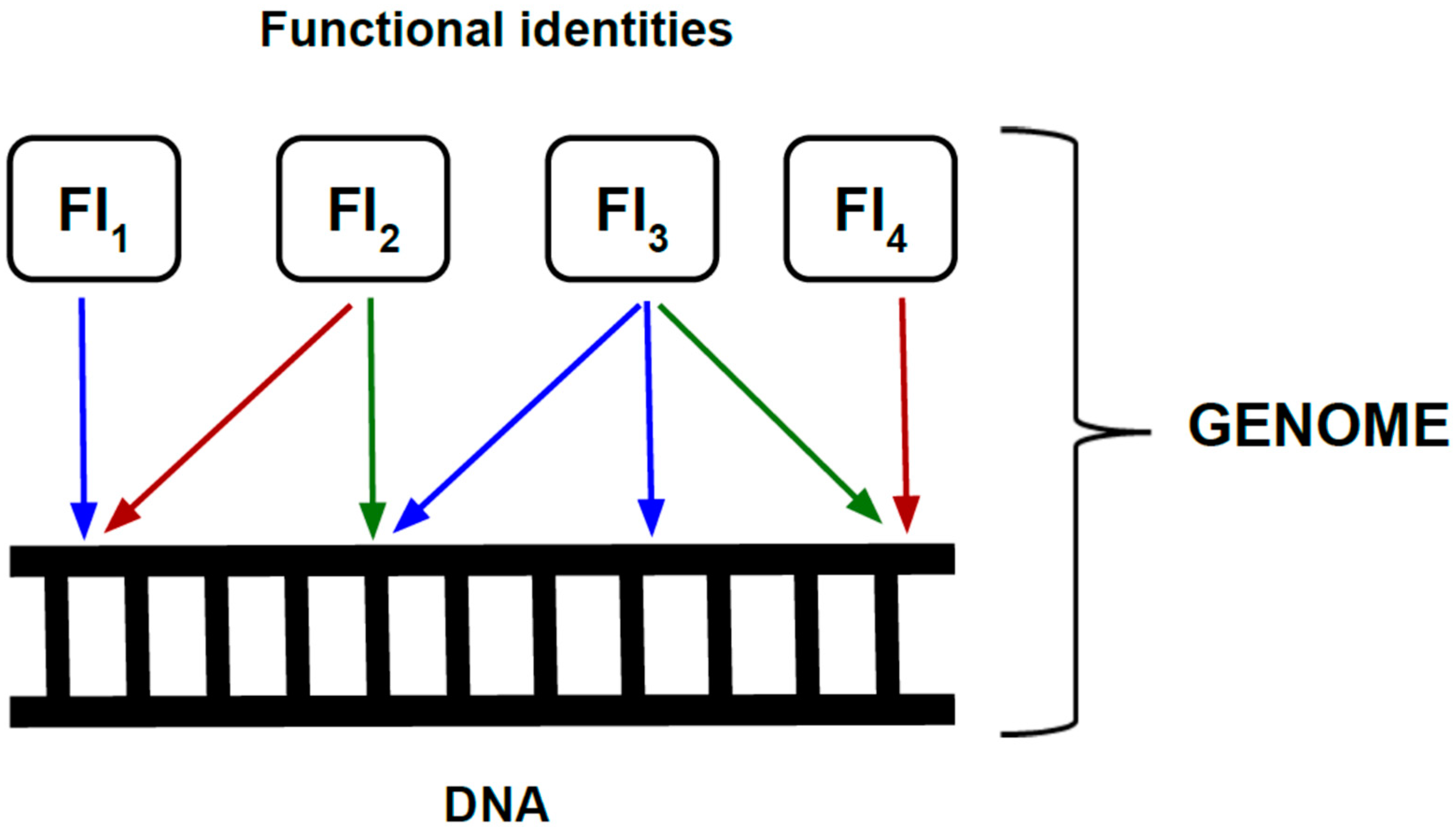
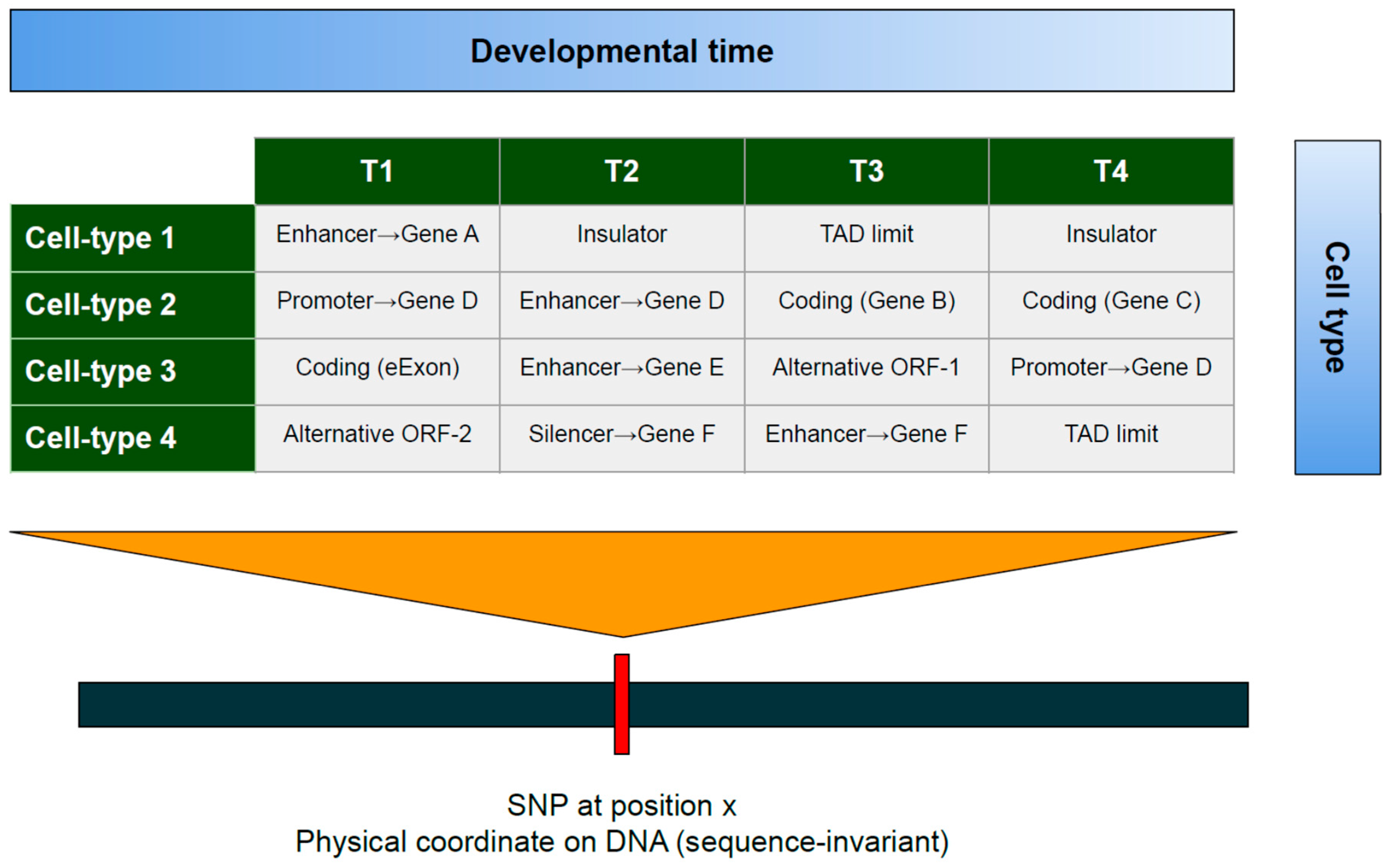
3. One DNA Locus, Multiple Functional Identities
4. When Functional Identity Emerges Outside the DNA
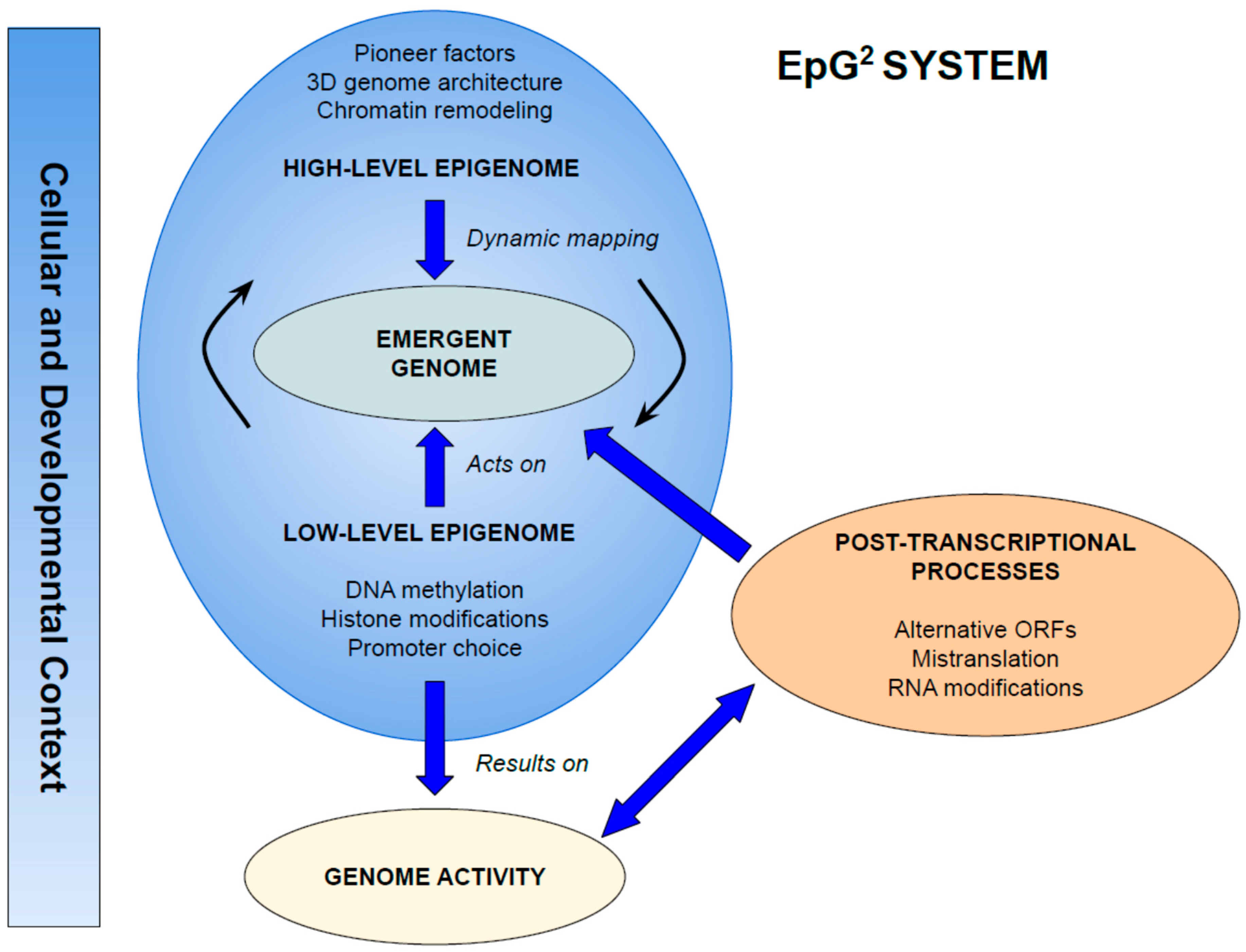
5. The EpG2 System
- High-level epigenome:mechanisms that establish the identity of genomic elements by mapping functional roles onto DNA, thereby generating the emergent genome itself.
- Low-level epigenome:mechanisms that regulate the activity of the emergent genome, including transcriptional output, alternative promoter usage, and chromatin dynamics.
6. Discussion and Implications
6.1. Elucidation of Mechanisms Leading to Genome Emergence
6.2. Genomic Variation and Disease
6.3. The EpG2 System Within the Evolutionary Development Biology Framework
7. Summary
Funding
Institutional Review Board Statement
Informed Consent Statement
Data Availability Statement
Conflicts of Interest
References
- Burris, H.H.; Baccarelli, A.A. Environmental epigenetics: From novelty to scientific discipline. J. Appl. Toxicol. 2014, 34, 113–116. [Google Scholar] [CrossRef] [PubMed]
- Andersson, R.; Sandelin, A. Determinants of enhancer and promoter activities of regulatory elements. Nat. Rev. Genet. 2020, 21, 71–87. [Google Scholar] [CrossRef] [PubMed]
- Field, A.; Adelman, K. Evaluating Enhancer Function and Transcription. Annu. Rev. Biochem. 2020, 89, 213–234. [Google Scholar] [CrossRef]
- Gisselbrecht, S.S.; Palagi, A.; Kurland, J.V.; Rogers, J.M.; Ozadam, H.; Zhan, Y.; Dekker, J.; Bulyk, M.L. Transcriptional Silencers in Drosophila Serve a Dual Role as Transcriptional Enhancers in Alternate Cellular Contexts. Mol. Cell 2020, 77, 324–337.e328. [Google Scholar] [CrossRef]
- Huang, D.; Ovcharenko, I. Enhancer-silencer transitions in the human genome. Genome Res. 2022, 32, 437–448. [Google Scholar] [CrossRef]
- Banerji, J.; Rusconi, S.; Schaffner, W. Expression of a beta-globin gene is enhanced by remote SV40 DNA sequences. Cell 1981, 27, 299–308. [Google Scholar] [CrossRef]
- Blow, M.J.; McCulley, D.J.; Li, Z.; Zhang, T.; Akiyama, J.A.; Holt, A.; Plajzer-Frick, I.; Shoukry, M.; Wright, C.; Chen, F.; et al. ChIP-Seq identification of weakly conserved heart enhancers. Nat. Genet. 2010, 42, 806–810. [Google Scholar] [CrossRef]
- Ludwig, M.Z.; Bergman, C.; Patel, N.H.; Kreitman, M. Evidence for stabilizing selection in a eukaryotic enhancer element. Nature 2000, 403, 564–567. [Google Scholar] [CrossRef]
- Arnold, C.D.; Gerlach, D.; Spies, D.; Matts, J.A.; Sytnikova, Y.A.; Pagani, M.; Lau, N.C.; Stark, A. Quantitative genome-wide enhancer activity maps for five Drosophila species show functional enhancer conservation and turnover during cis-regulatory evolution. Nat. Genet. 2014, 46, 685–692. [Google Scholar] [CrossRef]
- Visel, A.; Prabhakar, S.; Akiyama, J.A.; Shoukry, M.; Lewis, K.D.; Holt, A.; Plajzer-Frick, I.; Afzal, V.; Rubin, E.M.; Pennacchio, L.A. Ultraconservation identifies a small subset of extremely constrained developmental enhancers. Nat. Genet. 2008, 40, 158–160. [Google Scholar] [CrossRef] [PubMed]
- Pennacchio, L.A.; Ahituv, N.; Moses, A.M.; Prabhakar, S.; Nobrega, M.A.; Shoukry, M.; Minovitsky, S.; Dubchak, I.; Holt, A.; Lewis, K.D.; et al. In vivo enhancer analysis of human conserved non-coding sequences. Nature 2006, 444, 499–502. [Google Scholar] [CrossRef]
- Fu, X.; Pereira, R.; De Angelis, C.; Veeraraghavan, J.; Nanda, S.; Qin, L.; Cataldo, M.L.; Sethunath, V.; Mehravaran, S.; Gutierrez, C.; et al. FOXA1 upregulation promotes enhancer and transcriptional reprogramming in endocrine-resistant breast cancer. Proc. Natl. Acad. Sci. USA 2019, 116, 26823–26834. [Google Scholar] [CrossRef]
- Hnisz, D.; Abraham, B.J.; Lee, T.I.; Lau, A.; Saint-Andre, V.; Sigova, A.A.; Hoke, H.A.; Young, R.A. Super-enhancers in the control of cell identity and disease. Cell 2013, 155, 934–947. [Google Scholar] [CrossRef]
- Shin, H.Y. Targeting Super-Enhancers for Disease Treatment and Diagnosis. Mol. Cells 2018, 41, 506–514. [Google Scholar] [CrossRef]
- Lango Allen, H.; Caswell, R.; Xie, W.; Xu, X.; Wragg, C.; Turnpenny, P.D.; Turner, C.L.; Weedon, M.N.; Ellard, S. Next generation sequencing of chromosomal rearrangements in patients with split-hand/split-foot malformation provides evidence for DYNC1I1 exonic enhancers of DLX5/6 expression in humans. J. Med. Genet. 2014, 51, 264–267. [Google Scholar] [CrossRef] [PubMed][Green Version]
- Birnbaum, R.Y.; Clowney, E.J.; Agamy, O.; Kim, M.J.; Zhao, J.; Yamanaka, T.; Pappalardo, Z.; Clarke, S.L.; Wenger, A.M.; Nguyen, L.; et al. Coding exons function as tissue-specific enhancers of nearby genes. Genome Res. 2012, 22, 1059–1068. [Google Scholar] [CrossRef]
- Birnbaum, R.Y.; Patwardhan, R.P.; Kim, M.J.; Findlay, G.M.; Martin, B.; Zhao, J.; Bell, R.J.; Smith, R.P.; Ku, A.A.; Shendure, J.; et al. Systematic dissection of coding exons at single nucleotide resolution supports an additional role in cell-specific transcriptional regulation. PLoS Genet. 2014, 10, e1004592. [Google Scholar] [CrossRef]
- Kolovos, P.; Knoch, T.A.; Grosveld, F.G.; Cook, P.R.; Papantonis, A. Enhancers and silencers: An integrated and simple model for their function. Epigenet. Chromatin 2012, 5, 1. [Google Scholar] [CrossRef] [PubMed]
- Adjemout, M.; Nisar, S.; Escandell, A.; Torres, R.; Torres, M.; Nguyen Huu, H.T.; Thiam, A.; Manosalva, I.; Mbengue, B.; Dieye, A.; et al. Unraveling an enhancer-silencer regulatory element showing epistatic interaction with a variant that escaped genome-wide association studies. Cell Genom. 2025, 5, 100889. [Google Scholar] [CrossRef] [PubMed]
- Sharpless, N.E. INK4a/ARF: A multifunctional tumor suppressor locus. Mutat. Res. 2005, 576, 22–38. [Google Scholar] [CrossRef]
- Klemke, M.; Kehlenbach, R.H.; Huttner, W.B. Two overlapping reading frames in a single exon encode interacting proteins—A novel way of gene usage. EMBO J. 2001, 20, 3849–3860. [Google Scholar] [CrossRef]
- Abramowitz, J.; Grenet, D.; Birnbaumer, M.; Torres, H.N.; Birnbaumer, L. XLalphas, the extra-long form of the alpha-subunit of the Gs G protein, is significantly longer than suspected, and so is its companion Alex. Proc. Natl. Acad. Sci. USA 2004, 101, 8366–8371. [Google Scholar] [CrossRef]
- Kozak, M. Pushing the limits of the scanning mechanism for initiation of translation. Gene 2002, 299, 1–34. [Google Scholar] [CrossRef]
- Hinnebusch, A.G. Molecular mechanism of scanning and start codon selection in eukaryotes. Microbiol. Mol. Biol. Rev. 2011, 75, 434–467, first page of table of contents. [Google Scholar] [CrossRef] [PubMed]
- Johnstone, T.G.; Bazzini, A.A.; Giraldez, A.J. Upstream ORFs are prevalent translational repressors in vertebrates. EMBO J. 2016, 35, 706–723. [Google Scholar] [CrossRef] [PubMed]
- Whiffin, N.; Karczewski, K.J.; Zhang, X.; Chothani, S.; Smith, M.J.; Evans, D.G.; Roberts, A.M.; Quaife, N.M.; Schafer, S.; Rackham, O.; et al. Characterising the loss-of-function impact of 5′ untranslated region variants in 15,708 individuals. Nat. Commun. 2020, 11, 2523. [Google Scholar] [CrossRef]
- Sárkány, Z.; Silva, A.; Pereira, P.J.; Macedo-Ribeiro, S. Ser or Leu: Structural snapshots of mistranslation in Candida albicans. Front. Mol. Biosci. 2014, 1, 27. [Google Scholar] [CrossRef]
- Miranda, I.; Silva-Dias, A.; Rocha, R.; Teixeira-Santos, R.; Coelho, C.; Gonçalves, T.; Santos, M.A.; Pina-Vaz, C.; Solis, N.V.; Filler, S.G.; et al. Candida albicans CUG mistranslation is a mechanism to create cell surface variation. mBio 2013, 4, e00285-13. [Google Scholar] [CrossRef] [PubMed]
- Weil, T.; Santamaría, R.; Lee, W.; Rung, J.; Tocci, N.; Abbey, D.; Bezerra, A.R.; Carreto, L.; Moura, G.R.; Bayés, M.; et al. Adaptive Mistranslation Accelerates the Evolution of Fluconazole Resistance and Induces Major Genomic and Gene Expression Alterations in Candida albicans. mSphere 2017, 2, e00167-17. [Google Scholar] [CrossRef]
- Zhao, B.S.; Roundtree, I.A.; He, C. Post-transcriptional gene regulation by mRNA modifications. Nat. Rev. Mol. Cell Biol. 2017, 18, 31–42. [Google Scholar] [CrossRef]
- Hoernes, T.P.; Hüttenhofer, A.; Erlacher, M.D. mRNA modifications: Dynamic regulators of gene expression? RNA Biol. 2016, 13, 760–765. [Google Scholar] [CrossRef]
- Kan, R.L.; Chen, J.; Sallam, T. Crosstalk between epitranscriptomic and epigenetic mechanisms in gene regulation. Trends Genet. 2022, 38, 182–193. [Google Scholar] [CrossRef]
- Liu, X.H.; Liu, Z.; Ren, Z.H.; Chen, H.X.; Zhang, Y.; Zhang, Z.; Cao, N.; Luo, G.Z. Co-effects of m6A and chromatin accessibility dynamics in the regulation of cardiomyocyte differentiation. Epigenet. Chromatin 2023, 16, 32. [Google Scholar] [CrossRef] [PubMed]
- Heng, H.H.; Liu, G.; Stevens, J.B.; Bremer, S.W.; Ye, K.J.; Abdallah, B.Y.; Horne, S.D.; Ye, C.J. Decoding the genome beyond sequencing: The new phase of genomic research. Genomics 2011, 98, 242–252. [Google Scholar] [CrossRef] [PubMed]
- Heng, J.; Heng, H.H. Genome Chaos, Information Creation, and Cancer Emergence: Searching for New Frameworks on the 50th Anniversary of the “War on Cancer”. Genes 2021, 13, 101. [Google Scholar] [CrossRef] [PubMed]
- Reichmann, J.; Nijmeijer, B.; Hossain, M.J.; Eguren, M.; Schneider, I.; Politi, A.Z.; Roberti, M.J.; Hufnagel, L.; Hiiragi, T.; Ellenberg, J. Dual-spindle formation in zygotes keeps parental genomes apart in early mammalian embryos. Science 2018, 361, 189–193. [Google Scholar] [CrossRef]
- Mayer, W.; Niveleau, A.; Walter, J.; Fundele, R.; Haaf, T. Demethylation of the zygotic paternal genome. Nature 2000, 403, 501–502. [Google Scholar] [CrossRef]
- Mayer, W.; Fundele, R.; Haaf, T. Spatial separation of parental genomes during mouse interspecific (Mus musculus x M. spretus) spermiogenesis. Chromosome Res. 2000, 8, 555–558. [Google Scholar] [CrossRef]
- Zou, Z.; Wang, Q.; Wu, X.; Schultz, R.M.; Xie, W. Kick-starting the zygotic genome: Licensors, specifiers, and beyond. EMBO Rep. 2024, 25, 4113–4130. [Google Scholar] [CrossRef]
- Vallot, A.; Tachibana, K. The emergence of genome architecture and zygotic genome activation. Curr. Opin. Cell Biol. 2020, 64, 50–57. [Google Scholar] [CrossRef]
- Gassler, J.; Brandão, H.B.; Imakaev, M.; Flyamer, I.M.; Ladstätter, S.; Bickmore, W.A.; Peters, J.M.; Mirny, L.A.; Tachibana, K. A mechanism of cohesin-dependent loop extrusion organizes zygotic genome architecture. EMBO J. 2017, 36, 3600–3618. [Google Scholar] [CrossRef]
- Borsos, M.; Perricone, S.M.; Schauer, T.; Pontabry, J.; de Luca, K.L.; de Vries, S.S.; Ruiz-Morales, E.R.; Torres-Padilla, M.E.; Kind, J. Genome-lamina interactions are established de novo in the early mouse embryo. Nature 2019, 569, 729–733. [Google Scholar] [CrossRef]
- Yuan, S.; Zhan, J.; Zhang, J.; Liu, Z.; Hou, Z.; Zhang, C.; Yi, L.; Gao, L.; Zhao, H.; Chen, Z.J.; et al. Human zygotic genome activation is initiated from paternal genome. Cell Discov. 2023, 9, 13. [Google Scholar] [CrossRef]
- Sivkina, A.L.; Iarovaia, O.V.; Razin, S.V.; Ulianov, S.V. The establishment of the 3D genome structure during zygotic genome activation. Ann. N. Y. Acad. Sci. 2025, 1545, 38–51. [Google Scholar] [CrossRef]
- Ahituv, N. Exonic enhancers: Proceed with caution in exome and genome sequencing studies. Genome Med. 2016, 8, 14. [Google Scholar] [CrossRef]
- Chun, S.; Casparino, A.; Patsopoulos, N.A.; Croteau-Chonka, D.C.; Raby, B.A.; De Jager, P.L.; Sunyaev, S.R.; Cotsapas, C. Limited statistical evidence for shared genetic effects of eQTLs and autoimmune-disease-associated loci in three major immune-cell types. Nat. Genet. 2017, 49, 600–605. [Google Scholar] [CrossRef]
- Connally, N.J.; Nazeen, S.; Lee, D.; Shi, H.; Stamatoyannopoulos, J.; Chun, S.; Cotsapas, C.; Cassa, C.A.; Sunyaev, S.R. The missing link between genetic association and regulatory function. eLife 2022, 11, e74970. [Google Scholar] [CrossRef]
- Hakim, A.; Connally, N.J.; Schnitzler, G.R.; Cho, M.H.; Jiang, Z.G.; Sunyaev, S.R.; Gupta, R.M. Missing Regulation Between Genetic Association and Transcriptional Abundance for Hypercholesterolemia Genes. Genes 2025, 16, 84. [Google Scholar] [CrossRef] [PubMed]
- Yao, D.W.; O’Connor, L.J.; Price, A.L.; Gusev, A. Quantifying genetic effects on disease mediated by assayed gene expression levels. Nat. Genet. 2020, 52, 626–633. [Google Scholar] [CrossRef] [PubMed]
- Nathan, A.; Asgari, S.; Ishigaki, K.; Valencia, C.; Amariuta, T.; Luo, Y.; Beynor, J.I.; Baglaenko, Y.; Suliman, S.; Price, A.L.; et al. Single-cell eQTL models reveal dynamic T cell state dependence of disease loci. Nature 2022, 606, 120–128. [Google Scholar] [CrossRef] [PubMed]
- Ota, M.; Nagafuchi, Y.; Hatano, H.; Ishigaki, K.; Terao, C.; Takeshima, Y.; Yanaoka, H.; Kobayashi, S.; Okubo, M.; Shirai, H.; et al. Dynamic landscape of immune cell-specific gene regulation in immune-mediated diseases. Cell 2021, 184, 3006–3021.e3017. [Google Scholar] [CrossRef]
- Zhernakova, D.V.; Deelen, P.; Vermaat, M.; van Iterson, M.; van Galen, M.; Arindrarto, W.; van ‘t Hof, P.; Mei, H.; van Dijk, F.; Westra, H.J.; et al. Identification of context-dependent expression quantitative trait loci in whole blood. Nat. Genet. 2017, 49, 139–145. [Google Scholar] [CrossRef]
- Richardson, M.K. Theories, laws, and models in evo-devo. J. Exp. Zool. B Mol. Dev. Evol. 2022, 338, 36–61. [Google Scholar] [CrossRef]
- Müller, G.B. Why an extended evolutionary synthesis is necessary. Interface Focus. 2017, 7, 20170015. [Google Scholar] [CrossRef]
- Waddington, C.H. Genetic Assimilation of an Acquired Character. Evolution 1953, 7, 118–126. [Google Scholar] [CrossRef]
- Sabarís, G.; Schuettengruber, B.; Papadopoulos, G.L.; Coronado-Zamora, M.; Fitz-James, M.H.; González, J.; Cavalli, G. A mechanistic basis for genetic assimilation in natural fly populations. Proc. Natl. Acad. Sci. USA 2025, 122, e2415982122. [Google Scholar] [CrossRef] [PubMed]
- Nishikawa, K.; Kinjo, A.R. Mechanism of evolution by genetic assimilation: Equivalence and independence of genetic mutation and epigenetic modulation in phenotypic expression. Biophys. Rev. 2018, 10, 667–676. [Google Scholar] [CrossRef] [PubMed]
- Specchia, V.; Piacentini, L.; Tritto, P.; Fanti, L.; D’Alessandro, R.; Palumbo, G.; Pimpinelli, S.; Bozzetti, M.P. Hsp90 prevents phenotypic variation by suppressing the mutagenic activity of transposons. Nature 2010, 463, 662–665. [Google Scholar] [CrossRef]
- Moczek, A.P. Developmental plasticity and evolution—Quo vadis? Heredity 2015, 115, 302–305. [Google Scholar] [CrossRef]
- Siegal, M.L.; Bergman, A. Waddington’s canalization revisited: Developmental stability and evolution. Proc. Natl. Acad. Sci. USA 2002, 99, 10528–10532. [Google Scholar] [CrossRef]



| Concept | Definition |
|---|---|
| Genome | More than DNA sequence. The genome is the set of DNA elements that acquire functional identity through epigenomic processes. It is an emergent entity, varying across cell types and developmental stages. |
| Epigenome | The set of processes that establish and regulate genomic identities. The epigenome both defines what the genome is and modulates how it functions. |
| Functional identity | The functional role a DNA element acquires in a given context—such as enhancer, promoter, silencer, insulator, or coding region—emerging from interactions among sequence, DNA-binding proteins, and chromatin environment and architecture. |
| EpG2 system | The integrated Epigenome–Genome system. High-level epigenomic processes map functional identities onto DNA, producing the emergent genome; low-level processes regulate its activity. |
| Zygote genome emergence (ZGE) | Conventionally termed zygotic genome activation. Reframed as the coming-into-being of a new genome through epigenomic reprogramming, as maternal and paternal genomes—initially separate—are integrated into a totipotent system. |
| Contextual risk allele | A genetic variant whose effect on disease is context dependent. Its functional identity changes across cell types, developmental stages, or environmental states, reflecting the epigenomic processes that embed it in different emergent genomic functional identities. |
Disclaimer/Publisher’s Note: The statements, opinions and data contained in all publications are solely those of the individual author(s) and contributor(s) and not of MDPI and/or the editor(s). MDPI and/or the editor(s) disclaim responsibility for any injury to people or property resulting from any ideas, methods, instructions or products referred to in the content. |
© 2025 by the author. Licensee MDPI, Basel, Switzerland. This article is an open access article distributed under the terms and conditions of the Creative Commons Attribution (CC BY) license (https://creativecommons.org/licenses/by/4.0/).
Share and Cite
Ruiz-Narváez, E.A. Introducing the EpG2 System: Epigenomic Processes and the Emergent Genome. Epigenomes 2025, 9, 49. https://doi.org/10.3390/epigenomes9040049
Ruiz-Narváez EA. Introducing the EpG2 System: Epigenomic Processes and the Emergent Genome. Epigenomes. 2025; 9(4):49. https://doi.org/10.3390/epigenomes9040049
Chicago/Turabian StyleRuiz-Narváez, Edward A. 2025. "Introducing the EpG2 System: Epigenomic Processes and the Emergent Genome" Epigenomes 9, no. 4: 49. https://doi.org/10.3390/epigenomes9040049
APA StyleRuiz-Narváez, E. A. (2025). Introducing the EpG2 System: Epigenomic Processes and the Emergent Genome. Epigenomes, 9(4), 49. https://doi.org/10.3390/epigenomes9040049