


Abstract
The Zipoy-Voorhees solution is known as the -metric and/or q-metric being static and axisymmetric vacuum solution of Einstein field equations which becomes strong curvature naked singularity. The metric is characterized by two parameters, namely, the mass M and the dimensionless deformation parameter . It is shown that the velocity of test particle orbiting around the central -object can reach the speed of light, consequently, the total energy of the particle will be very high for a specific value the deformation parameter of the spacetime. It is also shown that causality problem arises in the interior region of the physical singularity for the specific value of the deformation parameter when test particles can move with superluminal velocity being greater than the speed of light that might be an additional tool for explaining the existence of tachyons for which are invisible for an observer.
1. Introduction
The mechanisms of the production of high-energy cosmic rays of energy eV are quite an interesting and important task in modern astrophysics. There are several mechanism to explain high-energy cosmic rays, for instance, Penrose process (PP) [1], Blandford-Znajek (BZ) mechanism [2] and Banados-Silk-West (BSW) effect [3]. It is also widely believed that sources of such high-energy cosmic rays are generated by the acceleration of the charged particle in the presence of the external magnetic field in the vicinity of the gravitational compact objects, such as Quasars and Blazars, etc... (See, e.g., [4,5,6,7,8]). A very high centre energy production from the collisions of two particles in the vicinity of the regular black holes has been discussed in Refs. [9,10].
In the present research note, we have demonstrated that high-energy neutral particles can be generated due to the deformation of the spacetime around the gravitational compact objects which can be in the form of the naked singularity. The naked singularity is a simple example for the deformed spacetime which is a hypothetical astrophysical compact object containing physical singularity and uncovered with an event horizon. The Penrose cosmic censorship claims that gravitational singularity may not be observable. However, the existence of naked singularity is important from observability of gravitational collapse of objects to infinity density. One simple example of the naked singularity is given by Zipoy-Voorhees spacetime, so-called the -metric [11,12] which is also known as the q-metric [13,14,15,16,17].
In Ref. [18], the contribution of the scalar field in the -spacetime has been investigated. Note that these spacetime metrics belong to Weyl’s class of solutions [19,20,21]. Several studies in the -metric can be found in the recent literature: optical appearance [22], the accretion process [10,23], shadows [24,25], geodesics motion [26], spinning particle motion [27] and charged particles dynamics [28,29].
In the present paper, we derive the expression for the orbital velocity by considering particle motion around the gravitational object described by the Zipoy-Voorhees spacetime [11,12].
The paper is organized as follows. In Section 2, we provide a very detailed derivation of the orbital velocity and energy of test particle in an arbitrary spacetime. In Section 3, we determine the velocity and energy of particle orbiting around compact objects described by the -metric. Finally, in Section 4, we summarize obtained results.
Throughout the paper, we choose the () signature for the metric tensor and spherical coordinates . Greek (Latin) indices run from 0 to 3 (1 to 3).
2. Formulation
The Lagrangian for test particle of mass m is given by
where is the metric tensor, is an affine parameter, is the four-velocity normalized as, , that allows to write the following expression:
where v is the relative three-velocity of particle measured in a frame of a local observer defined as, , and the orthonormal components are given as [30,31,32]
The conserved quantities, namely, the energy and angular momentum of test particle are given by
Hereafter eliminating, , from Equations (4) and (2), the classical expression for the energy as well as angular momentum of relativistic particle in the framework of general relativity (GR) can be expressed as [30,31,32]
On the other hand, from the standard calculations one can easily obtain the effective potential of test particle in the -spacetime. Using the normalization of the four-velocity of particle, i.e., , and taking into account the expressions in (4), one can obtain the expression for the effective potential in the form (See, e.g., [18,33]):
Considering the motion of particle at the equatorial plane and and by applying the conditions , the critical values for the conserved quantities can be found as
where prime denotes the derivative with respect to the radial coordinate.
Now, comparing the energy expressions (5) and (7), one can express the orbital velocity of particle in the form:
which can be easily determined for any spacetime geometry. It is easy to show that the orbital velocity of particle at the photonsphere always equals to speed of the light, i.e., . Because the position of the photonsphere can be found from the fact that the denominator of the energy expression (7) should be zero.
3. Results and Discussions
So far we have shown the detailed derivation of the expressions for the orbital velocity and total energy of particle. Now one can apply these results for a given spacetime. As a result, we choose the well-known -metric which is represented as [28,29]
where is the deformation parameter of the spacetime geometry, , M is the mass of the central object, G is the gravitational constant. In the case when , the metric (9) reduces to the Schwarzschild one, while for the large values of the parameter, one can have
Note that we are not interested in other two components of the metric tensor because they are not involved in the previous analyses.
Hereafter performing simple algebraic manipulations, the orbital velocity of test particle (8) in the -metric can be found as
It is interesting to determine orbital velocity in the characteristic radii, namely, the innermost stable circular orbit (ISCO) , photon-sphere and singularity can be found as [28,29]
which leads to statement that the orbital velocity of test particle at the ISCO position is determined as
Consequently, the energy expression for test particle (7) at the stable circular orbit takes a form:
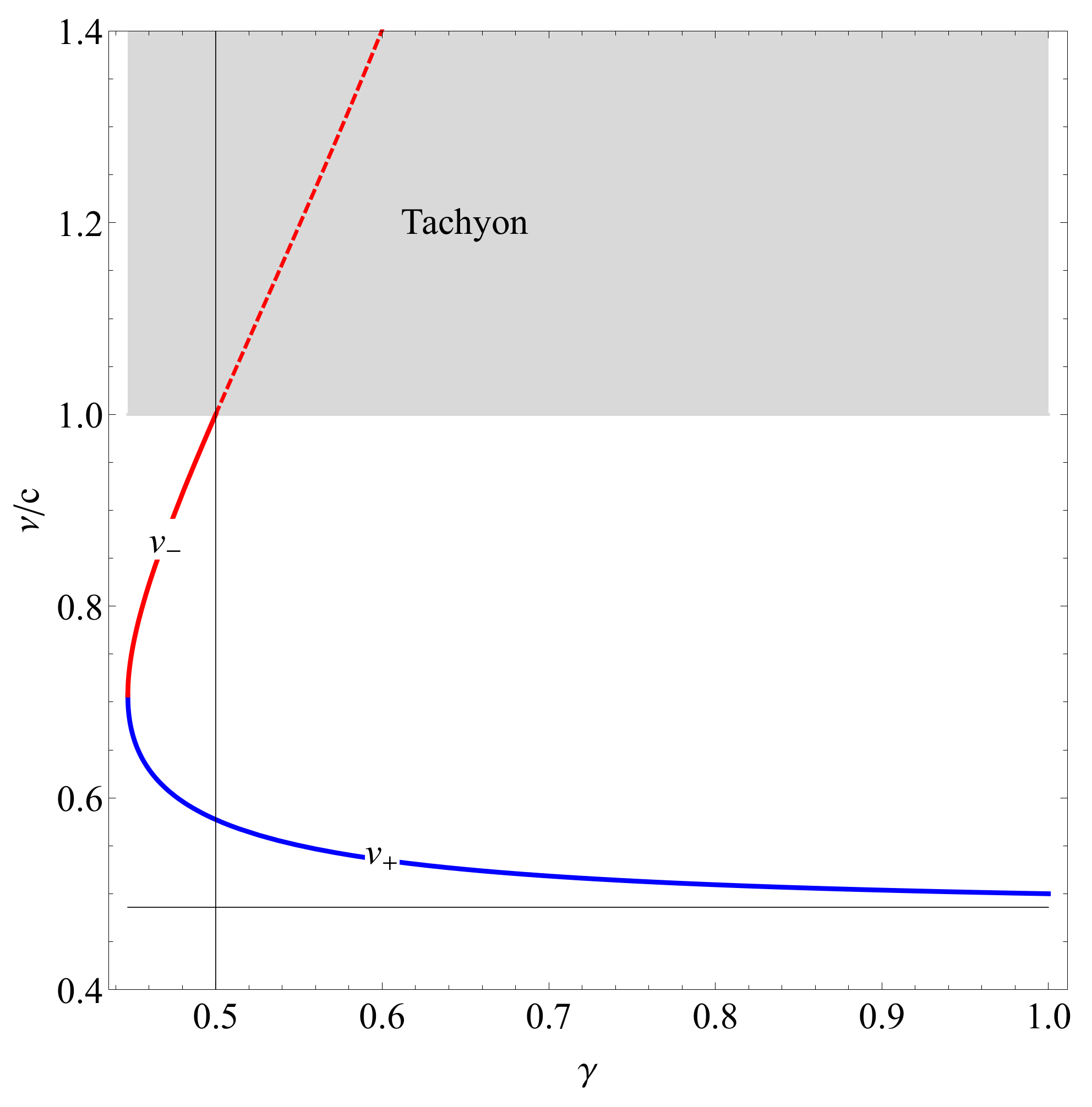
Our analyses show that there is no problem with the velocity of particle at the positive ISCO, , for any value of the parameter. However, at negative ISCO, it even might be greater than the speed of light for the specific values of the parameter. Figure 1 shows the dependence of the orbital velocity of the particle, , at the ISCO positions from the parameter. One can see that the maximum value for the velocity at the positive ISCO is for , while for the large value of the parameter, it will be . Interestingly, as we see from Figure 1, the velocity of particle at the negative ISCO may reach the speed of light, i.e., at , while it is greater than the speed of light for that leads to causality problem. Here, one might conclude that there is a tool/mechanism for the possible generation of tachyon which is a purely hypothetical particle with the superluminal velocity being greater than the speed of light. However, one has to keep in mind that tachyon might exist only beyond the physical singularity i.e. inside the singularity, and is consequently invisible for an observer.
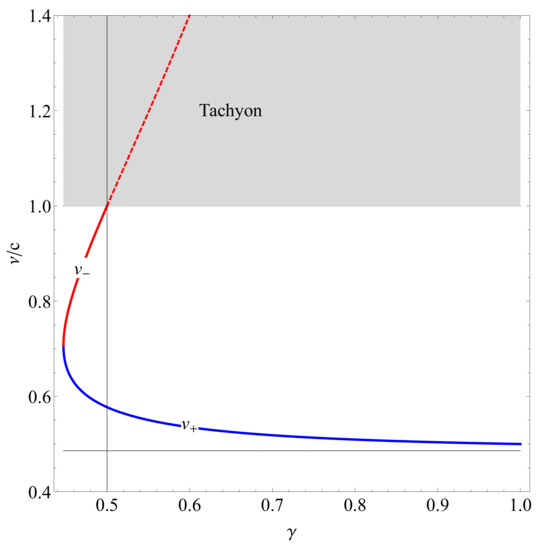
Figure 1.
The orbital velocity of particle at the closest stable orbit as functions of the parameter.
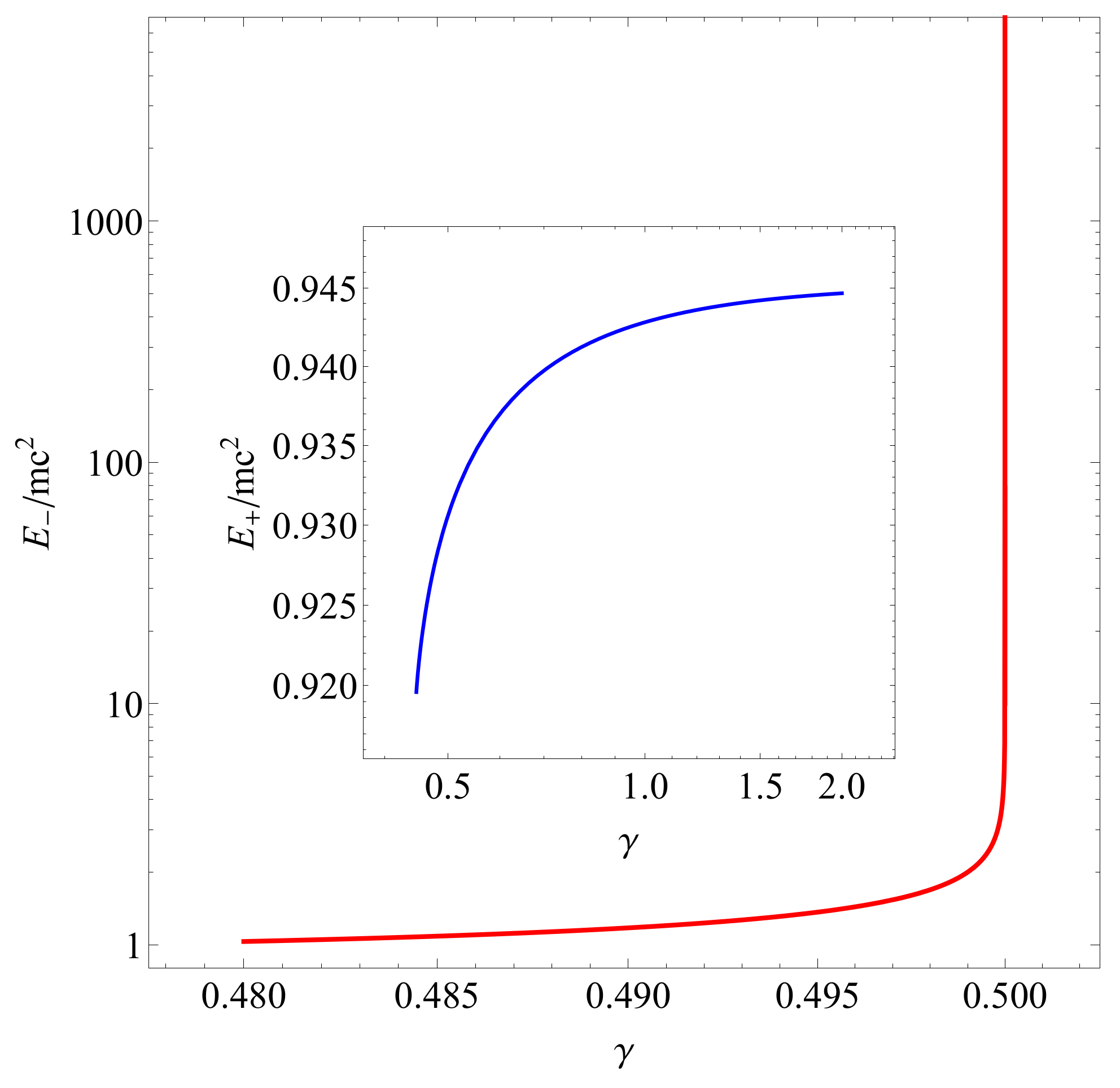
A similar situation can happen with the energy of particle . Figure 2 illustrates the dependence of the particle’s energy at the ISCO position from the parameter. The analyses show that the positive solution of the energy of particle is always finite for any value of the parameter. For , the energy of particle at the positive ISCO will be , however, at the negative ISCO, i.e., , it tends to infinity for or
while in this case, the particle’s velocity tends to the speed of light. If one slightly increases the parameter from the value of then the energy of particle will be imaginary with which produces a causality problem (corresponds to tachyon). To compare the results we also present the energy as well as velocity of particle in the Schwarzschild and extreme Reissner-Nordström (RN) spacetimes. The obtained results are listed in Table 1.
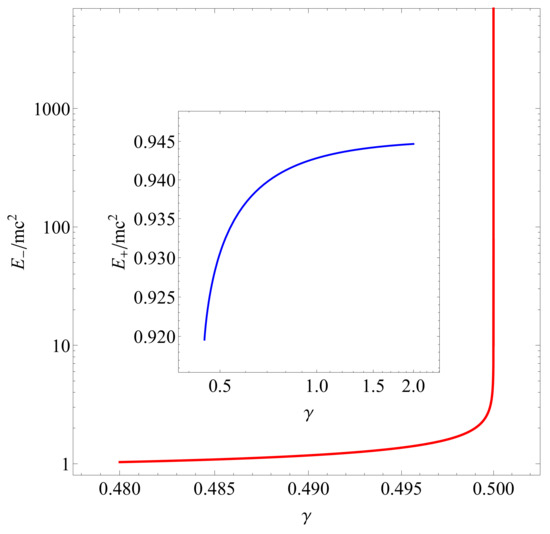
Figure 2.
The total energy of particle at the ISCO position as functions of the parameter.

Table 1.
The orbital velocity and energy of test particles orbiting at the ISCO position around the central objects described by the Schwarzschild, extreme Reissner-Nordström RN and -metric.
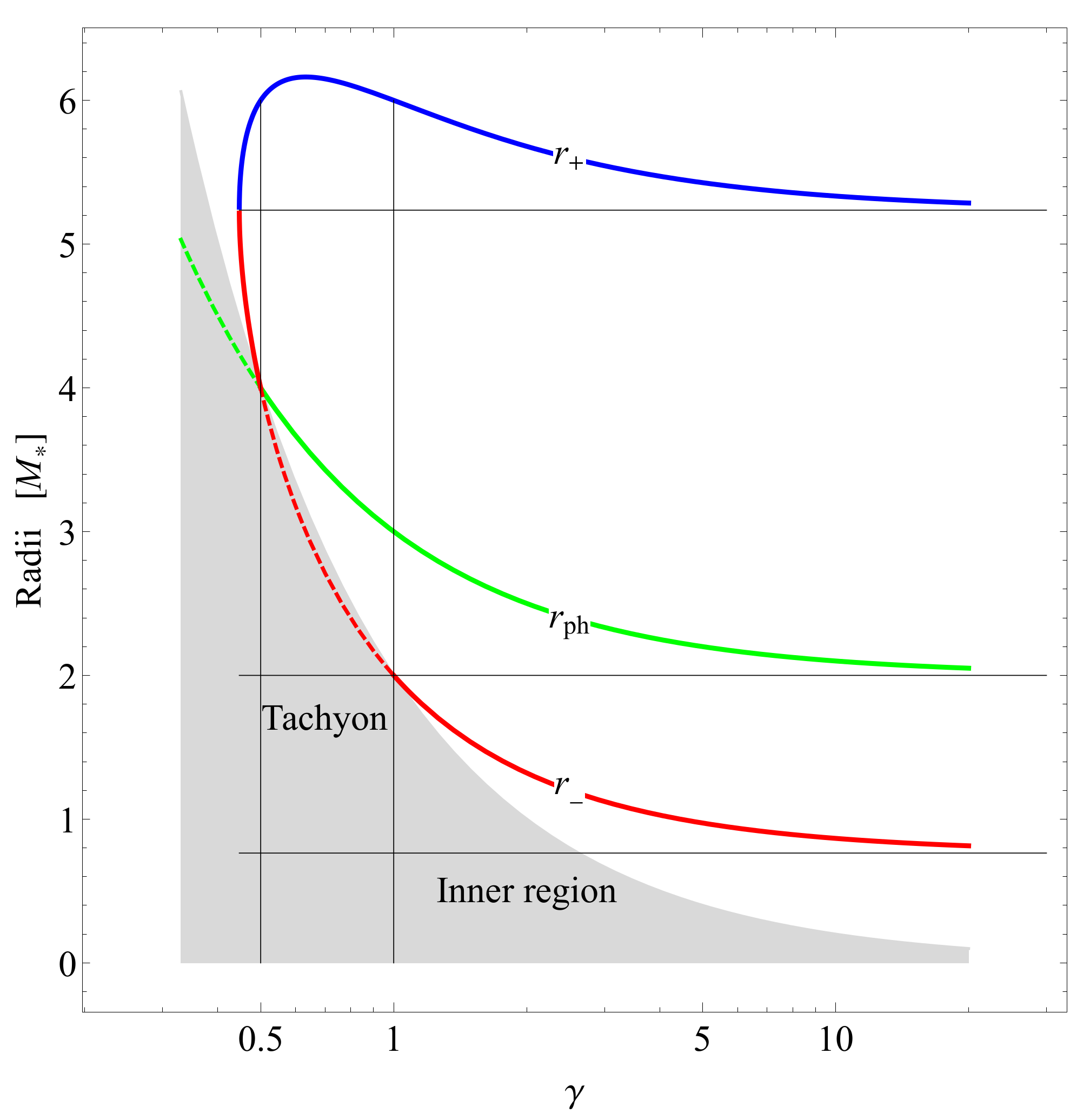
As we mentioned before the dependence of the characteristic radii from the parameter has been discussed by the number of authors [27,28,29]. However, there are still open questions on the behavior of the characteristic radii, in particular, when the value of the parameter is around . Here, one can clearly answer this question. The asymptotic behaviours of characteristic radii in (12) and (13) reads
Figure 3 illustrates the dependence of the characteristic radii from the parameter. As one can see from the figure that the positive ISCO position is well defined for any value of parameter, while the negative ISCO disappears in the range of the parameter and lies in the inner region of the singularity, and for , it again appears with the lower values than the position of the photonsphere. As we have already found that the orbital velocity at the photon-sphere is equal to the speed of light. From Figure 3, one can see that is the critical point for all radii and below this value, the photon-sphere disappears while above this value the ISCO position disappears. Test particle with a velocity greater than the speed of light might exist at the inner region of the singularity. Finally, one can conclude that the ISCO position is responsible for a relativistic particle for and for tachyon at which is invisible for the observer.
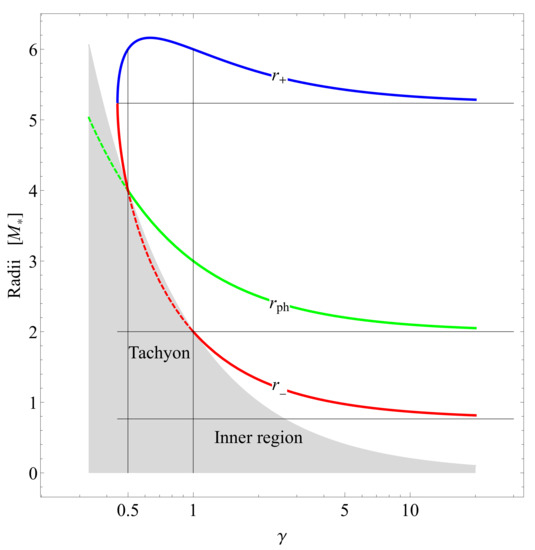
Figure 3.
Dependence of the characteristic radii, namely, ISCO, photonsphere and singularity of the spacetime from the parameter.
It is worth noting that the structure of the -metric is very similar to the well-known Janis-Newman-Winnicour (JNW) spacetime, in particular, at an equatorial plane they are identical. However, in the case of the JNW metric, the parameter arises due to the massless-scalar field. The performed calculations will be the same in this metric. That is why we also easily can follow our approach and apply it to JNW spacetime.
4. Summary
In the present research note, we have derived the explicit expression for the orbital velocity of test particle in arbitrary spacetime. The classical expression for the energy of relativistic particle has been derived in the frame of general relativity.
It is shown that the orbital velocity of massless particle (photon) is equal to the speed of light in arbitrary spacetime. We underline that test particle orbits at the ISCO position around the gravitational object with relativistic velocity, in particular, with half of the speed of light, i.e., around the Schwarzschild black hole, while with around the maximally charged black hole (the extreme RN spacetime).
It is investigated that particle may orbit around the gravitational compact object described by the -metric with the velocity of at the positive ISCO position shown in Equation (12), even it can orbit with a velocity greater than the speed of light at the negative ISCO position that might be an additional tool for explaining the existence of tachyon interior region of the singularity.
It is also shown that the energy of particle in the spacetime of -metric is finite at the positive ISCO position, while it is extremely high at the negative ISCO position (i.e., ) when . That is why one can conclude that the gravitational object described by -metric might be the source of the high-energy relativistic particles.
Author Contributions
Conceptualization, B.T. and B.A.; methodology, B.T.; software, B.T.; validation, B.A.; formal analysis, B.A.; investigation, B.T.; writing—original draft preparation, B.T.; writing—review and editing, B.T. and B.A.; visualization, B.T.; supervision, B.A. Both authors have read and agreed to the published version of the manuscript.
Funding
This research was funded by the Abdus Salam International Centre for Theoretical Physics under the Grant No. OEA-NT-01.
Institutional Review Board Statement
Not applicable.
Informed Consent Statement
Not applicable.
Data Availability Statement
No data available in this article.
Acknowledgments
This work was supported by the internal grant SGS/12/2019 of SU, Czech Republic and by Grants of Uzbekistan Ministry for Innovative Development.
Conflicts of Interest
The authors declare no conflict of interest.
Abbreviations
The following abbreviations are used in this manuscript:
| GR | General Relativity |
| ISCO | Innermost stable circular orbit |
| RN | Reissner-Nordström |
| JNW | Janis-Newman-Winnicour |
References
- Penrose, R. Gravitational Collapse: The Role of General Relativity. Nuovo Cim. Riv. Ser. 1969, 1, 252. [Google Scholar]
- Blandford, R.D.; Znajek, R.L. Electromagnetic extraction of energy from Kerr black holes. Mon. Not. R. Astron. Soc. 1977, 179, 433–456. [Google Scholar] [CrossRef]
- Bañados, M.; Silk, J.; West, S.M. Kerr Black Holes as Particle Accelerators to Arbitrarily High Energy. Phys. Rev. D 2009, 103, 111102. [Google Scholar] [CrossRef] [PubMed] [Green Version]
- Wagh, S.M.; Dhurandhar, S.V.; Dadhich, N. Revival of the Penrose Process for Astrophysical Applications. Astrphys. J. 1985, 290, 12. [Google Scholar] [CrossRef]
- Dadhich, N.; Tursunov, A.; Ahmedov, B.; Stuchlík, Z. The distinguishing signature of magnetic Penrose process. Mon. Not. R. Astron. Soc. 2018, 478, L89–L94. [Google Scholar] [CrossRef] [Green Version]
- Tursunov, A.; Stuchlík, Z.; Kološ, M.; Dadhich, N.; Ahmedov, B. Supermassive Black Holes as Possible Sources of Ultrahigh-energy Cosmic Rays. Astrophys. J. 2020, 895, 14. [Google Scholar] [CrossRef]
- Tursunov, A.; Zajaček, M.; Eckart, A.; Kološ, M.; Britzen, S.; Stuchlík, Z.; Czerny, B.; Karas, V. Effect of Electromagnetic Interaction on Galactic Center Flare Components. Astrophys. J. 2020, 897, 99. [Google Scholar] [CrossRef]
- Kološ, M.; Tursunov, A.; Stuchlík, Z. Radiative Penrose process: Energy gain by a single radiating charged particle in the ergosphere of rotating black hole. Phys. Rev. D 2021, 103, 024021. [Google Scholar] [CrossRef]
- Patil, M.; Joshi, P.S. Ultrahigh energy particle collisions in a regular spacetime without black holes or naked singularities. Phys. Rev. D 2012, 86, 044040. [Google Scholar] [CrossRef] [Green Version]
- Chowdhury, A.N.; Patil, M.; Malafarina, D.; Joshi, P.S. Circular geodesics and accretion disks in the Janis-Newman-Winicour and gamma metric spacetimes. Phys. Rev. D 2012, 85, 104031. [Google Scholar] [CrossRef] [Green Version]
- Zipoy, D.M. Topology of Some Spheroidal Metrics. J. Math. Phys. 1966, 7, 1137–1143. [Google Scholar] [CrossRef]
- Voorhees, B.H. Static Axially Symmetric Gravitational Fields. Phys. Rev. D 1970, 2, 2119–2122. [Google Scholar] [CrossRef]
- Toktarbay, S.; Quevedo, H. A stationary q-metric. Gravit. Cosmol. 2014, 20, 252–254. [Google Scholar] [CrossRef]
- Quevedo, H.; Toktarbay, S. Generating static perfect-fluid solutions of Einstein’s equations. J. Math. Phys. 2015, 56, 052502. [Google Scholar] [CrossRef] [Green Version]
- Boshkayev, K.; Gasperín, E.; Gutiérrez-Piñeres, A.C.; Quevedo, H.; Toktarbay, S. Motion of test particles in the field of a naked singularity. Phys. Rev. D 2016, 93, 024024. [Google Scholar] [CrossRef] [Green Version]
- Frutos-Alfaro, F.; Quevedo, H.; Sanchez, P.A. Comparison of vacuum static quadrupolar metrics. R. Soc. Open Sci. 2018, 5, 170826. [Google Scholar] [CrossRef] [PubMed] [Green Version]
- Arrieta-Villamizar, J.A.; Velásquez-Cadavid, J.M.; Pimentel, O.M.; Lora-Clavijo, F.D.; Gutiérrez-Piñeres, A.C. Shadows around the q-metric. Class. Quantum Gravity 2021, 38, 015008. [Google Scholar] [CrossRef]
- Turimov, B.; Ahmedov, B.; Kološ, M.; Stuchlík, Z. Axially symmetric and static solutions of Einstein equations with self-gravitating scalar field. Phys. Red. D 2018, 98, 084039. [Google Scholar] [CrossRef] [Green Version]
- Weyl, H. Zur Gravitationstheorie. Ann. Phys. 1917, 359, 117–145. [Google Scholar] [CrossRef]
- Weyl, H. Bemerkung über die axialsymmetrischen Lösungen der Einsteinschen Gravitationsgleichungen. Ann. Phys. 1919, 364, 185–188. [Google Scholar] [CrossRef] [Green Version]
- Weyl, H. Ausbreitung elektromagnetischer Wellen über einem ebenen Leiter. Ann. Phys. 1919, 365, 481–500. [Google Scholar] [CrossRef] [Green Version]
- Shaikh, R.; Paul, S.; Banerjee, P.; Sarkar, T. Shadows and thin accretion disk images of the γ-metric. arXiv 2021, arXiv:2105.12057. [Google Scholar]
- Boshkayev, K.; Konysbayev, T.; Kurmanov, E.; Luongo, O.; Malafarina, D.; Quevedo, H. Luminosity of accretion disks in compact objects with quadrupole. arXiv 2021, arXiv:2106.04932. [Google Scholar]
- Abdikamalov, A.B.; Abdujabbarov, A.A.; Ayzenberg, D.; Malafarina, D.; Bambi, C.; Ahmedov, B. Black hole mimicker hiding in the shadow: Optical properties of the γ metric. Phys. Rev. D 2019, 100, 024014. [Google Scholar] [CrossRef] [Green Version]
- Gal’tsov, D.V.; Kobialko, K.V. Photon trapping in static axially symmetric spacetime. Phys. Rev. D 2019, 100, 104005. [Google Scholar] [CrossRef] [Green Version]
- Herrera, L.; Paiva, F.M.; Santos, N.O.; Ferrari, V. Geodesics in the γ Spacetime. Int. J. Mod. Phys. D 2000, 9, 649–659. [Google Scholar] [CrossRef]
- Toshmatov, B.; Malafarina, D. Spinning test particles in the γ spacetime. Phys. Rev. D 2019, 100, 104052. [Google Scholar] [CrossRef] [Green Version]
- Benavides-Gallego, C.A.; Abdujabbarov, A.; Malafarina, D.; Ahmedov, B.; Bambi, C. Charged particle motion and electromagnetic field in γ spacetime. Phys. Rev. D 2019, 99, 044012. [Google Scholar] [CrossRef] [Green Version]
- Benavides-Gallego, C.A.; Abdujabbarov, A.; Malafarina, D.; Bambi, C. Quasiharmonic oscillations of charged particles in static axially symmetric space-times immersed in a uniform magnetic field. Phys. Rev. D 2020, 101, 124024. [Google Scholar] [CrossRef]
- Landau, L.D.; Lifshitz, E.M. The Classical Theory of Fields, Course of Theoretical Physics, Volume 2; Elsevier Butterworth-Heinemann: Oxford, UK, 2004. [Google Scholar]
- Misner, C.W.; Thorne, K.S.; Wheeler, J.A. Gravitation; W. H. Freeman: San Francisco, CA, USA, 1973. [Google Scholar]
- Frolov, V.P.; Novikov, I.D. Black Hole Physics, Basic Concepts and New Developments; Kluwer Academic Publishers: Dordrecth, The Netherlands, 1998. [Google Scholar]
- Turimov, B.; Rayimbaev, J.; Abdujabbarov, A.; Ahmedov, B.; Stuchlík, Z. Test particle motion around a black hole in Einstein-Maxwell-scalar theory. Phys. Rev. D 2020, 102, 064052. [Google Scholar] [CrossRef]
Publisher’s Note: MDPI stays neutral with regard to jurisdictional claims in published maps and institutional affiliations. |
© 2021 by the authors. Licensee MDPI, Basel, Switzerland. This article is an open access article distributed under the terms and conditions of the Creative Commons Attribution (CC BY) license (https://creativecommons.org/licenses/by/4.0/).