


Abstract
We describe a method of determining three-body and four-body Laplace-like phase angles with the potential to librate about a mean value in multiplanet extrasolar systems. Unlike in past searches of N-body results, this method relies on global mean-motion resonances (MMRs) and takes into consideration the location of the most massive planet that defines the 1:1 global MMR in each (sub)system. We compiled lists of potentially librating phase angles and prevalent MMRs in 35 real multibody systems, and we discuss their properties in conjunction with recent investigations of librations discovered in sophisticated N-body simulations. We hope that our results will facilitate systematic libration searches in dynamical models of compact systems with three or more orbiting bodies.
1. Introduction and Motivation
1.1. Mean-Motion Resonances and Phase Angles
The discovery of librating kinematic phase angles in N-body dynamical multiplanet simulations is based on in-depth analyses of the local1 mean-motion resonances (MMRs) between adjacent planets, the classical Laplace resonance (LR), and some guesswork of experimental higher-order variations of the LR [1,2,3,4,5,6,7,8,9,10,11]. Kinematic searches in vast N-body output data would have been much more difficult were it not for these few guiding principles.
Be that as it may, most libration searches in N-body models have not been systematic, and some unwarranted modifications/omissions of potentially librating angles could not, thus, be avoided. On many occasions, common factors were dropped from three-body phases, causing distortions to libration centers and confusion between comparisons (e.g., Refs. [2,3,10,12,13,14,15]); whereas in other cases, the angles were kept intact either by design [8] or because they did not have any common factors to be dropped (e.g., Refs. [5,6,9]).
In the few studies of four-body MMR chains, one of the two phases either was not detected (e.g., Kepler-223 [3]), or it was discovered and was given a geometric rather than a dynamical interpretation (e.g., the four Galilean satellites [16]). To remedy the situation, we also developed four-body Laplace-like2 phase angles in a systematic way, and we describe their properties and some typical case studies in an Appendix to the paper.
1.2. The Librating Phase Angle of Kepler-60
A case in point of interest in this work is the remarkable discovery of Goździewski et al. [2] (decidedly confirmed by Jontof-Hutter et al. [7]) that a peculiar combination of mean longitudes librate about 45° with an amplitude of ±10° in Kepler-60, viz.
where subscripts describe the orbits of planets b-c-d in order from the star. This result was widely misinterpreted: angle does not correspond to a triple MMR of any kind or order; thus, 45° is not the center of libration in Kepler-60 ([18], hereafter Paper I). We determined that the actual mean libration phase angle is , and it is, thus, centered at 180° (as listed in Table 1 and Table 2 below; see also the librations near ∼180° in the general-purpose models of Siegel and Fabrycky [8], hereafter SF21); a familiar center that relates to past studies of the classical Galilean LR [19] in which the Laplace phase angle
also librates about 180° with an amplitude of 0.06423° ± 0.00224° [20,21].
Table 1.
Observed global MMRs, local resonant pairs, and their Laplace-like phase angles.
Table 2.
Librating and circulating phase angles in first-order MMRs based on the findings of SF21.
1.3. Outline
We describe in Section 2 a method of determining resonant Laplace-like angles in N-body models of planetary systems that contain three planets, and we extend the method to four-body systems in the Appendix, where we also revisit the global MMR chains of HD 110067 and Kepler-223.
Then, we demonstrate and discuss our three-body results in Section 3, where we examine 35 observed multibody (sub)systems, including a Galilean chain featuring Callisto and our Earth’s local chain with the inferior planets, and we collect our determinations of Laplace-like phases in (the heavily annotated) Table 1 and Table 2.
Finally, we provide an extensive summary of our most distinct conclusions in Section 4. We believe that these results, as well as the many cross-comparisons described in the notes to the tables, will prove helpful to future research.
2. Method for Phase Angles in Triple Subsystems
For local resonant pairs of any order, ::p, where the orbital periods , index , and index , respectively, two of the commensurability relations between the mean longitudes (e.g., Ref. [37]) are
where is the longitude of the pericenter of the middle planet orbiting at radial location .
Angle can be introduced in both equations because the orbit is the only one that participates in both local MMRs. This does not imply that the local angles and describe genuine resonances even when they may be locked individually in librations. This point was first discovered in experiments [2,38], and then it was proven formally by Lari and Saillenfest [39] whose Hamiltonian formalism [40] showed that only LRs are true MMRs in three-body systems; because, unlike the individual two-body MMRs, their phase-space trajectories are bounded (thus, isolated and protected) by separatrices. It is for these reasons that we adopted the distinction of multibody MMRs into double/local and pure/global [2] and we do not require librating phases in the definition of MMR chains of three or more bodies (see also Paper I and the recent Hamiltonian-based simulations of triple systems by Wang et al. [41]).
By eliminating between Equation (3), we obtain the global phase angle of the triple, viz.
where and (for ), or and (for ). In the special case of a first-order resonant pair [17], then leading to and (see Paper I).
Equation (4) also represents the zeroth-order form of the ‘generalized resonance equation’ (e.g., Equation (15) in Ref. [5], with the additional order of the ‘three-planet MMR’ set to zero). It constitutes the main Laplace-like MMR relation that we used to compile Table 1. We discuss the properties of the tabulated phase angles in Section 3 and in the detailed remarks appended to Table 2 below.
3. Applications and Discussion
3.1. Table 1
Table 1 shows potentially librating resonances found in 35 (extra)solar subsystems. The list includes established LRs (phases ), the recently discovered Laplace-like MMRs (phases and the additional phases marked by asterisks), and the Earth’s secondary MMRs (not involving Jupiter) in our inner solar system (denoted by MVE and VET).
The observed MMRs are listed in column 1; they were used to obtain the corresponding local MMR pairs listed in column 2. The overall orders of the MMR pairs according to the classification scheme of Celletti et al. [17] are listed next in column 3, followed by the derived phase angles and the names of the (sub)systems in which these MMRs were found (columns 4 and 5, respectively).
The notes to Table 1 include many cross-comparisons with a number of numerical N-body models that have tracked the corresponding MMRs for librations [2,5,8,17].
3.2. Table 2
Table 2 is distilled from Table 1; it highlights librating and circulating Laplace-like angles of first-order global MMRs, as these were determined in the extensive numerical study of SF21. A number of remarks appended to Table 2 include detailed comparisons between these cases and an analysis of particular angular terms that are likely to signal libration or circulation of the overall phase angles. The overall phase angles are written without simplifying common factors, so when two distinct MMRs are subject to the same Laplace-like phase, our identification is precise (see items (d) and (f) in Section 3.3 below).
The commonly appearing angular phase terms are summarized in Section 3.3 (e) below. Furthermore, overlapping LRs and Laplace-like MMRs in first-order four-body (sub)systems are explored in the Appendix.
3.3. General Properties
Considering the phase angles and their host systems listed in Table 1 and Table 2, we deduce the following general properties and characteristics:
(a) As noted in Section 1, angle is not the center of libration in any real system, but some even multiples may be librating (based on the results of SF21); as in TOI-270 (; Paper I) and Kepler-60 (; Paper I and Ref. [2]), but not in TOI-1136 (; 30 circulating models were presented in SF21). Furthermore, TRAPPIST-1 can be used to determine whether some odd multiples of , such as , may be resonating too (the same configuration appears also in TOI-1136, HIP 41378, and Kepler-223). For this angle, as well as for (Kepler-11, K2-138, HD 110067, TRAPPIST-1 d-e-f MMR recast), the results obtained by SF21 (rows 7, 9 in Table 2) are affirmative.
(b) The 1::2 global MMR of HD 110067 [35] was recently shown to be a Laplace-like resonance with a phase angle of (Paper I). The factor of 2 might point to librations about 0°, although this is clearly not confirmed by the models of SF21 showing libration centers close to 180° (162° and 198°). Thus, new N-body models tailored to the particular configuration of planet masses in HD 110067 are needed to explore this issue further. For the time being, it is interesting to note that this Laplace angle (without the factor of 2), albeit embedded in a Laplace-like MMR, would seem to librate near ∼90° according to the SF21 models of the (3:2 and 4:3) MMR pair (row 3 in Table 2); this is in contrast to the classical cases with libration centers of 0° or 180° [20,42].
(c) Several exosystems with six or more planets (Kepler-90, HD 110067, TOI-1136, HIP 41378, and TRAPPIST-1) show additional three-body and four-body MMR chains that should be investigated again for locked librations of type II (‘pure’ three-body MMRs) according to the classification scheme established by Goździewski et al. [2] (also used in the paired MMR study of Charalambous et al. [5]). The two overlapping MMR triples found in HD 110067 [35] are discussed in the notes to Table 2 (item 4) and in more depth in Appendix A.
(d) We included in Table 1 the global MMR :1: that was not found in any real system. On the other hand, SF21 found that the associated local MMR pair (4:3 and 5:4) has a libration center of 180° (row 11 in Table 2). We think that this MMR chain is suppressed in real systems in favor of a nearly superimposed chain: although unusual, the geometric MMR chain ::1 likely appears in Kepler-444 [43,44]. The corresponding local MMR pair (5:4 and 5:4) also librates about 180° in the 30 N-body models of SF21. The librating phase is , the same as that of the mixed-order MMR pair (3:2 and 5:3) in HD 23472 (Table 1). Thus, we expect a librating phase to be found in HD 23472 as well (planets f-b-c [45]).
We also expect that relatively few such degeneracies will be found in phases of three-body systems because quite a few prerequisites are needed to establish an identical phase angle. For the case at hand (5:4 and 5:4 and 3:2 and 5:3), one has to adopt the conditions and , respectively, to derive , , and from an underdetermined system of two Diophantine equations with eight unknowns that is finally reduced to the 2 × 3 Diophantine system .
(e) A widespread characteristic of the angles in Table 1 is the succinct appearance of the differences of adjacent mean longitudes and , so that we can write
and
The appearance of only or along with in a phase angle has some notable consequences going forward:
- (i)
- The corresponding local MMR (1-2 or 3-2, leading or trailing) may determine whether the overall phase will librate or not. In cases of librations (e.g., Kepler-32, Kepler-82 in row 10 of Table 2), the other local MMR determines only the type (I or II) of the global MMR [2];
- (ii)
- (iii)
- This scenario also signifies that the same global MMR may or may not be librating in individual systems, as the incorporated -difference may or may not be locked in local resonance. The location of the most massive planet (i.e., the 1:1 orbit) in the MMR chain, as well as perturbations from neighboring planets outside of the resonance, may play an important role in determining the outcome of early dynamical evolution;
- (iv)
- The angles of five mostly mixed-order MMRs at the bottom half of Table 1 (HD 40307, PSR B1257+12, Kepler-90, VET, RTH) combine even multiples of with either or . If the terms could possibly be set aside for a moment, then the librations of angles would be determined solely by the single local -pair present in the phase angle. If the presumption in item (ii) holds for mixed/high-order MMRs as well, then the (5:3 and 8:5) MMR in Kepler-90 f-g-h and the (8:5 and 8:5) VET MMR that depend on should show circulating phases. Some local MMRs of mixed order (but not quite those listed in Table 1) have been studied numerically in the recent past (see, e.g., Refs. [5,6,17,30,42]);
- (v)
(f) In the Galilean satellite subsystem, the EGC resonant angle does not librate (Table 1). This result was demonstrated to us by a reviewer, and it is also implicit in the synthetic orbital elements obtained by Lainey et al. [38] using L1 ephemerides. Thus, Callisto is not locked on to the main Galilean LR. The corresponding circulating phase angle is , where subscripts 2, 3, 4 correspond to E, G, C, respectively. This angle is equivalent to that of the global first-order MMR :1: (built from the local pair of 5:4 and 7:6 MMRs3). This global resonance was not found in any of the 50 systems that we studied. Specifically, the leading 4:5 MMR may be an important component of the MMR in Kepler-60 (see row 8 in Table 2 and Paper I), but a trailing 7:6 MMR has never been seen in any real system (see also item (g) below and Appendix B.2).
Despite being out of phase, the oscillations of the orbit of Callisto do, however, have implications for spin-orbit coupling in the Galilean moons and the rotational librations of their spin axes which, in turn, are needed in studies of the oceanic content beneath their icy surfaces [48,49,50].
(g) Trailing MMRs, such as 7:6, 6:5, and 5:4, do not occur in the observed (exo)systems (items (d) and (f) above); they are described by those period ratios :p with . On the other hand, MMRs with are quite common in Table 1. In this category, a well-known example is the 4:3 RTH MMR involving the tiny pumice-moon Hyperion [51] orbiting right next to giant moon Titan (occupying the 1:1 MMR in the :1: global chain), the second most massive moon in our solar system; their semimajor axes scale as [34]. The nearest scale among the (unrealized) semimajor axes is, by Kepler’s third law, for . Thus, in general, trailing orbits do not occur as they are not permitted to maintain stability so close to the most massive (1:1) body.
In the case of Saturn’s Titan (where masses and semimajor axes are available), we confirm the unrealized () orbits and the tolerated () orbits, but the approximation fails marginally for the intermediate case of Hyperion’s 4:3 MMR (): Titan’s Landau wavelength is , where is the semimajor axis of the orbit of Titan (Paper I and Ref. [52]); then, the ‘screening’ (or Debye) belt of tidal dominance of Titan extends to radii
i.e., a little past Hyperion’s orbit (; a relative mismatch of 4%), although clearly shorter than the (vacant) orbits of the 3:2 and 2:1 trailing MMRs (with semimajor axes of and , respectively). Thus, a moon orbiting at the 3:2 global MMR of Titan would not have been a surprise (and the vacant 2:1 MMR is not a surprise), unlike the startling 4:3 orbit of tiny Hyperion.
4. Summary and Conclusions
With help from the listings and the notes compiled in the tables, we briefly summarize our most distinct conclusions. Row numbers refer to the rows of Table 2:
1. We found no global MMRs of the LR form 1:2:4 with the most massive planet occupying radial position , where (rows 1, 2, and Paper I). It is conceivable that such LRs may not form in multibody (sub)systems at all;
2. Laplace-like MMRs whose phase angles are integer multiples of the classical Laplace phase (Equation (2)) are apparently locked in librations centered in the neighborhood of φ = 180°, never near 0° (rows 3–5, 14). The same property seems to hold for linear combinations of and the angle defined in Equation (1) (rows 9–11, and also row 15 but with its libration center located at φ = 80°);
3. With the most massive planet defining the location of the 1:1 MMR, the 2:1 global MMR appears to be empty, except in LRs :1:2 (row 1) and Laplace-like MMRs 1:2 (row 3). The inner MMR chain listed for TOI-1136 in row 6 is not global; its global form is :: (note c in Table 1). The unobserved global 1:2 MMR chains listed in rows 12, 13 also prop up this argument;
4. From the results of SF21 and Ref. [33], all indications heretofore are that the overall phase angle of the paired MMRs (3:2 and 2:1) does not librate (row 6), but some higher multiples of do (rows 7, 8). Of the multiples, phase is the only one that can be written in terms of and only (but note also the phases of Kepler-90, HD 108236, and VET at the bottom of Table 1 showing linear combinations of and );
5. In general, the linear combinations of and likely signal librations (rows 9–11, 15), whereas the opposite is likely for the linear combinations of and (rows 6, 12–13). The former case is equivalent to combinations of and because of the relation (Equation (5)). The latter case is equivalent to combinations of and because of the relation (Equation (5) as well). We note that in rows 12, 13 of Table 2 column 4 was not filled for clarity;
6. We found no first-order local MMRs of the form :p with , just outside the principal 1:1 orbits (Section 3.3(g)). On the other hand, outer MMRs with are quite common (we counted ∼20 of them in Table 1 or in Table 2). It seems plausible that the most massive body in each (sub)system does not allow other bodies of any mass to settle into such nearby () orbits;
7. Geometric MMR sequences—Classical LRs form geometric sequences with a common ratio of . We found more geometric MMRs with smaller common ratios, as listed below. As in Paper I, the most massive planet in each system is denoted by and radial positions (n) are shown in parentheses for planets, as well as for the most massive planet in each geometric sequence:
- :
- ::1 HD 23472 e-f-b(4), [45];
- ::1 Kepler-102 c-d-e(4), [53];
- ::1: HD 110067 b-c-d(3)-e, [35];
- :1: K2-138 d-e(4)-f, [9];
- :1: Kepler-11 d-e(4)-f, [54,55];
- :1: HD 158259 e-f(5)-g, [56];
- :: TRAPPIST-1 d-e-f(5), [12];
- :: K2-384 c-d(3)-e, [57];
- :
- :2: HD 110067 e-f-g(6), [35];
- :
- ::1 Kepler-444 d-e-f(5), [43].
The overall chain of HD 110067 is of vital importance (see Appendix A and Figure A1 below). Not only does it show two adjoined geometric sequences coalescing in the middle of its exact Laplace-like resonance (1::2), but it also shows very small deviations of the orbits from the corresponding precise MMRs [35];
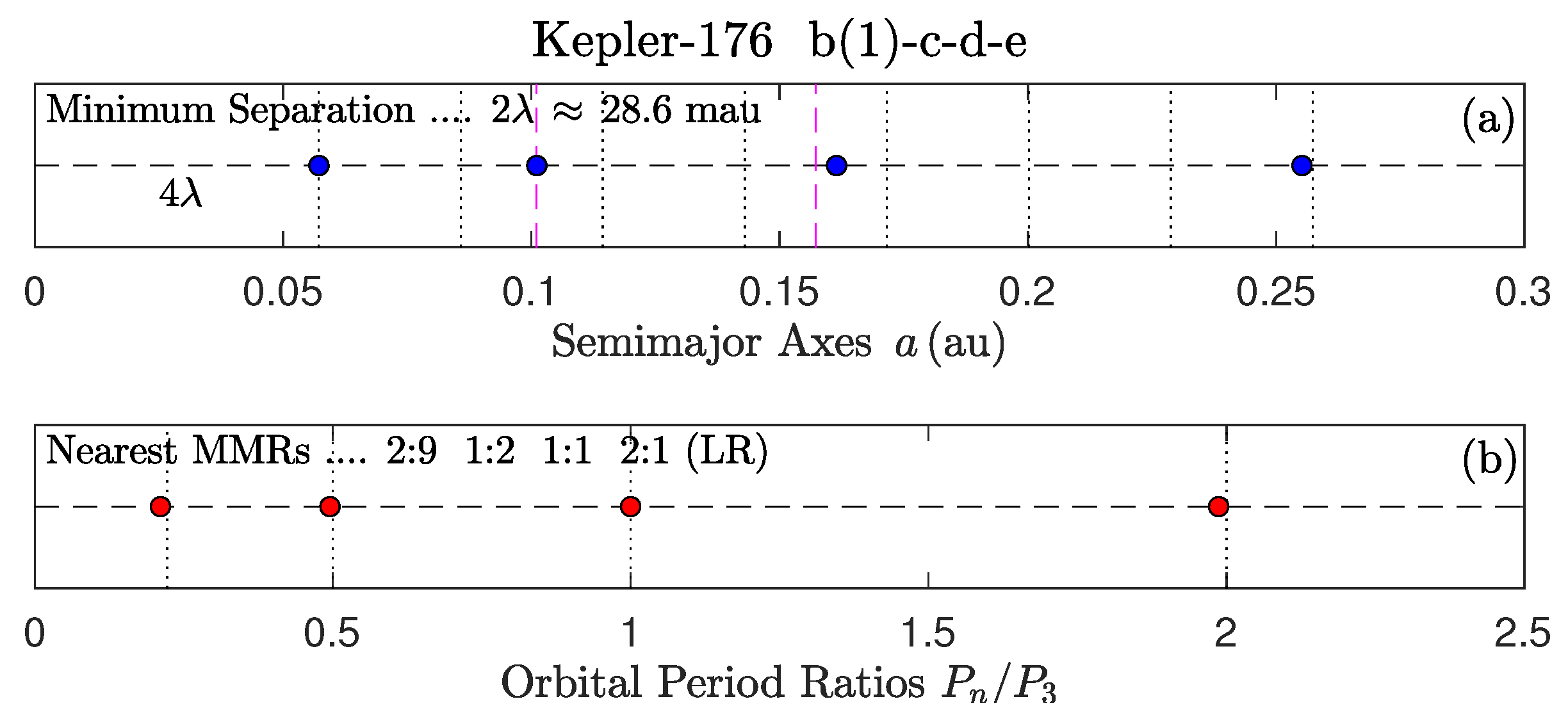
8. Overlapping LRs—Connected overlapping LRs do not exist in four-body (sub)systems (Appendix B.2). The four planets in overlapping LRs (2:1, 2:1 and 2:1) do not seem to face an issue of proximity, so their absence must be due to another dynamical cause. The cases of Callisto (7:3) and HR 8799 b (9:4) that were not allowed to join the LRs of their respective (2:1 and 2:1) inner bodies are discussed in Appendix B.2. But a far more sensational example is Kepler-176 [58] in which the innermost () and most massive planet b () in the 1:1 orbit did not join the LR of planets c-d-e. (this, however, may be due to the observation made in item 1 above). Thus, the global 2:1 MMR remains vacant in Kepler-176 as well (the adjacent MMR to the 1:1 () orbit turns out to be the familiar 7:3 MMR). The planetary system of Kepler-176 is shown in Figure 1, where we reset the 1:1 MMR to the second most massive planet d to highlight this unique LR among the 73 (sub)systems that we have studied so far;
Figure 1.
Kepler-176: (a) Distribution of semimajor axes of planets (filled blue circles) and nearest radial tidal potential minima (vertical dotted lines separated by a distance of , where mau is the wavelength of the tidal field). Equations (10) and (12) of Paper I predict that mau for planet d and mau for planet b. The vertical dashed lines split the particular intervals into equal segments. (b) Distribution of orbital period ratios of planets (filled red circles) and nearest global MMRs (vertical dotted lines). The orbits deviate from the nearby exact MMRs by ≤ 1.6%. Planet d () is the most massive within the LR ( [58]); it is taken to be orbiting at the 1:1 MMR for illustration purposes.
9. Finally, we summarize the types of high-order global MMRs that appear in actual multibody systems (Table 1):
- (a)
- We call principal resonant orbits those in the MMR set with . The principal MMRs are available for orbiting bodies to settle in safely, although the 2:1 MMR appears to be vacant (except in LRs and Laplace-like chains). High-order MMRs of this type provide shelter to orbiting bodies, especially to small distant planets, dwarf planets, and minor moons. For instance, Mercury and Pluto occupy the 1:50 and 21:1 MMRs of Jupiter, respectively, and Pan and Kiviuq occupy the 1:28 and 28:1 MMRs of Titan, respectively, in the Saturnian system;
- (b)
- Besides principal MMRs, very few rational outer MMRs :p and their reciprocal inner MMRs are common in multibody (sub)systems, and even fewer MMRs with appear scarcely. Our survey of 73 exosystems and solar subsystems is mapped out in Table 3. The scarce MMRs (, ) are enclosed in parentheses. An intriguing feature in this chart is that the MMRs commonly appear in reciprocal pairs. The three exceptional cases (4:5, 2:7, and 8:3) are also interesting in their own right;
- (c)
- Extending Table 3 out to and , we find only the 9:2 MMR in exosystems. Surprisingly, this MMR is common in systems that contain complete LRs (HIP 41378 d, HR 8799 b) or uncompleted (would-be) LRs (Kepler-48 d, Kepler-332 d). In the former case, two overlapping LRs are avoided (see also item 8 above); in the latter case, classical LRs are not assembled, and the global 2:1 MMR (that would have formed the LR) remains vacant.
Table 3.
Common global outer MMRs of the form :p and their reciprocal inner MMRs. Six scarcely appearing MMRs with and orders are enclosed in parentheses.
10. In closing the conclusions, we would like to report a much larger study of multibody systems that we conducted and that contains additional information concerning global MMRs, as well as additional dynamical properties of 68 extrasolar systems and nine solar-system subsystems [33]. The library of the 77 analyzed multibody systems was released publicly on 30 December 2024 (URL: https://doi.org/10.5281/zenodo.14577621, accessed on 24 February 2025).
Author Contributions
Conceptualization, D.M.C., S.G.T.L. and D.K.; formal analysis, D.M.C., N.M.S. and S.B.; investigation, N.M.S., S.B. and S.G.T.L.; methodology, D.M.C. and S.G.T.L.; project administration, S.G.T.L. and D.K.; resources, S.G.T.L.; software, N.M.S. and S.B.; supervision, D.K.; writing—original draft, D.M.C.; writing— review and editing, D.M.C., N.M.S., S.B., S.G.T.L. and D.K. All authors have read and agreed to the published version of the manuscript.
Funding
This work was supported in part by the Lowell Center for Space Science and Technology (LoCSST) of the University of Massachusetts Lowell and by NSF-AAG grant 2109004.
Data Availability Statement
The data used in this study are publicly available from the NASA Exoplanet Archive, URL: https://exoplanetarchive.ipac.caltech.edu/ (accessed on 10 October 2024). The reduced data sets used in this study are included in a public library of 77 multibody systems that can be downloaded from the Zenodo address: https://doi.org/10.5281/zenodo.14577621 (publicly released on 30 December 2024 and accessed last on 24 February 2025).
Acknowledgments
We thank the reviewers of this paper for constructive comments that led to improvements of the presentation.
Conflicts of Interest
The authors declare no conflicts of interest.
Abbreviations
The following abbreviations are used in this manuscript:
| EGC | Europa-Ganymede-Callisto |
| IEG | Io-Europa-Ganymede |
| LR | Laplace Resonance |
| MMR | Mean-Motion Resonance |
| MVE | Mercury-Venus-Earth |
| RTH | Rhea-Titan-Hyperion |
| SF21 | Siegel and Fabrycky (2021), Ref. [8] |
| TR-1 | TRAPPIST-1 |
| UTO | Umbriel-Titania-Oberon |
| VET | Venus-Earth-Toro |
Appendix A. Four-Planet Laplace-like Phase Angles in HD 110067
We derive the phase angles relating the mean longitudes of four adjacent orbiting bodies in the global MMR chain of HD 110067 (:1::2; see remark (4) in Table 2 and Figure A1). We use subscripts –4 for planets c-d-e-f, respectively, in increasing order from the star (not counting in the process planet b or g).
For planets c-d-e, the local MMR pair is 3:2 and 3:2; thus, and in Equation (3) give
where is the longitude of the pericenter of planet d orbiting at radial location .
For planets d-e-f, the local MMR pair is 3:2 and 4:3; thus, , , and in Equation (3) give
where is the longitude of the pericenter of planet e orbiting at radial location .
One phase angle, , is obtained from the linear combination in which and are eliminated, viz.
Another phase angle, , is obtained from the linear combination in which and are again eliminated, viz.
A striking property is detected in these four-planet angles: Their sum and difference describe overlapping triple MMR chains. In particular,
and
Figure A1.
HD 110067: (a) Distribution of semimajor axes of planets (filled blue circles) and nearest radial tidal potential minima (vertical dotted lines separated by a distance of , where mau is the wavelength of the tidal field). Equations (10) and (12) of Paper I predict that mau for planets d and e. The vertical dashed line splits the particular interval into equal segments. (b) Distribution of orbital period ratios of planets (filled red circles) and nearest global MMRs (vertical dotted lines). The orbits deviate from the nearby exact MMRs by ≤ 0.093%. Planet d () is the most massive ( [35]).
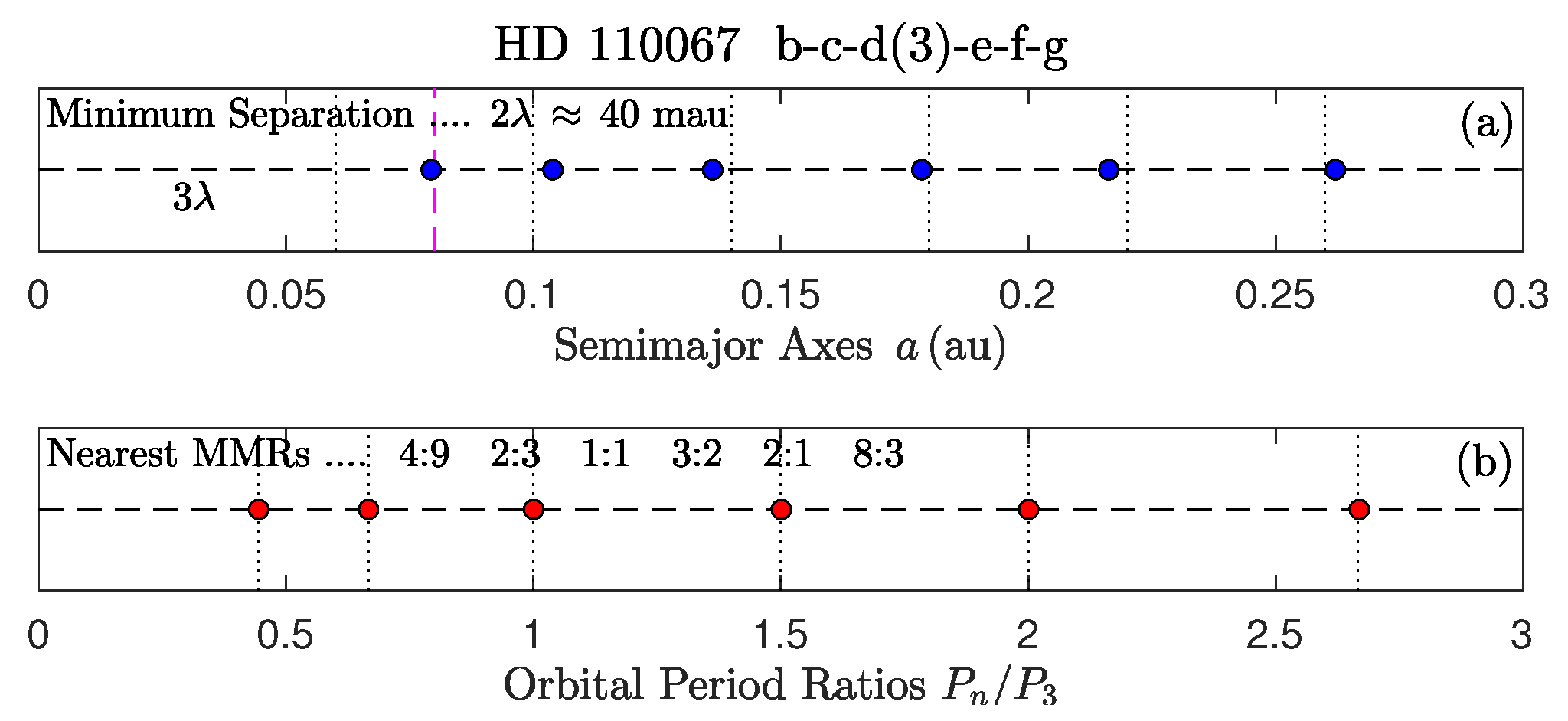
The sum and difference equations show that librations in four-body systems are connected to Laplace and Laplace-like librations in their overlapping triple MMR chains. Thus, four-body librating chains clearly resemble the shorter type-I double MMRs of Goździewski et al. [2], and there are no type-II pure MMRs in chains of four or more bodies. This conclusion makes classical LRs and Laplace-like resonances appear more prominent than previously thought.
The conclusions obtained from Equations (A5) and (A6) are valid for any overlapping triple MMRs, not only for those in HD 110067. We show this in Appendix B.1 below, where we derive the generalized equations for a chain of three consecutive local MMRs, all of the first order.
Appendix B. Overlapping First-Order Four-Body MMRs
In a chain of four orbiting bodies indexed by 1-4 radially outward, we consider three consecutive local MMRs of the first order with period ratios :, where .
Appendix B.1. Four-Body Phase Angles
For the leading pair (), Equation (3) with gives
where is the longitude of the pericenter of body 2.
Similarly, for the trailing pair () and for and , we obtain
where is the longitude of the pericenter of body 3.
One phase angle, , is obtained from the linear combination , viz.
Another phase angle, , is obtained from the linear combination , viz.
The sum and difference of and are then given by the equations
and
For in the trailing MMR, Equation (A12) then produces an exact Laplace multiple , as in Equation (A6) above. Similarly, Equation (A11) produces an exact Laplace multiple for . In the event that both the sum and the difference of the four-body angles are Laplace multiples, then both conditions hold simultaneously, and they are described by the conjunction
for integer values of (–3) and for both odd.
Appendix B.2. The Classical Double LR with rj = 1
The case with all corresponds to a chain of two overlapping classical LRs with global MMR of type 1:2:4:8, a layout that has not so far been observed (see below) and that was not permitted to occur in the Galilean satellites of Jupiter. At this point, we find it plausible that the double Laplace-like MMRs described by Equation (A13) may not exist at all, and one reason is the appearance of unconventional MMRs (6:5, 8:7, 10:9, 14:13, ⋯ for in Equation (A13)) that have also not been observed in multibody systems (see also items (f) and (g) in Section 3.3).
On the other hand, librating double LRs () have been generated in some N-body experiments of four-body configurations tailored after the four Galilean satellites [16,49] and the four planets of HR 8799 [59]. These MMRs result from specialized initial conditions and do not invalidate our presumption. In particular, the Galilean double LR is formed in some N-body models in which the classical LR migrates outward without disruption until it captures Callisto as well [16,49].
Another migration scenario unfolds in the N-body models of HR 8799 e-d-c-b, where the planets seek stability in or near a double LR; nevertheless, the best-fit strictly periodic MMR chain :1:2: turns out to display only one classical LR (planets e-d-c; Refs. [59,60], with the orbital periods calculated from Kepler’s third law).
The similarity of the observed displaced trailing MMRs of HR 8799 b (9:4) and Callisto (7:3) is compelling. Along with the dispacement of Kepler-176 b (Figure 1 and item 8 in Section 4), it certainly seems that a fully formed LR is powerful enough to prevent a fourth planet of any mass from joining in to the LR MMR chain.
Appendix B.3. Application to Kepler-223
Kepler-223 [3,10] is an exquisite resonant four-planet system with a global MMR chain ::1: (rows 7, 4 in Table 2 and note e in Table 1) that was mentioned briefly in Figure 1 of Paper I. The four-planet system of Kepler-223 b-c-d-e competes with the recently discovered six-planet HD 110067 system (Appendix A) and Kepler-60 b-c-d [2] for resonance proximity, and Kepler-223 places a close third. The pristine resonant system of Kepler-223 is shown in Figure A2.
Figure A2.
Kepler-223: (a) Distribution of semimajor axes of planets (filled blue circles) and nearest radial tidal potential minima (vertical dotted lines separated by a distance of , where mau is the wavelength of the tidal field). Equations (10) and (12) of Paper I predict that mau for planets d and e. The vertical dashed line splits the particular interval into equal segments. (b) Distribution of orbital period ratios of planets (filled red circles) and nearest global MMRs (vertical dotted lines). The orbits deviate from the nearby exact MMRs by ≤ 0.14%. Planet d () is the most massive ( [3]).
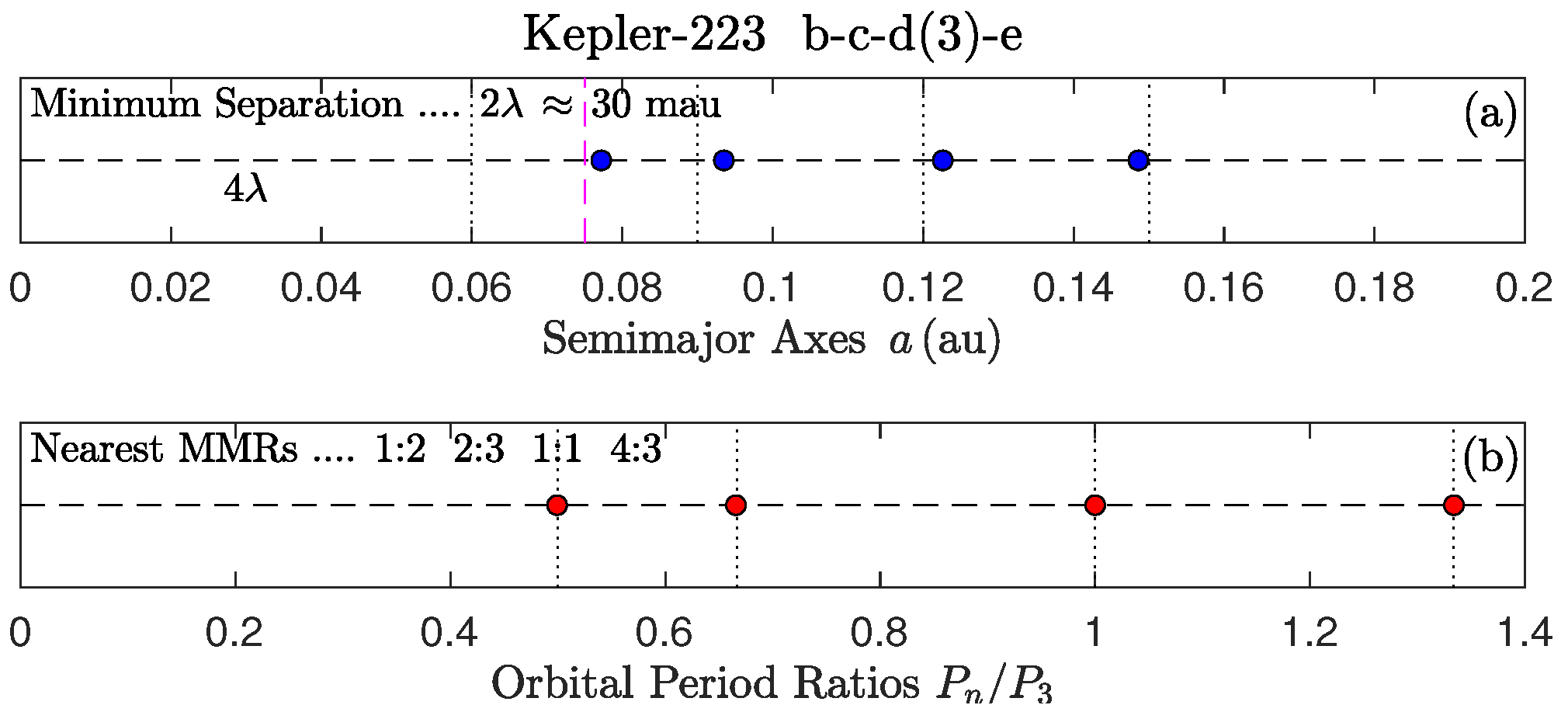
The local MMRs are 4:3, 3:2, and 4:3, all of order 1. The paired MMRs are also of the first order in the classification scheme of Celletti et al. [17]. The phase angle of the leading pair is (row 7 in Table 2), whereas the phase angle of the trailing pair is (row 3 in Table 2). The N-body models of Mills et al. [3] produced libration centers and amplitudes for reduced versions of the two overlapping triple chains; transformed to our -space, these are 175.5° ± 25.5° and 122° ± 28°, respectively. These MMR chains were also recently modeled in a Hamiltonian-based case study of triple planetary subsystems by Wang et al. [41].
Now, Equations (A9) and (A10) for produce two four-planet phase angles, viz.
and their sum and difference are
that is, twice as large as the phases of the paired MMRs given above (this is a universal scaling for all four-body phase angles irrespective of librations). According to the N-body results [3], the libration centers and amplitudes of are 351° ± 51° and 244° ± 56°, respectively.
Mills et al. [3] also monitored the four-planet phase (Equation (A14)); they measured librations about 306° ± 11° in agreement with the theoretical expectation of 297.5° ± 38° (derived from the librations of angles of the paired MMRs given above). Although they did not seem to be aware of the four-body phase (Equation (A14)), we have sufficient information from their simulations to determine the librations of as well. We recast the second of Equation (A15) in the form
and we use the libration results from the simulations [3], i.e., 306° ± 11° for and 61° ± 14° for . We determine, thus, librations of about 62° ± 57°.
Repeating the steps but using the first of Equation (A15), we find a similar result: librations of about 45° ± 52°. Actual N-body models should show a libration center near these values (45°–62°). But as Mills et al. [3] also remarked, the four-planet libration amplitudes are expected to be significantly smaller than the amplitudes of ∼50° determined above, owing to the strong coupling of the mean longitudes in Equation (A14).
Notes
| 1 | We use the term ‘local’ for MMRs between pairs of adjacent planets, such as those studied in the past. We also use the term ‘global’ for MMRs between three or more planets, such as those studied in this work. In the longest global MMR chains that include all closely packed planets (and may not include too distant planets), the most massive planet is thought to occupy the 1:1 resonant orbit because its inertia against radial excursions is the largest one. |
| 2 | As in Celletti et al. [17], we use the term ‘Laplace-like’ for some phase angles that are particular linear combinations of the mean orbital longitudes of adjacent planets. In Ref. [18], we identified three such three-body global MMRs: 1::2 (seen in HD 110067); ::1 (seen in Kepler-90, TOI-1136, and TRAPPIST-1); and :1: (seen in Kepler-223 and TOI-178). |
| 3 | Item (f) in Section 3.3: The paired MMRs are 5:4 and 7:6 and 2:1 and 7:3; the preconditions are and ; and the reduced 2 × 3 Diophantine system is with roots and . The sought-after solution is obtained by choosing . The only other solution of potential interest is obtained for , leading to the paired MMRs 3:2 and 5:4 (unrealized) and 2:1 and 5:3 (HD 40307 [46,47] in Table 1), both with the same phase . |
References
- Papaloizou, J.C.B. Three body resonances in close orbiting planetary systems: Tidal dissipation and orbital evolution. Int. J. Astrobiol. 2015, 14, 291. [Google Scholar] [CrossRef] [Scilit]
- Goździewski, K.; Migaszewski, C.; Panichi, F.; Szuszkiewicz, E. The Laplace resonance in the Kepler-60 planetary system. Mon. Not. R. Astron. Soc. Lett. 2016, 455, L104. [Google Scholar] [CrossRef] [Scilit]
- Mills, S.M.; Fabrycky, D.C.; Migaszewski, C.; Ford, E.B.; Petigura, E.; Isaacson, H. A resonant chain of four transiting, sub-Neptune planets. Nature 2016, 533, 509. [Google Scholar] [CrossRef] [Scilit] [PubMed]
- Delisle, J.B. Analytical model of multi-planetary resonant chains and constraints on migration scenarios. Astron. Astrophys. 2017, 605, A96. [Google Scholar] [CrossRef] [Scilit]
- Charalambous, C.; Martí, J.G.; Beaugé, C.; Ramos, X.S. Resonance capture and dynamics of three-planet systems. Mon. Not. R. Astron. Soc. Lett. 2018, 477, 1414. [Google Scholar] [CrossRef] [Scilit]
- Morrison, S.J.; Dawson, R.I.; MacDonald, M. Chains of planets in mean motion resonances arising from oligarchic growth. Astrophys. J. 2020, 904, 157. [Google Scholar] [CrossRef] [Scilit]
- Jontof-Hutter, D.; Ford, E.B.; Rowe, J.F.; Lissauer, J.J.; Fabrycky, D.C.; Van Laerhoven, C.; Agol, E.; Deck, K.M.; Holczer, T.; Mazeh, T. Erratum: “Secure TTV mass measurements: Ten Kepler exoplanets between 3 and 8 M⊕ with diverse densities and incident fluxes”. Astron. J. 2021, 911, 154. [Google Scholar] [CrossRef] [Scilit]
- Siegel, J.C.; Fabrycky, D. Resonant chains of exoplanets: Libration centers for three-body angles. Astron. J. 2021, 161, 290. [Google Scholar] [CrossRef] [Scilit]
- MacDonald, M.G.; Feil, L.; Quinn, T.; Rice, D. Confirming the 3:2 resonance chain of K2-138. Astron. J. 2022, 163, 162. [Google Scholar] [CrossRef] [Scilit]
- MacDonald, M.G.; Vivas, M.S.P.; D’Angiolillo, S.; Fernandez, A.N.; Quinn, T. exoMMR: A new python package to confirm and characterize mean motion resonances. Astron. J. 2023, 166, 94. [Google Scholar] [CrossRef] [Scilit]
- Quinn, T.; MacDonald, M.G. Confirming resonance in three transiting systems. Astron. J. 2023, 166, 58. [Google Scholar] [CrossRef] [Scilit]
- Luger, R.; Sestovic, M.; Kruse, E.; Grimm, S.L.; Demory, B.O.; Agol, E.; Bolmont, E.; Fabrycky, D.; Fernandes, C.S.; Grootel, V.V.; et al. A seven-planet resonant chain in TRAPPIST-1. Nat. Astron. 2017, 1, 0129. [Google Scholar] [CrossRef] [Scilit]
- Mah, J. Formation and Dynamics of the Resonant Chain in the TRAPPIST-1 Exoplanet System. Master’s Thesis, University of Hong Kong, Hong Kong, China, 2018. [Google Scholar]
- Brasser, R.; Barr, A.C.; Dobos, V. The tidal parameters of TRAPPIST-1b and c. Mon. Not. R. Astron. Soc. Lett. 2019, 487, 34. [Google Scholar] [CrossRef] [Scilit]
- Agol, E.; Dorn, C.; Grimm, S.L.; Turbet, M.; Ducrot, E.; Delrez, L.; Gillon, M.; Demory, B.; Burdanov, A.; Barkaoui, K.; et al. Refining the transit-timing and photometric analysis of TRAPPIST-1: Masses, radii, densities, dynamics, and ephemerides. Planet. Sci. J. 2021, 2, 1. [Google Scholar] [CrossRef] [Scilit]
- Lari, G.; Saillenfest, M.; Fenucci, M. The Galilean satellites’ evolution toward a 4-body mean motion resonance. In Proceedings of the EPSC-DPS Joint Meeting 2019, Geneva, Switzerland, 15–20 September 2019; Volume 13. [Google Scholar]
- Celletti, A.; Karampotsiou, E.; Lhotka, C.; Pucacco, G.; Volpi, M. Laplace-like resonances with tidal effects. Astron. Astrophys. 2021, 655, A94. [Google Scholar] [CrossRef] [Scilit]
- Christodoulou, D.M.; Sorabella, N.M.; Bhattacharya, S.; Laycock, S.G.T.; Kazanas, D.I. An Exceptional Multiplanetary Resonant Chain in TOI-270 and an Exact Laplace-like Resonance in HD 110067. Preprints 2024. Available online: https://www.preprints.org/manuscript/202410.1806/v1 (accessed on 24 February 2025). [CrossRef] [Scilit]
- Murray, C.D.; Dermott, S.F. Solar System Dynamics; Cambridge University Press: Cambridge, UK, 1999; pp. 364–371+396–399. [Google Scholar]
- Lieske, J.H. Galilean satellite ephemerides E5. Astron. Astrophys. Supl. Ser. 1998, 129, 205. [Google Scholar] [CrossRef] [Scilit]
- Musotto, S.; Varadi, F.; Moore, W.; Schubert, G. Numerical simulations of the orbits of the Galilean satellites. Astron. Astrophys. 2002, 159, 500. [Google Scholar] [CrossRef] [Scilit]
- Wolszczan, A.; Frail, D.A. A planetary system around the millisecond pulsar PSR1257+12. Nature 1992, 355, 145. [Google Scholar] [CrossRef] [Scilit]
- Konacki, M.; Wolszczan, A. Masses and orbital inclinations of planets in the PSR B1257+12 system. Astrophys. J. Lett. 2003, 591, L147. [Google Scholar] [CrossRef] [Scilit]
- Wolszczan, A. Discovery of pulsar planets. New Astron. Rev. 2012, 56, 2. [Google Scholar] [CrossRef] [Scilit]
- Goździewski, K.; Konacki, M.; Wolszczan, A. Long-term stability and dynamical environment of the PSR 1257+12 planetary system. Astrophys. J. 2005, 619, 1084. [Google Scholar] [CrossRef] [Scilit]
- Günther, M.N.; Pozuelos, F.J.; Dittmann, J.A.; Dragomir, D.; Kane, S.R.; Daylan, T.; Feinstein, A.D.; Huang, C.X.; Morton, T.D.; Bonfanti, A.; et al. A super-Earth and two sub-Neptunes transiting the nearby and quiet M dwarf TOI-270. Nat. Astron. 2019, 3, 1099. [Google Scholar] [CrossRef] [Scilit]
- Kaye, L.; Vissapragada, S.; Günther, M.N.; Aigrain, S.; Mikal-Evans, T.; Jensen, E.L.N.; Parviainen, H.; Pozuelos, F.J.; Abe, L.; Acton, J.S.; et al. Transit timings variations in the three-planet system: TOI-270. Mon. Not. R. Astron. Soc. Lett. 2022, 510, 5464. [Google Scholar] [CrossRef] [Scilit]
- Mikal-Evans, T.; Madhusudhan, N.; Dittmann, J.; Günther, M.N.; Welbanks, L.; Eylen, V.V.; Crossfield, I.J.M.; Daylan, T.; Kreidberg, L. Hubble Space Telescope transmission spectroscopy for the temperate sub-Neptune TOI-270 d: A possible hydrogen-rich atmosphere containing water vapor. Astron. J. 2023, 165, 84. [Google Scholar] [CrossRef] [Scilit]
- Danielsson, L. The orbital resonances between the asteroid Toro and the Earth and Venus. Moon Planets 1978, 18, 265. [Google Scholar] [CrossRef] [Scilit]
- MacDonald, M.G.; Ragozzine, D.; Fabrycky, D.C.; Ford, E.B.; Holman, M.J.; Isaacson, H.T.; Lissauer, J.J.; Lopez, E.D.; Mazeh, T.; Rogers, L.; et al. A dyamical analysis of the Kepler-80 system of five transiting planets. Astron. J. 2016, 152, 105. [Google Scholar] [CrossRef] [Scilit]
- Ćuk, M.; El Moutamid, M.; Tiscareno, M.S. Dynamical history of the Uranian system. Planet. Sci. J. 2020, 1, 22. [Google Scholar] [CrossRef] [Scilit]
- Jacobson, R.A. The orbits of the Uranian satellites and rings, the gravity field of the Uranian system, and the orientation of the pole of Uranus. Astron. J. 2014, 148, 76. [Google Scholar] [CrossRef] [Scilit]
- Christodoulou, D.M.; Laycock, S.G.T.; Kazanas, D. A library of 77 multibody solar and extrasolar subsystems. Preprints 2025. [Google Scholar] [CrossRef] [Scilit]
- Jacobson, R.A. The orbits of the main Saturnian satellites, the Saturnian system gravity field, and the orientation of Saturn’s pole. Astron. J. 2022, 164, 199. [Google Scholar] [CrossRef] [Scilit]
- Luque, R.; Osborn, H.P.; Leleu, A.; Pallé, E.; Bonfanti, A.; Barragán, O.; Wilson, T.G.; Broeg, C.; Cameron, A.C.; Lendl, M.; et al. A resonant sextuplet of sub-Neptunes transiting the bright star HD 110067. Nature 2023, 623, 932. [Google Scholar] [CrossRef] [Scilit] [PubMed]
- Gillon, M.; Triaud, A.H.; Demory, B.O.; Jehin, E.; Agol, E.; Deck, K.M.; Lederer, S.M.; de Wit, J.; Burdanov, A.; Ingalls, J.G.; et al. Seven temperate terrestrial planets around the nearby ultracool dwarf star TRAPPIST-1. Nature 2017, 542, 456. [Google Scholar] [CrossRef] [Scilit]
- Forgács-Dajka, E.; Sándor, Z.; Érdi, B. A fast method to identify mean motion resonances. Mon. Not. R. Astron. Soc. Lett. 2018, 477, 3383. [Google Scholar] [CrossRef] [Scilit]
- Lainey, V.; Duriez, L.; Vienne, A. Synthetic representation of the Galilean satellites’ orbital motions from L1 ephemerides. Astron. Astrophys. 2006, 456, 783. [Google Scholar] [CrossRef] [Scilit]
- Lari, G.; Saillenfest, M. The nature of the Laplace resonance between the Galilean moons. Celest. Mech. Dyn. Astron. 2024, 136, 19. [Google Scholar] [CrossRef] [Scilit]
- Batygin, K.; Morbidelli, A. Analytical treatment of planetary resonances. Astron. Astrophys. 2013, 556, A28. [Google Scholar] [CrossRef] [Scilit]
- Wang, X.; Zhou, L.-Y.; Beaugé, C. Resonant chains in triple-planet systems. Astron. Astrophys. 2024, 687, A266. [Google Scholar] [CrossRef] [Scilit]
- Rivera, E.J.; Laughlin, G.; Butler, R.P.; Vogt, S.S.; Haghighipour, N.; Meschiari, S. The Lick-Carnegie exoplanet survey: A Uranus-mass fourth planet for GJ 876 in an extrasolar Laplace configuration. Astrophys. J. 2010, 719, 890. [Google Scholar] [CrossRef] [Scilit]
- Mills, S.M.; Fabrycky, D.C. Mass, density, and formation constraints in the compact, sub-Earth Kepler-444 system including two Mars-mass planets. Astrophys. J. Lett. 2017, 838, L11. [Google Scholar] [CrossRef] [Scilit]
- Weiss, L.M.; Isaacson, H.; Howard, A.W.; Fulton, B.J.; Petigura, E.A.; Fabrycky, D.; Jontof-Hutter, D.; Steffen, J.H.; Schlichting, H.E.; Wright, J.T.; et al. The Kepler Giant Planet Search. I. A decade of Kepler planet-host radial velocities from W. M. Keck Observatory. Astrophys. J. Suppl. Ser. 2024, 270, 8. [Google Scholar] [CrossRef] [Scilit]
- Barros, S.C.C.; Demangeon, O.D.S.; Alibert, Y.; Leleu, A.; Adibekyan, V.; Lovis, C.; Bossini, D.; Sousa, S.G.; Hara, N.; Bouchy, F.; et al. HD 23472: A multi-planetary system with three super-Earths and two potential super-Mercuries. Astron. Astrophys. 2022, 665, A154. [Google Scholar] [CrossRef] [Scilit]
- Díaz, R.F.; Ségransan, D.; Udry, S.; Lovis, C.; Pepe, F.; Dumusque, X.; Marmier, M.; Alonso, R.; Benz, W.; Bouchy, F.; et al. The HARPS search for southern extra-solar planets. XXXVIII. Bayesian re-analysis of three systems. New super-Earths, unconfirmed signals, and magnetic cycles. Astron. Astrophys. 2016, 585, A134. [Google Scholar] [CrossRef] [Scilit]
- Tuomi, M.; Anglada-Escudé, G.; Gerlach, E.; Jones, H.R.A.; Reiners, A.; Rivera, E.J.; Vogt, S.S.; Butler, P.R. Habitable-zone super-Earth candidate in a six-planet system around the K2.5V star HD 40307. Astron. Astrophys. 2013, 549, A48. [Google Scholar] [CrossRef] [Scilit]
- Rambaux, N.; Van Hoolst, T.; Karatekin, Ö. Librational response of Europa, Ganymede, and Callisto with an ocean for a non-Keplerian orbit. Astron. Astrophys. 2011, 527, A118. [Google Scholar] [CrossRef] [Scilit]
- Lari, G.; Saillenfest, M.; Fenucci, M. Long-term evolution of the Galilean satellites: The capture of Callisto into resonance. Astron. Astrophys. 2020, 639, A40. [Google Scholar] [CrossRef] [Scilit]
- Downey, B.G.; Nimmo, F.; Matsuyama, I. Inclination damping on Callisto. Mon. Not. R. Astron. Soc. Lett. 2020, 499, 40. [Google Scholar] [CrossRef] [Scilit]
- Goldreich, P. An explanation of the frequent occurrence of commensurable mean motions in the solar system. Mon. Not. R. Astron. Soc. Lett. 1965, 130, 159. [Google Scholar] [CrossRef] [Scilit]
- Hamilton, D.P.; Burns, J.A. Orbital stability zones about asteroids: II. The destabilizing effects of eccentric orbits and of solar radiation. Astron. Astrophys. 1992, 96, 43. [Google Scholar]
- Bonomo, A.S.; Dumusque, X.; Massa, A.; Mortier, A.; Bongiolatti, R.; Malavolta, L.; Sozzetti, A.; Buchhave, L.A.; Damasso, M.; Haywood, R.D.; et al. Cold Jupiters and improved masses in 38 Kepler and K2 small planet systems from 3661 HARPS-N radial velocities. Astron. Astrophys. 2023, 677, A33. [Google Scholar] [CrossRef] [Scilit]
- Lissauer, J.J.; Jontof-Hutter, D.; Rowe, J.F.; Fabrycky, D.C.; Lopez, E.D.; Agol, E.; Marcy, G.W.; Deck, K.M.; Fischer, D.A.; Fortney, J.J.; et al. All six planets known to orbit Kepler-11 have low densities. Astrophys. J. 2013, 770, 131. [Google Scholar] [CrossRef] [Scilit]
- Bedell, M.; Bean, J.L.; Meléndez, J.; Mills, S.M.; Fabrycky, D.C.; Freitas, F.C.; Ramírez, I.; Asplund, M.; Liu, F.; Yong, D. Kepler-11 is a solar twin: Revising the masses and radii of benchmark planets via precise stellar characterization. Astrophys. J. 2017, 839, 94. [Google Scholar] [CrossRef] [Scilit]
- Hara, N.C.; Bouchy, F.; Stalport, M.; Boisse, I.; Rodrigues, J.; Delisle, J.B.; Santerne, A.; Henry, G.W.; Arnold, L.; Astudillo-Defru, N.; et al. The SOPHIE search for northern extrasolar planets. XVI. HD 158259: A compact planetary system in a near-3:2 mean motion resonance chain. Astron. Astrophys. 2020, 636, L6. [Google Scholar] [CrossRef] [Scilit]
- Christiansen, J.L.; Bhure, S.; Zink, J.K.; Hardegree-Ullman, K.K.; Adkins, B.D.; Hedges, C.; Morton, T.D.; Bieryla, A.; Ciardi, D.R.; Cochran, W.D.; et al. Scaling K2. V. Statistical validation of 60 new exoplanets from K2 campaigns 2–18. Astron. J. 2022, 163, 244. [Google Scholar] [CrossRef] [Scilit]
- Judkovsky, Y.; Ofir, A.; Aharonson, O. Kepler multitransiting system physical properties and impact parameter variations. Astron. J. 2024, 167, 103. [Google Scholar] [CrossRef] [Scilit]
- Goździewski, K.; Migaszewski, C. An exact, generalized Laplace resonance in the HR 8799 planetary system. Astrophys. J. Lett. 2020, 902, L40. [Google Scholar] [CrossRef] [Scilit]
- Zurlo, A.; Goździewski, K.; Lazzoni, C.; Mesa, D.; Nogueira, P.; Desidera, S.; Gratton, R.; Marzari, F.; Langlois, M.; Pinna, E.; et al. Orbital and dynamical analysis of the system around HR8799. New astrometric epochs from VLT/SPHERE and LBT/LUCI. Astron. Astrophys. 2022, 666, A133. [Google Scholar] [CrossRef] [Scilit]

Disclaimer/Publisher’s Note: The statements, opinions and data contained in all publications are solely those of the individual author(s) and contributor(s) and not of MDPI and/or the editor(s). MDPI and/or the editor(s) disclaim responsibility for any injury to people or property resulting from any ideas, methods, instructions or products referred to in the content. |
© 2025 by the authors. Licensee MDPI, Basel, Switzerland. This article is an open access article distributed under the terms and conditions of the Creative Commons Attribution (CC BY) license (https://creativecommons.org/licenses/by/4.0/).