

Skip to Content
You are currently on the new version of our website. Access the old version .

Galaxies, Volume 13, Issue 1

2025 February - 14 articles

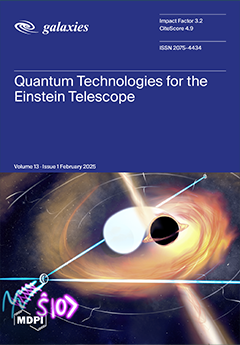
Cover Story: Quantum technology is at the heart of modern gravitational-wave detection, which already enhances the sensitivity of LIGO and Virgo through the use of quantum squeezed light. Remarkably, some of the most violent cosmic events remain invisible to us unless we utilise this fragile quantum light. By introducing just a few quantum-correlated photons into the detector, we extend its reach by many megaparsecs into the Universe. Next-generation observatories, such as the Einstein Telescope, will rely on even more advanced quantum techniques to fully realize their potential. This will demand innovations in several areas of quantum optics and engineering. This review explores the key quantum technologies that will shape gravitational-wave observations with the Einstein Telescope, examining both their challenges and promises for the future of the field. View this paper
  • Issues are regarded as officially published after their release is announced to the table of contents alert mailing list .
  • You may sign up for email alerts to receive table of contents of newly released issues.
  • PDF is the official format for papers published in both, html and pdf forms. To view the papers in pdf format, click on the "PDF Full-text" link, and use the free Adobe Reader to open them.

Articles (14)

  • Article
  • Open Access
4 Citations
1,675 Views
15 Pages

PyMAP: Python-Based Data Analysis Package with a New Image Cleaning Method to Enhance the Sensitivity of MACE Telescope

  • Mani Khurana,
  • Kuldeep Kumar Yadav,
  • Pradeep Chandra,
  • Krishna Kumar Singh,
  • Atul Pathania and
  • Chinmay Borwankar

15 February 2025

Observations of Very High Energy (VHE) gamma ray sources using the ground-based Imaging Atmospheric Cherenkov Telescopes (IACTs) play a pivotal role in understanding the non-thermal energetic phenomena and acceleration processes under extreme astroph...

  • Communication
  • Open Access
1 Citations
1,037 Views
14 Pages

13 February 2025

We obtain universal relations for fluid spheres without rotation made of dark energy assuming the extended Chaplygin gas equation-of-state. After integrating the relevant differential equations, we make a fit to obtain the unknown coefficients of the...

  • Article
  • Open Access
1,698 Views
12 Pages

Cryogenic Facility for Prototyping ET-LF Payloads Using Conductive Cooling

  • Marco Ricci,
  • Eugenio Benedetti,
  • Angelo Cruciani,
  • Van Long Hoang,
  • Benedetta Kalemi,
  • Luca Naticchioni,
  • Marco Orsini,
  • Stefano Pirro,
  • Paola Puppo and
  • Ettore Majorana
  • + 3 authors

12 February 2025

Cooling down large test masses up to 200 kg, as foreseen for the Einstein Telescope, is a complex challenge combining cutting-edge technological achievements from different disciplines with the experience gained from both room-temperature and cryogen...

  • Article
  • Open Access
2,228 Views
23 Pages

3 February 2025

The aim of the analysis of data from the Gaia Space Observatory is to obtain kinematic parameters of the collective motion of stars in a part of our galaxy. This research is based on a statistical analysis of the motion of 55,038,539 stars selected i...

  • Feature Paper
  • Article
  • Open Access
1 Citations
1,594 Views
9 Pages

Magnetic Noise Mitigation Strategies for the Einstein Telescope Infrastructure

  • Barbara Garaventa,
  • Federico Armato,
  • Andrea Chincarini and
  • Irene Fiori

31 January 2025

The Einstein Telescope (ET) will be a third-generation Gravitational Wave (GW) detector that will tackle cutting-edge technological challenges. The ET will be constructed at a depth of 200–300 m to isolate it from vibrations caused by seismic w...

  • Review
  • Open Access
3 Citations
2,691 Views
16 Pages

10 January 2025

Gamma-ray bursts are known to display various features on top of their canonical behavior. In this short review, we will describe and discuss two of them: the ultra-long gamma-ray bursts, which are defined by an extreme duration of their prompt phase...

  • Article
  • Open Access
2 Citations
1,671 Views
18 Pages

9 January 2025

It has long been known that the observed mass surface density of cored dark matter (DM) halos is approximately constant, independently of the galaxy mass (i.e., ρcrcconstant, with ρc and rc being the central volume density and the radi...

  • Article
  • Open Access
1 Citations
1,297 Views
8 Pages

Three Stages in Evolution of the Object Th4-4

  • Lyudmila Kondratyeva,
  • Eduard Denissyuk,
  • Saule Shomshekova,
  • Inna Reva,
  • Gauhar Aimanova and
  • Maxim Krugov

7 January 2025

The results of observations of the object Th4-4 in 1970–2024 showed that during this period the object went through several stages, when its characteristics corresponded to different classes of objects: Be star, symbiotic star and planetary neb...

  • Article
  • Open Access
1 Citations
2,239 Views
17 Pages

3 January 2025

We propose that modifications to the Higgs potential within a narrow atmospheric layer near the event horizon of an astrophysical black hole could significantly enhance the rate of sphaleron transitions, as well as transform the Chern–Simons nu...

  • Review
  • Open Access
2 Citations
3,340 Views
51 Pages

31 December 2024

So far, most of the about 5700 exoplanets have been discovered mainly with radial velocity and transit methods. These techniques are sensitive to planets in close orbits, not being able to probearge star–planet separations. μ-lensing is the...

  • Review
  • Open Access
4 Citations
4,207 Views
33 Pages

31 December 2024

I discuss here the progress made in the last decade on a few of the key open problems in GRB physics. These include (1) the nature of GRB progenitors, and the outliers found to the collapsar/merger scenarios; (2) jet structures, whose existence becam...

  • Article
  • Open Access
7 Citations
1,582 Views
31 Pages

31 December 2024

We compute the generalized spin precession frequency (Ωp) of a test gyroscope in a stationary spacetime, specifically for a Kerr–MOG black hole within the framework of scalar–tensor–vector gravity (STVG), also known as modifie...

Get Alerted

Add your email address to receive forthcoming issues of this journal.

XFacebookLinkedIn
Galaxies - ISSN 2075-4434