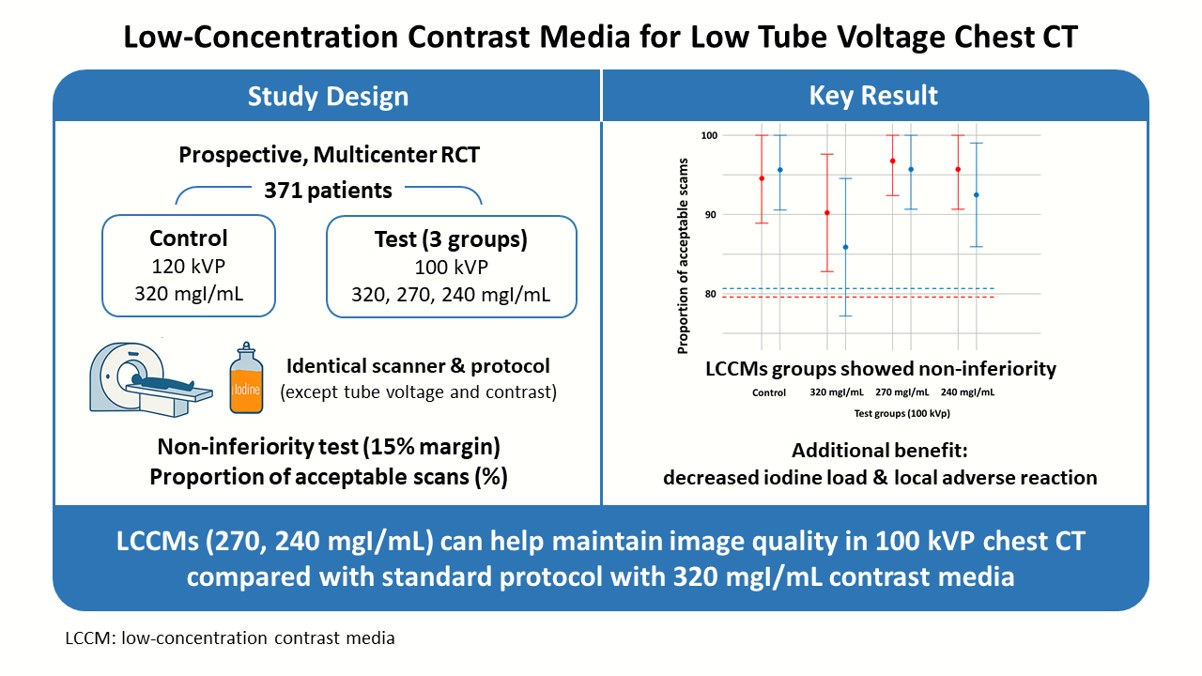
Optimization of the Contrast Concentration for Low-Tube-Voltage Chest CT: A Randomized Controlled Trial with Low-Concentration Contrast Media

 , , , , and
Abstract
1. Introduction
2. Materials and Methods
2.1. Study Design and Population
2.2. CT Image Acquisition
2.3. Image Analysis
2.4. Patient Safety
2.5. Statistical Analyses
3. Results
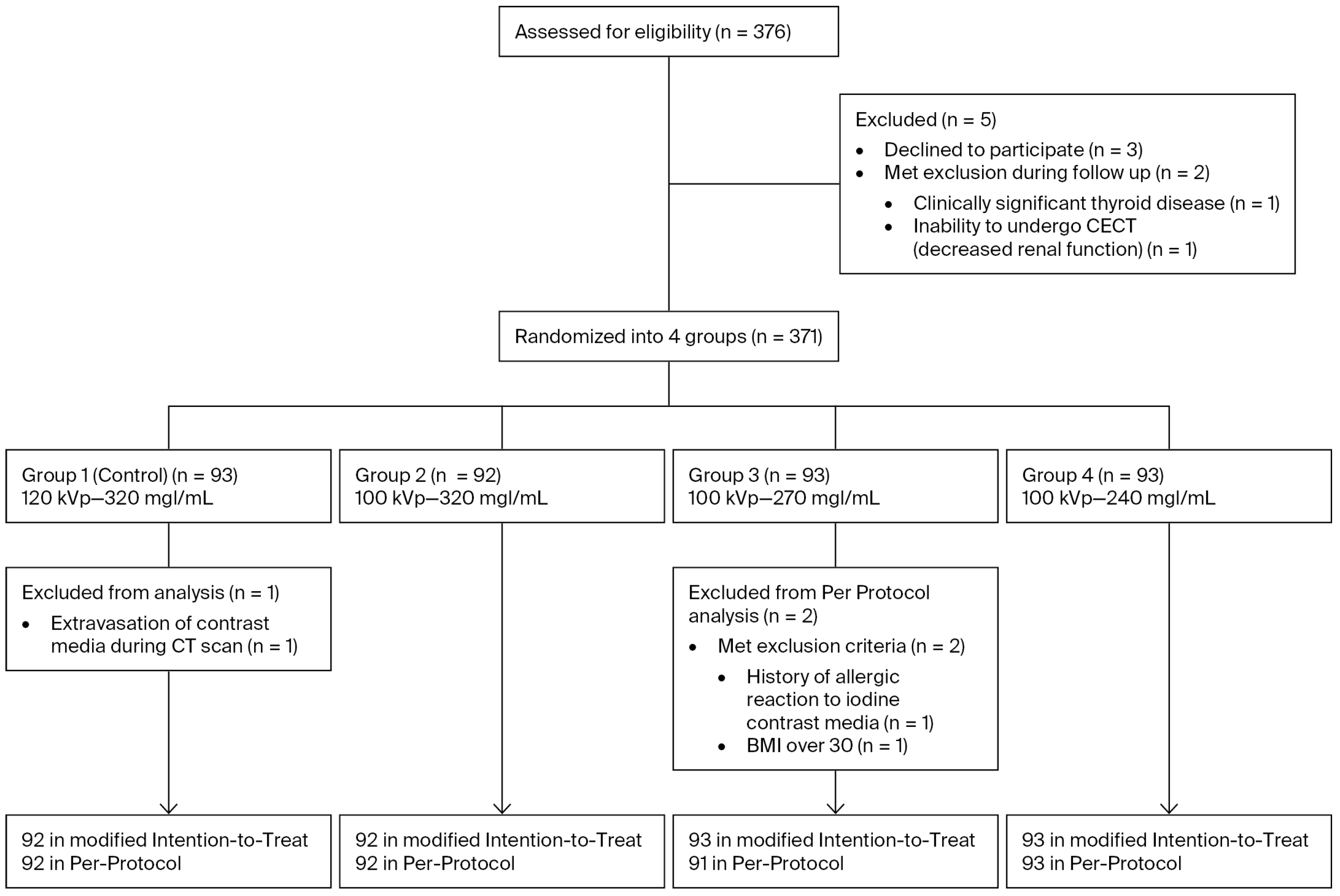
3.1. Patient Population
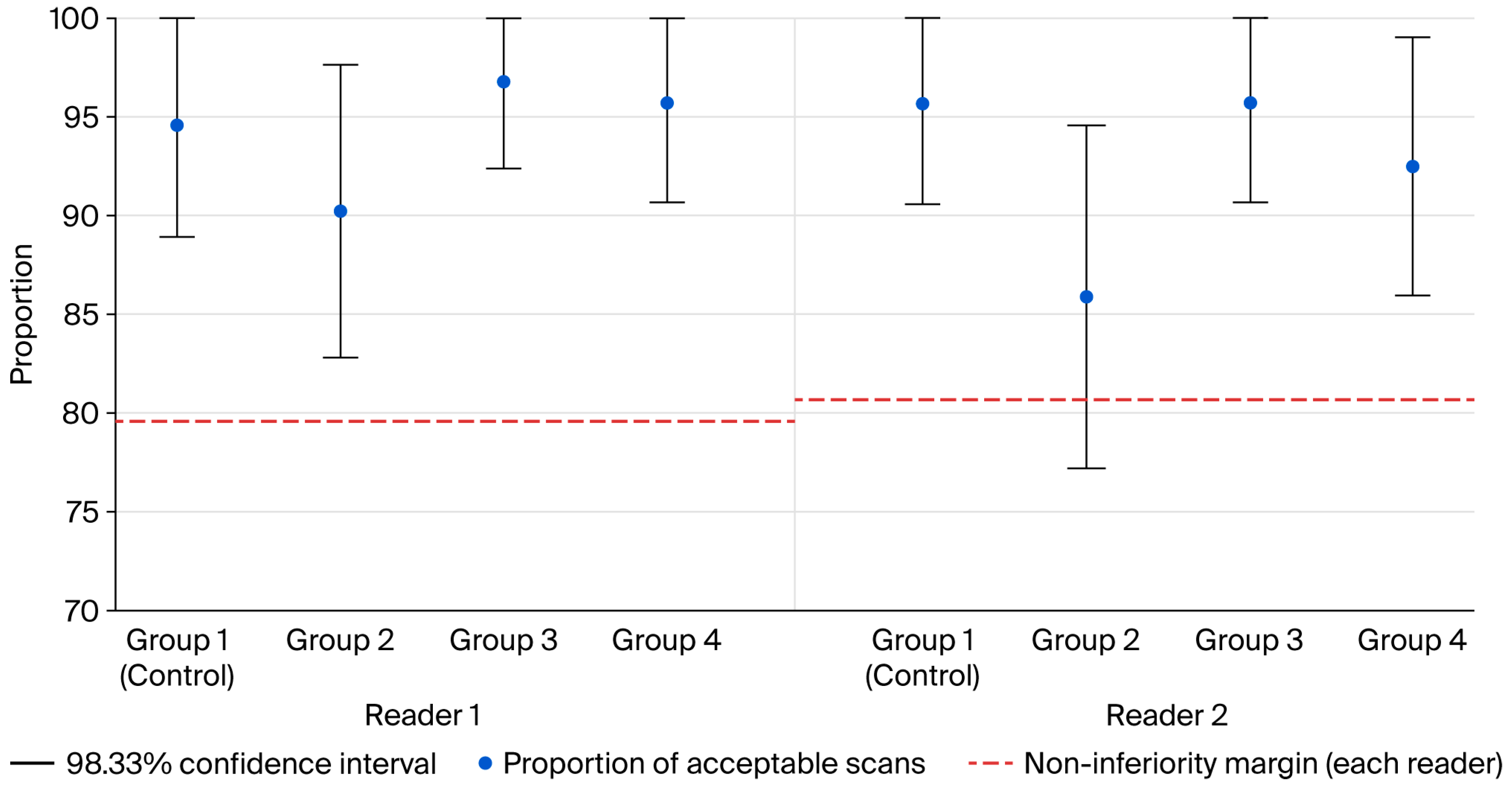
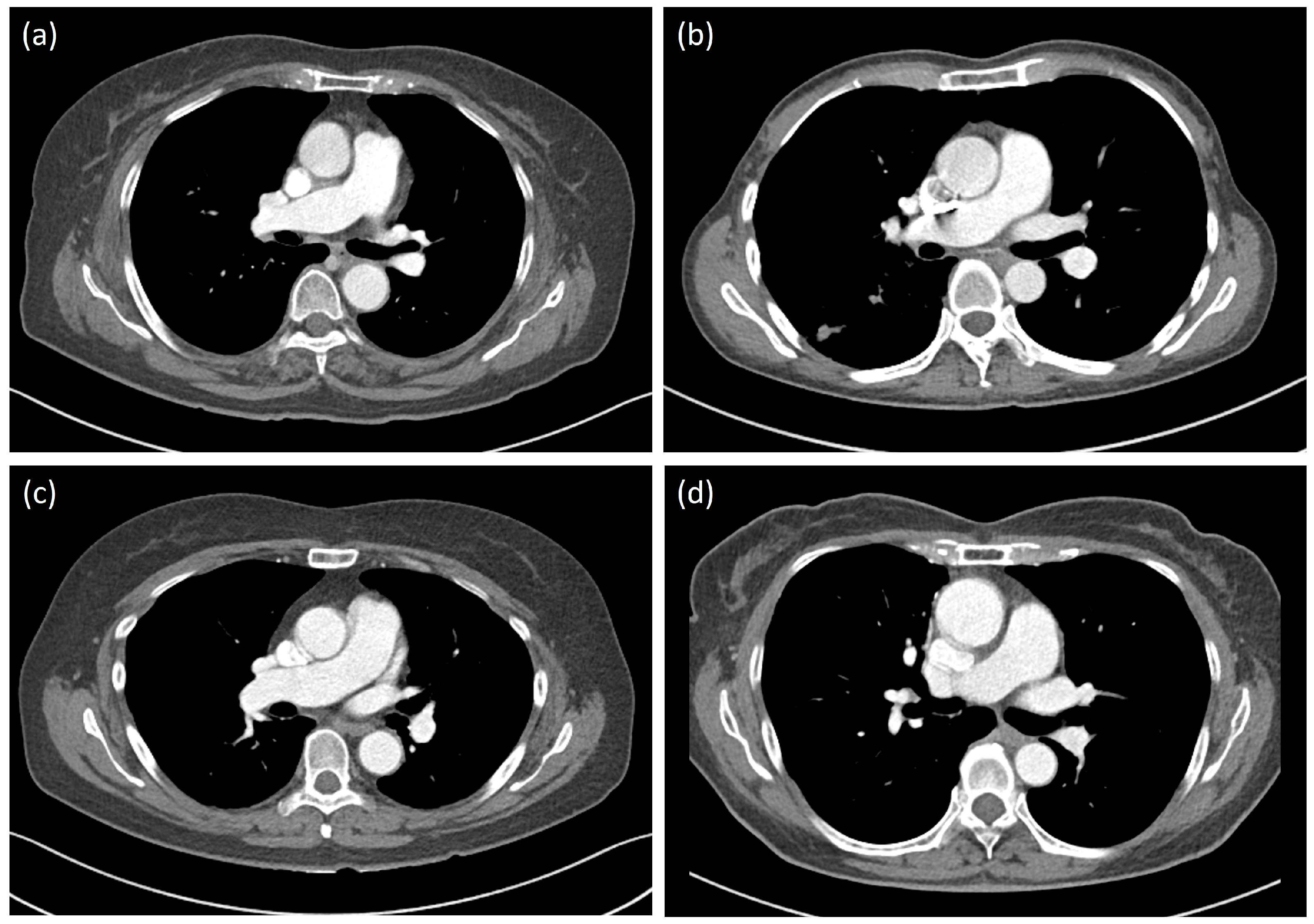
3.2. Image Analysis
3.3. Radiation
3.4. Patient Safety
4. Discussion
5. Conclusions
Supplementary Materials
Author Contributions
Funding
Institutional Review Board Statement
Informed Consent Statement
Data Availability Statement
Acknowledgments
Conflicts of Interest
Abbreviations
| LCCM | Low-concentration contrast media |
| CM | Contrast media |
| CECT | Contrast-enhanced computed tomography |
| HU | Hounsfield units |
| SNR | Signal-to-noise ratio |
| CNR | Contrast-to-noise ratio |
| FOM | Figure-of-merit |
| CTCAE | Common Terminology Criteria for Adverse Events |
References
- Koetzier, L.R.; Mastrodicasa, D.; Szczykutowicz, T.P.; van der Werf, N.R.; Wang, A.S.; Sandfort, V.; van der Molen, A.J.; Fleischmann, D.; Willemink, M.J. Deep learning image reconstruction for CT: Technical principles and clinical prospects. Radiology 2023, 306, e221257. [Google Scholar] [CrossRef] [PubMed]
- Ginat, D.T.; Gupta, R. Advances in computed tomography imaging technology. Annu. Rev. Biomed. Eng. 2014, 16, 431–453. [Google Scholar] [CrossRef] [PubMed]
- Kalva, S.P.; Sahani, D.V.; Hahn, P.F.; Saini, S. Using the K-edge to improve contrast conspicuity and to lower radiation dose with a 16-MDCT: A phantom and human study. J. Comput. Assist. Tomogr. 2006, 30, 391–397. [Google Scholar] [CrossRef] [PubMed]
- De Cecco, C.N.; Schoepf, U.J. New contrast injection strategies for low kV and keV imaging. Appl. Radiol. 2018, 47, 7–11. [Google Scholar] [CrossRef] [PubMed]
- Kok, M.; Mihl, C.; Hendriks, B.M.; Altintas, S.; Kietselaer, B.L.; Wildberger, J.E.; Das, M. Optimizing contrast media application in coronary CT angiography at lower tube voltage: Evaluation in a circulation phantom and sixty patients. Eur. J. Radiol. 2016, 85, 1068–1074. [Google Scholar] [CrossRef] [PubMed]
- Bae, K.T. Intravenous contrast medium administration and scan timing at CT: Considerations and approaches. Radiology 2010, 256, 32–61. [Google Scholar] [CrossRef] [PubMed]
- Bhalla, A.S.; Das, A.; Naranje, P.; Irodi, A.; Raj, V.; Goyal, A. Imaging protocols for CT chest: A recommendation. Indian. J. Radiol. Imaging 2019, 29, 236–246. [Google Scholar] [CrossRef] [PubMed]
- Iezzi, R.; Larici, A.R.; Franchi, P.; Marano, R.; Magarelli, N.; Posa, A.; Merlino, B.; Manfredi, R.; Colosimo, C. Tailoring protocols for chest CT applications: When and how? Diagn. Interv. Radiol. 2017, 23, 420–427. [Google Scholar] [CrossRef] [PubMed]
- Chang, S.; Jung, J.I.; Beck, K.S. Low tube voltage chest computed tomography with enhancement using low-concentration iodinated contrast media: Comparison of 240 mg/mL versus 300 mg/mL iodinated contrast media. Can. Assoc. Radiol. J. 2023, 74, 127–136. [Google Scholar] [CrossRef] [PubMed]
- Park, H.J.; Son, J.H.; Kim, T.B.; Kang, M.K.; Han, K.; Kim, E.H.; Kim, A.Y.; Park, S.H. Relationship between lower dose and injection speed of iodinated contrast material for CT and acute hypersensitivity reactions: An observational study. Radiology 2019, 293, 565–572. [Google Scholar] [CrossRef] [PubMed]
- Brockow, K.; Ring, J.; Rosengarten, D. Reduced iodinated contrast media dose and injection speed for CT: How much does this decrease the risk of hypersensitivity reactions? Quant. Imaging Med. Surg. 2020, 10, 537–540. [Google Scholar] [CrossRef] [PubMed]
- Rhee, C.M.; Bhan, I.; Alexander, E.K.; Brunelli, S.M. Association between iodinated contrast media exposure and incident hyperthyroidism and hypothyroidism. Arch. Intern. Med. 2012, 172, 153–159. [Google Scholar] [CrossRef] [PubMed]
- Achenbach, S.; Paul, J.F.; Laurent, F.; Becker, H.C.; Rengo, M.; Caudron, J.; Leschka, S.; Vignaux, O.; Knobloch, G.; Benea, G.; et al. Comparative assessment of image quality for coronary CT angiography with iobitridol and two contrast agents with higher iodine concentrations: Iopromide and iomeprol. A multicentre randomized double-blind trial. Eur. Radiol. 2017, 27, 821–830. [Google Scholar] [CrossRef] [PubMed]
- Rotzinger, D.C.; Si-Mohamed, S.A.; Yerly, J.; Boccalini, S.; Becce, F.; Boussel, L.; Meuli, R.A.; Qanadli, S.D.; Douek, P. Reduced-iodine-dose dual-energy coronary CT angiography: Qualitative and quantitative comparison between virtual monochromatic and polychromatic CT images. Eur. Radiol. 2021, 31, 7132–7142. [Google Scholar] [CrossRef] [PubMed]
- Koo, T.K.; Li, M.Y. A guideline of selecting and reporting intraclass correlation coefficients for reliability research. J. Chiropr. Med. 2016, 15, 155–163. [Google Scholar] [CrossRef] [PubMed]
- Bae, K.T. Optimization of contrast enhancement in thoracic MDCT. Radiol. Clin. N. Am. 2010, 48, 9–29. [Google Scholar] [CrossRef] [PubMed]
- Raman, S.P.; Mahesh, M.; Blasko, R.V.; Fishman, E.K. CT scan parameters and radiation dose: Practical advice for radiologists. J. Am. Coll. Radiol. 2013, 10, 840–846. [Google Scholar] [CrossRef] [PubMed]
- Park, E.A.; Lee, W.; Kang, D.K.; Lee, H.Y.; Chung, J.W.; Park, J.H. Image quality and radiation dose of 100-kVp versus 120-kVp chest CT in 80 patients. Korean J. Radiol. 2009, 10, 235–243. [Google Scholar] [CrossRef] [PubMed]



| All (N = 370) | Group 1 (Control), 320 mgI/mL and 120 kVp (n = 92) | Group 2, 320 mgI/mL and 100 kVp (n = 92) | Group 3, 270 mgI/mL and 100 kVp (n = 93) | Group 4, 240 mgI/mL and 100 kVp (n = 93) | p-Value | |
|---|---|---|---|---|---|---|
| Demographics | ||||||
| Age | 66.0 (58.0–73.0) | 66.0 (57.0–73.0) | 66.5 (56.0–72.0) | 66.0 (59.0–73.0) | 66.0 (57.0–75.0) | 0.94 |
| Sex | 0.27 | |||||
| male | 238 (64.3) | 54 (58.7) | 57 (62.0) | 60 (64.5) | 67 (72.0) | |
| female | 132 (35.7) | 38 (41.3) | 35 (38.0) | 33 (35.5) | 26 (28.0) | |
| Body mass index | 23.4 ± 3.3 | 23.5 ± 2.8 | 23.6 ± 3.1 | 23.2 ± 3.7 | 23.2 ± 3.5 | 0.83 |
| Smoking | 0.14 | |||||
| current smoker | 68 (18.4) | 10 (10.9) | 17 (18.5) | 22 (23.7) | 19 (20.4) | |
| ex-smoker | 145 (39.2) | 35 (38.0) | 32 (34.8) | 36 (38.7) | 42 (45.2) | |
| never smoker | 157 (42.4) | 47 (51.1) | 43 (46.7) | 35 (37.6) | 32 (34.4) | |
| Vital Sign | ||||||
| Systolic blood pressure | 128.0 (120.0–137.0) | 129.5 (123.0–142.0) | 128.0 (120.5–135.5) | 128.0 (121.0–138.0) | 125.0 (118.0–135.0) | 0.18 |
| Diastolic blood pressure | 78.0 (70.0–84.0) | 78.5 (72.0–83.5) | 77.5 (70.0–83.0) | 78.0 (70.0–85.0) | 76.0 (70.0–84.0) | 0.95 |
| Pulse rate | 79.0 (72.0–88.0) | 78.0 (72.0–88.0) | 80.5 (75.5–89.0) | 78.0 (72.0–86.0) | 80.0 (72.0–88.0) | 0.31 |
| Respiratory rate | 18.0 (16.0–20.0) | 18.0 (16.0–20.0) | 18.0 (16.0–20.0) | 18.0 (16.0–20.0) | 18.0 (16.0–20.0) | 0.53 |
| Comorbidities | ||||||
| Hypertension | 135 (36.5) | 27 (29.3) | 35 (38.0) | 35 (37.6) | 38 (40.9) | 0.40 |
| Diabetes mellitus | 78 (21.1) | 17 (18.5) | 18 (19.6) | 24 (25.8) | 19 (20.4) | 0.62 |
| Stroke | 8 (2.2) | 2 (2.2) | 1 (1.1) | 3 (3.2) | 2 (2.2) | 0.96 |
| Coronary artery disease | 21 (5.7) | 4 (4.3) | 4 (4.3) | 3 (3.2) | 10 (10.8) | 0.11 |
| Thyroid disease | 25 (6.8) | 7 (7.6) | 7 (7.6) | 5 (5.4) | 6 (6.5) | 0.92 |
| Asthma | 21 (5.7) | 8 (8.7) | 1 (1.1) | 5 (5.4) | 7 (7.5) | 0.12 |
| Chronic kidney disease | 4 (1.1) | 0 (0.0) | 2 (2.2) | 1 (1.1) | 1 (1.1) | 0.62 |
| Allergies | 17 (4.6) | 4 (4.3) | 4 (4.3) | 7 (7.5) | 2 (2.2) | 0.41 |
| Number of Acceptable Scans | Proportion of Acceptable Scans (98.3% CI) | Risk Difference (98.3% CI) | p-Value | |
|---|---|---|---|---|
| Modified ITT | ||||
| Reader 1 | ||||
| Group 1 | 87/92 | 94.57 (88.91, 100.00) | ||
| Group 2 | 83/92 | 90.22 (82.80, 97.63) | −4.35 (−13.67, 4.98) | 0.003 |
| Group 3 | 90/93 | 96.77 (92.39, 100.00) | 2.21 (−4.95, 9.37) | <0.001 |
| Group 4 | 89/93 | 95.70 (90.66, 100.00) | 1.13 (−6.44, 8.71) | <0.001 |
| Reader 2 | ||||
| Group 1 | 88/92 | 95.65 (90.56, 100.00) | ||
| Group 2 | 79/92 | 85.87 (77.18, 94.56) | −9.78 (−19.85, 0.29) | 0.11 |
| Group 3 | 89/93 | 95.70 (90.66, 100.00) | 0.05 (−7.11, 7.21) | <0.001 |
| Group 4 | 86/93 | 92.47 (85.93, 99.02) | −3.18 (−11.47, 5.11) | <0.001 |
| Per protocol | ||||
| Reader 1 | ||||
| Group 1 | 87/92 | 94.57 (88.91, 100.00) | ||
| Group 2 | 83/92 | 90.22 (82.80, 97.63) | −4.35 (−13.67, 4.98) | 0.003 |
| Group 3 | 88/91 | 96.70 (92.22, 100.00) | 2.14 (−5.08, 9.35) | <0.001 |
| Group 4 | 89/93 | 95.70 (90.66, 100.00) | 1.13 (−6.44, 8.71) | <0.001 |
| Reader 2 | ||||
| Group 1 | 88/92 | 95.65 (90.56, 100.00) | ||
| Group 2 | 79/92 | 85.87 (77.18, 94.56) | −9.78 (−19.85, 0.29) | 0.11 |
| Group 3 | 88/91 | 96.70 (92.22, 100.00) | 1.05 (−5.73, 7.83) | <0.001 |
| Group 4 | 86/93 | 92.47 (85.93, 99.02) | −3.18 (−11.47, 5.11) | <0.001 |
| 320 mgI/mL (n = 184) | 270 mgI/mL (n = 93) | 240 mgI/mL (n = 93) | p-Value | Group-Wise Comparison (p-Value) Using Bonferroni Correction | |||
|---|---|---|---|---|---|---|---|
| 320 vs. 270 | 320 vs. 240 | 320 vs. LCCM | |||||
| Injection site pain | 0.41 | 0.86 | 0.86 | 0.54 | |||
| No pain | 165 (89.7) | 87 (93.5) | 87 (93.5) | ||||
| Pain | 19 (10.3) | 6 (6.5) | 6 (6.5) | ||||
| Systemic heat | 0.003 | 0.07 | 0.01 | <0.001 | |||
| None | 85 (46.2) | 46 (49.5) | 56 (60.2) | ||||
| Mild heat | 59 (32.1) | 39 (41.9) | 32 (34.4) | ||||
| Moderate heat | 39 (21.2) | 8 (8.6) | 5 (5.4) | ||||
| Severe heat | 1 (0.5) | 0 (0.0) | 0 (0.0) | ||||
| Injection site heat | 34 (18.5) | 17 (18.3) | 11 (11.8) | 0.34 | >0.999 | 0.468 | >0.999 |
| Adverse effects | 2 (100.0) | 2 (100.0) | - | N/A | N/A | N/A | N/A |
| CTCAE term | >0.999 | >0.999 | N/A | >0.999 | |||
| Nausea | 1 (50.0) | 1 (50.0) | - | ||||
| Urinary urgency | 0 (0.0) | 1 (50.0) | - | ||||
| Urticaria | 1 (50.0) | 0 (0.0) | - | ||||
| CTCAE grade | >0.999 | >0.999 | N/A | >0.999 | |||
| 1 | 1 (50.0) | 2 (100.0) | - | ||||
| 2 | 1 (50.0) | 0 (0.0) | - | ||||
Disclaimer/Publisher’s Note: The statements, opinions and data contained in all publications are solely those of the individual author(s) and contributor(s) and not of MDPI and/or the editor(s). MDPI and/or the editor(s) disclaim responsibility for any injury to people or property resulting from any ideas, methods, instructions or products referred to in the content. |
© 2025 by the authors. Licensee MDPI, Basel, Switzerland. This article is an open access article distributed under the terms and conditions of the Creative Commons Attribution (CC BY) license.
Share and Cite
Park, J.; Gil, B.M.; Kim, Y.-H.; Jin, G.Y.; Jeong, Y.J.; Goo, J.M.; Chang, S.; Beck, K.S.; Jung, J.I. Optimization of the Contrast Concentration for Low-Tube-Voltage Chest CT: A Randomized Controlled Trial with Low-Concentration Contrast Media. Diagnostics 2026, 16, 82. https://doi.org/10.3390/diagnostics16010082
Park J, Gil BM, Kim Y-H, Jin GY, Jeong YJ, Goo JM, Chang S, Beck KS, Jung JI. Optimization of the Contrast Concentration for Low-Tube-Voltage Chest CT: A Randomized Controlled Trial with Low-Concentration Contrast Media. Diagnostics. 2026; 16(1):82. https://doi.org/10.3390/diagnostics16010082
Chicago/Turabian StylePark, Jiho, Bo Mi Gil, Yun-Hyeon Kim, Gong Yong Jin, Yeon Joo Jeong, Jin Mo Goo, Suyon Chang, Kyongmin Sarah Beck, and Jung Im Jung. 2026. "Optimization of the Contrast Concentration for Low-Tube-Voltage Chest CT: A Randomized Controlled Trial with Low-Concentration Contrast Media" Diagnostics 16, no. 1: 82. https://doi.org/10.3390/diagnostics16010082
APA StylePark, J., Gil, B. M., Kim, Y.-H., Jin, G. Y., Jeong, Y. J., Goo, J. M., Chang, S., Beck, K. S., & Jung, J. I. (2026). Optimization of the Contrast Concentration for Low-Tube-Voltage Chest CT: A Randomized Controlled Trial with Low-Concentration Contrast Media. Diagnostics, 16(1), 82. https://doi.org/10.3390/diagnostics16010082