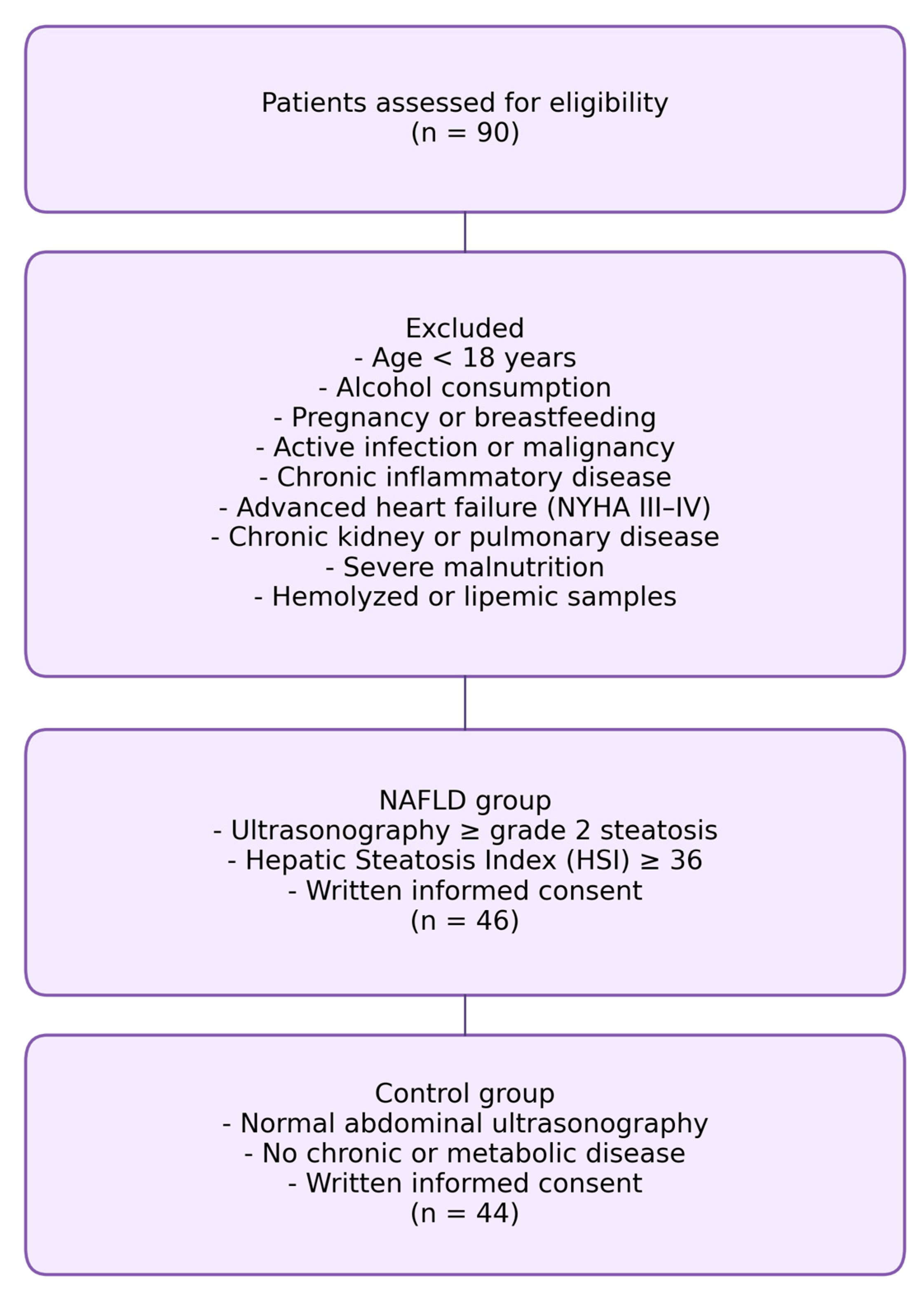
The Importance of Serum Perilipin-2 Level as an Early Indicator of Inflammation in Non-Alcoholic Fatty Liver Disease

 , , , , , , ,
Abstract
1. Introduction
2. Materials and Methods
2.1. Study Design
2.2. Subjects
2.3. Inclusion Criteria
2.4. Exclusion Criteria
2.5. Data Collection
2.6. Sample Collection
2.7. Biochemical Analyses
Assessment of Serum Perilipin-2 (PLIN 2) Concentration
2.8. Statistical Analysis
3. Results
3.1. Baseline Characteristics
3.2. Biochemical Findings
3.3. Serum PLIN2 Levels
3.4. Correlation Analyses
3.5. Subgroup Analyses
3.6. Diagnostic Performance of PLIN2
4. Discussion
4.1. Obesity, Anthropometrics, and PLIN2
4.2. NAFLD, IR, and T2D
4.3. Dyslipidemia and Lipid Metabolism in NAFLD
4.4. CRP, Inflammation, and the PLIN2 Connection
4.5. Hematological Markers, PLIN2, and Inflammation
4.6. Aminotransferases (AST/ALT)
4.7. Gender Differences and PLIN2
4.8. Comorbidities, Metabolic Syndrome, and PLIN2
4.9. Central Role of PLIN2 in NAFLD Pathogenesis
4.10. Diagnostic Efficacy of PLIN2 (ROC Analysis)
4.11. The PLIN2–Lysosomal Acid Lipase (LIPA) Axis: Mechanistic Link to Metabolic Dysfunction
4.12. The Limitations of This Study
4.13. Clinical Implications
5. Conclusions
Author Contributions
Funding
Institutional Review Board Statement
Informed Consent Statement
Data Availability Statement
Conflicts of Interest
References
- Younossi, Z.M. Non-Alcoholic Fatty Liver Disease—A Global Public Health Perspective. J. Hepatol. 2019, 70, 531–544. [Google Scholar] [CrossRef] [Scilit] [PubMed]
- Eslam, M.; Sanyal, A.J.; George, J. Toward More Accurate Nomenclature for Fatty Liver Diseases. Gastroenterology 2019, 157, 590–593. [Google Scholar] [CrossRef] [Scilit] [PubMed]
- Eslam, M.; Fan, J.-G.; Yu, M.-L.; Wong, V.W.-S.; Cua, I.H.; Liu, C.-J.; Tanwandee, T.; Gani, R.; Seto, W.-K.; Alam, S.; et al. The Asian Pacific Association for the Study of the Liver Clinical Practice Guidelines for the Diagnosis and Management of Metabolic Dysfunction-Associated Fatty Liver Disease. Hepatol. Int. 2025, 19, 261–301. [Google Scholar] [CrossRef] [Scilit]
- Alharthi, J.; Gastaldelli, A.; Cua, I.H.; Ghazinian, H.; Eslam, M. Metabolic Dysfunction-Associated Fatty Liver Disease: A Year in Review. Curr. Opin. Gastroenterol. 2022, 38, 251–260. [Google Scholar] [CrossRef] [Scilit]
- Han, S.K.; Baik, S.K.; Kim, M.Y. Non-Alcoholic Fatty Liver Disease: Definition and Subtypes. Clin. Mol. Hepatol. 2023, 29, S5–S16. [Google Scholar] [CrossRef] [Scilit]
- Li, Q.; Dhyani, M.; Grajo, J.R.; Sirlin, C.; Samir, A.E. Current Status of Imaging in Nonalcoholic Fatty Liver Disease. World J. Hepatol. 2018, 10, 530–542. [Google Scholar] [CrossRef] [Scilit]
- European Association for the Study of the Liver (EASL); European Association for the Study of Diabetes (EASD); European Association for the Study of Obesity (EASO). EASL-EASD-EASO Clinical Practice Guidelines on the Management of Metabolic Dysfunction-Associated Steatotic Liver Disease (MASLD). J. Hepatol. 2024, 81, 492–542. [Google Scholar] [CrossRef] [Scilit]
- Rinella, M.E.; Neuschwander-Tetri, B.A.; Siddiqui, M.S.; Abdelmalek, M.F.; Caldwell, S.; Barb, D.; Kleiner, D.E.; Loomba, R. AASLD Practice Guidance on the Clinical Assessment and Management of Nonalcoholic Fatty Liver Disease. Hepatology 2023, 77, 1797–1835. [Google Scholar] [CrossRef] [Scilit]
- Zhang, Z.; Yu, Z.; Liang, D.; Song, K.; Kong, X.; He, M.; Liao, X.; Huang, Z.; Kang, A.; Bai, R.; et al. Roles of Lipid Droplets and Related Proteins in Metabolic Diseases. Lipids Health Dis. 2024, 23, 218. [Google Scholar] [CrossRef] [Scilit]
- Olzmann, J.A.; Carvalho, P. Dynamics and Functions of Lipid Droplets. Nat. Rev. Mol. Cell Biol. 2019, 20, 137–155. [Google Scholar] [CrossRef] [Scilit] [PubMed]
- Althaher, A.R. An Overview of Hormone-Sensitive Lipase (HSL). Sci. World J. 2022, 2022, 1964684. [Google Scholar] [CrossRef] [Scilit] [PubMed]
- Chandrasekaran, P.; Weiskirchen, S.; Weiskirchen, R. Perilipins: A Family of Five Fat-Droplet Storing Proteins That Play a Significant Role in Fat Homeostasis. J. Cell Biochem. 2024, 125, e30579. [Google Scholar] [CrossRef] [Scilit] [PubMed]
- Conte, M.; Santoro, A.; Collura, S.; Martucci, M.; Battista, G.; Bazzocchi, A.; Morsiani, C.; Sevini, F.; Capri, M.; Monti, D.; et al. Circulating Perilipin 2 Levels Are Associated with Fat Mass, Inflammatory and Metabolic Markers and Are Higher in Women than Men. Aging 2021, 13, 7931–7942. [Google Scholar] [CrossRef] [Scilit]
- Alberti, K.G.M.M.; Zimmet, P.; Shaw, J. IDF Epidemiology Task Force Consensus Group The Metabolic Syndrome—A New Worldwide Definition. Lancet 2005, 366, 1059–1062. [Google Scholar] [CrossRef] [Scilit] [PubMed]
- Ambroselli, D.; Masciulli, F.; Romano, E.; Catanzaro, G.; Besharat, Z.M.; Massari, M.C.; Ferretti, E.; Migliaccio, S.; Izzo, L.; Ritieni, A.; et al. New Advances in Metabolic Syndrome, from Prevention to Treatment: The Role of Diet and Food. Nutrients 2023, 15, 640. [Google Scholar] [CrossRef] [Scilit]
- Huxley, R.; Mendis, S.; Zheleznyakov, E.; Reddy, S.; Chan, J. Body Mass Index, Waist Circumference and Waist: Hip Ratio as Predictors of Cardiovascular Risk—A Review of the Literature. Eur. J. Clin. Nutr. 2010, 64, 16–22. [Google Scholar] [CrossRef] [Scilit]
- Yuan, S.; Chen, J.; Li, X.; Fan, R.; Arsenault, B.; Gill, D.; Giovannucci, E.L.; Zheng, J.-S.; Larsson, S.C. Lifestyle and Metabolic Factors for Nonalcoholic Fatty Liver Disease: Mendelian Randomization Study. Eur. J. Epidemiol. 2022, 37, 723–733. [Google Scholar] [CrossRef] [Scilit]
- De Silva, N.M.G.; Borges, M.C.; Hingorani, A.D.; Engmann, J.; Shah, T.; Zhang, X.; Luan, J.; Langenberg, C.; Wong, A.; Kuh, D.; et al. Liver Function and Risk of Type 2 Diabetes: Bidirectional Mendelian Randomization Study. Diabetes 2019, 68, 1681–1691. [Google Scholar] [CrossRef] [Scilit]
- Smith, B.W.; Adams, L.A. Nonalcoholic Fatty Liver Disease and Diabetes Mellitus: Pathogenesis and Treatment. Nat. Rev. Endocrinol. 2011, 7, 456–465. [Google Scholar] [CrossRef] [Scilit]
- Younossi, Z.M.; Golabi, P.; de Avila, L.; Paik, J.M.; Srishord, M.; Fukui, N.; Qiu, Y.; Burns, L.; Afendy, A.; Nader, F. The Global Epidemiology of NAFLD and NASH in Patients with Type 2 Diabetes: A Systematic Review and Meta-Analysis. J. Hepatol. 2019, 71, 793–801. [Google Scholar] [CrossRef] [Scilit] [PubMed]
- Sporea, I.; Mare, R.; Popescu, A.; Nistorescu, S.; Baldea, V.; Sirli, R.; Braha, A.; Sima, A.; Timar, R.; Lupusoru, R. Screening for Liver Fibrosis and Steatosis in a Large Cohort of Patients with Type 2 Diabetes Using Vibration Controlled Transient Elastography and Controlled Attenuation Parameter in a Single-Center Real-Life Experience. J. Clin. Med. 2020, 9, 1032. [Google Scholar] [CrossRef] [Scilit]
- Hliwa, A.; Ramos-Molina, B.; Laski, D.; Mika, A.; Sledzinski, T. The Role of Fatty Acids in Non-Alcoholic Fatty Liver Disease Progression: An Update. Int. J. Mol. Sci. 2021, 22, 6900. [Google Scholar] [CrossRef] [Scilit]
- Kawano, Y.; Cohen, D.E. Mechanisms of Hepatic Triglyceride Accumulation in Non-Alcoholic Fatty Liver Disease. J. Gastroenterol. 2013, 48, 434–441. [Google Scholar] [CrossRef] [Scilit] [PubMed]
- Li, W.; Wang, Y.; He, F.; Liu, Z.; Dong, J.; Zhang, Y.; Li, T.; Liu, S.; Chen, E. Association between Triglyceride-Glucose Index and Nonalcoholic Fatty Liver Disease in Type 2 Diabetes Mellitus. BMC Endocr. Disord. 2022, 22, 261. [Google Scholar] [CrossRef] [Scilit] [PubMed]
- Liu, Q.; Han, M.; Li, M.; Huang, X.; Feng, R.; Li, W.; Chen, J.; He, H.; Zheng, W.; Hu, Z.; et al. Shift in Prevalence and Systemic Inflammation Levels from NAFLD to MAFLD: A Population-Based Cross-Sectional Study. Lipids Health Dis. 2023, 22, 185. [Google Scholar] [CrossRef] [Scilit]
- Duan, Y.; Pan, X.; Luo, J.; Xiao, X.; Li, J.; Bestman, P.L.; Luo, M. Association of Inflammatory Cytokines With Non-Alcoholic Fatty Liver Disease. Front. Immunol. 2022, 13, 880298. [Google Scholar] [CrossRef] [Scilit]
- Kumar, R.; Porwal, Y.C.; Dev, N.; Kumar, P.; Chakravarthy, S.; Kumawat, A. Association of High-Sensitivity C-Reactive Protein (Hs-CRP) with Non-Alcoholic Fatty Liver Disease (NAFLD) in Asian Indians: A Cross-Sectional Study. J. Family Med. Prim. Care 2020, 9, 390–394. [Google Scholar] [CrossRef] [Scilit] [PubMed]
- Zhu, N.; Wang, X.; Zhu, H.; Zheng, Y. Blood cell parameters and risk of nonalcoholic fatty liver disease: A comprehensive Mendelian randomization study. BMC Med Genom. 2024, 17, 102. [Google Scholar] [CrossRef] [Scilit] [PubMed] [PubMed Central]
- Yilmaz, Y.; Zeybel, M.; Adali, G.; Cosar, A.M.; Sertesen, E.; Gokcan, H.; Bahcecioglu, H.I.; Sahin, M.; Tulunay, C.; Ergun, I.; et al. TASL Practice Guidance on the Clinical Assessment and Management of Patients with Nonalcoholic Fatty Liver Disease. Hepatol. Forum 2023, 4, 1–32. [Google Scholar] [CrossRef] [Scilit]
- Liu, J.; Zhou, L.; An, Y.; Wang, Y.; Wang, G. The Atherogenic Index of Plasma: A Novel Factor More Closely Related to Non-Alcoholic Fatty Liver Disease than Other Lipid Parameters in Adults. Front. Nutr. 2022, 9, 954219. [Google Scholar] [CrossRef] [Scilit]
- Leoni, S.; Tovoli, F.; Napoli, L.; Serio, I.; Ferri, S.; Bolondi, L. Current Guidelines for the Management of Non-Alcoholic Fatty Liver Disease: A Systematic Review with Comparative Analysis. World J. Gastroenterol. 2018, 24, 3361–3373. [Google Scholar] [CrossRef] [Scilit]
- Ayonrinde, O.T.; Olynyk, J.K.; Beilin, L.J.; Mori, T.A.; Pennell, C.E.; de Klerk, N.; Oddy, W.H.; Shipman, P.; Adams, L.A. Gender-Specific Differences in Adipose Distribution and Adipocytokines Influence Adolescent Nonalcoholic Fatty Liver Disease. Hepatology 2011, 53, 800–809. [Google Scholar] [CrossRef] [Scilit]
- Angulo, P. Nonalcoholic Fatty Liver Disease. N. Engl. J. Med. 2002, 346, 1221–1231. [Google Scholar] [CrossRef] [Scilit] [PubMed]
- Fan, J.-G.; Kim, S.-U.; Wong, V.W.-S. New Trends on Obesity and NAFLD in Asia. J. Hepatol. 2017, 67, 862–873. [Google Scholar] [CrossRef] [Scilit]
- Goto-Inoue, N.; Yamada, K.; Inagaki, A.; Furuichi, Y.; Ogino, S.; Manabe, Y.; Setou, M.; Fujii, N.L. Lipidomics Analysis Revealed the Phospholipid Compositional Changes in Muscle by Chronic Exercise and High-Fat Diet. Sci. Rep. 2013, 3, 3267. [Google Scholar] [CrossRef] [Scilit]
- Carr, R.M.; Peralta, G.; Yin, X.; Ahima, R.S. Absence of Perilipin 2 Prevents Hepatic Steatosis, Glucose Intolerance and Ceramide Accumulation in Alcohol-Fed Mice. PLoS ONE 2014, 9, e97118. [Google Scholar] [CrossRef] [Scilit] [PubMed]
- Ikura, Y.; Caldwell, S.H. Lipid Droplet-Associated Proteins in Alcoholic Liver Disease: A Potential Linkage with Hepatocellular Damage. Int. J. Clin. Exp. Pathol. 2015, 8, 8699–8708. [Google Scholar] [PubMed]
- Bell, M.; Wang, H.; Chen, H.; McLenithan, J.C.; Gong, D.-W.; Yang, R.-Z.; Yu, D.; Fried, S.K.; Quon, M.J.; Londos, C.; et al. Consequences of Lipid Droplet Coat Protein Downregulation in Liver Cells: Abnormal Lipid Droplet Metabolism and Induction of Insulin Resistance. Diabetes 2008, 57, 2037–2045. [Google Scholar] [CrossRef] [Scilit]
- Li, M.; Ye, T.; Wang, X.-X.; Li, X.; Qiang, O.; Yu, T.; Tang, C.-W.; Liu, R. Effect of Octreotide on Hepatic Steatosis in Diet-Induced Obesity in Rats. PLoS ONE 2016, 11, e0152085. [Google Scholar] [CrossRef] [Scilit]
- Jin, Y.; Tan, Y.; Chen, L.; Liu, Y.; Ren, Z. Reactive Oxygen Species Induces Lipid Droplet Accumulation in HepG2 Cells by Increasing Perilipin 2 Expression. Int. J. Mol. Sci. 2018, 19, 3445. [Google Scholar] [CrossRef] [Scilit] [PubMed]
- Fang, C.; Liu, S.; Yang, W.; Zheng, G.; Zhou, F.; Gao, X.; Qin, L.; Yang, G.; Yang, J.; Zhu, G.; et al. Exercise Ameliorates Lipid Droplet Metabolism Disorder by the PLIN2-LIPA Axis-Mediated Lipophagy in Mouse Model of Non-Alcoholic Fatty Liver Disease. Biochim. Biophys. Acta Mol. Basis Dis. 2024, 1870, 167045. [Google Scholar] [CrossRef] [Scilit] [PubMed]



| Variables | Control Group (n = 44) | NAFLD Group (n = 46) | p |
|---|---|---|---|
| Age (years) | 43.70 ± 6.04 [43] | 44.3 ± 4.71 [45] | 0.060 *1 |
| Sex | |||
| Male | 21 (47.73%) | 22 (47.83%) | 0.993 *3 |
| Female | 23 (52.27%) | 24 (52.17%) | |
| Smoking | 18 (49.91%) | 23 (50.00%) | 0.513 *3 |
| Height (m) | 1.68 ± 0.09 [1.66] | 1.64 ± 0.10 [1.61] | 0.055 *1 |
| Weight (kg) | 69.34 ± 18.83 [68.5] | 93.1 ± 16.56 [90,95] | <0.001 *1 |
| BMI (kg/m2) | 24.51 ± 3.72 [24.32] | 34.81 ± 5.57 [33.94] | <0.001 *1 |
| Waist circumference (cm) | 84.59 ± 13.01 [87] | 112.98 ± 10.91 [111.5] | <0.001 *1 |
| Hip circumference (cm) | 97.70 ± 11.36 [96.5] | 117.74 ± 9.84 [116] | <0.001 *1 |
| Waist-to-hip ratio | 0.86 ± 0.06 | 0.96 ± 0.07 | <0.001 *2 |
| Variables | Control Group (n = 44) | NAFLD Group (n = 46) | p |
|---|---|---|---|
| Glucose (mg/dL) | 92.23 ± 9.15 [91.5] | 121.83 ± 54.05 [99] | 0.002 *1 |
| HOMA-IR | 2.43 ± 1.84 [2.05] | 7.23 ± 9.11 [4.13] | <0.001 *1 |
| HbA1c (%) | 5.47 ± 0.36 [5.4] | 6.46 ± 1.39 [6.1] | <0.001 *1 |
| ALT (U/L) | 17.16 ± 11.61 [15] | 31.98 ± 17.34 [25.5] | <0.001 *1 |
| AST (U/L) | 16.93 ± 5.30 [15] | 24.20 ± 11.19 [21] | <0.001 *1 |
| LDL-C (mg/dL) | 108.20 ± 30.12 | 119.61 ± 37.34 | 0.114 *2 |
| HDL-C (mg/dL) | 53.36 ± 16.00 [50.5] | 44.15 ± 10.20 [44.5] | 0.003 *1 |
| Triglycerides (mg/dL) | 121.98 ± 70.86 [108] | 181.15 ± 110.75 [156.5] | 0.001 *1 |
| Total cholesterol (mg/dL) | 186.55 ± 34.13 | 197.98 ± 42.52 | 0.164 *2 |
| CRP (mg/L) | 2.62 ± 4.63 [1.41] | 4.72 ± 4.71 [2.7] | <0.001 *1 |
| Platelet count (×103/µL) | 257.41 ± 59.88 [245] | 283.89 ± 91.72 [272] | 0.092 *1 |
| Lymphocyte count (×103/µL) | 2.21 ± 0.55 [2.1] | 2.67 ± 0.70 [2.55] | 0.001 *1 |
| Variable | Control Group (n = 44) | NAFLD Group (n = 46) | p |
|---|---|---|---|
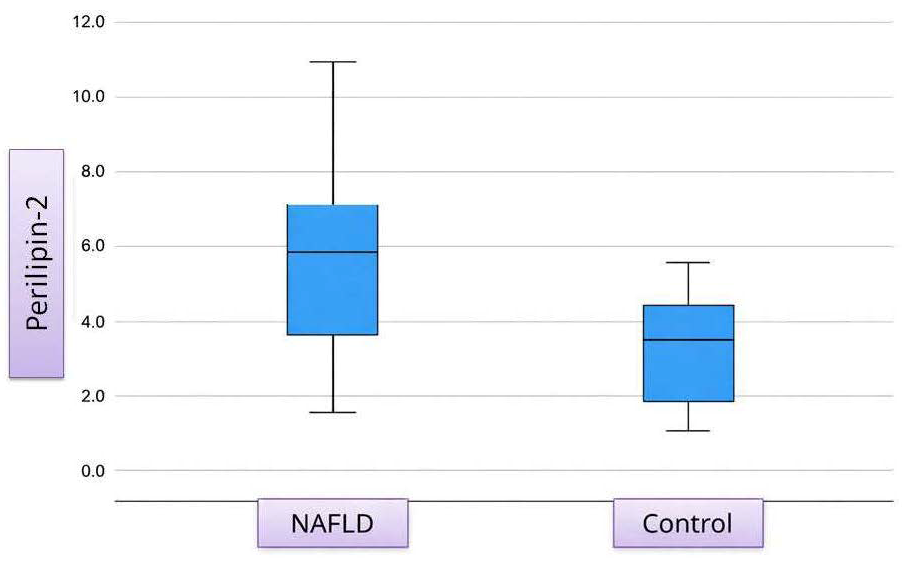
| PLIN2 (ng/mL) | 3.23 ± 1.40 [3.46] | 5.45 ± 2.26 [5.66] | <0.001 |
| Variables | r | p |
|---|---|---|
| Age (years) | 0.171 | 0.107 |
| Height (m) | −0.282 | 0.058 |
| Weight (kg) | 0.063 | 0.679 |
| BMI (kg/m2) | 0.431 | 0.003 (p < 0.01) |
| Waist circumference (cm) | 0.120 | 0.428 |
| Hip circumference (cm) | 0.350 | 0.017 (p < 0.05) |
| Waist-to-hip ratio | −0.216 | 0.149 |
| Glucose (mg/dL) | −0.090 | 0.550 |
| HOMA-IR | 0.086 | 0.569 |
| HbA1c (%) | −0.098 | 0.518 |
| ALT (U/L) | −0.205 | 0.172 |
| AST (U/L) | −0.133 | 0.379 |
| LDL-C (mg/dL) | −0.275 | 0.064 |
| HDL-C (mg/dL) | 0.125 | 0.408 |
| Triglycerides (mg/dL) | −0.107 | 0.480 |
| Total cholesterol (mg/dL) | −0.194 | 0.196 |
| CRP (mg/L) | 0.337 | 0.022 (p < 0.05) |
| Platelet count (×103/µL) | 0.359 | 0.014 (p < 0.05) |
| Lymphocyte count (×103/µL) | 0.126 | 0.405 |
| NAFLD | AUC (95% CI) | Cut-Off | Sensitivity (%) | Specificity (%) | p |
|---|---|---|---|---|---|
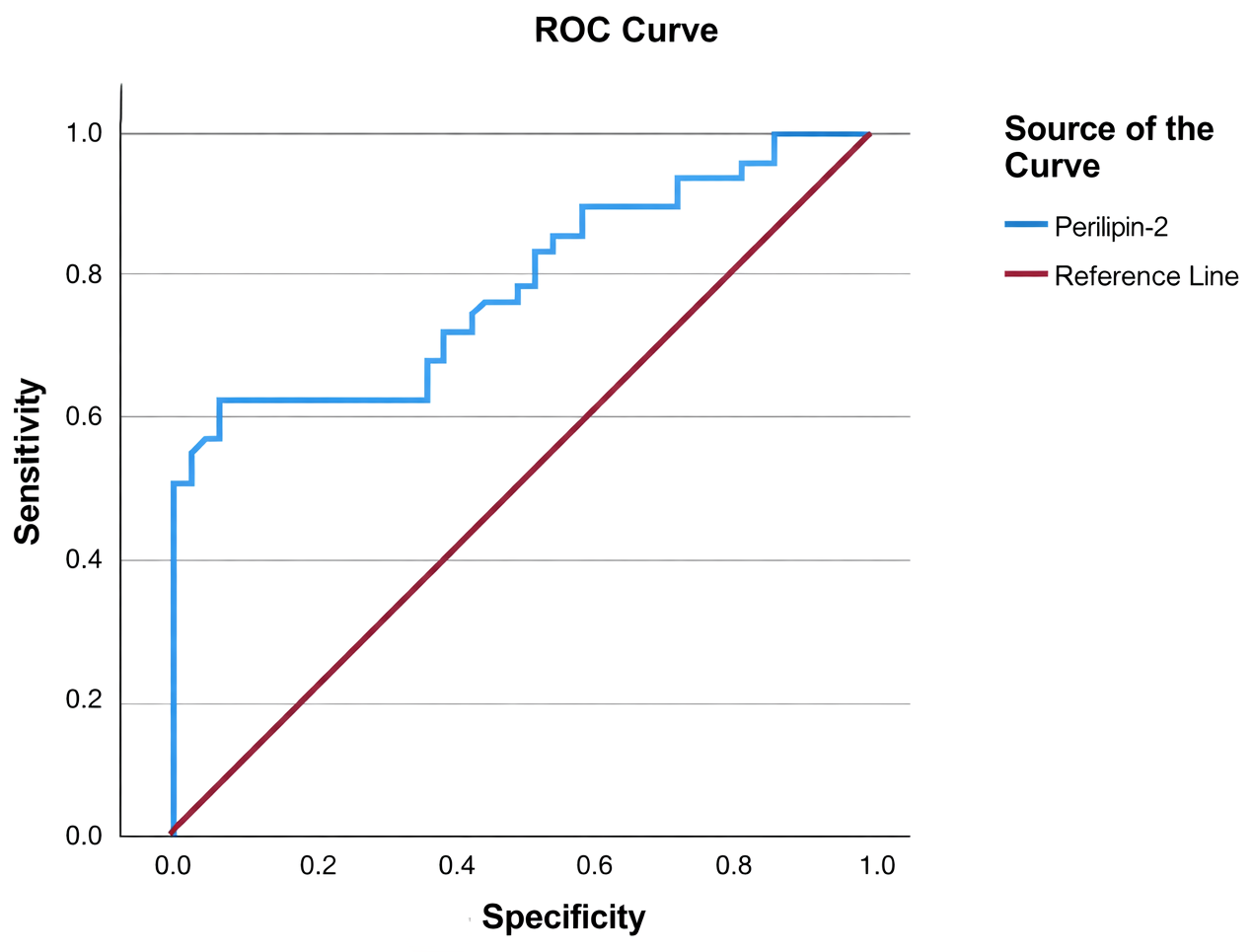
| Perilipin-2 | 0.784 (0.689–0.879) | 5.52 | 50 | 97.77 | <0.05 |
Disclaimer/Publisher’s Note: The statements, opinions and data contained in all publications are solely those of the individual author(s) and contributor(s) and not of MDPI and/or the editor(s). MDPI and/or the editor(s) disclaim responsibility for any injury to people or property resulting from any ideas, methods, instructions or products referred to in the content. |
© 2025 by the authors. Licensee MDPI, Basel, Switzerland. This article is an open access article distributed under the terms and conditions of the Creative Commons Attribution (CC BY) license.
Share and Cite
Alpaydin, O.V.; Duran, E.N.; Hur Alpaydin, A.; Ekinci, I.; Dumur, S.; Uzun, H.; Akarsu, M.; Yalcinkaya, I.; Tabak, O. The Importance of Serum Perilipin-2 Level as an Early Indicator of Inflammation in Non-Alcoholic Fatty Liver Disease. Diagnostics 2026, 16, 106. https://doi.org/10.3390/diagnostics16010106
Alpaydin OV, Duran EN, Hur Alpaydin A, Ekinci I, Dumur S, Uzun H, Akarsu M, Yalcinkaya I, Tabak O. The Importance of Serum Perilipin-2 Level as an Early Indicator of Inflammation in Non-Alcoholic Fatty Liver Disease. Diagnostics. 2026; 16(1):106. https://doi.org/10.3390/diagnostics16010106
Chicago/Turabian StyleAlpaydin, Omer Vehbi, Eda Nur Duran, Ayse Hur Alpaydin, Iskender Ekinci, Seyma Dumur, Hafize Uzun, Murat Akarsu, Isa Yalcinkaya, and Omur Tabak. 2026. "The Importance of Serum Perilipin-2 Level as an Early Indicator of Inflammation in Non-Alcoholic Fatty Liver Disease" Diagnostics 16, no. 1: 106. https://doi.org/10.3390/diagnostics16010106
APA StyleAlpaydin, O. V., Duran, E. N., Hur Alpaydin, A., Ekinci, I., Dumur, S., Uzun, H., Akarsu, M., Yalcinkaya, I., & Tabak, O. (2026). The Importance of Serum Perilipin-2 Level as an Early Indicator of Inflammation in Non-Alcoholic Fatty Liver Disease. Diagnostics, 16(1), 106. https://doi.org/10.3390/diagnostics16010106