


Heart Failure Alert Duration and Time at Risk of Heart Failure as Potential Modifier Factors of the TriageHF Algorithm in Remote Monitoring of Heart Failure: A Cohort Study
 , ,
, ,
Abstract
1. Introduction
2. Materials and Methods
2.1. Hypothesis
2.2. Objectives
- To perform a first analysis, in which moderate-risk alerts where the duration was less than 7 days were not considered, and use these results to make a further comparison varying the threshold.
- To test if considering positive alerts as only moderate-risk alerts where the length was longer than 15 days results in better specificity.
- To test if there are differences in the characteristics of the sample when dividing them into three groups according to their level of heart failure risk during the follow-up.
- To test if there are differences in the basal characteristics and the clinical follow-up of the sample depending on the occurrence of a heart failure episode.
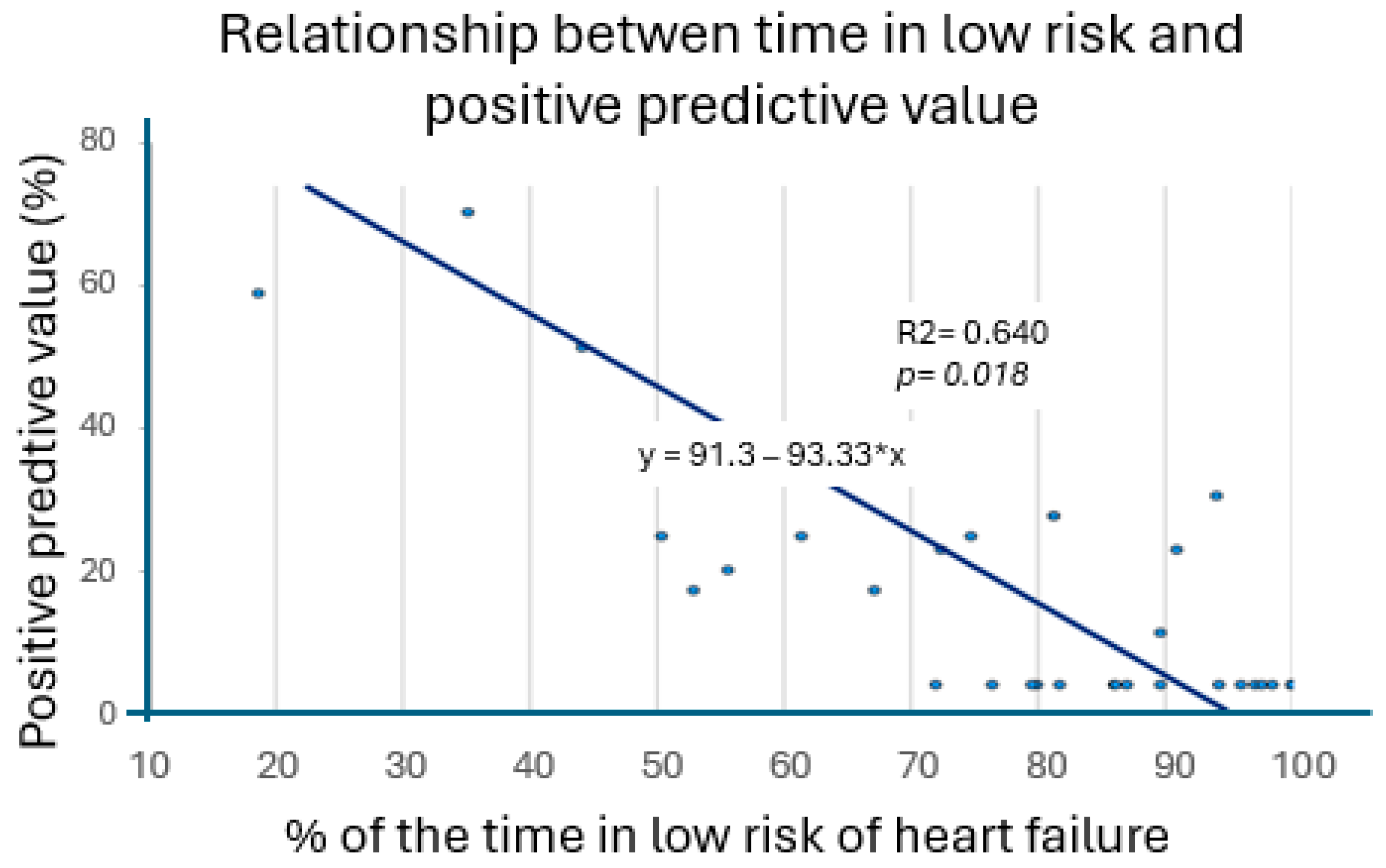
- To analyze if there is a relationship between the time spent in low risk and the positive predictive value of the TriageHF alerts.
2.3. Study Population
2.4. Patient Follow-Up
2.5. Statistical Analysis
3. Results
3.1. Population Characteristics
3.2. Alert Analysis
3.3. Prespecified 15-Day Cutoff Analysis
3.4. Population Follow-Up
3.5. Relationship Between Time at Risk of Heart Failure and Positive Predictive Value
4. Discussion
5. Conclusions
Author Contributions
Funding
Institutional Review Board Statement
Informed Consent Statement
Data Availability Statement
Conflicts of Interest
Abbreviations
| ACE-I | Angiotensin-Converting Enzyme Inhibitor |
| ARA-II | Angiotensin Receptor Antagonist |
| ARNI | Angiotensin Receptor–Neprilysin Inhibitor |
| COPD | Chronic Obstructive Pulmonary Disease |
| CRT-ICD | Cardiac Resynchronization Therapy with Implantable Cardioverter Defibrillator |
| HF | Heart Failure |
| ICDs | Implantable Cardioverter Defibrillators |
| LVEF | Left Ventricular Ejection Fraction |
| MRA | Mineralocorticoid Receptor Antagonist |
| NYHA | New York Heart Association |
| PPV | Positive Predictive Value |
| SGLT2-I | Sodium–Glucose Cotransporter 2 Inhibitor |
| TriageHF | Triage Heart Failure |
References
- Emmons-Bell, S.; Johnson, C.; Roth, G. Prevalence, incidence and survival of heart failure: A systematic review. Heart 2022, 108, 1351–1360. [Google Scholar] [CrossRef]
- McDonagh, T.A.; Metra, M.; Adamo, M.; Gardner, R.S.; Baumbach, A.; Böhm, M.; Burri, H.; Butler, J.; Čelutkienė, J.; Chioncel, O.; et al. 2021 ESC Guidelines for the diagnosis and treatment of acute and chronic heart failure. Eur. Heart J. 2021, 42, 3599–3726. [Google Scholar] [CrossRef] [PubMed]
- Campos-Arjona, R.; García-Pinilla, J.; de Teresa-Galván, E. Acute heart failure. Med. Clin. 2019, 12, 5237–5244. [Google Scholar] [CrossRef]
- Sicras-Mainar, A.; Sicras-Navarro, A.; Palacios, B.; Varela, L.; Delgado, J.F. Epidemiology and treatment of heart failure in Spain: The HF-PATHWAYS study. Rev. Esp. Cardiol. 2022, 75, 31–38. [Google Scholar] [CrossRef] [PubMed]
- Ponikowski, P.; Jankowska, E.A. Patogenia y presentación clínica de la insuficiencia cardiaca aguda. Rev. Esp. Cardiol. 2015, 68, 331–337. [Google Scholar] [CrossRef]
- Heidenreich, P.A.; Bozkurt, B.; Aguilar, D.; Allen, L.A.; Byun, J.J.; Colvin, M.M.; Deswal, A.; Drazner, M.H.; Dunlay, S.M.; Evers, L.R.; et al. 2022 AHA/ACC/HFSA Guideline for the Management of Heart Failure. Circulation 2022, 145, 895–1032. [Google Scholar] [CrossRef]
- Almendral, J.; Pombo, M.; Martínez-Alday, J.; González-Rebollo, J.M.; Rodríguez-Font, E.; Martínez-Ferrer, J.; Castellanos, E.; García-Fernández, F.J.; Ruiz-Mateas, F. Update on Arrhythmias and Cardiac Pacing 2013. Rev. Esp. Cardiol. 2014, 67, 294–304. [Google Scholar] [CrossRef]
- Shun-Shin, M.J.; Zheng, S.L.; Cole, G.D.; Howard, J.P.; Whinnett, Z.I.; Francis, D.P. Implantable cardioverter defibrillators for primary prevention of death in left ventricular dysfunction. Eur. Heart J. 2017, 38, 1738–1746. [Google Scholar] [CrossRef]
- Adamson, P.B.; Smith, A.L.; Abraham, W.T.; Kleckner, K.J.; Stadler, R.W.; Shih, A.; Rhodes, M.M. Prognostic value of heart rate variability measured by a CRT device. Circulation 2004, 110, 2389–2394. [Google Scholar] [CrossRef]
- Sarkar, S.; Koehler, J.; Crossley, G.H.; Tang, W.W.; Abraham, W.T.; Warman, E.N.; Whellan, D.J. AF burden and risk for HF hospitalization. Am. Heart J. 2012, 164, 616–624. [Google Scholar] [CrossRef]
- van Veldhuisen, D.J.; Braunschweig, F.; Conraads, V.; Ford, I.; Cowie, M.R.; Jondeau, G.; Kautzner, J.; Aguilera, R.M.; Lunati, M.; Yu, C.M.; et al. Intrathoracic impedance monitoring and outcomes. Circulation 2011, 124, 1719–1726. [Google Scholar] [CrossRef] [PubMed]
- Bertini, M.; Vitali, F.; Santini, L.; Tavoletta, V.; Giano, A.; Savarese, G.; Russo, A.D.; Santobuono, V.E.; Mattera, A.; Lavalle, C.; et al. ICD-detected HF status predicts AF occurrence. Heart Rhythm 2022, 19, 790–797. [Google Scholar] [CrossRef] [PubMed]
- Capucci, A.; Wong, J.A.; Gold, M.R.; Boehmer, J.; Ahmed, R.; Kwan, B.; Thakur, P.H.; Zhang, Y.; Jones, P.W.; Healey, J.S. Temporal Association of AF With Device-Detected HF Status. JACC Clin. Electrophysiol. 2022, 8, 182–193. [Google Scholar] [CrossRef] [PubMed]
- Gula, L.J.; Wells, G.A.; Yee, R.; Koehler, J.; Sarkar, S.; Sharma, V.; Skanes, A.C.; Sapp, J.L.; Redfearn, D.P.; Manlucu, J.; et al. Algorithm to assess HF exacerbation risk using ICD diagnostics: RAFT validation. Heart Rhythm 2014, 11, 1626–1631. [Google Scholar] [CrossRef]
- Cowie, M.R.; Sarkar, S.; Koehler, J.; Whellan, D.J.; Crossley, G.H.; Tang, W.H.W.; Abraham, W.T.; Sharma, V.; Santini, M. Integrated diagnostic algorithm for HF hospitalization risk. Eur. Heart J. 2013, 34, 2472–2480. [Google Scholar] [CrossRef]
- Virani, S.A.; Sharma, V.; McCann, M.; Koehler, J.; Tsang, B.; Zieroth, S. TRIAGE-HF study results. ESC Heart Fail. 2018, 5, 809–817. [Google Scholar] [CrossRef]
- Boehmer, J.P.; Hariharan, R.; Devecchi, F.G.; Smith, A.L.; Molon, G.; Capucci, A.; An, Q.; Averina, V.; Stolen, C.M.; Thakur, P.H.; et al. Multisensor algorithm predicts HF events. JACC Heart Fail. 2017, 5, 216–225. [Google Scholar] [CrossRef]
- Morgan, J.M.; Kitt, S.; Gill, J.; McComb, J.M.; Ng, G.A.; Raftery, J.; Roderick, P.; Seed, A.; Williams, S.G.; Witte, K.K.; et al. Remote management of HF using implantable devices. Eur. Heart J. 2017, 38, 2352–2360. [Google Scholar] [CrossRef]
- Whellan, D.J.; Ousdigian, K.T.; Al-Khatib, S.M.; Pu, W.; Sarkar, S.; Porter, C.B.; Pavri, B.B.; O’Connor, C.M. Combined HF device diagnostics and risk of hospitalization: PARTNERS-HF. J. Am. Coll. Cardiol. 2010, 55, 1803–1810. [Google Scholar] [CrossRef]
- Santini, M.; Gasparini, M.; Landolina, M.; Lunati, M.; Proclemer, A.; Padeletti, L.; Catanzariti, D.; Molon, G.; Botto, G.L.; La Rocca, L.; et al. Device-detected atrial tachyarrhythmias predict outcomes. J. Am. Coll. Cardiol. 2011, 57, 167–172. [Google Scholar] [CrossRef]
- Ahmed, F.Z.; Taylor, J.K.; Green, C.; Moore, L.; Goode, A.; Black, P.; Howard, L.; Fullwood, C.; Zaidi, A.; Seed, A.; et al. Triage-HF Plus remote monitoring pathway. ESC Heart Fail. 2020, 7, 107–116. [Google Scholar] [CrossRef]
- Zile, M.R.; Sharma, V.; Baicu, C.F.; Koehler, J.; Tang, A.S. Intrathoracic impedance-based prediction of HF hospitalization. ESC Heart Fail. 2020, 7, 3040–3048. [Google Scholar] [CrossRef] [PubMed]
- Zile, M.R.; Costanzo, M.R.R.; Ippolito, E.M.; Zhang, Y.; Stapleton, R.; Sadhu, A.; Jimenez, J.; Hobbs, J.; Sharma, V.; Warman, E.N.; et al. INTERVENE-HF feasibility study. ESC Heart Fail. 2021, 8, 849–860. [Google Scholar] [CrossRef] [PubMed]
- Ahmed, F.Z.; Sammut-Powell, C.; Kwok, C.S.; Tay, T.; Motwani, M.; Martin, G.P.; Taylor, J.K. Remote monitoring data predicts mortality. Europace 2022, 24, 245–255. [Google Scholar] [CrossRef]
- Bagudá, J.d.J.; Gómez, J.J.G.; Iglesias, M.P.; León, R.C.; Pérez, V.E.; Fernández, Ó.G.; Gándara, N.R.; Artaza, J.G.; Molina, B.D.; Gallego, A.M.; et al. Remote HF management using HeartLogic: RE-HEART registry. Rev. Esp. Cardiol. 2022, 75, 709–716. [Google Scholar] [CrossRef]
- Kolk, M.Z.H.; Narayan, S.M.; Clopton, P.; Wilde, A.A.M.; E Knops, R.; Tjong, F.V.Y. Remote device monitoring reduces mortality in ICD patients. Europace 2023, 25, 969–977. [Google Scholar] [CrossRef]
- Mittal, S.; Piccini, J.P.; Snell, J.; Prillinger, J.B.; Dalal, N.; Varma, N. Improved survival with early remote monitoring enrollment. J. Interv. Card. Electrophysiol. 2016, 46, 129–136. [Google Scholar] [CrossRef]
- Heath, K.; O’sHea, C.; Thomas, G.; Harper, C.; Campbell, K.; Sanders, P.; Middeldorp, M.E. Impact of intensive remote follow-up: Pilot study. Heart Rhythm O2 2023, 4, 90–96. [Google Scholar] [CrossRef]
- R Core Team. R: A Language and Environment for Statistical Computing; R Foundation for Statistical Computing: Vienna, Austria, 2021. [Google Scholar]
- Zile, M.R.; Koehler, J.; Sarkar, S.; Butler, J. Prediction of worsening HF and mortality using individualized risk stratification. ESC Heart Fail. 2020, 7, 4277–4289. [Google Scholar] [CrossRef]
- Matteucci, A.; Bonanni, M.; Centioni, M.; Zanin, F.; Geuna, F.; Massaro, G.; Sangiorgi, G. Home management of heart failure and arrhythmias in patients with cardiac devices during pandemic. J. Clin. Med. 2021, 10, 1618. [Google Scholar] [CrossRef]

| VARIABLE | TRIAGE-HF (N = 37) |
|---|---|
| Male sex | 30 (81%) |
| Mean age at implantation | 63.86 (+/−11.407) |
| CRT-ICD | 31 (83%) |
| Ischemic cardiomyopathy | 16 (43%) |
| Primary prevention implantation | 29 (78%) |
| Arterial hypertension | 24 (65%) |
| Diabetes mellitus | 12 (32.4%) |
| Chronic kidney disease | 7 (19%) |
| Dyslipidemia | 19 (51.3%) |
| Previous smoking | 21 (58%) |
| Previous COPD | 5 (13.5%) |
| Atrial fibrillation | 10 (27%) |
| 2 (5.4%) |
| 8 (21.6%) |
| Previous left ventricle ejection fraction (LVEF) | |
| 4 (10.8%) |
| 1 (2.7%) |
| 6 (16.21%) |
| 26 (70.27%) |
| Previous treatment | |
| 30 (81%) |
| 16 (43%) |
| 18 (49%) |
| 14 (37.8%) |
| 11 (28%) |
| Previous NYHA functional class | |
| 2 (5.4%) |
| 27 (72.9%) |
| 6 (16.2%) |
| 2 (5.4%) |
| Mean follow-up (days +/− SD) | 494.8 (+/−276.6) |
| Confirmed positive cases | 31 |
| Clinical HF episodes/patient (mean +/− SD) | 0.837 (+/−1.726) |
| Default Configuration | Positive If 15 Days or More in Moderate Risk | |
|---|---|---|
| Total number of alerts | 609 | 609 |
| Positive cases | 31 | 31 |
| Negative cases | 578 | 578 |
| Positive alerts | 166 | 111 |
| Negative alerts | 443 | 498 |
| True positive alerts | 30 | 27 |
| False positive alerts | 136 | 84 |
| True negative alerts | 442 | 494 |
| False negative alerts | 1 | 4 |
| Sensibility | 96.7% | 87% |
| Specificity | 76.4% | 85.6% |
| Positive predictive value | 18% | 24.3% |
| Negative positive value | 99.7% | 99.1% |
| VARIABLE | ONLY LOW RISK (N = 8) | ONLY MODERATE RISK (N = 18) | HIGH RISK (N = 11) | p |
|---|---|---|---|---|
| Male sex | 5 (62.5%) | 16 (88.8%) | 9 (81.81%) | 0.284 |
| Mean age at implantation | 58.12 +/− 4.09 | 64.278 +/− 2.72 | 67.36 +/− 3.48 | <0.001 |
| CRT-ICD | 7 (87.5%) | 15 (83.3%) | 9 (81.81%) | 0.944 |
| Ischemic cardiomyopathy | 2 (25%) | 8 (44.4%) | 6 (54.54%) | 0.434 |
| Primary prevention implantation | 7 (87.5%) | 12 (66.6%) | 10 (90.9%) | 0.238 |
| Arterial hypertension | 5 (62.5%) | 11 (61%) | 8 (72.7%) | 0.807 |
| Diabetes mellitus | 1 (12.5%) | 8 (44.4%) | 3 (27.27%) | 0.250 |
| Chronic kidney disease | 0 (0%) | 3 (16.6%) | 5 (45%) | 0.046 * |
| Previous COPD | 0 (0%) | 4 (22%) | 1 (9%) | 0.272 |
| Atrial fibrillation | 2 (25%) | 4 (22%) | 4 (36%) | 0.790 |
| 0 (0%) | 1 (5%) | 1 (9%) | |
| 2 (25%) | 3 (16.6%) | 3 (27.27%) | |
| Previous LVEF | 0.367 | |||
| 1 (12.5%) | 3 (16.6%) | 0 (0%) | |
| 1 (12.5%) | 0 (0%) | 0 (0%) | |
| 1 (12.5%) | 4 (22.2%) | 1 (9%) | |
| 5 (62.5%) | 11 (61.2%) | 10 (91%) | |
| Previous treatment | ||||
| 7 (87.5%) | 13 (72.2%) | 10 (91%) | 0.560 |
| 3 (37.5%) | 7 (38.38%) | 6 (54.54%) | 0.684 |
| 5 (62.5%) | 7 (38.38%) | 6 (54.54%) | 0.247 |
| 4 (50%) | 5 (27.77%) | 5 (45.45%) | 0.537 |
| 5 (62.5%) | 5 (27.77%) | 1 (9%) | 0.69 |
| Chronic diuretic treatment | 5 (62.5%) | 7 (38.38%) | 11 (100%) | 0.028 * |
| Islgt2 during follow-up | 8 (100%) | 11 (61.11%) | 5 (45.45%) | 0.044 * |
| Previous NYHA | 0.905 | |||
| 1 (12.5%) | 1 (5.5%) | 0 (0%) | |
| 6 (75%) | 13 (72.2%) | 8 (72.7%) | |
| 1 (12.5%) | 3 (16.6%) | 2 (18.18%) | |
| 0 (0%) | 1 (5.5%) | 1 (9.09%) | |
| Mean follow-up (days +/− SD) | 349.3 +/− 99.1 | 512 +/− 66.09 | 575 +/− 84.053 | 0.001 * |
| Confirmed positive cases | 0 (0%) | 7 (22.58%) | 24 (77.41%) | 0.04 * |
| Clinical HF episodes/patient (mean +/− SD) | 0 (0%) | 0.388 | 2.18 | |
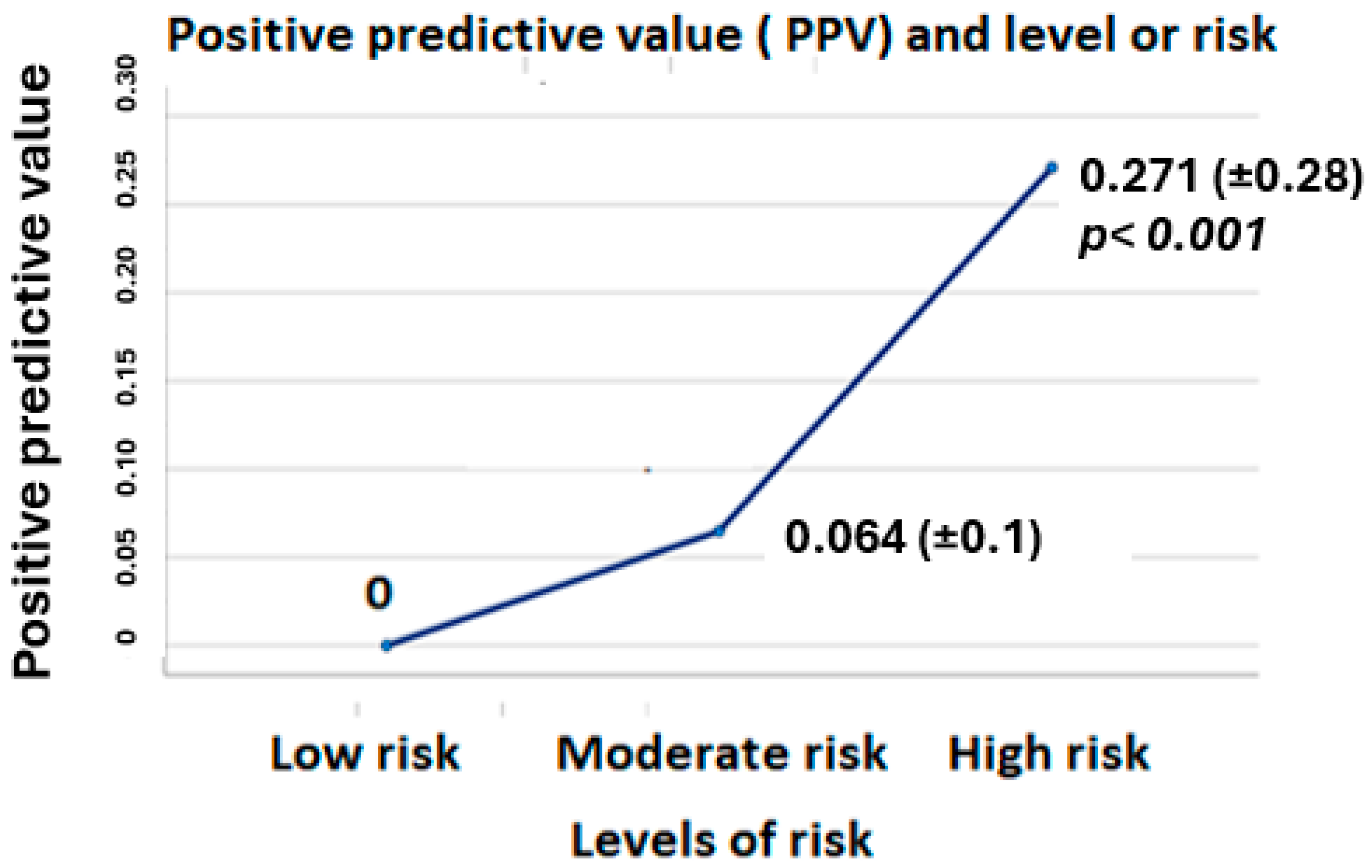
| % of time at low risk | 100 (+/−0) | 84.705 (+/−12.92) | 60.59 (+/−21.1) | <0.001 * |
| PPV | 0 | 0.064 (+/−0.1) | 0.271 (+/−0.28) | <0.001 * |
| VARIABLE | HF EPISODE (N = 14) | NOT IC EPISODE (N = 23) | p |
|---|---|---|---|
| Male sex | 12 (85.71%) | 18 (78.2%) | 0.459 |
| Mean age at implantation | 66.57 (+/−9.7) | 62.22 (+/−12.24) | 0.24 |
| CRT-ICD | 12 (85.71%) | 19 (82.6%) | 0.593 |
| Ischemic cardiomyopathy | 7 (50%) | 9 (39.13%) | 0.379 |
| Primary prevention implantation | 12 (85.71%) | 17 (73.9%) | 0.340 |
| Arterial hypertension | 10 (71.42%) | 14 (60.8%) | 0.387 |
| Diabetes mellitus | 5 (35.71%) | 7 (30.43%) | 0.507 |
| Chronic kidney disease | 3 (21.42%) | 5 (21.73%) | 0.215 |
| Previous COPD | 1 (7.14%) | 4 (22.22%) | 0.63 |
| Atrial fibrillation | 0.935 | ||
| 1 (7.14%) | 1 (4.34%) | |
| 3 (21.42%) | 5 (21.73%) | |
| Previous LVEF | |||
| 1 (7.14%) | 3 (13.04%) | 0.5 |
| 0 (0%) | 1 (4.34%) | |
| 1 (7.14%) | 5 (21.74%) | |
| 12 (85.71%) | 14 (60.87%) | |
| Previous treatment | |||
| 13 (92.85%) | 17 (73.9%) | 0.122 |
| 8 (57.14%) | 8 (34.78%) | 0.175 |
| 8 (57.14%) | 10 (43.47%) | 0.156 |
| 6 (42.85%) | 8 (34.78%) | 0.129 |
| 2 (14.28%) | 9 (39.13%) | 0.068 |
| Previous NYHA functional class | |||
| 0 (0%) | 2 (8.69%) | 0.684 |
| 11 (78.57%) | 16 (69.6%) | |
| 2 (14.28%) | 4 (17.4%) | |
| 1 (7.14%) | 1 (4.34%) | |
| Chronic diuretic treatment | 11 (78.57%) | 12 (52.17%) | 0.081 |
| ISGLT2 during follow-up | 7 (50%) | 17 (73.9%) | 0.131 |
| Mean follow-up (days +/− SD) | 628.86 +/− 255.028 | 415.04 +/− 255.08 | 0.240 |
| % of time at low risk | 62.17 (+/−21.14) | 92.20 (+/−8.267) | <0.001 * |
| PPV | 0.272 (+/−0.189) | 0.0142 (+/−0.053) | <0.001 * |
Disclaimer/Publisher’s Note: The statements, opinions and data contained in all publications are solely those of the individual author(s) and contributor(s) and not of MDPI and/or the editor(s). MDPI and/or the editor(s) disclaim responsibility for any injury to people or property resulting from any ideas, methods, instructions or products referred to in the content. |
© 2025 by the authors. Licensee MDPI, Basel, Switzerland. This article is an open access article distributed under the terms and conditions of the Creative Commons Attribution (CC BY) license (https://creativecommons.org/licenses/by/4.0/).
Share and Cite
Ledesma Oloriz, D.; García Iglesias, D.; di Massa, R.A.; Lorente Ros, Á.; López Iglesias, F.; Alonso Fernández, V.; Rubín López, J.M. Heart Failure Alert Duration and Time at Risk of Heart Failure as Potential Modifier Factors of the TriageHF Algorithm in Remote Monitoring of Heart Failure: A Cohort Study. Diagnostics 2025, 15, 3065. https://doi.org/10.3390/diagnostics15233065
Ledesma Oloriz D, García Iglesias D, di Massa RA, Lorente Ros Á, López Iglesias F, Alonso Fernández V, Rubín López JM. Heart Failure Alert Duration and Time at Risk of Heart Failure as Potential Modifier Factors of the TriageHF Algorithm in Remote Monitoring of Heart Failure: A Cohort Study. Diagnostics. 2025; 15(23):3065. https://doi.org/10.3390/diagnostics15233065
Chicago/Turabian StyleLedesma Oloriz, David, Daniel García Iglesias, Rodrigo Ariel di Massa, Álvaro Lorente Ros, Fernando López Iglesias, Vanesa Alonso Fernández, and José Manuel Rubín López. 2025. "Heart Failure Alert Duration and Time at Risk of Heart Failure as Potential Modifier Factors of the TriageHF Algorithm in Remote Monitoring of Heart Failure: A Cohort Study" Diagnostics 15, no. 23: 3065. https://doi.org/10.3390/diagnostics15233065
APA StyleLedesma Oloriz, D., García Iglesias, D., di Massa, R. A., Lorente Ros, Á., López Iglesias, F., Alonso Fernández, V., & Rubín López, J. M. (2025). Heart Failure Alert Duration and Time at Risk of Heart Failure as Potential Modifier Factors of the TriageHF Algorithm in Remote Monitoring of Heart Failure: A Cohort Study. Diagnostics, 15(23), 3065. https://doi.org/10.3390/diagnostics15233065

