Interferon-Gamma Release Assays Versus Tuberculin Skin Test for Active Tuberculosis Diagnosis: A Systematic Review and Diagnostic Meta-Analysis

 , , and
Abstract
1. Introduction
2. Methods
2.1. Literature Search
2.2. Eligibility Criteria
2.3. Data Collection
2.4. Quality Assessment
2.5. Data Synthesis
3. Results
3.1. Study Selection
3.2. Included Studies Characteristics
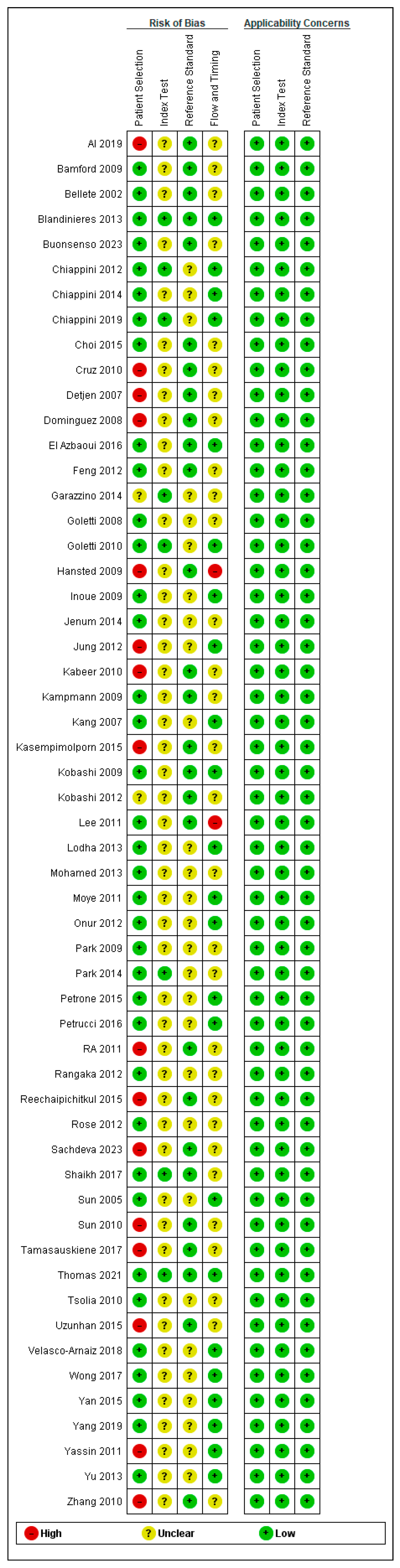
3.3. Quality Assessment Results
3.4. Diagnostic Meta-Analysis Outcomes
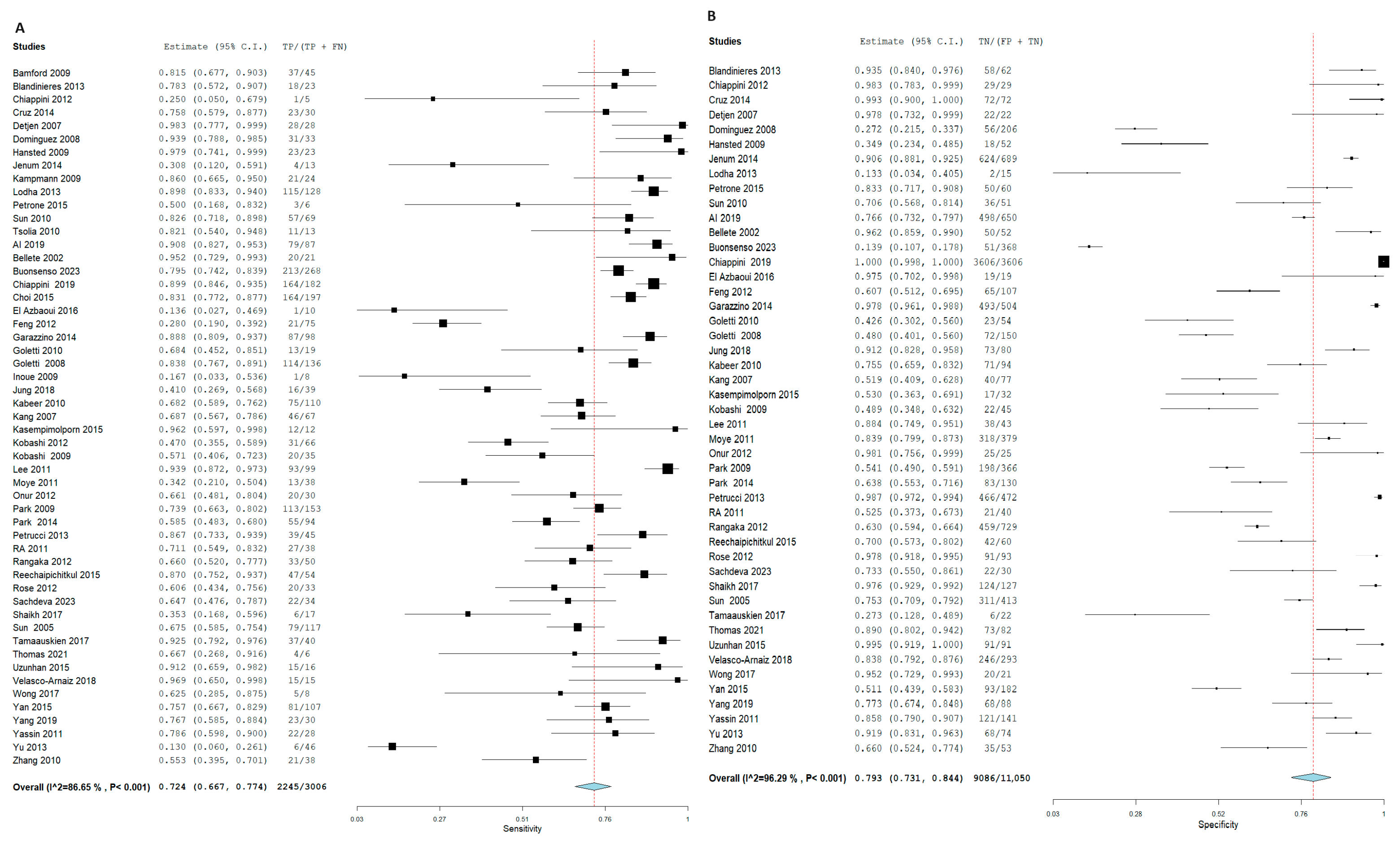
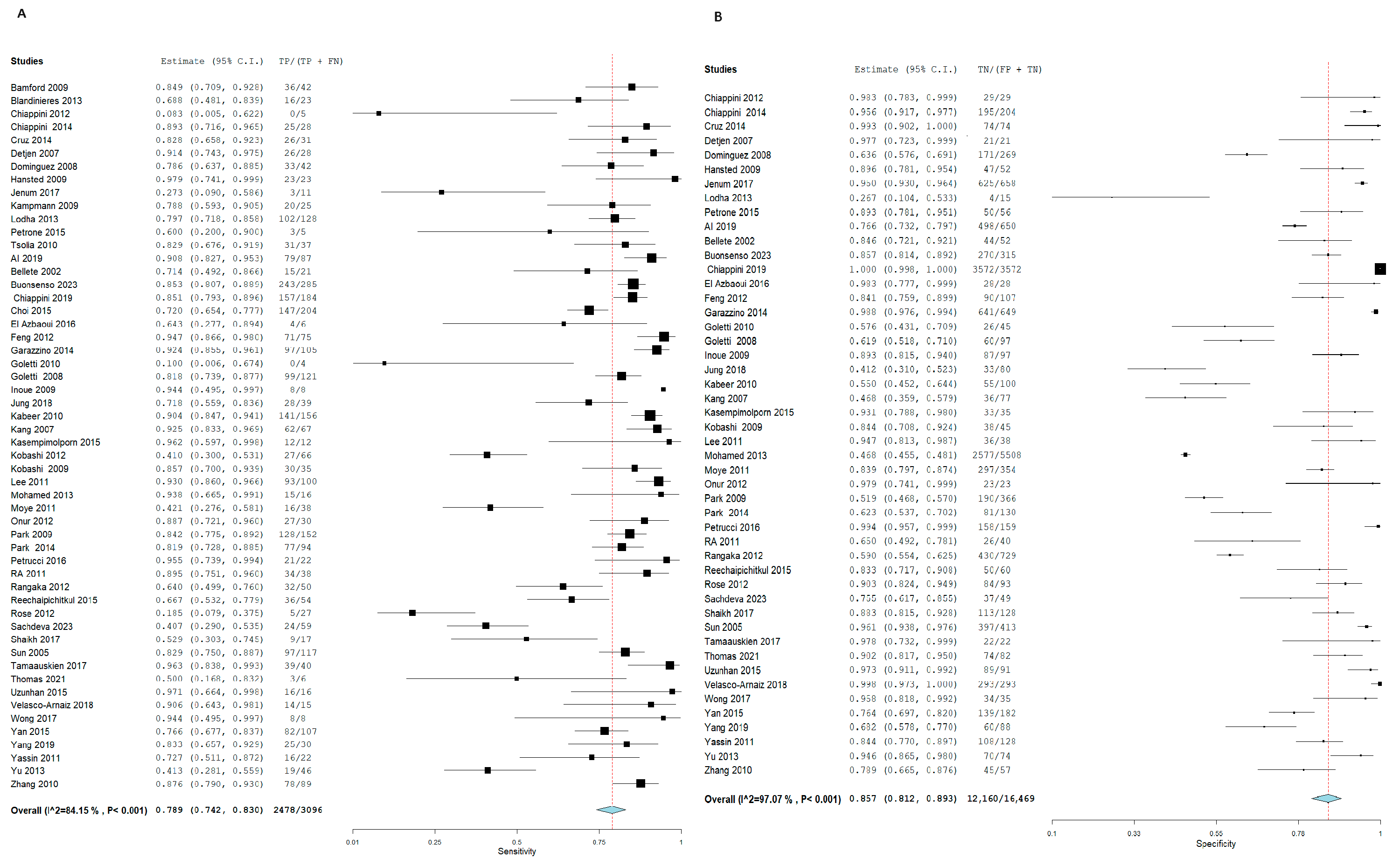
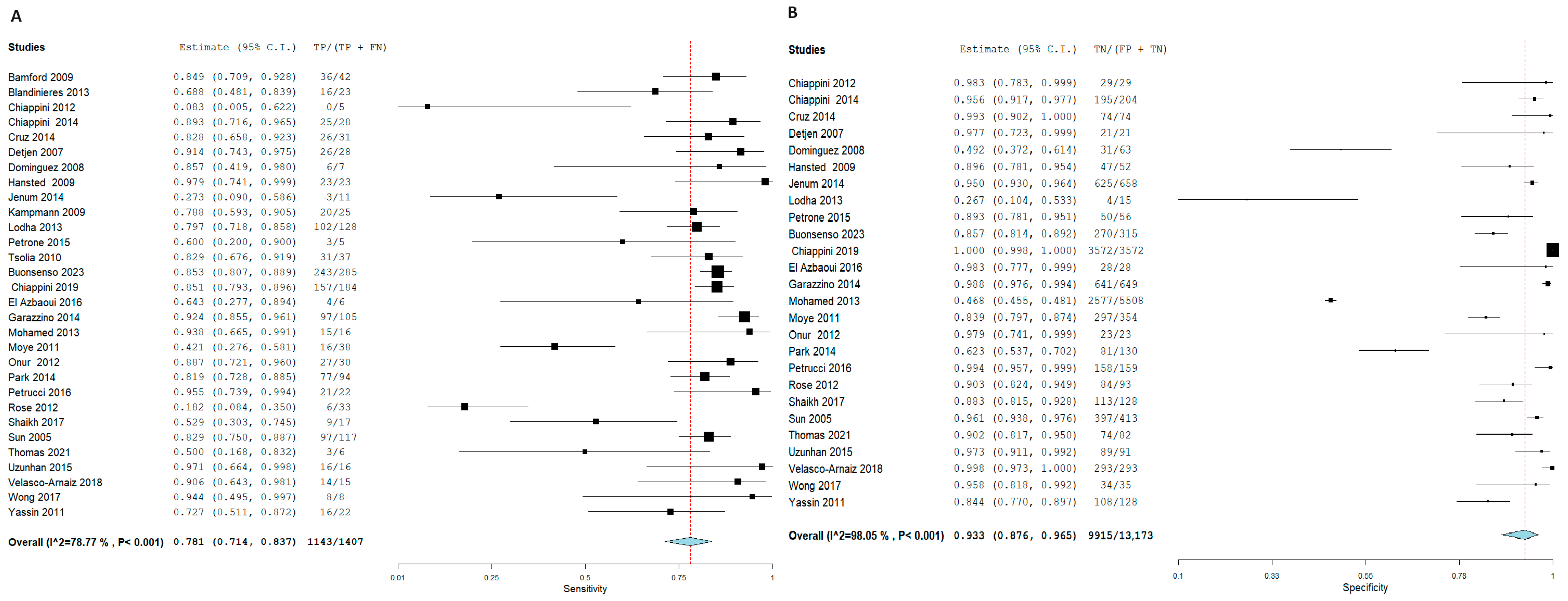
3.4.1. Overall
3.4.2. According to Age
Adult
Children
3.4.3. According to the Immunity Status
Immunocompromised
Immunocompetent
3.4.4. According to I.G.R.A. Type
3.4.5. According to the T.S.T. Cut-Off Value
4. Discussion
5. Conclusions
Supplementary Materials
Author Contributions
Funding
Institutional Review Board Statement
Informed Consent Statement
Data Availability Statement
Conflicts of Interest
References
- WHO. Global Tuberculosis Report 2023. Available online: https://www.who.int/teams/global-tuberculosis-programme/tb-reports (accessed on 10 May 2024).
- Dinnes, J.; Deeks, J.; Kunst, H.; Gibson, A.; Cummins, E.; Waugh, N.; Drobniewski, F.; Lalvani, A. A systematic review of rapid diagnostic tests for the detection of tuberculosis infection. Health Technol. Assess. 2007, 11, 1–196. [Google Scholar] [CrossRef]
- Pai, M.; Zwerling, A.; Menzies, D. Systematic review: T-cell-based assays for the diagnosis of latent tuberculosis infection: An update. Ann. Intern. Med. 2008, 149, 177–184. [Google Scholar] [CrossRef]
- Yang, J.; Kong, W.; Xv, N.; Huang, X.; Chen, X. Correlation between the tuberculin skin test and T-SPOT.TB in patients with suspected tuberculosis infection: A pilot study. Exp. Ther. Med. 2019, 18, 2250–2254. [Google Scholar] [CrossRef]
- Sun, L.; Xiao, J.; Miao, Q.; Feng, W.; Wu, X.; Yin, Q.; Jiao, W.; Shen, C.; Liu, F.; Shen, D.; et al. Interferon gamma release assay in diagnosis of pediatric tuberculosis: A meta-analysis. FEMS Immunol. Med. Microbiol. 2011, 63, 165–173. [Google Scholar] [CrossRef][Green Version]
- Sester, M.; Sotgiu, G.; Lange, C.; Giehl, C.; Girardi, E.; Migliori, G.B.; Bossink, A.; Dheda, K.; Diel, R.; Dominguez, J.; et al. Interferon-γ release assays for the diagnosis of active tuberculosis: A systematic review and meta-analysis. Eur. Respir. J. 2010, 37, 100–111. [Google Scholar] [CrossRef]
- Auguste, P.; Tsertsvadze, A.; Pink, J.; Court, R.; McCarthy, N.; Sutcliffe, P.; Clarke, A. Comparing interferon-gamma release assays with tuberculin skin test for identifying latent tuberculosis infection that progresses to active tuberculosis: Systematic review and meta-analysis. BMC Infect. Dis. 2017, 17, 200. [Google Scholar] [CrossRef]
- Auguste, P.; Madan, J.; Tsertsvadze, A.; Court, R.; McCarthy, N.; Sutcliffe, P.; Taylor-Phillips, S.; Pink, J.; Clarke, A. Identifying latent tuberculosis in high-risk populations: Systematic review and meta-analysis of test accuracy. Int. J. Tuberc. Lung Dis. 2019, 23, 1178–1190. [Google Scholar] [CrossRef]
- De Keyser, E.; De Keyser, F.; De Baets, F. Tuberculin skin test versus interferon-gamma release assays for the diagnosis of tuberculosis infection. Acta Clin. Belg. 2014, 69, 358–366. [Google Scholar] [CrossRef]
- Nasiri, M.J.; Pormohammad, A.; Goudarzi, H.; Mardani, M.; Zamani, S.; Migliori, G.B.; Sotgiu, G. Latent tuberculosis infection in transplant candidates: A systematic review and meta-analysis on TST and IGRA. Infection 2019, 47, 353–361. [Google Scholar] [CrossRef]
- Higgins, J.P.T.; Thomas, J.; Chandler, J.; Cumpston, M.; Li, T.; Page, M.J.; Welch, V.A. Cochrane Handbook for Systematic Reviews of Interventions, 2nd ed.; Higgins, J.P.T., Thomas, J., Chandler, J., Cumpston, M., Li, T., Page, M.J., Welch, V.A., Eds.; John Wiley & Sons: Chichester, UK, 2019. [Google Scholar]
- Page, M.J.; McKenzie, J.E.; Bossuyt, P.M.; Boutron, I.; Hoffmann, T.C.; Mulrow, C.D.; Shamseer, L.; Tetzlaff, J.M.; Akl, E.A.; Brennan, S.E.; et al. The PRISMA 2020 statement: An updated guideline for reporting systematic reviews. BMJ 2021, 372, n71. [Google Scholar] [CrossRef]
- Whiting, P.F.; Rutjes, A.W.S.; Westwood, M.E.; Mallett, S.; Deeks, J.J.; Reitsma, J.B.; Leeflang, M.M.G.; Sterne, J.A.C.; Bossuyt, P.M.M.; QUADAS-2 Group. QUADAS-2: A revised tool for the quality assessment of diagnostic accuracy studies. Ann. Intern. Med. 2011, 155, 529–536. [Google Scholar] [CrossRef]
- Ai, L.; Feng, P.; Chen, D.; Chen, S.; Xu, H. Clinical value of interferon-γ release assay in the diagnosis of active tuberculosis. Exp. Ther. Med. 2019, 18, 1253–1257. [Google Scholar] [CrossRef]
- Azbaoui, S.E.; Sabri, A.; Ouraini, S.; Hassani, A.; Asermouh, A.; Agadr, A.; Abilkassem, R.; Dini, N.; Kmari, M.; Akhaddar, A.; et al. Utility of the QuantiFERON®-TB Gold In-Tube assay for the diagnosis of tuberculosis in Moroccan children. Int. J. Tuberc. Lung Dis. 2016, 20, 1639–1646. [Google Scholar] [CrossRef]
- Bamford, A.R.J.; Crook, A.M.; Clark, J.E.; Nademi, Z.; Dixon, G.; Paton, J.Y.; Riddell, A.; Drobniewski, F.; Riordan, A.; Anderson, S.T.; et al. Comparison of interferon- release assays and tuberculin skin test in predicting active tuberculosis (TB) in children in the UK: A paediatric TB network study. Arch. Dis. Child. 2010, 95, 180–186. [Google Scholar] [CrossRef]
- Bellete, B.; Coberly, J.; Barnes, G.L.; Ko, C.; Chaisson, R.E.; Comstock, G.W.; Bishai, W.R. Evaluation of a Whole-Blood Interferon-g Release Assay for the Detection of Mycobacterium tuberculosis Infection in 2 Study Populations. Clin. Infect. Dis. 2002, 34, 1449–1456. [Google Scholar] [CrossRef][Green Version]
- Blandinières, A.; De Lauzanne, A.; Guérin-El Khourouj, V.; Gourgouillon, N.; See, H.; Pédron, B.; Faye, A.; Sterkers, G. QuantiFERON to diagnose infection by Mycobacterium tuberculosis: Performance in infants and older children. J. Infect. 2013, 67, 391–398. [Google Scholar] [CrossRef]
- Boom, J.A.; Tate, J.E.; Sahni, L.C.; Rench, M.A.; Quaye, O.; Mijatovic-Rustempasic, S.; Patel, M.M.; Baker, C.J.; Parashar, U.D. Sustained Protection from Pentavalent Rotavirus Vaccination During The Second Year of Life AT A Large, Urban United States Pediatric Hospital. Pediatr. Infect. Dis. J. 2010, 29, 1133–1135. [Google Scholar] [CrossRef]
- Buonsenso, D.; Noguera-Julian, A.; Moroni, R.; Hernández-Bartolomé, A.; Fritschi, N.; Lancella, L.; Cursi, L.; Soler-Garcia, A.; Krüger, R.; Feiterna-Sperling, C.; et al. Performance of QuantiFERON-TB Gold Plus assays in paediatric tuberculosis: A multicentre PTBNET study. Thorax 2023, 78, 288–296. [Google Scholar] [CrossRef]
- Chiappini, E.; Storelli, F.; Tersigni, C.; Venturini, E.; de Martino, M.; Galli, L. QuantiFERON-TB Gold In-Tube test performance in a large pediatric population investigated for suspected tuberculosis infection. Paediatr. Respir. Rev. 2019, 32, 36–47. [Google Scholar] [CrossRef]
- Chiappini, E.; Bonsignori, F.; Mazzantini, R.; Sollai, S.; Venturini, E.; Mangone, G.; Cortimiglia, M.; Olivito, B.; Azzari, C.; Galli, L.; et al. Interferon-Gamma Release Assay Sensitivity in Children Younger Than 5 Years is Insufficient To Replace The Use of Tuberculin Skin Test In Western Countries. Pediatr. Infect. Dis. J. 2014, 33, 1291–1293. [Google Scholar] [CrossRef]
- Chiappini, E.; Della Bella, C.; Bonsignori, F.; Sollai, S.; Amedei, A.; Galli, L.; Niccolai, E.; Del Prete, G.; Singh, M.; D’Elios, M.M.; et al. Potential Role of M. tuberculosis Specific IFN-γ and IL-2 ELISPOT Assays in Discriminating Children with Active or Latent Tuberculosis. PLoS ONE 2012, 7, e46041. [Google Scholar] [CrossRef]
- Choi, J.C.; Jarlsberg, L.G.; Grinsdale, J.A.; Osmond, D.H.; Higashi, J.; Hopewell, P.C.; Kato-Maeda, M. Reduced sensitivity of the QuantiFERON® test in diabetic patients with smear-negative tuberculosis. Int. J. Tuberc. Lung Dis. 2015, 19, 582–588. [Google Scholar] [CrossRef]
- Cruz, A.T.; Geltemeyer, A.M.; Starke, J.R.; Flores, J.A.; Graviss, E.A.; Smith, K.C. Comparing the Tuberculin Skin Test and T-SPOT.TB Blood Test in Children. Pediatrics 2011, 127, e31–e38. [Google Scholar] [CrossRef]
- Detjen, A.K.; Keil, T.; Roll, S.; Hauer, B.; Mauch, H.; Wahn, U.; Magdorf, K. Interferon- Release Assays Improve the Diagnosis of Tuberculosis and Nontuberculous Mycobacterial Disease in Children in a Country with a Low Incidence of Tuberculosis. Clin. Infect. Dis. 2007, 45, 322–328. [Google Scholar] [CrossRef]
- Domınguez, J.; Ruiz-Manzano, J.; Souza-Galvao, M.D.; Latorre, I.; Mila, C.; Blanco, S.; Jiménez, M.A.; Prat, C.; Lacoma, A.; Altet, N.; et al. Comparison of Two Commercially Available Gamma Interferon Blood Tests for Immunodiagnosis of Tuberculosis. Clin. Vaccine Immunol. 2008, 15, 168–171. [Google Scholar] [CrossRef]
- Feng, Y.; Diao, N.; Shao, L.; Wu, J.; Zhang, S.; Jin, J.; Wang, F.; Weng, X.; Zhang, Y.; Zhang, W. Interferon-Gamma Release Assay Performance in Pulmonary and Extrapulmonary Tuberculosis. PLoS ONE 2012, 7, e32652. [Google Scholar] [CrossRef]
- Garazzino, S.; Galli, L.; Chiappini, E.; Pinon, M.; Bergamini, B.M.; Cazzato, S.; Dal Monte, P.; Dodi, I.; Lancella, L.; Esposito, S.; et al. Performance of interferon-γ Release Assay for the Diagnosis of Active or Latent Tuberculosis in Children in the First 2 Years of Age: A Multicenter Study of the Italian Society of Pediatric Infectious Diseases. Pediatr. Infect. Dis. J. 2014, 33, e226–e231. [Google Scholar] [CrossRef]
- Goletti, D.; Raja, A.; Kabeer, B.S.A.; Rodrigues, C.; Sodha, A.; Butera, O.; Carrara, S.; Vernet, G.; Longuet, C.; Ippolito, G.; et al. IFN-γ, but not IP-10, MCP-2 or IL-2 response to RD1 selected peptides associates to active tuberculosis. J. Infect. 2010, 61, 133–143. [Google Scholar] [CrossRef]
- Goletti, D.; Stefania, C.; Butera, O.; Amicosante, M.; Ernst, M.; Sauzullo, I.; Vullo, V.; Cirillo, D.; Borroni, E.; Markova, R.; et al. Accuracy of Immunodiagnostic Tests for Active Tuberculosis Using Single and Combined Results: A Multicenter TBNET-Study. PLoS ONE 2008, 3, e3417. [Google Scholar] [CrossRef]
- Hansted, E.; Andriuskeviciene, A.; Sakalauskas, R.; Kevalas, R.; Sitkauskiene, B. T-cell-based diagnosis of tuberculosis infection in children in Lithuania: A country of high incidence despite a high coverage with bacille Calmette-Guerin vaccination. BMC Pulm. Med. 2009, 9, 41. [Google Scholar] [CrossRef]
- Inoue, T.; Nakamura, T.; Katsuma, A.; Masumoto, S.; Minami, E.; Katagiri, D.; Hoshino, T.; Shibata, M.; Tada, M.; Hinoshita, F. The value of QuantiFERON®TB-Gold in the diagnosis of tuberculosis among dialysis patients. Nephrol. Dial. Transplant. 2009, 24, 2252–2257. [Google Scholar] [CrossRef][Green Version]
- Jenum, S.; Selvam, S.; Mahelai, D.; Jesuraj, N.; Cárdenas, V.; Kenneth, J.; Hesseling, A.C.; Doherty, T.M.; Vaz, M.; Grewal, H.M.S. Influence of Age and Nutritional Status on the Performance of the Tuberculin Skin Test and QuantiFERON-TB Gold In-Tube in Young Children Evaluated for Tuberculosis in Southern India. Pediatr. Infect. Dis. J. 2014, 33, e260–e269. [Google Scholar] [CrossRef] [PubMed]
- Jung, J.Y.; Lim, J.E.; Lee, H.; Kim, Y.M.; Cho, S.-N.; Kim, S.K.; Chang, J.; Kang, Y.A. Questionable role of interferon-γ assays for smear-negative pulmonary TB in immunocompromised patients. J. Infect. 2012, 64, 188–196. [Google Scholar] [CrossRef]
- Kampmann, B.; Whittaker, E.; Williams, A.; Walters, S.; Gordon, A.; Martinez-Alier, N.; Williams, B.; Crook, A.M.; Hutton, A.-M.; Anderson, S.T. Interferon-γ release assays do not identify more children with active tuberculosis than the tuberculin skin test. Eur. Respir. J. 2009, 33, 1374–1382. [Google Scholar] [CrossRef]
- Kang, Y.A.; Lee, H.W.; Hwang, S.S.; Um, S.-W.; Han, S.K.; Shim, Y.-S.; Yim, J.-J. Usefulness of Whole-Blood Interferon-γ Assay and Interferon-γ Enzyme-Linked Immunospot Assay in the Diagnosis of Active Pulmonary Tuberculosis. Chest 2007, 132, 959–965. [Google Scholar] [CrossRef]
- Kasempimolporn, S. Performance of a Rapid Strip Test for the Serologic Diagnosis of Latent Tuberculosis in Children. J. Clin. Diagn. Res. 2015, 9, DC11. [Google Scholar] [CrossRef] [PubMed]
- Kobashi, Y.; Abe, M.; Mouri, K.; Obase, Y.; Miyashita, N.; Oka, M. Usefulness of Tuberculin Skin Test and Three Interferon-Gamma Release Assays for the Differential Diagnosis of Pulmonary Tuberculosis. Intern. Med. 2012, 51, 1199–1205. [Google Scholar] [CrossRef]
- Kobashi, Y.; Mouri, K.; Yagi, S.; Obase, Y.; Miyashita, N.; Oka, M. Clinical utility of a T cell-based assay in the diagnosis of extrapulmonary tuberculosis. Respirology 2009, 14, 276–281. [Google Scholar] [CrossRef] [PubMed]
- Lee, J.E.; Kim, H.-J.; Lee, S.W. The clinical utility of tuberculin skin test and interferon-γ release assay in the diagnosis of active tuberculosis among young adults: A prospective observational study. BMC Infect. Dis. 2011, 11, 96. [Google Scholar] [CrossRef]
- Lodha, R.; Mukherjee, A.; Saini, D.; Saini, S.; Singh, V.; Singh, S.; Grewal, H.M.S.; Kabra, S.K.; Delhi Tb Study Group. Role of the QuantiFERON®-TB Gold In-Tube test in the diagnosis of intrathoracic childhood tuberculosis. Int. J. Tuberc. Lung Dis. 2013, 17, 1383–1388. [Google Scholar] [CrossRef]
- Mahomed, H.; Ehrlich, R.; Hawkridge, T.; Hatherill, M.; Geiter, L.; Kafaar, F.; Abrahams, D.A.; Mulenga, H.; Tameris, M.; Geldenhuys, H.; et al. Screening for TB in high school adolescents in a high burden setting in South Africa. Tuberculosis 2013, 93, 357–362. [Google Scholar] [CrossRef]
- Moyo, S.; Isaacs, F.; Gelderbloem, S.; Verver, S.; Hawkridge, A.J.; Hatherill, M.; Tameris, M.; Geldenhuys, H.; Workman, L.; Pai, M.; et al. Tuberculin skin test and QuantiFERON® assay in young children investigated for tuberculosis in South Africa. Int. J. Tuberc. Lung Dis. 2011, 15, 1176–1181. [Google Scholar] [CrossRef] [PubMed]
- Onur, H.; Hatipoğlu, S.; Arıca, V.; Hatipoğlu, N.; Arıca, S.G. Comparison of Quantiferon Test with Tuberculin Skin Test for the Detection of Tuberculosis Infection in Children. Inflammation 2012, 35, 1518–1524. [Google Scholar] [CrossRef] [PubMed][Green Version]
- Park, H.; Shin, J.A.; Kim, H.J.; Ahn, C.M.; Chang, Y.S. Whole Blood Interferon-γ Release Assay Is Insufficient for the Diagnosis of Sputum Smear Negative Pulmonary Tuberculosis. Yonsei Med. J. 2014, 55, 725–731. [Google Scholar] [CrossRef][Green Version]
- Park, S.Y.; Jeon, K.; Um, S.-W.; Kwon, O.J.; Kang, E.-S.; Koh, W.-J. Clinical utility of the QuantiFERON-TB Gold In-Tube test for the diagnosis of active pulmonary tuberculosis. Scand. J. Infect. Dis. 2009, 41, 818–822. [Google Scholar] [CrossRef]
- Petrone, L.; Cannas, A.; Aloi, F.; Nsubuga, M.; Sserumkuma, J.; Nazziwa, R.A.; Jugheli, L.; Lukindo, T.; Girardi, E.; Reither, K.; et al. Blood or Urine IP-10 Cannot Discriminate between Active Tuberculosis and Respiratory Diseases Different from Tuberculosis in Children. BioMed Res. Int. 2015, 2015, 589471. [Google Scholar] [CrossRef]
- Petrucci, R.; Lombardi, G.; Corsini, I.; Reggiani, M.L.B.; Visciotti, F.; Bernardi, F.; Landini, M.P.; Cazzato, S.; Dal Monte, P. Quantiferon-TB Gold In-Tube Improves Tuberculosis Diagnosis in Children. Pediatr. Infect. Dis. J. 2017, 36, 44–49. [Google Scholar] [CrossRef]
- Ra, S.W.; Lyu, J.; Choi, C.-M.; Oh, Y.-M.; Lee, S.-D.; Kim, W.S.; Kim, D.S.; Shim, T.S. Distinguishing tuberculosis from Mycobacterium avium complex disease using an interferon-gamma release assay. Int. J. Tuberc. Lung Dis. 2011, 15, 635–640. [Google Scholar] [CrossRef]
- Rangaka, M.X.; Gideon, H.P.; Wilkinson, K.A.; Pai, M.; Mwansa-Kambafwile, J.; Maartens, G.; Glynn, J.R.; Boulle, A.; Fielding, K.; Goliath, R.; et al. Interferon release does not add discriminatory value to smear-negative HIV-tuberculosis algorithms. Eur. Respir. J. 2012, 39, 163–171. [Google Scholar] [CrossRef] [PubMed]
- Reechaipichitkul, W.; Pimrin, W.; Bourpoern, J.; Prompinij, S.; Faksri, K. Evaluation of the QuantiFERON?-TB Gold In-Tube assay and tuberculin skin test for the diagnosis of Mycobacterium tuberculosis infection in northeastern Thailand. Asian Pac. J. Allergy Immunol. 2015, 33, 236–244. [Google Scholar] [CrossRef]
- Rose, M.V.; Kimaro, G.; Nissen, T.N.; Kroidl, I.; Hoelscher, M.; Bygbjerg, I.C.; Mfinanga, S.G.; Ravn, P. QuantiFERON®-TB Gold In-Tube Performance for Diagnosing Active Tuberculosis in Children and Adults in a High Burden Setting. PLoS ONE 2012, 7, e37851. [Google Scholar] [CrossRef]
- Sachdeva, K.; Kumar, P.; Kante, B.; Vuyyuru, S.K.; Mohta, S.; Ranjan, M.K.; Singh, M.K.; Verma, M.; Makharia, G.; Kedia, S.; et al. Interferon-gamma release assay has poor diagnostic accuracy in differentiating intestinal tuberculosis from Crohn’s disease in tuberculosis endemic areas. Intest. Res. 2023, 21, 226–234. [Google Scholar] [CrossRef] [PubMed]
- Shaikh, N.; Gupte, A.; Dharmshale, S.; Pokkali, S.; Thakar, M.; Upadhye, V.J.; Ordonez, A.A.; Kinikar, A.; Gupte, N.; Mave, V.; et al. Novel interferon-gamma assays for diagnosing tuberculosis in young children in India. Int. J. Tuberc. Lung Dis. 2017, 21, 412–419. [Google Scholar] [CrossRef] [PubMed]
- Sun, L.; Tian, J.; Yin, Q.; Xiao, J.; Li, J.; Guo, Y.; Feng, G.; Peng, X.; Qi, H.; Xu, F.; et al. Performance of the Interferon Gamma Release Assays in Tuberculosis Disease in Children Five Years Old or Less. PLoS ONE 2015, 10, e0143820. [Google Scholar] [CrossRef]
- Sun, L.; Yan, H.; Hu, Y.; Jiao, W.; Gu, Y.; Xiao, J.; Li, H.; Jiao, A.; Guo, Y.; Shen, A.-d. IFN-γ release assay: A diagnostic assistance tool of tuberculin skin test in pediatric tuberculosis in China. Chin. Med. J. 2010, 123, 2786–2791. [Google Scholar] [PubMed]
- Syed Ahamed Kabeer, B.; Raman, B.; Thomas, A.; Perumal, V.; Raja, A. Role of QuantiFERON-TB Gold, Interferon Gamma Inducible Protein-10 and Tuberculin Skin Test in Active Tuberculosis Diagnosis. PLoS ONE 2010, 5, e9051. [Google Scholar] [CrossRef]
- Tamašauskienė, L.; Hansted, E.; Vitkauskienė, A.; Miliauskas, S.; Naudžiūnas, A.; Šitkauskienė, B. Use of interferon-gamma release assay and tuberculin skin test in diagnosing tuberculosis in Lithuanian adults: A comparative analysis. Medicina 2017, 53, 159–165. [Google Scholar] [CrossRef]
- Thomas, L.; Verghese, V.P.; Chacko, A.; Michael, J.S.; Jeyaseelan, V. Accuracy and agreement of the Tuberculin Skin Test (TST) and the QuantiFERON-TB Gold In-tube test (QFT) in the diagnosis of tuberculosis in Indian children. Indian J. Med. Microbiol. 2022, 40, 109–112. [Google Scholar] [CrossRef]
- Uzunhan, O.; Törün, S.H.; Somer, A.; Salman, N.; Köksalan, K. Comparison of tuberculin skin test and QuantiFERON®-TB Gold In-Tube for the diagnosis of childhood tuberculosis. Pediatr. Int. 2015, 57, 893–896. [Google Scholar] [CrossRef]
- Velasco-Arnaiz, E.; Soriano-Arandes, A.; Latorre, I.; Altet, N.; Domínguez, J.; Fortuny, C.; Monsonís, M.; Tebruegge, M.; Noguera-Julian, A. Performance of Tuberculin Skin Tests and Interferon-γ Release Assays in Children Younger Than 5 Years. Pediatr. Infect. Dis. J. 2018, 37, 1235–1241. [Google Scholar] [CrossRef]
- Wong, K.-S.; Huang, Y.-C.; Hu, H.-C.; Huang, Y.-C.; Wen, C.-H.; Lin, T.-Y. Diagnostic utility of QuantiFERON–TB Gold In-Tube test in pediatric tuberculosis disease in Taiwanese children. J. Microbiol. Immunol. Infect. 2017, 50, 349–354. [Google Scholar] [CrossRef] [PubMed][Green Version]
- Yan, L.; Xiao, H.; Han, M.; Zhang, Q. Diagnostic value of T-SPOT.TB interferon-γ release assays for active tuberculosis. Exp. Ther. Med. 2015, 10, 345–351. [Google Scholar] [CrossRef]
- Yassin, M.A.; Petrucci, R.; Garie, K.T.; Harper, G.; Arbide, I.; Aschalew, M.; Merid, Y.; Kebede, Z.; Bawazir, A.A.; Abuamer, N.M.; et al. Can Interferon-Gamma or Interferon-Gamma-Induced-Protein-10 Differentiate Tuberculosis Infection and Disease in Children of High Endemic Areas? PLoS ONE 2011, 6, e23733. [Google Scholar] [CrossRef]
- Yu, Y.; Zhao, X.; Wang, W.; Wu, H.; Chen, M.; Hua, W.; Wang, H.; Wei, T.; Jiao, Y.; Sun, G.; et al. Diagnostic Performance of Interferon-Gamma Releasing Assay in HIV-Infected Patients in China. PLoS ONE 2013, 8, e70957. [Google Scholar] [CrossRef] [PubMed]
- Zhang, S.; Shao, L.; Mo, L.; Chen, J.; Wang, F.; Meng, C.; Zhong, M.; Qiu, L.; Wu, M.; Weng, X.; et al. Evaluation of Gamma Interferon Release Assays Using Mycobacterium tuberculosis Antigens for Diagnosis of Latent and Active Tuberculosis in Mycobacterium bovis BCG-Vaccinated Populations. Clin. Vaccine Immunol. 2010, 17, 1985–1990. [Google Scholar] [CrossRef]
- Tsolia, M.N.; Mavrikou, M.; Critselis, E.; Papadopoulos, N.G.; Makrinioti, H.; Spyridis, N.P.; Kafetzis, D.A. Whole blood interferon-γ release assay is a useful tool for the diagnosis of tuberculosis infection particularly among Bacille Calmette Guèrin-vaccinated children. Pediatr. Infect. Dis. J. 2010, 29, 1137–1140. [Google Scholar] [CrossRef]
- Diel, R.; Loddenkemper, R.; Nienhaus, A. Evidence-based comparison of commercial interferon-γ release assays for detecting active TB: A metaanalysis. Chest 2010, 137, 952–968. [Google Scholar] [CrossRef] [PubMed]
- Galloway, K.M.; Parker, R. Could an increase in vigilance for spinal tuberculosis at primary health care level, enable earlier diagnosis at district level in a tuberculosis endemic country? Afr. J. Prim. Health Care Fam. Med. 2018, 10, 1–9. [Google Scholar] [CrossRef]
- Laurenti, P.; Raponi, M.; de Waure, C.; Marino, M.; Ricciardi, W.; Damiani, G. Performance of interferon-γ release assays in the diagnosis of confirmed active tuberculosis in immunocompetent children: A new systematic review and meta-analysis. BMC Infect. Dis. 2016, 16, 131. [Google Scholar] [CrossRef]
- Geldenhuys, H.; Verver, S.; Surtie, S.; Hatherill, M.; van Leth, F.; Kafaar, F.; Tameris, M.; Kleynhans, W.; Luabeya, K.K.; Moyo, S.; et al. The tuberculin skin test: A comparison of ruler and calliper readings. Int. J. Tuberc. Lung Dis. 2010, 14, 1266–1271. [Google Scholar]
- Pinto, L.M.; Grenier, J.; Schumacher, S.G.; Denkinger, C.M.; Steingart, K.R.; Pai, M. Immunodiagnosis of tuberculosis: State of the art. Med. Princ. Pract. 2012, 21, 4–13. [Google Scholar] [CrossRef] [PubMed]
- ATS/CDC. Targeted tuberculin testing and treatment of latent tuberculosis infection. American Thoracic Society. MMWR Recomm. Rep. Morb. 2000, 49, 1–51. [Google Scholar]
- Mazurek, G.H.; Jereb, J.; Vernon, A.; LoBue, P.; Goldberg, S.; Castro, K.; IGRA Expert Committee; Centers for Disease Control and Prevention (CDC). Updated guidelines for using Interferon Gamma Release Assays to detect Mycobacterium tuberculosis infection—United States, 2010. MMWR Recomm. Rep. 2010, 59, 1–25. [Google Scholar]
- Oni, T.; Gideon, H.P.; Bangani, N.; Tsekela, R.; Seldon, R.; Wood, K.; Wilkinson, K.A.; Goliath, R.T.; Ottenhoff, T.H.M.; Wilkinson, R.J. Risk factors associated with indeterminate gamma interferon responses in the assessment of latent tuberculosis infection in a high-incidence environment. Clin. Vaccine Immunol. 2012, 19, 1243–1247. [Google Scholar] [CrossRef]
- Banfield, S.; Pascoe, E.; Thambiran, A.; Siafarikas, A.; Burgner, D. Factors associated with the performance of a blood-based interferon-γ release assay in diagnosing tuberculosis. PLoS ONE 2012, 7, e38556. [Google Scholar] [CrossRef]
- Abubakar, I.; Drobniewski, F.; Southern, J.; Sitch, A.J.; Jackson, C.; Lipman, M.; Deeks, J.J.; Griffiths, C.; Bothamley, G.; Lynn, W.; et al. Prognostic value of interferon-γ release assays and tuberculin skin test in predicting the development of active tuberculosis (UK PREDICT TB): A prospective cohort study. Lancet Infect. Dis. 2018, 18, 1077–1087. [Google Scholar] [CrossRef] [PubMed]



| Study ID | Country | Recruitment Period | Number of Active Cases of TB | Number of Controls | BCG Vaccination, N (%) | Age Type | Age Range | Type of Interferon | TST Cut-Off Value | Conclusion |
|---|---|---|---|---|---|---|---|---|---|---|
| [14] | China | Between January and April 2016 | 30 | 650 | - | Adult | 1 to 96 years | IGRA | 5 mm | “The interferon γ release test seems superior to TST and TBIgG as a screening tool for detecting active tuberculosis in China”. |
| [16] | United Kingdom | between January 2005 and December 2007 | 49 | - | 31 (63.3%) | Children | (2 months–16 years) | QFT-GIT T-SPOT.TB | 15 mm | “A negative IGRA does not exclude active TB disease, but a combination of TST and IGRA enhances the sensitivity for identifying children with active TB”. |
| [17] | USA and Ethiopia | - | 21 | 52 | 29 (16.6%) | - | Not mentioned | QFT-GIT | 15 mm | “In its current form, with purified protein derivative used as the stimulation antigen, the IGRA was found to perform poorly in comparison to the TST in diagnosing M. tuberculosis infection”. |
| [18] | France | Between November 2007 to December 2011 | 51 | 31 | 46 (56%) | Children | 0–15 years | QFT-GIT | 10 mm | “In our low burden country, (i) QF-TB-IT specificity was 100%, (ii) QF-TB-It sensitivity was low in infants but commensurable to adult values in older children, and (iii) indeterminate results mostly relied on ongoing infections unrelated to TB”. |
| [20] | Spain | Between May 2017 and December 2019 | 488 | - | 235 (23.5%) | Children | less than 18 years | QFT-plus QFT-GIT T-SPOT.TB | 5–10 mm | “The results indicate that the latest generation IGRA assay, QFT- Plus, does not perform better than previous generation IGRAs or the TST in children with TB disease. Overall, tests performed worse in CNS and miliary TB and in immunocompromised children. None of the tests evaluated had sufficiently high sensitivity to be used as a rule-out test in children with suspected TB”. |
| [23] | France | Between January 2009 and April 2010 | 5 | 29 | 5 (14%) | Children | Not specified | QFT-GIT | 5–10 mm | “Our data suggest that IL-2 based ELISPOT with AlaDH antigen may be of help in discriminating children with active from those with latent TB”. |
| [22] | Italy | Between January 2010, and June 2013 | 28 | - | - | Children | Not specified | T-SPOT.TB QFT-GIT | - | “In conclusion, according to our results, IGRA sensitivity in children below 5 years of age is particularly low and inferior to TST sensitivity. Considering that this group of children is at high risk for severe disease, the replacement of TST with IGRAs in young children appears to be unsafe. Our data suggest a high IGRA specificity in young children. Simultaneous use of TST and IGRA in BCG-vaccinated young children may be beneficial to avoid unnecessary treatment for LTBI”. |
| [21] | Italy | Between January 2010 to December 2017 | 205 | 3676 | 1954 (50%) | Children | 0–18 years | QFT-GIT | - | “Our data suggest that QFT-IT might be used as a unique assay in children over 2 years of age investigated for recent immigration/adoption screening in cases of low-risk TB contact”. |
| [24] | USA | Between January 2005 and March 2012 | 204 | - | - | Adult | Not specified | QFT-GIT | 5–10 mm | “In San Francisco, QFT sensitivity was lower than that of TST, especially in patients with DM. Stratified analysis by sputum smear results demonstrated that this association was specific to smear-negative TB. In contrast, TST was not affected by the presence of DM”. |
| [25] | USA | Between 2005 and 2006 | 31 | 74 | 22 (20%) | Children | 1 month to 18 years | T-SPOT.TB | - | “T-SPOT.TB is comparable to the TST in the diagnosis of tuberculosis disease and identification of high-risk children with tuberculosis infection and is more specific than the TST in children who have received the BCG vaccine”. |
| [26] | Germany | Between December 2004 to March 2006 | 28 | 22 | 4 (80%) | Children | 4 months to 15 years | QFT-GIT | 5 mm | “Both IGRAs demonstrated high diagnostic value in bacteriologically confirmed childhood TB. Their advantage in this study, when performed in addition to the TST, was the ability to distinguish-positive TST results caused by non-tuberculous mycobacterial disease, thereby reducing overdiagnosis of TB and guiding clinical management”. |
| [27] | Spain | Between September 2004 and November 2006 | 42 | 270 | 138 (44%) | Adult and children | 0–18 years than 18 years | QFT-GIT T-SPOT.TB | 5 mm | “Both gamma interferon tests were unaffected by prior Mycobacterium bovis BCG vaccination. Among children who were not BCG vaccinated but had a positive tuberculin skin test, QFN-G-IT was negative in 53.3% of cases, and T-SPOT.TB was negative in 50% of cases”. |
| [15] | Morocco | Between April 2011 to March 2015 | 10 | 28 | - | Children | 0 to 17 years | QFT-GIT | 10 mm | “In epidemiological settings such as those found in Morocco, QFT-GIT is more sensitive than the TST for active TB diagnosis in children. Combining the TST and QFT-GIT would be beneficial for the diagnosis of active TB in children, in combination with clinical, radiological, and laboratory data”. |
| [28] | China | Between September 2008 and September 2009 | 75 | 107 | 182 (100%) | Adult | Not specified | T-SPOT.TB | 10 mm | “IGRA could function as a powerful immunodiagnostic test to explore pulmonary and extrapulmonary TB, while TST failed to play a liable or auxiliary role in identifying TB disease and infection in the BCG-vaccinated population”. |
| [29] | Italy | Between October 2005 and April 2012 | 108 | 681 | 218 (26.5%) | Children | 0 to 24 months | QFT-GIT | 5 mm | “QTF-IT demonstrated good sensitivity and specificity, and a low rate of indeterminate results in the first 2 years of life, supporting its use at this age. However, considering costs and the similar performance between QTF IT and TST, it is reasonable to suggest the latter as first-line testing in young children. The complementary use of TST and interferon-γ release assays may be considered in selected cases to improve the accuracy of testing”. |
| [31] | India | Between April 2007 and March 2008 | 41 | 45 | - | Adult | Not specified | QFT-GIT T-SPOT.TB | - | “IFN-g (but not IP-10, MCP-2, and IL-2) response to RD1 selected peptides is associated with active TB with a higher specificity than QFT-IT and TST”. |
| [30] | Italy and Spain | Between November 2005 and March 2008 | 173 | 197 | 159 (42%) | Adult | Not specified | QFT-GIT | 10 mm | “The assay based on RD1 selected peptides has similar accuracy for active tuberculosis compared with TST and commercial IGRAs”. |
| [32] | Lithuania | Between January 2005 and February 2007 | 23 | 52 | 75 (100%) | Children | 1–17 years | T-SPOT.TB | 10 mm | “The T-cell-based method is more objective than the TST for identifying latent TB infection in children who had been previously BCG vaccinated. This method could be beneficial in countries like Lithuania, where TB is high despite high coverage with BCG vaccination. It may also help to avoid unnecessary chemoprophylaxis when TST reactions are false positive”. |
| [33] | Japan | Between April 2006 and June 2008 | 8 | 131 | - | Adult | Not specified | QFT-GIT | 5 mm | “Our data suggest that the QFT test is a beneficial supplementary tool for the diagnosis of active TB, even in dialysis patients. Negative and indeterminate results on this test may be used to exclude the presence of active TB”. |
| [34] | India | - | 13 | 692 | - | Children | 0 to more than 2 years | QFT-GIT | 10 mm | “The sensitivities of the TST and QFT for clinical TB in children < 3 Years of age were equally poor in this population. Stunted children were more susceptible to Mycobacterium tuberculosis infection and more prone to indeterminate QFT results. TST was less reliable in children with wasting”. |
| [35] | South Korea | - | 32 | - | - | Adult | Not specified | QFT-GIT T-SPOT.TB | 10 mm | “The IGRAs and TST had no value as a single test either to rule in or rule out active TB in immunocompromised patients in an intermediate burden”. |
| [58] | India | Between November 2007 and October 2008. | 162 | 100 | - | Adult | More than 18 years | QFT-GIT | 10 mm | “QFT-IT and IP-10 were highly sensitive in detecting active cases. The combination with TST improved the sensitivity of QFT-IT and IP-10 significantly. Although the higher sensitivity of the combination of QFT-IT/IP-10 and TST may be beneficial inactive TB diagnosis, they are limited by their poor specificity due to the high prevalence of latent TB in our settings”. |
| [36] | United Kingdom | Between February 2006 and February 2008 | 25 | - | - | Children | 2- months to 16 years | QFT-GIT T-SPOT.TB | 10–15 mm | “A negative interferon-c release assay should not dissuade pediatricians from diagnosing and treating presumed active tuberculosis. If used for diagnosis of latent tuberculosis infection, interferon-c release assays could significantly reduce the number of children receiving chemoprophylaxis. Very good concordance between both tests was found”. |
| [37] | South Korea | Between December 2004 to December 2005 | 58 | - | - | Adult | 16 to 81 years | QFT-GIT T-SPOT.TB | 10 mm | “High NPVs of QFT-G and T SPOT.TB for the diagnosis of active TB suggests the supplementary role of these tests for the diagnostic exclusion of active TB. However, the low PPV limits their beneficialness in routine clinical practice in South Korea, where the prevalence of latent TB infection is considerable”. |
| [38] | Thailand | - | 12 | 33 | - | Adult | 1 to 58 years | QFT-GIT | 5 mm | “The strip test did not appear to be beneficial for diagnosis of active TB in comparison with the current diagnostic standard. The assay may be particularly significant in situations where TB is clinically difficult to diagnose, like LTBI. It could be a meaningful tool in terms of high specificity and simplicity for ruling pediatric TB in countries with high TB infection rates. Further studies are needed to determine whether strip tests can be improved in their sensitivity and should be implemented into routine clinical practice”. |
| [40] | Japan | Between January 2005 and December 2007 | 35 | 45 | - | Adult | Not specified | QFT-GIT | 5 mm | “The QFT-2G appears to be a reliable diagnostic test, and in the appropriate clinical context, QFT-2G may be more beneficial than the TST in supporting a diagnosis of E-TB. Studies are needed to evaluate its value also in situations of low clinical probability”. |
| [39] | Japan | Between 2009 and 2010. | 66 | - | - | Adult | Not specified | QFT-GIT T-SPOT.TB | 5 mm | “There were no significant differences among the three IGRA tests in this study. However, because the three IGRA tests demonstrated a significantly higher positive response rate for patients with pulmonary TB and a lower positive response rate for patients with non-pulmonary TB than TST, the three IGRA tests seemed to be more beneficial than TST for the differentiation of patients with pulmonary TB”. |
| [41] | South Korea | Between May 2008 and September 2009 | 41 | 43 | - | Adult | 20 to 29 years | QFT-GIT | 10 mm | “Both the TST and QFT-IT demonstrated high sensitivity and specificity in differentiating active TB from other diseases. The diagnostic accuracy of these two tests did not differ significantly when applied to this clinical population of young, immunocompetent adults in whom neonatal BCG vaccination was common, there was no history of previous TB, and in whom suspicion of TB was high”. |
| [42] | India | - | 128 | 15 | - | Children | 2 years to 15 years | QFT-GIT | 10 mm | “In high-burden countries, QFT-GIT is comparable to TST and offers no added advantage in the diagnosis of childhood intrathoracic TB”. |
| [43] | South Africa | Between 2005 and 2007 | 16 | 5508 | - | Children | 12 to 18 years | QFT-GIT | 10 mm | “The screening tools evaluated in this study may not be practical for routine use owing to low positive predictive values but may be beneficial in TB vaccine clinical trials”. |
| [44] | South Africa | Between July 2007 and September 2008 | 38 | 345 | 383 (100%) | Children | 9 to 34 months | QFT-GIT | 10–15 mm | “While TST and QFT had excellent concordance in this population, both tests had much lower sensitivity for TB disease than has been reported for other age groups. Our results suggested equivalent performance of QFT and TST in the diagnosis of TB disease in young children in a high-burden setting”. |
| [45] | Turkey | Between March 2008 and April 2009 | 30 | 25 | 47 (85%) | Children | 3 months to 14 years | QFT-GIT | 10 mm | “Utilization of QFT-GIT in the diagnosis of LTBI reduces false-positive results and prevents unnecessary treatment with INH and its adverse effects”. |
| [47] | South Korea | Between July 2007 to June 2008 | 153 | - | - | Adult | Not specified | QFT-GIT | 10 mm | “Additionally, the QFT-IT test has limited beneficialness in differentiating active pulmonary TB from non-tuberculous mycobacterial lung disease in areas with a high prevalence of latent tuberculosis infection”. |
| [46] | South Korea | Between October 2007 and April 2013 | 64 | 130 | - | Children | Less than 18 years | QFT-GIT | 10 mm | “Failure to enhance diagnostic yields by combination with other diagnostic modalities suggests that additional enforcement with IGRA may be insufficient to exclude other diagnoses in sputum smear-negative PTB suspects and to screen active PTB in an environment with intermediate TB prevalence and a high BCG vaccination rate”. |
| [48] | Uganda | Between May 2011 to September 2012 | 7 | 33 | - | Children | 1 month to 16 years | QFT-GIT | 10 mm | “IP-10 levels are higher in children with respiratory illness compared to controls, independent of “TB status” suggesting that the evaluation of this parameter can be used as an inflammatory marker more than a TB test”. |
| [49] | Italy | - | 45 | 30 | 4 (5%) | Children | 0 to 14 years | QFT-GIT | 10 mm | “Despite the concern about the use of QFT-IT in children because of their immature immune system, our results suggest the preferential use of QFT-IT as a support tool for diagnosis and management of TB, even in infants”. |
| [50] | South Korea | Between August 2004 to September 2007 | 38 | 40 | 38 (48%) | Adult | Not specified | QFT-GIT | 10 mm | “Our findings indicate that the TST and IGRAs could not discriminate between active TB and MAC disease or latent TB infection in a TB-endemic area”. |
| [51] | South Africa | Between November 2007 and September 2009 | 50 | 729 | - | Adult | 31 to 42 years | QFT-GIT | 5–15 mm | “QFT-GIT does not improve the discriminatory ability of current TB screening clinical algorithms used to evaluate HIV-infected individuals for TB ahead of preventive therapy. Evaluation of new TB diagnostics for clinical relevance should follow a multivariable process that goes beyond test accuracy”. |
| [52] | Thailand | Between September 2012 and March 2014 | 54 | 60 | 97 (85%) | Adult | 6 to 83 years | QFT-GIT | 10 mm | “The TST should be used as a screening test based on its higher sensitivity, whereas the QFT should be used as a confirmatory test because of its higher specificity”. |
| [53] | Tanzania | - | 33 | 93 | 115 (91%) | Children | Less than 15 years | QFT-GIT | 10 mm | “QFT and TST demonstrated poor performance and a surprisingly low sensitivity in children. In contrast, the performance of Tanzanian Zan adults was good and comparable to that of high-income countries. Indeterminate results in children were associated with young age and enhanced mortality. Neither test can be recommended for diagnosing active TB in children with immature or impaired immunity in a high-burden setting”. |
| [54] | India | Between July 2014 to September 2021 | 59 | 49 | - | Adult | Not specified | IGRA | 10 mm | “In a tuberculosis endemic region, IGRA had poor diagnostic accuracy for differentiating ITB from CD, suggesting a limited value of IGRA in this setting”. |
| [55] | India | Between August 2010 to December 2013 | 17 | 128 | 131 (90%) | Children | less than 5 years | T-SPOT.TB | 5 mm | “The TST and the standard and novel ELISpot assays performed poorly in diagnosing active TB among young children in India”. |
| [56] | China | Between March 2011 to June 2014 | 117 | 413 | 486 (91.7%) | Children | less than 5 years | T-SPOT.TB | 5–15 mm | “The results of the current study indicate that T-SPOT.TB has good sensitivity and specificity, supporting its use among patients of this age. A combination of IGRA and TST would be beneficial additions to assist in the diagnosis of childhood TB”. |
| [57] | China | Between July 2006 to December 2009 | 74 | 51 | 97 (77%) | Children | Not specified | T-SPOT.TB | 10 mm | “Although IFN-γ release assay had relatively high sensitivity and specificity, we also should consider the higher costs and complexity of this test. Therefore, TSPOT could be used as the complementary tool of TST in circumstances when a suspected patient with negative TST results, or to exclude a positive TST result caused by BCG vaccination”. |
| [59] | Lithuania | - | 40 | 22 | - | Adult | More than 18 years | T-SPOT.TB | 10 mm | “The T.SPOT.TB demonstrated greater accuracy in diagnosing TB than TST did. Positive T spot TB result but not the TST was more common in patients with diagnosed TB”. |
| [60] | India | - | 6 | 82 | - | Children | 1 to 15 years | QFT-GIT | 10 mm | “The higher sensitivity of the cheaper and simpler TST supports its use for TB diagnosis in a normally nourished population of BCG-vaccinated children”. |
| [68] | Greece | Between January 2007 and December 2008 | 11 | - | - | Children | less than 15 years | QFT-GIT | - | “It is concluded that QuantiFERON-TB Gold-InTube compares with the tuberculin skin test in the diagnosis of TB disease and latent tuberculosis infection in TB contacts among children and has enhanced specificity”. |
| [61] | Turkey | - | 16 | 92 | - | Children | 5 months and 17.5 years | QFT-GIT | - | “Although positive QFT-GIT test result is very significant for TB, negative results will a negative IGRA result cannot rule out TB with certainty infection. TST and QFT-GIT are used together may provide more efficient results”. |
| [62] | Spain | Between January 2005 and July 2015 | 15 | 293 | - | Children | Less than 5 years | QFT-GIT | - | “In young BCG-unvaccinated children with recent TB contact, a dual testing strategy using TST and QFT-GIT in parallel may not be necessary. However, TST+/QFT-GIT negative discordance is common, and it remains uncertain if this constellation indicates TB infection or not. In active TB, QFT-GIT assays do not perform better than TSTs”. |
| [63] | Taiwan | - | 7 | 35 | - | Children | Less than 18 years | QFT-GIT | 10 mm | “QFG-IT assay was more sensitive for the diagnosis of TB disease than TST in an intermediate burden population with universal neonatal BCG vaccination. The enhanced recognition of BCG-induced osteitis in recent years has alerted physicians that BCG induced lesions should be suspected when TST is positive but QFG-IT is negative”. |
| [64] | China | Between December 2011 and September 2012 | 107 | 182 | 289 (100%) | Adult | Not specified | T-SPOT.TB | 5 mm | “Therefore, the results indicated that the T-SPOT.TB assay is a promising diagnostic test for active PTB in a BCG-vaccinated population, and should replace the TST. As the administration of anti-TB treatment resulted in a lower sensitivity to the diagnostic test, the T-SPOT.TB assay may also be suitable for the assessment of treatment outcomes”. |
| [64] | China | Between October 2016 and 2017 | 30 | 88 | 88 (74%) | Adult | 18 to 95 years | T-SPOT.TB | 10 mm | “The T-SPOT.TB test had a higher sensitivity than the TST, but the difference was not statistically significant. Neither the TSPOT.TB test nor the TST was sufficiently accurate to detect active M. tuberculosis infection”. |
| [65] | Ethiopia | - | 28 | 156 | 100 (54%) | Children | 1 to 15 years | QFT-GIT | 10 mm | “Our findings therefore demonstrate that both INFc and IP10 identify children with latent and active TB. IP10 is less affected by the presence of HIV co-infection than INFc and has the potential to enhance the sensitivity of the IGRAS when used in combination with INFc. INFc, IP10 and TST however are unable to differentiate between latent and active disease”. |
| [66] | China | Between October 2010 and July 2012 | 46 | 74 | - | Adult | Not specified | T-SPOT.TB | 5 mm | “T-SPOT.TB is superior in screening ATB in HIV-infected patients in China over traditional TST. Additional TST would help to confirm a positive T-SPOT.TB result. Both tests work better for patients with extrapulmonary conditions”. |
| [67] | China | Between December 2006 to May 2008 | 89 | 57 | 129 (88%) | Adult | Not specified | T-SPOT.TB | 5–10 mm | “The IGRA is a most promising test for both active TB and latent TB infection (LTBI) diagnosis due to the improvement of its specificity and convenience, especially in the Mycobacterium bovis BCG-vaccinated population. Furthermore, the T-SPOT.TB assay using ESAT-6 and CFP-10 in ATB patients during anti-TB treatment could serve as a potential predictor of therapeutic efficacy”. |
Disclaimer/Publisher’s Note: The statements, opinions and data contained in all publications are solely those of the individual author(s) and contributor(s) and not of MDPI and/or the editor(s). MDPI and/or the editor(s) disclaim responsibility for any injury to people or property resulting from any ideas, methods, instructions or products referred to in the content. |
© 2025 by the authors. Licensee MDPI, Basel, Switzerland. This article is an open access article distributed under the terms and conditions of the Creative Commons Attribution (CC BY) license (https://creativecommons.org/licenses/by/4.0/).
Share and Cite
Tobaiqi, M.A.; Alshamrani, M.N.; Sriram, S.; Mahmoud, A.B.; Fadlalmola, H.A.; Albadrani, M. Interferon-Gamma Release Assays Versus Tuberculin Skin Test for Active Tuberculosis Diagnosis: A Systematic Review and Diagnostic Meta-Analysis. Diagnostics 2025, 15, 2343. https://doi.org/10.3390/diagnostics15182343
Tobaiqi MA, Alshamrani MN, Sriram S, Mahmoud AB, Fadlalmola HA, Albadrani M. Interferon-Gamma Release Assays Versus Tuberculin Skin Test for Active Tuberculosis Diagnosis: A Systematic Review and Diagnostic Meta-Analysis. Diagnostics. 2025; 15(18):2343. https://doi.org/10.3390/diagnostics15182343
Chicago/Turabian StyleTobaiqi, Muhammad Abubaker, Musleh Naser Alshamrani, Shyamkumar Sriram, Ahmad Bakur Mahmoud, Hammad Ali Fadlalmola, and Muayad Albadrani. 2025. "Interferon-Gamma Release Assays Versus Tuberculin Skin Test for Active Tuberculosis Diagnosis: A Systematic Review and Diagnostic Meta-Analysis" Diagnostics 15, no. 18: 2343. https://doi.org/10.3390/diagnostics15182343
APA StyleTobaiqi, M. A., Alshamrani, M. N., Sriram, S., Mahmoud, A. B., Fadlalmola, H. A., & Albadrani, M. (2025). Interferon-Gamma Release Assays Versus Tuberculin Skin Test for Active Tuberculosis Diagnosis: A Systematic Review and Diagnostic Meta-Analysis. Diagnostics, 15(18), 2343. https://doi.org/10.3390/diagnostics15182343