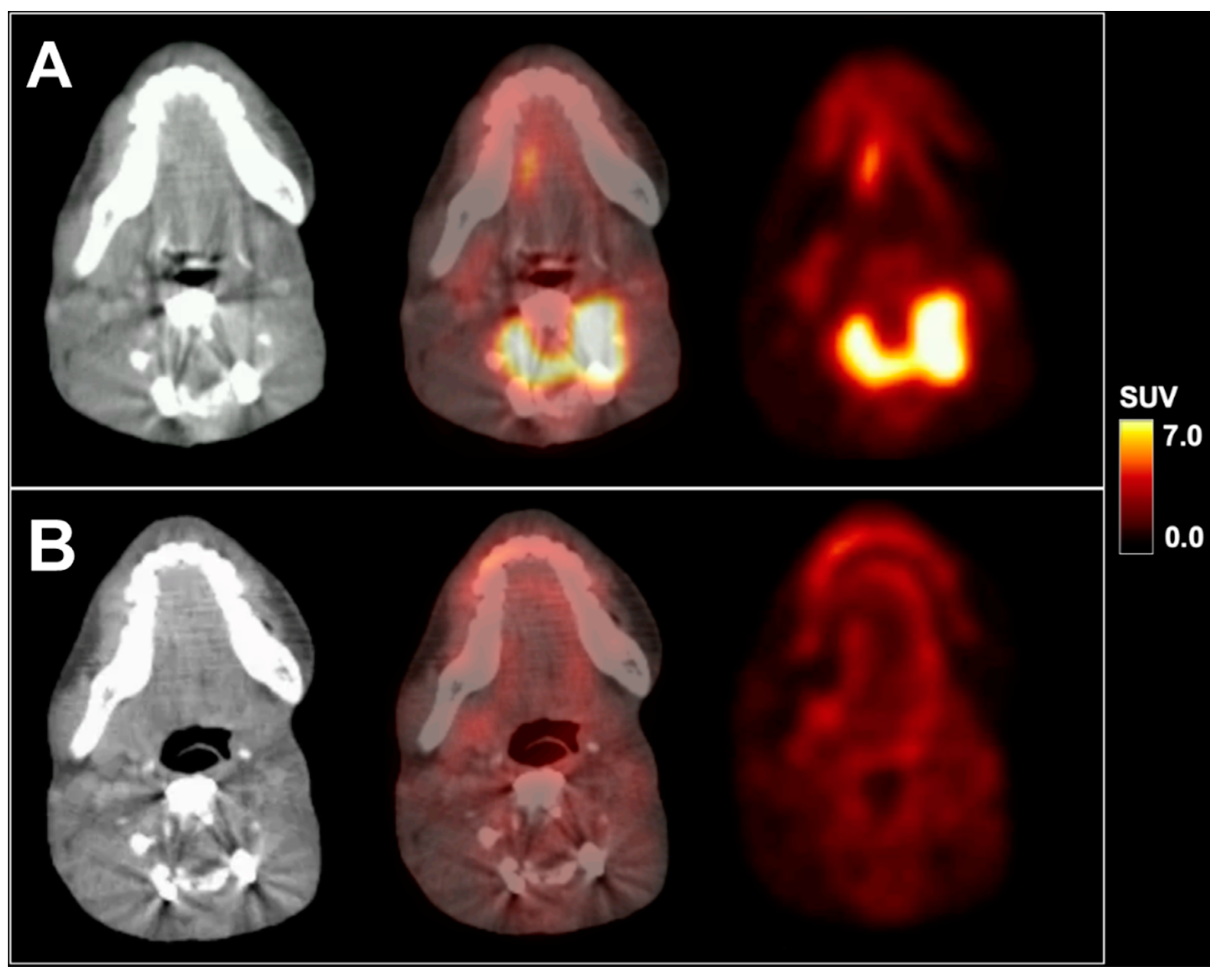

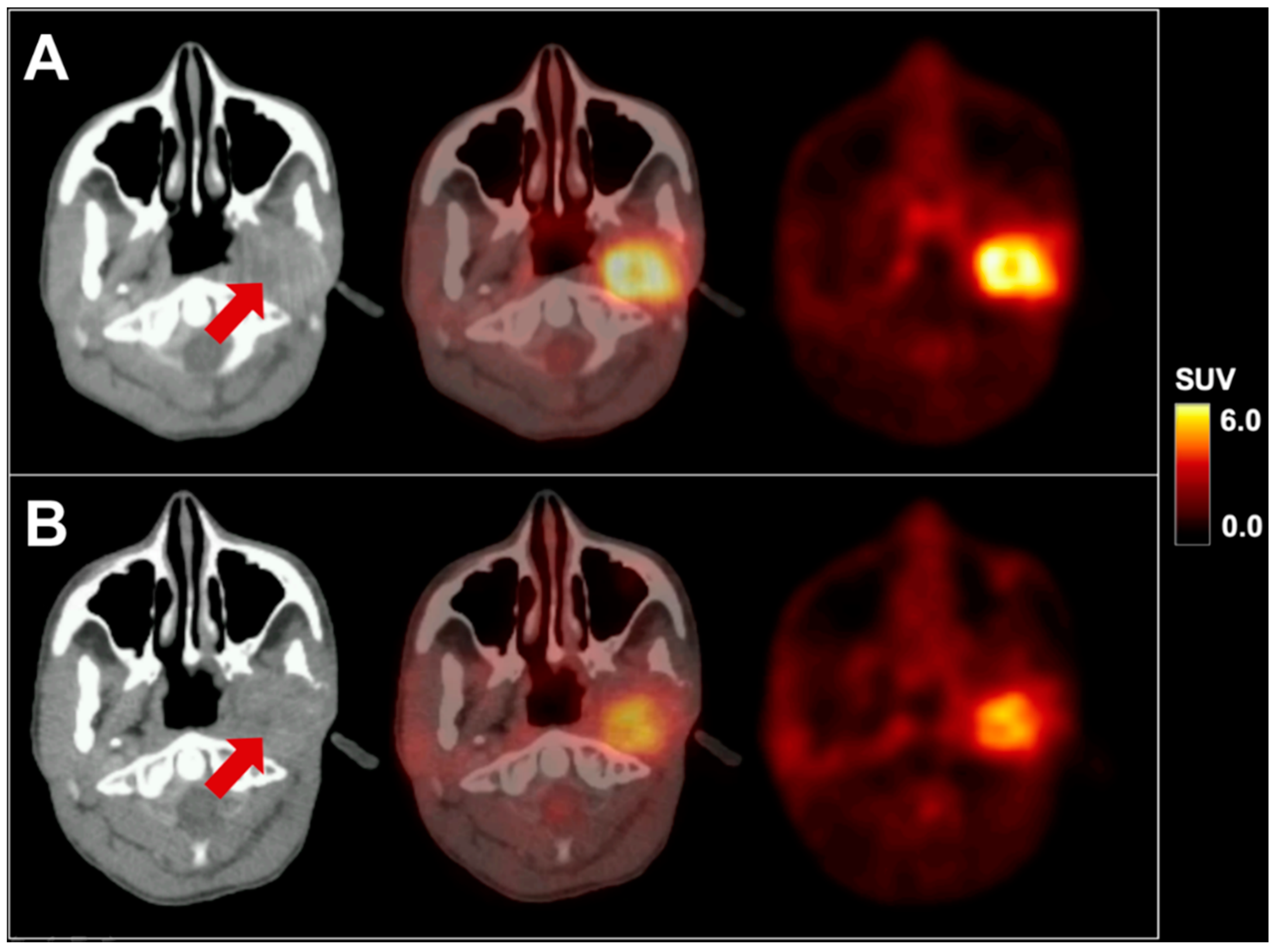
18F-FDG PET/CT for Response Assessment in Pediatric Sebaceous Carcinoma of the Parotid Gland

 ,
, 
 ,
, 
Abstract
Author Contributions
Funding
Conflicts of Interest
Consent for Publication
References
- Dasgupta, T.; Wilson, L.D.; Yu, J.B. A retrospective review of 1349 cases of sebaceous carcinoma. Cancer 2009, 115, 158–165. [Google Scholar] [CrossRef] [PubMed]
- Dores, G.M.; Curtis, R.E.; Toro, J.R.; Devesa, S.S.; Fraumeni, J.F., Jr. Incidence of cutaneous sebaceous carcinoma and risk of associated neoplasms: insight into Muir-Torre syndrome. Cancer 2008, 113, 3372–3381. [Google Scholar] [CrossRef] [PubMed]
- Knackstedt, T.; Samie, F.H. Sebaceous Carcinoma: A Review of the Scientific Literature. Curr. Treat. Options Oncol. 2017, 18, 47. [Google Scholar] [CrossRef] [PubMed]
- Khmou, M.; Laadam, K.; Cherradi, N. Parotid gland, an exceptional localization of sebaceous carcinoma: case report. BMC Clin. Pathol. 2016, 16, 10. [Google Scholar] [CrossRef] [PubMed]
- Marnouche el, A.; Maghous, A.; Kadiri, S.; Berhili, S.; Touil, A.; Kettani, F.; Majjaoui, S.; Elkacemi, H.; Kebdani, T.; Benjaafar, N. Sebaceous carcinoma of the parotid gland: a case report and review of the literature. J. Med Case Rep. 2016, 10, 174. [Google Scholar] [CrossRef] [PubMed]
- Mebazaa, A.; Boussofara, L.; Trabelsi, A.; Denguezli, M.; Sriha, B.; Belajouza, C.; Nouira, R. Undifferentiated sebaceous carcinoma: an unusual childhood cancer. Pediatric Dermatol. 2007, 24, 501–504. [Google Scholar] [CrossRef] [PubMed]
- Mirzamani, N.; Sundram, U.N. A case of sebaceous carcinoma diagnosed in an adolescent male. J. Cutan. Pathol. 2011, 38, 435–438. [Google Scholar] [CrossRef] [PubMed]
- Stacey, S.K.; Moss, T.A.; Kobayashi, T.T. Sebaceous carcinoma on the arm of a 10-year-old girl. Dermatol. Online J. 2017, 23, 6. [Google Scholar]
- Owen, J.L.; Kibbi, N.; Worley, B.; Kelm, R.C.; Wang, J.V.; Barker, C.A.; Behshad, R.; Bichakjian, C.K.; Bolotin, D.; Bordeaux, J.S.; et al. Sebaceous carcinoma: evidence-based clinical practice guidelines. Lancet. Oncol. 2019, 20, e699–e714. [Google Scholar] [CrossRef]
- Kumabe, A.; Kawase, T.; Miura, K.; Tada, Y.; Masubuchi, T.; Kamata, S.E.; Tanada, S.; Kubo, A.; Tajima, Y.; Shigematsu, N. Sebaceous carcinoma of the parotid gland: F-18 FDG PET/CT findings. Clin. Nucl. Med. 2010, 35, 260–262. [Google Scholar] [CrossRef] [PubMed]
- Masselli, G.; De Angelis, C.; Sollaku, S.; Casciani, E.; Gualdi, G. PET/CT in pediatric oncology. Am. J. Nucl. Med. Mol. Imaging 2020, 10, 83–94. [Google Scholar] [PubMed]
- Schmidkonz, C.; Krumbholz, M.; Atzinger, A.; Cordes, M.; Goetz, T.I.; Prante, O.; Ritt, P.; Schaefer, C.; Agaimy, A.; Hartmann, W.; et al. Assessment of treatment responses in children and adolescents with Ewing sarcoma with metabolic tumor parameters derived from (18)F-FDG-PET/CT and circulating tumor DNA. Eur. J. Nucl. Med. Mol. Imaging 2020, 47, 1564–1575. [Google Scholar] [CrossRef] [PubMed]
- Shapira-Zaltsberg, G.; Wilson, N.; Trejo Perez, E.; Abbott, L.; Dinning, S.; Kapoor, C.; Davila, J.; Smith, B.; Miller, E. Whole-Body Diffusion-Weighted MRI Compared to (18 F)FDG PET/CT in Initial Staging and Therapy Response Assessment of Hodgkin Lymphoma in Pediatric Patients. Can. Assoc. Radiol. J. 2020, 71, 217–225. [Google Scholar] [CrossRef] [PubMed]

Publisher’s Note: MDPI stays neutral with regard to jurisdictional claims in published maps and institutional affiliations. |
© 2020 by the authors. Licensee MDPI, Basel, Switzerland. This article is an open access article distributed under the terms and conditions of the Creative Commons Attribution (CC BY) license (http://creativecommons.org/licenses/by/4.0/).
Share and Cite
Holzgreve, A.; Pfluger, T.; Schmid, I.; Guntinas-Lichius, O.; Kunz, W.G.; Ricke, J.; Bartenstein, P.; Albert, N.L.; Unterrainer, M. 18F-FDG PET/CT for Response Assessment in Pediatric Sebaceous Carcinoma of the Parotid Gland. Diagnostics 2020, 10, 908. https://doi.org/10.3390/diagnostics10110908
Holzgreve A, Pfluger T, Schmid I, Guntinas-Lichius O, Kunz WG, Ricke J, Bartenstein P, Albert NL, Unterrainer M. 18F-FDG PET/CT for Response Assessment in Pediatric Sebaceous Carcinoma of the Parotid Gland. Diagnostics. 2020; 10(11):908. https://doi.org/10.3390/diagnostics10110908
Chicago/Turabian StyleHolzgreve, Adrien, Thomas Pfluger, Irene Schmid, Orlando Guntinas-Lichius, Wolfgang G. Kunz, Jens Ricke, Peter Bartenstein, Nathalie L. Albert, and Marcus Unterrainer. 2020. "18F-FDG PET/CT for Response Assessment in Pediatric Sebaceous Carcinoma of the Parotid Gland" Diagnostics 10, no. 11: 908. https://doi.org/10.3390/diagnostics10110908
APA StyleHolzgreve, A., Pfluger, T., Schmid, I., Guntinas-Lichius, O., Kunz, W. G., Ricke, J., Bartenstein, P., Albert, N. L., & Unterrainer, M. (2020). 18F-FDG PET/CT for Response Assessment in Pediatric Sebaceous Carcinoma of the Parotid Gland. Diagnostics, 10(11), 908. https://doi.org/10.3390/diagnostics10110908