1. Introduction
As a ubiquitous phenomenon, Euclidean rotational motions serve as a bridge between theoretical abstraction and practical applications. They are linear transformations that can be expressed by the orthogonal matrices whose determinants are 1, forming a non-Abelian group denoted by SO(3). Rotation matrices have attracted the attention of many researchers, as they play an important role in many application areas in many fields such as robotics [
1,
2], and differential geometry [
3]. Some well-known methods to obtain rotation matrices are the Rodrigues formula, the Cayley map, and quaternion multiplication.
Rotation transformations and their matrices can be defined for other scalar product spaces, and these new rotation transformations can create new fields of study. One of those spaces is the Minkowski 3-space [
4,
5,
6], which is a geometric framework that is used to study the structure of spacetime in special relativity. Rotation transformations of Minkowski 3-space are a crucial component of the three-dimensional Lorentz group, and their mathematical properties and the simplified physical scenarios they govern make them a valuable tool for theoretical physicists and mathematicians to explore fundamental concepts in relativity, quantum mechanics, and field theory. On the other hand, rotation transformations of the Minkowski spacetime finds diverse applications, including analyzing lens optics or laser cavity kinematics [
7], deriving robot manipulator equations of motion [
8], facilitating motion interpolations [
9], and modeling ideal fluid hydrodynamics [
10]. There are many studies on generating or generalizing the rotation matrices of the Minkowski 3-space, which have spacelike, timelike, or lightlike axes of rotation [
11,
12,
13,
14]. The rotation matrices of the generalized Minkowski 3-space that have spacelike or timelike axes are given in [
15,
16]. However, the rotation matrices that have generalized lightlike axes are not given yet.
The main aim of our study is to give generalized Lorentzian rotation matrices with generalized lightlike axes, which provide parabolic motions on general cones or hyperboloids of one or two sheets, while they also give linear motions on hyperboloids of one sheet, using the well-known classical methods of the Rodrigues formula, the Cayley map, and quaternion multiplication. Here, we have established that the generalized Lorentz rotation formulas are identical to the standard Lorentz rotation formulas, with the exception of skew-symmetric matrices. In addition, we consider the angle of a Lorentzian rotation about a lightlike axis in the Minkowski 3-space, and we introduce a geometric characterization for it, using the region swept by the rotated vector as in the classical geometries. Moreover, we provide a definition not found in the literature for measuring the angle between two spacelike vectors whose vector product is lightlike. We also adapt this characterization to the generalized Minkowski 3-space.
This paper is organized as follows: First, we give a brief introduction to the generalized Minkowski 3-space and the related number system. Then, we consider the Lorentzian rotation about a lightlike axis, and introduce the geometric meaning for the rotation angles, giving a definition of angle between two spacelike vectors on the same pseudosphere, whose vector product is lightlike. Finally, we generate the generalized Lorentzian rotation matrices which determine parabolic and linear rotational motions in the space, using the Rodrigues formula, the Cayley map, and the generalized split quaternion methods in the generalized Minkowski 3-space.
2. Preliminaries
The generalized Minkowski 3-space
derived by the standard Minkowski 3-space
of signature
, and its associated number system
, which is the generalized split quaternion, were introduced in [
15]. Accordingly,
is the real vector space
with the three-dimensional generalized Lorentzian scalar product or
-scalar product defined by a real symmetric matrix
with a negative determinant whose eigenvalues are not all of the same sign, which can be written as
for vectors
,
, while the standard Lorentzian scalar product is
where
. The matrix
is the associated matrix of the bilinear form, and
is called the constant of the matrix
. A nonzero vector
is called
-spacelike,
-timelike and
-lightlike (or
-null), if “
or
”,
, and “
and
”, respectively. The
-norm of the vector
is given by
For
, spheres of the generalized Minkowski 3-space or
-spheres with a center at the origin and radius
r are the sets
which is called an
-pseudosphere, which is a general hyperboloid of one sheet and an
-hyperbolic sphere which is a general hyperboloid of two sheets. In addition, the
-sphere with its center at the origin and radius 0 is
which is called
-light cone, which is a general cone.
A
matrix
S is defined as
-skew-symmetric if it satisfies the equation
, and for a given vector
, the
-skew-symmetric matrix related to the vector
has the form of
where
,
,
and
,
,
,
,
and
. Using this notion, the generalized Lorentzian vector product of vectors
is given as follows:
In addition, for vectors
, the following equation is satisfied:
The
-measure
of the angle between linearly independent
-spacelike vectors
and
is defined as follows [
16]:
- (i)
If
is
-spacelike and
, which are equivalent to
, then
- (ii)
If is -timelike, which is equivalent to , then
The
-measure
of the angle between linearly independent
-timelike vectors
and
satisfying
is defined as
Additionally, if
, then
and
are called
-orthogonal; in addition, if the
-norms of them are 1, then they are called
-orthonormal.
On the other hand, for the real numbers
A,
B,
C,
D,
E,
F which are the entries of the matrix
, and for the base elements
satisfying the following equalities
each element of the set
is called a generalized split quaternion or an
-split quaternion. The set
with its sum and multiplication operations is a non-commutative, non-division, and associative ring. For an
-split quaternion
, the real number
and the vector
are called the scalar part and the vector part of
, respectively. A pure
-split quaternion is defined as an
-split quaternion with a zero scalar part. So, the vectors of
can be thought of as pure
-split quaternions. For any two
-split quaternions
and
, the multiplication of them is given by
Then for two pure
-split quaternions
and
, the following equation is satisfied:
In addition, left and right multiplications of
-split quaternions can be computed as follows:
For an
-split quaternion
, the conjugate, norm and inverse of
are defined as follows:
If
then
is called a unit
-split quaternion. Generalized split quaternions, like ordinary split quaternions, can be classified as follows: an
-split quaternion is called spacelike, timelike and lightlike (or null), if
and
, respectively.
3. On the Lorentzian Rotation About a Lightlike Axis
In [
17], Sodsiri, using an elementary approach, determined the rotation matrices in the Minkowski 3-space
about the lightlike axis
by the angle
, as
for each
. It is easy to see that for each value of
n, a different Lorentzian rotation matrix is obtained, which fixes the axis
ℓ′ pointwise. Then, using the vectorial representation of the spherical rotations, the rotation about a general lightlike axis
ℓ spanned by a lightlike vector
as a geodesic was given as
for the unit vector
, in [
18]. Later, Nešović determined the rotation matrix
R about a general axis
ℓ spanned by a lightlike vector
by the angle
using Cartan’s frame [
19].
Cartan’s frame in
is a pseudo-orthonormal frame
satisfying the following conditions:
In this frame,
is on the pseudosphere with radius 1, and linearly independent lightlike vectors
and
are always on different naps of the light cone, since two lightlike linearly independent vectors lie in the same nap of the light cone if and only if their Lorentzian scalar product is less than 0 [
20]. In addition, the frame is positively oriented, since the frame conditions give the result det
. In particular, if
and
for real numbers
and
t in Cartan’s frame
, then it is possible to see with some calculations that
Hence, using the matrix (
21) and the frame coordinates or using Equation (
22), one can easily see the equation
which determines the angle of the Lorentzian rotation matrix
. On the other hand, the most general form of this frame can be written as
where
,
for the following Euclidean rotation about the
x-axis by the angle
which is also a Lorentzian rotation, and
is the Lorentzian rotation about the general lightlike axis
ℓ spanned by the lightlike vector
, since the multiplication of two Lorentzian rotations is also a Lorentzian rotation and
In addition, since the Lorentzian rotations preserve the Lorentzian scalar product, one gets
So, the rotation angle of
is also
.
Using this fact, Nešović determined the rotation matrix
R about the axis
ℓ spanned by the lightlike vector
by the angle
as
where
which is the semi-skew-symmetric matrix with respect to
. However, in these studies, the rotation angle
has no geometric meaning. In the next section, we introduce a geometric meaning for this value, and this meaning gives a new definition for the angle between two spacelike vectors on the same pseudosphere in
, whose vector product is lightlike.
4. Geometric Meaning of the Angle for Rotations About a Lightlike Axis
In this section, we introduce a geometric characterization of the rotation angle
between two linearly independent vectors on the same three-dimensional Lorentzian sphere, such that one of the vectors is rotated on to the other one by the Lorentzian rotation matrix (
28) about the lightlike axis with direction vector
by the angle
. Since all structure is invariant under the transformation
, we only consider the vector
where
. Notice that for two different linear dependent different lightlike vectors
and
, the Lorentzian rotation matrices about the axis
ℓ with direction vector
or
by the angle
are different. So, the representation
may be a cause of confusion. To avoid this confusion,
is a more suitable representation than
for the rotation transformation, and
is a more suitable representation than
ℓ for the rotation axis. For this reason, from now on, we only use the
notation for the Lorentzian rotation around the axis
by the angle
. But one can also prefer to call it the Lorentzian rotation about the axis
ℓ with respect to the vector
, by the angle
.
It is known that any nonzero vector and are in the same casual character, and the endpoint of the rotated vector is on the plane which passes through the endpoint of and Lorentzian orthogonal to . So, the trajectory of the motion of the endpoint of the vector under the rotation is either a line or a parabola since the intersection of the Lorentzian sphere and the plane is either two parallel lines or a parabola. More clearly, the trajectory is a parabola when the endpoint of is on a hyperbolic sphere or a light cone, while the trajectory is either a line or a parabola when the endpoint is on a pseudosphere; in particular, the trajectory is a line when the endpoint of is on the plane which passes through the origin and Lorentzian orthogonal to , and the trajectory is a parabola when the endpoint of is not on the plane .
Let be any nonzero vector linearly independent from . Then, either the vector lies in the plane or it does not; in other words, either , or .
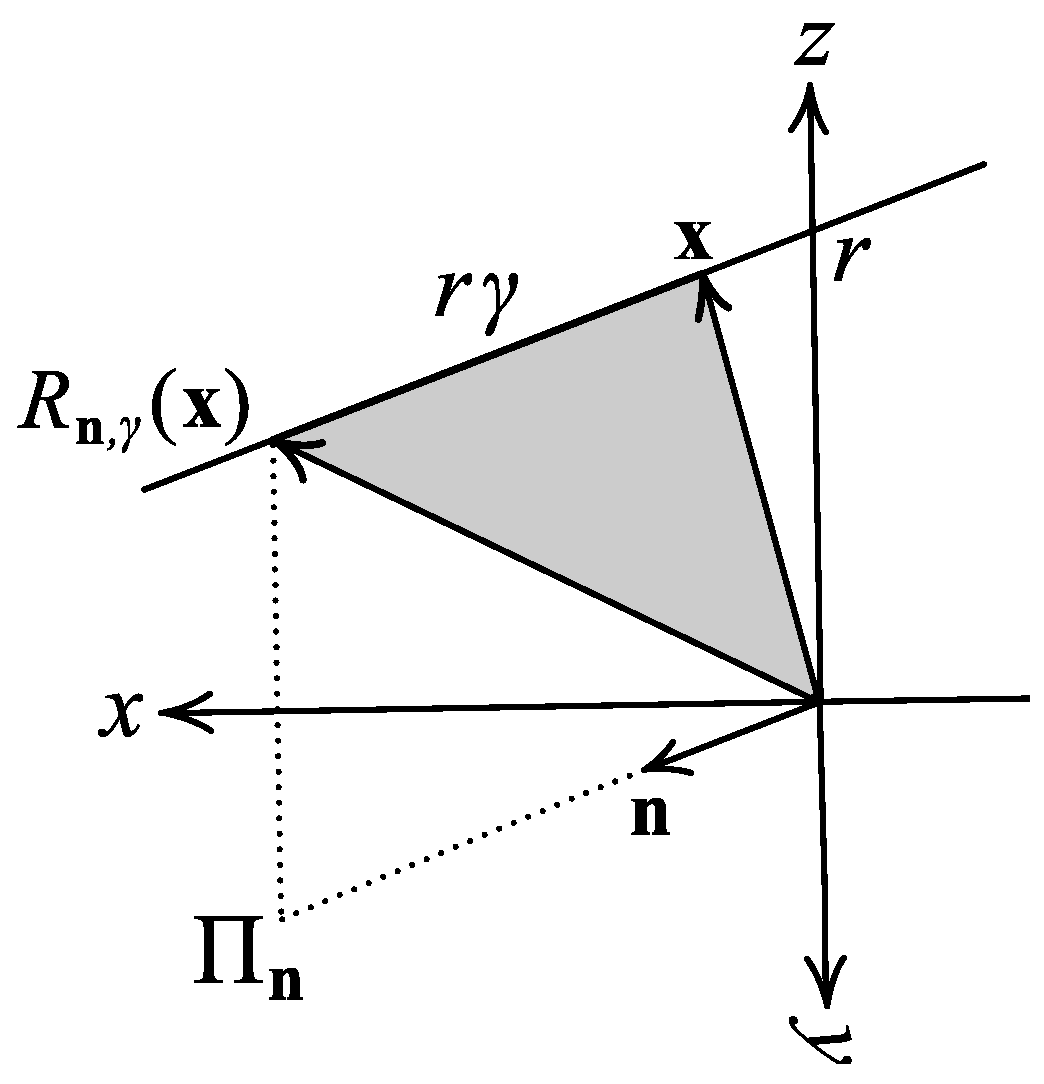
(1) First, let
lie in the plane
. In this case,
is a spacelike vector that can be written in general form as
, and its endpoint is on the Lorentz space circle
, which consists of a pair of parallel lines. Then, one can see that
and so the rotation occurs in the plane
, which is a tangent to the light cone along the line with direction vector
. Moreover, if
, then the directed area of the vector
swept under the rotation
is
(see
Figure 1). Therefore, in accordance with the classical geometries, the measurement
of the directed angle of the rotation with the axis
form
to
corresponds to the directed area
. In addition, if
, then the corresponding area increases
-fold. Consequently, for two given vectors
and
such that
where
, the directed angle
of the rotation can be computed by
where
S is equal to the directed area of the triangle determined by the vectors
and
.
Notice that, since the Lorentzian vector product of
and
is in the same direction as
in this case, one can define the angle between them by the angle of the rotation with the standard lightlike axis
, which transforms
to
, as follows
Clearly, this definition completes the angle definition between spacelike vectors given in the preliminary section.
(2) For the other cases, let us consider a nonzero vector
which does not lie in the plane
. In this case,
can be a spacelike, timelike or lightlike vector, and the rotation occurs in the plane
, which is parallel to
. Then, one can see that the plane
can be written in general form as
for a nonzero real number
d, such that
is equal to the Euclidean distance from the origin to the plane
. So,
can be written in general form as
for
. Using the matrix of the Lorentzian rotation (
21) about the axis
with
by the angle
, one finds that the difference of the third component of the coordinates of
and
is
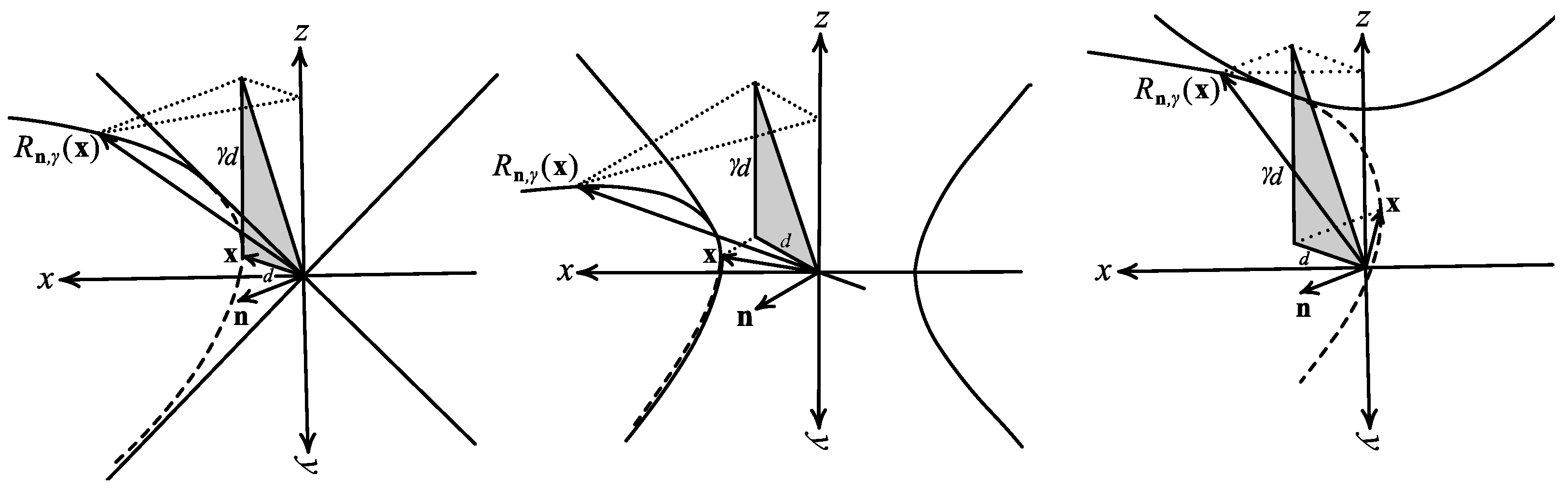
. In addition, the Euclidean length of the Euclidean orthogonal projection of the vector
to the plane
, which passes through the origin and Euclidean orthogonal to
, is
. Therefore, when
completes its movement under the transformation
, the area of the Euclidean orthogonal projection of the triangle scanned by
onto the plane Euclidean orthogonal to
is
(see
Figure 2). Therefore, in accordance with the classical geometries again, the measurement
of the directed angle of the rotation with the axis
from
to
corresponds to the directed area
, where
, acting like a radius, is the Euclidean distance from the origin to the plane
. In addition, if
, then the corresponding area and the difference of the third components increases
-fold. Consequently, for two given vectors
and
such that
, the directed angle
can be computed by
where
S is equal to the directed area of the Euclidean orthogonal projection of the triangle defined by vectors
and
onto the plane
. Notice that in this case, the rotation angle from
to
cannot be equal to the angle between them, since their Lorentzian vector product cannot be in the same direction as
.
Example 1. Let us take two spacelike vectors and whose Lorentzian vector product is lightlike. Then one can obtain the angle between and aswhere is the area of the triangle determined by the vectors and . One can check that for the Lorentzian rotation about the axis by the angle ,Notice that the trajectory in this example is a line. In addition to this example, the measurement of the angle of the rotation about another lightlike axis from to can be computed asIt is easy to check that Example 2. Let us take a timelike vector to rotate by the Lorentzian rotation about the lightlike axis by the angle . Then the rotation matrix can be found asand we getOne can verify the rotation angle γ by the formula aswhere is the Euclidean distance from the origin to the plane , and S is equal to the area of the Euclidean orthogonal projection of the triangle defined by vectors and onto the plane which passes through the origin and Euclidean orthogonal to . Notice that the trajectory in this case is a parabola. 5. -Rotation About an -Lightlike Axis
It is known that any given general hyperboloid of one or two sheets or general cones, which are
-spheres, can be transformed to their standard forms, which are Lorentzian spheres, by an affine transformation. So, if
and
are the quadratic forms associated with the Lorentzian and
-scalar products, respectively, and
A is a linear transformation that transforms the
-spheres to the standard Lorentz spheres, then
for every vector
, and one gets
and
Therefore, the geometric structure of the
-space
is the same as the standard Lorentzian space
. In other words, orthogonality, parallelism, and tangency are preserved.
For example, if
is
-lightlike vector, then the plane
which passes through the origin and
-orthogonal to
is the tangent plane to the
-light cone along the line with direction vector
; the intersection of the plane
with the
-pseudo spheres is two parallel lines. Likewise, Cartan’s
-frame is a
-pseudo-orthonormal positively oriented frame
formed by linearly independent
-lightlike vectors
and
which are on the
-light cone, and a unit
-spacelike vector
which is on the
-pseudosphere with radius 1, satisfying the following conditions:
A real matrix
O is
-orthogonal if and only if
, and the set of all
-orthogonal matrices whose determinants are equal to 1 gives the generalized Lorentzian group consists of all
-rotation matrices of
. For any vector
, if
R is an
-rotation matrix, the endpoint of
is on the plane
which passes through the endpoint of
and
-orthogonal to
, since
So, as in the standard Lorentzian case, the trajectory of motion of the endpoint of a vector under
-rotation is either a line or a parabola since the intersection of the
-Lorentzian spheres and such a plane whose
-normal is
-lightlike vector is either two parallel lines or a parabola. If
R is an
-rotation matrix, then one of the eigenvalues of
R is 1, and the eigenvector
corresponding to 1 determines the axis of rotation. In addition, in analogy with the standard Lorentzian geometry, if
is an
-rotation matrix about the axis
, we define the angle
as the
-measurement of the rotation angle if
is satisfied for Cartan’s
-frame
, and denoted as
with the angle
by
.
However, the geometric meaning of
-measurement of the angle
slightly changes, since one needs to use the generalization of the Euclidean norm by the same linear transformation
A in the corresponding angle formula. One can obtain that
for
which gives the generalization of the Euclidean norm with respect to the linear transformation
A. So, for two given vectors
and
such that
where
is an
-rotation matrix about the axis
by the angle
, the directed angle
can be computed by the formula
if
in which
can only be an
-spacelike vector in the plane
, and by the formula
if
in which
can be any vector not in the plane
, where
is the
-distance from the origin to the plane
, and
is the directed
-area of the
-orthogonal projection of the triangle defined by vectors
and
onto the plane
.
Here, one can derive the matrix
A using the Euclidean orthogonal diagonalization of the matrix
as follows: Let
P be the Euclidean-normalized orthogonal matrix with the first column determined by the negative eigenvalue of the matrix
, which has one negative and two positive eigenvalues. And let
D be the diagonal matrix determined by the eigenvalues corresponding to the columns of
P. Then we have
or
. If
then
gives the linear transformation
A, since
In the next sections, we determine the matrix of -rotation about an -lightlike axis, and the rotation angle of a given -rotation matrix, using the Rodrigues and Cayley methods and -split quaternions, by the following five theorems. These theorems are actually well-known results for the standard Minkowski 3-space. We just use the -scalar product in the proofs instead of the standard Lorentzian scalar product, and we see that the generalized Lorentz rotation formulas are identical to the standard Lorentzian rotation formulas with the exception of skew-symmetric matrices.