


Abstract
We establish a Perron–Frobenius-type theorem for the subdominant eigenvalue of Möbius monotone transition matrices defined on partially ordered state spaces. This result extends the classical work of Keilson and Kester, where they considered stochastically monotone transition matrices in a totally ordered setting. Furthermore, we show that this subdominant eigenvalue is the geometric ergodicity rate.
MSC:
60J10; 93B60
1. Introduction
A central problem in the theory of Markov chains concerns quantifying the convergence rate to the stationary distribution. This rate is determined by the spectral properties of the corresponding transition matrix, where the subdominant eigenvalue modulus plays a crucial role. Standard references on this topic include Chen [1] and Levin and Peres [2].
Consider an irreducible and aperiodic Markov chain on a finite state space , with transition matrix P and stationary distribution . For any square matrix A, we denote its spectrum by . Using the Perron–Frobenius theorem for stochastic matrices—see, e.g., Seneta [3] (Theorem 1.1)—the eigenvalue 1 is simple and strictly dominant in . Our analysis therefore focuses on Define the subdominant eigenvalue modulus of transition matrix P as follows:
If , we call the subdominant eigenvalue.
Denote, using , the Dirac measure concentrated on the state According to Levin and Peres [2] (12.37), if , then the total variation distance to stationarity decays geometrically at the rate of :
This result naturally raises two fundamental questions about the subdominant eigenvalue modulus:
- 1.
- Does the strict inequality hold ?
- 2.
- Is itself an eigenvalue of the transition matrix P ?
When P corresponds to a time-reversible Markov chain, all its eigenvalues are real. Then, both questions can be answered affirmatively: and . However, when P is nonreversible, it is generally challenging to address both questions, as P may have complex eigenvalues. In the non-reversible case, guaranteeing the mentioned properties related to commonly requires imposing some monotonicity assumptions on the chain. When is a totally ordered state space, we say that P is stochastically monotone if, for any with and ,
For stochastically monotone Markov chains in totally ordered state spaces, regarding the two mentioned questions, Keilson and Kester [4] established a Perron-Frobenius-type theorem for the subdominant eigenvalue, thus resolving both questions in a totally ordered setting.
While the theory of stochastically monotone chains on totally ordered spaces provides foundational insights, this framework has limitations in its ability to model complex systems with partially ordered state spaces. This motivated us to study partially ordered state spaces, where stochastic monotonicity generalizes to Möbius monotonicity (formally defined in the next section). The concept of Möbius monotonicity was first introduced by Kester [5] in his PhD thesis. Subsequently, Massy [6] established that Möbius monotonicity implies weak stochastic monotonicity. Lorek [7] further developed this theory, demonstrating its applicability to various systems, including queueing models and interacting particle systems [7,8,9,10].
The primary objective of this work is to establish a Perron–Frobenius-type theorem for the subdominant eigenvalue of Möbius monotone transition matrices. This result extends the Perron–Frobenius theorem developed by Keilson and Kester [4] and provides a systematic framework for analyzing the subdominant eigenvalue in partially ordered state spaces. Furthermore, we establish that the subdominant eigenvalue is the geometric ergodicity rate.
2. Main Results
In the following, we assume that is a finite state space equipped with a partial order ⪯. We further assume the following:
- is the unique minimal element, and is the unique maximal element under ⪯.
- The enumeration of is consistent with the partial order; that is, if for any , then .
Define the matrix as
where denotes the indicator function. According to Rota [11] (Proposition 1), there exists an inverse matrix of C such that, for any
and the following support restriction holds:
The matrix admits explicit expression for some specific partially ordered sets . For example, let be the lattice set. According to [11] (Proposition 5), we know for any can be written as
For the specific state space , from (4), we can derive as follows:
For any element and subset , define Denote for any The classical notion of stochastic monotonicity (defined for totally ordered sets such as natural numbers) can be extended to partially ordered sets.
Definition 1.
Let P be a transition matrix on .
- We say P is Möbius monotone, if for any ,
- We say P is strictly Möbius monotone, if for any ,
Remark 1.
Using the definition of C in (1) and the support restriction of in (3), for any , we have
Then, we can conclude that for all if and only if P is Möbius monotone, while for all if and only if P is strictly Möbius monotone.
When P is Möbius monotone, the matrix transformation (6) actually defines a new transition matrix
known as the Siegmund dual of P. The concept of Siegmund duality was introduced by Siegmund [12], who established the equivalence between absorbing and reflecting barrier problems for stochastically monotone Markov processes. Following Siegmund’s seminal work, subsequent research has significantly expanded the applications of Siegmund duality across various domains of Markov process theory; see, e.g., [10,13,14].
Remark 2.
When the state space is totally ordered, from Equation (4), the matrix admits the following explicit form:
Then, we have
from which we conclude that (strict) Möbius monotonicity reduces to (strict) stochastic monotonicity in totally ordered spaces.
Theorem 1.
Let P be an irreducible Möbius monotone transition matrix on . Then, the subdominant eigenvalue modulus belongs to and satisfies . If we further assume that P is strictly Möbius monotone, then is a simple eigenvalue, and the strict inequality holds for all .
Proof.
Since similarity transformations preserve spectral properties, it suffices to analyze the matrix . We shall first prove that is an eigenvalue of . Noting that is the minimal element in , for any ,
Then, one can write the matrix as
where is a column vector of dimension , is a row vector of dimension , and Q is a nonnegative matrix.
Now, we claim that the spectrum of P consists of 1, together with the spectrum of To see this, observe that the characteristic polynomial of P can be written as
where denotes the identity matrix for . Consequently,
Since Q is nonnegative, using Perron–Frobenius theorem—see, e.g., Horn and John- son [15] (Theorem 8.3.1)— belongs to the spectrum of Q, and satisfies
Furthermore, under the additional assumption of strict Möbius monotonicity for P, matrix Q becomes strictly positive. Thus, using another version of the Perron–Frobenius theorem—see, e.g., [15] (Theorem 8.2.8)—we know that is indeed a simple eigenvalue, and the strict inequality holds for all .
To complete the proof, it remains to show that . We divide the arguments into two parts:
(i) We first prove that is a strictly substochastic matrix on the reduced space . Using (2), we obtain the following:
and
By (6), (7), (8) and (9), for any ,
where, in the third equality, we interchange the order of summation between x and z. To establish the strict inequality in (10), we employ proof by contradiction. Assume the equality holds in (10). This implies
which consequently forces for all This contradicts the irreducibility of P. We therefore conclude that must be strictly substochastic.
(ii) Now, we are in a position to prove Using Perron–Frobenius theorem [15] (Theorem 8.3.1), a nonnegative nonzero eigenvector is observed, such that
Summing up both sides yields the following:
Interchanging the order of summation on the left-hand side gives
From the strictly substochastic property (established in (i)), there exists a , such that
while, for all other ,
Substituting these inequalities into (11) and noting the positivity of v, we derive
which immediately implies □
We emphasize that strict Möbius monotonicity is not a necessary condition for the simplicity of the subdominant eigenvalue. In fact, to apply the Perron–Frobenius theorem—see, e.g., Seneta [3] (Theorem 1.1)—one only needs Q to be irreducible and aperiodic; matrix Q is defined in (7). This condition is related to the strict monotonicity of the powers of Q, as follows.
Lemma 1.
Let P be a Möbius monotone transition matrix on . There exists an integer such that is strictly Möbius monotone if and only if Q defined in (7) is irreducible and aperiodic.
Proof.
From the block structure in (7), for any integer , we have
where denotes a row vector of dimension .
Assume Q is irreducible and aperiodic. Then, by [3] (Theorem 1.4), an integer exists such that is strictly positive. Substituting this into (12), the strict positivity of implies that is strictly Möbius monotone.
Conversely, suppose that is strictly Möbius monotone for some integer . It follows from (12) that is strictly positive. To show that remains strictly positive, suppose, for contradiction, that there is an element in equal to 0. This implies that at least one row of Q consists entirely of zeros, which contradicts the strict positivity of . Therefore, through induction, we can conclude that for any , is a strictly positive matrix. Consequently, Q must be irreducible and aperiodic. □
The next theorem slightly relaxes the condition for the second statement in Theorem 1.
Theorem 2.
Let P be a Möbius monotone transition matrix on . Suppose that there exists an integer such that is strictly Möbius monotone, or equivalently, the matrix Q defined in (7) is irreducible and aperiodic. Then, is a simple eigenvalue satisfying , and the strict inequality holds for all .
Proof.
Using Lemma 1, the strict Möbius monotonicity of is equivalent to the irreducibility and aperiodicity of Q. According to [3] (Theorem 1.4), Q is primitive; that is, there exists an integer , such that is a strictly positive matrix. Applying [3] (Theorem 1.1), we can see that is a simple eigenvalue of Q, and the strict inequality holds for all . The remainder of the proof for is the same as that of Theorem 1. □
Recall that when the modulus , we call the subdominant eigenvalue. The following theorem establishes the immediate application of Theorems 1 and 2 by linking the subdominant eigenvalue to the geometric ergodicity rate. Although Levin and Peres [2] (12.37) noted this connection for nonreversible Markov chains, they did not provide a rigorous proof. For the reader’s convenience, we provide a complete proof here.
Theorem 3.
Let P be an aperiodic, irreducible, Möbius monotone transition matrix on . Then, the corresponding Markov chain admits a unique stationary distribution, denoted by π, and
where is the subdominant eigenvalue belonging to
Proof.
According to Seneta [3] (Theorem 1.1), 1 is the simple eigenvalue of P, with the left eigenvector being its stationary distribution. Define the matrix by
Then, for any , it can be verified that
Using these identities and the definition of total variation norm, we have
where denotes the maximum row sum matrix norm, given by
Let be the all-ones column vector. Using Seneta [3] (Theorem 1.1) again, 1 is a simple eigenvalue with left eigenvector and right eigenvector . Through invariant subspace decomposition, any right eigenvector of P associated with an eigenvalue other than 1 satisfies . This implies that shares all the eigenvalues of P, except that 1 is replaced by 0. Therefore, according to Theorem 1,
From (13) and [15] (Corollary 5.6.14), it follows that
□
3. An Example
In this section, we illustrate the main contributions of this work through a typi- cal example.
Example 1.
Consider the finite lattice space . Suppose that the transition matrix P on is given by
This transition matrix is clearly irreducible. Following Remark 1, to establish Möbius monotonicity, it suffices to verify that is a nonnegative matrix. From (1) and (5), we obtain the following:
and
Direct computation yields
This confirms that the conditions for the first statement of Theorem 1 are satisfied. However, since , the matrix fails to be strictly Möbius monotone. Conversely, consider the submatrix
As Q is irreducible and aperiodic, it satisfies the conditions required by Theorem 2.
The spectrum of P is given by
where is the subdominant eigenvalue modulus of P. This verifies the first statement of Theorem 1: belongs to with . Although P is not strictly Möbius monotone (so the second statement of Theorem 1 does not apply), is nevertheless a simple eigenvalue and holds for all . This confirms Theorem 2.
By solving the linear equation , we obtain the unique stationary distribution
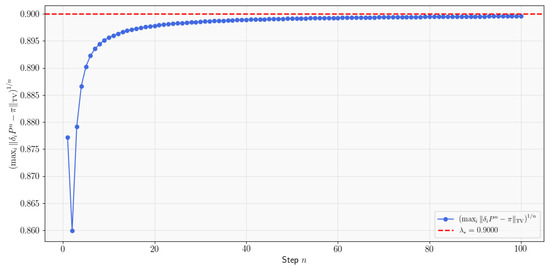
The following Figure 1 illustrates the geometric convergence rate
established in Theorem 3.
Figure 1.
.
4. Conclusions
This paper establishes a Perron–Frobenius-type theory for the subdominant eigenvalue of transition matrices on partially ordered state spaces, with the following key contributions:
- Spectral Framework for Möbius Monotonicity: While Möbius monotonicity was introduced in [5], we developed its first systematic application to spectral analysis. Our framework enables rigorous study of subdominant eigenvalues in partially ordered spaces where classical stochastic monotonicity is inapplicable.
- Generalized Perron–Frobenius Theory: For irreducible Möbius monotone chains, we proved that with (Theorem 1), extending Keilson and Kester’s theory from totally ordered to partially ordered spaces. Furthermore, we established that is a simple eigenvalue and strictly dominates all other eigenvalues except 1 when Q is strictly Möbius monotone. This condition is subsequently relaxed in Theorem 2 through novel submatrix analysis.
- Convergence Rate Characterization: We provided a complete proof establishing as the geometric convergence rate for total variation distance (Theorem 3), confirming the fundamental link between spectral gap and ergodicity in non-reversible chains.
The developed theory facilitates convergence analysis in multi-dimensional queuing systems and lattice random walks. Future work includes continuous-state extensions and Siegmund duality applications.
Author Contributions
Writing—original draft preparation, P.-S.L. and P.Z.; writing—review and editing, P.-S.L. and P.Z. All authors have read and agreed to the published version of the manuscript.
Funding
This research was funded by National Natural Science Foundation of China (Nos. 12271029 and 11901570) and R&D Program of Beijing Municipal Education Commission (No. KM202411417001).
Data Availability Statement
Data is contained within the article.
Acknowledgments
The authors are grateful to the anonymous referees for constructive comments and suggestions.
Conflicts of Interest
The authors declare no conflict of interest.
References
- Chen, M.F. Eigenvalues, Inequalities, and Ergodic Theory; Springer: New York, NY, USA, 2005. [Google Scholar]
- Levin, D.A.; Peres, Y. Markov Chains and Mixing Times, 2nd ed.; American Mathematical Society: Providence, RI, USA, 2017. [Google Scholar]
- Seneta, E. Non-negative Matrices and Markov Chains; Springer: New York, NY, USA, 1981. [Google Scholar]
- Keilson, J.; Kester, A. Monotone matrices and monotone Markov processes. Stoch. Process. Appl. 1977, 5, 231–241. [Google Scholar] [CrossRef]
- Kester, A. Preservation of Cone Characterizing Properties in Markov Chains. Ph.D. Thesis, University of Rochester, New York, NY, USA, 1977. [Google Scholar]
- Massey, W.A. Stochastic ordering for Markov processes on partially ordered spaces. Math. Oper. Res. 1987, 12, 350–367. [Google Scholar] [CrossRef]
- Lorek, P.; Szekli, R. Strong stationary duality for Möbius monotone Markov chains. Queueing Syst. 2012, 71, 79–95. [Google Scholar] [CrossRef][Green Version]
- Lorek, P.; Szekli, R. Strong stationary duality for Möbius monotone Markov chains: Examples. Probab. Math. Statist. 2016, 36, 75–97. [Google Scholar] [CrossRef][Green Version]
- Lorek, P. Generalized Gambler’s ruin problem: Explicit formulas via Siegmund duality. Methodol. Comput. Appl. Probab. 2017, 19, 603–613. [Google Scholar] [CrossRef]
- Lorek, P. Siegmund duality for Markov chains on partially ordered state spaces. Probab. Eng. Inform. Sci. 2018, 32, 495–521. [Google Scholar] [CrossRef]
- Rota, G.C. On the foundations of combinatorial theory I. theory of Möbius functions. Z. Wahrsch. Verw. Geb. 1964, 2, 340–368. [Google Scholar] [CrossRef]
- Siegmund, D. The equivalence of absorbing and reflecting barrier problems for stochastically monotone Markov processes. Ann. Probab. 1976, 4, 914–924. [Google Scholar] [CrossRef]
- Diaconis, P.; Fill, J.A. Strong stationary times via a new form of duality. Ann. Probab. 1990, 18, 1483–1522. [Google Scholar] [CrossRef]
- Li, Y.R.; Pakes, A.G.; Li, J.; Gu, A.H. The limit behavior of dual Markov branching processes. J. Appl. Prob. 2008, 45, 176–189. [Google Scholar] [CrossRef]
- Horn, R.A.; Johnson, C.R. Matrix Analysis, 2nd ed.; Cambridge University Press: Cambridge, UK, 2012. [Google Scholar]
Disclaimer/Publisher’s Note: The statements, opinions and data contained in all publications are solely those of the individual author(s) and contributor(s) and not of MDPI and/or the editor(s). MDPI and/or the editor(s) disclaim responsibility for any injury to people or property resulting from any ideas, methods, instructions or products referred to in the content. |
© 2025 by the authors. Licensee MDPI, Basel, Switzerland. This article is an open access article distributed under the terms and conditions of the Creative Commons Attribution (CC BY) license (https://creativecommons.org/licenses/by/4.0/).