Abstract
This paper, we study systems of difference equations numerically and theoretically. These systems have been examined by many researchers. We focus on their general forms and limits. We consider different orders of difference systems. In certain cases, we use a computer in order to verify the summation laws that we encountered. We consider a system with two parameters. For certain values of the parameters, we determine the explicit form of the solution and show that the limit of this sequence tends to zero. We show that for the values of a parameter between 0 and 1, the limit of the sequence is a nonzero value, while for the values greater than 1, the limit of the sequence becomes zero.
MSC:
40A30; 40A99
1. Introduction
The purpose of this paper is to explicate the behaviors of difference equation systems, which are called rational systems. Many students wrote their master thesis in this topic as we see in [1,2,3,4,5]. Al-ashhab supervised them and published many papers about this topic as we see in [6,7,8]. This topic is extensively covered in the existing literature, e.g., in [9,10,11,12,13], and we also refer to authoritative surveys [14,15,16,17,18,19] for further illumination. The machinery of rational difference appears naturally in the form of discrete analogues and numerical solutions of differential equations. Although the results of this paper are interesting in the theoretical sense, they are also applicable to practical problems in applied science, for example, in biology, ecology, and physics.
The values of most economic variables are given as a sequence of values observed at discrete time intervals or periods. These sequences are often specified by recursion with some initial elements. But it is preferable to know a rule in the form of an equation for the n-th element to calculate the values of the sequence elements. The recursive rule of a sequence represents a difference equation, and the functional notation for the n-th element can be obtained by solving this difference equation (see [20]). Many formulas used in financial mathematics can be derived from the recursive rules between two consecutive elements, which are modeled by difference equations of the first order. This includes, for example, simple and compound interest calculations, the present and future value of annuity, and loan amortization. In detail, we present some results from the references.
In [8], Al-Ashhab and Hasan consider the following system of equations:
Suppose that for any positive real initial values:
They prove that the solution is
Now, suppose that for any positive initial values:
In this case, the solution is
Al-Ashhab [7] considers the following case:
He proves that if the general form of the solution for is:
where the symbol denotes the Psi (digamma) function. Furthermore, Yacoub (see [8]) considers the following system:
He calculates the system for with one vanishing initial value. For example,
It is proven that the general solution when is as follows:
Thus, the general solution converges to zero under the assumption that a. In [10], Ibrahim considers
where is a fixed real number. He takes the following as the initial values:
The general solution of System (4) for … is as follows:
It is proven that if and and are positive real numbers, the solution for System (4) with the initial values
is
for 0, 1, 2, ….
In some cases, a rational difference equation has a periodic solution, as in [9]. For example, consider the following equation:
If we take the initial values and , we obtain the following for :
In this paper, our goal is to present sequences of solutions for two crucial cases. The first case is System (7), illustrated in detail in the Section 2:
where and a . We prove that the limit of this sequence under such conditions tends towards zero. In the second case, we consider System (10) (see Section 2):
We show that if the sequence converges to zero. However, when this system tends towards a non-zero value.
2. Main Results
Above, we saw that the limit of systems of difference equations was solved for both variables simultaneously. We now seek a generalization of these systems by considering the sequence for the first variable given as
where is a nonzero sequence, which we determine later. We seek a solution for the sequence
where is bounded in certain cases because when and have the same sign, the absolute value of the numerator will be less than the absolute value of the denominator. Thus, We consider a trivial case, namely, and , then . Hence, the solution of System (5) converges to one. In this paper, we will treat nontrivial cases in which we encounter other limits of the sequence, like zero and nonzero values.
We first derive the general formula. We find that the following is true by definition:
In general, we obtain
In general, the following holds when n = 3, 4, 5, …:
We use the notation
Hence,
We define the function as follows
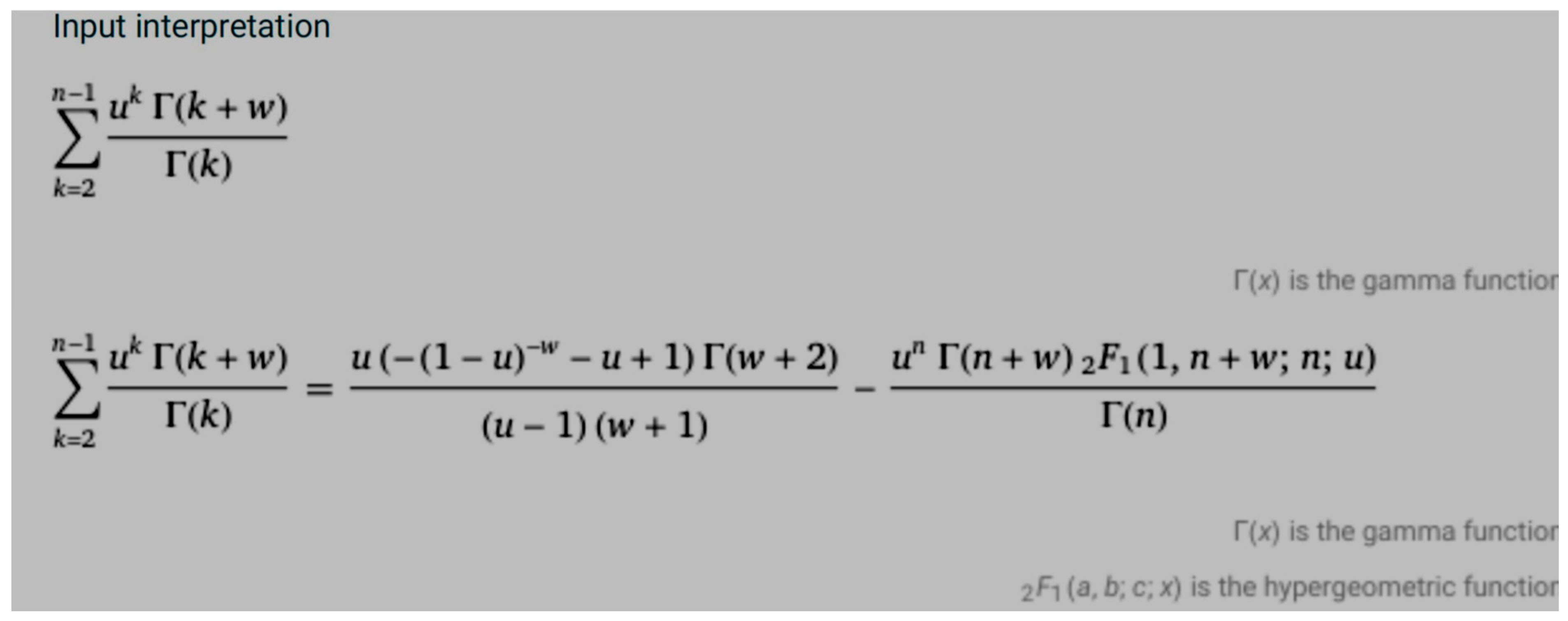
where is the hypergeometric function. Using Mathematica (online), we obtain the following formula
To see how this works, we visited the website of Wolframalpha (https://www.wolframalpha.com, accessed on 15 May 2025) and entered
in the input cell. Then, by pressing the ENTER tab, we saw on the Figure 1.
sum (u^k∗Γ(k + w))/Γ(k), k = 2 to n − 1
Figure 1.
Screenshot of the Mathematica website.
We use the notation
and consider two cases for the sequence. We first choose the following form of the function G:
Thus,
We can now study the first case, namely, the system
Hence, using Mathematica (online), we obtain
where and is the incomplete gamma function. Thus, we obtain the following form for
Since , is the reciprocal of
Now, we investigate the limit of the sequence. We consider the case in which . In this case, the function increases without bounds in m. Further, is the reciprocal of , i.e.,
Proposition 1.
Let and r be positive real numbers. If , we conclude for System (7) that the limit of the system is zero.
Proof.
It is clear that converges at 0 as n tends to infinity, by definition. The solution of the system is the reciprocal of a quantity growing in magnitude to infinity, as we calculated. □
For example, the system with the values and is
We obtain the following values for : 1, 1, Using Excel, we generated some remaining values when n is greater than 7, which we list in Table 1.
Table 1.
Values of System (9).
In some cases, we can modify the assumptions of the proposition and use the following reasoning in the previous proof: First, we ensure that the property (the terms are less than one) holds and the terms go to zero, so the limit of the numerator is zero while the limit of the denominator is nonzero. For example, if then the terms and are positive. Thus, the limit of System (7) is zero.
We consider the second case in two propositions. Here, we deal with the situation in which one parameter is greater and less than one.
We consider the following system:
where and d are fixed real numbers. By using Mathematica, we know that
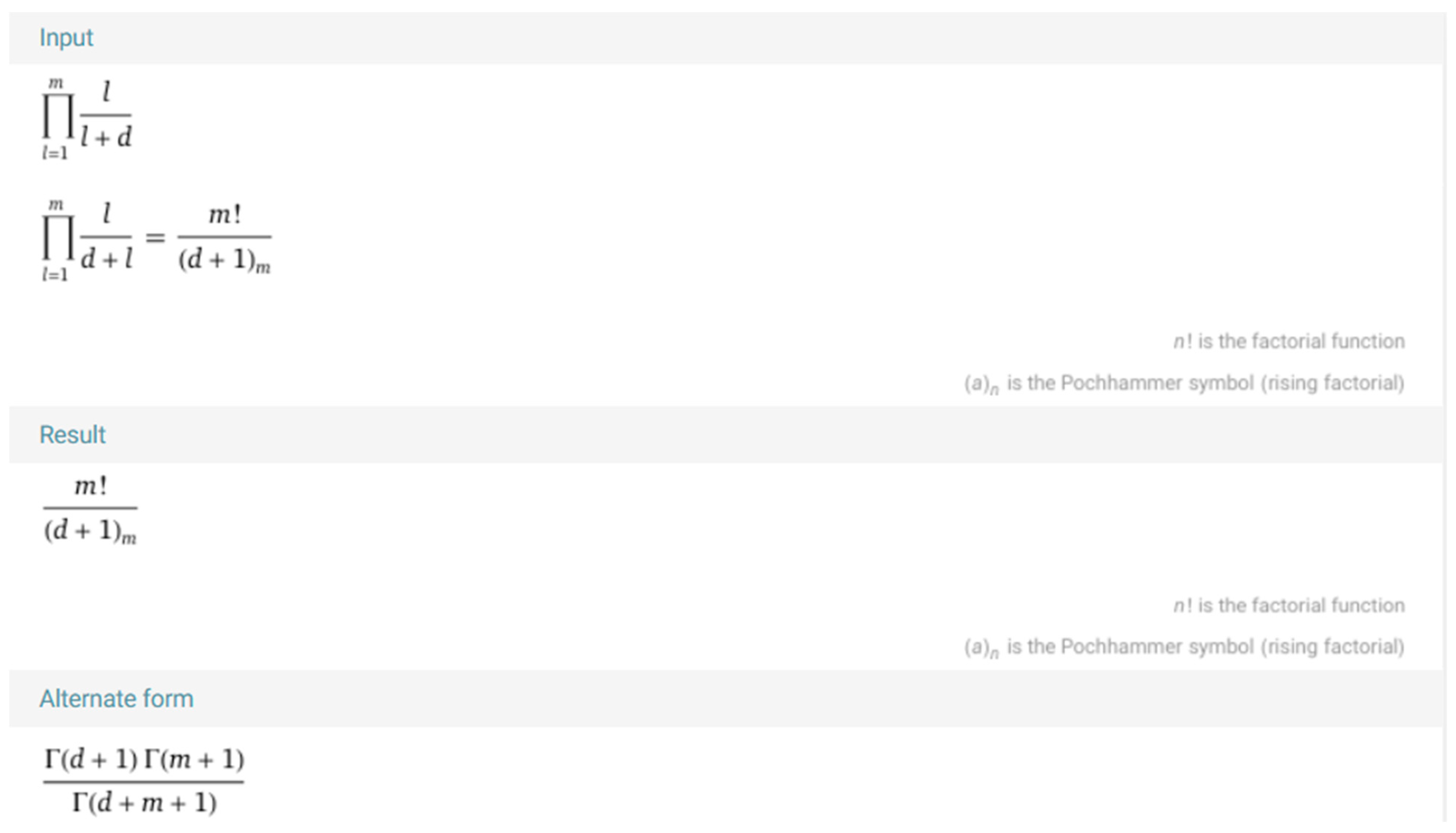
This can be established by visiting the website of Wolframalpha using the link: https://www.wolframalpha.com/input?i2d=true&i=Product%5BDivide%5Bl%2Cl%2Bd%5D%2C%7Bl%2C1%2Cm%7D%5D (accessed on 15 May 2025).
By pressing on the “=” bottom (compute input), we obtained Figure 2.
Figure 2.
Screenshot of the Mathematica website.
Hence, we obtain
We then obtain the following form:
In general, we will obtain
In other words, is the reciprocal of
Proposition 2.
Let and be positive real numbers, with . Assume that 0 < d < . The general solution of System (10) satisfies
Proof.
We know that
We create two parts
We then consider the function
And so on:
Since and m > 2, k = 0, …, ,
Thus,
For example,
Since d > 0, we obtain the following for n = 3, 4, …:
We turn our attention to :
Since we conclude that
Now, since and ,
So, we can conclude from these computations that
□
For example, for a system with the values and , we consider that
Using Excel, we calculated the first terms of the sequence, which are listed in Table 2.
Table 2.
Values of System (11).
Now, let us study the case in which . We change the notations so that is the reciprocal of . In other words, we now study the system
In the same manner, we conclude that is the reciprocal of
where
According to the previous formulas,
But we now have negative values for the hypergeometric function. For example,
In fact, we tested the value of for d = 1, 2, 3, and 4 by using Mathematica online as we did previously, and we concluded that
where are constants. For example,
We calculate the following expressions as indicated:
where
Therefore,
We can now turn our attention to . Since the gamma function increases at the interval (1.46, ∞), we obtain the following for m = 3, 4, …:
In the case that and , we conclude that
Proposition 3.
Let and be positive real numbers, with . Then, for the solution of System (12), we have
We reformulate the result as follows: Let and be positive real numbers, with . Then, for the solution of System (10), we have
For example, the system with the values and is
We then obtain
Using Excel, we calculated some other terms of the sequence, which are listed in Table 3:
Table 3.
Values of System (13).
We notice that . It is clear that the sequence is decreasing and that two-thirds is the lower limit. To be precise, using Mathematica, we conclude that the exact value of the solution is
and we see immediately that two-thirds is the limit.
We can now study the system in the remaining case, which is , i.e.,
This is a simple case. We state the result in a separate proposition.
Proposition 4.
Assume that . Then, the general solution of System (14) converges to zero.
Proof.
Of course, is the reciprocal of
where
Using Mathematica (online) as we did previously,
In other words, is the reciprocal of
Since , the limit of this quantity is infinity, the sequence converges to zero for all real values of c. □
3. Conclusions
We have determined the limits of some sequences without determining the explicit formulas of the solutions, which might be not easily expressible in closed form. We encountered many formulas, which were provided by the software program Mathematica. Yet there are still cases to be studied in the future. We studied special cases due to the lack of formulas of summation in some cases.
Author Contributions
Both authors worked on the paper equally. They discussed and formulated all the results together. All authors have read and agreed to the published version of the manuscript.
Funding
This research received no external funding.
Data Availability Statement
Data are contained within the article.
Conflicts of Interest
The authors declare no conflicts of interest.
References
- Alhayal, M.A.A. A Study on the Solutions of Rational Difference Equations with Hypergeometric Functions. Master’s Thesis, Al-Albayt University, Mafraq, Jordan, 2017. [Google Scholar]
- Amodi, A. A Study of the Solution of Difference Equations Using Mathematica. Master’s Thesis, Al-Albayt University, Mafraq, Jordan, 2020. [Google Scholar]
- Intisar, M.; Khaled, B. A Study on Boundedness and Limits of the Solution of System of Difference Equations. Master’s Thesis, Al-Albayt University, Mafraq, Jordan, 2019. [Google Scholar]
- Ibrahim, F.D. A Study of the Solution for Systems of Difference Equations. Master’s Thesis, Al-Albayt University, Mafraq, Jordan, 2015. [Google Scholar]
- Yakoub, B. A Study on the Solution of Rational Systems of Difference Equations. Master’s Thesis, Al-Albayt University, Mafraq, Jordan, 2018. [Google Scholar]
- Al-Ashhab, S. On the Solution of the System of Rational Difference Equations . Gulf J. Math. 2014, 2, 106–117. [Google Scholar]
- Al-Ashhab, S. On the Limit of a Difference Equation with a Generating sequence. Palest. J. Math. 2022, 11, 13–27. [Google Scholar]
- Al-Ashhab, S. Omar Hasan, Rational systems of Difference Equations. Asian J. Math. Comput. Res. 2015, 5, 247–260. [Google Scholar]
- El-Metwally, H.; Elabbasy, E.M.; Elsayed, E.M. The Periodicity Character of a Difference Equation. Int. J. Nonlinear Sci. 2009, 8, 291–299. [Google Scholar]
- Kocic, V.L.; Ladas, G. Global Behavior of Nonlinear Difference Equations of Higher Order with Applications; Kluwer Academic Publishers: Dordrecht, The Netherlands, 1993. [Google Scholar]
- Asiri, A.; El-Dessoky, M.M.; Elsayed, E.M. Solution of a third order fractional system of difference equations. J. Comput. Anal. Appl. 2018, 24, 444–453. [Google Scholar]
- Karatas, R. Global behavior of a higher order difference equation. Inter. J. Contemp. Math. Sci. 2017, 12, 133–138. [Google Scholar] [CrossRef]
- Gumus, M.; Abo-Zeid, R.; Ocalan, O. Dynamical behavior of a third-order difference equation with arbitrary powers. Kyungpook Math. J. 2017, 57, 251–263. [Google Scholar]
- Elsayed, E.M. Dynamics and behavior of a higher order rational difference equation. J. Nonlinear Sci. App. 2016, 9, 1463–1474. [Google Scholar] [CrossRef]
- Elsayed, E.M.; El-Metwally, H. Global Behavior and periodicity of some difference equations. J. Comput. Anal. Appl 2015, 19, 298–309. [Google Scholar]
- Elsayed, E.M. New method to obtain periodic solutions of period two and three of a rational difference equation. Nonlinear Dyn. 2015, 79, 241–250. [Google Scholar] [CrossRef]
- Yazlik, Y.; Elsayed, E.M.; Taskara, N. On the behavior of the solutions of difference equation systems. J. Comput. Anal. Appl. 2014, 16, 932–941. [Google Scholar]
- Elsayed, E.M.; Ibrahim, T.F. Solutions and periodicity of a rational recursive sequences of order five. Bull. Malays. Math. Sci. Soc. 2015, 38, 95–112. [Google Scholar] [CrossRef]
- Elsayed, E.M.; Ibrahim, T.F. Periodicity and Solutions for Some Systems of Nonlinear Rational Difference Equations. Hacet. J. Math. Stat. 2015, 44, 1361–1390. [Google Scholar] [CrossRef]
- Rhova, D.; Viskotova, L. Some Applications of Linear Difference Equations in Finance with Wolframalpha and Maple. Ratio Math. 2014, 27, 81–90. [Google Scholar]
Disclaimer/Publisher’s Note: The statements, opinions and data contained in all publications are solely those of the individual author(s) and contributor(s) and not of MDPI and/or the editor(s). MDPI and/or the editor(s) disclaim responsibility for any injury to people or property resulting from any ideas, methods, instructions or products referred to in the content. |
© 2025 by the authors. Licensee MDPI, Basel, Switzerland. This article is an open access article distributed under the terms and conditions of the Creative Commons Attribution (CC BY) license (https://creativecommons.org/licenses/by/4.0/).