


Abstract
In this manuscript, we present several novel results in fixed-point theory for a complete controlled metric space. The first presented result is inspired from the Caristi contraction where we explore the existence and uniqueness of fixed points under specific conditions. Furthermore, we propose a graphical form of it by endowing the considered space with a graph and develop a new fixed-point theorem, which is illustrated by two examples. Also, we establish a theorem for the -admissible mapping. To demonstrate its effectiveness, the last theorem proposes an approach to solve a second-order differential equation.
MSC:
54H25; 47H10
1. Introduction
The Banach contraction principle is regarded as one of the most renowned results in fixed-point (FP) theory. It focused on the uniqueness of the FP of a self-mapping on a complete metric space [1]. This basic result motivated researchers to develop several FP theorems in different metric spaces [2,3,4,5,6,7].
FP theory, with its broad range of applications, has driven researchers to develop innovative results and explore its use across diverse mathematical disciplines. A prominent application lies in the solving of differential equations, where fixed-point theorems play a crucial role in establishing the existence and uniqueness of solutions, particularly for nonlinear problems [8,9]. These results are instrumental in transforming complex differential equations into solvable integral equations, providing a framework for both analytical and numerical approaches.
On the other hand, the exploration of the interplay between fixed-point theory and graph theory has garnered significant attention, leading to the development of numerous research contributions. Many researchers have investigated the integration of graph-based constraints into metric spaces, yielding novel fixed-point results. This emerging field has not only enriched the theoretical framework of fixed-point theory but also expanded its applicability to a wide range of disciplines, including network theory, optimization, and dynamical systems. We will provide a brief historical overview of the development of the concept of metric spaces endowed with a graph structure.
It is essential to note that early research was focused on equipping metric spaces with a partial ordering. The first significant result in this area was presented by Ran and Reurings [10]. They presented an analogue of Banach’s FP theorem in partially ordered sets and several applications. Their results were extended by Petrusel and Rus in [11] by introducing FP results in ordered L-spaces. Next, in [12], Jachymski established the foundational framework for metric spaces endowed with graph structures. This pioneering approach created new possibilities for investigating the interactions between distance functions and relational structures, leading to significant advancements in FP theory within these spaces [13,14,15,16,17,18].
One of the most important FP results was introduced by Caristi in [19]. He established an FP theorem for a mapping satisfying the following condition
where is a nonnegative real function which is lower semi-continuous. The mapping is called a Caristi map on . Next, Caristi’s result was considered and developed to obtain more general results. Recently, Karapinar et al. [20] proposed a new FP theorem that combined both Banach and Caristi type theorems in a b-metric space. The concept of the b-metric is based on the generalization of the triangle inequality of the standard metric by inserting a constant coefficient to the right-hand side of the triangle inequality. More studies of the b-metric can be found in [21,22,23,24,25]. One of the recent extensions of the b-metric was introduced by Mlaiki et al. [26] and is called controlled metric type space (CMS for short). They inserted a controlled function of the right-hand side of the b-triangle inequality. Subsequently, numerous studies have investigated this new space, demonstrating fixed-point results for various contraction mappings under a range of conditions [27,28].
In this paper, we introduce a new FP theorem inspired by the Caristi contraction in the CMS. Inspired by the exploration of the interplay between FP theory and graph theory, we endow the considered metric space with a graph and we propose a graphical form of the first theorem established. We illustrate the obtained result by two examples. Additionally, we present a theorem for -admissible mappings. Since FP theory provides a robust mathematical framework for tackling a wide range of problems in differential equations and integral equations, our last result offers an approach to solve a second-order differential equation using FP theory to highlight its practical utility.
Let us revisit the definition and essential topological properties of the CMS.
Definition 1
([26]). Let , , and a function satisfying the following hypothesis for all :
- (d1)
- if and only if ;
- (d2)
- ;
- (d3)
- .
The triplet is called a controlled metric type space, and the function ϱ is called a controlled metric.
It is clear that the CMS is an extension for b-metric spaces. Every b-metric space is a CMS, though the reverse may not hold.
Notation 1.
In the rest of this paper, we adopt the following notations:
- represents the set of real numbers.
- represents the set of natural numbers.
Definition 2
([26]). Let be a CMS and be a sequence in Ω.
- 1.
- The sequence converges to some τ in if for every , there exists such that for all .
- 2.
- is a Cauchy sequence, if .
- 3.
- The space is said to be complete if every Cauchy sequence in Ω is convergent.
Definition 3.
Let be a CMS. Let and .
- (i)
- The open ball is
- (ii)
- The mapping is said to be continuous at if ∀, there exists such that .
Evidently, if a mapping g is continuous at v in the space , then implies that as .
2. Main Results
In this section, we present the main results concerning fixed-point theorems for Caristi contractions and -admissible mappings. Some examples and an applications are presented.
2.1. Fixed-Point Theorems for Caristi Contractions
Our first main result is a fixed-point theorem for Caristi contraction mappings. We demonstrate the existence and uniqueness of fixed points under certain conditions. Then, in Theorem 2, we extend this framework to providing a new fixed-point theorem that incorporates the structure of a graph on the underlying space. We propose two examples to illustrate the practical application of the FP results in metric spaces with a graph.
Theorem 1.
Let be a complete CMS. Consider the mapping such that
where is a bounded function from below.
For , take . Moreover, assume that, for every , we have
and ϖ satisfies the following condition
Then, φ has a unique FP.
Proof.
Case 1: Assume that there exists such that , which implies that . Then, is a FP of .
Case 2: Assume that for all . Let us denote . From (1), we obtain
Hence,
Therefore, the sequence is required to be positive and non-increasing. Thus, . Now, using (4), we obtain
which means that . Consequently, we have
Taking into account (5), there exists such that for all ,
This yields that
Now, we show that is a Cauchy sequence. From (7), we obtain
Let with . By using the condition in Definition 1, we have
Using (8), we obtain
Let
Then, we obtain
Now, in order to obtain the limit of , we will study the convergence of the ratio . We have
Therefore, by the ratio test, we deduce that exists and is finite. Hence, is a Cauchy sequence. Subsequently, by applying the limit to the inequality (9), we obtain
Therefore, is a Cauchy sequence, and by the completeness of the space , we can affirm that as .
Now, we claim that is an FP of . From (1), we have
Knowing that the limits of and exist and are finite from (2) and using (10), we can affirm that
On the other hand, we have
If we take the limit in (13) as n goes toward ∞ and from (2) and (12), we obtain , that is, is an FP of .
Assume that has two FPs, e.g., and (that is, and ). Then,
Therefore and . □
Now, we present the graphical version of Theorem 1 by endowing the CMS with a graph. We propose a corollary by relaxing the condition of the continuity. Also, two examples are introduced. In order to get into the topic, let us begin by recalling some concepts and definitions from graph theory which will be necessary later.
In accordance with the work of Jachymski in [12], we endow the CMS with a graph G, where G is characterized by its set of vertices , which is identical to , and its set of edges . Assuming that G contains no parallel edges, it can be identified as the pair .
Additionally, the graph G can be interpreted as a weighted graph by assigning a weight to each edge based on the distance between its vertices.
Definition 4.
Let and be two vertices in a graph G. A path from to in G of length j (where ) is a sequence of distinct vertices where and , and each pair of consecutive vertices , for all .
Definition 5
([12]). Consider a vertex u in a graph G. The subgraph , which consists of all the vertices and edges that are part of some path in G starting at u, is referred to as the component of G that contains u. The equivalence class on the vertex set , defined by the relation R (where if there is a path from u to v), satisfies the property that the set of vertices in , denoted by , is equal to .
Definition 6.
Let be a mapping. We denote .
Definition 7.
Let be a complete CMS equipped with a graph G. We name the mapping a G-Caristi mapping if it satisfies the following hypothesis:
- 1.
- (G-edge preserving)
- 2.
- There exists a function bounded from below satisfying
Theorem 2.
Let be a complete CMS equipped with a graph G. Let be a continuous G-Caristi mapping. Assume that there exists such that
We take and we assume that for each , we have
and ϖ satisfies the following condition
Therefore, φ has a unique FP.
Proof.
Equation (16) implies that there exists such that . Since is G-edge-preserving, we obtain for all . Then, from (15), we have
which gives . Hence, is a sequence of positive numbers that is decreasing. Let . For any , we obtain
From the properties of , we have that converges to zero when . We claim that . Using the triangle inequality of the controlled metric, we obtain
Similarly to Theorem 1, using (15), we have
Then,
where . Using condition (18) similarly to Theorem 1, we can deduce that . Thereafter, . Consequently, is a Cauchy sequence within the space . Then, there exists such that . The continuity of implies that and hence is an FP of .
Suppose that there exist two FPs, and , in such that and . We have
and therefore ⟹. □
Example 1.
Let , , and . It is easy to prove that is a complete CMS. Note that this space is neither a metric space in the usual sense nor a b-metric space.
Consider the mappings and defined by and . We claim that φ is G-Caristi mapping in endowed with a graph G. Indeed, and ; then, φ satisfies the G-edge preserving condition.
On the other hand, for all , we have
By a simple calculus, we can verify that . Consequently, we obtain
Therefore, assumption (15) is satisfied and φ is G-Caristi mapping. Additionally, conditions (17) and (23) are met. Finally, all the conditions of Theorem 2 are satisfied, so the mapping φ has a unique fixed point that is .
Example 2.
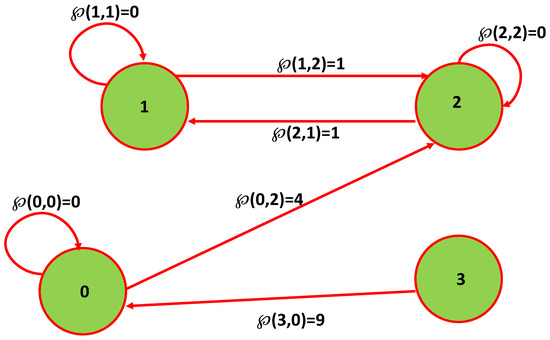
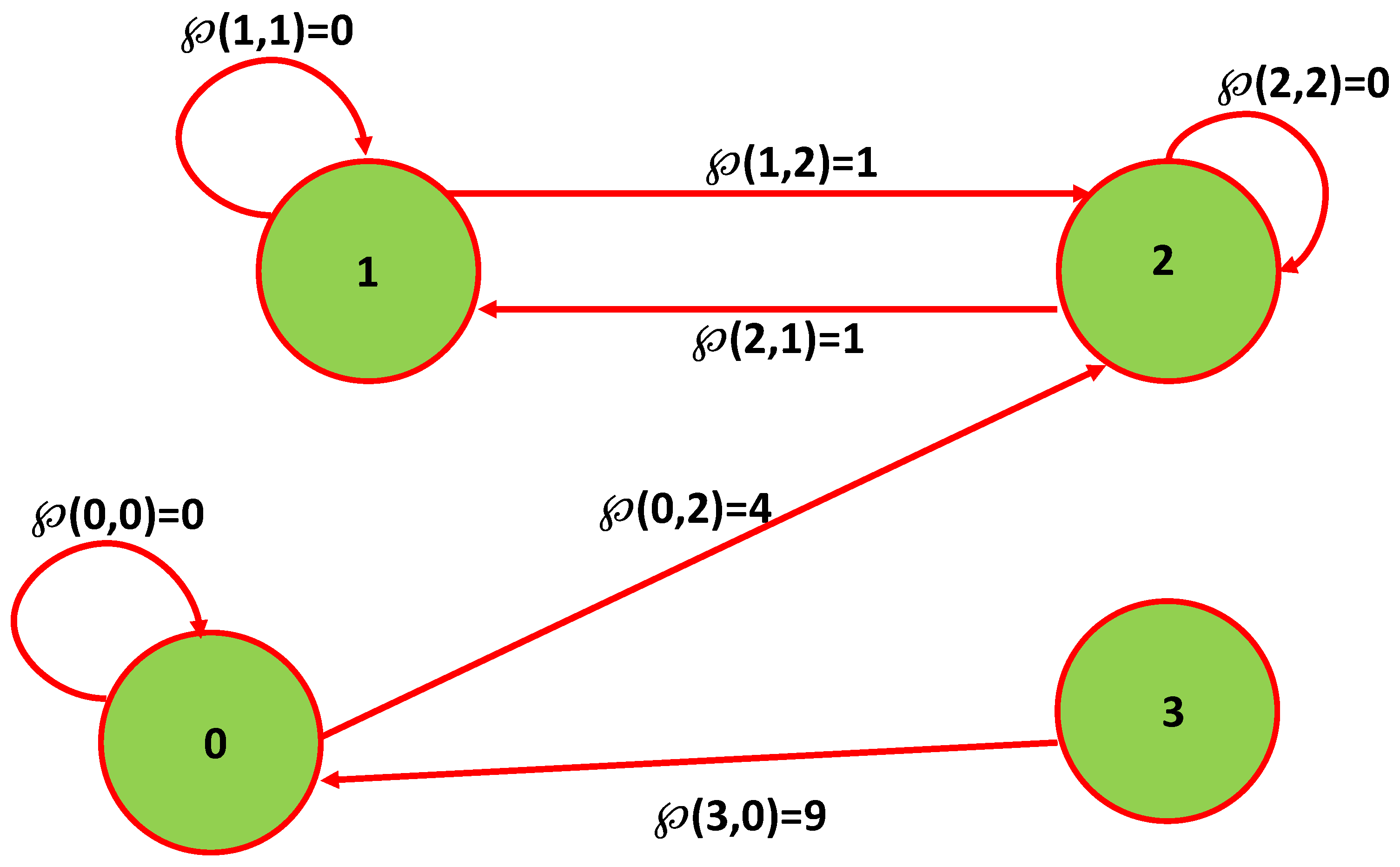
Let , , and . Then, is a complete CMS. Consider the mappings and defined, respectively, by , , , , and
Consider the following set of edges . We represent the graph G composed by the vertices and the edges in Figure 1.
Figure 1.
The graph of Example 2.
Let us begin by verifying the condition for G-edge preserving. We have
- , ,
- , ,
- , ,
- , ,
- , ,
- , ,
- , ,
Therefore, condition (14) holds. Now, we will prove that the mapping φ satisfies condition (15) for all the edges in .
- •
- For the edge , we have . Also, we obtain the same result in a similar manner for the edges and .
- •
- For the edge , we have .
- •
- For the edge , we have .
- •
- For the edge , we have .
- •
- For the edge , we have .
The following result is obtained by relaxing the condition of the continuity of the contraction. We use orbital continuity which is weaker than continuity.
Definition 8.
A mapping is called orbitally G-continuous if for all and any positive sequence ,
Corollary 1.
Let be a complete CMS equipped with a graph G. Let be a G-Caristi mapping orbitally G-continuous. We assume the following property : for any in , if and , then there is a subsequence with .
Moreover, suppose that there exists such that
We take and we assume that for each , we have
and ϖ satisfies the following condition
Therefore, the restriction has a unique FP.
Proof.
Similarly to the proof of Theorem 2, we demonstrate that is a Cauchy sequence. Then, there exists such that
Since , for all , then . From property , there exists a subsequence of such that for all .
2.2. Fixed-Point Results for -Admissible Mappings
In this subsection, we introduce a new FP theorem concerning the -admissible mappings under suitable hypotheses. Moreover, to highlight the potential application in various mathematical contexts, we propose Theorem 4 to solve second-order differential equations. Let us start by defining the -admissible mappings that will be involved in the next theorem.
Definition 9.
Let and let . The mapping φ is called α-admissible if ∀, implies that .
Definition 10
([4]). Let and . The mapping φ is called α-admissible with respect to β if ∀, , we have .
Now, we consider a new class of families of mappings satisfying the following assumptions:
- (i)
- g is an upper semi-continuous mapping from the right;
- (ii)
- ;
- (iii)
- .
Theorem 3.
Let be a complete CMS and . Supppose that is a continuous mapping that meets the following hypotheses:
- φ is α-admissible with respect to β;
- if and , then ;
- there exists such that .
Therefore, φ has an FP.
Proof.
Consider as an element in . We denote . Therefore, we construct the sequence defined as follows
Assume that ; otherwise, has an FP.
From condition , we have and taking into account that is -admissible with respect to , we obtain that
By extending this process, we obtain
Applying and the property of , we obtain that
Therefore, is a nonincreasing sequence. As a result, there exists fulfilling
We claim that . Suppose that . Since is upper semi-continuous from the right, using (28), we obtain
This leads to a contradiction. Hence,
From (29), we can affirm the existence of some for every , such that
Then, we obtain
Consequently, forms a Cauchy sequence and thus converges to some . Owing to the continuity of , we have
Thus, is an FP of . □
To illustrate that the FP result is a powerful tool in various mathematical fields, we apply it to solve a second-order differential equation using Theorem 3. Indeed, by carefully verifying the assumptions outlined in Theorem 3, we ensure that the FP serves as a valid and effective tool for deriving solutions to second-order differential equations for the given problem, as demonstrated in the following theorem (Theorem 4).
Consider the following problem :
where is continuous. The Green function associated to (31) is defined by
Denote . Let be defined by
It is easy to see that is a complete CMS.
Theorem 4.
Let us examine the two-point boundary value problem . Suppose that the following assumptions hold:
- 1.
- there exists a function such that, ∀, and with , we have
- 2.
- There exists such that, ∀, we have
- 3.
- If is a sequence in such that and , ∀, then for all ;
- 4.
- For all , for all , implies that
Then, possesses a solution in .
Proof.
Solving the problem is tantamount to solving the following integral equation:
Let be a self-mapping on defined by
Suppose that such that ∀. Using the first assumption of the theorem, we obtain that
As , for all , we obtain . Consequently,
for each , such that for all . Therefore, condition of Theorem 3 holds.
Now, let us prove that is -admissible concerning . Let be mappings defined by
Let such that . Hence, . Hence,
Moreover, if such that , by applying assumption 4 of Theorem 4, we obtain , and this yields . Therefore, is -admissible with respect to . Using condition 2, there exists such that .
Finally, given that all the conditions of Theorem 3 are satisfied, then has an FP in , e.g., , which is a solution of the problem . □
3. Conclusions and Perspectives
In conclusion, this paper introduces several significant contributions to FP theory within the context of CMS. We have extended the classical Caristi contraction by exploring the existence and uniqueness of fixed points under specific conditions, and further developed a graphical representation of this result. Also, by introducing the concept of -admissible mappings, we provided a new FP theorem with practical applications, including the solution to a second-order differential equation. These contributions provide valuable tools for tackling problems across various domains of mathematical analysis.
Moving forward, further research will aim to expand on these results, exploring broader applications and potential generalizations of the established theorems in the double controlled metric space which is more general than the CMS. Also, one promising direction is the generalization of the -admissible mappings to a broader class of operators, potentially incorporating non-contractive and nonlinear mappings. This could pave the way for FP theorems in settings where traditional contraction mappings are not applicable, thereby extending the scope of fixed-point theory.
Author Contributions
Conceptualization and Methodology N.S.; Formal analysis N.S.; Investigation N.S.; Validation L.H.; Resources L.H.; Writing—review and editing L.H. All authors have read and agreed to the published version of the manuscript.
Funding
This research was funded by King Saud University through Researchers Supporting Project number (RSPD2025R687), King Saud University, Riyadh, Saudi Arabia.
Data Availability Statement
The original contributions presented in this study are included in the article. Further inquiries can be directed to the corresponding author.
Acknowledgments
The authors extend their appreciation to King Saud University for funding this work through the Researcher Supporting Project number RSPD2025R687, King Saud University, Riyadh, Saudi Arabia.
Conflicts of Interest
The authors declare no conflict of interest.
References
- Banach, S. Sur les operations dans les ensembles abstraits et leur applications aux equations integrales. Fundam. Math. 1922, 3, 133181. [Google Scholar] [CrossRef]
- Deng, J.; Liu, X.; Sun, Y.; Zhou, M. Fixed Point Results for a New Rational Contraction in Double Controlled Metric-like Spaces. Mathematics 2022, 10, 1439. [Google Scholar] [CrossRef]
- Azmi, F.M. New fixed point results in double controlled metric type spaces with applications. AIMS Math. 2022, 8, 1592–1609. [Google Scholar] [CrossRef]
- Salimi, P.; Latif, A.; Hussain, N. Modified α-ϕ-contractive mappings with applications. Fixed Point Theory Appl. 2013, 2013, 151. [Google Scholar] [CrossRef]
- Shatanawi, W.; Pitea, A. Some coupled fixed point theorems in quasi-partial metric spaces. Fixed Point Theory Appl. 2013, 2013, 153. [Google Scholar] [CrossRef][Green Version]
- Gupta, V.; Shatanawi, W.; Kanwar, A. Coupled fixed point theorems employing clr-property on v-fuzzy metric spaces. Mathematics 2020, 8, 404. [Google Scholar] [CrossRef]
- Mishra, A.; Raja, H. Study Of Fixed-Point Results In G-Metric Space And G- Cone Metric Space and Its Application. In Proceedings of the 2024 OPJU International Technology Conference (OTCON) on Smart Computing for Innovation and Advancement in Industry 4.0, Raigarh, India, 5–7 June 2024. [Google Scholar]
- Ali, F.; Ali, J.; Rodríguez-López, R. Approximation of fixed points and the solution of a nonlinear integral equation. Nonlinear Funct. Anal. Appl. 2021, 26, 869–885. [Google Scholar]
- Özger, F.; Temizer Ersoy, M.; Ödemiş Özger, Z. Existence of Solutions: Investigating Fredholm Integral Equations via a Fixed-Point Theorem. Axioms 2024, 13, 261. [Google Scholar] [CrossRef]
- Ran, A.C.M.; Reurings, M.C.B. A fixed point theorem in partially ordered sets and some applications to matrix equations. Proc. Am. Math. Soc. 2004, 132, 1435–1443. [Google Scholar] [CrossRef]
- Petruşel, A.; Rus, I. Fixed point theorems in ordered L-spaces. Proc. Am. Math. Soc. 2006, 134, 411–418. [Google Scholar] [CrossRef]
- Jachymski, J. The contraction principle for mappings on a metric space with a graph. Proc. Am. Math. Soc. 2008, 136, 1359–1373. [Google Scholar] [CrossRef]
- Fallahi, K.; Rad, G.S. The Banach Type Contraction for mappings on Algebraic Cone Metric Spaces Associated with an Algebraic Distance and Endowed with a Graph. Iran. J. Math. Sci. Inform. 2020, 15, 41–52. [Google Scholar] [CrossRef]
- Fallahi, K.; Rad, G.S. Fixed Points of a φ-G-Contractive Mapping with Respect to a c-Distance on an Abstract Metric Space Endowed with a Graph. Math. Notes 2019, 105, 781–788. [Google Scholar] [CrossRef]
- Bojor, F. Fixed points of Kannan mappings in metric spaces endowed with a graph. An. St. Univ. Ovidius Constanta 2012, 20, 31–40. [Google Scholar] [CrossRef]
- Souayah, N.; Mlaiki, N.; Mrad, M. The-Contraction Principle for Mappings on an-Metric Spaces Endowed With a Graph and Fixed Point Theorems. IEEE Access 2018, 6, 25178–25184. [Google Scholar] [CrossRef]
- Souayah, N.; Mrad, M. Some Fixed Point Results on Rectangular Metric-Like Spaces Endowed with a Graph. Symmetry 2019, 11, 18. [Google Scholar] [CrossRef]
- Souayah, N. Fractional Differential equation in partially ordered controlled metric spaces. Univ. Politeh. Buchar. Sci. Bull.-Ser. A-Appl. Math. Phys. 2022, 84, 81–88. [Google Scholar]
- Caristi, J. Fixed point theorems for mappings satisfying inwardness conditions. Trans. Am. Math. Soc. 1976, 215, 241–251. [Google Scholar] [CrossRef]
- Karapinar, E.; Khojastech, F.; Mitrović, Z. A Proposal for Revisiting Banach and Caristi Type Theorems in b-Metric Spaces. Mathematics 2019, 7, 308. [Google Scholar] [CrossRef]
- Arandelović, I.D.; Aljohani, S.; Mitrović, Z.D.; Dokić, V.V.; Mlaiki, N. Fixed point theorem for extended nonlinear quasi-contractions on b-metric spaces. Results Appl. Math. 2024, 23, 100497. [Google Scholar] [CrossRef]
- Aydi, H.; Bota, M.F.; Karapinar, E.; Moradi, S. A common fixed point for weak ϕ-contractions on b-metric spaces. Fixed Point Theory 2012, 13, 337–346. [Google Scholar]
- Kukic, K.; Shatanawi, W.; Gardaoevic-Filipovic, M. Khan and Ciric contraction principles in almost b-metric spaces. UPB Sci. Bull. Ser. A 2020, 82, 113–144. [Google Scholar]
- Bakhtin, I.A. The contraction mapping principle in almost metric spaces. Funct. Anal. 1989, 30, 26–37. [Google Scholar]
- Czerwik, S. Contraction mappings in b-metric spaces. Acta Math. Inform. Univ. Ostra 1993, 1, 5–11. [Google Scholar]
- Mlaiki, N.; Aydi, H.; Souayah, N.; Abdeljawad, T. Controlled Metric Type Spaces and the Related Contraction Principle. Mathematics 2018, 6, 194. [Google Scholar] [CrossRef]
- Ahmad, J.; Al-Mazrooei, A.E.; Aydi, H.; De la Sen, M. On Fixed Point Results in Controlled Metric Spaces. J. Funct. Spaces 2020, 2020, 2108167. [Google Scholar] [CrossRef]
- Al-Mazrooei, A.E.; Ahmad, J. Fixed Point Results in Controlled Metric Spaces with Applications. Mathematics 2022, 10, 490. [Google Scholar] [CrossRef]
Disclaimer/Publisher’s Note: The statements, opinions and data contained in all publications are solely those of the individual author(s) and contributor(s) and not of MDPI and/or the editor(s). MDPI and/or the editor(s) disclaim responsibility for any injury to people or property resulting from any ideas, methods, instructions or products referred to in the content. |
© 2025 by the authors. Licensee MDPI, Basel, Switzerland. This article is an open access article distributed under the terms and conditions of the Creative Commons Attribution (CC BY) license (https://creativecommons.org/licenses/by/4.0/).