


Abstract
In this research paper, we provide a concise overview of fractal calculus applied to fractal sets. We introduce and solve a -order fractal differential equation with constant coefficients across different scenarios. We propose a uniqueness theorem for -order fractal linear differential equations. We define the solution space as a vector space with non-integer orders. We establish precise conditions for -order fractal linear differential equations and derive the corresponding fractal adjoint differential equation.
Keywords:
fractal calculus; 2α-order fractal linear differential equations; fractal adjoint differential equation MSC:
34A02; 34A11; 28A11; 26A04
1. Introduction
Fractal patterns, although represented across various scales rather than infinitely, have been extensively modeled due to limitations related to time and space constraints. These models can simulate theoretical fractals or natural phenomena with fractal features, and the results derived from modeling processes can serve as benchmarks for fractal analysis. Fractal calculus, which emerged as a formulation extending ordinary calculus, procures a constructive and algorithmic approach toward the smooth differentiable-structured modeling of natural processes through fractals.
Benoit Mandelbrot is credited with pioneering the field of fractal geometry [1], which revolves around shapes possessing fractal dimensions that surpass their topological dimensions [2,3]. These intricate fractals exhibit self-similarity and frequently demonstrate non-integer and complex dimensions [4,5]. An eclectic survey of fractals has been organized into two parts, covering a diverse array of innovative applications. The first part has been designed to focus on the glossary of fractals, their mathematical description, and their aesthetic, artistic, and architectural applications, while the second part has been focused on engineering, industry, commercial, and futuristic applications of fractals [6]. The focus is on engineering, industrial, commercial, and futuristic fractal applications, with prior coverage of fractal fundamentals. Key applications include landscape modeling, antennas, and image compression, highlighting innovative, industry-oriented uses [7]. The fractal morphology of scale-invariant patterns has been surveyed, with emphasis on scale and conformal invariance, fractal non-uniformity, inhomogeneity, and anisotropy. Six adimensional indices have been identified to quantify these features, and distinctions between mathematical and real-world fractals have been highlighted [8].
Nevertheless, the analysis of fractals presents challenges, given that traditional geometric measures such as Hausdorff measure [9], length, surface area, and volume are typically applied to standard shapes [10]. As a result, applying these measures directly to fractal analysis becomes complex [11,12,13,14,15,16].
Researchers have tackled the challenge of fractal analysis through various methodologies, including harmonic analysis [17,18], measure theory [19,20,21,22,23,24], fractional space and nonstandard methods [25], probabilistic methods [26] fractional calculus [27,28,29,30,31], and non-standard methods [32].
Fractal calculus is a mathematical framework that extends traditional calculus, allowing for the treatment of equations whose solutions take the form of functions exhibiting fractal properties, such as fractal sets and curves [33,34]. What makes fractal calculus particularly appealing lies in its elegance and algorithmic methodologies, which contrast favorably with other techniques [35].
The generalization of -calculus (FC) has been successfully achieved by employing the gauge integral method. This generalization focuses on the integration of functions over a specific subset of the real number line that contains singularities found within fractal sets [35].
Various methods have consequently been employed to solve fractal differential equations, and their stability conditions have been determined accordingly [35].
The application of FC is demonstrated through the analysis of fractal interpolation functions and Weierstrass functions. These functions often display characteristics of non-differentiability and non-integrability when viewed through the lenses of traditional calculus [35].
Fractal calculus has been expanded to encompass the study of Cantor cubes and Cantor tartan [35], and within this framework, the Laplace equation has been formally defined [35].
Analyses based on non-local fractal calculus have been conducted for electrical circuits with arbitrary source terms, broadening the scope of examination to include circuits [36].
Numerical simulations explored the influence of parameters on noise performance. Increasing the orders of fractal-fractional reactive components generally improved noise performance across different circuits [37,38].
The utilization of non-local fractal derivatives to characterize fractional Brownian motion on thin Cantor-like sets was demonstrated. The proposal of the fractal Hurst exponent establishes its connection to the order of non-local fractal derivatives [35]. Furthermore, fractal stochastic differential equations have been defined and categorized for processes such as fractional Brownian motion and diffusion occurring within media with fractal structures [35]. Local vector calculus within fractional-dimensional spaces, on fractals, and in fractal continua has been developed. The proposition was put forth that within spaces characterized by non-integer dimensions, it was feasible to define two distinct del-operators, each operating on scalar and vector fields. Employing these del-operators, the foundational vector differential operators and Laplacian in fractional-dimensional space were formulated conventionally. Additionally, Laplacian and vector differential operators linked with -derivatives on fractals were established [39]. The concept of a fractal comb and its associated staircase function was introduced. Derivatives and integrals were defined for functions on these combs using the staircase function [40]. Fractal retarded, neutral, and renewal delay differential equations with constant coefficients were solved through the utilization of the method of steps and the Laplace transform [41]. Fractal integral and differential forms were defined using non-standard analysis [42]. The solution space for higher -order linear fractal differential equations was defined, showcasing its non-integer dimensionality [43].
Fractal time, recently suggested by physics researchers for its self-similar properties and fractional dimension, was investigated in the context of economic models utilizing both local and non-local fractal Caputo derivatives [35,44,45,46,47,48].
Along these lines of developments and implications, we have introduced -order fractal linear differential equations and elucidated their corresponding solutions.
To this end, the current paper is structured as follows: in Section 2, we provide a concise review of fractal calculus. Moving on to Section 3, we define and solve the -order fractal differential equation and present the uniqueness theorem associated with it. In Section 4, we extend the discussion to encompass the uniqueness theorem for -order fractal linear differential equations. Section 5 addresses the comprehensive study of the exact -order fractal differential equation. In Section 6, we delve into the solution and presentation of the nonhomogeneous -order fractal differential equation. Finally, Section 7 provides the conclusion, discussion, and future directions.
2. Overview of Fractal Calculus on Fractal Sets
In this section, we present a concise overview of fractal calculus applied to fractal sets, as summarized in [33,34,35]. Moreover, in this section and more generally throughout the paper, we will indicate by F a fractal subset of a real line.
Definition 1.
The flag function of a set F and a closed interval is defined as:
Definition 2.
For a subdivision of , and for a given , the coarse-grained mass of is defined by
where , and .
Definition 3.
The mass function of F is defined as the limit of the coarse-grained mass as δ approaches zero:
Definition 4.
The γ-dimension of is defined as:
Definition 5.
The integral staircase function of order α for F is given by:
where is an arbitrary fixed real number.
Definition 6.
Let , , and . A number l is called the limit of for , if for any given , there exists such that:
If such a number exists, then it is denoted by:
Definition 7.
Let , and . Whenever
we say that the function f is F-continuous at x. If f is F-continuous at each point of , we say that f is F-continuous in
Remark 1.
Let us observe that the continuity of a function f in interval implies the F-continuity of f in however, the converse is not true (see [33,34,35]).
Definition 8.
Let f be a real function defined in The -derivative of f is defined as follows:
if exists [33]. Moreover, if f has the -derivative at each point of the fractal set we say that f is -differentiable on
Remark 2.
Let us observe that if a function f is differentiable on , f is also -differentiable on . The converse is not true. Indeed, let us consider . It is trivial to observe that However, is not differentiable on since it is not continuous on
Theorem 1.
Let f be a real function defined on If f is -differentiable on then the function f is F-continuous on
Definition 9.
Let f be a real function defined on . If f is -differentiable on the second -derivative of f at the point x is defined as follows:
Moreover, if f has the second -derivative at each point of the fractal set F, we say that f is twice -differentiable on .
Remark 3.
Let us observe that if a function f is twice differentiable on , f is also twice -differentiable on . The converse is not true. Let us consider . Since (see [33,34]), it is trivial to observe that , However, as already observed in Remark 2, is not differentiable on .
Definition 10.
Let such that is finite on I. Let f be a bounded function defined on and let . The -integral of f on I is defined as:
3. Preliminaries on the -Order Fractal Differential Equation
A relation of the form:
where is the unknown function and G is an assigned function of the 4 variables , is called -order ordinary fractal differential equation; here, 2th indicate the maximum order of the -derivative that appears in the equation while, as usual, denotes the dimension of the fractal subset of the real line, If G is a first-degree polynomial of the variables , the equation is said to be linear and its general form is:
where the coefficients for are F-continuous functions in as well as the function Whenever Equation (12) is said to be homogeneous. An equation that is not of the form of Equation (12) is said to be a nonlinear -order fractal differential equation.
Example 1.
The following -order fractal differential equation
is linear.
Example 2.
The following -order fractal differential equation that represents the motion of an oscillating pendulum with fractal time
where is the unknown function that physically means an oscillating pendulum of length L with the vertical direction, is nonlinear because of the term .
Remark 4.
Now, let us observe that, if in Equation (11) it is possible to explicate the 2th -derivative, the -order fractal differential equation is said to be written in normal form and we have:
where g is an assigned function of the 3 variables:
Definition 11.
A solution of the -order fractal differential equation is a function
such that:
Remark 5.
It is trivial to observe that if (12) is written in a normal form, i.e., in the form of Equation (15), a solution of (15) is a function
such that
we can conjecture that the set of all solutions of a -order fractal differential equation is represented by a family of functions depending on 2 parameters.
-Order Fractal Differential Equation with Constant Coefficient
Let us consider a homogeneous -order fractal differential equation with constant coefficients
We are interested in the problem of finding all solutions of Equation (17). To do that, let us note that the linearity of the differential equation means that if and are any two solutions of Equation (17) and and are any two constants, then the function is also a solution of Equation (17). Moreover, let us recall that if where k is a generic constant, the functions and are linearly independent on By a similarity with the -order fractal differential equation (see [49]), we assume that the function is a solution of Equation (17). Therefore, by substituting into Equation (17), we have:
Since is never zero, we can conclude:
This equation is known as the characteristic equation for Equation (17). We encounter three main cases:
1. Real Roots Case (): In this scenario, let us assume that and are the two real distinct root solutions of Equation (19). Therefore, the functions and are two linear independent solutions of Equation (17). By this conjecture, we obtain that the general solution of Equation (17) is given by:
2. Complex Roots Case (): In this case, let us assume that and , where and are two real distinct root solutions of Equation (19). Therefore, the function
and the function
are two linear independent solutions of Equation (17). Since we are considering only real functions, by the elementary property of the complex numbers and by our conjecture about the set of all solutions of the -order fractal differential equation, we obtain that the functions:
and
are still solutions of Equation (17). Therefore, we can represent the general solution of Equation (17) in terms of trigonometric functions:
3. Repeated Roots Case (): In this situation, we have . Therefore, the general solution for Equation (17) takes the form:
Indeed, let us observe that if is a real function on that is also twice -differentiable at , indicated by , it follows that the function and the function are linearly independent, since So, by replacing in Equation (17), we have:
and by solving this equation for , we obtain:
This completes the solutions for the -order fractal differential equation with constant coefficients under various cases.
Example 3.
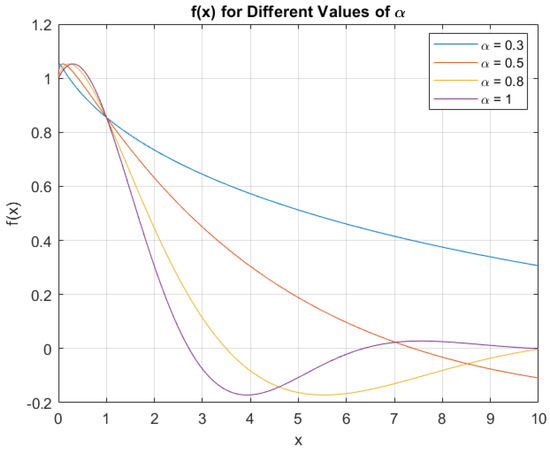
Consider the -order fractal differential equation:
Its characteristic equation is given by:
The roots of this characteristic equation are:
Therefore, the general solution of Equation (27) is:
In Figure 1, we illustrate Equation (30) for various values of α, highlighting how the fractal support influences the solutions.
Figure 1.
Graph of Equation (30) for .
4. Uniqueness Theorem for -Order Fractal Linear Differential Equations
In this section, we prove the existence and the uniqueness of the solution of a given -order fractal differential equation with some fixed initial conditions.
Theorem 2.
(Existence Theorem) Consider the following -order fractal differential equation:
with the initial conditions
where and , are two predefined constants.
Let and be the two linear independent solutions of Equation (31) (as already found in the previous section); therefore, there exist two constants and such that is a solution of the assigned -order fractal differential equation given by Equation (31) with the initial conditions given by Equation (32).
Proof.
So that is a solution of the Equation (31) with the initial conditions given by Equation (32), the constants and should be the solutions of the following linear system:
It is well known that the system (33) admits one and only one solution if the determinant,
called Wronskian, is nonzero. Since the functions and are linearly independent, the Wronskian condition (determinant of Wronskian different from zero) is satisfied in either case (see [50,51]). Therefore, are the unique constants satisfying Equation (31) with the initial conditions given by Equation (32). This shows that there is a unique linear combination of and which is a solution of the assigned -order fractal differential equation. □
Now, in order to prove the uniqueness theorem, we need to prove the following technical lemma.
Lemma 1.
Let be any solution on of the following fractal differential equation:
Let Then, for all , we have
where
Proof.
Let . This implies that
Subsequently,
and
By the hypothesis on , we have:
and, consequently,
Now, by substituting (42) into (40), we obtain
and by the inequality
setting and , we obtain
Therefore, we obtain
Subsequently, we obtain
Now, to prove Equation (36), let us observe that the right inequality of Equation (47) can be expressed as
Since for all , we can multiply both members of Equation (48) by , so we obtain that
Now, let Let us start by considering ; therefore, the -integral from to x of results in
This leads to the inequality
which yields
The corresponding left inequality in Equation (47) implies
which consequently leads to
Now, considering Equation (47) for along with a fractal integration from x to , we obtain
which completes the proof. □
In Figure 2, it is evident that consistently remains between the two curves and .
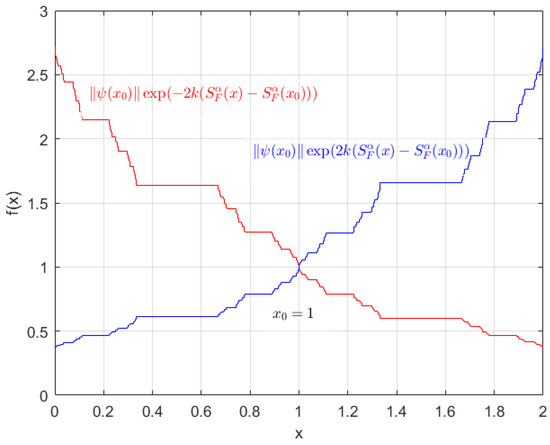
Figure 2.
Graph of lower and upper bound of given by Equation (55).
Theorem 3.
(Uniqueness Theorem) Let and be any two constants and let be any point in the fractal set F. On any interval containing , there exists at most one solution of the initial value problem
Proof.
Let us assume that there are two different solutions indicated by and of the assigned initial value problem. Let . Then, we have that satisfies the initial value problem with the initial conditions . Thus, and by applying the inequality Equation (55) of the previous Lemma to , we obtain for all . Therefore, for all Thus, there exists at most one solution to the initial value problem (56), establishing the uniqueness of the solution. □
Example 4.
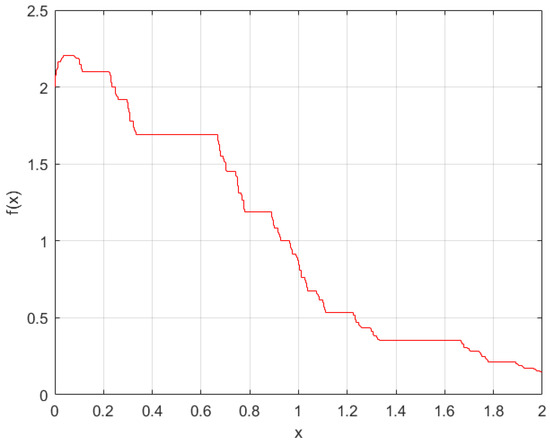
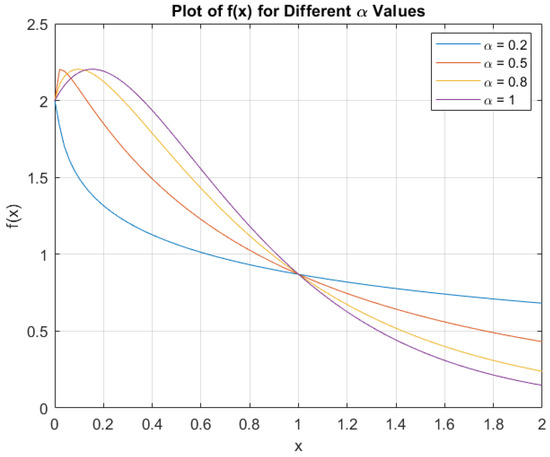
Remark 6.
We observe that for , the inequality holds [52].
Definition 12.
We say that the fractal dimension of the solution space of the -order fractal differential equation is .
5. Exact -Order Fractal Differential Equation
In this section, we present the concept of a homogeneous fractal differential equation of order and outline the approach to determine its solution.
Definition 13.
A -order fractal differential equation:
is considered exact when it can be transformed into the following form:
where the function can be determined in terms of , , and .
Theorem 4.
The -order fractal differential equation, as given by Equation (60):
is exact if
In other words, the equation is exact when the combination of the second -derivative of the coefficient function and the -derivative of the coefficient function , along with the term , equals zero.
Proof.
To prove this theorem, we can equate the coefficients of Equations (61) and (62) and then eliminate , resulting in the equation:
□
Theorem 5.
Consider a -order fractal homogeneous equation given by:
If this equation is not exact, we can make it exact by multiplying it by a function , which is a solution of the following equation, often referred to as the adjoint equation associated with Equation (65):
Proof.
Let us consider the equation obtained by multiplying the given -order fractal linear homogeneous equation by :
We can express Equation (67) in the following form:
By equating the coefficients of Equations (67) and (68), we can eliminate the function , revealing that the function must satisfy the following equation:
□
Lemma 2.
A -order fractal homogeneous equation, represented as:
can be referred to as self-adjoint if it satisfies the condition:
In simpler terms, the equation is considered self-adjoint when the α-derivative of the coefficient function is equal to the function .
Proof.
The proof follows straightforwardly from Equation (66). □
Example 5.
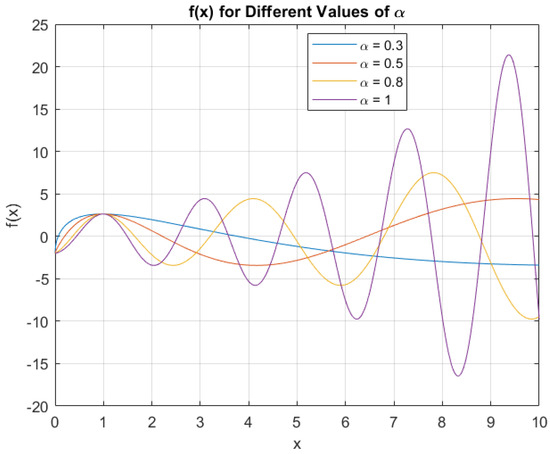
Consider a -order fractal differential equation given by:
with the following initial conditions:
The solution to this equation is given by:
In Figure 5, we have graphed Equation (74), illustrating how varying dimensions influence the solution. In simpler terms, this example illustrates a -order fractal differential equation with specific initial conditions and provides the corresponding solution expressed in terms of trigonometric and exponential functions.
Figure 5.
Graph of Equation (74).
Theorem 6.
Let us consider a solution, denoted as , to a -order fractal differential equation given by:
Now, the second solution, denoted as , can be expressed as:
which satisfies the following equation:
In essence, this theorem explains how to find a second solution to a -order fractal differential equation when we already have one solution, and it provides a differential equation for the function that relates the two solutions.
Proof.
Example 6.
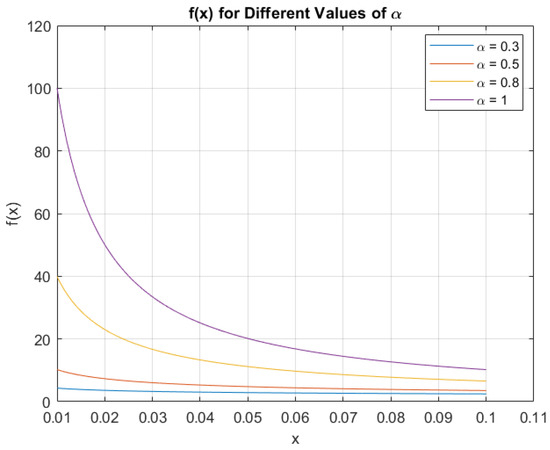
Let us consider the equation:
where is one of the solutions. To find a second fundamental solution, we propose . By substituting this expression for , , and into Equation (81) and collecting terms, we obtain:
if we let , we have a separable α-order differential equation. By solving it, we find:
So, we can determine as:
and, consequently, the solution becomes:
Figure 6.
Graph of for .
In summary, this example demonstrates how to find a second solution to the given differential equation, building on the knowledge of the first solution .
6. Nonhomogeneous -Order Fractal Differential Equation
In this section, we introduce and discuss nonhomogeneous -order fractal differential equations. These equations involve both the -order derivative of a function and a nonhomogeneous term, typically denoted as . Nonhomogeneous equations are important in modeling real-world phenomena where external influences or sources contribute to the behavior of the system. We explore various aspects of these equations, including their solutions and properties.
Definition 14.
Let us consider a nonhomogeneous -order fractal differential equation as
where , and g are given F-continuous on the . If ,
which is called the homogenous fractal differential equation.
Theorem 7.
Consider a nonhomogeneous linear fractal differential equation given by Equation (86), where and are two solutions. Then, their difference is a solution of the corresponding homogeneous fractal differential equation, as given by Equation (87). Furthermore, if and form a fundamental set of solutions of the homogeneous fractal differential equation, then the difference can be expressed as:
where and are constants.
Proof.
To prove this theorem, we start by noting that for the nonhomogeneous linear fractal differential equation:
where L represents the differential operator and is the nonhomogeneous term, we have two solutions, and . Now, by subtracting these Equation (89), we obtain:
Therefore, we can conclude that:
where and are constants. □
Theorem 8.
The general solution of the nonhomogeneous fractal differential equation given by (87) can be represented in the form:
where and are fundamental solutions of the corresponding homogeneous Equation (87), and are arbitrary constants, and is any solution of the nonhomogeneous Equation (86). This form allows us to describe the general solution of the nonhomogeneous equation in terms of both homogeneous solutions and a particular solution.
Proof.
The proof of this theorem follows directly from Theorem 7. If we consider to be and to be , then we immediately obtain Equation (92). This demonstrates that the general solution in the form stated in the theorem is indeed valid. □
Example 7.
Let us consider a nonhomogeneous fractal differential equation:
We are looking for a particular solution that satisfies the following equation:
To find this particular solution , let us assume that the solution of Equation (94) can be written as . By substituting this into Equation (94), we obtain:
By solving for A, we find that . Therefore, the particular solution is:
This provides a specific solution to the nonhomogeneous fractal differential Equation (93).
Theorem 9
(Fractal Variation of Parameters). Let us consider a nonhomogeneous -order linear fractal differential equation:
Assuming that the functions , , and are F-continuous on the open interval , and that and form a fundamental set of solutions for the corresponding homogeneous fractal equation:
Then, a particular solution of Equation (97) can be expressed as:
where is any conveniently chosen point in the open interval . The general solution of Equation (97) is then:
where and are constants. This theorem provides a method to find both particular and general solutions for nonhomogeneous -order linear fractal differential equations under certain conditions on the functions involved.
Proof.
To establish this theorem, we begin by considering a general solution for the nonhomogeneous equation:
where and are unknown functions, and and are the solutions to the homogeneous Equation (98). Since this equation introduces two unknown functions, it is appropriate to impose an additional condition. We choose the following conditions:
Now, let us compute the fractal derivatives of :
By differentiating once more:
Now, we can express the action of L on as:
Since and are solutions to the homogeneous equation, we have:
This leads to the system of equations:
To determine and from these conditions, we solve this system, resulting in:
By substituting Equation (108) into Equation (101), we obtain the general solution for the nonhomogeneous equation. This concludes the proof. □
Remark 7.
Although the statement of the theorems is similar to that known in the literature, it is worth proposing the proof for the sake of completeness, since the domain of action is a fractal subset of the real line and not the whole real line, and as already observed, a solution of a fractal differential equation of -order is not necessarily a solution of a second-order differential equation which has as its domain a real and not fractal subset of the real line.
Example 8.
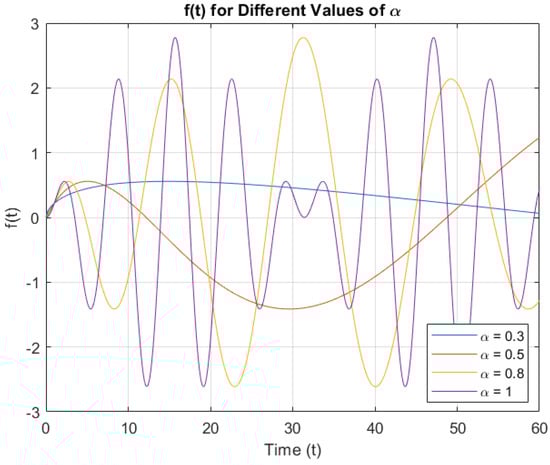
Consider the equation describing the motion of an undamped forced oscillator:
This equation represents the behavior of the oscillator, where and ω are constants. The initial conditions for this oscillator are given as:
To find the general solution for Equation (109), which describes the oscillator’s motion, we obtain the following expression:
where represents the natural frequency of the oscillator. By applying the initial conditions from Equation (110), we further simplify the solution to:
In the accompanying Figure 7, we have depicted the behavior described by Equation (112) for the given parameters: and .
Figure 7.
Graph of .
7. Conclusions
In our paper, we have introduced the concept of second-order fractal differentials, denoted as -order, along with a method for solving them. We have also defined a solution space for these differentials, which encompasses non-integer dimensions. Furthermore, we have presented a uniqueness theorem for -order linear fractal differential equations, and we have provided an exact formulation for a second-order fractal differential equation. This equation is complemented by its adjoint equation, making it self-adjoint. In addition, we have defined and successfully solved nonhomogeneous -order fractal differential equations. The models we have presented can be applied to processes occurring in fractal time and space.
Author Contributions
Conceptualization, A.K.G. and D.B.; methodology, A.K.G.; software, A.K.G.; validation, A.K.G. and D.B.; writing—original draft preparation, A.K.G.; writing—review and editing, D.B. All authors have read and agreed to the published version of the manuscript.
Funding
This research received no external funding.
Data Availability Statement
All data are contained within the paper, and a report of any other data is not included.
Acknowledgments
During the preparation of this work, the authors used GPT in order to correct grammar and writing. After using this GPT, the authors reviewed and edited the content as needed and took full responsibility for the content of the publication.
Conflicts of Interest
The authors declare no conflicts of interest.
References
- Mandelbrot, B.B. The Fractal Geometry of Nature; WH Freeman: New York, NY, USA, 1982. [Google Scholar]
- Falconer, K. Fractal Geometry: Mathematical Foundations and Applications; John Wiley & Sons: New York, NY, USA, 2004. [Google Scholar]
- Jorgensen, P.E. Analysis and Probability: Wavelets, Signals, Fractals; Springer Science & Business Media: Cham, Switzerland, 2006; Volume 234. [Google Scholar]
- Massopust, P.R. Fractal Functions, Fractal Surfaces, and Wavelets; Academic Press: Cambridge, MA, USA, 2017. [Google Scholar]
- Lapidus, M.L.; Radunović, G.; Žubrinić, D. Fractal Zeta Functions and Fractal Drums; Springer International Publishing: Cham, Switzerland, 2017. [Google Scholar]
- Husain, A.; Nanda, M.N.; Chowdary, M.S.; Sajid, M. Fractals: An eclectic survey, part I. Fractal Fract. 2022, 6, 89. [Google Scholar] [CrossRef]
- Husain, A.; Nanda, M.N.; Chowdary, M.S.; Sajid, M. Fractals: An eclectic survey, part II. Fractal Fract. 2022, 6, 379. [Google Scholar] [CrossRef]
- Patiño-Ortiz, M.; Patiño-Ortiz, J.; Martínez-Cruz, M.Á.; Esquivel-Patiño, F.R.; Balankin, A.S. Morphological Features of Mathematical and Real-World Fractals: A Survey. Fractal Fract. 2024, 8, 440. [Google Scholar] [CrossRef]
- Rogers, C.A. Hausdorff Measures; Cambridge University Press: Cambridge, MA, USA, 1998. [Google Scholar]
- Lesmoir-Gordon, N.; Rood, B. Introducing Fractal Geometry; Icon Books: London, UK, 2000. [Google Scholar]
- Barnsley, M.F. Fractals Everywhere; Academic Press: Cambridge, MA, USA, 2014. [Google Scholar]
- Dewey, T.G. Fractals in Molecular Biophysics; Oxford University Press: Oxford, UK, 1998. [Google Scholar]
- Rosenberg, E. Fractal Dimensions of Networks; Springer: Berlin/Heidelberg, Germany, 2020; Volume 1. [Google Scholar]
- Pietronero, L.; Tosatti, E. (Eds.) Fractals in Physics; Elsevier: Amsterdam, The Netherlands, 1986. [Google Scholar]
- Bishop, C.J.; Peres, Y. Fractals in Probability and Analysis; Cambridge University Press: Cambridge, MA, USA, 2017; Volume 162. [Google Scholar]
- Bunde, A.; Havlin, S. Fractals in Science; Springer: Berlin/Heidelberg, Germany, 2013. [Google Scholar]
- Kigami, J. Analysis on Fractals; Number 143; Cambridge University Press: Cambridge, MA, USA, 2001. [Google Scholar]
- Strichartz, R.S. Differential Equations on Fractals; Princeton University Press: Princeton, NJ, USA, 2018. [Google Scholar]
- Giona, M. Fractal calculus on [0, 1]. Chaos Solit. Fractals 1995, 5, 987–1000. [Google Scholar] [CrossRef]
- Freiberg, U.; Zähle, M. Harmonic calculus on fractals-a measure geometric approach I. Potential Anal. 2002, 16, 265–277. [Google Scholar] [CrossRef]
- Jiang, H.; Su, W. Some fundamental results of calculus on fractal sets. Commun. Nonlinear Sci. Numer. Simul. 1998, 3, 22–26. [Google Scholar] [CrossRef]
- Bongiorno, D. Derivatives not first return integrable on a fractal set. Ric. Mat. 2018, 67, 597–604. [Google Scholar] [CrossRef]
- Bongiorno, D.; Corrao, G. On the fundamental theorem of calculus for fractal sets. Fractals 2015, 23, 1550008. [Google Scholar] [CrossRef]
- Bongiorno, D.; Corrao, G. An integral on a complete metric measure space. Real Anal. Exch. 2015, 40, 157–178. [Google Scholar] [CrossRef]
- Stillinger, F.H. Axiomatic basis for spaces with noninteger dimension. J. Math. Phys. 1977, 18, 1224–1234. [Google Scholar] [CrossRef]
- Barlow, M.T.; Perkins, E.A. Brownian motion on the Sierpinski gasket. Probab. Theory Relat. Fields 1988, 79, 543–623. [Google Scholar] [CrossRef]
- Deppman, A.; Megías, E.; Pasechnik, R. Fractal Derivatives, Fractional Derivatives and q-Deformed Calculus. Entropy 2023, 25, 1008. [Google Scholar] [CrossRef] [PubMed]
- Uchaikin, V.V. Fractional Derivatives for Physicists and Engineers; Springer: Berlin/Heidelberg, Germany, 2013; Volume 2. [Google Scholar]
- Damián Adame, L.; Gutiérrez-Torres, C.d.C.; Figueroa-Espinoza, B.; Barbosa-Saldaña, J.G.; Jiménez-Bernal, J.A. A Mechanical Picture of Fractal Darcy’s Law. Fractal Fract. 2023, 7, 639. [Google Scholar] [CrossRef]
- Samayoa Ochoa, D.; Damián Adame, L.; Kryvko, A. Map of a Bending Problem for Self-Similar Beams into the Fractal Continuum Using the Euler-Bernoulli Principle. Fractal Fract. 2022, 6, 230. [Google Scholar] [CrossRef]
- Sandev, T.; Tomovski, Ž. Fractional Equations and Models; Springer International Publishing: Cham, Switzerland, 2019. [Google Scholar]
- Nottale, L. Scale Relativity and Fractal Space-Time: A New Approach to Unifying Relativity and Quantum Mechanics; World Scientific: Singapore, 2011. [Google Scholar]
- Parvate, A.; Gangal, A.D. Calculus on fractal subsets of real line-I: Formulation. Fractals 2009, 17, 53–81. [Google Scholar] [CrossRef]
- Parvate, A.; Satin, S.; Gangal, A. Calculus on fractal curves in Rn. Fractals 2011, 19, 15–27. [Google Scholar] [CrossRef]
- Golmankhaneh, A.K. Fractal Calculus and its Applications; World Scientific: Singapore, 2022. [Google Scholar]
- Banchuin, R. Nonlocal fractal calculus based analyses of electrical circuits on fractal set. COMPEL-Int. J. Comput. Math. Electr. Electron. Eng. 2022, 41, 528–549. [Google Scholar] [CrossRef]
- Banchuin, R. On the noise performances of fractal-fractional electrical circuits. Int. J. Circuit Theory Appl. 2023, 51, 80–96. [Google Scholar] [CrossRef]
- Banchuin, R. Noise analysis of electrical circuits on fractal set. COMPEL-Int. J. Comput. Math. Electr. Electron. Eng. 2022, 41, 1464–1490. [Google Scholar] [CrossRef]
- Balankin, A.S.; Mena, B. Vector differential operators in a fractional dimensional space, on fractals, and in fractal continua. Chaos Solit. Fractals 2023, 168, 113203. [Google Scholar] [CrossRef]
- Golmankhaneh, A.K.; Ontiveros, L.A.O. Fractal calculus approach to diffusion on fractal combs. Chaos Solit. Fractals 2023, 175, 114021. [Google Scholar] [CrossRef]
- Golmankhaneh, A.K.; Tejado, I.; Sevli, H.; Valdés, J.E.N. On initial value problems of fractal delay equations. Appl. Math. Comput. 2023, 449, 127980. [Google Scholar] [CrossRef]
- Golmankhaneh, A.K.; Welch, K.; Serpa, C.; Jørgensen, P.E. Non-standard analysis for fractal calculus. J. Anal. 2023, 31, 1895–1916. [Google Scholar] [CrossRef]
- Golmankhaneh, A.K.; Depollier, C.; Pham, D. Higher order fractal differential equations. Mod. Phys. Lett. A 2024, 39, 2450127. [Google Scholar] [CrossRef]
- Faghih, N. An Introduction to Time and Fractals: Perspectives in Economics, Entrepreneurship, and Management; Springer: Berlin/Heidelberg, Germany, 2023. [Google Scholar]
- Welch, K. A Fractal Topology of Time: Deepening into Timelessness; Fox Finding Press: Austin, TX, USA, 2020. [Google Scholar]
- Vrobel, S. Fractal Time; World Scientific: Singapore, 2011. [Google Scholar]
- Shlesinger, M.F. Fractal Time in Condensed Matter. Annu. Rev. Phys. Chem. 1988, 39, 269–290. [Google Scholar] [CrossRef]
- Plonka, A. Fractal time rate processes in polymer systems. Radiat. Phys. Chem. 1995, 45, 67–70. [Google Scholar] [CrossRef]
- Golmankhaneh, A.K.; Bongiorno, D. Exact solutions of some fractal differential equations. Appl. Math. Comput. 2024, 472, 128633. [Google Scholar] [CrossRef]
- Peano, G. Sur le déterminant Wronskien. Mathesis 1889, 9, 75–76. [Google Scholar]
- Apostol, T. Mathematical Analysis; Addison-Wesley: Boston, MA, USA, 1974. [Google Scholar]
- Dovgoshey, O.; Martio, O.; Ryazanov, V.; Vuorinen, M. The cantor function. Expo. Math. 2006, 24, 1–37. [Google Scholar] [CrossRef]
Disclaimer/Publisher’s Note: The statements, opinions and data contained in all publications are solely those of the individual author(s) and contributor(s) and not of MDPI and/or the editor(s). MDPI and/or the editor(s) disclaim responsibility for any injury to people or property resulting from any ideas, methods, instructions or products referred to in the content. |
© 2024 by the authors. Licensee MDPI, Basel, Switzerland. This article is an open access article distributed under the terms and conditions of the Creative Commons Attribution (CC BY) license (https://creativecommons.org/licenses/by/4.0/).