


Abstract
Win proved a very famous conclusion that states the graph G with connectivity , independence number and contains a spanning k-ended tree. This means that there exists a spanning tree with at most k leaves. In this paper, we strengthen the Win theorem to the following: Let G be a simple 2-connected graph such that , and the number of maximum independent sets of cardinality is at most . Then, either G contains a spanning k-ended tree or a subgraph of .
MSC:
05C10
1. Introduction
Notation regarding graph theory is not covered in this paper. We refer the reader to [1]. Let be a graph satisfying vertex set and edge set . We denote the set of vertices adjacent to v in G as . We write for . We also denote the subgraph of G induced by S as for . Let and be two subgraphs of G which vertex disjoint, and P be a path of G. A path in G with end vertices is called a path from to if and . -path is a path from to a vertex set U. We write an -fan of width k for if F is a union of -paths , where for . Let and be two subgraphs of G. We denote by , respectively) the Hamilton path of , which starts at x (terminates at x, respectively). We denote by the Hamilton path of , which starts at x and terminates at y. We denote by the Hamilton path of . A nontrivial graph, G, is considered k-connected if the maximum number of pairwise internally disjoint -paths for any two distinct vertices, x and y, is greater than or equal to k. A trivial graph is considered 0-connected or 1-connected, but it is not considered k-connected for any k greater than 1. The connectivity, , of G is defined as the maximum value of k for which G is k-connected.
If a graph contains a Hamilton path, then the graph is said traceable, and if a graph contains a Hamilton cycle, then the graph is said hamiltonian. The sufficient conditions under which a graph can be traceable involving connectivity () and independence number () were given by Chvátal and Erdős in 1972.
Theorem 1.
(Chvátal and Erdős, [2]) If a graph G with satisfies the conditions , , respectively, then G is Hamiltonian and traceable, respectively.
Theorem 1 has been extended in various directions, as documented in previous studies [3,4,5,6,7,8]. For recent results, see [9,10,11,12]. Fouquet and Jolivet [13] conjecture whether a graph’s circumference can have a best possible lower bound when its independence number exceeds its connectivity. This has been proved by Suil O et al.
Theorem 2.
(Suil O et al., [14]) If G is a simple graph such that and , then G contains a cycle with length of at least .
The number of maximum independent sets of H for a subgraph is denoted by . In their study [15], Chen et al. presented the following theorem that generalizes Theorem 1 by bound . Specifically, the authors demonstrated that expanding the independence number (i.e., ) slightly and bounding m(G) does not alter the traceability of G. It is worth noting that represents a complete graph with s vertices, while is the complement of . Additionally, the join of disjoint graphs G and H is obtained by joining each vertex of G to each vertex of H in the graph .
In the following, we construct three graphs which are excluded. Let be a copy of where . The graph is defined as , where and is a matching of cardinality between and . If , then is obtained from by joining exactly two (nonadjacent) vertices of or by joining all vertices of and some fixed vertex . Let be the graph , where and is a matching of cardinality between and . Define the graph ; see Figure 1.
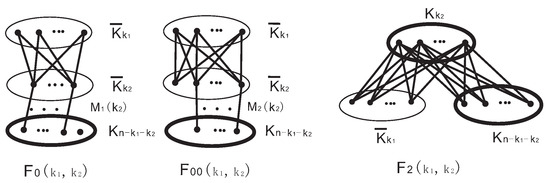
Figure 1.
, and .
Theorem 3.
(Chen et al., [15]) Let G be a 2-connected graph with , , and . Then, either G is Hamiltonian or , where and are two graphs defined above.
Theorem 4.
(Chen et al., [15]) Let G be a connected graph with , , and . Then either G is traceable or , where is the graph defined above.
A Hamilton path is viewed as a spanning tree with exactly two leaves. This perspective allows for the generalization of sufficient conditions for a graph to be traceable to those for a spanning tree with at most k leaves. A tree is called a k-ended tree if it has at most k leaves. Our focus now shifts to spanning k-ended trees. Clearly, if , then a spanning s-ended tree is also a spanning t-ended tree. Theorem 1 demonstrates that each graph G such that is traceable. In [16], Win proved the following theorem, which generalizes Theorem 1.
Theorem 5.
(Win, [16]) Let G be a connected graph and let be an integer. If , then G contains a spanning k-ended tree.
In [17], Lei et al. extend Theorem 5 in cases when to the following direction.
Theorem 6.
(Lei et al., [17]) Let and G be a connect graph with , and . Then G contains a spanning k-ended tree.
In [15], Chen et al. generalize Theorem 1 by bound . The authors demonstrated that expanding the independence number (i.e., ) slightly and bounding does not alter the traceability of G.
In this paper, our focus will be on the existence of spanning k-ended tree. We will work on extending Theorem 5 to a more general case. A natural question is whether expanding the independence number can alter the existence of the spanning k-ended tree. In the following section, we introduce the k-ended system, which is an important tool for studying the k-ended tree.
k-Ended System
If there exists a set of paths and cycles where the elements are pairwise vertex-disjoint, we refer to it as a system. This system is often viewed as a subgraph. Let be a system in a graph. For , we put if S is a path of order at least 3 and otherwise (i.e., S is a vertex, an edge or a cycle). We write and . If , is called a k-ended system. Moreover, we call a spanning k-ended system of G, if . Let
Then,
Additionally, and can be defined in a similar manner. We use , and to represent the number of elements in , and , respectively. For each , we assign an orientation denoted by the symbol <, where if x precedes y in the orientation. Let be the orientation of and let be the reverse orientation of for . By assigning an orientation to each , we identify as a system with an orientation, where each element is ordered relative to the others.
Let be a system with a defined orientation. For any , we define and as the two end-vertices of P such that . Additionally, for each , we select an arbitrary vertex within C. These definitions will be used in subsequent analyses. Then define
For and , we write the first, second and ith predecessor (successor, respectively) of x as , and (, and , respectively). For convenience, we write for and for .
For , if , respectively), we have only the predecessor of (successor of , respectively). For , we denote by the section a path of consecutive vertices of P and denote by the section a path of consecutive vertices of P. Moreover, if , then the section is trivial.
The following lemma illustrates the importance of k-ended systems for spanning k-ended trees.
Lemma 1.
(Win, [16]) Let be an integer and let G be a connected simple graph. If G contains a spanning k-ended system, then G also contains a spanning k-ended tree.
A k-ended system in G is considered a maximal k-ended system if there is no other k-ended system in G satisfying . The following lemma presents some useful properties of k-ended systems. It is important to note that two distinct elements of are connected by a path in if there exists a path in G whose end-vertices are in elements of and whose inner vertices are not all contained in . It is worth mentioning that a path may not have any inner vertex.
Lemma 2.
(Akiyama and Kano, [18]) Let be an integer and G be a connected simple graph. Assume that G does not contain a spanning k-ended system and let be a maximal k-ended system of G satisfying the cardinality of the maximum value of subject to the maximum value of . Then the following characterizations are true.
- (i)
- There is no path connecting two distinct elements of whose inner vertices are in .
- (ii)
- There is no path connecting an element of and one end-vertex of an element of whose inner vertices are in .
- (iii)
- There is no path connecting an end-vertex of an element of and an end-vertex of another element of whose inner vertices are in .
- (iv)
- There are no two internally disjoint paths and connecting two distinct elements of whose inner vertices are in with .
2. Methods
In this paper, our focus will be on the existence of spanning k-ended tree. We will work on extending Theorem 5 to a more general case. We tried to prove that it does not change the existence of spanning k-ended tree if we expand the independent numbers a little bit and bound m(G). The proof will follow an approach similar to Theorem 6, but with additional considerations for the increased connectivity of the graph. Our proof follows a method of contradiction. We primarily utilize the crucial tool of the maximal k-ended system, as mentioned above, to derive contradictions. The subsequent section is the crucial property of the maximal k-ended system which we obtained. This property plays a pivotal role in our proof.
Important Properties of Maximal k-Ended System Based on Theorem 7
In this section, for convenience, we assume the following: Let and G be a graph with , , and . Suppose that there is no spanning k-ended system in G and let be a k-ended system of G satisfying the following:
- (I)
- The cardinality of the set is maximized.
- (II)
- The cardinality of is maximized subject to condition .
Then is a set of subgraphs of G satisfying the hypothesis of Lemma 2. Let . Then . Let . The following lemma is easily obtained from the selection of and we omit the proof.
Lemma 3.
The following characterizations are true.
- (1)
- For any , and are not in .
- (2)
- For any such that , .
By the Fan Lemma, there exists a -fan with width . For with , let (where are the vertices of S along the direction of S) and be the path of between w and . Then and is the set of paths between w and S. Denote and . By Lemma 3(1),(2), and are well defined and hence .
The proof of the following lemmas can be easily obtained from the choice of and we will omit it.
Lemma 4.
A graph G cannot have a -ended system that includes all vertices in a k-ended system , where .
Lemma 5.
The following characterizations are true:
- (1)
- Both and are independent sets of G.
- (2)
- .
- (3)
- .
- (4)
- Let , where . Then . Furthermore, if , then .
Lemma 6.
Let and with . Then the following statements are true:
- (1)
- for any and .
- (2)
- If (, respectively), then (, respectively) for any .
Let Y be an independent set of G with size . Then the following lemma holds.
Lemma 7.
Let belong to which satisfies having precisely one vertex, denoted as z, i.e, . If for each , then forms a clique.
Proof of Lemma 7.
We begin by assuming the opposite and using a proof by contradiction. Suppose that for some pair of vertices and in , where . Then, forms an independent set of G with a size of . This contradicts the fact that . Hence, is a clique. □
For convenience, suppose that x is an element of . For each , we define as follows:
Similarly, we define as follows:
Therefore, and . We say that is a spanning subgraph of satisfying if .
Some properties of are described in the following lemmas, as proved in Appendix B.
Lemma 8.
and .
By Lemma 8, (say). Then and . For convenience, denote that and
Lemma 9.
The following statements hold.
- (1)
- or and or .
- (2)
- If and , then there exist at least two elements C, such that , .
- (3)
- forms an independent set of G with size .
- (4)
- If and , then .
- (5)
- Let satisfy , and . Then forms a clique. Additionally, if the intersection of and is , then the graph forms a clique.
- (6)
- forms a clique for any . Furthermore, for any .
3. Results and Discussion
In [17], the authors provide a novel extension by imposing a limit on the maximum number of independent sets, although the limit is not sharp. Note that G has no spanning -ended tree for each . In this paper, we extend Theorem 5 to the case where and the bound on the number of maximum independent sets is already sharp.
Theorem 7.
Let and G be a graph with , , and . Then G contains a spanning k-ended tree, unless either for , or for
Note that a spanning tree having exactly two leaves is called a Hamilton path. Then, we can immediately obtain the following result.
Corollary 1.
Let G be a graph with , , and . Then G is traceable, unless either for , or for
In the case of 2-connected, the bounds of can do better. Clearly, Corollary 1 improves the result of Theorem 4. It demonstrated that expanding the independence number slightly and bounding also does not alter the traceability in highly connected graphs.
If for , or for , then . Hence, we can obtain the following result immediately.
Corollary 2.
Let and G be a graph of order such that , and . Then G contains a spanning k-ended tree.
4. Proof of Theorem 7
In this section, we employ the same terminology and notation in Section 3.
Proof of Theorem 7.
Let and G be a graph with , , and . We begin by assuming the opposite and using a proof by contradiction. Suppose that G does not have a spanning k-ended tree. This assumption, along with Theorem 5, implies the following equation:
Thus, by Lemma 1, G cannot have a spanning k-ended system. We select a maximal k-ended system of G that satisfies conditions (I) and (II) outlined in Section 3. Define . Clearly . Let .
We will show that for , or for
Fact 1.
.
Proof of Fact 1.
Claim 1.
and .
Proof of Claim 1.
Using symmetry, we can focus on proving that . By contradiction, suppose that ; say and . By Lemma 2, .
Denote
If , then, by Lemma 9(4), . Therefore, by Lemma 9(5), forms a clique. If , then, according to Lemma 9(5), forms a clique. Hence,
As G is a connected graph, . For , there exists a vertex with . We will show that
By contradiction, suppose that . By Lemma 6(2) and (2), . We will examine the following two scenarios to reach a contradiction:
- Suppose that . By Lemma 9(1), or . We will show that . If , then, by symmetry and Lemma 9(5), . If , then, by Lemma 9(1), . By symmetry and Lemma 9(4), . Then, by symmetry and Lemma 9(5) and (2), either the set of vertices of the subgraph and is equal to , which contradicts (I); or in G is equal to , which contradicts Lemma 4.
- Assume that . Then, by Lemma 9(1)(2) and (2), the set of vertices of the subgraphandis equal to or , which contradicts (I).
This contradiction shows that (3) holds.
If and , then, . By (2), has a cycle . By (2), we structure a new path such that by rearranging the order of the vertices in P. Then . It is easy to verify that . Note that . By Lemma 9(5), the subgraph forms a clique. Let . Since G is connected, . For , there exists a vertex with . By the proof of , . That means , contradicting . Therefore, by (3), we have either and or and . Then, , contradicting . This contradiction indicates that Claim 1 is true. □
According to Claim 1 and Lemma 9(1), and . Denote
By Lemma 9(3), is an independent set of G with size . Thus,
Claim 2.
and form cliques.
Proof of Claim 2.
By virtue of symmetry, we may restrict our consideration to prove that forms a clique. As is connected, we can assume that . According to Lemma 5(1) (4) and Claim 1, . By (4), . By Lemma 9(5), forms a clique. □
Claim 3.
.
Proof of Claim 3.
By contradiction, suppose that ; say for some . This implies that there is a vertex with . By Lemma 8, .
We will show that
Suppose, by way of contradiction, that for some . Suppose that . By symmetry, we may only think of . Then, by Claim 2, and cover , contradicting (I). Therefore, for some . Then, by Claim 2, the set of vertices of the subgraph and in G is equal to , which again contradicts (I). Thus, we have shown that (5) holds.
Next, we will prove that
By contradiction, suppose that . Note that . We consider the neighbourhood of the vertex . According to Lemma 2, . If and for some are adjacent in G, then, by Claim 2 and (5), and in G covers , contradicting (I). Hence, . If v and for some are adjacent in G, then, by Claim 2 and (5), and in G covers , contradicting (I). Hence, . Note that . Therefore, by Lemma 2, forms an independent set of size . This contradicts the fact that and thus establishes that (6) holds.
Claim 4.
for each element .
Proof of Claim 4.
Since G is connected, for any . For , there exists a vertex with . According to Lemma 2, . By Claim 3, . This implies that
Next, we will show that . By contradiction, suppose that . By Lemma 6(2) and Claim 2, z does not belong to . To arrive at a contradiction, we will examine the following three scenarios using (7):
- Suppose that . Then or , contradicting Claim 1.
- Suppose that or . By symmetry, we consider that say for some . Then, by Claim 2, and cover , contradicting (I).
- Suppose that for some . We consider the neighbourhood of the vertex . We claim that . Suppose otherwise that there exists a vertex such that . By Lemma 6(1), . According to the definition of , we will examine the following two scenarios to reach a contradiction.
- –
- Assume that ; say for some . If , then, by Claim 2, the set of vertices of the subgraph and is equal to , which contradicts (I). If , then, by Claim 2, the set of vertices of the subgraph is equal to , which again contradicts (I).
- –
- Assume that . By Lemma 6(2), . Then, by Claim 2, the set of vertices of the subgraph is equal to , which contradicts (I).
This contradiction establishes that . By , . If and or , then, by Lemma 9(6), the set of vertices of the subgraph is equal to , which contradicts Lemma 4. If and , then, according to Lemma 9(6), . Note that . If , then, by Lemma 9(6), would be an independent set of cardinality , contradicting (1). Therefore, . Then the set of vertices of the subgraph is equal to , which contradicts Lemma 4.
This contradiction establishes that . Since and , for any element . □
Claim 5.
Let with . For any two disjoint vertices , , there exist two disjoint vertices v, such that , .
Proof of Claim 5.
We establish Claim 5 by contradiction. Suppose that either or and for some , .
If , then , contradicting Claim 4. Now suppose that . Let and . Since , . Then, by hypothesis and Claim 4, . However, , contradicting the hypothesis that G is -connected. These contradictions establish that Claim 5 is true. □
Claim 6.
forms a clique.
Proof of Claim 6.
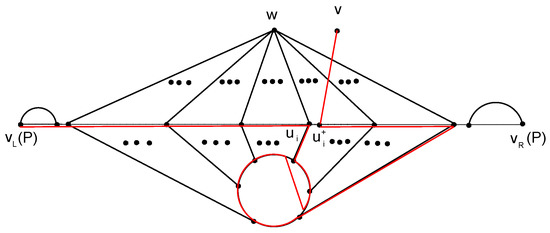
We will only focus on the case where . For every vertex , . We assume that there is at least one vertex with . By Claim 3, x is not an element of . By Lemma 3(1), . Then, ; say for some . Then, by Claims 2, 4 and 5, there exist a path Q and cover , see Figure 2, contradicting (I). This contradiction shows that . By (4), for every vertex . Let . Then, according to Lemma 7, forms a clique. □
Figure 2.
.
Denote and .
Claim 7.
The following two statements are true.
- (1)
- for;
- (2)
- .
Proof of Claim 7.
We will prove the first statement. By symmetry, we have only proved that . Let . By Claim 2(1), . We pick an element , by Claim 4, a new path would be obtained. We structure a new system such that , and . It is easy to verify that , and . Hence, is also a k-ended system satisfying (I), (II). Then, by Claim 4, .
Next, we need to prove the second statement. The proof here is similar to Claim 4. (For details, see Appendix A.) □
Claim 8.
Suppose that . For any two disjoint vertices , , there exist two disjoint vertices v, such that , .
Proof of Claim 8.
The proof here is similar to Claim 5. (For details, see Appendix A.) □
Claim 9.
for each .
Proof of Claim 9.
Since is connected, we only need to focus on the case where . By contradiction, suppose that for some . By (4), there exists at least one vertex satisfying . By Claim 4, . We will examine the following two scenarios to reach a contradiction, based on the definition of :
- Assume that ; say for some . If , then, by Claim 4, the set of vertices of the subgraph is equal to , which contradicts (I). If , then, by Claims 4 and 5, the set of vertices of the subgraph is equal to , which again contradicts (I).
- Assume that . If , then covers , which contradicts (I). Therefore, . Then covers , which again contradicts (I).
This contradiction demonstrates that . By (4), . □
By Claim 9, it holds that for every . Let for every .
Claim 10.
For each section, the following two statements are true.
- forms a clique;
- .
Proof of Claim 10.
We pick an element ; by Claims 4 and 5, a new path would be obtained. We structure a new system such that , and . It is easy to verify that , and . Hence, is also a k-ended system satisfying (I), (II). According to Lemma 9(6), forms a clique; by Claim 4, . Claim 10 is proved. □
By Claims 2–10 and Lemma 9(6), and every component of forms a clique. Then,
. This completes the proof of Fact 1. □
Fact 2.
and .
Proof of Fact 2.
By Fact 1 and the condition of Theorem 5, . Then, we will show that .
By contradiction, suppose that . Then for any . Otherwise, , contradicting . Let for some . By Claims 7(2) and 8, in G cover , which contradicts (I). This contradiction shows that . □
Denote
Finally, we need to prove that G is isomorphic to one of those graphs F with or . Denote . By Fact 2, and there exists at most one vertex such that . Then . Let . It follows that is an independent set of G with a cardinality of . Additionally, is a maximum independent set of G for any vertex . By Claims 4, 7 and 10, is not adjacent to any vertex in ; it should be adjacent to for all . Now let and . This implies that and or and (note that ), which completes the proof of Theorem 7. □
5. Conclusions
We demonstrats that it does not change the existence of spanning k-ended tree if we expand the independent numbers a little bit and bound . Therefore, we generalize Theorem 5 and the bound on the number of maximum independent sets is already sharp. Note that a Hamilton path is viewed as a spanning tree with exactly two leaves; in other words, a Hamilton path is a spanning 2-ended tree. Hence, our results extend Theorem 4, which has significant implications for traceability and the existence of spanning trees. Moreover, we extend Theorem 5 to the case where . This extension has important implications for the study of independent sets in highly connected graphs.
The proof of the results is currently too complex and difficult. We hope to find a more clever and concise proof technique for Theorem 7 in the future.
Author Contributions
Conceptualization, W.L.; methodology, W.L.; validation, W.L.; formal analysis, W.L. and J.Y.; investigation, W.L.; writing—original draft preparation, W.L.; writing—review and editing, W.L.; supervision, W.L.; project administration, W.L. and J.Y. All authors have read and agreed to the published version of the manuscript.
Funding
This work was supported by the Natural Science Funds of China (No. 11801296), the General project of the Basic Research Program of Shanxi Province (Free exploration) (No. 202103021224303), the Shanxi Province Higher Education Reform and Innovation Project (No. J2021552) and the Shanxi Province Higher Education Science and Technology Innovation Project (No. 2020L0510).
Institutional Review Board Statement
Not applicable.
Informed Consent Statement
Not applicable.
Data Availability Statement
Not applicable.
Acknowledgments
The authors are greatly indebted to the Referees for their careful reading of the manuscript and invaluable comments and suggestions, which improved the paper.
Conflicts of Interest
The authors declare no conflict of interest.
Appendix A. Some Proofs of Claims of Theorem 7
Proof of Claim 7(2).
Since G is connected, . For , there exists a vertex with . By Claim 3, . This implies that . We will prove that . Suppose, by way of contradiction, that . We will examine the following three scenarios to reach a contradiction.
- Assume that or . By symmetry, it would therefore suffice to consider that . (By) Claim 2(1), the set of vertices of the subgraph is equal to , which contradicts (I).
- Assume that or . By symmetry, it would therefore suffice to think about ; say for some . If , then covers , contradicting (I). If , then, by Claim 6, the set of vertices of the subgraph is equal to , which contradicts (I).
- Assume z belongs to for some . We consider the neighbourhood of the vertex . By (4), ; say . By Claim 4, . We will consider the following two cases to obtain a contradiction.
- –
- Assume that ; say for some . Suppose, first, that . If , then, by Claim 6, the set of vertices of the subgraph is equal to , which contradicts (I). If , then the set of vertices of the subgraph is equal to , which also contradicts (I). Suppose, now, that . If , then, by Claim 6, covers , which contradicts (I). If , then covers , which also contradicts (I).
- –
- Assume that . Let us take without loss of generality. If , then, by Claim 6, the set of vertices of the subgraph is equal to , which contradicts (I). If , then covers , which also contradicts (I).
This contradiction shows that , contradicting (4).
This contradiction shows . Since and , . □
Proof of Claim 8.
By contradiction, suppose that either or and for some , .
Suppose first that . Then , contradicting Claim 7(2). Suppose now that . Let and . Since , . Then, by hypothesis and Claim 7(2), . However, , contradicting the hypothesis that G is -connected. These contradictions show that Claim 8 holds. □
Appendix B. Proof of Lemmas 8 and 9
In this section, we employ the same terminology and notation in Section 3.
In order to prove Lemmas 8 and 9, we first do some preparatory work.
Denote and . If , then, by Lemma 5, and ; say .
Lemma A1.
(Akiyama and Kano, [18]) The following statements are true.
- (1)
- If , then forms an independent set of G with a size of .
- (2)
- If and , then for some and forms an independent set of G with a size of .
- (3)
- If and , then:
- (i)
- The set does not include four distinct vertices with ;
- (ii)
- is triangle-free;
- (iii)
- is an independent set of G.
Lemma A2.
Suppose that . The following statements are true.
- (1)
- If , then has exactly one nontrivial component denoted by such that is a star with ;
- (2)
- If , then has exactly one nontrivial component denoted by such that is a star with .
Proof of Lemma A2.
By symmetry, it would therefore suffice to show that (1) is true. By Lemmas 3 and 5(1), is an independent set of G. By Lemma 5(1)(2), is an independent set of G. Since , there must exist some edges between and . By Lemma A1(3), has exactly one nontrivial component and is a star. □
Remark A1.
and always denote the stars in Lemma A2 in the following. From Lemma A3 to Lemma A6, for convenience, we assume and .
Lemma A3.
Let and . Then for each vertex with for some , it holds that .
Proof of Lemma A3.
By contradiction, suppose that . Then there exists a vertex ; say for some . Suppose first that . If , then the set of vertices of the subgraph is equal to , which contradicts Lemma 4. If , then covers , contradicting Lemma 4. Now suppose that . Then and cover , contradicting Lemma 4. These contradictions show that Lemma A3 holds. □
Lemma A4.
The cardinality of the set is equal to one and .
Proof of Lemma A4.
By Lemma A2(1), and . In other words, we need to prove that .
By contradiction, suppose that . Then, by Lemma A2(1), there exists a vertex such that , and for some and some . By Lemma 5(4), . Then, ; say . By Lemma A2(1), is an independent set of G with size . By Lemma A3, . We consider the neighbourhood of the vertex . By Lemma A3, and . Then, . According to Lemma 2, . Hence, forms an independent set with a cardinality of , which contradicts . This contradiction show that Lemma A4 holds. □
Remark A2.
If and , then, by Lemma A4, ; say for some and some . Denote . Then, by Lemmas A1(3), A2(1) and A4, is an independent set of G with size . If , then, by Lemmas 5(4) and A4,
Lemma A5.
Let . Then, for some , the following statements are true.
- (1)
- If for some , then for each ;
- (2)
- If for some , then is adjacent to all vertices in C.
Proof of Lemma A5.
First, we will show that (1) holds. Let and . We prove Lemma A5(1) by induction on t. Note that , and . According to Lemma A3, . This implies that Lemma A5(1) holds for . Next, we assume that Lemma A5(1) holds for all positive integers . Then . We need to prove that it holds for . By Lemma 2, . Note that . By Lemma A4, . Then is an independent set of G with size . Hence, . Otherwise, is an independent set of G with size , contradicting .
We claim that forms a clique. Since is connected, we only need to focus on the case when . By contradiction, suppose that for some pair of vertices , with , then is an independent set of G with size , contradicting . Hence, is a clique.
By our claim, contains a subgraph such that and .
Next, we will show that Lemma A5(1) holds for . By contradiction, suppose that . Then there exists a vertex ; say for some . Suppose first that . Then, by our claim, the set of vertices of the subgraph
and is equal to , which contradicts (I). Now suppose that . Then, by our claim, the set of vertices of the subgraph , and is equal to , which contradicts (I). These contradictions show that Lemma A5(1) holds for . Thus, Lemma A5(1) is proved.
Now, we start to prove Lemma A5(2). If , then and are two independent sets of G. For any , by Lemma A5(1). According to Lemma 2, . Hence, . Otherwise, is an independent set of G with size , contradicting . Lemma A5(2) is proved. □
Remark A3.
Suppose and . For some and some , if for , then, by Lemma A5(2), contains a spanning subgraph with .
For some and , we consider the following configuration.
- (i)
- , for some .
- (ii)
- (, for some .
- (iii)
- For given and , and for some .
- (iv)
- For some and , for some .
Then we denote
Lemma A6.
Suppose that and for some and . If , then .
Proof of Lemma A6.
By contradiction, suppose that . Note that is an independent set of G with size . Then there exists at least one vertex with . Recall that , we assume that . In other words, . By Lemma 6(1)(2), . According to the definition of , we will consider the following three cases in order to arrive at a contradiction.
- Assume that . According to Lemma 6(1), , then . By (A1) and Lemma 6(2), . Note that . By Lemma A5(2), the set of vertices of the subgraph in G is equal to , which contradicts Lemma 4.
- Assume that ; say for some . If , then, by (A1), the set of vertices of the subgraph in G is equal to , which contradicts Lemma 4. Therefore, . Note that . Then or occurs. By Lemma A5(2),cover or , which contradicts (I).
- Suppose that for ; say for some . If , then, by (A1), the set of vertices of the subgraph is equal to , which contradicts Lemma 4. Therefore, . Note that . Then or occurs. By Lemma A5(2), the set of vertices of the subgraph is equal to or , which contradicts (I).
The contradiction indicates that . Note that . Therefore, . Lemma A6 holds. □
Lemma A7.
If , then there exists exactly one path such that or .
Proof of Lemma A7.
First, we claim that there is a path with or . To prove this claim, we will consider the following two cases.
- Suppose that and . Then, by Lemma A1(2), there is a path with , i.e., .
- Assume that and . According to Lemma A4, . Suppose first that . By Lemmas 5(4) and A4, there is a path satisfying and , i.e., . Now, suppose that , i.e., ; say . By Lemma A4, ; say for some and . It should be noted that forms an independent set of G with a cardinality of . By Lemmas A2 and A4, . We will show that . Suppose otherwise that . By (A1), . Note that . Then or occurs. By Lemmas A5(2) and A6, the set of vertices of the subgraphin G is equal to or , which contradicts (I). The contradiction indicates that . Then .
Hence, our claim is proved.
Now, we will prove Lemma A7. We begin by assuming the opposite and using a proof by contradiction. Suppose that there exists another path with or . To arrive at a contradiction, we consider the following two cases:
- Assume that . If and , then does not form an independent set of G with a cardinality of , contradicting Lemma A1(2). Therefore, or . Without loss of generality, suppose that , then or . Hence, there exist two adjacent vertices in , contradicting Lemma A1(2).
- Assume that . Then and . Then, has at least two stars, contradicting Lemma A2(1).
This statement indicates that Lemma A7 is true. □
Let
Then, by Lemmas A1, A4 and A7, X forms an independent set of G satisfying size and
Otherwise, there is a vertex satisfying being an independent set of G with size , which contradicts .
Lemma A8.
Suppose that . The following two statements are true.
- (1)
- contains exactly one path Q such that or and or ;
- (2)
- If and , then there exist at least two elements C, with , .
Proof of Lemma A8.
By symmetry and Lemma A7, has exactly one path P (say) such that or . First, we will show . By contradiction, suppose that . Denote . To arrive at a contradiction, we consider the following three cases using Lemma A7:
- Assume that and . Then the set of vertices of the subgraph in G is equal to , which contradicts (I).
- Assume that either and or and . By symmetry, suppose that and . According to Lemma A7, ; say . Then the set of vertices of the subgraph in G is equal to , which contradicts (I).
- Suppose that and . Applying symmetry and using Lemma A7, and . Then or occurs. By Lemma A5(2), and in G cover or , contradicting Lemma 4 or (I).
This contradiction shows that Lemma A8(1) holds.
Next, we will demonstrate Lemma A8(2). By Lemma A8(1), and . We begin by assuming the opposite and using a proof by contradiction. Suppose that there is precisely one element with and . Note that and . By Lemma A4, and . Then, by Lemmas A5(2) and A6, the set of vertices of the subgraph in G is equal to , which contradicts (I). This contradiction demonstrates that Lemma A8(2) is true. □
Remark A4.
If , then, by Lemma A7, ; say . If , then, by Lemma A8(1), ; say . If and , then, by Lemma A8(2), . For convenience, we denote
Let
and
Lemma A9.
Let and . It follows that .
Proof of Lemma A9.
First, we assert that for each vertex , . To prove this, we will use a proof by contradiction. Assume that . According to Lemma 2, . Then, there is at least one vertex for some and some . Assuming . Then, the set of vertices of the subgraph in G is equal to , which contradicts (I). Therefore, . Suppose first that . If , (say ) and , then the set of vertices of the subgraph in G is equal to or ; see Lemma 4. Otherwise, by Lemma A7, C and in G cover or , contradicting (I). Suppose now that , i.e., . Let . If , (say ) and , then the set of vertices of the subgraph in G is equal to , which contradicts Lemma 4. Otherwise, by Lemma A7, , and in G cover or , contradicting (I). These contradictions show that our claim holds.
According to Lemma 2, . Combining this with our claim, we arrive at . By (A2), . □
Lemma A10.
For any , forms a clique.
Proof of Lemma A10.
As is connected, we only need to focus on the case when . It is worth noting that . According to Lemma A9, for every vertex . Let . Then, according to Lemma 7, forms a clique. □
Lemma A11.
Suppose that . The following two statements are true.
- (1)
- Let and such that , and . Then forms a clique. Moreover, if , then also forms a clique;
- (2)
- Let and such that , and . Then forms a clique. Moreover, if , then also forms a clique.
Proof of Lemma A11.
By virtue of symmetry, we may restrict our consideration to demonstrate the truth of (1). As is connected, it is sufficient to focus on the case where . Suppose that there is at least one vertex with . According to Lemma 6(1)(2), . Note that . Then . We assume that for some . If , then the set of vertices of the subgraph in G is equal to , which contradicts (I). If , then in G covers , contradicting (I). Therefore, we have , which is a contradiction. According to (A2),
Note that . Let . According to Lemma 7, it would therefore suffice to show that the following characterization holds,
We apply (A3) repeatedly to obtain (A4).
Next, we will demonstrate that if and , then forms a clique. Since is connected, we can assume that . It is important to note that , which combined with (A4) implies that for every vertex . Let . According to Lemma 7, we can conclude that forms a clique. □
Denote
=, , , ;
=, , , .
Remark A5.
If , then, according to the definition of , there is at least one vertex . Let
Lemma A12.
Let , and . Then the following three characterizations are true:
- (1)
- If , then ;
- (2)
- If , then ;
- (3)
- If , then .
Proof of Lemma A12.
First, we will prove Lemma A12(1). We begin by assuming the opposite, i.e., ; say for some . Denote . To arrive at a contradiction, we will consider the following two situations.
- Suppose that . Then , and in G cover or , which contradicts (I).
- Assume that . Then, by Lemma A7, there exists exactly one path such that (say ) or . Denote . To arrive at a contradiction, we differentiate between the following two cases:
- –
- Assume that . Then, by Lemma A7, the set of vertices of the subgraph is equal to or , which contradicts (I).
- –
- Assume that . Then . Otherwise the set of vertices of the subgraph is equal to , which contradicts (I). Then, by Lemma A7, . Then or occurs. By Lemma A5(2), the set of vertices of the subgraph in G is equal to or , which contradicts Lemma 4 or (I).
This statement indicates that Lemma A12(1) is true.
Next, we assert that if , then .
Assuming a contradiction, let us suppose that ; say . By Lemma 6(1), . To derive a contradiction, we differentiate between the following two cases based on the definition of X:
- Assuming ; say for some . Then the set of vertices of the subgraph in G is equal to or , which contradicts (I).
- Assuming . To arrive at a contradiction by Lemma A12(1), we differentiate between the following two cases:
- –
- Assume that ; say for some . Then the set of vertices of the subgraph and is equal to or , which contradicts (I).
- –
- Assume that . LetAssume that . Then, by Lemma A7, the set of vertices of the subgraph is equal to or , which contradicts (I). Now suppose that . Then . Otherwise, the set of vertices of the subgraph is equal to , which contradicts (I). Then, by Lemma A7, . Then or occurs. By Lemma A5, and in G cover or , contradicting Lemma 4 or (I).
This contradiction demonstrates the validity of our claim. Therefore, Lemma A12(2) is true.
Final, we will prove Lemma A12(3). By our claim, if , then . Hence, we only prove that . By contradiction, suppose that . Then in G covers , which contradicts Lemma 4. This contradiction demonstrates that Lemma A12(3) is true. □
Lemma A13.
Let and with . If , then .
Proof of Lemma A13.
By contradiction, suppose that . To arrive at a contradiction, we differentiate between the following two cases:
- Assume that . Then the set of vertices of the subgraph and in G cover or , which contradicts (I).
- Suppose that . Let . Suppose first that . Then, by Lemma A7, the set of vertices of the subgraph is equal to or , which contradicts (I). Now suppose that . Then . Otherwise, the set of vertices of the subgraph is equal to , which contradicts (I). Then, by Lemma A7, . Then or occurs. By Lemma A5, the set of vertices of the subgraph is equal to or , which contradicts Lemma 4 or (I).
This contradiction shows that . □
Lemma A14.
Let , . If , then .
Proof of Lemma A14.
Assuming a contradiction, let us suppose that . By Lemma 2, . Note that . We assume that . By Lemma 6(1), . If , then the set of vertices of the subgraph in G is equal to , which contradicts Lemma 4. Therefore, and . By Lemma A9, . By Lemma A12(3), . Then forms an independent set of size ; this would contradict the fact that . This contradiction demonstrates that Lemma A14 is true. □
Lemma A15.
Let with . Then and .
Proof of Lemma A15.
Denote
By symmetry and Lemmas A1, A4 and A8, is an independent set of G with size . Then, ; otherwise, is an independent set of G with size , contradicting . Moreover, . Otherwise, is not an independent set of G. □
Lemma A16.
.
Proof of Lemma A16.
By contradiction, suppose that .
Claim A1.
for any .
Proof of Claim A1.
By contradiction, suppose that for some . Now, we consider the section . By Lemma A15, .
Suppose that . Then, by Lemmas A12(2), A13 and A15, we have , contradicting (A2). This contradiction shows that
Hence, . Then there exists a vertex such that for . By Lemmas A12(2) and A13, . By (A2), . Then there exists at least one vertex . Suppose that . We know by Lemmas A12(3), A13 and A14, contradicting (A2). This contradiction shows that . Combining this with (A2) and Lemmas A12(2), A13, we obtain that . Thus, , contradicting (A5). Claim A1 is proved. □
According to Lemma 4, for any path , . We can select the vertex from such that and . Denote
If and , then, by the definition of and Lemma A12(2), (A2), .
Claim A2.
For any path , the following two characterizations are true.
- (1)
- and ;
- (2)
- Either or is a cut vertex of G.
Proof of Claim A2.
First, we will prove Claim A2(1). If or , then Claim A2(1) holds. Therefore, and . Note that . Suppose first that . Claim A2(1) holds. Suppose now that . Then we consider the neighbourhood of the vertex . If , then, by Lemmas A12(3) and A14, , contradicting (A2). Therefore, . Claim A2(1) holds.
Next, we will prove Claim A2(2). Since G is connected, . For , there exists a vertex with . By the definition of and Claim A2(1), . According to Claim A1 and Lemma A11(2),
We will demonstrate that z belongs to . To begin, we assume the opposite, z is not an element of . By Lemma 6(2) and (A6), . To arrive at a contradiction, we differentiate between the following two cases:
- Assume that with . By Lemma 6(2), . Therefore, . By the definition of and Claim A2(1), and . Then, by Claim A1 and Lemmas A11(1)(2), and are cliques. Hence, there exists a with . By Lemma A11(2), the set of vertices of the subgraph and in G is equal to , which contradicts Lemma 4.
- Suppose that . To arrive at a contradiction, we differentiate between the following two cases:
- –
- Assume that . Then, by Lemmas A8(1)(2), A11(1)(2) and (A6), the set of vertices of the subgraphand are equal to or or or , which contradicts (I).
- –
- Suppose that or . By virtue of symmetry, we may restrict our consideration to . By Lemma A8(1), or . Combining this with Lemma A6, we obtain that . By Claim A1 and Lemma A11(2), is a clique. Then, by (A6), either and in G cover , or in G covers , which contradicts Lemma 4.
This contradiction demonstrates that
To prove Claim A2(2), we differentiate between the following two cases:
- Suppose that . We will show that there is no pair of edges and with and . Suppose otherwise that and . Note that and form cliques. Then the set of vertices of the subgraph in G is equal to , which contradicts Lemma 4. If either and or and , then, by Lemma 6(2) and (A7), . Therefore, is a cut vertex of G. If and , then, by Lemma 6(2) and (A7), . Therefore, is a cut vertex of G.
- Suppose that . Then and ; say . Suppose, first, that . Then ; otherwise, the set of vertices of the subgraph in G is equal to , which contradicts Lemma 4. Combining this with Lemma 6(2) and (A7), we obtain that . Then, is a cut vertex of G. Suppose, now, that ; say . By (A6), has a cycle with . By (A6), we structure a new path such that by rearranging the order of the vertices in P. Then . It is easy to verify that . We will prove that there is no pair of edges , such that and . Suppose otherwise that and . Then in G cover , contradicting Lemma 4. Let . By (A7), . If , then . By Lemma 6(2) and (A7), . Therefore, is a cut vertex of G. If , then, . By Lemma 6(2) and (A7), . Therefore, is a cut vertex of G. If and , then, according to Lemma 6(2) and (A7), . Therefore, is a cut vertex of G.
Claim A2(2) is proved. □
Claim A2(2) contradicts . Hence, Lemma A16 is proved. □
Now, let us prove Lemmas 8 and 9 which are mentioned in Section 3.
Proof of Lemma 8.
By contradiction, suppose that . According to Lemma A16, . As G is connected and , there are at least two elements of connected by a path whose inner vertices are in , contradicting Lemma 2. Therefore, . By Lemma A16, . □
Proof of Lemma 9.
By Lemma A8(1)(2), Lemma 9 holds. Suppose first that is not empty. Then, by Lemma A1(2), forms an independent set of G with size . Suppose now that . By Lemma 9(1), or . By Lemmas A1(3), A2(1) and A4, forms an independent set of G with size . Therefore, Lemma 9 holds. Furthermore, by Lemma A6, Lemma 9 holds. By Lemma A11(1), Lemma 9 holds. By Lemmas A9 and A10, Lemma 9(6) holds. □
References
- Bondy, A.; Murty, U.S.R. Graph Theory; Graduate Texts in Mathematics; Springer: Berlin/Heidelberg, Germany, 2008. [Google Scholar]
- Chvatal, V.; Erdös, P. A note on Hamilton circuits. Discret. Math. 1972, 2, 111–135. [Google Scholar] [CrossRef]
- Ahmed, T. A Survey on the Chvátal-Erdős Theorem. Available online: http://citeseerx.ist.psu.edu/viewdoc/download?doi=10.1.1.90.9100&rep=rep1&type=pdf (accessed on 15 March 2023).
- Ainouche, A. Common generalization of Chvátal-Erdős and Fraisse’s sufficient conditions for Hamiltonian graphs. Discret. Math. 1995, 142, 21–26. [Google Scholar] [CrossRef]
- Enomoto, H.; Kaneko, A.; Saito, A.; Wei, B. Long cycles in triangle-free graphs with prescribed independence number and connectivity. J. Comb. Theory Ser. B 2004, 91, 43–55. [Google Scholar] [CrossRef]
- van den Heuvel, J. Extentions and consequences of Chvátal-Erdős theorem. Graphs Comb. 1996, 12, 231–237. [Google Scholar] [CrossRef]
- Jackson, B.; Oradaz, O. Chvátal-Erdős conditions for paths and cycles in graphs and digraphs, A survey. Discret. Math. 1990, 84, 241–254. [Google Scholar] [CrossRef]
- Neumann-Lara, V.; Rivera-Campo, E. Spanning trees with bounded degrees. Combinatorica 1991, 11, 55–61. [Google Scholar]
- Tsugaki, M.; Yamashita, T. Spanning trees with few leaves. Graphs Combin. 2007, 23, 585–598. [Google Scholar] [CrossRef]
- Han, L.; Lai, H.J.; Xiong, L.; Yan, H. The Chvátal-Erdős condition for supereulerian graphs and the Hamiltonian index. Discret. Math. 2010, 310, 2082–2090. [Google Scholar] [CrossRef]
- Chen, G.; Hu, Z.; Wu, Y. Circumferences of k-connected graphs involving independence numbers. J. Graph Theory 2011, 68, 55–76. [Google Scholar] [CrossRef]
- Saito, A. Chvátal-Erdős theorem—Old theorem with new aspects. Comput. Geom. Graph Theory 2008, 2535, 191–200. [Google Scholar]
- Fouquet, J.L.; Jolivet, J.L. Probléme 438. In Problémes Combinatoires et Théorie des Graphes; University Orsay: Orsay, France, 1976. [Google Scholar]
- West, O.S.; Wu, D.B. Longest cycles in k-connected graphs with given independence number. Comb. Theory Ser. B 2011, 101, 480–485. [Google Scholar]
- Chen, G.; Li, Y.; Ma, H.W.T.; Xiong, L. An extension of the Chvátal-Erdős theorem: Counting the number of maximum independent sets. Graphs Comb. 2015, 31, 885–896. [Google Scholar] [CrossRef]
- Win, S. On a conjecture of Las Vergnas concerning certain spanning trees in graphs. Results Math. 1979, 2, 215–224. [Google Scholar] [CrossRef]
- Lei, W.; Xiong, L.; Du, J.; Yin, J. An extension of the Win theorem: Counting the number of maximum independent sets. Chin. Ann. Math. Ser. B. 2019, 40, 411–428. [Google Scholar] [CrossRef]
- Akiyama, J.; Kano, M. Factors and Factorizations of Graphs: Proof Techniques in Factor Theory. Lecture Notes in Mathematics, 2031; Springer: Berlin/Heidelberg, Germany, 2011. [Google Scholar]
Disclaimer/Publisher’s Note: The statements, opinions and data contained in all publications are solely those of the individual author(s) and contributor(s) and not of MDPI and/or the editor(s). MDPI and/or the editor(s) disclaim responsibility for any injury to people or property resulting from any ideas, methods, instructions or products referred to in the content. |
© 2023 by the authors. Licensee MDPI, Basel, Switzerland. This article is an open access article distributed under the terms and conditions of the Creative Commons Attribution (CC BY) license (https://creativecommons.org/licenses/by/4.0/).