


Abstract
In this brief note, we study the problem of asymptotic behavior of the solutions for non-resonant, singularly perturbed linear Neumann boundary value problems , , , with an indication of possible extension to more complex cases. Our approach is based on the analysis of an integral equation associated with this problem.
Keywords:
singular perturbation; linear ordinary differential equation; Neumann boundary value problem MSC:
34E15; 34B05
1. Introduction
In this paper, we are dealing with the singularly perturbed linear problem
with the Neumann boundary condition
The analysis of the differential equations under consideration is complicated by the fact that all roots of characteristic equations of this differential equation are located on the imaginary axis; that is, the differential equation is not hyperbolic. For the singularly perturbed dynamical systems, the dynamics near a normally hyperbolic critical manifold are well-known; see [1,2,3,4,5] for a geometric approach to the singular perturbation theory, Refs. [6,7,8,9] for the lower and upper solution method and [10] for applications in control theory. However, if the condition of normal hyperbolicity of a critical manifold is not fulfilled, then the problem of existence and asymptotic behavior (as ) of solutions is hard to solve in general, and leads to the principal technical difficulties in nonlinear cases; see, for example [11]. Thus, the considerations below may be instructive and helpful for the analyses of this class of problems. The calculations that will follow (and thus, the main result formulated in Theorem 1 below) can also be applied to nonlinear differential equations, where the right-hand side of (1), (2) will have the function instead of but in this case it will be necessary to guarantee that the set of solutions of such problems also belong to the space , and are uniformly bounded together with their second and third derivatives on the interval (Remark 2). The uniform boundedness of the first derivatives follows from the boundary conditions imposed on the solutions (2), and uniform boundedness of the second derivatives.
Despite these difficulties, we will prove that there are an infinite number of sequences , such that converge uniformly to on for where is a solution of the Problem (1), (2) with and u represents the critical manifold for our system, that is, a solution of the reduced problem obtained from Equation (1) for
Henceforth, in this paper, for the values of parameter , we consider the closed intervals only, defined as
where is an arbitrarily small but fixed constant (), which guarantees the existence and uniqueness to the solutions of (1), (2); that is, a non-resonant case.
Example 1.
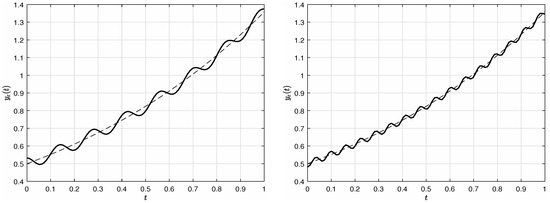
As an academic example, let us consider the linear problem
and its solution
Hence, for every sequence , the solution of the problem under consideration satisfies
and thus, the solutions converge uniformly on the interval to the solution of the reduced problem for The second term on the right-hand side denotes the convenient Big–O notation. For better illustration, Figure 1 graphically shows the solutions for different values of the parameter The MATLAB code for Figure 1 is below, in Listing 1.
Figure 1.
Solutions of the Neumann boundary value problem from Example 1 on the interval for and (left) and (right). A dashed line is used to draw the function the solution of the reduced problem.
| Listing 1. MATLAB code for Figure 1. |
| %bvp5cNeumann.m |
| format long; |
| a = 0; |
| b = 1; |
| k = 2; |
| eps = 0.0002; |
| ode = @(x,y) [y(2) ; (-k*y(1) + exp(x))/eps]; |
| bc = @(ya,yb)[ya(2); yb(2)]; %Neumann BC |
| solinit = bvpinit(linspace(a,b,50),[1 0]); |
| sol = bvp5c(ode,bc,solinit); |
| x = linspace(a,b); |
| y = deval(sol,x); |
| X=x’; Y=y(1,:)’; |
| %[X Y] |
| plot(x,Y,’linewidth’,1.5); |
| hold on |
| plot(x,exp(x)/k, ’--’); |
| hold on |
| grid on |
| xlabel(’$t$’,’interpreter’,’latex’); |
| ylabel(’$y_{\varepsilon}(t)$’,’interpreter’,’latex’); |
| %print(’figure1’,’-deps’) |
The main result of this note is the following theorem generalizing the Example 1 to all right-hand sides
2. Main Result
Theorem 1.
Proof.
First, we show that the function
is a solution of (1), (2). Differentiating (3) twice, taking into consideration the relation
we obtain that
From (5) and (3), after a little algebraic rearrangement, we get
that is, is a solution of differential Equation (1), and from (4), it is easy to verify that this solution of (1) satisfies the boundary condition (2).
Let be arbitrary, but fixed. Let us denote by and the integrals
and
Then
Integrating and by parts we obtain that
Thus,
Now, we estimate the difference We have
The integrals in (6) converge to zero for as Indeed, with respect to the assumption imposed on f we may integrate by parts in (6). Thus,
and
where and
Substituting (7) and (8) into (6), we obtain the a priori estimate of solutions of the problem (1), (2) for all in the form
Because the right-hand side of the inequality (9) is independent of the convergence is uniform on
Analogously, using (4), for , we obtain for all the estimate
where the constant on the right-hand side does not depend on Theorem 1 is proved. □
Remark 1.
We conclude that in the case when —that is, the solution of a reduced problem satisfies the prescribed boundary conditions (2)—the convergence rate of the solutions of (1), (2) to the function u on the interval is even faster; namely, for , as follows from (9).
For example, the Neumann boundary value problem , , (2) , , , has solution satisfying
for all as Note here that
Remark 2.
As follows from the proof of Theorem 1, the boundedness of the set
implies for uniformly on for the solutions of the nonlinear Neumann problem
where u is a solution of the reduced problem defined on In the proof we just replace with and so on.
3. Conclusions
In this paper, we dealt with a standard problem in the field of singular perturbations, namely the asymptotic behavior of the solutions when the parameter reaches zero, and the relation of this limit to the solution of the reduced problem ().
The problem, namely (1), (2) which we analyze in the paper looks seemingly simple, but our approach represents a possible way of analyzing singularly perturbed problems when the critical manifold (solution of the reduced problem) is not normally hyperbolic (the roots of the characteristic equation are located on the imaginary axis). The investigation of this type of problem is still far from complete, and this article represents a small contribution (perhaps rather an attempt) towards grasping it.
Funding
This publication has been published with the support of the Operational Program Integrated Infrastructure within project “Výskum v sieti SANET a možnosti jej d’alšieho využitia a rozvoja”, code ITMS 313011W988, co-financed by the European Regional Development Fund (ERDF).
Institutional Review Board Statement
Not applicable.
Informed Consent Statement
Not applicable.
Data Availability Statement
Not applicable.
Acknowledgments
The author thanks the editors and the anonymous reviewers for their insightful comments, which improved the quality of the paper.
Conflicts of Interest
The author declares no conflict of interest.
References
- Jones, C.K.R.T. Geometric Singular Perturbation Theory. In Dynamical Systems, Part of the Lecture Notes in Mathematics; Springer: Heidelberg, Germany, 2006; Volume 1609, pp. 44–118. [Google Scholar]
- Fenichel, N. Geometric singular perturbation theory for ordinary differential equations. J. Differ. Equ. 1979, 31, 53–98. [Google Scholar] [CrossRef] [Green Version]
- Wiggins, S. Normally Hyperbolic Invariant Manifolds in Dynamical Systems; Springer Science+Business Media: New York, NY, USA, 1994. [Google Scholar]
- Kuehn, C. Multiple Time Scale Dynamics; Springer: Cham, Switzerland; Heidelberg, Germany; New York, NY, USA; Dordrecht, The Netherlands; London, UK, 2015. [Google Scholar]
- Riley, J.W. Fenichel’s Theorems with Applications in Dynamical Systems; University of Louisville: Louisville, KY, USA, 2012. [Google Scholar]
- De Coster, C.; Habets, P. Two-Point Boundary Value Problems: Lower and Upper Solutions; Elsevier Science: Amsterdam, The Netherlands, 2006. [Google Scholar]
- Chang, K.W.; Howes, F.A. Nonlinear Singular Perturbation Phenomena: Theory and Applications; Springer: New York, NY, USA, 1984. [Google Scholar]
- Vrabel, R. Upper and lower solutions for singularly perturbed semilinear Neumann’s problem. Math. Bohem. 1997, 122, 175–180. [Google Scholar] [CrossRef]
- Cabada, A.; Lopez-Somoza, L. Lower and Upper Solutions for Even Order Boundary Value Problems. Mathematics 2019, 7, 878. [Google Scholar] [CrossRef] [Green Version]
- Kokotovic, P.; Khalil, H.K.; O’Reilly, J. Singular Perturbation Methods in Control, Analysis and Design; Academic Press: London, UK, 1986. [Google Scholar]
- Vrabel, R. Singularly perturbed semilinear Neumann problem with non-normally hyperbolic critical manifold. Electron. J. Qual. Theory Differ. Equ. 2010, 9, 1–11. [Google Scholar] [CrossRef]
Publisher’s Note: MDPI stays neutral with regard to jurisdictional claims in published maps and institutional affiliations. |
© 2022 by the author. Licensee MDPI, Basel, Switzerland. This article is an open access article distributed under the terms and conditions of the Creative Commons Attribution (CC BY) license (https://creativecommons.org/licenses/by/4.0/).