


Abstract
In this article, we prove that the condition holds, first by using the Fuchs index of the complex Kawahara equation, and then proving that all meromorphic solutions of complex Kawahara equations belong to the class W. Moreover, the complex method is employed to get all meromorphic solutions of complex Kawahara equation and all traveling wave exact solutions of Kawahara equation. Our results reveal that all rational solutions and simply periodic solutions of Kawahara equation are solitary wave solutions, while simply periodic solutions are not real-valued. Finally, computer simulations are given to demonstrate the main results of this paper. At the same time, we believe that this method is a very effective and powerful method of looking for exact solutions to the mathematical physics equations, and the search process is simpler than other methods.
MSC:
30D35; 34A05
1. Introduction and Main Results
In this article, we study all traveling wave exact solutions of the Kawahara equation [1]:
where are constants, x and t represent spatial and time variables, is the nonlinear disturbance term, and and are the dispersion terms of order three and five, respectively. The solutions of Equation (1) could be used to analyze and interpret a lot of nonlinear dispersive phenomena that can arise in optical fiber, ocean, plasma physics, etc. [2,3]. Given the importance of this equation, it remains the subject of study for many researchers. Many different techniques were devoted to studying various solutions of Equation (1) and its family [4,5,6,7,8,9,10,11,12,13]. For example, Kudryashov [14], obtained exact meromorphic solutions of the Kawahara equation using the Laurent series. Wazwaz [15], found some different solutions (compacton and solitons) to Equation (1) in terms of trigonometric functions. Khan [16], analyzed the Kawahara equation using the variational approach and derived new conditions for obtaining solitary wave solutions. Using the traveling wave ansatz, Baiswas [17], studied the generalized Kawahara equation and derived a solitary wave solution for the family of the Kawahara equation. A lot of effective methods are applied to study the exact solutions, which makes the research more abundant [18,19,20,21,22,23]. Wang [24] used ansatz method to derive the exact solitary wave solution for the generalized Korteweg–de Vries–Kawahara (GKdV-K) equation. Aiman Zara [25] studied numerical approximation of the modified Kawahara equation using the Kernel smoothing method. El-Tantawy [26] derived a set of novel exact and approximate analytic solutions to the family of the forced damped Kawahara equation (KE) using the ansatz method.
In recent years, Yuan et al. [27,28] introduced the condition to study a class of constant-coefficient complex algebraic differential equations with dominant terms, and obtained all possible meromorphic solutions which belong to the class W. That is to say, the general representation of rational function solutions, finitely growing simply periodic solutions and elliptic solutions, and both rational function solutions and simply periodic solutions can be obtained by degenerating elliptic general solutions. Futhermore, a complex method for obtaining exact solutions in the mathematical physics is presented. Using the complex method [27,28], we prove that all meromorphic solutions of complex Kawahara equation belong to the class W, and then get all meromorphic solutions of complex Kawahara equation and all traveling wave exact solutions of Equation (1). This method is simpler than other methods in the process of finding solutions, and can also be applied to the solution of other nonlinear differential equations.
Substitute the traveling wave transform
into Equation (1); integrate it to get
where is an integral constant.
Multiply Equation (3) by , and integrate it; thus, we get the complex ordinary differential Kawahara equation
where , and are integral constants.
Now, we give the main results in our paper.
Theorem 1.
in , and
γ is a root of in .
Let , then all meromorphic solutions of Equation (4) belong to the class W. Here, class W consists of elliptic functions and their degenerations with the form or , , where R is a rational function.
In addition, the solutions of Equation (4) have the forms:
(1) All elliptic function solutions
where
D and N are constants.
(2) All simply periodic solutions
and
where
(3) All rational function solutions
where and .
All traveling wave exact solutions of Equation (1) are obtained by substituting (2) into meromorphic solutions w of Equation (4). So, we get the following Theorem.
Theorem 2.
Let , all traveling wave exact solutions of Equation (1) have the following forms:
(1) All elliptic function solutions
where
and are constants.
(2) All simply periodic solutions
and
where γ is a root of .
(3) All rational function solutions
where and are arbitrary real constants.
The rest of the article is organized in the following order: In Section 2, we will present the relevant lemmas and methodology. Section 3 gives the detailed proof process of Theorem 1 and concise proof method of Theorem 2. Section 4 illustrates our main results using computer simulations. In the last section, some conclusions are given.
2. Preliminary Lemmas and the Complex Method
We need some definitions and lemmas in order to prove Theorem 1 and present the complex method.
Set , , .
The degree of defined by .
Definition 1 ([28]).
A differential polynomial is defined by
where Λ is a finite index set, and are constants. is called the degree of .
Consider the differential equation
where is a constant.
The dominant part of composes all dominant terms which can determine the multiplicity q of w in , and is denoted by . and represent the multiplicity of pole of each term in and the multiplicity of pole of each monomial in , respectively.
Obviously
Definition 2 ([28]).
The derivative of with respect to w can be calculated by the following formula, for any
Definition 3 ([28]).
Substituting Laurent series
into Equation (15), where . Then, we can get p different principle
with pole of multiplicity q at , Equation (15) is said to satisfy weak condition. If Equation (15) has p different meromorphic solutions with pole of multiplicity q at , Equation (15) satisfies condition.
Definition 4 ([28]).
Let be two given complex numbers, such that is discrete subset , which is isomorphic to . The discriminant and
Weierstrass elliptic function is a meromorphic function with double periods , which satisfies the following formula
where and
Definition 5 ([29]).
The Fuchs index of Equation (15) can be defined as the root of the equation
Lemma 1 ([28,30,31,32]).
Set . If Equation (15) satisfies condition, all meromorphic solutions of Equation (15) belong to class W.
Any elliptic function solution with pole at is given in the form
where can be determined by (18), and are constants. and
Any rational function solution is expressed as
which has different poles of multiplicity q.
Any simply periodic solution is a rational function of and can be given in the form
which has different poles of multiplicity q.
Lemma 2 ([33,34]).
Weierstrass elliptic functions have the addition formula and two successive degeneracies, as shown below:
(I) Addition formula
(II) If , Weierstrass elliptic functions degenerate to simply periodic functions, which can be expressed as
(III) If , Weierstrass elliptic functions degenerate to rational functions of z, which can be expressed as
Next, we give the complex method.
- Substituting the transform into a given PDE yields a nonlinear ODE: Equation (4) here.
- Insert (18) into Equation (4) here to determine that weak condition holds.
- By (22)–(24), we obtain all meromorphic solutions of Equation (4) here with pole at .
- Get all meromorphic solutions by Lemmas 1 and 2.
- Inserting the inverse transform into , we obtain all exact solutions of the given partial differential equation.
3. Proof of Theorem 1
From balance the order of the poles in Equation (4), yields
and we get .
Substitute (18) into Equation (4),and set the cofficients to zero, we have
and then determine Therefore, Equation (4) is said to satisfy weak condition. We also get that all meromorphic solutions of Equation (4) belong to W if Equation (4) satisfies condition by Lemma 1.
In fact, since (17) and of Equation (4), we have ,
and
Thus, from (29), (30) and (21), we infer that the Fuchs index of Equation (4) are zeros of the function
It is easy to prove that if Hence, if , then . That is to say, the Fuchs index of Equation (4) cannot be a positive integer. This implies that (ref. [29], p. 90): The principle part of the Laurent series of determines the whole Laurent series of . Therefore, weak condition implies that condition holds.
From, (23), we get the indeterminant form of rational function solutions of Equation (4) at pole
Inserting (32) into Equation (4), and then setting the coefficients to zero, we get the system of Equations (1) which are given in Appendix A. Computing the system of Equations (1), we get
So we find that the rational function solutions of Equation (4) are
at pole , here .
Hence, all rational function solutions of Equation (4) are
where and .
By (22) and (26), we get the indeterminant form of simply periodic solutions of Equation (4) at pole
where
Expanding at , we have
Substituting (36) into (35), we get
Comparing coefficients of (37) and (28), we obtain the system of Equations (2) which are showed in Appendix A. Solving the system of Equations (2), we have
and
Substituting (35), (38) and (39) into Equation (4), from the correlation of coefficients we can obtain, respectively,
and
where is a root of
Hence, we obtain the simply periodic solutions of Equation (4) at pole are
and
where
in , and
is a root of in .
Furthermore, all simply periodic solutions of Equation (4) are given by
and
where
in , and
is a root of in .
From (22), we infer the indeterminant forms of elliptic function solutions of Equation (4) are
with pole at .
Expanding at , we have
Put (45) into (44) and apply (20), we get
Comparing coefficients of and (28), we obtain the system of Equations (3). which are shown in the Appendix. Computing the system of Equations (3), we derive
and satisfies
Substituting (44) and (47) into Equation (4), from the correlation of coefficients, we can get
then we have
Thus, all elliptic function solutions of Equation (4) are
where
and satisfies
By using the addition formula, we can get another representation of it as
where
D and N are constants.
So far, we have completed the proof of Theorem 1.
Substituting (2) into all meromorphic solutions of Equation (4), we obtained Theorem 2. According to the theorem in ref. [35], we can get the following corollary.
Corollary. All rational solutions and simply periodic solutions of Equation (1) are real valued, while simply periodic solutions are not real valued.
4. Computer Simulations
This subsection will show our results through computer simulations of and , as demonstrated in the following figures.
- By applying the complex method, we are able to achieve the rational solution of Equation (4). Figure 1 describes the 3D graphs of solution for , , and within the interval . Figure 2 shows the 2D graphs of solution for , , and within the interval when . It could be observed that they have one generation pole, which is shown by Figure 1 and Figure 2.
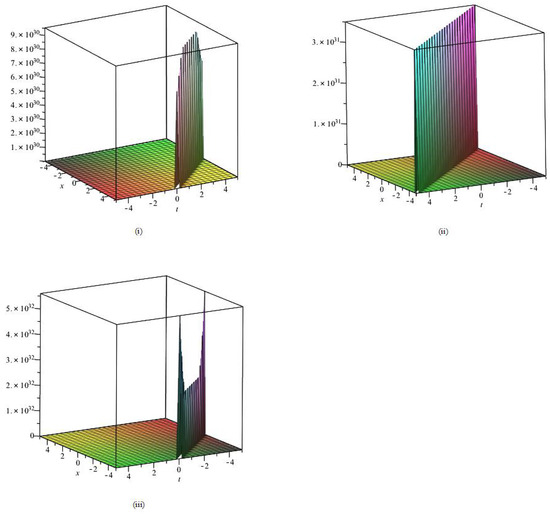 Figure 1. The 3D profiles of solution of Equation (1) corresponding to (i) , (ii) , (iii) .
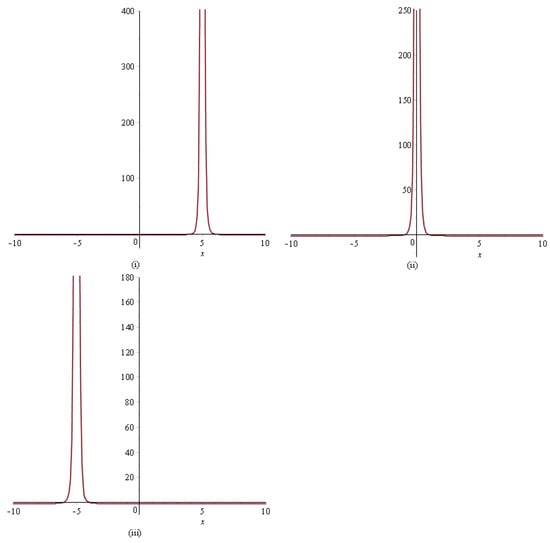 Figure 2. The 2D profiles of solution of Equation (1) corresponding to (i) , (ii) , (iii) .
 - By employing the complex method, we are able to obtain the simply periodic solutions and of Equation (4). Figure 3 shows the 3D graphs of solution for , , , and within the interval . Figure 4 describes the 2D graphs of solution for , , , and within the interval when .
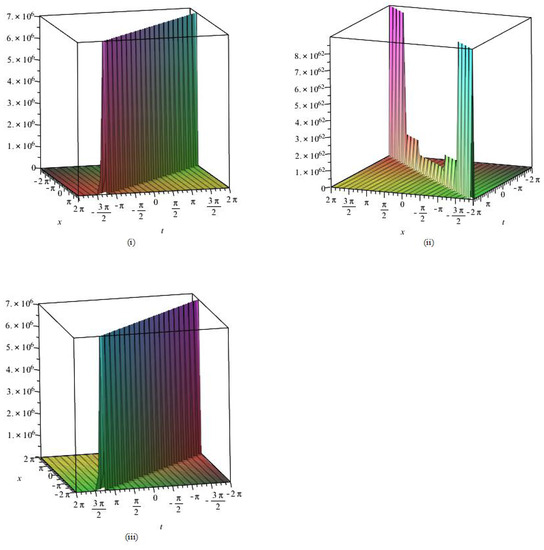 Figure 3. The 3D profiles of solution of Equation (1) corresponding to (i) , (ii) , (iii) .
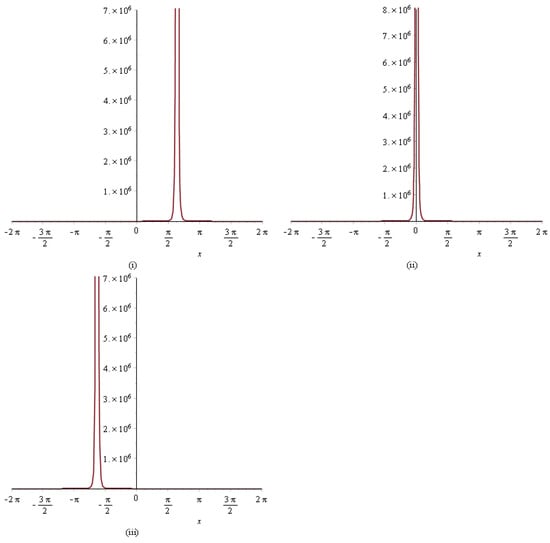 Figure 4. The 2D profiles of solution of Equation (1) corresponding to (i) , (ii) , (iii) .
5. Conclusions
In this paper, we are the first to utilize the complex method to prove that all meromorphic solutions of complex Kawahara equation belong to the class W, and then we get all meromorphic solutions of complex Kawahara equation and all traveling wave exact solutions of Equation (1). In addition, we find that all rational solutions and simply periodic solutions of Equation (1) are solitary wave solutions, which could be used to analyze and interpret a lot of nonlinear dispersive phenomena. This research enriches the methods of solving differential equations. Our results also reveal that the complex method of looking for traveling wave exact solutions is general and feasible, and can be applied to other nonlinear partial differential equations.
Author Contributions
Conceptualization, J.T. and Y.G.; methodology, J.T. and Y.G.; software, C.J.; writing—original draft, F.Y. and X.Z.; writing—review, editing, T.O. All authors have read and agreed to the published version of the manuscript.
Funding
This work is supported by the NSF of China (11901111), Young Innovative Talents Project of Guangdong Universities (2021KQNCX130), Science Research Group Project of SEIG (ST202101).
Institutional Review Board Statement
Not applicable.
Informed Consent Statement
Not applicable.
Data Availability Statement
Not applicable.
Acknowledgments
The authors would like to express their hearty thanks to the editor and referees for their very helpful comments and useful suggestions.
Conflicts of Interest
The authors declare no conflict of interest.
Appendix A
- The system of Equations (1):
- The system of Equations (2):
- The system of Equations (3):
References
- Kawahara, T. Oscillatory solitary waves in dispersive media. J. Phys. Soc. Jpn. 1972, 33, 260–264. [Google Scholar] [CrossRef]
- Wazwaz, A.M. New solitary wave solutions to the Kuramoto-Sivashinsky and the Kawahara equations. Appl. Math. Comput. 2006, 182, 1642–1650. [Google Scholar] [CrossRef]
- Yusufoǧlu, E.; Bekir, A.; Alp, M. Periodic and solitary wave solutions of Kawahara and modified Kawahara equations by using sine-cosine method. Chaos. Soliton. Fract. 2008, 37, 1193–1197. [Google Scholar] [CrossRef]
- Kaya, D.; Al-Khaled, K. A numerical comparison of a Kawahara equation. Phys. Lett. A. 2007, 363, 433–439. [Google Scholar] [CrossRef]
- Wazwaz, A.M. Partial Differential Equations and Solitary Waves Theory; Higher Education Press: Beijing, China, 2009. [Google Scholar]
- Jang, B. New exact travelling wave solutions of Kawahara type equations. Nonlinear Anal. 2009, 70, 510–515. [Google Scholar] [CrossRef]
- Kudryashov, N.A. A note on new exact solutions for the Kawahara equation using exp-function method. J. Comput. Appl. Math. 2010, 234, 3511–3512. [Google Scholar] [CrossRef]
- Kaur, L.; Gupta, R.K. Kawahara equation and modified Kawahara equation with time dependent coefficients: Symmetry analysis and generalized (G’/G)- expansion method. Math. Methods Appl. Sci. 2012, 36, 584–600. [Google Scholar] [CrossRef]
- Pinar, Z.; Öziş, Z.T. The periodic solutions to Kawahara equation by means of the auxiliary equation with a sixth-degree nonlinear term. J. Math. 2013, 2013, 106349. [Google Scholar] [CrossRef]
- Mahmood, B.A.; Yousif, M.A. A novel analytical solution for the modified Kawahara equation using the residual power series method. Nonlinear Dyn. 2017, 89, 1233–1238. [Google Scholar] [CrossRef]
- El-Tantawy, S.A.; Salas, A.H.; Alharthi, M.R. Novel analytical cnoidal and solitary wave solutions of the extended Kawahara equation. Chaos. Soliton. Fract. 2021, 147, 110965. [Google Scholar] [CrossRef]
- Ghanbari, B.; Kumar, S.; Niwas, M.; Baleanu, D. The life symmetry analysis and exact Jacobi elliptic solutions for the Kawahara-KDV type equations. Results. Phys. 2021, 23, 104006. [Google Scholar] [CrossRef]
- Dascioǧlu, A.; Cuiha, S. Unal New exact solutions for the space-time fractional Kawahara equation. Appl. Math. Model. 2021, 89, 952–965. [Google Scholar] [CrossRef]
- Demina, M.V.; Kudryashov, N.A. From Laurent series to exact meromorphic solutions: The Kawahara equation. Phys. Lett. A. 2010, 374, 4023–4029. [Google Scholar] [CrossRef]
- Wazwaz, A.M. Compacton solutions of the Kawahara-type nonlinear dispersive equation. Appl. Math. Comput. 2003, 145, 133–150. [Google Scholar] [CrossRef]
- Khan, Y. A new necessary condition of soliton solutions for Kawahara equation arising in physics. Optik 2018, 155, 273–275. [Google Scholar] [CrossRef]
- Biswas, A. Solitary wave solution for the generalized Kawahara equation. Appl. Math. Lett. 2009, 22, 208–210. [Google Scholar] [CrossRef]
- Khan, K.; Akbar, M. The exp(-ϕ(ξ))-expansion method for finding traveling wave solutions of Vakhnenko-Parkes equation. Int. J. Dyn. Syst. Differ. Equ. 2014, 5, 72–83. [Google Scholar]
- Khan, K.; Akbar, M.; Koppelaar, H. Study of coupled nonlinear partial differential equations for finding exact analytical solutions. R. Soc. Open Sci. 2015, 2, 140406. [Google Scholar] [CrossRef]
- Jafari, H.; Kadkhoda, N.; Baleanu, D. Fractional Lie group method of the time-fractional Boussinesq equation. Nonlinear Dyn. 2015, 81, 1569–1574. [Google Scholar] [CrossRef]
- Jafari, H.; Kadkhoda, N.; Azadi, M.; Yaghoubi, M. Group classification of the time-fractional Kaup-Kupershmidt equation. Sci. Iran. 2017, 24, 302–307. [Google Scholar] [CrossRef][Green Version]
- Sahoo, S.; Ray, S. Solitary wave solutions for time fractional third order modified kdv equation using two reliable techniques G’/G-expansion method and improved G’/G-expansion method. Phys. Lett. A 2010, 374, 4023–4029. [Google Scholar] [CrossRef]
- Özkan, E.M.; Özkan, A. The soliton solutions for some nonlinear fractional differential equations with Beta-derivative. Axioms 2021, 10, 203. [Google Scholar] [CrossRef]
- Wang, X.F.; Cheng, H. Solitary wave solution and a linear mass-conservative difference scheme for the generalized Korteweg-de Vries Kawahara equation. Comput. Appl. Math. 2021, 40, 273. [Google Scholar] [CrossRef]
- Rehman, S.U.; Ahmad, F.; Kouser, S.; Pervaiz, A. Numerical approximation of modified Kawahara equation using Kernel smoothing method. Math. Comput. Simul. 2022, 194, 169–184. [Google Scholar]
- El-Tantawy, S.A.; Salas, A.H.; Alyousef, H.A.; Alharthi, M.R. Novel exact and approximate solutions to the family of the forced damped Kawahara equation and modeling strong nonlinear waves in a plasma. Chin. J. Phys. 2022, 77, 2454–2471. [Google Scholar] [CrossRef]
- Yuan, W.J.; Li, Y.Z.; Lin, J.M. Meromorphic solutions of an auxiliary ordinary differential equation using complex method. Math. Method Appl. Sci. 2013, 36, 1776–1782. [Google Scholar] [CrossRef]
- Yuan, W.J.; Wu, Y.H.; Chen, Q.H.; Huang, Y. All meromorphic solutions for two forms of odd order algebraic differential eqyations and its applications. Appl. Math. Comput. 2014, 240, 240–251. [Google Scholar]
- Conte, R. The Painlevé approach to nonlinear ordinary differential equations. In The Painlev Property, One Century Later, CRM Series in Mathematical Physics; Conte, R., Ed.; Springer: New York, NY, USA, 1999; pp. 77–180. [Google Scholar]
- Yuan, W.J.; Huang, Y.; Shang, Y.D. All travelling wave exact solutions of two nonlinear physical models. Appl. Math. Comput. 2013, 219, 6212–6223. [Google Scholar]
- Yuan, W.J.; Shang, Y.D.; Huang, Y.; Wang, H. The representation of meromorphic solutions of certain ordinary differential equations and its applications. Sci. Sin. Math. 2013, 43, 563–575. [Google Scholar]
- Yuan, W.J.; Meng, F.N.; Huang, Y.; Wu, Y.H. All traveling wave exact solutions of the variant Boussinesq equations. Appl. Math. Comput. 2015, 268, 865–872. [Google Scholar] [CrossRef]
- Lang, S. Elliptic Functions, 2nd ed.; Springer: New York, NY, USA, 1987. [Google Scholar]
- Conte, R.; Musette, M. Elliptic general analytic solutions. Stud. Appl. Math. 2009, 123, 63–81. [Google Scholar] [CrossRef]
- Gu, Y.Y.; Wu, C.F.; Yuan, W.J. Characterizations of all real solutions for the KdV equation and . Appl. Math. Lett. 2020, 107, 106446. [Google Scholar]
Publisher’s Note: MDPI stays neutral with regard to jurisdictional claims in published maps and institutional affiliations. |
© 2022 by the authors. Licensee MDPI, Basel, Switzerland. This article is an open access article distributed under the terms and conditions of the Creative Commons Attribution (CC BY) license (https://creativecommons.org/licenses/by/4.0/).