


Abstract
A topological abelian group G is said to have the quasi-convex compactness property (briefly, qcp) if the quasi-convex hull of every compact subset of G is again compact. In this paper we prove that there exist locally quasi-convex metrizable complete groups G which endowed with the weak topology associated to their character groups , do not have the qcp. Thus, Krein’s Theorem, a well known result in the framework of locally convex spaces, cannot be fully extended to locally quasi-convex groups. Some features of the qcp are also studied.
Keywords:
quasi-convex subset; determining subgroup; quasi-convex compactness property; Krein’s Theorem MSC:
54H11; 54D50; 46A20
1. Introduction
Krein’s Theorem is a key result in the classical theory of topological vector spaces. It admits different formulations with varying degrees of generality; for instance the one presented in [1] (5.3, Theorem 4) reads as follows:
Theorem 1.
Let E be a locally convex space and let A be a weakly compact subset of E. Then the closed convex hull of A is weakly compact if and only if it is complete for the given topology.
From this result it immediately follows that the weak topology of a complete locally convex space has the convex compactness property (we recall the relevant notions below). In this paper we deal with the extension of Krein’s Theorem to topological abelian groups, in the natural form, which consists of replacing classical objects of the theory of topological vector spaces by corresponding objects of the theory of topological abelian groups. For instance, the natural substitution of continuous linear forms is realized by continuous characters, the notion of convexity by that of quasi-convexity etc. This process may result in natural counterparts of important theorems of Functional Analysis for the class of topological abelian groups. Our main result Theorem 6 confirms that this is not always the case.
We first deal with the quasi-convex compactness property (qcp), a convenient notion which mimics the convex compactness property as defined in [2]. In Section 2 and Section 3 some aspects of the qcp are outlined, including the description of classes of abelian topological groups which have the qcp, the hereditary behaviour and some obstructions to the qcp. In Section 4 we study the relation between the qcp and the convex compactness property in topological vector spaces. With these instruments at hand, in Section 5 we prove that a counterpart of Krein’s Theorem holds for the class of locally convex spaces considered as topological abelian groups. However, it cannot be extended to the bigger class of locally quasi-convex groups. We provide a family of locally quasi-convex metrizable groups G which endowed with their weak topology do not have the qcp. The groups in this family can be considered as counterexamples to the version of Krein’s Theorem for topological groups.
In Section 6 we study some interactions between the qcp and other properties like being g-barrelled, or the Glicksberg property.
The many ways in which completeness-like properties relate to convexity in topological vector spaces have been studied for a long time and Krein’s theorem is just an important milestone in this ongoing exploration. As suggested by one of the referees of this paper, it would make sense to look for relevant topological group counterparts of other concepts and results which have arisen in connection with this topic, e.g., those concerning the metric convex compactness property, or Mackey completeness.
Preliminaries
Define as and denote by the canonical projection. On we consider the group norm Note that for every and whenever We put
A character of an abelian group X is a homomorphism . We denote by the group of all characters of X with pointwise sum.
If X is a topological abelian group, we write for the subgroup of whose elements are the continuous characters of X. A topological abelian group X is said to be MAP (an abbreviation of “maximally almost periodic”) if for every in X there exists with Two group topologies on an abelian group are called compatible if they give rise to the same family of continuous characters.
If U is a subset of the topological abelian group X, the set is called the polar of U. Note that a subset of is equicontinuous if and only if it is a subset of the polar of a neighborhood of zero in X. If B is a subset of , where X is clear from the context, we will sometimes denote by the set . Note that for every We will say that U is quasi-convex if . For an arbitrary the set is the smallest quasi-convex subset of X which contains U; we call it the quasi-convex hull of U in X and denote it usually by
A topological abelian group is called locally quasi-convex if it has a basis of neighborhoods of zero formed by quasi-convex sets. Given a topological abelian group X with topology , the quasi-convex neighborhoods of zero in X form a basis of neighborhoods of zero for the finest topology among the group topologies on X which are coarser than and locally quasi-convex. We call the group X endowed with this locally quasi-convex modification of its original topology. The groups X and have the same continuous characters. Moreover, is Hausdorff if and only if X is MAP. See ([3], Proposition 6.18) for details on this construction.
Given an abelian group X and a subgroup H of , we denote by the initial topology on X with respect to the characters in H. The topological group is precompact and its dual group is exactly H. In what follows X will often carry a group topology and H will be taken as also, for a MAP topological group X we will sometimes consider the weak topology where X is regarded as a subgroup of in the natural way.
A topological abelian group is said to satisfy the Glicksberg property if every compact subset of X is compact. The classical Glicksberg Theorem establishes that all locally compact abelian groups have the Glicksberg property.
If X is a topological abelian group, we denote by the topology on of uniform convergence on compact subsets of X. We will often write as a shorthand for . The topology admits as a basis of neighborhoods of zero the family of all sets of the form where K runs over all compact subsets of X.
For any topological abelian group X we define the homomorphism by . We say that X is semi-reflexive if is onto. We say that X is reflexive if is a topological isomorphism. The classical Pontryagin-van Kampen theorem asserts that every locally compact abelian group is reflexive.
Let H be a subgroup of a topological abelian group X, and let be the inclusion mapping. We say that H is dually embedded in X if every continuous character of H can be extended to X, i.e., if the restriction mapping is onto. It is clear that is always continuous; we say that H is strongly dually embedded in X if it is actually a quotient mapping (i.e., it is onto and open). Every open subgroup is strongly dually embedded ([4], Lemma 2.2). Assume that H is dense in X; then clearly H is strongly dually embedded in X if and only if is a topological isomorphism. We say in this case that Hdetermines X. A metrizable group is determined by all of its dense subgroups (see ([3], Theorem 4.3) and ([5], Theorem 2)).
The refinement or k-modification of a topological space is the topological space where is the family formed by those with for every compact set The topology is the finest topology on X among those which induce on every compact If t is a Hausdorff topology, admits the following characterization: a subset is closed if and only if is compact for every compact subset The space is a space if Metrizable spaces and locally compact spaces are spaces. If an abelian topological group X is a space, then all compact subsets of are equicontinuous, i.e., the homomorphism is continuous.
We say that the topological abelian group X is locally precompact if it admits a nonempty precompact open subset or, equivalently if it is a subgroup of a locally compact group.
A topological group is almost metrizable if it contains a compact subset of countable character. As proved in ([3], 2.20), an abelian Hausdorff topological group X is almost metrizable if and only if it has a compact subgroup K such that is metrizable.
We only consider vector spaces over A subset A of a topological vector space E is said to be balanced if A subset of E is absolutely convex if it is both convex and balanced. For any subset we denote by the closure of the absolutely convex hull of A. A topological vector space E is said to have the convex compactness property (ccp in what follows) if is compact for every compact subset
If E is a topological vector space, we denote by the dual space of E, i.e., the space of all linear continuous functionals defined on E. We say that E is dually separated if for every in E there exists with We denote by the initial vector space topology on E with respect to all linear functionals in
The symbol stands for the space endowed with the topology of uniform convergence on compact subsets of E. For any topological abelian group E the mapping
is an isomorphism of topological abelian groups (see [6] or ([7], Proposition 2.3)).
If U is a subset of a topological vector space E, we put We call the set the bipolar of U and denote it by The well-known Bipolar Theorem asserts ([8], II.4, Corollary 1) that for any subset U of a locally convex space E.
Every topological vector space has a topological abelian group structure which arises from its internal operation and its topology. The topological vector spaces whose underlying topological groups are MAP (resp. locally quasi-convex) are exactly the dually separated (resp. locally convex) ones ([7], Proposition 2.4). Other aspects of topological vector spaces considered as abelian groups are studied in the book [9].
2. Generalities on the Quasi-Convex Compactness Property
We start by formulating the natural group counterpart of the convex compactness property:
Definition 1.
Let X be a topological abelian group. We say that X satisfies the quasi-convex compactness property (qcp) if is a compact subset of X for any compact subset
The qcp was defined for the first time in [10]. In the next Proposition we collect some (mostly known) information regarding this property.
Proposition 1.
- (a)
- Every semi-reflexive locally quasi-convex group has the qcp.
- (b)
- Every complete locally quasi-convex group has the qcp.
- (c)
- A locally quasi-convex group with the qcp can fail to be semi-reflexive. Actually there exists a complete, metrizable, locally quasi-convex group which is not semi-reflexive.
- (d)
- A locally quasi-convex group with the qcp can fail to be complete.
- (e)
- A metrizable, locally quasi-convex group with the qcp is necessarily complete.
- (f)
- If X is a topological abelian group such that is continuous, then has the qcp.
- (g)
- If σ and τ are compatible locally quasi-convex group topologies on an abelian group X where and has the qcp, then has the qcp too.
Proof.
(a) and (b) are proved in ([11], Proposition 3.1).
- (c)
- Such an example can be found in ([3], Corollary 11.15). Note that this group has the qcp by (a).
- (d)
- Let G be any locally compact, noncompact abelian group. Put By Glicksberg’s Theorem, This implies, on the one hand, that that is, X is semi-reflexive and by (a) has the qcp. On the other hand, X is not complete since otherwise it would be compact and in particular would be compact as well, a contradiction.
- (e)
- (f) and (g) are Theorem 3.6, Proposition 3.4 and Proposition 3.3 in [11], respectively. A different proof of (e) can be found in ([12], Theorem 2).
□
It makes sense to ask whether local quasi-convexity can be relaxed to the MAP property in Proposition 1 (a), (b) and (e). The answer is negative in the case of (b) (see Example 3 below) and positive in the case of (e); actually within the class of MAP metrizable groups the qcp already implies local quasi-convexity (see Theorem 2).
Lemma 1.
Let X be a metrizable, MAP topological abelian group. The identity mapping is a topological isomorphism.
Proof.
See ([3], Proposition 6.18). □
The following result is included in the preprint [13] as Theorem I.34. We provide a different, very natural proof.
Theorem 2.
Let X be a metrizable, MAP topological abelian group with the qcp. Then X is locally quasi-convex and complete.
Proof.
Call the given metrizable topology on X and its locally quasi-convex modification. We are going to show that Since and (being metrizable) is a space topology, it is enough to show that every compact set is compact. Fix a compact set K. The set is a neighborhood of zero in By Lemma 1 is also a neighborhood of zero in . Hence there exists a compact set C with This implies . Since is compact by hypothesis, and K is closed, we deduce that K is actually compact.
This implies that X is locally quasi-convex. The fact that it is also complete follows from Proposition 1(e). □
Problem 1.
Is it possible to extend Theorem 2 to the class of MAP topological groups which are k-spaces? Is the dual group of any group X in a k-space?
Note that if X is a metrizable topological vector space, we can even remove the restriction of being MAP from Theorem 2 (see Proposition 7 below). A non-metrizable topological vector space with the qcp does not need to be locally (quasi-)convex; see ([14], Example 2) and Section 4 below.
In order to give a characterization of the qcp in terms of topologies of uniform convergence on the dual group, we need the following result:
Lemma 2.
Let X be an abelian group. Let and be group topologies on X such that and has a basis of neighborhoods of zero formed by -closed sets. If is complete, then it is complete, too.
Proof.
Assume that L is -complete. Let be a Cauchy net in . The inequality implies that is a Cauchy net in , thus we can find such that .
Let V be a zero neighborhood in , which is -closed. Since is a Cauchy net in there is an index such that for all . For a fixed , and since V is -closed. This is true for all , thus for all . In other words, . □
Recall that for any topological abelian group X we denote by the topology on of uniform convergence on compact subsets of X. In what follows we also denote by the topology on of uniform convergence on compact, quasi-convex subsets of X.
Proposition 2.
For a Hausdorff locally quasi-convex topological group the following statements are equivalent:
- (a)
- X has the qcp.
- (b)
- .
Proof.
A basic -neighborhood of zero has the form for some compact . Fix such a subset By (a) the quasi-convex hull of K is compact in , and hence also in the weaker topology . Now is a neighborhood of zero in .
Let be -compact. By (b) we can find a -compact, quasi-convex such that . This implies . Since is a -closed subset of C, it is -compact, therefore complete with respect to . By Lemma 2, is also complete with respect to (note that quasi-convex subsets of X are closed). On the other hand it is - precompact, being the quasi-convex hull of a -compact set ([3], Theorem 7.12). Thus is -compact and has the qcp. □
3. The qcp on Subgroups
In this section we analyze the hereditary behavior of the quasi-convex compactness property. Clearly, the qcp is not preserved by proper dense subgroups in general. Actually a noncomplete metrizable group cannot have the qcp (Proposition 1(e)). This can be generalized to proper dense, determining subgroups of groups that are spaces (Corollary 2).
The following result gives a quite general condition under which a subgroup inherits the qcp from its ambient group.
Proposition 3.
Let X be a topological abelian group with the qcp. Let H be a subgroup of X which is closed in the modification of X. Then H also has the qcp.
Proof.
Since H is closed in the k-modification of X, the set is compact for any compact subset C in X. By hypothesis for every compact subset K of H the set is compact. Hence is compact as well. Since is closed in H and is clearly a subset of , the result follows. □
Corollary 1.
Let X be a topological abelian group with the qcp. Let H be a closed subgroup of X. Then H has the qcp.
The following result is a partial converse of Proposition 3. Note that the qcp of the group X is not required.
Theorem 3.
Let X be a Hausdorff topological abelian group and let H be a strongly dually embedded subgroup of X. If H has the qcp, then H is closed in the modification of
Proof.
Fix a compact subset C in X. We need to show that is compact. Since is closed in H, it suffices to find a compact subset of H which contains it. Let us denote by the restriction mapping given by this is an open mapping by hypothesis, so there exists a compact subset K of H such that . (The symbol ▸ denotes a polar set computed in the dual pair .) Since clearly , we deduce that , where denotes the subgroup of formed by those characters which are identically zero on H. This implies and consequently
which is compact by hypothesis. (The identity follows easily from the fact that H is dually embedded in X.) □
As expressed in Section 1, the notion of strongly dually embedded subgroup directly leads to that of determining subgroup. Thus, Theorem 3 yields the following results:
Corollary 2.
Let X be a Hausdorff topological abelian group which is a space. If H is a proper dense subgroup of X which determines X, then H fails to have the qcp.
Note that Corollary 2 implies (e) in Proposition 1, since every metrizable group determines its completion. An analogous consequence in a different context follows:
Corollary 3.
If a topological abelian group H is (locally) precompact, has the qcp and determines its completion, then it is actually (locally) compact.
It is known ([3], Theorem 7.11) that the quasi-convex hull of a finite subset of a MAP group is again finite. This gives the following
Corollary 4.
If H is a precompact non-compact topological group whose compact subsets are finite, then H does not determine its completion.
We prove below (Theorem 6) that the locally precompact groups X which determine their completions can be characterized by means of the joint continuity of the evaluation mapping , defined by . Previously we establish a few results related with the weaker condition of continuity of the associated mapping .
The following result has a straightforward proof.
Lemma 3.
Let X be a topological abelian group. If is continuous then is continuous.
Lemma 4.
Let H be a dense subgroup of a topological abelian group X, the restriction mapping, and equicontinuous with respect to H. Then is equicontinuous with respect to X.
Proof.
Let V be an open zero neighborhood in H with for every Let W be an open zero neighborhood in X such that . We next check that . If and is its unique extension to a continuous character on X, we have . Since is continuous, also where the closure is taken in X. The density of H implies . Thus . □
Proposition 4.
Let H be a dense subgroup of a topological abelian group X and let be the restriction mapping. If is continuous then the inverse image of any compact subset is compact in .
Proof.
This is Theorem I.19(b) in the preprint [13]. We provide the reader with a proof anyway. Pick compact. Since is continuous, K is equicontinuous with respect to H and by Lemma 4, is equicontinuous with respect to X. On the other hand, is closed in by the continuity of r. By Ascoli’s Theorem ([15], Theorem 9), is compact in . □
Proposition 5.
Let H be a dense subgroup of a topological abelian group X. If is continuous (in particular, if H is a k-space) and is a space, then H determines X.
Proof.
The restriction mapping is a continuous isomorphism whenever H is a dense subgroup. Thus it is only left to prove that r is open, equivalently closed. Pick a closed . We must prove that is compact in for every compact . Since and is compact by Proposition 4, we obtain that is compact. Now r continuous implies that is compact. □
The continuity of in Proposition 5 cannot be removed as the following example shows.
Example 1.
Let L be a locally compact, non-compact abelian group and let . By Glicksberg’s theorem , therefore is even locally compact. However H does not determine its completion X: clearly, is discrete whereas is non-discrete. Observe further that H has the qcp (see the proof of Proposition 1(d)).
Under the more restrictive assumption that is continuous, it is easily obtained that is locally compact, ([16], Proposition 1.2). We claim the following:
Theorem 4.
Let H be a locally quasi-convex, Hausdorff group. The following conditions are equivalent:
- (i)
- is continuous.
- (ii)
- H is locally precompact and determines its completion.
Proof. 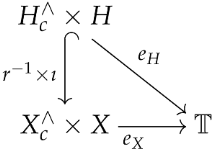
Let X be the completion of H and be the inclusion mapping. By hypothesis X is locally compact and the restriction mapping is a topological isomorphism. The diagram
is commutative and is clearly continuous. The assertion follows.
By Prop. 1.2 in [16], is locally compact, and in particular a space. The homomorphism is an embedding: take into account that H is Hausdorff, locally quasi-convex and apply Lemma 3 and ([7], Lemma 14.3). Since is locally compact, we deduce that H is locally precompact.
From Proposition 5 we obtain that H determines X. □
Corollary 5.
Let X be a locally compact abelian group and let H be a dense subgroup of X. Then H determines X if and only if is continuous.
Remark 1.
In the class of reflexive groups, continuity of implies local compactness of X, as proved in [17]. On the other hand, a reflexive noncomplete group does not determine its completion ([18], Theorem 5.2). For a general topological group X, continuity of is equivalent to continuity of plus local compactness of [19].
Example 1 shows that a topological group which is a k-space may have dense subgroups which are not k-spaces. In particular, H does not determine X in the mentioned example. The following are natural questions:
Problem 2.
- (i)
- If a topological group X contains a dense subgroup which is a k-space and determines X, must X be a k-space?
- (ii)
- If a topological group X contains a dense subgroup H which is a k-space, does H determine X?
Corollary 6.
Let H be a dense subgroup of X. If H is almost metrizable, then H determines X.
Proof.
If H is almost metrizable, then H is a k-space ([3], Proposition 1.24) therefore is continuous and is a k-space (Proposition 5.20 in the same reference). Thus H satisfies the hypothesis of Proposition 5. □
Remark 2.
If H is a dense subgroup of X and H is almost metrizable, then X is almost metrizable too. In fact, if K is a compact subgroup of H such that is metrizable, clearly K is also a compact subgroup of X. On the other hand is dense in , therefore metrizable implies metrizable. Thus, X is almost metrizable.
In the preceding Remark “almost metrizable” cannot be replaced by “space”, as the following example shows:
Example 2.
Let , where β is any uncountable ordinal, and let H be the corresponding Σ-product (i.e., the subgroup formed by those with countable support). If X is endowed with its usual product topology, H is Fréchet-Urysohn ([20], Theorem 2.1), therefore it is a k-space ([21], 1.6.14, 3.3.20). Clearly H is dense in X. However X is not a k-space. ([22], Chapter 7, Ex. J(b)).
In ([23], Theorem 4.8) it is proved that any compact abelian group X contains an almost metrizable proper dense subgroup which determines X. Our Corollary 6 shows that the fact that H determines X is a consequence of the remaining hypothesis. The following question arises naturally:
Problem 3.
Does every almost metrizable (resp. k-space) X contain an almost metrizable (resp. k-space) proper dense subgroup which determines X?
4. The qcp in Topological Vector Spaces
In this section we study the relationship between the ccp and the qcp on a topological vector space.
The next result is a slight improvement of Proposition 4.5 in [11] (see also ([7], Proposition 15.1)). In its proof we will need the following fact: If E is any dually separated topological vector space, compact subsets and compact subsets coincide. This result is proved in ([24], Lemma 1.2) in the locally convex case but it can be easily generalized since it only involves weak topologies.
Proposition 6. 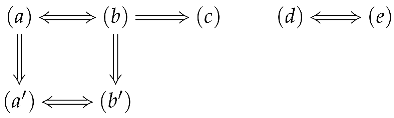
Let E be a topological vector space. Consider the following properties:
- (a)
- For every compact subset K of E, the set is compact (i.e., E has the qcp).
- (a′)
- For every compact subset K of E, the set is compact.
- (b)
- For every compact subset K of E, the set is compact.
- (b′)
- For every compact subset K of E, the set is compact.
- (c)
- For every compact subset K of E, the set is compact (i.e., E has the ccp).
- (d)
- The natural mapping defined by is onto (i.e., E is semi-reflexive as a topological abelian group).
- (e)
- The natural mapping defined by is onto.
Then the following implications hold:
If E is locally convex then all these properties are equivalent.
Proof.
Note that if is balanced and nonempty then ([25], Prop. 1.11(c)). Since is compact for every compact and quasi-convex hulls are closed sets, it is clear that (a) holds if and only if is compact for every compact set Now and the equivalence is proved.
Again, since is compact for every compact and quasi-convex hulls are closed sets, it is clear that (a′) holds if and only if is compact for every compact set It only remains to apply that compact subsets and compact subsets coincide.
and are trivial.
: Let K be a compact subset of E. The set is closed and a subset of which is compact by hypothesis. Hence it is compact, too.
: As we have mentioned (1), the mapping
is an isomorphism of topological abelian groups. Hence its adjoint mapping
is an isomorphism of abelian groups.
Analogously, the mapping
is an isomorphism of abelian groups.
It is easy to check that This shows that (d) and (e) are equivalent.
if E is locally convex: This is an immediate consequence of the Bipolar Theorem.
if E is locally convex: This is known ([26], Theorem 9.2.12).
if E is locally convex: Fix a compact subset By hypothesis the set is compact. Since E is a locally quasi-convex group, is both complete (Lemma 2) and precompact ([3], 7.12), hence compact. □
The equivalence between qcp and ccp holds for metrizable spaces, and actually these properties characterize Fréchet spaces within this class:
Proposition 7.
Let E be a metrizable topological vector space. The following properties are equivalent:
- (a)
- E has the qcp.
- (b)
- E has the ccp.
- (c)
- E is locally convex and complete.
Proof.
follows from Proposition 6.
: If E has the ccp then it is locally convex by ([27], 1.642). Hence it is also complete ([2], Theorem 2.3).
: This is true for locally quasi-convex complete groups ([11], Proposition 3.1). □
Local convexity in (c) plays an essential role. Below we present an example of a metrizable complete topological vector space which does not have the qcp.
Example 3.
Consider the space (with ) endowed with the p-norm It is known that is a non locally convex, complete metric linear space. Its dual space is (in the usual sense for sequence spaces), and in particular is a MAP group. (Details can be found for instance in Chapter 2.3 of [28].) The fact that does not have the ccp follows from in Proposition 7. Let us give a concrete example of a compact subset of this space whose absolutely convex closure is not compact. Define the sequence by
The sequence converges to 0 in the space , since
However, the convex hull of the compact subset is unbounded with respect to the p-norm . Indeed, define
for each This sequence is clearly contained in the convex hull of K. We have
which goes to infinity as . Thus is unbounded in and consequently, the closed convex hull of K is not compact.
Let us now analyze the presence of the qcp in weak vector space topologies.
Proposition 8.
Let E be a dually separated topological vector space. The following properties are equivalent:
- (a)
- The group has the qcp.
- (b)
- The space has the ccp.
- (c)
- is a semi-reflexive group.
Proof.
It is known that for any dually separated topological vector space E, the dual space of is (see for instance ([29], Chapter IV, 1.2)). Moreover, as we have mentioned above, given any topological vector space F the natural group homomorphism given by is actually an isomorphism. These facts clearly imply that
From (2) and the above mentioned fact that compact subsets and compact subsets coincide, we deduce on the one hand that (a) is equivalent to
- (a′)
- has the qcp and on the other hand that
By in Proposition 6 applied to the locally convex space (b) is equivalent to (a′). Since (a′) is equivalent to (a), we have proved
By in Proposition 6 applied to the locally convex space (b) is equivalent to
- (b′)
- is semi-reflexive as a topological abelian group.
5. The Krein Property for Topological Abelian Groups
In the sequel we will call Krein’s Theorem the following statement which is an immediate consequence of Theorem 1:
Theorem 5.
If E is a complete locally convex space, then the space has the ccp.
We will see below that Krein’s Theorem cannot be totally extended to the class of locally quasi-convex groups, but some approach is possible and we first study positive results in this line. For convenience we introduce the Krein property:
Definition 2.
Let X be a MAP topological abelian group. We say that X has the Krein property if has the qcp.
By Proposition 1(g), any locally quasi-convex group with the Krein property has the qcp.
Denote by the topology on of uniform convergence on compact subsets of a topological abelian group X. Proposition 2 yields the following:
Proposition 9.
Let X be a MAP topological abelian group. The following conditions are equivalent:
- (a)
- X has the Krein property.
- (b)
- The topologies and coincide on
We denote by the completion of the group , where X is a MAP topological abelian group. The compact group can be realized as with the topology it carries as a subgroup of The following result is an immediate consequence of Corollary 3:
Proposition 10.
Let X be a MAP topological abelian group. If X has the Krein property then either or does not determine .
The following result follows at once from Proposition 8. It shows that the Krein property, as we have just defined it, generalizes its natural vector-space counterpart in a satisfactory way.
Proposition 11.
Let be a dually separated topological vector space. Then its underlying group has the Krein property if and only if has the ccp.
Hence Krein’s (Theorem 5 above) can be restated as the fact that all complete locally convex spaces have the Krein property as groups. In order to show that Krein’s Theorem does not remain true for complete locally quasi-convex groups, we present a family of counterexamples considered in [30] with a different purpose.
We follow the notation of the mentioned paper, and outline the parts that allow us to reach our conclusion.
Notation 1.
For a Hausdorff topological abelian group X, let u and p be, respectively, the uniform and the product topology on . A basis of zero neighborhoods for u is given by the family where stands for a zero-neighborhood basis at X. Denote by the subgroup of formed by the null sequences of X, by the topology induced by u in and by the topology induced by p in .
Theorem 6.
Let X be an infinite compact, connected metrizable topological abelian group, and let . Then G is a complete metrizable group. However, G does not have the Krein property.
Proof.
Straightforward calculations show that is closed in . Therefore G is complete and metrizable.
The important fact is that its dual group is countable, and this is obtained in [30], after several steps that include the definition of a subclass of the locally generated abelian groups. A steady reasoning leads to the fact that , whenever X is a nontrivial compact connected metrizable group ([30], Theorem 7.3).
Now it is easy to prove that is countable. Taking into account that is dense in , can be identified with the dual group of which is the direct sum of countably many copies of , say . Since X is a compact metrizable group, is countable. Thus, is also countable.
The topology coincides with , so we have that is metrizable. The fact that G does not have the Krein property follows by contradiction: had the qcp, by Proposition 1(e), it would be complete. But this is not the case since and is a proper dense subgroup of the complete group . □
6. The Krein and the Glicksberg Properties in the Context of Duality
There is some interaction between these properties as we present below.
Proposition 12.
Let X be a locally quasi-convex topological group with the Krein property. The following statements are equivalent:
- (a)
- X has the Glicksberg property.
- (b)
- .
Proof.
derives from the equality and from Proposition 9.
Let be -compact. Thus is a -neighborhood of zero, and since we can find a compact subset C of such that . This implies . Since, by Proposition 1 (g), also has the qcp, we obtain that is compact in . Consequently, K is -compact. □
We recall that a topological abelian group is g-barrelled if every compact subset of is equicontinuous. For reflexive groups, the “Glicksberg property” and “being g-barrelled” are dual to each other as shown below (Corollary 7).
Proposition 13.
Let be a Hausdorff locally quasi-convex group. Consider the assertions:
- (a)
- is g-barrelled.
- (b)
- X has the Glicksberg property.
Then . If is further semi-reflexive, then .
Proof.
Let be -compact. Through the natural embedding
we obtain that is a -compact subset of . By there is a zero-neighborhood V in such that . Since is a compact subset of and is closed, we obtain that is also compact in . From the assumption that X is locally quasi-convex, we have that is relatively open, thus is compact in , which ends the proof.
Assume now that is semi-reflexive. In order to prove observe that is a topological isomorphism. Thus, if is -compact, is a -compact subset of X. By it is also -compact, therefore is a neighborhood of zero in such that . Thus, K is equicontinuous. Consequently, is g-barrelled. □
Corollary 7.
Let be a reflexive group. The following two properties are equivalent:
- (a)
- is g-barrelled.
- (b)
- X has the Glicksberg property.
Remark 3.
of Corollary 7 is a generalization of ([25], Proposition 1.7). In [31] it was wrongly stated that every reflexive group satisfies . A counterexample can be seen in [24]. Thus, we conclude that the dual of a reflexive group is not necessarily g-barreled.
Corollary 7 can also be obtained from Proposition 5.3 of [32], where several notions of barreledness for groups are considered.
Melting Proposition 12 and Corollary 7, we obtain:
Corollary 8.
Let X be a reflexive group with the Krein property. The following statements are equivalent:
- (i)
- is g-barrelled.
- (ii)
- X has the Glicksberg property.
- (iii)
- The topologies and coincide on
Example 4.
- (i)
- Banach spaces provide examples of reflexive topological groups with the Krein property. Just take into account that a Banach space is a reflexive topological group ([6]), and Theorem 5 and Proposition 11 of the present paper.
- (ii)
- A reflexive group with the Krein property, such that is not g-barrelled: Let G be an infinite dimensional, reflexive Banach space (in the ordinary sense of reflexivity for Banach spaces). It does not have the Glicksberg property: in fact, the unit ball B is -compact and by [24] also -compact. Clearly B is not compact in the norm topology of G. Thus, Corollary 8 applies to obtain that is not g-barrelled.
- (iii)
- A non reflexive group with Krein and Glicksberg properties such that is g-barrelled: Let where E is an infinite dimensional Banach space and is its weak topology. The group G is locally quasi-convex nonreflexive ( is not continuous) and by (i) it has the Krein property. Since the -compact subsets of E coincide with the -compact subsets ([24], Lemma 1.2), G has the Glicksberg property. By Proposition 12, the compact-open topology on coincides with .By Proposition 8, G is semi-reflexive and Proposition 13 proves that is g-barrelled. Observe also that G itself is not g-barrelled.
Author Contributions
Investigation, T.B., X.D. and E.M.-P.; Writing—original draft, T.B., X.D. and E.M.-P.; Writing—review & editing, T.B., X.D. and E.M.-P. All authors have read and agreed to the published version of the manuscript.
Funding
The second and third authors were supported by Spanish Agencia Estatal de Investigación (AEI) grant MTM2016-79422-P cofinanced by European Regional Development Fund (EU).
Institutional Review Board Statement
Not applicable.
Informed Consent Statement
Not applicable.
Data Availability Statement
Data is contained in the body of the paper.
Conflicts of Interest
The authors declare no conflict of interest.
References
- Grothendieck, A. Topological Vector Spaces; Gordon and Breach: New York, NY, USA; London, UK; Paris, France, 1973. [Google Scholar]
- Ostling, E.G.; Wilansky, A. Locally convex topologies and the convex compactness property. Proc. Camb. Philos. Soc. 1974, 75, 45–50. [Google Scholar] [CrossRef]
- Aussenhofer, L. Contributions to the Duality Theory of Abelian Topological Groups and to the Theory of Nuclear Groups; Dissertationes Mathematicae; PWN: Warszawa, Poland, 1999; Volume 384. [Google Scholar]
- Banaszczyk, W.; Chasco, M.J.; Martín Peinador, E. Open subgroups and Pontryagin duality. Math. Z. 1994, 215, 195–204. [Google Scholar] [CrossRef]
- Chasco, M.J. Pontryagin duality for metrizable groups. Arch. Math. 1998, 70, 22–28. [Google Scholar] [CrossRef]
- Smith, M.F. The Pontrjagin Duality Theorem in Linear Spaces. Ann. Math. 1952, 56, 248–253. [Google Scholar] [CrossRef]
- Banaszczyk, W. Additive subgroups of topological vector spaces. In Lecture Notes in Mathematics; Springer: Berlin/Heidelberg, Germany, 1991; Volume 1466. [Google Scholar]
- Robertson, A.P.; Robertson, W. Topological Vector Spaces, 2nd ed.; Cambridge University Press: London, UK; New York, NY, USA, 1973. [Google Scholar]
- Hofmann, K.H.; Morris, S.A. The Structure of Compact Groups, 4th ed.; Studies in Mathematics; De Gruyter: Berlin, Germany; Boston, MA, USA, 2020; Volume 25. [Google Scholar]
- Bruguera, M. Grupos Topológicos y Grupos de Convergencia: Estudio de la Dualidad de Pontryagin. Ph.D. Thesis, University of Barcelona, Barcelona, Spain, 1999. [Google Scholar]
- Bruguera, M.; Martín-Peinador, E. Banach-Dieudonné theorem revisited. J. Aust. Math. Soc. 2003, 75, 1–15. [Google Scholar] [CrossRef]
- Hernández, S. Pontryagin duality for topological abelian groups. Math. Z. 2001, 238, 493–503. [Google Scholar] [CrossRef]
- Lukács, G. Notes on duality theories of abelian groups. arXiv 2006, arXiv:math/0605149. [Google Scholar]
- Araki, T. A characterization of non-local convexity in some class of topological vector spaces. Math. Japon. 1995, 41, 573–577. [Google Scholar]
- Morris, S.A. Pontryagin Duality and the Structure of Locally Compact Abelian Groups; London Mathematical Society Lecture Notes Series; Cambridge University Press: Cambridge, UK; London, UK; New York, NY, USA; Melbourne, Australia, 1977; Volume 29. [Google Scholar]
- Martín-Peinador, E.; Tarieladze, V. A property of Dunford-Pettis type in topological groups. Proc. Amer. Math. Soc. 2003, 132, 1827–1837. [Google Scholar] [CrossRef]
- Martín-Peinador, E. A reflexive admissible topological group must be locally compact. Proc. Am. Math. Soc. 1995, 123, 3563–3566. [Google Scholar] [CrossRef][Green Version]
- Comfort, W.W.; Raczkowki, S.U.; Trigos-Arrieta, F.J. The dual group of a dense subgroup. Czechoslovak Math. J. 2004, 54, 509–533. [Google Scholar] [CrossRef]
- Turnwald, G. On the continuity of the evaluation mapping associated with a group and its character group. Proc. Amer. Math. Soc. 1998, 126, 3413–3415. [Google Scholar] [CrossRef]
- Noble, N. The continuity of functions on Cartesian products. Trans. Amer. Math. Soc. 1970, 149, 187–198. [Google Scholar] [CrossRef]
- Engelking, R. General Topology; Sigma Series in Pure Mathematics; Heldermann Verlag: Berlin, Germany, 1989; Volume 6. [Google Scholar]
- Kelley, J.L. General Topology; University Series in Higher Mathematics; D. Van Nostrand: Toronto, ON, Canada; New York, NY, USA; London, UK, 1955. [Google Scholar]
- Bruguera, M.; Tkachenko, M. Pontryagin duality in the class of precompact Abelian groups and the Baire property. J. Pure Appl. Algebra 2012, 216, 2636–2647. [Google Scholar] [CrossRef]
- Remus, D.; Trigos-Arrieta, F.J. Abelian groups which satisfy Pontryagin duality need not respect compactness. Proc. Amer. Math. Soc. 1993, 117, 1195–1200. [Google Scholar] [CrossRef]
- Chasco, M.J.; Martín-Peinador, E.; Tarieladze, V. On Mackey topology for groups. Studia Math. 1999, 132, 257–284. [Google Scholar] [CrossRef]
- Wilansky, A. Modern methods in Topological Vector Spaces; McGraw-Hill International Book Co.: New York, NY, USA, 1978. [Google Scholar]
- Mazur, S.; Orlicz, W. Sur les espaces métriques linéaires (I). Stud. Math. 1948, 10, 184–208. [Google Scholar] [CrossRef][Green Version]
- Kalton, N.J.; Peck, N.T.; Roberts, J.W. An F-Space Sampler; London Mathematical Society Lecture Note Series; Cambridge University Press: Cambridge, UK; New York, NY, USA; Melbourne, Australia, 1984; Volume 89. [Google Scholar]
- Schaefer, H.H. Topological Vector Spaces; Graduate Texts in Mathematics; Springer: New York, NY, USA; Heidelberg/Berlin, Germany, 1971; Volume 3. [Google Scholar]
- Dikranjan, D.; Martín-Peinador, E.; Tarieladze, V. Group valued null sequences and metrizable non-Mackey groups. Forum Math. 2014, 26, 723–757. [Google Scholar] [CrossRef]
- Venkataraman, R. Compactness in abelian topological groups. Pac. J. Math. 1975, 57, 591–595. [Google Scholar] [CrossRef]
- Gabriyelyan, S. Maximally almost periodic groups and respecting properties. In Descriptive Topology and Functional Analysis II; Ferrando, J.C., Ed.; Springer Proceedings in Mathematics & Statistics; Springer: Cham, Switzerland, 2019; Volume 286, pp. 103–106. [Google Scholar]
Publisher’s Note: MDPI stays neutral with regard to jurisdictional claims in published maps and institutional affiliations. |
© 2022 by the authors. Licensee MDPI, Basel, Switzerland. This article is an open access article distributed under the terms and conditions of the Creative Commons Attribution (CC BY) license (https://creativecommons.org/licenses/by/4.0/).