


Abstract
The classical graph entropy based on the vertex coloring proposed by Mowshowitz depends on a graph. In fact, a hypergraph, as a generalization of a graph, can express complex and high-order relations such that it is often used to model complex systems. Being different from the classical graph entropy, we extend this concept to a hypergraph. Then, we define the graph entropy based on the vertex strong coloring of a hypergraph. Moreover, some tightly upper and lower bounds of such graph entropies as well as the corresponding extremal hypergraphs are obtained.
1. Introduction
Hypergraphs are an important generalization of ordinary graphs. In this paper, some problems on extremal values of graph entropy based on the strong coloring in k-uniform hypergraphs are studied. Indeed, the colorings for hypergraphs are also a natural extension of colorings for graphs, which have various applications (timetabling and scheduling problems, planning of experiments, multi-user source coding, etc.) and offer rich connections with other combinatorial areas (probabilistic methods, extremal set theory, Ramsey theory, discrepancy theory, etc.).
In information theory, Shannons entropy, as a well-known information entropy, was proposed by Shannon [1]. As one of the most important indicators in information theory, it can measure the unpredictability of information contents. Let be a probability distribution, where and . Shannons entropy is defined as
Combining Shannons entropy with the probability distribution defined on the vertex set or edge set of a graph, the graph entropy is obtained. Indeed, graph entropy plays an important role in many disciplines such as information theory, biology, chemistry and sociology. It can not only express the structure information contents of a graph but also serve as a complexity measure. Up until now, many graph entropies have been proposed in [2,3,4,5,6,7,8,9,10,11,12,13,14]. For more results on the theory and applications of graph entropies, we refer the reader to [10,13,15,16,17].
In view of the vast amount of existing graph entropies of ordinary graphs, there is little work on graph entropy of hypergraphs [18,19]. Inspired by Mowshowitz [6], who introduced a graph entropy based on the vertex coloring, we define a graph entropy (see Definition 1) based on the strong coloring in a hypergraph.
A hypergraph with n vertices and m edges consists of a set of vertices and a set of edges , which is a family of subsets of V such that and . A hypergraph in which all edges have the same cardinality k is called k-uniform. A k-uniform hypergraph H is called simple if there are no multiple edges in H, that is, all edges in H are distinct. All hypergraphs considered here are simple and k-uniform with . For a k-uniform hypergraph , the degree of a vertex is defined as . A vertex of degree one is called a pendent vertex. Otherwise, it is called a non-pendent vertex. An edge is called a pendent edge if e contains exactly pendent vertices. Otherwise, it is called a non-pendent edge. A walk W of length l in H is a sequence of alternating vertices and edges, i.e., , where for . If , then W is called a circuit. A walk of H is called a path if no vertices and edges are repeated. A circuit H is called a cycle if no vertices and edges are repeated except . A distance between two vertices x and y is the minimum length of a path which connects x and y. The diameter of is defined by . In [20,21,22], more hypergraph concepts are introduced.
Let be a hypergraph with vertex coloring. A strong k-coloring of H is a partition of V such that the same color does not appear twice in the same edge. In other words, for any edge and any element of the partition. If a partition of V is a strong k-coloring of H, it is said to be a chromatic decomposition of H. Then set is called a color classe for . The strong chromatic number is the smallest number k such that H has a strong k-coloring. Define the non-increasing chromatic decomposition sequence of H by for a chromatic decomposition denoted by c, that is, .
Definition 1.
Let be a hypergraph with n vertices and m edges. Let is an arbitrary chromatic decomposition of H and . Then the graph entropy based on the vertex strong coloring of H is given by
If , then .
2. Preliminaries
In this section, some basic definitions and results are given.
Definition 2
([19]). Let H be a k-uniform hypergraph with n vertices, m edges and l connected components. The cyclomatic number of H is denoted and defined by . The hypergraph H is called a -cyclic hypergraph.
A connected hypergraph H does not contain any cycles if and only if .
Definition 3
([23]). Let be an ordinary graph. For an integer , the k-th power of G, denoted by , is defined as the k-uniform hypergraph with the set of vertices and the set of edges , where are new added vertices for e.
Definition 4
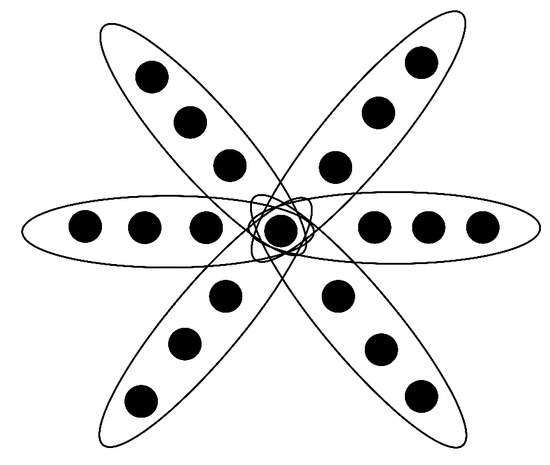
([23]). The k-th power of , denoted by , is called a hyperstar (see Figure 1 for an example).
Figure 1.
Hyperstar .
Definition 5
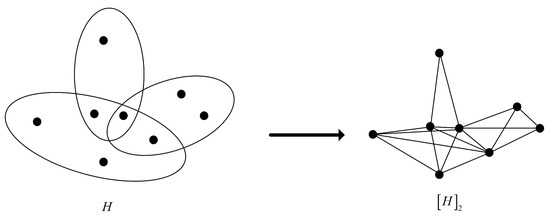
([20]). Let be a hypergraph. The 2-section of H is the graph, denoted by , where vertices are the vertices of H and where two distinct vertices form an edge if and only if they are in the same edge of H. An example of 2-section is given in Figure 2.
Figure 2.
A 2-section of a hypergraph.
Lemma 1
([20]). The strong chromatic number denoted by is the smallest k such that H has a strong k-coloring. Then is the chromatic number of the graph .
Definition 6
([24]). A graph G with vertex coloring is called color-critical if for every proper subgraph of G. If G is a color-critical k-chromatic graph, then G is called critically k-chromatic or simply k-critical.
Lemma 2
([24]). Every k-critical graph, , is -edge-connected.
Definition 7.
A k-uniform hypergraph H with vertex coloring is called color-critical if for every k-uniform proper subhypergraph of H. If H is color-critical and k-chromatic, then H is called critically k-chromatic or simplyk-critical.
Some operations [25] of moving edges for hypergraphs are stated as follows.
Definition 8.
Let and be a hypergraph with and such that for . Suppose that and write . Let be the hypergraph with . Then is said to be obtained from H by moving edge from to u.
Lemma 3.
Let k-uniform hypergraph H be t-critical . The graph is obtained from by deleting the vertex whose degree is . Then and is t-critical.
Proof.
By Lemma 1, we have . By contradiction, suppose . If , then , which contradicts with . If , then , which contradicts with . Thus, .
Now, we prove that is t-critical. Assume is not t-critical. Then there is a proper subgraph of such that . Any proper subgraph of can be obtained by deleting vertices whose degree is from the 2-section of the hypersubgraph of hypergraph H. Then, there is a hypersubgraph of H with , which implies that H is not t-critical and this is a contradiction. Hence, is t-critical. □
3. Extremality of among k-Uniform Hypergraphs
In this section, we investigate the extremality of graph entropy based on the vertex strong coloring among all k-uniform supertrees and k-uniform -cyclic hypergraphs . Assume .
Lemma 4.
Suppose , where . For any , if or , then obtains the minimal value.
Proof.
Suppose is divisible by n. Assume and . For any , it has . Suppose and . Then there are , where . Let and . Then
where and . So, we obtain . This implies that attains the minimum value as .
For the case that is not divisible by n, with the same way as above, we can check that attains the minimum value as , where and satisfying or for . □
Lemma 5.
Let be a k-uniform hypergraph on n vertices with edges and . Then the number of vertices whose degree is 1 in hypergraph is and hypergraph H has, at most, pendent edges.
Proof.
Suppose the number of vertices whose degree is 1 in hypergraph H is t, then hypergraph H has, at most, pendent edges. Let the number of vertices whose degree is 2 in hypergraph is x. By and , we have
So, the number of vertices whose degree is 1 in hypergraph is and hypergraph H has, at most, pendent edges. □
Lemma 6.
Let be a k-uniform hypergraph on n vertices with m edges and connected components. If , then .
Proof.
By contradiction, suppose as . If is , then there exists a subhypergraph of H, which is -critical. Let such that is colored with color i. Now, we discuss the following two cases.
There is a vertex set in such that any two vertices in are in the same edge.
Let be a k-uniform hypergraph of vertices and edges, with connected component. Since hypergraph is k uniform, all vertices of cannot appear in one edge of . By the condition that any two vertices in vertex set are in the same edge, there are three vertices in to form a circle of length 3. Such a cycle is denoted by , where and . For any , we find that there are two vertices of such that the two vertices and the vertex can form a cycle of length 3. Assume and are such two vertices and the cycle is , where is an edge containing and , and is an edge containing and . If there is not such a cycle , then the vertices and must be in the same edge, which is a contradiction with . So, there must be a cycle in hypergraph for .
Let be the graph obtained from adding the isolated vertices . Let be the k-uniform hypergraph obtained from by the following operations of moving edges, i.e., and . Then, we see that is connected and it has no cycles . Thus,
and
From and Inequality (2), we have
Then, we obtain that , which is a contradiction.
There are at least two vertices in which are not in the same edge for any vertex set in .
Let be the graph obtained from by deleting the vertex whose degree is . By Lemma 3, we obtain that and is -critical. By the condition, there are at least two vertices in which are not in the same edge for any vertex set in , there are at least two vertices in that are not adjacent. Suppose is not adjacent to , where . By Lemma 2, is k-edge-connected. Then contains k pairwise edge-disjoint paths. So, contains k pairwise edge-disjoint paths. Let be k pairwise edge-disjoint paths in . Let be the graph obtained from adding isolated vertices . Suppose contains an edge and a vertex such that and , where . Let be the k-uniform hypergraph obtained from by the following operations of moving edges, i.e., . Then, we see that is connected and it has no paths . Thus,
and
From and Inequality (3), we have
Then we obtain that , which is a contradiction. □
For the upper bound about , due to the lack of effective analysis methods, we only consider k-uniform hypergraph on n vertices with edges, where and is an integer. is the maximum number of edges when the diameter of is less than or equal to 5, where is a k-uniform hypergraph on n vertices with m edges and the maximum degree 2.
Theorem 1.
Let be a k-uniform hypergraph on n vertices with edges, where is an integer and . Then
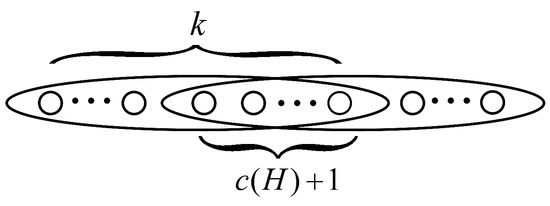
with the equality holding if and only if , where and is a k-uniform hypergraph with the maximum degree 2, possessing n vertices and m edges, which has pendent edges. Then, we see that there is a hypersubgraph of with , where the hypergraph is obtained from jointing two edges by common vertices (see Figure 3).
Figure 3.
The k-uniform -cyclic hypersubgraph of .
Proof.
By Lemma 6, . By Lemma 5, and is an integer, the hypergraph has, at most, pendent edges. For on n vertices with edges and the maximum degree 2, there is that satisfies that the diameter of is less than or equal to 5 because of . By the structure and strong coloring of hypergraph , the chromatic decomposition sequences obtained from all strong coloring of k-uniform hypergraph are the same and unique when is an integer and , which is supposed to be . If n is divisible by k, then in the case of . Otherwise, , , where . Thus, . In addition, does not hold for any . By Lemma 4, there is no such hypergraph H satisfying . This completes the proof. □
From Theorem 1 and Equality (1), we have the following result.
Theorem 2.
Let be a k-uniform hypergraph on n vertices with edges, where is an integer and . Then
the equality holds if and only if , where are given in Theorem 1.
From Theorem 2 and Equality (1), we have the following result.
Corollary 1.
Let be a k-uniform supertree on n vertices with edges, where is an integer and . Then
with the equality holding if and only if , where and is a k-uniform supertree with the maximum degree 2, possessing n vertices and m edges, which has pendent edges.
Theorem 3.
Let be a k-uniform hypergraph on n vertices with edges. Then
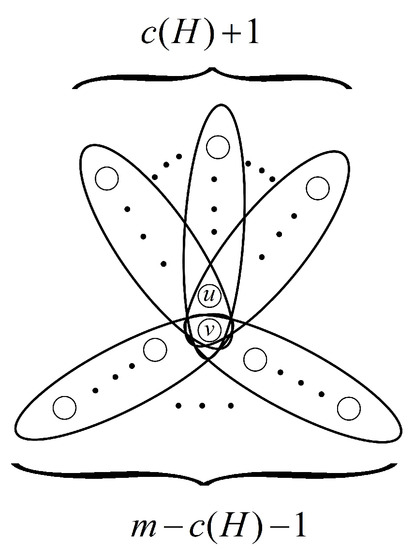
with the equality holding if and only if , where the hypergraph is obtained from jointing edges with two common vertices u and v and jointing edges by the vertex v, respectively. (see Figure 4)
Figure 4.
The k-uniform -cyclic hypergraph .
Proof.
By Lemma 6, . According to the structure and the strong coloring of a hypergraph, the chromatic decomposition sequence obtained from any strong coloring of is the same and unique, which is denoted by . Then , and . So . Note that for any strong coloring of a hypergraph. For any , we see that or . Suppose there is a hypergraph with and its coloring c satisfying . Let . Then there is satisfying and . So, there are and satisfying . Moreover, there is a vertex and a vertex satisfying . Suppose , then and . Let be the other edges of H containing . Let be a k-uniform hypergraph obtained from H by following operations of moving edges, i.e., and . Obviously, is also a k-uniform -cyclic hypergraph. Then, color the vertex with the color j noting that its color is i before. Thus, there is a coloring in satisfying . Then
where and . That is, , which means that attains the maximum value as . □
From Theorem 3 and Equality (1), we have the following result.
Theorem 4.
Let be a k-uniform hypergraph on n vertices with edges. Then
the equality holds if and only if , where are given in Theorem 3.
From Theorem 4 and Equality (1), we have the following result.
Corollary 2.
Let be a k-uniform supertree on n vertices with m edges. Then
The equality holds if and only if .
4. Conclusions
In this paper, we determine the extremal values for graph entropy based on strong coloring for k-uniform hypergraph H. For k-uniform hypergraph H with n vertices and m edges, when is an integer and , we obtain an upper bound of the graph entropy based on strong coloring by using n and k. For k-uniform hypergraph H with n vertices and m edges, we obtain a lower bound of graph entropy based on strong coloring by using n, k, m and . Hypergraph is a generalization of a graph. However, there is little research on the entropy of a hypergraph. So, it is meaningful to extend the conclusions of graph entropies based on graphs to hypergraphs in the future.
Author Contributions
Conceptualization, methodology, software, software, validation, writing— original draft preparation, L.F.; formal analysis, writing—review and editing, B.D.; supervision, H.Z.; project administration, X.L. All authors have read and agreed to the published version of the manuscript.
Funding
This research was funded by the Key Laboratory of Tibetan Information Processing Ministry of Education, Tibetan Information Processing Engineering Technology and Research Center of Qinghai Province, Qinghai-Tibet Plateau Innovation and Talent Introduction Base in Big Data Subject of Language and Culture (Grant No. 111Project D20035), Qinghai Office of Science and Technology (Grant No. 2019-ZJ-7086).
Data Availability Statement
Not applicable.
Acknowledgments
The authors were very grateful to the referees and the editor for their valuable comments and suggestions, which significantly improved the presentation of this manuscript.
Conflicts of Interest
The authors declare no conflict of interest.
References
- Shannon, C.E.; Weaver, W. The Mathematical Theory of Communication; University of Illinois Press: Urbana, IL, USA, 1949. [Google Scholar]
- Rashevsky, N. Life, information theory and topology. Bull. Math. Biophys. 1955, 17, 229–235. [Google Scholar] [CrossRef]
- Mowshowitz, A. Entropy and the complexity of graphs: I. An index of the relative complexity of a graph. Bull. Math. Biol. 1968, 30, 175–204. [Google Scholar] [CrossRef] [PubMed]
- Mowshowitz, A. Entropy and the complexity of graphs: II. The information content of digraphs and infinite graphs. Bull. Math. Biol. 1968, 30, 225–240. [Google Scholar] [CrossRef] [PubMed]
- Mowshowitz, A. Entropy and the complexity of graphs: III. Graphs with prescribed information content. Bull. Math. Biol. 1968, 30, 387–414. [Google Scholar] [CrossRef]
- Mowshowitz, A. Entropy and the complexity of graphs: IV. Entropy measures and graphical structure. Bull. Math. Biol. 1968, 30, 533–546. [Google Scholar] [CrossRef]
- Korner, J. Coding of an information source having ambiguous alphabet and the entropy of graphs. In Proceedings of the 6th Prague Conference on Information Theory, Prague, Czech Republic, 19–25 September 1971; pp. 411–425. [Google Scholar]
- Dehmer, M. Information processing in complex networks: Graph entropy and information functionals. Appl. Math. Comput. 2008, 201, 82–94. [Google Scholar] [CrossRef]
- Bonchev, D. Information Theoretic Indices for Characterization of Chemical Structures; Research Studies Press: Chichester, UK, 1983. [Google Scholar]
- Dehmer, M.; Mowshowitz, A. A history of graph entropy measures. Inf. Sci. 2011, 181, 57–78. [Google Scholar] [CrossRef]
- Korner, J.; Marton, K. Graphs that split entropies. SIAM J. Discret. Math. 1988, 1, 71–79. [Google Scholar] [CrossRef]
- Li, X.; Qin, Z.; Wei, M.; Gutman, I.; Dehmer, M. Novel inequalities for generalized graph entropies–Graph energies and topological indices. Appl. Math. Comput. 2015, 259, 470–479. [Google Scholar] [CrossRef]
- Simonyi, G. Perfect graphs and graph entropy, An updated survey. In Perfect Graphs; Ramirez-Alfonsin, J., Reed, B., Eds.; John Wiley & Sons: Hoboken, NJ, USA, 2001; pp. 293–328. [Google Scholar]
- Trucco, E. A note on the information content of graphs. Bull. Math. Biol. 1956, 18, 129–135. [Google Scholar] [CrossRef]
- Li, X.; Wei, M. Graph entropy: Recent results and perspectives. In Mathematical Foundations and Applications of Graph Entropy; Dehmer, M., Ed.; Wiley-VCH Verlag: Weinheim, Germany, 2016; pp. 133–182. [Google Scholar]
- Simonyi, G. Graph entropy: A survey. Comb. Optim. 1995, 20, 399–441. [Google Scholar]
- Cao, S.; Dehmer, M.; Shi, Y. Extremality of degree-based graph entropies. Inf. Sci. 2014, 278, 22–33. [Google Scholar] [CrossRef]
- Hu, D.; Li, X.L.; Liu, X.G.; Zhang, S.G. Extremality of Graph Entropy Based on Degrees of Uniform Hypergraphs with Few Edges. Acta Math. Sin. 2019, 35, 1238–1250. [Google Scholar] [CrossRef] [Green Version]
- Fan, Y.-Z.; Liu, A.-H.; Peng, X.-X.; Tan, Y.-Y. Maximizing spectral radii of uniform hypergraphs with few edges. Discuss. Math. Graph Theory 2016, 36, 845. [Google Scholar] [CrossRef]
- Bretto, A. Hypergraph Theory; Springer: Berlin/Heidelberg, Germany, 2013. [Google Scholar]
- Berge, C. Hypergraphs; North-Holland: Amsterdam, The Netherlands, 1989. [Google Scholar]
- Gionfriddo, M.; Milazzo, L.; Voloshin, V. Hypergraphs and Designs; Nova Publishers: New York, NY, USA, 2015. [Google Scholar]
- Hu, S.; Qi, L.; Shao, J.-Y. Cored hypergraphs, power hypergraphs and their Laplacian H-eigenvalues. Linear Algebra Its Appl. 2013, 439, 2980–2998. [Google Scholar] [CrossRef] [Green Version]
- Chartrand, G.; Lesniak, L.; Zhang, P. Graphs and Digraphs; Brooks/Cole Pub. Co.: Pacific Grove, CA, USA, 2011. [Google Scholar]
- Li, H.; Shao, J.-Y.; Qi, L. The extremal spectral radii of k -uniform supertrees. J. Comb. Optim. 2015, 32, 741–764. [Google Scholar] [CrossRef]
Publisher’s Note: MDPI stays neutral with regard to jurisdictional claims in published maps and institutional affiliations. |
© 2021 by the authors. Licensee MDPI, Basel, Switzerland. This article is an open access article distributed under the terms and conditions of the Creative Commons Attribution (CC BY) license (https://creativecommons.org/licenses/by/4.0/).