


Abstract
The large-sized Tarangaole uranium deposit and its neighboring Daying and Nalinggou deposits, located in the northeastern margin of the Ordos Basin, constitutes a major uranium resource base in northern China. In order to further clarify the sedimentary material source, uranium source and regional sediment–tectonic setting of the uranium-fed clastic rocks (i.e., Zhiluo Formation(J2z)) in the district, this paper carried out whole-rock geochemistry, heavy minerals composition and in situ U-Pb dating of detrital zircons for sandstones from the lower section of the Zhiluo Formation. The results have shown that the average chemical differentiation index (CIA) for the host rocks is 73.16 and the chemical weathering degree is moderate. Heavy minerals are mainly composed of ilmenite, garnet, chlorpyrite, zircon, pyrite, apatite, hematite, etc. The U-Pb dating of detrital zircon generally indicates three age peaks, i.e., 260~Ma, 1850~Ma and 2450~Ma, respectively. In conclusion, the source rocks may have been formed at active continental margins, e.g., in a continental margin arc environment. The sedimentary materials mainly come from khondalite series, TTGs, granulite, and mafic–ultramafic intrusive rocks distributed among the Daqing–Ula Mountains and adjacent areas, etc. The Late Paleozoic U-rich intermediate and acidic magmatic rocks spreading over the eastern part of the Ula–Daqing and Wolf mountains have provided the main uranium sources for the formation of major U deposits in the northern Ordos Basin.
1. Introduction
The Ordos Basin is an important energy basin in northern China, in coexistence with coal, oil, gas, uranium and other mineral resources [1]. The northeastern margin of the Ordos Basin has been a research hotspot for sandstone-type uranium deposits. The Tarangaole uranium deposit, located between the Daying super-large and the Nalinggou large-sized uranium deposits, is a newly discovered large-sized uranium deposit in this district. The Daying–Tarangaole–Nalinggou uranium deposits constitute a large uranium resource base in northern China [2]. The uranium-bearing strata of the three deposits are the Middle Jurassic Zhiluo Formation. The analysis of the sedimentary material sources of the Zhiluo Formation can provide an important basis for the study of the coupling mineralization process, uranium sources and mineralization mechanism in the northeast margin of the Ordos Basin. Previously, whole-rock geochemistry, mineralogy, hydrothermal alteration and detrital zircon U-Pb dating have been carried out for uranium deposits such as the Daying and Nalinggou deposits [3,4,5,6,7,8,9]. These studies have presented some understanding of their geochemical characteristics, fluid alteration characteristics, mineralization mechanisms and metallogenic patterns. As a newly discovered deposit, the source of mineralization and its regional sedimentary–tectonic setting of the Tarangaole deposit are poorly constrained. This has limited our understanding for the Zhiluo Formation of sedimentary sources, evolution and further uranium prediction and evaluation in the uranium resource base.
In this paper, based on a systematic investigation on coalfield and uranium deposits boreholes, some basic work, such as the geochemistry, detrital zircon U-Pb geochronology and heavy minerals composition for the sandstones in the lower section of the Zhiluo Formation, was carried out in the Tarangaole area. Furthermore, in combination with regional geological background and isotopic chronologic data from the regional Precambrian metamorphic rocks and intrusive rocks, the origination, evolution and tectonic setting for the uranium-containing Zhiluo Formation are discussed. The relevant results provide key insights for the further exploration of the sandstone-type uranium deposit in the northeastern Ordos Basin mining district.
2. Geological Setting
The research area is located at the Tarangaole, north-central part of the Yimeng Uplift, Ordos Basin (Figure 1), and is situated to the south of the Hetao graben and Yinshan orogenic belt. Within this area, the well-known Daying uranium deposit lies in the west, the Nalinggou uranium deposit lies in the east and the three deposits are located approximately 10–15 km from each other. Regionally, the Carboniferous to Quaternary successively were deposited on Archean and Proterozoic basement rocks and the overall strata show a monoclinic structure gently dipping towards the south-west direction. The Poerjianghaizi deep fault is located near the study area and cuts deeply into the basement. The sandstone-type uranium deposits are hosted in the Middle Jurassic Zhiluo Formation (J2z) [10]. This formation unconformably overlies the coal-bearing strata of the Yan’an Formation(J1-2y) and is in conformable contact with the overlying Anding Formation(J2a). Due to the uneven erosion of the Anding Formation, the Lower Cretaceous conglomerates unconformably cover the top of the Zhiluo Formation in some areas [11]. Two capital ancient river channels spread from north to south in the Tarangaole area [8], evolving into multiple branches to the south (Figure 1). The width of the channel is 5~10 km, the thickness can reach up to 260 m and the arenite content can reach up to 85%.
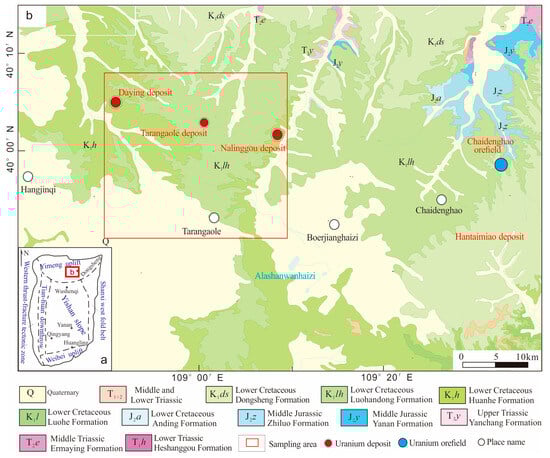
Figure 1.
Schematic tectonic map of the Ordos Basin (a) and regional geological map of research area (b) (modified from [3]).
The thickness of the Zhiluo Formation in the study area is 130~400 m and the bottom boundary is buried at a depth of 300~800 m (Figure 2a,b). The Zhiluo Formation can be divided into upper and lower sections according to their lithology (Figure 2c,d). The lower section (J2z1) is dominated by gray and gray–green medium-coarse sandstone, with gravel at the bottom, and the proportion of sandstone is generally more than 75%, which presents typical sedimentation of braided fluvial facies [12]. In the upper section (J2z2), the argillaceous interlayer increases significantly and the grain size becomes finer. The upper stratum is mainly composed by gray–green medium-fine-grained sandstone, brown–red mudstone and siltstone. The uranium ore bodies, which are distributed in the transition part of the gray–green alteration zone and the gray reduction zone of the Zhiluo Formation (J2z1), appear in the form of board and rolls on the profile. The lower section of the Zhiluo Formation presents loose, coarse-grained, mainly gray and gray–white conglomerate sandstone and coarse sandstone in the northern part of the study area; it gradually changes to gray and gray–green medium sandstone and fine sandstone. The main mineral components of the sandstone of the Zhiluo Formation are: quartz, feldspar and granite detritus, etc. Mineral sorting is medium-fine and the rounding is general-medium-sized (Figure 2e,f). The thickness of gray–green uranium-bearing sandstone can generally reach up to 50~100 m (Figure 2g).
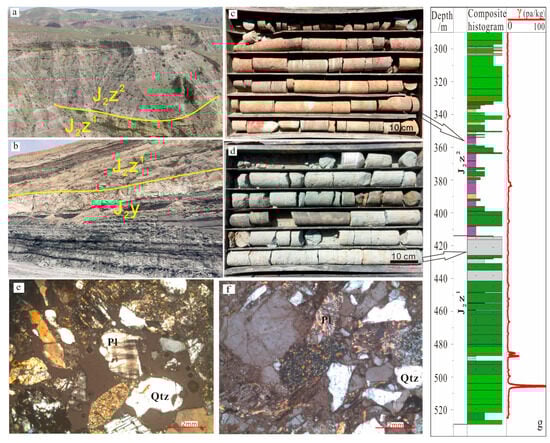
Figure 2.
Field outcrops, drill core photographs and stratigraphic histogram of the Tarangaole uranium deposit. (a) Outcrops of the upper and lower subsection of the lower section from the Zhiluo Formation; (b) Outcrops of the Zhiluo and Yan’an formations; (c) Drilled cores from the upper section of the Zhiluo Formation; (d) Drilled cores from the lower section of the Zhiluo Formation; (e,f) Microscopic feature of the Zhiluo Formation greywacke; (g) Schematic stratigraphic column of the Zhiluo Formation. Qtz = quartz, Pl = plagioclase.
3. Sampling and Analytical Methods
3.1. Sampling
Clastic rock samples from the boreholes were collected from the Zhiluo Formation in the Tarangaole and Nalinggou deposit area. All samples were processed at the Laboratory of Beijing Institute of Geology, Nuclear Industry, and the Laboratory of Tianjin Center, China Geological Survey.
3.2. Analytical Methods
3.2.1. Petrogeochemistry
Seven sandstone samples were used for the petrogeochemistry analysis. The major elements analysis was carried out by melting X-ray fluorescence spectroscopy (XRF) method and the Inductively coupled plasma-Mass Spectrometry (ICP-MS) method was used for trace and rare earth elements analysis at the Laboratory of Beijing Institute of Geology, Nuclear Industry. The analysis accuracy for major and trace elements are better than 5%.
3.2.2. Heavy Mineral Analysis
Heavy minerals analysis was performed on 19 medium-sized to coarse-grained sandstone samples and the sampling location is shown in Figure 1. Sixteen samples were taken from the borehole cores in the Tarangaole area, whereas 3 samples were collected from outcrop profile in the Gaotouyao area, covering the entire Zhiluo Formation distribution in the northern basin. Each sample (mainly medium-coarse-grained sandstone) weighed l~3 kg. The samples were processed as following: the weathered parts of the sample were removed, crushed, acidified and then selected as 63~250 μm mixed particle level fragments. Minerals were separated by the heavy liquid (CHBr3) method, then about 20 mg heavy minerals were identified under the binocular.
3.2.3. Zircon U-Pb Dating
The detrital zircons from fine-grained sandstone samples were collected for in situ LA-ICP-MS U-Pb dating. The separation of zircon grains and production of sample targets were undertaken by Langfang Chengxin Geological Service Co., Ltd. (Hebei, China). Zircon U-Pb isotope dating was conducted at the Laboratory of the Tianjin Center, China Geological Survey, using a Neptune (LA-MC-ICPMS) manufactured by Thermo Fisher Scientific, Waltham, MA, USA, referring to [13] and [14] for detailed procedures. The age data were processed by the ICPMS Data Cal program [15] and the calculation of zircon weighted average age and drawing of concordia diagrams were finished by Isopolot [16].
4. Results
4.1. Petrogeochemistry
The results of the major element analysis are shown in Table 1. The SiO2 content of the Zhiluo Formation sandstone in the Tarangaole area is relatively low, averaging at 64.14%. The content of Al2O3 is higher, with an average content of 15.98%. In addition, the average chemical differentiation index (CIA) of the Zhiluo Formation sandstone is 73.16, indicating that the chemical weathering degree is moderate at the source area.

Table 1.
Major elements (%) of analytical data of the Zhiluo Formation sandstone in study area.
The analysis results of trace and rare earth elements (REE) are shown in Table 2. The contents of compatible elements such as Co, Ni, Cr and V are similar to average levels of the continental crust [17], showing a moderately acidic tendency. In the MORB-normalized trace element spider diagram (Figure 3a), these rocks are relatively enriched in large-ion lipophile elements (LILEs) such as K, Rb and Ba, and depleted in high-field-strength elements (HFSEs) (e.g., Ti and Ta) and inactive elements such as P, as well as Sr, Ni and Y. The total amount of REEs for the Zhiluo sandstones varies significantly (192.42~292.32 ppm) with an average of 241.82 ppm. The ΣLREE/ΣHREE ratios fall into 4.46 to 5.27, with an average ratio of 4.65. The (La/Yb)N is varying from 10.79 to 13.03 with an average ratio of 11.80. According to the distribution mode of REEs (Figure 3b), most of the samples have no obvious Ce anomalies. The chondrite-normalized patterns show that the light REE tends to be enriched, whereas heavy REEs are flat, with δEu 0.66~0.77 (the average 0.73). The weak Eu negative anomaly and the REE mode is similar to that of the upper crust [18].
Table 2.
Trace elements (weight-ppm) and rare earth elements (weight-ppm) analytical data of the Zhiluo Formation sandstone.
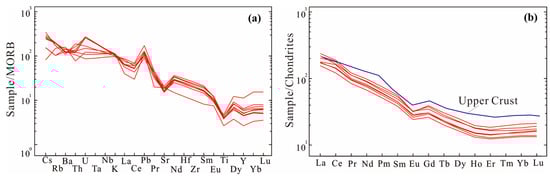
Figure 3.
MORB-normalized trace element spider diagram (a) (after [19]) and chondrite-normalized REE pattern (b) (after [20]) of sandstones from the Zhiluo Formation in study area.
4.2. Heavy Mineral Analysis
The statistical results of heavy minerals in the study area are shown in Figure 4. The main heavy minerals in the Zhiluo Formation sandstones are ilmenite, zoisite and garnet (>40%), followed by zircon, pyrite, apatite, hematite, etc., (within 10%). Especially noteworthy is that pyrite minerals are concentrated in the middle of the study area, spreading in a north–south band, whereas hematite minerals are relatively concentrated in the outer area (Figure 4).
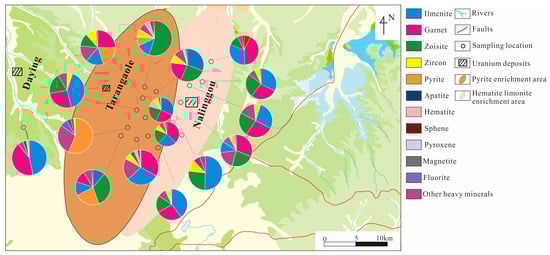
Figure 4.
Comparison of heavy mineral contents within sandstones from Zhiluo Formation in the Tarangaole uranium deposit, Ordos Basin.
4.3. Zircon U-Pb Geochronology
According to the cathodoluminescence (CL) images (Figure 5), it can be seen that the zircon grains are medium in size (60~120 μm), the crystals are idiomorphic and hypidiomorphic and the growth ring and oscillatory zoning are obvious. Among them, the Paleozoic grains are mostly angular, indicating a magmatic source. In contrast, the older zircons are mostly round and some of them have ancient cores, indicating that they may have experienced long-distance transport abrasion and later metamorphic recrystallization [21].
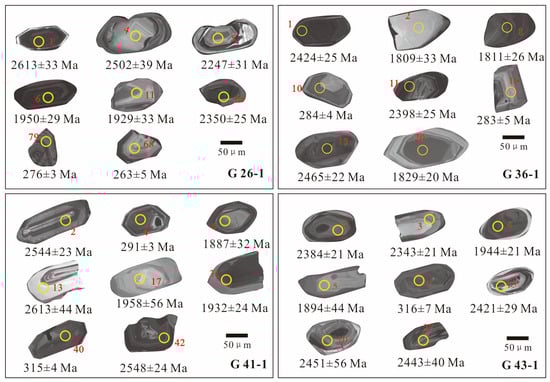
Figure 5.
Carhodoluminescence (CL) images of typical detrital zircon from sandstone samples (G26-1, G36-1, G41-1 and G43-1) of the Zhiluo Formation.
Based on the geochronological results (Table 3, Table 4, Table 5 and Table 6), the 206Pb/238U surface age was adopted for the individual zircon (<1000 Ma); the 207Pb/206Pb surface age was also adopted (>1000 Ma) [22] (Figure 5). Most of the data points fall on or near a concordia line, after removing the concordia degree < 95%. Only a few points deviated slightly from the concordia line, reflecting the little loss of Pb or U.
Table 3.
U-Pb isotope test results of detrital zircon from the Zhiluo Formation sandstone (G26-1) in study area.
Table 4.
U-Pb isotope test results of detrital zircon from the Zhiluo Formation sandstone (G36-1) in study area.
Table 5.
U-Pb isotope test results of detrital zircon from the Zhiluo Formation sandstone (G41-1) in study area.
Table 6.
U-Pb isotope test results of detrital zircon from the Zhiluo Formation sandstone (G43-1) in study area.
Eighty zircon grains from Sample G26-1 were tested (Table 3), of which four zircon grains had a concordia degree of less than 95%, without participating in the age statistics. The concordia age of 76 zircon grains is mainly divided into three groups: group 1, with an age of 240~277 Ma and a main peak of ~262Ma; group 2, with an age of 1817~1989 Ma and a main peak of ~1956 Ma; and group 3, with an age of 2247~2668 Ma and peaks of 2335 Ma and 2512 Ma (Figure 6a,b).
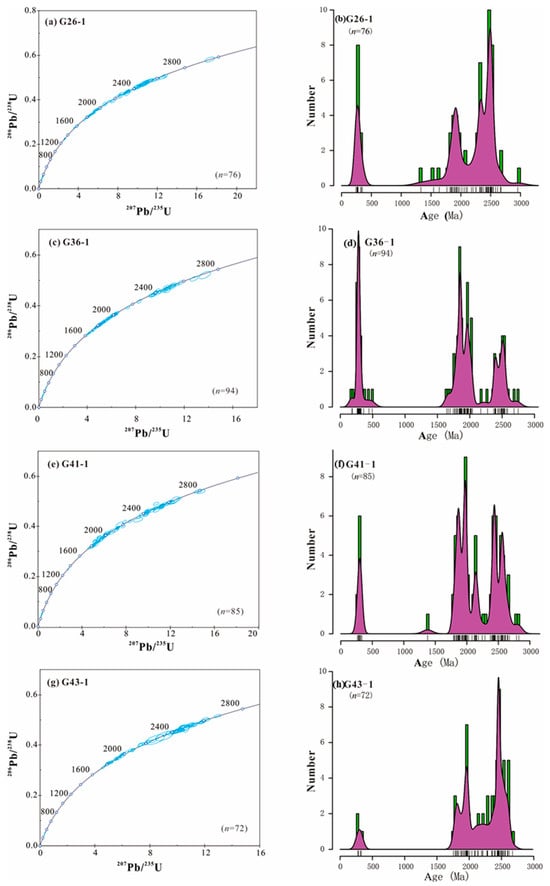
Figure 6.
Concordia curves and age spectrum of detrital zircons of the sandstones (G26-1 (a,b), G36-1 (c,d), G41-1 (e,f) and G43-1 (g,h)) from the Zhiluo Formation in the study area (after [23]).
Ninety-five zircon grains from Sample G36-1 were tested (Table 4), of which one zircon grain presented a concordia degree of less than 95%, without participating in the age statistics. The concordia age of 94 zircon grains can be divided into three groups: group 1, with an age of 260~323 Ma and a peak of ~ 280Ma; group 2, with an age of 1643~2035 Ma and peaks of ~1828 Ma and ~2000 Ma; and group 3, with an age of 2172~2736 Ma and a peak of ~2450 Ma (Figure 6c,d).
Eighty-eight zircon grains from Sample G41-1 were tested (Table 5), of which three zircon grains present a concondia degree of less than 95%, without participating in the age statistics. The concordia age of 85 zircon grains could be divided into three groups: group 1, aged between 264~335 Ma with a main peak of ~315 Ma; group 2, with an age of 1767~2200 Ma and peak ages of ~1850 Ma, 1960 Ma and ~2020 Ma; and group 3, with an age of 2256~2785 Ma and a main peak of ~2531 Ma (Figure 6e,f).
Eighty zircon grains from Sample G43-1 were tested (Table 6), of which eight zircon grains presented a concondia degree of less than 95%, without participating in the age statistics. The concordia age of 72 zircon grains can be divided into three groups: group 1, aged between 275~326Ma with a peak of ~265Ma; group 2, with an age of 1700~2200 Ma and a main peak of ~1829 Ma and ~1997 Ma; and group 3, with an age of 2200~3000 Ma and a peak of ~2418 Ma (Figure 6g,h).
5. Discussion
5.1. Geochemical Characteristics and Tectonic Setting of Host Rocks
On the FeO-MgO-A12O3 diagram [24], the source rocks of the Zhiluo Formation sandstones generally fall into the active continental margin or island-arc settings (Figure 7). In terms of trace element compositions, these sandstones are enriched in LILEs and are strongly depleted in HFSEs (Figure 3). This further suggests that the source rocks of these sandstones may have been formed in typical subduction-related settings. We, therefore, conclude that the source rocks of the Zhiluo Formation in the Daying–Tarangaole–Nalinggou area were formed in island-arc or active continental margin settings.
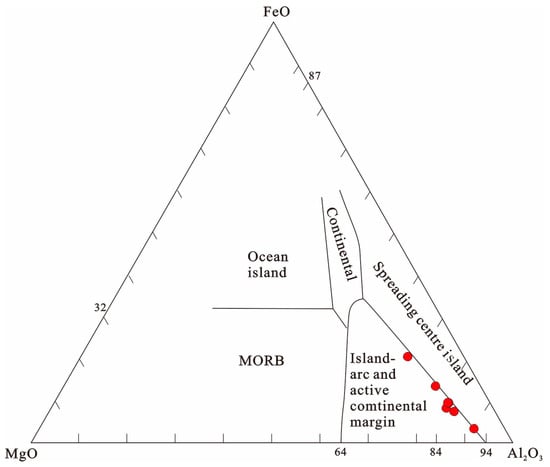
Figure 7.
The FeO-MgO-A12O3 discrimination diagram for sandstones samples from the Zhiluo Formation (after [24]).
5.2. Composition of Heavy Mineral and Implications for U Mineralization
Based on the statistical analysis on the composition of heavy minerals for the Zhiluo Formation sandstones, there is no obvious difference for the associations of stable heavy minerals among the three uranium deposits. The content of ilmenite is slightly decreased in some boreholes due to the changing of surface hydrodynamic conditions during the sedimentary processes. From the comparison of the heavy mineral contents (Figure 4), the individual relative enrichment zone can be divided into pyrite and hematite, reflecting that under the same source background, the late oxidation-reduction may have generated some authigenic heavy minerals. Although they may not indicate the source rocks of the material, they can identify the paleo-oxidation-reduction environment, which plays a certain role in indicating the spatial positioning of uranium reservoirs. The pyrite enrichment area represents the dominant zones for reducing fluids, whereas the hematite enrichment area represents the dominant zone for oxidizing fluids. Some pyrite overlaps with the limonite enrichment area, which is considered the oxidation-reduction barrier, a favorable location of U prospection.
5.3. Spatial–Temporal Constraints on the Source Rocks
Compared with the age spectrum of the neighboring areas, the age peaks (i.e., ~260 Ma, ~1850 Ma and ~2450 Ma) (Figure 6) of detrital zircons from the Tarangaole uranium deposit are highly similar to that of the Daqingshan–Ula, Yin and Wolf mountains located at the northern edge of the basin [2,8,9,25]. The Precambrian high-grade metamorphic complex distributed among the Daqing–Ula Mountains is an important part of the khondalite belt on the northern margin of the North China Craton (NCC). It is mainly composed of the Archean Xinghe Rock Group gneiss series (basement reconstructed rock series: 1950~1850 Ma, 2500~2450 Ma), the Paleoproterozoic khondalite series, the (perilla) granitic gneiss–diorite gneiss and the Paleoproterozoic mafic gneiss, the plagioclase amphibole [26]. The metamorphic events are related to the Paleoproterozoic subduction-collision dynamics between the Yinshan Massif and the Ordos Massif on the northern margin of the NCC [27]. The gneiss, granulite, khondalite series and late Paleozoic intermediate and acidic intrusive rocks in these mountains are proposed to be the main sources for sandstones in the Zhiluo Formation [2].
The age peaks of ~1850 Ma and ~2450 Ma are consistent with the two tectonic thermal events in the northern margin of the North China Craton [28] and the age peak of ~260 Ma may record the rapid subduction event of the Paleo-Asian Ocean beneath the northern margin of the North China Craton, respectively [29].
5.4. Origin of Uranium in the Zhiluo Formation
Previous studies have shown that the late Paleozoic granites in the northern Ordos Basin (i.e., source area) are highly enriched in uranium [8], e.g., the ~328 Ma Dahuabei pluton in the Ula Mountain has an average uranium content of 5.16 ppm [30] and the 253~254 Ma Chaganhua Mo-bearing granite in the eastern Wolf Mountain contains a uranium content of 5.2~20. 8 ppm [31]. These magmatic rocks were yielded in the source area of the Zhiluo Formation and it can be inferred that the uranium-abnormal properties of the Middle Jurassic Zhiluo Formation sandstones may have been caused by these late Paleozoic acidic uranium-rich magmatic rocks (Figure 8).
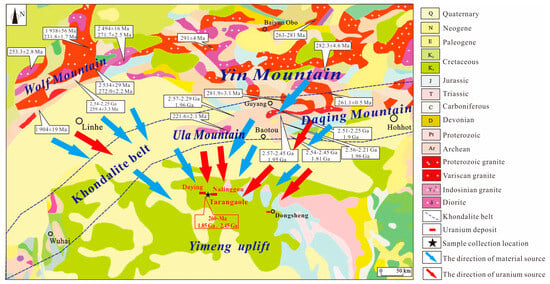
Figure 8.
Schematic diagram for the source of sediments and uranium in the Zhiluo Formation, northern Ordos Basin (modifed after [2]; the age of magmatic rocks are from [9]).
During the Middle Jurassic, the widely distributed, late Paleozoic uranium-rich intermediate and acidic magmatic rocks in the Ula–Daqing and Wolf mountains along the northern Ordos Basin may have suffered strong uplift and erosion processes [3]. The paleowater flow would carry abundant sediment supplies and the surface water would facilitate the migration of uranium (+6 U) into the basin. During the later reduction stage, the uranium is restored as U ore (+4U) by reducers like pyrite, coal and other organic matter [32].
As a product of the Paleo-Asian Ocean’s evolution, these Carboniferous–Permian uranium-rich intermediate and acidic magmatic rocks are mainly distributed along the northern margin of the North China Craton. As the evolution of these granites directly controls the development of uranium-rich sandstones, the distribution of these granites can be used as a valuable index for the prediction and evaluation of potential uranium resources in the Ordos basin [33].
6. Conclusions
- Lithogeochemical features indicate that the source rocks of the Zhiluo Formation sandstones may have been formed in island arcs or active continental margins.
- Heavy mineral assemblage shows that the sedimentary sources of the Zhiluo Formation are mainly from intermediate and acidic magmatic rocks with minor metamorphic rocks. The source areas are located in the northern part of the Ordos Basin, the Ula–Daqing Mountains and the eastern area of the Wolf Mountain.
- Detrital zircons from the Zhiluo Formation sandstones show three age peaks, i.e., ~2450 Ma, ~1850 Ma and ~260 Ma, which appear to be related to two phases of Paleoproterozoic tectonic thermal events and the rapid subduction of the Paleo-Asian Ocean during the Early Carboniferous~Middle Permian, respectively.
- The late Paleozoic uranium-rich magmatic rocks successively provide uranium for the Zhiluo Formation sandstones.
Author Contributions
Formal analysis, Q.Z.; Supervision, C.-J.X. and J.-W.Y.; Writing—original draft, G.-Y.L.; Writing—review and editing, X.-B.Z. All authors have read and agreed to the published version of the manuscript.
Funding
This work was financially supported by the National Natural Science Foundation of China (92162212), China Scholarship Council (No. 202308570015), the Geological Survey Project of the China Geological Survey (12120113057300; DD20160129; DD20160014; DD20160039; DD20190119; DD20230027) and the Scientific Research and Technology Development Project of PetroChina Changqing Oilfield Company (2022DJ0611).
Data Availability Statement
Data is contained within the article.
Conflicts of Interest
The authors declare no conflicts of interest.
References
- Liu, C.Y.; Zhao, H.G.; Gui, X.J.; Yue, L.P.; Zhao, J.F.; Wang, J.Q. Space- Time coordinate of the evolution and reformation and mineralization response in Ordos Basin. Acta Geol. Sin. 2006, 80, 617–638, (In Chinese with English abstract). [Google Scholar]
- Yu, R.A.; Sima, X.Z.; Jin, R.S.; Miao, P.S.; Peng, S.L. Discovery of a large-size uranium deposit in Northeast Ordos Basin. Geol. China 2020, 47, 883–884. [Google Scholar]
- Zhu, Q.; Yu, R.A.; Feng, X.X.; Li, J.G.; SiMa, X.Z.; Tang, C.; Xu, Z.L.; Liu, X.X.; Si, Q.H.; Li, G.Y.; et al. Mineralogy, geochemistry, and fluid action process of uranium deposits in the Zhiluo Formation, Ordos Basin, China. Ore Geol. Rev. 2019, 111, 102984. [Google Scholar] [CrossRef]
- Zhu, Q.; Wu, Y.; Wen, S.B.; Wang, Y.; Li, G.Y.; Si, Q.H.; Zhao, H.L. Analysis and comparative research on metallogenic geo-logical characteristics of sandstone-type uranium deposits between Zhiluo Formation and Luohe Formation in Ordos Basin. North China Geol. 2022, 45, 28–37. [Google Scholar]
- Chen, L.L.; Chen, Y.; Feng, X.X.; Li, J.G.; Guo, H.; Miao, P.S.; Jin, R.S.; Tang, C.; Zhao, H.L.; Wang, G.; et al. Uranium occurrence state in the Tarangaole area of the Ordos Basin, China: Implications for enrichment and mineralization. Ore Geol. Rev. 2019, 115, 103034. [Google Scholar] [CrossRef]
- Chen, Y.; Luo, N.; Chen, L.L.; Miao, P.S.; Li, J.G.; Zhao, H.L.; Li, J.M. Geochemical characteristics of basalts in the northeastern Ordos Basin. North China Geol. 2022, 45, 1–20. [Google Scholar]
- Zhao, H.L.; Chen, L.L.; Feng, X.X.; Li, J.G.; Chen, Y.; Wang, G. Features of Clay Minerals in the Middle Jurassic Zhiluo Formation Sandstones of the Nalinggou Area in the Ordos Basin and a Preliminary Comparison with Adjacent Areas. Geol. J. China Univ. 2018, 24, 627–636. [Google Scholar]
- Zhang, L.; Wu, B.L.; Liu, C.Y.; Lei, K.Y.; Hou, H.Q.; Li, S.; Cun, X.N.; Wang, J.Q. Provenance Analysis of the Zhiluo Formation in the Sandstone-hosted Uranium Deposits of the northern Ordos Basin and Implications for Uranium mineralization. Acta Geol. Sin. 2016, 90, 3441–3453, (In Chinese with English abstract). [Google Scholar]
- Lei, K.Y.; Liu, C.Y.; Zhang, L.; Wu, B.L.; Wang, J.Q.; Cun, X.N.; Sun, L. Detrital Zircon U—Pb Dating of Middle-Late Mesozoic Strata in the Northern Ordos Basin: Implications for Tracing Sedim ent Sources. Acta Geol. Sin 2017, 91, 1522–1541. [Google Scholar]
- Jiao, Y.Q.; Chen, A.P.; Wang, M.F.; Wu, L.Q.; Yuan, H.T.; Zhang, C.Z.; Xu, Z.C. Genetic analysis of the bottom sandstone of Zhiluo Formation, Northeastern Ordos Basin: Predictive base of spatial orientation of sandstone-type uranium deposit. Acta Sedimentol. Sin. 2005, 3, 371–379, (In Chinese with English abstract). [Google Scholar]
- Yue, L.; Jiao, Y.; Wu, L.; Rong, H.; Tao, Z. In situ characterization of pyrite from multiple microenvironments in middle Jurassic strata, northeastern Ordos Basin, China: Evaluation of synsedimentary/diagenetic fluid evolution. Sediment. Geol. 2023, 452, 106412. [Google Scholar] [CrossRef]
- Jiao, Y.Q.; Wu, L.Q.; Rong, H.; Peng, Y.B.; Miao, A.S.; Wang, X.M. The Relationship between Jurassic coal measures and sandstone-type uranium deposits in the northeastern Ordos Basin, China. Acta Geol. Sin. (Engl. Ed.) 2016, 90, 2117–2132. [Google Scholar] [CrossRef]
- Li, H.K.; Geng, J.Z.; Hao, S.; Zhang, Y.Q.; Li, H.M. Zircon U-Pb dating technique using LA-MC-ICP-MS. Bull. Mineral. Petrol. Geochem. 2009, 28, 77. (In Chinese) [Google Scholar]
- Geng, J.Z.; Li, H.K.; Zhang, J.; Zhou, H.Y.; Li, H.M. Zircon Hf Isotope Analysis by Means of LA-MC-ICP-MS. Geol. Bull. China 2011, 30, 1508–1513, (In Chinese with English abstract). [Google Scholar]
- Liu, Y.S.; Gao, S.; Hu, Z.C.; Gao, C.G.; Zong, K.Q.; Wang, D.B. Continental and oceanic crust recycling-induced melt-peridotite interactions in the Trans-North China Orogen: U-Pb dating, Hf isotopes and trace elements in zircons from mantle xenoliths. J. Petrol. 2010, 51, 537–571. [Google Scholar] [CrossRef]
- Ludwig, K.R. ISOPLOT/EX 3.0: A Geochronological Toolkit for Microsoft Excel; Berkeley Geochronology Centre Special Publication: Berkeley, CA, USA, 2003. [Google Scholar]
- Rudnick, R.L.; Gao, S. Composition of the Continental Crust. In The Crust; Rudnick, R.L., Ed.; Elsevier-Pergamon: Oxford, UK, 2003; pp. 1–64. [Google Scholar]
- Taylor, S.R.; McLennan, S.M. The Continental Crust: Its Composition and Evolution; Blackwell Scientific Publication: Oxford, UK, 1985. [Google Scholar]
- McDonough, W.F.; Sun, S.S. The composition of the Earth. Chem. Geol. 1995, 120, 223–253. [Google Scholar] [CrossRef]
- Sun, S.S.; McDonough, W.F. Chemical and isotopic systematics of oceanic basalts: Implications for mantle composition and processes. Geol. Soc. Lond. Spec. Publ. 1989, 42, 313–345. [Google Scholar] [CrossRef]
- Wu, Y.B.; Zheng, Y.F. Mineralogy of Zircon genesis and its constraints on U-Pb age interpretation. Chin. Sci. Bull. 2004, 49, 1589–1604, (In Chinese with English abstract). [Google Scholar] [CrossRef]
- Sircombe, K.N. Tracing provenance through the isotope ages of littoral and sedimentary detrital zircon, eastern Australia. Sediment. Geol. 1999, 124, 47–67. [Google Scholar] [CrossRef]
- Vermeesch, P. On the visualisation of detrital age distributions. Chem. Geol. 2012, 312, 190–194. [Google Scholar] [CrossRef]
- Pearce, T.H.; Gorman, B.E.; Birkett, T.C. The relationship between major element chemistry and tectonic environment of basic and intermediate volcanic rocks. Earth Planet. Sci. Lett. 1977, 36, 121–132. [Google Scholar]
- Wang, M.; Luo, J.L.; Li, M.; Bai, X.; Cheng, C.; Yan, L. Provenance and Tectonic Setting of Sandstone-Type Uranium Deposit in Dongsheng Area, Ordos Basin: Evidence from U-Pb Age and Hf Isotopes of Detrital Zircons. Acta Petrol. Sin. 2013, 29, 2746–2758, (In Chinese with English abstract). [Google Scholar]
- Liu, P.H.; Liu, F.L.; Cai, J.; Liu, J.H.; Shi, J.R.; Wang, F. Geochronological and geochemical study of the lijiazi mafic granulites from the daqingshan-wulashan metamorphic complex, the central khondalite belt in the north china craton. Acta Petrol. Sin 2013, 29, 462–484, (In Chinese with English abstract). [Google Scholar]
- Cai, J.; Liu, F.L.; Liu, P.H.; Wang, F.; Shi, J.R. Geochronology of the Paleoproterozoic khondalite rocks from the Wulashan-Daqingshan area, the Khondalite Belt. Acta Petrol. Sin. 2015, 31, 3081–3106, (In Chinese with English abstract). [Google Scholar]
- Li, G.Y.; Li, Z.D.; Wang, J.Y.; Wen, S.B. Formation Age, Geochemical Signatures and Geological Significance of the Gaoyaohai BIF-Type Iron Deposit in the Guyang Greenstone Belt, Inner Mongolia. J. Jilin Univ. (Earth Sci. Ed.) 2019, 49, 1317–1326, (In Chinese with English abstract). [Google Scholar]
- Li, G.Y.; Qiu, L.; Li, Z.D.; Gao, L.; Fu, C.; Wang, J.Y.; Zhang, Q.; Tu, J.R.; Ge, T.F. Closure of the Eastern Paleo-Asian Ocean: Constraints from the Age and Geochemistry of Early Permian Zhaojinggou Pluton in Inner Mongolia (North China). Miner. 2022, 12, 738. [Google Scholar] [CrossRef]
- Wang, L.; Wang, G.H.; Lei, S.B.; Chang, C.J.; Hou, W.R.; Jia, L.Q.; Zhao, G.M.; Chen, H.J. Petrogenesis of Dahuabei Pluton from Wulashan, Inner Mongolia: Constraints from Geochemistry, Zircon U-Pb Dating and Sr-Nd-Hf Isotopes. Acta Petrol. Sin. 2015, 31, 1977–1994, (In Chinese with English abstract). [Google Scholar]
- Liu, Y.F.; Nie, F.J.; Jiang, S.H.; Xi, Z.; Zhang, Z.G.; Xiao, W.; Zhang, K.; Liu, Y. Ore-Forming Granites from Chaganhua Mo-lybdenum Deposit, Central Inner Mongolia, China: Geochemistry, Geochronology and Petrogenesis. Acta Petrol. Sin. 2012, 28, 409–420, (In Chinese with English abstract). [Google Scholar]
- Jiao, Y.Q.; Wu, L.Q.; Peng, Y.B.; Rong, H.; Ji, D.M.; Miao, A.S.; Li, H.L. Sedimentary tectonic setting of the deposition-type uranium deposits forming in the Paleo-Asian tectonic domain, North China. Earth Sci. Front. 2015, 22, 189–205, (In Chinese with English abstract). [Google Scholar]
- Jiao, Y.Q.; Wu, L.Q.; Rong, H. Model of inner and outer reductive media within uranium reservoir sandstone of sandstone-type uranium deposits and its ore-controlling mechanism: Case studies in Daying and Qianjiadian Uranium Deposits. Earth Sci. 2018, 2, 459–474, (In Chinese with English abstract). [Google Scholar]
Disclaimer/Publisher’s Note: The statements, opinions and data contained in all publications are solely those of the individual author(s) and contributor(s) and not of MDPI and/or the editor(s). MDPI and/or the editor(s) disclaim responsibility for any injury to people or property resulting from any ideas, methods, instructions or products referred to in the content. |
© 2024 by the authors. Licensee MDPI, Basel, Switzerland. This article is an open access article distributed under the terms and conditions of the Creative Commons Attribution (CC BY) license (https://creativecommons.org/licenses/by/4.0/).