Article

DIGIT: An In Situ Experiment for Studying the Diffusion of Water and Solutes Under Thermal Gradient in the Toarcian Clayrock at the Tournemire URL; Part 2—Lessons Learned After 20 Months of Heat


1
Autorité de Sûreté Nucléaire et de Radioprotection (ASNR), PSE-ENV/SPDR/LETIS, 92260 Fontenay-aux-Roses, France
2
UMR 8148 GEOPS, Université Paris-Saclay, CNRS, Bâtiment 504, 91405 Orsay, France
3
Department of Civil Engineering, University of Ottawa, Ottawa, ON K1N 6N5, Canada
4
Canadian Nuclear Safety Commission (CNSC), Ottawa, ON K1P 5S9, Canada
5
Institut de Mécanique des Fluides de Toulouse, UMR 5502 CNRS/INP/UPS, 31400 Toulouse, France
*
Author to whom correspondence should be addressed.
Minerals 2026, 16(4), 380; https://doi.org/10.3390/min16040380
Submission received: 15 November 2025 / Revised: 25 February 2026 / Accepted: 26 February 2026 / Published: 3 April 2026

Abstract

The DIGIT experiment was launched at the Tournemire Underground Research Laboratory (URL) with the aim of determining the effects of temperature on the transfer of tracers mimicking the most mobile radionuclides in the Toarcian clay rock. The properties of this rock are similar to those of the host rocks being considered for a future deep geological repository for high-level radioactive waste (HLW). The experiment involves the monitoring of the interaction between a test water doped with stable halides and deuterium at constant concentration, and the porewater of the Toarcian clay rock under constant ambient conditions, as well as at higher temperature induced by artificial heating. This experiment seeks to partially address questions regarding the potential spread of contaminants during the thermal phase of HL waste packages. Specifically, the in situ experiment aims to evaluate the role of scale effects, thermodiffusion, a process that combines Fick’s law, the Soret effect, and convection in the transfer of radionuclides. This paper is the second part of a companion paper dedicated to predictive calculations and the installation of the experimental device. It presents the main experimental and modeling results obtained since the beginning of the installation and after 20 months of heat at 70 °C. The test was carried out in five phases, finishing with a sampling campaign: a phase 0 called “initial conditions”, followed by a pure diffusion phase (5 months), then three phases in a heated period lasting 1 year and 8 months. In total, 47 rock cores were analyzed, with approximately 170 samples tested by four diffusion methods (radial, outgoing, through and in vapor-phase) to determine the tracer concentrations in the porewater, their water content and their diffusive transport parameters. The results show a decrease in tracer concentrations with distance from the test zone, in the directions parallel and perpendicular to the stratification. The anisotropy of the medium results in greater migration in the direction parallel to the stratification. Thermal properties also confirm anisotropy with a higher thermal conductivity in the direction parallel to the stratification. Finally, an activation energy of 22.9 ± 1.7 kJ·mol−1 could be proposed by NMR for deuterium, indicating diffusion behavior following an Arrhenius law between 30 and 70 °C. The experimental data allowed for the calibration of a 2D axisymmetric numerical model using the commercial finite element software COMSOL Multiphysics®. The Fick’s law corrected by an Arrhenius law best reproduces the penetration of deuterium and anions. The Soret effect, integrated into certain scenarios, is only significant for anions’ migration, using a fitted Soret coefficient of 0.1 K−1, as proposed in the literature for the Callovo-Oxfordian, the host rock of the Cigéo project in the east of France. The calibration of the simulated data with the experimental data allowed for the characterization of damaged and/or disturbed zones evolving over time. Simulations over 150 years, the duration of the thermal maximum for HLW packages, show that advection—modeled by Darcy’s law—would have a negligible role in this context due to the low permeability of the upper Toarcian. In conclusion, the DIGIT test showed that, for the Upper Toarcian clay rocks at the Tournemire URL in France, diffusion, corrected for the effect of temperature, is the mechanism that characterizes the transport of radionuclide analogues. The study showed that thermodiffusion has a limited influence on deuterium migration but remains significant for anions in the case of a coupling between temperature correction and thermodiffusion. The test also highlighted the impact of temperature on the spatiotemporal development of a damaged and/or disturbed zone. These new and relevant results in the field will need to be confirmed later through additional experiments.

1. Introduction

Clay rocks have been considered for several decades as a host formation for the disposal of radioactive wastes due to their favorable swelling properties (for some of them), their low hydraulic conductivity, and their radionuclide retention capacity [1,2].
In France, the Cigéo project was proposed by Andra, the French Agency for the management of radioactive waste, for the definitive repository of high-level waste (HLW) and long-lived intermediate-level waste (LL-ILW) produced by all existing nuclear facilities up to their dismantling, as well as waste resulting from the reprocessing of spent fuel from nuclear power plants. The repository relies on three main barriers for long-term waste containment and isolation, namely, the clay host rock, the engineered barrier systems, and the waste packages. Cigéo is to be located in eastern France, in the Meuse/Haute-Marne area, within a deep clay layer at about 500 m depth and approximately 125 m thick, belonging to the Callovo-Oxfordian (COx) formation. The repository is planned in the center of this layer, which is bounded by aquiferous carbonate formations [3]. The French repository project proposed by Andra comprises an underground facility consisting of two disposal zones or areas, one for LL-ILW and the other for HLW [3,4].
This paper focuses more specifically on the HLW repository zone and on the environment of the vitrified waste packages resulting from the reprocessing of spent fuel. Indeed, HLW is exothermic, with an average thermal power at emplacement of about 30 W per package, which decreases over time [5,6]. The waste is planned to be stored in sub-horizontal repository cells about 150 m long, surrounded by a carbon steel casing. The packages, enclosed in their carbon steel overpacks, would be placed in a carbon steel liner to allow positioning during the operational phase, which should last about 150 years, and to allow retrieval in the event of a defective package being detected [4].
It is also for retrievability requirements that the French concept does not require HLW packages to be surrounded by an engineered buffer, as is the case of other concepts in Scandinavia, Switzerland, and Canada [1,7,8,9,10,11]. The HLW packages were designed and selected in particular to prevent water from the clay layer from reaching the vitrified HLW, at least during the thermal phase (>70 °C for the most exothermic vitrified waste packages), with a maximum duration of about 500 years [3]. The most exothermic phase in the post-closure period of the repository is estimated to last approximately 150 years, with rock temperatures in contact with the repository cells ranging from 60 to 70 °C. The present paper focuses on the impact of a premature leak of radionuclides from HLW waste packages in an environment assumed to be fully resaturated and at the peak of this thermal phase.
The safety issue lies in the ability to evaluate the zone affected by this potential leak. From a scientific point of view, the objective is to study the contribution of coupled Thermal–Hydraulic–Chemical (THC) processes to radionuclide transport under thermal load and in water-saturated conditions.
Heat transfer in low-permeability saturated porous media, such as the indurated Callovo-Oxfordian clay rocks of the Meuse/Haute-Marne Underground Research Laboratory (MHM URL), the Upper Toarcian clay rocks at the Tournemire URL in France, or those of the Mont Terri URL in Switzerland, is known to be dominated by thermal conduction (Fourier’s law). This results in energy exchange between the solids and the immobile pore fluids, with very limited mass transfer. Other potential contributors to heat transfer by convection (macroscopic displacement of thermal energy by fluid motion) or by radiation (energy transfer through electromagnetic emission) have always been considered minor, if not negligible, for both URLs [5].
During this thermal phase, and assuming a premature leak from one of the packages, mass transfers of dissolved species should be accelerated under the effect of temperature. Radionuclides dissolved in porewater could migrate with higher diffusion velocities. As is often the case in porous media, solute transport is dominated by two processes: diffusion, driven by a concentration gradient, and convection, induced by an interstitial pressure gradient. In intact clay rocks, diffusion has often been assessed as the dominant transport process over convection. This has been demonstrated by Andra and ASNR (Autorité de Sûreté Nuclaire et de Radioprotection) in several studies on clay rocks at the Meuse/Haute-Marne [6,12], Tournemire [13], and Mont Terri [14,15] underground research laboratories (URLs). The diffusive contribution to overall transport is governed by the effective diffusion coefficient (De). For environments such as those mentioned above, the effective diffusion coefficients must take into account two specific effects: the anisotropy of overconsolidated clay rocks due to burial and their temperature dependence. The magnitude of these effects depends strongly on the site studied—for Tournemire [6,16], for the MHM URL, and for Mont Terri [17]. For the three URLs studied in Western Europe, the anisotropy of effective diffusion coefficients of radionuclides such as HTO, 36Cl, and 22Na varies by factors between 3 and 6, reflecting a shorter tortuous path for species diffusing parallel to bedding [18]. For the Tournemire URL, an anisotropy factor of 3 was determined [19].
Finally, the heat flux associated with the thermal phase may also induce solute transfer under a temperature gradient. This requires considering another transport process resulting from flux–force coupling, which is generally neglected in predictive calculations. This is the Soret effect, or thermodiffusion, i.e., mass transfer due to a temperature gradient [20,21]. Only one experimental evaluation to date has been carried out on crushed and recompacted Callovo-Oxfordian clay rock from Andra’s Underground Research Laboratory (LRST MHM), under maximum temperature gradients of 26 °C [22]. Those results showed that thermodiffusion tended to accelerate radionuclide transfer compared with the pure diffusive flux, without precise quantification, and that the sign of the Soret coefficient depended on the relative directions of the temperature and concentration gradients. Modeling performed on laboratory experiments also suggests that the Soret effect may be significant due to strong thermal gradients at the sample scale, but should theoretically not exist under in situ conditions [23].
ASNR therefore decided to initiate its own experiment to evaluate the impact of temperature on mass transfer in a setting more representative of in situ conditions, within its Underground Research Laboratory at Tournemire. This experiment is based on an experimental concept originally proposed for the Mont Terri URL [24].
The principle of the experiment called DIGIT (DIffusion under Thermal GradIenT) is based on an exchange between a test zone filled with about 400 L of tracer-enriched water, maintained at constant concentration and temperature, and the water contained in the matrix or fracture porosity of the adjacent rock. The chosen tracers were anionic and stable isotopic species: Cl, Br, I, and 2H. The target tracer concentrations were 500 mmol·L−1 NaCl, 50 mmol·L−1 NaBr and NaI, and +560‰ vs. VSMOW for 2H (VSMOW stands for Vienna Standard Mean Ocean Water. It is an international isotopic reference standard used to express the isotopic ratios of water, mainly for hydrogen: 2H/1H and oxygen: 18O/16O) [25,26]. A constant temperature of 70 °C was applied within the test zone, corresponding to the target temperature expected for the clay rock in contact with an HLW package at the peak of the thermal phase, assumed here to last 150 years. The surrounding rock was regularly sampled in order to estimate tracer migration over time and to evaluate the impact of temperature on transfer processes. Deuterium (2H) served as a natural water tracer and, throughout the experiment, made it possible to characterize the extent of a damaged and/or perturbed zone. The anions, in turn, made it possible to identify the transfer processes involved in their mobility in a clay context, similarly to deuterium. For this purpose, various diffusion experiments described in Humbezi et al. [26] were initiated at the end of the different sampling campaigns described later in this paper, allowing the characterization of tracer profiles in the clay rock and their transport parameters.
The DIGIT experiment was adapted and implemented at the Tournemire URL with the objectives of (i) identifying the transfer processes likely to be involved in the migration of non-radioactive tracers as analogues for radionuclides, with and without thermal load; (ii) assessing scale, anisotropy, and damage effects on tracer transfers with and without a thermal gradient; and, finally, (iii) increasing confidence in process understanding by demonstrating the ability to evaluate a rock volume potentially impacted by radionuclide migration.
To meet these objectives, the study was divided into four parts, of which only the last three are examined in this article: (i) predictive calculations related to the DIGIT test, its installation, and the first results for isothermal diffusion, presented in a companion paper [26]; (ii) the implementation of the test, including the various experimental heating and sampling phases with temporal monitoring of temperature and pressure in the test zone and in surrounding boreholes; (iii) the temporal monitoring of tracer concentrations in porewater of the clay rock; and, finally, (iv) the multiphysics modeling of these experimental phases.
This paper provides a synthesis of the results obtained during this experiment and aims to conclude on the role of temperature in species transfer within an indurated clay formation.

2. Monitoring of the In Situ DIGIT Experiment

Figure 1 shows the five key phases of the DIGIT experiment, from drilling of the borehole to the final sampling campaign, including water saturation, heating initiation, and the successive sampling campaigns conducted over a period of approximately two and a half years. An initial water saturation phase without heating (Phase 1) was required in order to distinguish the behavior of the claystone and tracers with and without thermal effects. It should be noted that due to the limited experimental time, only a single target temperature was applied throughout the heating experiment, which began at the start of Phase 2.
Each phase ended with a sampling campaign carried out as follows: the reservoir containing the water—heated or not—was emptied, followed by sampling of the claystone (core drilling performed either parallel or perpendicular to bedding). The clay cores obtained were analyzed through diffusive exchange experiments (vapor and aqueous phases, using radial, outgoing, and through-diffusion setups) to determine tracer profiles and their diffusive transport properties. The analytical protocols used to quantify tracer concentrations are described in the first publication associated with this work [26]. The results obtained in terms of tracer concentrations in porewater, and their transport parameters, are discussed in the following section.
The installation of sensors within the test zone and around the borehole, along with the various sampling campaigns, allowed the measurement of the temperature and concentration around the DIGIT borehole. These data were then used to determine temporal and spatial variations of temperature and concentration, which served to analyze the impact of temperature on solute transport in the claystone through numerical simulations performed using COMSOL Multiphysics® (6.2), a finite element modeling tool for solving partial differential equations describing various physical phenomena. COMSOL Multiphysics® enables the modeling and analysis of complex problems involving multiple coupled processes.
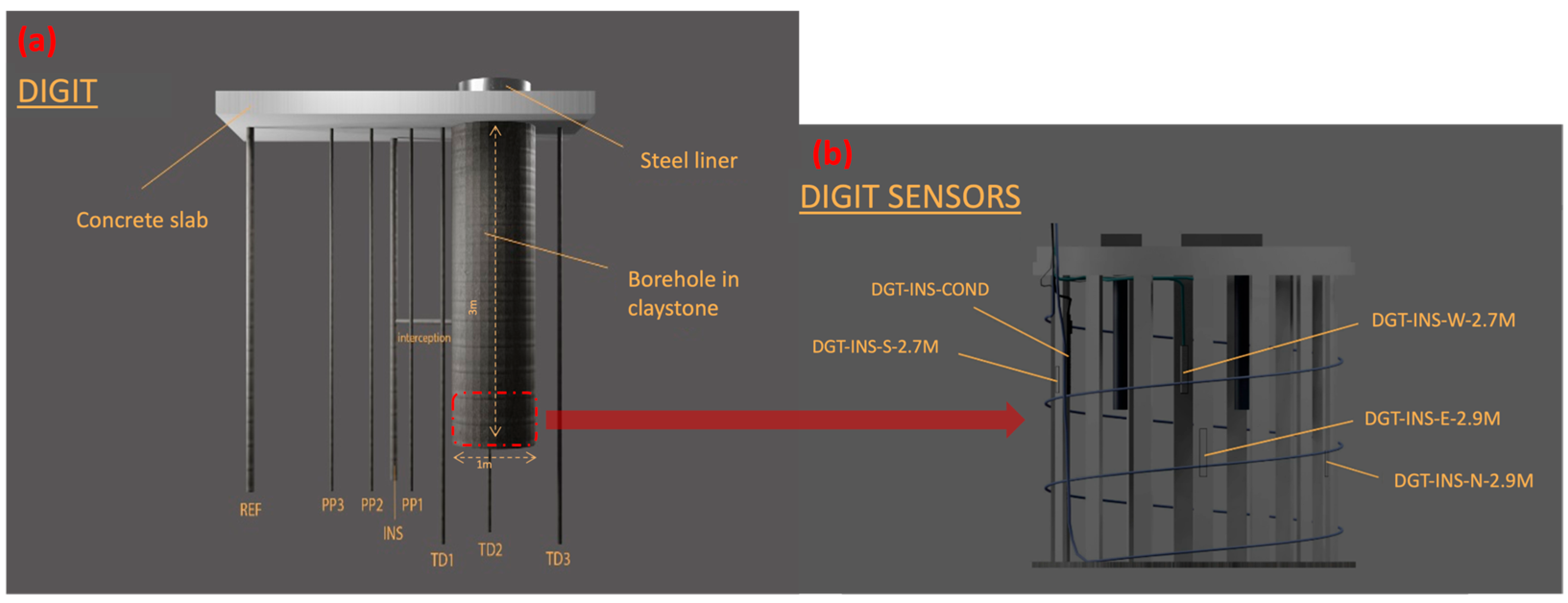
Figure 2a shows a 3D view of the main borehole of the DIGIT experiment and the surrounding monitoring boreholes. These boreholes were designed to continuously monitor temperature and pressure variations around the main boreholes. Boreholes TD1, TD2, and TD3 (3.5 m deep, 56 mm in diameter) are located at distances of 10, 20, and 30 cm from the borehole wall, respectively. Each borehole was equipped with two platinum PT100 probes positioned at depths of 3.0 m and 3.5 m relative to the gallery floor (elevation 0 m), as well as an optical fiber sensor for temperature and strain measurements. Boreholes PP1, PP2, and PP3 (3.5 m deep, 62 mm in diameter) were installed at 50, 100, and 150 cm from the borehole wall, respectively. Each of these was equipped with combined pressure and temperature sensors at a depth of 3.5 m. The INS borehole, also known as the instrumentation borehole, served as a conduit for all sensor cables connected to the test zone.
Figure 2b presents a 3D view of the test zone, showing the positions of four temperature sensors (INS-S2.7, INS-N2.9, INS-W.7, and INS-E2.9), a conductivity probe installed on the wall of the test chamber, and an optical fiber for wall temperature monitoring. Each temperature sensor was installed according to the North, South, East, and West directions. The temperature in the test zone was thus monitored by two PT1000 sensors (INS-S2.7 and INS-N2.9) and two PT100 sensors (INS-W.7 and INS-E2.9), mounted on PTFE rods attached to the vessel wall. The test zone, located at the bottom of the borehole, measures 50 cm in height and 1 m in diameter. It is within this zone that the water enriched with non-radioactive tracers was introduced.
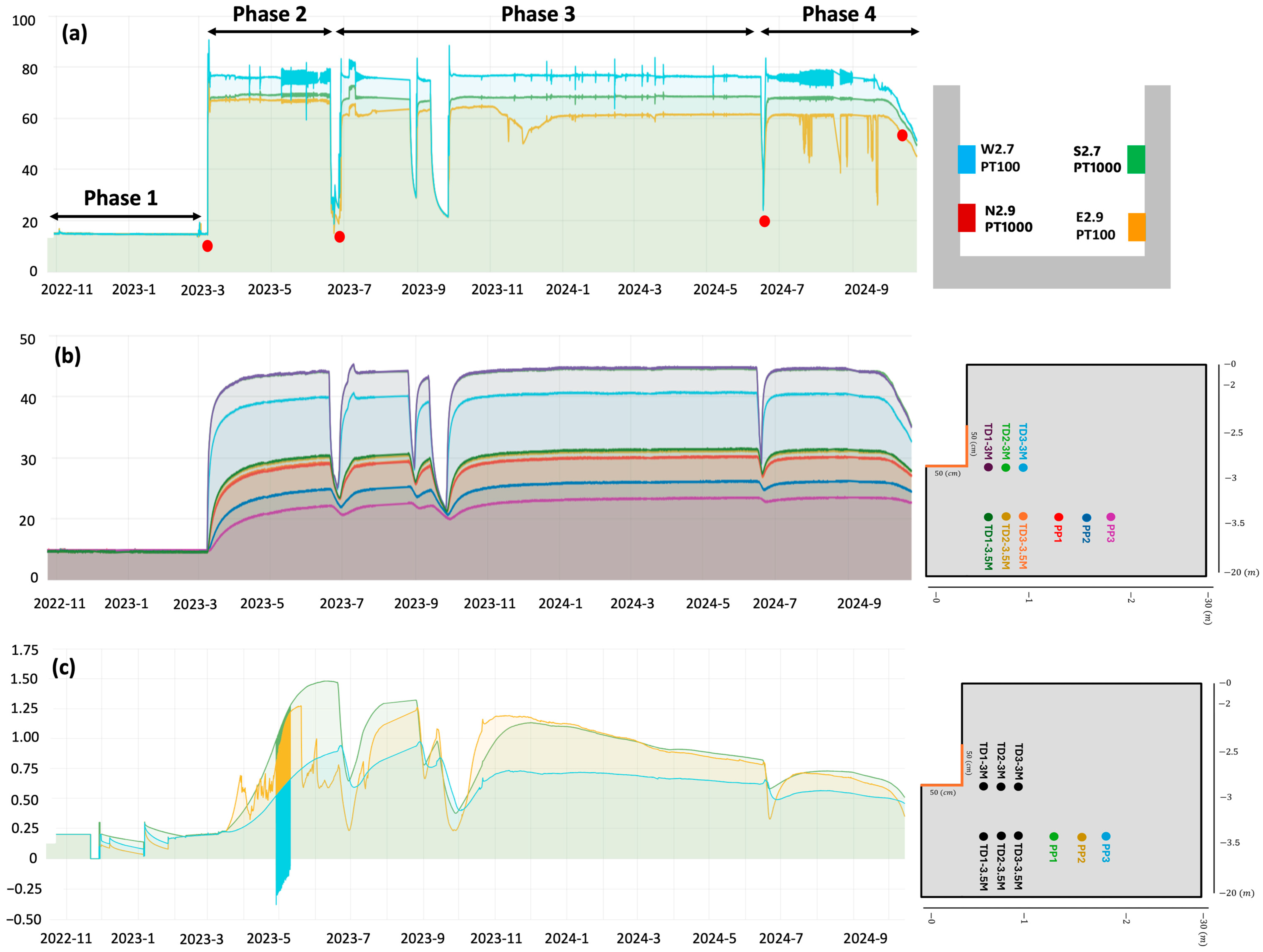
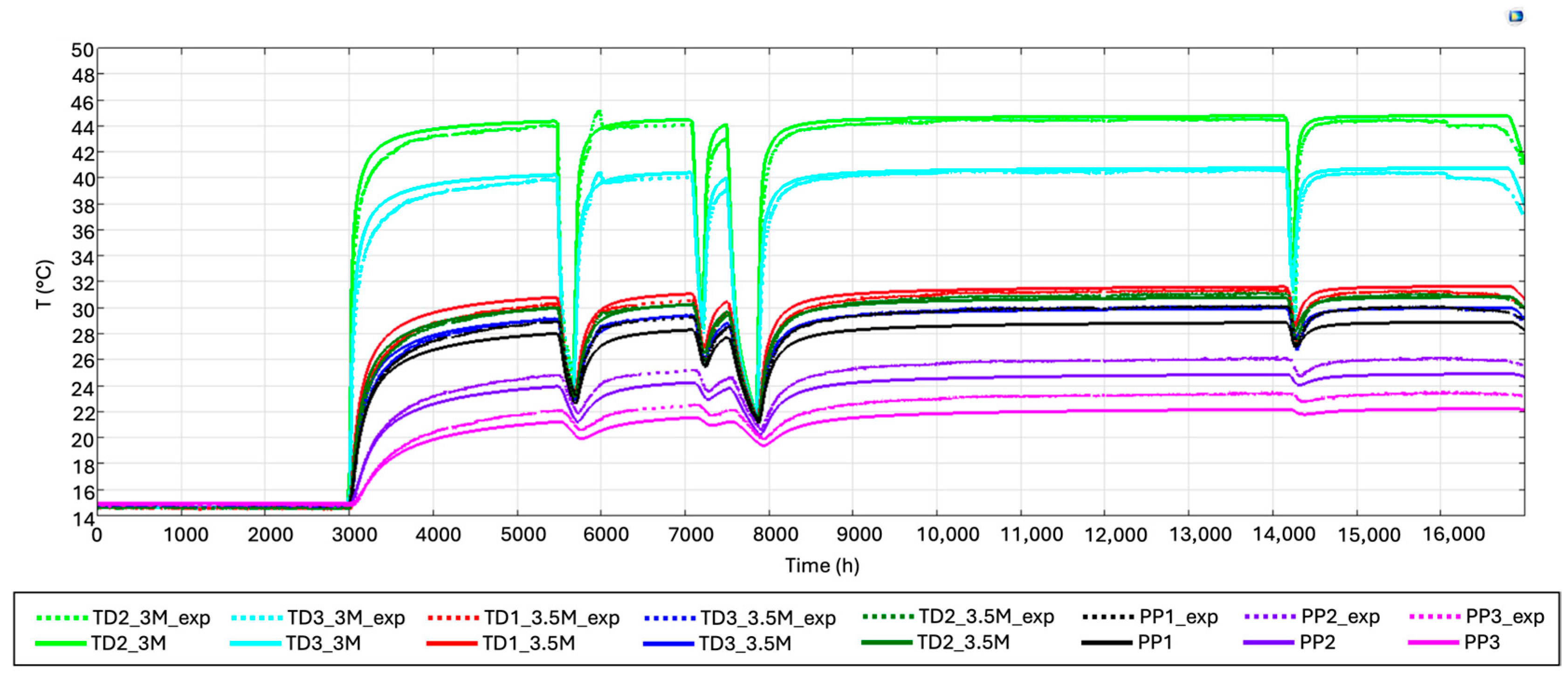
Figure 3 illustrates the evolution of temperature inside the test chamber (a) and around the borehole (b), as well as the evolution of pressure in the peripheral boreholes (c).
In the tracer water reservoir, a temperature difference of approximately 15 °C was observed between the various sensors (Figure 3a). This variation is attributed to the relative position of the sensors with respect to the heating elements and to the imperfect homogenization of heat within the test zone, despite the constant setpoint temperature of 70 °C applied to each of the three electric resistors.
In the surrounding rock, the recorded temperatures were directly related to the distance from the test zone. The maximum temperature observed was 44 °C at 10 cm from the borehole wall (Figure 3b).
Figure 3 also highlights the successive heating and cooling periods associated with the sampling campaigns:
  • Heating (1): 8 March 2023–19 June 2023;
  • Heating (2): 28 June 2023–15 June 2024;
  • Heating (3): 17 June 2024–30 September 2024.
Beyond this period, a malfunction of the heating system resulting in a gradual decrease in temperature was detected.
Figure 3c shows the evolution of pore pressure recorded in the peripheral piezometric boreholes PP1, PP2, and PP3 over a two-year period (from 24 October 2022 to 24 October 2024). The initial pore pressure measurement was essential for assessing the effects of Thermo–Hydro–Mechanical (THM) coupling during the heating phase. THM coupling can lead to an increase in pore pressure, mainly due to the thermal expansion of water. The pressure sensors used were designed to operate within a range of 0 to 2 MPa. During the first heating phase (1), an increase in absolute pressure of approximately 1.3 MPa was observed (from 0.2 MPa to 1.5 MPa) on the sensor located 50 cm from the borehole wall, followed by a slow return to equilibrium—likely due to heat dispersion within the rock over the full duration of the experiment. The cooling phases corresponding to the sampling campaigns were marked by an almost instantaneous pressure drop that coincided perfectly with temperature variations. Thus, five coring campaigns were conducted during the DIGIT experiment, as shown in Figure 3 with red dots (only four dots are present in Figure 3 because the first point, corresponding to Phase 0, was before the sensors were operational):
  • Sampling (1): corresponds to Phase 0, representing the “initial conditions,” without contact with tracer water and without heating. Cores were taken from the pilot borehole named EX1 [26].
  • Sampling (2): conducted on 1 March 2023, at the end of Phase 1, corresponding to five months of tracer water saturation without heating (3 November 2022–27 February 2023).
  • Sampling (3): performed on 21 June 2023, after eight months of water contact, including four months of heating (Phase 2).
  • Sampling (4): carried out on 18 June 2024, after one year and seven months of water contact, including one year and three months of heating (Phase 3).
  • Sampling (5): conducted on 4 November 2024, after two years of water contact, including one year and eight months of heating (Phase 4).
At the end of each sampling campaign, different claystone samples were collected parallel and perpendicular to the bedding. The locations of the different cores taken are shown in Figure S9 (Supplementary Materials).
The implementation of these successive sampling campaigns in the DIGIT test zone, corresponding to Phases 0 to 4, allowed for the characterization of the evolution of tracer concentrations in the porewater, as well as the water contents in the Upper Toarcian claystone. To this end, several diffusion experiments were conducted throughout the DIGIT experiment. These experiments are presented in detail in a previous article describing the first part of the DIGIT study [26].

3. Results Obtained on Core Samples

3.1. Transport Properties

3.1.1. Radial Diffusion Cells

The radial diffusion cells allowed the determination of the diffusive transport parameters (ωacc, De) under initial conditions, which are essential for initializing the modeling work. These experiments involve inward diffusion, where tracers penetrated the pore volume from the labeled synthetic solution. The interpretation was performed in a radial configuration using two computational codes—Mathematica 5.2 and COMSOL Multiphysics®—to allow for an intercomparison of the results.
The diffusion coefficients and tracer-accessible porosities were estimated by fitting the analytical solution of the radial diffusion equation to the experimental results obtained from the temporal monitoring of the test water composition. The evolution of halide and deuterium concentrations was followed by regular sampling within the radial diffusion cells. On average, isotopic equilibrium for deuterium was reached after approximately 150 days, whereas equilibrium concentrations for halides were attained after about 300 days. The experimental results—obtained either from halide analyses performed at the Lutèce Laboratory or from isotopic measurements carried out at the GEOPS Laboratory, University of Paris-Saclay—were then fitted to simulated curves from numerical models developed under Mathematica 5.2 or COMSOL Multiphysics®.
The first model was based on the diffusion equation expressed in radial coordinates according to Van der Kamp et al. [27], with a dedicated routine developed in Mathematica 5.2 [28,29]. A second routine, developed with COMSOL Multiphysics® using the dilute species mass transport module in a radial plane configuration, was also used to determine the diffusion coefficients and tracer-accessible porosities. Figure S1 presents an example of a 3D axisymmetric simulation of a radial diffusion cell performed in COMSOL Multiphysics®, while Figure S2 provides an example of the intercomparison of results obtained using both numerical tools for a core sample taken at an elevation of 184 m NGF.
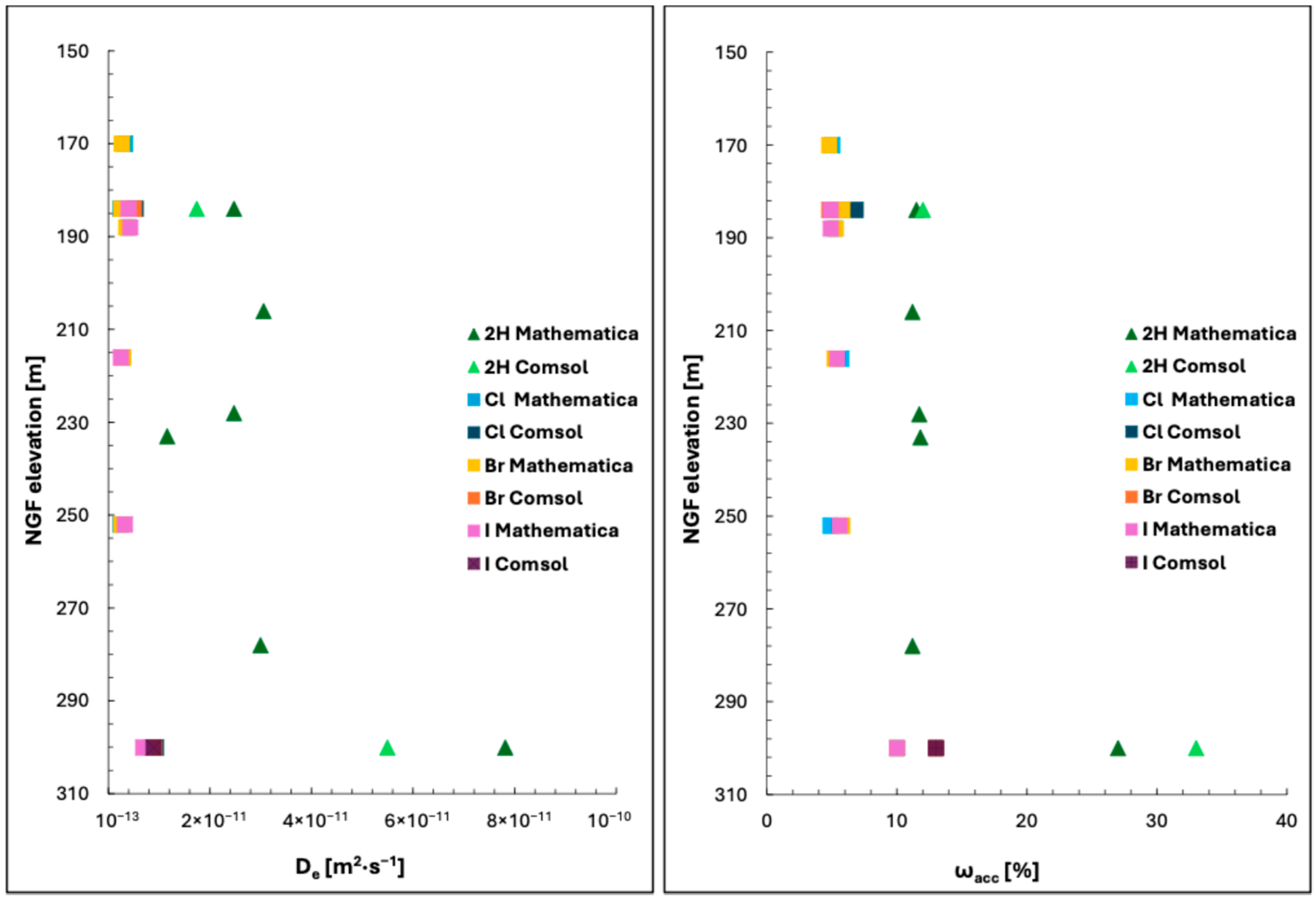
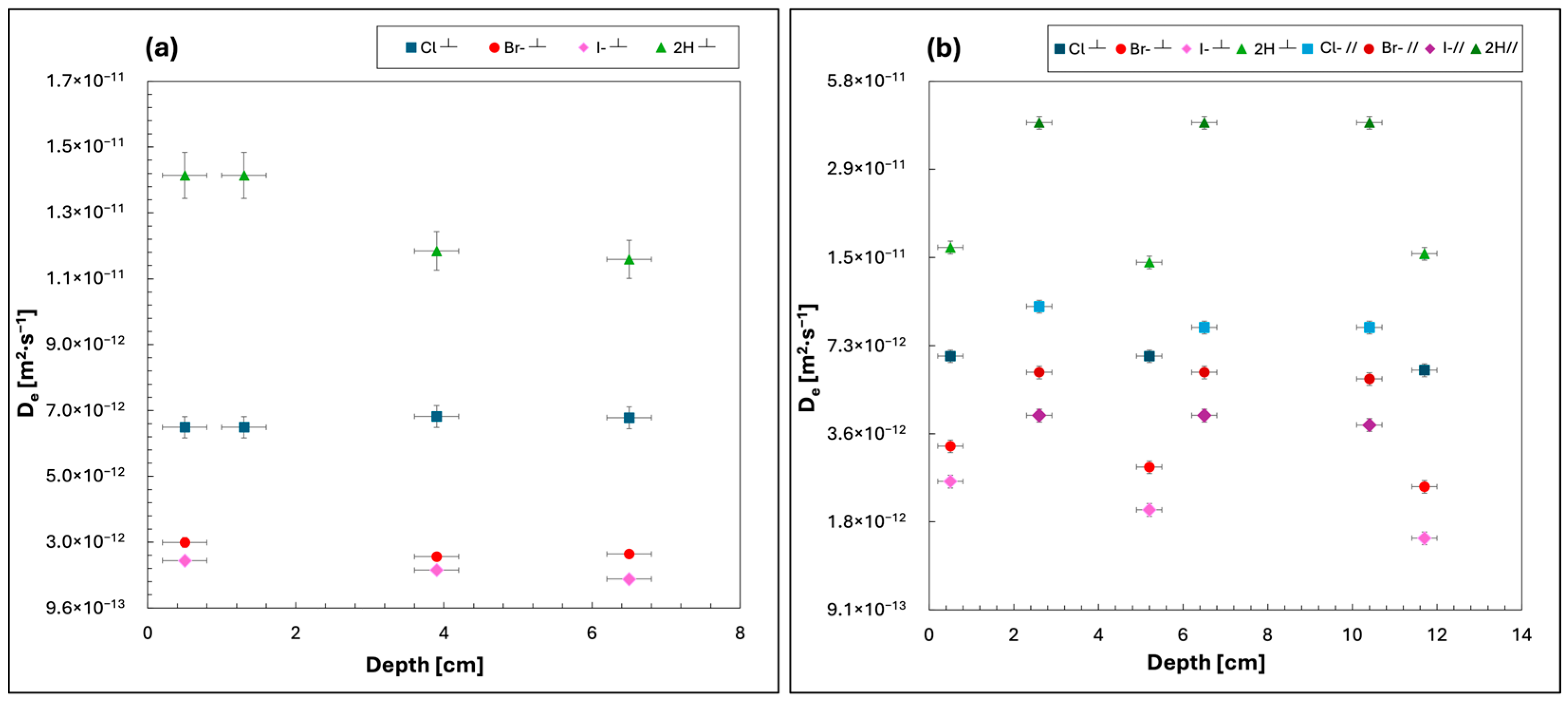
Figure 4 shows the variation of the effective diffusion coefficients and corresponding tracer-accessible porosities with depth for the four tracers, as determined using Mathematica 5.2 and COMSOL Multiphysics® fitting. All core samples used for the radial diffusion cell experiments were taken during Phase 0, at depths ranging from 170 to 278 m NGF (NGF (Nivellement Général de la France)—the French national vertical datum. An NGF elevation corresponds to the precise altitude measured relative to the mean sea level, based on the Mediterranean reference at Marseille), corresponding to initial conditions (no thermal load and no water injection into the borehole). Only one core sample was taken after the second sampling campaign (Phase 1), i.e., after five months of interaction between the test water and the porewater. This core was drilled perpendicularly to the bedding, in the borehole, at a depth of 300 m NGF.
Under initial conditions—at the end of Phases 0 and 1 (no heating)—effective diffusion coefficients were determined and have been evaluated to be approximately 10−11 m2·s−1 for deuterium and 10−12 m2·s−1 for anions, with accessible porosities of around 11% for deuterium and 5% for anions. These values are consistent with those obtained for Upper Toarcian claystones [17]. The differences between deuterium and anions are explained by the phenomenon of anion exclusion, which limits the porosity accessible to anions.
At the end of Phase 1, for the sample located at 300 m NGF, higher effective diffusion coefficients and accessible porosities were observed compared to those determined at the end of Phase 0. This difference is attributed to the presence of a damaged or disturbed zone caused by excavation, leading to increased accessible porosity and, consequently, a higher effective diffusion coefficient [26]. The accessible porosities measured at this elevation—approximately 10% for anions and 30% for deuterium—could indicate microfracturing of the sample. Slightly higher values of both the effective diffusion coefficient and accessible porosity were obtained with COMSOL Multiphysics® compared to Mathematica 5.2. This difference appears to be linked to the solution method used. Indeed, Mathematica solves the analytical solution in a single direction (r), while COMSOL Multiphysics® employs a finite element approach in two directions (r and z), providing a theoretically more realistic resolution.

3.1.2. Through-Diffusion Cells

The through-diffusion experiment consists of studying the migration of a tracer through a cylindrical claystone sample placed between an upstream reservoir, containing a tracer-enriched solution maintained at a constant concentration, and a downstream reservoir containing a tracer-free solution. This technique allows for the precise estimation of the effective diffusion coefficient (De) from the steady-state plateau of cumulative concentrations. The estimation of the accessible porosity (ωacc) is, however, more uncertain, as it requires several measurements during the short transient phase. This situation is the reverse of that observed in radial diffusion, where the steady phase provides access to ωacc, and the transient phase determines the effective diffusion coefficient (De).
Following the second sampling campaign (Phase 1)—after five months of exchange between the test water and porewater—a set of six through-diffusion cells has been assembled to determine De as a function of depth. The six cells were prepared from Core I, which was drilled perpendicular to the bedding and sectioned into 1 cm slices.
For each through-diffusion cell, the temporal monitoring of concentrations in the upstream and downstream reservoirs made it possible to characterize the evolution of cumulative concentrations of chloride, bromide, and iodide over approximately 100 days, as well as the corresponding normalized fluxes. Using the experimental model developed with COMSOL Multiphysics®, it was possible to determine, for each tracer analyzed in each cell, its corresponding effective diffusion coefficient. An example is given in Figure S3, showing the evolution of cumulative concentrations, normalized flux, and the COMSOL Multiphysics® fitting to the experimental data for a given cell. Figure 5 shows the effective diffusion coefficients (De) obtained as a function of depth for Phases 1 and 2.
At the end of Phase 1, in the perpendicular direction and for depths ranging from 1 to 6 cm, the De values for deuterium, chloride, bromide, and iodide ranged respectively between 14.05 and 11.50, 6.69 and 6.40, 2.90 and 0.825, and 2.35 and 0.508 × 10⁻¹² m2·s−1. In the same direction, at the end of Phase 2, higher De values were observed for 2H, Cl, Br, and I, ranging from 15.80 to 14.00, 6.70 to 6.00, 3.30 to 2.40, and 2.50 to 1.60 × 10⁻¹² m2·s−1 for depths between 1 cm and 12 cm.
This increase in De could be attributed to the temperature effect that comes into play starting from Phase 2, resulting in an increase in medium porosity due to heating. De values for chloride were observed to be about twice as high as those for bromide and iodide, with bromide diffusion coefficients higher than those of iodide. Deuterium, having access to the entire porosity, exhibited De values about 10 times higher than those of the halides. This behavior can be explained by the anisotropy of the medium, leading to greater tracer penetration along the bedding plane. In this study, as in previous work [16,17], the effective diffusion coefficients in the bedding parallel direction were three times higher (or more) than those estimated in the vertical direction.
At this stage, the data confirm three key points:
(i)
The anion exclusion phenomenon, which results in greater accessible porosity for water isotopes than for anions due to electrostatic repulsion.
(ii)
The effect of the hydrodynamic radius of diffusing species, which depends on the atomic mass and ionic radius, tending to favor higher diffusion rates for smaller species.
(iii)
A decrease in effective diffusion coefficients (De) with depth, possibly linked to the presence of a damaged or disturbed zone in the first few centimeters caused by the excavation of the DIGIT borehole.
These initial De results indicate that the effective diffusion coefficients obtained from the through-diffusion cells are consistent with those derived from numerical simulations at the end of Phase 1, at the scale of the DIGIT experiment (see Section 5.2). They are therefore representative of the spatial scale of the in situ test and highlight a decrease in De with depth, possibly linked to a damaged zone evolving over time.
The transport parameters obtained using radial diffusion cells under initial conditions (Phase 0) made it possible to determine the characteristic transport properties of the intact rock, which are required for the various modeling efforts carried out at the scale of the DIGIT experiment. Conversely, the transport parameters derived from measurements performed with the through-diffusion cell after Phases 1 and 2 provided an estimate of the order of magnitude of the parameters to be considered for the damaged zones.

3.2. Determination of Tracer Concentrations

3.2.1. Halides Out-Diffusion Cells

The out-diffusion experiments, performed in a cylindrical configuration, provided estimates of the halide concentrations in porewater using mass balance equations. These diffusive exchange cell measurements were conducted after each of the phases 0 to 4, using cores collected from the test zone.
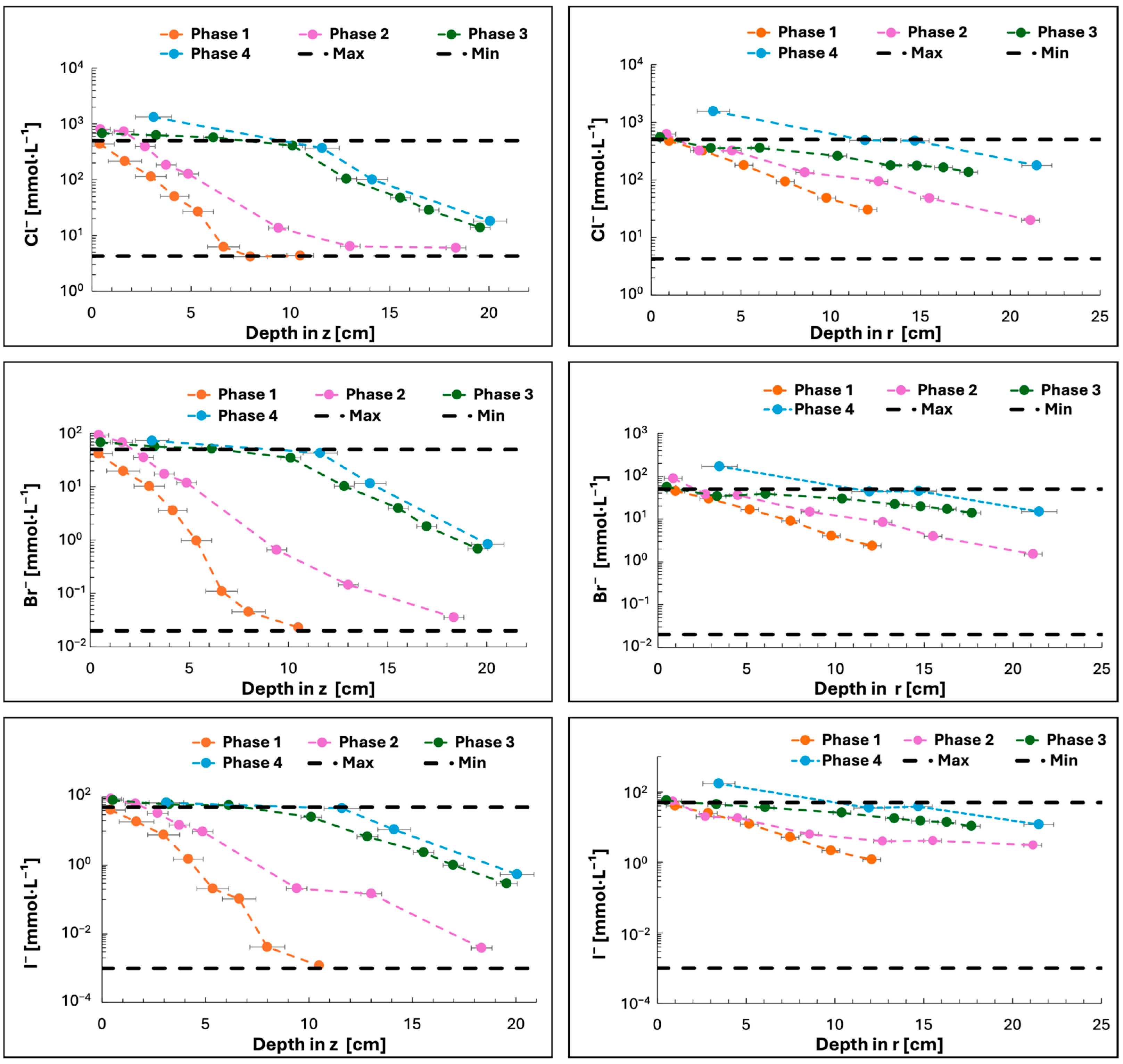
Initially, the samples obtained at the end of Phase 1 aimed to determine the effective diffusion coefficient (De) of tracers under in situ conditions, that is, taking into account the Excavation Damaged Zone (EDZ) and before the onset of heating. The introduction of the heating starting from Phase 2 was intended to characterize the impact of temperature on the transport of tracers within the porewater of the claystone. Thus, at the end of each phase, on average, two cores collected in each of the z (perpendicular) and r (parallel) directions were used for the out-diffusion experiments. These cores were cut every centimeter to allow for a centimeter-scale characterization of anion concentrations in the porewater. Figure 6 compares the evolution of chloride, bromide, and iodide concentrations estimated in porewater as a function of depth, using eight cores taken perpendicularly (⊥) and parallel (//) to the bedding. The black dashed lines represent the maximum tracer concentrations in the DIGIT test water, as well as the minimum tracer concentrations measured in the porewater of the claystone.
At the end of Phase 1 (unheated phase), a decrease in chloride, bromide, and iodide concentrations was observed perpendicular to bedding, from 435.48 ± 2.53, 41.51 ± 0.24, and 40.95 ± 0.24 mmol·L−1 at ~1 cm depth to 4.18 ± 0.02, 0.023 ± 0.0001, and 0.0012 ± 0.000012 mmol·L−1 at ~10 cm depth. A similar decrease was observed parallel to bedding, with concentrations dropping from 473.07 ± 2.70, 44.92 ± 0.24, and 40.33 ± 0.20 mmol·L−1 at ~1 cm to 30.40 ± 0.18, 2.37 ± 0.013, and 1.18 ± 0.007 mmol·L−1 at ~12 cm.
The chloride, bromide, and iodide concentrations measured at 10 cm depth, perpendicularly to the bedding and at the end of Phase 1, are noticeably higher than the initial porewater concentrations corresponding to Phase 0 (black dashed line). This result suggests that tracer penetration does not exceed 10 cm in depth. Conversely, tracer penetration parallel to the bedding appears to extend beyond 15 cm.
A decrease in chloride, bromide, and iodide concentrations in porewater as a function of depth was also observed at the end of each of the heated phases (Phases 2, 3, and 4). Greater tracer penetration was observed from one phase to the next, both perpendicular and parallel to the bedding. However, penetration remained lower perpendicular compared to parallel to the bedding. For instance, at 15 cm depth, the concentrations measured perpendicularly increased from Phase 2 to Phase 4 as follows:
  • Chloride: ~6 ± 0.02 → ~83 ± 0.5 mmol·L−1;
  • Bromide: ~0.15 ± 0.001 → ~10 ± 0.06 mmol·L−1;
  • Iodide: ~0.10 ± 0.0002 → ~9.5 ± 0.05 mmol·L−1.
Parallel to bedding:
  • Chloride: ~55 ± 0.1 → ~465 ± 2.80 mmol·L−1;
  • Bromide: ~5 ± 0.09 → ~44 ± 0.26 mmol·L−1;
  • Iodide: ~4 ± 0.003 → ~37 ± 0.22 mmol·L−1.
These results clearly demonstrate the anisotropy of the medium, with greater tracer penetration along the bedding plane and an overall increase in tracer penetration after each heated phase. It is likely that, in addition to the time factor, which naturally allows tracers to penetrate further with time, temperature also accelerates tracer penetration.
However, at the end of each heated phase, samples in direct contact with the borehole wall displayed concentrations significantly higher than those of the test water (500 mmol·L−1 NaCl; 50 mmol·L−1 NaI and NaBr). For example, at the end of Phase 2, for samples in contact with the borehole wall and test water, the porewater concentrations were:
  • Chloride: 807 ± 4.63 and 621 ± 3.92 mmol·L−1;
  • Bromide: 93.25 and 89.65 mmol·L−1;
  • Iodide: 86 ± 0.49 and 55 ± 0.35 mmol·L−1.
These high values can be explained by salt crystallization on the borehole wall during successive draining and by the likely presence of a microfractured and/or disturbed zone, in which the transport properties are altered. The black dashed line in Figure 6, which delineates the maximum concentrations, may define the extent of this damaged and/or disturbed zone, which appears to evolve over time.
At the end of Phase 1, concentrations near the wall did not exceed the test water values, but after the heated phases, concentrations above the maxima were observed:
  • In the z-direction, from ~2.5 cm depth after Phase 2 to ~10 cm after Phase 4.
  • In the r-direction, up to ~15 cm depth.
Thus, the experimental determination of halogen penetration depth after Phases 2–4 provided key data to characterize the temperature effect on solute transport, through comparison of experimental results with numerical simulations performed for the DIGIT experiment.

3.2.2. Deuterium and Water Content–Vapor-Phase Diffusive Exchange Cells

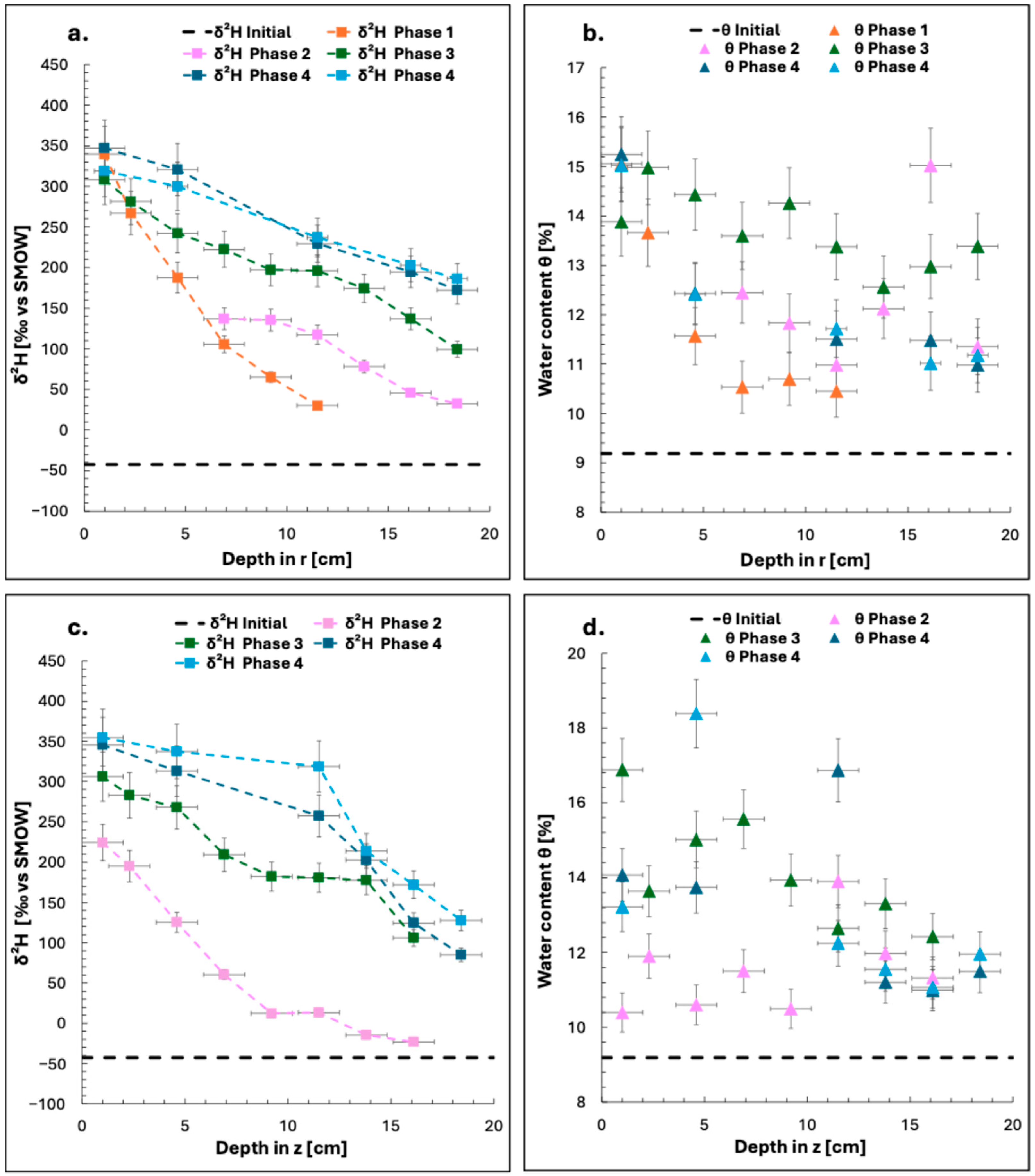
The vapor-phase diffusion experiment has already been used in previous studies. This technique, based on a mass balance approach, allows for the simultaneous determination, on the same sample, of the deuterium content (δ2H) and the volumetric water content (θ) naturally present in porewater. For each phase (0 to 4), two cores were collected, perpendicular (⊥) and parallel (//) to bedding, whenever possible, in order to determine the 2H profiles in porewater and the water contents of the samples. To this end, the cores were cut every two centimeters and placed in vapor-phase diffusion exchange cells. Figure 7 compares the evolution of 2H contents in porewater and water contents of analyzed samples as a function of depth, based on nine cores obtained perpendicular and parallel to bedding.
A decrease in 2H contents in the porewater of the claystone is observed with depth for both the (r) and (z) directions. Furthermore, greater 2H penetration is observed between Phases 1, 2, 3, and 4 in both directions. 2H contents higher than those naturally present in porewater (δ2H = −42.5 ± 2.52‰ vs. VSMOW) are observed parallel to bedding at the end of Phases 2, 3, and 4. It therefore appears that 2H penetration exceeds 20 cm in depth (Figure 7a).
Perpendicular to bedding (Figure 7c), at the end of Phase 2, 2H contents similar to the natural values of the claystone are observed at 16 cm depth, suggesting that in this case, 2H penetration does not exceed 20 cm. For Phases 3 and 4, contents higher than natural values are also observed, indicating penetration beyond 20 cm. Thus, a difference in 2H penetration between directions parallel and perpendicular to bedding is observed, reflecting the anisotropy of the medium. For example, at 16 cm depth and parallel to bedding, the 2H contents measured at the end of Phases 2, 3, and 4 are respectively 45.66 ± 2.74, 133.54 ± 8.01, and 202.96 ± 12.18‰ vs. VSMOW. In contrast, perpendicular to bedding, the 2H contents are lower: −23.27 ± 1.40, 10.06 ± 6.36, and 124.58 ± 7.47‰ vs. VSMOW for the same phases.
At the end of Phase 1, Figure 7b shows water content values decreasing from 14% at 2.5 cm to 10.5% at 5 cm depth. This variation suggests the presence of a damaged and/or disturbed zone within the first 5 cm in the horizontal direction, probably induced by drilling and the experimental setup. Then, a tendency for water content to increase is observed after the heated phases (Phases 2, 3, and 4).
Figure 7d shows a significant increase in volumetric water content in the first 10 cm between Phase 2 (~10%) and Phases 3 and 4, where values reach up to 18%. This evolution is likely related to the progressive expansion of the disturbed zone over time, under the effect of prolonged heating. The longer the thermal phase, the higher the water contents, indicating a gradual modification of the microstructure of the material. Beyond 15 cm depth, a decrease in water content is observed, with values returning to around 12%, suggesting increasing distance from the affected zone.
Thus, in the plane parallel to bedding, water contents increase moderately within the first centimeters (from 14% to 15%), reflecting a progressive opening of pores under the effect of temperature. In the vertical plane, although no initial damage was detected, the onset of heating seems to have generated increasing thermal disturbance, reflected by an increase in water content, confirming the major role of the thermal gradient in the evolution of claystone properties.
At the beginning of the experiment (isothermal phase), the observed damage is mainly horizontal, i.e., parallel to bedding, and remains confined to the first few centimeters. No clear vertical damage is identified at this stage. However, as soon as heating begins, modifications also appear in the vertical plane, indicating an anisotropic development of the disturbed zone. Thus, while the initial drilling-induced damage is limited and horizontally oriented, the thermal phase induces a structural evolution of the rock both vertically and horizontally. Consequently, at the end of the heated phases, it can be assumed that the extent of the damaged zone reaches up to 15 cm in both directions. These first experimental results have made it possible to define target values for characterizing the extension of the damaged zone in the numerical simulations of the DIGIT experiment (see Section 5).

4. Influence of Temperature on Molecular Diffusion

The literature indicates that the higher the temperature, the higher the diffusion coefficient in water [30,31,32]. Thus, in this study, the correction of the temperature effect on the effective diffusion coefficient will be applied using an Arrhenius-type law. Indeed, studies carried out on the Opalinus Clay have shown that the effective diffusion coefficient of 3H, 36Cl, and 22Na+ follows an Arrhenius-type relationship [2,31]. The following equation expresses this relationship:
D e , i = A r e E a / R · T
where A r is the Arrhenius parameter, also known as the pre-exponential factor, which is independent of temperature, and E a is the activation energy for diffusion in porewater [kJ·mol−1].
In this study, an attempt was made to measure the activation energy of 2H in the Upper Toarcian claystone from Tournemire. The measurement was performed at the IFPen institute using Nuclear Magnetic Resonance (NMR). The technique was successfully applied to a 1 cm × 1 cm sample at three temperature levels (30, 50, and 70 °C). Each temperature step required 10 to 20 h of data acquisition, compared to 20 to 40 days for through-diffusion methods [31,32,33]. This technique provides the pore diffusion coefficient ( D p , i ), whereas through-diffusion allows access to the effective diffusion coefficient ( D e , i ). The main difficulty of this method lies in preserving the sample structure throughout the experimental series. For this reason, the sample was saturated with a highly saline solution (80 g NaCl·L−1) to reduce the Debye length and repulsive forces within the clay matrix. An activation energy of 22.9 kJ·mol−1 was obtained in the 30–70 °C range, consistent with values reported for other highly consolidated claystones, such as at Benken (CH). The following Table 1 summarizes the activation energies determined for four different claystone samples.
Thus, for all simulations carried out in this study, the activation energy value of the Upper Toarcian claystone determined for deuterium was used.
Regarding anions, the activation energy value from the Opalinus Clay at Benken was adopted. Indeed, the Upper Toarcian claystone of Tournemire and the Opalinus Clay from the Benken site exhibit very similar petrophysical and transport properties [2,25,29].
It should be noted that an alternative analysis, based on a different law leading to a constant tortuosity at high temperature, was also performed. This approach, presented in detail in a companion paper [34], relies on a power–law relationship and allows for a more accurate correction of the deuterium pore diffusion coefficient over the temperature range from 10 to 70 °C. However, the excellent agreement between the results obtained at the Benken and Tournemire sites using the Arrhenius law applied to water tracers led us to favor this latter approach over the constant-tortuosity power–law formulation.

5. Multiphysics Modeling of Transfers

This section aims to model the impact of the thermal gradient on the transfer of radionuclide analogues (Cl, Br, I, 2H) during the different unheated and heated phases of the DIGIT experiment.
The mathematical model of the DIGIT experiment was developed using COMSOL Multiphysics®. This study required the use of several modules, including the heat transfer module for thermal transfer calculations, the transport of diluted species module for solute transport in porous media, and the porous media flow module to simulate natural convection. These modules can be used simultaneously by creating strong, direct couplings.
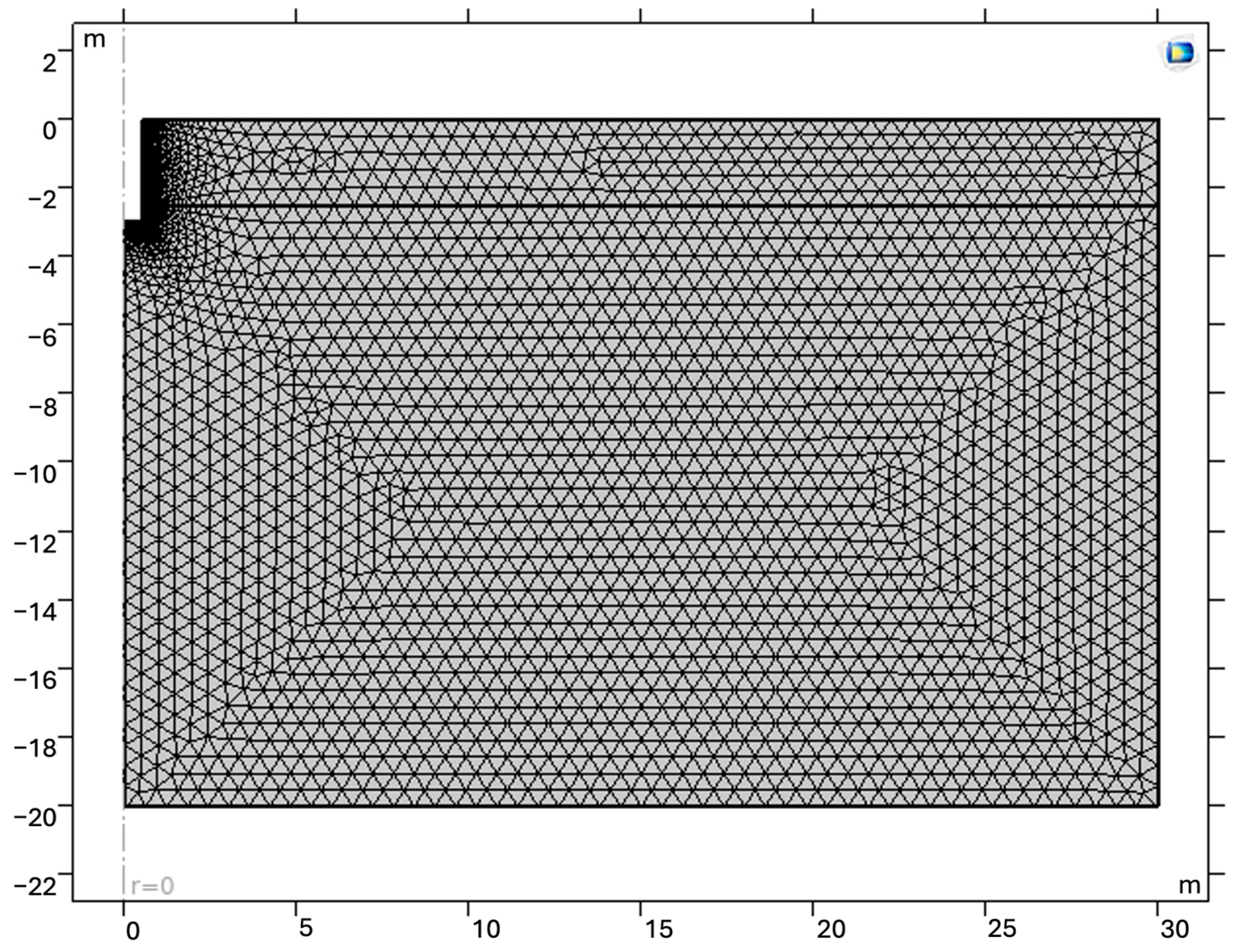
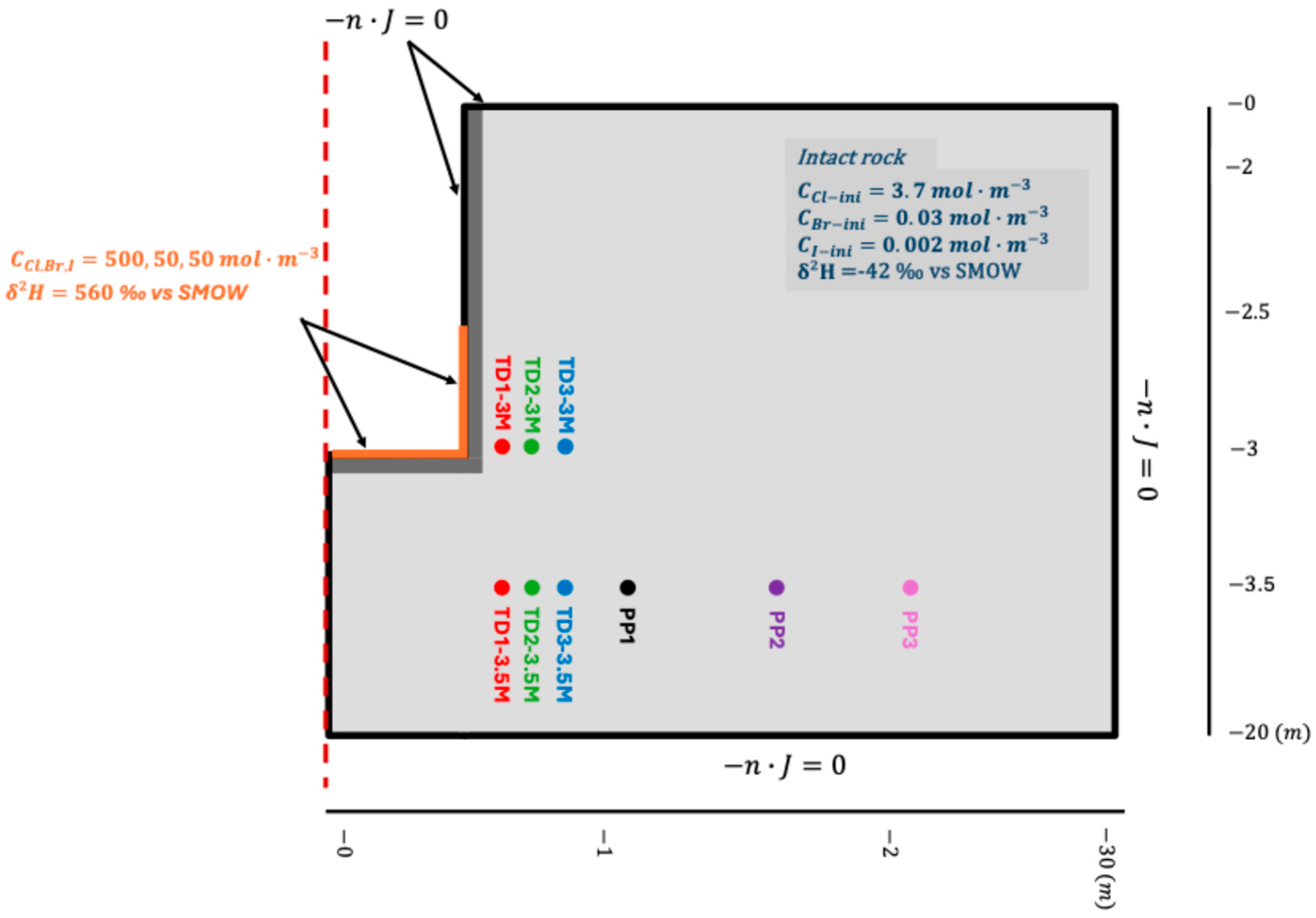
The finite element mesh and the geometry of the DIGIT modeling domain are illustrated in Figure 8. The model was designed to be sufficiently large (30 m radius and 20 m depth) so that the boundary conditions would not be affected by thermal or mass transients. The chosen geometry is 2D axisymmetric, with the vertical axis as the axis of symmetry. The mesh is refined around the borehole area to obtain better accuracy.
In this section, we will first summarize the input data used for modeling. Then, we will assess the effect of temperature on mass transfer. To this end, four different Fick-based models were studied: (1) without temperature correction, (2) with temperature correction applied to the effective diffusion coefficient, (3) without temperature correction but including the Soret (thermodiffusion) effect, and (4) with both temperature correction and the Soret effect. For each of these cases, the experimentally acquired data were compared with simulated results in order to better define the extent of intact and disturbed zones and their transport properties.
Finally, we will assess the impact of the thermal transient characteristic time corresponding to high-level waste disposal (150 years) on all coupled processes, including those with a convective contribution.

5.1. Synthesis of Input Data for Modeling

All experimentally obtained data have been directly integrated into the COMSOL Multiphysics® simulations, allowing a more accurate reproduction of the diffusive behavior of tracers under in situ conditions of the DIGIT experiment. This integration aimed to better quantify the influence of the Excavation Damaged Zone (EDZ) and the impact of the thermal gradient on diffusive transfers, as well as to refine predictions both at the experiment scale and over long time periods. The characteristic data of the intact rock and the damaged zone, determined during this study, are summarized in Table 2. The heat capacity was determined by Humbezi et al., 2024 [26], while the activation energy was determined as previously described in this study. These data served as the basis for the modeling presented next.

5.2. Fick’s Law Without Temperature Effect

The purpose of this modeling is to determine the effective diffusion coefficients (De) in both directions, as well as the accessible porosities (ωacc), for the four tracers (Cl, Br, I, 2H) obtained after Phase 1 (water saturation without heating, at ambient temperature of 15 °C), taking into account the Excavation Damaged Zone (EDZ).
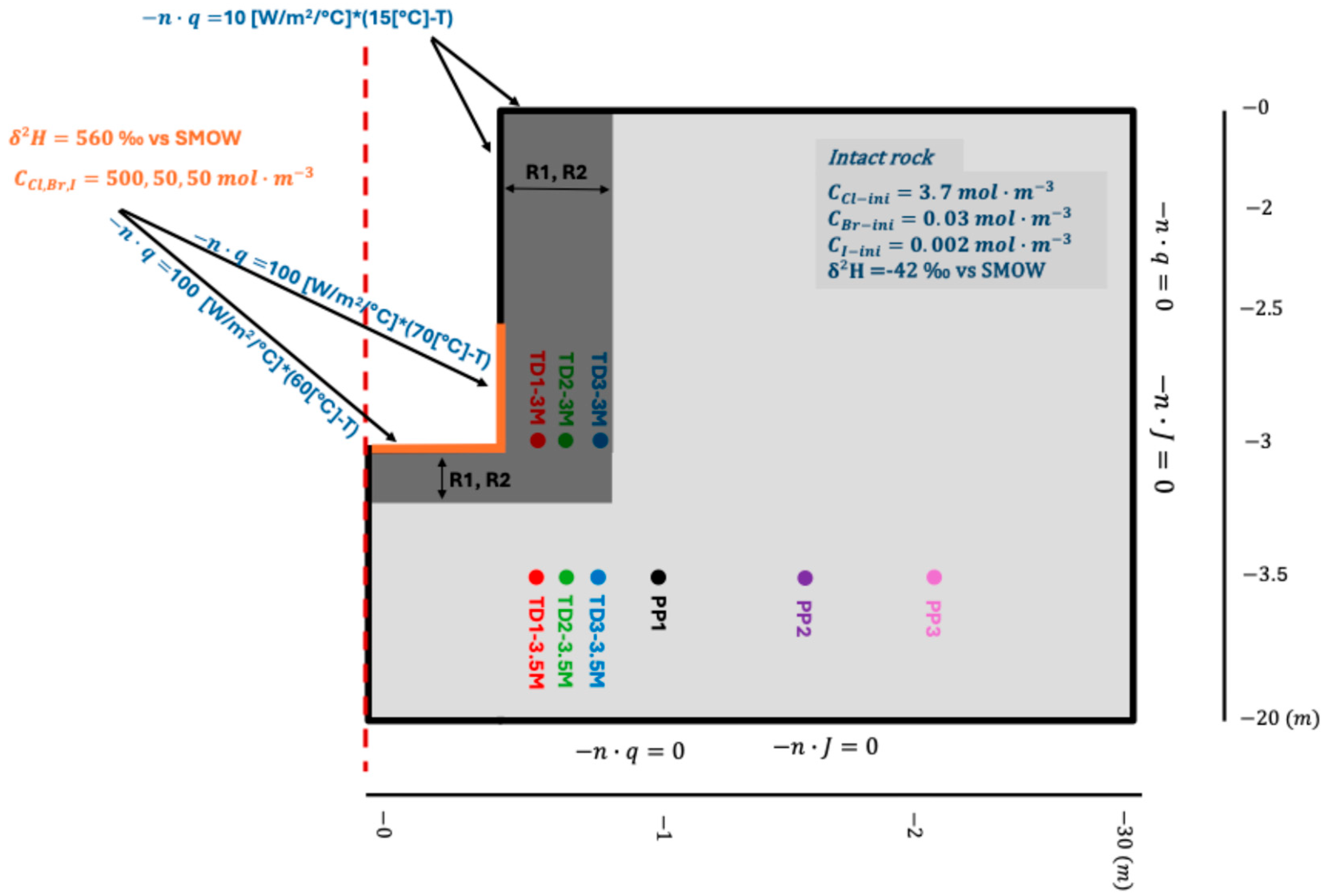
The simulated data were compared to the experimentally measured tracer penetration profiles in the claystone. The boundary and initial conditions are shown in Figure 9: the imposed wall concentrations (in orange) are identical throughout the test zone, while the naturally occurring concentrations in the rock (in blue) are imposed in the rest of the domain. The dark gray zone along the borehole boundary represents the damaged/disturbed zone, necessary to calibrate the model during the fitting phase between simulated and experimental data. Model dimensions of 20 m in z and 30 m in r were selected to prevent boundary effects from influencing the results.
The equation describing this pure diffusion case in porous media under isothermal conditions is as follows:
ω a c c , i C t = · ( D e , i C )
where C is the tracer concentration [mmol·L−1].
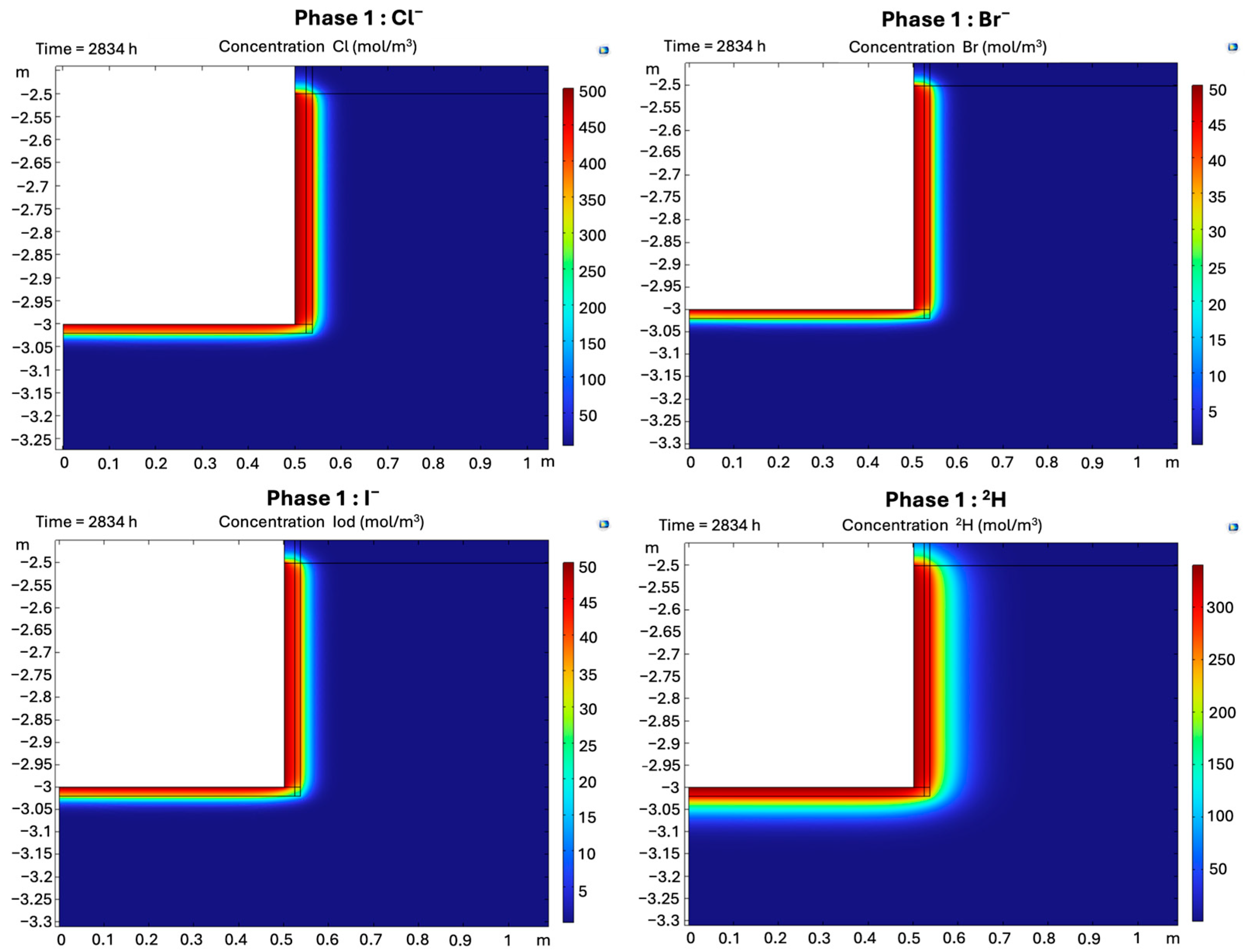
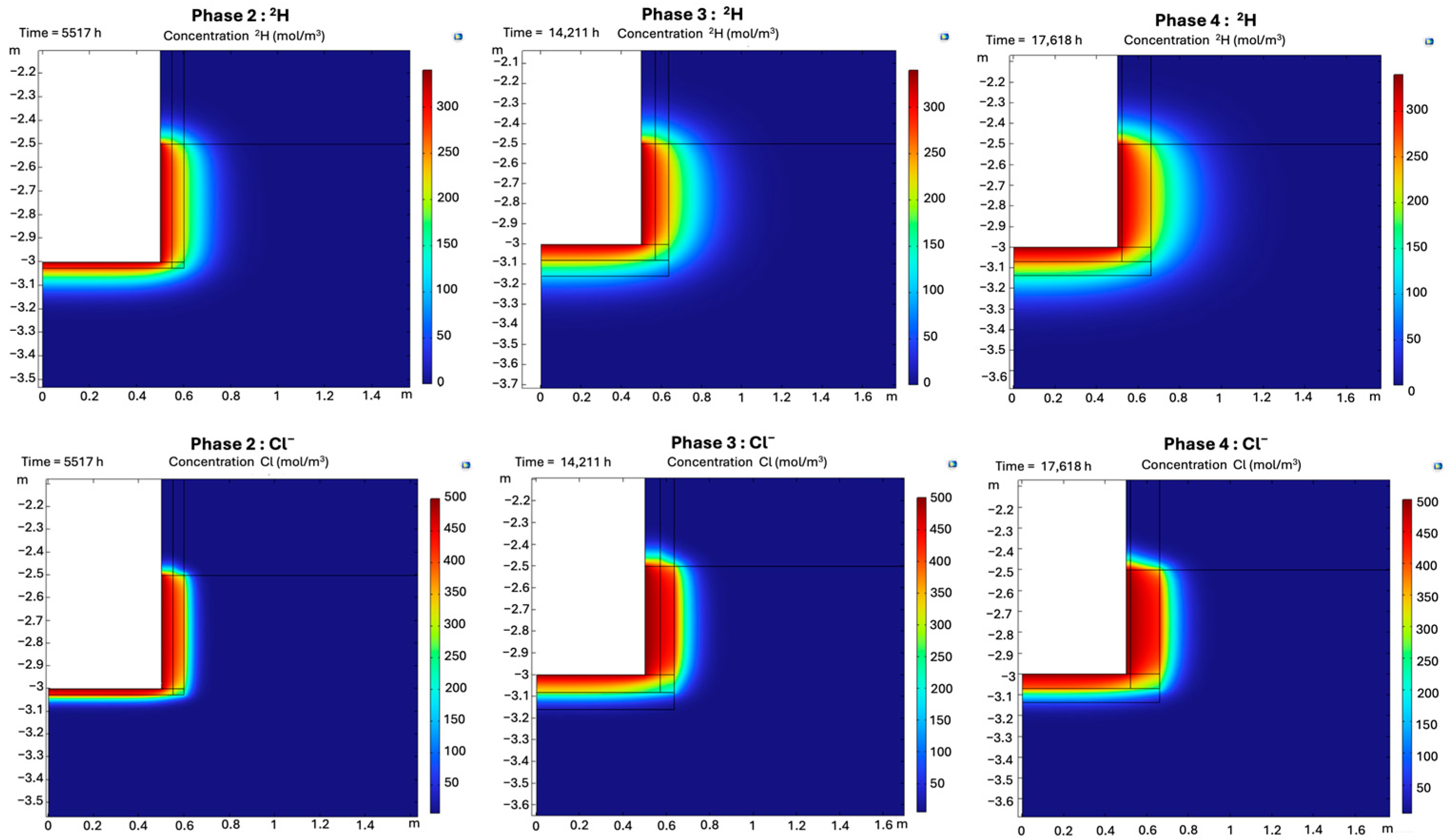
The effective diffusion coefficients (De) and accessible porosities (ωacc) were determined by adjusting simulated curves until a satisfactory agreement with experimental data was achieved. Initially, the evolution of tracer concentrations was modeled at the end of Phase 1. Figure 10 compares the 2D evolution of tracer concentrations obtained at this stage. Since the specific unit of 2H (δ2H vs. SMOW) is not implemented in COMSOL Multiphysics®, calculations were performed using concentration equivalents (mol·m−3).
For the halides, concentration profiles revealed penetration fronts localized near the test surface, limited to a few tens of centimeters in both the z- and r-directions. In contrast, 2H diffused more extensively into the porous medium, reaching 10 to 20 cm in both directions. This difference is explained by anion exclusion effects, whereas deuterium accesses the entire porosity.
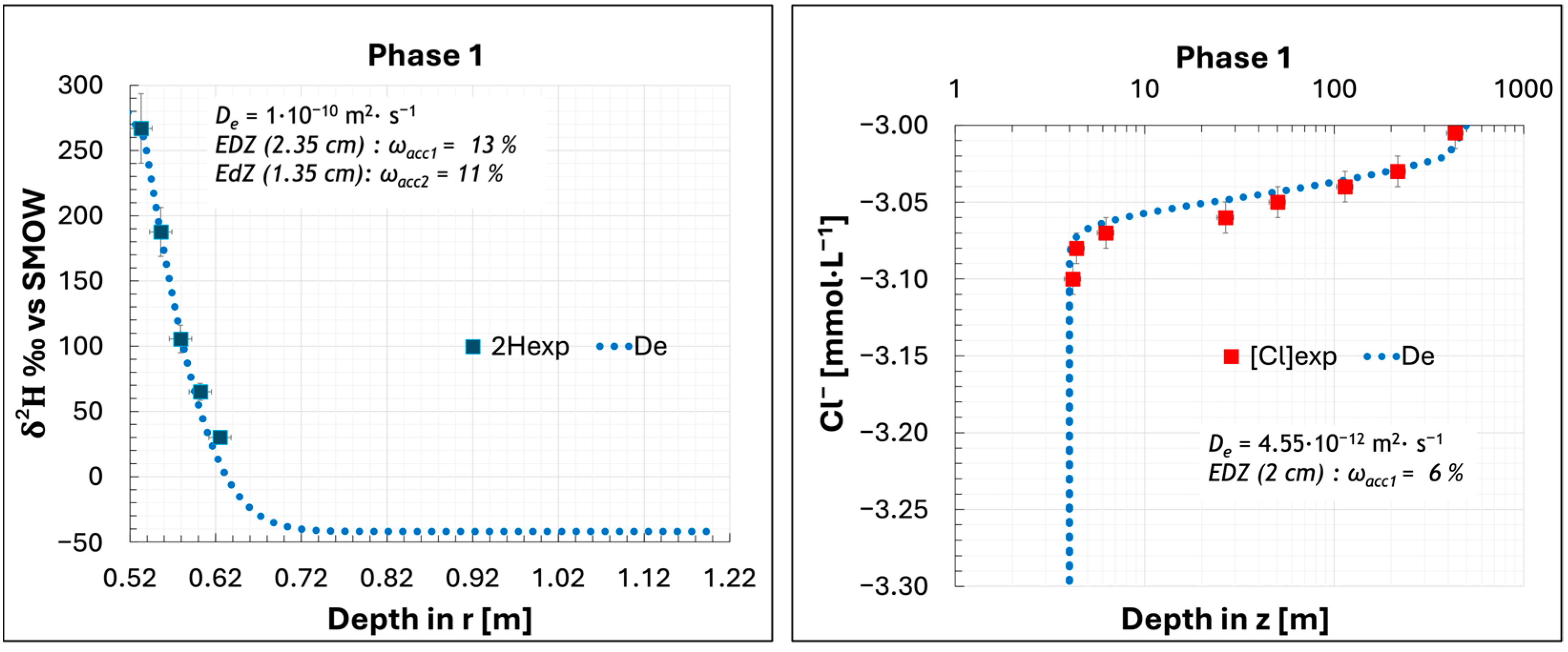
Thus, based on the simulated evolution of tracer concentrations, calibration between simulated and experimental penetration curves was performed for each tracer. Two calibration examples one for 2H in the r-direction and one for Cl in the z-direction—are presented in Figure 11, while the remaining calibrations are shown in Figure S4. The extent of the EDZ (Excavation Damaged Zone) and the EdZ (Excavation disturbed Zone), as well as the transport parameters used to achieve good fits, are indicated in the graphs.
The simulations of tracer concentration evolution at the end of Phase 1 also allowed the estimation of maximum tracer penetration, defined as the distance needed to reach the initial porewater concentration:
  • 2H: up to 20 cm in the r-direction;
  • Cl, Br, and I: up to 15 cm in the r-direction and 10 cm in the z-direction.
The transport parameters were thus determined in both parallel and perpendicular directions to bedding for each tracer, by fitting simulated tracer penetration curves as a function of depth. The inclusion of EDZ and EdZ zones proved essential to obtain a good match between simulated and experimental data. Table 3 summarizes the transport parameters and the extent of the EDZ and EdZ zones determined in this study.
The results show that the effective diffusion coefficients (De) of deuterium (2H) are one order of magnitude higher than those of anions, with accessible porosities approximately twice as high. This difference is attributed to the anion exclusion phenomenon [36]
At the end of Phase 1, in the plane parallel to bedding, both 2H and anions reach EDZ and/or EdZ zones of similar extent, varying between 3.7 and 4 cm. Due to the lack of samples in the z-direction, 2H could not be analyzed vertically. For anions, a single damaged zone (EDZ) was identified, with an extent of 4 cm in r and 2 cm in z, reflecting greater excavation-induced damage in the r-direction. These extents of the damaged and disturbed zones are representative of in situ conditions before heating.
To achieve satisfactory fitting of the simulated and experimental 2H data, the consideration of two distinct zones—damaged and disturbed—was necessary. In these two zones, different ωacc values were used for 2H, varying between 13% (ωacc1) and 11% (ωacc2). Conversely, for the anions, a single zone was considered in each direction, but with distinct accessible porosities (ωacc ⊥ = 6% and ωacc = 7.5%).
De ratios (deuterium/anions) ranging from 4.26 to 6.25 were determined in the parallel direction, consistently with previously measured values in the Upper Toarcian claystone (ratios between 2.68 and 6.22 for depths of 433–513 m NGF, close to the DIGIT test depth [17]). At these same depths, accessible porosity ratios between 1.80 and 2.68 were found, comparable to those obtained in this study (1.73 and 2.17) [17].
It should be noted that the effective diffusion coefficients determined in this section are those assigned to the damaged and/or disturbed zones, which are used in the subsequent simulations presented in the following sections.

5.3. Heat Transfer Modeling

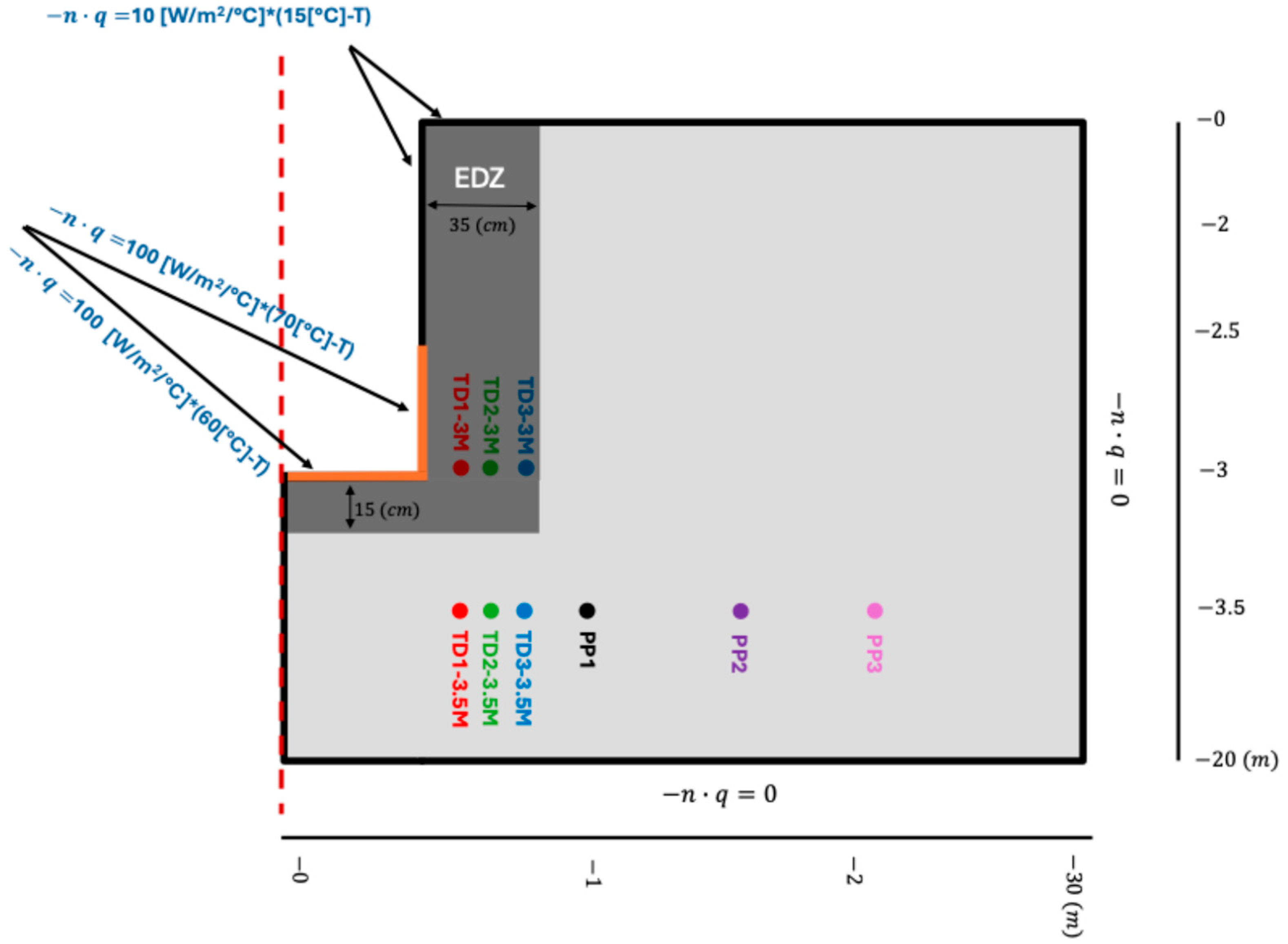
The objective of this section is to characterize heat transfer using only Fourier’s law. To achieve this, the effective thermal conductivity was determined around the periphery of the test zone (Figure 2) by adjusting simulated temperatures to the measurements recorded by sensors TD1, TD2, TD3, PP1, PP2, and PP3 located at 3 and 3.5 m, around the boundary of the test area. The boundary conditions imposed on the model are illustrated in Figure 12.
Throughout the experiment, despite an imposed temperature of 70 °C in the test zone, a non-homogeneous temperature distribution was recorded by the DGT-INS sensors installed within the test area (see Section 2).
Different convective heat fluxes were applied as boundary conditions on the surface of the test zone wall, the borehole wall, and the gallery wall in contact with the atmosphere to characterize heat exchange between the rock and the surrounding medium. Convective heat transfer coefficients of 10 and 100 W·m−2·°C−1 were used to represent the intensity of heat exchanges between the wall and the solution in the test zone, as well as between the wall and the atmosphere.
This required imposing two thermal fluxes: one at 70 °C on the wall and another at 60 °C at the bottom of the test zone. The dark-gray zones along the borehole boundary represent damaged/disturbed zones, which were necessary to adjust the model during the calibration phase between experimental and simulated data (Figure 12).
Thus, based on Fourier’s law, the equation governing thermal transfer and used to calibrate the conductivity with experimental data is expressed as follows:
· ( K T ) = ρ p c p T t  
where K is the effective thermal conductivity in the porous medium [W·m−1·K−1], T is the temperature [K], ρ p = ω a c c , i ρ β + 1 ω a c c , i ρ σ is the bulk density of the porous medium [kg·m−3], with ω a c c the accessible porosity to the tracer, ρ β the density of the fluid, ρ σ the density of the solid, and c p the specific heat capacity of the porous medium [J·kg−1·K−1].
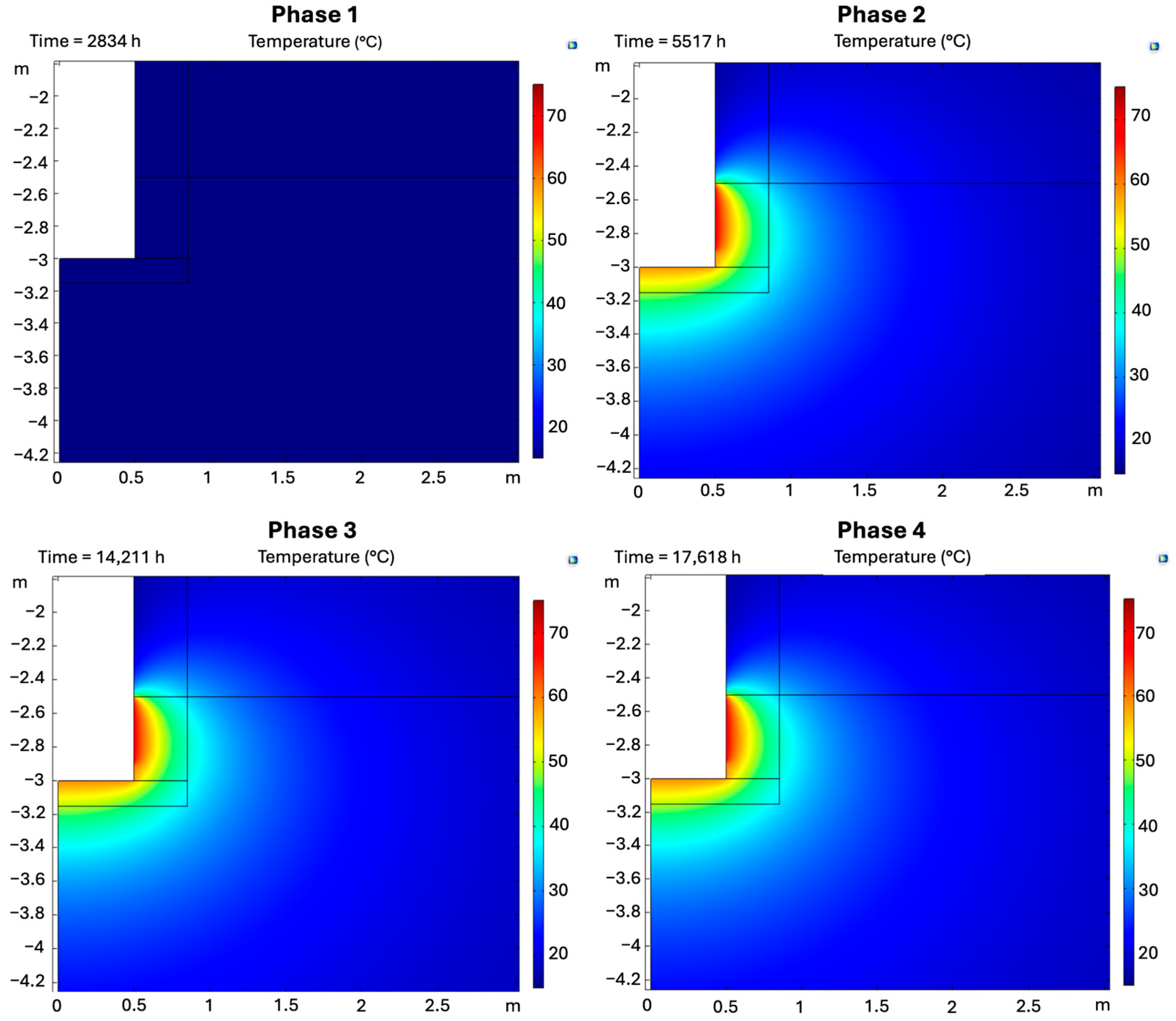
The determination of thermal conductivity in the DIGIT experiment was performed by comparing the evolution of temperatures measured in the rock by the sensors (TD1, TD2, TD3, PP1, PP2, and PP3), located respectively at 10, 20, 30, 50, 100, and 150 cm from the wall of the test zone (at depths of 3 and 3.5 m), with simulated temperatures. It should be noted that sensor TD1 at 3 m depth was not considered in the simulations due to inconsistent measured values. Anisotropic thermal conductivities were deduced from the best fitting curves obtained during simulation calibration. The temperature evolution was modeled after the four sampling phases (Phases 1, 2, 3, and 4), accounting for the heating shutdowns and restarts, using the boundary conditions shown in Figure 12. The simulated thermal field is illustrated in Figure 13.
At the end of Phase 1, corresponding to water saturation without heating, the temperature field remained homogeneous around 15 °C, a value characteristic of the local geothermal gradient, consistent with the isothermal nature of this phase.
As soon as heating began, a local temperature increase appeared near the test zone, with a difference between the upper part (~65 °C) and the lower part (~55 °C). This temperature inhomogeneity reflects the experimental observations from sensors installed around the test zone (see Section 2). Throughout the test, the thermal gradient remained confined within the first 1 to 1.5 m around the heated zone.
These first simulation results of temperature evolution during the DIGIT experiment led to additional trials to determine thermal conductivities in both the intact rock and the EDZ over the entire test duration (Phases 3 and 4 included). For this purpose, simulated data were compared to temperatures measured by the sensors located around the test zone.
Figure 14 illustrates the calibration between simulated results and experimental measurements, obtained using adjusted thermal conductivities in both directions. A good agreement was observed for sensors TD1, TD2, and TD3 at 3 and 3.5 m (except for TD1 at 3 m). However, a slight underestimation (~1 °C) of simulated temperatures was observed for sensors PP1, PP2, and PP3. This discrepancy could be due to differences in the mineralogical composition of the medium—for example, a different pyrite content, which has higher thermal conductivity due to the presence of iron-bearing minerals, or the solicitation of different strata due to a slight bedding dip. Another possible explanation may be related to differences between temperature sensors (brand, type, or calibration).
A damaged zone (EDZ—Excavation Damaged Zone, Figure 14) of 35 cm in the radial direction (r) and 15 cm in the vertical direction (z) was necessary to obtain these results. Without including an EDZ in the simulations, discrepancies appeared between simulated and experimental data. Thus, the calibrated thermal conductivity values obtained from the sensors closest to the test zone (TD sensors) were used in the models involving a thermal gradient.
These results revealed a clear anisotropy of thermal conductivity in the claystone, with conductivities approximately twice as high in the bedding plane ( K r ) as those perpendicular to bedding ( K z ) (Table 4).

5.4. Coupling Between Thermal and Mass Transfers

5.4.1. Thermal Effects on Mass Transfer

The objective of this section is to characterize mass transfer with and without temperature influence. To this end, four models based on Fick’s law, coupling mass and heat transfer, were simulated and compared with experimental data for each studied tracer, after the different test phases.
Model 1:
De—Fick’s Law—Equation (2).
Model 2:
DeT—Fick’s Law with Temperature Influence (Arrhenius Law).
The dependence of the effective diffusion coefficient on temperature was modeled using an Arrhenius-type law, with an activation energy of Ea = 21 kJ·mol−1 for ions [31] and Ea = 22.9 kJ·mol−1 for deuterium (value determined in this study). The law describing species transport in porous media (Fick’s law) is expressed as:
ω a c c , i C t = · ( D e , i T C )
where the effective diffusion coefficient D e , i T follows the Arrhenius law.
Model 3:
De + ST—Thermodiffusion without Temperature Influence on the Diffusion Coefficient.
The integration of thermodiffusion into the following equations, implemented in the various simulations carried out in COMSOL Multiphysics®, required introducing a Soret coefficient S T .
The phenomenological coefficient of the Soret effect, noted S T , is defined as the ratio of the thermal diffusion coefficient to the molecular diffusion coefficient:
S T = D T D a q  
where D a q is the diffusion coefficient of the species in free water, and D T is the thermal diffusion coefficient. When S T is positive, the heavier species moves toward the colder region; when negative, it moves toward the hotter region.
A study, referring to this work, was conducted at the in situ scale during the DIGIT experiment [26]. The development and validation of a mathematical model based on these two experiments suggested that the Soret effect could be significant due to strong temperature gradients at the laboratory sample scale (≈1300 °C/m), but such gradients should theoretically not occur under in situ conditions [23].
The tortuosity ( τ ) can be defined as the ratio between the effective diffusion coefficient in the porous medium and the diffusion coefficient in the liquid phase (β). It has also been shown that the ratio between the effective thermodiffusion coefficient ( D T e ) and the thermodiffusion coefficient ( D T ) leads to the same tortuosity, which is considered an intrinsic property of the porous medium, independent of the diffusing species [20,37]:
D T e D T = D e , i D β = 1 τ
Thus, the Soret coefficient ( S T ) implemented in the simulations in COMSOL Multiphysics® was determined from Equations (5) and (6), as a function of the effective diffusion coefficient ( D T e ), according to the following relation:
D T e = S T · D e , i
The Soret coefficient adopted at the DIGIT experiment scale for halides is 0.1 K−1, consistent with the findings of Rosanne et al. [35] for the COx. For 2H, a wide range of Soret coefficients was tested to achieve the best fit with the experimental data.
Since the coupled thermodiffusion effect is not implemented in COMSOL’s standard modules, it was manually added as a mass flux term in the species balance equation, both in the domain and on its boundaries.
It should be noted that possible variations of D T e with temperature may exist, even though they have not yet been demonstrated. The integration of the Soret coefficient into the mass equation taking into account the coupling thermal and mass transfer is described in the following models.
The equation that defines Model 3 is:
ω a c c , i C t = · ( D e , i C ) + · ( C S T D e , i T )
Model 4:
DeT + ST–Thermodiffusion with Temperature Influence on the Diffusion Coefficient.
ω a c c , i C t = · ( D e , i T C ) + · ( C S T D e , i T )
The boundary and initial conditions are shown in Figure 15. The gray zones along the borehole boundary represent damaged and/or disturbed zones, which were necessary to adjust the models. Indeed, calibration of the experimental data with the simulated results for each model required considering a damaged zone (EDZ) and/or a disturbed zone (EdZ) within the first few centimeters near the wall of the test zone, in both the z- and r-directions.
In a first step, the evolution of tracer concentrations was modeled at the end of the three heated phases (phases 2, 3, and 4). Figure 16 illustrates an example of the spatial and temporal evolution of 2H and Cl concentrations during these phases. At the end of phase 4, 2H and Cl are expected to penetrate up to approximately 1 m and 40 cm in the r-direction, and up to 30 cm and 15 cm in the z-direction, respectively.
Thus, simulations of tracer concentration evolution allowed a calibration between the simulated penetration profiles and the experimental results measured for each tracer at the end of the three heated phases.

5.4.2. Case of Deuterium

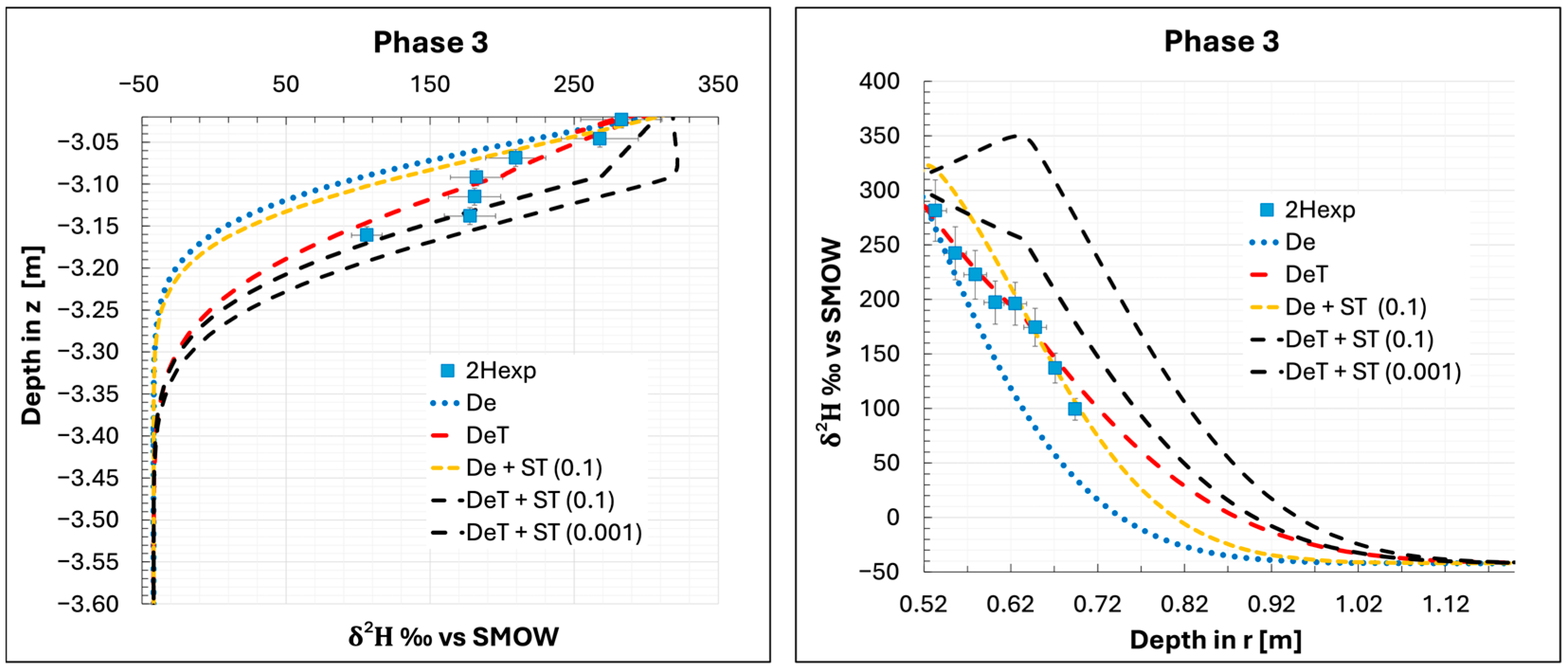
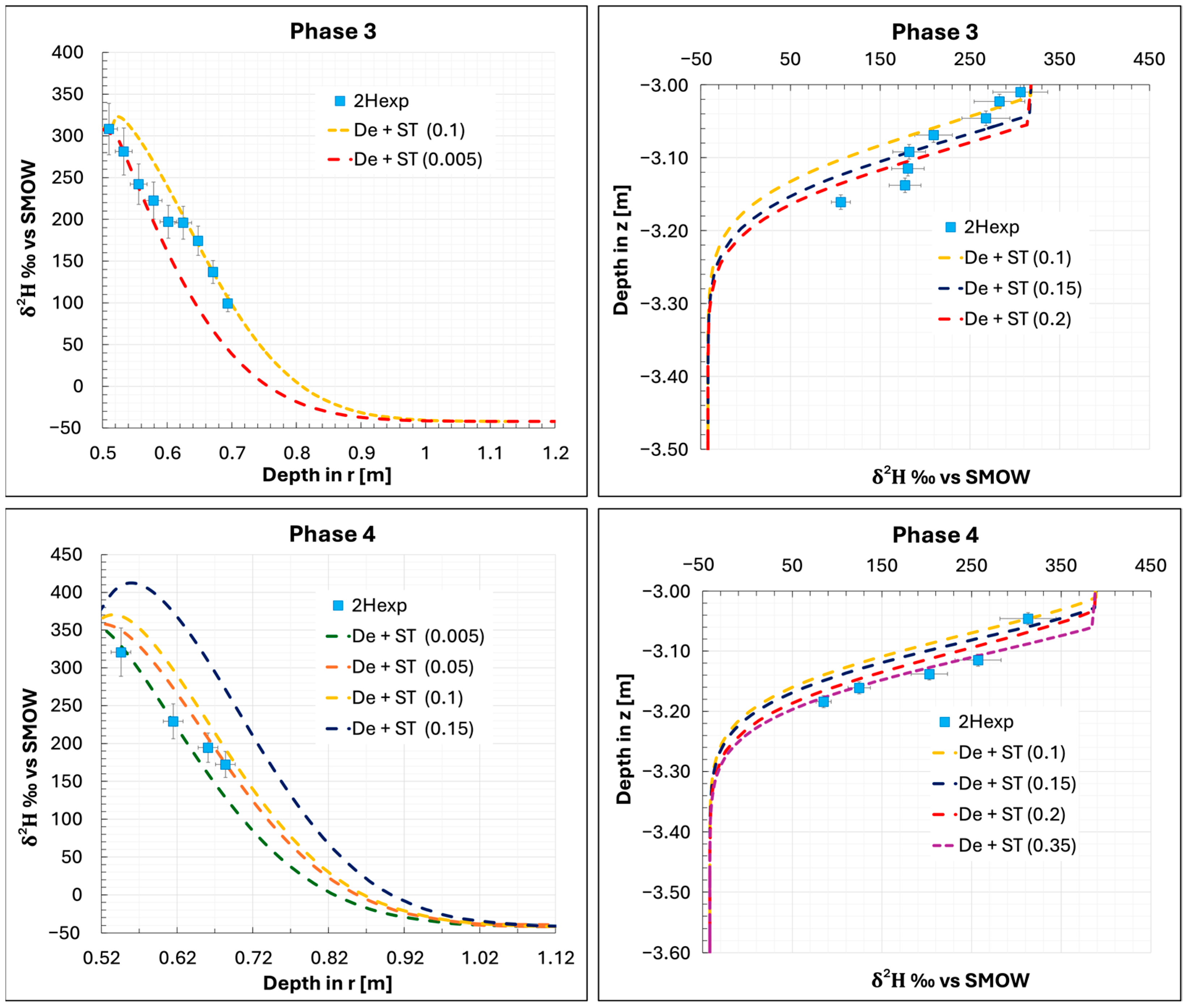
The penetration of deuterium at the end of the three heated phases (2, 3 and 4) was analyzed in both the radial (r) and vertical (z) directions using the four models, which were compared with the experimentally acquired data. The results obtained at the end of phase 3 are shown in Figure 17. For phases 2 and 4, in both directions, the calibration results are given in Figure S5.
Drops in deuterium content were observed within the first two centimeters of penetration at the test zone walls, in both the z- and r-directions. It is considered that these concentration decreases are due to wall capillary effects created during the sampling phases, resulting in contraction and therefore a reduction of the pore space. Such phenomena have already been observed in this type of clay when the rock is desaturated [38,39]. This is also the case in the present study during the different drainage phases in the test zone. Therefore, to avoid this sampling-related artifact, both experimental and modeled 2H values were taken not at the wall boundary of the test zone but 2 cm away from the edges, i.e., from −3.02 m in the z-direction and 0.52 m in the r-direction. This explains why, in Figure 17, the simulations do not start at the reference value of +560‰ vs. SMOW but rather between 200 and 350‰ vs. SMOW.
The analysis of the results obtained for the three heated phases (2, 3, and 4) was first carried out according to the orientation with respect to bedding. It appears that, regardless of direction (r or z), the simulations indicate that:
Models 1 (De), 3 (De + ST), and 4 (DeT + ST) do not accurately reproduce the experimental data. Using a Soret coefficient of 0.1 K−1 for 2H underestimates or overestimates the simulated concentrations compared with the experimental data.
Model 2 (DeT), which includes the temperature effect on the effective diffusion coefficient, provides the best fit to the experimental data.
The sensitivity of Models 3 and 4 [Equations (8) and (9)] to Soret coefficients was evaluated in both directions. For Model 4, tests were carried out by varying the Soret coefficient from 0.1 to 0.001 K−1 (Figure 17).
For Model 3, simulation results are shown in Figure 18. The results indicate that both Models 3 and 4 produce either overestimated or underestimated deuterium concentrations relative to experimental data, regardless of the Soret coefficient value or direction considered.
At the end of the heated phases, satisfactory calibration between simulated and experimental data across the full penetration depth of 2H was achieved only with Model 2, including consideration of the EDZ and EdZ zones.
At this stage, two distinct zones, an EDZ and an EdZ, were identified based on the experimentally measured deuterium contents at the end of each phase. Table 5 presents the extent of these zones as determined after phases 2, 3, and 4. The deuterium penetration profiles obtained at the end of phases 2, 3, and 4 from vapor-phase exchange experiments thus allowed the characterization of the extent of these damaged and/or disturbed zones (see Section 3.2.2). The choice of 2H as a reference tracer for determining these zones is based on its ability to access the entire porosity available for water isotope transfer.
The extent and accessible porosities associated with these zones evolve over time: they range from 2.8 and 10 cm (phase 2, z- and r-directions) to 13.5 and 16 cm (phase 4, z- and r-directions). Within these zones, porosities vary from 12 to 15% for 2H at the end of phase 2 and from 13 to 16% at the end of phase 4. For anions, at the end of the heated phases, porosities range between 8 and 10% in the r- and z-directions. Table 5 therefore suggests a gradual evolution of these zones under the effect of heating.
Consequently, for anions, at the end of the heated phases (2, 3, and 4), the calibration of simulated versus experimental data was carried out using the same zones as those determined for 2H, while retaining the effective diffusion coefficients (De) obtained at the end of phase 1 (see Section 5.2) but adjusting the accessible porosity.
The simulations allowed estimation of the maximum penetration depth of deuterium, defined as the distance required to reach its initial concentration in porewater:
  • Phase 2: up to 20 cm in z, 35 cm in r;
  • Phase 3: up to 35 cm in z, 55 cm in r;
  • Phase 4: up to 40 cm in z, 65 cm in r.
Thus, at the end of the heated phases, only Model 2, accounting for temperature correction on the diffusion coefficient, accurately reproduces the 2H transfer dynamics in the clay rock. Conversely, Models 3 and 4 did not reproduce the 2H penetration, regardless of the Soret coefficient value within the tested ranges. Moreover, 2H served as the reference tracer to determine the extent of the EDZ and EdZ zones, which were then fixed for the simulations applied to halides.

5.4.3. Case of Halides

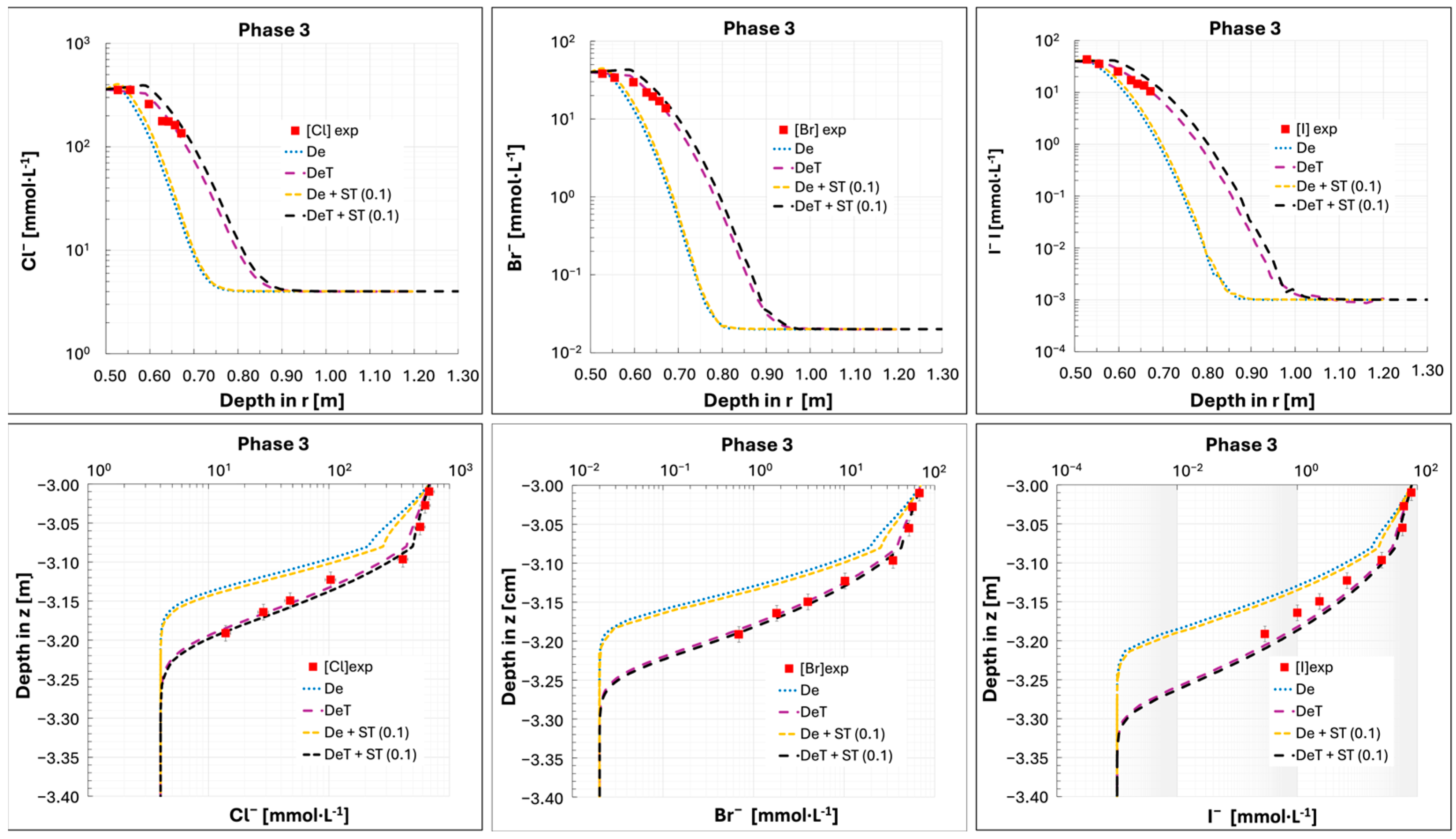
The migration of anions at the end of the three heated phases was evaluated, as for deuterium, using the four models. The various simulations of chloride, bromide, and iodide penetration at the end of phase 3 are shown in Figure 19. Calibration between experimental and simulated data was achieved by varying the accessible porosity at the end of each heated phase within the damaged zones (see Table 5). For phases 2 and 4, the calibration results are given in Figures S6 and S7.
At the end of Phase 2 and in both directions, Models 1 (De) or 3 (De + ST) overlap with the experimentally determined halide data within the first five centimeters. Beyond 10 cm, all halides follow either Model 2 (DeT) or 4 (DeT + ST). At the end of phases 3 and 4, in both directions, Models 2 and 4 reproduce the tracer migration for chlorides and bromides. This is also true for iodides within the first 10 cm. However, beyond 10 cm, the simulated curves of Models 2 and 4 progressively diverge from the experimental results. This suggests that a retardation factor, characterized by a partition coefficient or KD, should be applied to properly describe iodide penetration. Thus, at the beginning of heating (phase 2), tracer penetration within the first centimeters is mainly described by Models 1 and 3. Beyond 10 cm, Models 2 and 4 better reproduce halide penetration. The longer the heating phase continues (phase 3 and 4), the more accurately these two models describe the migration behavior. In the case of Model 4, the addition of a Soret coefficient of 0.1 K−1 allows the characterization of halide penetration dynamics. However, a slight discrepancy between the simulated curves and the experimental data appears over time, particularly in the r-direction, reflecting the effect of the medium’s anisotropy. Furthermore, the deeper iodine penetrates the rock, the greater the deviation between simulated and experimental data becomes. This confirms the necessity of introducing a retardation factor with evaluation of a partition coefficient, KD, to model iodine diffusion.
These simulations also allowed estimation of the tracer penetration distances at the end of each phase, i.e., the maximum distance required to reach their initial concentration in porewater. Thus, Cl, Br, and I migrate approximately:
  • 13, 15, and 17 cm in z and 25, 27, and 35 cm in r, at the end of phase 2;
  • 25, 28, and 33 cm in z and 40, 45, and 50 cm in r, at the end of phase 3;
  • 28, 30, and 35 cm in z and 45, 50, and 60 cm in r, at the end of phase 4.
Thus, since DeCl > DeBr > DeI and [Cl]pw > [Br]pw > [I]pw, chlorine reaches its initial concentration in porewater more rapidly than bromine, and bromine more rapidly than iodine, regardless of the migration direction. However, for iodine, a retardation factor should likely be considered to accurately describe its migration.

6. Mass Transfer with Convection

The objective of this section is to characterize the impact of coupled mass transfers over a timescale comparable to that of the main thermal phase of a high-level waste repository, estimated at 150 years. At this timescale, the effects of thermodiffusion and convection may become relevant. Based on this, a numerical model coupling mass transfer, heat transfer, and convection was implemented in COMSOL Multiphysics® using the species, energy, and mass conservation equations.

6.1. Governing Equations and Model Formulation

For deuterium, only the species conservation Equations (4) and (10) were considered. The unknown value of the Soret coefficient for deuterium did not allow characterization of its migration via thermodiffusion.
ω a c c C t + · ω a c c C v β = · D e , i T C
where v β is the Darcy velocity [m·s−1].
For anions, Equation (11) was primarily considered. It accounts for:
  • The correction of the diffusion coefficient by temperature according to the Arrhenius law;
  • The Soret effect;
  • Convection via the effective velocity defined by Darcy’s law, in which the porosity accessible to tracers is considered equivalent to the kinematic porosity.
ω a c c C t + · ω a c c C v β = · D e , i T C + · C S T D e , i T
The four models tested for anions are:
  • DeT + convection—Equation (10);
  • DeT without convection—Equation (4);
  • DeT + ST + convection—Equation (11);
  • DeT + ST without convection—Equation (9).
The energy and mass conservation equations that used coupling mass, heat, and convection are:
ρ C p T t + v β · T = K T
t ω a c c , i ρ + · ρ v β = 0
With the Darcy equation:
v β = k μ p ρ T g

6.2. Model Assumptions and Boundary Conditions

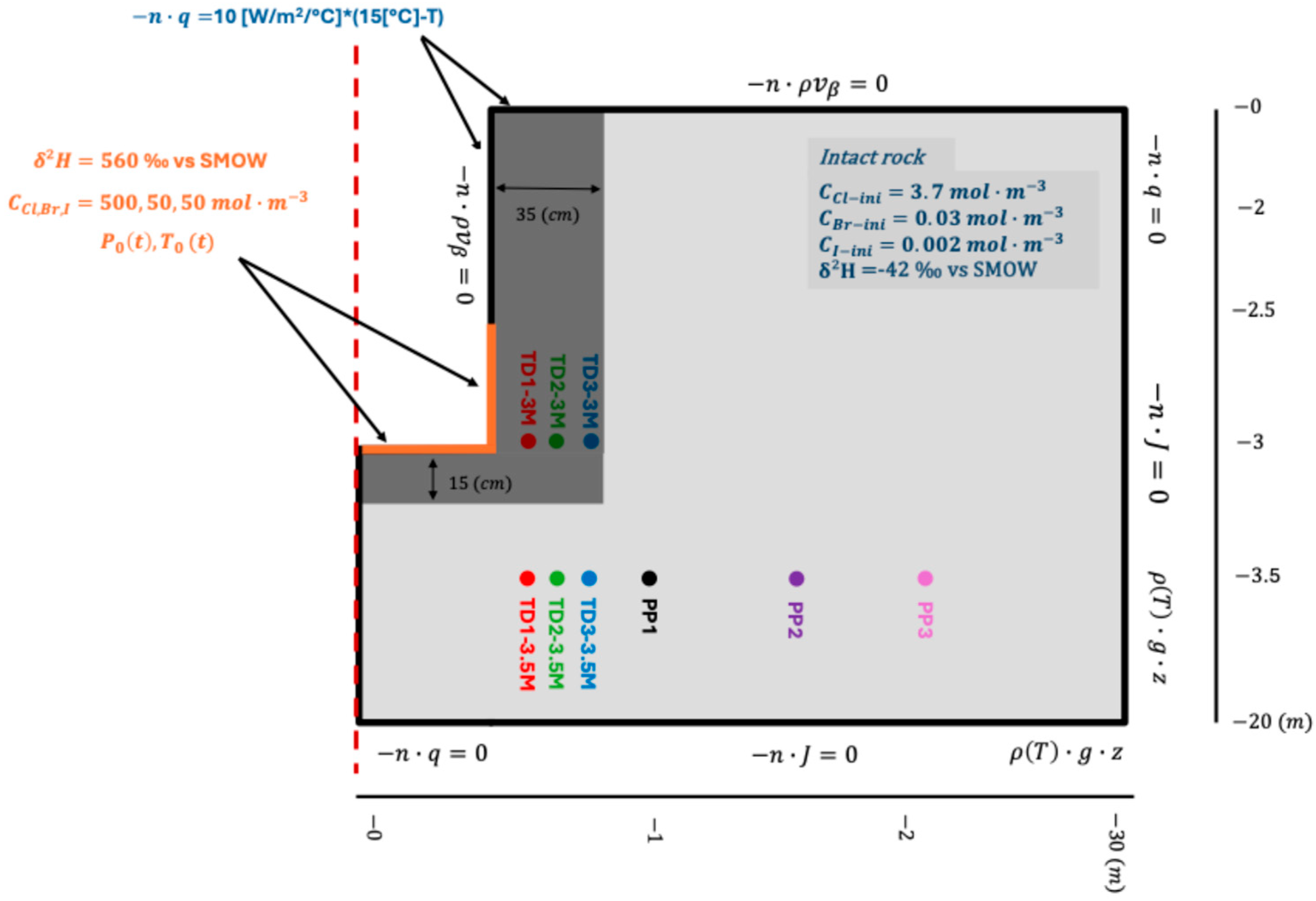
The extent of the damaged zone was defined based on heat transfer (see Section 5.3): 35 cm in the r-direction and 15 cm in the z-direction. The boundary and initial conditions imposed in the COMSOL Multiphysics® model are presented in Figure 20. These are the same as those used in previous sections, with the addition of velocity and pressure conditions. At the wall of the test zone, a time-dependent temperature was applied. This temperature evolution over 1000 years was defined using ANDRA predictions for HLW cell wall temperatures [40].
During the heating initiation in the DIGIT experiment, overpressures up to 1.5 MPa were measured at 50 cm from the test zone wall (see Section 2), reflecting a Thermo–Hydro–Mechanical (THM) coupling with an increase in pore pressure due to thermal expansion of water. Vo et al. [41] evaluated the influence of THM-solute coupling. Considering an anisotropic elastic mechanical model, they concluded that despite high-pressure gradients induced by THM effects, diffusion remains the dominant mechanism due to the very low permeability of the Tournemire rock [41]. Based on these results, these effects were not further addressed in this study but could be explored in future simulations.
The current model incorporates the specific temperature evolution and water thermal expansion over 150 years, reflecting an increase in pore pressure due to thermal expansion. To solve Equations (10) and (11), simulations use a wall temperature based on ANDRA predictive calculations for HLW cell walls [40] and a constant pressure of 0.4 MPa at the test zone wall. This pressure corresponds to observations after 2 years of heating on PP1 (50 cm from the wall). Overpressure dissipation is expected after 4–5 years, returning to the equilibrium pressure of 0.2 MPa.

6.3. Simulation Results

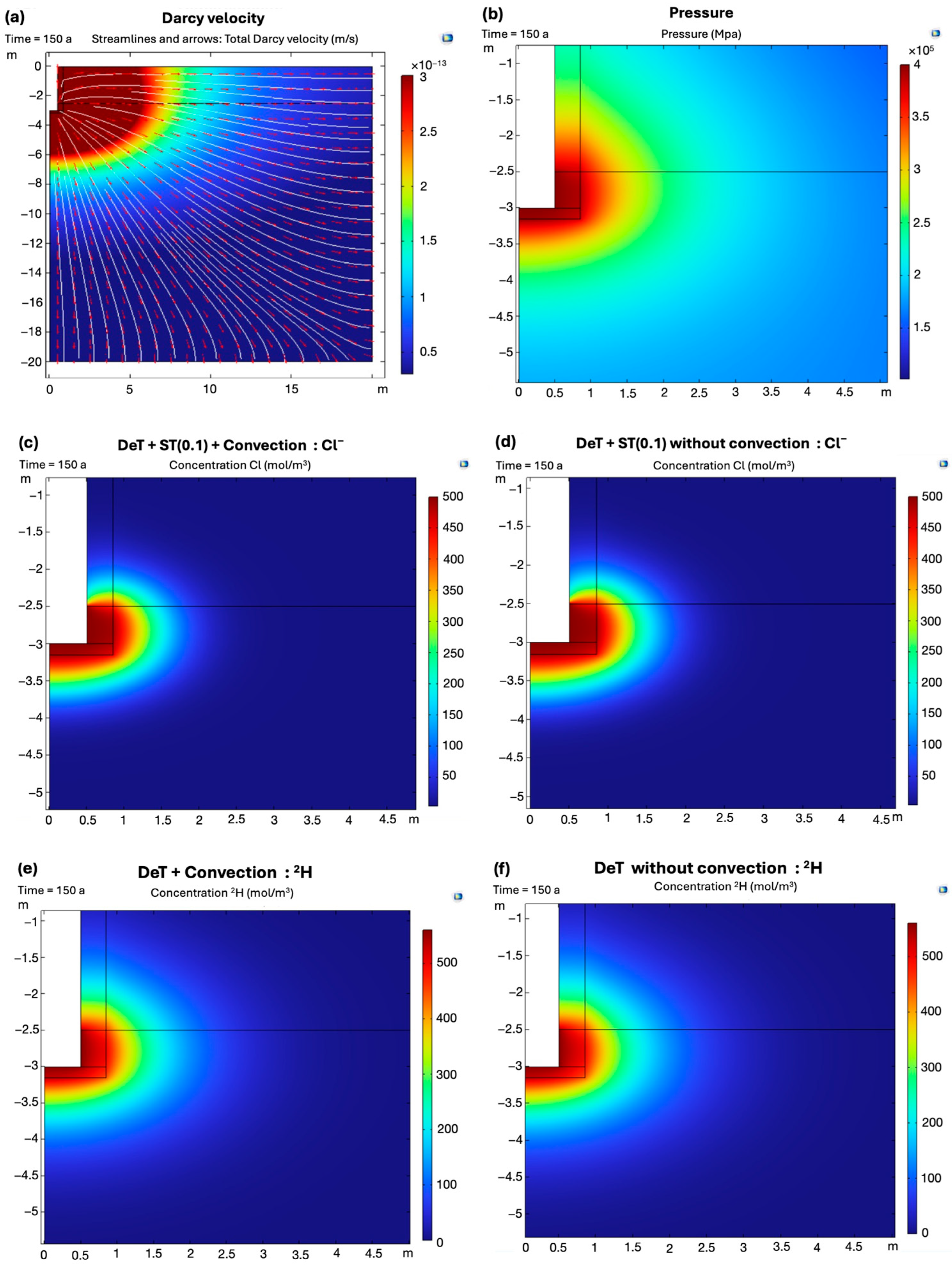
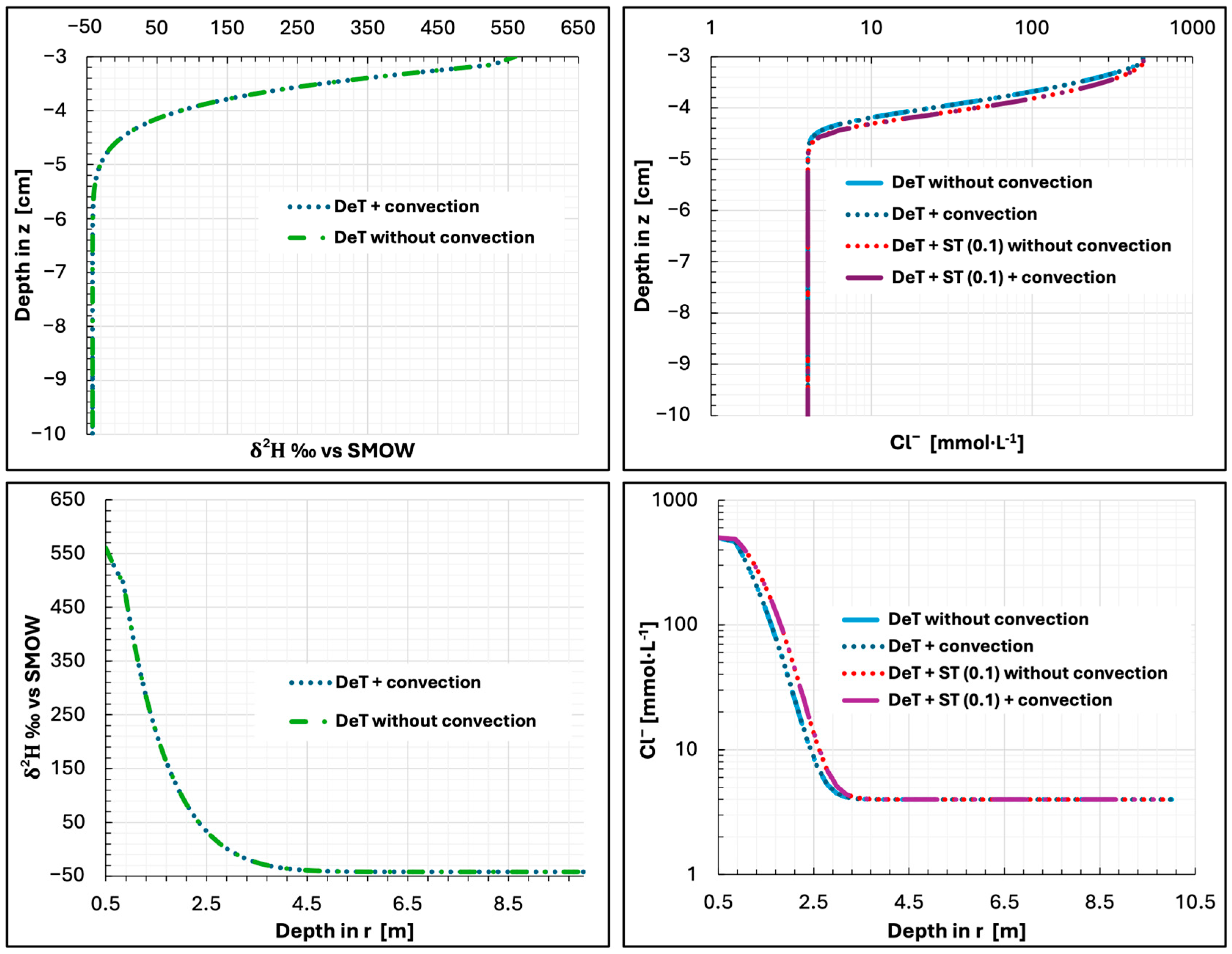
Convection within the coupling of thermal and mass transfers after 150 years was characterized by applying a Darcy velocity field, wall pressure conditions representative of the experiment, and comparing tracer penetration results with or without convection (Figure 21). Flux vectors indicate convective circulation, evidencing non-strictly diffusive transport. A pressure of ~0.4 MPa was applied at the test zone wall (maximum observed after two years of heating), with progressive dissipation to an equilibrium pressure of ~0.2 MPa at 4 m. Including thermodiffusion (DeT + ST) in halide simulations could generate overconcentration zones within EDZs. For deuterium, including convection in the DeT model does not significantly affect migration.
Using simulations with or without convection, tracer concentration evolution over 150 years in both directions could be predicted. Figure 22 presents predictive modeling results for deuterium and chloride contents after 150 years of transfer in claystone. Bromide and iodide results are in Figure S8.
Figure 22 and Figure S8 show that after 150 years, 2H, Cl, Br, and I are expected to have penetrated 4, 2.3, 3, and 3.5 m in the r-direction and 2, 1.5, 2, and 2.5 m in the zzz-direction, respectively. These distances are small compared to the spacing between two HLW cells (~50 m) in the Cigéo context but should be considered minimal values due to the more favorable transport properties of the Callovo-Oxfordian LSMHM compared to the Toarcian LRST. Reference values for the COx considered by ANDRA are 3·10−20 m2 for intrinsic permeability and 5·10−12 m2·s−1 for the effective diffusion coefficient of Cl [5], one order of magnitude and twice the values determined in the upper Toarcian LRST during the DIGIT experiment. This suggests that penetration distances could exceed those estimated in this study.

7. General Conclusions

The DIGIT experiment was specifically designed to experimentally mimic the effects of a premature leak of radionuclide analogues, with the objective of assessing the potential role of temperature on diffusive transfers, with or without the Soret effect and convection.
Beyond this objective, the experiment constitutes one of the few long-term in situ studies combining controlled heating (70 °C), tracer diffusion, pore pressure monitoring and multiphysics modeling under conditions representative of a deep geological repository.
Several successive sampling campaigns were conducted during the experiment, allowing a progressive and time-resolved characterization of tracer migration. Determining tracer concentrations in porewater at the end of each phase, in directions parallel (r) and perpendicular (z) to the stratification, allowed characterization of a decrease in tracer concentrations with depth, as well as the anisotropy of the medium.
Water contents deduced from mass balances carried out on deuterium exchange cells in the vapor-phase also highlighted the development of a damaged or disturbed zone, initially confined to the first centimeters of the wall (in the isothermal phase), which gradually expanded under heating. This zone is initially horizontally localized, linked to the drilling, and then develops vertically under the applied thermal gradient, reflecting structural evolution of the rock both vertically and horizontally. This is manifested by water content evolution from 14 to 15% in the first centimeters in the parallel plane and from 10 to 18% in the vertical plane at the end of phases 3 and 4. Beyond 15 cm depth, a decrease in water content is observed in both directions, suggesting the extension of the damaged or disturbed zone.
In situ and laboratory experimental data enabled the development and calibration of a numerical model coupling thermal and mass transfers at the scale of the DIGIT experiment, implemented in COMSOL Multiphysics®. Simulations of temperature evolution throughout the DIGIT experiment, calibrated with temperature data, allowed proposing new thermal conductivities of 1.7 W·m−1·K−1 (r) and 0.85 W·m−1·K−1 (z) for intact rock and 1.6 W·m−1·K−1 (r) and 0.85 W·m−1·K−1 (z) for a damaged and/or disturbed zone, whose extent is estimated at approximately 35 cm (r) and 15 cm (z). Results show anisotropy of thermal conductivity, roughly twice as high in the stratification plane. These simulations also allowed estimating the maximum penetration of chlorides, bromides, iodides, and deuterium at the end of the experiment (phase 4), reaching 45, 50, 60, and 65 cm in r and 28, 30, 35, and 40 cm in z, respectively.
Determining the damaged and/or disturbed zones from deuterium (2H) results enabled satisfactory calibration between simulated and experimental tracer migration data for the three heated phases. At the end of these phases, model 2, which includes a temperature correction on the diffusion coefficient, best describes deuterium migration. For halides, models 2 and 4—the latter incorporating both temperature correction and the Soret effect—best reproduce experimental data.
A Soret coefficient of 0.1 K−1, determined in a previous study, proved relevant to characterize halide movement [35]. However, for 2H, tests showed that including this coefficient via models 3 or 4 did not account for its movement. This suggests that, at the spatio-temporal scale of the DIGIT experiment, thermodiffusion has little influence on deuterium migration. Iodide also exhibits retention effects relative to lighter halides. Evaluating this retention, which would require a new model, could not be performed in this study and is considered a future perspective.
The different models tested during the DIGIT experiment show that, under the maximum thermal phase considered here (150 years) and within the DIGIT experimental context, Fick’s law corrected for temperature via the Arrhenius law is the dominant process explaining deuterium and halide movement. The Soret effect, with a coefficient of 0.1 K−1 used in model 4, influences only halide migration, and the additional transfer induced by this coupled effect remains minor after 150 years. Convection, limited here to Darcy’s law, has a minimal contribution to mass transfers compared to processes involving the diffusion coefficient. This result is mainly due to the very low intrinsic permeability of the Upper Toarcian clay. The contribution of convection could be increased by considering chemo- and thermo-osmotic processes, which generate water fluxes under concentration and temperature gradients; studying their long-term contribution is proposed as a future perspective. These new and relevant results in the field will need to be confirmed later through additional experiments.
It should also be noted that tracer movement is expected to be on the meter-to-multi-meter scale, which, in a repository context, would limit potential contamination to the vicinity of a single disposal cell. However, since the transfer properties of the Toarcian clay are significantly lower than those of the Callovo-Oxfordian, it cannot be excluded that radionuclide penetration during a premature leak under full thermal conditions in a repository context such as Cigéo could be higher than the estimates presented in this study.
In conclusion, the DIGIT test demonstrated, at in situ scale and over a duration exceeding two years, that diffusion corrected for temperature dependence is the mechanism governing the transport of radionuclide analogues in the Upper Toarcian claystone at Tournemire. The study provides (i) a rare long-term in situ dataset under thermal load, (ii) a quantitative assessment of thermal effects on effective diffusion coefficients, (iii) experimental evidence of EDZ evolution under heating, and (iv) a calibrated multiphysics model capable of extrapolating results to repository-relevant timescales. These new and relevant results in the field strengthen confidence in process understanding under thermal conditions representative of HLW disposal and will nevertheless benefit from confirmation through additional experiments in other geological contexts and under complementary thermal scenarios.

Supplementary Materials

The following supporting information can be downloaded at: https://www.mdpi.com/article/10.3390/min16040380/s1. The various models developed using COMSOL Multiphysics® are provided in the Supplementary Materials. In addition, all comparison curves between simulated and experimental data obtained at the end of each phase are included.

Author Contributions

Conceptualization, J.-M.M. and M.H.D.; methodology, M.H.D. and A.N.; software, U.V., M.F., S.T.N., J.Á.I.S. and M.M.; validation, M.M., J.-M.M. and S.T.N.; formal analysis, M.H.D.; investigation, M.H.D.; resources, M.H.D.; data curation, M.H.D.; writing—original draft preparation, M.H.D.; writing—review and editing, M.F., S.T.N., J.Á.I.S., A.N., M.M. and J.-M.M.; visualization, J.-M.M.; supervision, J.-M.M.; project administration, C.W.; funding acquisition, J.-M.M. All authors have read and agreed to the published version of the manuscript.

Funding

This research received no external funding.

Data Availability Statement

The data presented in this study are available on request from the corresponding author. The data are not publicly available due to due to the large size of the datasets.

Acknowledgments

This work was carried out under the Globe implementation agreement co-financed by ASNR and FANC (ASNR contracts: LW Contract 2021-0060 and AFCN: 20221009 FANC-3-ASNR) and relating to research activities on the clay geological barrier of a geological repository for radioactive waste. This agreement is part of the Tenor consortium’s umbrella agreement on studies relating to research activities carried out at the Tournemire Underground Research Laboratory. All experiments were performed at LUTECE (the SPDR’s experimental platform), and isotopic measurements of water-stable isotopes at the GEOPS laboratory of the university of Paris Saclay.

Conflicts of Interest

The authors declare no conflict of interest.

References

  1. Sellin, P.; Leupin, O.X. The Use of Clay as an Engineered Barrier in Radioactive-Waste Management—A Review. Clays Clay Miner. 2013, 61, 477–498. [Google Scholar] [CrossRef]
  2. Technical Report NTB 12-03. Available online: https://nagra.ch/fr/telechargements/technical-report-ntb-12-03-3/ (accessed on 6 November 2025).
  3. Agence Nationale Pour la Gestion des Dechets Radioactifs—Andra. 2005 Clay Dossier—Evaluation of the Feasibility of a Geological Repository in an Argillaceous Formation. Meuse/Haute-Marne Site—Synthesis. December 2005; INIS-FR--19-1357, Déc. 2006. Available online: https://www.andra.fr/cigeo/les-documents-de-reference (accessed on 6 November 2025).
  4. Andra. Authorization File for the Creation of the Cigéo Basic Nuclear Facility (INB). Available online: https://www.andra.fr/sites/default/files/2023-04/Pi%C3%A8ce%2007-VPRS-PARTIE%203%20D%C3%A9monstration%20s%C3%BBret%C3%A9-Volume%2008-D%C3%A9monstration%20de%20s%C3%BBret%C3%A9%20apr%C3%A8s-fermeture.pdf (accessed on 6 November 2025).
  5. Guo, R.; Thatcher, K.E.; Seyedi, D.M.; Plúa, C. Calibration of the thermo-hydro-mechanical parameters of the Callovo-Oxfordian claystone and the modelling of the ALC experiment. Int. J. Rock Mech. Min. Sci. 2020, 132, 104351. [Google Scholar] [CrossRef]
  6. Gens, A.; Vaunat, J.; Garitte, B.; Wileveau, Y. In situ behaviour of a stiff layered clay subject to thermal loading: Observations and interpretation. Géotechnique 2007, 57, 207–228. [Google Scholar] [CrossRef]
  7. Technical Report NTB 21-01, Nagra. Available online: https://nagra.ch/en/downloads/technical-report-ntb-21-01/ (accessed on 6 November 2025).
  8. Zou, L.; Cvetkovic, V. Disposal of high-level radioactive waste in crystalline rock: On coupled processes and site development. Rock Mech. Bull. 2023, 2, 100061. [Google Scholar] [CrossRef]
  9. Swedish Radiation Safety Authority (SRSA). “2021:15 National Plan: Responsible and Safe Management of Spent Fuel and Radioactive Waste in Sweden,” Strålsäkerhetsmyndigheten. Available online: https://www.stralsakerhetsmyndigheten.se/publikationer/rapporter/avfall--transport--fysiskt-skydd/2021/202115/ (accessed on 27 March 2024).
  10. Posiva Oy, Application for Operating Licence, Työ-ja Elinkeinoministeriö. Available online: https://tem.fi/en/posivas-operating-licence (accessed on 27 January 2026).
  11. Canada’s Deep Geological Repository|NWMO. Available online: https://www.nwmo.ca/en/canadas-plan/canadas-deep-geological-repository (accessed on 6 November 2025).
  12. Bensenouci, F.; Michelot, J.L.; Matray, J.M.; Savoye, S.; Massault, M.; Vinsot, A. Coupled study of water-stable isotopes and anions in porewater for characterizing aqueous transport through the Mesozoic sedimentary series in the eastern Paris Basin. Mar. Pet. Geol. 2014, 53, 88–101. [Google Scholar] [CrossRef]
  13. Rebeix, R.; Le Gal La Salle, C.; Jean-Baptiste, P.; Lavastre, V.; Fourré, E.; Bensenouci, F.; Matray, J.M.; Landrein, P.; Shouakar-Stash, O.; Frape, S.K.; et al. Chlorine transport processes through a 2000 m aquifer/aquitard system. Mar. Pet. Geol. 2014, 53, 102–116. [Google Scholar] [CrossRef]
  14. Trémosa, J. Influence of Osmotic Processes on the Excess-Hydraulic Head Measured in the Toarcian/Domerian Argillaceous Formation of Tournemire. Ph.D. Thesis, Université Paris 6, Paris, France, 2010. Available online: https://www.theses.fr/2010PA066670 (accessed on 12 September 2023).
  15. Gonçalvès, J.; Matray, J.-M.; Yu, C.J. Assessing relevant transport processes in Opalinus Clay at the Mont Terri rock laboratory using excess-pressure, concentration and temperature profiles. Appl. Clay Sci. 2023, 242, 107016. [Google Scholar] [CrossRef]
  16. Ji, Y.C. Comparative Study of Convective and Diffusive Transport Phenomena Within the Opalinus Clay of Mont Terri. Ph.D. Thesis, Aix-Marseille University, Le Pharo, France, 2017. Available online: https://www.theses.fr/2017AIXM0409 (accessed on 12 September 2023).
  17. Bensenouci, F. Apport des Traceurs Naturels à la Compréhension des Transferts au Sein des Formations Argileuses Compactées. Ph.D. Thesis, Université Paris-Sud 11, Paris, France, 2010. Available online: https://theses.fr/2010PA112156 (accessed on 6 November 2025).
  18. Leupin, O.X.; Van Loon, L.R.; Gimmi, T.; Wersin, P.; Soler, J.M. Exploring diffusion and sorption processes at the Mont Terri rock laboratory (Switzerland): Lessons learned from 20 years of field research. Swiss J. Geosci. 2017, 110, 391–403. [Google Scholar] [CrossRef]
  19. Van Loon, L.R.; Soler, J.M.; Müller, W.; Bradbury, M.H. Anisotropic diffusion in layered argillaceous rocks: A case study with Opalinus Clay. Environ. Sci. Technol. 2004, 38, 5721–5728. [Google Scholar] [CrossRef]
  20. Davarzani, H.; Marcoux, M.; Costeseque, P.; Quintard, M. Experimental measurement of the effective diffusion and thermodiffusion coefficients for binary gas mixture in porous media. Chem. Eng. Sci. 2010, 65, 5092–5104. [Google Scholar] [CrossRef]
  21. Motellier, S.; Devol-Brown, I.; Savoye, S.; Thoby, D.; Alberto, J.-C. Evaluation of tritiated water diffusion through the Toarcian clayey formation of the Tournemire experimental site (France). J. Contam. Hydrol. 2007, 94, 99–108. [Google Scholar] [CrossRef]
  22. Furry, W.H.; Jones, R.C.; Onsager, L. On the Theory of Isotope Separation by Thermal Diffusion. Phys. Rev. 1939, 55, 1083–1095. [Google Scholar] [CrossRef]
  23. Vo, U.; Fall, M.; Sedano, J.Á.I.; Humbezi-Desfeux, M.; Matray, J.-M.; Marcoux, M.; Nguyen, T.S. Numerical simulation of solute transport in argillaceous rock under thermal gradient with a coupled THM-solute transport model. Geomech. Energy Environ. 2025, 41, 100632. [Google Scholar] [CrossRef]
  24. Caractérisation de L’argile à Opalinus. Available online: https://www.mont-terri.ch/fr/caracterisation-de-largile-a-opalinus-experiences (accessed on 6 November 2025).
  25. de Wit, J.C.; van der Straaten, C.M.; Mook, W.G. Determination of the Absolute Hydrogen Isotopic Ratio of V-SMOW and SLAP. Geostand. Newsl. 1980, 4, 33–36. [Google Scholar] [CrossRef]
  26. Humbezi Desfeux, M.; Marcoux, M.; Matray, J.-M.; Gorny, J.; Schädle, P.; Pochet, G. DIGIT: An In Situ Experiment for Studying the Diffusion of Water and Solutes under Thermal Gradient in the Toarcian Clay Rock at the Tournemire Underground Research Laboratory: Part 1—Goals, Scoping Calculations, Installation and First Results under Unheated Conditions. Minerals 2024, 14, 563. [Google Scholar] [CrossRef]
  27. van der Kamp, G.; Van Stempvoort, D.R.; Wassenaar, L.I. The Radial Diffusion Method: 1. Using intact cores to determine isotopic composition, chemistry, and effective porosities for groundwater in aquitards. Water Resour. Res. 1996, 32, 1815–1822. [Google Scholar] [CrossRef]
  28. de Hoog, F.R.; Knight, J.H.; Stokes, A.N. An Improved Method for Numerical Inversion of Laplace Transforms. SIAM J. Sci. Stat. Comput. 1982, 3, 357–366. [Google Scholar] [CrossRef]
  29. Patriarche, D.; Ledoux, E.; Simon-Coinçon, R.; Michelot, J.-L.; Cabrera, J. Characterization and modeling of diffusion process for mass transport through the Tournemire argillites (Aveyron, France). Appl. Clay Sci. 2004, 26, 109–122. [Google Scholar] [CrossRef]
  30. Technical Report NTB 03-07, Nagra. Available online: https://nagra.ch/fr/telechargements/technical-report-ntb-03-07-3/ (accessed on 6 November 2025).
  31. Van Loon, L.R.; Müller, W.; Iijima, K. Activation energies of the self-diffusion of HTO, 22Na+ and 36Cl− in a highly compacted argillaceous rock (Opalinus Clay). Appl. Geochem. 2005, 20, 961–972. [Google Scholar] [CrossRef]
  32. Savoye, S.; Goutelard, F.; Beaucaire, C.; Charles, Y.; Fayette, A.; Herbette, M.; Larabi, Y.; Coelho, D. Effect of temperature on the containment properties of argillaceous rocks: The case study of Callovo–Oxfordian claystones. J. Contam. Hydrol. 2011, 125, 102–112. [Google Scholar] [CrossRef]
  33. Fleury, M.; Chevalier, T.; Berthe, G.; Dridi, W.; Adadji, M. Water diffusion measurements in cement paste, mortar and concrete using a fast NMR based technique. Constr. Build. Mater. 2020, 259, 119843. [Google Scholar] [CrossRef]
  34. Fleury, M.; Humbezi Desfeux, M.; Marcoux, M.; Matray, J.-M. Effect of Temperature on Water Diffusion in Claystone: Tournemire Case. Paris, France. 2026; manuscript in preparation.
  35. Rosanne, R.; Paszkuta, M.; Tevissen, E.; Adler, P.M. Thermodiffusion in compact clays. J. Colloid Interface Sci. 2003, 267, 194–203. [Google Scholar] [CrossRef]
  36. Van Loon, L.R.; Soler, J.M.; Jakob, A.; Bradbury, M.H. Effect of confining pressure on the diffusion of HTO, 36Cl− and 125I− in a layered argillaceous rock (Opalinus Clay): Diffusion perpendicular to the fabric. Appl. Geochem. 2003, 18, 1653–1662. [Google Scholar] [CrossRef]
  37. Davarzani, H. Déterminations Théorique et Expérimentale des Coefficients de Diffusion et de Thermodiffusion en Milieu Poreux. Ph.D. Thesis, Institut National Polytechnique de Toulouse (INPT), Toulouse, France, 2010. Available online: https://theses.fr/2010INPT0003 (accessed on 6 November 2025).
  38. Song, X.; Wang, M. Molecular dynamics modeling of a partially saturated clay-water system at finite temperature. Int. J. Numer. Anal. Methods Geomech. 2019, 43, 2129–2146. [Google Scholar] [CrossRef]
  39. Chertkov, C.; Avina, I. Effect of interaggregate capillary cracks on the hydraulic conductivity of swelling clay soils. Water Resour. Res. 2025, 37, 1245–1256. [Google Scholar] [CrossRef]
  40. Andra 2016: Dossier-Options-Surete-Apres-Fermeture_0.pdf. Available online: https://www.andra.fr/sites/default/files/2018-04/dossier-options-surete-apres-fermeture_0.pdf (accessed on 6 November 2025).
  41. Vo, U.; Fall, M.; Sedano, J.Á.I.; Nguyen, T.S. A Multiphysics Model for the Near-Field Evolution of a Geological Repository of Radioactive Waste. Minerals 2023, 13, 1535. [Google Scholar] [CrossRef]
Figure 1. DIGIT experiment timeline, where time 0 represents the installation of the traced water in the test zone and the numbers associated with days indicate the sampling campaigns.
Minerals 16 00380 g001
Figure 2. (a) 3D view of the DIGIT experiment showing the borehole and peripheral monitoring drillholes. (b) Test zone with INS temperature sensors (N2.9, E2.9, S2.7, and W2.7), INS-COND conductivity probe, and an optical fiber temperature sensor installed in a spiral along the test zone wall.
Minerals 16 00380 g002
Figure 3. Evolution of temperature (°C): (a) In the test zone, INS sensors (S2.7, N2.9, W2.7, E2.9) and their positions within the DIGIT borehole. (b) In the rock surrounding the borehole, sensors DGT-TD1,2,3 and DGT-PP1,2,3 and their locations around the borehole, for the period from 24 October 2022 to 24 October 2024. (c) Evolution of pressure (MPa) from sensors DGT-PP1, DGT-PP2, and DGT-PP3 and their positions around the borehole (period: 24 October 2022 to 24 October 2024). Red points represent sampling campaigns.
Minerals 16 00380 g003
Figure 4. Depth distribution of effective diffusion coefficients (left) and tracer-accessible porosities (right) obtained from radial diffusion cells and interpreted using Mathematica 5.2 and COMSOL Multiphysics®.
Minerals 16 00380 g004
Figure 5. Effective diffusion coefficients obtained from through-diffusion tests at the end of: (a) Phase 1 and (b) Phase 2.
Minerals 16 00380 g005
Figure 6. Evolution of chloride, bromide, and iodide concentrations in the porewater of the claystone obtained from cores sampled perpendicularly (⊥, left figures) and parallel (//, right figures) to the bedding. (i) Porewater concentrations estimated at the end of Phase 1 (orange), Phase 2 (pink), Phase 3 (green), and Phase 4 (blue).
Minerals 16 00380 g006
Figure 7. Evolution of 2H contents and volumetric water contents in the porewater obtained from cores sampled parallel (r), figures (a,b), and perpendicular (z), figures (c,d), to the bedding. Colors correspond to data from Phases 1 (orange), 2 (pink), 3 (green), and 4 (blue). The black dashed line indicates the initial mean values obtained from vapor-phase cells and petrophysical measurements [26].
Minerals 16 00380 g007
Figure 8. Finite element meshing of the DIGIT model.
Minerals 16 00380 g008
Figure 9. Boundary and initial conditions for Case 1 (pure diffusion). Colored points in the domain represent temperature sensors positioned along the vertical direction (z) from the surface and radial distance (r) from the axis of symmetry.
Minerals 16 00380 g009
Figure 10. 2D spatial distribution of Cl, Br, I, and 2H concentration fields at the end of Phase 1 (t = 2834 h).
Minerals 16 00380 g010
Figure 11. Penetration of 2H and Cl at the end of Phase 1 as a function of depth in directions z and r. Experimental data (red squares) compared with simulated models (blue curves).
Minerals 16 00380 g011
Figure 12. Boundary conditions used for thermal conductivity calibration. Colored points in the domain correspond to temperature sensors located according to vertical direction (Z) from the surface and radial distance (R) from the axis of symmetry.
Minerals 16 00380 g012
Figure 13. Simulated temperature fields at the end of each phase at the DIGIT experiment scale. Phase 1 (t = 2834 h) and Phases 2 (t = 5517 h), 3 (t = 14,211 h), and 4 (t = 17,618 h).
Minerals 16 00380 g013
Figure 14. Comparison between measured (dotted lines) and simulated (solid lines) temperatures throughout the DIGIT experiment.
Minerals 16 00380 g014
Figure 15. Boundary and initial conditions for the coupled thermal transport and solute transfer simulation.
Minerals 16 00380 g015
Figure 16. 2D spatial distribution of concentration fields of 2H (top figures) and Cl (bottom figures) at the end of Phases 2 (t = 5517 h), 3 (t = 14,211 h), and 4 (t = 17,618 h).
Minerals 16 00380 g016
Figure 17. Penetration of 2H at the end of Phase 3 as a function of depth in directions (z, left) and (r, right). Experimental data (blue squares) compared with models: 1 (De, blue), 2 (DeT, red), 3 (De + ST, yellow), and 4 (DeT + ST, black). For models 3 and 4, numbers in parentheses indicate tested Soret coefficient values (K−1).
Minerals 16 00380 g017
Figure 18. Penetration of 2H after phases 3 and 4 as a function of depth in the (z)- and (r)-directions. The experimental data (blue squares) are compared with model 3 (De + ST) for different Soret coefficients (0.005 to 0.35 K−1).
Minerals 16 00380 g018
Figure 19. Penetration of Cl, Br, and I at the end of Phase 3 as a function of depth in directions (z) and (r). Experimental data (red squares) compared with models: 1 (De, blue), 2 (DeT, pink), 3 (De + ST, yellow), and 4 (DeT + ST, black). For models 3 and 4, numbers in parentheses indicate Soret coefficient values.
Minerals 16 00380 g019
Figure 20. Boundary and initial conditions for the mass transfer simulation with convection.
Minerals 16 00380 g020
Figure 21. Convective regime (a,b). Effect of convection and thermo–mass couplings (DeT + ST) and (DeT) on the distribution of Cl and 2H concentrations after 150 years (cf).
Minerals 16 00380 g021
Figure 22. Predictive modeling at 150 years of 2H and Cl content evolution in radial (r)- and axial (z)-directions. DeT: temperature corrected De following Arrhenius law; DeT + ST: thermodiffusion with temperature correction applied to the diffusion coefficient. Convection effects are also reported for both cases.
Minerals 16 00380 g022
Table 1. Estimation of activation energy (kJ·mol−1) of different tracers in four different claystones.
TracerMont Terri (Opalinus Clay) [31]Benken (Opalinus Clay) [31]Bure (Callovo-Oxfordian) [32]Tournemire (Upper Toarcian, This Study)
KJ⋅mol−1KJ⋅mol−1KJ⋅mol−1KJ⋅mol−1
3H20.3 ± 0.422.5 ± 2.9018.45 ± 0.92
36Cl18.5 ± 0.220.3 ± 1.8415
2H 22.9 ± 1.7
Table 2. Common input data from experimental characterizations implemented in numerical simulations.
ParameterSymbolValueUnitSource
Parallel, ⊥ Perpendicular to Bedding
Initial deuterium concentration in porewater δ 2 H 0 −42.0 ± 2.52‰ vs. SMOWThis study
Initial chloride concentration in porewater C l 0 3.66 ± 0.02mmol·L−1This study
Initial bromide concentration in porewater B r 0 0.0290 ± 0.0002mmol·L−1This study
Initial iodide concentration in porewater I 0 0.00175 ± 0.00002mmol·L−1This study
Specific heat capacityCp800 ± 100J·kg−1 L−1This study
Bulk wet density ρ h 2540 ± 2kg·m−3This study
Total porosity accessible to water ω 2 H 10 ± 1.0vol. %This study
Total porosity accessible to Cl ω C l 5.36 ± 0.3vol. %This study
Total porosity accessible to Br ω B r 5.8 ± 0.5vol. %This study
Total porosity accessible to I ω I 4.9 ± 0.5vol. %This study
Effective diffusion coefficient for deuterium D e 2 H 3.23 ± 0.618∙10−11m2·s−1This study
Effective diffusion coefficient for Cl D e C l 2.60 ± 0.115∙10−12m2·s−1This study
Effective diffusion coefficient for Br D e B r 2.58∙10−12m2·s−1This study
Effective diffusion coefficient for I D e I 4.03∙10−12m2 ·s−1This study
Activation energy for deuterium E a 2 H 22.9 ± 1.70kJ·mol−1This study
Activation energy for anions E a a , w c 21.3 ± 1.84kJ·mol−1[31]
Intrinsic permeability of intact rock k β 2.9∙10−21m2This study
Intrinsic permeability of damaged zone k s 2.9∙10−20m2This study
Soret coefficientST0.1K−1[35]
Reference temperatureTref288.15 (15)K (°C)This study
Inlet wall temperature of the test sectionTtest section343.15 (70)K (°C)This study
Table 3. Transport parameters and extent of the damaged (EDZ) and disturbed (EdZ) zones obtained by calibration for diffusion at ambient temperature in the DIGIT test (Phase 1).
Parallel, ⊥ Perpendicular to the Stratification
2H Cl, Br, I Cl, Br, I
Effective diffusion coefficient [m2· s−1] D e × ( 10 11 ) 102.35; 2.18; 1.600.46; 0.36; 0.3
EDZ Extent [cm]EDZ2.3542
EDZ accessible porosity [%]ωacc1137.56
EdZ extent [cm]EdZ1.35
EdZ accessible porosity [%]ωacc211
Effective diffusion coefficients ratio D e 2 H D e C l ,   B r ,   I 7.24 (Cl); 9.25 (Br); 11.1 (I)
⊥ 4.26 (Cl); 4.60 (Br); 6.25 (I)
Accessible porosity ratioωacc2H/ ωaccCl,Br,I 1.73; ⊥ 2.17
Table 4. Thermal conductivities determined by calibration during the DIGIT in situ experiment.
ParametersValuesSource
EDZIntact Rock
Effective thermal conductivity (K) [W·m−1·K−1] K r 1.61.7Calibrated
K z 0.850.85Calibrated
Table 5. Extent of EDZ and EdZ zones and imposed tracer-accessible porosities for 2H, Cl, Br, and I at the end of heated phases (Phases 2, 3, and 4), in directions r (parallel) and z (perpendicular) to the bedding.
Parallel, ⊥ Perpendicular to the Stratification
Phase 2 ⊥Phase 2 Phase 3 ⊥Phase 3 Phase 4 ⊥Phase 4 Intact Rock
R1(EDZ)
R2 (EdZ)
R1R1R2R1R2R1R2R1R2R1R2
Extension [cm]2.8558876.521476.5
ω2H [%]121513161316131614161310
ωCl,Br,I [%]101081210121012101210~5
Disclaimer/Publisher’s Note: The statements, opinions and data contained in all publications are solely those of the individual author(s) and contributor(s) and not of MDPI and/or the editor(s). MDPI and/or the editor(s) disclaim responsibility for any injury to people or property resulting from any ideas, methods, instructions or products referred to in the content.