Article

Research on the Application of Neutron Gamma Density in Anomalous Mineral Formations

1
Well-Tech Department, China Oilfield Services Limited, Langfang 065201, China
2
College of Geophysics and Petroleum Resources, Yangtze University, Wuhan 430100, China
*
Author to whom correspondence should be addressed.
Minerals 2026, 16(4), 381; https://doi.org/10.3390/min16040381
Submission received: 11 February 2026 / Revised: 27 March 2026 / Accepted: 1 April 2026 / Published: 3 April 2026
(This article belongs to the Section Mineral Exploration Methods and Applications)

Abstract

Neutron gamma density (NGD) plays an increasingly important role in petroleum exploration and development. However, current NGD logging fails to obtain reliable results in anomalous mineral formations (such as anhydrite, halite and coal). To address these issues, the application of NGD logging in anomalous minerals has been studied in this paper. Studies have shown that, compared to the standard formations (dolomite, limestone and sandstone), halite, anhydrite and coal have additional influence on inelastic gamma rays, epithermal neutron distribution, and thermal neutron distribution. This causes additional errors when the gamma and neutron information is used for density calculation. In addition, since the influence mechanisms of different minerals on NGD logging are different, it is necessary to determine the mineral type before conducting NGD correction. Compared to other minerals, halite can be easily distinguished by its very high sigma (thermal neutron capture cross-section) and low apparent density; anhydrite by its high sigma, high density and low neutron porosity; and coal by its very low density and zero neutron porosity. Furthermore, for a given anomalous mineral, the density error of NGD logging has a clear linear relationship with the apparent density, which can be used for density correction. By using the corresponding correction algorithm, the density error of NGD logging can be controlled within 0.025 g/cm3 in anomalous mineral formations. This study can provide guidance for the application of NGD technology in mineral exploration.

1. Introduction

Compared to traditional density logging, NGD (neutron gamma density) logging provides safety and environmental benefits, which can significantly reduce LWD (logging while drilling) risks and costs [1,2,3]. In addition, NGD logging has a deeper detection range and can measure multiple nuclear parameters (compared to a single density parameter). However, due to the complex logging mechanism, NGD logging is easily influenced by borehole and formation factors and has difficulties in environmental correction, which limits the promotion of NGD technology [4,5].
NGD logging utilizes secondary inelastic gamma rays induced by a D-T (Deuterium-Tritium) source for density measurement. The generation and transport of secondary inelastic gamma rays are dominated by element composition, fast neutron distribution and density attenuation [6,7,8]. To obtain accurate formation density, NGD logging always needs to record additional information (such as epithermal neutron, thermal neutron, or capture gamma) for correcting the fast neutron distribution [9,10]. As a result, different NGD algorithms using different neutron and gamma information will introduce different environmental influences. Additionally, formation lithology and mineral type will change element composition, which affects the generation of inelastic gamma rays and leads to significant density errors.
In recent years, many experts and scholars have conducted extensive research on data processing and environmental correction methods of NGD logging. Odom et al. (1994, 2001) [11,12] determined formation density in cased holes using inelastic gamma and fast neutron information, but the research did not involve environmental influences. Jacobson et al. and Quirein et al. (2004, 2005) [13,14] achieved formation density using inelastic and capture gamma information, and borehole corrections were also considered. In 2005, Schlumberger first introduced a commercial NGD instrument (Ecoscope) that utilizes epithermal neutrons and inelastic gamma rays for density measurement [15], and a compensating algorithm for borehole correction was proposed [16]. Yu et al. (2011) [17] studied the effects of boreholes on NGD logging using Monte Carlo simulation. In 2012, Schlumberger launched the second-generation NGD tool (NeoScope), and a series of common borehole and formation correction methods were updated [4,9]. Zhang et al. (2017) [18] also proposed an NGD method for obtaining density using inelastic gamma and fast neutron information, and the influences of borehole and the formation were analyzed. Wang et al. (2019) [19] proposed a density calculation algorithm using the inelastic gamma and thermal neutron information, and the environmental influence was analyzed. Zhang et al. (2021) [20] analyzed the application results of different NGD methods under different borehole and formation conditions. In 2024, Schlumberger enhanced the accuracy and range of the NGD tool (NeoScope), and a specific correction for shale was given [21]. Yu et al. (2025) [22] provided improved data processing for NGD logging, and the influences of shale minerals and gas-bearing formations were corrected. Overall, current research on the environmental influence of the NGD logging mainly involves borehole size, borehole fluid, standard formation lithology (water-saturated dolomite, limestone and sandstone), shale minerals, formation water salinity, and so on. The influence and correction methods of NGD logging in special minerals (such as anhydrite, halite, and coal) are rare, which limits the application of NGD logging in mineral exploration.
This study aims to achieve the application of NGD logging in special minerals. Firstly, using the Monte Carlo method, the logging responses and density errors of NGD logging in anomalous minerals were analyzed. Then, identification charts and the density correction method were proposed, improving the accuracy of NGD logging technology in anomalous mineral formations. This study can extend the application of NGD logging to anomalous mineral formations.

2. Data and Methods

2.1. NGD Logging Principles

Currently, a popular and mature NGD instrument is the NeoScope with an array neutron-gamma detection system [9]. The instrument mainly consists of one pulsed neutron generator, two gamma detectors, two thermal neutron detectors and one epithermal neutron detector. The pulsed neutron generator emits 14 MeV fast neutrons into the formation. Then, the fast neutrons undergo inelastic and elastic scattering with the geological material. The high-energy fast neutrons decelerate into thermal and epithermal neutrons, emitting inelastic gamma rays. Finally, the thermal neutrons are captured by the formation, and release captured gamma rays. The recorded data include inelastic and captured gamma counts, the inelastic and captured gamma energy spectrum, the captured gamma time spectrum, thermal neutron counts, thermal neutron time spectra, and epithermal neutron counts from the formation. This information can be used to calculate various formation parameters, as shown in Table 1.
As can be seen from Table 1, the neutron gamma density can be calculated from the inelastic gamma count, thermal neutron count, and epithermal neutron count. Thermal neutron porosity can be calculated from the thermal or epithermal neutron count. Sigma (thermal neutron capture cross-section) can be calculated from the thermal or captured gamma time spectrum. Elemental content is obtained through the spectrum analysis of the inelastic or captured gamma energy spectra. Therefore, NGD logging can acquire various formation parameters at once, which provides technical support for the mineral exploration.

2.2. Model Building of the NGD Logging

This paper uses the Monte Carlo method to simulate the logging operations of NGD logging instruments in the formation. The Monte Carlo method is a numerical simulation method based on random sampling. By establishing simulation models, actual experiments can be replaced to simulate the transport process of neutrons, photons, and charged particles in different media. The Monte Carlo method has advantages such as low cost, intuitiveness, and safety. It is widely used in nuclear reactor design, radiation protection, and nuclear logging. Currently, mainstream simulation software widely applied in nuclear logging includes MCNP, SuperMC, Geant4, and FLUKA.
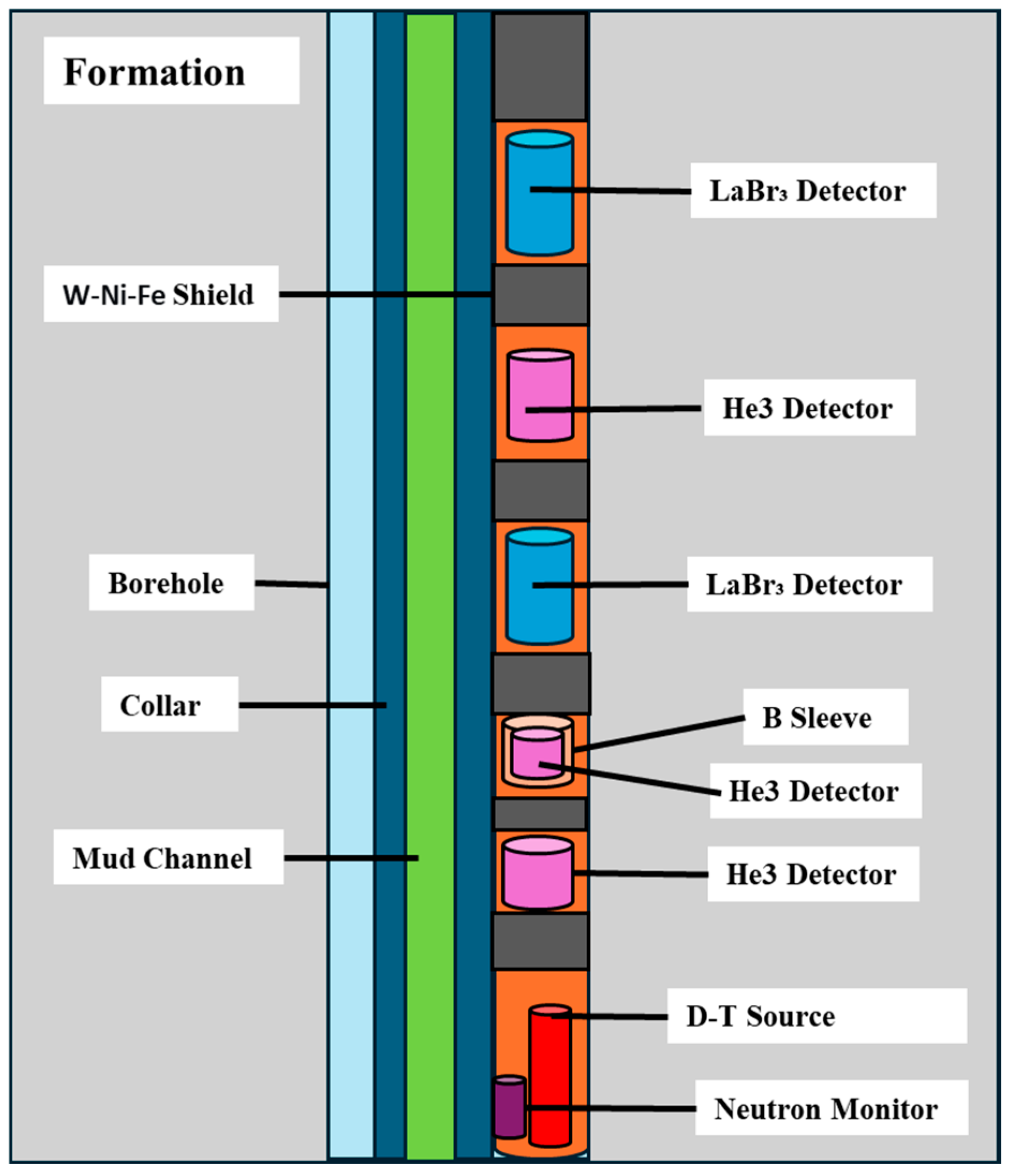
According to the basic structure of the public NGD tool, this study established an LWD model of NGD logging using the Monte Carlo method, as shown in Figure 1. The NGD instrument mainly consists of one D-T source, two LaBr3 detectors, one He3 detector with a B sleeve, and two He3 detectors. The LaBr3 detector is used to record gamma counts, while the He3 detector is used to record thermal neutron counts. Due to the extremely low detection efficiency of epithermal neutrons, a B sleeve is added to the He3 detector to thermalize the epithermal neutrons into thermal neutrons. Therefore, in the simulation, the information listed in Table 1 can be recorded to derive density, porosity, and sigma.

2.3. Density Calculation Method

In the NGD logging, the D-T source emits 14 MeV fast neutrons into formation. High-energy (1~14 MeV) fast neutrons will react with the formation atoms and release secondary inelastic gamma rays. They undergo Compton scattering with formation materials. Thus, the transport of the inelastic gamma rays has a close relationship with the formation density attenuation. By detecting the inelastic gamma information from the formation, the formation density can be derived.
According to the neutron and gamma couple theory [18], the distribution of the inelastic gamma can be described as follows,
N i n ( R ) = n Σ i n S 0 4 π R e R ( 1 a ) ( 1 / λ s ) e R a ρ μ m
where ρ is the actual formation density, n is the gamma photon number from one inelastic scattering collision, μm is the mass attenuation coefficient, S0 is the source strength, R is the gamma detector spacing, Σin is the inelastic scattering cross-section, a is the proportional coefficient, and λs is the high-energy fast-neutron-scattering free path that dominates the fast neutron distribution.
By the couple theory [18], the density can be described as follows,
ρ = A × ln N i n + B × 1 / λ s + C
where A, B and C are constants. It can be seen in Equation (2) that the correction of the fast neutron distribution is necessary when the inelastic gamma information is adopted for density measurement. Considering that high-energy fast neutrons are difficult to detect, the existing density algorithms of NGD logging must use the epithermal neutron, thermal neutron or capture gamma information for correcting the fast neutron distribution.
Before actual NGD logging, the density algorithm of the NGD tool always needed to be calibrated. We found that if a density algorithm only adopts a single type of neutron or gamma count for correcting fast neutron distribution, it can achieve accurate density results under a given lithology condition but cannot simultaneously get accurate results in all three standard lithologies (sandstone, limestone and dolomite). That is because one single kind of neutron or gamma count fails to correct the influence of lithology.
To ensure that the NGD algorithm can perform well in three lithologies, the epithermal and thermal neutron information are simultaneously adopted to correct the influences of fast neutron distribution for the three lithologies [22]. Finally, the NGD algorithm is given as follows,
ρ = A × ln N i n + B × F N C + C
F N C = f ( R t , N e p i )
where FNC is the term of the fast neutron correction, and it is a function of the epithermal neutron count Nepi and thermal neutron count ratio Rt. By the above density algorithm, the NGD tool can obtain accurate density results in three lithologies.

3. Results and Analysis

3.1. Calibration of the Density Algorithm

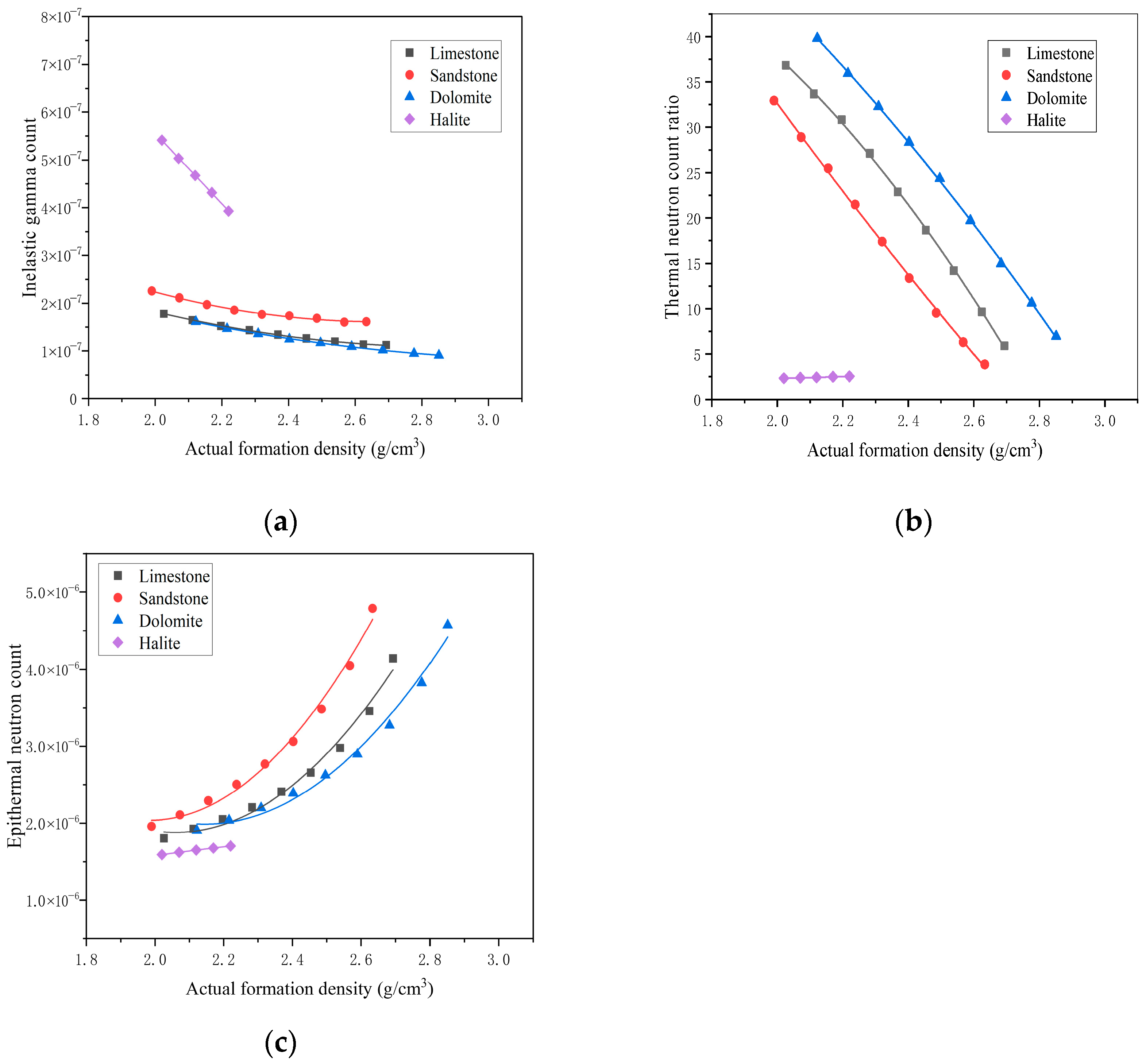
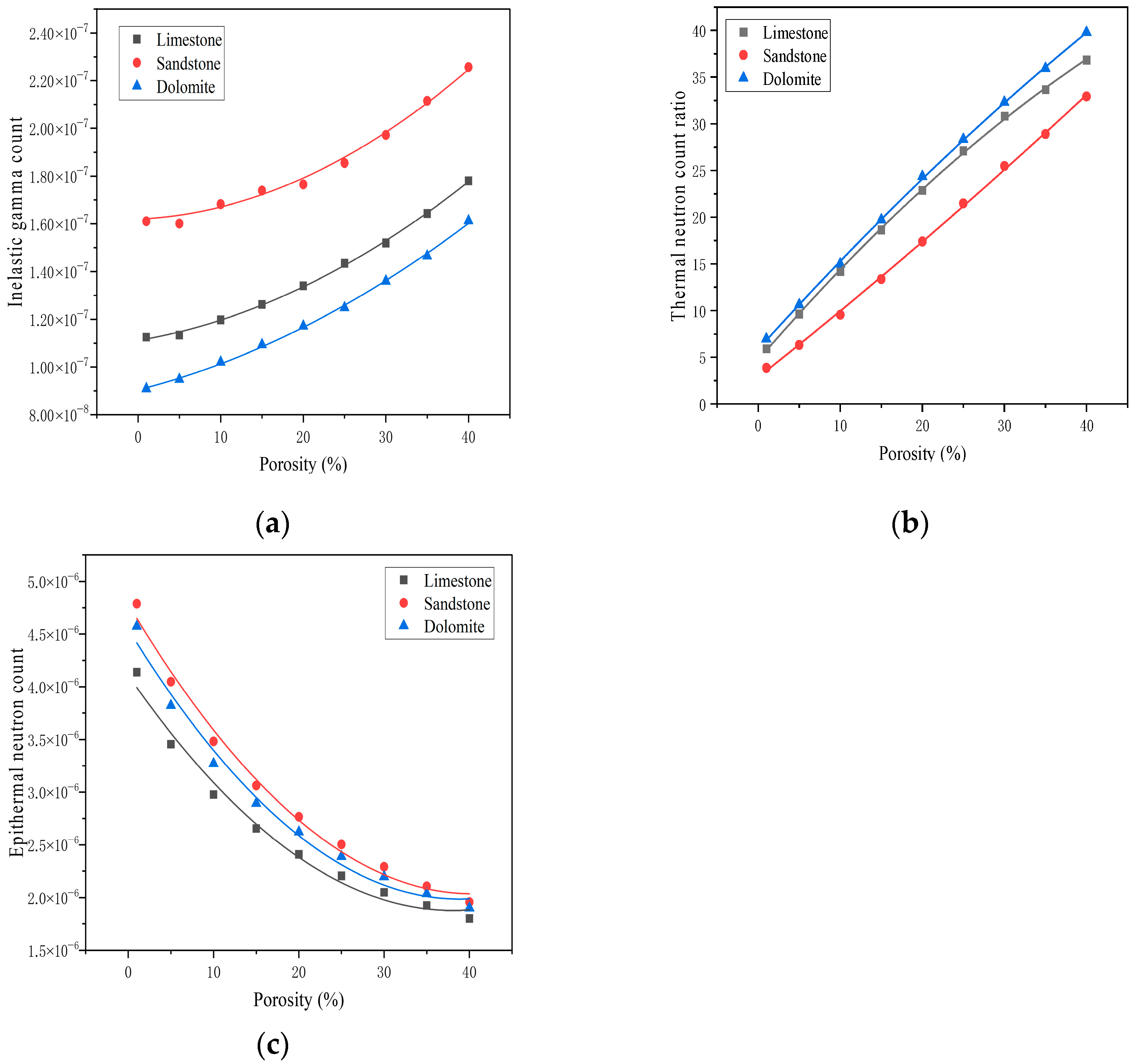
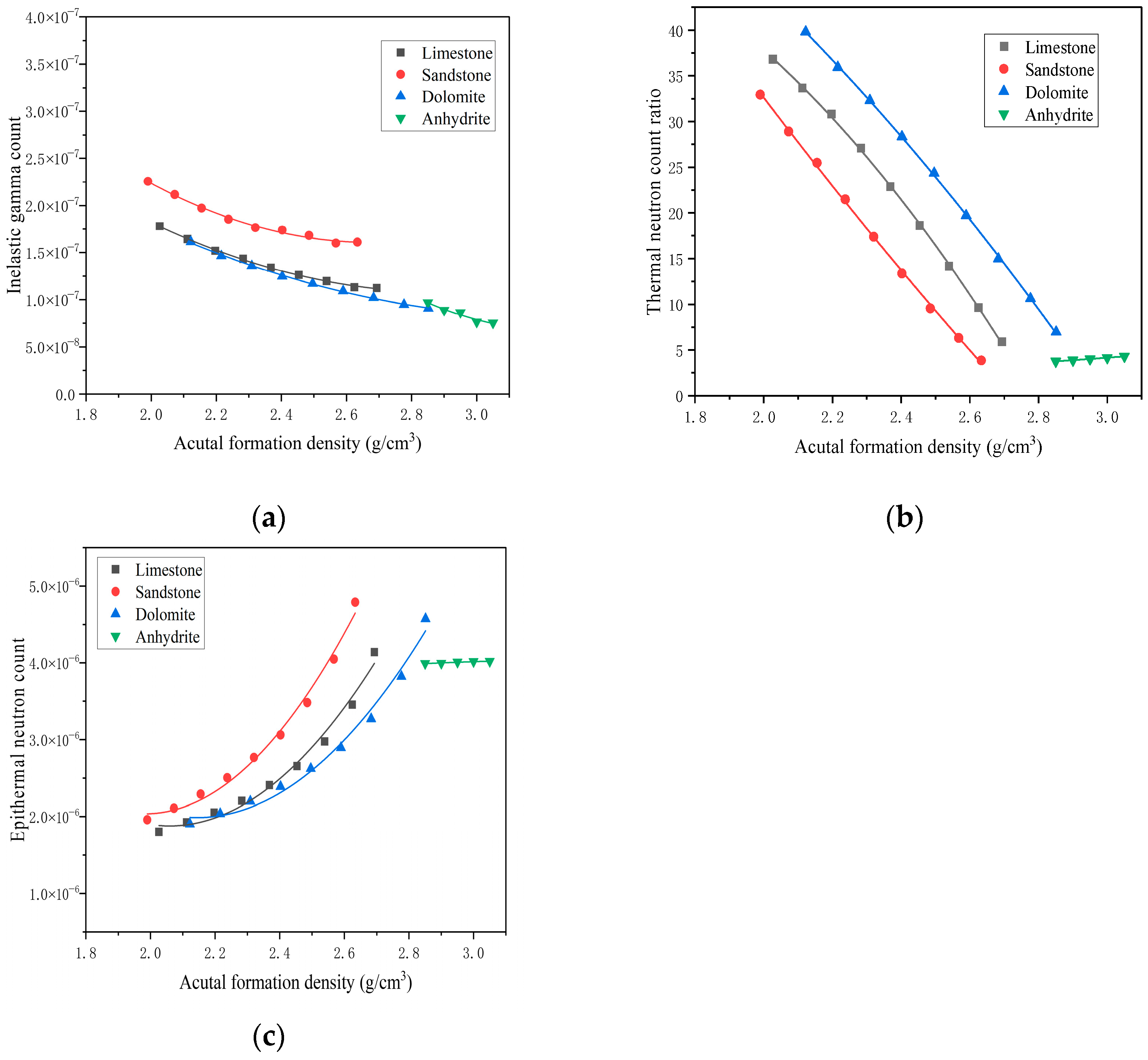
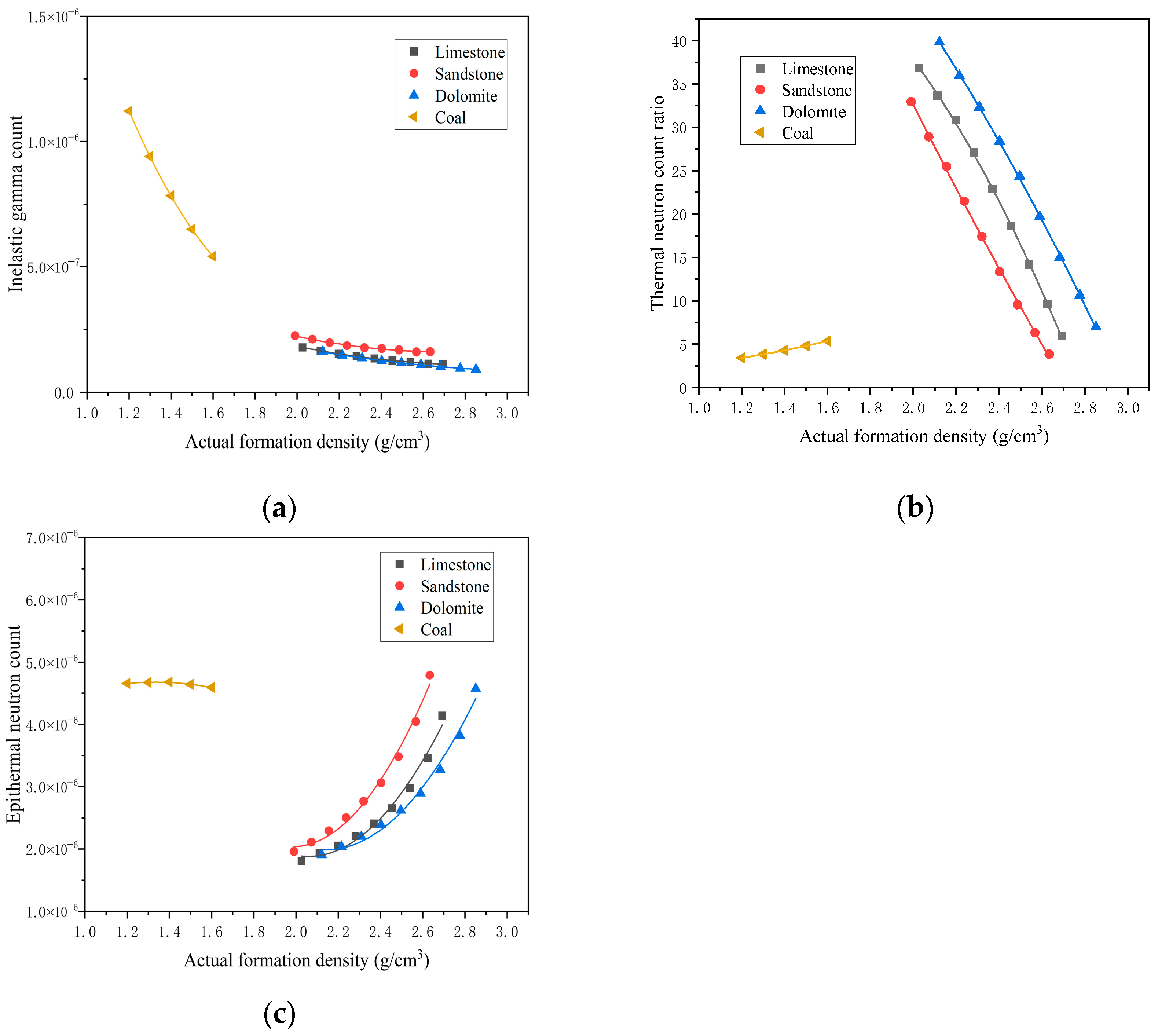
Before analyzing the NGD results in anomalous mineral formations, the density algorithm of the NGD logging must be obtained from calibration wells. The calibration well consists of three types of water-saturated lithological formations (dolomite, limestone and sandstone). Based on the simulation model in Figure 1, a series of calibration-well models were established according to the actual parameters of calibration wells. The formation matrix was set as dolomite, limestone, and sandstone, respectively, and the porosity was set to 1% to 40%. The size and fluid of the borehole part were set to 20 cm and fresh water, respectively. Figure 2 shows the logging responses of the inelastic gamma count, thermal neutron count ratio, and epithermal neutron count under different calibration well conditions.
As shown in Figure 2, as porosity increases, the inelastic gamma count and thermal neutron count ratio gradually increases, while the epithermal neutron count gradually decreases. In addition, the lithology also has a clear influence on the three logging responses mentioned above. Based on the simulation data in Figure 2 and multiple regression methods, the content (A, B and C) of the density algorithm (Equations (3) and (4)) was derived, and the corresponding error of the density algorithm was also derived in Equation (5)
Δ ρ = ρ a ρ
where Δρ is the density error and ρa is the apparent density calculated by the density algorithm.
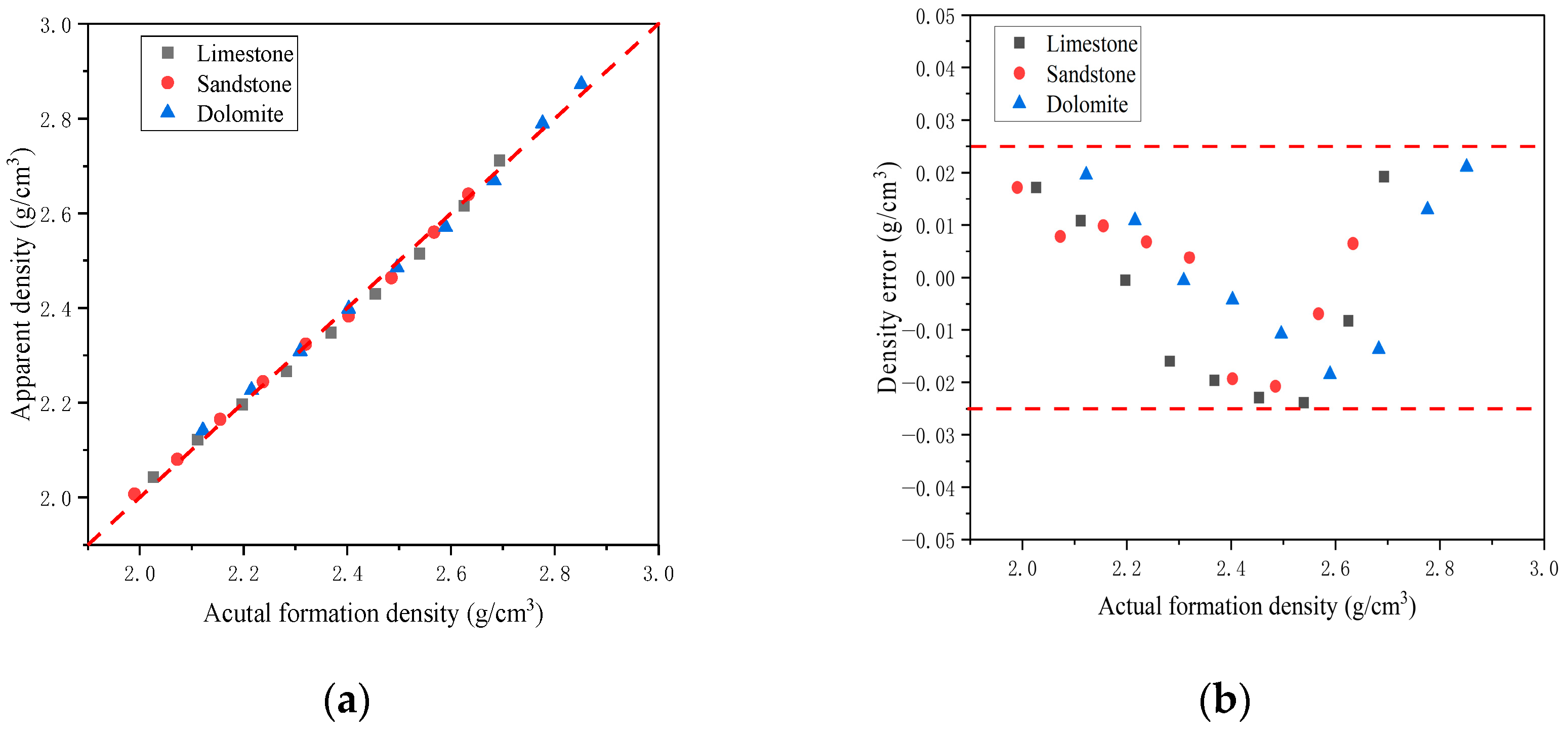
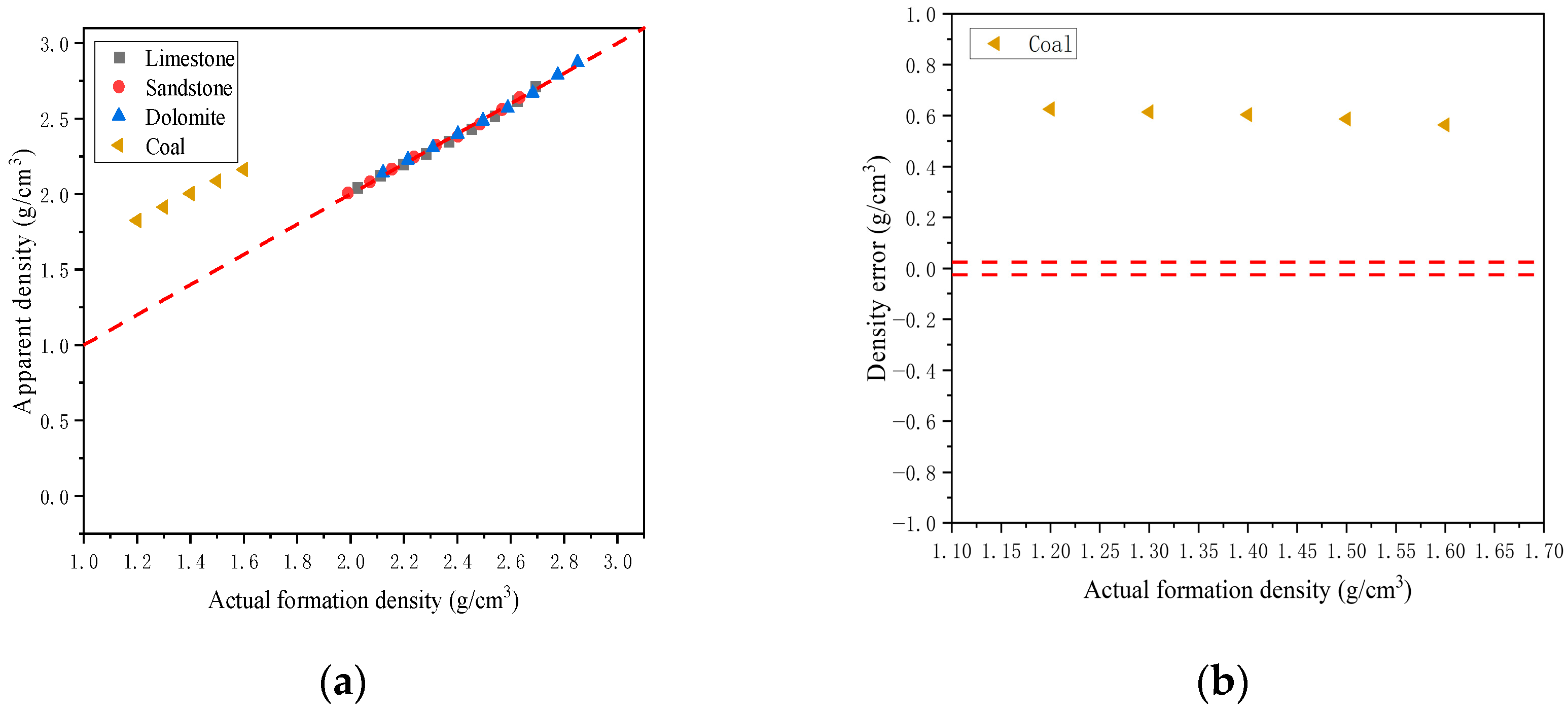
From the algorithms in Equations (3) and (4), the apparent formation density can be calculated using the inelastic gamma count, the thermal neutron count ratio and the epithermal neutron count. Figure 3 shows the performance of the new NGD algorithm in water-saturated sandstone, limestone and dolomite. It can be seen from Figure 3 that the apparent density of NGD logging is highly consistent with the true formation density, and density error can be maintained within ±0.025 g/cm3 in three lithologies. This indicates that the NGD algorithm in Equation (3) is not affected by the common formation lithology.

3.2. Logging Responses and Result Analysis in Anomalous Mineral Formations

To investigate the logging response in anomalous mineral formations, the common formation materials of NGD model in Figure 1 need to be replaced by anomalous minerals, such as anhydrite, halite, and coal. Specific parameters of the anhydrite, halite, and coal are shown in Table 2. Note that coal seams have numerous classifications, and their elemental composition varies significantly. In this study, a typical and common coal seam with 90% carbon content was selected for simulation.
By changing the element composition and density of the formation part, the NGD logging responses in different anomalous mineral conditions can be simulated, and the density results of NGD logging in anomalous mineral formations can be obtained and analyzed.

3.2.1. Influence Mechanisms of Anhydrite

(1)
Logging responses in anhydrite
In the simulation, the element composition of the anhydrite is set to CaSO4 and kept unchanged. The anhydrite density was changed from 2.85 g/cm3 to 3.05 g/cm3, and the density interval was 0.05 g/cm3. By these settings, the logging responses of the inelastic gamma count, the thermal neutron count ratio, and the epithermal neutron count in anhydrite formation can be simulated, as shown in Figure 4.
It can be concluded from Figure 4 that the change law of the inelastic gamma count with formation density in anhydrite is consistent with that in three lithologies, and that the inelastic gamma count decreases with increasing formation density. That is because the inelastic gamma information is mainly influenced by the inelastic scattering cross-section and density attenuation. Since the three lithologies (Ca, C, O, Mg and Si) have similar elemental composition to anhydrite (Ca, S and O), there is only a minor difference in the inelastic scattering cross-section. Therefore, compared to the common lithologies, the change law and count of the inelastic gamma in anhydrite does not change significantly. However, the change laws of the thermal neutron count ratio and epithermal the neutron count in anhydrite have significant differences from those in the common three lithologies. That is because the thermal neutron and the epithermal neutron information are primarily influenced by the hydrogen index. Anhydrite has zero porosity; as a result, the thermal neutron count ratio and the epithermal neutron count in anhydrite hardly vary with density changes.
(2)
Error analysis of NGD logging in anhydrite
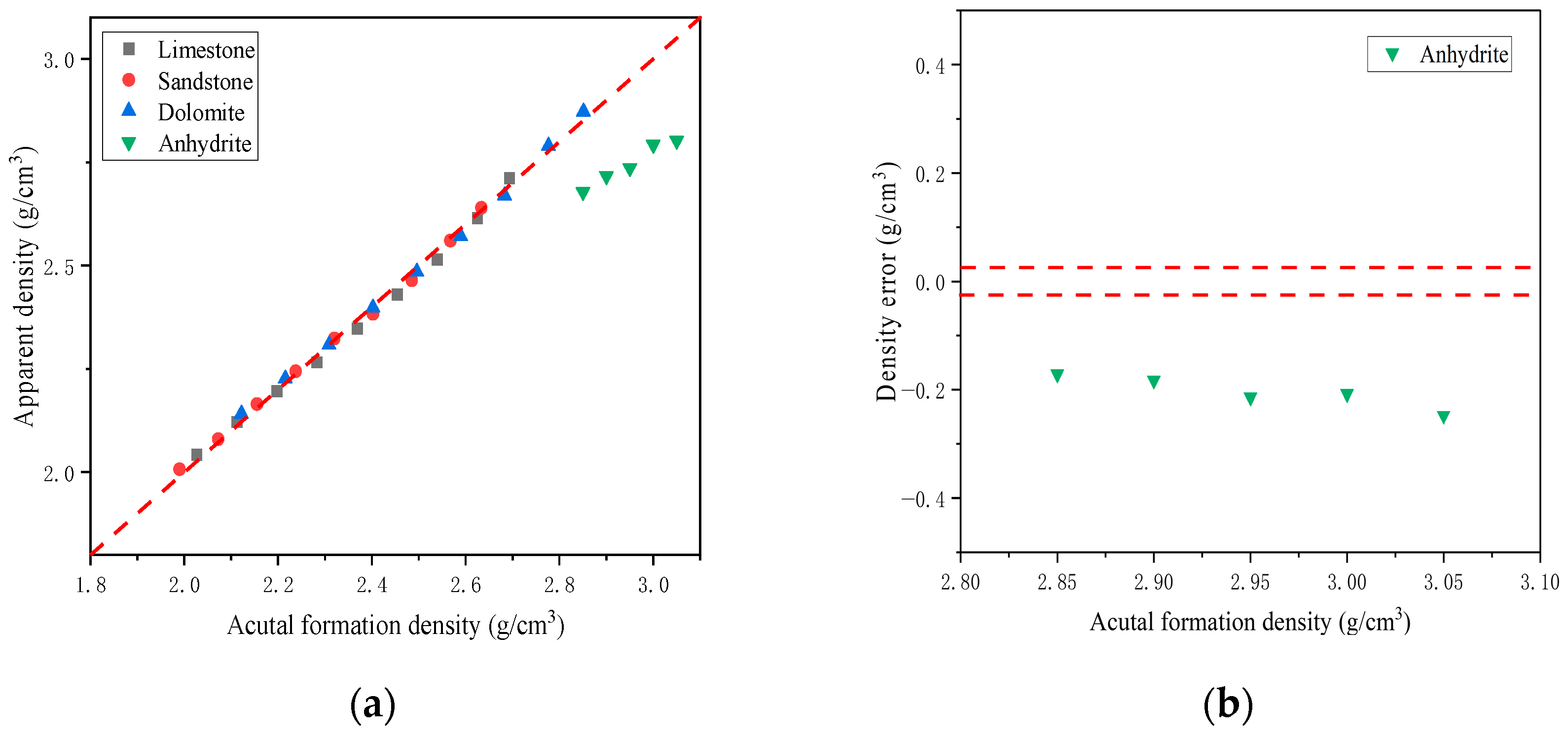
Based on the simulated data in Figure 4 and the density algorithm in Equation (3), the apparent density and density error of NGD logging in anhydrite were calculated, as shown in Figure 5.
As can be seen from Figure 5, the apparent density of anhydrite is relatively low compared to real density, and the density error is significantly greater than the standard error of ±0.025 g/cm3. That is the reason why NGD logging cannot work in anhydrite formations.
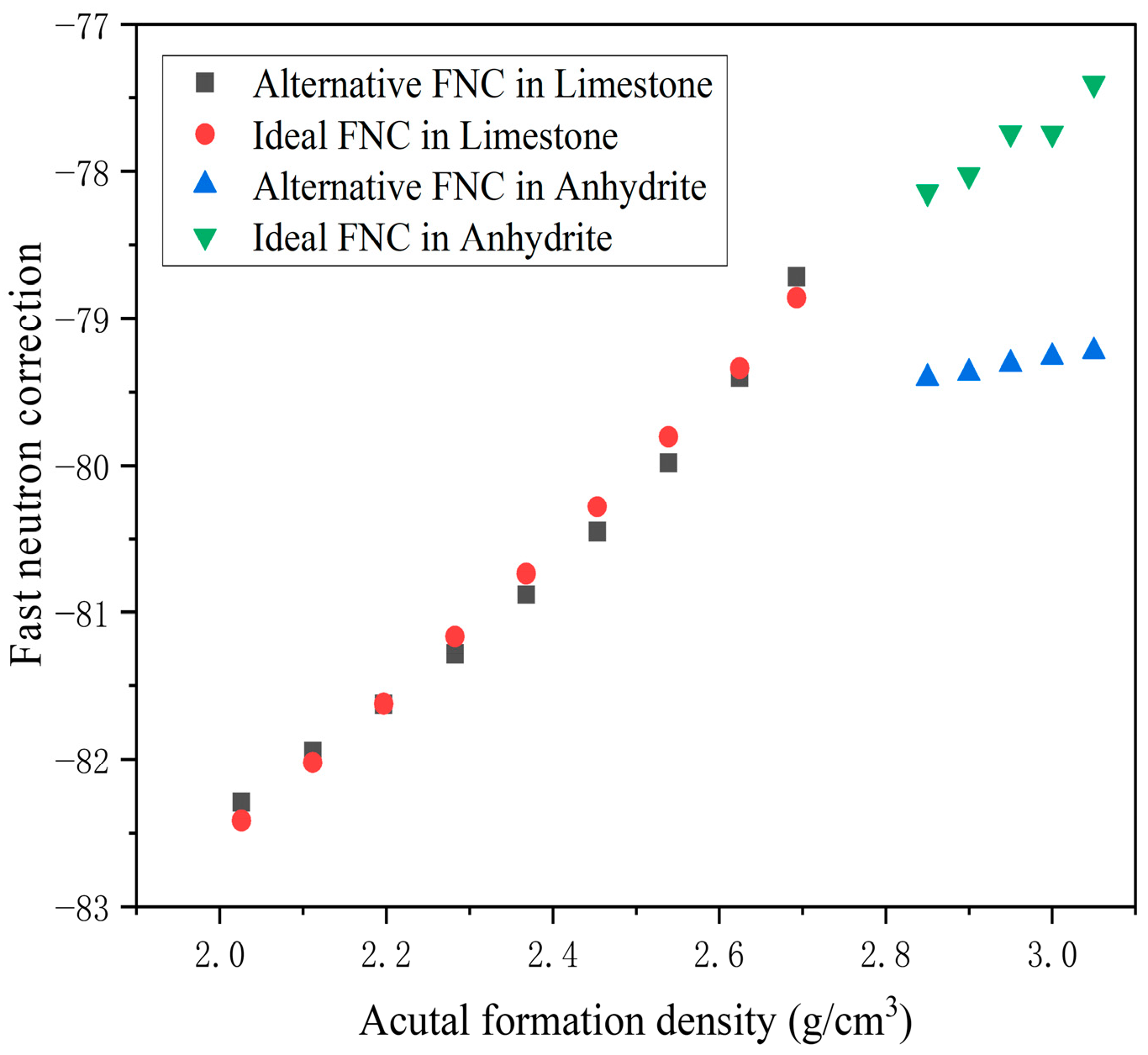
To investigate the causes of significant NGD errors in anhydrite, the concept of the ideal fast neutron correction (FNC) was introduced. The ideal FNC refers to the ideal amount of fast neutron correction required to calculate accurate formation density for a given inelastic gamma count, and its expression can be derived from Equation (2),
I d e a l   F N C = A × ln N i n ρ + C B
where ρ is the actual formation density. When the actual formation density and inelastic gamma count are given, the ideal fast neutron correction can be obtained. The ideal FNC is absolutely different from the FNC in Equation (4). In actual logging, the ideal FNC cannot be measured; therefore, an alternative FNC in Equation (4) has to be adopted for the density measurement, and it can be calculated using the thermal and epithermal neutron information.
Figure 6 shows the comparison results of the ideal and alternative FNC in anhydrite. It can be seen that, as the density algorithm is derived from the common three lithologies, the ideal FNC and alternative FNC are approximately equal. However, due to the zero porosity of anhydrite, the logging responses of the thermal and epithermal neutron significantly changed; as a result, the alternative FNC derived from the thermal and epithermal neutron information is smaller than the ideal FNC, and it cannot satisfy the requirement for the actual fast neutron correction.
In summary, the calculated apparent NGD results in anhydrite are relatively low and contain significant errors. This is mainly because the alternative FNC using the thermal and epithermal neutron information cannot fully replace the ideal FNC in anhydrite.

3.2.2. Influence Mechanisms of Halite

(1)
Logging responses in halite
For the simulation in halite, the element composition of the formation part is set to NaCl and kept unchanged. Halite density was changed from 2.02 g/cm3 to 2.22 g/cm3, and the density interval is 0.05 g/cm3. Using similar settings, the logging responses of the inelastic gamma count, the thermal neutron count ratio, and the epithermal neutron count in halite formations can be obtained.
Figure 7 shows the comparison results of logging responses in halite and the three lithologies. As can be seen, the logging response of the inelastic gamma count in halite is different from that in three lithologies, and the value is relatively larger. That is because there is a lager difference in elemental composition between halite and the three lithologies; as a result, the inelastic scattering cross-section of halite and common lithologies is different. When the formation density is same, more inelastic gamma rays are produced in halite. In addition, similar to anhydrite, halite also has zero porosity; hence, the thermal neutron count ratio and the epithermal neutron count in halite hardly vary with density changes.
(2)
Error analysis of the NGD logging in halite
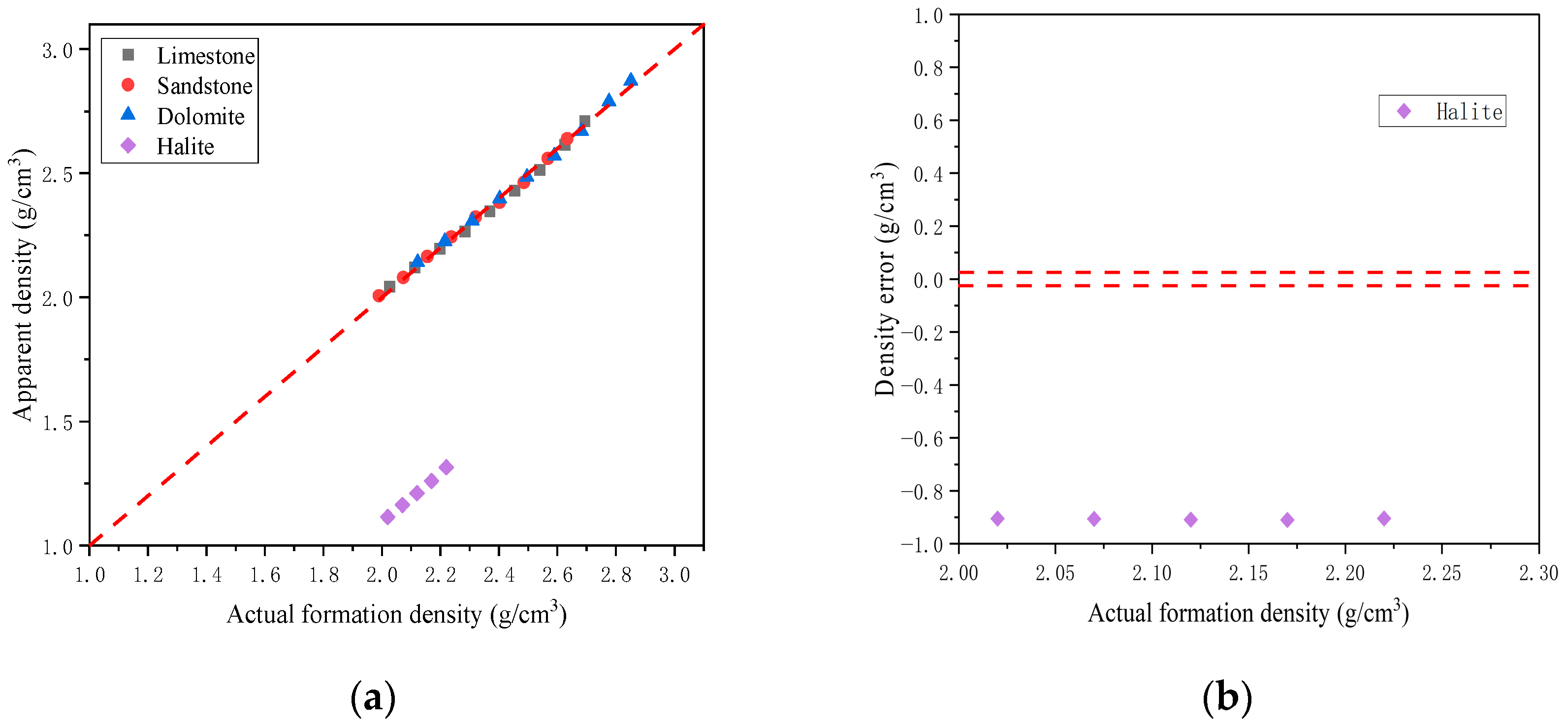
The apparent density and density error in halite formations are given in Figure 8. As shown in Figure 8, the apparent density calculated in halite is too low, and the density error is approximately −0.9 g/cm3, which is far greater than the standard error of ±0.025 g/cm3.
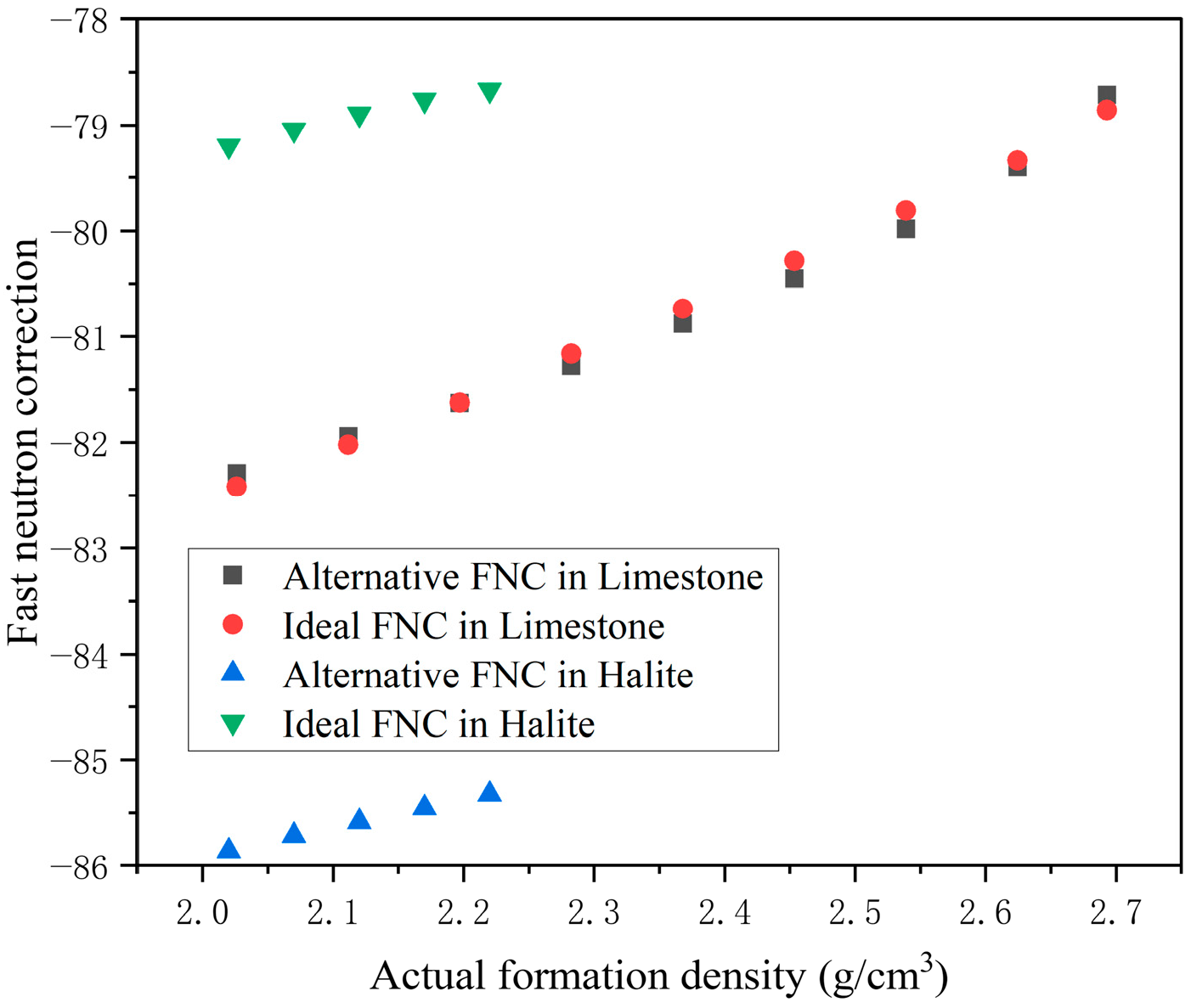
The ideal FNC and alternative FNC in halite formations were also compared in Figure 9. The ideal FNC of halite is far greater than the alternative FNC. That is because the ideal FNC in halite formations includes the influence of the inelastic scattering cross-section and fast neutron distribution. While the alternative FNC derived from the epithermal and thermal neutron information can only reflect partial effects of the fast neutron distribution, it cannot be used for correcting the influence of the inelastic scattering cross-section. That is why there is a large difference between the ideal FNC and alternative FNC. As a result, NGD logging is not suitable in halite formations.
In summary, due to significant differences in elemental composition between halite and the common formations, the logging responses in halite formations differ from those in the three lithologies. Consequently, the alternative FNC for the density algorithm cannot absolutely eliminate the influence of the inelastic scattering cross-section and fast neutron distribution, which cause the apparent density of NGD logging in halite to be far smaller than the true density.

3.2.3. Influence Mechanisms of Coal

(1)
Logging responses in coal
Similarly, NGD logging responses in coal also can be analyzed in the same way. The element composition of coal was set according to Table 1, and the density was changed from 1.20 g/cm3 to 1.60 g/cm3 with an interval of 0.10 g/cm3. Figure 10 shows the logging response of inelastic gamma count, thermal neutron count ratio and epithermal neutron count in coal. It can be seen that, due to the element difference and low density, the inelastic gamma count in coal is far larger than that in standard formations. In addition, due to the low porosity and density, the neutron slowing-down capability of coal is very weak. As a result, the thermal neutron count ratio in coal is relatively small, and the epithermal neutron count in coal is relatively large.
(2)
Error analysis of the NGD logging in coal
The apparent density and density error of NGD logging in coal seam were calculated and shown in Figure 11. The apparent density in coal is greater than the true density, and the density error is approximately 0.50~0.60 g/cm3, which is significantly greater than the standard error of ±0.025 g/cm3.
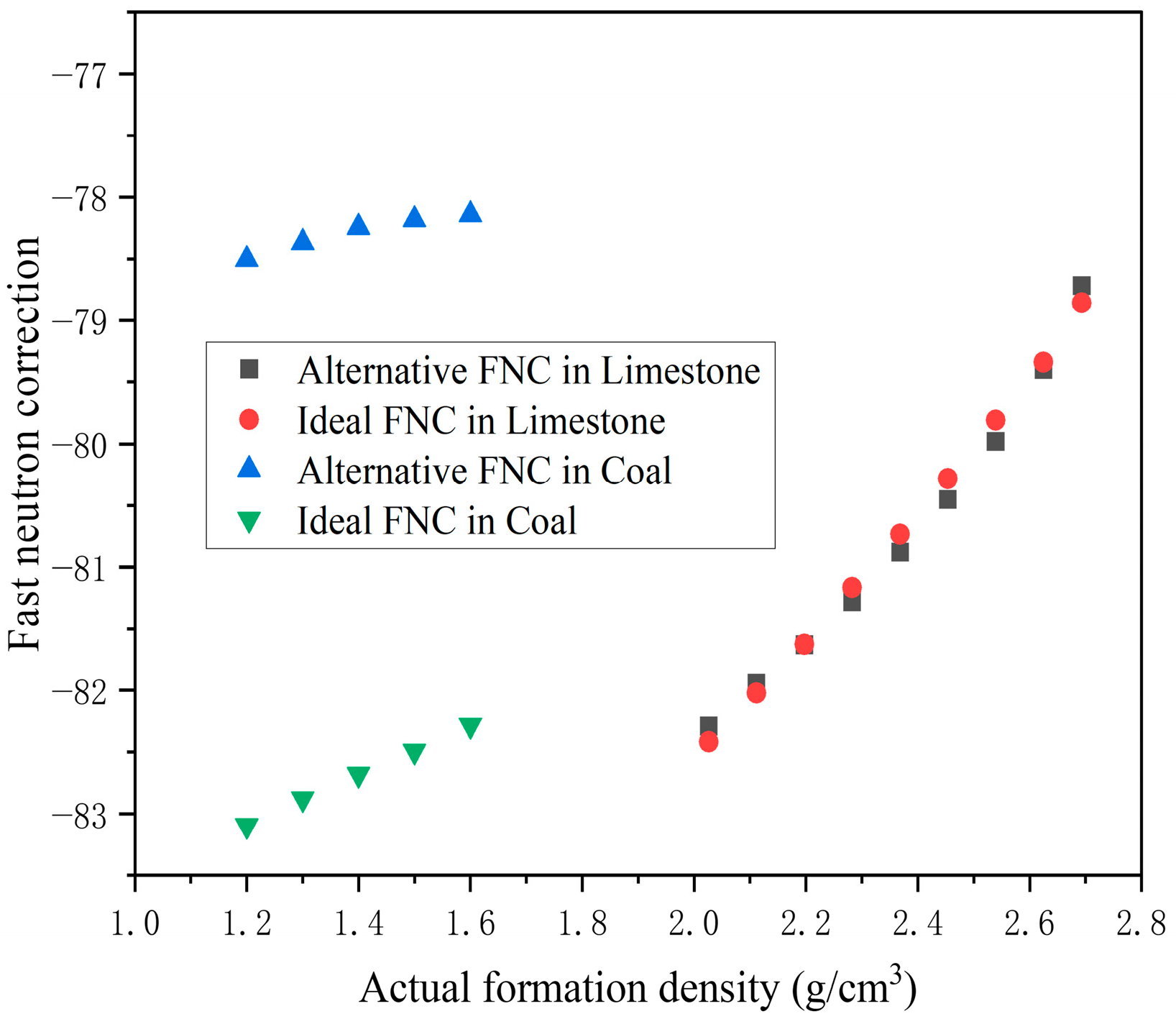
Figure 12 shows the ideal FNC and alternative FNC in coal seams. The ideal FNC in coal is far smaller than the alternative FNC, resulting in a larger apparent density and density error in coal.
In summary, the influence of coal on NGD logging is similar to that of halite. The large difference in element composition results in the generation of inelastic gamma rays in coal seams that differ from those in standard formations. The alternative FNC cannot satisfy the need for correction due to the inelastic scattering cross-section and fast neutron distribution.

4. Identification and Correction Method

Based on the above analysis, it can be found that the influence mechanisms of anhydrite, halite and coal on NGD logging are different. As a result, it is difficult to obtain one common correction algorithm which can work in all anomalous mineral formations. Therefore, the “identification and correction” idea were proposed to resolve the application of NGD logging in anomalous mineral formations.
The NGD tool in Figure 1 which adopts the array neutron gamma detection system can simultaneously measure apparent density, neutron porosity, sigma and element content. Although element content is the most convenient way to identify mineral type, element logging is difficult to implement and has significant uncertainties. Therefore, the apparent density, neutron porosity, and sigma were used for identifying the mineral type in this study. By analyzing the differences in apparent density, neutron porosity, and sigma between anomalous minerals and the three lithologies, the identification charts for anomalous minerals can be established. Subsequently, the corresponding correction method can be proposed according to the identification results.

4.1. Identification Method for Different Anomalous Minerals

(1)
Nuclear parameters of different anomalous minerals
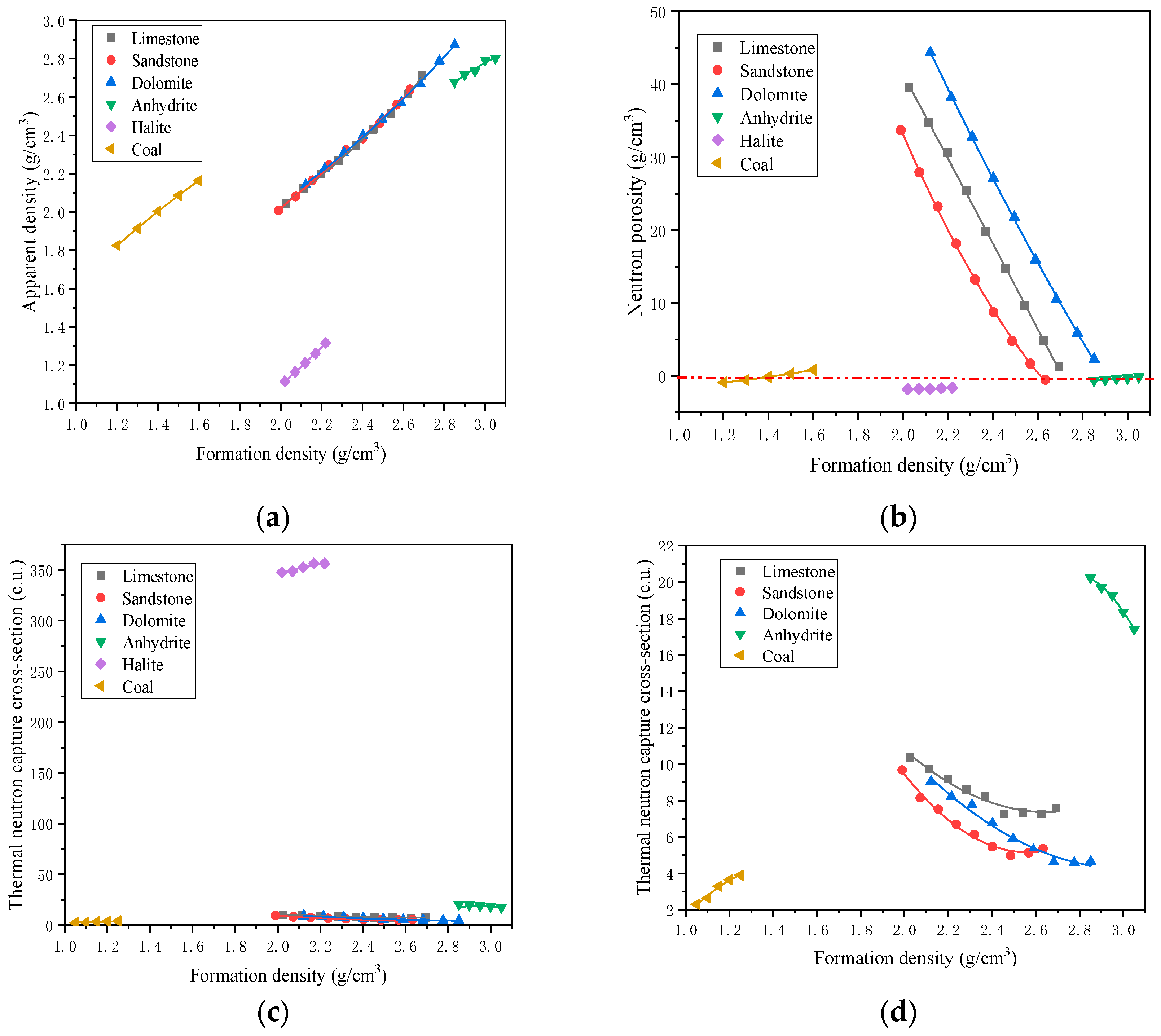
Based on the NGD model in Figure 1, the inelastic gamma count, epithermal neutron count, thermal neutron count and time spectrum of thermal neutron in different anomalous mineral formations can be simulated, and the apparent density, neutron porosity, and sigma can be derived, as shown in Figure 13.
It can be seen from Figure 13 that the apparent density of halite is much lower than that of standard formations, while the apparent density range of anhydrite and coal is very close to that of common formations. Compared to common lithologies, the neutron porosity in anomalous mineral formations is nearly zero. As for the formation sigma, the halite has far larger sigma than that of other minerals. Due to the low density, coal has the smallest sigma in all minerals. In addition, although anhydrite has a relatively larger sigma than that of the common lithologies and coal, its sigma is still very small compared to halite.
(2)
Identification charts for different anomalous minerals
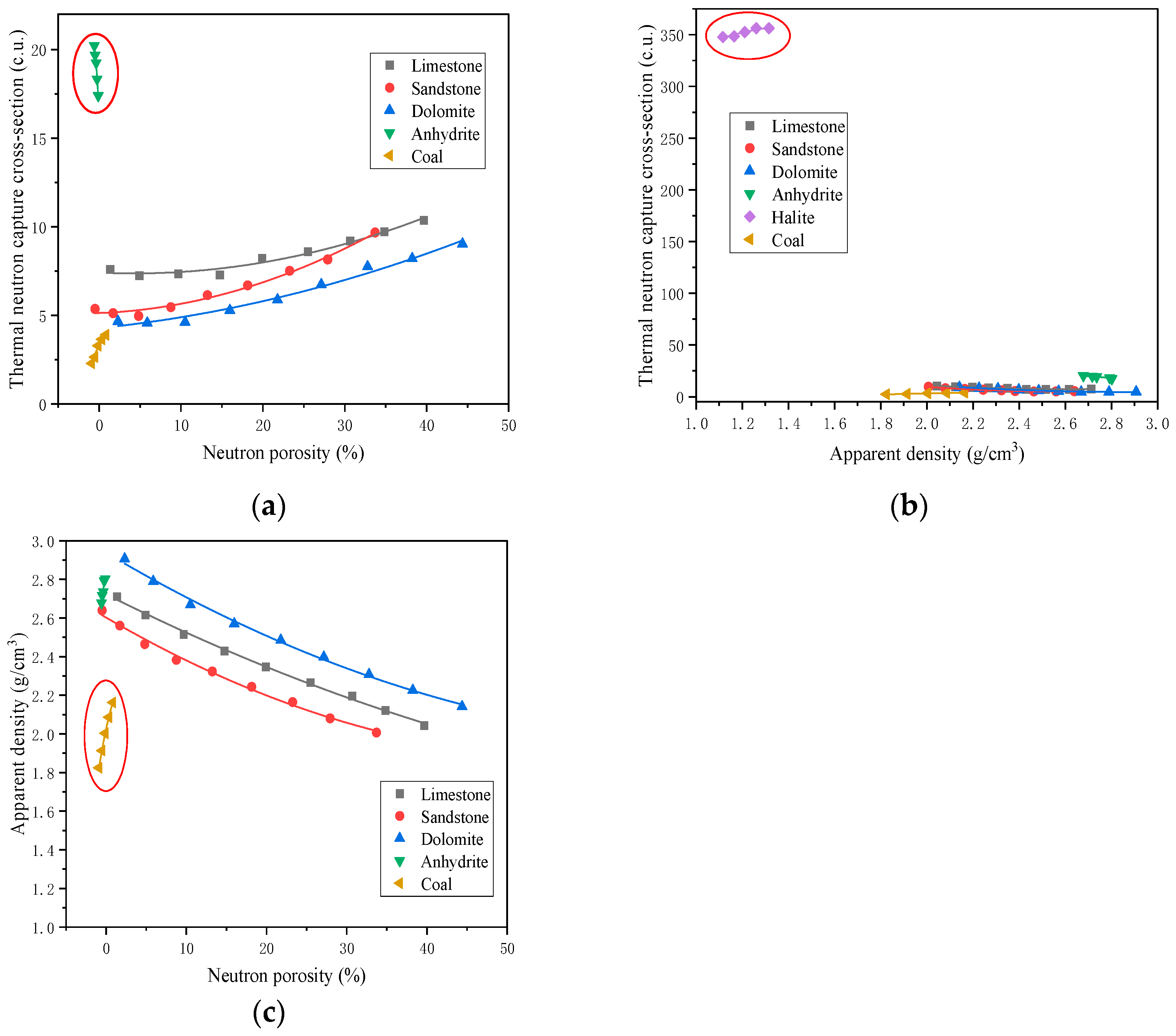
According to above analysis, it can be seen that using a single nuclear parameter is difficult to distinguish anomalous minerals except for halite. Hence, the cross-plot idea of two nuclear parameters is adopted for mineral identification.
It can be seen from Figure 14, compared to common formations, anhydrite has nearly zero neutron porosity and relatively high sigma, and coal has relatively low apparent density and neutron porosity. As for halite, it has a very high sigma and a low apparent density. Overall, the cross-plot of the neutron porosity and sigma can be used to identify anhydrite, the cross-plot of the apparent density and sigma can be used to identify halite, and the cross-plot of the neutron porosity and apparent density can be used to identify coal.

4.2. Correction Algorithms for Different Anomalous Minerals

By analyzing the change laws of NGD errors in different minerals, it can be found that the density error of NGD logging has a close relationship with apparent density. As a result, the mathematical relationship between density error and apparent density in NGD logging can be established for obtaining accurate density,
Δ ρ = g ( ρ a )
ρ c = ρ a Δ ρ = ρ a g ( ρ a )
where ρc is the corrected density of NGD logging, and ρa is the apparent density before correction.
(1)
Density correction in anhydrite
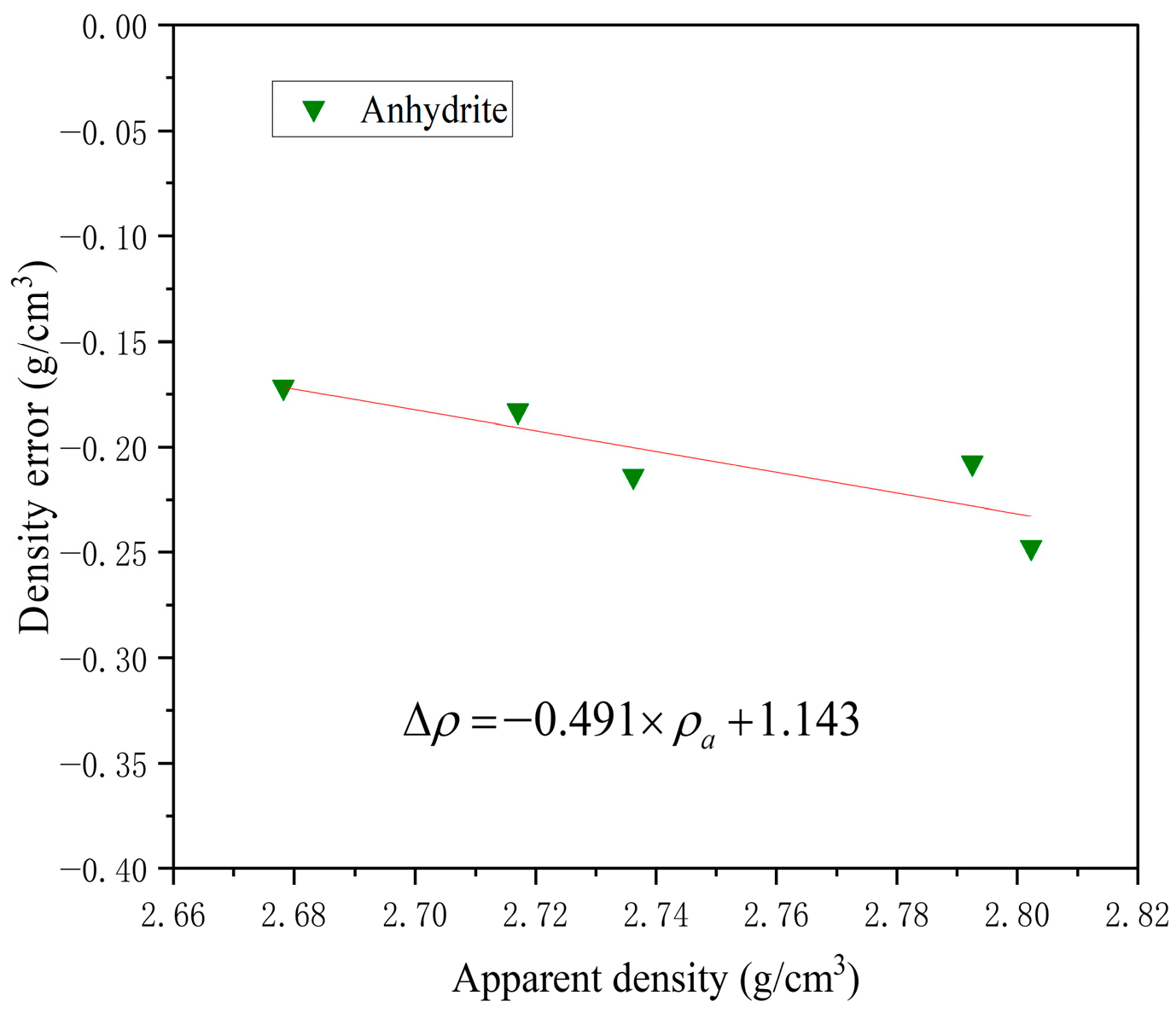
Figure 15 shows the relationship between apparent density and density error in anhydrite. As can be seen from that, there is a linear relationship between the density error and apparent density, and the detailed mathematical formula is also given.
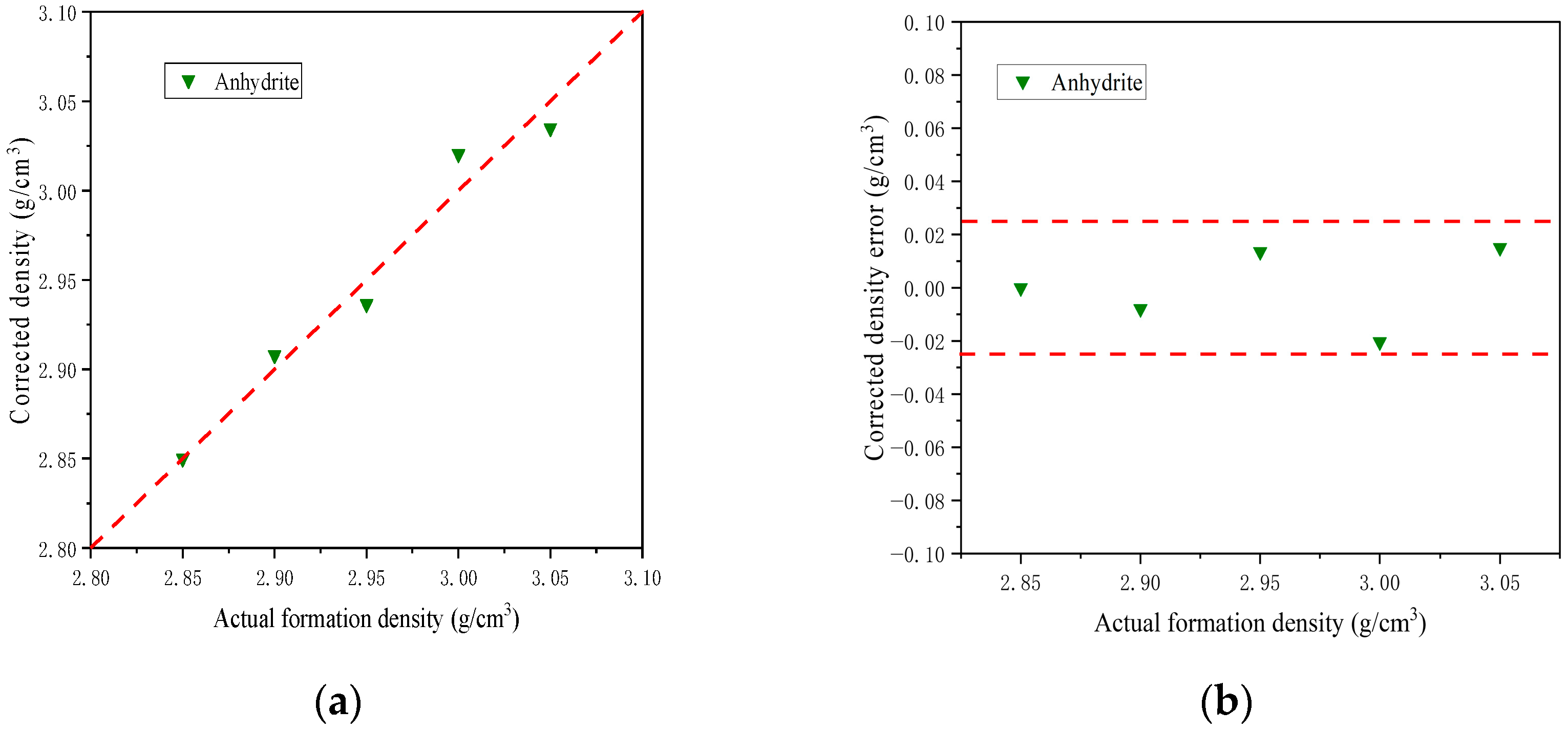
The corrected density and density error in anhydrite are shown in Figure 16. As can be seen, the apparent density after correction in anhydrite is more accurate, and the density error meets the standard of ±0.025 g/cm3.
(2)
Density correction in halite
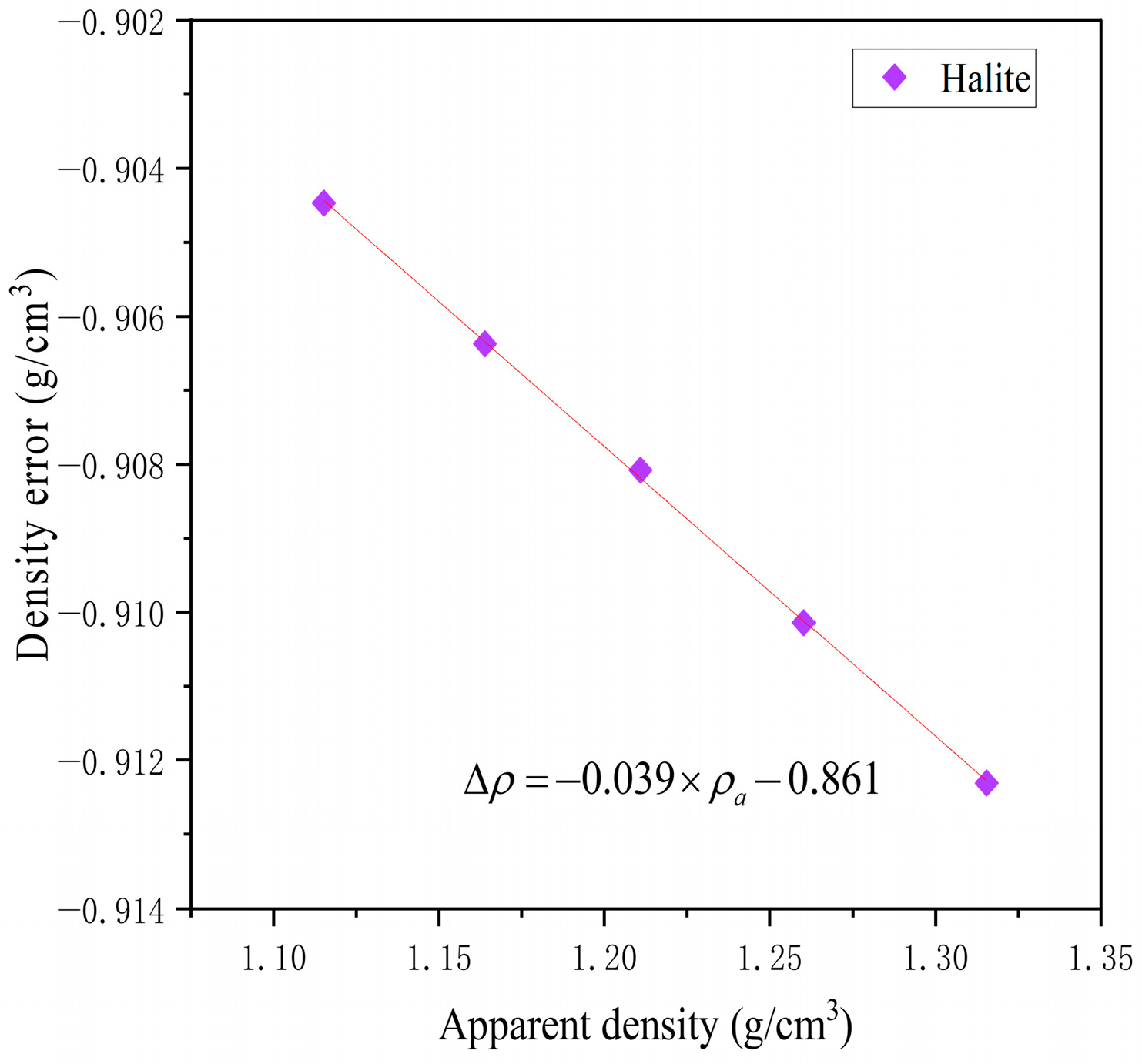
Figure 17 shows that the density error in halite has a good linear relationship with its apparent density.
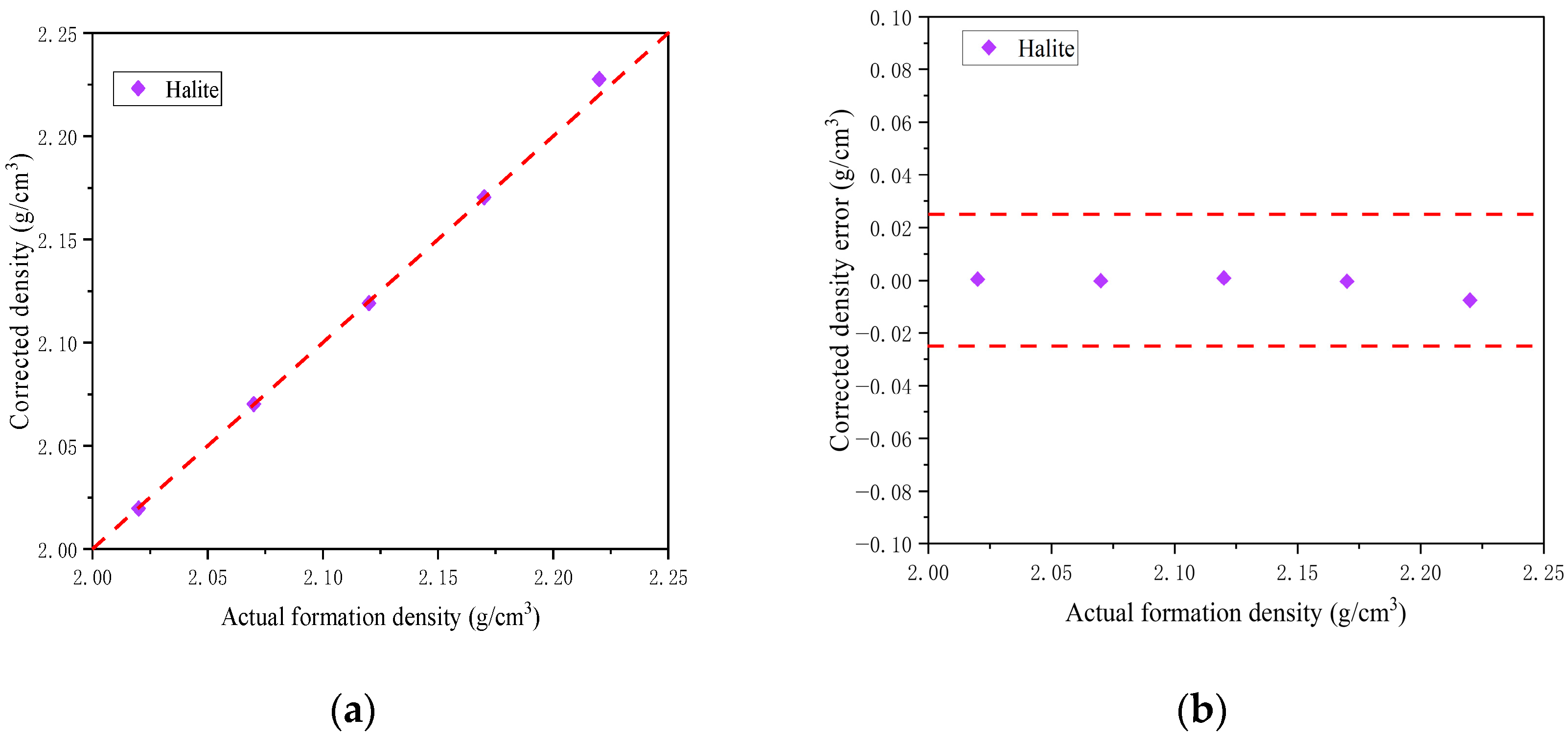
Using the correction algorithm in Figure 17, the corrected density and density error in halite are shown in Figure 18. As can be seen, apparent density after correction in halite is very close to the actual density, and the corrected density is controlled within ±0.01 g/cm3.
(3)
Density correction in coal
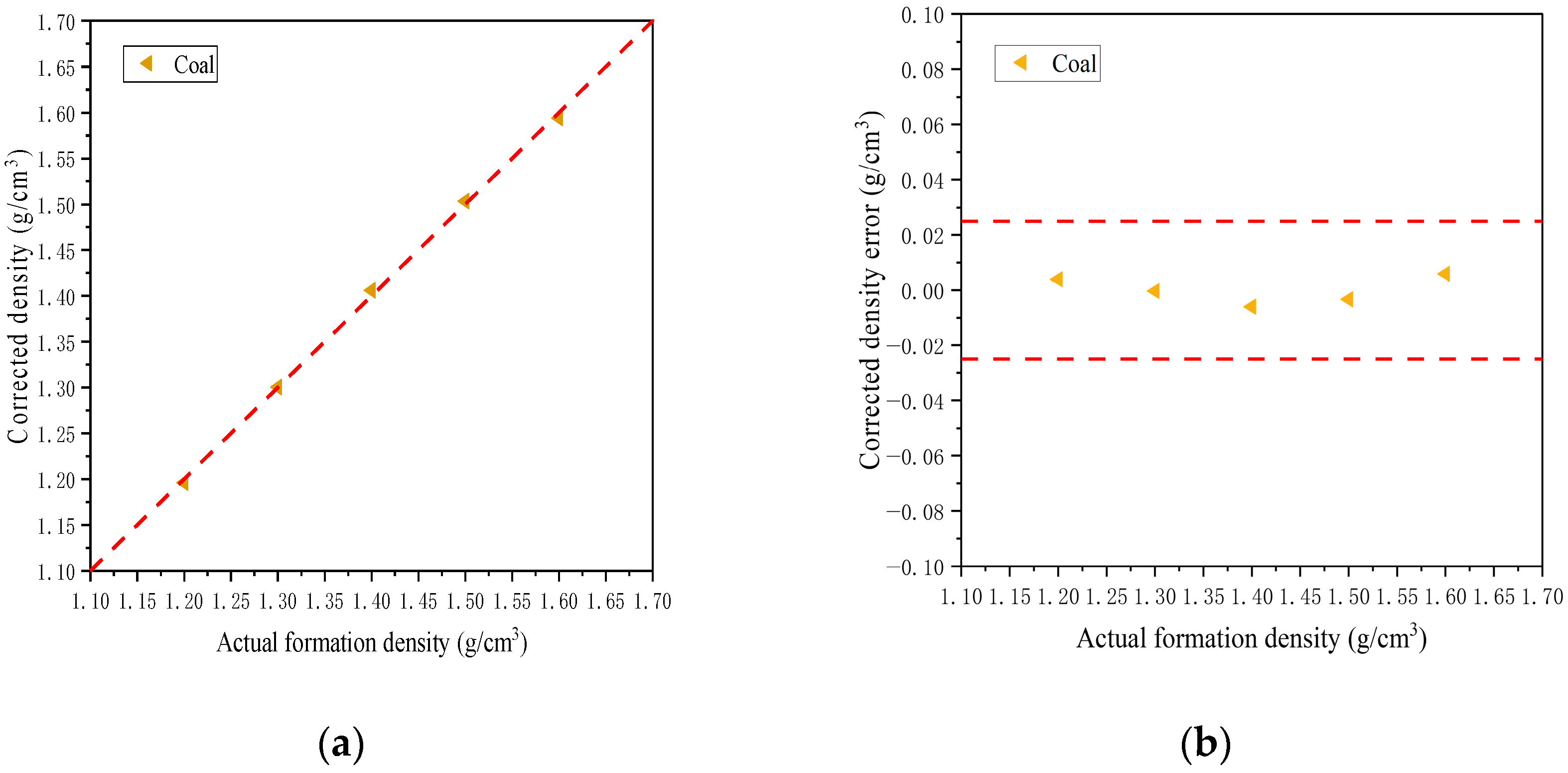
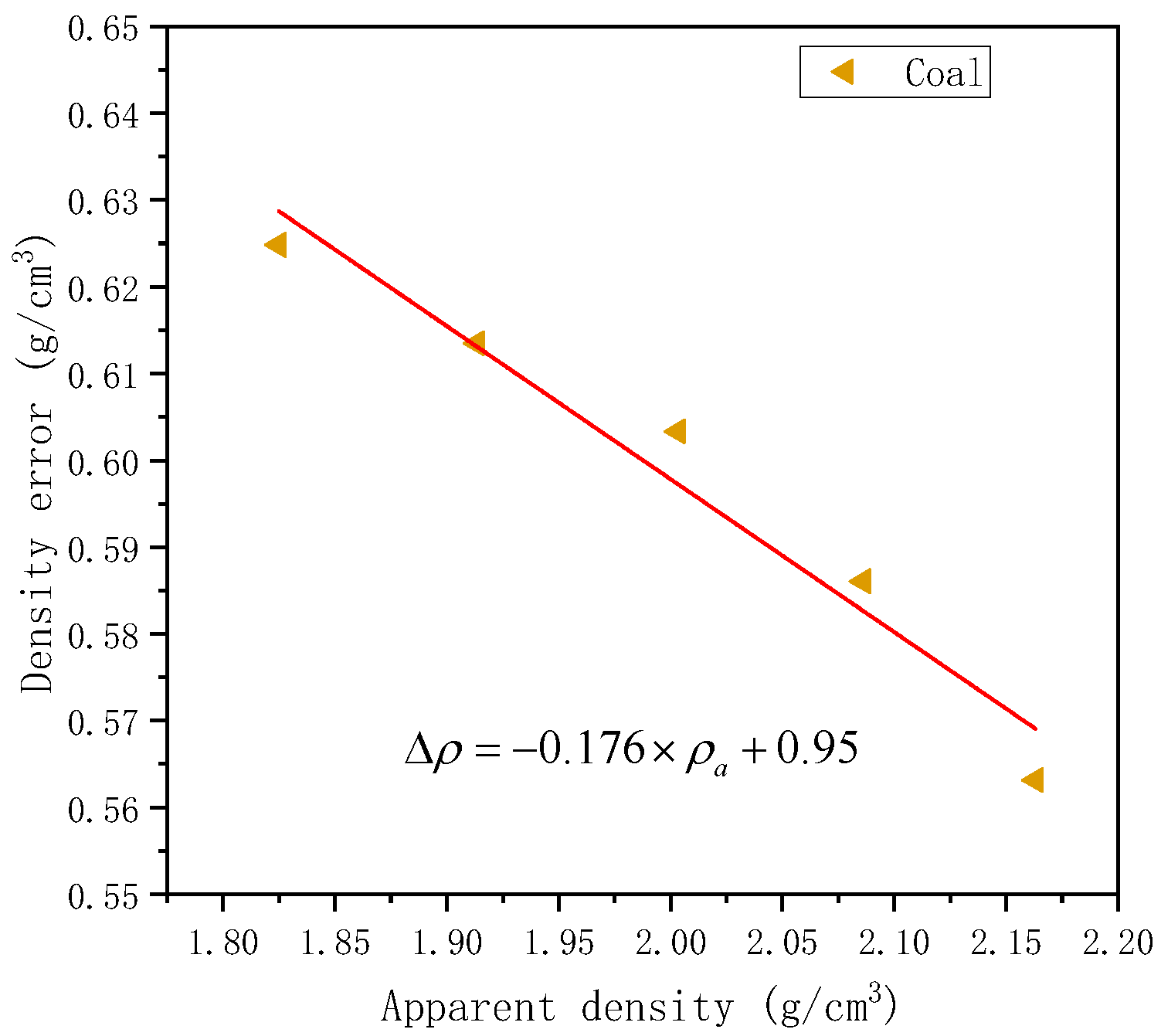
Similarly, the relationship between apparent density and density error in coal also has a good linear relationship with its apparent density, as shown in Figure 19.
Similarly, the corrected density and density error of coal are given in Figure 20. It is clear that the apparent density after correction in coal is also very close to the actual formation density, and the corrected density error can be controlled within ±0.01 g/cm3.

5. Conclusions

By using the Monte Carlo method, this paper studies the NGD logging responses in anomalous mineral formations and analyzes the influence mechanism of anomalous minerals on NGD logging. Based on the differences in nuclear parameters, the identification charts for different anomalous minerals were established. Finally, the corresponding NGD correction algorithms were proposed. The conclusions were given as follows:
(1)
The apparent density of NGD logging in anhydrite is relatively low and contains significant errors. That is because the high density and zero porosity of anhydrite makes the logging responses of the thermal neutron count ratio and the epithermal neutron count significantly different with the common formation. As a result, the alternative FNC calculated by the epithermal and thermal neutron information cannot absolutely match the actual high-energy fast neutron distribution.
(2)
As for the halite and coal, their elemental composition differs significantly from those of common formations, which leads to an obvious difference in the generation of inelastic gamma rays. In halite and coal, the alternative FNC calculated by the epithermal and thermal neutron information cannot satisfy the need for correction of the influence of the inelastic scattering cross-section.
(3)
As the influence mechanisms and results of anhydrite, halite and coal on NGD logging are different, the correction method for NGD logging in different mineral formations needs to be established according to the mineral type, respectively. Hence, the “identification and correction” idea is introduced in the study. Before density correction, the mineral type needs to be determined.
(4)
The NGD tool with an array detector system can provide apparent, neutron porosity, sigma and other nuclear parameters. Using the differences in apparent density, neutron porosity and sigma, halite can be easily distinguished by its very high capture cross-section (sigma) and low apparent density; anhydrite by its high sigma and low neutron porosity; and coal by its very low apparent density and neutron porosity.
(5)
By using the “identification and correction” method in anomalous mineral formations, the density errors of NGD logging in anhydrite can be controlled within 0.025 g/cm3, and the density errors in halite and coal can be controlled within 0.01 g/cm3.

Author Contributions

Conceptualization, M.W. and Y.Z.; methodology, M.W. and Q.Z.; validation, Y.Z. and Q.Z.; investigation, M.W., Y.Z. and Q.Z.; writing—original draft preparation, Q.Z.; visualization, M.W., Y.Z. and Q.Z. All authors have read and agreed to the published version of the manuscript.

Funding

This research received no external funding.

Data Availability Statement

The research data in the study are included in the article.

Conflicts of Interest

Authors Meng Wang and Yue Zhou were employed by the company China Oilfield Services Limited. Author Quanying Zhang was employed by the Yangtze University. The authors declare that the research was conducted in the absence of any commercial or financial relationships that could be construed as a potential conflict of interest.

References

  1. Badruzzaman, A.; Badruzzaman, T.; Zalan, T.A.; Mai, K. Multi-sensor through-casing density and saturation measurement concepts with a pulsed neutron source: A modeling assessment. In SPE International Oil Conference and Exhibition, Puebla Pue, Mexico, 7–9 November 2004; SPE: Richardson, TX, USA, 2004. [Google Scholar]
  2. Majidi, A.; Plyuta, A.; Alexandrova, A.; Bourg, L.; Reichel, N.J.; Malyasov, V.; Zhadan, G. Positive Comparison of LWD Data Acquired with and Without Chemical Radioactive Sources in the Vankor field, Russia, Paves the Way for Radioisotope-Free Formation Evaluation (Russian). In SPE Russian Oil and Gas Exploration and Production Technical Conference and Exhibition, Moscow, Russia, October 2012; SPE: Richardson, TX, USA, 2012. [Google Scholar]
  3. Alakeely, A.; Meridji, Y. Can sourceless density LWD replace wireline in exploration wells? Case study from Saudi Arabia. In SPE Saudi Arabia Section Technical Symposium and Exhibition, Al-Khobar, Saudi Arabia, 21–24 April 2014; SPE: Richardson, TX, USA, 2014. [Google Scholar]
  4. Evans, M.; Allioli, F.; Cretoiu, V.; Haranger, F.; Laporte, N.; Mauborgne, M.; Nicoletti, L.; Reichel, N.; Stoller, C.; Tarrius, M.; et al. Sourceless neutron-gamma density(SNGD): A radioisotope-free bulk density measurement: Physics principles, environmental effects, and applications. In SPE Annual Technical Conference and Exhibition, San Antonio, Texas, 8–10 October 2012; SPE: Richardson, TX, USA, 2012. [Google Scholar]
  5. Zhang, Q.; Zhang, F.; Yuan, C.; Wang, X.; Zhang, X. A comparative study on the neutron-gamma density and gamma-gamma density logging. J. Petrol. Sci. Eng. 2019, 176, 792–799. [Google Scholar] [CrossRef]
  6. Badruzzaman, A. An assessment of fundamentals of nuclear-based alternatives to conventional chemical source bulk density measurement. Petrophysics 2014, 55, 415–434. [Google Scholar]
  7. Inanc, F. Pulsed neutron generator-driven sourceless density measurements–expectations, physics and issues. In SPWLA 55th Annual Logging Symposium, Abu Dhabi, United Arab Emirates, May 2014; Society of Petrophysicists and Well Log Analysts: Houston, TX, USA, 2014. [Google Scholar]
  8. Zhang, F.; Zhang, Q.; Liu, J.; Wang, X.; Wu, H.; Jia, W.; Ti, Y.; Qiu, F.; Zhang, X. A method to describe inelastic gamma field distribution in neutron gamma density logging. Appl. Radiat. Isot. 2017, 129, 189–195. [Google Scholar] [CrossRef] [PubMed]
  9. Reichel, N.; Evans, M.; Allioli, F.; Mauborgne, M.; Nicoletti, L.; Haranger, F.; Laporte, N.; Stoller, C.; Cretoiu, V.; El Hehiawy, E.; et al. Sourceless neutron-gamma density (SNGD): Principles, field-test results and log quality control of a radioisotope-free bulk-density measurement. Petrophysics 2013, 54, 91–103. [Google Scholar]
  10. Luycx, M.; Torres-Verdín, C. Resolution and accuracy of Neutron-Gamma density measurements compared to conventional Gamma-Gamma density measurements. In SPE Annual Technical Conference and Exhibition, San Antonio, Texas, 9–11 October 2017; SPE: Richardson, TX, USA, 2017. [Google Scholar]
  11. Odom, R.C.; Streeter, R.W.; Hogan, G.P., II; Tittle, C.W. A New 1.625’’ Diameter Pulsed Neutron Capture and Inelastic/Capture Spectral Combination System Provides Answers in Complex Reservoirs. In SPWLA 35th Annual Logging Symposium, Tulsa, Oklahoma, June 1994; Society of Petrophysicists and Well Log Analysts: Houston, TX, USA, 1994. [Google Scholar]
  12. Odom, R.C.; Wilson, R.D.; Ladtkow, R.K. Log examples with a prototype three-detector pulsed- neutron system for measurement of cased-hole neutron and density porosities. In SPE Rocky Mountain Petroleum Technology Conference, Keystone, Colorado, 21–23 May 2001; SPE: Richardson, TX, USA, 2001. [Google Scholar]
  13. Jacobson, L.; Durbin, D.; Reed, S. An Improved Formation Density Measurement using PNC Tools. In SPE Annual Technical Conference and Exhibition, Houston, Texas, September 2004; SPE: Richardson, TX, USA, 2004. [Google Scholar]
  14. Quirein, J.; Smith, H., Jr.; Chen, D.; Perkins, T.; Reed, S. Formation density prediction using pulsed neutron capture tools. In SPWLA 46th Annual Logging Symposium, New Orleans, Louisiana, 26–29 June 2005; Society of Petrophysicists and Well Log Analysts: Houston, TX, USA, 2005. [Google Scholar]
  15. Weller, G.; Griffiths, R.; Stoller, C.; Allioli, F. A new integrated LWD platform brings next-generation formation evaluation services. In SPWLA 46th Annual Logging Symposium, New Orleans, Louisiana, June 2005; Society of Petrophysicists and Well Log Analysts: Houston, TX, USA, 2005. [Google Scholar]
  16. Reichel, N.J.; Prabawa, H.; Mpanzu, A.; Crowe, J. Compensated Neutron-Gamma Density for Formation Evaluation, Continuing Field Tests Demonstrate Improvements and New Features. In SPE EUROPEC/EAGE Annual Conference and Exhibition, Vienna, Austria, May 2011; SPE: Richardson, TX, USA, 2011. [Google Scholar]
  17. Yu, H.; Sun, J.; Wang, J.; Gardner, R.P. Accuracy and borehole influences in pulsed neutron gamma density logging while drilling. Appl. Radiat. Isot. 2011, 69, 1313–1317. [Google Scholar] [CrossRef] [PubMed]
  18. Zhang, Q.; Zhang, F.; Liu, J.; Wu, H.; Wu, G.; Jia, W.; Ti, Y.; Li, J. A method of determining formation density based on fast-neutron gamma coupled field theory. Petrophysics 2017, 58, 411–425. [Google Scholar]
  19. Wang, H.; Wu, W.; Wang, R.; Ge, Y. Neutron transport correction and density calculation in the neutron-gamma density logging. Appl. Radiat. Isot. 2019, 150, 110–119. [Google Scholar] [CrossRef] [PubMed]
  20. Zhang, Q.; Zhang, F.; Yuan, C.; Deng, R.; Liu, G. Application analysis on the different neutron gamma density (NGD) logging methods. Appl. Radiat. Isot. 2021, 172, 109672. [Google Scholar] [CrossRef] [PubMed]
  21. Mauborgne, M.; Rodriguez, R.; Allioli, F.; Sergeyeva, V.; Haranger, F.; Pallain, A.; Babaghayou, I.; Tanguy, E.; Jain, V.; Agarwal, V.; et al. Enhancing Accuracy and Range of Sourceless Density. In SPWLA 65th Annual Logging Symposium, Rio de Janeiro, Brazil, May 2024; Society of Petrophysicists and Well Log Analysts: Houston, TX, USA, 2021. [Google Scholar]
  22. Yu, H.; Wang, Z.; Zhang, Q.; Xue, Z.; Shang, X.; Yuan, W.; Li, S.; Wang, C. Data-processing methods for D–T source neutron-gamma density logging while drilling. Nucl. Sci. Tech. 2025, 36, 93. [Google Scholar] [CrossRef]
Figure 1. The LWD model of NGD logging.
Minerals 16 00381 g001
Figure 2. Logging responses under calibration well conditions. (a) Inelastic gamma count; (b) thermal neutron count ratio; (c) epithermal neutron count.
Minerals 16 00381 g002
Figure 3. Density results of NGD logging under different lithology conditions. (a) Apparent density; (b) density error.
Minerals 16 00381 g003
Figure 4. Logging responses in anhydrite formations. (a) Inelastic gamma count; (b) thermal neutron count ratio; (c) epithermal neutron count.
Minerals 16 00381 g004
Figure 5. Apparent density and density error in anhydrite. (a) Apparent density; (b) density error.
Minerals 16 00381 g005
Figure 6. The ideal FNC and alternative FNC in anhydrite.
Minerals 16 00381 g006
Figure 7. Logging responses in halite formations. (a) Inelastic gamma count; (b) thermal neutron count ratio; (c) epithermal neutron count.
Minerals 16 00381 g007
Figure 8. Apparent density and density error in halite formations. (a) Apparent density; (b) density error.
Minerals 16 00381 g008
Figure 9. The ideal FNC and alternative FNC in halite formations.
Minerals 16 00381 g009
Figure 10. Logging responses in the coal seam. (a) Inelastic gamma count; (b) thermal neutron count ratio; (c) epithermal neutron count.
Minerals 16 00381 g010
Figure 11. Comparison results of the ideal and alternative FNC in coal seams. (a) Apparent density; (b) density error.
Minerals 16 00381 g011
Figure 12. The ideal FNC and alternative FNC in coal seams.
Minerals 16 00381 g012
Figure 13. Nuclear parameters in different mineral formations. (a) Apparent density; (b) neutron porosity; (c) sigma (including halite); (d) sigma (no halite).
Minerals 16 00381 g013
Figure 14. Identification charts for different anomalous minerals. (a) Identification chart for coal; (b) identification chart for halite; (c) identification chart for anhydrite.
Minerals 16 00381 g014
Figure 15. Relationship between apparent density and density error in anhydrite.
Minerals 16 00381 g015
Figure 16. Corrected density and density error in anhydrite. (a) Corrected density; (b) density error.
Minerals 16 00381 g016
Figure 17. Relationship between apparent density and density error in halite.
Minerals 16 00381 g017
Figure 18. Corrected density and density error in halite. (a) Corrected density; (b) density error.
Minerals 16 00381 g018
Figure 19. Relationship between apparent density and density error in coal.
Minerals 16 00381 g019
Figure 20. Corrected density and density error in coal. (a) Corrected density; (b) density error.
Minerals 16 00381 g020
Table 1. NGD logging information.
Formation InformationRecorded Information
Neutron gamma densityInelastic gamma, thermal neutron and epithermal neutron count
Thermal neutron porosityThermal neutron or epithermal neutron count
Thermal neutron capture cross-sectionTime spectrum of thermal neutron or capture gamma
Element contentEnergy spectrum of inelastic gamma or capture gamma
Table 2. Nuclear parameters of anomalous mineral.
Mineral TypeElement CompositionMineral Density (g/cm3)Mineral Porosity (%)
AnhydriteCaSO42.85–3.050
HaliteNaCl2.02–2.220
CoalC: 90%, O: 5%, H: 5%1.20–1.601%–5%
Disclaimer/Publisher’s Note: The statements, opinions and data contained in all publications are solely those of the individual author(s) and contributor(s) and not of MDPI and/or the editor(s). MDPI and/or the editor(s) disclaim responsibility for any injury to people or property resulting from any ideas, methods, instructions or products referred to in the content.