Article

Hydro-Mechanical Modelling of Anisotropic Deformation and Failure Behaviour of Opalinus Clay Under Saturated and Unsaturated Conditions


1
Federal Institute for Geosciences and Natural Resources (BGR), 30655 Hannover, Germany
2
Helmholtz Center for Environmental Research (UFZ), 04318 Leipzig, Germany
*
Author to whom correspondence should be addressed.
Minerals 2026, 16(3), 279; https://doi.org/10.3390/min16030279
Submission received: 2 February 2026 / Revised: 1 March 2026 / Accepted: 4 March 2026 / Published: 6 March 2026

Abstract

Opalinus Clay (OPA) is a key host rock for the geological disposal of high-level radioactive waste in Switzerland and is also under investigation in Germany. Reliable prediction of the long-term performance of deep geological repositories requires constitutive models capable of capturing the coupled hydro-mechanical (HM) behaviour of the host rock, including mechanical anisotropy, strain-dependent stiffness, suction effects, and stress-dependent failure. This study presents a hydro-mechanically coupled constitutive model incorporating anisotropic yield behaviour, hardening/softening, and strain-dependent permeability. The model is calibrated against laboratory triaxial, Brazilian tensile strength (BTS), and uniaxial compressive strength (UCS) tests on OPA, with bedding orientations between 0° and 90°. Implemented in OpenGeoSys (OGS), the model represents bedding-controlled plastic anisotropy using a microstructure tensor approach. The simulations reproduce key experimental trends relevant to repository-induced perturbations, including bedding-dependent strength and stiffness, suction effects on UCS, and the orientation-dependent tensile strength observed in Brazilian tests. Remaining discrepancies under high confining stress indicate the need for improved regularization and dilatancy formulations. Overall, the proposed framework provides a robust building block for HM process modelling and long-term safety assessments of deep geological repositories.

1. Introduction

The long-term safety assessment of deep geological repositories for radioactive waste requires a robust understanding of the coupled HM processes in the host rock. These processes govern the evolution of stresses, pore pressures, damage, and transport pathways over time scales of up to several hundred thousand years. In this context, claystone formations—such as OPA in Switzerland—are considered potential host rocks due to their favourable barrier properties, including extremely low intrinsic permeability, strong radionuclide retention capacity, and pronounced self-sealing behaviour following mechanical damage or desaturation [1,2,3].
Despite these favourable characteristics, the response of claystone to repository-induced perturbations is highly complex. Excavation activities lead to the formation of an excavation-damaged zone (EDZ) characterized by stress redistribution, strain localization, and microstructural changes [4,5,6,7,8]. Subsequent re-saturation, gas generation, temperature evolution, and long-term creep or swelling processes during and after the optional phase further alter the hydro-mechanical conditions in the near field [9,10]. Capturing these interactions requires constitutive models that can represent (i) the anisotropic elastic and inelastic behaviour related to bedding planes, (ii) the dependency of strength and stiffness on confining stress, (iii) suction-controlled effective stress in partially saturated states, and (iv) the evolution of permeability and storage as a function of strain and damage.
OPA exhibits a particularly pronounced mechanical anisotropy, which arises from its layered structure and mineralogical composition [11,12,13]. Strength, stiffness, deformation mode, and failure geometry depend strongly on the orientation of loading relative to the bedding. Laboratory studies consistently show that specimens loaded parallel to bedding exhibit different yielding and localization characteristics than those loaded perpendicular or at intermediate angles [14,15,16,17]. Similarly, the transition from brittle shear localization at low confining stress to more ductile behaviour at higher stress levels is well documented [16]. These features must be incorporated into mathematical and numerical models used to predict EDZ development and long-term hydro-mechanical evolution in the repository.
A substantial body of work has addressed individual aspects of OPA behaviour, including elastic anisotropy, suction-dependent strength, strain localization mechanisms, and anisotropic plasticity formulations [18,19,20,21]. However, integrating these elements into fully coupled hydro-mechanical (HM) models suitable for HM simulators remains a challenge. Many existing studies rely on simplified yield criteria or do not incorporate strain-dependent permeability, which is critical for simulating EDZ evolution, gas migration, and self-sealing. Moreover, validation against datasets that include both saturated and unsaturated conditions across a wide range of bedding orientations is still limited.
The present study is part of the DECOVALEX-2027 [22] HyMAR task, which aims to improve the predictive capability of numerical models for the anisotropic and time-dependent behaviour of clayrocks under coupled HM conditions, including insights from microscopic observations. The objectives of this study are threefold. First, a hydro-mechanically coupled constitutive model for OPA is developed and calibrated to capture key material characteristics, including anisotropic yield behaviour, stress-dependent stiffness, and suction-dependent strength, as well as hardening and softening behaviour. Second, the model is compared with an extensive experimental dataset, comprising triaxial compression (CU), uniaxial compression under controlled suction, and Brazilian tensile strength tests, with specimens tested for bedding orientations ranging from 0° to 90°. Third, the model’s capability to reproduce repository-relevant deformation mechanisms is assessed, with particular focus on anisotropy-controlled failure, pore pressure evolution, and shear localization. Through this comprehensive approach, the study aims to provide a robust framework for predicting the complex coupled behaviour of clayrocks in both laboratory and repository-relevant conditions.
The constitutive model is implemented in the open-source simulator OpenGeoSys [23,24] and applied as three-dimensional simulation of the laboratory tests. By systematically evaluating model performance across stress states, saturation levels, and bedding orientations, the study provides a comprehensive basis for HM applications relevant to the long-term safety assessment of geological repositories.

2. Experimental Measurements

2.1. Materials and Bedding Orientations

The experimental study [16,17] aims to quantify the anisotropic mechanical behaviour of OPA through a coordinated series of consolidated undrained triaxial compression tests, uniaxial compressive strength tests under controlled suction, and Brazilian tensile strength tests. Cylindrical specimens were prepared with bedding orientations of 0°, 30°, 45°, 60°, and 90°, enabling a systematic assessment of strength and deformation as a function of structural anisotropy.

2.2. Triaxial Compression Tests

Triaxial tests were conducted on fully saturated specimens following the procedure [16]: (i) controlled saturation under low effective stress, verified by successive Skempton B-checks (B ≈ 1); (ii) isochoric consolidation to effective confining stresses between 2.5 and 16 MPa; and (iii) undrained axial shearing at a constant strain rate of 5 × 10⁻⁷ s−1 until residual strength was attained. Continuous measurements of axial and radial strains, pore water pressure, and axial load were acquired.

2.3. Uniaxial Compressive Strength Tests

UCS tests were performed under controlled suction levels of 9.7 MPa and 23 MPa, representing partially saturated conditions. They quantify the suction-induced increase in compressive strength and allow differentiation between suction-controlled and pore pressure-controlled mechanical responses as a function of bedding orientation.

2.4. Brazilian Tensile Strength Tests

Brazilian tests were carried out on disc specimens with matching bedding orientations to determine the anisotropy of tensile strength. These experiments complement the compressive tests by characterizing the orientation-dependent tensile failure behaviour.

3. Mathematical Model

3.1. Governing Equations

The hydro-mechanical behaviour of OPA is described within a continuum porous-medium framework based on the effective stress concept. A geomechanical sign convention is employed, with compressive stresses defined as negative and tensile quantities as positive throughout the formulation. Depending on the experimental setup, two different hydro-mechanical (HM) formulations are employed in this study:
(i)
A fully saturated single-fluid formulation for the consolidated undrained (CU) triaxial tests.
(ii)
An unsaturated two-phase formulation for the UCS and BTS simulations to account for suction effects.
Both formulations are implemented in OGS.

3.1.1. Fully Saturated HM Formulation (CU Tests)

For the fully saturated CU triaxial tests, a Biot-type hydro-mechanical formulation is used, with solid displacement, u, and pore water pressure, p, as primary variables. The momentum balance equation of the porous medium is as follows:
· σ + ρ g = 0 .
where is the nabla operator, σ is the total stress tensor, ρ is the bulk density of the porous medium, and g is the gravitational acceleration.
The total stress tensor is given by:
σ = σ α p I ,
where σ is the effective stress tensor, α is the Biot coefficient, p is the pore pressure, and I is the identity tensor.
The mass balance of the pore fluid in the fully saturated CU triaxial tests is as follows:
α δ ( · u ) δ t + S s δ p δ t · k μ l p ρ l g = Q ,
where Ss is the specific storage coefficient, k is the intrinsic permeability, μ l is the dynamic viscosity of the fluid, ρ l is the fluid density, and Q is the source/sink term.

3.1.2. Unsaturated HM Formulation (UCS and BTS Tests)

For the UCS and BTS simulations under partially saturated conditions, a two-phase formulation is used. Gas pressure, pg, and capillary pressure, pc, serve as primary variables. The liquid pressure is defined as:
p l = p g p c .
The momentum balance equation of the porous medium is in the unsaturated HM formulation as shown in Equation (1). However, the stress formulation follows Bishop’s concept:
σ = σ α χ p l I .
where χ is an effective stress parameter depending on the liquid saturation, Sl.
The mass balance equations for the liquid and gas phase are expressed as:
δ ( ϕ S l ρ l ) δ t + · ρ l v l = Q l ,
δ ( ϕ S g ρ g ) δ t + · ρ g v g = Q g ,
where ϕ is the porosity, Sg is the gas saturation, ρ g is the gas density, vl and vg are the Darcy velocities of liquid and gas, and Ql and Qg denote source/sink terms for liquid and gas. Darcy velocities can be calculated using Darcy’s law (Section 3.2.4).

3.2. Constitutive Equations

3.2.1. Elastic Constitutive Formulation for Transversely Isotropic Behaviour

The constitutive description of the material behaviour is formulated within an effective stress framework, in which elastic anisotropy is captured through a transversely isotropic stress–strain law and its stress-dependent stiffness parameters. Based on Hooke’s law, the effective stress tensor can be expressed as:
σ = C : ( ε ε p l ) ,
where C is the fourth order elastic tensor, ε is the total strain tensor, and εpl is the plastic strain tensor. The material is assumed to be transversely isotropic. The relevant elastic properties are obtained from the compliance matrix S (see Appendix A), where   E = 1 S 11 ,   E = 1 S 33 ,   ν = S 12 S 11 ,   ν = S 13 S 11 ,   a n d   G = 1 2 S 44 .
The calibration of the Young’s modulus is challenging due to the pronounced nonlinearity of the stress–strain response and the strong influence of stress-dependent stiffness [14,25,26]. In particular, the identification of the elastic domain requires careful selection of the strain interval, as the transition from the initial linear behaviour to inelastic deformation is gradual rather than clearly defined. In this study, Young’s modulus was determined from the initial approximately linear portion of the stress–strain curve, typically within an axial strain range of about 0.05%–0.1%, depending on the visually observed deviation from linearity in each test. This procedure reflects the inherent uncertainty associated with defining the purely elastic regime in clay-rich geomaterials such as Opalinus Clay.
Furthermore, the stiffness exhibits a clear dependence on the applied stress level. For triaxial experiments with bedding oriented parallel to the loading direction, a relationship for Young’s modulus dependent on the confining pressure was derived:
E = 0.3   σ M + 2.45   G P a ,
where σ M is the applied confining stress. The Young’s modulus perpendicular to the bedding orientation can be assumed to be a factor of 2 to 5 smaller than the Young’s modulus directed parallel with the bedding orientation.

3.2.2. Plasticity Framework and Yield Criterion

An advanced formulation of the Mohr–Coulomb criterion was used to describe the inelastic deformation of OPA with mechanical anisotropy [20]. This approach is based on the microstructure tensor approach [18]. Microstructure-based models are crucial because they capture the directional dependence of material behaviour caused by internal fabrics, such as bedding planes and fissures [27]. By including these effects, the model can more accurately describe anisotropic responses under complex loading conditions, which are typical in layered geomaterials.
In OGS, the microstructure approach is applied by introducing a scalar variable, η, that accounts for both the loading direction and the orientation of bedding planes. First, the traction magnitudes on planes normal to the three principal stress directions are computed as:
L i = σ i 1 2 + σ i 2 2 + σ i 3 2 ,     i = 1 ,   2 ,   3 .
These values form the components of a vector L = [ L 1 , L 2 , L 3 ] , which characterizes the magnitude of traction acting on each principal plane. To evaluate the relative contribution of each plane, a normalized loading vector l is defined:
l i = L i L 1 2 + L 2 2 + L 3 2 ,     i = 1 ,   2 ,   3 .
This ensures that l is a unit vector (‖l‖ = 1) and reflects the distribution of traction magnitudes along the principal axes. The scalar anisotropic parameter, η, is then calculated by combining the loading vector with the components of the second-order microstructure tensor Aij:
η = A i j l i l j ,
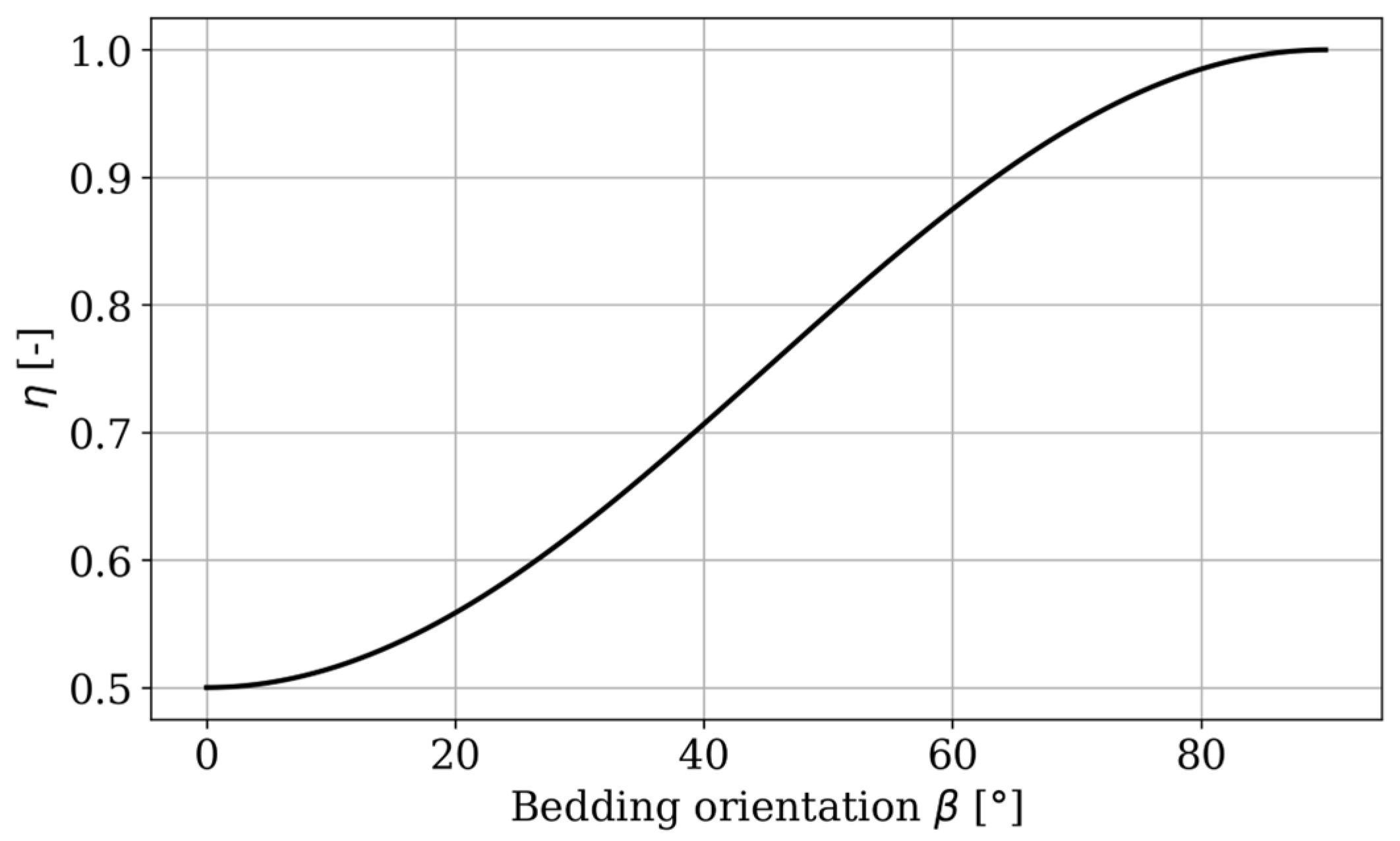
where η quantifies how the applied load interacts with the material’s anisotropic structure (Figure 1). The scalar anisotropy parameter, η, can equivalently be expressed in compact tensor form as:
η = σ : A : σ σ : σ ,
which represents a normalized projection of the stress tensor onto the microstructure tensor A. This formulation is mathematically equivalent to the definition based on normalized traction magnitudes in the principal stress space.
For Opalinus Clay, transverse isotropy with the symmetry axis normal to the bedding plane is assumed. In the local material coordinate system (1–2 plane parallel to bedding, 3-direction normal to bedding), the adopted microstructure tensor is defined as:
A 0 = a | | 0 0 0 a | | 0 0 0 a  
with principal values a | | = 1.0 and a = 0.5 . These values represent a reduced contribution in the direction normal to bedding compared to the bedding plane (Table 1). They were calibrated to reproduce the experimentally [17] observed variation in peak strength with bedding orientation and should not be interpreted as directly measured microstructural properties. The ratio a/ a | | controls the magnitude of anisotropy in the yield formulation.
For arbitrary bedding orientation, the tensor is rotated into the global coordinate system using:
A ( β ) = R β A 0 R T ( β )
where R(β) is the rotation matrix describing the bedding inclination angle β relative to the global coordinate system.
For example, for a rotation around the y-axis, the rotation matrix reads:
R ( β ) = cos θ 0 sin θ 0 1 0 sin θ 0 cos θ  
For triaxial compression with principal stresses σ1 (axial) and σ2 = σ3 (confining), the loading vector, l, aligns with the direction of the maximum principal stress. For loading parallel to bedding (β = 90°), the axial direction coincides with the local 1-direction, hence l = (1, 0, 0) and:
η = l T A 0 l = a = 1.0 .
For loading normal to bedding (β = 0°), the axial direction coincides with the local 3-direction, hence l = (0, 0, 1) and:
η = l T A 0 l = a = 0.5 .
Intermediate bedding orientations yield η values between these bounds, consistent with Table 1.
The yield function, F, is defined in terms of stress invariants and Lode angle:
F = 1 3 N φ 1 I 1 + 2 3 N φ sin θ + 2 3 π sin θ 2 3 π J 2 f c η ,
with:
N φ = 1 + sin φ 1 sin φ
and
f c η = b 0 + b 1 η + b 2 η 2 .
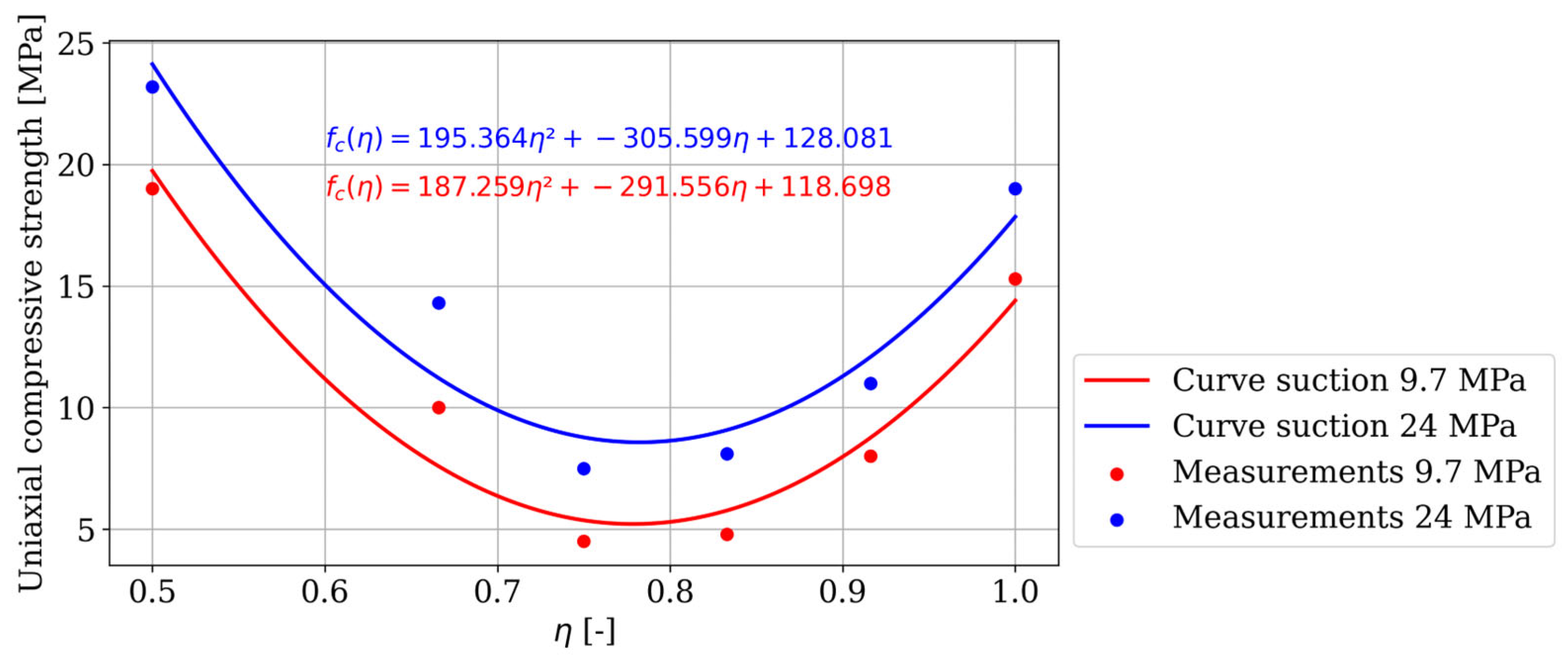
where I1 is the first stress invariant, θ is the lode angle, J2 is the second deviatoric stress invariant, and φ is the friction angle. The scalar variables b 0 ,   b 1 ,   and   b 2 can be derived from the uniaxial compression strength measurements (Figure 2). A non-associated plasticity formulation is employed, in which the plastic potential differs from the yield function. The dilatancy angle, ψ, controls the plastic flow direction and governs the ratio of volumetric to shear plastic strain.
The tensile strength anisotropy is defined as a function of the anisotropy parameter, η, associated with the bedding orientation. In this study, a quadratic polynomial function is adopted to describe the variation in tensile strength with respect to bedding orientation:
σ t ( η ) = t 0 + t 1 η + t 2 η 2 ,
where σt denotes the apparent tensile strength and t0, t1, and t2 are material parameters. This formulation allows for a smooth, orientation-dependent transition of tensile strength between loading normal and parallel to the bedding plane. The coefficients t0, t1, and t2 were calibrated within the numerical framework to reproduce the experimentally observed orientation-dependent tensile strength trend from Brazilian tests. It should be noted that the apparent tensile strength is not controlled solely by the quadratic function in Equation (22). Since the Brazilian test induces a combined tensile–shear stress state, failure results from the interaction of the anisotropic yield criterion, the tensile cutoff, and bedding-dependent strength parameters. Consequently, the simulated tensile strength represents an emergent response of the full constitutive formulation rather than a direct evaluation of the polynomial function alone.
In the present formulation, the quadratic function implicitly represents the macroscopic orientation-dependent tensile strength, but it does not explicitly distinguish between the intrinsic tensile strength of the bedding planes and that of the intact clay matrix across bedding. Introducing a separate tensile strength parameter for the bedding planes would allow for a more mechanistically consistent representation of weak plane opening and could improve the prediction of fracture localization in BTS simulations, particularly for loading orientations close to parallel bedding where failure is governed by preferential crack propagation along these planes.

3.2.3. Hardening and Softening Behaviour

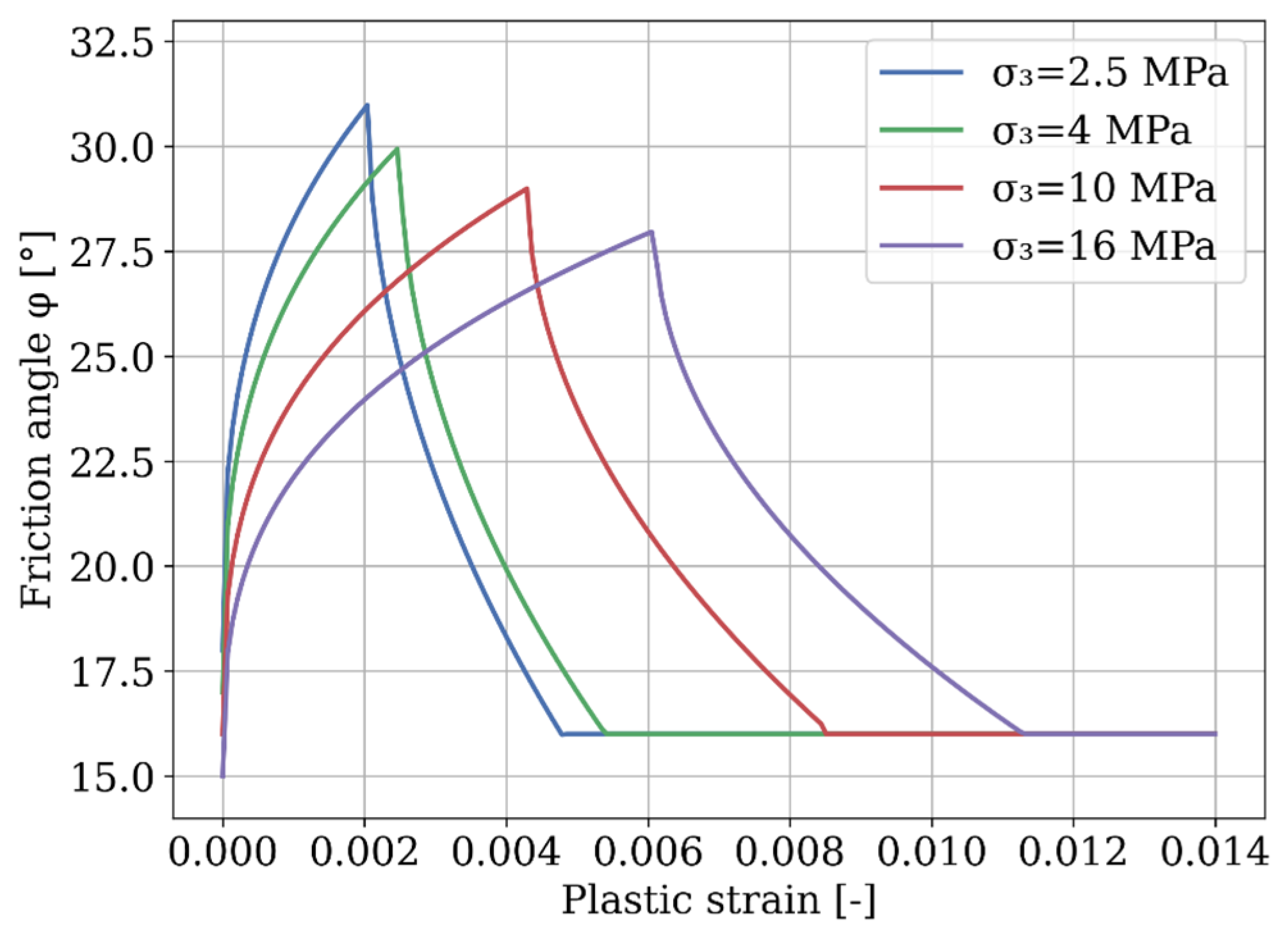
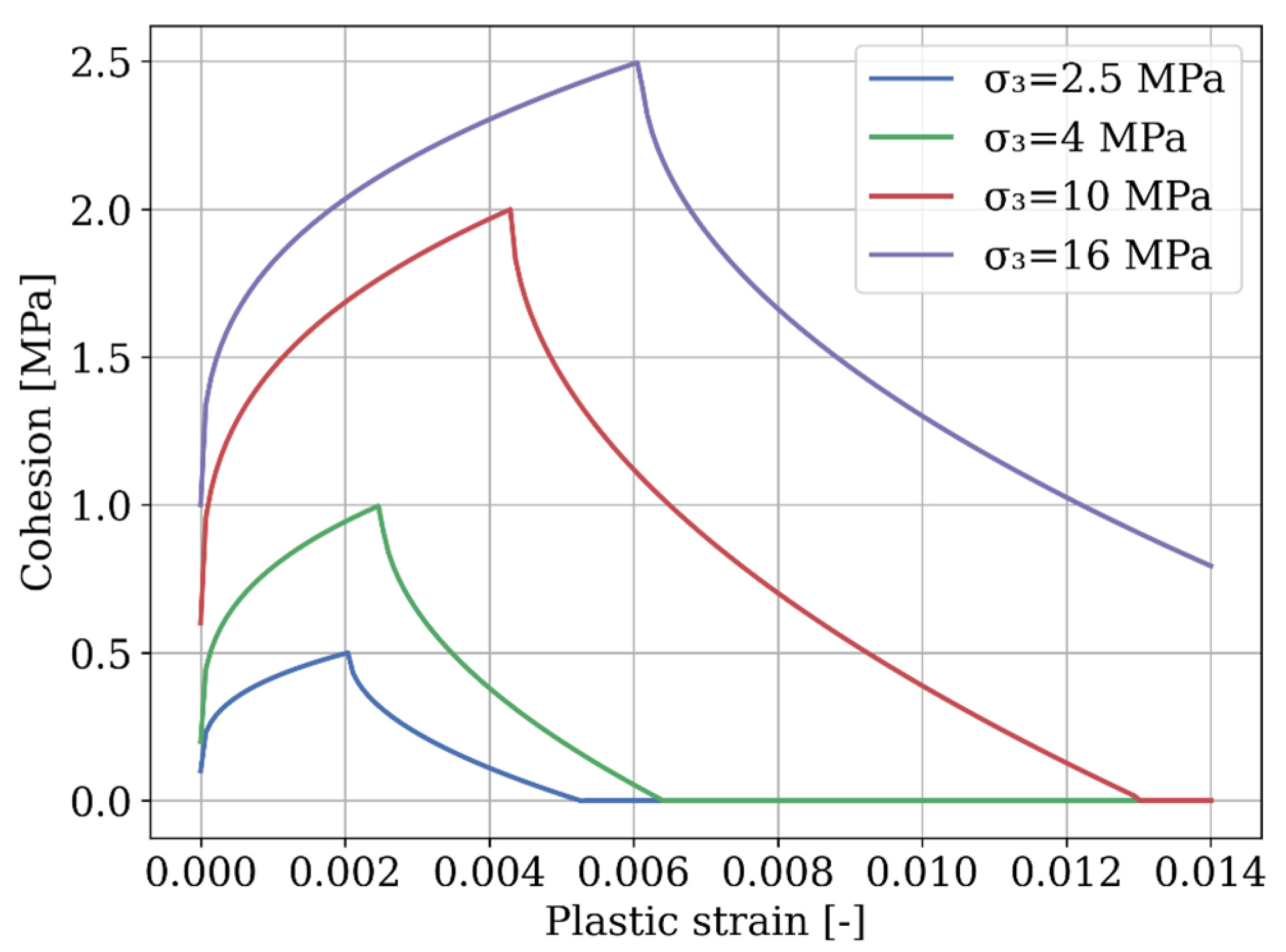
The following section describes the modelled evolution of strength parameters under plastic deformation and demonstrates how hardening and softening behaviour can be represented as functions of friction angle, cohesion, and plastic strain. The friction angle and cohesive strength evolve progressively with accumulated strain and are influenced by the applied confining stress, as well as the bedding orientation. To express the hardening and softening behaviour consistently for both friction angle and cohesion in all simulations, the evolution of each parameter can be formulated with X { φ , c } as follows:
X ε ¯ p l = X 0 + ε ¯ p l ε p e a k p l 1 / 3 X p e a k X 0 ) ,                             i f     ε ¯ p l < ε p e a k p l       X p e a k + ε ¯ p l   ε p e a k p l ε p e a k p l 1 2 ( X 0   X p e a k ) ,                               i f   ε p e a k p l     ε ¯ p l   < ε r X r ,                                                                                                                                       i f   ε ¯ p l ε r ,
with:
ε p e a k p l = a 0 + a 1   σ M + a 2 σ M 2
and
ε ¯ p l = 2 3   t r ε p l ε p l .
ε p e a k p l is the plastic strain at the time when differential stress reaches its maximum and can be determined from triaxial test data. a0, a1, and a2 are scalar variables related to the maximum plastic strain and confining stress. X 0 , X p e a k , and X r are the initial, peak, and residual values of friction angle or cohesion, respectively. It is assumed that the peak stress is reached after the onset of plastic deformation, i.e., ε p e a k p l > 0 , ensuring a well-defined hardening regime. The values can be obtained from the laboratory measurements [16] with bedding planes oriented parallel to the loading direction.
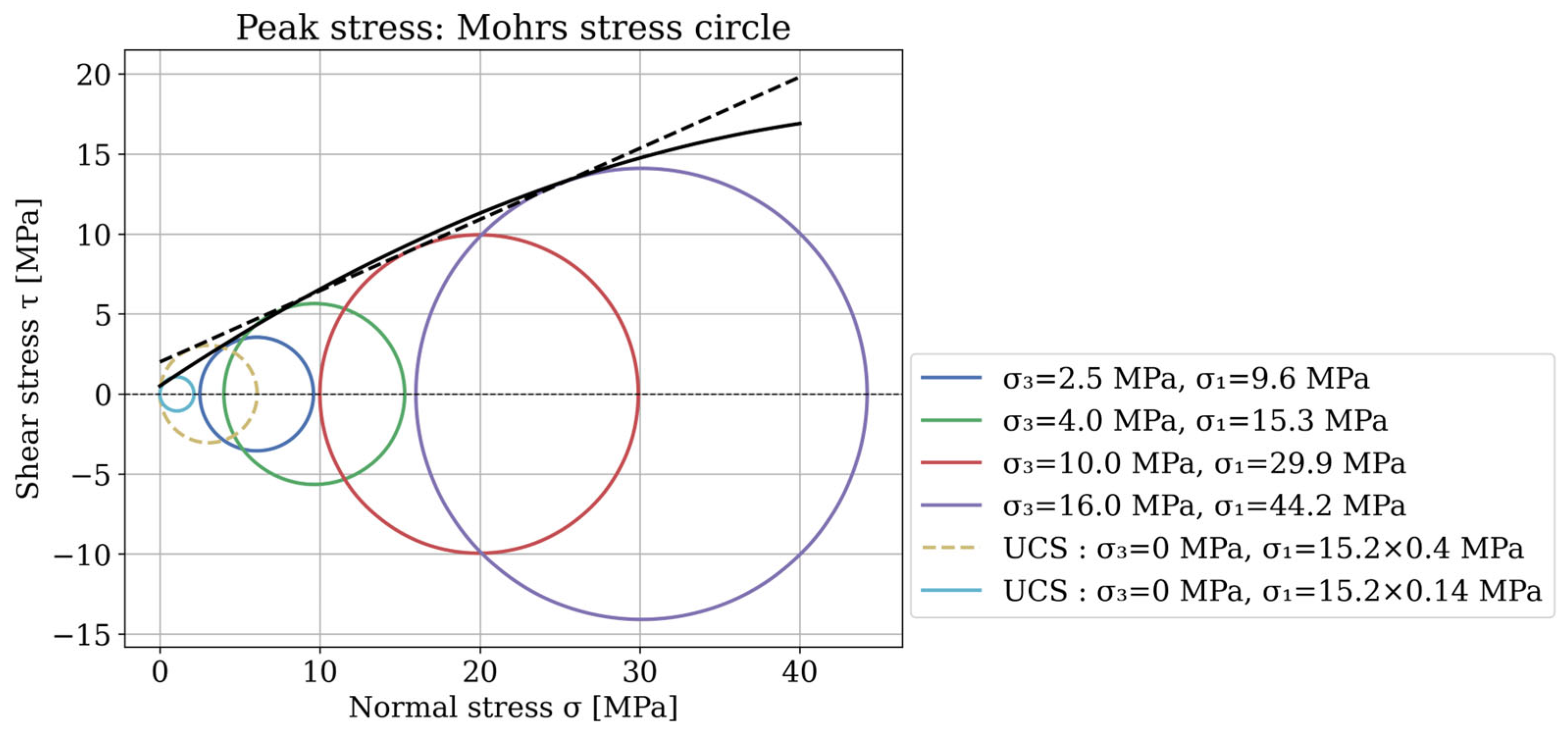
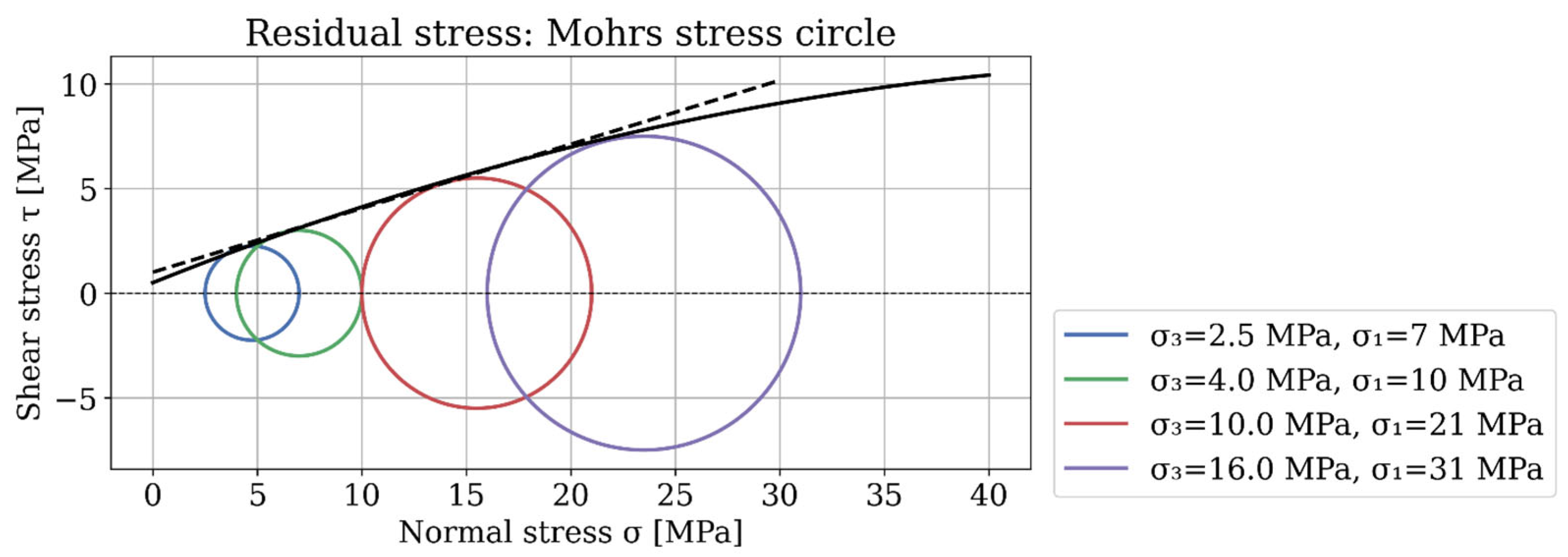
The initial and the maximum, as well as the residual cohesion and friction, are derived from the measurements (Figure 3 and Figure 4) by plotting Mohr’s circles. Using this approach, hardening and softening curves can be calculated (Figure 5 and Figure 6).

3.2.4. Hydraulic Constitutive Framework

Darcy’s law for the wetting and non-wetting fluid can be expressed as:
v l = ρ l k k l r μ l p l ρ l g ,
and
v g = ρ g k k g r μ g p g ρ g g .
where k is the intrinsic permeability, k l r is the relative permeability of the liquid fluid, k g r is the relative permeability of the gaseous fluid,   μ l is the viscosity of the liquid fluid, and μ g is the viscosity of the gaseous fluid. Van Genuchten’s law for the unsaturated conditions in the UCS simulation is as follows:
S e = 1 p c p b n + 1 m ,                                   f o r   p c > 0   1 ,                                                                         f o r   p c 0   ,
with m and n as the van Genuchten parameters and pb as the gas breakthrough pressure. The effective saturation is defined as follows:
S e = S l S r S m a x S r ,
where S r is the residual liquid saturation and S m a x is the maximum liquid saturation. The intrinsic permeability is dependent on the volumetric strain, ε v o l , and the equivalent plastic strain of the material:
k = f ε v o l e x p c 1 ε ¯ p l   k 0 ,
with:
f ε v o l = 10 c 2 ε v o l ,       ε v o l 0   10 c 3 ε v o l ,         ε v o l > 0   .
The parameters c1, c2, and c3 control the permeability evolution due to plastic and volumetric strain. In this study, the values c1 = 30, c2 = 30 and c3 = 300 [7,28] were used. These parameters are treated as phenomenological coefficients representing strain-induced permeability enhancement in clay-rich geomaterials. No additional re-calibration was performed for the present study.
The specific storage of the medium is, similar as the permeability, dependent on volumetric and plastic strain. According to the mass balance equation, the specific storage is expressed as:
S s = α ϕ 1 α 1 K s .

4. Numerical Model

4.1. General Setup and Primary Variables

All simulations were performed using OGS. Depending on the test type, different hydro-mechanical formulations were employed. For the CU triaxial simulations, a fully saturated single-phase HM formulation was used with solid displacement, u, and pore water pressure, p, as primary variables. For the UCS and BTS simulations under partially saturated conditions, a two-phase HM formulation was used with gas pressure, pg, and capillary pressure, pc, as primary variables, while solid displacement was solved simultaneously.
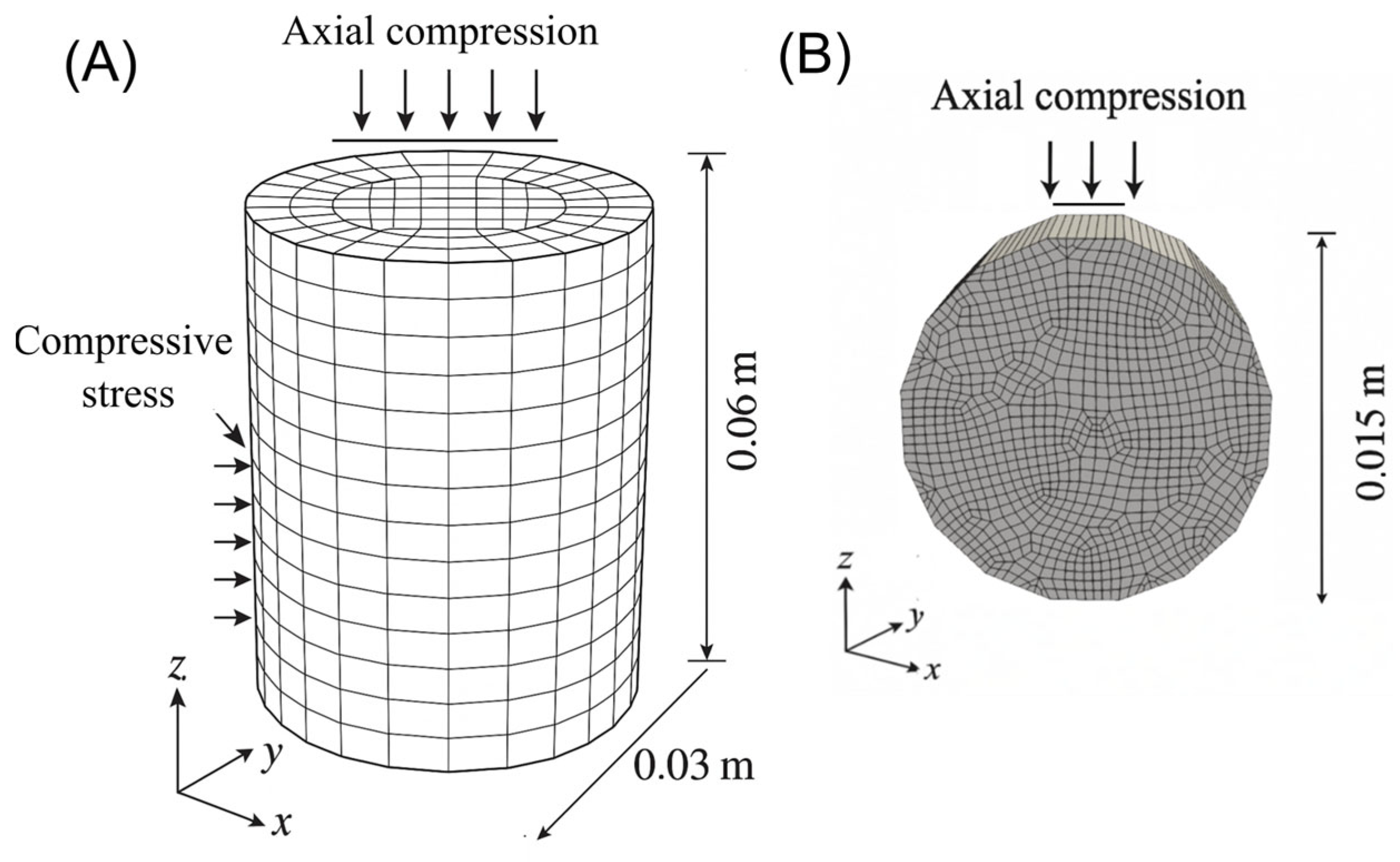
Two finite element meshes are created for the numerical simulations. For the CU and UCS tests, a 3D structured mesh consisting of 1728 hexahedral elements and 2057 nodes was used. For the BTS simulations, a 3D mesh with 978 hexahedral elements and 2086 nodes was employed (Figure 7). The geometries are based on the experimental specimens. No separate saturation or consolidation step was simulated. Instead, the analyses start from predefined initial conditions (stress state, pore pressure, and suction), after which mechanical loading is applied directly.
A brief mesh sensitivity check (coarse vs. reference mesh) indicates that peak stress levels are relatively robust, whereas post-peak effective stress paths and localization features show discretization dependence, as expected for local plasticity. Accordingly, localization and post-peak results are interpreted qualitatively, and objective predictions would require nonlocal/gradient or viscoplastic regularization.

4.2. UCS Tests Setup

The UCS tests are performed using the same cylindrical finite element mesh as the triaxial tests. The initial suction state is defined by prescribing the capillary pressure, pc, as 9.7 MPa or 24 MPa, corresponding to degrees of saturation of 0.88 and 0.80, respectively. The initial gas pressure is set to atmospheric conditions. Gas pressure boundary conditions corresponding to atmospheric pressure are applied at the top and bottom surfaces. No-flow conditions are imposed on lateral surfaces. The imposed capillary pressure determines the initial suction state and is allowed to evolve consistently with the two-phase formulation. Axial compression is applied via a prescribed vertical displacement at the top surface, while the bottom surface is fixed in the vertical direction. All lateral surfaces are traction-free. Material softening and hardening are neglected in the simulations. The model parameters are listed in Table 2.

4.3. CU Triaxial Tests Setup

The domain in the CU triaxial tests is assumed to be fully saturated. The initial pore pressure and stress state correspond to the applied confining stress (Table 2). Confining pressure is applied to the lateral surfaces as a Neumann boundary condition. No-flow boundary conditions are imposed on all outer surfaces, representing undrained conditions. Axial compression is simulated by prescribing a vertical displacement rate at the upper surface (Dirichlet boundary condition), parallel to the z-axis. The bottom surface is fixed in the vertical direction. Radial displacements remain unconstrained except for the applied confining stress. There are several parameters dependent on the confining stress and the orientation while others are constant for all tests (Table 3). The mechanical parameters dependent on confining stress and bedding orientation include:
  • Stiffness.
  • Hardening/softening behaviour.
  • Yield behaviour.
Table 3. Initial and boundary conditions of the CU tests.
Sample-Effective Confining Pressure (MPa)Total Confining Stress (MPa)Initial Pore Pressure (MPa)
P-2.54.92.4
P-46.42.4
P-1012.42.4
P-1619.03.0
Z45-1012.72.7
S-1013.23.2

4.4. BTS Tests Setup

The BTS tests are performed using a disc-shaped specimen under unconfined conditions (Figure 7). The initial capillary pressure and gas pressure are prescribed to 24 MPa and atmospheric pressure, respectively. Diametral compression is applied via a prescribed traction (Neumann boundary condition) in the z-direction at the loading surface. The opposite surface is constrained in the z-direction to prevent rigid body motion. All remaining outer surfaces are traction-free.
The simulations are carried out using a two-phase hydro-mechanically coupled model with gas pressure and capillary pressure as primary variables to represent unsaturated conditions. Material softening and hardening are neglected in the simulations. The model parameters are listed in Table 4.

5. Modelling Results

5.1. UCS Tests Results

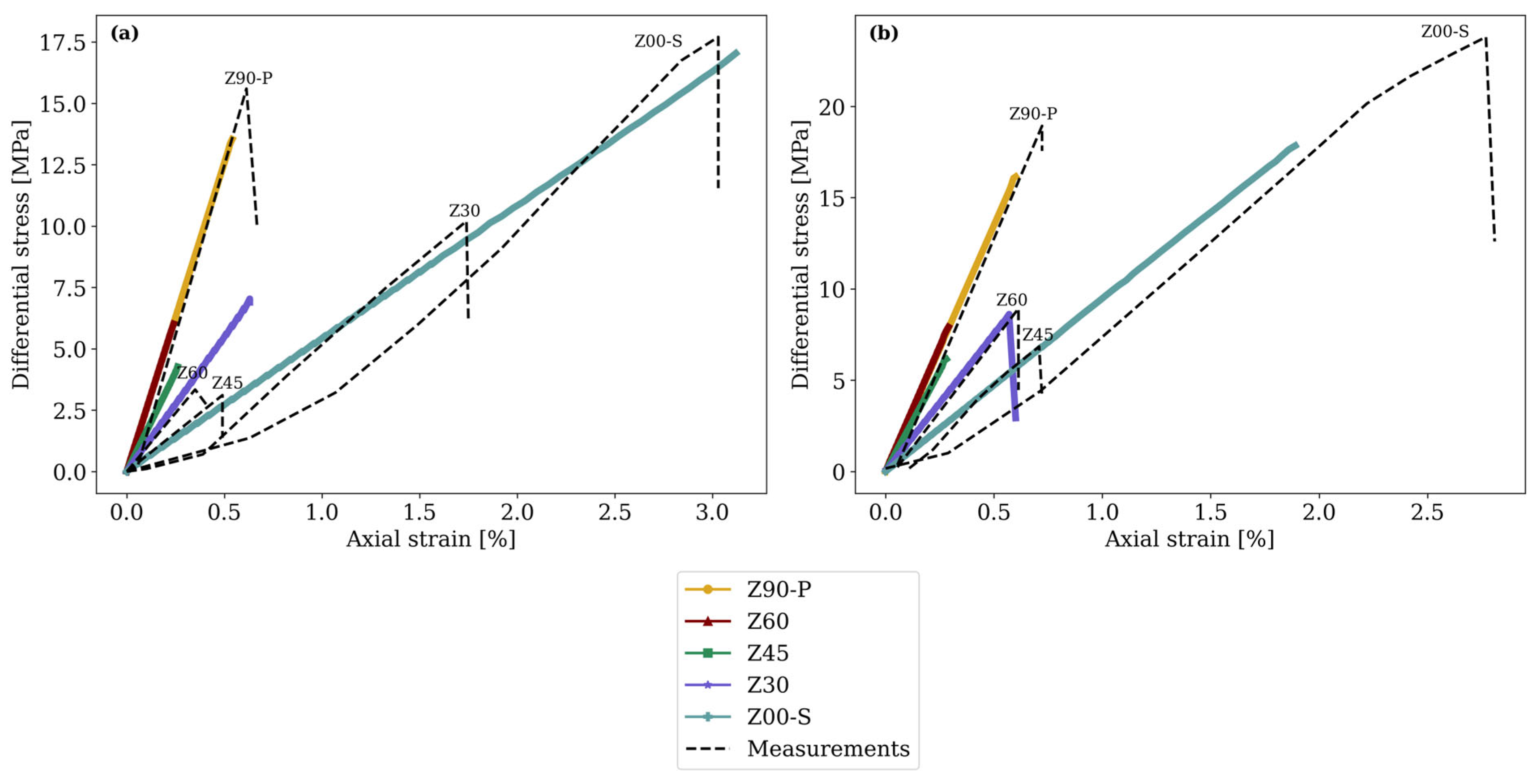
The UCS simulations at suctions of 9 MPa and 23 MPa reproduce the characteristic anisotropic strength behaviour of OPA (Figure 8). The lowest peak strengths occur for bedding orientations between 30° and 60°, where the combined effect of shear along and across bedding leads to a mechanically unfavourable configuration. In contrast, both the P-orientation and S-orientation exhibit comparatively high strengths, consistent with experimental trends. The stress–strain responses of Z60 and Z90-P are very similar and therefore largely overlap in Figure 8; however, the Z60 case reaches a lower peak differential stress.
Anisotropy effects are more pronounced at low suction (9 MPa), where the reduced suction-induced strength enhancement magnifies the directional dependency of the mechanical response. The model successfully captures the overall stiffness evolution and peak-strength envelope for both suction levels.

5.2. BTS Tests Results

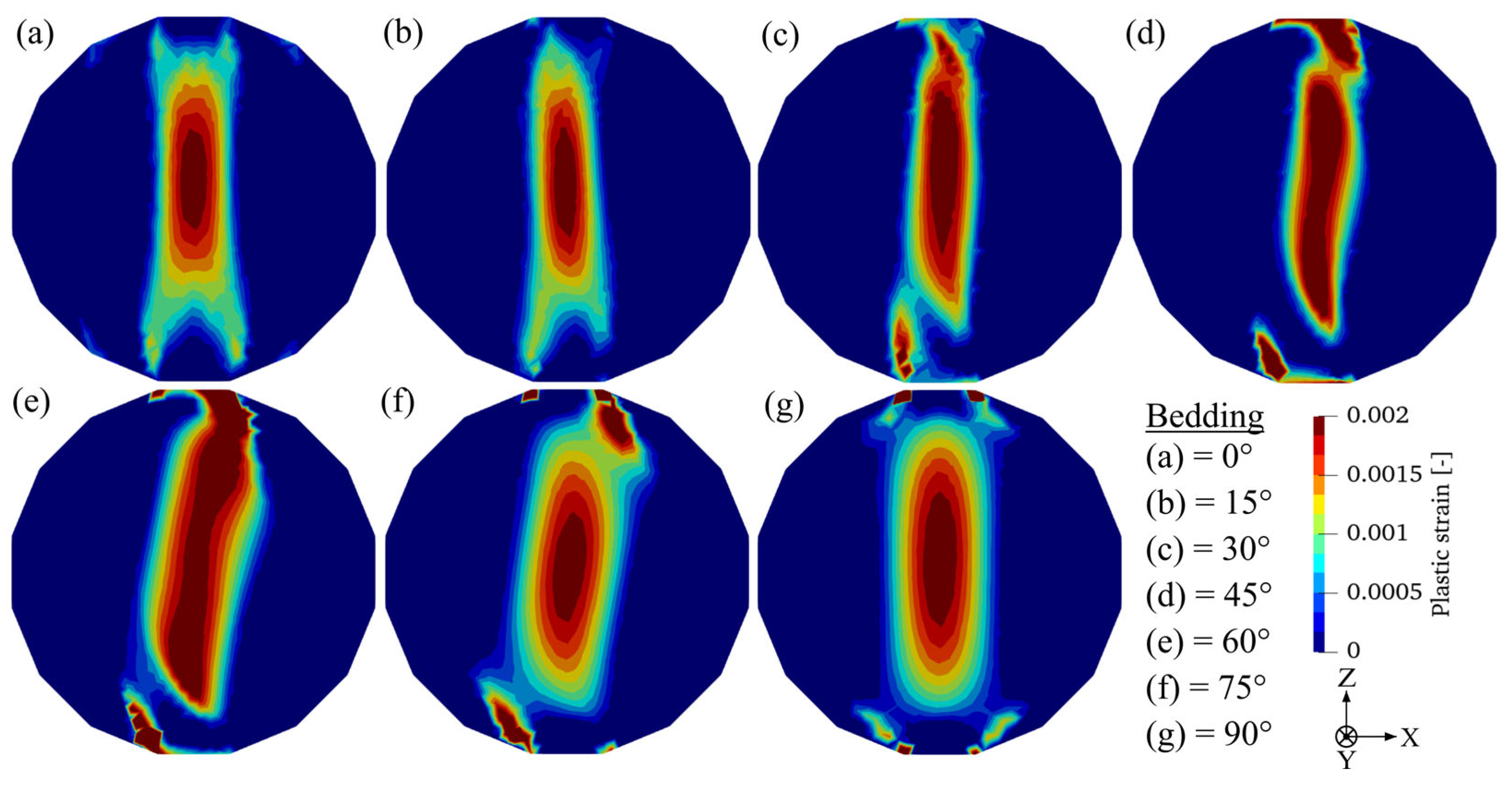
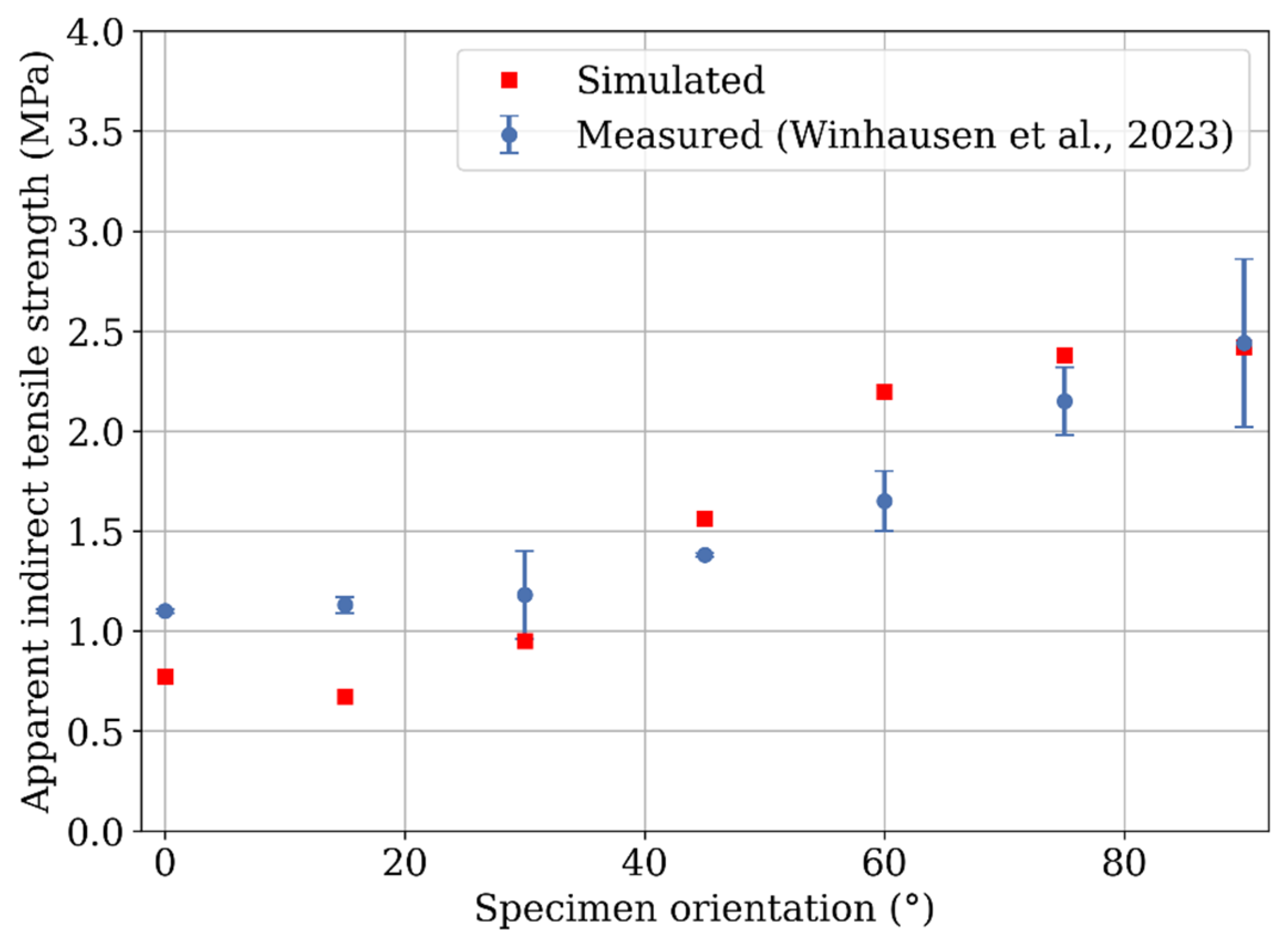
The BTS tests simulations were carried out on specimens with varying orientations relative to the bedding plane, covering angles from 0° (parallel to bedding) to 90° (normal to bedding) in 15° increments (Figure 9). This setup allows for capturing the anisotropic tensile response of OPA. The lowest tensile strengths were observed for orientations closer to parallel-to-bedding (0°), while the highest strengths occurred for the normal-to-bedding orientation (90°). Intermediate orientations followed an S-shaped trend, reflecting the gradual transition between these extremes.
The simulated fracture patterns show a predominantly axial localization of plastic strain for all bedding orientations. While slight deviations from a purely vertical fracture plane are observed for intermediate orientations, the overall fracture propagation remains largely symmetric and only weakly influenced by the bedding orientation. In contrast to the experimental observations, pronounced stepwise fracture propagation along and across the bedding plane is not fully reproduced. For loading at 90°, fractures still predominantly cross the bedding plane, indicating that the model captures the general tensile failure mode, but underestimates the effect of structural anisotropy on fracture localization.
In the present simulations, no distinct peak load is observed due to the perfectly plastic tensile response and the absence of an explicit damage or softening formulation. Therefore, an operational failure criterion was introduced to extract an apparent tensile strength. Failure onset is defined when the equivalent plastic strain reaches a critical value of
ε ¯ p l , c r i t = 0.002
within the central region of the specimen. At this stage, a continuous localized plastic zone has developed across the specimen (Figure 9), corresponding to the initiation of macroscopic fracture.
The corresponding global load level at this state is converted into an apparent Brazilian tensile strength, σ t a p p , using the nominal Brazilian expression:
σ t a p p = 2 P ε ¯ p l , c r i t π D T   .
where P corresponds to the load at the defined critical failure value, and D and T are the specimen’s diameter and thickness in m, respectively. Thus, the reported tensile strengths represent apparent failure onset values within the adopted constitutive framework rather than peak strengths derived from load instability. Nevertheless, the simulations reproduce the overall orientation-dependent trend of tensile strength and remain consistent with analytical solutions for transversely isotropic rocks (Figure 10). While the global tensile strength envelope is well captured, the influence of structural anisotropy on fracture localization is underestimated, and the experimentally observed fracture complexity is only partially reproduced.

5.3. Triaxial CU Tests Results

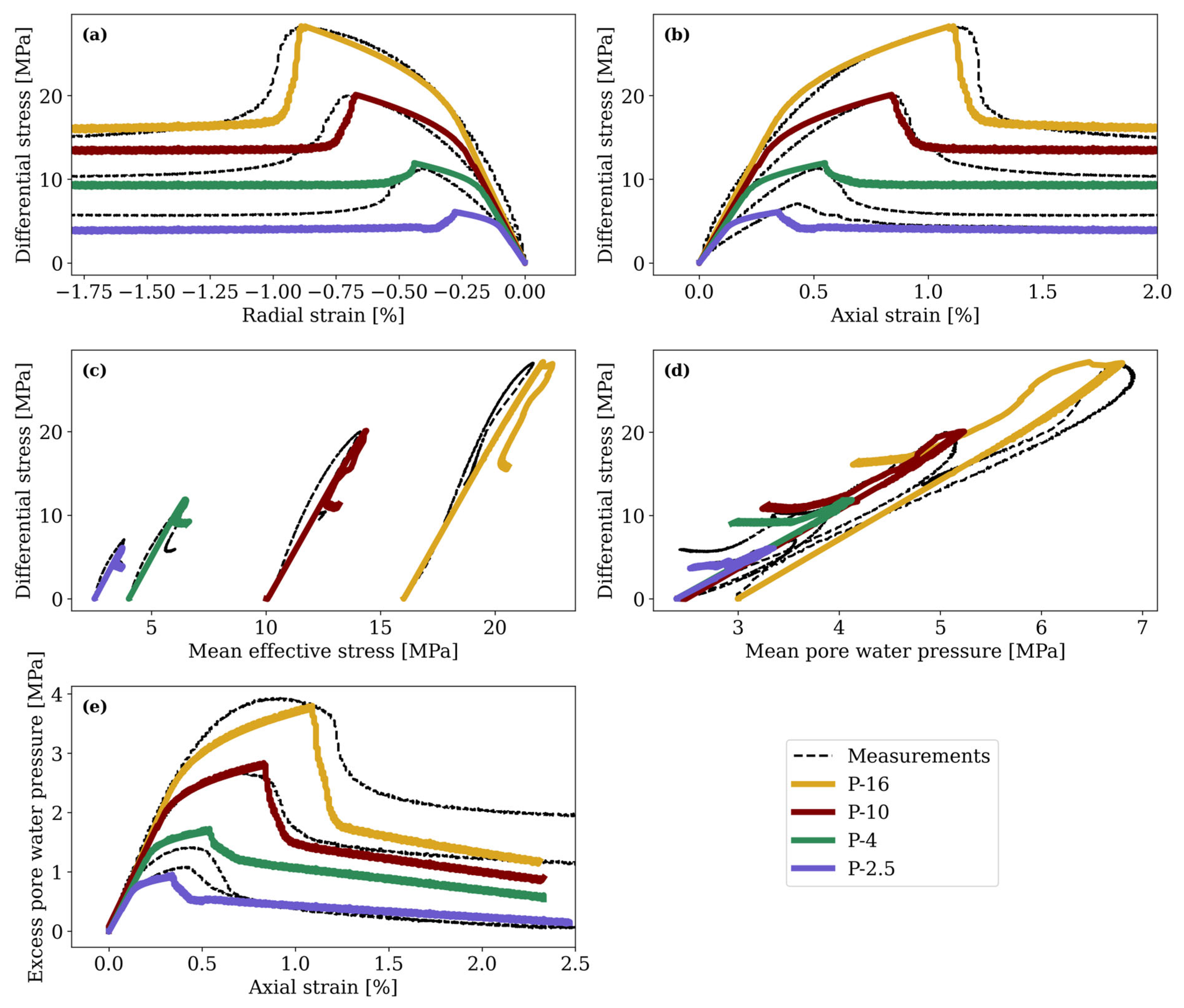
The model reproduces the key features of the mechanical response of OPA under consolidated undrained triaxial loading for bedding-parallel (P) specimens (Figure 11). The simulations show that peak strength increases systematically with confining stress, consistent with experimental trends for anisotropic claystones. As the applied confining pressure increases, dilation becomes progressively suppressed, resulting in a significantly more consolidated reaction. This behaviour reflects the pressure-dependent stiffness and frictional hardening implemented in the constitutive model.
Furthermore, the numerical results capture the transition from brittle behaviour at low confining pressures to a ductile, strain-hardening response at higher stresses. The evolution of stress–strain curves across confining stresses from 2.5 to 16 MPa demonstrates that the model is capable of reproducing both the peak strength and the post-peak softening behaviour observed in laboratory tests (Figure 11a,b). The simulated peak differential stresses deviate by less than 5% from the experimental values for the P-specimens. The peak mean pore pressures are also well captured for the P-cases, with deviations below 5%.
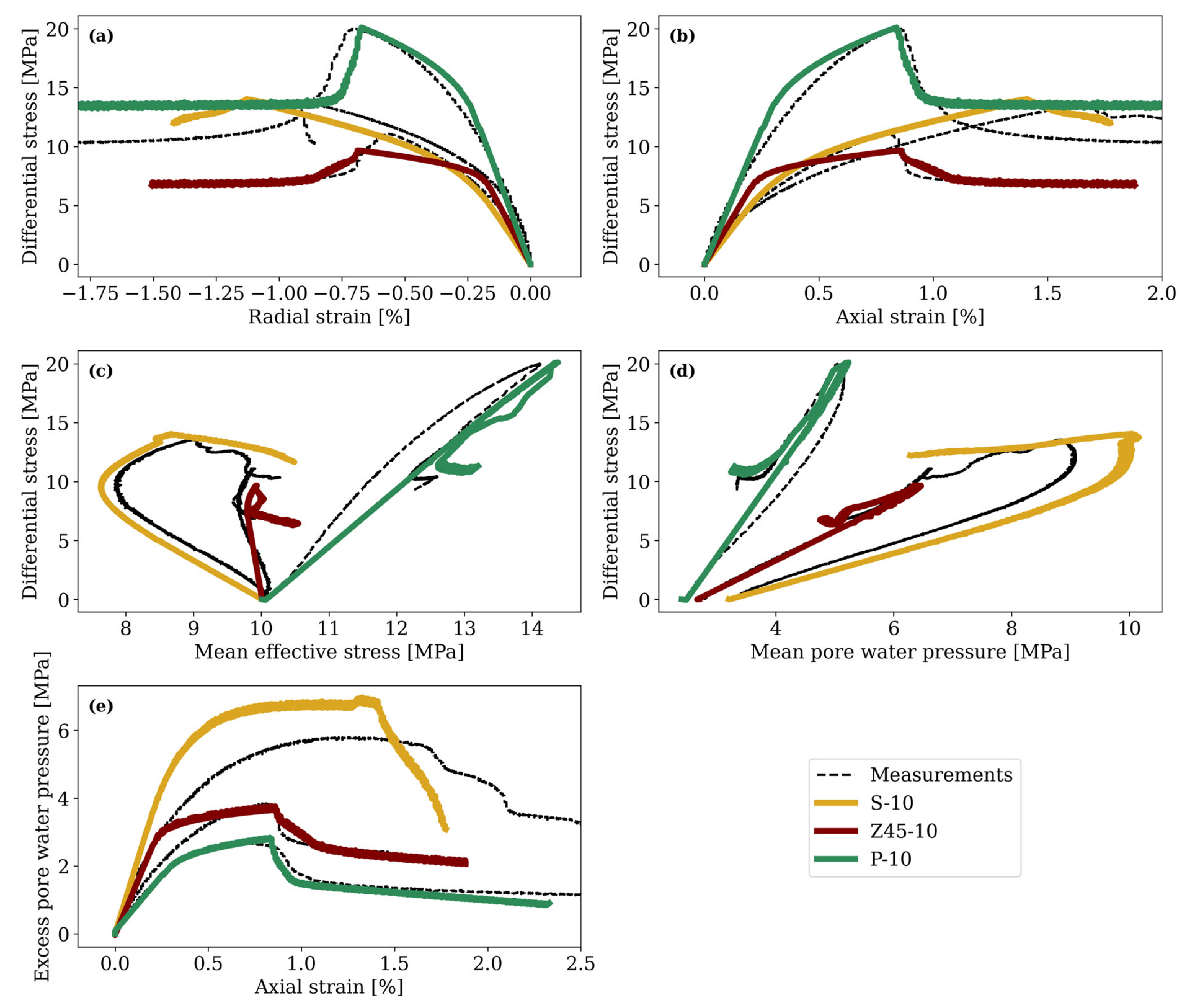
The simulated effective stress paths (q–p′) show a consistent increase in the effective mean stress up to the point of peak deviatoric stress (Figure 11c). Beyond peak, the model predicts a reduction in q accompanied by a modest decrease in p′, reflecting the onset of strain softening in undrained loading. Bedding orientation effects—particularly the reduction in peak q and changes in the curvature of the stress path—are well reproduced across the simulated specimen orientations (Figure 12c).
The evolution of excess pore pressure is also captured effectively. The simulations show a clear dependence on both confining stress and bedding orientation: higher confining stresses promote higher excess pore pressures (Figure 11e), while P- and S-oriented samples exhibit different drainage tendencies and pore pressure build-up (Figure 12d,e). This behaviour aligns with experimental observations and highlights the coupling between anisotropic stiffness, volumetric response, and pore fluid pressurization.
However, for the S orientation at 10 MPa confining stress, the simulated peak excess pore pressure reaches approximately 6.5 MPa, whereas the experimental value is approximately 5.5 MPa, corresponding to an overestimation of about 18%. This deviation primarily affects the pore pressure evolution, while the peak differential stress remains well reproduced.
As the applied confining pressure increases, dilation becomes progressively suppressed, resulting in a more consolidated response. In the current formulation, a constant dilatancy angle of ψ = 1° is adopted for all confining stress levels and orientations. Under high confining stress, this fixed dilatancy angle likely overestimates volumetric expansion in the post-yield regime for certain bedding orientations, particularly the S-10 case. The dilatancy reduces the predicted pore pressure less than observed experimentally, leading to a slight overestimation of excess pore pressure. A stress-dependent or orientation-dependent dilatancy formulation would likely improve the pore pressure prediction at high confinement.

6. Discussion

The modelling framework developed in this study is able to reproduce the dominant mechanical and hydro-mechanical characteristics of OPA across a wide range of loading and boundary conditions. In particular, the model successfully captures the pronounced strength anisotropy associated with bedding, the increase in strength under partially saturated conditions due to suction, and the stress-dependent stiffness that has been well documented in laboratory investigations [16,17]. The simulations further reproduce the transition from brittle to more ductile behaviour with increasing confining stress, consistent with experimental observations. The brittle–ductile transition is evaluated based on (i) the evolution of volumetric deformation under undrained loading, derived from the excess pore-pressure response (Figure 11e) and the effective stress path (q–p′, Figure 11c), and (ii) changes in the shape of the stress–strain curves (Figure 11a,b). With increasing confining stress, the response indicates progressively suppressed net dilation and a smoother, more distributed inelastic deformation, consistent with microstructural observations [17] that link higher confining stress to less dilatant, broader shear zones.
Moreover, the predicted strain localisation patterns reflect the interplay between strength anisotropy and the applied stress state, thereby demonstrating that the constitutive formulation is capable of describing the key mechanisms governing failure in OPA.
However, in the Brazilian tensile simulations, the model underestimates the influence of structural anisotropy on fracture localization. In the present continuum plasticity framework, anisotropy is introduced through a scalar microstructure tensor that modifies the yield surface, but no discrete weakness planes or interface formulations are implemented. Consequently, microstructural mechanisms such as reduced tensile strength of bedding planes or interlayer slip along clay-rich laminations are not explicitly represented. Experimental observations suggest that fracture propagation in OPA may follow a stepwise pattern, alternating between tensile cracking and shear slip along bedding interfaces [16,17]. Such mechanisms require either interface elements, orientation-dependent softening laws, or anisotropic fracture energy formulations. Since the current model employs a perfectly plastic tensile cut-off without directional softening or damage evolution, fracture localization is primarily governed by the global tensile stress field. As a result, axial plastic strain localization dominates in the simulations irrespective of bedding orientation.

Limitations

There are still some open questions and challenges: First, the post-peak response exhibits mesh sensitivity, indicating that the current local plasticity formulation is not sufficient to regularize strain localisation. This suggests that the implementation of a nonlocal or gradient-enhanced plasticity framework would be necessary to obtain objective and mesh-independent results. Second, the dilatancy behaviour is not yet reproduced accurately: in particular, the model tends to underestimate volumetric strain in S-oriented specimens, implying that the current dilatancy criterion does not fully reflect the anisotropic microstructural controls on deformation. Third, introducing a viscoplastic regularization could provide not only numerical stabilization but also a phenomenological representation of the deformation mechanisms observed in claystones, such as rate-dependent plastic deformation and time-dependent microstructural rearrangements [29]. This may improve the smoothness of the stress–strain response and reduce localization-induced instabilities near peak strength.
It should be emphasized that the present study focuses on the calibration and validation of the constitutive framework at laboratory scale; the simulation of excavation-damaged zone (EDZ) evolution under repository-scale conditions, including stress redistribution, staged excavation, and long-term creep effects, is beyond the scope of this work and will be addressed in future applications of the model.

7. Conclusions

This study presents an anisotropic hydro-mechanical constitutive model for Opalinus Clay and evaluates its performance using an extensive set of laboratory experiments covering different bedding orientations, stress paths, and suction conditions. The results demonstrate that the model successfully reproduces key mechanical characteristics relevant to deep geological repositories, including pronounced bedding-induced strength anisotropy, suction-controlled variations in uniaxial compressive strength, and the transition from brittle to ductile behaviour with increasing confining stress.
The proposed modelling approach provides a robust basis for applications in repository safety assessment within a hydro-mechanical framework, particularly for processes affecting the excavation-damaged zone, gas migration after sealing, and hydro-mechanical responses during re-saturation. By explicitly accounting for anisotropy, stress-dependent strength, and strain-dependent stiffness and permeability, the model represents a suitable building block for coupled HM and H2M simulations required to evaluate the long-term evolution and performance of deep geological repositories.
Future developments will focus on improving the dilatancy formulation, introducing nonlocal regularization to ensure mesh-independent post-peak behaviour, and extending the framework toward fully coupled H2M analyses. These enhancements are essential to further increase confidence in the predictive capability of numerical models that are primarily calibrated against short-term laboratory data but applied to repository-relevant time scales.

Author Contributions

Conceptualization, J.H. and H.S.; methodology, H.S. and E.R.; software, W.W.; writing—original draft preparation, E.R.; writing—review and editing, J.H., H.S., W.W. and E.R.; visualization, E.R.; supervision, J.H. All authors have read and agreed to the published version of the manuscript.

Funding

This work was supported by the German Federal Ministry for Economic Affairs Energy (BMWE).

Data Availability Statement

The data supporting the reported results can be provided by the corresponding author upon request.

Acknowledgments

This research was conducted within the DECOVALEX-2027 project. DECOVALEX is an international research project comprising participants from industry, government, and academia, focusing on the development of understanding, models, and codes related to complex coupled problems in sub-surface geological and engineering applications, including the geologic disposal of radioactive waste; DECOVALEX-2027 is the current phase of the project. The authors appreciate and thank the DECOVALEX-2027 Funding Organizations Andra, BASE, BGE, BGR, CAS, CNSC, COVRA, DynaFrax (KORAD), US DOE, ENRESA, ENSI, KAERI, KIGAM, NWMO, RWM, SSM, SÚRAO, and Taipower for the financial and technical support of the work described in this paper. The statements made in the paper are solely those of the authors and do not necessarily reflect those of the funding organizations.

Conflicts of Interest

The authors declare that they have no known competing financial interests or personal relationships that could have appeared to influence the work reported in this paper.

Nomenclature

nabla operator
αBiot coefficient
βbedding angle
εtotal strain tensor
εplplastic strain tensor
ε peak pl peak plastic strain tensor
εvolvolumetric strain
ηanisotropic parameter
θ lode angle
μldynamic viscosity of wetting fluid
μgdynamic viscosity of non-wetting fluid
ρbulk density
ρ l   density of wetting fluid
ρ g   density of non-wetting fluid
σstress tensor
σeffective stress tensor
σMconfining pressure
νPoisson’s ratio in the transverse plane
νPoisson’s ratio for axial strain due to transverse stress
φ friction angle
ϕporosity
χBishop’s coefficient
ψdilatancy angle
Amicrostructure tensor
a0, a1, a2hardening/softening coefficients
b0, b1, b2scalar coefficients UCS
Cfourth-order elastic tensor
EYoung’s modulus in the transverse plane (1–2)
EYoung’s modulus in the axial direction (3)
Iidentity tensor
I1first stress invariable
J2second deviatoric stress invariant
kintrinsic permeability
ggravitational acceleration
GShear modulus in the 1–3 or 2–3 plane
m, nvan Genuchten parameter
ppore pressure
pgpressure of non-wetting fluid
plpressure of wetting fluid
pccapillary pressure
pbgas entry pressure
Qwsource and sink of water
Qgsource and sink of gas species
Rrotation matrix
Sldegree of saturation of the wetting fluid
Srresidual degree of saturation
Smaxmaximum degree of saturation
Seeffective degree of saturation
Sgdegree of saturation of the non-wetting fluid
Ssspecific storage coefficient
ttime
t0, t1, t2scalar variables BTS
udisplacement vector
vlDarcy velocity of the wetting fluid
vgDarcy velocity of the non-wetting fluid

Appendix A

The stiffness matrix C in Voigt notation for a transversely isotropic material (with symmetry axis along direction 3) is:
C = C 11 C 12 C 13 0 0 0 C 12 C 11 C 13 0 0 0 C 13 C 13 C 33 0 0 0 0 0 0 C 44 0 0 0 0 0 0 C 44 0 0 0 0 0 0 C 66
With:
C 11 = E 1 ν 1 + ν 1 2 ν
C 33 = E 1 ν 1 + ν 1 2 ν
C 12 = ν E 1 + ν 1 2 ν
C 13 = ν E 1 + ν 1 2 ν
C 44 = G
C 66 = E 2 1 + ν
There are five independent elastic constants for transversely isotropic materials:
  • E: Young’s modulus in the transverse plane (1–2).
  • E: Young’s modulus in the axial direction (3).
  • ν: Poisson’s ratio in the transverse plane.
  • ν: Poisson’s ratio for axial strain due to transverse stress.
  • G: Shear modulus in the 1–3 or 2–3 plane.
To directly relate the stiffness tensor to Young’s modulus, the compliance matrix S = C 1 is used:
S = C 1 = 1 E ν E ν E 0 0 0 ν E 1 E ν E 0 0 0 ν E ν E 1 E 0 0 0 0 0 0 1 G 0 0 0 0 0 0 1 G 0 0 0 0 0 0 2 1 + ν E

References

  1. Bossart, P.; Meier, P.M.; Moeri, A.; Trick, T.; Mayor, J.C. Geological and hydraulic characterisation of the excavation disturbed zone in the Opalinus Clay of the Mont Terri Rock Laboratory. Eng. Geol. 2002, 66, 19–38. [Google Scholar] [CrossRef]
  2. Popp, T.; Salzer, K.; Minkley, W. Influence of bedding planes to EDZ-evolution and the coupled HM properties of Opalinus Clay. Phys. Chem. Earth Parts A/B/C 2008, 33, S374–S387. [Google Scholar] [CrossRef]
  3. Kneuker, T.; Mann, T.; Dohrmann, R.; Ufer, K.; Blumenberg, M.; Erbacher, J.; Pollok, L. Compositional-structural properties of the Opalinus Clay in southern Germany: Combining facies-based studies and mineralogical analyses. Appl. Clay Sci. 2026, 279, 108032. [Google Scholar] [CrossRef]
  4. Tsang, C.F.; Barnichon, J.D.; Birkholzer, J.; Li, X.L.; Liu, H.H.; Sillen, X. Coupled thermo-hydro-mechanical processes in the near field of a high-level radioactive waste repository in clay formations. Int. J. Rock Mech. Min. Sci. 2012, 49, 31–44. [Google Scholar] [CrossRef]
  5. Armand, G.; Leveau, F.; Nussbaum, C.; de La Vaissiere, R.; Noiret, A.; Jaeggi, D.; Landrein, P.; Righini, C. Geometry and properties of the excavation-induced fractures at the Meuse/Haute-Marne URL drifts. Rock Mech. Rock Eng. 2014, 47, 21–41. [Google Scholar] [CrossRef]
  6. Shao, H.; Paul, B.; Wang, X.; Hesser, J.; Becker, J.; Garitte, B.; Müller, H. The influence of different supports on the properties of the excavation damaged zone along the FE tunnel in the Mont Terri Underground Rock Laboratory. Geol. Soc. Lond. Spec. Publ. 2017, 443, 149–157. [Google Scholar] [CrossRef]
  7. Radeisen, E.; Shao, H.; Pitz, M.; Hesser, J.; Kolditz, O.; Wang, W. Combination of a Failure Index and a Dilatancy-Dependent Permeability Model in Hydro-Mechanically-Coupled Numerical Simulations of Argillaceous Rock Formations of the Callovo-Oxfordian (COx). Rock Mech. Rock Eng. 2024, 57, 4285–4298. [Google Scholar] [CrossRef]
  8. Plúa, C.; De La Vaissiere, R.; Armand, G.; Olivella, S.; Rodriguez-Dono, A.; Yu, Z.; Shao, J.-f.; Radeisen, E.; Shao, H. Numerical investigation of the gas-induced fracturing behavior of the Callovo-Oxfordian claystone. Geomech. Energy Environ. 2025, 42, 100669. [Google Scholar] [CrossRef]
  9. Villar, M.V.; Bésuelle, P.; Collin, F.; Cuss, R.; de Lesquen, C.; Dizier, A.; Tabbal, G.E.; Gens, A.; Graham, C.; Grgic, D.; et al. EURAD state-of-the-art report: Thermo-hydro-mechanical behaviour at high temperature of host clay formations. Front. Nucl. Eng. 2025, 4, 1436490. [Google Scholar] [CrossRef]
  10. Chen, W.; Yu, H.; Li, X. Thermo-Hydro-Mechanical Coupling in Clay Rock: Experimental Characterization and Numerical Modelling; Springer Nature: Berlin/Heidelberg, Germany, 2026. [Google Scholar]
  11. Siegesmund, S.; Popp, T.; Kaufhold, A.; Dohrmann, R.; Gräsle, W.; Hinkes, R.; Schulte-Kortnack, D. Seismic and mechanical properties of Opalinus Clay: Comparison between sandy and shaly facies from Mont Terri (Switzerland). Environ. Earth Sci. 2014, 71, 3737–3749. [Google Scholar] [CrossRef]
  12. Laurich, B.; Urai, J.L.; Nussbaum, C. Microstructures and deformation mechanisms in Opalinus Clay: Insights from scaly clay from the Main Fault in the Mont Terri Rock Laboratory (CH). Solid Earth 2017, 8, 27–44. [Google Scholar] [CrossRef]
  13. Schuster, V.; Rybacki, E.; Bonnelye, A.; Kwiatek, G.; Schleicher, A.M.; Dresen, G. Strain partitioning and frictional behavior of opalinus clay during fault reactivation. Rock Mech. Rock Eng. 2023, 56, 2065–2101. [Google Scholar] [CrossRef]
  14. Corkum, A.G.; Martin, C.D. The mechanical behaviour of weak mudstone (Opalinus Clay) at low stresses. Int. J. Rock Mech. Min. Sci. 2007, 44, 196–209. [Google Scholar] [CrossRef]
  15. Bonnelye, A.; Schubnel, A.; David, C.; Henry, P.; Guglielmi, Y.; Gout, C.; Fauchille, A.-L.; Dick, P. Strength anisotropy of shales deformed under uppermost crustal conditions. J. Geophys. Res. Solid Earth 2017, 122, 110–129. [Google Scholar] [CrossRef]
  16. Winhausen, L.; Khaledi, K.; Jalali, M.; Urai, J.L.; Amann, F. Failure mode transition in Opalinus Clay: A hydro-mechanical and microstructural perspective. Solid Earth Discuss. 2022, 13, 901–915. [Google Scholar] [CrossRef]
  17. Winhausen, L.; Khaledi, K.; Jalali, M.; Bretthauer, M.; Amann, F. The Anisotropic Behavior of a Clay Shale: Strength, Hydro-Mechanical Couplings and Failure Processes. J. Geophys. Res. Solid Earth 2023, 128, e2023JB027382. [Google Scholar] [CrossRef]
  18. Pietruszczak, S.; Mroz, Z. Formulation of anisotropic failure criteria incorporating a microstructure tensor. Comput. Geotech. 2000, 26, 105–112. [Google Scholar] [CrossRef]
  19. Salager, S.; François, B.; Nuth, M.; Laloui, L. Constitutive analysis of the mechanical anisotropy of Opalinus Clay. Acta Geotech. 2013, 8, 137–154. [Google Scholar] [CrossRef]
  20. Xu, W.; Shao, H.; Marschall, P.; Hesser, J.; Kolditz, O. Analysis of flow path around the sealing section HG-A experiment in the Mont Terri Rock Laboratory. Environ. Earth Sci. 2013, 70, 3363–3380. [Google Scholar] [CrossRef]
  21. Nordas, A.N.; Brauchart, A.; Anthi, M.; Anagnostou, G. Calibration method and material constants of an anisotropic, linearly elastic and perfectly plastic Mohr–Coulomb constitutive model for Opalinus Clay. Rock Mech. Rock Eng. 2024, 57, 3–25. [Google Scholar] [CrossRef]
  22. Birkholzer, J.T.; Bond, A.E.; Tsang, C.-F. The DECOVALEX international collaboration on modeling of coupled subsurface processes and its contribution to confidence building in radioactive waste disposal. Hydrogeol. J. 2024, 32, 1295–1305. [Google Scholar] [CrossRef]
  23. Kolditz, O.; Bauer, S.; Bilke, L.; Böttcher, N.; Delfs, J.; Fischer, T.; Görke, U.; Kalbacher, T.; Kosakowski, G.; McDermott, C.; et al. OpenGeoSys: An open-source initiative for numerical simulation of thermo-hydro-mechanical/chemical (THM/C) processes in porous media. Environ. Earth Sci. 2012, 67, 589–599. [Google Scholar] [CrossRef]
  24. Bilke, L.; Flemisch, B.; Kalbacher, T.; Kolditz, O.; Helmig, R.; Nagel, T. Development of open-source porous media simulators: Principles and experiences. Transp. Porous Media 2019, 130, 337–361. [Google Scholar] [CrossRef]
  25. Minardi, A.; Giger, S.B.; Ewy, R.T.; Stankovic, R.; Stenebråten, J.; Soldal, M.; Rosone, M.; Ferrari, A.; Laloui, L. Benchmark study of undrained triaxial testing of Opalinus Clay shale: Results and implications for robust testing. Geomech. Energy Environ. 2021, 25, 100210. [Google Scholar] [CrossRef]
  26. Wild, K.M.; Amann, F. Experimental study of the hydro-mechanical response of Opalinus Clay–Part 1: Pore pressure response and effective geomechanical properties under consideration of confinement and anisotropy. Eng. Geol. 2018, 237, 32–41. [Google Scholar] [CrossRef]
  27. Shao, H.; Radeisen, E.; Hesser, J.; Wang, W.; Kolditz, O. Coupled processes at micro- and macroscopic levels for long-term performance assessment studies of nuclear waste repositories. Minerals 2024, 14, 453. [Google Scholar] [CrossRef]
  28. Radeisen, E.; Shao, H.; Hesser, J.; Naumov, D.; Wang, W.; Kolditz, O. Modelling of preferential gas flow in saturated bentonite using a bimodal, strain-dependent pore model. Appl. Clay Sci. 2024, 249, 107232. [Google Scholar] [CrossRef]
  29. Souley, M.; Coarita-Tintaya, E.D.; Vu, M.N.; Golfier, F.; Armand, G.; Laviña, M.; Idiart, A. A regularised anisotropic elastoplastic damage and viscoplastic model and its hydromechanical application to a meuse/haute-marne URL drift. Rock Mech. Rock Eng. 2024, 57, 4389–4419. [Google Scholar] [CrossRef]
Figure 1. Relation between the bedding orientation and the scalar variable η.
Minerals 16 00279 g001
Figure 2. Uniaxial compressive strength with the scalar variable η. Measurements were performed by [17].
Minerals 16 00279 g002
Figure 3. Mohr stress circles of triaxial tests [17] with bedding oriented parallel to the loading at peak stress. Uniaxial compressive strength tests fitted under linear (dashed black line) and nonlinear yield curve (black line).
Minerals 16 00279 g003
Figure 4. Stresses of triaxial tests with bedding oriented parallel to the loading at residual stress with linear (dashed black line) and nonlinear yield curve (black line).
Minerals 16 00279 g004
Figure 5. Friction angle as a function of plastic strain for parallel bedding orientations, ranging from 2.5 to 16 MPa.
Minerals 16 00279 g005
Figure 6. Cohesion as a function of plastic strain for parallel bedding orientations, ranging from 2.5 to 16 MPa.
Minerals 16 00279 g006
Figure 7. (A) Structured 3D mesh with radial confining stress and axial displacement for triaxial and uniaxial compressive strength test simulation and (B) 3D mesh with axial displacement for Brazilian tensile strength test simulation.
Minerals 16 00279 g007
Figure 8. UCS test results for (a) suction of 9 MPa and (b) suction of 23 MPa.
Minerals 16 00279 g008
Figure 9. Contour plots of the BTS tests for bedding orientations ranging from 0° to 90°. The plots are shown at the stage when the plastic strain at the centre of the X–Y plane reaches the prescribed limit plastic strain of 0.002. (a) 0°; (b) 15°; (c) 30°; (d) 45°; (e) 60°; (f) 75°; (g) 90° bedding orientation.
Minerals 16 00279 g009
Figure 10. Apparent indirect tensile strength with the specimen orientation [17].
Minerals 16 00279 g010
Figure 11. Simulation results of triaxial test with confining pressures between 2.5 and 16 MPa for the P bedding orientation. Results show (a,b) radial and axial strain with differential stress, (c,d) mean effective stress (p′) and mean pore water pressure with differential stress (q), and (e) excess pore water pressure with axial strain.
Minerals 16 00279 g011
Figure 12. Simulation results of triaxial test with 10 MPa confining pressure for the S, Z45, and P bedding orientation. Results show (a,b) radial and axial strain with differential stress, (c,d) mean effective stress (p′) and mean pore water pressure with differential stress (q), and (e) excess pore water pressure with axial strain.
Minerals 16 00279 g012
Table 1. Bedding orientation to load orientation (z-direction).
Bedding Orientation β30°45°60°90°
Graphical bedding orientation with vertical loadMinerals 16 00279 i001Minerals 16 00279 i002Minerals 16 00279 i003Minerals 16 00279 i004Minerals 16 00279 i005
Anisotropic parameter η0.50.670.750.831
Unit vector l ( 0 ,   0 ,   1 ) 1 2 ,   0 , 3 2 2 2 ,   0 , 2 2 3 2 ,   0 , 1 2 ( 1 ,   0 ,   0 )
Table 2. Initial and boundary conditions of the BTS and UCS tests.
SampleTotal Confining Stress (MPa)Initial Capillary Pressure (MPa)Initial Gas Pressure (MPa)
Z00-S09.7 and 240.1
Z3009.7 and 240.1
Z4509.7 and 240.1
Z6009.7 and 240.1
Z90-P09.7 and 240.1
BTS0-P0240.1
BTS150240.1
BTS300240.1
BTS450240.1
BTS600240.1
BTS750240.1
BTS90-S0240.1
Table 4. Model parameter for all simulations.
Model ParameterSymbolOPAOPA 9 MPaOPA 24 MPaUnit
Test type CUUCSUCS and BTS-
Biot coefficientα 0.9 0.9 0.9 -
Cohesive strengthc E q u a t i o n s   23 ( 25 ) 1.5 1.5 MPa
Dilatancy angleψ111°
Friction angleφ E q u a t i o n s   23 ( 25 ) 28 28 °
Gas breakthrough pressure p b -1515MPa
Initial friction φ 0 15 28 28 °
Initial intrinsic permeability k 0 5 · 10 20   1.3 · 10 20 5 · 10 20   1.3 · 10 20 5 · 10 20   1.3 · 10 20 m2
Poisson’s ratioυ 0.2   0.31 0.15   0.35 0.15   0.22 -
Porosityϕ 0.1 0.16 0.16 -
Shear modulusG 1.2 1.07 1.4 GPa
Tensile strength t 0 , t 1 , t 2 1.5 , 0 , 0 0.36 , 1.305 , 1.235 0.36, −1.305, 1.235MPa
Uniaxial compressive strength b 0 , b 1 , b 2 54 , 134 , 88 118 , 291 , 187 128 , 306 , 195 MPa
Van Genuchten parameterm, n-0.33, 1.490.33, 1.49-
Young’s modulus
(‖ bedding)
E | | E q u a t i o n   ( 9 ) 2.46 2.46 GPa
Young’s modulus
(⊥ bedding)
E 0.45   E 0.6 0.8 GPa
Disclaimer/Publisher’s Note: The statements, opinions and data contained in all publications are solely those of the individual author(s) and contributor(s) and not of MDPI and/or the editor(s). MDPI and/or the editor(s) disclaim responsibility for any injury to people or property resulting from any ideas, methods, instructions or products referred to in the content.