Article

Triassic Skarn Co Mineralization in Eastern Segment of East Kunlun Orogenic Belt, China: Insights from Haisi Fe-Co Deposit


1
Key Laboratory of Metallogenic Prediction of Nonferrous Metals and Geological Environment Monitoring, Ministry of Education, School of Geosciences and Info-Physics, Central South University, Changsha 410083, China
2
Hunan Institute of Geological Disaster Investigation and Monitoring, Changsha 410004, China
3
Qinghai Provincial Geological Survey Bureau, Xining 810000, China
*
Author to whom correspondence should be addressed.
Minerals 2026, 16(2), 194; https://doi.org/10.3390/min16020194
Submission received: 20 January 2026 / Revised: 5 February 2026 / Accepted: 9 February 2026 / Published: 12 February 2026

Abstract

Skarn deposits, as one of the most widespread ore deposit types, commonly contain economically subordinate Co, which can locally reach ore-grade concentrations in arsenide and sulfarsenide minerals. However, the partition behavior of Co during skarn mineralization and the key physicochemical factors governing its enrichment remain unclear. The Haisi Fe-Co deposit in the eastern segment of the East Kunlun Orogenic Belt is an ideal case for understanding Co mineralizing processes. Based on mineral paragenesis and texture observation, the chemical compositions of magnetite and Fe, Co-, and As- mineral phases were obtained using the EPMA and LA-ICPMS methods. Low Co concentrations (<7 ppm) in magnetite suggest a low partition coefficient of magnetite relative to skarn fluids. During the sulfide stage, abundant glaucodot, alloclasite, cobaltite, and Co-rich arsenopyrite were formed, following earlier native bismuth, safflorite, and löllingite mineralization. The observed paragenetic evolution from diarsenides to sulfarsenides likely records a progressive increase in oxygen fugacity (fO2) and an increase in the S/As ratio of ore-forming fluids. Thermodynamic modeling using CHNOSZ corroborates that the continuous increase in fO2 and sulfur fugacity (fS2), coupled with a possible decrease in pH, promoted the sequential precipitation of diarsenides, sulfarsenides, and ultimately sulfides. These findings imply that dynamic redox and sulfur activity gradients are critical drivers for Co concentration in skarn systems.

1. Introduction

Skarn deposits, as one of the most common deposit types, account for approximately 87% of Sn resources, 71% of W, 32% of Cu, 25% of Zn-Pb, and ~9% of Fe in China [1]. These systems also host other economically critical elements, including Co, Se, Te, and Bi, with considerable resource potential [2,3,4,5]. Cobalt, as a critical metal, has attracted much attention due to the high demand for rechargeable lithium-ion batteries and Co superalloys. Abundant Co resources have been found in two economically significant skarn metallogenic belts in China, i.e., the Middle-Lower Yangtze River Valley Metallogenic Belt (MLYRB) and East Kunlun Orogenic Belt (EKOB). In the MLYRB, extensive Yanshanian magmatism fostered the Co-bearing porphyry–skarn Cu-Au, Fe, and Mo mineralization, in which pyrite with subordinate pyrrhotite and magnetite serves as the primary carrier of Co [2]. Relatively, most skarn Sn, W, Cu, Fe, and Pb-Zn deposits in the EKOB formed from the emplacement of hydrous, fertile Indosinian granitoids in a post-collisional extensional tectonic setting related to the subduction of the Paleo-Tethyan Ocean, with mineralizing ages of 240–200 Ma [6,7,8,9]. Among them, the Co-bearing skarn deposit representatives clustered at three segments, i.e., the Qimantagh Belt (the western segment of EKOB) and the middle and eastern segments of the EKOB. Interestingly, the host minerals of Co seem to be distinct along the EKOB. The Kendekeke Fe-Co-Bi-Au polymetallic, Galinge Fe, and Niukutou Pb-Zn-Fe deposits in the Qimantagh Belt are featured by the presence of Co- arsenides (skutterudite) and sulfarsenides (cobaltite, glaucodot, and arsenopyrite), whereas the Lalingzaohuo Cu polymetallic deposit in the middle segment of the EKOB is dominated by Co-rich sulfides (pyrite and pyrrhotite) and sulfarsenides (cobaltite) [3,4,8]. Despite distinct Co-bearing mineral phases, these studies indicate that Co mineralization occurred dominantly during the sulfide stage, which is later than the oxide stage. This leads to key questions regarding Co behavior: How is it partitioned between magnetite and sulfide minerals? What are the controlling roles of physicochemical conditions (e.g., temperature, fO2, pH, and As/S ratio) during skarn mineralization?
Skarn deposits are abundant in the eastern segment of the EKOB. They are distributed in the Xiangride–Dulan district, as represented by the Baishiya Fe-Pb-Zn, Longwagadang Fe-Pb-Zn, Shuangqing Fe-Pb-Zn, Zhanbuzhale Fe, Xiaowolong Fe-Pb-Zn-Sn, and Haisi Fe deposits [10]. Among these deposits, the Haisi deposit has Fe reserves of 8.94 Mt, with varied grades of 25 to 58 wt% TFe and up to 2.90 wt% Co (average 0.18 wt%), 3.03 wt% As, and 0.41 wt% Bi [11,12]. This context provides an accessible case study for understanding the Co mineralizing mechanism during skarn processes.
This study investigated ore mineral paragenesis in the Haisi deposit based on petrological observations and the recognition of mineralization stages. After the identification of two types of magnetite and various Co- and As- mineral phases, their chemical compositions were obtained using the EPMA and LA-ICPMS methods. In combination with thermodynamic modeling, Co’s behavior of partitioning into arsenides and sulfarsenides was discussed, and the Co enrichment mechanism in skarn deposits was elucidated. These findings provide valuable insight into targeted Co exploration in skarn deposits across the EKOB.

2. Geological Setting

The EKOB, a significant tectonic unit in the western segment of the Central China Orogenic System, was formed by the collision of the Qaidam Block with Qiangtang or Bayanhar Terrane as a consequence of the closure of the Kunlun Ocean (branch of the Paleo-Tethyan Ocean) [13]. The EW-trending orogen extends from the Altyn Tagh Fault in the west to the east of Xiangride and is bounded by the Qaidam Basin to the north and the Anemaqen accretionary belt to the south (Figure 1a) [13,14]. It is divided into three tectonic belts by the NWW-trending North, Central, and South Kunlun deep faults: the North Qimantagh Belt or North Kunlun Belt (NKL), Central Kunlun Belt (CKL), and South Kunlun Belt (SKL), from north to south (Figure 1b). Precambrian basements are represented by metamorphic volcano–sedimentary rocks of the Paleoproterozoic Jinshuikou, Paleoproterozoic Kuhai, and Meso-Neoproterozoic Wanbaogou groups, which are overlain by the Early Cambrian to Jurassic terrestrial clastic, volcanic and carbonate rocks [15,16]. These sequences were extensively intruded by three main episodes of dioritic–granitic plutons, including the Neoproterozoic (ca. 1006–870 Ma), Paleozoic (ca. 466–390 Ma) and Triassic (ca. 250–200 Ma) [13]. The complex tectonic–magmatic evolution linked to the closure of the early Proterozoic Proto-Tethyan Ocean and late Paleozoic to early Mesozoic Paleo-Tethyan Ocean and the collision between the Indian and Eurasian plates in the Cenozoic fostered numerous magmatic Cu-Ni; porphyry–skarn–epithermal Cu-, Ag-, and Fe polymetallic; and orogenic Au deposits that developed in the EKOB [17,18,19,20,21]. Among these, skarn deposits were mainly formed in the Late Triassic and correlate to the magmatism induced by the northward subduction of the Songpan–Ganzi–Bayanhar Block [22,23].
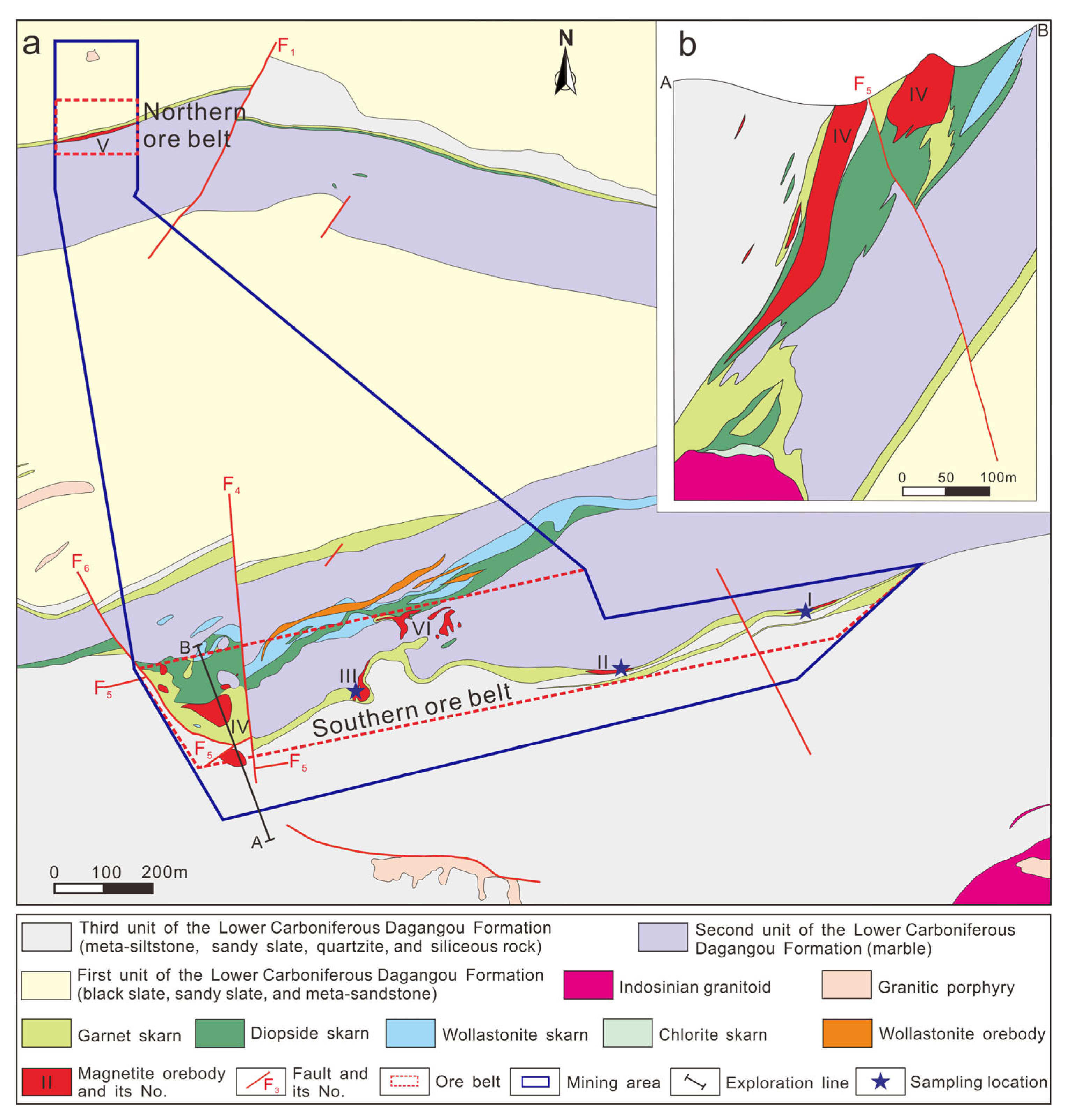
The Haisi deposit is located in the Dulan–Elashan County, the eastern segment of the EKOB. The strata in the region include the Paleoproterozoic Jinshuikou Group, Upper Devonian Maoniushan Formation, Lower Carboniferous Dagangou Formation, and Upper Triassic Elashan Formation, of which only the Dagangou Formation occurs within the mining area (Figure 2). The Paleoproterozoic Jinshuikou Group as the metamorphic basement is composed of muscovite quartz schist and chlorite quartz schist intercalated with gneiss, amphibolite, and marble. The Upper Devonian Maoniushan Formation consists of gray-green conglomerates intercalated with sandstone. The Upper Triassic Elashan Formation is composed of felsic–mafic volcanic rocks including dacite, crystalline tuff, rhyolite, and andesite (ca. 240–218 Ma) [24,25,26]. The Lower Carboniferous Dagangou Formation, which occupies the mining area, is divided into three units from bottomto top. The first unit consists predominantly of black slate, sandy slate, and meta-sandstone; the second unit, as the main ore horizon, is composed of marble; and the third unit includes meta-siltstone, sandy slate, quartzite, and siliceous rock. Faults are well-developed in the mining area, including NE-, NW-, nearly NS-, and NWW-trending faults, which cut across skarns. Triassic granitoid plutons are present in the southern part of the mining area, including biotite granodiorite, syenogranite, and monzonite granite. These calc-alkaline, metaluminous I-type granitoids with zircon U-Pb ages of 249 to 223 Ma were derived from the partial melting of Precambrian basement rocks with minor mantle material involvement due to the closure of the Paleo-Tethyan Ocean [27]. Minor granite porphyry and granite aplite occur as veins. Skarn alteration is widely developed within the interstratified fracture zone of the marble (Figure 3). Magnetite ores manifest as veined and lenticular orebodies within the northern and southern ore belts. The southern ore belt consists of I, II, III, IV, and VI orebodies, while the northern ore belt includes a V orebody. These orebodies are all hosted in the distal skarn, with the nearly EW-trending strike and dip from 40 to 70° to the south (Figure 2b).
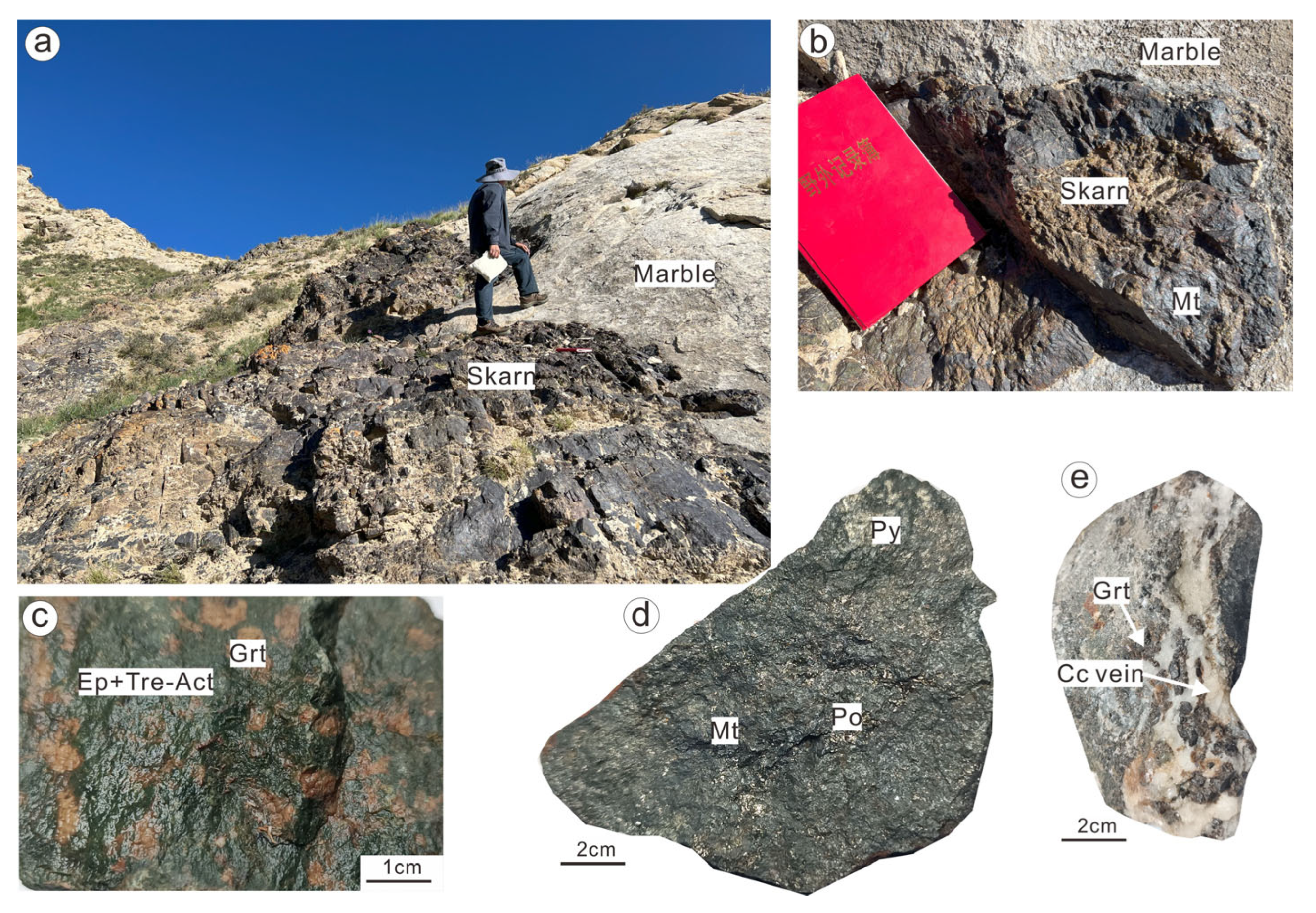
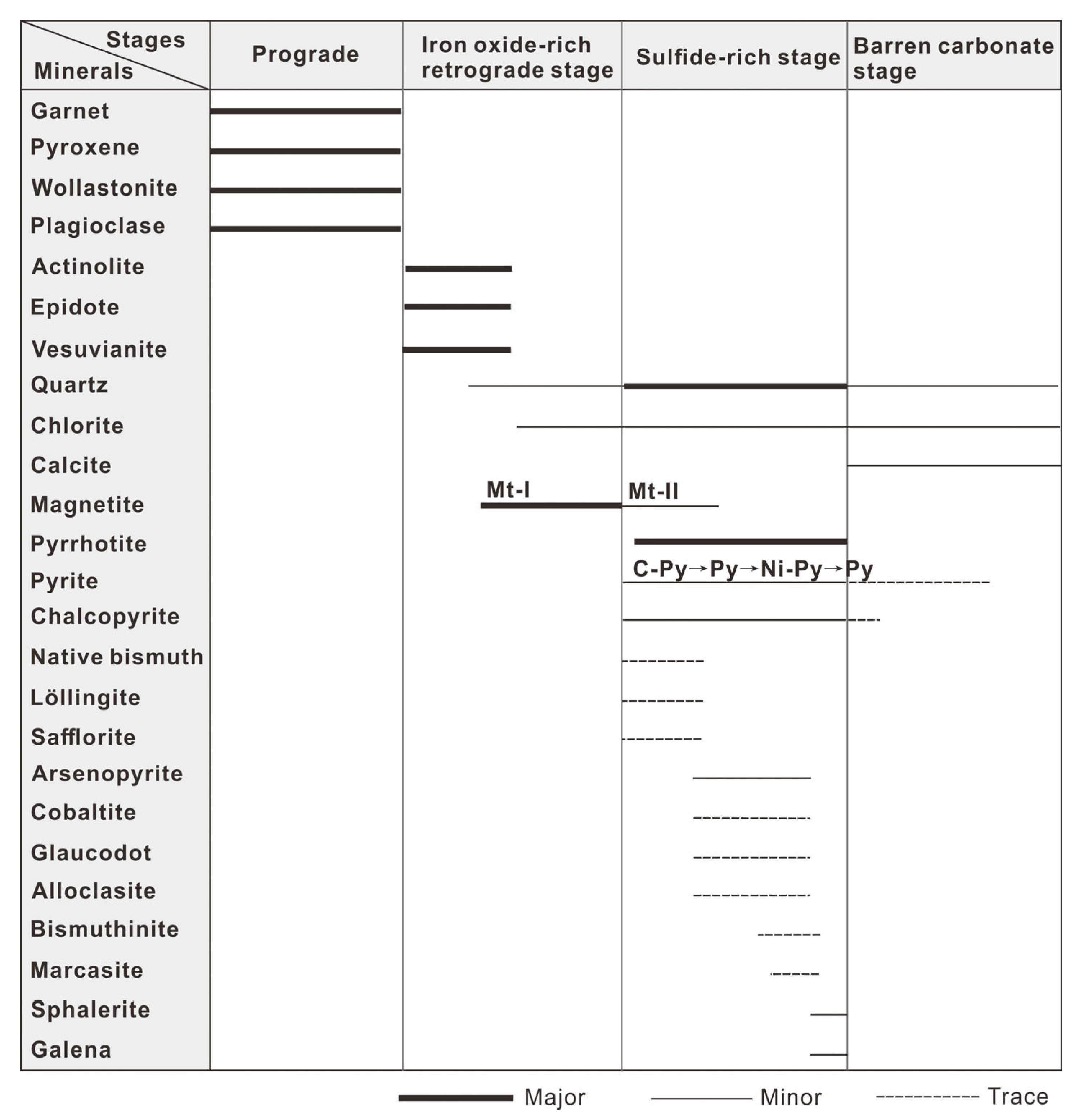
Mineralizing processes can be divided into the high-temperature prograde stage, iron oxide-rich retrograde stage, sulfide-rich stage, and barren carbonate stage (Figure 4). Prograde-stage minerals typically include garnet, pyroxene, wollastonite, and plagioclase, and the retrograde stage consists of epidote, vesuvianite, quartz, tremolite–actinolite, and magnetite (Figure 3a–d). These skarn rocks and Fe ores commonly have sharp contact with marble rocks (Figure 3a,b), and the replacement of prograde minerals by hydrous calc-silicate minerals is common (Figure 3c). Iron ores are composed of magnetite, with massive texture (Figure 5). The sulfide-rich stage is featured either by sulfide veins or disseminated sulfide mineralization in skarn or magnetite ores (Figure 3d). Gangue minerals are mainly composed of quartz, chlorite, and calcite, and ore minerals include pyrrhotite, pyrite, marcasite, chalcopyrite, and arsenopyrite, with subordinate bismuth, bismuthinite, löllingite, safflorite, glaucodot, alloclasite, cobaltite, galena, and sphalerite (Figure 6). The barren carbonate stage typically features calcite veins cutting across earlier mineral assemblages (Figure 3e).

3. Sampling and Analytical Methods

All samples were collected from I, II, and III orebodies at the southern ore belt, including garnet skarn, garnet–diopside skarn, garnet-bearing disseminated magnetite ores, massive magnetite ores, pyrrhotite ores, and pyrrhotite–pyrite–arsenopyrite ores. These samples were prepared as thin sections for petrographic observation followed by EPMA and LA-ICPMS analyses.
The determination of the EPMA chemical compositions of magnetite, arsenides (safflorite and löllingite), sulfarsenides (arsenopyrite, glaucodot, alloclasite, and cobaltite), and sulfides (pyrrhotite and pyrite) was carried out at Wuhan SampleSolution Analytical Technology Co., Ltd., Wuhan, China. The analyses were performed by a JEOL JXA-iHP200F electron microprobe (JEOL Ltd., Tokyo, Japan) equipped with four wavelength-dispersive spectrometers. The operating conditions of spot analyses include a beam diameter of 1 μm, acceleration voltage of 20 kV, and current of 20 nA. As for magnetite data, the following standards were used for calibration: NaAlSi3O8 for Na, (MgFe)2SiO4 for Mg, Mg3Al2Si3O12 for Al, SiO2 for Si, (MgCr)CaSi2O6 for Ca, TiO2 for Ti, V metal for V, Cr metal for Cr, MnSiO3 for Mn, and Fe2O3 for Fe. As for arsenide, sulfarsenide, and sulfide data, the following standards were used for calibration: CuFeS2 for S, Cu, and Fe; Co metal for Co; (Fe, Ni)9S8 for Ni; FeAsS for As; Bi2Se3 for Se; and Sb2Te3 for Sb. All results were corrected by the atomic number–absorption–fluorescence (ZAF) method. In addition, pyrite and arsenopyrite representatives with complex texture were chosen for the elemental mapping of Co, Ni, and As. The operating conditions of mapping are as follows: an accelerating voltage of 20 kV, beam current of 50 nA, sample acquisition time of 30 ms, and pitch of 0.2–1.0 μm.
The LA-ICPMS analyses of magnetite were carried out using a Telydyne Cetac HE 193 nm laser ablation system (Teledyne Photon Machines, Belgrade, MT, USA) coupled with Analytik Jena PlasmaQuant MS Ellite ICP-MS (Analytik Jena AG, Jena, Germany) at the School of Geosciences and InfoPhysics, Central South University, Changsha, China. A spot diameter of 35 μm, laser repetition rate of 5 Hz and laser beam energy of 3.5 J/cm2 were employed in the ablation protocol. The analytical sequence for each spot, lasting for 70 s, consists of a 20 s background measurement (laser off), a 30 s analysis signal acquisition, and a 20 s washout period. The USGS geochemical reference materials GSE-2G and GSD-1G were used as external standards, with Fe concentrations acquired by EPMA serving as the internal standard. The USGS reference glass (NIST SRM610 and SRM612) was employed as a system monitoring sample, while USGS reference materials BCR-2 and BHVO-2 were utilized for quality control purposes. The measured elements include 23Na, 25Mg, 27Al, 29Si, 39K, 43Ca, 49Ti, 51V, 53Cr, 55Mn, 59Co, 60Ni, 65Cu, 67Zn, 98Mo, 118Sn, 183W, and 208Pb. The analytical results for all standards are in good agreement with the recommended values within acceptable error margins. Data reduction was carried out using GLITTER 4.4.4 [28]. The minimum detection limits are 0.24 ppm for Na; 0.32 ppm for Mg; 27.43 ppm for Al; 113 ppm for Si; 0.04 ppm for K; 0.54 ppm for Ca; 1.30 ppm for Ti; 0.02 ppm for V and Cr; 109 ppm for Mn; 0.09 ppm for Co; 0.01 ppm for Ni, Cu, Mo, W, and Pb; 25.49 ppm for Zn; and 0.60 ppm for Sn. After spot analyses, one area containing two magnetite types was selected for LA–ICPMS elemental mapping. Analytical conditions were: a laser repetition rate of 10 Hz, square beam spot size of 35 μm, scan speed of 35 μm/s, and an energy density of 3.5 J/cm2. Detailed analytical procedures were given in Zhang et al. (2024) [29]. Elemental maps were processed with LA–ICPMS imaging software (LIMSMapping20251112) following the protocol of Wang et al. (2017) [30].

4. Results

4.1. Mineral Associations

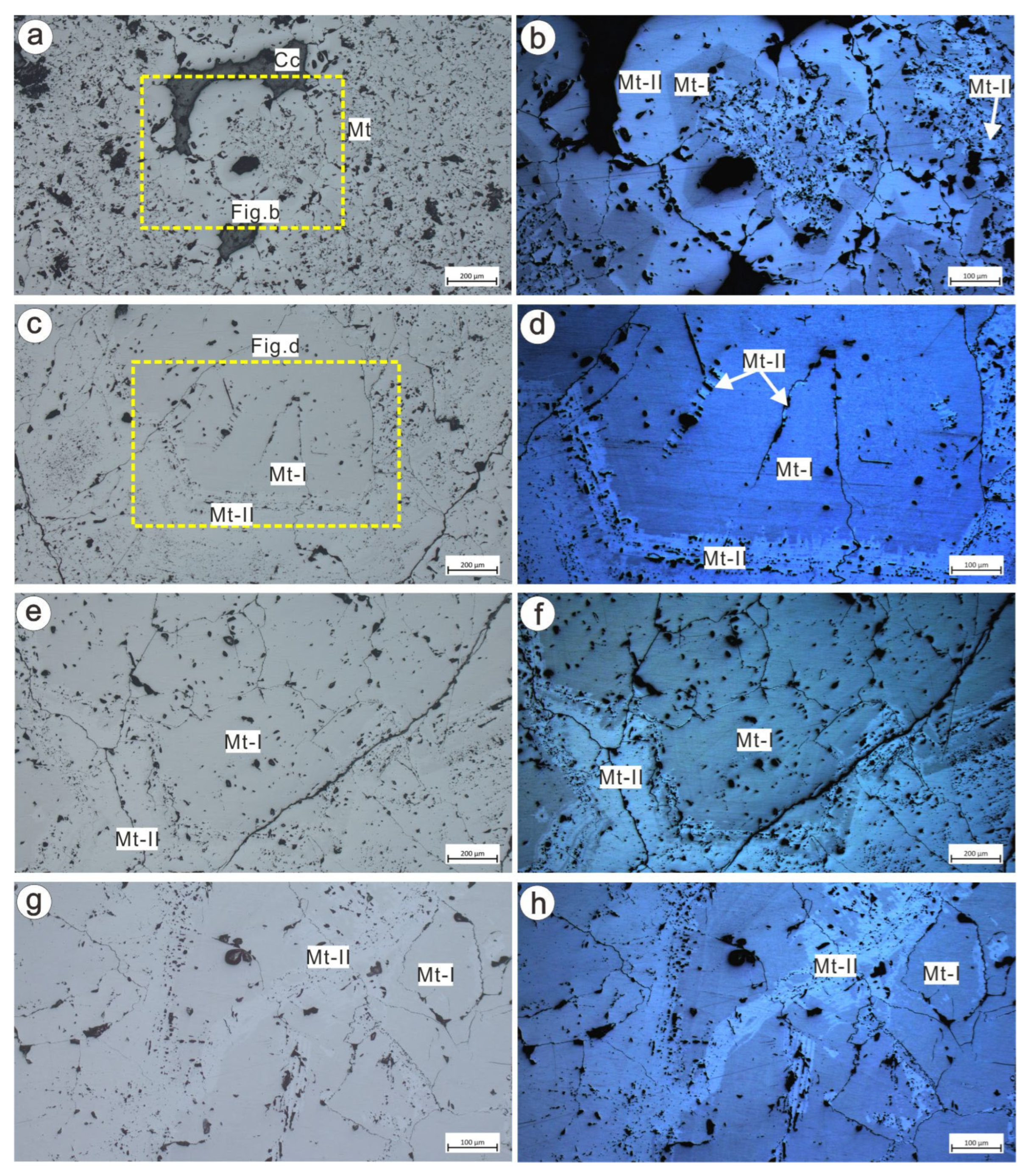
Based on mineral assemblages and their textures, two generations of magnetite were recognized: Mt-I and Mt-II. Mt-I dominates the majority of magnetite and formed at the iron oxide-rich retrograde stage. It commonly occurs as coarse, euhedral to anhedral grains (Figure 5) and exhibits oscillatory zones under Gamma-enhanced reflected light (Figure 5d,f,h). The Mt-II domain is obviously lighter relative to the dark gray color of Mt-I, especially under Gamma-enhanced reflected light (Figure 5b,d,f,h). It replaced Mt-I along microfractures or grain boundaries to various extents, with a sharp contact boundary between them (Figure 5a–d), suggesting that Mt-II postdated Mt-I. Specifically, some Mt-II grains exhibit epitaxial growth on Mt-I, as observed by their shared morphology (Figure 5b,d). Some Mt-II grains occur as irregular veins or patches truncating Mt-I (Figure 5g–h). Additionally, anhedral, fine-grained Mt-II replaced arsenopyrite and was subsequently overgrown by arsenopyrite (Figure 6g), suggesting Mt-II formation during the sulfide stage.
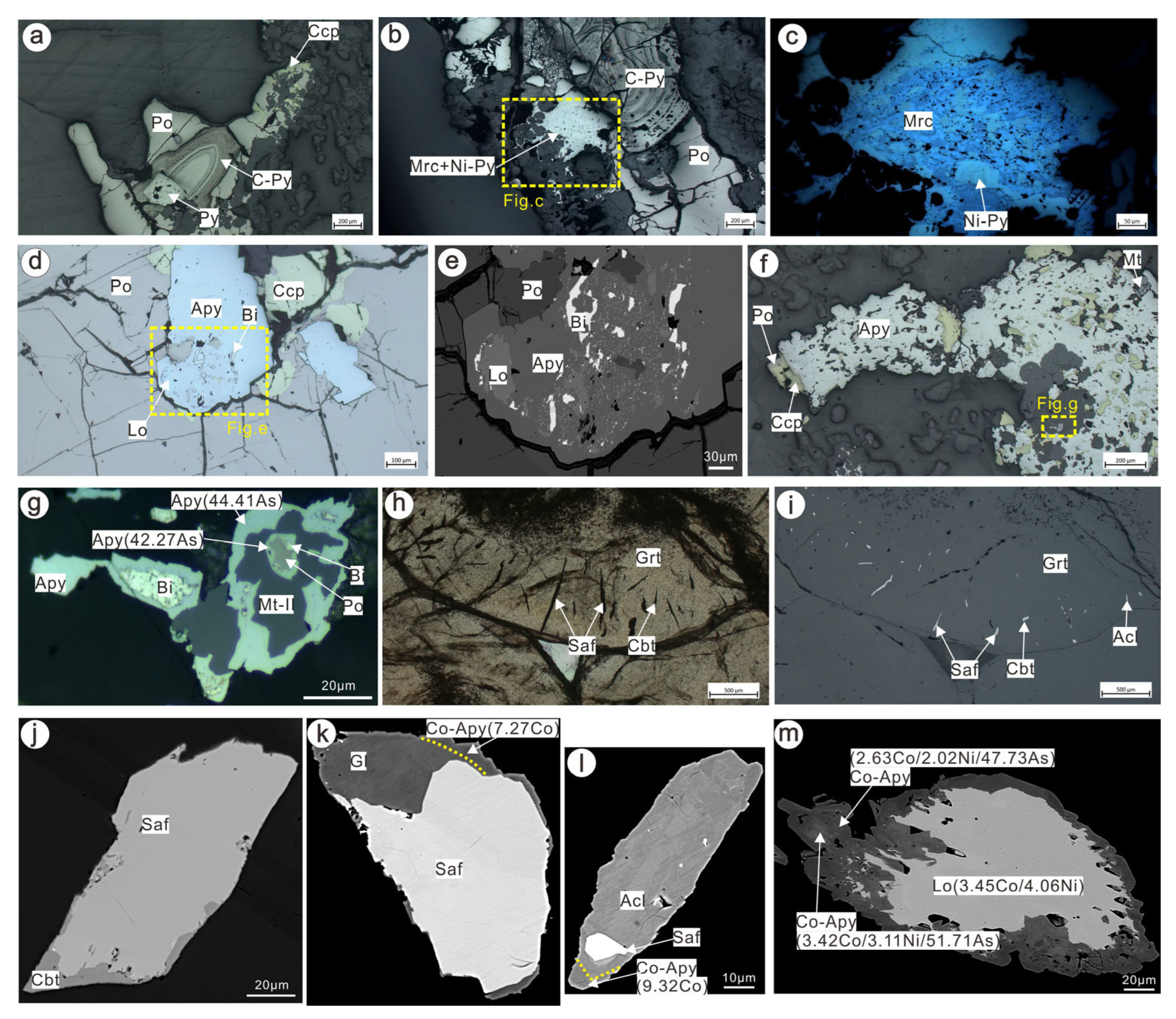
Abundant mineral phases were present during the sulfide stage. An initial phase of colloidal pyrite precipitation is evident. It is featured by packages of layers (Figure 6a) and often shows a coarsening outward sequence (Figure 6b). The replacement of colloidal pyrite by pyrrhotite, chalcopyrite, pyrite, and marcasite was obvious (Figure 6a–c), implying its formation most likely in the early sulfide stage. Pyrrhotite and chalcopyrite occur as the anhedral grain assemblages and were replaced by subhedral to anhedral arsenopyrite (Figure 6d–f). Interestingly, abundant anhedral pyrrhotite, chalcopyrite, native Bi, and löllingite were included within arsenopyrite. These inclusions intergrew with each other (Figure 6d,e,g), suggesting that they formed almost simultaneously. Locally, arsenopyrite coexists with Mt-II (Figure 6g). Independent Co-bearing arsenides and sulfarsenides were identified within garnet, such as safflorite, glaucodot, alloclasite, and cobaltite (Figure 6h,i). They occur as acicular along healed fissures and have grain sizes of no more than 200 μm. The BSE images further reveal that these fine-grained minerals have complex growth history. Specifically, arsenides are commonly circled by sulfarsenides such as safflorite by glaucodot, alloclasite, or cobaltite (Figure 6j,k), and the latter is overgrown by Co-rich arsenopyrite (Figure 6l). In contrast, Co-rich löllingite is only overgrown by Co-rich arsenopyrite, with hackly contact (Figure 6m). These mineral associations indicate that arsenides precipitated before sulfarsenides and that Co–sulfarsenides were followed by Fe–sulfarsenides. Marcasite that generally replaced pyrite with a ‘sponge-like’ texture precipitated towards the end of the mineralization sequence. Locally, native bismuth was replaced partially or fully by bismuthinite.

4.2. Chemical Compositions

4.2.1. Magnetite

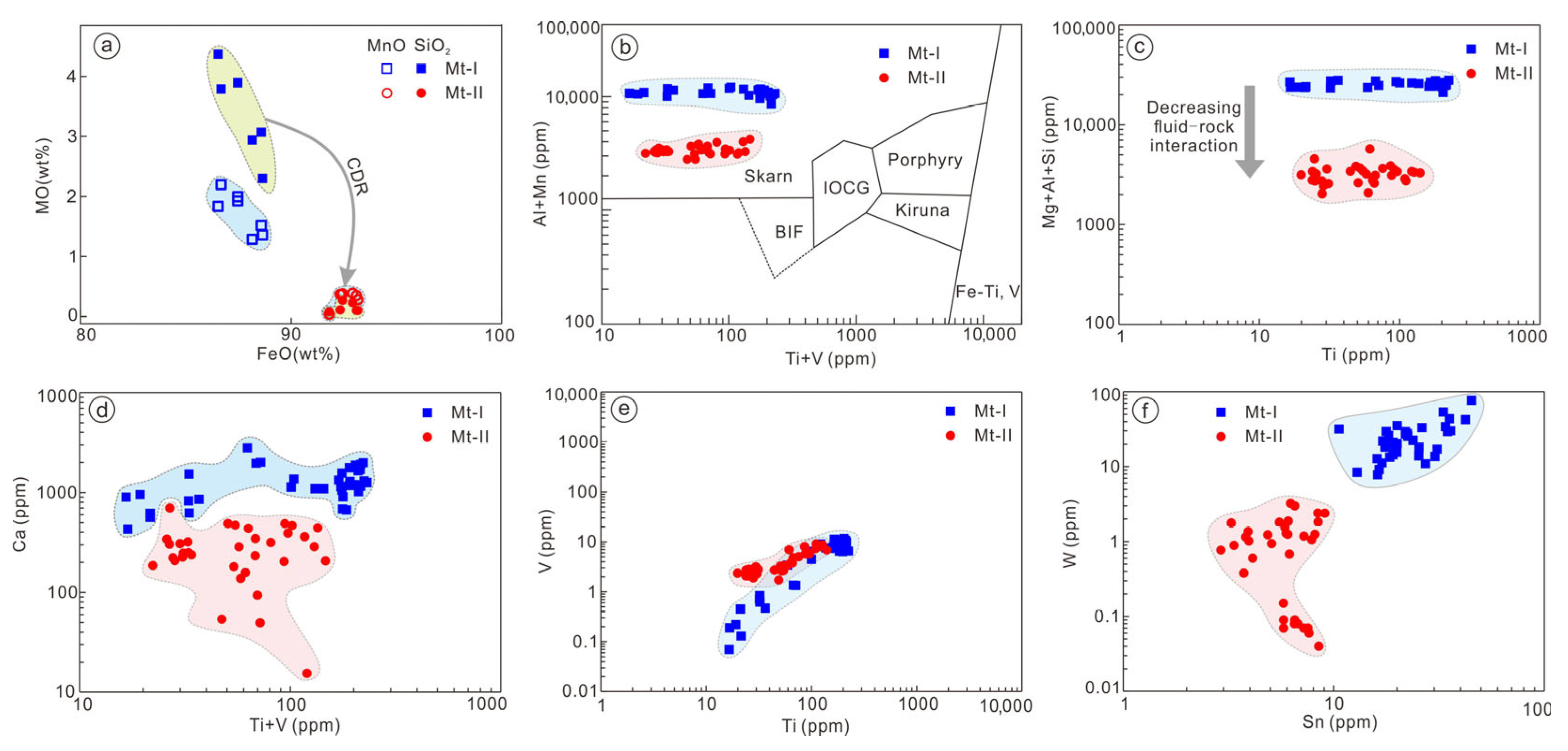
A total of 13 EPMA spot analyses were completed on the magnetite grains, with 7 on Mt-I and 6 spots on Mt-II (Table S1). The results reveal that Mt-I has higher SiO2 and MnO contents than Mt-II. The contents of SiO2 decrease from 2.31 to 4.38 wt% for Mt-I to 0.09 to 0.28 wt% for Mt-II, while MnO contents decrease from 1.29 to 2.20 wt% for Mt-I to 0.04 to 0.39 wt% for Mt-II. In contrast, Mt-I has lower FeO contents (86.53–88.64 wt%) than Mt-II (91.81–93.17 wt%). The negative correlations of SiO2 and MnO with FeO are observed within Mt-I data (Figure 7a).
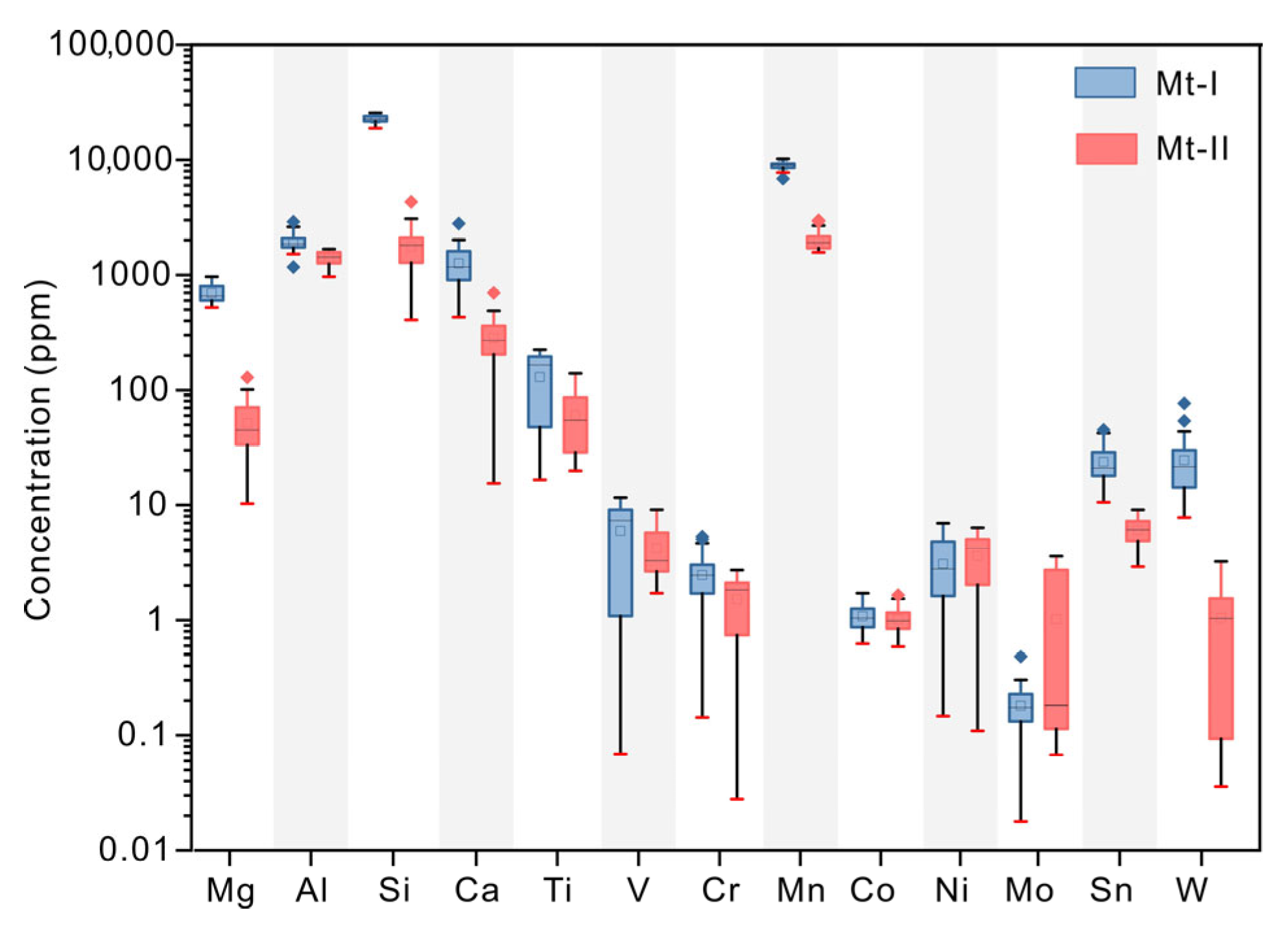
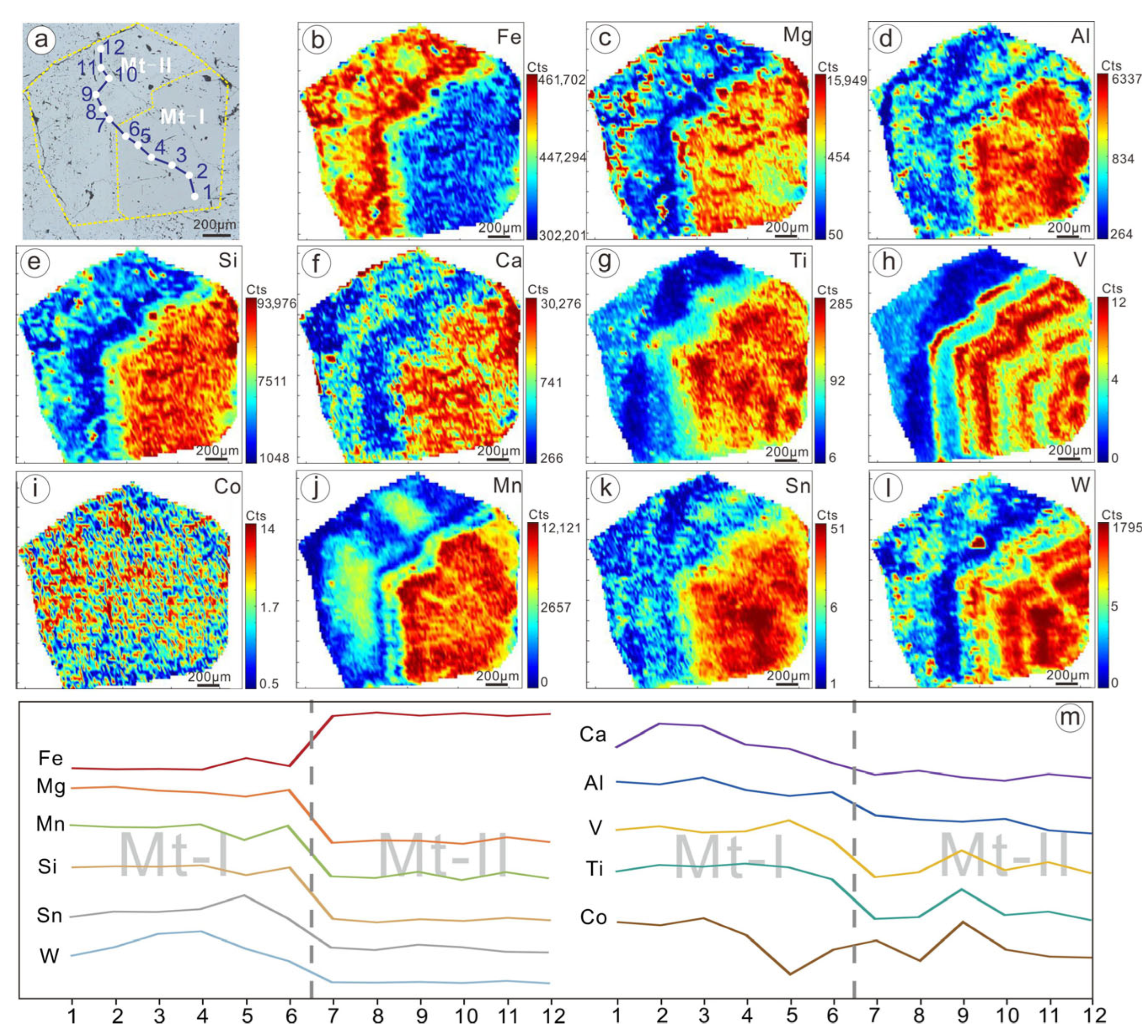
A total of 70 LA-ICPMS spot analyses were completed on the magnetite grains, with 36 spots on Mt-I and 34 spots on Mt-II (Table S2). Similarly to EPMA data, the LA-ICPMS results reveal that Mt-I has higher concentrations of Si and Mn than Mt-II. In addition, Mt-I exhibits elevated concentrations of Mg (Avg. 694 ppm), Al (Avg. 1928 ppm), Ca (Avg. 1262 ppm), Cr (Avg. 2.47 ppm), Sn (Avg. 23.71 ppm), and W (Avg. 24.53 ppm) compared to Mt-II (Avg. 51.42 ppm Mg, Avg. 1403 ppm Al, Avg. 284 ppm Ca, Avg. 1.52 ppm Cr, Avg. 6.01 ppm Sn, and Avg. 1.05 ppm W) (Figure 7b–e and Figure 8). The average contents of Ti (Avg. 129 ppm) and V (Avg. 5.96 ppm) in Mt-I are slightly higher than those in Mt-II (Avg. 60.16 ppm Ti, and Avg. 4.21 ppm V), despite the narrower concentration ranges observed for Mt-II compared to Mt-I (Figure 7f). In general, two generations of magnetite display relatively constant contents of Co (<2 ppm) and Ni (<7 ppm). In addition, the Cu, Zn, and Pb contents in all magnetite grains are also relatively constant. The averaged Mo concentrations are increased from Mt-I (Avg. 0.18 ppm) to Mt-II (Avg. 1.02 ppm). These distinctions of trace element concentrations between Mt-I and Mt-II are further evidenced by the LA-ICPMS mapping (Figure 9).

4.2.2. Arsenides, Sulfarsenides, and Sulfides

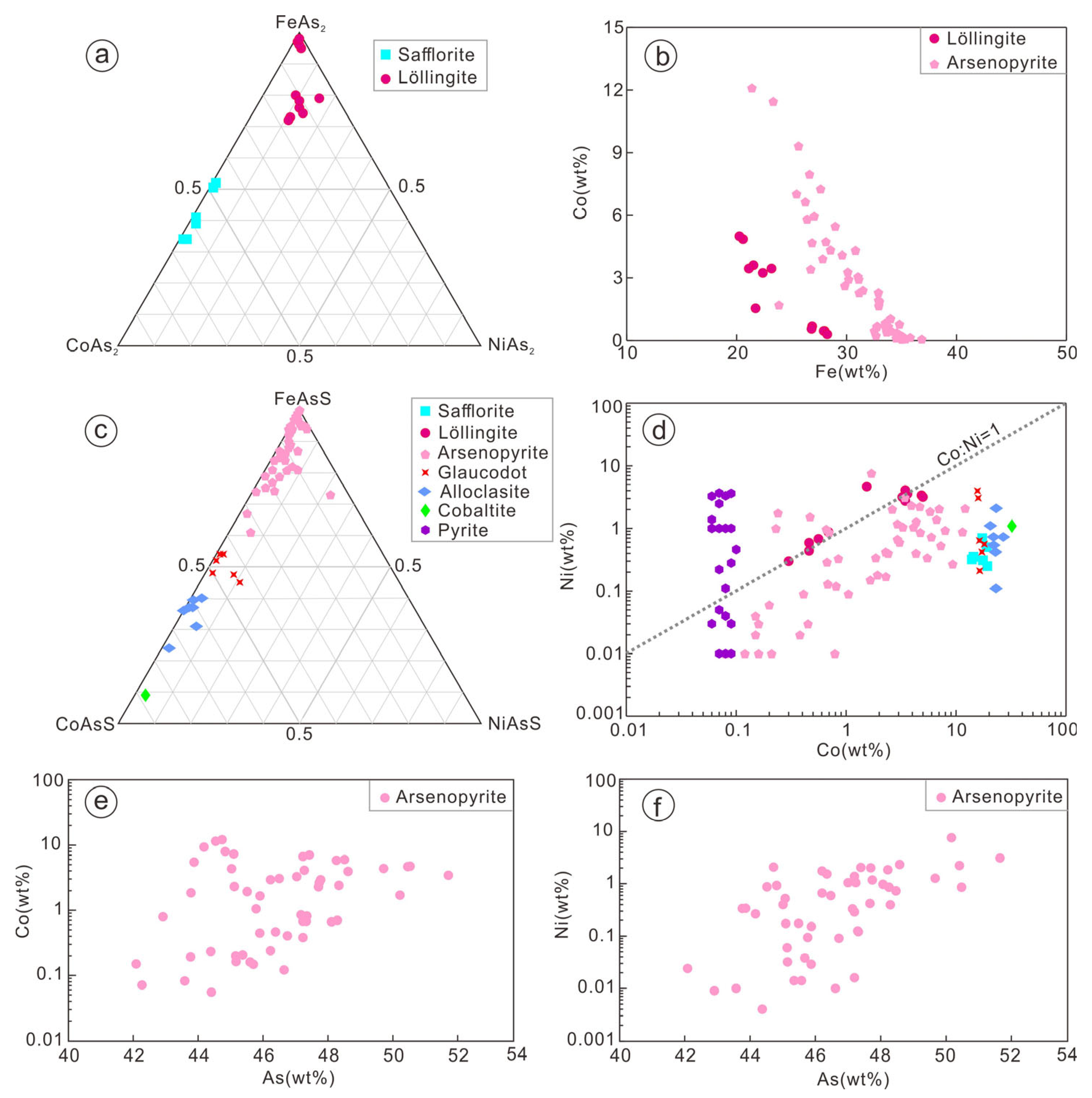
A total of 120 EPMA spot data including 6 safflorite, 12 löllingite, 54 arsenopyrite, 6 glaucodot, 7 alloclasite, 1 cobaltite, 32 pyrite, and 2 pyrrhotite dots were obtained, as shown in Table S3. These results revealed that arsenides and sulfarsenides are generally solid solutions of Fe, Co, and Ni end-members. Safflorite has Fe contents ranging from 9.49 to 14.40 wt% (Avg. 11.73 wt%), Co from 13.91 to 19.24 wt% (Avg. 16.90 wt%), and Ni from 0.25 to 0.70 wt% (Avg. 0.41 wt%). In contrast, löllingite has higher Fe (Avg. 24.05 wt%) and Ni contents (Avg. 2.30 wt%) but lower Co contents (Avg. 2.30 wt%) (Figure 10a). An obviously negative correlation between Co and Fe is observed in löllingite (Figure 10b).
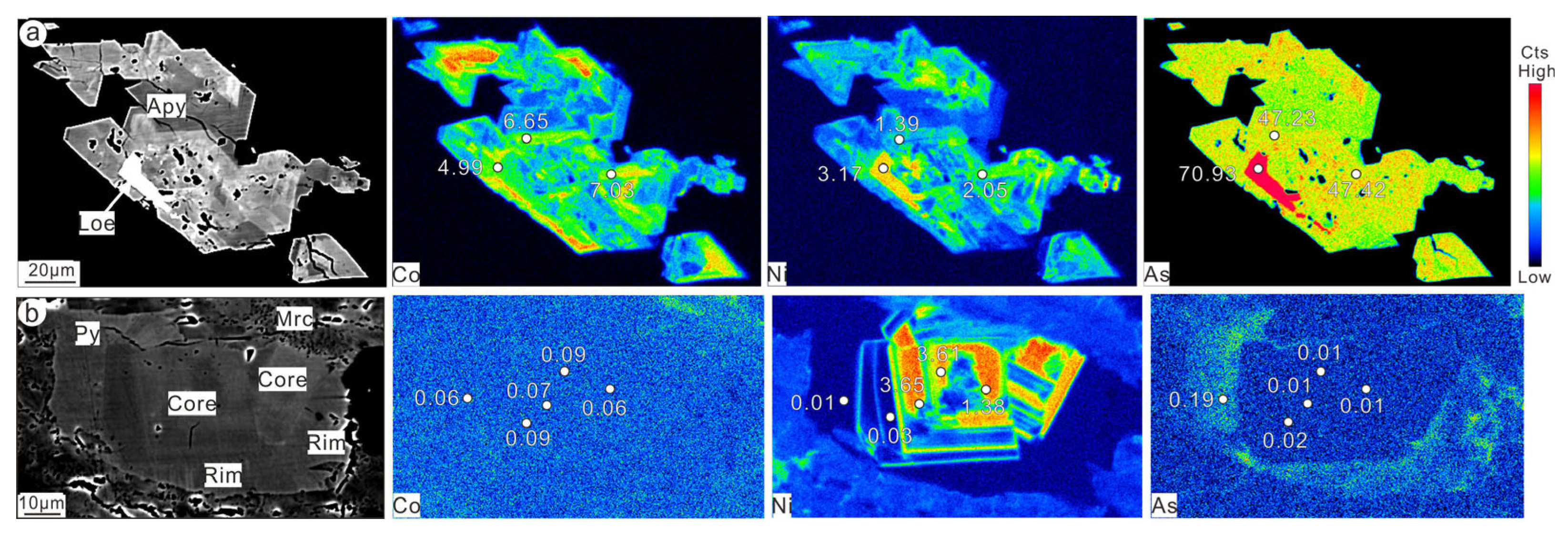
The contents of Fe, Co, and Ni end-members in sulfarsenides vary significantly. Iron contents decrease progressively from arsenopyrite (Avg. 31.22 wt%) to glaucodot (Avg. 17.26 wt%), alloclasite (Avg. 11.98 wt%), and cobaltite (Avg. 3.11 wt%), while Co contents correspondingly increase from arsenopyrite (Avg. 2.73 wt%) to glaucodot (Avg. 16.59 wt%), alloclasite (Avg. 22.90 wt%), and cobaltite (Avg. 32.21 wt%) (Figure 10c). The Ni concentrations are relatively constant across these sulfarsenides, with an average value of approximate 1 wt%. The Co and Ni concentrations in arsenopyrite vary from 0.06 to 12.10 wt% and from below the detection limit (BDL) to 7.60 wt%, respectively, and most grains preferentially incorporate Co over Ni (Figure 10d). The obviously negative correlation between Co and Fe, as well as the positive correlations of Co and Ni with As, is observed in arsenopyrite (Figure 10b,e,f). The EPMA mappings further reveal a heterogeneous arsenopyrite texture in which bright cores enriched in Co, Ni, and As are overgrown by darker, compositionally depleted rims, confirming the coupling distribution of Co and Ni with As (Figure 11a).
In general, pyrrhotite has low Co (<0.15 wt%), Ni (<0.05 wt%), and As (<0.60 wt%) contents (Table S3). In contrast with pyrrhotite, the EPMA analyses reveal low Co (0.06–0.10 wt%) and As (≤0.26 wt%) contents in pyrite, with variable Ni from BDL to 3.65 wt%. The X-ray elemental maps reveal a complex texture for pyrite grains (Figure 11b). Specifically, the Ni-rich cores exhibiting oscillatory zoning were overgrown by Ni-barren rims with slightly elevated As concentrations.

5. Discussion

5.1. Two Pulses of Magnetite Formation

Magnetite possesses an inverse spinel structure that accommodates diverse minor and trace elements across a wide range of geological conditions, and it thus serves as a valuable pathfinder mineral for elucidating ore-forming processes and for guiding mineral exploration [31,32,33,34,35,36,37]. Haisi magnetite displays markedly low Ti (16.53–224 ppm), V (0.07–11.62 ppm), and Cr (<6 ppm) concentrations, coupled with relatively high Fe contents (67.30–72.46 wt%) compared with magmatic magnetite. Together with its Ni/Cr ratios (≥1), these geochemical characteristics indicate a strong affinity with hydrothermal magnetite [32,33,38]. In the Al + Mn vs. Ti + V discrimination diagram, all data are plotted within the skarn field, despite the fact that Mt-I and Mt-II form two distinct clusters (Figure 7b). This separation is attributed to the hydrothermal alteration in primary magnetite during late-stage processes (Figure 5 and Figure 9).
The chemistry of hydrothermal magnetite is governed by the physicochemical conditions (such as temperature, fO2, and fS2), fluid composition, intensity of fluid–rock interactions, and co-precipitated minerals [31,33,34,37]. Titanium and Al concentrations in magnetite are correlated to temperature, and the incorporation of V is affected by fO2 [39,40]. Two magnetite types have overlapping Ti and V contents, despite the positive correlations of Ti with V observed in both Mt-I and Mt-II (Figure 7e). Together with minor Al variations between Mt-I and Mt-II, temperature and fO2 were precluded as the primary controls on the compositional differences between the two magnetite types. Extensive fluid–rock interactions during skarn mineralization commonly result in an enrichment in Mg, Al, Si, Ca, and Mn in magnetite [32,36,41]. The higher contents of these elements in Mt-I compared to Mt-II (Figure 7a–d) reflect an elevated fluid–rock interaction intensity for Mt-I. Their reduced concentrations in Mt-II indicate that evolving fluids during progressive mineralization were gradually depleted in these components due to reduced fluid–rock interaction. In addition, the markedly higher concentration of W and Sn in Mt-I than Mt-II suggests that primary magmatic–hydrothermal fluids are W- and Sn-bearing. The presence of Triassic skarn Sn mineralization in the Haisi–Elashan Belt, exemplified by the Xiaowolong Fe-Sn-Cu deposit [6], appears to corroborate this. The concentration of W and Sn in magnetite serves as a mineralizing indicator in the Nanling Range, South China [42].
The multiple pulses of magnetite mineralization were recognized in iron oxide copper–gold (IOCG), Kiruna-type iron oxide–apatite (IOA), and skarn deposits, where oxy-exsolution, coupled dissolution–reprecipitation (CDR) reactions, and re-equilibration processes contribute to complicating the textures and geochemical compositions of magnetite [22,34,37,43]. Because oxy-exsolution occurs only in high-Ti magnetite, this is not the scenario in this study. Instead, the core–rim textures and crosscutting relationships indicate that Mt-II formed through fluid infiltrating into the Mt-I precursor, i.e., the CDR process. This is supported by well-developed microporosity in Mt-II, the abrupt interface between Mt-I and Mt-II, and sharp trace element compositional gradients from Mt-I to Mt-II (Figure 5 and Figure 9) [44,45].

5.2. Cobalt Enrichment in the Haisi Deposit

The petrographic observation and mineral chemistry revealed two types of Co occurrence in the Haisi deposit. One occurred as independent minerals such as safflorite, glaucodot, alloclasite, and cobaltite. The other was incorporated into the crystal lattice of löllingite and arsenopyrite via stoichiometric substitution, with up to 4.99 wt% Co in löllingite and 12.10 wt% Co in arsenopyrite. The negative correlation between Co and Fe within arsenopyrite and löllingite supports this substitution (Figure 10b). The preference of Co in diarsenides and sulfarsenides at Haisi is distinct from the Lalingzaohuo Cu polymetallic deposit in the CKL where Co is enriched in pyrite (up to 3.1 wt%), pyrrhotite (up to 2.5 wt%), chalcopyrite (up to 1.4 wt%) and sphalerite (up to 0.9 wt%) apart from cobaltite [8]. Instead, the Co-bearing mineral assemblage resembles that of Fe polymetallic deposits in the Qimantagh Belt, where skutterudite (CoAs3), cobaltite, and arsenopyrite (containing up to 9.4 wt% Co) host Co in the Galinge Fe deposit [4], while Co is mainly associated with cobaltite, glaucodot, and arsenopyrite (up to 1.0 wt% Co) in the Niukutou Pb-Zn-Fe deposit [3]. Comparatively, the low Co abundance, <2 ppm in Haisi magnetite and no more than several hundreds of ppm in available hydrothermal magnetite [32], suggests the low partition coefficients of magnetite relative to skarn fluids. This is possibly related to the hydrothermal conditions. Skarn fluids commonly have a relatively high redox state, temperature, and salinity [46], which can effectively mobilize Co [47,48]. Wen et al. (2024) proposed that the gradual fractional crystallization of magnetite with time would lead to the elevated Co/Fe ratio of residual skarn hydrothermal fluids and thus favor Co precipitation in late-stage sulfides [49]. Therefore, when skarn fluids evolve to the reduced sulfide stage, Co metal tends to precipitate from fluids due to increased fS2 and decreased fO2.
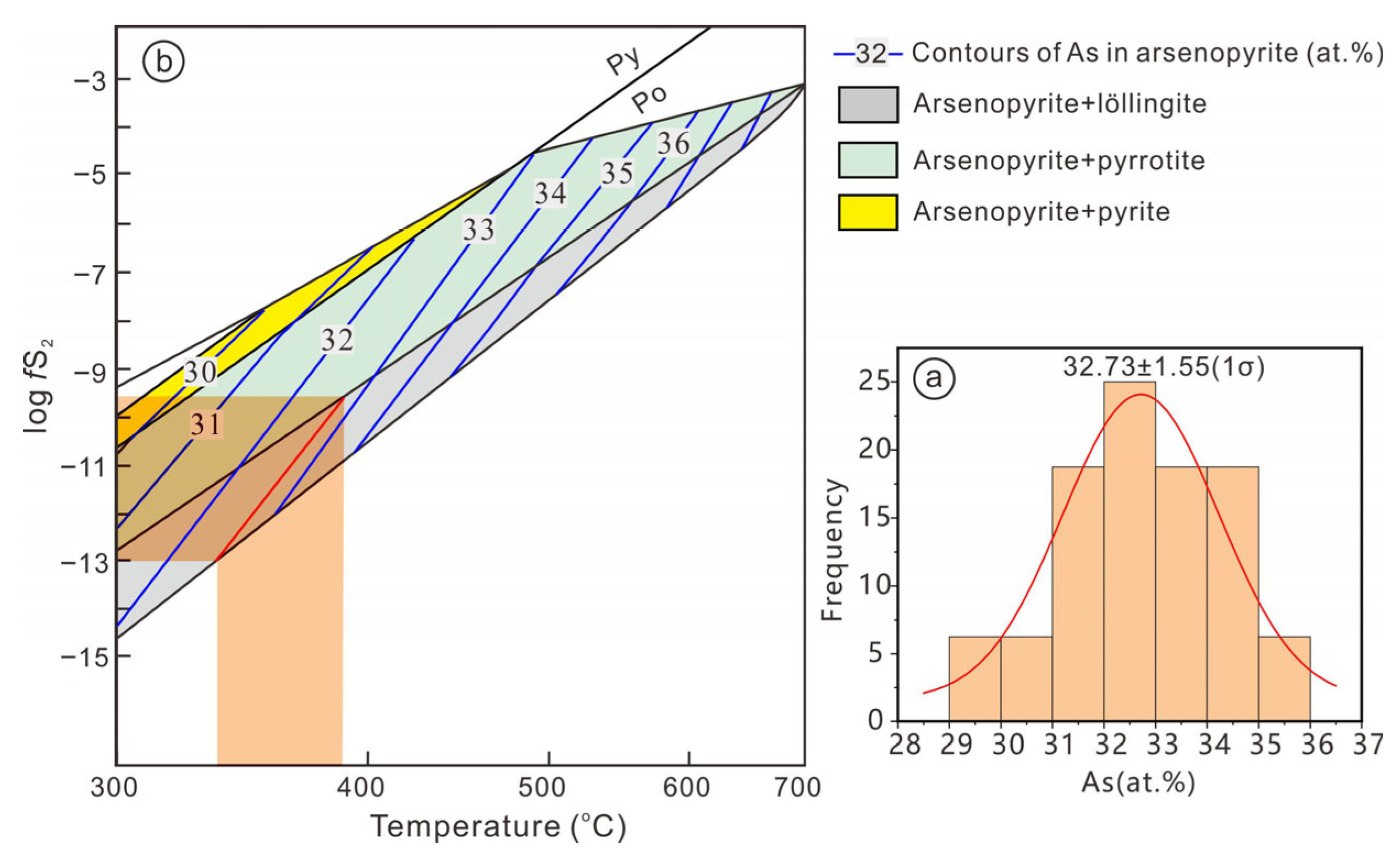
Here, the specific physiochemical conditions responsible for Co enrichment processes during the sulfide stage were discussed. The mineral assemblages of native elements, arsenide, sulfarsenide, and sulfides and their chemical compositions can be employed to estimate the physiochemical conditions of the fluids [50,51,52]. The mineralizing temperature can be constrained by an arsenopyrite geothermometer. In the Haisi deposit, arsenopyrite has a close spatial correlation with löllingite, and thermochemical models for As partitioning behavior during fluid–rock interaction have revealed that the concentration of As in arsenopyrite has positive correlations with temperature in As-rich systems where arsenopyrite and löllingite coexist [53]. Considering that the arsenopyrite geothermometer proposed by Kretschmar and Scott (1976) was calibrated using data containing no more than 1 wt% combined Co, Ni, and Sb [54], only arsenopyrite grains with trace elements contents below 1 wt% were adopted for temperature estimation. These data give As contents varying from 29.86 to 35.03 at.%, with a mean value of 32.73 at.% (Figure 12a). The geothermometer yields a temperature varying from 340 to 390 °C and sulfur fugacity with logfS2 values ranging from −13.0 to −9.6 (Figure 12b).
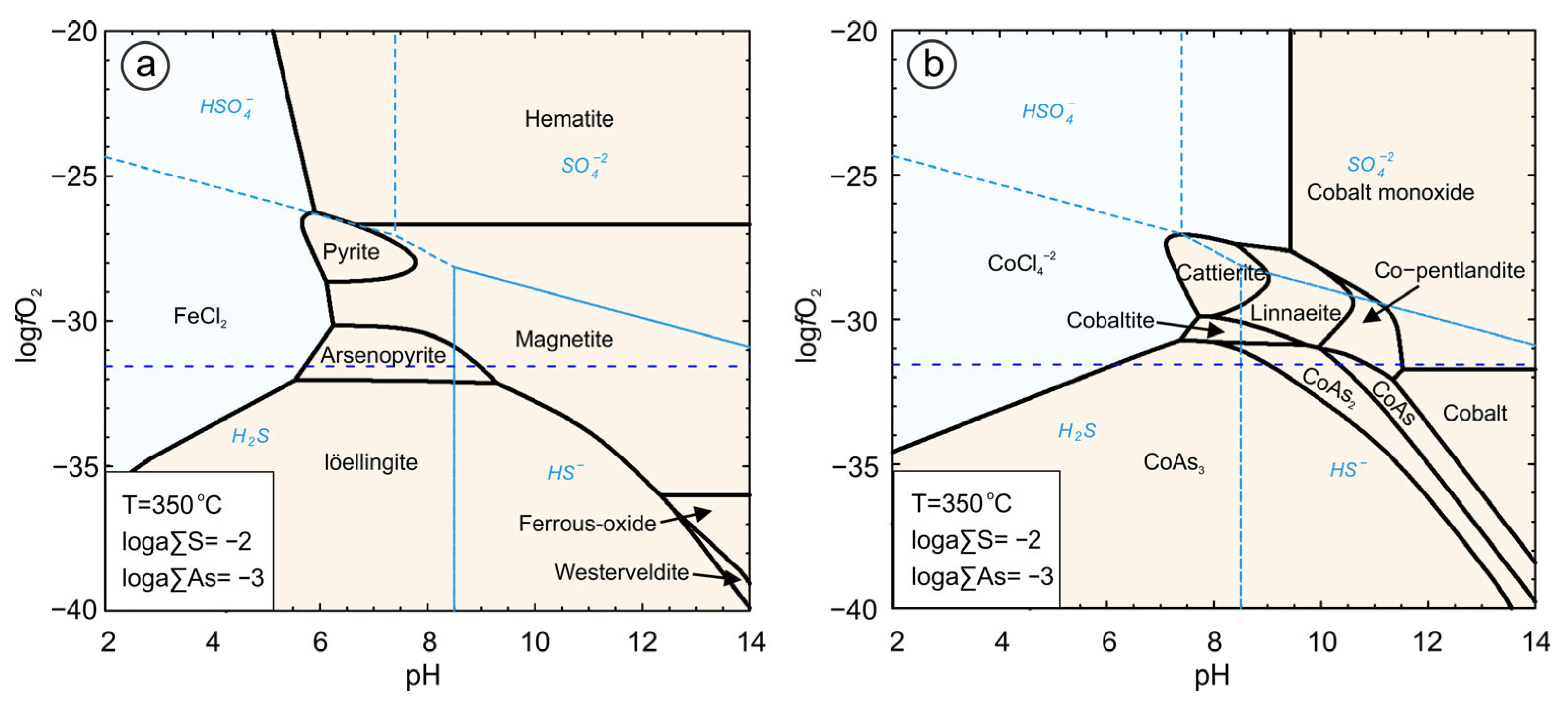
Native bismuth, as an earlier mineral during the sulfide stage, commonly forms within the field of pyrrhotite, with low-fS2 and -fO2 conditions [55]. Following native bismuth, safflorite, and löllingite mineralization, abundant glaucodot, alloclasite, cobaltite, and arsenopyrite were formed. The transition of Fe-Co-As-S paragenesis from diarsenides to their sulfarsenides likely reflects an increase in fO2 and the S/As ratio. To better illustrate these processes, we constructed phase diagrams using the R package 2.2.0 of CHNOSZ [56]. The thermodynamic modeling data for chemical species are listed in File S1. The R code used to generate the Co–S–As–O–Cl and Fe–S–As–O–Cl phase diagrams is listed in File S2. As shown in the phase diagram, löllingite and safflorite are stable at an fO2 of −31 at 350 °C, whereas arsenopyrite and cobaltite are stable over a higher fO2 of −29 to −31 (Figure 13). The coexistence of hydrothermal magnetite (MtII) and arsenopyrite (Figure 6g) also indicates a short-lived elevated fO2 (Figure 13a). Subsequently, the system evolved toward sulfide-dominated assemblages. Elevated sulfur contents (i.e., a high S/As ratio in the fluid) favored the precipitation of Co-bearing pyrite (equivalent to cattierite), pyrite, and bismuthinite (within the pyrite stability field) [55], accompanied by an increase in oxygen fugacity from fO2 −29 to −26 (Figure 13b). The appearance of marcasite suggests a concurrent decrease in pH [57]. pH variations also explain the concentration of Ni, rather than Co, in late-stage pyrite due to the different stabilities of their chloride complexes [58]. Above all, the continuous increases in fO2 and fS2 together with a possible decrease in pH foster the successive precipitation of diarsenides, sulfarsenides, and sulfides during late mineralization. The variation in ore-forming conditions might be related to the conversion of carbonate to skarn, which would release abundant CO2 and thus increase the pressure within the mineralizing system [59]. This elevated pressure might trigger extensive hydraulic fractures [60], producing an episodic increase in fO2. This is further supported by the initial precipitation of colloform pyrite, a short-lived FeS2 supersaturation that was triggered by a sudden drop in fluid pressure caused by fracturing [61].

6. Conclusions

(1)
Two generations of magnetite were identified: Mt-I and Mt-II. Mt-I, which accounts for the majority of magnetite, formed during the iron oxide-rich retrograde stage, whereas Mt-II formed during the sulfide stage. The higher Mg, Al, Si, Ca, and Mn concentrations in Mt-I relative to Mt-II indicate a decrease in fluid–rock interaction intensity from the oxide-rich stage to the sulfide stage.
(2)
Cobalt occurs in two principal forms: (1) independent arsenide (e.g., safflorite) and sulfarsenide (e.g., glaucodot, alloclasite, cobaltite) minerals and (2) via stoichiometric substitution within the crystal structures of löllingite and arsenopyrite.
(3)
Cobalt mineralization in the Haisi deposit is featured by the sequential precipitation of diarsenides, followed by sulfarsenides and finally sulfides. The paragenetic sequence reflects a concurrent increase in fluid fO2 and the S/As ratio, alongside a possible decrease in pH.

Supplementary Materials

The following supporting information can be downloaded at https://www.mdpi.com/article/10.3390/min16020194/s1, Table S1: Chemical compositions (wt%) of different generations of magnetite analyzed by EPMA from Haisi skarn deposit, EKOB; Table S2: Chemical compositions (ppm) of different generations of magnetite analyzed by LA-ICPMS from Haisi skarn deposit, EKOB; Table S3: Chemical compositions (wt%) of arsenides, sulfarsenides, and sulfides analyzed by EPMA from Haisi skarn deposit, EKOB. File S1: Thermodynamic modeling data for chemical species; File S2: The R code used to generate the Co–S–As–O–Cl and Fe–S–As–O–Cl phase diagrams.

Author Contributions

Conceptualization, Z.W.; Data analysis, J.G. and Y.Z.; Funding acquisition, Z.W.; Investigation, T.W., Z.L. and F.X.; Methodology, J.G. and F.X.; Software, Y.W.; Writing—original draft, J.G. and Y.Z.; Writing—review and editing, Z.W. and Y.W. All authors have read and agreed to the published version of the manuscript.

Funding

This research was financially co-supported by the National Natural Science Foundation of China (No. 42372106 and U2344205).

Data Availability Statement

Data is contained within the article or Supplementary Materials.

Acknowledgments

We are grateful to Jian Tang and Chengfu Yu from Qinghai Geological Survey Institute for their help with sampling. The editors and two anonymous reviewers are acknowledged for their thorough and constructive comments.

Conflicts of Interest

Author Yueqiang Zhou was employed by the Hunan Institute of Geological Disaster Investigation and Monitoring, Tao Wang and Zhiqiang Li were employed by Qinghai Provincial Geological Survey Bureau. The remaining authors declare that the research was conducted in the absence of any commercial or financial relationships that could be construed as a potential conflict of interest.

References

  1. Chang, Z.S.; Shu, Q.H.; Meinert, L.D. Skarn Deposits of China. SEG Spec. Publ. 2019, 46, 189–234. [Google Scholar] [CrossRef]
  2. Liang, X.; Wang, F.Y.; Zhang, L.; Zhang, J.W.; Wei, C.S.; Fan, Y.; Guo, X.Z.; Zhou, T.F.; Zhang, J.; Lü, Q.T. Cobalt distribution and enrichment in skarn iron deposits: A case study of the Zhuchong skarn iron deposit, Eastern China. Ore Geol. Rev. 2023, 163, 105778. [Google Scholar] [CrossRef]
  3. Che, Y.Y.; Su, H.M.; Liu, T.; Li, H.; He, S.Y. The occurrence and enrichment of cobalt in skarn Pb-Zn deposits: A case study of the Niukutou Co-rich deposit, East Kunlun metallogenic belt, western China. Ore Geol. Rev. 2024, 172, 106210. [Google Scholar] [CrossRef]
  4. Liu, T.; Jiang, S.-Y.; Cao, S.; Wang, W.; Su, H.M.; Yang, D.; Li, H.; He, S. Cobalt enrichment and metallogenic mechanism of the Galinge skarn iron deposit in the Eastern Kunlun metallogenic belt, western China. Ore Geol. Rev. 2024, 170, 106147. [Google Scholar] [CrossRef]
  5. Jiang, J.; Xu, J.; Xie, G.; Liu, W.; Cen, Z.; Chen, S.; Nan, G. Occurrence and distribution of Se and Te in the Jilongshan Au-Cu skarn deposit from the Middle-Lower Yangtze River metallogenic belt, China. Ore Geol. Rev. 2025, 176, 106439. [Google Scholar] [CrossRef]
  6. Guo, X.; Jia, Q.; Lü, X.; Li, J.; Kong, H.; Yao, X. The Permian Sn metallogenic event and its geodynamic setting in East Kunlun, NW China: Evidence from zircon and cassiterite geochronology, geochemistry, and Sr–Nd–Hf isotopes of the Xiaowolong skarn Sn deposit. Ore Geol. Rev. 2020, 118, 103370. [Google Scholar] [CrossRef]
  7. Yin, S.; Ma, C.; Xu, J.; Fu, J.; Zhang, X.N. The role of crystal mush in porphyry systems: A case study from the Baishiya ore field, East Kunlun orogenic belt, northern Qinghai-Tibet plateau. Ore Geol. Rev. 2022, 146, 104962. [Google Scholar] [CrossRef]
  8. Chen, J.; Wu, H.; Niu, X.; Niu, S.; Wang, Y.; Wang, J.; Wang, Z. Geology and geochronology of the Lalingzaohuo cobalt-bearing copper polymetallic skarn deposit, East Kunlun. Ore Geol. Rev. 2023, 154, 105349. [Google Scholar] [CrossRef]
  9. Su, H.M.; Che, Y.Y.; Liu, T.; Li, H.; Liu, L.; Jin, T.; He, S. Multiple generations of garnet and their genetic significance in the Niukutou cobalt-rich Pb-Zn-(Fe) skarn deposit, East Kunlun orogenic belt, western China. Ore Geol. Rev. 2024, 174, 106308. [Google Scholar] [CrossRef]
  10. Ma, H.Y. Metallotectonics and Geochemistry of the Baishiya Iron-polymetallic Deposit, Dulan, Qinghai, China. Master’s Thesis, Central South University, Changsha, China, May 2010. (In Chinese with English abstract). [Google Scholar]
  11. Pan, T. Study on the Metallogenic Series of Cobalt Deposits In Eastern Kunlun Orogenic Belt. Ph.D. Thesis, Jilin University, Changchun, China, May 2005. (In Chinese with English abstract). [Google Scholar]
  12. Pan, T. Research on the occurrence state and technological characteristics of cobalt deposits in the Eastern Kunlun, Qinghai Province. Qinghai Technol. 2009, 1, 61–64. (in Chinese). [Google Scholar]
  13. Dong, Y.; He, D.; Sun, S.; Liu, X.; Zhou, X.; Zhang, F.; Yang, Z.; Cheng, B.; Zhao, G.; Li, J. Subduction and accretionary tectonics of the East Kunlun orogen, western segment of the Central China Orogenic System. Earth–Sci. Rev. 2018, 186, 231–261. [Google Scholar] [CrossRef]
  14. Dong, Y.; Sun, S.; Santosh, M.; Zhao, J.; Sun, J.; He, D.; Shi, X.; Hui, B.; Cheng, C.; Zhang, G. Central China Orogenic Belt and amalgamation of East Asian continents. Gondwana Res. 2021, 100, 131–194. [Google Scholar] [CrossRef]
  15. Meng, F.; Cui, M.; Wu, X.; Ren, Y. Heishan mafic–ultramafic rocks in the Qimantag area of Eastern Kunlun, NW China: Remnants of an early Paleozoic incipient island arc. Gondwana Res. 2015, 27, 745–759. [Google Scholar] [CrossRef]
  16. Meng, F.; Zhang, J.; Cui, M. Discovery of Early Paleozoic eclogite from the East Kunlun, Western China and its tectonic significance. Gondwana Res. 2013, 23, 825–836. [Google Scholar] [CrossRef]
  17. Wang, Z.; Wang, Y.; Chi, G.; Peng, E.; Li, H.; Zou, S.; Xu, D.; Deng, T.; Yu, M. Cobalt remobilization during tectonic–hydrothermal overprinting: A case from the Tuolugou Co(–Au) deposit in East Kunlun Orogenic Belt, China. Ore Geol. Rev. 2024, 170, 106149. [Google Scholar] [CrossRef]
  18. Song, X.Y.; Yi, J.N.; Chen, L.M.; She, Y.W.; Liu, C.Z.; Dang, X.Y.; Yang, Q.A.; Wu, S.K. The giant Xiarihamu Ni–Co sulfide deposit in the East Kunlun Orogenic Belt, northern Tibet Plateau, China. Econ. Geol. 2016, 111, 29–55. [Google Scholar] [CrossRef]
  19. Zhang, A.; Wang, J.; Liu, G.; Ma, Z. Main minerogenetic series in the Qimantag area, Qinghai Province, and their metallogenic models. Acta Mineral. Sin. 2021, 41, 1–21, (In Chinese with English abstract). [Google Scholar]
  20. Chen, X.D.; Li, B.; Yu, M.; Zhang, W.D.; Zhu, L. Generation of crystal-rich rhyodacites by fluid-induced crystal-mush rejuvenation: Perspective from the Late Triassic Nageng (sub-)volcanic complex of the East Kunlun Orogen, NW China. Chem. Geol. 2022, 599, 120833. [Google Scholar] [CrossRef]
  21. Yu, M.; Zeng, Q.; Wang, H.; Zhang, J.; Mao, J.; Feng, C. Lithospheric influence on metallogenesis in the East Kunlun Orogen: Insights from isotopic and geochemical mapping. J. Geochem. Explor. 2024, 263, 107515. [Google Scholar] [CrossRef]
  22. Yin, S.; Ma, C.; Robinson, P.T. Textures and high field strength elements in hydrothermal magnetite from a skarn system: Implications for coupled dissolution-reprecipitation reactions. Am. Mineral. 2017, 102, 1045–1056. [Google Scholar] [CrossRef]
  23. Yu, M.; Feng, C.Y.; Santosh, M.; Mao, J.W.; Zhu, Y.F.; Zhao, Y.M.; Li, D.X.; Li, B. The Qiman Tagh Orogen as a window to the crustal evolution in northern Qinghai-Tibet Plateau. Earth-Sci. Rev. 2017, 167, 103–123. [Google Scholar] [CrossRef]
  24. Hu, Y.; Niu, Y.; Li, J.; Ye, L.; Kong, J.; Chen, S.; Zhang, Y.; Zhang, G. Petrogenesis and tectonic significance of the late Triassic mafic dikes and felsic volcanic rocks in the East Kunlun Orogenic Belt, Northern Tibet Plateau. Lithos 2016, 245, 205–222. [Google Scholar] [CrossRef]
  25. Fan, X.; Sun, F.; Xu, C.; Wu, D.; Yu, L.; Wang, L.; Yan, C.; Bakht, S. Volcanic rocks of the Elashan Formation in the Dulan-Xiangride Basin, East Kunlun Orogenic Belt, NW China: Petrogenesis and implications for Late Triassic geodynamic evolution. Int. Geol. Rev. 2022, 64, 1270–1293. [Google Scholar] [CrossRef]
  26. Liu, B.; Wu, L.; Ma, C.Q.; Zhang, M.Y.; Xue, Z.H.; Sun, Y.; Li, S.Z. Volcanic-intrusive connections and crystal-melt segregation in the Dulan tilted crustal section: Insights from accessory mineral evolution. Chem. Geol. 2025, 672, 122517. [Google Scholar] [CrossRef]
  27. Xiong, F.H.; Ma, C.Q.; Zhang, J.Y.; Liu, B.; Jiang, H.A. Reworking of old continental lithosphere: An important crustal evolution mechanism in orogenic belts, as evidenced by Triassic I-type granitoids in the East Kunlun orogen, Northern Tibetan Plateau. J. Geol. Soc. 2014, 171, 847–863. [Google Scholar] [CrossRef]
  28. Griffin, W.L.; Powell, W.J.; Pearson, N.J.; O’Reilly, S.Y. GLITTER: Data reduction software for laser ablation ICP-MS. In Laser Ablation-ICP-MS in the Earth Sciences: Current Practices and Outstanding Issues; Sylvester, P., Ed.; Mineralogical Association of Canada: Sudbury, ON, Canada, 2008; Volume 40, pp. 308–311. [Google Scholar]
  29. Zhang, D.; Liu, J.; Wang, Z.; C.Bayless, R.; Hu, Z.; Xie, X.; Chen, S. In situ LA–ICP–MS trace elements in sphalerite from the Fankou Pb–Zn deposit, South China: Implications for ore genesis. Ore Geol. Rev. 2024, 164, 105812. [Google Scholar] [CrossRef]
  30. Wang, F.; Ge, C.; Ning, S.; Nie, L.; Zhong, G.; Noel, C.W. A new approach to LA–ICP–MS mapping and application in geology. Acta Petrol. Sin. 2017, 33, 3422–3436, (In Chinese with English abstract). [Google Scholar]
  31. Nadoll, P.; Angerer, T.; Mauk, J.L.; French, D.; Walshe, J. The chemistry of hydrothermal magnetite: A review. Ore Geol. Rev. 2014, 61, 1–32. [Google Scholar] [CrossRef]
  32. Nadoll, P.; Mauk, J.L.; Leveille, R.A.; Koenig, A.E. Geochemistry of magnetite from porphyry Cu and skarn deposits in the southwestern United States. Miner. Deposita. 2015, 50, 493–515. [Google Scholar] [CrossRef]
  33. Dare, S.A.S.; Barnes, S.J.; Beaudoin, G.; Méric, J.; Boutroy, E.; Potvin-Doucet, C. Trace elements in magnetite as petrogenetic indicators. Miner. Deposita 2014, 49, 785–796. [Google Scholar] [CrossRef]
  34. Huang, X.W.; Beaudoin, G. Textures and chemical compositions of magnetite from iron oxide copper-gold (IOCG) and kiruna-type iron oxide-apatite (IOA) deposits and their implications for ore genesis and magnetite classification schemes. Econ. Geol. 2019, 114, 953–979. [Google Scholar] [CrossRef]
  35. Huang, X.W.; Sappin, A.A.; Boutroy, E.; Beaudoin, G.; Makvandi, S. Trace element composition of igneous and hydrothermal magnetite from porphyry deposits: Relationship to deposit subtypes and magmatic affinity. Econ. Geol. 2019, 114, 917–952. [Google Scholar] [CrossRef]
  36. Liu, Y.; Fan, Y.; Zhou, T.; Xiao, X.; White, N.C.; Thompson, J.; Hong, H.; Zhang, L. Geochemical characteristics of magnetite in Longqiao skarn iron deposit in the Middle-Lower Yangtze Metallogenic Belt, Eastern China. Miner. Deposita 2019, 54, 1229–1242. [Google Scholar] [CrossRef]
  37. Zhang, Y.; Hollings, P.; Shao, Y.; Li, D.; Chen, H.; Li, H. Magnetite texture and trace-element geochemistry fingerprint of pulsed mineralization in the Xinqiao Cu-Fe-Au deposit, Eastern China. Am. Mineral. 2020, 105, 1712–1723. [Google Scholar] [CrossRef]
  38. Dare, S.A.S.; Barnes, S.J.; Beaudoin, G. Variation in trace element content of magnetite crystallized from a fractionating sulfide liquid, Sudbury, Canada: Implications for provenance discrimination. Geochim. Cosmochim. Acta 2012, 88, 27–50. [Google Scholar] [CrossRef]
  39. Toplis, M.J.; Carroll, M.R. An experimental study of the influence of oxygen fugacity on Fe-Ti oxide stability, phase relations, and mineral—Melt equilibria in ferro-basaltic systems. J. Petrol. 1995, 36, 1137–1170. [Google Scholar] [CrossRef]
  40. Toplis, M.J.; Corgne, A. An experimental study of element partitioning between magnetite, clinopyroxene and iron-bearing silicate liquids with particular emphasis on vanadium. Contrib. Mineral. Petrol. 2002, 144, 22–37. [Google Scholar] [CrossRef]
  41. Deditius, A.P.; Reich, M.; Simon, A.C.; Suvorova, A.; Knipping, J.; Roberts, M.P.; Rubanov, S.; Dodd, A.; Saunders, M. Nanogeochemistry of hydrothermal magnetite. Contrib. Mineral. Petrol. 2018, 173, 46. [Google Scholar] [CrossRef]
  42. Zhao, W.W.; Zhou, M.F. In-situ LA–ICP-MS trace elemental analyses of magnetite: The Mesozoic Tengtie skarn Fe deposit in the Nanling Range, South China. Ore Geol. Rev. 2015, 65, 872–883. [Google Scholar] [CrossRef]
  43. Hu, H.; Lentz, D.; Li, J.W.; McCarron, T.; Zhao, X.F.; Hall, D. Reequilibration processes in magnetite from iron skarn deposits. Econ. Geol. 2015, 110, 1–8. [Google Scholar] [CrossRef]
  44. Putnis, C.V.; Tsukamoto, K.; Nishimura, Y. Direct observations of pseudomorphism: Compositional and textural evolution at a fluid-solid interface. Am. Mineral. 2005, 90, 1909–1912. [Google Scholar] [CrossRef]
  45. Altree-Williams, A.; Pring, A.; Ngothai, Y.; Brugger, J. Textural and compositional complexities resulting from coupled dissolution–reprecipitation reactions in geomaterials. Earth-Sci. Rev. 2015, 150, 628–651. [Google Scholar] [CrossRef]
  46. Yu, M. Metallogenic Mechanism of the Galinge Polymetallic Iron Skarn Deposit, Qiman Tagh Mountains, Qinghai Province; Springer: Singapore, 2019; pp. 235–248. [Google Scholar]
  47. Liu, W.; Borg, S.J.; Testemale, D.; Etschmann, B.; Hazemann, J.L.; Brugger, J. Speciation and thermodynamic properties for cobalt chloride complexes in hydrothermal fluids at 35–440 °C and 600 bar: An in-situ XAS study. Geochim. Cosmochim. Acta 2011, 75, 1227–1248. [Google Scholar] [CrossRef]
  48. Migdisov, A.A.; Zezin, D.; Williams-Jones, A.E. An experimental study of Cobalt (II) complexation in Cl- and H2S-bearing hydrothermal solutions. Geochim. Cosmochim. Acta 2011, 75, 4065–4079. [Google Scholar] [CrossRef]
  49. Wen, G.; Li, J.-W.; Hofstra, A.H.; Harlov, D.E.; Zhao, X.F.; Lowers, H.A.; Koenig, A.E. Trace element fractionation in magnetite as a function of Fe depletion from ore fluids at the Baijian Fe-(Co) skarn deposit, eastern China: Implications for Co mineralization in Fe skarns. Am. Mineral. 2024, 109, 1657–1669. [Google Scholar] [CrossRef]
  50. Scharrer, M.; Kreissl, S.; Markl, G. The mineralogical variability of hydrothermal native element-arsenide (five-element) associations and the role of physicochemical and kinetic factors concerning sulfur and arsenic. Ore Geol. Rev. 2019, 113, 103025. [Google Scholar] [CrossRef]
  51. Williams-Jones, A.E.; Vasyukova, O.V. Constraints on the genesis of cobalt deposits: Part I. Theoretical considerations. Econ. Geol. 2022, 117, 513–528. [Google Scholar] [CrossRef]
  52. Wang, H.; Zou, S.; Wang, Z.; Xu, D.; Zhang, Y.; Zhang, H. Textural and compositional evolution of quartz and cobalt-bearing minerals from the Wubaoshan Deposit, Jiangxi Province, South China: Implications for cobalt mineralization. Ore Geol. Rev. 2024, 170, 106150. [Google Scholar] [CrossRef]
  53. Xing, Y.; Brugger, J.; Tomkins, A.; Shvarov, Y. Arsenic evolution as a tool for understanding formation of pyritic gold ores. Geology 2019, 47, 335–338. [Google Scholar] [CrossRef]
  54. Kretschmar, U.; Scott, S.D. Phase relations involving arsenopyrite in the system Fe-As-S and their application. Can. Mineral. 1976, 14, 364–386. [Google Scholar]
  55. Brando Soares, M.; Alves, F.E.A.; Corrêa Neto, A.V.; Bertolino, L.C.; Araújo, I.M.C.D.P.; Gopon, P.; Mozart, M.S. Gold refinement by the fractionation of Bi-enriched partial melts at the Quadrilátero Ferrífero, Brazil: Implications on the formation of hypozonal deposits. Miner. Deposita 2022, 57, 781–800. [Google Scholar] [CrossRef]
  56. Dick, J.M. CHNOSZ: Thermodynamic calculations and diagrams for geochemistry. Front. Earth Sci. 2019, 7, 180. [Google Scholar] [CrossRef]
  57. Murowchick, J.B.; Barnes, H.L. Marcasite precipitation from hydrothermal solutions. Geochim. Cosmochim. Acta 1986, 50, 2615–2629. [Google Scholar]
  58. Markl, G.; Burisch, M.; Neumann, U. Natural fracking and the genesis of five-element veins. Miner. Deposita 2016, 51, 703–712. [Google Scholar] [CrossRef]
  59. Meinert, L.D.; Dipple, G.M.; Nicolescu, S. World Skarn Deposits; Society of Economic Geologists: Littleton, CO, USA, 2005; pp. 299–336. [Google Scholar]
  60. Sibson, R.H.; Robert, F.; Poulsen, K.H. High-angle reverse faults, fluid-pressure cycling, and mesothermal gold-quartz deposits. Geology 1988, 16, 551–555. [Google Scholar]
  61. Wu, Y.F.; Li, J.W.; Evans, K.; Koenig, A.E.; Li, Z.K.; O’Brien, H.; Lahaye, Y.; Rempel, K.; Hu, S.Y.; Zhang, Z.P.; et al. Ore-forming processes of the Daqiao epizonal orogenic gold deposit, West Qinling orogen, China: Constraints from textures, trace elements, and sulfur isotopes of pyrite and marcasite, and Raman spectroscopy of carbonaceous material. Econ. Geol. 2018, 113, 1093–1132. [Google Scholar] [CrossRef]
  62. Naumov, G.B.; Ryzhenko, B.N.; Khodakovsky, I.L. Handbook of Thermodynamic Data; U.S. Department of Commerce: Washington, DC, USA, 1974; PB 226 722; pp. 1–328.
  63. Majzlan, J.; Kiefer, S.; Lilova, K.; Subramani, T.; Navrotsky, A.; Tuhý, M.; Vymazalová, A.; Chareev, D.A.; Dachs, E.; Benisek, A. Calorimetric study of skutterudite (CoAs2.92) and heazlewoodite (Ni3S2). Am. Mineral. 2022, 107, 2219–2225. [Google Scholar]
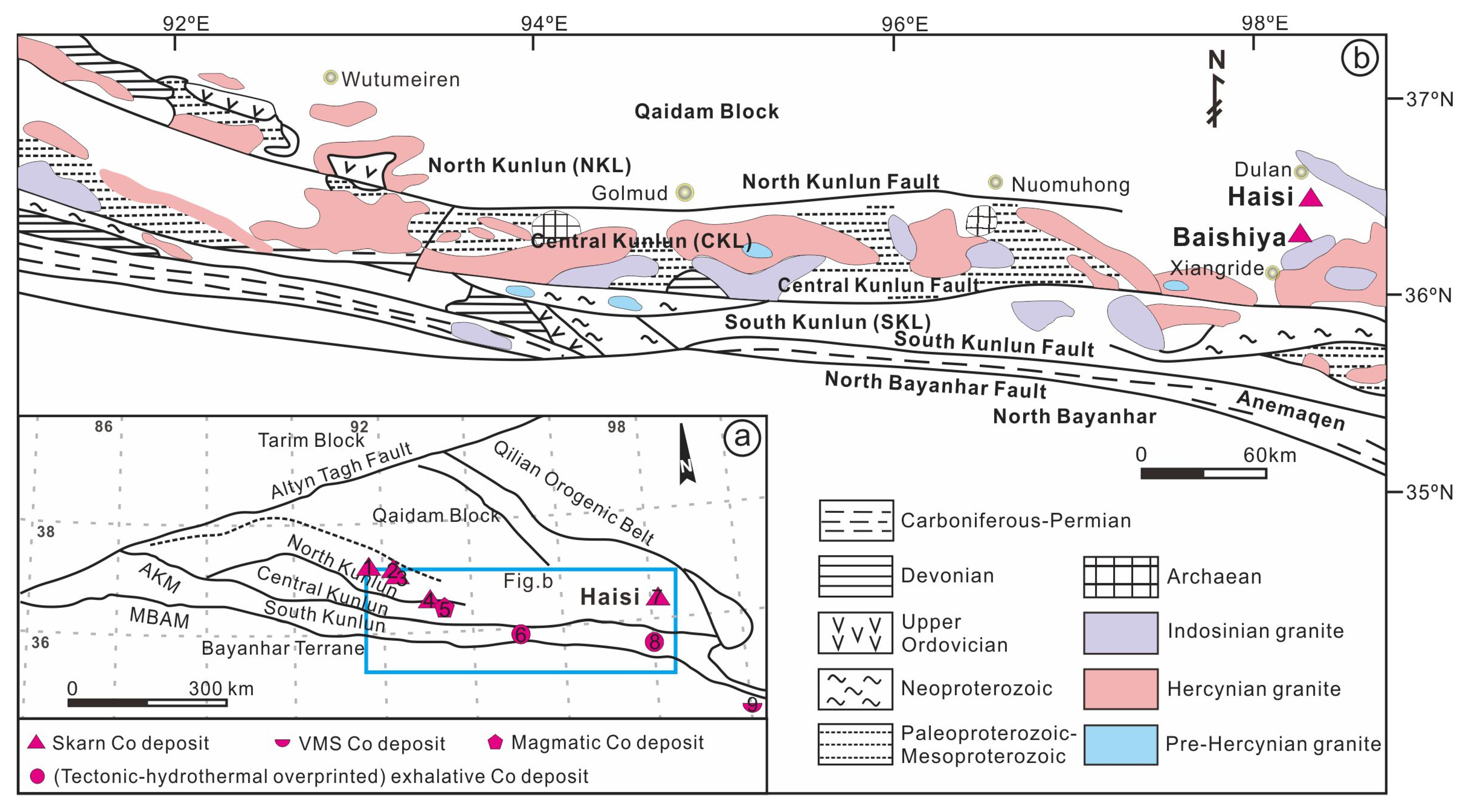
Figure 1. (a) The tectonic framework of the EKOB and occurrence of Co-bearing deposits (modified after [8]). 1 = Kendekeke deposit; 2 = Galinge deposit; 3 = Niukutou deposit; 4 = Lalingzaohuo deposit; 5 = Xiarihamu deposit; 6 = Tuolugou deposit; 7 = Haisi deposit; 8 = Dulenggou deposit; 9 = De’erni deposit. (b) A simplified geological map of the EKOB (modified after [17]).
Minerals 16 00194 g001
Figure 2. (a) Geological map of Haisi deposit. (b) Exploration section of line A–B.
Minerals 16 00194 g002
Figure 3. Representative skarn rocks and ores in Haisi deposit. (a) Contact zone of skarns with carbonate wall rocks. (b) Garnet-bearing magnetite ores. (c) Garnet–epidote–tremolite skarn. (d) Massive magnetite ores with disseminated sulfides. (e) Calcite vein cutting across garnet skarn. Mt = magnetite; Grt = garnet; Cc = calcite; Ep = epidote; Tre = tremolite; Act = actinolite; Py = pyrite; Po = pyrrhotite.
Minerals 16 00194 g003
Figure 4. Mineral paragenesis for the Haisi deposit.
Minerals 16 00194 g004
Figure 5. Photomicrographs of two magnetite generations. (a,b) Gamma-enhanced reflected light images reflect compositional heterogeneity of magnetite. (c,d) Mt-II replaced Mt-I along microfractures and oscillatory zones. (e,f) Mt-II replaced Mt-I along oscillatory zones or grain boundaries. (g,h) Mt-II cutting across Mt-I. (a,c,e,g) Reflected light. (b,d,f,h) Gamma-enhanced reflected light.
Minerals 16 00194 g005
Figure 6. Occurrence of cobaltiferous sulfides and their mineral assemblages. (a) Colloidal pyrite replaced by pyrrhotite, chalcopyrite, and pyrite, reflected light. (b) Colloidal pyrite featured by packages of layers and coarsening outward sequence, reflected light. (c) Coexistence of marcasite with Ni-rich pyrite, reflected light. (d,e) Native bismuth and löllingite occur as isolated islands within arsenopyrite, (d) reflected light, (e) BSE image. (f) Subhedral to anhedral arsenopyrite replacing chalcopyrite, reflected light. (g) Anhedral Mt-II replaced arsenopyrite and was subsequently overgrown by arsenopyrite, reflected light. (h,i) Co-arsenides and sulfarsenides (e.g., safflorite, alloclasite, and cobaltite) within garnet, (h) plane-polarized light, (i) reflected light. (jl) Co- arsenides overgrown by Co- sulfarsenides, BSE image. (m) Cobaltiferous löllingite overgrown by cobaltiferous arsenopyrite, BSE image. Grt = garnet; Mt= magnetite; Py = pyrite; C-Py = colloidal pyrite; Po = pyrrhotite; Mrc = marcasite; Ccp = chalcopyrite; Bi = native bismuth; Lo = löllingite; Saf = safflorite; Apy = arsenopyrite; Cbt = cobaltite; Acl = alloclasite; Gl = glaucodot.
Minerals 16 00194 g006
Figure 7. Plots of FeO vs. MnO and SiO2 (a), Ti + V vs. Al + Mn (b), Ti vs. Mg + Al + Si (c), Ti + V vs. Ca (d), Ti vs. V (e), Sn vs. W (f) of magnetite. (b) Modified from [31].
Minerals 16 00194 g007
Figure 8. Box plots of trace element concentrations in magnetite from the Haisi deposit.
Minerals 16 00194 g008
Figure 9. (al) LA-ICPMS element mapping of magnetite from Haisi deposit. (m) Corresponding signal profiles extracted along traverse line (from 1 to 12) shown in panel (a).
Minerals 16 00194 g009
Figure 10. (a) FeAs2-CoAs2-NiAs2 ternary diagram. (b) Plot of Fe vs. Co. (c) FeAsS-CoAsS-NiAsS ternary diagram. (d) Plot of Co vs. Ni. (e) Plot of As vs. Co. (f) Plot of As vs. Ni.
Minerals 16 00194 g010
Figure 11. EPMA mapping of arsenopyrite (a) and Ni-rich pyrite (b) from Haisi deposit.
Minerals 16 00194 g011
Figure 12. (a) Histogram of arsenic (atomic percentage) in arsenopyrite. (b) Sulfur fugacity and temperature projection based on arsenopyrite geothermometer. Red line represents the average As contents (at.%) in arsenopyrite, and orange zones indicate the temperature and sulfur fugacity obtained by geothermometer. Modified after [54].
Minerals 16 00194 g012
Figure 13. (a) Fe-S-As-O-Cl system phase diagram under 350 °C, S/As = 10, log a(AsH3) = −3, log a(H2S) = −2, and log a(Cl) = 1. (b) Co-S-As-O-Cl system phase diagram under 350 °C, S/As = 10, log a(AsH3) = −3, log a(H2S) = −2, and log a(Cl) = 1. Dark blue horizontal dashed lines represent the water saturation line. Light blue lines delineate the stability fields of various sulfur species within the hydrothermal fluid. Thermodynamic data were compiled from multiple sources (for details, see File S1), with CoAs from [62], CoAsS and CoAs2 from [50], and CoAs3 from [63].
Minerals 16 00194 g013
Disclaimer/Publisher’s Note: The statements, opinions and data contained in all publications are solely those of the individual author(s) and contributor(s) and not of MDPI and/or the editor(s). MDPI and/or the editor(s) disclaim responsibility for any injury to people or property resulting from any ideas, methods, instructions or products referred to in the content.