Article

Mechanical Properties, Acoustic Emission Characteristics, and Damage Evolution of Cemented Tailings Backfill Under Temperature Effects

1
Information Institute, Ministry of Emergency Management of the PRC, Beijing 100029, China
2
School of Resources Engineering, Xi’an University of Architecture and Technology, Xi’an 710055, China
*
Author to whom correspondence should be addressed.
Minerals 2026, 16(2), 193; https://doi.org/10.3390/min16020193
Submission received: 13 January 2026 / Revised: 5 February 2026 / Accepted: 9 February 2026 / Published: 12 February 2026
(This article belongs to the Special Issue Advances in Mine Backfilling Technology and Materials, 2nd Edition)

Abstract

In the context of deep mining and green low-carbon transition, this study characterizes the thermo-mechanical evolution and fracture mechanisms of cemented tailings backfill (CTB) through systematic experiments conducted at 20–60 °C across 3–28 days. Results demonstrate that strength and elastic modulus follow a unimodal dependence on temperature, peaking at 40 °C. Gaussian modeling reveals that curing times narrow the thermal tolerance window, with the elastic modulus exhibiting higher sensitivity to overheating. A consistent “pre-peak activity window” is identified in AE responses, characterized by b-value drops and an increase in tensile event proportions from 66% to 83%. A composite AE damage index (ADI) is introduced to systematically precede macroscopic failure, with thresholds of ADI ≥ 0.60 and 0.70 indicating accelerated crack propagation and imminent instability, respectively. Microstructural analysis confirms that 40 °C promotes C-S-H and fine ettringite bridging, whereas temperatures ≥ 50 °C induce Ca(OH)2 coarsening and enhanced pore connectivity, triggering early tensile-dominated degradation. This study establishes a “temperature → hydration/porosity → AE response → mechanical evolution” pathway, providing an optimal curing window of 40 ± 5 °C and an ADI-based early-warning criterion for temperature-adaptive CTB design and on-site safety management.

1. Introduction

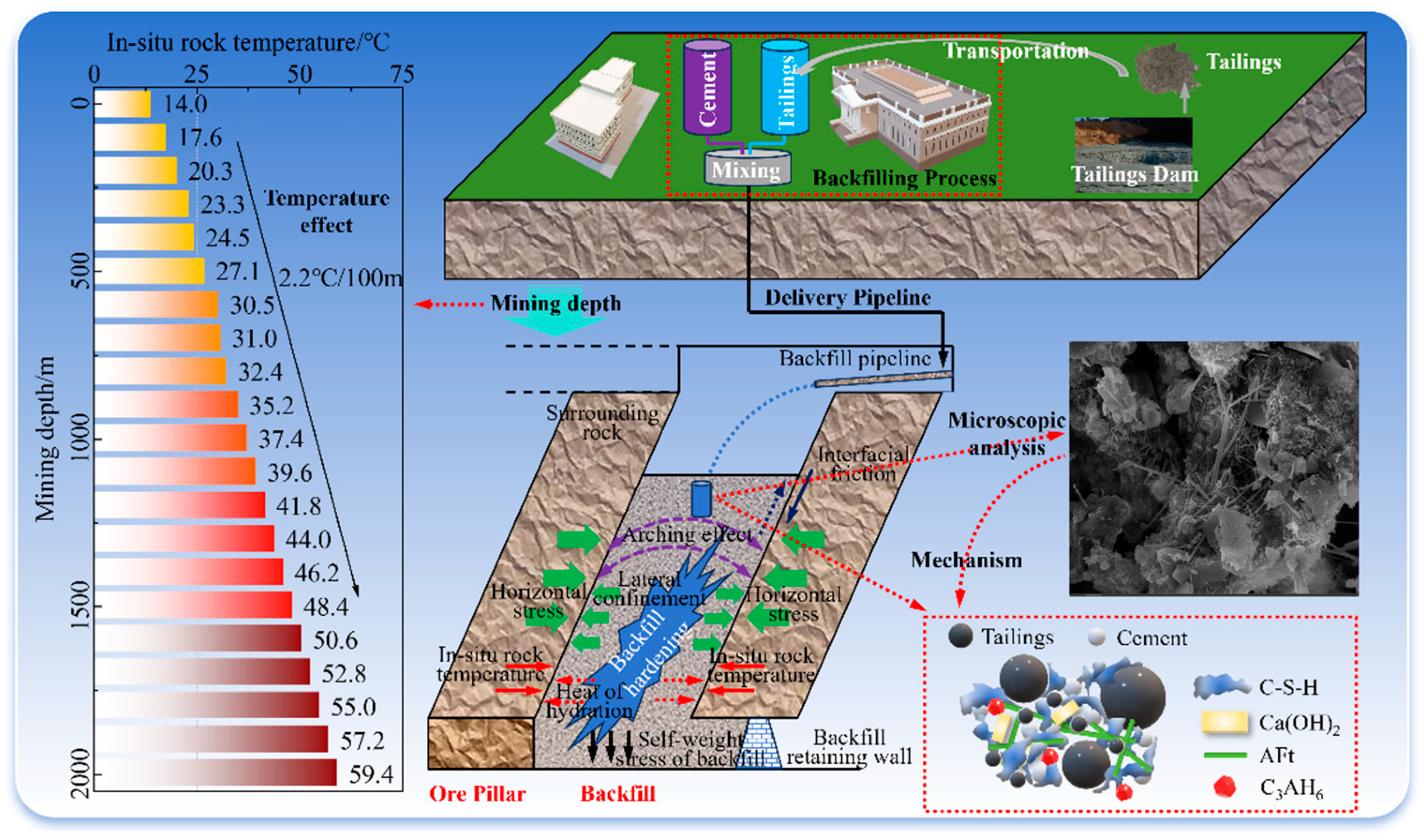
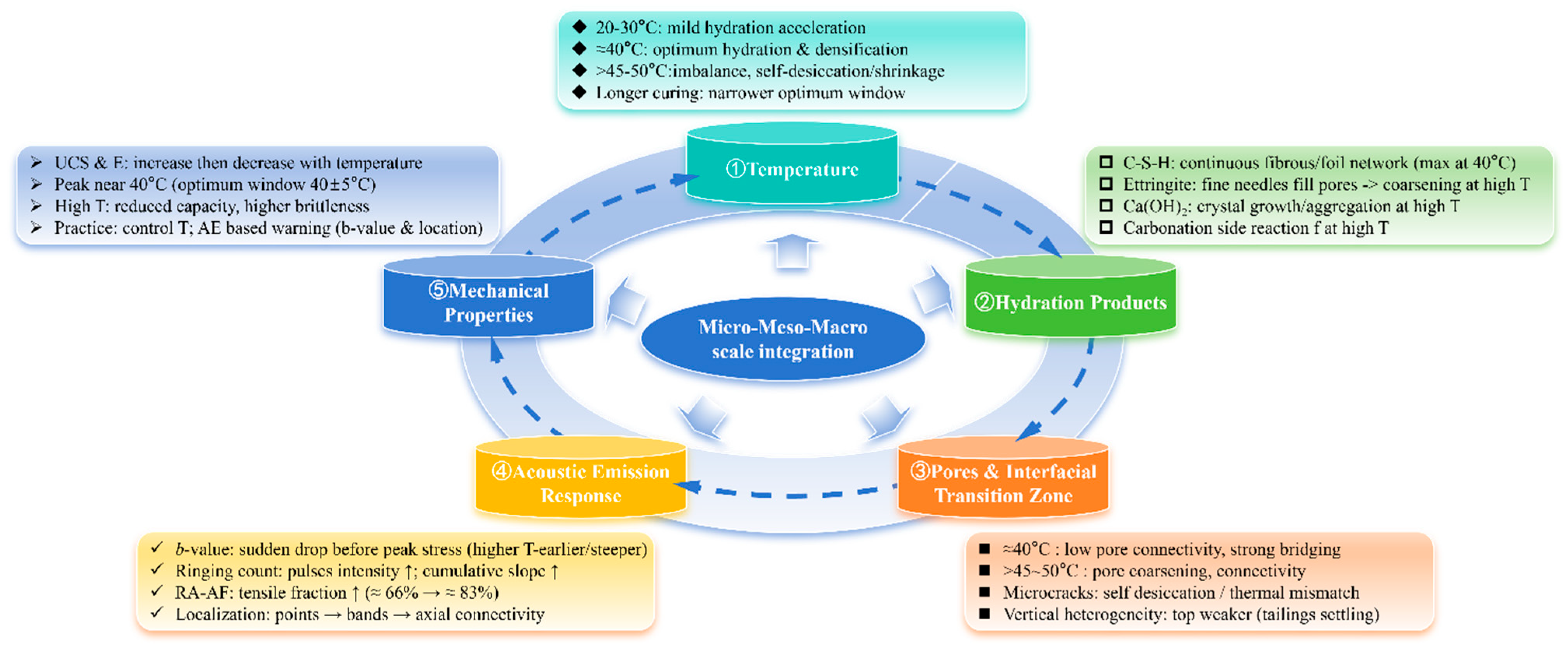
Cemented tailings backfill (CTB) is a fundamental load-bearing medium in deep and green mining operations, where its mechanical stability is vital for stope integrity and production safety [1]. Throughout its lifecycle in underground environments, CTB is inevitably governed by thermal conditions [2]. From mixing [3], transportation [4], and initial setting [5] to early curing and ultimate failure under loading, temperature regulates hydration kinetics [6], product morphology [7], and the microstructure of pores and interfacial transition zones (ITZ) [8,9], thereby influencing macroscopic strength, stiffness, and failure mode. The overall research background and multi-scale coupling process are schematically illustrated in Figure 1. As mining depth increases, the in situ rock temperature can reach 60 °C or higher, interacting with the hydration heat of CTB. During slurry mixing, transportation, and placement, thermal effects alter hydration kinetics and product formation, which in turn reshape the pore-ITZ structure and modify stress transfer within the backfilled stope. At the microscopic scale, hydration products such as C-S-H gels, ettringite (AFt), and Ca(OH)2 evolve under different curing temperatures, ultimately governing crack initiation, acoustic activity, and macroscopic mechanical degradation. Therefore, systematically revealing the coupling mechanism among temperature–microstructure–acoustic response is not only a fundamental scientific issue for understanding the constitutive behavior and failure mechanism of CTB, but also an urgent engineering demand for formulating temperature-control strategies and in situ monitoring methods.
On the one hand, temperature accelerates cement hydration, promotes the formation of C-S-H gels and needle-like AFt, and thereby enhances pore refinement and ITZ densification [10,11]. On the other hand, under overheating conditions, it may induce the growth of Ca(OH)2 crystals and self-desiccation shrinkage, leading to simultaneous pore coarsening, increased connectivity, and microcrack activation [12,13]. At the macroscopic scale, this typically manifests as a unimodal trend in which strength and stiffness first increase and then decrease with rising temperature [3,14]. However, the optimal temperature, the post-peak degradation rate, and their evolution with curing age remain poorly constrained and lack a unified and comparable quantitative framework across different engineering and mix proportion conditions.
In response to this phenomenon, most existing studies have relied on macroscopic indicators such as uniaxial/triaxial strength, elastic modulus, and ultrasonic wave velocity, using maturity or equivalent age models, as well as empirical regressions, to characterize the coupled effects of temperature and curing time [15,16,17,18]. A few studies have further introduced peak-shaped or piecewise functions to describe post-peak degradation [19]. However, temperature–time cross-sections are often simplified (e.g., concentrated at 28 d), making it difficult to systematically reveal the full trajectory of “optimal temperature–temperature tolerance–post-peak degradation,” and even more challenging to compare the differential sensitivity of strength and modulus to overheating. At the microstructural level, techniques such as SEM/EDS, XRD, FTIR, TGA/DSC [20,21], and MIP, NMR, and CT [22,23] have provided “static descriptions” confirming that temperature alters hydration product textures and pore structures. Nevertheless, these microstructural pieces of evidence have not been rigorously aligned with the temporal sequence and spatial connectivity of crack evolution during loading, leaving a gap in establishing quantitative correlations between microstructure and mechanical failure.
Acoustic emission (AE) technology provides the possibility for in situ monitoring of microcrack initiation, propagation, and instability [24,25]. Ring counts and energy can characterize the intensity of crack activity, while the b-value reflects the scale distribution of events [26]. The Rise Angle-Average Frequency (RA-AF) criterion enables differentiation between tensile and shear mechanisms [27,28], and three-dimensional location techniques can reveal the geometric evolution from banded clustering to main fracture coalescence. Nevertheless, current applications remain dominated by single indicators, lacking synthesis of joint features such as pre-peak b-value drops (scale transitions), sharp rate accelerations, and band-like connectivity. Moreover, different AE indices are seldom aligned on a unified temporal axis with macroscopic damage, and stable thresholds or transferable criteria are insufficient, which restricts the reliability of pre-peak warning and engineering applicability under temperature effects.
From an engineering perspective, there is an urgent need for a quantitative framework that can not only stably reproduce the measured unimodal law within the two-dimensional temperature–curing time parameter domain but also establish a monotonic pre-peak mapping with multiple AE parameters. On the one hand, such a framework should clarify the “optimal temperature window” and its convergence pattern with curing age, thereby providing an operable boundary for mix design and curing conditions. On the other hand, it should compress AE indicators—including activity intensity, scale distribution, fracture mechanism, and spatial connectivity—into a robust composite index, define threshold criteria with temperature-transferable applicability, and further constrain the mechanism through microstructural evidence from hydration products, pore structures, and ITZ evolution.
Based on these considerations, this study systematically investigates the multi-scale damage evolution of CTB across a representative range of curing temperatures and times. By integrating uniaxial compression tests with synchronous AE monitoring and microstructural characterizations, this work aims to clarify the thermal sensitivity of CTB and its internal degradation mechanisms. The primary focus is placed on establishing a quantitative temperature–mechanical response model and developing a multi-parameter acoustic emission index capable of comprehensively characterizing the damage evolution process to provide a reliable framework for instability warning. This research seeks to identify the consistent links between hydration product evolution and macroscopic acoustic signatures, offering technical support for temperature-controlled curing and safety monitoring in deep mining environments.

2. Materials and Methods

2.1. Materials

(1) Tailings
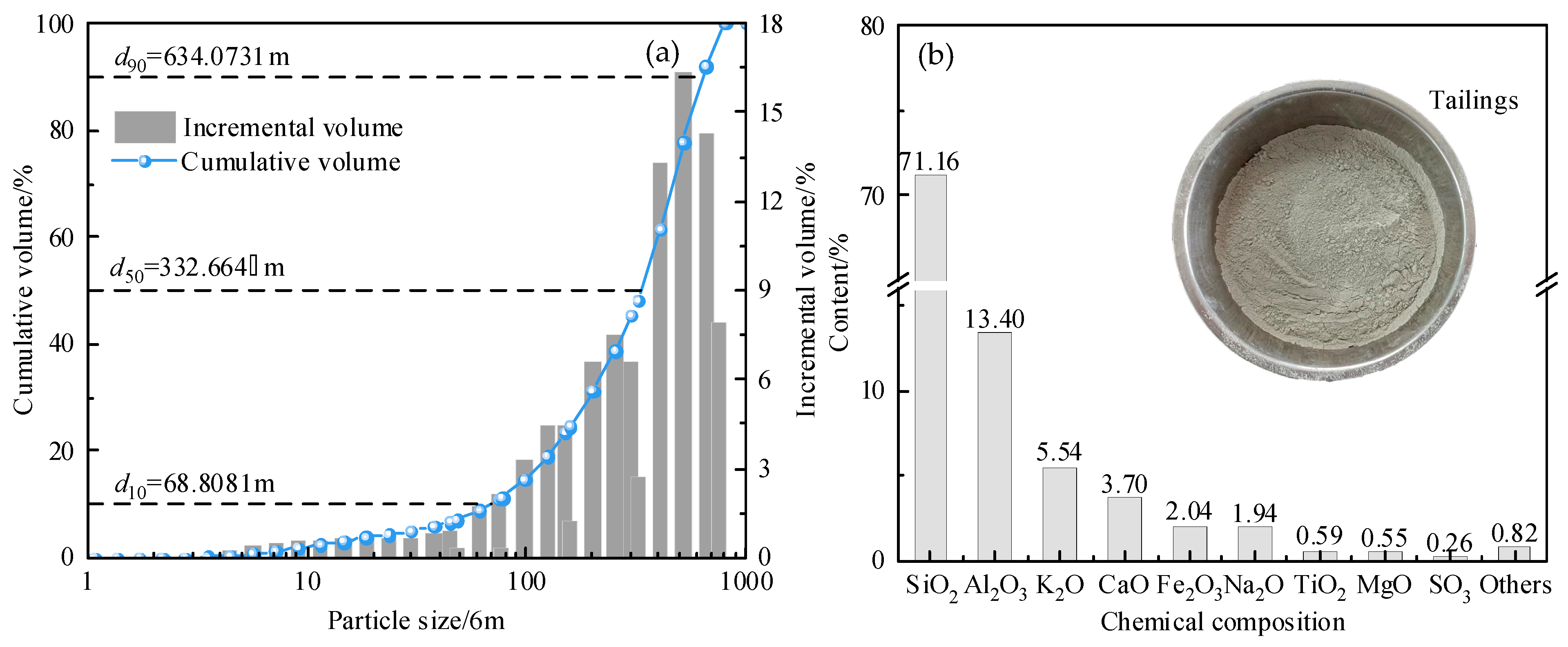
The tailings were obtained from a gold concentrator of Shandong Gold Mining Co., Ltd. (Yantai, China). To characterize their particle size distribution, an LS-POP laser particle size analyzer was employed (Figure 2a). The results showed that the median particle size (d50) was 332.66 μm, indicating that the material belongs to the category of coarse tailings. The calculated coefficient of curvature (Cc) was 1.59, and the coefficient of uniformity (Cu) was 5.91, suggesting a relatively continuous particle size distribution [29].
The chemical composition of the tailings was determined by X-ray fluorescence (XRF, Bruker, Karlsruhe, Germany) (Figure 2b). The major oxides were SiO2 (71.16%) and Al2O3 (13.40%). The activity index, defined as Ma = Al2O3/SiO2 = 0.19, was 0.19, indicating low pozzolanic activity and thus limited activation potential for cementitious reactions.
(2) Binder
Ordinary Portland cement (P.O 42.5R) was used as the binder. Its primary chemical components were CaO (64.90%) and SiO2 (22.40%). Based on the Bogue equations [30], the mineralogical phase composition was calculated as follows: C3S 53.83%, C2S 23.62%, C3A 6.55%, C4AF 9.77%, and CaSO4 3.09%. The relatively high C3S content favors the development of early strength, while C2S contributes significantly to strength at later times.
(3) Mixing water
Tap water from the laboratory, with a pH value of 7.6, was used for specimen preparation. The water quality met the requirements for backfill production.

2.2. Experimental Methods

(1) Preparation of backfill specimens
Considering the actual mining conditions, the cement-to-tailings ratio (by mass) was set at 1:6, and the slurry mass concentration was 70%. The materials (water, tailings, and binder) were proportionally weighed and thoroughly mixed. The slurry was then poured into cylindrical rubber molds (50 mm in diameter and 100 mm in height). After 24 h, the specimens were demolded and transferred to a curing chamber with preset temperature conditions.
(2) Mechanical and AE experiments
Specimens were cured at 20, 30, 40, 50, and 60 °C for curing times of 3, 7, 14, and 28 days. Uniaxial compressive strength (UCS) experiments were performed using a YAW-600 electro-hydraulic servo universal testing machine (Jinan Hensgrand Instrument Co., Ltd., Jinan, China) with a constant displacement rate of 0.2 mm/min. To ensure the reproducibility of the results, at least three parallel specimens were tested for each curing condition, and the average values were reported. Simultaneously, a DS5 full-information AE analyzer (Beijing Soft Island Times Scientific Co., Ltd., Beijing, China) was employed to record AE signals and conduct event localization. During the loading process, the stress, strain, AE ring counts, and energy parameters were continuously recorded to characterize the deformation and damage evolution of the specimens.
(3) Microstructural and phase analysis
After mechanical testing, the fractured specimens were selected for microstructural and mineralogical analyses. The fragments were first immersed in absolute ethanol for 24 h to terminate hydration and then dried in an oven at 60 °C for 6 h. The surfaces of the samples were sputter-coated with carbon before scanning electron microscopy (SEM, Carl Zeiss AG, Oberkochen, Germany) observations, which were carried out to examine the micro-morphology and pore structure under different curing temperatures.
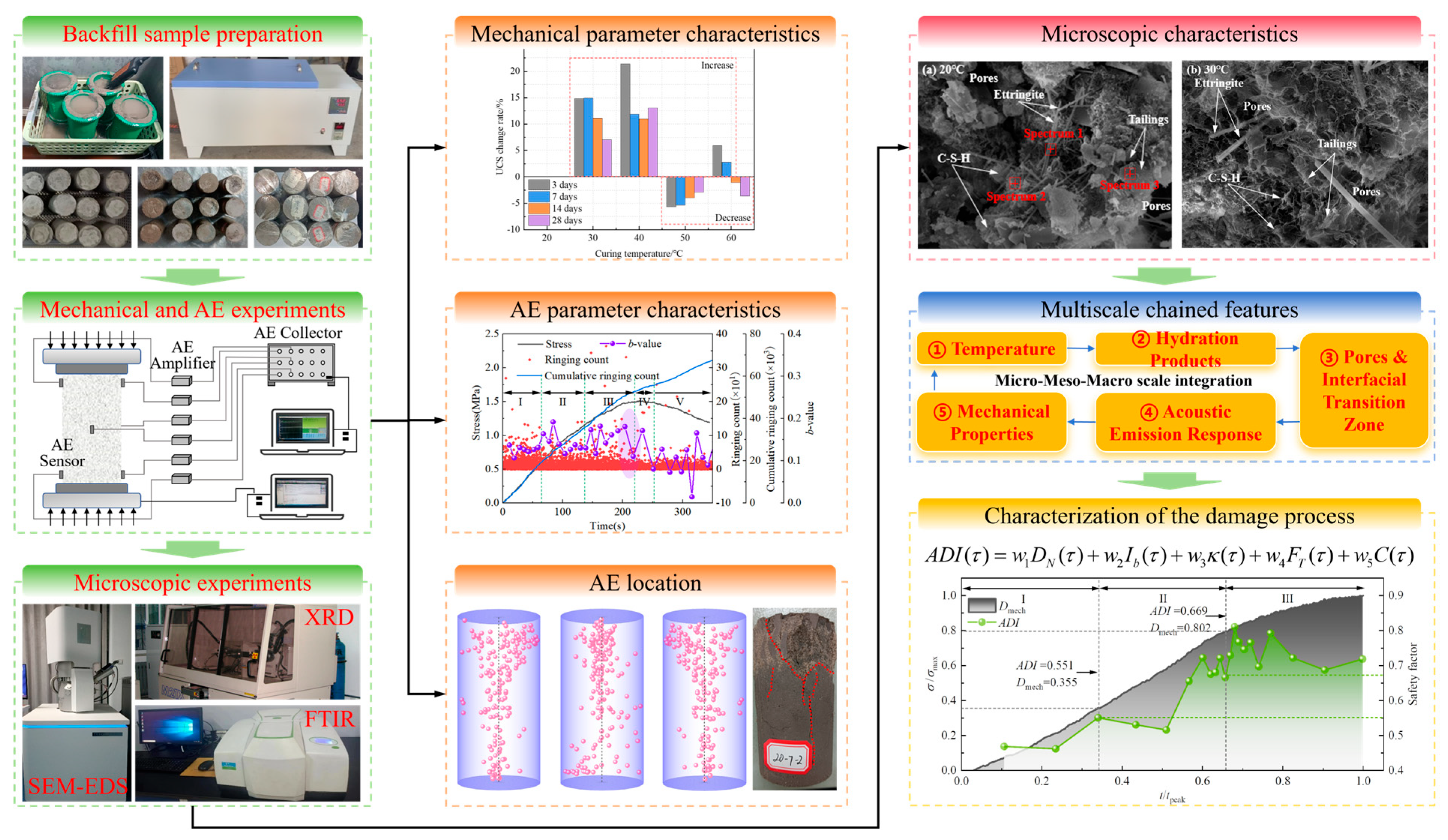
Phase analysis was conducted using X-ray Diffractometer (XRD, Bruker, Karlsruhe, Germany) with a scanning range of 10~90° and a step size of 0.02°. A scan rate of 8°/min was adopted to facilitate the qualitative identification of major mineralogical phases and to perform comparative analysis across the large batch of CTB samples. The obtained diffraction patterns were analyzed using Jade 9 software and PDF reference cards to identify mineral compositions and their variations. To further elucidate the hydration process and functional group changes, Fourier-transform infrared spectroscopy (FTIR, PerkinElmer Frontier, Shelton, CT, USA) was employed. This technique enabled the investigation of bond breaking and recombination, providing molecular-level insights into the evolution of hydration products under different curing temperatures. The specific expe rimental process has been illustrated in Figure 3.

2.3. Theory

(1) b-value analysis
To characterize the crack size distribution, the AE b-value method was employed. The b-value originates from the Gutenberg–Richter relationship in seismology,
log N = a b M
where M is the earthquake magnitude, N is the frequency of events within the magnitude interval ∆M, and a and b are constants. In AE testing, the signal amplitude A is generally used as an analogue of magnitude, with the following transformation,
M = A 20
A higher b-value indicates a predominance of micro-scale cracking, whereas a declining trend reflects the coalescence of these defects into large-scale fractures. In this study, the b-value was calculated via the least squares method. To achieve a balance between statistical stability and temporal sensitivity, a sliding window of 200 AE events was selected, with the magnitude bin width set at 0.2 dB to ensure sufficient resolution for fitting the Gutenberg–Richter relationship. Preliminary sensitivity checks confirmed that these parameters effectively filter stochastic noise while capturing the characteristic b-value drops prior to peak stress.
(2) Acoustic emission damage analysis
Among AE waveform parameters, the AF and RA are widely applied to qualitatively identify fracture mechanisms, which are defined as:
A F = C o u n t s D u r a t i o n
R A = R i s e t i m e A m p l i t u d e
The fracture mechanisms were categorized using the RA-AF criterion. Generally, tensile fractures exhibit high AF and low RA values, whereas shear fractures show the opposite. Based on the Japan Concrete Institute standards and relevant research [31,32], a threshold of k = 80 was adopted. This threshold was further validated for our specific CTB material and setup by aligning the AE-derived failure modes with the physical crack patterns observed in the post-test specimens. This cross-validation ensures that k = 80 provides a reliable basis for identifying the transition from micro-tensile damage to macroscopic shear instability across various curing times.
(3) AE event localization
In this study, the Geiger algorithm was employed to locate AE events. The method starts from an initial hypocenter estimate θ (x, y, z, t) and iteratively refines the source coordinates through a limited number of corrections until the optimal solution is achieved. At each iteration, the correction vector ∆θ (∆x, ∆y, ∆z, ∆t) is calculated using the least-squares method and added to the previous estimate. The general formulation can be expressed as:
v P ( t t i ) = ( x x i ) 2 + ( y y i ) 2 + ( z z i ) 2
where xi, yi, zi are the coordinates of the i-th sensor, ti is the actual P-wave arrival time at the i-th sensor, and vP denotes the P-wave velocity, which was initially measured using a non-metallic ultrasonic analyzer. For the i-th sensor, the theoretical arrival time t0, i can be approximated by the first-order Taylor expansion,
t 0 , i = t c , i + t i x Δ x + t i y Δ y + t i z Δ z + t i t Δ t t i x = ( x i x ) v P R , t i y = ( y i y ) v P R t i z = ( z i z ) v P R , t i t = 1 R = ( x x i ) 2 + ( y y i ) 2 + ( z z i ) 2
where tc,i is the calculated P-wave arrival time at the i-th sensor. With N sensors (N ≥ 4), the system can be expressed in matrix form as
t 1 x t 1 y t 1 z 1 t 2 x t 2 y t 2 z 1 t n x t n y t n z 1 Δ x Δ y Δ z Δ t = t 0 , 1 t c , 1 t 0 , 2 t c , 2 t 0 , n t c , n
By applying Gaussian elimination, the correction vector ∆θ can be obtained, and the updated hypocenter (θ + ∆θ) is iteratively computed until the convergence criteria are satisfied. This ensures accurate localization of AE events.

3. Experimental Results

3.1. Mechanical Experiments

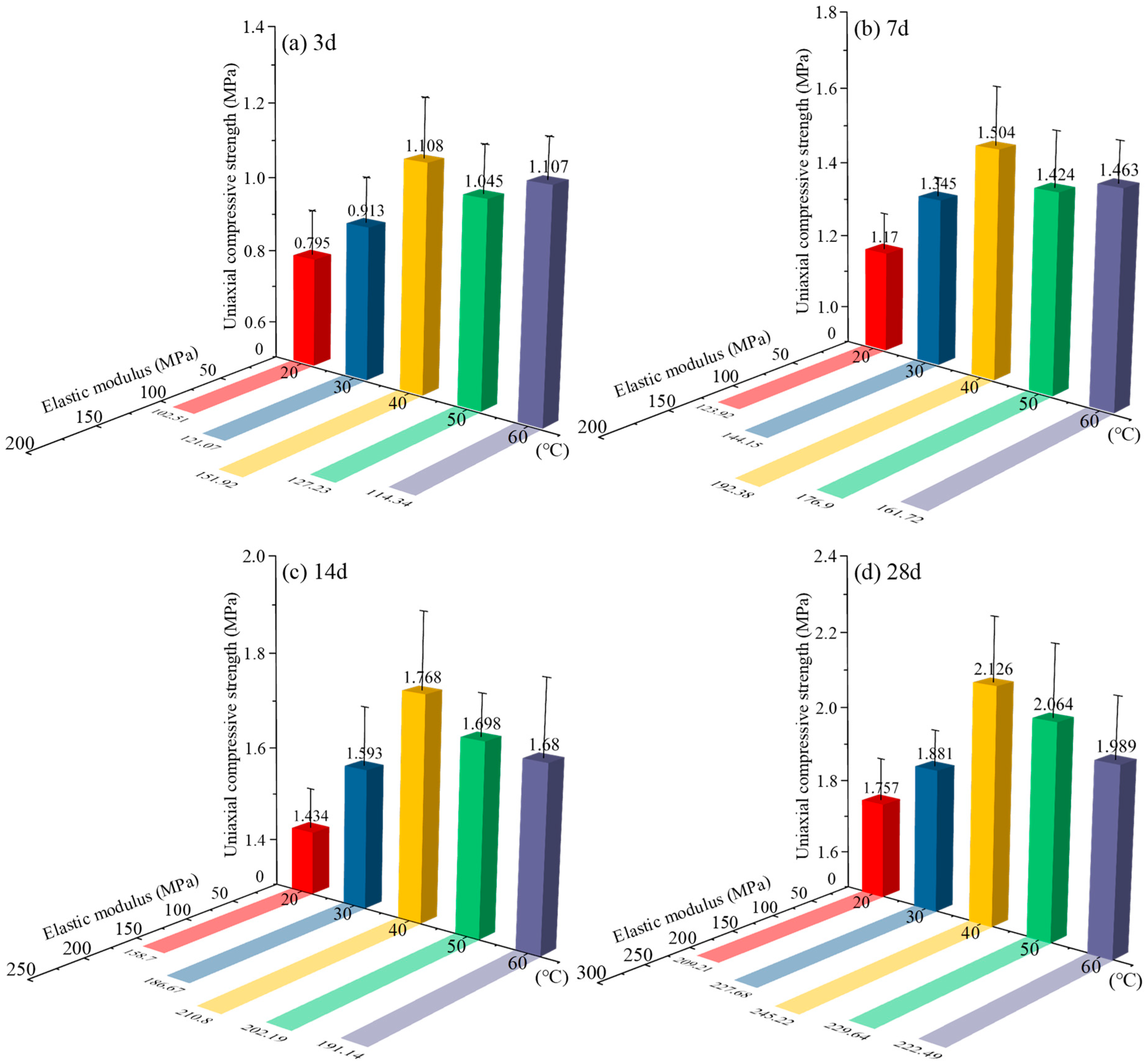
Figure 4 presents the evolution of UCS and elastic modulus (E) of CTB under different curing temperatures and curing times. Overall, both UCS and E exhibit a non-monotonic dependence on temperature: they first increase and then decrease, reaching their peak values at 40 °C, which clearly demonstrates a temperature-threshold effect.
At 3 days of curing, UCS increased from 0.795 MPa at 20 °C to 1.108 MPa at 40 °C (+39.3%), while E simultaneously reached its maximum of 127.34 MPa. This indicates that moderate heating can markedly accelerate early hydration reactions and the formation of C-S-H gels, which in turn fill pores and enhance structural compactness. At 7 days of curing, UCS reached 1.504 MPa at 40 °C, representing a 28.6% increase compared with 20 °C, while E rose to 179.96 MPa. This stage reflects not only the accelerated generation of hydration products but also further densification of the microstructure, producing more pronounced improvements in performance. At 14 days of curing, UCS and E at 40 °C were 1.768 MPa and 162.71 MPa, respectively. Although elevated temperatures still exerted a positive influence, the enhancement diminished at 50 °C and 60 °C. This reduction can be attributed to the suppression of stable hydration products and deterioration of the pore structure under overheating conditions. At 28 days of curing, UCS and E again peaked at 40 °C, reaching 2.126 MPa and 222.48 MPa, respectively—an improvement of 20.99% and 26.5% over 20 °C. However, further increases in temperature caused a decline in both parameters, reinforcing the existence of an optimal temperature threshold. Excessive heating disrupts the balance of hydration reactions and induces structural loosening, ultimately reducing the mechanical performance of CTB.
To quantitatively characterize the above-mentioned unimodal behavior, a Gaussian function was adopted to fit the relationships between UCS, E, and curing temperature at different curing times,
σ = σ 0 + A w × π / 2 e 2 × ( T T c w ) 2
E = E 0 + A w × π / 2 e 2 × ( T T c w ) 2
where σ0 (or E0) represents the baseline level, Tc denotes the optimal temperature (peak position), w corresponds to the temperature sensitivity bandwidth (peak width, reflecting the tolerance interval), and A refers to the effective increment (magnitude of the temperature-enhancing effect).
The Gaussian function was selected to characterize this unimodal behavior due to its robust mathematical properties and clear physical interpretability. Specifically, parameters Tc, w, and A provide direct analogies to the optimal curing temperature, thermal tolerance interval, and enhancement amplitude, respectively. While the Gaussian model is an empirical approximation that assumes structural symmetry, it offers a practical balance between fitting precision and parametric stability. Although microstructural evidence suggests that degradation beyond 50 °C can be asymmetric and abrupt, the Gaussian formulation was preferred over more complex alternatives, such as skewed Gaussian or log-normal models. This choice avoids the risk of over-fitting associated with additional shape parameters and ensures a smooth, robust representation across all curing times, as evidenced by the high correlation coefficients (R2 > 0.85) obtained for both strength and modulus.
The fitting parameters are summarized in Table 1. The optimal temperature Tc for UCS primarily falls within 46.56–51.43 °C, whereas for E it is concentrated within 41.11–45.90 °C, indicating that stiffness tends to reach its optimum at slightly lower temperatures than strength. This observation is consistent with the well-acknowledged notion that modulus is more sensitive to microcracks and pore evolution than strength. The bandwidth parameter w further reveals that, at early ages (e.g., 7 days), the effective temperature window for strength is broader, but gradually narrows with curing time, converging toward stability at 28 days. All fitting results achieved correlation coefficients (R2) greater than 0.85, confirming the robustness of the Gaussian model in reproducing the temperature effect.
By combining Figure 4 and Table 1, it can be concluded that the optimal interval for mechanical performance lies approximately within 40–45 °C. Beyond this range, the beneficial role of elevated temperature is counteracted by microstructural deterioration (instability of hydration products, pore coarsening, and shrinkage-induced microcracks), leading to simultaneous reductions in both UCS and E.
To further quantify the thermal sensitivity of CTB and its dependence on curing age, a growth rate (G) was defined as the relative change in mechanical indices between adjacent temperature steps of 10 °C:
G = X T i + 1 X T i X T i × 100 %
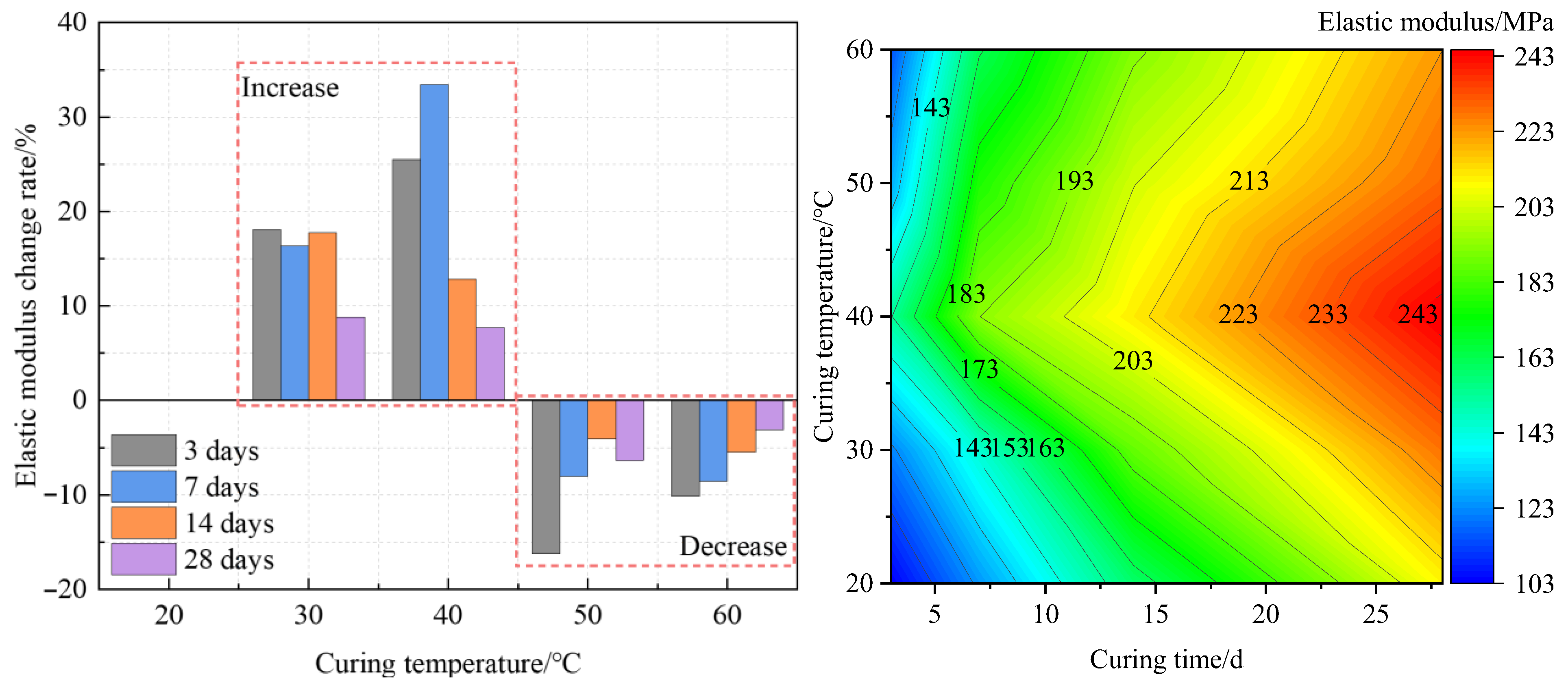
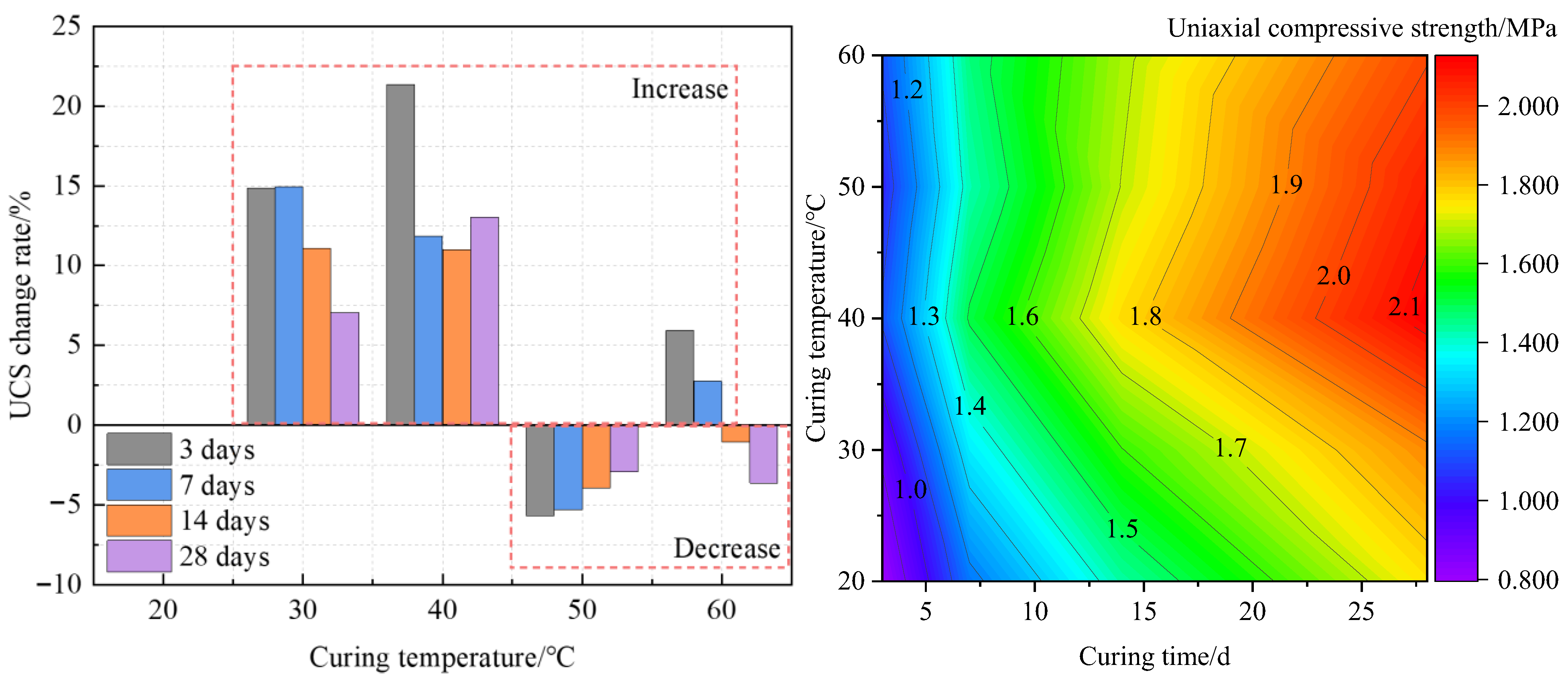
where XTi and XTi+1 represent the UCS or E at two consecutive temperature levels (e.g., 20 °C and 30 °C, 30 °C and 40 °C, etc.). This discrete approximation of the local derivative allows for a detailed analysis of the “gain/loss” characteristics across different temperature intervals, as illustrated in the growth-rate bar charts and contour plots (Figure 5 and Figure 6).
In terms of strength, the 20–40 °C range consistently exhibited positive growth (G > 0), representing the gain zone where thermal acceleration dominates. Once the temperature crossed the optimum point (≈40 °C) into the 40–5 0 °C interval, the growth rate turned negative, signaling the onset of post-peak decline. In the 50–60 °C interval, while a slight strength recovery occasionally appeared at early times, negative growth prevailed in the mid-to-late stages, suggesting that post-peak degradation stabilizes over time. The elastic modulus followed a similar trend but demonstrated higher sensitivity to overheating: within the 50–60 °C interval, the negative growth of E was generally larger than that of UCS, indicating that stiffness deteriorates more severely than strength. This is consistent with the Gaussian fitting results, where E exhibited a lower optimal temperature (Tc) and a narrower tolerance bandwidth (w).
The synergistic effects of temperature and curing times are visualized through contour plots, where a distinct “ridge line” along ≈40 °C persists across all times, identifying the optimal temperature band. In the >40 °C region, the contour lines become notably denser, reflecting heightened local sensitivity to thermal disturbances (∂X/∂t). Along the time axis, the spacing between contour lines is widest during 3–14 days, suggesting that the marginal benefit of curing time is most significant at early-to-middle stages. By 21–28 days, the lines converge at both the low (20–30 °C) and high (50–60 °C) ends, where extending curing times yields diminishing returns due to thermal degradation. Collectively, these results reveal a “synergistic rapid-growth zone” (≈35–45 °C × 7–21 days) characterized by additive gain effects, contrasting with a “post-peak zone” (>40–45 °C) where negative thermal sensitivity dominates.
From a sensitivity perspective, the density of contour lines reflects the relative magnitudes of ∣∂X/∂T∣ and ∣∂X/∂t∣. In the high-sensitivity region (40–50 °C, 7–14 days), both derivatives are large, marking it as a critical zone for stability monitoring. This finding aligns with the physical implications of the Gaussian model: as curing times increase, the narrowing of w implies a contraction of the “optimal temperature window,” causing mechanical performance to decline more abruptly once this thermal threshold is exceeded.

3.2. Acoustic Emission Parameters

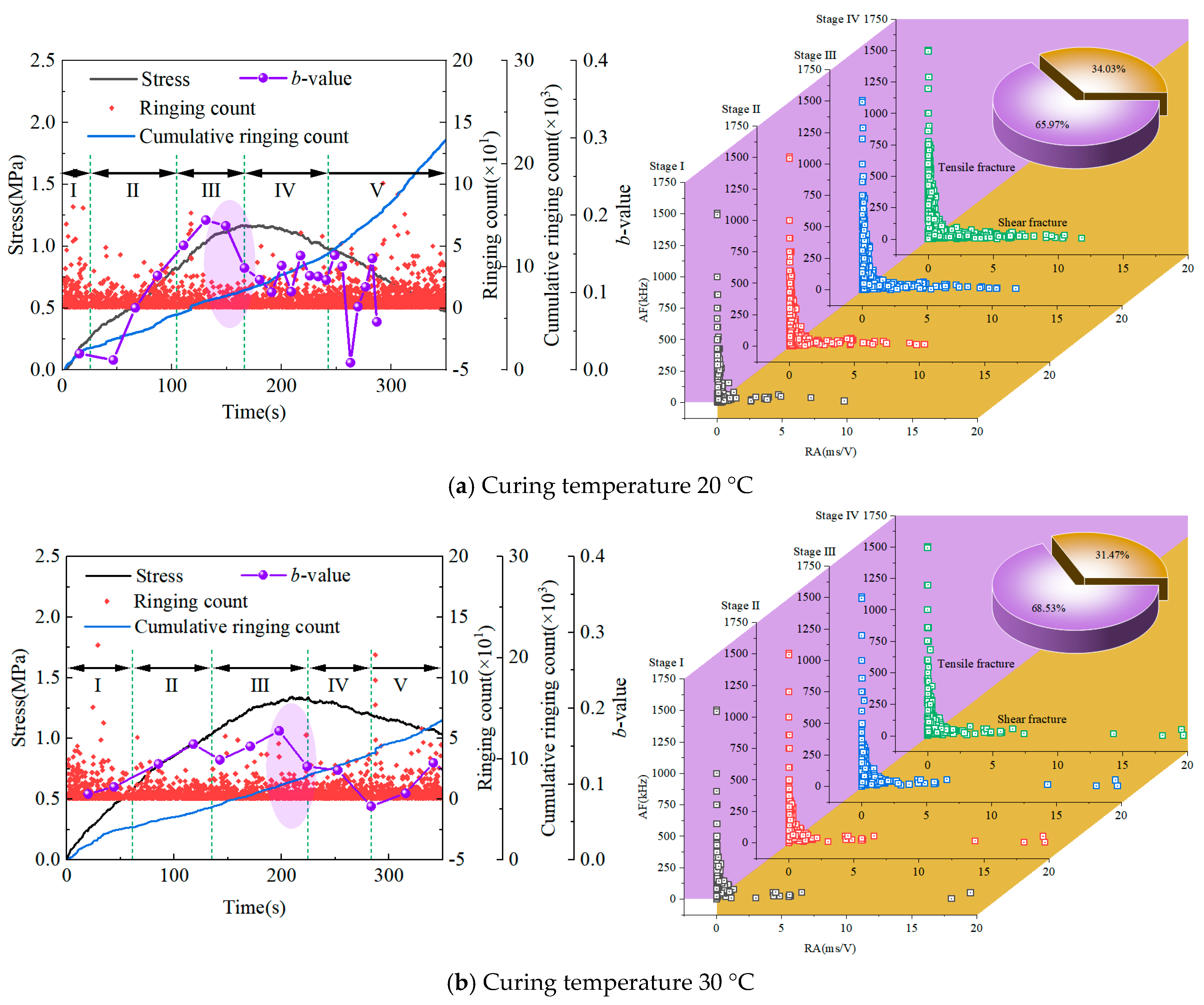
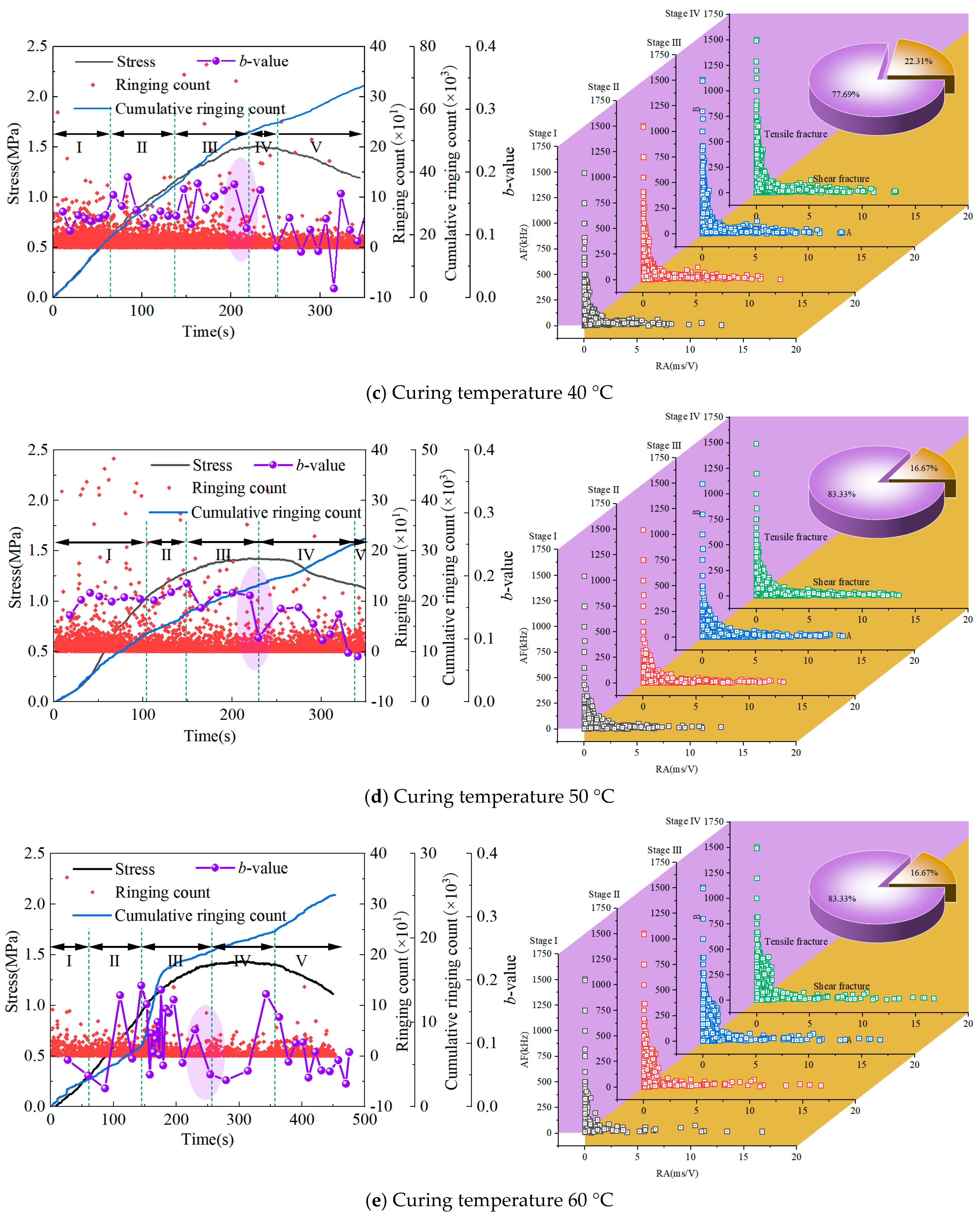
During the uniaxial compression tests, stress, ring counts, and cumulative ring counts were synchronously recorded. Meanwhile, the b-value was calculated according to the method described in Section 2.3, and the RA–AF criterion was applied to identify the crack types. Based on the characteristic variations in stress, the loading process was divided into five stages: I—compaction, II—elastic deformation, III—accelerated crack propagation, IV—instability, and V—post-failure propagation. The results obtained under different curing temperatures are presented in Figure 7.
Raising the curing temperature advances the onset of AE activity, enhances its intensity, accelerates its accumulation, and markedly alters the distribution of crack scales and fracture mechanisms. At 20–30 °C, the ringing counts increase significantly only during the transition from the elastic to the stable-propagation stage, while the cumulative counts grow steadily with a relatively low slope. Around the onset of the accelerated propagation stage, the b-value exhibits a sharp pre-peak drop and then stabilizes at a lower level. The RA-AF criterion indicates tensile cracking as dominant, with tensile fractions of 65.97% and 68.53% at 20 °C and 30 °C, respectively, suggesting that pore opening and interfacial debonding prevail, while shear cracking remains secondary.
When the curing temperature rises to 40 °C, the elastic and stable-propagation stages last longer. Ringing counts intensify abruptly just before peak stress, accompanied by a marked increase in the slope of cumulative counts. Immediately thereafter, the b-value undergoes a rapid pre-peak drop, indicating a sudden transition from small-scale events to high-energy events concentrated in a single burst rather than multiple fluctuations. The tensile fraction increases further to 77.69%, consistent with the higher strength and stiffness observed in Section 3.1, implying that specimens at this temperature reach greater load-bearing capacity while dominant cracks concentrate and coalesce just before failure.
At higher curing temperatures of 50–60 °C, AE ringing pulses appear at much earlier stress levels, and cumulative counts show steeper slopes starting already in the stable-propagation stage, reflecting accelerated crack accumulation. The pre-peak b-value drop occurs earlier and is more pronounced, sometimes with multiple declines, suggesting that larger cracks are activated earlier and more frequently to release energy. Meanwhile, the RA-AF criterion reveals a clear shift toward tensile dominance, with tensile fractions reaching 83.33% at both 50 °C and 60 °C.
Overall, across the five AE descriptors, curing temperatures from 20 °C to 60 °C lead to earlier AE initiation, higher pulse density, faster cumulative growth, sharper and earlier b-value drops before peak stress, and an increase in the tensile fraction from 66% to 83%. Notably, specimens cured at 40 °C display a distinctive “single, concentrated” pre-peak b-value drop that corresponds to the highest load-bearing capacity, whereas at 50–60 °C, the earlier and steeper b-value declines, together with faster AE accumulation and higher tensile proportions, align with the observed reduction in mechanical performance and earlier onset of failure.

3.3. Acoustic Emission Localization

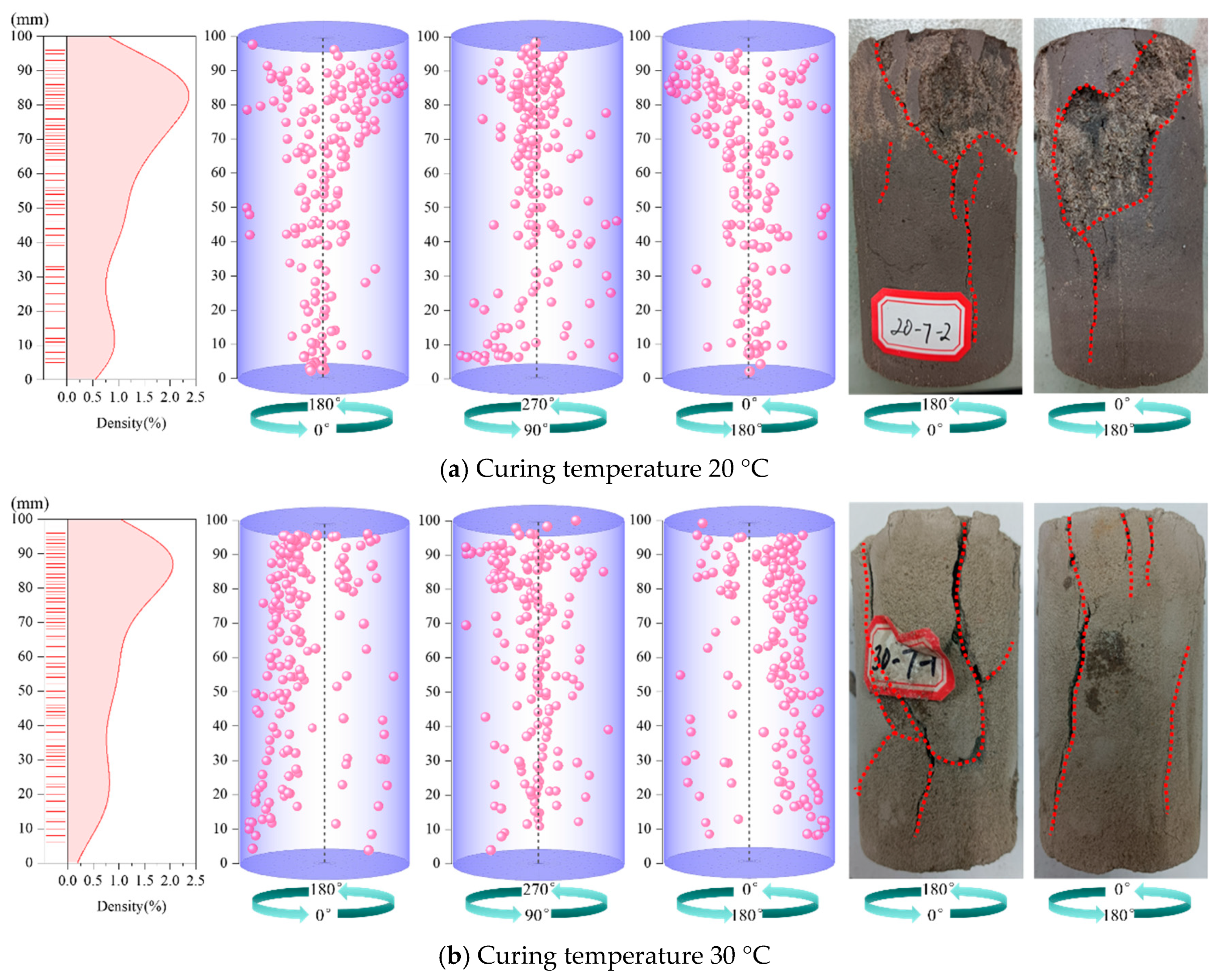
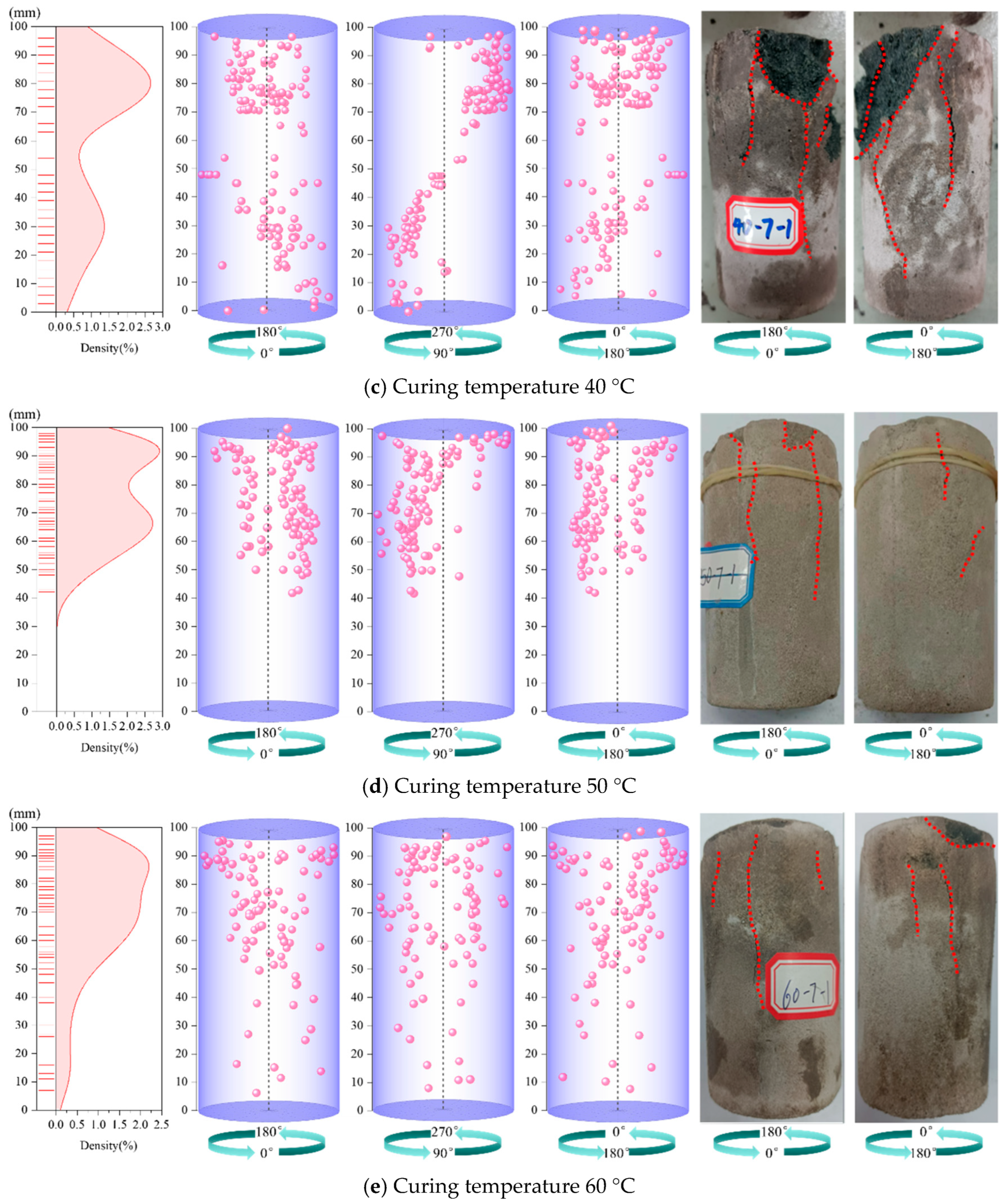
The Geiger algorithm was employed to localize AE events in three dimensions. As shown in Figure 8, each row presents (from left to right): the cumulative density distribution of events along the specimen height, unfolded cylindrical projections from 0°/90°/180° perspectives, and photographs of the actual fracture surface, enabling a direct comparison of “acoustic–geometric” consistency. Overall, increasing curing temperature led to earlier band-like clustering of AE events during loading. The density distribution evolved from scattered activity to a single dominant fracture band or multiple sub-parallel bands, which overlapped closely with the final through-going cracks. This spatial evolution is highly consistent with the temporal AE features discussed in the previous section—namely, the pre-peak b-value drop, rapid accumulation of ringing counts, and the higher proportion of tensile events—thereby highlighting a pronounced temperature effect.
The spatial evolution of AE events reveals a clear temperature-dependent transition in failure mechanisms. At low temperatures (20–30 °C), AE events were discretely distributed with a multi-peak density profile, signifying numerous initiation sites and poor crack cooperativity. These events eventually converged into bifurcated or intersecting oblique bands, resulting in tortuous splitting. At the optimum temperature (40 °C), AE activity was notably subdued and concentrated, characterized by a single prominent density peak. This corresponds to a well-defined inclined band and a solitary dominant fracture, indicating that a denser microstructure promotes higher load-bearing capacity and superior spatial coherence between AE localization and the fracture plane. Conversely, at elevated temperatures (50–60 °C), AE activity intensified and shifted toward the specimen ends. The localization patterns evolved from nearly vertical bands into wider parallel strips, correlating with longitudinal splitting and fragmentation. This shift reflects reduced stiffness and heightened stress concentration at the specimen ends, which facilitates axial tensile cracking and the subsequent coalescence of fracture planes.
In addition, the influence of vertical heterogeneity on crack initiation should be noted. At all curing temperatures, AE events and the dominant fracture plane tended to initiate in the upper portion of the specimens before propagating downward. This can be attributed to particle segregation during specimen preparation: coarse tailings settled to the bottom, while finer particles and water migrated upward. As a result, the lower portion of the CTB exhibited a denser skeletal structure, whereas the upper portion contained higher porosity, bleed-water channels, and weaker ITZ, leading to a “stronger bottom–weaker top” strength gradient. This heterogeneity explains the higher AE density and the greater frequency of crack initiation observed in the upper region.
Overall, the localization results across 20–60 °C demonstrate that increasing temperature enhances azimuthal alignment and vertical connectivity of AE events, while density peaks evolve from multiple to single or few dominant peaks that appear earlier in the loading process and correspond more directly to the final fracture planes. The 40 °C specimens displayed a single well-defined band corresponding to a dominant fracture plane, consistent with their highest strength and stiffness. By contrast, at 50–60 °C, multiple bands formed earlier, and the final failure was dominated by longitudinal splitting with branching, in agreement with the earlier and steeper pre-peak b-value drop and the RA-AF analysis indicating tensile-dominated mechanisms. These findings suggest that the emergence and connectivity of dominant density bands can serve as spatial precursors of CTB failure under temperature effects: once a single or parallel high-density band appears in both density profiles and cylindrical projections, the dominant fracture plane can be considered established and close to coalescence. Coupled with the pre-peak b-value drop and the steepened slope of cumulative ring counts, this provides a robust spatiotemporal criterion for identifying imminent failure.

3.4. Microstructural Characteristics

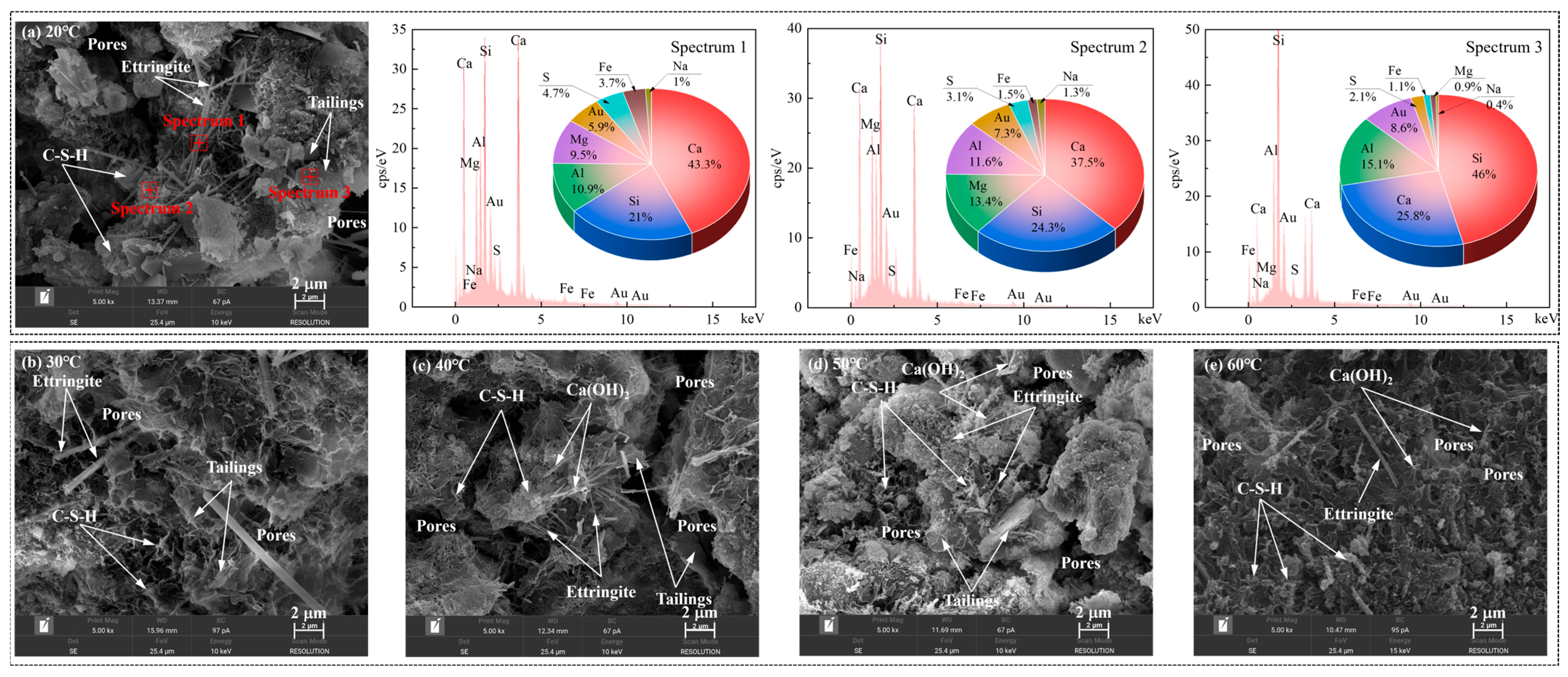
To elucidate the mechanisms by which temperature governs the internal structural evolution and hydration kinetics of CTB, specimens were analyzed via SEM-EDS, XRD, and FTIR (Figure 9, Figure 10 and Figure 11). Overall, temperature significantly dictates the morphology and spatial distribution of hydration products. Within the 20–40 °C range, the hydration process favors the formation of a highly integrated skeleton, with the most pronounced densification occurring near 40 °C. However, at elevated temperatures (50–60 °C), the appearance of plate-like Ca(OH)2 crystals and AFt is accompanied by significant pore coarsening and micro-crack propagation, which ultimately compromises the structural integrity.
From the SEM observations (Figure 9), the specimen cured at 20 °C primarily consists of flaky C-S-H gels and fine, disordered needle-like AFt. Interconnected pores remain prevalent at the ITZ between the matrix and tailings aggregates. At 40 °C, a qualitative shift in the microstructure is observed: C-S-H gels exhibit an interwoven fibrous–flaky texture, while fine AFt bundles uniformly permeate the capillary pores, bridging with the C-S-H to form a continuous, load-bearing skeleton. This optimal densification significantly reduces interconnected porosity and enhances interfacial bonding. Conversely, at 50–60 °C, the microstructure becomes markedly heterogeneous. Accelerated hydration leads to the precipitation of oversized Ca(OH)2 plates and coarsened AFt clusters. This rapid but defective crystal growth induces localized shrinkage strains and micro-fractures, shifting the pore size distribution toward larger, interconnected voids and weakening the matrix–aggregate adhesion.
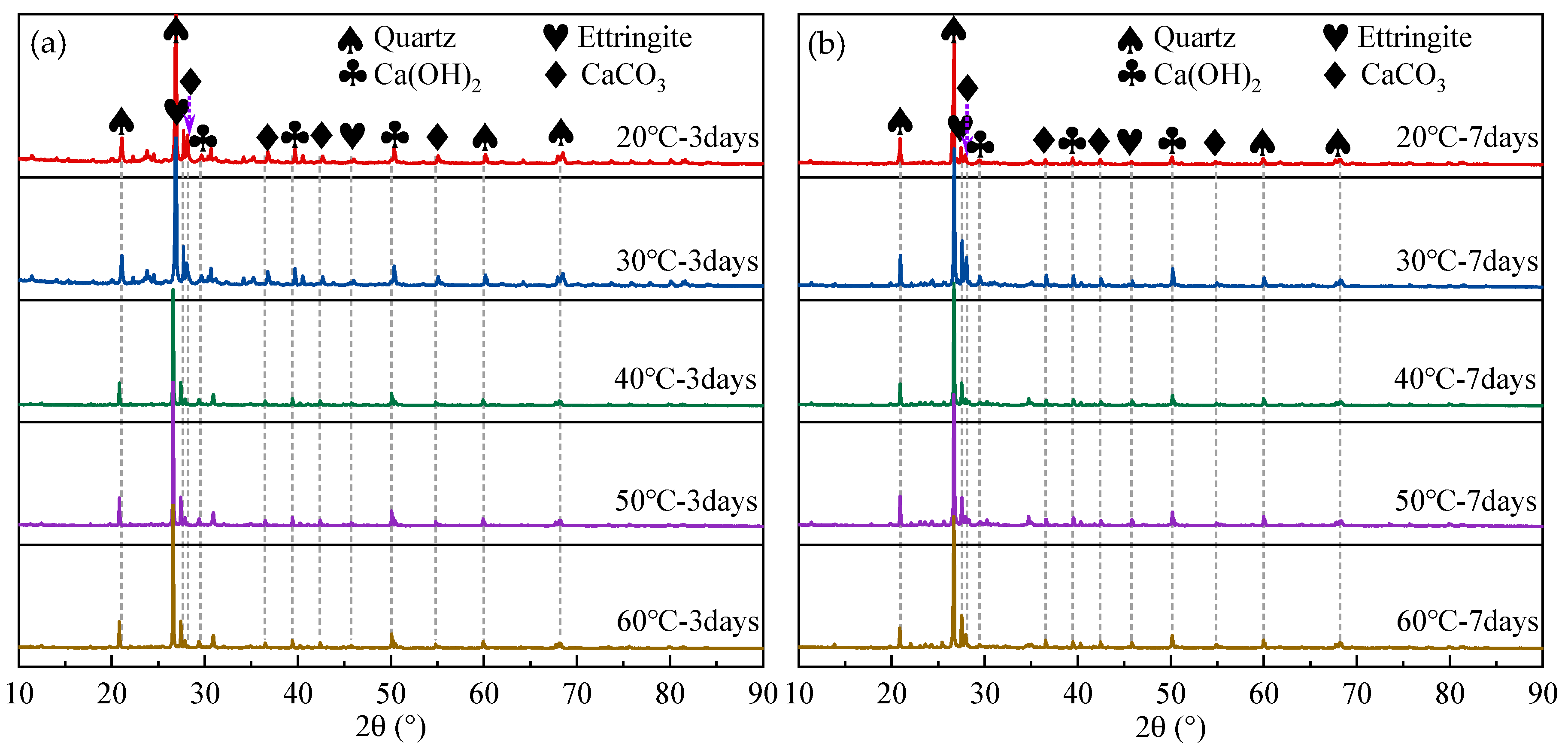
The XRD patterns (Figure 10) illustrate that the predominant crystalline phases across all curing temperatures consist of quartz (derived from the tailings aggregate), AFt, and Ca(OH)2, with minor diffraction peaks of CaCO3 identified in specific samples. Comparing the 3-day and 7-day specimens, a significant enhancement in the peak intensity of AFt was observed as the curing temperature rose from 20 °C to 40 °C, accompanied by a progressive increase in Ca(OH)2 peaks, which signifies an accelerated hydration rate. At further elevated temperatures of 50–60 °C, the Ca(OH)2 diffraction peaks became more pronounced; however, the AFt peaks exhibited signs of coarsening and structural irregularity. This phenomenon suggests the overgrowth of Ca(OH)2 crystals and the potential thermal instability of AFt under high-temperature conditions. Notably, as a poorly crystalline phase, C-S-H gel is not readily distinguishable by XRD. Its formation is instead corroborated by the dense gel network identified in SEM micrographs and the Si-O-Si stretching vibrations detected in FTIR spectra.
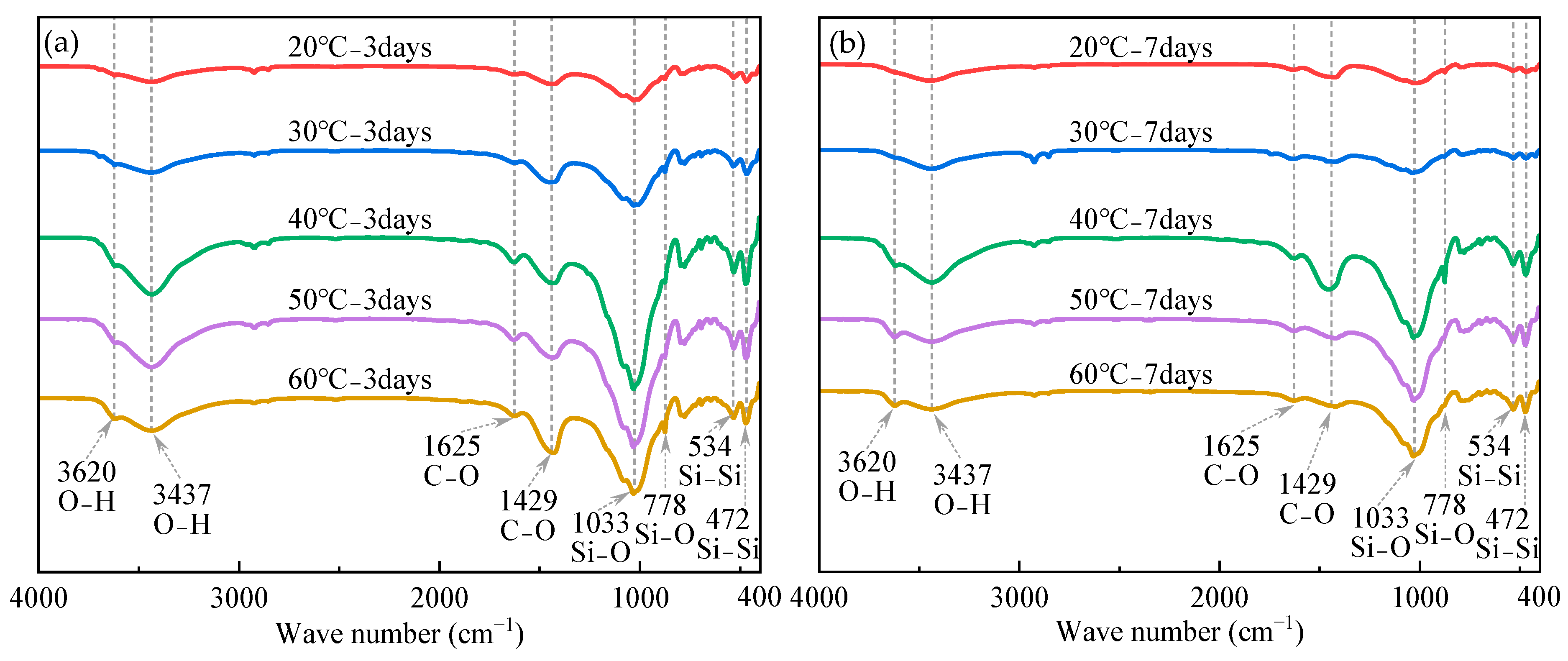
The FTIR spectra (Figure 11) further corroborate these findings at the molecular level. The absorption band at 3620 cm−1 and 3437 cm−1, together with the bending vibration at 1625 cm−1, correspond to -OH groups and H-O-H bending, confirming the presence of Ca(OH)2 and bound water. The peak at 1429 cm−1 is attributed to C-O vibrations, indicating a certain degree of carbonation on the specimen surface. The dominant peak at ~1033 cm−1 corresponds to Si-O-Si (or Si-O-Al) stretching, while additional bands at 778, 534, and 472 cm−1 are associated with Si-O/Si-Si bending and framework vibrations. A comparison of relative intensities shows that the specimen cured at 40 °C exhibits a more prominent main peak near 1033 cm−1, signifying a higher degree of silicate network polymerization and a more complete C-S-H structure. In contrast, the 50–60 °C specimens display stronger -OH and C-O related peaks. When combined with the SEM and XRD observations, these results suggest that high curing temperatures accelerate Ca(OH)2 crystallization and promote secondary carbonation reactions, which, in turn, contribute to pore coarsening and the initiation and propagation of microcracks.
The three characterization approaches provide a consistent multi-scale picture. At intermediate temperatures (≈40 °C), the cooperative formation and bridging of C-S-H gels and fine ettringite needles effectively fill pores and densify the ITZ, resulting in a more continuous load-bearing skeleton. By contrast, elevated temperatures (≥50 °C) accelerate early hydration but simultaneously induce product coarsening, agglomeration of Ca(OH)2 crystals, and shrinkage-related microcracking, leading to pore structure degradation and weakened interfacial bonding. This microstructural–macroscopic evolution explains why both UCS and elastic modulus reached maxima at 40 °C and declined thereafter (Section 3.1), and it is consistent with the AE evidence presented in Section 3.2 and Section 3.3.

4. Discussion

4.1. Temperature Threshold Effect and Multi-Scale Damage Evolution Mechanism

This study reveals a pronounced temperature threshold effect across micro-, meso-, and macro-scales. Both UCS and E increased with curing temperature up to a critical point (40 °C), beyond which they declined. Gaussian fitting confirmed this behavior, yielding optimal temperatures Tc of 46.6–51.4 °C for UCS and 41.1–45.9 °C for E, consistent with the experimental peaks (Figure 4). Moreover, the bandwidth parameter w narrowed with curing time, indicating that the effective temperature window for mechanical enhancement becomes progressively restricted. This phenomenon arises from the competition between two opposing processes: temperature-induced promotion (accelerated hydration and densification) and temperature-induced degradation (product coarsening, pore enlargement, and microcrack activation).
Microstructural evidence supports this interpretation. SEM-EDS results showed that in the 20–40 °C range, C-S-H gels evolved into a denser fibrous/flake network, while fine needle-like ettringite uniformly filled pores and bridged with C-S-H, resulting in a compact ITZ. The 40 °C specimens displayed the most integrated gel network with minimal pore connectivity. In contrast, at 50–60 °C, large plate-like Ca(OH)2 crystals and coarse ettringite bundles became prevalent, accompanied by shrinkage cracks and microcracks, reducing overall structural integrity. XRD confirmed the divergence: medium temperatures promoted sustained ettringite formation, whereas higher temperatures favored Ca(OH)2 crystallization and product coarsening. FTIR spectra further supported these findings: the Si-O-Si main peak at 1033 cm−1 was most intense at 40 °C, indicating optimal polymerization of the silicate network, while -OH and C-O related peaks were stronger at 50–60 °C, reflecting enhanced Ca(OH)2 crystallization and carbonation side reactions. Collectively, these results identify 40 °C as the condition producing the optimal microstructure (“high polymerization–strong bridging–low pore connectivity”), while higher temperatures trigger the deterioration pathway (“coarsening–porosity increase–microcrack initiation”).
AE responses further validated the multi-scale mechanism. In the time domain, b-values consistently exhibited a pre-peak drop across all temperatures, occurring earlier and with greater magnitude at higher temperatures. Simultaneously, ringing counts showed denser pulses during stages III–IV, and the slope of cumulative counts increased markedly. The RA-AF criterion revealed a shift toward tensile cracking, with the tensile event proportion rising from 66% at 20 °C to 83% at 50–60 °C. In the spatial domain, AE event locations evolved from scattered points (20–30 °C) to continuous bands: at 40 °C, a single dominant band formed, coinciding with a throughgoing macrocrack, while at 50–60 °C wider, often parallel bands developed, corresponding to axial splitting and branching. Notably, crack initiation preferentially occurred in the upper specimen regions, attributable to particle segregation during casting: coarse tailings settled to the bottom, leaving finer particles and water concentrated at the top, thus producing a “strong-bottom–weak-top” strength gradient.
Based on these results, the multi-scale damage pathway can be conceptualized (Figure 12). The temperature threshold effect arises from the competition between hydration-induced densification and degradation through Ca(OH)2 crystallization, AFt coarsening, and shrinkage cracking. The AE precursors—pre-peak b-value drop, steeper cumulative slope, higher tensile ratio, and banded spatial clustering—form a robust set of indicators, offering practical criteria for temperature control and in situ AE monitoring of CTB.

4.2. Characterization and Quantification of the Damage Process Using AE Parameters

In this study, AE is employed as a measurable proxy to track the entire damage evolution chain, spanning microcrack initiation, meso-scale propagation, and macro-scale failure. Four categories of AE information—ringing counts/cumulative counts, b-value, RA-AF fracture mechanism, and spatial connectivity from event localization—are integrated to provide a unified representation and quantification of the damage process.
To transform these descriptors into quantitative indices, AE and mechanical responses were aligned on a unified time axis. By setting the peak stress instant as tpeak, a dimensionless time parameter τ = t/tpeak ∈ [0, 1] was defined. The cumulative ringing count Ncum(t) was adopted to characterize the “degree of crack activity completion,” leading to the normalized cumulative parameter,
D N ( τ ) = N c u m ( τ ) N c u m ( t p e a k ) [ 0 , 1 ]
where DN(t) represents the normalized cumulative ringing count.
This index grows slowly during the stable propagation stage but rises sharply as the accelerated expansion stage approaches.
Considering that the b-value reflects a transition in crack size distribution (from dominance of small-scale events to larger-scale events), a drop factor was defined relative to the baseline average bref obtained during stage II,
I b ( τ ) = 1 b ( τ ) b r e f ( 0 )
Once the accelerated expansion stage begins, Ib increases rapidly within a short time window, sensitively capturing the pre-peak b-value drop.
To describe changes in crack activity rate, a normalized slope parameter was introduced,
κ ( τ ) = 1 κ max d N c u m d t
where κmax is the maximum pre-peak slope, which can be determined by differentiating the stress–strain curve. During the stable propagation stage, κ remains close to zero, while in the accelerated stage it approaches unity.
The fracture mechanism was further quantified by the proportion of tensile events identified via the RA-AF criterion,
F T ( τ ) = N T N T + N S
Meanwhile, spatial geometry was characterized by the proportion of events aligned within the dominant localization band,
C ( τ ) = N b a n d ( τ ) N a l l ( τ )
Experimentally, the peak values of Ib, κ, and C often appeared nearly simultaneously within a short pre-peak window and corresponded closely to the stiffness degradation observed on the stress–strain curve.
Building upon the individual indices, a composite AE damage index (Acoustic Damage Index, ADI) was proposed as a precursor measure of macroscopic damage,
A D I ( τ ) = w 1 D N ( τ ) + w 2 I b ( τ ) + w 3 κ ( τ ) + w 4 F T ( τ ) + w 5 C ( τ )
Equal weighting (0.2) was assigned to each component in Equation (16) to ensure the objectivity and transferability of the index across various experimental conditions. This approach effectively avoids the potential bias introduced by subjective empirical weighting and prevents the model from over-fitting to specific datasets. The scientific rationale for this scheme is based on the synergistic response of the five selected AE parameters, which typically exhibit synchronized transitions during the onset of unstable crack propagation. While the specific contribution of each parameter may vary, the equal-weight ADI provides a robust and computationally efficient framework for real-time engineering monitoring. It should be noted, however, that the proposed thresholds of 0.60 and 0.70 may require site-specific recalibration when applied to different binder systems or tailing types to account for inherent differences in material brittleness.
For comparison with mechanical degradation, macroscopic damage was quantified by the relative reduction in load-bearing capacity,
A D mesh ( τ ) = σ ( τ ) σ max
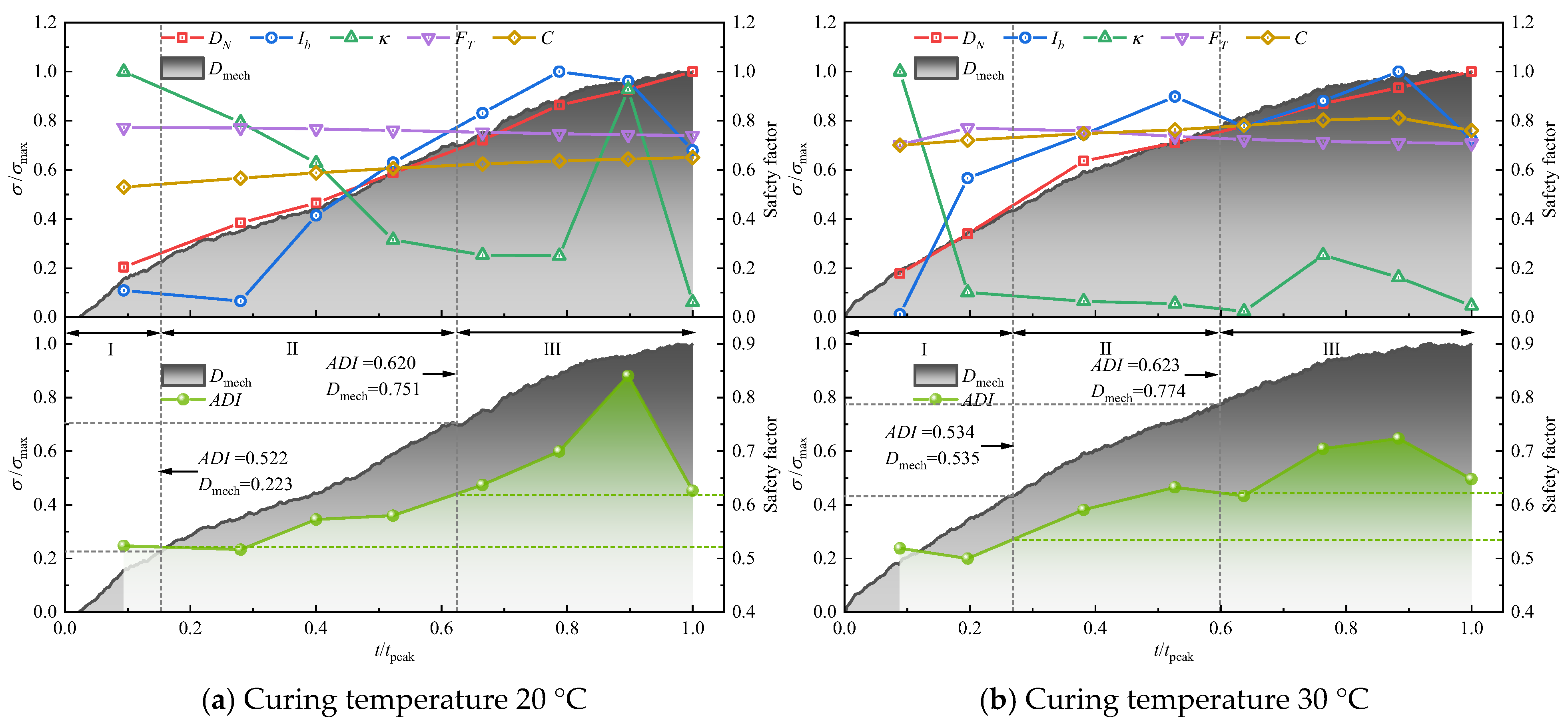
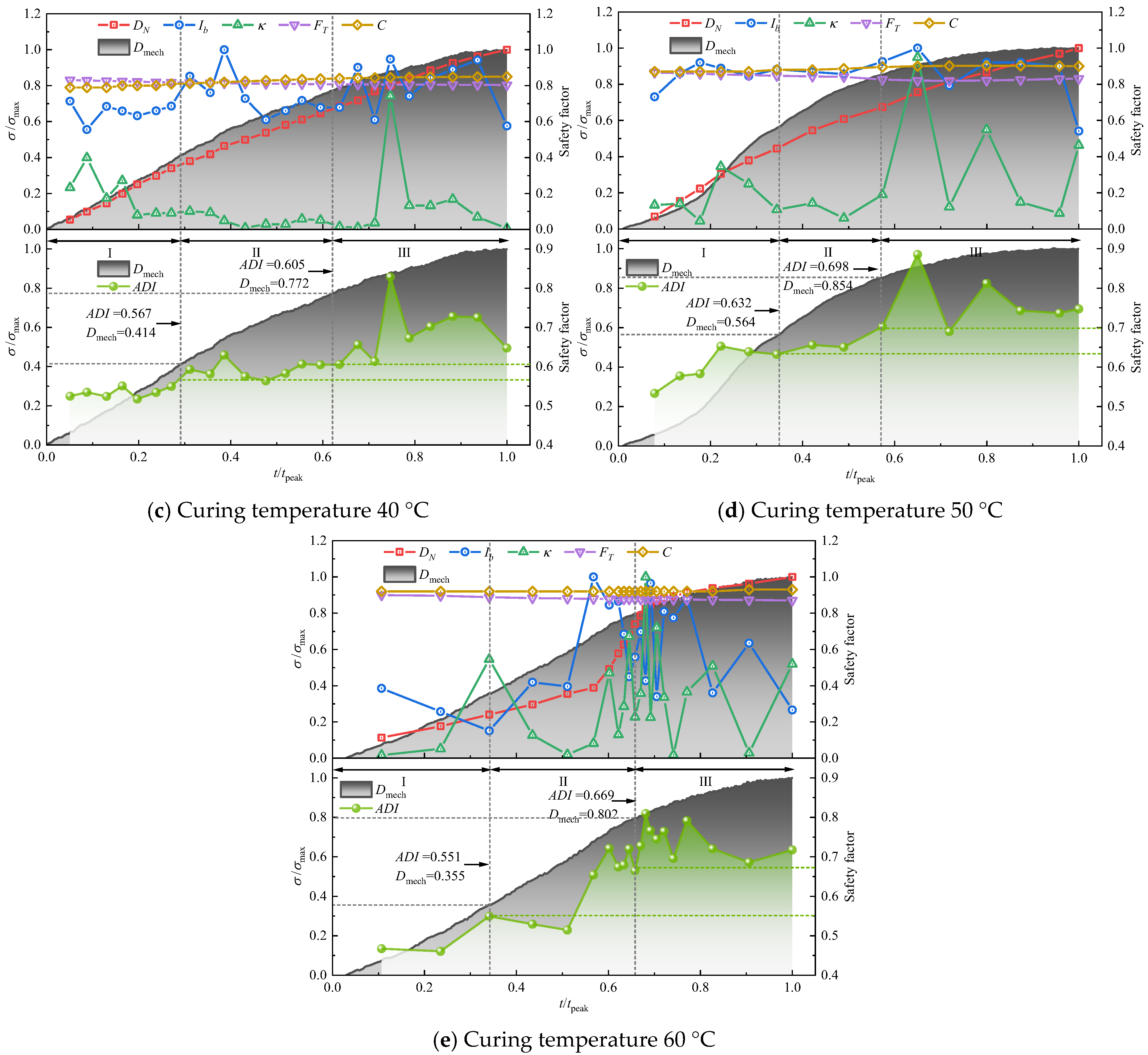
Taking the curing time of 7 days as an example, Figure 13 presents the normalized evolution of the composite AE damage index, ADI(τ), and the macroscopic damage index, Dmech(τ), under different curing temperatures. At all temperatures, a short window of intensified activity could be identified prior to peak stress. During this window, κ exhibited a steep rise, Ib increased abruptly, C rose rapidly, and FT remained at a high level. These combined effects caused ADI to surge within the short window and consistently precede the growth of Dmech, demonstrating the clear precursory role of AE in signaling the onset of accelerated crack propagation.
A stage-wise quantitative comparison further highlights the effect of temperature. At the end of Stage I, ADI increased progressively from 20 °C to 60 °C (0.522, 0.534, 0.567, 0.632, 0.551), peaking at 50 °C. The corresponding Dmech values were 0.223, 0.535, 0.414, 0.564, and 0.355, indicating that elevated temperature shifted early damage responses forward in time, while load-bearing capacity at 60 °C had not yet markedly degraded. By the end of Stage II, ADI values were 0.620, 0.623, 0.605, 0.698, and 0.669, with corresponding Dmech values of 0.751, 0.774, 0.772, 0.854, and 0.802. High-temperature specimens (50–60 °C) crossed the early-warning threshold of ADI ≈ 0.60 sooner and were associated with greater macroscopic damage. In contrast, the 40 °C specimen exhibited the lowest ADI at Stage II, with its primary increase concentrated within a narrow pre-peak window. This reflects a “delayed but concentrated” release of energy, consistent with higher strength and a single dominant fracture path.
The decomposition of individual indicators further clarifies the temperature effect on fracture mechanisms and geometric connectivity. At 20–30 °C, DN increased nearly linearly, κ showed only minor pulses during Stage III, Ib generally exhibited a single pre-peak drop, C rose slowly from 0.5 to 0.7–0.8, and FT stabilized near 0.7. At 40 °C, κ and Ib exhibited sharp peaks immediately before failure, concurrent with a rapid increase in C, indicating that the transition in crack scale and the formation of a continuous AE band occurred almost simultaneously near peak stress. At 50–60 °C, κ displayed multiple pulses, Ib dropped earlier and more sharply, FT increased to 0.85, and C reached 0.9 at an earlier τ, indicating that large-scale tensile cracks dominated earlier and accelerated axial coalescence. This “earlier and amplified” AE signature is consistent with Section 3.3 (early formation of AE localization bands) and Section 3.4 (coarsening of Ca(OH)2 crystals and enhanced pore connectivity under elevated temperatures).
ADI(τ) and Dmech(τ) exhibited a monotonic mapping in the pre-peak stage, with a clear time–temperature equivalence: the higher the temperature, the smaller τ required to reach a given ADI or Dmech, reflecting the systematic acceleration of damage evolution by heat. At 40 °C, ADI showed a delayed but concentrated surge, characterizing a stable failure mode with higher strength and a single fracture surface. Based on the statistical patterns in Figure 13, a practical criterion is proposed for in situ identification: ADI ≥ 0.60 indicates the entry into accelerated propagation, while ADI ≥ 0.70 signals imminent instability. These thresholds remain robust across the tested conditions, though recalibration may be necessary for different binder systems.
In summary, AE parameters provide quantifiable precursors to macroscopic failure, effectively linking curing temperature, hydration product morphology, and pore/ITZ evolution to mechanical degradation. Around 40 °C, the microstructure achieves an optimal state of maximum bridging and minimum connectivity, resulting in a concentrated ADI surge and superior load-bearing capacity. At elevated temperatures, however, enhanced pore connectivity and tensile crack dominance shift AE responses forward, causing earlier, multi-peaked damage. This integrated framework, summarized in Table 2, provides a reliable reference for the real-time stability monitoring and early warning of cemented tailings backfill in engineering practice.

5. Conclusions

This study investigated the coupled chain of temperature–mechanical–AE–microstructure in CTB. Uniaxial compression tests with synchronous AE monitoring were conducted at 20–60 °C for 3–28 days, integrated with SEM, XRD, and FTIR. A temperature–strength single-peak pattern was established, and an ADI was proposed for quantitative damage assessment. The major findings are as follows:
(1) Mechanical temperature threshold: Both UCS and E follow a single-peak pattern with curing temperature, peaking at 40 °C. Gaussian fitting identifies optimal ranges of 41.1~51.4 °C, which narrow with curing time. Moreover, E exhibits higher sensitivity to thermal degradation than UCS.
(2) Pre-peak AE short window as a precursor: A distinct intensified AE window precedes peak stress across all temperatures, marked by a sharp rise in κ, a drop in b-value, and increased tensile events. Elevated temperatures shift this precursor window earlier and amplify its intensity.
(3) Spatial fracture evolution revealed by AE localization: AE localization transitions from scattered points to banded clusters. At 40 °C, a single continuous band forms, coinciding with the dominant fracture. At 50–60 °C, wider parallel bands and longitudinal splitting predominate, driven by the “strong bottom–weak top” gradient from tailings segregation.
(4) Mapping between ADI and macroscopic damage: The ADI systematically precedes macroscopic damage. Thresholds of ADI ≥ 0.60 (accelerated cracking) and ADI ≥ 0.70 (imminent instability) serve as early-warning indicators. Higher temperatures accelerate the time fraction to reach these thresholds.
(5) Consistency across micro-meso-macro mechanisms: The 40 °C peak is attributed to polymerized C-S-H gels and fine AFt bridging. Curing at ≥50 °C causes Ca(OH)2 coarsening and increased pore connectivity, explaining the observed macroscopic degradation and earlier AE activity.
Although this study establishes a robust thermo-mechanical framework for CTB, its current application is limited to specific laboratory conditions, including a single tailings source and uniaxial loading. Future research should address the variability of ADI thresholds across diverse binder systems beyond traditional cement-based backfill. Additionally, investigating the scaling effects between laboratory specimens and in situ structures will be essential to refine the early-warning framework for complex mining environments, ensuring long-term stability across various curing times.

Author Contributions

H.H.: Data curation, Validation, Funding acquisition, Writing—review and editing. C.Z.: Resources, Software, Methodology, Supervision, Writing—review and editing. J.G.: Conceptualization, Supervision, Funding acquisition, Writing—review and editing. X.W.: Validation, Writing—review and editing. All authors have read and agreed to the published version of the manuscript.

Funding

This study was supported by the National Natural Science Foundation of China (No. 52374081) and the Shaanxi Provincial Key Research and Development Program (2025SF-YBXM-535).

Data Availability Statement

Data will be made available upon request.

Conflicts of Interest

The authors declare that they have no known competing financial interests or personal relationships that could have appeared to influence the work reported in this paper.

References

  1. Al Heib, M.M.; Didier, C.; Masrouri, F. Improving short- and long-term stability of underground gypsum mine using partial and total backfill. Rock Mech. Rock Eng. 2010, 43, 447–461. [Google Scholar] [CrossRef]
  2. Saremi, A.; Fall, M. Self-desiccation behavior of nano-cemented tailings backfill plug: Insights from thermo-mechanical-chemical column experiments. J. Mater. Res. Technol. 2024, 30, 5952–5962. [Google Scholar] [CrossRef]
  3. Zhang, C.; Song, W.; Taheri, A.; Fu, J.; Zhao, T.; Tan, Y. Hydration mechanism and mechanical-thermal correlation of cemented paste backfill under different curing temperatures. J. Build. Eng. 2024, 85, 108691. [Google Scholar] [CrossRef]
  4. Haruna, S.; Fall, M. Time and temperature-dependent rheological properties of cemented paste backfill that contains superplasticizer. Powder Technol. 2020, 360, 731–740. [Google Scholar] [CrossRef]
  5. Wang, Y.; Fall, M.; Wu, A. Initial temperature-dependence of strength development and self-desiccation in cemented paste backfill that contains sodium silicate. Cem. Concr. Compos. 2016, 67, 101–110. [Google Scholar] [CrossRef]
  6. Yang, L.; Wang, H.; Wu, A.; Li, H.; Bruno, T.A.; Zhou, X.; Wang, X. Effect of mixing time on hydration kinetics and mechanical property of cemented paste backfill. Constr. Build. Mater. 2020, 247, 118516. [Google Scholar] [CrossRef]
  7. Zhang, C.; Song, W.; Guo, J.; Taheri, A.; Wang, Y.; Wang, X. Hydration behavior, microstructural characteristics, and kinetic analysis of cemented tailings backfill under temperature effect. Case Stud. Constr. Mater. 2025, 23, e05081. [Google Scholar] [CrossRef]
  8. Chen, S.; Yilmaz, E.; Xiang, Z.; Wang, Y. Curing conditions effect on pore structure, compressive strength and elastic modulus of cementitious tailings backfills. Powder Technol. 2023, 422, 118458. [Google Scholar] [CrossRef]
  9. Zhang, C.; Wang, J.; Song, W.; Fu, J. The bonding mechanism of rock and cement paste backfill interface under high temperature curing. Powder Technol. 2025, 453, 120680. [Google Scholar] [CrossRef]
  10. Li, X.; Fu, W.; Wang, P.; Zhou, J.; Hu, Z.; Guo, Z. Enhancing foamed concrete performance with pre-wetted ceramsite: Mitigating early cracking, shrinkage, and improving interfacial transition zone properties. Constr. Build. Mater. 2025, 458, 139509. [Google Scholar] [CrossRef]
  11. Nasir, O.; Fall, M. Coupling binder hydration, temperature and compressive strength development of underground cemented paste backfill at early ages. Tunn. Undergr. Space Technol. 2010, 25, 9–20. [Google Scholar] [CrossRef]
  12. Wang, Y.; Cao, Y.; Cao, C.; Wang, H. Effect of curing temperature under deep mining conditions on the mechanical properties of cemented paste backfill. Minerals 2023, 13, 383. [Google Scholar] [CrossRef]
  13. Fall, M.; Célestin, J.; Pokharel, M.; Touré, M. A contribution to understanding the effects of curing temperature on the mechanical properties of mine cemented tailings backfill. Eng. Geol. 2010, 114, 397–413. [Google Scholar] [CrossRef]
  14. Liu, W.; Guo, Z.; Wang, C.; Niu, S. Physico-mechanical and microstructure properties of cemented coal Gangue-Fly ash backfill: Effects of curing temperature. Constr. Build. Mater. 2021, 299, 124011. [Google Scholar] [CrossRef]
  15. Carette, J.; Staquet, S. Unified modelling of the temperature effect on the autogenous deformations of cement-based materials. Cem. Concr. Compos. 2018, 94, 62–71. [Google Scholar] [CrossRef]
  16. Nandhini, K.; Karthikeyan, J. The early-age prediction of concrete strength using maturity models: A review. J. Build. Pathol. Rehabil. 2021, 6, 7. [Google Scholar] [CrossRef]
  17. Mahmood, A.H.; Hampton, I.; Bescher, E.; Pang, L.; Castel, A. On-site strain and temperature monitoring of belitic calcium sulfoaluminate cement concrete airport slabs: Feasibility of maturity method. Int. J. Pavement Eng. 2025, 26, 2518153. [Google Scholar] [CrossRef]
  18. Abdulkadir, S.B.; Chen, Q.; Yilmaz, E.; Wang, D. Comparative and Meta-Analysis Evaluation of Non-Destructive Testing Methods for Strength Assessment of Cemented Paste Backfill: Implications for Sustainable Pavement and Concrete Materials. Materials 2025, 18, 2888. [Google Scholar] [CrossRef]
  19. Ma, K.; Gao, Z.; Ren, F. Investigation of the shearing behavior and mechanism of serrated granite-concrete interface considering the temperature difference initial damage. Constr. Build. Mater. 2024, 455, 139192. [Google Scholar] [CrossRef]
  20. Liu, L.; Ding, X.; Tu, B.; Qu, H.; Xie, G. Energy evolution and mechanical properties of modified magnesium slag-based backfill materials at different curing temperatures. Constr. Build. Mater. 2024, 411, 134555. [Google Scholar] [CrossRef]
  21. Wu, J.; Yang, S.; Williamson, M.; Wong, H.S.; Bhudia, T.; Pu, H.; Yin, Q.; Ma, D.; Chen, W. Microscopic mechanism of cellulose nanofibers modified cemented gangue backfill materials. Adv. Compos. Hybrid Mater. 2025, 8, 177. [Google Scholar] [CrossRef]
  22. Nasharuddin, R.; Luo, G.; Robinson, N.; Fourie, A.; Johns, M.L.; Fridjonsson, E. Understanding the microstructural evolution of hypersaline cemented paste backfill with low-field NMR relaxation. Cem. Concr. Res. 2021, 147, 106516. [Google Scholar] [CrossRef]
  23. Fu, J.; Wang, K.; Wang, J. Internal pore evolution and early hydration characterization of fly ash cement backfill. J. Build. Eng. 2023, 72, 106716. [Google Scholar] [CrossRef]
  24. Chen, G.; Yao, N.; Ye, Y.; Fu, F.; Hu, N.; Zhang, Z. Study on the settlement and delamination mechanism and acoustic emission characteristics of mixed aggregate cemented backfill. Constr. Build. Mater. 2023, 408, 133635. [Google Scholar] [CrossRef]
  25. Yin, S.; Zhou, Y.; Chen, X.; Li, G. A new acoustic emission characteristic parameter can be utilized to evaluate the failure of cemented paste backfill and rock combination. Constr. Build. Mater. 2023, 392, 132017. [Google Scholar] [CrossRef]
  26. Zhang, L.; Lai, X.; Pan, J.; Shan, P.; Zhang, Y.; Zhang, Y.; Xu, H.; Cai, M.; Xi, X. Experimental investigation on the mixture optimization and failure mechanism of cemented backfill with coal gangue and fly ash. Powder Technol. 2024, 440, 119751. [Google Scholar] [CrossRef]
  27. Zhao, K.; Shi, Y.; Ma, C.; Yan, Y.; Zhong, J.; Feng, Y.; Ao, W. Damage evaluation indexes for cemented tailings backfill based on RA and AF values. Nondestruct. Test. Eval. 2025, 41, 487–502. [Google Scholar] [CrossRef]
  28. Ji, Y.; Xie, L.; Xiao, J.; Zheng, Y.; Ma, S.; Pan, T. Mechanical properties and acoustic emission characteristics of microbial cemented backfill with various particle size distributions of recycled aggregates. Constr. Build. Mater. 2024, 417, 135269. [Google Scholar] [CrossRef]
  29. Tan, Y.; Li, Y.; Yu, X.; Deng, Y.; Song, Z.; Kou, Y. Study of the spatial strength distribution patterns and microstructure characteristics of ultra-fine tailings cemented paste backfill. Sci. Rep. 2025, 15, 108. [Google Scholar] [CrossRef]
  30. Zhang, C.; Taheri, A.; Du, C.; Xia, W.; Tan, Y. Mechanical characteristics and macro–microscopic response mechanisms of cemented paste backfill under different curing temperatures. Minerals 2024, 14, 433. [Google Scholar] [CrossRef]
  31. Ohno, K.; Ohtsu, M. Crack classification in concrete based on acoustic emission. Constr. Build. Mater. 2010, 24, 2339–2346. [Google Scholar] [CrossRef]
  32. Aldahdooh, M.; Bunnori, N.M. Crack classification in reinforced concrete beams with varying thicknesses by mean of acoustic emission signal features. Constr. Build. Mater. 2013, 45, 282–288. [Google Scholar] [CrossRef]
Figure 1. Research background and schematic representation of cemented tailings backfill under deep mining temperature conditions.
Minerals 16 00193 g001
Figure 2. Physical characteristics of cemented tailings backfill: (a) particle size distribution; (b) chemical composition.
Minerals 16 00193 g002
Figure 3. Experimental procedure.
Minerals 16 00193 g003
Figure 4. Mechanical properties of cemented tailings backfill under different curing conditions: (a) 3 days; (b) 7 days; (c) 14 days; (d) 28 days.
Minerals 16 00193 g004
Figure 5. Growth rate of uniaxial compressive strength and iso-contour map of UCS as a function of curing temperature and time.
Minerals 16 00193 g005
Figure 6. Growth rate of elastic modulus and iso-contour map of elastic modulus as a function of curing temperature and time.
Minerals 16 00193 g006
Figure 7. Acoustic emission parameter analysis of CTB specimens cured at different temperatures (7 days).
Minerals 16 00193 g007aMinerals 16 00193 g007b
Figure 8. Failure patterns and AE event localization of backfill specimens cured at different temperatures (7 days).
Minerals 16 00193 g008aMinerals 16 00193 g008b
Figure 9. Microstructural analysis of CTB cured at different temperatures (7 days): (a) 20 °C; (b) 30 °C; (c) 40 °C; (d) 50 °C; (e) 60 °C.
Minerals 16 00193 g009
Figure 10. XRD analysis of CTB cured at different temperatures: (a) 3 days; (b) 7 days.
Minerals 16 00193 g010
Figure 11. FTIR analysis of CTB cured at different temperatures: (a) 3 days; (b) 7 days.
Minerals 16 00193 g011
Figure 12. Multi-scale chained characteristics of cemented tailings backfill under temperature effects.
Minerals 16 00193 g012
Figure 13. Evolution of the composite AE damage index and macroscopic damage under different curing temperatures.
Minerals 16 00193 g013aMinerals 16 00193 g013b
Table 1. Characteristic parameters obtained from Gaussian fitting of UCS and E under different curing conditions.
Curing TimeUCS (MPa)Elastic Modulus (MPa)
s0TcwAR2E0TcwAR2
3 days0.53851.43047.75335.6980.859107.02341.11314.516819.7390.954
7 days−1.92448.830126.029542.2640.914109.52545.90427.5221759.2700.915
14 days−0.19846.96991.049221.6780.93142.67745.21359.48912,385.6150.971
28 days1.64346.56330.92718.4180.936201.73642.21626.4151329.9600.889
Table 2. Practical early-warning framework based on ADI and micro-parameters.
Damage StageADI ThresholdGaussian ParametersMicrostructural StateEngineering Implication
StableADI < 0.60Low sensitivityIsolated hydration productsSafe operating zone
Warning0.60 ≤ADI < 0.70A, w risingCa(OH)2 coarseningEarly warning stage
CriticalADI > 0.70Peak responseMacro-crack coalescenceImminent failure risk
Disclaimer/Publisher’s Note: The statements, opinions and data contained in all publications are solely those of the individual author(s) and contributor(s) and not of MDPI and/or the editor(s). MDPI and/or the editor(s) disclaim responsibility for any injury to people or property resulting from any ideas, methods, instructions or products referred to in the content.