Article

The Fluid Characteristics, Metallogenic Chronology and Ore-Forming Mechanism of the Nanping Granitic Pegmatite-Type Nb-Ta Deposit, Southeast China


1
Zijin School of Geology and Mining, Fuzhou University, Fuzhou 350108, China
2
College of Oceanography, Hohai University, Nanjing 210024, China
*
Authors to whom correspondence should be addressed.
Minerals 2026, 16(3), 285; https://doi.org/10.3390/min16030285
Submission received: 28 January 2026 / Revised: 23 February 2026 / Accepted: 27 February 2026 / Published: 9 March 2026

Abstract

The Nanping pegmatite-type Nb-Ta deposit is one of the large-scale Li-Cs-Ta (LCT)-type pegmatite deposits in Southeast China. Nevertheless, the mineralization mechanism of this ore deposit remains unclear, primarily due to the lack of systematic research on the characteristics of ore-forming fluids and mineralization processes. To address this issue, analyses of the fluid inclusion characteristics, hydrogen–oxygen isotope compositions and in situ U-Pb geochronology of Nb-Ta minerals were performed on the No. 31 vein of the Nanping pegmatite deposit. In situ U-Pb dating of the Nb-Ta minerals with varying textures from different zones yields main mineralization ages clustered between 390 and 370 Ma, along with isolated younger ages around 270 Ma in specific mineral zones, indicating multiple mineralization episodes. The fluid inclusion homogenization temperatures of different zones range from 130 to 382 °C, and salinities between 2 and 16 wt% NaCl eqv, consistent with a medium-to-low temperature and salinity fluid system. Hydrogen and oxygen isotope data show that the ore-forming fluids were predominantly derived from magmatic fluids, mixed with later meteoric waters. This study clarifies the multistage mineralization history and fluid evolution of the Nanping pegmatite-type Nb-Ta deposit, providing key constraints for metallogenic models of pegmatite-hosted rare-metal deposits.

1. Introduction

Niobium and tantalum are critical rare-metal elements with unique geochemical properties, and they are indispensable in high-technology sectors including electronics, aerospace, and defense industries [1,2]. Pegmatites exhibit a genetic association with the enrichment of critical metals such as Li, Be, Nb, Ta, Cs, and Rb, and thus have become a central focus within rare-metal research [3,4,5,6]. Nb-Ta pegmatite deposits are frequently characterized by significant enrichment in Nb, Ta, Li, and Cs, and they represent critical global sources of these metals. Specifically, these deposits contribute to the majority of global tantalum production, nearly the entirety of the world’s cesium supply, and approximately 25% of global lithium output.
Several classification frameworks have been proposed for pegmatites, and dual-criteria classification is most widely used [7]. This scheme classifies pegmatites by integrating two key dimensions: (1) their geological setting, mineralogical assemblages, and geochemical characteristics, and (2) their petrogenetic origins. Through this integrated methodology, pegmatites are systematically classified into three distinct categories: Nb-Y-F (NYF), Li-Cs-Ta (LCT), and mixed LCT-NYF. The LCT-type pegmatites are enriched in Li, Cs, and Ta (as well as Rb, Be, Sn, B, P, and F), with Ta > Nb and extremely low Nb/Ta ratios (<5), and exhibit high alumina saturation. Based on geochemical characteristics, they are mainly formed during the late orogenic stage and are associated with peraluminous S-type granites, and partly with I-type granites, with the source region being the upper to middle crustal supracrustal rocks. NYF-type pegmatites are enriched in Nb, Y, and F (as well as Be, REE, Sc, Ti, Zr, Th, and U), with Nb > Ta and high Nb/Ta ratios. They are alkali-rich and mainly formed during the anorogenic stage through differentiation of metaluminous to peraluminous A-type and I-type granites. Their source region is deeper than that of LCT-type pegmatites, with a higher proportion of deep-seated components. LCT + NYF mixed-type pegmatites exhibit the characteristics of both aforementioned pegmatite families. LCT-type pegmatites far outnumber NYF-type pegmatites in terms of quantity [8,9,10,11,12]. LCT-type pegmatites represent an important source of Nb and Ta, and many studies have shown that their formation is closely associated with both deep crustal magmatic evolution and anatexis and shallow hydrothermal processes [13].
The Nanping Nb-Ta deposit in the Southeast China is a large-scale LCT-type pegmatite deposit with significant enrichment in Nb, Ta, and Sn. It was initially identified during 1:200,000 scale regional geological mapping during 1960–1966. Since the 1990s, many studies on pegmatites in northwestern Fujian have been carried out, including the characteristics of the ore deposit, mineralogy and compositions of the main minerals, and internal zoning, as well as geochronology [14,15,16,17,18,19,20,21]. However, the current understanding of the forming mechanism of this deposit remains limited, mainly due to the lack of data on fluid characteristics.
To date, more than 500 pegmatite veins have been documented in the district [16]. Notably, the No. 31 pegmatite vein represents the largest and most highly differentiated orebody within the Nanping pegmatite deposit. Therefore, studying the ore-forming fluid characteristics and ore-formation mechanism of this vein can help better understand the genesis of the Nanping pegmatite deposit.
To elucidate the fluid characteristics and mineralization mechanisms of the Nanping pegmatite deposit, we conducted analyses of fluid inclusion characteristics, hydrogen–oxygen isotope compositions, in situ U-Pb geochronology, and trace element compositions of Nb-Ta minerals for the No. 31 vein. Additionally, we also discuss the genesis, fluid characteristics and the ore-forming mechanism of the Nanping pegmatite ore deposit by integrating previously published data and geological features.

2. Geological Setting

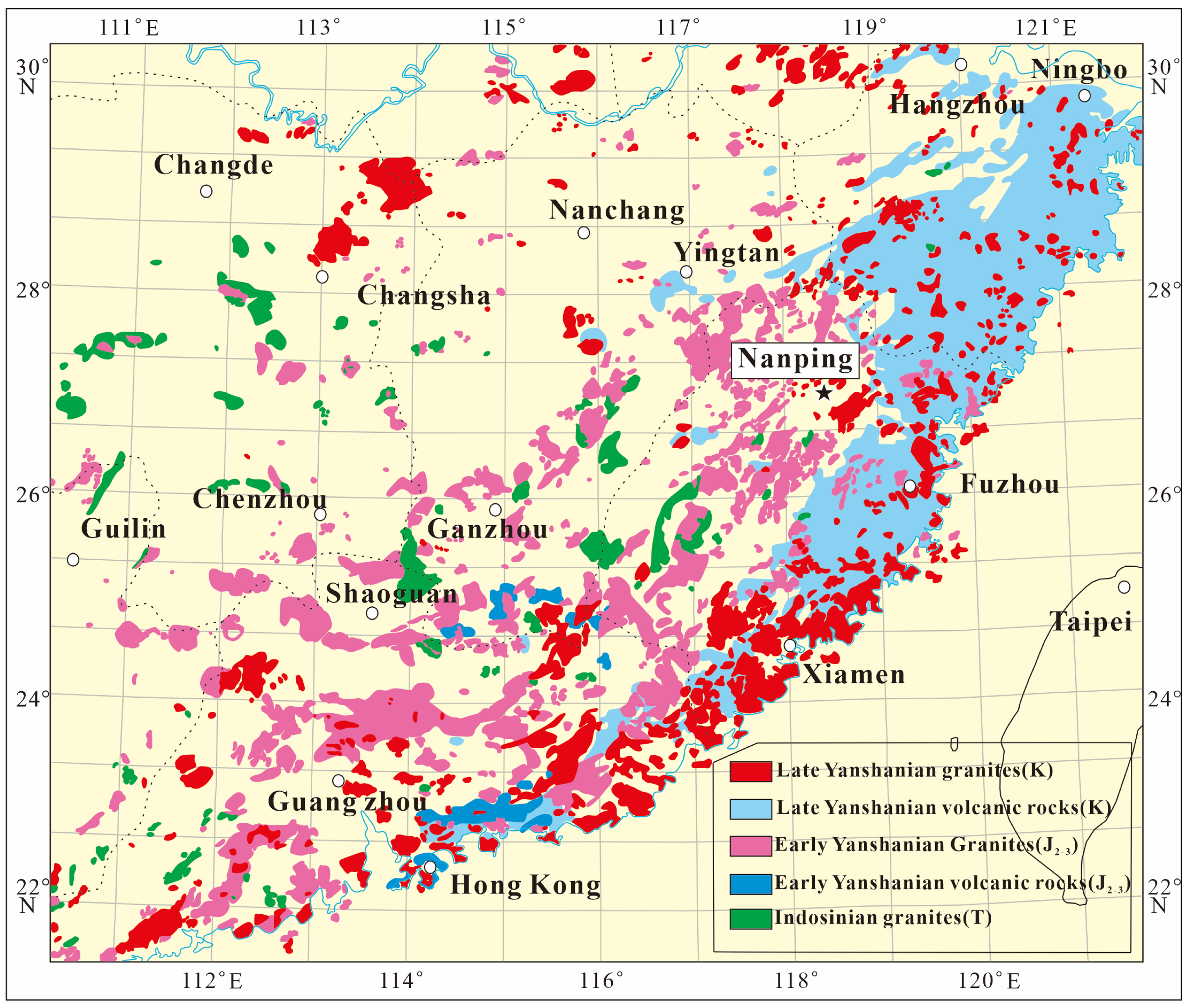
The Nanping Nb-Ta type pegmatite deposit is situated within the South China Block (Figure 1). The region hosts abundant exposures of Precambrian metamorphic rocks as well as multi-stage granitic intrusions that exhibit clear temporal and spatial associations with the pegmatites distributed in northwestern Fujian province. Granite emplacement in the area occurred mainly during three magmatic–tectonic cycles: Proterozoic (2500–541 Ma), Caledonian (490–390 Ma), and Yanshanian (175–80 Ma) [22,23]. Yanshanian granites are the most extensively exposed, followed by Caledonian granites. Many Yanshanian intrusions are genetically linked to regional Cu-Fe-Pb-Zn mineralization [24,25,26,27,28]. The Caledonian granites occur in two NE-trending belts and intrude Archean to Paleoproterozoic metamorphic rocks. Compared to Proterozoic granites, these granites exhibit multi-phase emplacement, diverse lithological assemblages, and a significantly weaker metamorphic overprint [16].
The Nanping granitic pegmatite has a complex, multi-stage tectonic–magmatic evolution. It lies at the intersection of two major Fujian tectonic units: the north-northeast (NNE) -striking Zhenghe-Dapu fault zone and northeast (NE)-oriented Nanping-Ninghua tectono-magmatic belt. Since the Mesoproterozoic–Neoproterozoic period, multiple tectonic episodes have gradually formed a structural framework dominated by NNE-NE trends, with subsidiary northwest (NW) and north-south (NS) trends (Figure 2). The present geology preserves records of multi-stage tectonic events, including ductile shear zones and extensional structures formed during the Sibao-Jinning, Caledonian, Indosinian, and Yanshanian periods [14]. Among these, the NNE-trending ductile shear zones developed in the Late Caledonian period, together with associated anticlinal structures, exert a significant control on the emplacement of pegmatite veins. Furthermore, the morphology, scale, and orientations of both pegmatite vein clusters and individual veins are frequently influenced by secondary folds, with dilation zones at fold hinges typically acting as favorable mineralization sites.
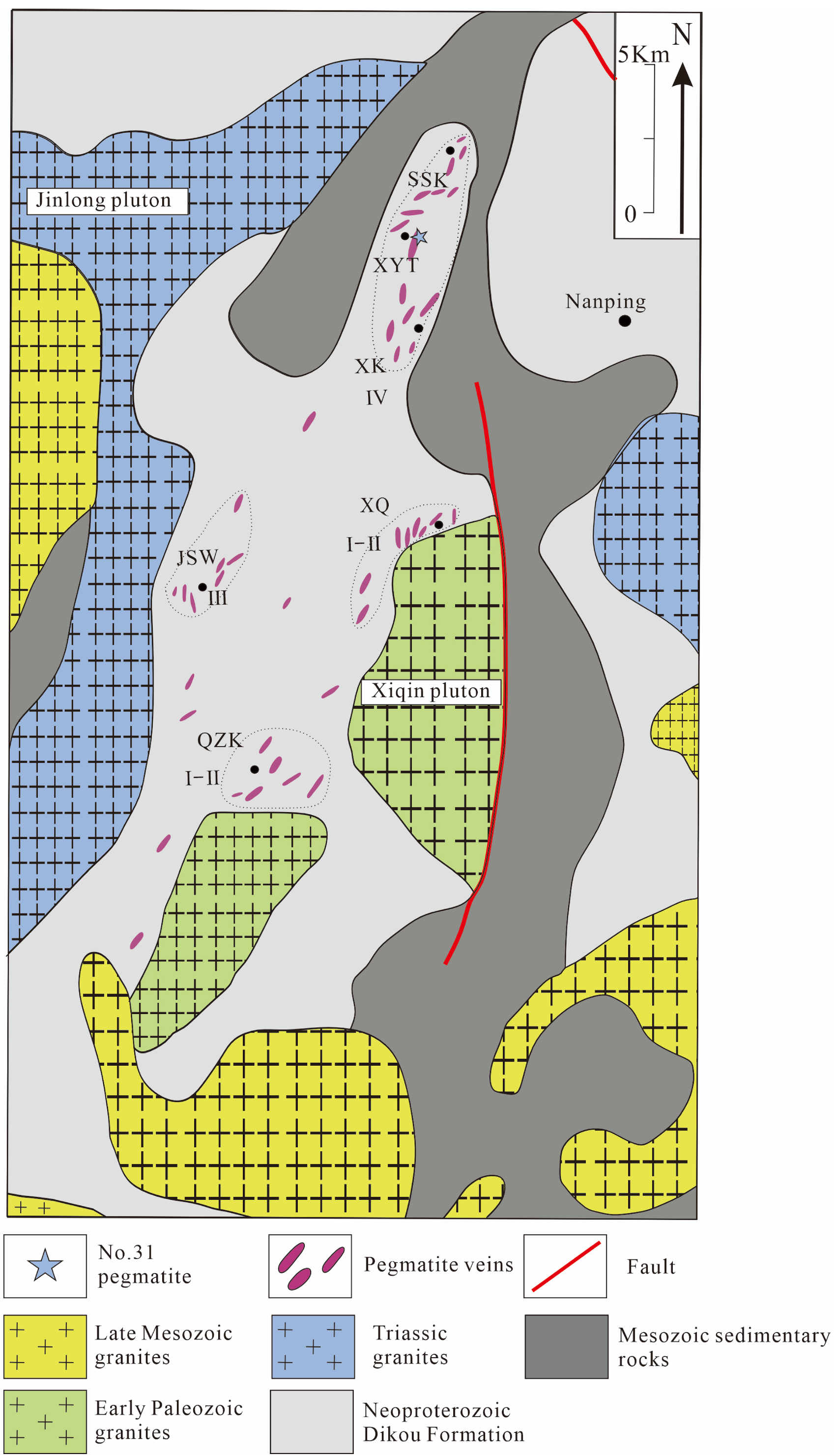
The area around the Nanping pegmatite is predominantly composed of granitic intrusive rocks, including monzogranites, granodiorites, and K-feldspar granites. Field relationships and isotopic dating indicate these intrusions were emplaced during the Caledonian, Indosinian and Yanshanian periods. Among these, the Caledonian granites exhibit the closest genetic link to the pegmatites. As a large Caledonian granite intrusion, the Xiqin pluton is situated in the central part of the ore district and forms an elliptical, NNE-trending domal body. The pluton intrudes metamorphic rocks of the Xiafeng Formation (Wanquan Group) and covers an outcrop area of 38.5 km2. Its eastern margin is in fault contact with the Lower Jurassic Lishan Formation. The Xiqin pluton exhibits well-developed gneissic structures. Small granitic pegmatite veins occur within its inner contact zone. Zircon U–Pb dating indicates that the Xiqin pluton was emplaced at ca. 410 Ma (411.6 ± 4.0 Ma and 409.2 ± 4.4 Ma) [29]. Geochemically, the pluton belongs to the calc-alkaline series. Its emplacement was structurally controlled by syn-emplacement NE–NNE-trending Caledonian ductile shear zones. To date, approximately 500 pegmatite veins have been documented within the ore field. Most of these veins occur in the biotite–plagioclase granulite and two-mica schist of the Meso- to Neoproterozoic Xiafeng Formation (Wanquan Group), located west of the Xiqin pluton. Only a small number are emplaced within the inner zone of the pluton itself. The veins display a dense, NNE-trending distribution over an area of 250 km2. They typically exhibit sharp, well-defined intrusive contacts with the country rocks [20].
The pegmatites in the Nanping area primarily occur within the Neoproterozoic Dikou Formation, comprising biotite–plagioclase granulite, two-feldspar granulite, and two-mica schist (Figure 2). The regional structural framework is characterized by well-developed folds and faults. The folds, predominantly developed in metamorphic basement, trend towards N-NE, while the dominant fault systems strike approximately N-S. The No. 31 pegmatite vein exhibits a characteristic S-shaped geometry in both plane and cross-sectional views. It occurs predominantly as lenticular bodies, with subordinate irregular veins. The vein trends NNE, extends for 300–600 m and to 90 m in depth, and ranges from 5 to 6 m in thickness [17]. The No. 31 vein exhibits internal zoning, characterized by different mineral assemblages [17,20].
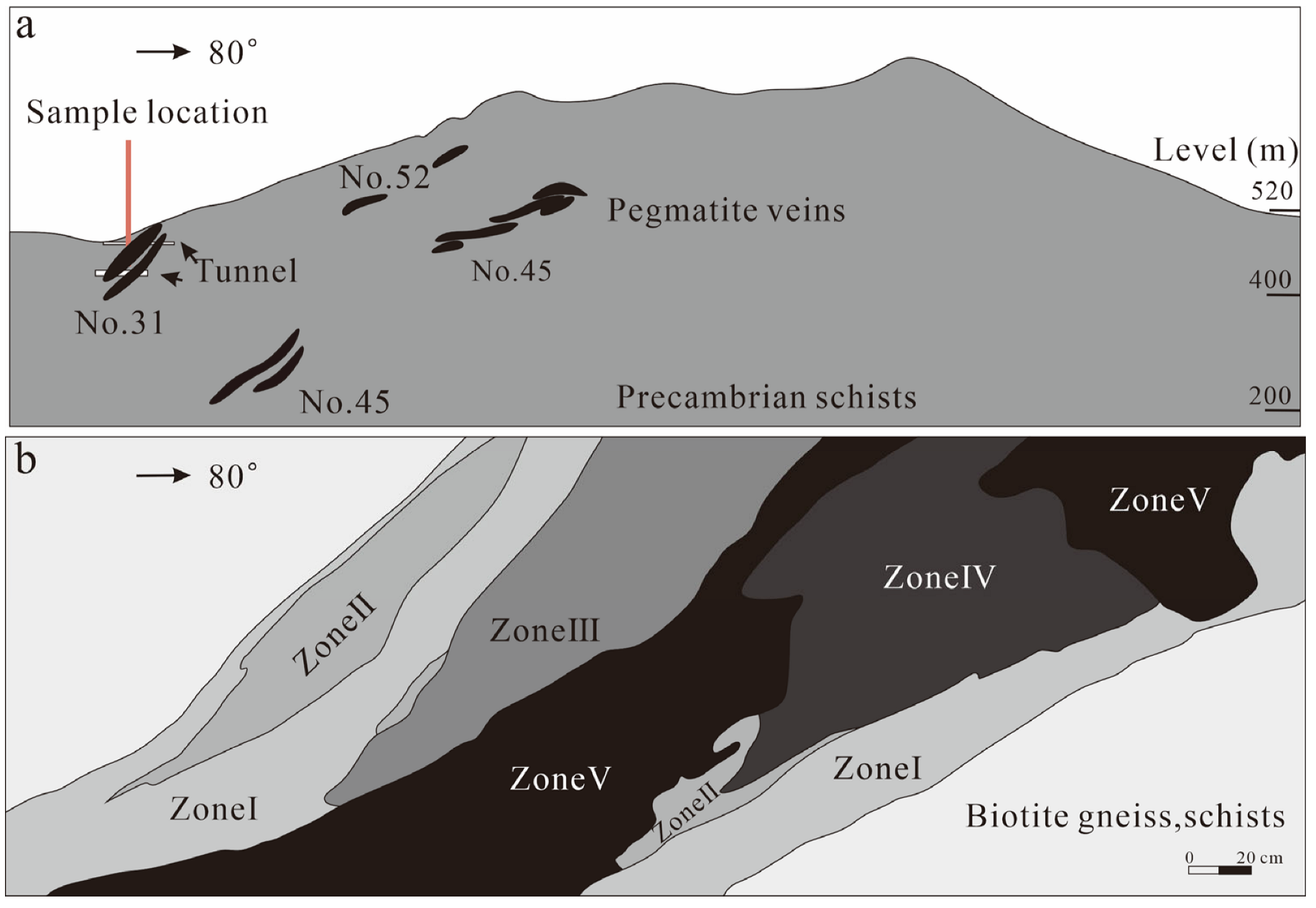
The No. 31 pegmatite vein exhibits a complex internal structure characterized by well-developed zonation (Figure 3). From margin to center, the vein is subdivided into five textural–mineralogical zones [14].
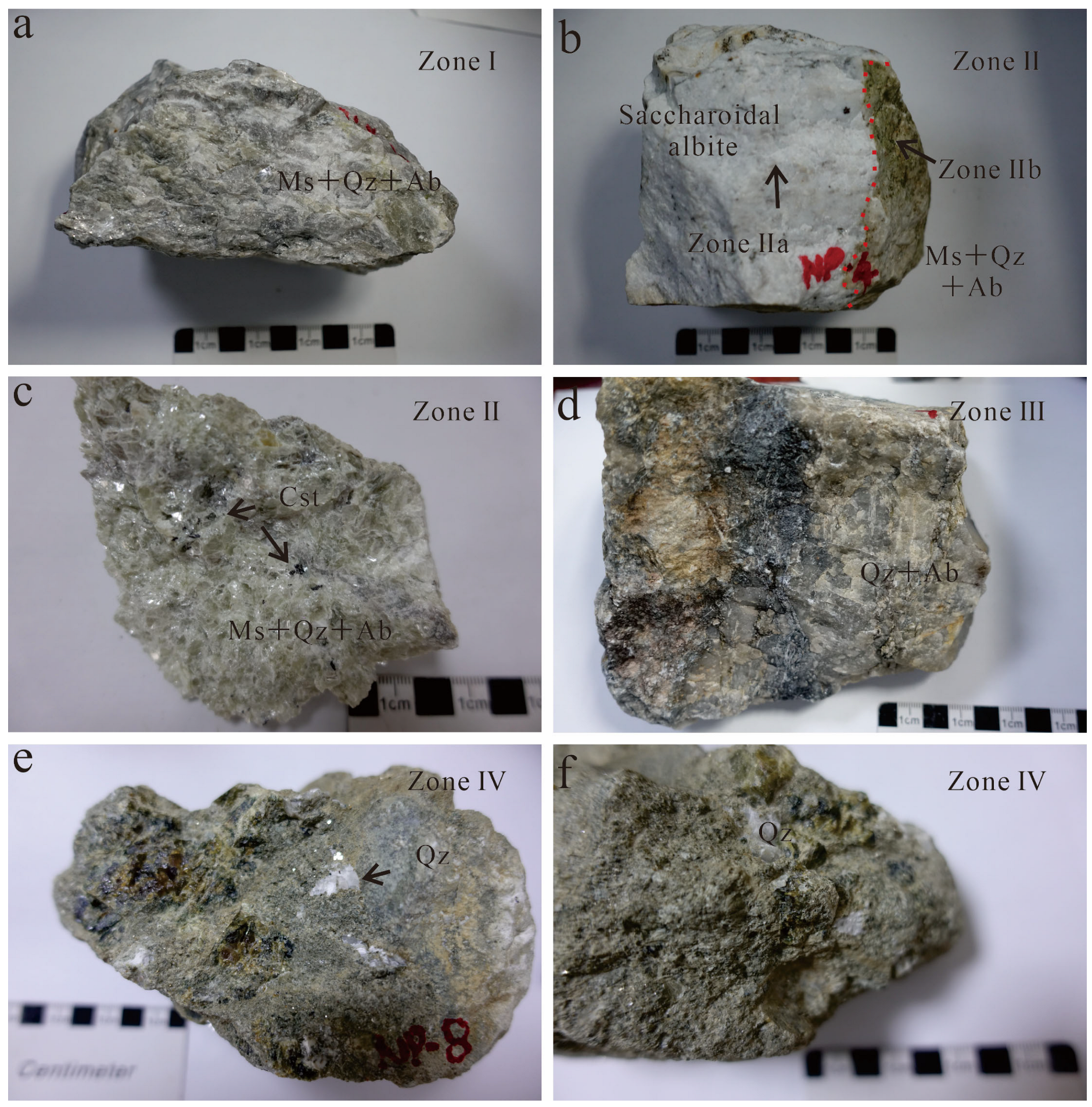
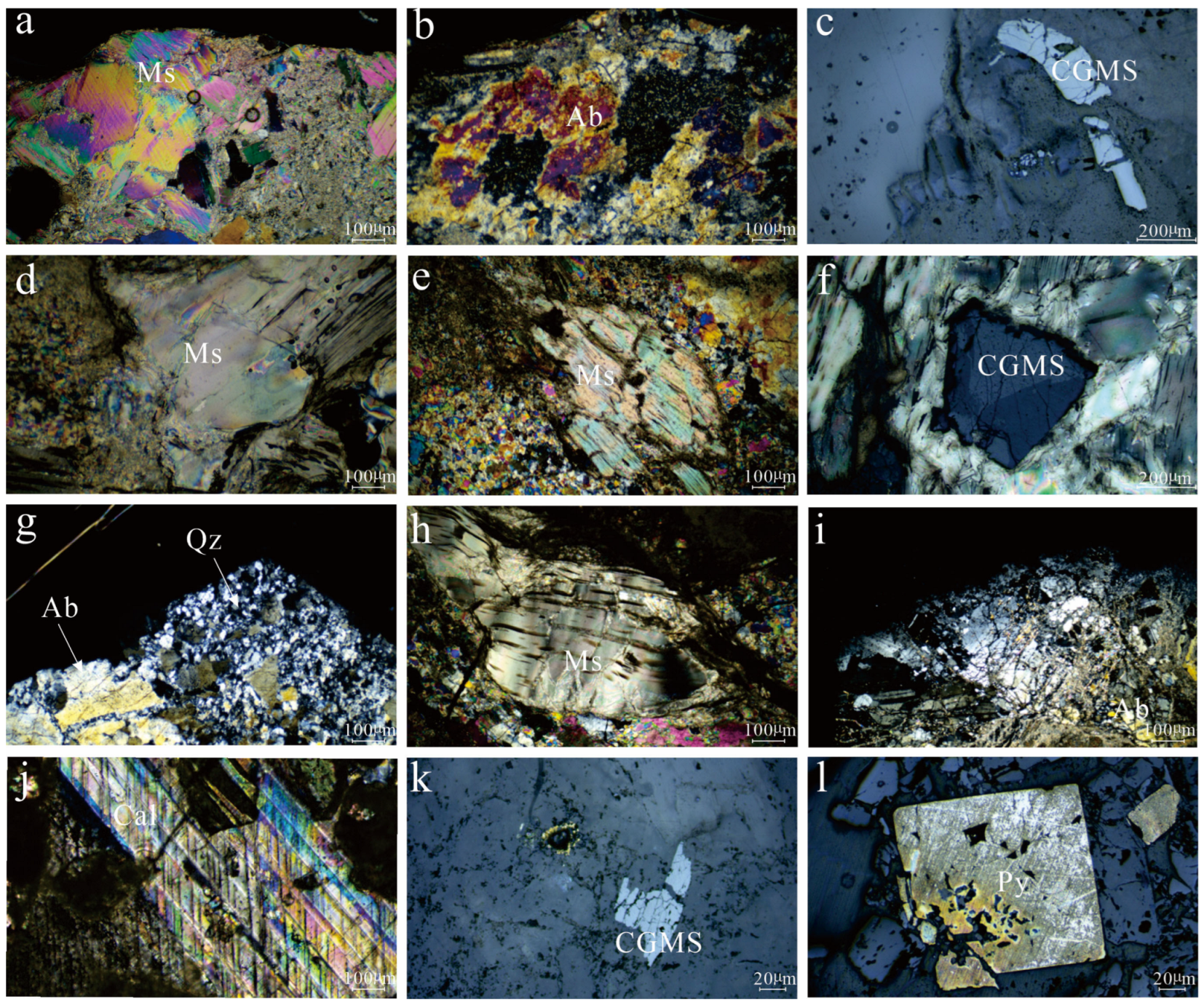
Zone I forms a discontinuous thin rim composed mainly of quartz (50 vol%), muscovite (35 vol%), and albite (15 vol%) (Figure 4a and Figure 5a,b). The Nb-Ta-Sn-bearing minerals in the Zone I area are dominated by columbite-group minerals (CGMs) and cassiterite (Figure 5c). Zone II is characterized by saccharoidal albite and muscovite. It occurs discontinuously, either adjacent to Zone IV or enclosed within Zone I. This zone is further subdivided into Zones IIa and IIb. Zone IIa consists predominantly of saccharoidal albite (>90 vol%) (Figure 4b). Zone IIb is discontinuous and comprises muscovite (50 vol%), albite (30 vol%), and quartz (10 vol%) (Figure 4c and Figure 5d,e). The contact between Zones IIa and IIb hosts abundant cassiterite and CGMs, which are commonly associated. Zone III is composed primarily of platy albite and quartz, with spodumene occurring in the inner part (Figure 4d). Minor amounts of muscovite and K-feldspar are present. Accessory minerals include CGMs, cassiterite, microlite, beryl and zircon. Zone IV is located in the central segment of the vein and is mainly composed of coarse-grained quartz, spodumene, and amblygonite (Figure 4e,f), with minor calcite (Figure 5j). Spodumene in this zone commonly exhibits hydrothermal alteration. Nb-Ta-Sn minerals and beryl are prevalent in the massive quartz and spodumene (Figure 5k). Pyrite and chalcopyrite occur sporadically (Figure 5l). Zone V is dominated by massive quartz and K-feldspar. Rare-metal Nb-Ta minerals are scarce in this zone [14,17].

3. Materials and Methods

3.1. Electron Probe Microanalysis (EPMA)

EPMA was carried out using a Jeol JXA-8230 instrument (JEOL Ltd., Tokyo, Japan) at the Electron Probe Laboratory of Fuzhou University. The instrumental conditions were configured with an accelerating voltage of 15 kV, a beam current maintained at 20 nA, and an electron beam focused to a spot size between 5 and 10 μm. The analyzed elements were: Ta, Nb, Fe, Mn, Ti, W and Sn. We used the following standards: Ta, Nb, and Sc metals, along with cassiterite, fayalite, MnTiO3, and CaWO4. Peak counting times were adjusted according to each element’s signal intensity. The analytical accuracy of most elements was better than 1 wt%.

3.2. CGMs U-Pb Dating Methods

U-Pb geochronological analyses on CGMs were conducted employing a GeoLas Pro 193 nm excimer ArF laser ablation system coupled with an Agilent 7500a quadrupole ICP-MS (Coherent, Inc., Santa Clara, CA, USA). This analytical work was completed at the State Key Laboratory of Critical Mineral Research and Exploration, Chinese Academy of Sciences. The detailed analytical procedures are similar to that described by previous study [30]. To ensure analytical precision and monitor instrumental drift, zircon reference materials and coltan standard (Coltan 139) were analyzed three times per fifteen sample analyses, while NIST SRM 610 (Sigma-Aldrich, St. Louis, MO, USA) was measured twice in the same sequence. External calibration was performed using the standard, with all the measured isotope ratios regressed and corrected based on recommended values with 2% uncertainty. Each analysis comprised nearly 30 s of acquisition, 60 s of sample ablation data collection, and 60-s gas blank washout period. The concordia diagrams and weighted mean U–Pb plots were calculated with the IsoplotR 6.8 software package.

3.3. Fluid Inclusions Temperature Measurement

Fluid inclusion microthermometry was conducted at Fuzhou University employing a Linkam THMSG600 thermal stage coupled with an Olympus microscopic imaging system (Linkam Scientific Instruments Ltd., Tadworth, UK). The instrument covers a operational temperature spectrum from −200 °C to +600 °C, maintaining a measurement accuracy of ±0.1 °C throughout this range. This investigation determined homogenization temperatures and final ice-melting temperatures for diverse fluid inclusion assemblages representing multiple mineralization stages. Thermal cycling rates were typically maintained between 5 °C·min−1 and 10 °C·min−1, while being carefully reduced to 0.1–1 °C·min−1 in proximity to phase transformation boundaries.

3.4. H-O Isotopes

Hydrogen–oxygen isotope analysis of quartz was conducted at Tuoyan Analytical Technology Co., Ltd., Guangzhou, China, using the following methodology: based on the expected water content of quartz, approximately 0.1 μL of water was anticipated to be released. An accurately weighed 200-mesh whole-rock sample was dried in a constant-temperature oven at 105 °C for more than 4 h, then wrapped in clean, dry silver cups for analysis. Following high-temperature pyrolysis, the released H2O was reduced by carbon to generate H2, which was carried by a high-purity helium stream into the MAT253 mass spectrometer (Thermo Fisher Scientific, Bremen, Germany) for hydrogen isotope analysis. Results are reported by δD values relative to the IAEA-VSMOW standard (δDVSMOW) [31], with analytical precision better than 2.0‰ [32].

4. Results

4.1. Chemical Composition Characteristics of Columbite–Tantalite

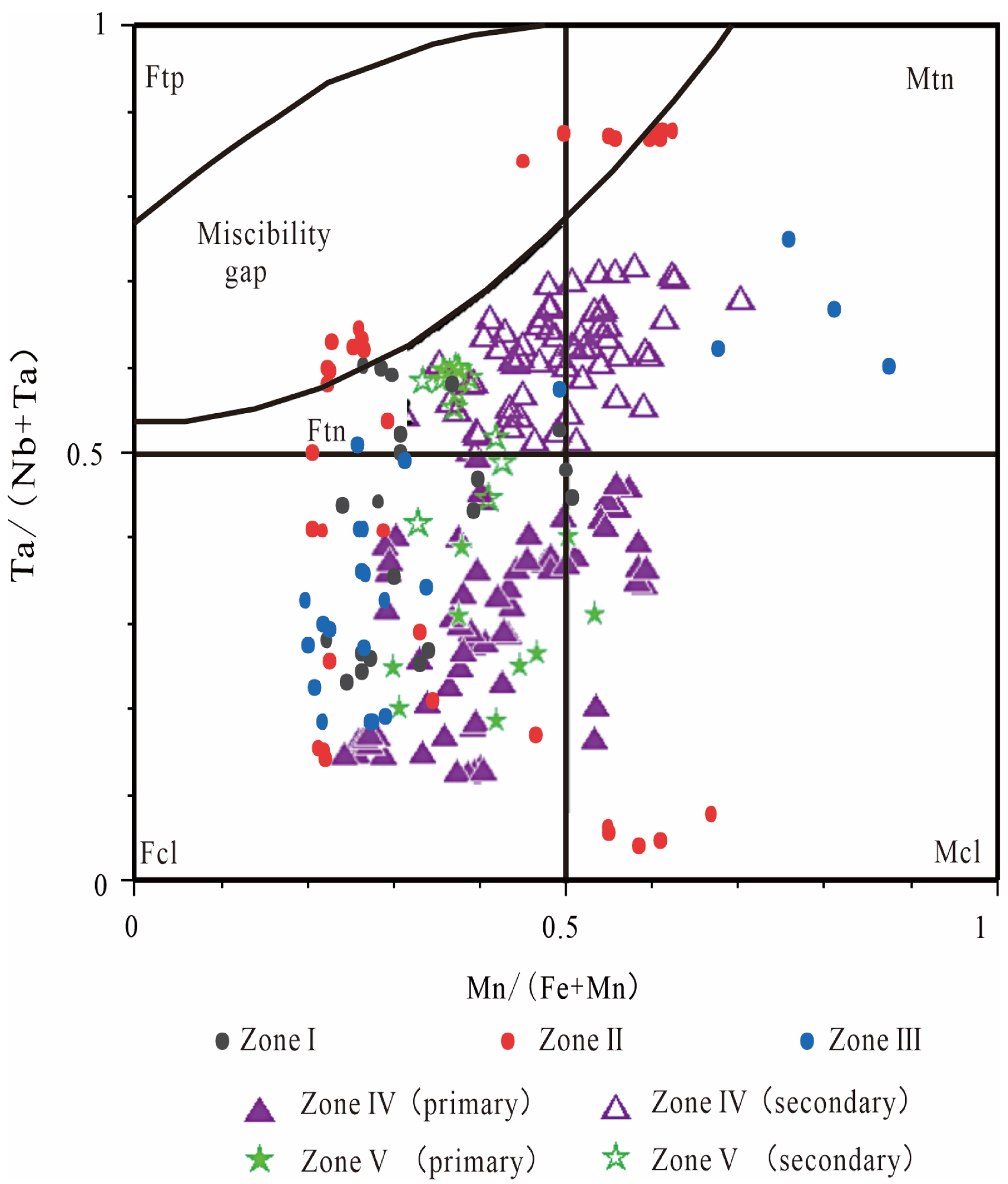
The EPMA results of columbite–tantalite minerals indicate considerable variation in their chemical compositions (Figure 6). The EPMA results are presented in Table S1.
In Zone I, the Nb2O5 content ranges from 23.03% to 51.96%, with an average of 35.39%; Ta2O5 from 26.10% to 58.13%, averaging 44.44%; FeO from 8.44% to 12.63%, averaging 10.62%; and MnO from 3.30% to 8.87%, averaging 5.05%. The main minerals are columbite-(Fe) and tantalite-(Fe).
In Zone II, the Nb2O5 content ranges from 20.30% to 61.29%, averaging 34.33%; Ta2O5 from 17.11% to 61.82%, averaging 45.89%; FeO from 10.37% to 14.03%, averaging 11.91%; and MnO from 3.04% to 4.50%, averaging 3.53%. Columbite-(Mn) and columbite-(Fe) occur in this zone. The plotting of data points within the miscibility gap region may indicate that the isomorphous substitution of high-valence cations has broadened the solid solution range of columbite–tantalite [33]. This interpretation is consistent with the EPMA data showing relatively high SnO2 contents in these points and the microscopic observation of columbite–tantalite associated with cassiterite.
In Zone III, the Nb2O5 content ranges from 25.06% to 56.58%, averaging 45.15%; Ta2O5 from 21.18% to 56.58%, averaging 34.07%; FeO from 8.50% to 13.60%, averaging 12.08%; and MnO from 3.23% to 7.48%, averaging 4.23%. In this zone, the main minerals are columbite-(Fe), tantalite-(Mn) and tantalite-(Fe).
In Zone IV, all CGMs have mineralized; in Zone V, the main minerals are columbite-(Fe) and tantalite-(Fe).
Based on EPMA data, the CGMs from the No. 31 vein were compositionally classified. Data were subsequently plotted on the columbite–tantalite quadrilateral diagram. The compositional variation trends of these minerals across different textural–zonal domains of the pegmatite are summarized as follows.
The results indicate that in Zone I, the CGMs consist predominantly of columbite-(Fe) and columbite–tantalite, with minor amounts of columbite-(Mn). The Mn/(Fe + Mn) ratios range from 0.22 to 0.51, while Ta/(Nb + Ta) ratios range from 0.23 to 0.60.
In Zone II, the main CGM phases include columbite-(Fe) and tantalite-(Fe), accompanied by minor amounts of columbite-(Mn) and tantalite-(Mn). Columbite-(Fe) and tantalite-(Fe) typically coexist, with tantalite-(Fe) occurring in mineral cores and columbite-(Fe) forming in rims. The Mn/(Fe + Mn) ratios range from 0.06 to 0.77, and Ta/(Nb + Ta) ratios range from 0.20 to 0.67.
In Zone III, the CGMs are primarily composed of columbite-(Fe) with subordinate tantalite-(Fe). The Mn/(Fe + Mn) ratios range from 0.20 to 0.65, and Ta/(Nb + Ta) ratios range from 0.19 to 0.78.

4.2. Chronology of Columbite-Tantalite

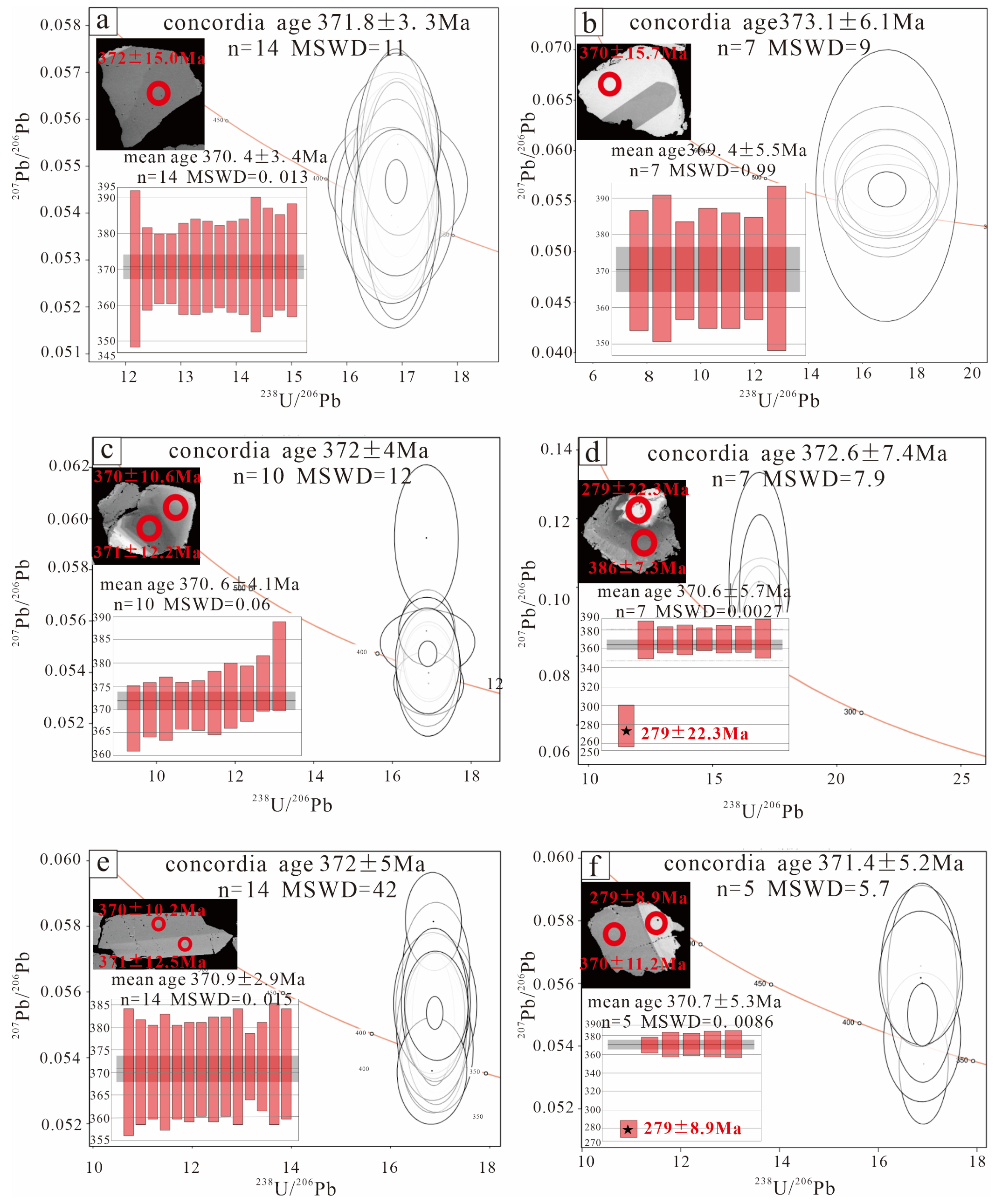
In situ U–Pb dating of texturally heterogeneous CGMs was performed to constrain temporal evolution of mineralization. Analytical spots were strategically selected from both bright and dark domains in BSE images to represent distinct compositional zones within the pegmatite. The U–Pb dating results are presented in Table S2; LA-ICP-MS trace element concentrations for CGMs from the Nanping deposit are presented in Table S3.
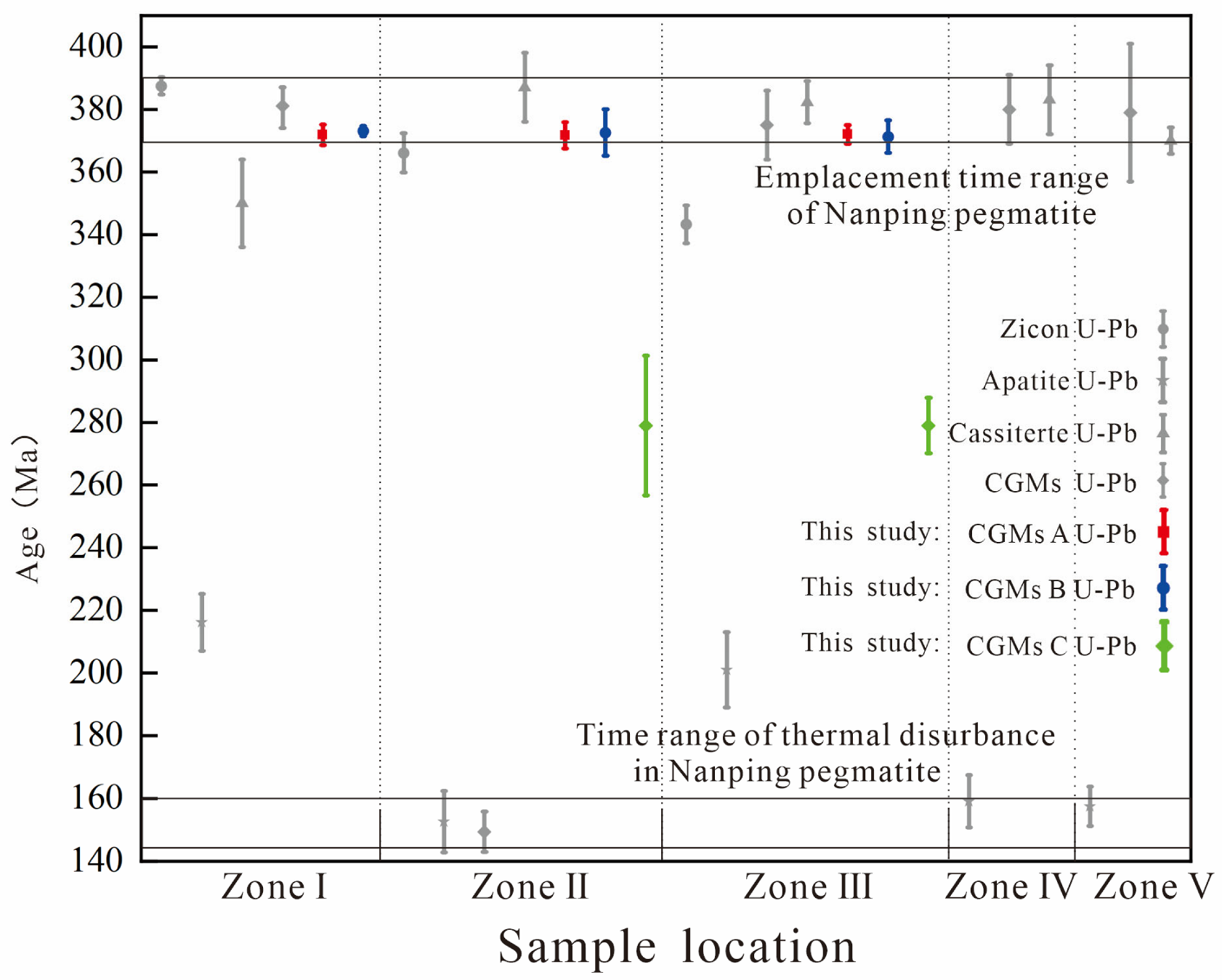
The Tera–Wasserburg concordia diagrams for Zone I columbite–tantalite samples yielded lower intercept ages of 371.8 ± 3.3 Ma, mean squared weighted deviation (MSWD) = 14 for BSE-dark domains and 373.1 ± 6.1 Ma (MSWD = 9) for BSE-bright domains. The corresponding weighted mean 206Pb-corrected ages are 370.4 ± 3.4 Ma (MSWD = 0.013) for BSE-dark domains and 369.4 ± 5.5 Ma (MSWD = 0.99) for BSE-bright domains (Figure 7a,b).
Zone II samples produced lower intercept ages of 372 ± 4 Ma (MSWD = 12) for BSE-dark domains and 372.6 ± 7.4 Ma (MSWD = 7.9) for BSE-bright domains, with corresponding weighted mean 206Pb-corrected ages of 370.6 ± 4.1 Ma (MSWD = 0.006) for BSE-dark domains and 370.6 ± 5.7 Ma (MSWD = 0.0027) for BSE-bright domain (Figure 7c,d).
Zone III samples produced lower intercept ages of 372 ± 5 Ma (MSWD = 42) for BSE-dark domains and 371.4 ± 5.2 Ma (MSWD = 5.7) for BSE-bright domains, with corresponding weighted mean 206Pb-corrected ages of 370.9 ± 2.9 Ma (MSWD = 0.015) or BSE-dark domains and 370.7 ± 5.3 Ma (MSWD = 0.0086) for BSE-bright domain (Figure 7e,f).
U–Pb dating results from Zones I to III yield similar ages of ca. 370 Ma for both BSE-dark and BSE-bright zones. However, two analyses from bright zones in Zones II and III give distinctly younger ages of approximately 279 Ma. These younger ages contrast sharply with the dates obtained from adjacent dark zones within the same samples (Figure 7d,f).

4.3. Characteristics of Ore-Forming Fluids

4.3.1. Inclusion Types

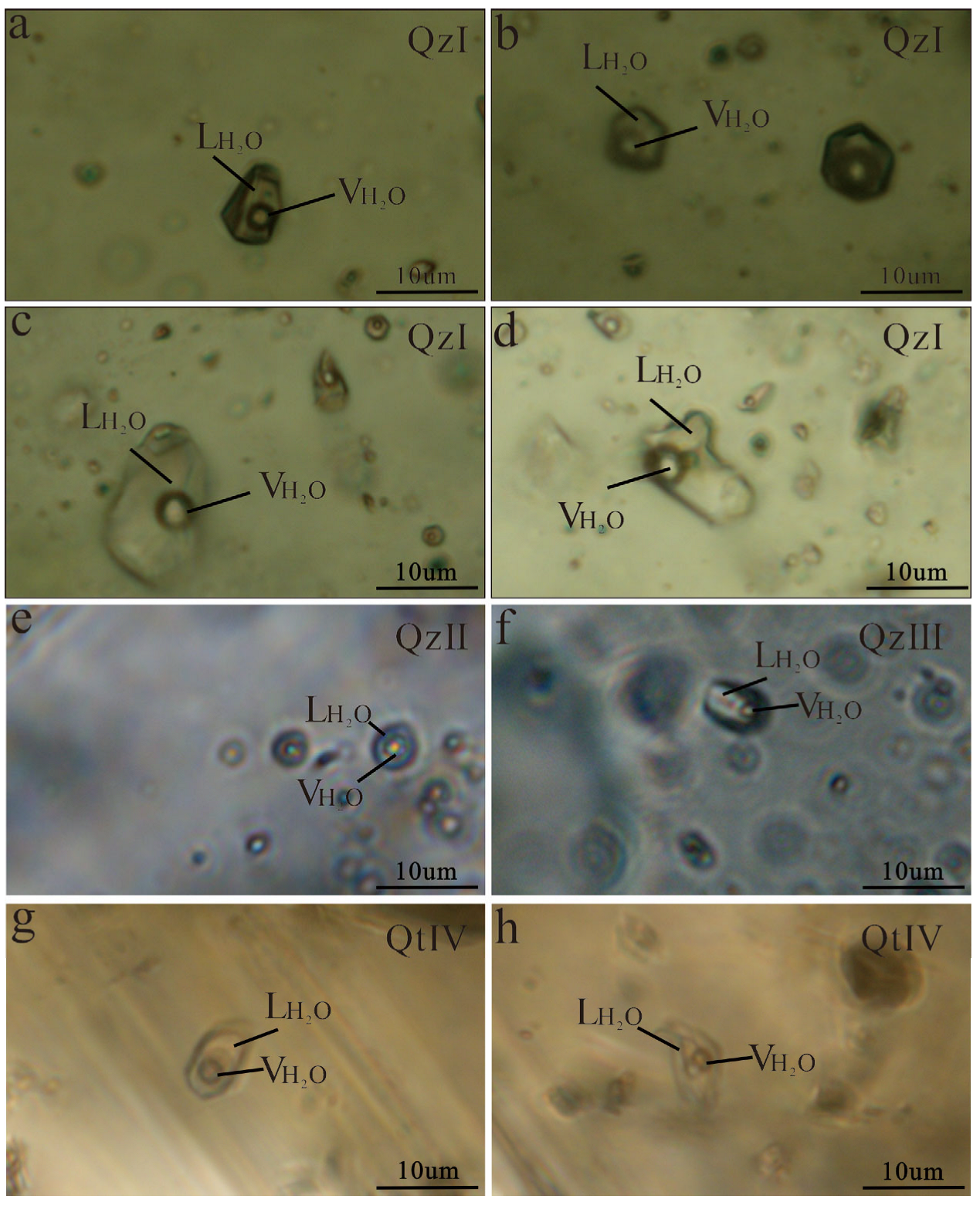
The primary fluid inclusions observed in the No. 31 vein are aqueous inclusions (Figure 8), mainly present in quartz. Primary aqueous two-phase inclusions are typically elliptical to polygonal and occur as isolated individuals. They measure mainly 7–10 μm in diameter, although a few exceed 20 μm. Most homogenize to the liquid phase upon heating. Secondary aqueous two-phase inclusions are very abundant and are typically aligned along mineral fractures. They generally range in size from 1 to 10 μm and display circular, elliptical, negative-crystal, or irregular shapes.

4.3.2. Homogenization Temperature and Salinity

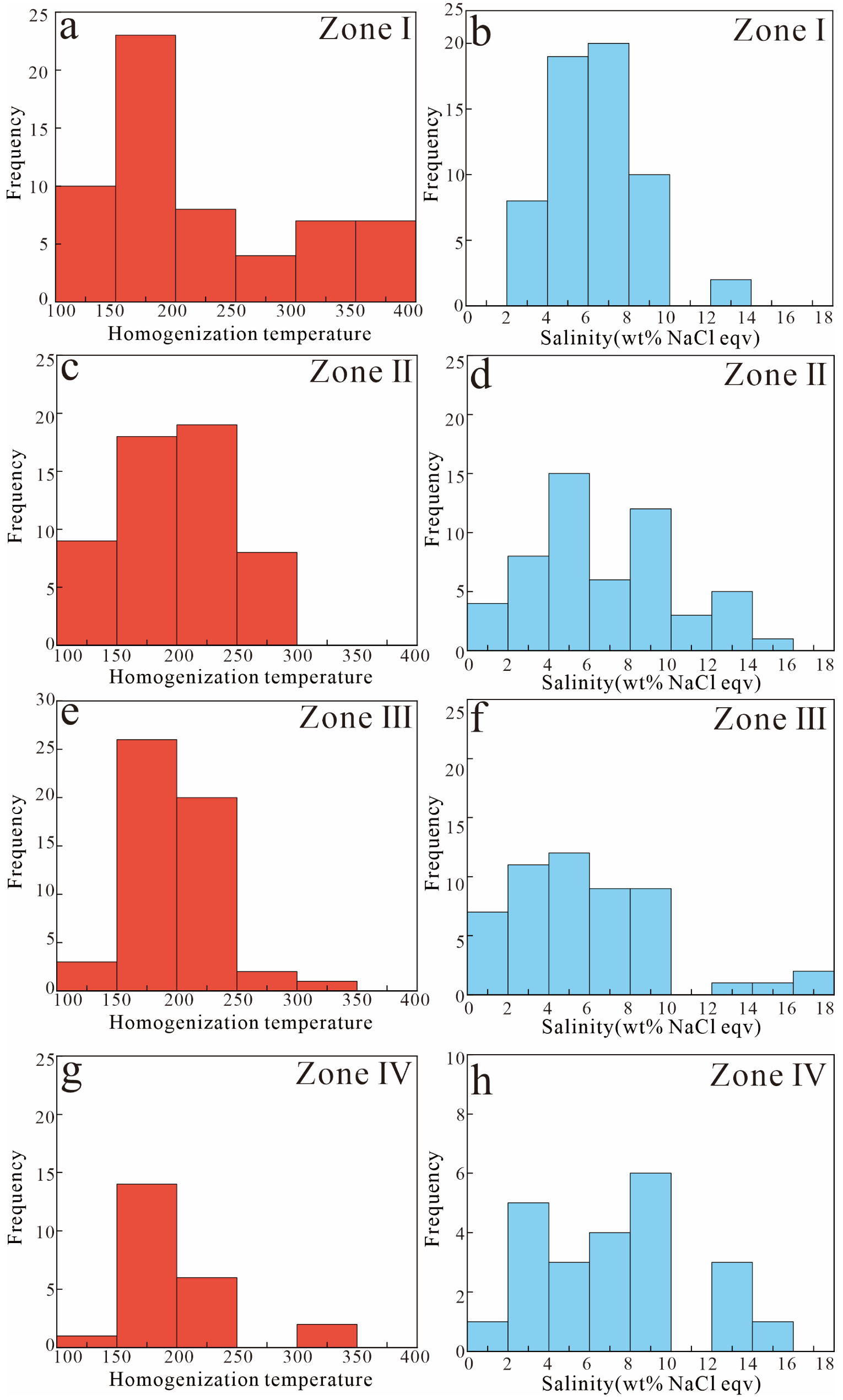
The fluid inclusions analyzed in this study were collected from Zones I to IV. The results indicate that the fluids in the No. 31 vein are predominantly characterized by medium-low salinity and medium-low temperature (Figure 9). The results are presented in Table S4.
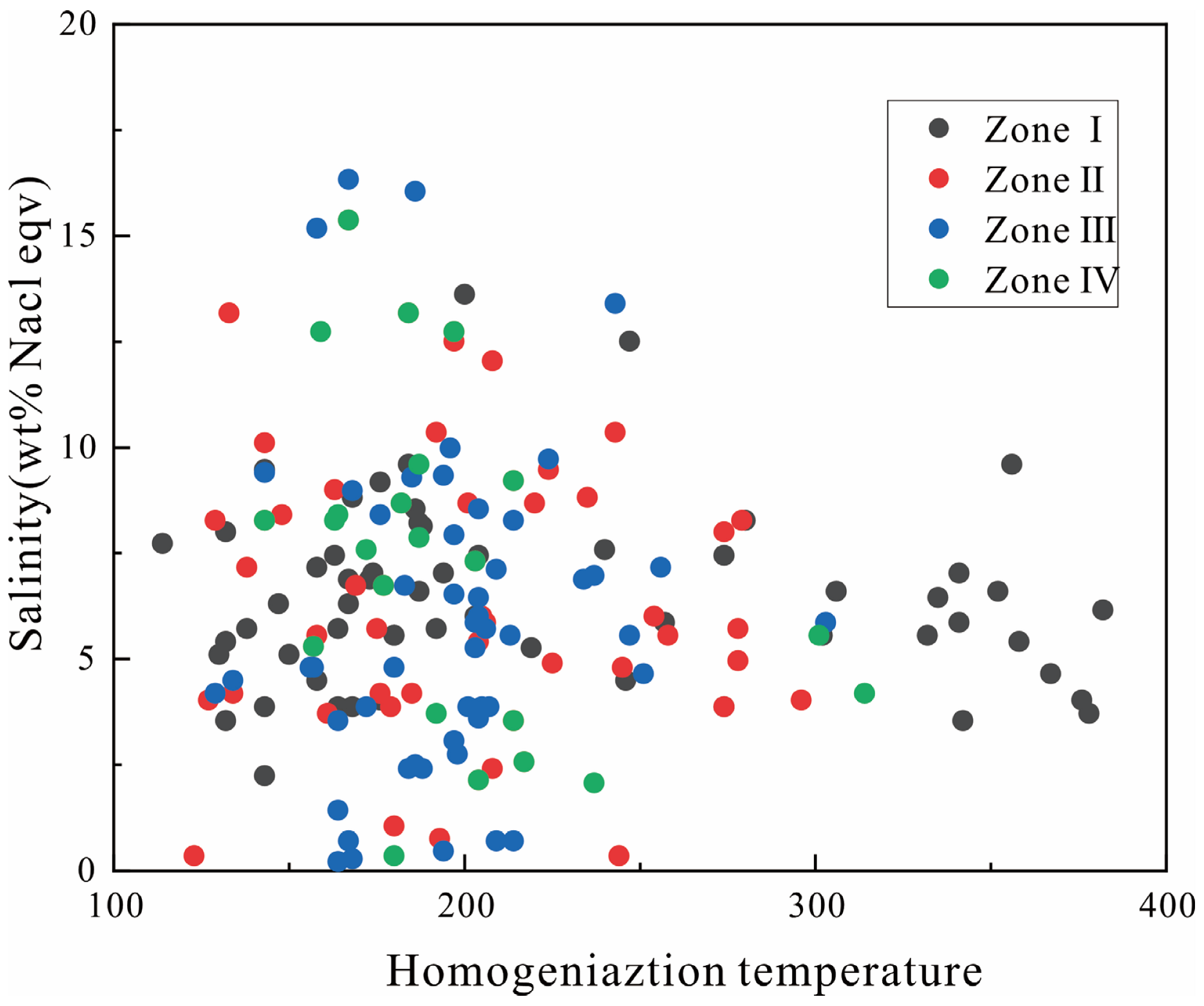
In Zone I, Type I inclusions homogenize predominantly to the liquid phase, with homogenization temperatures ranging from 130 to 382 °C (average: 222 °C), ice-melting temperatures ranging from −9.7 to −1.3 °C (average: −4.08 °C), and salinities varying from 2.24 to 13.61 wt% NaCl eqv (average: 6.44 wt%).
In Zone II, Type I inclusions exhibit homogenization temperatures ranging from 133 to 296 °C (average: 201 °C) and final ice-melting temperatures from −10.5 to −0.2 °C (average: −4.32 °C). Salinities range from 0.4 to 15.37 wt% NaCl eqv (average: 6.6 wt%).
In Zone III, Type I inclusions show homogenization temperatures from 129 to 303 °C (average: 195 °C) and final ice-melting temperatures from −12.4 to −0.12 °C (average: −3.8 °C). Salinities range from 0.21 to 16.33 wt% NaCl eqv (average: 5.89 wt%).
In Zone IV, Type I inclusions have homogenization temperatures ranging from 129 to 314 °C (average: 195 °C) and final ice-melting temperatures from −12.4 to −0.1 °C (average: −4.5 °C). Salinities range from 2.07 to 16.38 wt% NaCl eqv (average: 6.7 wt%).
The homogenization temperature results indicate that temperatures for the Nanping pegmatite deposit range from 130 to 382 °C, predominantly concentrated between 180 and 250 °C.

4.4. H-O Isotope Characteristics

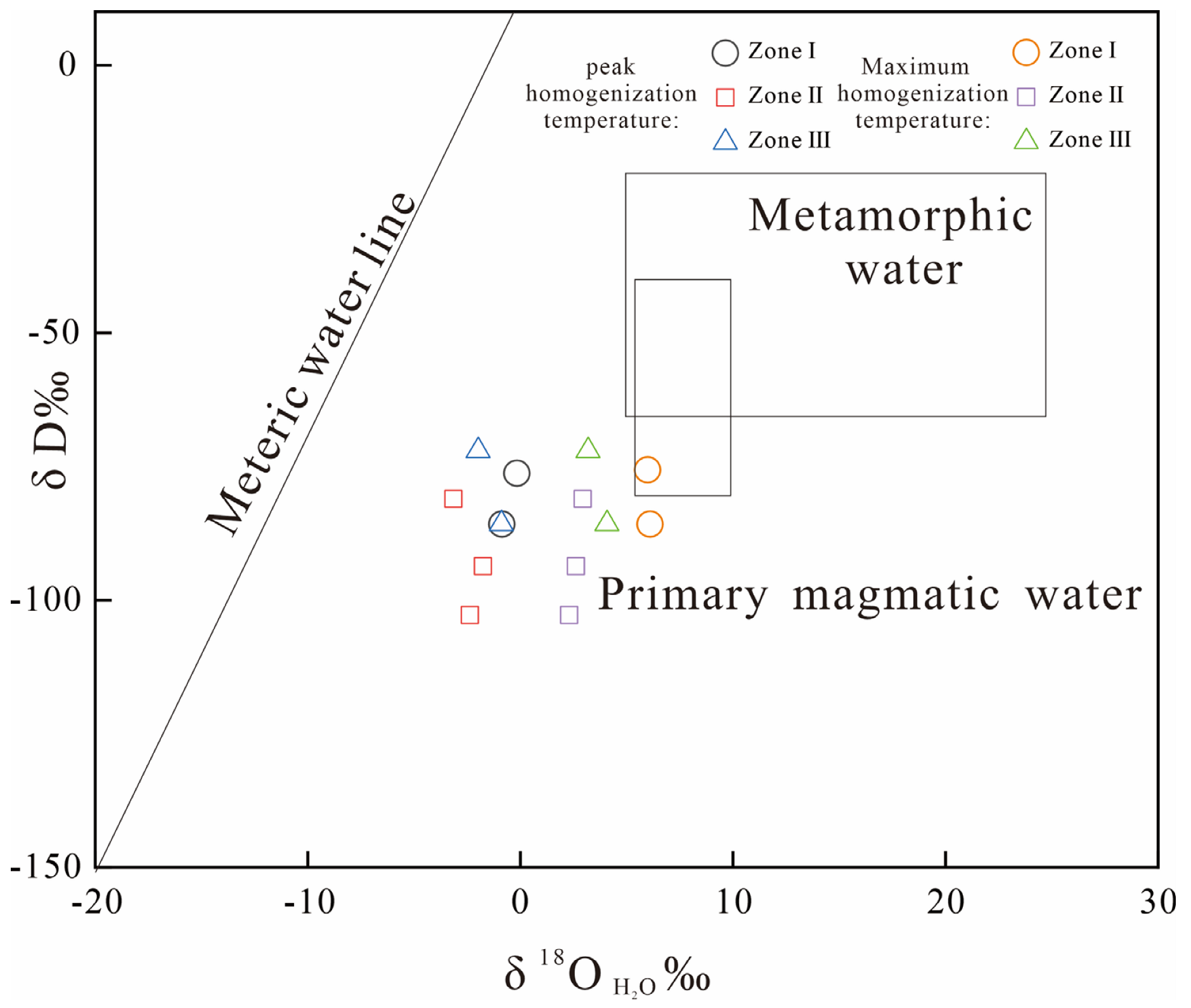
This study selected samples from Zones I, II, and III of the No. 31 vein for the H-O isotope analysis of quartz. The values of δ18O quartz range from 8.78‰ −10.58‰ in Zone I, from 9.33‰ to 9.64‰ in Zone II, and from 9.98‰ to 10.86‰ in Zone III, indicating a relatively narrow variation range. The δD values of quartz range from −85.8‰ to −76.3‰ in Zone I, from −102.8‰ to −93.6‰ in Zone II, and from −85.7‰ to −81.1‰ in Zone III.
Assuming H-O isotope equilibrium between the fluid inclusions and the host mineral, the H-O isotope composition of the water in equilibrium with the mineral was calculated using the fractionation formula [34]:
1000lnα(quartz-water) ≈ 3.38 × (106/T2) − 2.90
The T in this fractionation formula is the homogenization temperature in Kelvin. Both the peak homogenization temperature and the maximum homogenization temperature for each zone were used in the calculation (Figure 10). The results are presented in Table S5.

5. Discussion

5.1. The Chronological Framework for Nb-Ta Mineralization in the Nanping Area

Previous studies have constrained the mineralization ages of the Nanping pegmatites using various mineral dating methods, including U-Pb dating of zircon, apatite, cassiterite, and Nb-Ta minerals [20,21]. However, these studies primarily focused on establishing a general chronological sequence for different pegmatite zones, lacking detailed in situ U-Pb analyses targeting specific mineral textures. Our research shows that some Nb-Ta minerals in the Nanping pegmatites exhibit significant heterogeneous textures (Figure 7), which may record multi-stage mineralization events.
In situ U-Pb geochronological analysis of the same mineral with different compositions can reveal complex mineralization events [36]. As the primary rare-metal mineral in the mining area, columbite–tantalite is a reliable geochronometer for constraining the timing of Nb-Ta mineralization [37,38,39]. Therefore, this study conducted systematic in situ U-Pb dating on BSE-dark domains (Nb-rich) and BSE-bright domains (Ta-rich) in characteristic structural zones of CGMs to constrain the multi-stage Nb-Ta mineralization history of the Nanping No. 31 pegmatite vein. The in situ U-Pb dating results show that despite differences in texture and composition, most BSE-dark and BSE-bright CGM domains from Zones I to III yield similar weighted mean 206Pb/238U ages: 370.4 ± 3.4 Ma, 369.4 ± 5.5 Ma, 370.6 ± 4.1 Ma, 370.6 ± 5.7 Ma, 370.9 ± 2.9 Ma, and 370.7 ± 5.3 Ma, respectively. These ages indicate that Nb-Ta minerals with different textures and compositions are mainly formed at ca. 370 Ma, representing the main Nb-Ta mineralization stage of the Nanping pegmatites. Additionally, some Nb-Ta minerals in Zones II and III record local ages of approximately ca. 279 Ma.
By integrating our new dating results with published data, this study constructed a comprehensive geochronological framework for the Nanping pegmatite deposit (Figure 11). On this basis, the Nb-Ta mineralization of the Nanping pegmatites can be divided into three distinct stages:
  • Stage I: Main mineralization period (390–370 Ma)
Our U-Pb ages of CGMs are generally consistent with previous U-Pb dating results of CGMs and cassiterite from the Nanping No. 31 vein, constraining the main Nb-Ta mineralization event of the Nanping pegmatites to ca. 390–370 Ma. This Devonian mineralization event led to the most extensive Nb-Ta enrichment in the South China Block.
  • Stage II: Localized small-scale mineralization event (279 Ma)
This study has identified anomalous ages of ca. 279 Ma in CGMs from Zones II and III (Figure 7d,f), revealing the presence of a localized small-scale Nb-Ta mineralization event during the Early Permian period. These significantly younger ages deviate markedly from the principal mineralization episode and may represent: (1) remobilization and reconcentration of pre-existing ore-forming materials under thermal perturbation conditions; (2) products of small-scale magmatic–hydrothermal events [21,39]. This discovery provides novel geochronological constraints for understanding the multi-stage mineralization characteristics of the Nanping pegmatites.
  • Stage III: Late-stage thermal disturbances (160–140 Ma)
In addition to the ages presented in this study, others previously reported younger apatite and cassiterite U-Pb ages of ca.160–140 Ma [21]. Notably, because apatite and cassiterite are not Nb-Ta-hosting minerals, these younger ages are not direct proxies for the timing of Nb-Ta mineralization. Rather, they are more likely to record thermal perturbation events from the Yanshanian (175–80 Ma) orogeny that postdated mineralization.

5.2. Ore-Forming Processes

Fluid inclusions in hydrothermal minerals preserve critical records of physicochemical conditions during mineralization. Systematic analysis of these inclusions enables reconstruction of hydrothermal evolution [40,41,42]. In the No. 31 pegmatite vein, fluid inclusions are predominantly H2O-rich aqueous two-phase types. Homogenization temperatures range from 130 to 382 °C, peaking between 180 and 250 °C. Salinities vary from 0.2 to 16.3 wt% NaCl eqv (Figure 12), characterizing a medium-to-low temperature and salinity fluid system [43,44]. These characteristics indicate mineralization occurred in a hypabyssal environment under relatively stable thermal and salinity conditions. From Zone I to Zone IV, both peak homogenization temperatures and salinities show limited variation (Figure 9), suggesting gradual cooling without evidence of large-scale fluid boiling [45,46].
Previous studies on Nanping phosphate minerals indicate that magmatic differentiation was the primary and initial source. The characteristics: High temperature, rich in F, and rich in Li [19]; another article shows distinct zoning (from zone I to zone V). The later zone (IV–V) contains mineral assemblages enriched in fluids (such as sodium feldspar, lithium mica, and phosphate minerals), indicating the enrichment of fluids during the late stage of magma differentiation [20]; these conclusions are both consistent with the conclusions regarding H-O isotopes.
During magma evolution, following the crystallization of early-formed minerals, the residual melt undergoes differentiation. As crystallization proceeds, the system reaches volatile saturation, leading to the exsolution of a supercritical fluid-melt phase [47,48,49]. During the mineralization process of LCT pegmatites, fluids are primarily generated after the main ore-forming magma stage. This stage is called the magmatic–hydrothermal transition of LCT-pegmatites [50,51,52]. With further cooling and decompression, this process ultimately generated fluids that were progressively enriched in iron (Fe) and magnesium (Mg). The oxygen fugacity is relatively low, and the main reaction is the Fe2+/Mg2+ exchange reaction. This indicates that the pegmatite has undergone the magma–hydrothermal stage. After this stage, the pegmatite intruded into the pre-Cambrian schist, granulite (basement) and Paleozoic sedimentary rocks (cap rocks). The hydrothermal fluids reacted with these surrounding rocks through water–rock processes, extracting the elements from the surrounding rocks. This is an important source of elements such as Sr, Ba, and Ca. Under the action of hot fluids, the feldspars and micas in the surrounding rock can release these large-ion petrochemical elements, forming late-stage phosphate and sulfate minerals rich in these elements [19].
After integrating the fluid inclusions data from different regions, it can be clearly observed that Zone I displays relatively medium-to-low homogenization temperatures and salinities, and also shows a relatively high homogenization temperature, consistent with high-temperature magmatic–hydrothermal fluids derived from early magmatic differentiation. The fluids derived from early magmatic differentiation were separated from the residual melt during the late stage of magmatic crystallization (~360 °C), driven by volatile saturation, decreasing pressure, and declining temperatures [19,20,29]. This magmatic–hydrothermal transition stage represents a critical juncture for the initiation of fluid activity and the onset of rare-metal enrichment in the pegmatite metallogenic system. Zones II and III also record medium-to-low temperatures and salinities, with an increase in low-temperature, low-salinity inclusion. This shift indicates cooling, dilution, and fluid mixing during mid- to late-stage mineralization. Zone IV shows further reductions to medium-low temperatures and low salinities, reflecting the continued influx of meteoric water. This indicates that after the porphyritic rock underwent magma differentiation, it went through the magma–hydrothermal stage, reacted with the surrounding rock through water–rock interactions, and finally mixed into meteoric water. The ore-forming fluid thus had multiple stages and multiple sources.

5.3. Genesis of the Nanping Nb-Ta Deposit

LCT-type pegmatites are typically genetically linked to granites [53]. Previous studies indicate the Xiqin and Jinlong granites were emplaced at ca. 410 Ma and 220 Ma [19,29], respectively. These ages are significantly distinct from the period of niobium–tantalum mineralization in the Nanping pegmatites (390–370 Ma). Hf isotope evidence: The εHf(t) values of zircons range from −13.81 to −11.60, and the TDM2 model age is 2107–2246 Ma, indicating that the granodiorite melt originated from the partial melting of ancient Archean crustal material [20,29], indicating that the diagenetic melt originated from the recycling of ancient crustal materials [54].
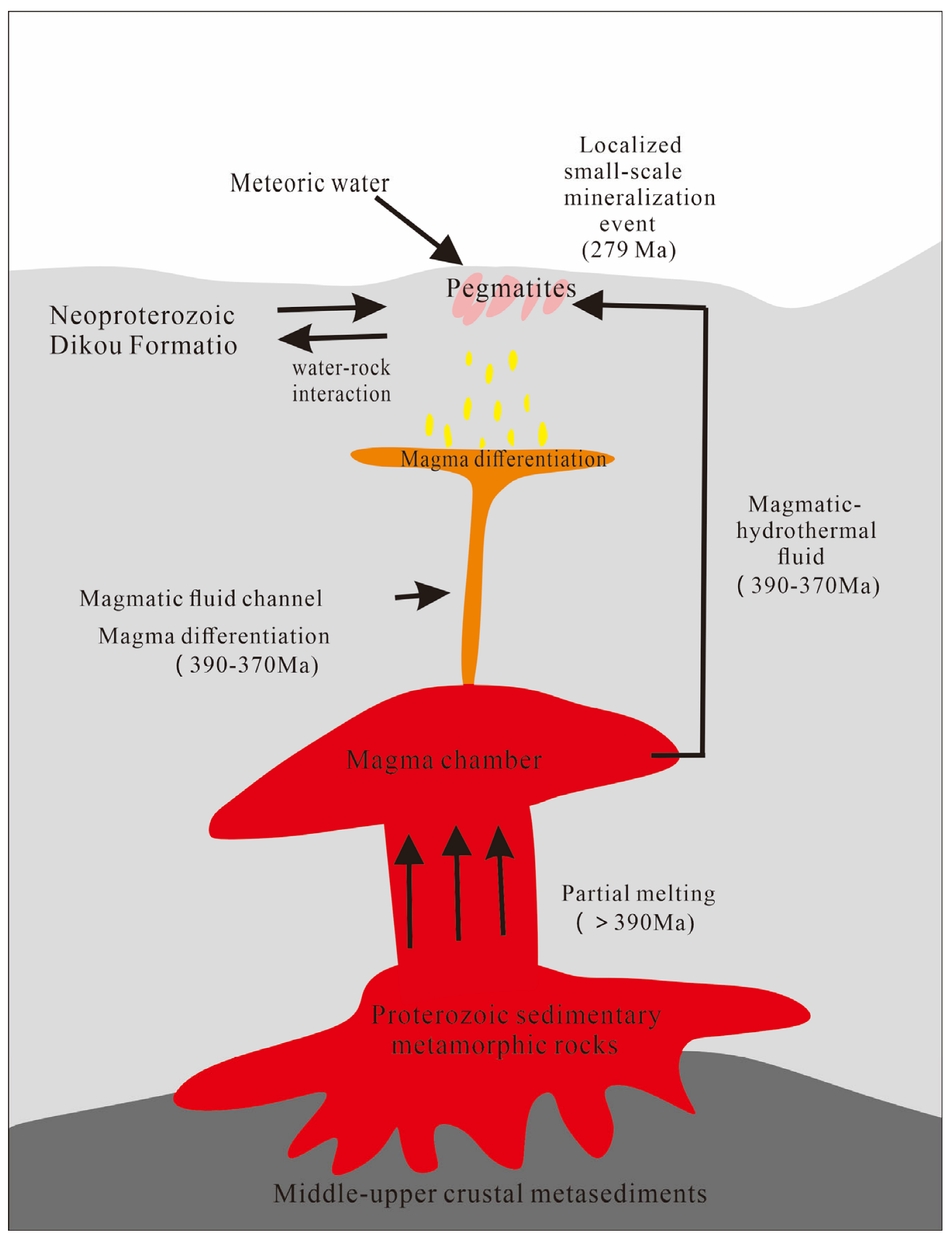
The mineralization chronology study of the Nanping pegmatite indicates that there were multiple mineralization events in this area. The fluid inclusions and hydrogen–oxygen isotopes prove that the fluid source of the Nanping pegmatite was influenced by meteoric water. Based on the previous research on phosphate minerals and the enrichment cycle of Li, it is concluded that the mineralizing fluid underwent stages of magma differentiation, magma–hydrothermal interactions, water–rock interactions of the surrounding rocks, and the influence of meteoric water. The mineralizing fluid has multiple sources and multi-stage characteristics (Figure 13).

6. Conclusions

In situ U-Pb dating of Nb-Ta minerals defines a principal mineralization event at 390–370 Ma for the Nanping pegmatite, consistent with previous studies. Localized ages of approximately 270 Ma imply a later hydrothermal overprint, indicating a multi-stage mineralization history. The 160–140 Ma interval shown by apatite and cassiterite indicates thermal perturbation events. Based on the above information, the mineralization stages of Nanping pegmatite can be divided into three stages:
Stage I: Main mineralization period (390–370 Ma)
Stage II: Localized small-scale mineralization event (279 Ma)
Stage III: Late-stage thermal disturbances (160–140 Ma)
Fluid inclusion data indicate that the ore-forming fluids constituted a medium-to-high temperature and low-to-medium salinity saline solution, characterized by homogenization temperatures predominantly between 180 and 250 °C. The systematic shift in quartz H-O isotopes from the magmatic field toward the meteoric water line reveals the involvement of a fluid mixing process during mineralization. Based on fluid inclusion and hydrogen–oxygen isotope characteristics, the Nanping pegmatite exhibits multi-stage evolutionary features: the early magmatic stage corresponds to Zone I, with fluids showing relatively medium-to-high homogenization temperatures, consistent with high-temperature magmatic hydrothermal fluids derived from early magmatic differentiation. The middle-to-late magmatic–hydrothermal stage corresponds to Zones II and III, where fluid temperatures and salinities decrease, with an increase in low-temperature, low-salinity inclusions, indicating fluid cooling, dilution, and mixing. The shift in hydrogen–oxygen isotopes suggest the influence of meteoric water. Integrating previous research results, the Nanping pegmatite exhibits multi-source evolutionary characteristics: the magmatic source originated from early-stage fluids derived from magmatic differentiation, carrying deep-seated features such as high temperatures and enrichment in F and Li, representing the initial source of ore-forming materials. The wall-rock source: during the magmatic-hydrothermal stage, fluids interacted with surrounding rocks (Precambrian schist/gneiss and Paleozoic sedimentary rocks) through water–rock interaction, extracting elements such as Sr, Ba, and Ca to form late-stage phosphate and sulfate minerals. At the meteoric water source during the late mineralization stage, meteoric water mixed into the hydrothermal system, further reducing fluid temperatures and salinities, forming a multi-source mixed ore-forming fluid. The mineralizing fluid has multiple sources and multi-stage characteristics.

Supplementary Materials

The following supporting information can be downloaded at: https://www.mdpi.com/article/10.3390/min16030285/s1. Table S1: Electron probe microanalytical data for CGMs of Nanping deposit (wt.%); Table S2: CGMs U-Pb dating of Nanping deposit; Table S3: LA-ICP-MS trace element concentrations for CGMs from Nanping deposit; Table S4: Fluid inclusion data of Nanping deposit; Table S5: H-O Isotope of Nanping deposit.

Author Contributions

Y.Q.: Writing—original draft, Formal analysis, Data curation, Methodology; J.Z.: Writing—review and editing, Validation, Supervision; W.F.: Writing—review and editing, Validation, Conceptualization; H.Z.: Writing—review and editing, Validation. All authors have read and agreed to the published version of the manuscript.

Funding

This research was supported by the National Key Research and Development Program (2023YFC2907105) and the research funding of Fuzhou University (No. XRC-25058).

Data Availability Statement

Data are contained within the article and Supplementary Materials.

Acknowledgments

We thank Jing Xu for his help during the fluid inclusion analyses.

Conflicts of Interest

The authors declare no conflicts of interest. The funders had no role in the design of the study; in the collection, analyses or interpretation of data; in the writing of the manuscript; or in the decision to publish the results.

References

  1. Linnen, R.L.; Van Lichtervelde, M.; Černý, P. Granitic pegmatites as sources of strategic metals. Elements 2012, 8, 275–280. [Google Scholar] [CrossRef]
  2. Zhai, M.G.; Wu, F.Y.; Hu, R.Z.; Jiang, S.Y.; Li, W.C.; Wang, R.C.; Wang, D.H.; Qi, T.; Qin, K.Z.; Wen, H.J. Critical metal mineral resources: Current research status and scientific issues. Bull. Natl. Nat. Sci. Found. China 2019, 33, 106–111, (In Chinese with English abstract). [Google Scholar]
  3. Mao, J.W.; Yuan, S.D.; Xie, G.Q.; Song, S.W.; Zhou, Q.; Gao, Y.B.; Liu, X.; Fu, X.F.; Cao, J.; Zeng, Z.L.; et al. New advances on metallogenic studies and exploration on critical minerals of China in 21st century. Miner. Depos. 2019, 38, 935–969, (In Chinese with English abstract). [Google Scholar]
  4. Zhao, Z.H.; Yan, S. Some Issues Relevant to Rare Metal Metallogeny of Granitic Pegmatites. Geotecton. Metallog. 2023, 47, 1–41, (In Chinese with English abstract). [Google Scholar]
  5. Sun, Y.; Chen, B.; Li, W.J.; Liu, S.J. Garnet as indicator of pegmatite evolution and mineralisation: The case study of the koktokay pegmatites, Altai, NW China. Geol. J. 2025, 60, 1852–1865. [Google Scholar] [CrossRef]
  6. Xiong, Y.Q.; Fan, Z.W.; Yu, H.Y.; Di, H.F.; Cao, Y.H.; Wen, C.H.; Jiang, S.Y. Genetic linkage between parent granite and zoned rare metal pegmatite in the Renli-Chuanziyuan granite-pegmatite system, South China. Geol. Soc. Am. Bull. 2025, 137, 1607–1627. [Google Scholar] [CrossRef]
  7. Černý, P.; Ercit, T.S. The classification of granitic pegmatites revisited. Can. Mineral. 2005, 43, 2005–2026. [Google Scholar] [CrossRef]
  8. Yang, S.; Wang, R. Research progress on the mechanism for the formation of Nb-Ta deposits by fractionation and enrichment and method development for columbite-tantalite analysis a review. Earth Sci. Front. 2023, 30, 151–170, (In Chinese with English abstract). [Google Scholar]
  9. Ran, Z.L.; Li, Y.J. Research advance on rare metal pegmatite deposits. Bull. Geol. Technol. 2021, 40, 13–23, (In Chinese with English abstract). [Google Scholar]
  10. Sun, W.L.; Liu, Y.; Zhang, Z.W. Research Progresson Petrogenesis of LCT-type Granitic Pegmatite and Lithium Enrichment Mechanism. Northwestern Geol. 2022, 55, 35–55, (In Chinese with English abstract). [Google Scholar] [CrossRef]
  11. Chen, J.F.; Wen, C.H.; Lv, Z.H.; Huang, J.Z.; Zhang, J.X.; Tang, Y.; Du, Y.; Cao, C.H. Petrogenesis of Mesozoic Li-, Cs-, and Ta-rich (LCT) pegmatites from the Neoproterozoic Jiangnan Orogenic Belt, South China: An alternative origin model for the LCT type pegmatite. Ore Geol. Rev. 2023, 153, 105276. [Google Scholar] [CrossRef]
  12. Li, J.; Yan, Q.; Li, P.; Jacobson, M.I. Formation of granitic pegmatites during orogenies: Indications from a case study of the pegmatites in China. Ore Geol. Rev. 2023, 156, 105391. [Google Scholar] [CrossRef]
  13. Li, P.; Li, J.K.; Liu, Q.L.; Wang, D.H.; Jiang, P.F.; Qin, H.B. The first LCT-type mineralized pegmatite in China: Discovery and significance of Yanlingguan spodumene pegmatite in central Shandong. Acta Petrol. Sin. 2024, 40, 2621–2637, (In Chinese with English abstract). [Google Scholar] [CrossRef]
  14. Yang, Y.Q.; Ni, Y.X.; Guo, Y.Q.; Qiu, N.M.; Chen, C.H.; Cai, C.F.; Zhang, Y.P.; Liu, J.B.; Chen, Y.X. Rock-forming and Ore-forming characteristics of the Xikeng granitic pegmatites in Fujian province. Miner. Depos. 1987, 6, 10–21, (In Chinese with English abstract). [Google Scholar]
  15. Wang, W.Y.; Yang, Y.Q.; Chen, C.H.; Zhu, J.H. Study on the Nb and Ta-minerals from the Granitic Pegmatites in Nanping, Fujian Province. Geol. Fujian 1999, 3–24, (In Chinese with English abstract). [Google Scholar]
  16. Chen, G.J. Geological characteristics and genesis of the Nanping granitic pegmatite type Ta-Nb deposit, Fujian Province. Geol. Bull. China 2014, 33, 1550–1561, (In Chinese with English abstract). [Google Scholar]
  17. Rao, C.; Wang, R.C.; Hu, H.; Zhang, W.L. Complex internal textures in oxide minerals from the Nanping No. 31 dyke of granitic pegmatite, Fujian Province, southeastern China. Can. Mineral. 2009, 47, 1195–1212. [Google Scholar] [CrossRef]
  18. Rao, C.; Wang, R.C.; Hu, H. Paragenetic assemblages of beryllium silicates and phosphates from the Nanping no. 31 granitic pegmatite dyke, Fujian province, southeastern China. Can. Mineral. 2011, 49, 1175–1187. [Google Scholar] [CrossRef]
  19. Rao, C.; Wang, R.C.; Yang, Y.Q.; Frédéric, H.; Xia, Q.K.; Yue, X.G.; Wu, M.Y. Insights into post-magmatic metasomatism and Li circulation in granitic systems from phosphate minerals of the Nanping No. 31 pegmatite (SE China). Ore Geol. Rev. 2017, 91, 864–876. [Google Scholar] [CrossRef]
  20. Tang, Y.; Zhao, J.Y.; Zhang, H.; Cai, D.W.; Lv, Z.H.; Liu, Y.L.; Zhang, X. Precise columbite-(Fe) and zircon U-Pb dating of the Nanping No. 31 pegmatite vein in northeastern Cathaysia Block, SE China. Ore Geol. Rev. 2017, 83, 300–311. [Google Scholar] [CrossRef]
  21. Wang, H.Y.; Tang, Y.; Zhang, H.; Lv, Z.H.; Xu, Y.S. The geochronology of the rare metal pegmatite deposits: A case study in Nanping No. 31 pegmatite vein in northeastern Cathaysian block, China. Ore Geol. Rev. 2023, 153, 105280. [Google Scholar] [CrossRef]
  22. Sun, T. A new map showing the distribution of granites in South China and its explanatory notes. Geol. Bull. China 2006, 25, 332–335, (In Chinese with English abstract). [Google Scholar]
  23. Zhou, X.M.; Sun, T.; Shen, W.Z.; Shu, L.S.; Niu, Y.L. Petrogenesis of Mesozoic granitoids and volcanic rocks in South China: A response to tectonic evolution. Epis. J. Int. Geosci. 2006, 29, 26–33. [Google Scholar] [CrossRef]
  24. Mao, J.W.; Cheng, Y.B.; Chen, M.H.; Pirajno, F. Major types and time–space distribution of Mesozoic ore deposits in South China and their geodynamic settings. Miner. Depos. 2013, 48, 267–294. [Google Scholar] [CrossRef]
  25. Mao, J.W.; Zheng, W.; Xie, G.Q.; Lehmann, B.; Goldfarb, R. Recognition of a Middle–Late Jurassic arc-related porphyry copper belt along the southeast China coast: Geological characteristics and metallogenic implications. Geology 2021, 49, 592–596. [Google Scholar] [CrossRef]
  26. Xing, B.; Mao, J.; Liu, H.; Xiao, X.; Jia, F.; Li, H.; Guo, S.; Li, H.; Huang, W. Porphyry Mo and distal Zn-Pb mineral system: An example of the Fengyan Zn–Pb–Mo deposit in central Fujian, SE China. Ore Geol. Rev. 2022, 144, 104821. [Google Scholar] [CrossRef]
  27. Zheng, J.H.; Mao, J.W. Recognition of a ca. 130 Ma Makeng-Yangshan iron skarn belt in the Southeastern China: Evidence from garnet in situ U–Pb geochronology. Miner. Depos. 2023, 58, 925–937. [Google Scholar] [CrossRef]
  28. Li, Z.W.; Zheng, J.H. Mineralogy, fluid evolution, and ore-forming mechanism of the Early Cretaceous Yangshan iron skarn deposit in the Makeng-Yangshan region, SE China. J. Asian Earth Sci. 2025, 293, 106746. [Google Scholar] [CrossRef]
  29. Cai, D.W.; Tang, Y.; Zhang, H.; Lv, Z.H.; Liu, Y.L. Petrogenesis and tectonic setting of the Devonian Xiqin A-type granite in the northeastern Cathaysia Block, SE China. J. Asian Earth Sci. 2017, 141, 43–58. [Google Scholar] [CrossRef]
  30. Che, X.D.; Wu, F.Y.; Wang, R.C.; Gerdes, A.; Ji, W.Q.; Zhao, Z.H.; Yang, J.H.; Zhu, Z.Y. In situ U-Pb isotopic dating of columbite–tantalite by LA-ICP-MS. Ore Geol. Rev. 2015, 65, 979–989. [Google Scholar] [CrossRef]
  31. Gonfiantini, R. Standards for stable isotope measurements in natural compounds. Nature 1978, 271, 534–536. [Google Scholar] [CrossRef]
  32. Gong, B.; Zheng, Y.F.; Chen, R.X. An online method combining a thermal conversion elemental analyzer with isotope ratio mass spectrometry for the determination of hydrogen isotope composition and water concentration in geological samples. Rapid Commun. Mass Spectrom. 2007, 21, 1386–1392. [Google Scholar] [CrossRef]
  33. Černý, P.; Ercit, T.S. Some recent advances in the mineralogy and geochemistry of Nb and Ta in rare-element granitic pegmatites. Bull. Minéralogie 1985, 108, 499–532. [Google Scholar] [CrossRef]
  34. Clayton, R.N.; O’Neil, J.R.; Mayeda, T.K. Oxygen isotope exchange between quartz and water. J. Geophys. Res. 1972, 77, 3057–3067. [Google Scholar] [CrossRef]
  35. Hedenquist, J.W.; Lowenstern, J.B. The role of magmas in the formation of hydrothermal ore deposits. Nature 1994, 370, 519–527. [Google Scholar] [CrossRef]
  36. Zheng, J.H.; Chen, B.; Liu, S.J.; Bao, C. A Triassic orogenic gold mineralization event in the Paleoproterozoic metamorphic rocks: Evidence from two types of rutile in the Baiyun gold deposit, Liaodong Peninsula, North China Craton. Econ. Geol. 2022, 117, 1657–1673. [Google Scholar] [CrossRef]
  37. Camacho, A.; Baadsgaard, H.; Davis, D.W.; Cerný, P. Radiogenic isotope systematics of the Tanco and Silverleaf granitic pegmatites, Winnipeg River pegmatite district. Manitoba. Can. Mineral. 2012, 50, 1775–1792. [Google Scholar] [CrossRef]
  38. Che, X.D.; Wang, R.C.; Wu, F.Y.; Zhu, Z.Y.; Zhang, W.L.; Hu, H.; Xie, L.; Lu, J.J.; Zhang, D. Episodic Nb–Ta mineralisation in South China: Constraints from in situ LA–ICP–MS columbite-tantalite U–Pb dating. Ore Geol. Rev. 2019, 105, 71–85. [Google Scholar] [CrossRef]
  39. Zhang, B.; Yao, S.; Ma, A.; Hu, W.; Liu, B.; Yang, W. New geochemical constraints on the development of active continental margin in Southeast China during the Middle Permian and its tectonic implications. Gondwana Res. 2022, 103, 458–472. [Google Scholar] [CrossRef]
  40. Audétat, A.; Gunther, D.; Heinrich, C.A. Formation of a magmatic-hydrothermal ore deposit: Insights with LA-ICP-MS analysis of fluid inclusions. Science 1998, 279, 2091–2094. [Google Scholar] [CrossRef]
  41. Zheng, J.H.; Mao, J.W.; Yang, F.Q.; Chai, F.M.; Zhu, Y.F. Mineralogy, fluid inclusions, and isotopes of the Cihai iron deposit, eastern Tianshan, NW China: Implication for hydrothermal evolution and genesis of subvolcanic rocks-hosted skarn-type deposits. Ore Geol. Rev. 2017, 86, 404–425. [Google Scholar] [CrossRef]
  42. Yuan, Y.; Chen, B.; Shang, L.; Sendula, E.; Chou, I.M. Lithium enrichment of the magmatic-hydrothermal fluid in albite-spodumene pegmatite from Lijiagou, Eastern Tibetan Plateau: Evidence from fluid inclusions. Ore Geol. Rev. 2023, 162, 105685. [Google Scholar] [CrossRef]
  43. Liu, B.; Duan, G.X. The density and isochoric formulae for NaCl-H2O fluid inclusions (salinity ≤ 25 wt%) and their applications. Acta Mineral. Sin. 1987, 7, 345–352, (In Chinese with English abstract). [Google Scholar] [CrossRef]
  44. Lu, H.Z.; Fan, H.R.; Ni, P.; Ou, G.X.; Shen, K.; Zhang, W.Z. Fluid Inclusions; Science Press: Beijing, China, 2004; Available online: https://book.sciencereading.cn/shop/book/Booksimple/show.do?id=BED3F26EC6CE2498E98CEFDA1B63C90AD000 (accessed on 5 January 2026).
  45. Wilkinson, J.J. Fluid inclusions in hydrothermal ore deposits. Lithos 2001, 55, 229–272. [Google Scholar] [CrossRef]
  46. Canet, C.; Franco, S.I.; Prol-Ledesma, R.M.; González-Partida, E.; Villanueva-Estrada, R.E. A model of boiling for fluid inclusion studies: Application to the Bolaños Ag–Au–Pb–Zn epithermal deposit, Western Mexico. J. Geochem. Explor. 2011, 110, 118–125. [Google Scholar] [CrossRef]
  47. London, D. Magmatic-hydrothermal transition in the Tanco rare-element pegmatite: Evidence from fluid inclusions and phase-equilibrium experiments. Am. Mineral. 1986, 71, 376–395. Available online: https://pubs.geoscienceworld.org/msa/ammin/article-abstract/71/3-4/376/41830/ (accessed on 5 January 2026).
  48. Thomas, R.; Davidson, P.; Beurlen, H. The competing models for the origin and internal evolution of granitic pegmatites in the light of melt and fluid inclusion research. Mineral. Petrol. 2012, 106, 55–73. [Google Scholar] [CrossRef]
  49. Thomas, R.; Davidson, P.; Appel, K. The enhanced element enrichment in the supercritical states of granite–pegmatite systems. Acta Geochim. 2019, 38, 335–349. [Google Scholar] [CrossRef]
  50. Dittrich, T.; Seifert, T.; Schulz, B.; Hagemann, S.; Gerdes, A.; Pfänder, J. Archean Rare-Metal pegmatites in Zimbabwe and Western Australia. In Geology and Metallogeny of Pollucite Mineralisations; Springer Briefs in Worlds Mineral Deposits; Springer: Berlin/Heidelberg, Germany, 2019; p. 25. [Google Scholar] [CrossRef]
  51. Chen, J.Z.; Zhang, H.; Tang, Y.; Lv, Z.H.; An, Y.; Wang, M.T.; Xu, Y.S. Lithium mineralization during evolution of a magmatic–hydrothermal system: Mineralogical evidence from Li-mineralized pegmatites in Altai, NW China. Ore Geol. Rev. 2022, 149, 105058. [Google Scholar] [CrossRef]
  52. Shaw, R.A.; Goodenough, K.M.; Deady, E.; Nex, P.; Ruzvidzo, B.; Rushton, J.C.; Mounteney, I. The magmatic–hydrothermal transition in lithium pegmatites: Petrographic and geochemical characteristics of pegmatites from the Kamativi Area, Zimbabwe. Can. Mineral. 2022, 60, 957–987. [Google Scholar] [CrossRef]
  53. Černý, P. Fertile granites of Precambrian rare-element pegmatite fields: Is geochemistry controlled by tectonic setting or source lithologies. Precambrian Res. 1991, 51, 429–468. [Google Scholar] [CrossRef]
  54. Mulder, J.A.; Nebel, O.; Gardiner, N.J.; Cawood, P.A.; Wainwright, A.N.; Ivanic, T.J. Crustal rejuvenation stabilised Earth’s first cratons. Nat. Commun. 2021, 12, 3535. [Google Scholar] [CrossRef] [PubMed]
Figure 1. Distribution of Mesozoic granite-volcanic rocks in South China [23].
Minerals 16 00285 g001
Figure 2. Simplified geological map of the Nanping pegmatite district [14]. Abbreviations: SSK—Shisunken, XYT—Xiyuantou, XK—Xikeng, XQ—Xiqin, JSW—Jushuwang, QZK—Qiuzhuke, XLY—Xialiuyuan.
Minerals 16 00285 g002
Figure 3. The profile (a) and internal textural zone (b) of the Nanping No. 31 granitic pegmatite [14].
Minerals 16 00285 g003
Figure 4. Photographs of some typical internal zones of the No. 31 pegmatite. (a) Zone I: Quartz ± Albite ± Muscovite assemblage. (b) Boundary between the saccharoidal albite zone (IIa) and the quartz ± albite ± muscovite zone (IIb). (c) Zone IIb: Cassiterite distributed within the quartz ± albite ± muscovite assemblage. (d) Zone III: Platy albite and quartz. (e,f) Zone IV: Massive quartz. Qz: Quartz; Ab: Albite; Ms: Muscovite; Cst: Cassiterite.
Minerals 16 00285 g004
Figure 5. Photomicrographs of typical minerals from the Nanping pegmatite deposit. (a) Zone I muscovite in CPL. (b) Zone I albite in CPL. (c) Zone I tantalum–niobium minerals in RL. (d) Zone II green muscovite in CPL. (e) Zone II intergrowth of muscovite and albite in CPL. (f) Zone II paragenesis of tantalum–niobium minerals and muscovite in CPL. (g) Zone III intergrowth of quartz and albite in TPL. (h) Zone III muscovite in CPL. (i) Zone III intergrowth of quartz and albite in TPL. (j) Zone IV calcite in CPL. (k) Zone IV tantalum–niobium minerals in RL. (l) Zone IV pyrite in RL. Abbreviations: Ms—Muscovite, Ab—Albite, CGMs—Columbite-group minerals (tantalum–niobium minerals), Qz—Quartz, Cal—Calcite, Py—Pyrite; CPL—crossed polarized light, TPL—transmitted polarized light, RL—reflected light.
Minerals 16 00285 g005
Figure 6. Plot of compositions of the columbite-group minerals and tapiolite in the columbite quadrilateral diagram [33]. Symbols: Fcl: columbite-(Fe), Mcl: columbite-(Mn), Mtn: tantalite-(Mn), Ftn: tantalite-(Fe), Ftp: tapiolite-(Fe). (Zone I-III dates from this study; zone IV and zone V dates from published journals).
Minerals 16 00285 g006
Figure 7. U-Pb dating results of columbite–tantalite from Zones I-III. (a): Nb- and Fe-rich dark zones in Zone I; (b): Ta- and Mn-rich bright zones in Zone I; (c): Nb- and Fe-rich dark zones in Zone II; (d): Ta- and Mn-rich bright zones in Zone II; (e): Nb- and Fe-rich dark zones in Zone III; (f): Ta- and Mn-rich bright zones in Zone III.
Minerals 16 00285 g007
Figure 8. Photomicrographs of fluid inclusions in quartz (Qz) from different zones of the Nanping pegmatite deposit. (a) Irregular-shaped, H2O-rich, aqueous two-phase primary inclusions in Zone I. (b) Elliptical, H2O-rich, aqueous two-phase primary inclusions in Zone I. (c) Elliptical, H2O-rich, aqueous two-phase primary inclusions in Zone I. (d) Irregular-shaped, H2O-rich, aqueous two-phase primary inclusions in Zone I. (e) Spherical, H2O-rich, aqueous two-phase primary inclusions and secondary inclusions in Zone II. (f) Irregular-shaped, H2O-rich, aqueous two-phase primary inclusions in Zone III. (g) Elliptical, H2O-rich, aqueous two-phase primary inclusions and secondary inclusions in Zone IV. (h) Irregular-shaped, H2O-rich, aqueous two-phase primary inclusions in Zone IV.
Minerals 16 00285 g008
Figure 9. Histograms showing homogenization temperature and salinity distributions of fluid inclusions from the Nanping pegmatite deposit. (a,b): Homogenization temperature and salinity for Zone I. (c,d): Homogenization temperature and salinity for Zone II. (e,f): Homogenization temperature and salinity for Zone III. (g,h): Homogenization temperature and salinity for Zone IV.
Minerals 16 00285 g009
Figure 10. Diagram of δDSMOW − δ18OH2O of the ore-forming fluids in the Nanping pegmatite deposit [35].
Minerals 16 00285 g010
Figure 11. Box binary diagram showing dating results of different minerals in various zones. CGM A: Dark-colored, Nb- and Fe-rich domains within the columbite-group minerals; CGM B: Bright -colored, Ta- and Mn-rich domains within the columbite-group minerals; CGM C: Anomalous ages obtained from light-colored, Nb- and Mn-rich columbite-group minerals in Zones II and III.
Minerals 16 00285 g011
Figure 12. Nanping pegmatite fluid inclusions homogenization temperatures and salinity in different zones.
Minerals 16 00285 g012
Figure 13. A model for the evolution of the Nanping pegmatites.
Minerals 16 00285 g013
Disclaimer/Publisher’s Note: The statements, opinions and data contained in all publications are solely those of the individual author(s) and contributor(s) and not of MDPI and/or the editor(s). MDPI and/or the editor(s) disclaim responsibility for any injury to people or property resulting from any ideas, methods, instructions or products referred to in the content.