
Mineralogical and Geochemical Insights into Formation of the Muji Carbonic Springs, NW China
 , and
, and
Abstract
1. Introduction
2. Geologic Background
3. Sampling and Analytical Methods
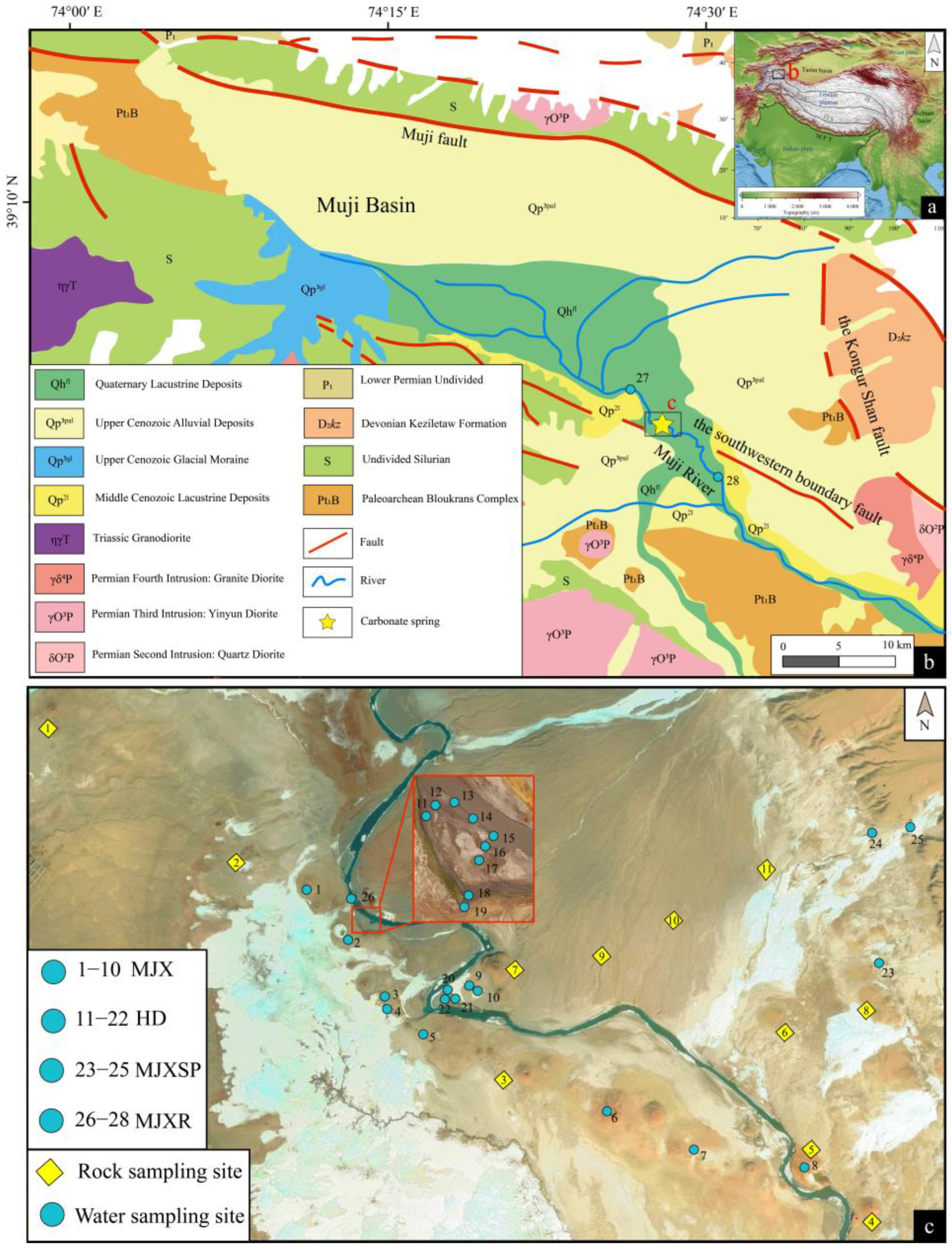
3.1. Sample Collection
3.2. Elemental and Mineralogical Analysis
3.3. Carbon Isotope Analysis
4. Results and Discussion
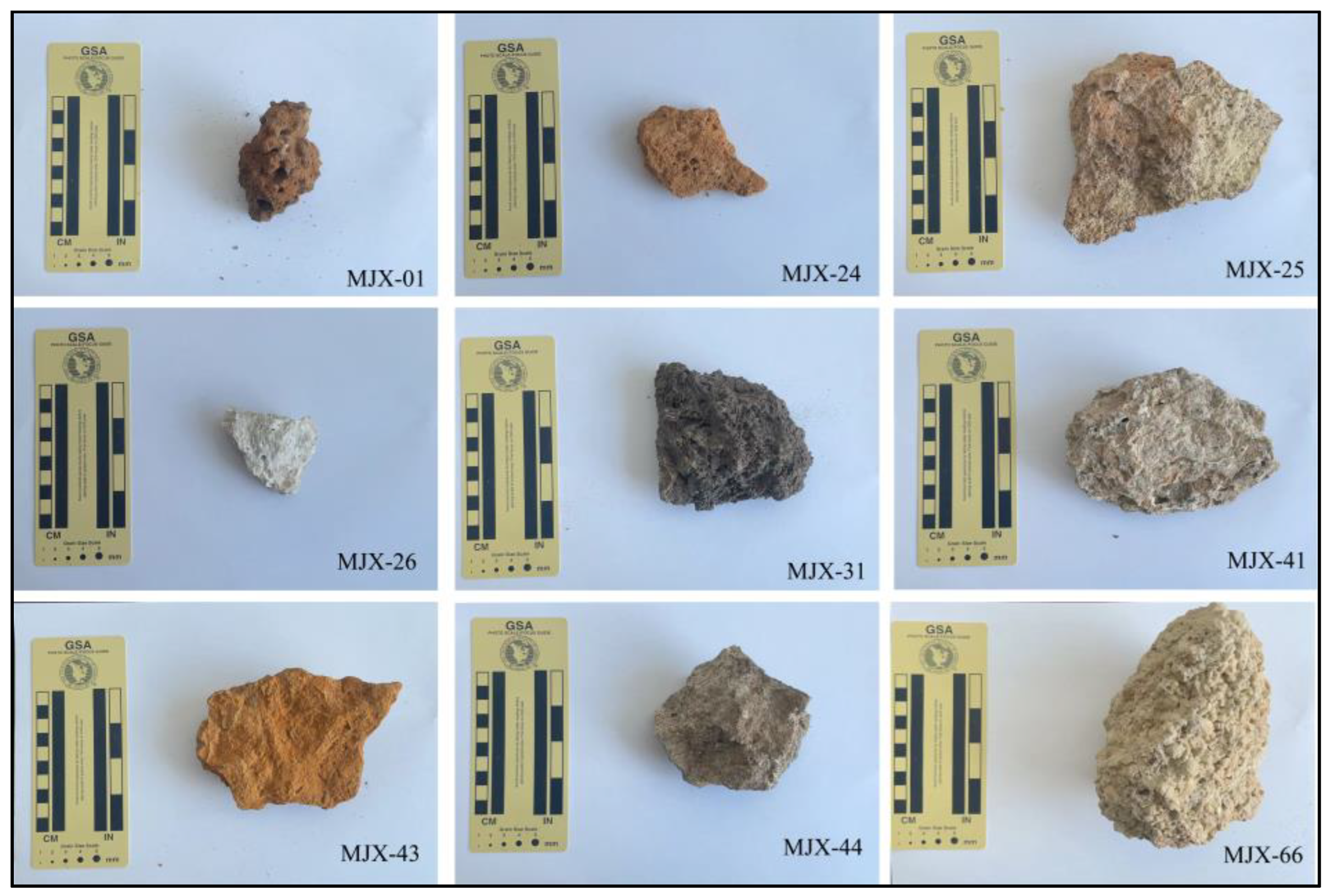
4.1. Mineralogical Characteristics and Precipitation Mechanisms
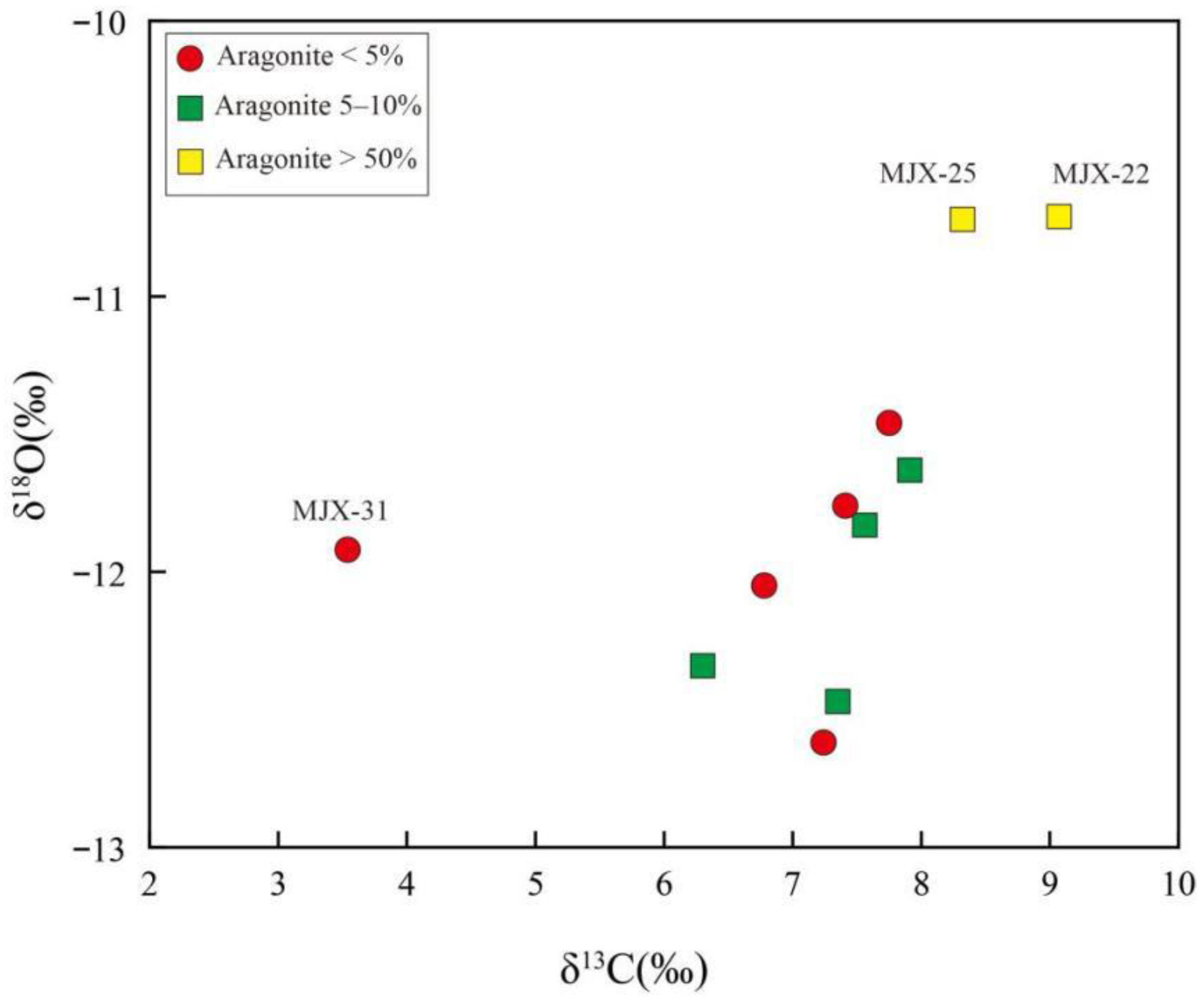
4.2. Stable Isotope Characteristics
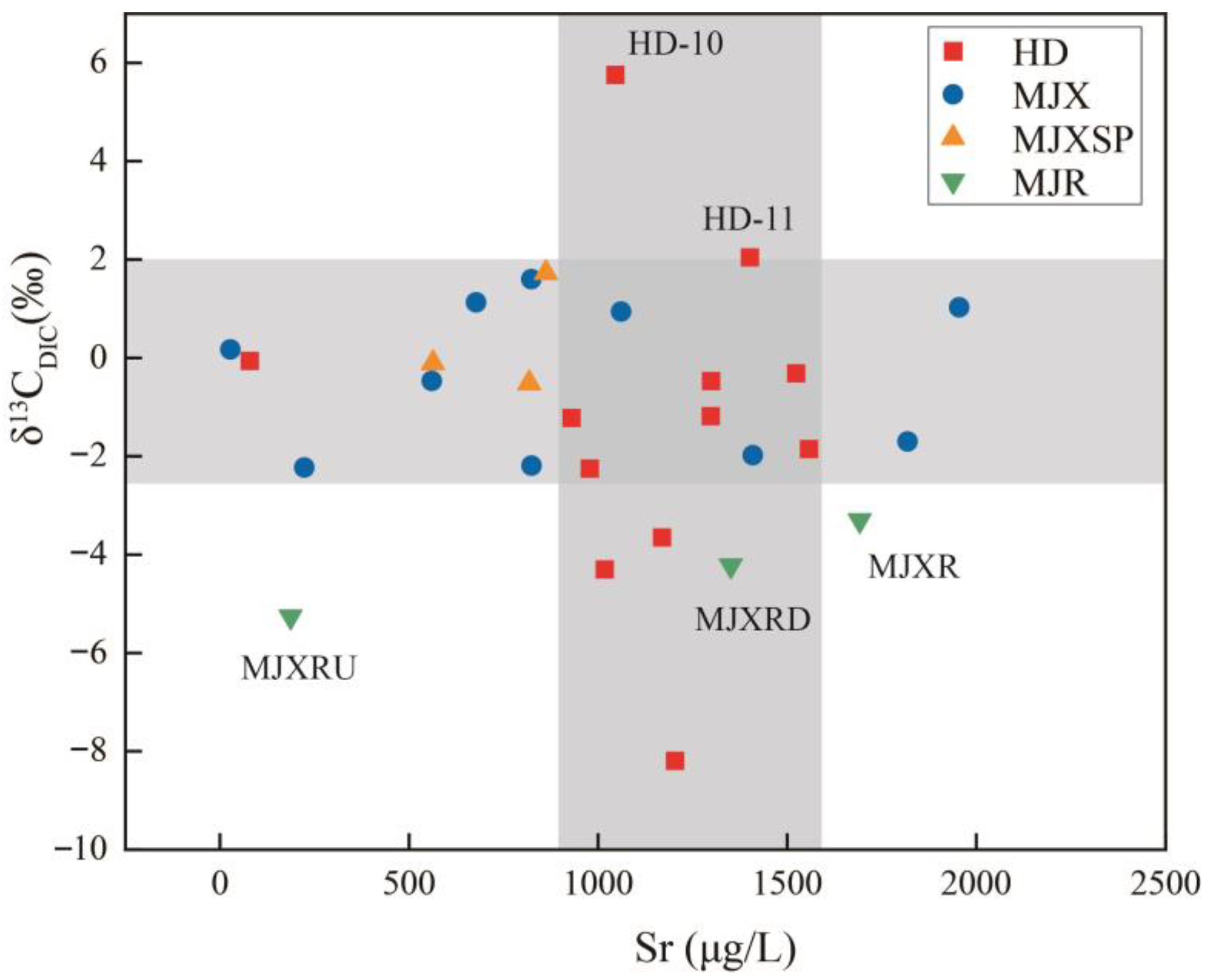
4.3. Geochemical Characteristics and Regional Implications
5. Conclusions
Supplementary Materials
Author Contributions
Funding
Data Availability Statement
Acknowledgments
Conflicts of Interest
References
- Pentecost, A. Travertine; Springer: Berlin, Germany, 2005. [Google Scholar]
- McGibbon, C.; Crossey, L.J.; Karlstrom, K.E.; Grulke, T. Carbonic springs as distal manifestations of geothermal systems, highlighting the importance of fault pathways and hydrochemical mixing: Example from the Jemez Mountains, New Mexico. Appl. Geochem. 2018, 95, 45–57. [Google Scholar] [CrossRef]
- Zheng, G.D.; Martinelli, G.; Wang, Y.X.; Li, S.; Ma, X.X. Notes for a history of gas geochemistry. J. Earth Sci. 2022, 33, 1614–1623. [Google Scholar] [CrossRef]
- Lavrushin, V.Y.; Kuleshov, V.N.; Kikvadze, O.E. Travertines of the northern Caucasus. Lithol. Miner. Resour. 2006, 41, 137–164. [Google Scholar] [CrossRef]
- Faccenna, C.; Soligo, M.; Billi, A.; De Filippis, L.; Funiciello, R. Late Pleistocene depositional cycles of the Lapis Tiburtinus travertine (Tivoli, Central Italy): Possible influence of climate and fault activity. Glob. Planet. Chang. 2008, 64, 151–166. [Google Scholar] [CrossRef]
- Fouke, B.W. Hot-spring systems geobiology: Abiotic and biotic influences on travertine formation at Mammoth Hot Springs, Yellowstone National Park, USA. Sedimentology 2011, 58, 170–219. [Google Scholar] [CrossRef]
- Zhou, R.; Liu, J.; Wang, Y.; Song, J.; Zhao, Y.; Li, Y. Hydrogeochemical and isotopic characteristics of the hot springs in eastern Qinghai–Tibet Plateau. Water 2022, 14, 1496. [Google Scholar]
- Kennedy, B.M.; van Soest, M.C. Flow of mantle fluids through the crust: Helium isotope perspectives. Geochim. Cosmochim. Acta 2006, 70, 759–766. [Google Scholar]
- Chiodini, G.; Cardellini, C.; Amato, A.; Boschi, E.; Caliro, S.; Frondini, F.; Ventura, G. Carbon dioxide Earth degassing and seismogenesis in central and southern Italy. Geophys. Res. Lett. 2004, 31, L07615. [Google Scholar] [CrossRef]
- Sun, Z.; Liu-Zeng, J.; Shao, Y.; Wang, W.; Zhou, X.; Zhang, M.; Li, Y.; Han, L.; Cui, F. Hydrogeochemical characteristics of geothermal springs along the central section of Altyn Tagh fault: Implications for deep fluid circulation and tectonic activity. Geothermics 2025, 130, 103327. [Google Scholar] [CrossRef]
- Barbieri, M.; Boschetti, T.; Petitta, M.; Tallini, M. Stable isotope (2H, 18O and 87Sr/86Sr) and hydrochemistry monitoring for groundwater hydrodynamics analysis in a karst aquifer (Gran Sasso, Central Italy). Appl. Geochem. 2005, 20, 2063–2081. [Google Scholar] [CrossRef]
- Chiodini, G.; Cardellini, C.; Di Luccio, F.; Selva, J.; Frondini, F.; Caliro, S.; Rosiello, A.; Beddini, G.; Ventura, G. Correlation between tectonic CO2 Earth degassing and seismicity is revealed by a 10-year record in the Apennines, Italy. Sci. Adv. 2020, 6, eabc2938. [Google Scholar] [CrossRef] [PubMed]
- Chiodini, G.; Frondini, F.; Cardellini, C.; Granieri, D.; Marini, L.; Ventura, G. CO2 degassing and energy release at Solfatara volcano, Campi Flegrei, Italy. J. Geophys. Res. Solid Earth 2001, 106, 16213–16229. [Google Scholar] [CrossRef]
- Tao, G.; Zhou, X.; Wu, Y.; Cao, R.; Chen, B.; Li, Z.; Jiang, Z.; Wang, M. CO2 degassing and calcite precipitation from hot springs in the Litang, western Sichuan. Geothermics 2025, 133, 103442. [Google Scholar] [CrossRef]
- Zhang, M.; Xie, X.G.; Liu, W.; Liu, Y.; Wang, L.; Sano, Y.; Lang, Y.C.; Liu, C.Q.; Xu, S. Hydrothermal degassing through the Karakoram fault, western Tibet: Insights into active deformation driven by continental strike-slip faulting. Geophys. Res. Lett. 2024, 51, e2023GL106647. [Google Scholar] [CrossRef]
- Klemperer, S.L.; Zhao, P.; Whyte, C.J.; Darrah, T.H.; Crossey, L.J.; Karlstrom, K.E.; Hilton, D.R.; Duchene, H.R.; Newell, D.L. Limited underthrusting of India below Tibet: 3He/4He analysis of thermal springs locates the mantle suture in continental collision. Proc. Natl. Acad. Sci. USA 2022, 119, e2113877119. [Google Scholar] [CrossRef]
- Liu, J.Q.; Wu, C.Q.; Zhang, B.; Sun, Z.H.; Zhu, Z.Y.; Xu, L.Q.; Zhang, L.; Ye, Z.H.; Guo, Z.F. The attributes and characteristics of “Muji Volcanic Group” in Xinjiang. Acta Geol. Sin. 2024, 98, 1637–1648, (In Chinese with English abstract). [Google Scholar]
- Yang, H.; Wu, X.; Cui, H.; Wang, W.; Cheng, Y.; Gong, X.; Luo, X.; Lin, Q. Formation Mechanism of Muji Travertine in the Pamirs Plateau, China. Minerals 2024, 14, 1192. [Google Scholar] [CrossRef]
- Zhang, L.; Ma, X.; Shao, Y.; Chen, J.; Li, Z.; Zhang, L.; Cao, C.; Chelnokov, G.; Lavrushin, V.; Zheng, G. Geochemistry and Origin of Geofluids from Muji Carbonic Springs in the Northeastern Pamir Plateau, NW China: Implications for Regional Fault Activities. J. Asian Earth Sci. 2026, 297, 106882. [Google Scholar] [CrossRef]
- Ren, Z.; Su, F.; Xu, B.; Xie, Y.; Kan, B. A coupled glacier–hydrology model and its application in eastern Pamir. J. Geophys. Res. Atmos. 2018, 123, 13692–13713. [Google Scholar] [CrossRef]
- Chen, J.; Li, T.; Sun, J.F.; Fang, L.H.; Yao, Y.; Li, Y.H.; Wang, H.R.; Fu, B. Seismogenic structure and surface rupture of the MW6.6 Akto earthquake on November 25, 2016, in Xinjiang, China. Seismol. Geol. 2016, 38, 1160–1174, (In Chinese with English abstract). [Google Scholar]
- Chen, Z.; Song, X.; Sun, M.; Yu, H.; Guo, X.; Yin, X.; Song, Q. Microstructure, geochemical characteristics, and genesis of travertine deposits in the Muji Basin, Xinjiang, China. Quat. Res. 2023, 43, 173–186, (In Chinese with English abstract). [Google Scholar]
- Li, T.; Schoenbohm, L.M.; Chen, J.; Yuan, Z.; Feng, W.; Li, W.; Xu, J.; Owen, L.A.; Sobel, R.E.; Zhang, B.; et al. Cumulative and coseismic (during the 2016 Mw 6.6 Aketao earthquake) deformation of the dextral-slip Muji Fault, northeastern Pamir orogen. Tectonics 2019, 38, 3975–3989. [Google Scholar] [CrossRef]
- Chevalier, M.L.; Li, H.; Pan, J.; Pei, J.; Wu, F.; Xu, W.; Sun, Z.; Liu, D. Fast slip-rate along the northern end of the Karakorum fault system, western Tibet. Geophys. Res. Lett. 2011, 38, L22309. [Google Scholar] [CrossRef]
- Robinson, A.C.; Yin, A.; Manning, C.E.; Harrison, T.M.; Zhang, S.H.; Wang, X.F. Tectonic evolution of the northeastern Pamir: Constraints from the northern portion of the Cenozoic Kongur Shan extensional system, western China. Geol. Soc. Am. Bull. 2004, 116, 953–973. [Google Scholar] [CrossRef]
- Yang, W.Q.; Liu, L.; Cao, Y.T.; Wang, C.; He, S.P.; Li, R.S.; Zhu, X.H. Geochronological evidence of Indosinian (high-pressure) metamorphic event and its tectonic significance in Taxkorgan area of the Western Kunlun Mountains, NW China. Sci. China Earth Sci. 2010, 53, 1445–1459. [Google Scholar] [CrossRef]
- Li, S.; Feng, X.; Zhang, H.; Yuan, W. Sedimentary characteristics and sedimentary facies of the Southern Kyzyltau Formation in Yingjisha, Xinjiang. Xinjiang Geol. 2004, 22, 155–159, (In Chinese with English abstract). [Google Scholar]
- Jones, B.; Renaut, R.W. Calcium carbonate polymorph precipitation in hot-spring systems: Controls of CO2 degassing, water chemistry, and temperature on aragonite vs. calcite deposition. Sedimentology 2017, 64, 1237–1275. [Google Scholar]
- De Choudens-Sánchez, V.; Gonzalez, L.A. Calcite and Aragonite Precipitation Under Controlled Instantaneous Supersaturation: Elucidating the Role of CaCO3 Saturation State and Mg/Ca Ratio on Calcium Carbonate Polymorphism. J. Sediment. Res. 2009, 79, 363–376. [Google Scholar] [CrossRef]
- Luo, L.; Capezzuoli, E.; Rogerson, M.; Vaselli, O.; Wen, H.; Lu, Z. Precipitation of carbonate minerals in travertine-depositing hot springs: Driving forces, microenvironments, and mechanisms. Sediment. Geol. 2022, 438, 106207. [Google Scholar] [CrossRef]
- Land, L.S. Failure to precipitate dolomite at 25 °C from dilute solution despite 1000-fold oversaturation after 32 years. Aquat. Geochem. 1998, 4, 361–368. [Google Scholar] [CrossRef]
- Gregg, J.M.; Bish, D.L.; Kaczmarek, S.E. Dolomite: Perspectives on a perplexing mineral. Sediment. Geol. 2015, 319, 1–10. [Google Scholar]
- Guo, L.; Riding, R. Hot-spring travertine facies and sequences, Shiqiang, Hubei Province, China. Sedimentology 1999, 46, 1023–1038. [Google Scholar]
- Jones, B.; Renaut, R.W. Chapter 4 Calcareous spring deposits in continental settings. In Carbonates and Evaporites: Facies, Environments, and Processes; Alonso-Zarza, A.M., Tanner, L.H., Eds.; Developments in Sedimentology; Elsevier: Amsterdam, The Netherlands, 2010; Volume 61, pp. 177–224. [Google Scholar]
- Morse, J.W.; Arvidson, R.S.; Lüttge, A. Calcium carbonate formation and dissolution. Chem. Rev. 2007, 107, 342–381. [Google Scholar] [CrossRef] [PubMed]
- Craig, H. Isotopic variations in meteoric waters. Science 1961, 133, 1702–1703. [Google Scholar] [CrossRef]
- Cerling, T.E. The stable isotopic composition of modern soil carbonate and its relationship to climate. Earth Planet. Sci. Lett. 1984, 71, 229–240. [Google Scholar] [CrossRef]
- Stauffer, R.E.; Thompson, J.M. Arsenic and other trace elements in thermal waters of Yellowstone National Park, Wyoming. U.S. Geol. Surv. Prof. Pap. 1984, 1256, 33. [Google Scholar]
- Zhuang, S.; Zhou, X.; Li, P.; Shi, Z.; Saimairenaji, N.; Wuyina, K.; Zhu, C.; Yan, Y. Environmental hydrogeochemical characteristics of hot springs in Tashkurgan Fault Zone of Xinjiang, China. J. Earth Sci. Environ. 2022, 44, 699–712, (In Chinese with English abstract). [Google Scholar]
- U.S. Geological Survey (USGS). Yellowstone National Park Water Quality Data (YNP_WQ.csv). National Water Information System (NWIS) Database. 2020. Available online: https://waterdata.usgs.gov (accessed on 15 July 2025).
- Paces, J.B.; McCleskey, R.B.; Hurwitz, S.; Thordsen, J.J. Radiogenic strontium- and uranium-isotope tracers of shallow groundwater flow in the Upper Geyser Basin, Yellowstone National Park, USA. Geochem. Geophys. Geosyst 2024, 25, e2023GC011245. [Google Scholar] [CrossRef]
- Deffeyes, K.S.; Lucia, F.J.; Weyl, P.K. Dolomitization and limestone diagenesis—Their relation to magnesium/calcium ratio in ancient seawater. SEPM Spec. Publ. 1976, 21, 133–153. [Google Scholar]
- Morse, J.W.; Bender, M.L. Partition coefficients in calcite: Examination of factors influencing the validity of experimental results and their application to natural systems. Chem Geol. 1990, 82, 265–277. [Google Scholar] [CrossRef]



| No. | Sample ID | Quartz (%) | Plagioclase (%) | Calcite (%) | Aragonite (%) | Dolomite (%) | Gypsum (%) |
|---|---|---|---|---|---|---|---|
| 1 | MJX-01 | 1.9 | – | 89.9 | 8.2 | – | – |
| 2 | MJX-02 | 1.6 | – | 96.6 | 1.2 | – | 0.6 |
| 3 | MJX-22 | 1.6 | 0.4 | 40.8 | 57.3 | – | – |
| 4 | MJX-24 | 1.7 | – | 98.3 | – | – | – |
| 5 | MJX-25 | 1.7 | – | 31.0 | 67.3 | – | – |
| 6 | MJX-26 | 2.6 | 0.6 | 88.8 | 7.5 | 0.6 | – |
| 7 | MJX-31 | 1.2 | – | 98.8 | – | – | – |
| 8 | MJX-41 | 0.9 | – | 89.1 | 9.5 | – | 0.5 |
| 9 | MJX-43 | 2.1 | – | 88.8 | 9.1 | – | – |
| 10 | MJX-44 | 1.7 | – | 94.6 | 2.6 | – | 1.1 |
| 11 | MJX-66 | 0.9 | 3.7 | 94.5 | 1.0 | – | – |
| No. | Sample ID | SiO2 (%) | Al2O3 (%) | TFe2O3 (%) | CaO (%) | MgO (%) | K2O (%) | Na2O (%) | δ13Ctufa (‰) | δ18Otufa (‰) |
|---|---|---|---|---|---|---|---|---|---|---|
| 1 | MJX-01 | 6.1 | 1.0 | 12.8 | 46.5 | 1.6 | 0.8 | 2.7 | 7.6 | −11.8 |
| 2 | MJX-02 | 5.5 | 1.4 | 3.1 | 49.5 | 1.3 | 0.4 | 0.5 | 6.8 | −12.1 |
| 3 | MJX-22 | 4.8 | 0.6 | 7.2 | 51.6 | 0.7 | 0.2 | 0.1 | 9.1 | −10.7 |
| 4 | MJX-24 | 3.8 | 0.7 | 2.7 | 53.5 | 1.0 | 0.1 | 0.1 | 7.4 | −11.8 |
| 5 | MJX-25 | 5.0 | 0.7 | 4.2 | 51.8 | 1.0 | 0.2 | 0.2 | 8.3 | −10.7 |
| 6 | MJX-26 | 4.0 | 0.8 | 0.4 | 51.8 | 2.4 | 0.2 | 0.2 | 6.3 | −12.3 |
| 7 | MJX-31 | 1.8 | 0.4 | 0.8 | 47.3 | 2.7 | 0.7 | 0.8 | 3.5 | −11.9 |
| 8 | MJX-41 | 1.2 | 0.2 | 0.5 | 54.6 | 1.1 | 0.1 | 0.1 | 7.9 | −11.6 |
| 9 | MJX-43 | 7.5 | 1.5 | 8.9 | 49.9 | 0.6 | 0.3 | 0.2 | 7.4 | −12.5 |
| 10 | MJX-44 | 2.1 | 0.4 | 0.4 | 53.2 | 1.0 | 0.1 | 0.3 | 7.2 | −12.6 |
| 11 | MJX-66 | 3.6 | 0.5 | 1.5 | 52.7 | 1.9 | 0.1 | 0.3 | 7.8 | −11.5 |
| No. | Sample | T (℃) * | Ca2+ (mmol/L) * | Mg2+ (mmol/L) * | Sr (μg/L) | Ba (μg/L) | U (μg/L) | δ13CDIC (‰) |
|---|---|---|---|---|---|---|---|---|
| 1 | MJX-03 | – | 6.34 | 2.12 | 824.2 | 22.7 | 3.89 | −2.2 |
| 2 | MJX-06 | 11.6 | 3.54 | 3.24 | 677.4 | 12.4 | 3.68 | 1.1 |
| 3 | MJX-10 | 12.1 | 6.24 | 3.90 | 1061.0 | 34.4 | 6.53 | 0.9 |
| 4 | MJX-10-1 | 11.8 | 8.86 | 4.90 | 823.6 | 27.7 | 3.39 | 1.6 |
| 5 | MJX-16 | 11.4 | 6.56 | 6.09 | 1818.4 | 62.9 | 1.87 | −1.7 |
| 6 | MJX-21 | 10.7 | 8.93 | 5.88 | 559.9 | 24.8 | 0.76 | −0.5 |
| 7 | MJX-26 | 10.7 | 7.31 | 3.96 | 1409.4 | 59.7 | 0.40 | −2.0 |
| 8 | MJX-31 | 10.8 | 7.98 | 3.18 | 27.3 | 2.8 | 0.03 | 0.2 |
| 9 | MJX-36 | 10.9 | 5.09 | 4.05 | 223.2 | 7.6 | 0.05 | −2.2 |
| 10 | MJX-37 | – | 4.17 | 4.40 | 1955.1 | 154.1 | 3.50 | 1.0 |
| 11 | HD-01 | 10.7 | 7.41 | 2.81 | 1298.5 | 55.4 | 1.40 | −0.5 |
| 12 | HD-02 | 10.4 | 8.21 | 2.59 | 929.5 | 25.8 | 1.18 | −1.2 |
| 13 | HD-03 | 10.8 | 9.16 | 3.68 | 1523.5 | 61.0 | 1.26 | −0.3 |
| 14 | HD-04 | 11.0 | 3.54 | 3.21 | 1202.7 | 50.4 | 1.52 | −8.2 |
| 15 | HD-05 | 11.2 | 5.16 | 2.86 | 1297.5 | 47.2 | 2.59 | −1.2 |
| 16 | HD-06 | – | 7.91 | 3.24 | 1556.9 | 73.3 | 1.98 | −1.9 |
| 17 | HD-07 | – | 2.72 | 1.81 | 1017.0 | 57.4 | 7.06 | −4.3 |
| 18 | HD-08 | – | 6.94 | 2.72 | 1168.3 | 26.8 | 1.23 | −3.7 |
| 19 | HD-09 | – | 7.34 | 1.87 | 977.5 | 42.4 | 0.94 | −2.3 |
| 20 | HD-10 | – | 9.13 | 5.14 | 1045.0 | 56.9 | 0.04 | 5.8 |
| 21 | HD-11 | 10.8 | 8.26 | 4.16 | 1400.9 | 83.5 | 0.91 | 2.1 |
| 22 | HD-12 | – | 7.71 | 4.98 | 78.3 | 9.6 | – | −0.1 |
| 23 | MJXSP-01 | – | 4.17 | 2.87 | 862.2 | 56.1 | 9.57 | 1.7 |
| 24 | MJXSP-02 | 10.2 | 5.24 | 3.88 | 817.8 | 49.1 | 9.40 | −0.5 |
| 25 | MJXSP-03 | 10.6 | 5.49 | 3.95 | 563.4 | 80.4 | 5.90 | −0.1 |
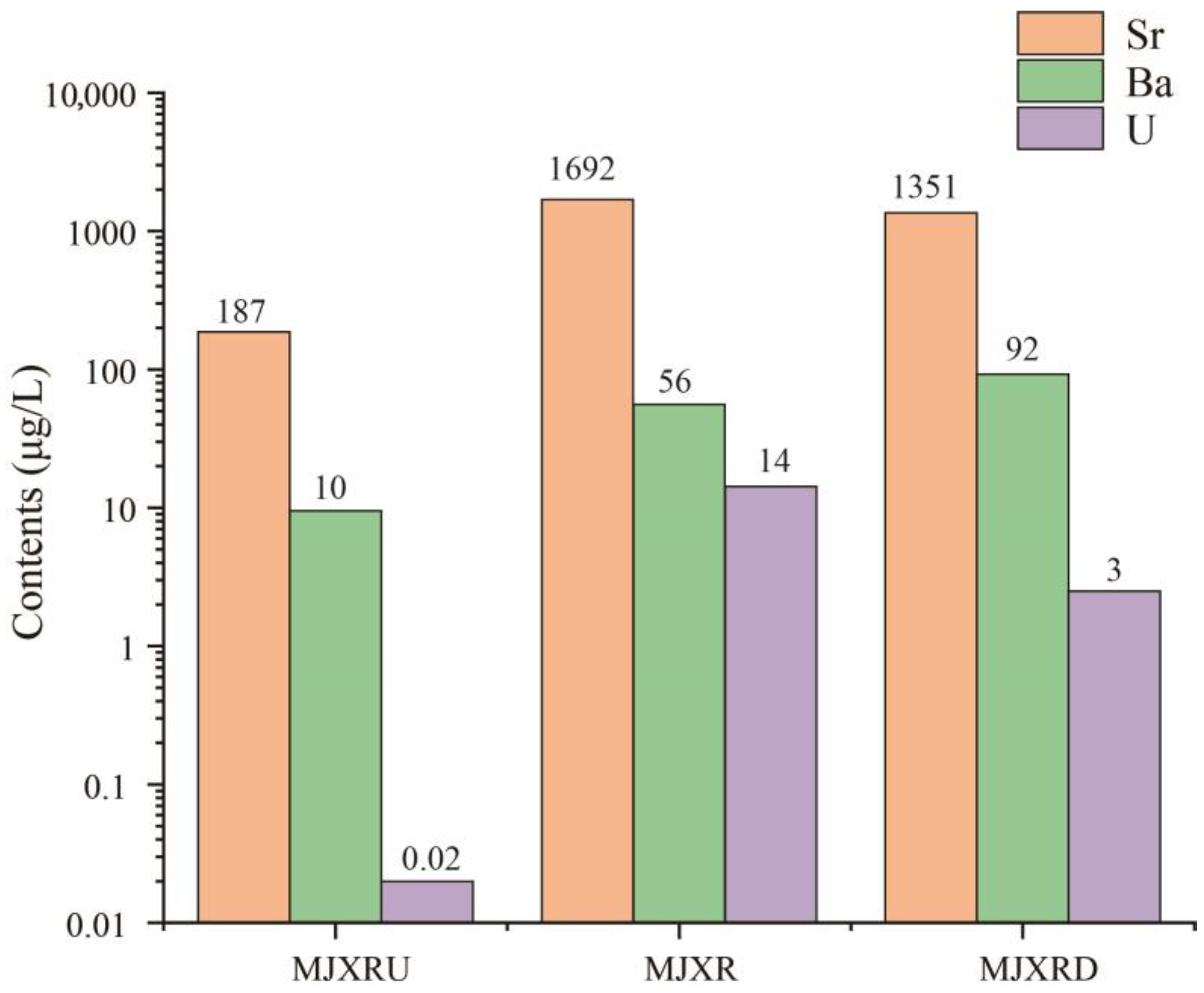
| 26 | MJXR | 10.6 | 1.76 | 1.20 | 1691.7 | 55.8 | 14.3 | −3.3 |
| 27 | MJXRD | – | 1.83 | 1.52 | 1350.8 | 92.4 | 2.50 | −4.2 |
| 28 | MJXRU | – | 1.27 | 0.56 | 186.6 | 9.5 | 0.02 | −5.3 |
| Elements | N | Minimum | P10 | Median | P90 | Maximum | Mean ± SD |
|---|---|---|---|---|---|---|---|
| Muji | |||||||
| Sr (μg/L) | 24 | 27.3 | 324.2 | 1031 | 154.7 | 1955 | 1023.1 ± 491.3 |
| Ba (μg/L) | 24 | 2.8 | 10.5 | 48.1 | 70.2 | 154 | 46.0 ± 31.7 |
| U (μg/L) | 23 | 0.03 | 0.12 | 1.50 | 6.95 | 9.57 | 2.75 ± 2.83 |
| Yellowstone * | |||||||
| Sr (μg/L) | 39 | 3.50 | 4.60 | 54.0 | 464 | 508 | 172.8 ± 190.2 |
| Ba (μg/L) | 15 | 1.0 | 2.8 | 18 | 1728 | 1890 | 442.5 ± 718.1 |
| U (μg/L) | 39 | 0.02 | 0.08 | 6.61 | 13.05 | 14.82 | 6.40 ± 5.59 |
| Tashkurgan * | |||||||
| Sr (μg/L) | 6 | 249 | 575 | 937 | 1735 | 2061 | 1082.2 ± 605.6 |
| Ba (μg/L) | 6 | 6.92 | 10.5 | 32.0 | 69.1 | 85.6 | 37.2 ± 28.6 |
| U (μg/L) | 6 | 0.01 | 0.03 | 0.12 | 0.39 | 0.54 | 0.18 ± 0.20 |
Disclaimer/Publisher’s Note: The statements, opinions and data contained in all publications are solely those of the individual author(s) and contributor(s) and not of MDPI and/or the editor(s). MDPI and/or the editor(s) disclaim responsibility for any injury to people or property resulting from any ideas, methods, instructions or products referred to in the content. |
© 2025 by the authors. Licensee MDPI, Basel, Switzerland. This article is an open access article distributed under the terms and conditions of the Creative Commons Attribution (CC BY) license (https://creativecommons.org/licenses/by/4.0/).
Share and Cite
Zhang, L.; Guo, Y.; Zheng, G.; Shao, Y.; Somarin, A.K.; Lavrushin, V.; Ma, X. Mineralogical and Geochemical Insights into Formation of the Muji Carbonic Springs, NW China. Minerals 2025, 15, 1302. https://doi.org/10.3390/min15121302
Zhang L, Guo Y, Zheng G, Shao Y, Somarin AK, Lavrushin V, Ma X. Mineralogical and Geochemical Insights into Formation of the Muji Carbonic Springs, NW China. Minerals. 2025; 15(12):1302. https://doi.org/10.3390/min15121302
Chicago/Turabian StyleZhang, Li, Yuxin Guo, Guodong Zheng, Yuanyuan Shao, Alireza K. Somarin, Vasilii Lavrushin, and Xiangxian Ma. 2025. "Mineralogical and Geochemical Insights into Formation of the Muji Carbonic Springs, NW China" Minerals 15, no. 12: 1302. https://doi.org/10.3390/min15121302
APA StyleZhang, L., Guo, Y., Zheng, G., Shao, Y., Somarin, A. K., Lavrushin, V., & Ma, X. (2025). Mineralogical and Geochemical Insights into Formation of the Muji Carbonic Springs, NW China. Minerals, 15(12), 1302. https://doi.org/10.3390/min15121302