You are currently viewing a new version of our website. To view the old version click .
Minerals
  • Correction
  • Open Access

18 January 2024

Correction: Liao et al. A Comparison of the Fine-Grinding Performance between Cylpebs and Ceramic Balls in the Wet Tumbling Mill. Minerals 2022, 12, 1007

,
,
,
,
,
and
1
School of Resources and Environmental Engineering, Jiangxi University of Science and Technology, Ganzhou 341000, China
2
Jiangxi Key Laboratory of Mining Engineering, Jiangxi University of Science and Technology, Ganzhou 341000, China
3
Betterwear New Material Co., Ltd., Jingdezhen 333000, China
4
Goldpro New Material Co., Ltd., Handan 057650, China
This article belongs to the Special Issue Advances in Ore Processing Technologies: Crushing, Milling and Separation

Error in Equations

In the original publication [1], Equations (1)–(4) in Section 2, Tables 3 and 8 in Section 3, and Figures 5–8, 10 and 11 in Section 4 were not correctly put.
A correction has been made to Equations (1)–(4) in Section 2 to clarify this point. It replaces the text from “where S1(t) is the breakage rate for the top size” with:
d ω 1 t d t = S 1 ( t ) ω 1 ( t )
where S1(t) is the breakage rate for the top size;  ω 1 is the weight fraction of the material with the top size; t is the grinding time (min). If the breakage rate (S1(t)) does not change with time and follows the first-order kinetics, Equation (2) can be given in the following form:
l g ω 1 ( t ) ω 0 = S 1 · t 2.303
l g ω 1 ( t 1 ) ω 1 ( t 2 ) = S 1 ( t 2 t 1 ) 2.303
l g ω 1 ( t 0 ) ω 1 ( t 1 ) = S 1 ( t 1 t 0 ) 2.303

Error in Tables

A correction has been made to Tables 3 and 8 in Section 3 to clarify this point. It replaces the text Table 3 and Table 8 with:
Table 3. Physical properties of grinding media.
Table 8. Comparison of ceramic balls and cylpebs with different charge volumes.

Error in Figures

A correction has been made to Figures 5–8, 10 and 11 in Section 4 to clarify this point. It replaces the text from Figure 5, Figure 6, Figure 7, Figure 8, Figure 10 and Figure 11 with:
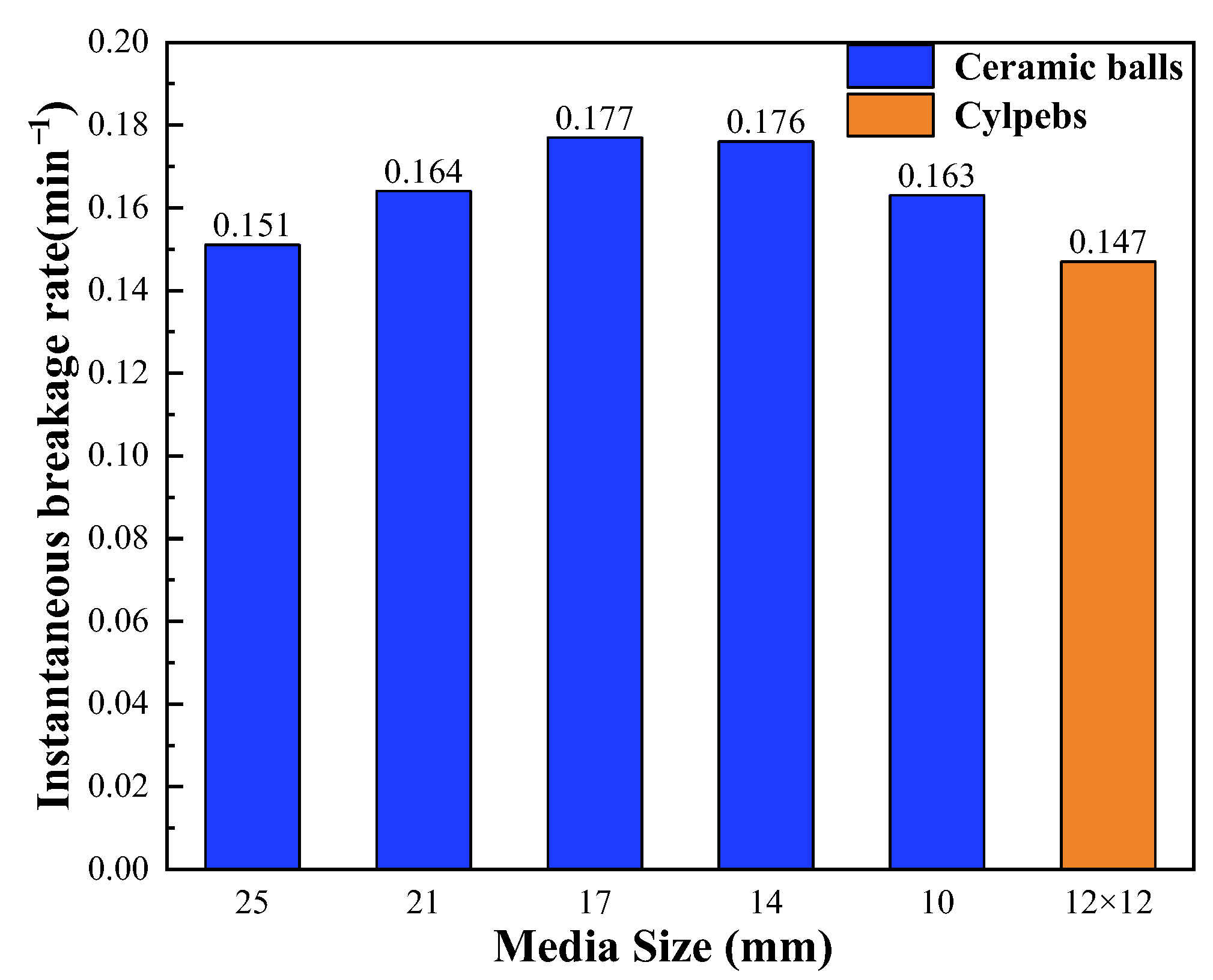
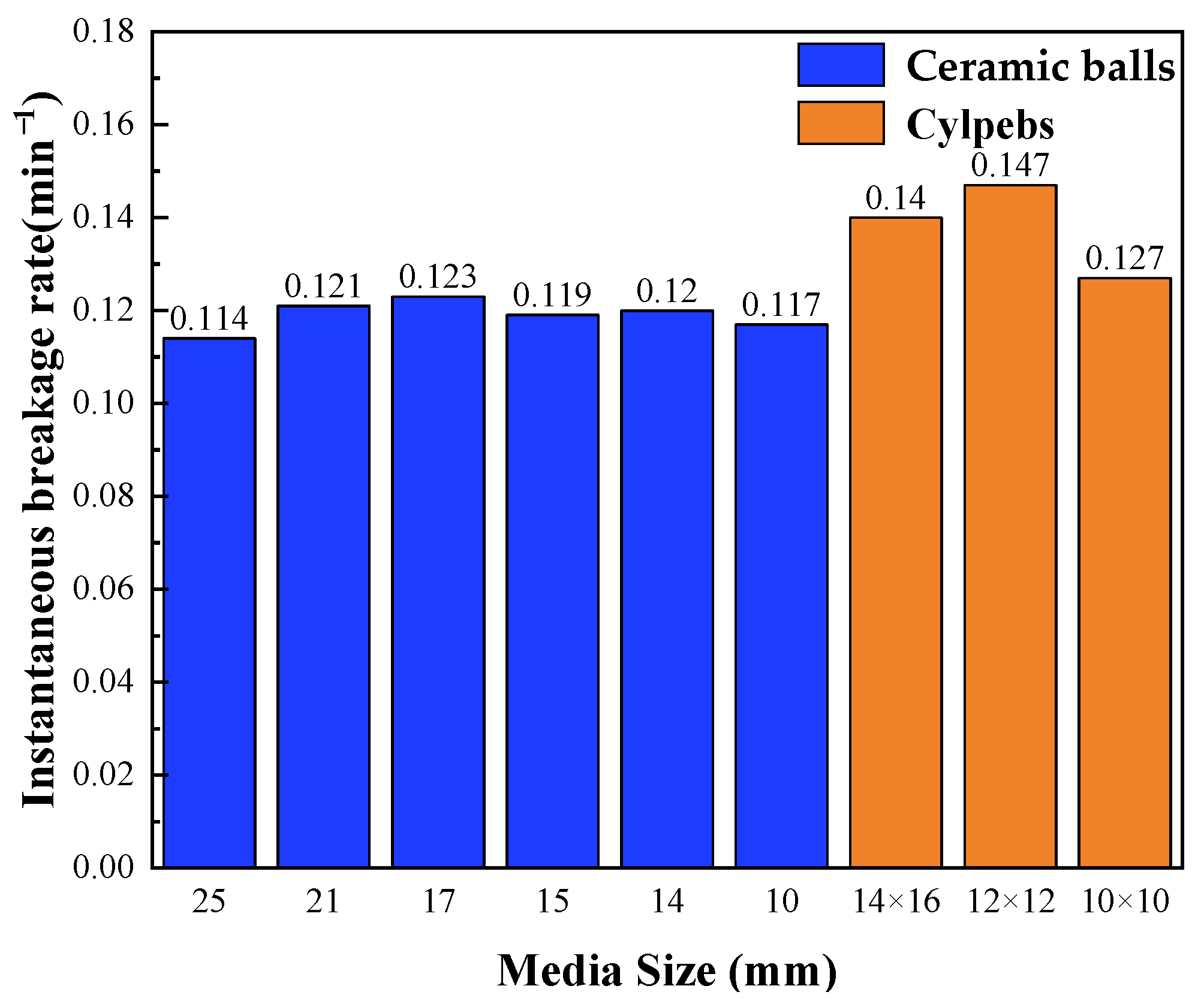
Figure 5. Instantaneous breakage rates of the grinding media at the same charge volume.
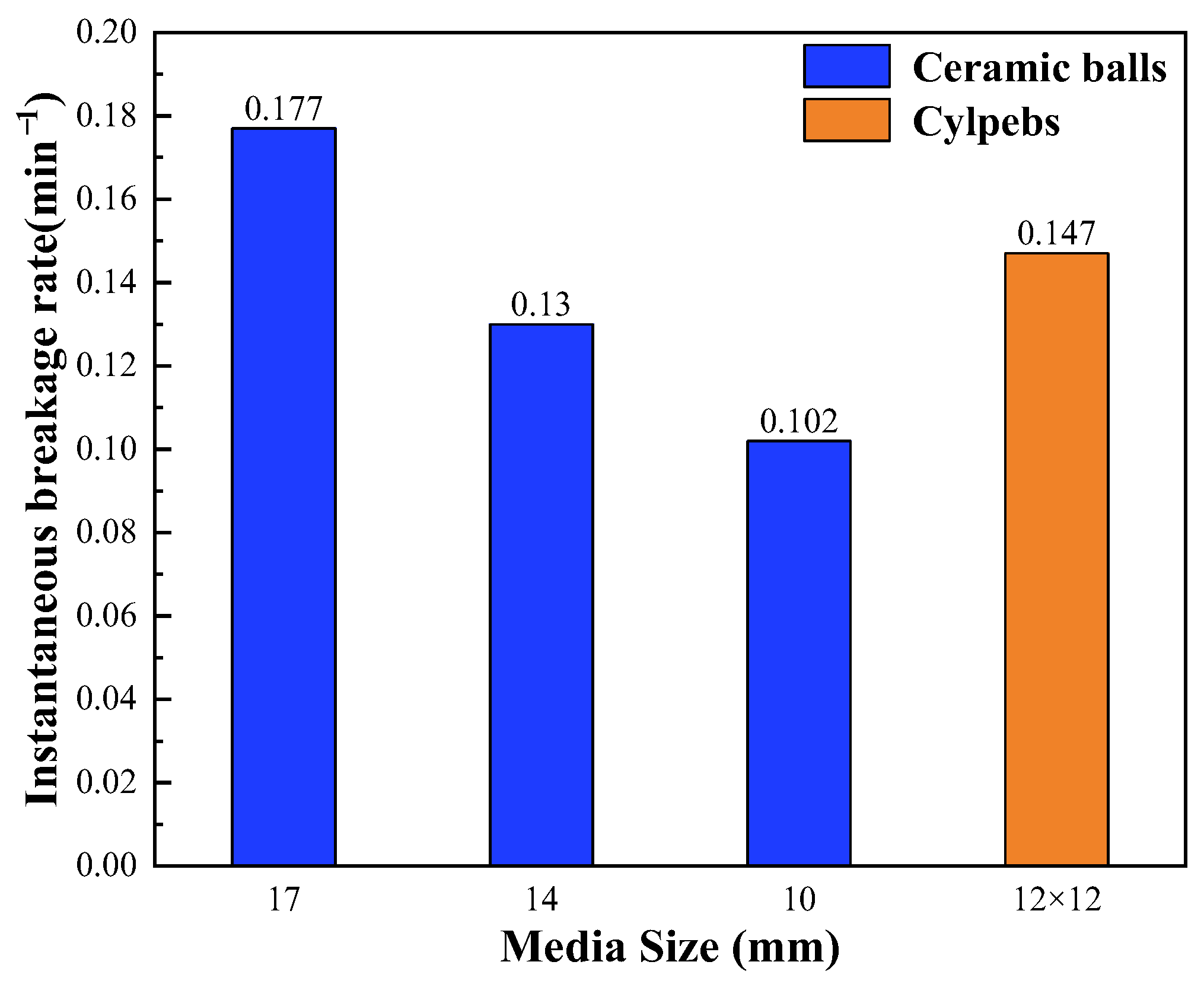
Figure 6. Instantaneous breakage rates of the ground products at the same total mass.
Figure 7. Instantaneous breakage rates of the ground products at the same total number.
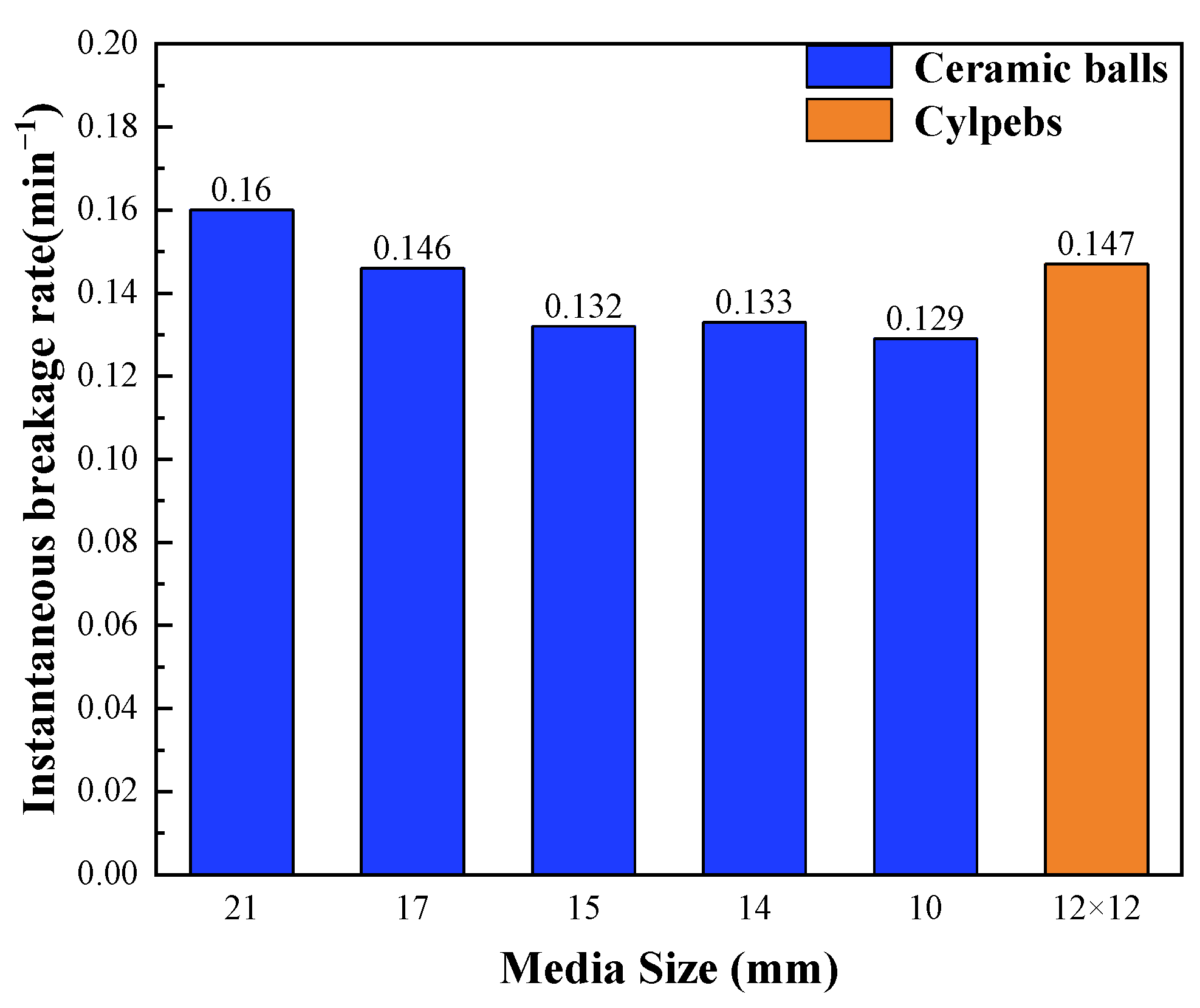
Figure 8. Instantaneous breakage rates of the ground products at the same total surface area.
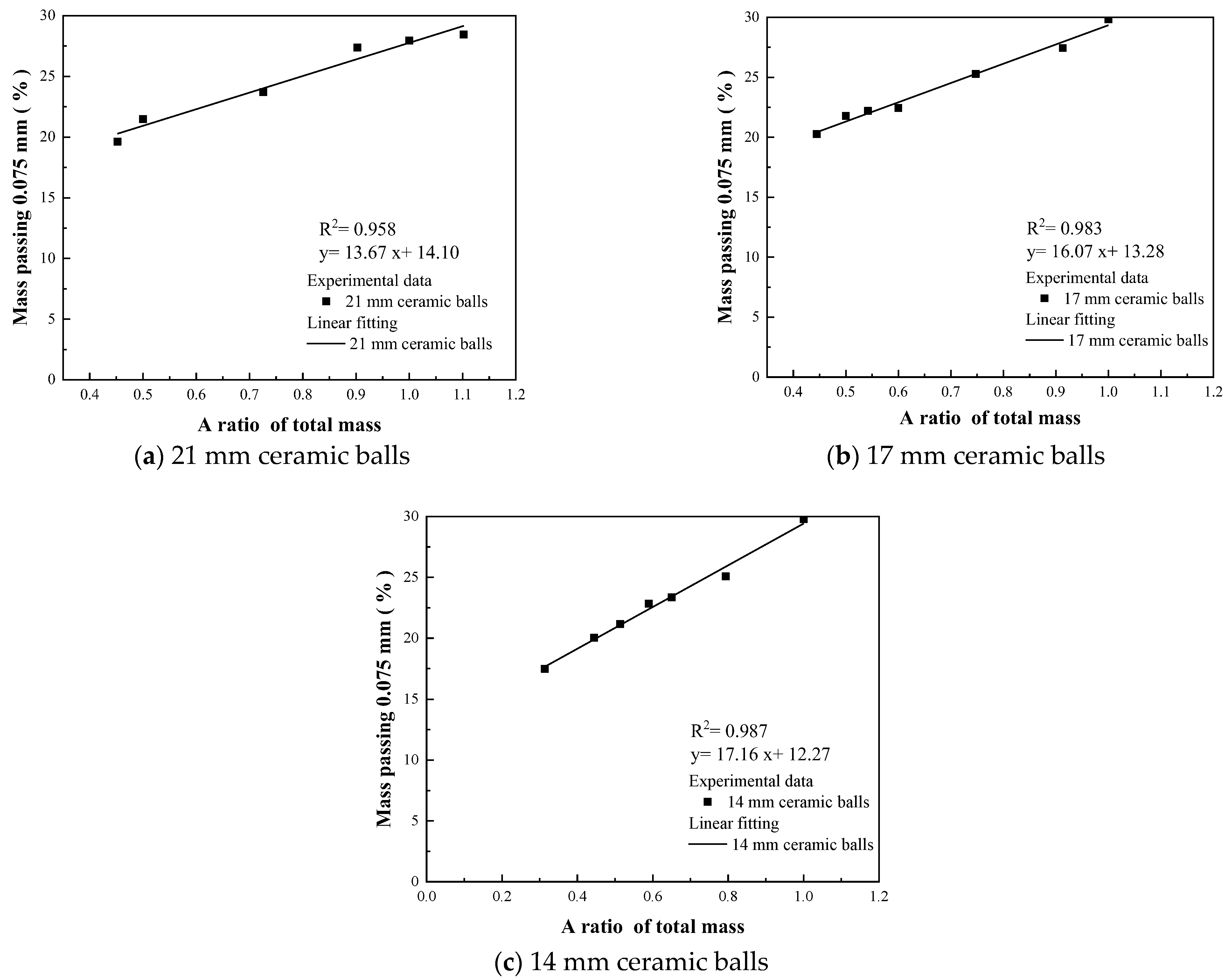
Figure 10. The relationship of the distribution of the percentage passing 0.075 mm in the ground product and the ratio of the total mass of 12 × 12 mm cylpebs at the same charge volume: (a) 21 mm ceramic balls; (b) 17 mm ceramic balls; (c) 14 mm ceramic balls.
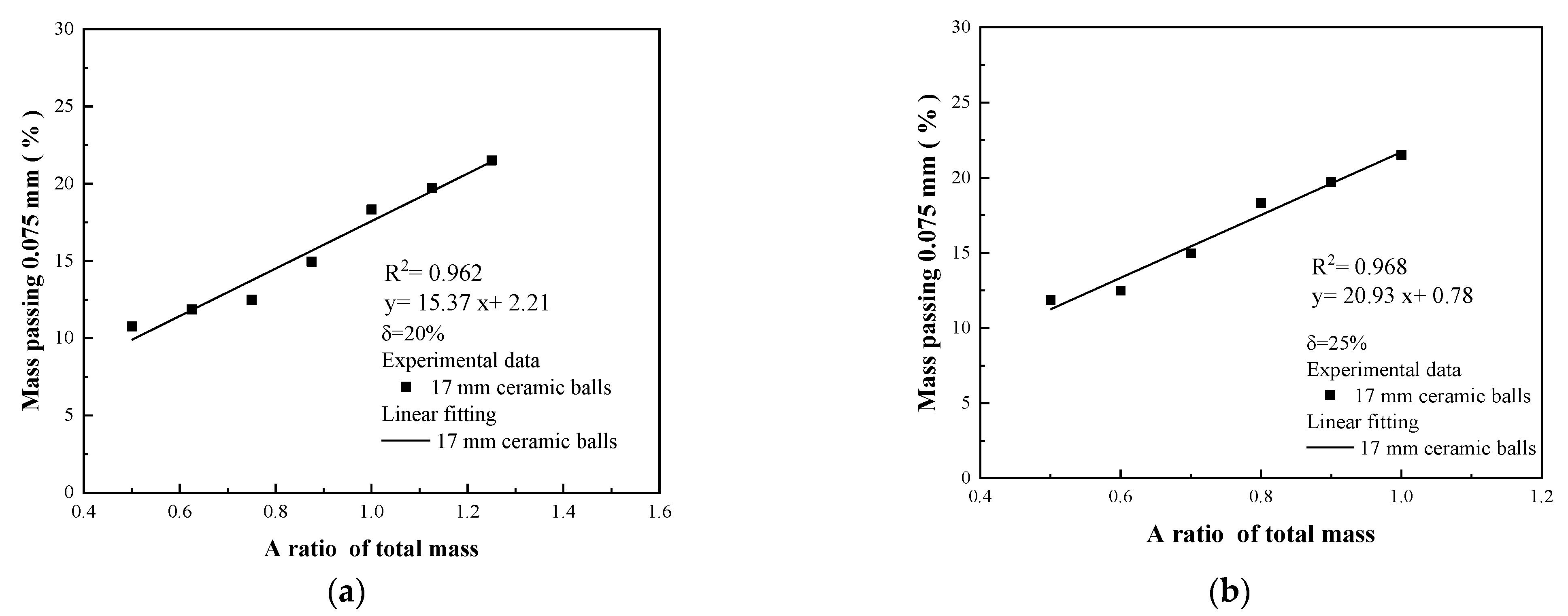
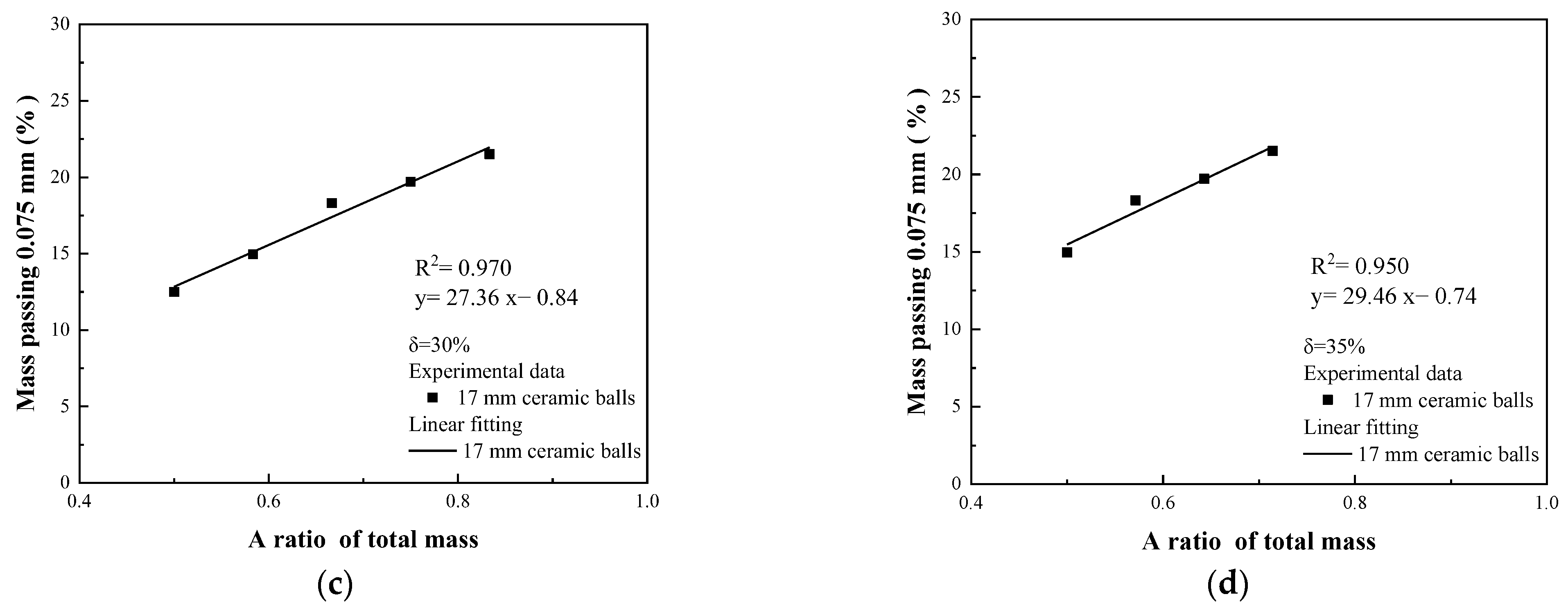
Figure 11. The relationship of the distribution of the percentage passing 0.075 mm in the ground product and the ratio of the total mass of 12 × 12 mm cylpebs in a wider charge volume: (a) δ = 20%; (b) δ = 25%; (c) δ = 30%; (d) δ = 35%.

Text Correction

A correction has been made to Section 4.2, Paragraphs 2–4:
Compared with 12 × 12 mm cylpebs, 17 mm ceramic balls have the same single mass, total number of grinding media, and total mass, but a larger total surface area. As illustrated in Figure 6, the instantaneous breakage rate (0.177 min−1) of 17 mm ceramic balls is larger than that (0.147 min−1) of 12 × 12 mm cylpebs. This may reflect the fact that ceramic balls have a larger total surface area than cylpebs, which is beneficial to fine grinding with the same total charge mass and same total number of charges.
Compared with 12 × 12 mm cylpebs, 21 mm ceramic balls have the same total mass, larger total surface area, larger single mass, and smaller total number of charges. As shown in Figure 6, the instantaneous breakage rate (0.164 min−1) of 21 mm ceramic balls is still larger than that of 12 × 12 mm cylpebs. According to Table 5, there are 0.54 times less total number, 1.07 times larger total surface area, and 1.84 times larger single mass than 12 × 12 mm cylpebs, which is also beneficial to fine grinding at the same total charge mass. However, when the size of the ceramic ball continues to increase to 25 mm, the instantaneous breakage rate (0.151 min−1) of 25 mm ceramic balls is more than that of 12 × 12 mm cylpebs. The weight of one single 25 mm ceramic ball is 3.15 times heavier than that of 12 × 12 mm cylpebs, which also shows that the impact break force of ceramic balls is greater than that of cylpebs, and the total number and total surface area of 25 mm ceramic balls are only 0.32 times and 0.92 times smaller, respectively, than those of 12 × 12 mm cylpebs.
When the size of the ceramic ball continues to decrease to 14 mm, the instantaneous breakage rate (0.176 min−1) of 14 mm ceramic balls is larger than that of 12 × 12 mm cylpebs. Although the weight of one single 14 mm ceramic ball is only 0.58 times lighter than that of 12 × 12 mm cylpebs, the total number and total surface area of 14 mm ceramic balls are 1.73 times and 1.57 times larger, respectively, than those of 12 × 12 mm cylpebs. When the size of the ceramic ball continues to decrease to 10 mm, the instantaneous breakage rate (0.163 min−1) of 10 mm ceramic balls is more than that of 12 × 12 mm cylpebs. Although the weight of one single 10 mm ceramic ball is 0.22 times lighter than that of 12 × 12 mm cylpebs, the total number of 10 mm ceramic balls is 4.64 times more than that of 12 × 12 mm cylpebs, and the total surface area is 2.15 times larger than that of 12 × 12 mm cylpebs.
A correction has been made to Section 4.4, Paragraph 1:
The effect of the total surface area on the fine-grinding performance is shown in Figure 8. As presented in Tables 4 and 7, 17 mm ceramic balls have the same total surface area, but 0.75 times less the total number of charges and total mass compared with 12 × 12 mm cylpebs. Moreover, Figure 8 shows that, when the 17 mm ceramic balls shared the same total surface area as 12 × 12 mm cylpebs, an equal instantaneous breakage rate of the ground product could be obtained. This interesting phenomenon may indicate that, when using ceramic balls with an equal single mass instead of cylpebs, the total mass of the ceramic balls can be less than that of the cylpebs. When the size of the ceramic ball is larger than 17 mm and up to 21 mm, the instantaneous breakage rate of the ground product is larger than that produced by 12 × 12 mm cylpebs. This is because, when the total surface area is kept the same, the weight of a single 21 mm ceramic ball is 1.84 times heavier than that of 12 × 12 mm cylpebs, and, hence, the break force of 21 mm ceramic balls is greater than that of 12 × 12 mm cylpebs. Although the total number of 21 mm ceramic balls is only 0.49 times smaller than that of 12 × 12 mm cylpebs, which also shows that a larger break force makes up for the lack of collision probability, the former still demonstrates a better effect of the fine grinding. When the size of ceramic balls is less than 17 mm, despite having the same total surface area and a larger total number, the single mass and total mass are both less than those of 12 × 12 mm cylpebs. Therefore, the effect of the fine grinding of 14 mm and 10 mm ceramic balls is inferior to that of 12 × 12 mm cylpebs.
The authors state that the scientific conclusions are unaffected. This correction was approved by the Academic Editor. The original publication has also been updated.

Reference

  1. Liao, N.; Wu, C.; Li, J.; Fang, X.; Li, Y.; Zhang, Z.; Yin, W. A Comparison of the Fine-Grinding Performance between Cylpebs and Ceramic Balls in the Wet Tumbling Mill. Minerals 2022, 12, 1007. [Google Scholar] [CrossRef]
Disclaimer/Publisher’s Note: The statements, opinions and data contained in all publications are solely those of the individual author(s) and contributor(s) and not of MDPI and/or the editor(s). MDPI and/or the editor(s) disclaim responsibility for any injury to people or property resulting from any ideas, methods, instructions or products referred to in the content.

Article Metrics

Citations

Article Access Statistics

Multiple requests from the same IP address are counted as one view.