2. Abstract Polyhedra
Let be a ranked partially ordered set of vertices, edges, and faces, which have rank 0, 1, and 2, respectively. If or , we say that F and G are incident. A flag of is a maximal chain, and two flags are adjacent if they differ in exactly one element. We say that is an (abstract) polyhedron if it satisfies the following properties:
Each flag of consists of a vertex, an edge, and a face.
Each edge is incident on exactly two vertices and two faces.
If F is a vertex and G is a face such that , then there are exactly two edges that are incident to both F and G.
is strongly flag-connected, meaning that if and are two flags of , then there is a sequence of flags such that for , the flags and are adjacent, and each contains .
As a consequence of the second and third properties above, every flag has a unique flag that differs from only in its element of rank i. We say that is i-adjacent to .
For polyhedra and , an isomorphism from to is an incidence- and rank-preserving bijection, and an isomorphism from to itself is an automorphism. We denote the group of all automorphisms of by . There is a natural action of on the flags of , and we say that is regular if this action is transitive. The faces of a regular polyhedron all have the same number of sides, and the vertices all have the same valency. In general, we say that a polyhedron is of type if every face is a p-gon and every vertex is q-valent.
Given a regular polyhedron
, fix a
base flag. Then the automorphism group
is generated by involutions
and
, where
maps the base flag
to
. This completely determines the action of each
on all flags, since for any automorphism
and flag
,
If
is of type
, then these generators satisfy (at least) the relations
If these are the only defining relations, then we denote
by
, and
is a Coxeter group, denoted
. We note that whenever
is the face-lattice of a regular convex polyhedron, then its denotation is the same as the usual Schläfli symbol for that polyhedron (see [
2]).
For
and a group
, we define
. The strong flag-connectivity of polyhedra induces the following
intersection property in the group:
In general, if
is a group such that each
has order 2 and such that
, then we say that Γ is a
string group generated by involutions on 3 generators (or
sggi). If Γ also satisfies the intersection property given above, then we call Γ a
string C-group on 3 generators. There is a natural way of building a regular polyhedron
from a string C-group Γ such that
Γ [
3] (Theorem 2E11). Therefore, we get a one-to-one correspondence between regular polyhedra and string C-groups on 3 specified generators.
Let
and
be two polyhedra (not necessarily regular). A function
is called a
covering if it preserves adjacency of flags, incidence, and rank; then
is necessarily surjective, by the flag-connectedness of
. We say that
covers if there exists a covering
. If
and
are both regular polyhedra, then their automorphism groups are both quotients of
Therefore there are normal subgroups
M and
K of
W such that
and
. Then
covers
if and only if
.
2.1. Duality Operations
There are two well-known duality operations on maps on surfaces, described in [
1] and earlier articles. These naturally give rise to corresponding operations on polyhedra. The first is known simply as
duality, and the
dual of (denoted
) is obtained from
by reversing the partial order. If a polyhedron is isomorphic to its dual, then it is called
self-dual.
In order to formulate the second duality operation, we need to define the Petrie polygons of a polyhedron. Consider a walk along edges of the polyhedron such that at each successive step, we alternate between taking the first exit on the left and the first exit on the right. When we start with a finite polyhedron, such a walk will eventually take us to a vertex we have already visited, leaving in the same direction as we have before. This closed walk is one of the Petrie polygons of the polyhedron.
We can now describe the second duality operation. Given a polyhedron , its Petrie dual consists of the same vertices and edges as , but its faces are the Petrie polygons of . Taking the Petrie dual of a polyhedron also forces the old faces to be the new Petrie polygons, so that . If is isomorphic to , then we say that is self-Petrie.
Since Petrie polygons play a central role in this paper, we expand some of our earlier terminology. If
is a regular polyhedron, then its Petrie polygons all have the same length, and that length is the order of
in
. A regular polyhedron of type
and with Petrie polygons of length
r is also said to be of type
. If
is of type
and it covers every other polyhedron of type
, then we call it
the universal polyhedron of type and we denote it by
. The automorphism group of
is denoted by
, and this group is the quotient of
by the single extra relation
. We will also extend our notation and use
for the group with presentation
even when there is no universal polyhedron of type
.
The operations and form a group of order 6, isomorphic to . A regular polyhedron that is self-dual and self-Petrie is invariant under all 6 operations; such a polyhedron must be of type for some . In general, if is of type , then is of type , and is of type . Furthermore, the dual and the Petrie dual of a universal polyhedron is again universal.
3. Mixing Polyhedra
The mixing construction on polyhedra is analogous to the join of two maps or hypermaps [
4]. Using it, we can find the minimal common cover of two or more polyhedra, which will enable us to describe the self-dual, self-Petrie covers of regular polyhedra.
We begin by describing the mixing operation on groups (also called the parallel product in [
5]). Let
and
be regular polyhedra with
and
. Let
for
. Then we define
the mix of and to be the group
Note that the order of any word
is the least common multiple of the orders of
and
. In particular, each
is an involution, and
. Therefore,
is a string group generated by involutions. As we shall see, it also satisfies the intersection property (Equation (
1)). Recall that
.
Proposition 3.1. Let and be regular polyhedra, and let . Let , , and . Then .
Proof. Let , and write . Then and . Now, since and are polyhedra, we have that and . Therefore, . □
Corollary 3.2. Let and be regular polyhedra. Let , , and . Then Γ
satisfies the intersection property (Equation(1)). Proof. Let and let . Let . We need to show that for subsets I and J of , . If , the claim follows immediately from Proposition 3.1. If , the claim also clearly holds. The only remaining case is when and for . We will prove the case and ; the other cases are similar. Now, from Proposition 3.1, we know that . We want to show that and are not in . We have that , which is a dihedral group. In particular, all relations of have even length. The same is true of . Therefore, when we reduce a word in , the length of each component must have the same parity. In particular, we cannot have or . Therefore, , which is what we wanted to show. □
Since the group satisfies the intersection property, we can build a regular polyhedron from the group. We call this polyhedron the mix of and , and we denote it . By construction, .
Note that whether we mix and as regular polyhedra, or take their join as maps, we get the same structure. Therefore, Corollary 3.2 tells us that when we take the join of two maps that correspond to polyhedra, we get another map that corresponds to a polyhedron.
There is another way to describe the mix of
and
using quotients of the group
W, which was described in
Section 2. Let
and
be regular polyhedra with
and
. Then the homomorphism from
W to
, sending a word
w to the pair of cosets
, has kernel
and image
. Thus we see that
. Therefore,
is the minimal regular polyhedron that covers both
and
.
Now we can describe how to construct the self-dual, self-Petrie cover of a polyhedron. Let
, the group of polyhedron operations generated by duality and Petrie duality, and let
be a regular polyhedron with
. For any
, define
to be the regular poset (usually a polyhedron) built from the group
. Now consider
Then
is the quotient of
W by
and since this subgroup is fixed by both
and
, it follows that
is self-dual and self-Petrie. Now, if
and
are both polyhedra, then Corollary 3.2 tells us that
is also a polyhedron. In the rare cases where
is not a polyhedron, we can use the “quotient criterion” [3, Theorem 2E17] to show that
is nevertheless a polyhedron, since the natural epimorphism from
to
is one-to-one on the subgroup
. In any case,
is the minimal regular, self-dual, self-Petrie polyhedron that covers
.
If is a regular polyhedron of type , then is of type , where n is the least common multiple of p, q, and r. This gives us a full picture of the local structure of . Determining the global structure, such as the size, isomorphism type, and presentation of , is much more challenging. With the tools presented so far, the only way we can determine is by looking at the intersection of six subgroups of W, or finding the diagonal subgroup of the direct product of six groups. Neither alternative is feasible in general.
There is another construction, dual to mixing, that helps us calculate the size of
. If
has presentation
and
has presentation
, then we define
the comix of and , denoted
, to be the group with presentation
Informally speaking, we can just add the relations from
to those of
, rewriting them to use
in place of
. As a result, the order of any word
in
divides the order of the corresponding word in
and in
.
Like the mix of two groups, the comix has a natural interpretation in terms of quotients of W. In particular, if and , then . That is, is the maximal common quotient of and (with respect to the natural covering maps).
Proposition 3.3. Let and be finite regular polyhedra. ThenFurthermore, if is trivial, then . Proof. Let
and
. Then
and
. Let
and
be the natural epimorphisms. Then
and
. Therefore, we have that
and the result follows. □
Using Proposition 3.3, it is often possible to determine the size of by hand or with the help of a computer algebra system. However, since finding the comix of two groups usually requires that we know their presentations, the result is somewhat less useful for determining the size of , which is the mix of six groups. In a few nice cases, though, we can determine the size or structure of without any difficult calculations. We present a few such results here.
Theorem 3.4. Let be a self-Petrie polyhedron of type . Suppose p is odd and that p and q are coprime. Then Proof. First, we note that is of type . In , the order of divides p and q, and since p and q are coprime, we get ; that is, . Similarly, , and so . Now, the order of divides p. On the other hand, , and so the order divides 2 as well. Therefore, we must have that . This forces all of the generators to be trivial, and thus is trivial and .
Now, is of type , and is of type . Then in their comix, we get that has order dividing p and q, and thus it is trivial. Thus , and so . On the other hand, we also have that in the comix, and since p is odd, this means that is trivial. So is trivial, and . Similarly, , and thus . But again, we also have that , and thus . So and we see that the comix is trivial. Therefore, the mix is the direct product .
Finally, we note that since is self-Petrie, we have , , and . Therefore, the self-dual, self-Petrie cover of consists of just the three distinct polyhedra we have mixed. □
Corollary 3.5. Let be a regular polyhedron of type . Suppose p and r are odd and both coprime to q. Let . Then Proof. We start by noting that any self-dual, self-Petrie polyhedron that covers must also cover ; therefore, . Now, the polyhedron is a self-Petrie polyhedron of type , where ℓ is the least common multiple of p and r. Since p and r are both odd and coprime to q, ℓ is also odd and coprime to q. Then we can apply Theorem 3.4 and the result follows. □
The condition in Theorem 3.4 that p is odd is essential. When p is even, we cannot tell from the type alone whether has order 1 or 2. However, if is the universal polyhedron of type , then we can still determine .
Theorem 3.6. Let , the universal polyhedron of type . Suppose p is even and that p and q are coprime. Then Proof. Since
p and
q are coprime, a presentation for
is given by
and direct calculation shows that this is a group of order 2. Then by Proposition 3.3,
.
Now we consider
. In this group, the order of
divides both
p and
q, and thus
. Therefore,
, which forces
to have order dividing 2, and similarly
, which forces
to have order dividing 2. Therefore, the comix is a (not necessarily proper) quotient of the group
, a group of order 4. Now, since
and
p is even, we see that
covers
. We similarly see that
covers
and that
covers
, and thus
covers
, which is equal to
. Thus we see that the group
is the maximal group covered by both
and
, and therefore it is their comix. Therefore,
□
We note here that the arguments used can be generalized to give bounds on even when we cannot calculate the exact value. In the next section, however, we will only consider cases where we can calculate exactly.
4. The Covers of Universal Polyhedra
In this section, we will consider several of the finite polyhedra
and calculate
. The results are summarized in
Table 1. In most cases, the sizes are easily calculated by applying Corollary 3.5 to
or one of its images under the duality operations. A few others can be found by applying Theorem 3.6 or by calculating the size directly using GAP [
6]. We cover the remaining cases here.
We start with
. The order of
in
is
, and therefore
, which has an automorphism group of order
. If
, then
is already self-dual and self-Petrie. In any case, there are only 3 distinct images of
under the duality operations, and thus
Now,
is a self-dual regular polyhedron of type
. We note that for any
s, the group
is equal to
. In fact, this group is equal to
, the group of order 8 generated by 3 commuting involutions (
i.e., the direct product of three cyclic groups of order 2). Then by Proposition 3.3, we see that
. In order to determine whether
is self-Petrie, we would like to determine the group
. A computation with GAP [
6] suggests that the group is always the quotient of
by the extra relation
. Since this extra relation also holds in
and
, this quotient must cover
. Therefore, to prove that this is in fact the mix, it suffices to show that this group has order
.
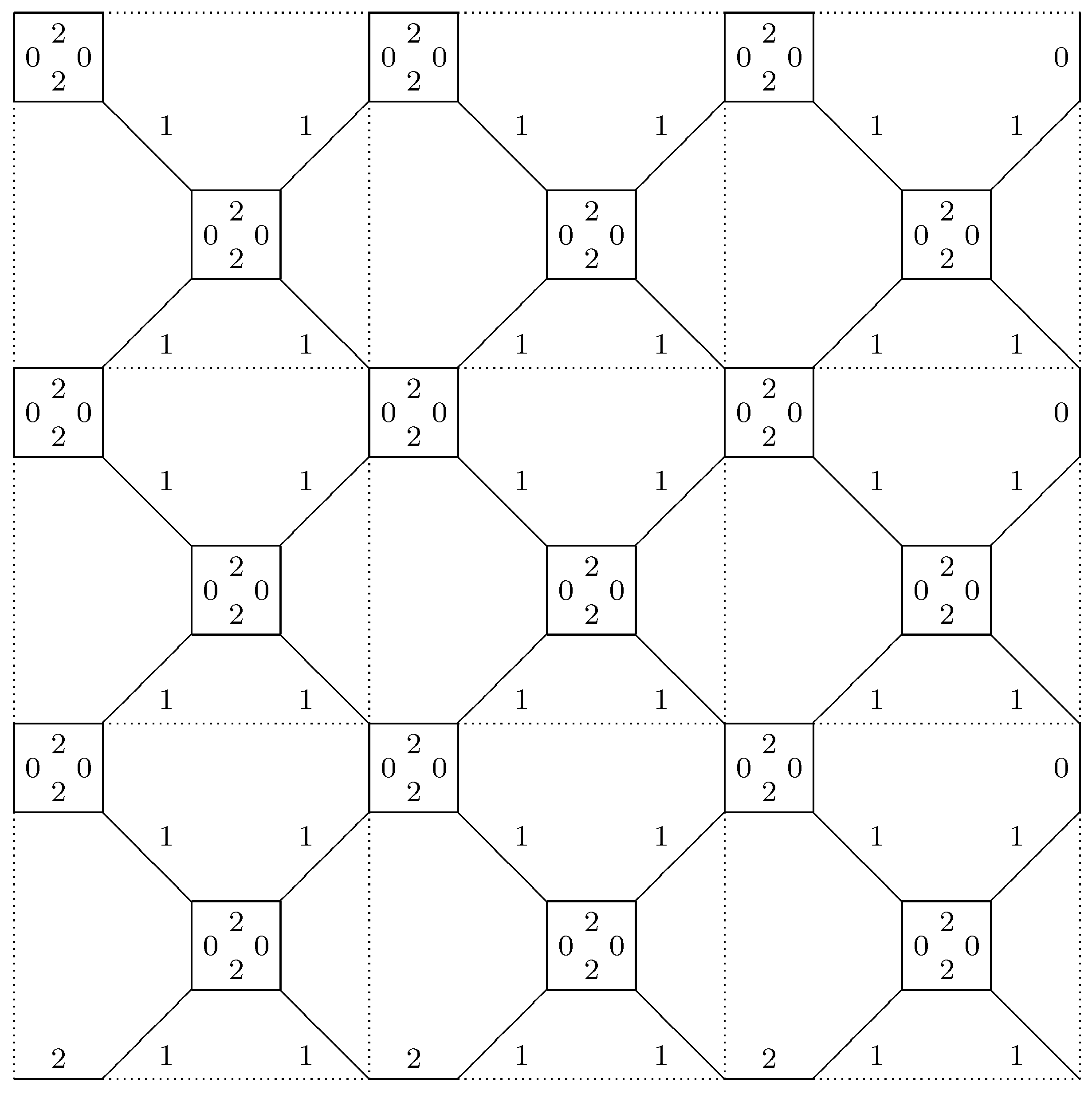
Start by considering the Cayley graph
G of
Starting at a vertex and building out from it, we see that the Cayley graph of this group is the uniform tiling
of the plane by squares and octagons.
Figure 1 gives a local picture of
G.
Now, let us see what happens when we introduce the remaining relations and . We note that the components of G induced by edges labeled 0 and 1 are vertical zigzags, while the components of G induced by edges labeled 1 and 2 are horizontal zigzags. Therefore, adding the relation forces an identification between points that are s tiles away vertically, and adding the relation forces an identification between points that are s tiles away horizontally. Therefore, the Cayley graph of consists of an grid of tiles, with opposite sides identified. Each tile has 8 vertices, so there are a total of vertices, which shows that the given group has elements. Therefore the given group is indeed the mix.
Now we consider , which is the quotient of by the extra relation . Put another way, we get the quotient of by the extra relation . Using the Cayley graph from before, we see that the relation forces us to identify each tile with the tiles that touch it at a corner. When s is odd, this forces every tile to be identified, leaving us with a Cayley graph with 8 vertices. When s is even, we instead get 2 distinct tiles, and the Cayley graph has 16 vertices. Therefore, if s is odd, and if s is even. In other words, if , then , and if , then .
Now suppose that . This polyhedron is covered by (which is equal to , as we observed earlier); therefore, covers . Calculating the size of the mix, we find that , and thus these two groups must be equal. From this it easily follows that , and thus .
Next we consider the polyhedra
, which are the torus maps
with
flags [
7]. First, suppose that
, so that
. Then
, which has order 64. Therefore, by Proposition 3.3,
Now,
is of type
, and
is the universal polyhedron of type
. Thus
is
or a proper quotient. Since
covers
, so does
. Then since
also covers
, so does
, and thus the comix is the whole group
. Thus we see that
Now suppose that
, so that
. Then
, which has size 8. Therefore,
Now,
is of type
and
is the universal polyhedron
. Thus
is
or a proper quotient. Clearly,
covers
. Furthermore,
covers
and
covers
; therefore, their mix covers
, which covers
. Therefore, the comix is the whole group
of order 16, and we see that
It would be natural here to consider the torus maps . However, in this case there are 6 distinct polyhedra under the duality operations, and the problem seems to be intractable.
Finally, we note that the self-dual, self-Petrie covers of and have groups of the same order. In fact, since covers , these two polyhedra have the same self-dual, self-Petrie cover.