1. Introduction
Let
G be a finite group. Given an element
, the
symmetry on
G with the
centre g is the mapping
This is an old notion, which can be found in the book [
1]. And it is a very natural one, since
where
are the left translation, the right translation, and the inversion, respectively. Indeed, it follows from
that
, so
. Consequently,
. Similarly,
. Then
A subset is symmetric if it is invariant with respect to some symmetry on G. Equivalently, S is symmetric if there exists an element (centre of symmetry) such that .
Given , an r-coloring of G is any mapping .
Definition 1.1 For every finite group and , define the numbers and as follows.
is the greatest number of the form , where such that for every r-coloring of G there exists a monochrome symmetric subset of cardinality k.
is the greatest number of the form , where such that for every r-coloring of G there exists a subset of cardinality k and element g such that for all .
It is easy to see that
For every finite Abelian group
G,
, and consequently,
[
2]. In the non-Abelian case this inequality fails [
3]. In this note we describe groups with
,
, and
. Since the journal [
2] is not easy to access and it is in Ukrainian, we give here also a short proof of the inequality from [
2].
2. The Inequality
In this section we prove the following theorem.
Theorem 2.1 Let
G be a finite group of odd order or any finite Abelian group, and let
. Then
and consequently
Let
G be a finite group. For every
r-coloring
and
, let
and let
Then
For every
, let
Lemma 2.2 For every
,
where
.
Proof Computing in two ways the number of all triples
such that
, we obtain
It remains to notice that
Proof of Theorem 2.1 Let
and let
. By Lemma 2.2
If
G has odd order, then
for any
. Since the function
, where
, attains minimum when
,
If
G is Abelian, then
if and only if
and in this case
. Let
be cosets of
G modulo
,
. Then
Therefore, in each case, there exists an element
such that
and so
.
3. Finite Abelian Groups with and
In this section we describe finite Abelian groups with and .
Theorem 3.1 if and only if r divides .
Proof Define the subgroups and . Denote and . Obviously, .
Consider first the case when
r does not divide
m. Fix any
r-coloring
of a group
G. Let
be cosets of
G modulo
,
. Then
Hence,
Therefore, there exists an element
such that
and so
.
Now consider the case where r divides m. By Theorem 2.1, , so it suffices to construct a coloring with . Pick subgroup H of a group G such that and . Then . Define r-coloring of G as follows:
(1) every coset of G modulo is monochrome;
(2) every r cosets of G modulo which form a coset of G modulo are colored in r different colors.
Then
So
for every
. Therefore
.
Theorem 3.2 if and only if one of the following cases holds:
- (1)
;
- (2)
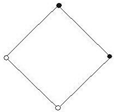
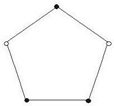
and G is a cyclic group of order either 3 or 5;
- (3)
G is a Boolean group.
Proof Sufficiency is obvious. We need to prove Necessity. Assume on the contrary that neither of cases (1)–(3) holds.
Suppose first that
is even. Then both subgroups
and the elementary Abelian 2-group
are different from
G. Pick
such that
and
. Define
by
Let
. Since
,
. If
, then
, because
. It follows that either
or
, a contradiction.
Now suppose that is odd. Then . Since , we can choose distinct such that for any distinct , .
To see this, pick any distinct . There is a unique such that . We then pick .
Define
by
Let
. If
and
, then
. If
, say
, then
. It follows that there is
such that
, again a contradiction.
Remark Theorem 3.2 describes finite Abelian groups where each
r-coloring is symmetric. A coloring
of
G is
symmetric if there exists
such that
Obviously, the number of all
r-colorings of a group
G of order
n equals
. To find the number of all symmetric
r-colorings of a group
G is a quite complicated exercise involving Möbious inversion on the lattice of subgroups. Precise formula for the number of all symmetric
r-colorings of finite Abelian group was established in [
4], and the corresponding formula for every finite group has been found only recently [
5] (for the quaternion group, see [
6]).
4. Finite Abelian Groups with
In this section we prove the following.
Theorem 4.1 Let G be a finite Abelian group and .
- (1)
If G contains subgroup , then ;
- (2)
If G does not contain subgroup , then .
We first prove some auxiliary statements.
Lemma 4.2 .
Proof Define the coloring
by
Fix
. If
, then
. It remains to notice that
.
For every group G and a coloring , let denote the cardinality of the largest monochrome symmetric subset of G divided by .
Lemma 4.3 Let G be a finite group, let be a surjective homomorphism and let be a coloring of H. Define coloring of G by . Then .
Proof Let
S be a monochrome subset of
G symmetric with respect to
. By definition of
it follows that
if and only if
. So,
is a monochrome subset of
H symmetric with respect to
. Since
,
Thus
.
Conversely, let
S be a monochrome subset of
H symmetric with respect to
. Then
is a monochrome subset of
G symmetric with respect to any
. Since
,
Thus
.
Corollary 4.4 Let G be a finite group and let H be a homomorphic image of G. Then .
Proof of Theorem 4.1 (1) By Theorem 2.1, we have that . If G contains subgroup , then there exists a homomorphism from G onto . Thus, by Corollary 4.4, . By Lemma 4.2, . Thus .
(2) Suppose that
G does not contain
. Then
for some subgroup
H of odd order and Boolean group
B (which can be trivial). Let
be an arbitrary 2-coloring of
G. For every
define the coloring
on
H by
. Then
Since
H has odd order, we obtain that
Then
It follows that there exists
such that
Consequently,
and hence
Theorem 4.1 implies the following two criteria.
Corollary 4.5 For every finite Abelian group G, if and only if G contains subgroup .
Corollary 4.6 if and only if .
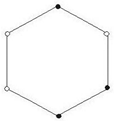
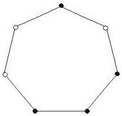
Below we give the corresponding coloring.

We conclude the paper with the following table (
Table 1).