


Abstract
A new family of graph operations based on multipartite graph with an arbitrary number of parts is defined and their applications are explored in this paper. The complete spectra of graphs derived from multipartite graphs are determined. Because the adjacency matrix of the multipartite graph is symmetric, we can use it to generate an unlimited number of special symmetric graphs. Methods for generating countless new families of integral graphs using these multipartite graph operations have been presented. By applying these multipartite graph operations, we can construct infinitely many orderenergetic graphs from orderenergetic or non-orderenergetic graphs. Additionally, infinite pairs of equienergetic and non-cospectral graphs can be generated through these new operations. Moreover, this kind of graph operation can also be used to construct other special graphs related to eigenvalues and energy.
1. Introduction
Let be a graph with order where is the vertex set and is the edge set. Usually, we use and to denote the complete multipartite graph with order and a complete graph of order The m-splitting graph of a graph G is obtained by adding to each vertex v of G new m vertices, say such that is adjacent to each vertex that is adjacent to v in The m-shadow graph of a connected graph G is obtained by taking m copies of G, say then joining each vertex u in to the neighbors of the corresponding vertex v in
A duplicate graph of is where the vertex set and W is a set, such that and is bijective (for , we write as for convenience), the edge set of is defined as the edge is in E, if and only if both and are in The adjacency matrix of the graph G is a symmetric matrix, where if otherwise, . The characteristic polynomial of the graph G is the characteristic polynomial of the adjacency matrix and is defined as Let be the eigenvalues of the adjacency matrix ; then, the spectrum of the graph G is The energy of graph G is defined as
This concept was first introduced by Gutman [1] as a way to approximate the total -electron energy of a molecule, and has since been studied in a remarkably large number of papers [2,3,4,5,6].
The problem of classifying graphs based on their eigenvalues and energy has consistently received widespread attention in the academic community. A graph G is integral if all of its eigenvalues are integers [7]. Two graphs are said to be a pair of equienergetic and non-cospectral graphs if their energies are equal but their spectra are different [8]. The construction of the integral graphs and equienergetic graphs can be found in [9,10,11,12]. A graph G of order n is said to be borderenergetic if This definition was first proposed in [13]. The borderenergetic graph has been studied in these papers [13,14,15,16,17]. If then the graph is called a hyperenergetic graph [18] and if the graph is called a hypoenergetic graph [19]. Recently, orderenergetic graphs were defined in [20]; a graph is said to be orderenergetic if its energy is equal to its order. These special graphs, related to eigenvalues and energy, have several applications in theoretical chemistry. It has been shown that complete bipartite graphs, and , are all connected orderenergetic graphs for any positive integer p, and computer searches have been conducted for all orderenergetic-connected graphs with orders of up to In [21], the authors provided an infinite amount of complete multipartite orderenergetic graphs with an unusually large number of parts. Some researchers have also constructed orderenergetic graphs using the join of a regular graph, complete bipartite graphs and their complements [22,23,24]. The authors also generated orderenergetic, hypoenergetic, and equienergetic graphs by discussing the m-splitting, m-shadow, and duplicate graphs in [22].
In recent years, several new graph operations have been introduced to construct special graphs related to eigenvalues and energy in [25,26]. Based on this, we aim to explore an additional series of graph operations to generate these special graphs. In this paper, we propose a new family of graph operations based on non-complete multipartite graphs with an arbitrary number of parts. These non-complete multipartite graphs are integral regular graphs when the graph has an even number of parts. When the number of parts is odd, we also provide sufficient conditions for these multipartite graph operations to generate integral graphs. Through this new family of graph operations, we propose methods to generate an infinite amount of orderenergetic graphs and infinite pairs of equienergetic graphs. Compared with previous constructions, we did not use special graphs such as regular graphs, complete graphs, or complete multipartite graphs for our construction. Instead, we used non-complete multipartite graphs. Even though such multipartite graphs are normal when the graph has an even number of parts, the special graphs we generated differed, as the graph operations we employed were distinct.
This paper is organized as follows. In Section 2, we outline some known results that were needed to prove the main theorems. The new family of non-complete multipartite graph operations are introduced in Section 3. The spectra of the graphs derived from non-complete multipartite graph operations are expressed in Section 4. The applications of the non-complete multipartite graph operations are presented in Section 5. Finally, we conclude with the main results and discuss future works in Section 6.
2. Preliminaries
In this section, we recall the concepts of the floor and celling of a real number and list some known results from the m-splitting graph, as well as the theory of matrices as lemmas, which are needed to prove the main theorem [26].
The floor of a real number written as is the largest integer that is less than or equal to The celling of a real number written as is the smallest integer that is greater than or equal to x [27]. The energy of the m-splitting graph can be calculated using the following result.
Lemma 1
([22]).
Lemma 2
([26]). If A and D are square matrices (need not be same order) and B and C are matrices with compatible orders, then the determinant of the following block matrix is given by
provided or exists.
Lemma 3
([25]). Let A be an -order square matrix with eigenvalues and B be an order square matrix with eigenvalues Then, the eigenvalues of the square matrix of the order are given by all possible products for and which is in number.
Lemma 4
([26]). If is a order square matrix, then
3. Multipartite Graph Operations
In this section, the new multipartite graph operations will be proposed as follows. Let G be a graph with order n and number of edges Take p copies of denoted by and take number of isolated vertices for some positive integer Let the n vertices of be for Let the isolated vertices be named as and where and Then construct the new graph from the graphs and the isolated vertices as follows.
- The edges in are obtained as follows. If is adjacent to in for then
- the edges and for all
- the edges and for all
- the edges and for all and
- the edges and for all and
- the edges and for all and
From the construction of these edges, it is easy to see that the new graph is a symmetric graph. The total number of vertices in the derived graph will be and the total number of edges will be
It is not hard to see that the adjacency matrix of the new graph derived from the defined operations is given by the following Kronecker product
where is the adjacency matrix of the graph is a square matrix of order whose block matrix representation is given by
where represents the all one matrix of order represents the identity matrix of order p and represents a zero matrix of order It is clear that this block matrix corresponds exactly to the adjacency matrix of a multipartite graph, which we will denote as
From the adjacency matrix of the multipartite graph it can be seen that the degree of the vertices of falls into two categories, and Then the graph is regular when m is even and or when is odd and However, will not be a complete graph because its adjacency matrix contains the identity matrix.
When we have the following example.
Example 1.
Let G be a graph with order n and number of edges Take p copies of denoted by for and take number of isolated vertices for some positive integer Let the n vertices of be for Let the isolated vertices be named as and where and A new graph can be constructed by the graph and the isolated vertices and as follows.
- 1.
- 2.
- The edges in are obtained as follows. If is adjacent to in for then
- the edges and for all
- the edges and for all
- the edges and for all and
The total number of vertices in the derived graph will be and the total number of edges will be
It is not hard to see that the block matrix corresponding to this new graph can be expressed as follows.
The graph is derived from the complete graph and the graph operation based on multipartite graph that is shown in Figure 1.
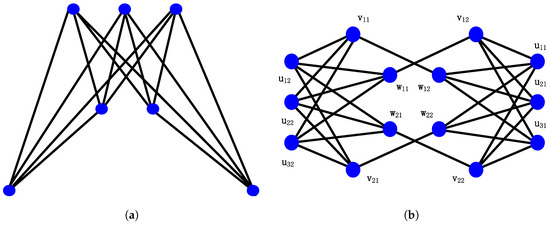
Figure 1.
The graphs from Example 1. ((a) is the multipartite graph ; (b) is the graph ).
When the order of the multipartite graph is even, we set and use to replace The following multipartite graph operation is from
Example 2.
Let G be a graph with order n and number of edges Take p copies of denoted by for and take number of isolated vertices for positive integer Let the n vertices of be for Let the isolated vertices be named as and where and The new graph can be constructed by the graph and the isolated vertices and as follows.
- 1.
- 2.
- The edges in are obtained as follows. If is adjacent to in for then
- the edges and for all
- the edges and for all
- the edges and for all
- the edges and for all
- the edges and for all
The total number of vertices in the derived graph will be and the total number of edges will be
It is not hard to see that the block matrix corresponding to this new graph can be expressed as follows.
The graph is derived from the complete graph and the graph operation based on multipartite graph that is shown in Figure 2.
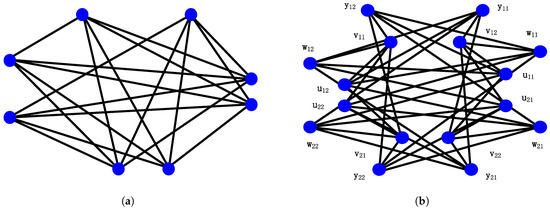
Figure 2.
The graphs from Example 2. ((a) is the multipartite graph ; (b) is the graph ).
4. Spectra of the Graphs Derived from the Multipartite Graph Operations
The spectra of the graphs and will be found out in this section respectively, where k is any positive integer. The graph is derived from a graph G and the operation based on multipartite graph with odd order. The graph is derived from a graph G and the operation based on multipartite graph with even order.
4.1. Spectrum of the Graph
Firstly, we calculate the complete spectrum of the graph The spectrum of Example 1 was then proposed.
Theorem 1.
If G is a graph of order n whose non-zero eigenvalues are given by for some then the non-zero eigenvalues of the graph derived from G and are with multiplicity with multiplicity and with multiplicity for which are numbers. Also, zero is an eigenvalue with multiplicity
Proof.
Since the characteristic polynomial of the adjacency matrix of multipartite graph is given by
According to Lemma 2,
Subtract the first row from all odd rows and the second row from all even rows.
We add all odd columns to the first column and all even columns to the second column, then apply the Lemma 2 to obtain the following result.
So, the non-zero eigenvalues of the matrix are with multiplicity with multiplicity k with multiplicity Let and are the adjacency matrices of the graphs G and respectively, then . Then from Lemma 3 the theorem follows. □
When the following corollary can be obtained.
Corollary 1.
If G is a graph of order n whose non-zero eigenvalues are given by for some then the non-zero eigenvalues of the graph derived from G and are with multiplicity with multiplicity for which are number. Also, zero is an eigenvalue with multiplicity
Proof.
Since the characteristic polynomial of the adjacency matrix of multipartite graph is given by
According to Lemma 2,
So, the non-zero eigenvalues of the matrix are with multiplicity 1 with multiplicity Let and are the adjacency matrices of the graphs G and respectively, then . Then from Lemma 3 the corollary follows. □
4.2. Spectrum of the Graph
Firstly, we calculate the complete spectrum of the graph The spectrum of Example 2 was then given.
Theorem 2.
If G is a graph of order n whose non-zero eigenvalues are given by for some then the non-zero eigenvalues of the graph derived from G and are with multiplicity with multiplicity for which are number. Also, zero is an eigenvalue with multiplicity
Proof.
Since the characteristic polynomial of the adjacency matrix of multipartite graph is given by
Now, we will replace and with J and respectively. According to Lemma 2,
Add the negative of the first row to each odd row and the negative of the second row to each even row.
Add all the odd columns to the first column and all the even columns to the second column, then apply the Lemma 2 to obtain the following result.
So, the non-zero eigenvalues of the matrix are with multiplicity with multiplicity Let and are the adjacency matrices of the graphs G and respectively, then . Then from Lemma 3 the theorem follows. □
Similarly, we have the following corollary when
Corollary 2.
If G is a graph of order n whose non-zero eigenvalues are given by for some then the non-zero eigenvalues of the graph derived from G and are with multiplicity with multiplicity for which are number. Also, zero is an eigenvalue with multiplicity
Proof.
The characteristic polynomial of the adjacency matrix of multipartite graph is given by
Nextly, we will substitute with J and with respectively. According to Lemma 2,
So, the non-zero eigenvalues of the matrix are with multiplicity 1 with multiplicity Let and are the adjacency matrices of the graphs G and respectively, then . Then from Lemma 3 the corollary follows. □
5. Applications of Multipartite Graph Operations
In this section, we will discuss several applications of the multipartite graph operations in the construction of integral, orderenergetic and equienergetic graphs.
5.1. Applications of Graph Operation Based on Multipartite Graph with Odd Order
From this kind of multipartition graphs with odd order, we can characterize some of the derived graphs which are integral graphs.
Theorem 3.
Let G be an integral graph of order Then the graph derived from and G is an integral graph if for some positive integer
Proof.
Let G be an integral graph of order Then from Theorem 1, is also an integral graph if are integers. This will happen only when is a perfect square. Let where is non-negative integer valued function. Then
The general integer value function making this a perfect square is so that So the required value of Then the eigenvalues of become and for some positive integer So, from Theorem 1 it follows that the eigenvalues of are integers and so is an integral graph if G is an integral graph. □
The next theorem gives a general method for generating orderenergetic graphs from a given graph.
Theorem 4.
Let G be any graph on n vertices with integral energy If are all positive integers satisfying
then the graph derived from and G with is an orderenergetic graph.
Proof.
Similarly, we have the following corollary when
Corollary 3.
Let G be an integral graph of order Then the graph derived from and G is an integral graph when for any positive integer
Corollary 4.
Let G be any graph on n vertices with integral energy If s is a positive integer satisfying
Then the graph derived from and G with is always an orderenergetic graph.
Based on the aforementioned theorem and corollary, we can generate numerous orderenergetic graphs and equienergetic graphs. The following are some of the results.
Corollary 5.
If G is an orderenergetic graph on n vertices, then the sequence of graphs derived from and G are also orderenergetic graphs with order for any positive integer
Proof.
The result follows from Corollary 4 by setting and noting that
□
Corollary 6.
If G is an orderenergetic graph on n vertices, then the sequence of graphs derived from and are orderenergetic graphs with order .
Proof.
From Theorem 1, we have
where is the order of the graph So the graph is an orderenergetic graph. □
Similarly, the following corollary can be obtained.
Corollary 7.
The sequence of graphs derived from and are orderenergetic graphs with order for any positive integer
These multipartite graph operations can also be used to generate equienergetic graphs.
Corollary 8.
Let G be any graph, then the pair of graphs and are non-cospectral equienergetic graphs of same order, for any positive integer Moreover if the graph G is an integral graph and is a positive integer for some positive integer then all the pairs of equienergetic graphs are also integral graphs.
Corollary 9.
Let G and be a pair of equienergetic graphs, then the graphs and are also pair of equienergetic graphs for any positive integer
5.2. Applications of Graph Operation Based on Multipartite Graph with Even Order
According to the Theorem 2, we know the multipartite graphs are all integral graphs for any positive integer From this kind of multipartition graphs with even order, we can characterize some of the graphs which are orderenergetic graphs.
Theorem 5.
Let G be any graph on n vertices with integral energy If k is a positive integer satisfying
then the graph derived from and G is an orderenergetic graph.
Proof.
Similarly, we also have the following corollary when
Corollary 10.
Let G be any graph on n vertices with integral energy If then the graph derived from and G is an orderenergetic graph.
Based on the aforementioned theorem and corollary, we can generate numerous orderenergetic graphs and equienergetic graphs. The following are some of the results.
Corollary 11.
The sequence of graphs derived from and are orderenergetic graphs with order for any positive integer
Proof.
The result follows from Corollary 10
where is the order of the graph So the graph is an orderenergetic graph. □
Similarly, the following results can be obtained.
Corollary 12.
If G is an orderenergetic graph on n vertices, then the sequence of graphs derived from and are orderenergetic graphs with order .
Corollary 13.
The sequence of graphs derived from and are orderenergetic graphs with order for any positive integer
These multipartite graph operations can also be used to generate equienergetic graphs. The following results can be obtained by using Theorem 2 to calculate the energy of the derived graph.
Corollary 14.
Let G and be a pair of equienergetic graphs, then the graphs and are also pair of equienergetic graphs for any positive integer Moreover, if the graphs G and are integral graphs, then all the pair of equienergetic graphs are also integral graphs.
Corollary 15.
Let G and be two orderenergetic graphs with order and respectively. Then the graphs and are a pair of equienergetic graphs.
Corollary 16.
If is a positive integer, then the graphs and are a pair of equienergetic and non-cospectral graphs for some positive integer k and any positive integer
Remark 1.
Similar to the proofs of Theorems 4 and 5, other special graphs related to eigenvalues or energy can be obtained, such as borderenergetic graph, hyperenergetic graph, hypoenergetic graph.
Remark 2.
It is worth noting that we can conclude that the energy of the graph is , while the number of vertices in the graph is , which demonstrates that the graph is exactly a borderenergetic graph.
6. Conclusions
In recent years, Joseph, S. P. proposed several graph operations to generate the special graphs in [25,26]. This paper primarily presents a new class of non-complete multipartite graph operations. These operations can be used to generate special graphs, such as infinitely many integral graphs, orderenergetic graphs, and infinitely many pairs of equienergetic graphs.
In the present work, the special graph related to eigenvalues or energy was mainly constructed by regular graph, complete graphs and complete multipartite graphs as well as their complement. In this paper, the non-complete multipartition graph was used to construct these special graphs. Even though such multipartite graphs are regular when m is even, the graph operations used in our construction are different, leading to inconsistent results.
In future work, we will extend our research in the following areas:
- (i)
- In [28], the authors introduce somen new concepts and operations of type 2 soft graphs. These concepts and operations may assist us in further exploring the construction and properties of these special graphs.
- (ii)
- Furthermore, they characterize type 2 soft graphs on underlying subgraphs of a simple graph in [28]. Investigating the type 2 soft graphs on underlying subgraphs of multipartite graphs is also one of our future research directions.
- (iii)
- Only one new class of non-complete multipartite graph and its associated three parameters are considered in this paper. Further research will explore additional incomplete multipartite graphs and related parameters.
Author Contributions
Conceptualization, Q.L. (Qiuping Li) and Q.L. (Qingyun Liu); methodology, Q.L. (Qiuping Li); validation, L.T.; investigation, Q.L. (Qiuping Li) and M.L.; resources, Q.L. (Qiuping Li); writing—original draft preparation, Q.L. (Qiuping Li) and M.L.; review and editing, Q.L. (Qiuping Li) and L.T. All authors have read and agreed to the published version of the manuscript.
Funding
This research was funded by the Scientific Research Fund of Hunan Provincial Education Department (22A0502, 23C0228, 23C0240).
Data Availability Statement
Data are contained within the article.
Conflicts of Interest
The authors declare no conflicts of interest.
References
- Gutman, I. The energy of a graph. Ber. Math. Stat. Sekt. Forschungszent. Graz. 1978, 103, 1–22. [Google Scholar]
- Zhao, J.; Hameed, S.; Ahmad, U.; Tabassum, A.; Asgharsharghi, L. Sequence of Bounds for Spectral Radius and Energy of Digraph. Symmetry 2024, 16, 1386. [Google Scholar] [CrossRef]
- Ilić, A.; Bašić, M. Path matrix and path energy of graphs. Appl. Math. Comput. 2019, 355, 537–541. [Google Scholar] [CrossRef]
- Nikiforov, V. The energy of graphs and matrices. J. Math. Anal. Appl. 2007, 326, 1472–1475. [Google Scholar] [CrossRef]
- Yang, X.; Wang, L. On the ordering of bicyclic digraphs with respect to energy and iota energy. Appl. Math. Comput. 2018, 339, 768–778. [Google Scholar] [CrossRef]
- Xu, B.; Li, S.; Yu, R.; Zhao, Q. On the spectral radius and energy of the weighted adjacency matrix of a graph. Appl. Math. Comput. 2019, 340, 156–163. [Google Scholar] [CrossRef]
- Harary, F.; Schwenk, A.J. Which graphs have integral spectra? In Graphs and Combinatorics; Bari, A., Harary, F., Eds.; Springer: Berlin, Germany, 1974; pp. 45–51. [Google Scholar]
- Ramane, H.S.; Walikar, H.B.; Rao, S.B.; Acharya, B.D.; Hampiholi, P.R.; Jog, S.R.; Gutman, I. Equienergetic graphs. Kragujevac J. Math. 2004, 26, 5–13. [Google Scholar]
- Bašić, M.; Ilić, A.; Stamenković, A. Maximal diameter of integral circulant graphs. Inf. Comput. 2024, 301, 105208. [Google Scholar] [CrossRef]
- Solymosi, J. Integral and rational graphs in the plane. Graphs Comb. 2024, 40, 107. [Google Scholar] [CrossRef]
- Tang, L.W.; Liu, J.; Qin, S. Construction of Equienergetic Trees. MATCH Commun. Math. Comput. Chem. 2024, 91, 485–488. [Google Scholar] [CrossRef]
- Liu, F.; Su, K.; Wang, W.; Zhang, H. Non-cospectral equienergetic trees of diameter at most four. Appl. Math. Comput. 2025, 487, 129104. [Google Scholar] [CrossRef]
- Gong, S.; Li, X.; Xu, G.; Gutman, I.; Furtula, B. Borderenergetic graphs. MATCH Commun. Math. Comput. Chem. 2015, 74, 321–332. [Google Scholar]
- Li, J.; Deng, B.; Jin, X.; Lv, X. Q-borderenergeticity under the graph operation of complements. Appl. Comput. Math. 2022, 11, 81–86. [Google Scholar] [CrossRef]
- Li, Q.; Tang, L. Infinite numbers of infinite classes L-borderenergetic graphs. MATCH Commun. Math. Comput. Chem. 2023, 90, 729–742. [Google Scholar] [CrossRef]
- Dede, C.; Maden, A.D. Bounds on the Parameters of Non-L-Borderenergetic Graphs. Ukr. Math. J. 2024, 75, 1388–1406. [Google Scholar] [CrossRef]
- Cahit, D. New families of Laplacian borderenergetic graphs. Acta Inform. 2024, 61, 1–15. [Google Scholar] [CrossRef]
- Gutman, I. Hyperenergetic molecular graphs. J. Serb. Chem. Soc. 1999, 64, 199–205. [Google Scholar]
- Gutman, I.; Radenković, S. Hypoenergetic molecular graphs. Indian J. Chem. 2007, 46, 1733–1736. [Google Scholar]
- Akbari, S.; Ghahremani, M.; Gutman, I.; Koorepazan–Moftakhar, F. Orderenergetic graphs. MATCH Commun. Math. Comput. Chem. 2020, 84, 325–343. [Google Scholar]
- Stanković, I.; Milošević, M.; Stevanović, D. On complete multipartite orderenergetic graphs. MATCH Commun. Math. Comput. Chem. 2024, 92, 739–749. [Google Scholar] [CrossRef]
- Jahfar, T.K.; Chithra, A.V. Orderenergetic, hypoenergetic and equienergetic graphs resulting from some graph operations. J. Math. Comput. Sci. 2021, 11, 5501–5513. [Google Scholar] [CrossRef]
- Rakshith, B.R.; Das, K.C. On orderenergetic graphs. MATCH Commun. Math. Comput. Chem. 2024, 92, 73–88. [Google Scholar] [CrossRef]
- Li, Q.; Tang, L.; Liu, Q.; Lin, M. Construction of orderenergetic graphs. MATCH Commun. Math. Comput. Chem. 2024, 92, 729–738. [Google Scholar] [CrossRef]
- Joseph, S.P. A graph operation and its applications in generating orderenergetic and equienergetic graphs. MATCH Commun. Math. Comput. Chem. 2022, 87, 703–715. [Google Scholar] [CrossRef]
- Joseph, S.P. Several methods for generating families of orderenergetic, integral and equienergetic graphs. MATCH Commun. Math. Comput. Chem. 2023, 89, 665–686. [Google Scholar] [CrossRef]
- Koshy, T. Discrete Mathematics with Applications; Elsevier: Amsterdam, The Netherlands, 2004. [Google Scholar]
- Hayat, K.; Cao, B.Y.; Ali, M.I.; Karaaslan, F.; Qin, Z.J. Characterization of certain types of type-2 soft graphs. Discret. Dyn. Nat. Soc. 2018, 2018, 8535703. [Google Scholar] [CrossRef]
Disclaimer/Publisher’s Note: The statements, opinions and data contained in all publications are solely those of the individual author(s) and contributor(s) and not of MDPI and/or the editor(s). MDPI and/or the editor(s) disclaim responsibility for any injury to people or property resulting from any ideas, methods, instructions or products referred to in the content. |
© 2025 by the authors. Licensee MDPI, Basel, Switzerland. This article is an open access article distributed under the terms and conditions of the Creative Commons Attribution (CC BY) license (https://creativecommons.org/licenses/by/4.0/).