


Abstract
Narrowband Internet of Things (NB-IoT) was designed as a key Low-Power Wide-Area Network technology when 5G networks were established. The ideal quadrature demodulation in NB-IoT relies on the fundamental symmetry between the in-phase (I) and quadrature (Q) branches, characterized by a perfect 90-degree phase shift and matched amplitude. However, practical hardware imperfections in mixers, filters, and ADCs break this symmetry, leading to I/Q imbalances. Moreover, I/Q imbalance is coupled with carrier frequency offset (CFO), which arises from asymmetry in the frequency of the transceiver oscillator. In this paper, we propose a model-embedded lightweight network for joint CFO and I/Q imbalance estimation for NB-IoT systems. An I/Q imbalance compensation model is embedded as a layer to connect two subnetworks, I/Q estimation network (IQENET) and CFO estimation network (CFOENET). By embedding the physical model, the network gains the capability to learn the features of coupling effects during the training process, as the image signals caused by I/Q imbalance are removed before CFO estimation. A phased training strategy is also proposed. In the first phase, the two subnetworks are pre-trained independently. In the second phase, they are fine-tuned jointly to deal with the coupling effects. Simulation results show that the proposed network achieves high estimation accuracy while maintaining low complexity.
1. Introduction
Narrowband Internet of Things (NB-IoT) is designed to provide massive connectivity, wide coverage, low power consumption, and low cost for Internet of Things devices as a key Low-Power Wide-Area Network (LPWAN) technology [1]. NB-IoT employs orthogonal frequency division multiplexing (OFDM) due to its low computational complexity and excellent spectral efficiency. However, in actual deployment, the low equipment cost and small size limit the performance of the radio-frequency (RF) front-end hardware, making it susceptible to various non-ideal factors.
Hardware impairments may be caused by factors such as in-phase/quadrature-phase (I/Q) imbalance, carrier frequency offset (CFO), and phase noise [2,3]. At low frequency bands, phase noise has a relatively minor impact and can often be neglected, making I/Q imbalance and CFO the dominant non-ideal factors that require attention.
In the concept of quadrature demodulation, the I and Q channels are designed to be perfectly symmetric with only a precise 90° phase shift. This inherent structural symmetry is crucial for accurate signal representation. However, in practice, the analog components responsible for maintaining this symmetry, namely, the local oscillator, mixers, low-pass filters, and ADC, are inherently non-ideal. The amplitude and phase mismatches in these components break the pristine symmetry of the system. This symmetry breaking manifests as the well-known I/Q imbalance. In the presence of I/Q imbalance, the spectrum of the image signal overlaps with that of the desired signal, causing self-interference to the desired signal. This interference cannot be mitigated by increasing the transmission power nor eliminated through filtering. When the image frequency of a high-amplitude signal overlaps with a low-amplitude subcarrier, the low-amplitude signal could be completely overwhelmed by the interference from the high-amplitude signal. It is impossible to demodulate the weak signal successfully under any circumstances [4].
CFO arises from a breach of frequency symmetry between the transmitter and receiver oscillators. Ideal coherent detection requires identical carrier frequencies—a state of perfect frequency symmetry. The presence of CFO disrupts the orthogonality symmetry among OFDM subcarriers, thereby introducing inter-carrier interference (ICI) and resulting in significant system performance degradation [5].
Beyond the impact of single hardware impairments, in actual systems, the estimation of I/Q imbalance and CFO are coupled with each other. The phase rotation caused by CFO will exacerbate the signal distortion caused by I/Q imbalance, while the image signal generated by I/Q imbalance will interfere with the accurate estimation of CFO [6,7]. For the amplified coupling effects in the low-performance RF components, the conventional estimation methods focusing on single hardware impairment may not be suitable, necessitating the joint estimation of I/Q imbalance and CFO.
Traditional methods for jointly estimating I/Q imbalance and CFO fall into two main categories. These are blind estimation methods and data-aided methods. Blind estimation methods do not require pilot signals, relying instead on inherent features of the data signals, often statistical properties such as the circular symmetry of complex Gaussian distributions [8], constant modulus characteristics [9], or zero-number properties [10]. Such methods usually have a longer delay, as they need longer observation intervals to obtain stable statistical information, or require specially designed transmit signals, thereby limiting their applicability. Data-aided methods, on the other hand, insert training sequences [11] or pilots [12] for parameter estimation. These approaches generally achieve higher accuracy and faster convergence but at the cost of reduced transmission efficiency and lower bandwidth utilization.
Traditional methods estimate CFO and I/Q imbalance in a serial manner—for example, by proposing a CFO estimation method robust to I/Q imbalance, combined with a separate I/Q imbalance estimation method, to achieve joint estimation. However, such traditional signal processing approaches cannot avoid error propagation and accumulation. Strictly speaking, these methods only consider one-way coupling rather than mutual bidirectional coupling and do not constitute true joint estimation methods.
In recent years, emerging research has turned to deep learning (DL) methods to achieve genuine joint estimation. To be specific, hardware impairment estimation in wireless communication systems based on deep learning has been extensively studied [13,14,15,16,17]. These data-driven methods eliminate the need for prior knowledge but their neural network with excessive parameters results in high computational complexity. Existing deep learning algorithms adopt an end-to-end approach, treating these impairments along with other channel effects as a single black box. This methodology fails to leverage the inherent physical models of these individual impairments, resulting in unbearable complex network structures. We summarize the three types of methods in the following Table 1.

Table 1.
Comparison of different estimation method categories.
This paper aims to address this research gap by introducing a physical model for I/Q imbalance compensation, thereby simplifying the structure and parameter count of the deep learning network, making it more suitable for deployment on low-cost, low-power NB-IoT nodes. Our major contributions of this paper are listed as follows.
- A network was designed that explicitly embeds the compensation method into the network structure. Specifically, an I/Q imbalance compensation layer is designed to connect the two subnetworks IQENET and CFOENET, which estimate I/Q imbalance and CFO separately. This design explicitly embeds the physical model into the network architecture.
- A phased training strategy is adopted, preserving the individual estimation accuracy of the two subnetworks while capturing their intrinsic coupling relationship.
- The proposed model-embedded architecture and phased training strategy together enable a lightweight design. Simulation results show that the proposed DL-based method achieves high estimation accuracy within the typical SNR range of the NB-IoT devices while maintaining low complexity.
The rest of this paper is structured as follows. In Section 2, we introduce the OFDM system model impaired by I/Q imbalance and CFO, along with the principles for their compensation. Section 3 details the proposed DL framework, which consists of two subnetworks, namely IQENET and CFOENET, cascaded by the I/Q imbalance compensation layer. A phased training strategy is also described in this section. Section 4 presents a series of simulation experiments, where the performance of the proposed method is compared with existing algorithms and the effectiveness of the network architecture is validated. Finally, Section 5 concludes the paper.
Notations: and represent conjugate and transpose; is the imaginary unit; diag(a) is a diagonal matrix with the main vector being ; and define the vector space of complex and real matrices, respectively; and denote the real and imaginary parts, respectively. Boldface uppercase letters, boldface lowercase letters, and lowercase letters represent matrices, column vectors, and scalars, respectively.
2. System Model
Let us consider an OFDM system that is subject to both I/Q imbalance and CFO. We assume that there are N subcarriers and OFDM symbols in each subframe. is the length of cyclic prefix. The discrete baseband signal in the b-th time domain OFDM symbol is given by
where denotes the OFDM modulation symbols in the n-th subcarrier. After adding a cyclic prefix, the time domain signal passes through the wireless fading channel, and the received signal of b-th OFDM symbol can be described as
where represents the additive white Gaussian noise.
Now denote as the CFO normalized by carrier intervals. The phase rotation matrix is given by
Hence, the received signal with CFO is
Due to the inevitable amplitude and phase mismatches between the I and Q branches in practical I/Q modulation, let and denote the amplitude and phase mismatch, respectively. The received I/Q signal can be expressed as
After down-conversion, the received signal is given by
where and are defined as I/Q imbalance impairment parameters, and they are given by
and
It can be seen from (7) that the influence of I/Q imbalance lies in introducing the interference of the image signal to the received signal. To compensate for I/Q imbalance, we introduce the parameter , and the parameter needs to satisfy the following equation:
By substituting (7) into (10), we can obtain as
Then, in order to compensate for the CFO, we need to estimate and normalize CFO , and then obtain the compensated time domain received signal
in which represents the estimated normalized CFO.
Therefore, the joint compensation of CFO and I/Q imbalance for the OFDM system can be achieved by estimating parameters and .
3. Methodology
In this section, we propose a model-embedded lightweight network for joint I/Q imbalance and CFO estimation in NB-IoT systems. The network framework is shown in Figure 1. The proposed network consists of I/Q estimation network (IQENET) and CFO estimation network (CFOENET). The original data is input into IQENET to obtain the I/Q imbalance compensation parameter . The I/Q imbalance compensation layer utilizes to remove image signals in the original data before CFO estimation, thereby reducing the coupling effect during joint estimation of I/Q imbalance and CFO. The network architecture is designed based on the end-to-end training algorithm, by directly inputting the data into the network, and the final result is output by the fully connected layer. This section provides a detailed description of the network structure, the training process, and its advantages.
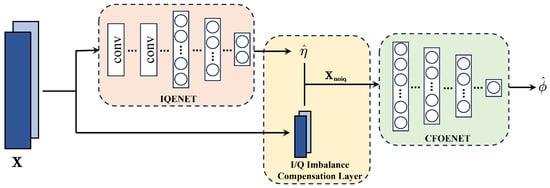
Figure 1.
The network framework of the proposed joint estimation method for CFO and I/Q imbalance in OFDM systems based on deep learning.
3.1. Input Data
Let the number of subcarries be N. Since neural networks cannot handle complex numbers, it is necessary to preprocess the signal. First, separate the real and imaginary parts of each pilot signal. Then, the real part data of the transmitted pilot signal and the real part data of the received pilot signal are alternately arranged to form a real part sequence of length . The imaginary part data are also processed in the same way to obtain an imaginary part sequence. Then, the real part sequence and the imaginary part sequence are stacked to obtain input data . Such a data structure can bring significant advantages in feature extraction in neural networks, especially in CNNs. This forces the convolution kernels of CNNs to simultaneously perceive the real and imaginary parts of the transmitted signal and the corresponding received signal within the local receptive field, naturally capturing the joint features between the transmitted and received signals.
3.2. IQENET
3.2.1. Architecture
I/Q imbalance and CFO arise from different physical mechanisms and are modeled separately. A single monolithic network would need to implicitly learn two entirely different models and their coupling from data alone, resulting in a large, inefficient, and hard-to-train model. This is not suitable for resource-constrained nodes in NB-IoT systems. The proposed IQENET architecture is shown in Figure 2. The input of IQENET is , and the output is the estimated value of the I/Q imbalance compensation parameter . is first passed through four feature extraction blocks and a shared FC net in IQENET, and then the real and imaginary parts of are output by FC1 and FC2, respectively.
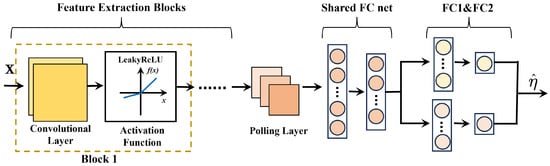
Figure 2.
The architecture of IQENET. The network comprises four feature extraction blocks, an average pooling layer, a shared FC net, and two independent FC branches.
Given that I/Q imbalance exerts a comparatively smaller distortion effect on signals than CFO, its features are inherently more challenging to extract directly from the input data for estimating . To address this limitation, four feature extraction blocks based on CNN are employed. A block includes one convolutional layer, one batch normalization layer, and one activation layer. The output of a feature extraction block can be expressed as
where and denote the weights and biases of the filters in the l-th convolutional layer, respectively. ⊗ denotes the convolution operation, and represents the parametric rectified linear unit (LeakyReLU) activation function for the l-th convolutional layer, which is defined as
where corresponds to the negative slope coefficient. Here is set as 0.01. The network employs four feature extraction blocks followed by an average pooling layer for dimensionality reduction of the data. The convolutional layers in feature extraction blocks are sequentially configured with channel sizes of 32, 16, 32, and 16, and employ kernel sizes of 3, 5, 3, and 5, respectively. The flattened output from the average pooling layer serves as the input to the shared FC network. This network utilizes fully connected layers to learn the common characteristics shared by the real and imaginary parts of . Subsequently, the network branches into two independent subnetworks, FC1 and FC2, which perform regression on the real and imaginary parts of , respectively. The shared FC network has layers with neuron numbers of 64 and 32. The branch networks FC1 and FC2 each have layers with neuron numbers of 16 and 1.
3.2.2. Loss Function
To train IQENET, we employ the mean squared error (MSE) function
where and stand for the batch size and the i-th data sample of the batch.
3.3. CFOENET
3.3.1. Architecture
As shown in Figure 3, the architecture of the proposed CFOENET consists of four fully connected layers. CFOENET takes as input and outputs the estimated value of CFO . is obtained by compensating for the I/Q imbalance in the received signal part of , with the transmitted signal part unchanged. To enhance the network’s nonlinear representation capabilities and accelerate convergence, the batch normalization layer and activation layer are applied after each of the first three fully connected layers.
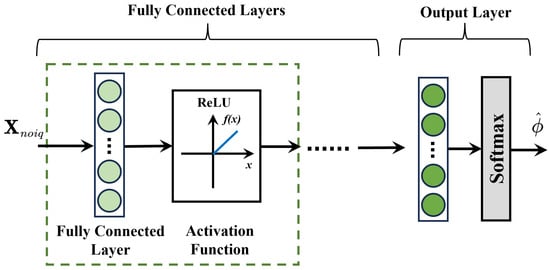
Figure 3.
The architecture of CFOENET. It consists of four fully connected layers, with the first three followed by batch normalization and LeakyReLU activation. The final layer is followed by softmax activation.
Given that the fractional frequency offset exhibits minor variations within a limited range, we reformulate the CFO estimation task as a classification problem [14,17]. A softmax activation function is appended to the last fully connected layer, expressed as
where denotes the activation function of the last layer, and and represent the weight matrix and bias term, respectively. The softmax function transforms multiclass outputs into a probability distribution over [0, 1], formulated as
Here, denotes the output of the i-th neuron in the pre-softmax layer, with representing the probability corresponding to the i-th neuron. Thus, original outputs are transformed into a probability distribution via the softmax transformation. The CFO estimation branch then predicts the class index exhibiting maximum probability
Given the normalized CFO range of [−0.5, 0.5] with 0.01 classification interval and exclusion of , 100 distinct CFO categories are established. The interval size of 0.01 was chosen to balance estimation performance with model complexity. This interval introduces a maximum quantization error of , which is acceptable within NB-IoT systems. A smaller interval would reduce this error only marginally while substantially increasing the number of neurons, thereby raising model complexity and the risk of overfitting. A larger interval would undesirably increase the quantization error.
The final CFO is derived via transformation between class indices and corresponding frequency offsets
where and . To achieve classification probability prediction for 100 distinct CFO values, the number of neurons in four full connected layers is set to 200, 150, 125, and 100.
3.3.2. Loss Function
CFOENET is trained using the cross-entropy loss function, commonly employed for classification tasks. This loss function is defined as
where N and K denote the total number of samples and classes, respectively, is the n-th sample belonging to the k-th category, and represents the predicted probability after softmax activation for the n-th sample with the k-th category.
3.4. I/Q Imbalance Compensation Layer
We introduce the I/Q imbalance compensation layer in the proposed network, which connects IQENET and CFOENET together. The I/Q imbalance compensation layer takes and as inputs and outputs . This layer is designed based on the physical model considered in Section 2. According to (10), assuming is already known, then we can eliminate the image signal to obtain . It is not difficult to derive that , which is a coefficient related to I/Q imbalance impairment parameters and . can be handled during channel estimation, without having to estimate an excessive number of parameters such as and .
It should be noted that the compensation for I/Q imbalance is differentiable and will not cause the gradients of the cascaded two subnetworks to disappear. Denote and as the outputs of IQNET and CFOENET, respectively. and can be obtained from
and
where is the original data obtained by multiplying the received signal part in by , which has been compensated for I/Q imbalance. Denote and as the network parameters for IQENET and CFOENET, respectively. The gradient direction of CFOENET can be given by
The gradient direction of IQENET can be given by
where represents the loss of the entire network. Thus, the updates of the parameters of the two subnetworks will influence each other, which plays an important role in addressing the coupling effect.
3.5. Training Strategy
In Section 2, we establish an OFDM system model with receiver I/Q imbalance and CFO. According to (12), it can be inferred that in order to recover the transmitted signal from the original received signal, I/Q imbalance must be compensated first and then CFO. Thus, we construct an end-to-end differentiable architecture that cascades the IQENET and CFOENET for joint training. The entire training is divided into two stages.
3.5.1. Stage 1: Standalone Training
During this stage, IQENET and CFOENET undergo standalone training with decoupled gradient updates. IQENET is trained on the dataset containing both I/Q imbalance and CFO. The batch size and the learning rate are set to 128 and , respectively. IQENET is trained for 200 epochs. CFOENET is trained on the dataset only containing CFO. The training process takes 50 epochs with a batch size of 256, and the learning rate is set to .
3.5.2. Stage 2: Joint Training
After Stage 1, the two subnetworks have achieved good performance in their respective estimation tasks. To further enhance the accuracy of the estimation and address the coupling effects, we conducted a joint training by cascading IQENET and CFOENET together. It should be noted that the compensation for I/Q imbalance is differentiable, and the gradient chain will not be disconnected at the cascade point. The cascaded network uses a new loss function to ensure that the parameters of the two networks are updated together during backpropagation, and they influence each other. The loss function is as follows:
For the stage of joint training, the batch size and the learning rate are set to 256 and , respectively. The training of the networks takes 100 epochs. Due to the smaller magnitude of compared to , parameter updates may inadvertently prioritize the performance of CFOENET at the expense of IQENET’s estimation accuracy. Hence, during each parameter update, the IQENET loss is monitored and, if stagnation is detected, IQENET parameters remain frozen.
4. Simulation Results and Analysis
In this section, we evaluate the I/Q imbalance and CFO estimation performance and verify the effectiveness of the proposed I/Q imbalance compensation layer and training strategy. We also calculate the computational complexity of the proposed joint estimation network method and compare it with some existing methods [8,13].
One of the comparison algorithms [13] is selected as a comparative algorithm because it is a recent approach that employs deep learning specifically for the joint estimation of CFO and I/Q imbalance, which is directly aligned with our core problem. The other one [8] is a classical and foundational method on joint CFO and I/Q imbalance estimation based on null subcarriers. It has been extensively compared against various traditional signal processing algorithms in the literature and demonstrates robust performance among them. Comparing our DL-based method to this established method helps to elucidate the comparative advantages and potential trade-offs between DL-based and traditional model-based techniques.
The pilot sequences used for training were randomly generated by MATLAB R2025a. We generate , , and original samples for training, validation, and test datasets, respectively. The number of subcarriers and cyclic prefix is and , respectively, and the modulation scheme is quadrature phase shift keying. Hence, the dimensions of the input data X are . The system employs a frequency selective Rayleigh fading channel model. The channel order is randomly selected between 2 and 5. An exponential power delay profile is adopted, with tap gains set to [0, −4, −8, −12, −16] dB. The channel is assumed to be quasi-static, remaining invariant over the duration of one OFDM frame but varying independently across different frames. The normalized CFO is randomly selected from −0.5 to 0.5 with an interval of 0.01 except 0. The impairment parameters of I/Q imbalance are randomly selected from and . The signal-to-noise ratio ranges from −6 to 18 dB. The parameters of the simulation model are set as shown in Table 2.
Table 2.
Simulation model.
4.1. Performance Evaluation
In Figure 4, we show the MSE of I/Q imbalance compensation parameter against different SNRs. We can see that the proposed method demonstrated better estimation performance in the SNR region of [−6, 18] dB compared with the other two methods. In Xu’s method, I/Q imbalance estimation is performed after CFO estimation. If there exists an error in the CFO estimation, the I/Q imbalance estimation will be severely affected, leading to increased bias. In Liu’s method, the introduction of a weighting coefficient in the loss function causes the network to prioritize the estimation of the CFO over the I/Q imbalance. In the proposed method, we first train networks for estimating I/Q imbalance and CFO separately. This allows each network to focus on a single task, thereby enhancing the overall performance.
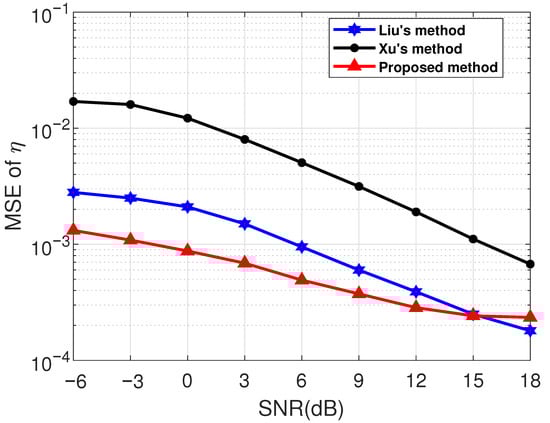
Figure 4.
MSE of I/Q imbalance compensation parameter against different SNRs (Xu’s method [8] and Liu’s method [13]).
Figure 5 shows the MSE of CFO parameter against different SNRs. The proposed method achieves the lowest MSE compared to other methods. Due to the employment of the phased training strategy and the compensation structure designed based on the physical model, the coupling effect is taken into account, and the input of CFOENET is the signals that had already been compensated for I/Q imbalance, thereby reducing the interference factors. Traditional methods neglect the coupling effects between I/Q imbalance and CFO estimation. This interference complicates the model of the received signal and increases the estimation difficulty.
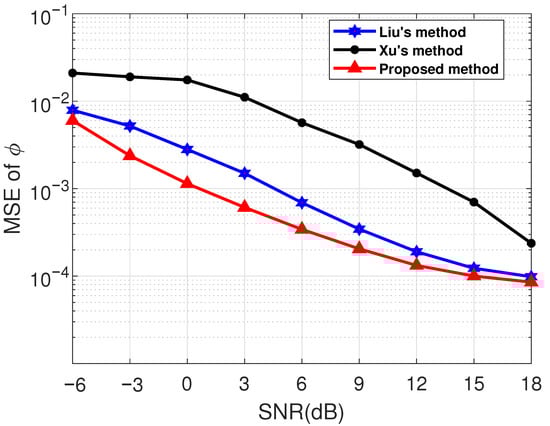
Figure 5.
MSE of CFO parameter against different SNRs (Xu’s method [8] and Liu’s method [13]).
Figure 6 shows the BER against different SNRs. We employ the LS method for channel estimation after compensating for hardware impairment. The proposed method obtains the lowest BER compared to other methods since the MSE performance of impairment parameter estimation takes precedence in the other models, as shown in Figure 4 and Figure 5.
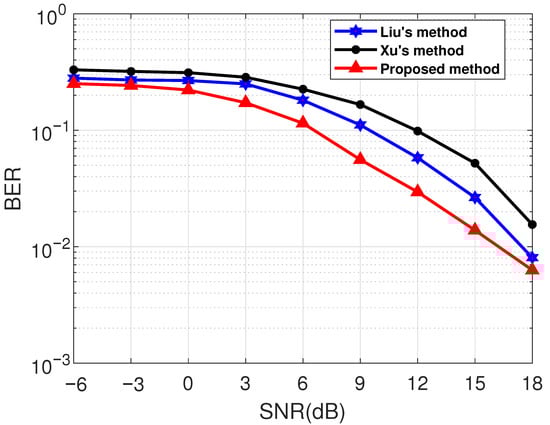
Figure 6.
BER against different SNRs (Xu’s method [8] and Liu’s method [13]).
4.2. Effectiveness Verification
For the verification of the effectiveness of the I/Q imbalance compensation layer, we directly input the original data containing I/Q imbalance and CFO into IQENET and CFOENET, respectively, for standalone training of the two subnetworks, and then use them for performance evaluation. For the training strategy, we only conducted standalone training to verify whether joint training could further enhance the accuracy of the estimation and address the coupling effects.
Figure 7 illustrates the I/Q imbalance estimation performance of the proposed method in comparison to scenarios without the I/Q imbalance compensation layer and joint training. The results indicate that both components contribute to a certain degree of performance enhancement. As the I/Q imbalance compensation layer removes the effect of I/Q imbalance from the input for CFOENET to enhance its performance, and joint training further refines the performance of both subnetworks, the absence of either component leads to a certain decline in I/Q imbalance estimation performance.
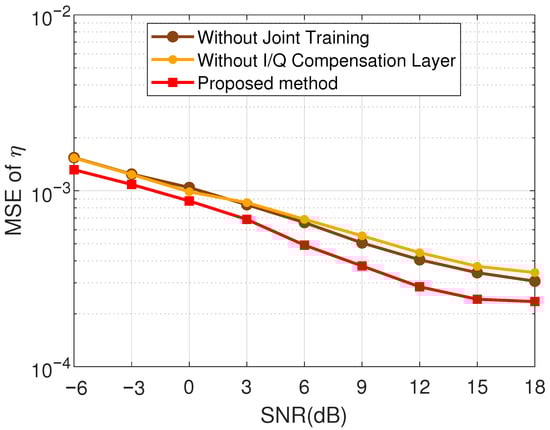
Figure 7.
Comparison of MSE of I/Q imbalance compensation parameter for the proposed method and its ablated variants.
Figure 8 shows the impact of the I/Q imbalance compensation layer and the phased training strategy on CFO estimation performance. Joint training further enhanced the estimation performance of the CFO, compared to the existing baseline. The I/Q imbalance compensation layer leads to a significant improvement in performance, as it removes the effect of I/Q imbalance from the original signal, thereby reducing interference in the input data.
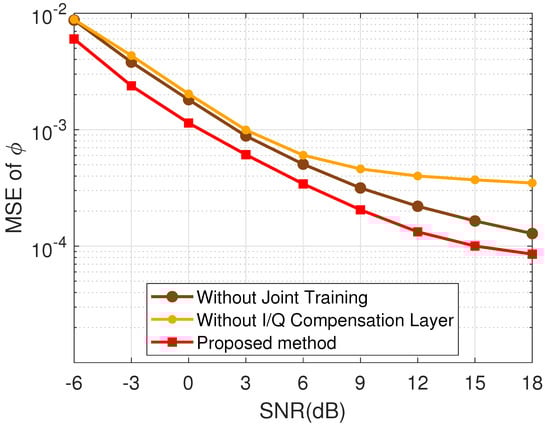
Figure 8.
Comparison of MSE of CFO parameter for the proposed method and its ablated variants.
In Figure 9, we show the BER against different SNRs. The proposed method significantly enhances the BER performance, primarily driven by the I/Q imbalance compensation layer. This layer addresses the I/Q imbalance in the original signal, which otherwise severely degrades CFO estimation performance and leads to high BER. The phased training strategy further enhances the estimation performance of both I/Q imbalance and CFO, thereby further reducing the BER.
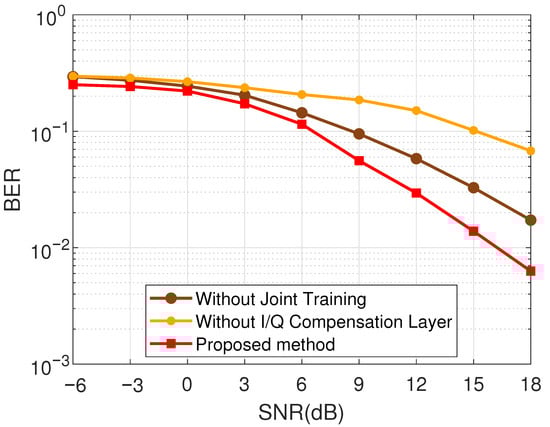
Figure 9.
Comparison of BER for the proposed method and its ablated variants.
Figure 10 presents an error bar figure comparing the mean absolute error (MAE) and standard deviation (Std) of I/Q imbalance estimation for the proposed method against other ablated scenarios. It demonstrates that the proposed method not only achieves a lower MAE but also exhibits a smaller standard deviation against various SNRs. This indicates improvements in both estimation accuracy and result stability. The enhancement can be attributed to the I/Q imbalance compensation layer, which effectively reduces interference for the network, and the joint training process, which further improves the performance of IQENET by learning the features of coupling effects between the two estimation tasks.
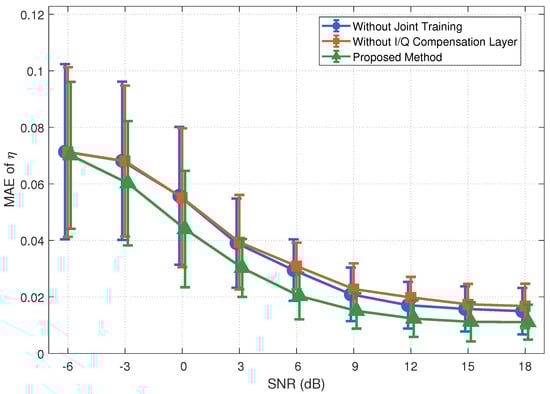
Figure 10.
MAE and standard deviation of I/Q imbalance compensation parameter estimation. Error bars represent .
Figure 11 illustrates the impact of the I/Q imbalance compensation layer and the phased training strategy on the MAE performance and standard deviation of CFO estimation, presented with error bars. The results indicate that both proposed components contribute not only to a reduction in the MAE of CFO estimation but also to a decrease in the standard deviation, thereby enhancing estimation stability. This improvement stems from the I/Q imbalance compensation layer, which compensates for I/Q imbalance from the input data before CFO estimation, and is further refined by the joint training process, which optimizes the coupling between the two estimation tasks.
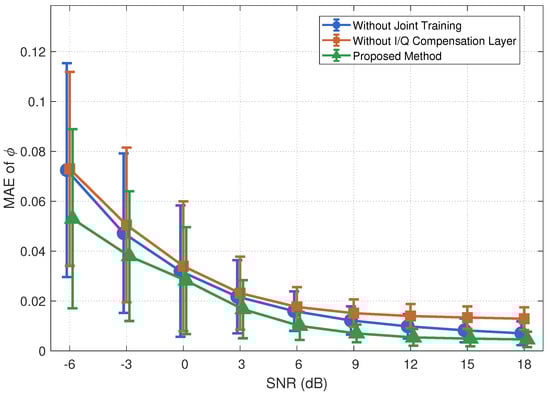
Figure 11.
MAE and standard deviation of CFO parameter estimation. Error bars represent .
The compensation of I/Q imbalance reduces the interference in the input data to CFOENET, thereby further enhancing the estimation performance of CFO. Also, the training strategy further improves the overall estimation performance of the network by effectively exploiting the coupling between CFO and I/Q imbalance, leading to a more robust and accurate system overall.
4.3. Complexity Analysis
The computational complexity of [8] mainly depends on the one-dimensional search steps in the CFO estimation, the number of null subcarriers V, and the number of OFDM symbols M. The CFO estimation needs to conduct a one-dimensional grid search within the CFO range . For each candidate CFO value u, the method needs to process V out of M OFDM symbols, calculate the conjugate ratio of the frequency-domain signal, and determine its variance. The I/Q imbalance estimation involves performing a similar ratio calculation and averaging operation on the optimal CFO estimated value.
To calculate the computational complexity of DL-based method, first assume that H and W are the height and width of the input data, so the input feature map and the output feature map of the convolutional layer are and , respectively. The convolution kernel size is K, and the number of input channels and output channels are both and . The number of multiplications and additions are all . Then assume that the number of input neurons and output neurons of the fully connected layer are and , respectively. The number of multiplications and additions are both .
Table 3 shows the number of multiplications and additions required for various methods. It can be seen that the complexity of the proposed method is reduced by one order of magnitude compared with Xu’s method [8], which employs blind estimation by the null subcarriers. Compared with Liu’s DL-based method, the proposed method still has the advantage of lightweight and consumes less computing power to train the network.
Table 3.
Comparison of number of multiplications and additions among various methods.
The above results not only demonstrate that IQENET and CFOENET have high estimation accuracy at low and medium SNR ranges, but also reveal that the network contributes to enhanced data transmission reliability. This is because the network could effectively extract features from the input data while maintaining stable estimation performance. Moreover, the lightweight property of the network makes it suitable for NB-IoT systems, aligning with their low cost requirements while enhancing data transmission efficiency and overall system performance.
5. Conclusions
In this paper, we propose a model-embedded lightweight network for joint I/Q imbalance and CFO estimation in NB-IoT systems. By embedding the physical model via the I/Q imbalance compensation layer and the phased training strategy, the coupling effects between I/Q imbalance and CFO estimation are reduced. At SNR = −6 dB, the MSE of can reach approximately , and the MSE of can reach approximately , demonstrating that the proposed network maintains good estimation performance even under low SNR conditions. At SNR=18 dB, the BER can reach approximately , representing a significant improvement for NB-IoT systems. Compared with the comparison methods, the proposed method exhibits superior performance across the entire SNR range from -6 dB to 18 dB. The lightweight network has lower computational complexity compared to traditional methods. The number of multiplications and additions is only . In conclusion, the IQENET and CFOENET framework provides a practical deep learning solution to the hardware impairment problem in NB-IoT. It significantly enhances the system’s operational SNR range, improves link reliability in challenging environments, and paves the way for deploying more resilient and cost-effective massive IoT networks.
Our current study has certain limitations that point toward meaningful future work. First, like many recent data-driven approaches in this field, our model was trained and validated using synthetically generated data. While this is a common and practical starting point for algorithm development, its real-world performance ultimately depends on how well the simulation reflects actual hardware variations. In practice, I/Q imbalance in a given RF chain tends to remain relatively stable, yet building a sufficiently diverse real-world dataset would require measurements from a large number of deployed devices—a challenging and costly undertaking. Nevertheless, moving toward real-data validation, such as through collaborations with industry partners in operational NB-IoT networks (e.g., wide-area meter-reading systems), remains a natural and valuable next step to assess practical utility.
Second, although our model-embedded framework improves interpretability and reduces parameter count compared to conventional deep learning methods, it still carries some inherent traits of data-driven approaches. These include a degree of opacity relative to fully analytical estimators, dependency on representative training data, and the need for offline training and memory for deployment. Such trade-offs are characteristic of the current generation of learning-based communication algorithms.
Looking ahead, several promising research avenues emerge. One is to expand the scope from receiver-only I/Q imbalance to the more complex—and more realistic—case of joint transmitter and receiver I/Q imbalance estimation. This would involve a more intricate system model with increased parameter coupling, posing a meaningful challenge for future lightweight network designs.
Another compelling direction lies in extending the framework to multi-antenna receivers, which are commonly used in NB-IoT base stations to enhance coverage. In such systems, each antenna’s RF chain may exhibit distinct I/Q and CFO characteristics, and inter-antenna imbalances could further complicate the estimation process. Designing an efficient architecture—for instance, one that shares most network parameters across antennas while allowing for chain-specific fine-tuning—could enable practical and lightweight joint estimation in multi-antenna settings.
We believe these directions not only address the limitations of the current work but also align well with the evolving needs of practical NB-IoT deployment. Thank you again for the constructive feedback, which has strengthened the discussion in our revised manuscript.
Author Contributions
Conceptualization, Y.L. and Y.M.; methodology, Y.L. and Y.M.; validation, Y.L.; formal analysis, Y.L.; investigation, Y.M.; resources, Y.M.; data curation, Y.L.; writing—original draft preparation, Y.L.; writing—review and editing, Y.L.; visualization, Y.L.; supervision, Y.M.; project administration, Y.M.; funding acquisition, Y.M. All authors have read and agreed to the published version of the manuscript.
Funding
This research was funded by the National Natural Science Foundation of China (NSFC) under Grant 62201273.
Data Availability Statement
Data are contained within the article.
Conflicts of Interest
The authors declare no conflicts of interest.
References
- Chaudhari, B.S.; Zennaro, M.; Borkar, S. LPWAN Technologies: Emerging Application Characteristics, Requirements, and Design Considerations. Future Internet 2020, 12, 46. [Google Scholar] [CrossRef]
- Javed, S.; Amin, O.; Ikki, S.S.; Alouini, M.S. Multiple Antenna Systems with Hardware Impairments: New Performance Limits. IEEE Trans. Veh. Technol. 2019, 68, 1593–1606. [Google Scholar] [CrossRef]
- Mohammadian, A.; Tellambura, C. RF Impairments in Wireless Transceivers: Phase Noise, CFO, and IQ Imbalance—A Survey. IEEE Access 2021, 9, 111718–111791. [Google Scholar] [CrossRef]
- Tubbax, J.; Come, B.; Van der Perre, L.; Donnay, S.; Engels, M.; Man, H.D.; Moonen, M. Compensation of IQ imbalance and phase noise in OFDM systems. IEEE Trans. Wirel. Commun. 2005, 4, 872–877. [Google Scholar] [CrossRef]
- Pollet, T.; Van Bladel, M.; Moeneclaey, M. BER sensitivity of OFDM systems to carrier frequency offset and Wiener phase noise. IEEE Trans. Commun. 1995, 43, 191–193. [Google Scholar] [CrossRef]
- Canbilen, A.E.; Ikki, S.S.; Basar, E.; Gultekin, S.S.; Develi, I. Joint Impact of I/Q Imbalance and Imperfect CSI on SM-MIMO Systems Over Generalized Beckmann Fading Channels: Optimal Detection and Cramer-Rao Bound. IEEE Trans. Wirel. Commun. 2020, 19, 3034–3046. [Google Scholar] [CrossRef]
- Teng, Y.; Jia, L.; Liu, A.; Lau, V.K.N. Joint Estimation of Channel and I/Q Imbalance in Massive MIMO: A Two-Timescale Optimization Approach. IEEE Trans. Wirel. Commun. 2019, 18, 4723–4737. [Google Scholar] [CrossRef]
- Xu, W.; Wang, Y.; Hu, X. Blind joint estimation of carrier frequency offset and I/Q imbalance in OFDM systems. Signal Process. 2015, 108, 46–55. [Google Scholar] [CrossRef]
- Tong, M.; Huang, X.; Zhang, J.A. Joint Inter-Symbol Interference and I/Q Imbalance Cancellation in FTN Systems. IEEE Trans. Wirel. Commun. 2025, 24, 2680–2692. [Google Scholar] [CrossRef]
- Meng, Y.; Zhang, W.; Wang, W. Blind Frequency Synchronization for OFDM Systems With I/Q Imbalance. IEEE Trans. Veh. Technol. 2017, 66, 7862–7876. [Google Scholar] [CrossRef]
- Meng, Y.; Zhang, W.; Wang, W.; Lin, H. Joint CFO and I/Q Imbalance Estimation for OFDM Systems Exploiting Constant Modulus Subcarriers. IEEE Trans. Veh. Technol. 2018, 67, 10076–10080. [Google Scholar] [CrossRef]
- Anttila, L.; Valkama, M.; Renfors, M. Circularity-Based I/Q Imbalance Compensation in Wideband Direct-Conversion Receivers. IEEE Trans. Veh. Technol. 2008, 57, 2099–2113. [Google Scholar] [CrossRef]
- Liu, S.; Wang, T.; Wang, S. Hardware Impairment Estimation in NB-IoT: A Parallel Multitask Learning Method. IEEE Internet Things J. 2023, 10, 6859–6869. [Google Scholar] [CrossRef]
- Chen, Z.; Liu, Z.; Geng, X.; Zhao, Y.; Wu, H. Attention Guided Multi-Task Network for Joint CFO and Channel Estimation in OFDM Systems. IEEE Trans. Wirel. Commun. 2024, 23, 321–333. [Google Scholar] [CrossRef]
- Liu, S.; Wang, T.; Wang, S. Joint Compensation of CFO and IQ Imbalance in OFDM Receiver: A Deep Learning Based Approach. In Proceedings of the 2021 IEEE/CIC International Conference on Communications in China (ICCC), Xiamen, China, 28–30 July 2021; pp. 793–798. [Google Scholar]
- Ren, B.; Teh, K.C.; An, H.; Gunawan, E. OFDM Modulation Classification Using Cross-SKNet With Blind IQ Imbalance and Carrier Frequency Offset Compensation. IEEE Trans. Veh. Technol. 2024, 73, 8389–8403. [Google Scholar] [CrossRef]
- Wu, H.; Chen, Z.; Liu, Z.; Geng, X.; Zhao, Y.; Liu, Z. CRS-Based Joint CFO and Channel Estimation Using Deep Learning in OFDM-Based Vehicular Communication Systems. IEEE Trans. Wirel. Commun. 2025, 24, 3882–3893. [Google Scholar] [CrossRef]
Disclaimer/Publisher’s Note: The statements, opinions and data contained in all publications are solely those of the individual author(s) and contributor(s) and not of MDPI and/or the editor(s). MDPI and/or the editor(s) disclaim responsibility for any injury to people or property resulting from any ideas, methods, instructions or products referred to in the content. |
© 2025 by the authors. Licensee MDPI, Basel, Switzerland. This article is an open access article distributed under the terms and conditions of the Creative Commons Attribution (CC BY) license (https://creativecommons.org/licenses/by/4.0/).