1. Introduction
The study of decompositions of multivariable functions into sums of functions depending on fewer variables has a long tradition in functional analysis and approximation theory [
1]. Such decompositions provide insight into the structural and symmetric properties of function spaces and play an essential role in the analysis of projections [
2], tensor products [
3,
4], and operators [
5]. In particular, identifying and characterizing projections onto subspaces defined by these decompositions allows for a deeper understanding of the geometry and algebraic structure of spaces of functions.
In [
6], the projection from the space
S of all functions defined on
(where
are finite sets) onto its subspace consisting of all sums of functions depending on a single variable was investigated. It was shown that such a projection is unique. In this paper, we continue this line of research by providing an explicit formula for this projection.
A related problem was considered in [
7], where the author studied the subspace of all sums of functions depending on two variables. There, the formula for a unique projection onto this subspace was shown. The goal of this paper is to extend this result in a substantial way. Specifically, we consider the space
S of all functions defined on the Cartesian product
where each
is a finite set, and we investigate the subspace
consisting of all sums of functions depending on
variables. We show an explicit representation for the projection from
S onto this subspace.
Beyond -spaces on finite sets, our results apply in a much broader context. We show that the same constructions and formulas remain valid for a large class of spaces. This generalization highlights the relevance of this paper in various analytic and algebraic contexts.
The paper is organized as follows. In
Section 2, we recall the basic definitions and known results used in this work.
Section 3 contains the main result of the explicit formula for the unique projection from [
6]. In
Section 4, we focus on generalizing the results from [
7] and derive formulas for minimal projections for a number of spaces.
2. Preliminaries
At the beginning, let us set up the necessary terminology and notation.
Definition 1. Let S be a Banach space, and let T be a closed linear subspace of S. An operator is called a projection if . We denote by the set of all linear and continuous (with respect to the operator norm) projections.
Definition 2. A projection is called minimal ifA projection is called cominimal if The main problems in the theory of minimal projections are the existence and the uniqueness of minimal projection [
8,
9], finding the constant
[
10], and concrete formulas for minimal projections [
11]. This theory is widely studied by many authors, also recently [
12,
13,
14,
15,
16]. We focus here on the first and third problems.
The main tool for proving minimality is Rudin’s Theorem. We present it below with some basic definitions.
Definition 3. Let X be a Banach space, and G be a topological group such that for every there is a continuous linear operator for whichThen, we say that G acts as a group of linear operators on X. Definition 4. We say that commutes with G if for every .
Theorem 1 (Rudin, [
17]).
Let G be a compact topological group that acts as a group of isomorphisms on a Banach space S and let T be its complemented (i.e., ) G invariant subspace. Let be an image of through that isomorphism, and assume that mappingis continuous in strong operator topology.Then, for any , the projection given by the formulacommutes with G. From now on, we will write g in place of .
Theorem 2. Let the assumptions of Theorem 1 be satisfied. Assume also that every is a surjective linear isometry on S. If there exists a unique projection that commutes with G, then Q is minimal.
Theorem 1, combined with Theorem 2, provides an effective way to prove the minimality of projections. Let us recall another version of Rudin’s Theorem from [
18], which enables us to apply our results to a wide range of other spaces. Moreover, the projection under consideration is not only minimal, but also cominimal.
Let
be a Banach algebra of all continuous linear operators from a Banach space
Z into
Z. For every
, we define
where
G is a compact topological group that acts through isometries on
Z, and
is the normalized Haar measure for
G.
Theorem 3 (Theorem 2.2. [
18]).
Let G be a compact topological group that acts through isometries on a Banach space Z, and let be a convex lower semicontinuous function in the strong operator topology . LetIn particular, if V is a closed subspace of Z and there is only one projection Q from Z into V that commutes with G, then Q is N-minimal and N-cominimal. This means that and for every bounded projection P of Z into V.
The results presented here are also applicable to modular spaces. Let us recall the basic facts about these spaces.
Let X be a vector space over or .
Definition 5. A functional is called semimodular if
- 1.
;
- 2.
, where ;
- 3.
.
If we replace condition 1. by the following:then ρ is called modular. If ρ is modular, thenwhich is a linear subspace of X, is called a modular space. The most common norms considered in a modular space are the
Luxemburg norm and
Orlicz norm given by
and
respectively. A special case of modular spaces is the Orlicz space.
Definition 6. Let be a convex function. If and , then φ is called an Orlicz function.
Definition 7. If an Orlicz function also meets the conditionsthen we call it an N-function. From this point on, let us assume that is an N-function.
Definition 8. Let be a complete space with a σ-finite measure. Let be a space of Σ-measurable functions with values in . Then, for any , we can define Orlicz modular Because φ is convex, ρ is a convex semimodular. Then, the modular space X is called an Orlicz space and denoted by .
Recall two theorems from [
19], which allow us to expand our results to spaces with various norms.
Theorem 4 (Theorem 3.2. [
19]).
Let X be a vector space over and . Set and let be an s-convex semimodular on X for every . Letand be a convex function such thatFor every and assume Definefor every . Then is an s-norm (a norm if ) in . If for some , it holds that , then we define Using Theorem 4 for , it is straightforward to obtain
Theorem 5 (Theorem 3.3. [
19]).
Let be the same as in Theorem 4, be an s-convex semimodular. Then functionis an s-convex norm (a norm if ) on . Definition 9. Let p be a right-sided derivative of φ. Define the function Then the functionis called a complementary function of φ. The necessary and sufficient conditions for the smoothness of the Orlicz space can be found in [
20], Chapter
. For our space
, these conditions are as follows.
Theorem 6 (Theorem 2.54 [
20]).
Let φ be an N-function. Then equipped with the Luxemburg norm is smooth if and only if φ is smooth on . Theorem 7 (Theorem 2.56 [
20]).
Let φ be an N-function. Then with the Orlicz norm is smooth if and only if φ is smooth on and , where The preceding two theorems facilitate a significant extension of our results to Orlicz spaces (Theorems 11 and 12).
3. Subspace
Let
, and
Z be finite sets containing
,
, and
elements, respectively. Let
be the space of all functions from
into
(
or
). This section concentrates on projections from
into its subspace
consisting of all sums of functions that depend on one variable, i.e.
Let
denote the permutation that interchanges planes
and
, where
. The permutations
and
are defined analogously. These transformations generate a finite group
G. The elements of
G are associated with
S in a natural way. We can define
We will consider the norm on S such that the maps are isometries. The subspace T is invariant under the isometries . If G has a discrete topology, then the mapping is continuous.
In [
6], the following theorem was proved.
Theorem 8 (Theorem 10 [
6]).
Let S and be as above. Assume that for any element π of the group G, the mapping is an isometry, and S is equipped with a smooth norm. Assume that Q is a minimal projection of S into its subspace and it commutes with G. Then Q is the unique minimal projection of S into . In that section, we will show the uniqueness of the projection commuting with G, presenting its explicit formula. Then, from Theorem 2, we obtain minimality, and from Theorem 8, we establish the uniqueness of minimal projection. But first, we need two lemmas.
Lemma 1. If , then .
Proof. The space
is generated by matrices
where
denotes the only non-zero row consisting of all 1’s, and
denotes the only non-zero column consisting of all 1’s. Note that each of these matrices and any of their linear combinations
C satisfies the so-called four-point rule:
for any
and
. Hence, every element of the space
also satisfies this equality. Since
,
, then
. □
Lemma 2. If Q is a projection of S into , which commutes with a group G, thenfor some constants satisfying the following equations Proof. To prove that
Q is of that form, we proceed similarly as in the proof of Theorem 4 in [
7]. Note that, for any
, we have
. Hence,
and since
Q commutes with
G, we obtain
For the rest of the permutations, we obtain another two sets of equalities
and
Moreover,
therefore,
It is enough to find the formula of
. Element
could be interpreted as a so-called “three-dimensional matrix”, whose first layer has the following form (I):
and each subsequent layer one has a form (II)
In other words, the element
consists of
matrices
by
arranged one after the other, the first of which is of the form (I) and each subsequent one is of the form (II). Since
, it can be represented as a sum of the basis elements of
:
In a 3D-matrix interpretation, this means that is a sum of matrices with constant levels, matrices with constant verticals, and matrices with constant layers. Consequently, by subtracting from certain basis elements multiplied by certain constants, we obtain a three-dimensional matrix whose elements are all equal to zero.
Let us subtract from
the verticals numbered 2 to
, each having all elements equal to
B; that is, the matrix
. We then obtain
Then, subtracting the first level with all elements equal to
, that is, the matrix
, we obtain
Now, let us subtract the first layer with all elements equal to
(that is, the matrix
). We will obtain the following:
where
and
Finally, let us subtract the first vertical with all elements equal to
(matrix
). We will receive the following:
Note that the restriction of the space
and its generators to one layer is isomorphic to the space
and its generators. In particular, Lemma 1 could be used for the restriction to the second and all subsequent layers,
and thus we obtain
which implies
Analogously, the restriction of one vertical is isomorphic to
. In particular, Lemma 1 could be used for the restriction to the second and all subsequent verticals,
and thus we obtain
which implies
Finally, the restriction to one level is isomorphic to
. From Lemma 1, applied to the second and all subsequent levels, we obtain
and thus
which implies
Consequently, the first layer (I) takes the following form:
which (from Lemma 1) implies
and thus
which ends the proof. □
By virtue of the technical Lemma, we can now find the form of the minimal projection onto our subspace .
Theorem 9. For S, , and G defined as above, there exists a unique projection commuting with G.
Proof. Let be a projection commuting with G. Similarly to the proof of Lemma 2, first we find a formula for .
We obtain analogical equations for
and
. The obtained equations of the first type can be written in the form
and these of the second type in the form
where
are constants, as in Lemma 2.
Geometrically (for the three-dimensional matrix with fixed element ), it means that the sum of all elements at every level, vertical and layer, which contains the element , equals 1. Every other level, vertical, and layer, has elements that add up to 0. As we can see, the above systems of equations exhibit perfect symmetry with respect to the indices; consequently, determining a single variable immediately provides the values of all other variables of the same type.
Using Equations (
3)–(
12), we will obtain an explicit formula for
Q, which will complete the proof. From (
4) and (
7), we obtain
and hence,
Analogically, from (
5) and (
8), we receive
and from (
6) and (
9) we obtain
Now comparing Equation (
13) multiplied by
and Equation (
14) multiplied by
, we obtain
Consequently,
which implies that
This combined with (
16) yields
The linear system considered in the proof shows symmetry with respect to the permutation of indices; hence, we can analogously obtain
and
Now, using (
17)–(
19) in Equation (
3), we obtain
Whereas in Equations (
4)–(
6) we obtain, respectively,
Now, substituting these values into Equation (
10), we receive
After elementary transformations and reductions, we receive
and
This determines the values of Q on the basis, which completes the proof. □
In consequence, we obtain the following.
Theorem 10. Let , , and and let be measures such that for all , , . If , then there exists a unique minimal projection Q from into . Moreover,where . Proof. Permutations of levels, verticals, and layers of any function do not change its norm. Hence, the operators associated with these permutations are isometries. By Theorem 9, we obtain the uniqueness of the projection commuting with G. Now, from Theorem 2, we deduce that the projection Q is minimal. For the norm on is smooth, which allows us to apply Theorem 8. Consequently, we obtain the uniqueness of the minimal projection. □
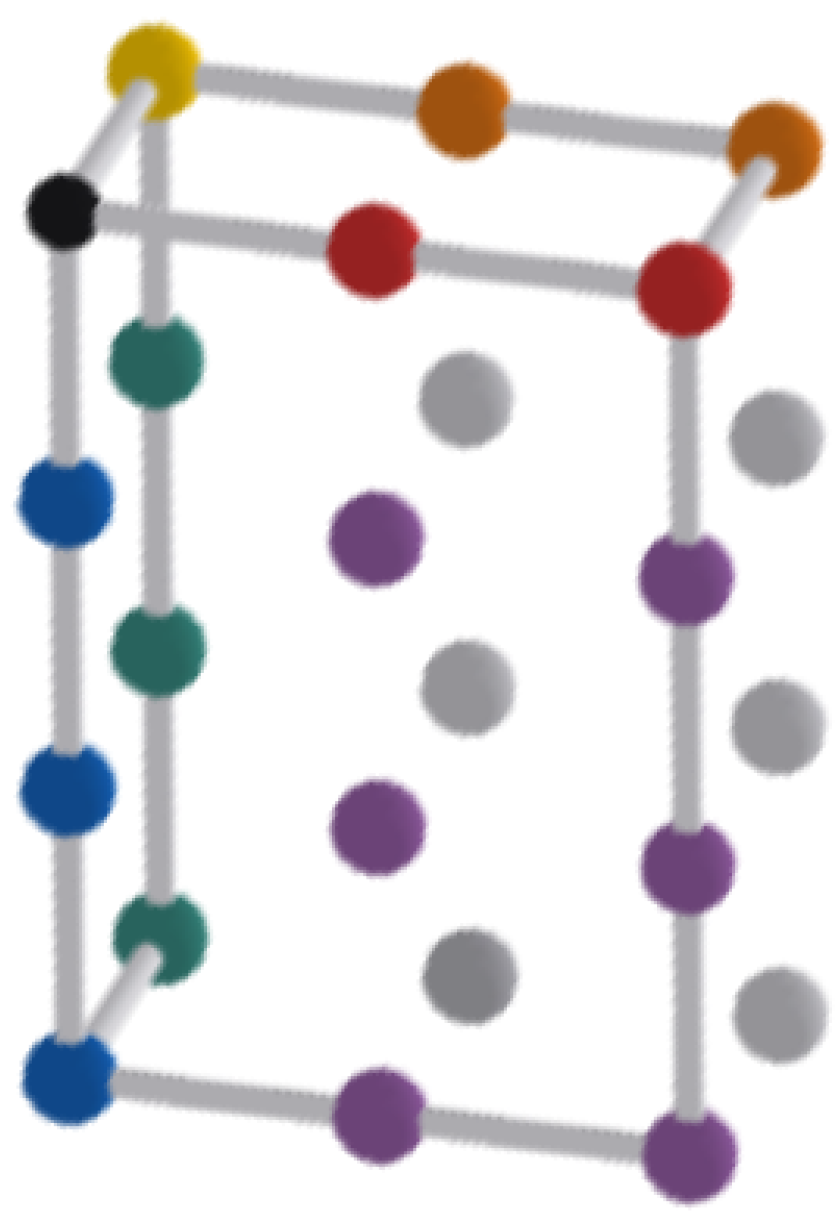
Example 1. Let . Equip these sets with probability measures defined by Then, there is a unique minimal projection Q from onto , which acts on the canonical basis elements as follows:where . This example (
Figure 1) illustrates how the symmetry of the underlying system determines the pattern of the coefficients. Although the cardinalities of
are different, the projection preserves the same structural relations among the parameters.
Remark 1. Note that Theorem 10 is true for . In this case, the orthogonal projection onto is a minimal projection. By Theorem 2.9 in [21], is a unique minimal projection. Hence, the projection Q from Theorem 9 is equal to . The applications of Theorem 10 are not limited to
spaces. We can consider, for example, Orlicz spaces like Żwak in [
22]. In fact, Theorem 8 also works in modular spaces, among others. Following Skrzypek (see [
23]), we can define an Orlicz modular corresponding to our space
S as
for any
, where
and
is an Orlicz function.
Then the Luxemburg and Orlicz norms have the forms
respectively.
It is easy to check that in the space S with the Luxemburg or Orlicz norm, the mappings are isometries. Thus, by Theorems 6 and 7, we obtain the following two theorems.
Theorem 11 (Luxemburg norm).
Let φ be an N-function such that φ is smooth on . Then the projection Q of the space S equipped with the Luxemburg norm given by a Formula (21) is a unique minimal projection. Theorem 12 (Orlicz norm).
Let φ be an N-function such that φ is smooth on and , where , ρ, and ϕ are as in Preliminaries. Then the projection Q of the space S with an Orlicz norm given by a Formula (21) is a unique minimal projection. Example 2. Take . This φ is an N-function, and the Luxemburg and Orlicz norms generated by it are smooth. Thus, we obtain the uniqueness of projections in spaces with norms other than .
Remark 2. The assumption about the smoothness of the S space norm in Theorem 10 is significant, as shown by the following theorem.
Theorem 13. If S is equipped with or , then the projection Q given by a Formula (21) is not unique. The proof of the theorem is analogous to the proof of Theorem 2.3 in [
9].
4. Subspace
Let us now focus on another subspace of
S. Let
. In [
7], the following theorem was proved.
Theorem 14. For S, T, and G defined earlier, there exists a unique projection commuting with G.
In the proof of this claim, the following lemma played a key role.
Lemma 3 (Eight-point rule).
Let . Then if and only if f satisfies the “eight-point rule”for any It was mentioned in [
7] that similar reasoning could be carried out for
and its subspace
where
, for every
.
In this section, we will prove it and show the explicit formula for a minimal projection in the generalized discrete case. First, let us generalize Lemma 3.
Lemma 4 (
-point rule).
Let . Then if and only if f satisfies the following -point rule:or in a shorter version:for any , where and Proof. If
, then, without loss of generality,
f depends on the last
variables; therefore,
for any
. In particular,
Adding these equations together, we obtain the thesis.
To prove the opposite, fix
. The sum on the right side of Equation (
23) can be split into smaller parts. For our convenience, let the components of the right side of (
23) be elements of
F. Let
Let
for
. Then
does not depend on the
th variable, i.e.,
Of course, . Hence, . □
For simplicity, assume that , for every . Then, the space S can be identified with ”n-dimensional matrices” of dimensions . Now we show a technical lemma strictly connected to the final formula for Q and the -point rule.
Lemma 5. For any , and the following equation holds: Proof. We will conduct the classical inductive proof on n.
- (1)
For : .
For
, the left side of Formula (
24) equals
, while the right side equals
- (2)
Assume that (
24) is true for some
l- (3)
In the second equality, we used the inductive assumption. The last equality comes from the fact that this expression consists of all possible products: those that contain the factor and those that do not. Therefore, we obtain the right-hand side of the formula for .
- (4)
By induction, the formula is true for any , which ends the proof.
□
Fix
. By
, we mean a permutation of elements of
that have the first coordinate equal to
with elements having the first coordinate equal to
. To be more precise:
Analogously, we define the permutations . Let G be the finite group generated by these permutations. Now we can prove the generalization of Theorem 14.
Theorem 15. There exists a unique projection commuting with G.
Proof. The canonical basis of
S is composed of elements
It is enough to find the image of that basis under the mapping
Q commuting with
G, i.e.
. Since
we will only focus on finding a formula for
.
We know that
for all
, which gives us the first type of equations
for any
and
. Analogously for
,
,
we obtain
These equations imply
for any
provided that
It means that is equal to one of values, depending only on which of the numbers is equal to 1.
For our convenience, we use the following notation:
Moreover, the second type of equations holds:
Likewise, for the two indices at
and for a larger number of indices at
e. The same equalities hold for analogous indices at
e such that
. In particular,
which implies
Similarly,
and
which gives us
Continuing the reasoning, we obtain
where
, and as a result
Of course
, and thus applying Lemma 4 to
, we obtain
and from (
29) we receive
This gives us a unique projection of the form
where
. □
The conclusion of this claim is the following theorem.
Theorem 16. For , let be spaces with measures such that for every . Let and . If and is given by a Formula (30), then Q is a minimal projection of S into its subspace Proof. Permutations of a function do not change its norm. Hence, the operators are of the unit norm. Thus, from Theorem 15, we obtain the uniqueness of the projection commuting with G. Now, from Theorem 2, we deduce that the projection Q is minimal. □
Remark 3. Recall that Theorem 16 remains true for . In this case, the orthogonal projection is minimal and From Theorem 2.9 from [21], it follows that is a unique minimal projection. Therefore, the projection Q from Theorem 15 equals . Theorem 16, which provides a formula for minimal projections, can also be applied to spaces with other norms.
Theorem 3 can be applied to our spaces
and, consequently, we obtain further extensions of Theorem 16.
Recall that by , we denote the algebra of all continuous linear operators from the Banach space X into its subspace V. If , we use the shorter notation .
Remark 4. Let N be any norm on satisfying the condition (2) from Theorem 3. The dimension of S is finite, so N is continuous in the strong operator topology on and satisfies the assumptions of Theorem 3. In the following, we present a couple of norms that satisfy the condition (
2) required to use Theorem 3. Details of why these norms meet the assumptions can be found in [
18].
Example 3 (Numerical radius).
For every define the numerical radius aswhereThen the projection Q given by (30) is minimal and cominimal. Example 4 (
p-integrable operators).
Operator is called p-integrable, for , if there exists a compact set K and a probabilistic measure μ on K such that L can be decomposed into the formwhere , and . Consider a space with a normThen the projection Q defined by (30) is minimal and cominimal. Example 5 (
p-nuclear operators).
Operator is p-nuclear (where ) if it can be written in the formwhere , ,and . Then we define asand the projection Q given by (30) is minimal and cominimal. Remark 5. Theorem 16 also works for spaces S and T with a norm , which is a convex combination of norms.
Note that Theorem 5 provides us with many other examples if we consider modulars that preserve isometries associated with elements of a group G.
Particular examples of norm-preserving modulars are Orlicz modulars (see Definition 8). This is important because, in general, the minimum projections in relation to two equivalent norms do not have to be the same. The following example shows that a minimal projection need not be an orthogonal projection in the sense of the classical scalar product in .
Example 6. Let , , and , for . Then the operator given byis a projection on Y and . By Theorem III.3.1 from [24] (p. 105), there is a unique minimal projection. Note that and . Since , the vector is not orthogonal to Y. Hence, is not an orthogonal projection on Y. 5. Summary
This study successfully generalizes the existence and uniqueness results concerning projections onto subspaces of functions defined on a product of finite sets. Building upon the groundwork laid in [
6,
7], we provided an explicit formula for the unique projection from the space
S (of all functions on
) onto its crucial subspace,
, consisting of sums of functions depending on
variables. Furthermore, we established the validity of these results not only for the traditional
-spaces but also for a broad class of other function spaces, highlighting the underlying algebraic and structural stability of this projection operator.
The derived explicit formula for the generalized projection holds significant utility. In possible applications like data decomposition, functional ANOVA, and machine learning, this projection can serve as an optimal tool for extracting additive structures or for approximating high-dimensional functions with lower-dimensional components, minimizing error in the chosen norm. The fact that this unique projection exists across various function spaces (beyond ) confirms its deep structural role in the analysis of multivariable functions.
Our findings open up several promising avenues for future research. Current work focused on the projection onto the subspace of functions depending on at most variables. An immediate extension would be to investigate projections onto other natural additive subspaces of S, such as the space of all sums of functions depending on at most k variables, where k is any natural number less than n. Developing an explicit, generalized formula for these more restrictive subspaces would further complete the picture of optimal functional decomposition.
Another generalization involves moving beyond finite product spaces. Our current results rely heavily on the counting measure on finite sets, which guarantees the space is finite-dimensional. Future work should focus on extending these projection theorems to infinite-dimensional spaces defined over non-atomic measure spaces (e.g., with the Lebesgue measure). Extending our results to the case of non-atomic measures presents several challenges. Many steps in the discrete proofs rely on the action of the permutation group on finite sets, which forms a compact group of isometries. In the non-atomic setting, such a group is no longer available, so arguments based on averaging over permutations or exploiting discrete symmetries do not apply. Similarly, certain combinatorial identities used to reduce the linear systems to a single free parameter depend crucially on the finiteness of the index sets. While a complete treatment in this context remains open, one possible approach is to approximate non-atomic measures by discrete measures, or to identify alternative compact symmetry groups that could play a similar role. We leave a detailed analysis of these directions for future work.
In summary, this paper provides a robust foundation and explicit tools for the analysis of additive function structures in discrete, multi-dimensional settings. We anticipate that these results will serve as a starting point for deeper investigations into function decomposition in both finite and continuous measure spaces.