


Abstract
Let us consider a two-sided multi-species stochastic particle model with finitely many particles on , defined as follows. Suppose that each particle is labelled by a positive integer l, and waits a random time exponentially distributed with rate 1. It then chooses the right direction to jump with probability p, or the left direction with probability . If the particle chooses the right direction, it jumps to the nearest site occupied by a particle (with the convention that an empty site is considered as a particle with labelled 0). If the particle chooses the left direction, it jumps to the next site on the left only if that site is either empty or occupied by a particle , and in the latter case, particles l and swap their positions. We show that this model is integrable, and provide the exact formula of the transition probability using the Bethe ansatz.
1. Introduction
In this paper, we treat a multi-species stochastic particle model with finitely many particles on the infinite lattice , which has the exclusion rule that each site cannot be occupied by more than one particle. Each particle is labelled by a positive integer l, representing its species. A state of the system can be described by specifying each particle’s species and its location. To be more specific, if with represents the positions of N particles, and the species of the particle at is denoted by , then we denote the state of the system by with . In a single-species model, of course, a state is simply denoted by .
The asymmetric simple exclusion process (ASEP) is the most well-known single-species stochastic particle model. In the ASEP on , each particle waits an exponential time with rate 1 to choose a direction to jump. It chooses the right direction with probability p or the left direction with probability . After choosing a direction, a particle at x immediately jumps to if the site is empty. However, if the target site is already occupied by another particle, the particle gives up jumping, and waits a random time again to jump. In particular, if (or ), the model is called the totally asymmetric simple exclusion process (TASEP). The technique to find the transition probability of the ASEP on using the Bethe ansatz is well-known [1,2].
In the multi-species ASEP, a higher-numbered particle has priority over a lower-numbered particle in jumping. To be more specific, if a particle l at x chooses to jump to with probability p (or with probability q), which is already occupied by , then the particle l can indeed jump to the site by switching their positions. However, if , then the particle l gives up jumping to the site occupied by . In particular, if (or ), we call it the multi-species TASEP. These models have been extensively studied in many directions [3,4,5,6,7,8,9,10,11].
Another stochastic particle model with rules as simple as those of the ASEP is the drop-push model [12,13,14]. In the drop-push model, each particle jumps to the next site on the right after an exponential random time with a rate of 1. Unlike the ASEP, a particle can jump even if the target site is already occupied by pushing the particle occupying the site. For example, if a particle at x jumps to , occupied by another particle, the particle at x jumps to , pushing the particle at to . In this case, if is also occupied, then the particle pushed to also pushes the particle at to (Figure 1 illustrates the definition of the drop-push model).

Figure 1.
Drop-push model.
A multi-species version of the (one-sided) drop-push model was introduced as the frog model in [15]. Additionally, the stationary distribution of the frog model was recently studied [16,17]. In particular, ref. [16] treated various multi-species particle models in a unified way to study the stationary distribution. Another direction of extending to a multi-species version of the (one-sided) drop-push model is found in [18]. A straightforward extension of the one-sided drop-push model to the one where a particle jumps to the right with rate p or to the left with rate is not integrable, in the sense that the Bethe ansatz is not applicable. However, it is known that if the jumping rates satisfy certain conditions, the two-sided model is integrable [19]. A natural question arises as to whether there exists an integrable multi-species version of the model in [19]. Unfortunately, the authors’ best efforts to find such a version have not been fruitful. Nevertheless, in this paper, we introduce a two-sided integrable multi-species model incorporating the rule of the long-range jumps partially.
1.1. Definition of the Model
In this paper, we show that if particles follow the rule of the frog model when they jump to the right, and follow the rule of the multi-species TASEP when they jump to the left, then the corresponding two-sided model is integrable. Hence, we can use the Bethe ansatz to find the transition probability. For our task, overall, we will take a similar approach to the method in [20]. The precise definition of the model is as follows.
Definition 1.
A particle l at x waits an exponential time with rate 1 to jump to the right with probability p or to the left with probability . If l chooses the right direction, it jumps to the nearest right site occupied by (including , which corresponds to an empty site), and immediately jumps to the nearest right site occupied by . If l at x chooses the left direction to jump, and is occupied by , then l jumps to , and moves to x. However, if , then l gives up jumping to .
We will call this model the multi-species ASEP with long-range jumps. The definition of our model with can be motivated by the basic coupling of two drop-push models with different configurations. The idea of viewing a low-numbered particle in the two-species ASEP as a discrepancy between the configurations of two ASEPs is well known [10,21]. Using the same idea, let be a drop-push model, and represent the state of site x at time t; that is, if x is unoccupied, and if it is occupied. Let be the coupled process of the drop-push models and with for all x. If we think of a site x with as being occupied by a particle of species 2, and a site x with as being occupied by a particle of species 1, then the evolution of the coupled process is the same as that of our model in Definition 1. Similarly, the two-sided model with general p in Definition 1 can be interpreted via the basic coupling of two-sided corresponding single species models. The two-sided single-species model where a particle follows the rule of the drop-push model when it moves to the right, and follows the rule of the TASEP when it moves to the left was studied in [22], so our model can be seen as a multi-species version of the model in [22]. Figure 2 illustrates the interpretation by the basic coupling.
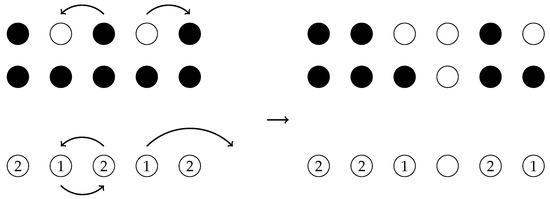
Figure 2.
Basic coupling.
1.2. Notations
Suppose that there are N particles labelled by positive integers , and let be the multi-set of those N integers. Let be the probability that the system will be in state at time t, given that the system is in state at time 0. We view and as permutations of of N elements. Of course, if and are permutations of two different multi-sets, then .
We will consider an arbitrary multi-set with each to cover all possible compositions of species. For this purpose, let be the matrix, such that rows and columns are labelled with and the -element is . According to the definition of the model, is a lower triangular matrix when rows and columns are labelled lexicographically from to . For example, for ,
Throughout this paper, denotes the identity matrix, and denotes the zero matrix. If needed, we write and to specify that their dimensions are n by n. We write for the -element of a matrix .
1.3. Organization of the Paper
In Section 2, we investigate the case of as a preliminary building block for the case of general N. In Section 3, we investigate the case of . The arguments for build upon the results for . However, in the case of , two-body reducibility, and the Yang–Baxter equation are discussed for integrability. Moving from to is not a trivial extension, but if the integrability of is proved, then the integrability of general N is trivially confirmed. Hence, we provide detailed arguments for the case of in Section 3, and only the results for general N in Section 4. This approach also helps us understand the integrability of the model better, reducing the heavy notations for general N. In Section 4, we provide the exact formula for the transition probability for an arbitrary N-particle system.
2.
2.1. Master Equations
Each element in (1) satisfies the master equation and the initial condition:
For a fixed Y, the form of the master equation for depends on . The master equation for when with is the -element of the matrix equation:
where the differentiation on the left side in (3) denotes the differentiation of each matrix element.
The master equation for when is the -element of the matrix equation:
where
and
Note that the -element of represents the instantaneous rate of transition from state to state , while the -element of represents the instantaneous rate of transition from state to state . Moreover, (4) can be expressed as:
due to the relation .
The matrix form of the initial condition (2) is given by:
2.2. Bethe Ansatz
In this section, we extend the Bethe ansatz method [1,2,20] to find solutions of the matrix Equations (3) and (8).
Recall that in (1) was defined for the physical region, meaning for and with and , respectively. Let be the matrix obtained by replacing in (1) with some functions defined for all . Suppose that satisfies
for all and
for all . Then, for and , (10) equals
which is in the form of (8). Thus, if satisfies (10) and the so-called boundary condition (11), then it obviously satisfies (3) when , and satisfies (8) when and .
By the ansatz of the separation of variables , and letting be the matrix, such that , and then substituting it into (10), we obtain for some constant (a constant with respect to ). The equations for spatial variables of (10) and (11) are
and
The Bethe ansatz solution of the matrix Equation (13) is given by
for any nonzero complex numbers and . Here, and are matrices similar in structure to , meaning that the positions of the zero elements in , and correspond. The nonzero elements of and are constants (with respect to ). By substituting (15) in (13), we find
It is important to note that is block-diagonal, allowing us to compute
blockwise. Specifically, for the blocks in the centre of (18), we have
where
Hence, we obtain
as a condition for (14) to be satisfied. Thus, with (15) and (21) satisfies (3) when , and (12) when and . (For now, is not the transition probability yet, because we have not proved yet that it satisfies the initial condition.)
Remark 1.
A key idea of defining our two-sided model, as in Definition 1, comes from the observation that the boundary condition for the one-sided multi-species model with long-range jumps (to the right direction) and the boundary condition for the multi-species TASEP (to the left direction) are the same, as given by (14).
3.
For , is a matrix whose rows and columns are labelled by . For with , we immediately obtain the master equation in matrix form:
3.1. Master Equation for with , , and
In this case, we could find the master equation in matrix form by finding all master equations for the elements of , but we will use another approach. Considering the positions of particles and the definition of the model, we see that the master equation for should be in the form of
for some matrices .
3.1.1. Matrix
The -element of is the instantaneous rate of transition from state to state . In fact, if the transition
is permissible, then it occurs with rate p by the definition of the model, and if (24) is not permissible, its rate is obviously 0. The permissibility of (24) depends on and . Since is kept the same during the transition, it means that . If , (24) is not possible, so its rate is 0. In the case that , we may say that the permissibility of (24) depends on the permissibility of the transition from to , which is actually encoded in (5). Now, let us view as a partitioned matrix whose rows and columns are labelled by , and the -element is a matrix whose rows are labelled by , and columns are labelled by . According to the permissibility of the transition from to , available in (5), and the requirement for (24), we obtain
If we let
then we have a succinct expression:
3.1.2. Matrices and
The -element of is the instantaneous rate of transition
which is due to the interchange of positions of particles at x and . Hence, the instantaneous rate of (27) is q if the transition is permissible, and otherwise, the rate is 0. Since in (27), it means that , and we see that the permissibility of (27) depends on the permissibility of
which is actually encoded in (6). Using a similar argument as in Section 3.1.1, if we let
we have
The matrix is a diagonal matrix, such that the -element is the instantaneous rate of jumping out of the state due to particles’ jumps to the left. The rate of the jump of the particle k at to the left direction is q, and the rate of the jump of i at x and j at is encoded in (7). Hence, if we let
then we obtain
Moreover, observing that , we see that (23) is equivalent to
3.2. Master Equation for with , , and
Considering the positions of particles, and the definition of the model, we see that the master equation should be in the form:
for some matrices .
First, we find the matrix . The -element of is the instantaneous rate of the transition
If the transition (32) is permissible, then it occurs with rate p by the definition of the model. If (32) is not permissible, its rate is obviously 0. Since is kept the same during the transition (32), it means that . If , then (32) is not possible, so its rate is 0. In the case where , we may say that the permissibility of (32) depends on the permissibility of the transition from to , which is actually encoded in the matrix in (25).
Now, let us view as a partitioned matrix whose rows and columns are labelled by . The -element is a matrix whose rows and columns are labelled by and , respectively. Then, using in (25), and the requirement for the transition (32), we obtain
Using similar arguments as in Section 3.1.2, we obtain:
with in (28), and
with in (29). Moreover, observing that , we see that (31) is equivalent to
3.3. Master Equation for
Considering all possible states that can transition to states with , we see that the master equation should be in the form:
for some matrices .
The -element of is the instantaneous rate of transition from to . Using the same argument as in Section 3.1.2, we find that .
The -element of is the instantaneous rate of transition
We could find all matrix elements of by checking the permissibility of (36), but we will take a different approach by considering an alternative perspective on the definition of our model. Specifically, we will interpret the rule of the long-range jump as consecutive two-body interactions.
Definition 2.
(Equivalent to Definition 1). A particle l at position x waits an exponential time with rate 1, and then jumps to with probability p or to with probability . When the particle jumps to , if is already occupied by a particle , then instantaneously accommodates both l and , such that is positioned to the left of at , and immediately jumps to .

Figure 3.
Transition from to .

Figure 4.
Transition from to .
According to Definition 2, the transition (36) can be interpreted as
where and occur instantaneously. We see that for (37) to be possible, it must be that and . Using the arguments in Section 3.1 and Section 3.2, the permissibility of is represented by , and the permissibility of is represented by . It is obvious that is represented by the identity matrix. Hence, we conclude that
The -element of is the instantaneous rate of transition from to . This transition is possible when either or , according to the rule of the multi-species TASEP to the left direction. Hence, using the arguments in Section 3.1.2, we have
is a diagonal matrix such that the -element represents the rate of jumping out of the state due to particles’ jumps to the left direction. Recall that describes the rate of jumping out of the state with due to the first particle’s jump to the left and the second particle’s jump to the left (which is possible only when ), and describes the rate of jumping out of the state with due to the second particle’s jump to the left and third particle’s jump to the left (which is possible only when ). Hence, it must be that
Again, using that , we see that (35) is equivalent to
3.4. Two-Body Reducibility
We obtained four different forms of the master Equations (22), (30), (34), and (39) for , depending on . Now, we will show that (30), (34), and (39) can be derived from the equation in the form of (22) and the boundary conditions that describe two-particle interactions.
We naturally extend the notations and for in Section 2.2 to . Suppose that satisfies
for all . If also satisfies
then, for , (40) becomes
which is in the form of (30). Similarly, if satisfies
then (40) becomes
which is in the form of (34).
Now, we find a condition for (40) to be in the form of (39). For this purpose, we substitute in (40), and compare it with (39). Then, we can see that
for all if and only if (40) is in the form of (39). To satisfy (45), we set:
and
Now, we will show that (46) and (47) are satisfied if the boundary conditions (41) and (43) are satisfied. It is easy to see that (47) is satisfied by (41) and (43). Let us show that (46) is satisfied by (41) and (43). The first term on the left side of (46) is the same as the first term on the right side of (46) by (41). Also, the second term on the left side of (46) is the same as the second term on the right side of (46) because
by (41), and
by (43).
3.5. Bethe Ansatz Solution
In the previous section, we showed that if satisfies (40), (41), and (43), then it satisfies the master Equations (22), (30), (34), or (39) for each X in the corresponding physical region. In this section, we find such a solution that satisfies (40), (41), and (43). Extending the idea and the notations in Section 2.2, we separate variables in the form . This leads to the following spatial equations derived from (40), (41), and (43):
and
The Bethe ansatz solution for (48) is given by
where are nonzero complex numbers. The sum is taken over all permutations in the symmetric group , and is a matrix with the same structure as (that is, zero elements in and occupy the same positions), whose nonzero elements are constants with respect to . Substituting (51) into (48), we find that
We now substitute (51) into (49) and (50) to derive conditions on that ensure (49) and (50) are satisfied. First, substituting (51) into (49) and simplifying, we obtain
Note that can be made block-diagonal by reordering labels of rows and columns in the order of . Using the results from (19), we then obtain
where is a matrix with the -element given by
Therefore, if satisfies (58), then the Bethe ansatz solution (51) will also satisfy (49). Similarly, we can demonstrate that if
then the Bethe ansatz solution (51) will satisfy (50). However, to ensure consistency between the expressions in (58) and (59), it must be verified that
and
where (60) is known as the parameter-dependent Yang–Baxter equation. The proofs of (60) and (61) are provided in Appendix A, using the approach outlined in Section 2.4 of [23].
4. General
In this section, we extend the results for to general .
4.1. Master Equations
Definition 3.
We define as the matrix with rows and columns labelled lexicographically by , such that the -element is given by
Now, we define a matrix that describes the permissibility of transition for a two-particle sector consisting of the l-th and -th particles.
Definition 4.
For , we define an matrix
where is the identity matrix.
Then, is an matrix with rows and column labelled lexicographically by and , respectively, with . The -element of describes the permissibility of transition
where for .
Definition 5.
We define and as matrices with rows and columns, labelled lexicographically by , such that their -elements are given by
and
respectively. In the same manner as Definition 4, we define and .
The -element of describes the permissibility of transition
where for . The -element of the diagonal matrix represents the rate of jumping out of the state
due to the jumps of and to the left when is empty.
We extend the notations and used for to general N. If satisfies
and the boundary conditions
for all , then satisfies the master equation corresponding to any given X in the physical region. For example, for , Equation (66) becomes
by the boundary conditions (67). If we use the fact that , then (68) can be rewritten as the master equation involving .
4.2. Bethe Ansatz Solution
To ensure that (69) satisfies (67) for each , we substitute (69) into (67) and simplify to obtain
for each l.
Let be the subgroup of all even permutations of , and let be the simple transposition that exchanges the i-th and the -th elements. We can then express (71) as
To satisfy (72), we set
for each . Consequently, we obtain
where the second equality in (74) is derived similarly to (55), and is the matrix whose rows and columns are labelled by , with its -elements given as in (57).
Definition 6.
Let be an matrix with rows and columns labelled lexicographically by , where the -element is given by (57). We define
where is the matrix.
The following proposition follows from the arguments presented above.
Proposition 1.
Since generates , for any , there exists an expression
for some . The following lemma provided a condition for (76) to be satisfied, which is evident from the construction.
Lemma 1.
For in (78) to be well-defined, the following relations must also be satisfied:
In fact, Lemmas A1 and A2 demonstrate that these relations are satisfied.
4.3. Transition Probabilities
In the previous section, we claimed that in (69), with defined by (78), satisfies the master equation for each X in the corresponding physical region. This holds true when performing contour integrals over all variables with appropriate contours. This approach is well known for various integrable particle models [1,2]. The transition probability of our model can also be expressed as a contour integral, analogous to the formula for the multi-species ASEP in [20].
Theorem 1.
Proof.
It is sufficient to verify the initial condition. Since the denominators of the nontrivial terms in the matrix that is contained in the expression of match those of with and in Section 4 of [24], the proofs of Corollary 2 and Theorem 1 in [24] essentially imply that (80) satisfies the initial condition. □
5. Discussion
We have defined a multi-species stochastic particle model (distinct from the multi-species ASEP) on , where the particles move either to the right or the left: a particle jumping to the right moves to the nearest site occupied by a lower-numbered particle (or an empty site), and pushes the lower-numbered particle (if any) forward; a particle jumping to the left follows the rules of the conventional multi-species TASEP. We have shown that this model is integrable, and derived the formula for the transition probability for an arbitrary initial state. A key motivation of defining this model in such a way that the model can be integrable is the symmetry between the one-sided model with long-range jumps and the multi-species TASEP in the opposite direction, in the sense that their boundary conditions are compatible when using the Bethe ansatz.
Given the form of the matrices in (80), it is anticipated that with can be expressed as a determinant (see [20] for related results in the multi-species TASEP context). Generally, the integrand in (80) can be a sum of numerous products, due to being a product of matrices, as described in (78). However, for certain special initial permutations of species, such as , , , and so on, it seems that can be expressed as a single product (see [25] for related results for the multi-species ASEP). Also, it would be interesting to investigate whether the methods used in this paper could serve as the machinery to develop other new integrable multi-species particle models, as well as multi-species versions of other known single-species models, such as [26]. Furthermore, these methods might help find the transition probabilities for some known multi-species particle models mentioned in [27,28,29].
Finally, we have not yet identified an integrable multi-species model where particles make long-range jumps in both directions, i.e., a multi-species version of the model in [19]. Developing such a multi-species version, and finding its transition probability, remain areas for future research.
Funding
This research is funded by Nazarbayev University under the faculty-development competitive research grants program for 2024–2026 (grant number 201223FD8822).
Data Availability Statement
The original contributions presented in the study are included in the article, further inquiries can be directed to the corresponding author.
Acknowledgments
The author is grateful to Axel R. Saenz for valuable discussions, and to Temirlan Raimbekov and Nazgul Tileukabyl for their assistance in writing the manuscript.
Conflicts of Interest
The author declares no conflict of interest.
Appendix A. Proof of the Consistency Conditions
We use the same approach as in Section 2.4 of [23].
Lemma A1.
If is the matrix defined by (57), then is the identity matrix.
Proof.
Let and be labels of rows and columns, with . For ,
For ,
For ,
□
Now, we prove that the matrix in (57) satisfies the parameter-dependent Yang–Baxter equation. As discussed in Section 3.5, the Yang–Baxter equation arises as a consistency condition within the Bethe ansatz framework, and its satisfaction is essential for a model to be integrable. (For more details on the Yang–Baxter equation, refer to [30] for related works in statistical mechanics and [31] for comprehensive quantum group theory).
Lemma A2.
(Yang–Baxter equation). Let . If is the matrix defined by (57), and is the matrix,
Proof.
Both and are matrices with rows and columns labelled with , and each label is a permutation of a certain multi-set . If and are permutations from two different multi-sets, then
Hence, if we reorder the columns and rows so that all permutations of a given multi-set are grouped, then both and become block-diagonal. Let
be the block on the diagonal of the matrix , whose rows are columns are labelled with permutations of . We similarly define . It suffices to show (A1) blockwise, i.e.,
for each multi-set . Each multi-set of integers is one of these forms: , with , with , and with . First, for the multi-set , (A2) is simply
which is obviously true, because
For with , we can obtain
and
Using these matrices, we can verify (A2) by direct matrix computation. Similarly, (A2) is verified for with . Finally, for with , we obtain
and
Again, we can verify (A2) by directly performing matrix multiplication. □
References
- Schütz, G.M. Exact solution of the master equation for the asymmetric exclusion process. J. Stat. Phys. 1997, 88, 427–445. [Google Scholar] [CrossRef]
- Tracy, C.; Widom, H. Integral formulas for the asymmtric simple exclusion process. Commun. Math. Phys. 2008, 279, 815–844. [Google Scholar] [CrossRef]
- Chatterjee, A.; Hayakawa, H. Multi species asymmetric simple exclusion process with impurity activated flips. SciPost Phys. 2023, 14, 016. [Google Scholar] [CrossRef]
- Chatterjee, S.; Schütz, G. Determinant representation for some transition probabilities in the TASEP with second class particles. J. Stat. Phys. 2010, 140, 900–916. [Google Scholar] [CrossRef]
- Chen, Z.; de Gier, J.; Hiki, I.; Sasamoto, T.; Usui, H. Limiting current distribution for a two species asymmetric exclusion process. Commun. Math. Phys. 2022, 395, 59–142. [Google Scholar] [CrossRef]
- de Gier, J.; Mead, W.; Wheeler, M. Transition probability and total crossing events in the multi-species asymmetric exclusion process. J. Phys. A Math. Gen. 2023, 56, 255204. [Google Scholar] [CrossRef]
- Kuan, J. Determinantal expressions in multi-species TASEP. SIGMA 2020, 16, 133. [Google Scholar] [CrossRef]
- Kuniba, A.; Maruyama, S.; Okado, M. Multispecies TASEP and combinatorial R. J. Phys. A Math. Gen. 2015, 48, 34FT02. [Google Scholar] [CrossRef]
- Prolhac, S.; Evans, M.R.; Mallick, K. The matrix product solution of the multispecies partially asymmetric exclusion process. J. Phys. A Math. Gen. 2009, 42, 165004. [Google Scholar] [CrossRef]
- Tracy, C.; Widom, H. On the distribution of a second-class particle in the asymmetric simple exclusion process. J. Phys. A Math. Gen. 2009, 42, 425002. [Google Scholar] [CrossRef]
- Tracy, C.; Widom, H. On the asymmetric simple exclusion process with multiple species. J. Stat. Phys. 2013, 150, 457–470. [Google Scholar] [CrossRef]
- Alimohammadi, M.; Karimipour, V.; Khorrami, M. Exact solution of a one-parameter family of asymmetric exclusion processes. Phys. Rev. E 1998, 57, 6370–6376. [Google Scholar] [CrossRef]
- Sasamoto, T.; Wadati, M. Exact results for one-dimensional totally asymmetric diffusion models. J. Phys. A Math. Gen. 1998, 31, 605. [Google Scholar] [CrossRef]
- Schütz, G.M.; Ramaswamy, R.; Barma, M. Pairwise balance and invariant measures for generalized exclusion processes. J. Phys. A Math. Gen. 1996, 29, 837–843. [Google Scholar] [CrossRef]
- Bukh, B.; Cox, C. Periodic words, common subsequences and frogs. Ann. Appl. Probab. 2022, 32, 1295–1332. [Google Scholar] [CrossRef]
- Aggarwal, A.; Nicoletti, M.; Petrov, L. Colored Interacting Particle Systems on the Ring: Stationary Measures from Yang-Baxter Equation. arXiv 2023, arXiv:2309.11865. [Google Scholar]
- Ayyer, A.; Martin, J. The inhomogeneous multispecies PushTASEP: Dynamics and symmetry. arXiv 2023, arXiv:2310.09740. [Google Scholar]
- Roshani, F.; Khorrami, M. Solvable multi-species extensions of the drop-push model. Eur. Phys. J. B 2003, 36, 99–104. [Google Scholar] [CrossRef]
- Alimohammadi, M.; Karimipour, V.; Khorrami, M. A two-parameteric family of asymmetric exclusion processes and its exact solution. J. Stat. Phys. 1999, 97, 373–394. [Google Scholar] [CrossRef]
- Lee, E. Exact Formulas of the Transition Probabilities of the Multi-Species Asymmetric Simple Exclusion Process. SIGMA 2020, 16, 139. [Google Scholar] [CrossRef]
- Liggett, T. Stochastic Interacting Systems: Contact, Voter and Exclusion Processes; Springer: Berlin/Heidelberg, Germnay, 1999. [Google Scholar]
- Borodin, A.; Ferrari, P.L. Large time asymptotics of growth models on space-like paths I: PushASEP. Electron. J. Probab. 2008, 13, 1380–1418. [Google Scholar] [CrossRef]
- Lee, E. Integrability of the Multi-Species TASEP with Species-Dependent Rates. Symmtry 2021, 13, 1578. [Google Scholar] [CrossRef]
- Lee, E. The current distribution of the multiparticle hopping asymmetric diffusion model. J. Stat. Phys. 2012, 149, 50–72. [Google Scholar] [CrossRef][Green Version]
- Lee, E.; Raimbekov, T. Simplified Forms of the Transition Probabilities of the Two-Species ASEP with Some Initial Orders of Particles. SIGMA 2022, 18, 008. [Google Scholar] [CrossRef]
- Povolotsky, A.M. On the integrability of zero-range chipping models with factorized steady states. J. Phys. A 2013, 46, 465205. [Google Scholar] [CrossRef]
- Takeyama, Y. Algebraic construction of multi-species q-Boson system. arXiv 2015, arXiv:1507.02033. [Google Scholar]
- Kuan, J. A multi-species ASEP(q, j) and q-TAZRP with stochastic duality. Int. Math. Res. Not. 2018, 17, 5378–5416. [Google Scholar] [CrossRef]
- Kuniba, A.; Okado, M.; Watanabe, S. Integrable Structure of Multispecies Zero Range Process. SIGMA 2017, 13, 044. [Google Scholar] [CrossRef]
- Baxter, R.J. Exactly Solved Models in Statisitcal Mechanics; Dover Pulications: Mineola, NY, USA, 2008. [Google Scholar]
- Klimyk, A.; Schmüdgen, K. Quantum Groups and Their Representations; Springer: Berlin/Heidelberg, Germany, 2012. [Google Scholar]
Disclaimer/Publisher’s Note: The statements, opinions and data contained in all publications are solely those of the individual author(s) and contributor(s) and not of MDPI and/or the editor(s). MDPI and/or the editor(s) disclaim responsibility for any injury to people or property resulting from any ideas, methods, instructions or products referred to in the content. |
© 2024 by the author. Licensee MDPI, Basel, Switzerland. This article is an open access article distributed under the terms and conditions of the Creative Commons Attribution (CC BY) license (https://creativecommons.org/licenses/by/4.0/).