


Abstract
In this paper, we address the problem of the divergent sums of general arithmetic functions over the set of primes. In classical analytic number theory, the sum of the logarithm of the prime numbers plays a crucial role. We consider the sums of powers of the logarithm of primes and its connection with Riemann’s zeta function (z.f.). This connection is achieved through the second Chebyshev function of order n, which can be estimated by exploiting the symmetry properties of Riemann’s zeta function. Finally, a heuristic approach to evaluating more general sums is also given.
1. Introduction
The development of analytic number theory and the classical proof of the prime number theorem is closely related to the definition of the so-called second Chebyshev function [1,2,3,4]:
where is the von Mangoldt arithmetic function:
In (1), the apostrophe denotes that the contribution of the term is . Closely related with is the first Chebyshev function, which involves only a sum over prime numbers, p, instead of the powers of the primes:
These two functions are related by
By using the Möbius function, this equation can also be inverted, yielding the first Chebyshev function in terms of the second one:
As part of the theory of Riemann’s z. f., , the following estimation of has been obtained [5,6]:
where denotes the derivative of Riemann’s z. f. and X, T are large real parameters. The first sum on the right-hand side of (6) extends over all the non-trivial zeros of Riemann’s z. f., and T can be chosen freely. Here, is an error term bounded as follows [6]:
Here, denotes the integer part of X. As and the second sum in (6) is , the dominant contribution to the error of the approximation for is given by the sum over the non-trivial zeros. To estimate these sums, we will assume throughout this paper that a generally weaker version of Riemann’s hypothesis holds. We will call this condition the restricted Riemann’s hypothesis (RRH):
Definition 1.
Restricted Riemann’s hypothesis (RRH): Let , . We say that the RRH is verified for this parameter α if for any non-trivial zero of we have . If then we recover the standard Riemann’s hypothesis.
Although it was not then known by this name, the RRH has already been considered by Ingham in his treatise on the distribution of prime numbers [1]. Assuming RRH, for a given parameter , we can find the bound:
Now, we denote by the number of zeros in the critical strip with imaginary part . This allows us to replace the sum over by an integral:
Estimates of were obtained by von Mangoldt in 1905 and by Backlund in 1918, following a conjecture by Riemann himself [6]. These results imply that for . Combining this result with (9), we find that
Finally, we use (6), (7) and (10) with to obtain the estimate of the second Chebyshev function:
which is equivalent to the prime number theorem proved by Hadamard and de la Vallée Poussin in 1896 [1,2]. This is indeed a stronger result because it assumes the validity of the still unproven RRH for a given , while in the classical original proof only the previously proven result about the absence of zeros of with was taken into account.
Inspired by Equations (1) and (3), we propose the following generalization, to be called the first Chebyshev function of order n:
where , 2, … and p denotes the prime numbers. Similarly, we define the second Chebyshev function of order n as a generalization of (1), as follows:
where the apostrophe means, as before, that for (if X is an integer) the last term in the sum contributes only . Here, is the von Mangoldt function of order , 2, … that we will define as follows:
Note that for we recover the standard von Mangoldt’s function. The relation of the first Chebyshev function of order n and the second Chebyshev function of the same order can be found in terms of a Möbius inversion formula:
which allows us to estimate the sums of the powers of the logarithm of the prime numbers once the second Chebyshev function of order n is also estimated.
The objective of this paper is to extend the classical techniques of analytical number theory, which allow us to estimate the Chebyshev functions, to the case of the generalized Chebyshev functions as defined in Equations (12) and (13). The paper is organized as follows: In Section 2, we discuss the analytical calculation of the Chebyshev functions of order and make some indications for the cases , 4, … Some theorems about Riemann’s z. f., which are required in the proof of Section 2, are enumerated in the Appendix A. The results in Section 2 suggest a heuristic approach to calculating general divergent sums of arithmetic functions over the primes, which is presented in Section 3. We also apply this conjecture to evaluating the sum of the logarithm of the logarithm of the prime numbers. The paper ends with some conclusions in Section 4.
2. The Sum of the Squares of the Logarithm of the Prime Numbers
In this section, we evaluate an approximation to the first and second Chebyshev functions of order that, according to (15), are closely related. Our objective, therefore, is to prove the following theorem:
Theorem 1.
Under the assumption of the restricted Riemann hypothesis (RRH), the following result for the sum of the squares of the logarithm of prime numbers, , holds:
where is a real number corresponding to the strip , where all non-trivial zeros of are located.
We should start by defining the following piecewise function:
This function can also be represented as an integral in the complex plane:
where is a real constant and . This integral can also be defined as the limit, as , of the following integral over a segment in the complex plane:
i.e., . The approach of to is algebraic in T as T becomes large. In [6], it is proven that
Now, we have the necessary tool to find a connection among the Chebyshev functions of order and Riemann’s z. f. From the definition in (13) and (17), we have
which, obviously, is the limit, as , of
Absolute convergence for allows us to swap the sum and the integral in (23), yielding
Here, the sum in parentheses can be evaluated in terms of Riemann’s z. f. To see the connection, we start with Euler’s product:
where, as usual, p denotes all the prime numbers. From (25), we can find the second-order logarithmic derivative of , as follows:
This allows us to rewrite (24) in the following form:
This equation explicitly states the connection between the second Chebyshev function of order and Riemann’s z. f.
Our next objective is to find an asymptotic expression for , estimating the error term. The first step, then, is to calculate the distance between and . From Equations (20)–(22), we obtain
where the first term on the right-hand side of the inequality only appears when X is a prime power. As X is expected to be large, we assume to take c as follows:
The second sum on the right-hand side of (28) is better estimated by separating the summation into four regions. To this end, we define
And the sum in (28) can be written as
To proceed, we need Lemma A1 in the Appendix A. Firstly, we analyze the first and last sums on the right-hand side of (31). If we have or then the following inequality holds:
We now consider the sum . We denote by the largest prime power less than X. In the following, we assume that lies in the interval . If there is no prime power in this interval then and the whole sum is bounded by the term in (33). But the contribution of the prime powers in this interval may be large, and we need to take that into account. For the term , we have
Therefore, the contribution of this term is bounded by
where we have taken into account that for the prime power and, according to the definition in (14), we have
For the rest of the prime powers in the interval , we can say that , with m being a subset of . In this case, the following inequality holds:
Consequently, this contribution to would be bounded by
We now consider the sum of the reciprocals of the integers:
A similar argument can be applied to the remaining partial summation, i.e., . This would lead to the same result as given in (40). Therefore, from Equations (33) and (40), we obtain
Our next objective is to evaluate and, by taking the limit , also . We begin with an identity for the logarithmic derivative of Riemann’s z. f.:
Here, the sum over extends over all non-trivial zeros of Riemann’s z. f. Absolute convergence allows us to differentiate term-by-term the expression in (42):
The sums in (43) are convergent for any value of s. To evaluate the integral in (27), we use Cauchy’s residue theorem on the path plotted in Figure 1.

Figure 1.
The path in the complex plane. Note that . c is defined as in (29) and U, T are large real numbers.
The corresponding integral along this path can be written as follows:
We note that the poles inside the path are , and ( being a zero of Riemann’s z. f. with imaginary part ) and , with n and integer in the interval . Both T and U are chosen in such a way that there are no zeros along the path . By Cauchy’s residue theorem, we have
The last summation in (45), as , can be written in terms of the polylogarithmic functions:
Here, is the logarithmic function and
is the dilogarithmic function. Although it is not necessary for our calculation, we can also give an explicit expression for the constant term in (45), as follows [5]:
where is the Euler–Mascheroni constant and is the Stieltjes constant of order one.
From Cauchy’s integral theorem, we can now write
To estimate the order of magnitude of these integrals, we should study the integrands in several domains. Firstly, we consider (for and ) that and . T also being different from the imaginary part of a zero of Riemann’s z. f., . From (42), we can also write
where represents the non-trivial zeros of Riemann’s z. f. From Stirling’s formula [5], we have
and, consequently,
as . And now, taking the logarithmic derivative,
and also
for and , this yields
To proceed, we now need Theorem A1 about the sums of the reciprocal of the squares of the distances of the imaginary part of the non-trivial zeros of Riemann’s z. f. from T for (see Appendix A). This way, we arrive at
We also need the Theorem A2 discussed by Chen [6]: for all sufficiently large positive real numbers T, the number of zeros of the function in the critical strip with is . As T is arbitrary, and according also to this theorem, we can choose it in such a way that for any nontrivial zero of with imaginary part . Consequently, in the aforementioned region of the complex plane, we have
and, as the number of zeros of such that is , we finally arrive at the following estimate:
valid for , . We also need another estimate of the second-order logarithmic derivative of for and for . We start with the unsymmetrical form of the functional equation [5,6,7]:
or, equivalently,
Stirling’s formula for yields
On the other hand, the last two terms in (61) are bounded for , and we have
We are now ready to evaluate the integrals on the right-hand side of (49). The first integral is separated for convenience, as follows:
Similarly, by using (63), we can write
Note that the results in Equations (65) and (66) are also valid if we replace T by . This means that the third integral on the right-hand side of (49) has the same value as the first one. Finally, we evaluate a bound for the second integral:
under the conditions , for all and also (which is true for ). Thus, the bound in (63) can be applied again, to obtain
If we take the limit and use Equations (45) and (46) then the following expression for is deduced:
where C is the constant given in (48). The Chebyshev function of order 1 is now calculated from Equations (41) and (70), yielding
with the following error term:
To obtain our estimation of , we need first to evaluate a bound on the sums over the nontrivial zeros of Riemann’s z. f. In this calculation, we assume the validity of the restricted Riemann’s hypothesis in Definition 1 for a given real number, .
Under these conditions, we have
where we have applied the principle that the sum of the reciprocals of all the nontrivial zeros of Riemann’s z. f. is a constant [5]. Similarly,
Here, we have used (10), about the sums of the reciprocals of the imaginary part of the nontrivial zeros of Riemann’s z. f. From Equations (71)–(74), we finally deduce that
with the error term given by
In (76), we have taken into account that the large prime power lesser or equal to X, , is greater than 1, and we have included only the dominant contributions. Note, again, that X and T are large but independent. The error term in (76) can then be optimized for fixed X by finding its minimum as a function of T. Approximately, this is equivalent to taking for . With this choice of T, we finally obtain our estimation of the Chebyshev function of order 1 under the assumption of the validity of the restricted Riemann’s hypothesis:
For , the behavior of given in this equation is equivalent to Riemann’s hypothesis. Now, by using the Möbius inversion formula in (15), we deduce that the first Chebyshev function of order 1 behaves asymptotically in the same way as , i.e., the sums of the squares of the logarithm of the primes lesser or equal to X are also given by the asymptotic expression in (77). This proves Theorem 1.
3. The General Divergent Sums
In Equations (11) and (77), we have given the asymptotic behavior of the second Chebyshev functions of order 0 and 1, respectively. According to the Möbius inversion formulas in Equations (5) and (15), we can obtain similar expressions for the asymptotic behavior of the sum over the logarithm of the primes and the square of the logarithm of the primes.
A natural question that arises is whether the analytical techniques discussed in this paper can be extended to yield general formulas for the asymptotics of any divergent sum over a function acting upon the primes. The key point is (27), in which the Chebyshev function is related to an integral in which derivatives of appear. We have shown that this can be done for the squares of the logarithms of the primes, and it can also be obtained for other powers of these logarithms. Nevertheless, finding such a relation for a particular function of the primes can be difficult. Therefore, it would be useful to obtain a heuristic approach to this problem from the two cases of the sums of and . Following this idea, we suggest the following conjecture:
Proposition 1.
Let be a real function , integrable over any finite segment of the real line. We consider the sums over the prime numbers:
Then, under the assumption of the RRH for certain , we obtain
This is justified by a well-known version of the prime number theorem, under the assumption of the RRH [2]:
where is the number of primes less than or equal to X, and where is the logarithmic integral function. According to (80), we can deduce that the density of the prime numbers around X is given by
And our conjecture in (79) is simply equivalent to
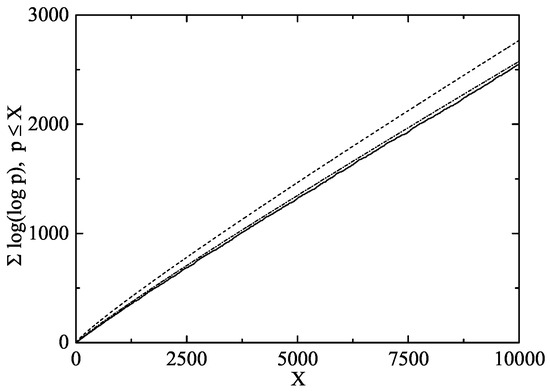
that we expect to be valid in a statistical sense. We will now apply this conjecture to the evaluation of the sum
From (79), we have
where we have also assumed the validity of the Riemann hypothesis. We now apply the following well-known identities [8]:
where is the logarithmic integral and 3F3 is the generalized hypergeometric function of order [8]. From Equations (84)–(86), we can finally write
Note that only the first two terms are dominant in comparison with the error term. In Figure 2, we show the results of a numerical calculation of the sum in (83) for 10,000. We compare this with the predictions of the formula in (87) by keeping only the first term and by taking into account this first term and the second one as well.
4. Conclusions
In this paper, we have studied the asymptotic behavior of a certain class of generalized Chebyshev arithmetic functions of the first and second order under the assumption of a restricted version of the Riemann hypothesis (RRH). In particular, we have obtained an estimation of the sum of the squares of the logarithm of the primes for prime numbers below a certain large quantity. This strongly suggests that the divergent sums over the primes can be estimated from a heuristic approach based upon the prime number density. This also generalizes some previous results by Axler on the sum of the first n prime numbers [9,10]. We conclude that the study of the moments of the distribution of the logarithms of prime numbers, both analytically and numerically, could shed some light on the validity of RH or the restricted version, RRH, for a given real parameter, .
Funding
This research received no external funding.
Data Availability Statement
Data are contained within the article.
Conflicts of Interest
The author declares no conflicts of interest.
Appendix A. Some Useful Results
Lemma A1.
For any real parameter there is a positive constant , such that
Proof.
has a simple pole at with residue 1, so it can be written as follows:
where is a holomorphic function. Therefore, the second logarithmic derivative of Riemann’s z. f. can be given as
Theorem A1.
For all sufficiently large , we have
where ρ are the zeros of in the critical strip and .
Proof.
See [6] (Theorem 6S). □
Theorem A2.
For all sufficiently large , the number of zeros of Riemann’s z. f. in the critical strip satisfying the condition is .
Proof.
See [6] (Theorem 6R). □
References
- Ingham, A.E. The Distribution of Prime Numbers; Cambridge University Press: Cambridge, UK, 1932. [Google Scholar]
- Córdoba, A.; Cilleruelo, J. La teoría de los Números; Mondadori: Madrid, Spain, 1991. (In Spanish) [Google Scholar]
- Apostol, T.M. Introduction to Analytic Number Theory; Undergraduate Texts in Mathematics; Springer: New York, NY, USA, 1976. [Google Scholar] [CrossRef]
- Murty, M.R. Problems in Analytic Number Theory; Graduate Texts in Mathematics (Readings in Mathematics); Springer: New York, NY, USA, 2001; Volume 206. [Google Scholar] [CrossRef]
- Edwards, H.M. Riemann’s Zeta Function; Dover Publications Inc.: Mineola, NY, USA, 2001. [Google Scholar]
- Chen, W.W.L. Distribution of Prime Numbers; Personal Lecture Notes (Unpublished). Available online: http://www.williamchen-mathematics.info/lndpnfolder/lndpn.html (accessed on 12 May 2021).
- Ivić, A. The Riemann Zeta-Function: Theory and Applications; Dover Publications Inc.: Mineola, New York, NY, USA, 2003. [Google Scholar]
- Olver, F.W.J.; Lozier, D.W.; Boisvert, R.F.; Clark, C.W. (Eds.) NIST Handbook of Mathematical Functions; Cambridge University Press: Cambridge, UK, 2010; ISBN 978-0-521-19225-5. [Google Scholar]
- Axler, C. New bounds for the sum of the first n prime numbers. arXiv 2016, arXiv:1606.06874v2. [Google Scholar]
- Axler, C. On the sum of the first n prime numbers. J. Théorie Nombres Bordx. 2019, 31, 293–311. [Google Scholar] [CrossRef]
Disclaimer/Publisher’s Note: The statements, opinions and data contained in all publications are solely those of the individual author(s) and contributor(s) and not of MDPI and/or the editor(s). MDPI and/or the editor(s) disclaim responsibility for any injury to people or property resulting from any ideas, methods, instructions or products referred to in the content. |
© 2024 by the author. Licensee MDPI, Basel, Switzerland. This article is an open access article distributed under the terms and conditions of the Creative Commons Attribution (CC BY) license (https://creativecommons.org/licenses/by/4.0/).