


Abstract
This paper investigates the Hopf-like bifurcation of a fractional tumor-lymphatic model with two time delays. The two time delays are considered as branching parameters, and we analyze their influences on the dynamic properties of the model. Through an examination of the root distribution of the characteristic equation, we derive the properties of the positive steady state and the conditions for the occurrence of Hopf-like bifurcation near the positive equilibrium point. Numerical simulations are demonstrated to support our theoretical results.
1. Introduction
In recent years, tumor-immune models have garnered extensive attention due to their theoretical and practical significance. These models have attracted a diverse group of researchers, including applied mathematicians, biologists, and medical professionals, resulting in numerous interesting and meaningful findings, see, e.g., [1,2,3,4,5,6,7,8,9,10,11,12,13]. Recently, Wang et al. [14] developed a tumor-lymphatic model with two time delays and examined the effects of these time delays on the dynamics of the new model. During the clinical practice, a symmetrical tumor-lymphatic model is a common model, in which the lymphatic vessels are arranged in a regular pattern around the tumor. This allows for the efficient drainage of lymphatic fluid and ensures that immune cells can access the tumor and attack it. Moreover, the symmetrical structure of the tumor-lymphatic model is also important for the distribution of chemotherapy drugs. If the lymphatic vessels are not arranged in a regular pattern, the drugs may not be evenly distributed throughout the tumor, which could reduce the effectiveness of treatment. Overall, the symmetrical structure of the tumor-lymphatic model is critical for the functioning of the lymphatic system and plays a key role in the immune response to cancer.
It is well-known that biological systems can be effectively described using both fractional calculus and traditional calculus. Nevertheless, as noted by Petras [15], fractional calculus offers more degrees of freedom for modeling dynamical systems when compared to conventional approaches. Furthermore, the utilization of fractional calculus in modeling biological systems can significantly enhance our ability for the discrimination, design, and control of dynamic systems due to its limitless memory [16,17]. Thereupon, fractional order biological systems have gained prominence as a research hotspot, resulting in numerous significant achievements [16,17,18,19,20,21,22,23]. Recently, the study of fractional-order dynamic systems has mainly involved the properties of the fractional-order dynamics system [24,25], such as stability analysis, bifurcations, and chaos.
It is worth noting that the study of nonlinear systems can benefit from robust bifurcation analysis, which enables the acquisition of delicate stability results. Especially, Hopf bifurcation analysis for a nonlinear system is a highly effective approach. We know that Hopf bifurcations are associated with the emergence of oscillatory behavior in a system. By studying these bifurcations in fractional order systems with time delays, researchers can better predict when and how oscillations will occur, which can be crucial for preventing undesirable outcomes in applications like control systems and signal processing. Therefore, Hopf bifurcation analysis has drawn the attention of researchers from various disciplines.
Given the above discussion, we first extend the delayed tumor-lymphatic model to the fractional-order case using the Caputo fractional derivative. Then, we investigate the stability and bifurcation characteristics of the proposed system. The contributions of this paper are shown as below. (1) The initial extension of the tumor-lymphatic model with two time delays to fractional order case by Caputo fractional derivative. (2) A detailed elucidation of the precise conditions for the occurrence of Hopf-like bifurcation near the positive equilibrium point of the delayed fractional tumor-lymphatic model under various combinations of two time delays. (3) The analysis method employed in our paper can be adapted for general fractional-order systems with multiple time delays.
The rest of this paper is organized as below. In Section 2, we quote some definitions of fractional calculus and propose a novel fractional-order tumor-lymphatic model with time delays. In Section 3, we analyze the characteristic equation to examine the linear stability of the equilibrium and derive the conditions for the occurrence of Hopf-like bifurcation at the positive equilibrium for various combinations of two time delays. In Section 4, the simulation example is given to validate our theoretical results. In Section 5, we give a brief discussion to conclude this work.
2. Preliminaries
This section addresses some of the results of the fractional-order derivatives and the fractional-order tumor-lymphatic model. It is widely recognized that several definitions of fractional-order derivatives exist due to varying interpretations. Typically, the Riemann–Liouville definition and the Caputo definition are the more commonly used ones. They are preferred because they can effectively represent well-understood aspects of physical situations, making them more applicable to real-world problems. In this paper, the Caputo derivative is taken into account when discussing the fractional-order tumor-lymphatic model.
Definition 1
([15]). The Caputo derivative of order α for one function is defined by
where , is the Gamma function and .
As a special case, when we have .
It is well known that the Laplace transform of the fractional Caputo derivative is shown as below:
where .
Then, we can easily derived when where .
For simplicity, the notation is represented the Caputo derivative operator in this paper.
Next, we will introduce the fractional-order tumor-lymphatic model with two time delays, which can be expressed as
where for , 2, and 3; represents the time delay for and 2, and the other variables and parameters of system (1) are well expounded in Table 1.

Table 1.
The meaning of variables and parameters for system (1).
For convenience’s sake, we employ the notation in Wang et al. [14] as follows to system (1),
Hence, we derive the following simplified fractional-order tumor-lymphatic model:
with , , , and .
Here, we presume that the following condition is true:
.
According to the hypothesis , we know that system (4) has a unique positive equilibrium point with
If , system (4) changes into the following integer-order system:
The primary objective of this paper is to determine the conditions of Hopf-like bifurcation for system (4) with two time delays serving as bifurcation parameters using the stability analysis method [4]. Additionally, we aim to elucidate the influence of these parameters on the bifurcation.
3. Main Results
In this section, we conduct an analysis of the local stability of system (4). We derive the conditions for Hopf-like bifurcation in system (4) while considering time delays and as the bifurcation parameters. Initially, we linearize system (4) and calculate the Jacobian matrix of the system at the equilibrium . Therefore, we have the associated characteristic equation as below:
To deeply study the dynamic behavior of system (4) at , we mainly consider three cases as follows.
- Case 1:
- and .
When , we convert Equation (8) into
At it follows from Equation (9) that
where , and .
Let be one root of Equation (10) with , where is the imaginary unit of a complex number. Plugging into Equation (10) and thus performing elementary calculations leads to
where and stand for the real part and the imaginary part of , respectively, which are shown as below:
Based on Equation (11), we easily have
Hence,
In the sequel of this paper, we make the following hypothesis.
Positive roots exist for Equation (13).
By the first equation of (12), we have
We define the following bifurcation point:
To obtain the bifurcation conditions, we give the following useful hypothesis in detail:
,
where and are described by Appendix A where and 2.
Lemma 1.
Assume that is the root of Equation (10) near satisfying and . Then, the transversality condition holds.
Proof.
Differentiating both sides of Equation (10) with respect to , we have
where are the derivatives of with and 2.
Thus,
where
It follows from Equation (16) that
where , , , and are the real and imaginary parts of , and the real and imaginary parts of , respectively.
Clearly, hypothesis shows that the transversality condition holds. This completes the proof. □
From the above results and notations, we directly obtain the following result.
Theorem 1.
If – hold, then the following results are available for system (4).
- (1)
- The tumor-present equilibrium point of system (4) is asymptotically stable for .
- (2)
- For , system (4) undergoes a Hopf-like bifurcation at tumor-present equilibrium . That is, system (4) has a branch of periodic solutions bifurcating from the tumor-present equilibrium point near .
- Case 2:
- and .
When , for Equation (8) we directly have
At , the characteristic Equation (18) takes the form
where , and .
Assume that is one root of Equation (19) where . We perform elementary calculations by substituting into Equation (19), yielding
where , are the real part and the imaginary part of with and 2, respectively, which are as follows:
By Equation (20), it is easy to obtain
It follows from the Equation (21) that we have
We further assume that
Positive roots exist for Equation (22).
Therefore, Equation (21) implies that
Then, we can define the critical value as follows:
To obtain the bifurcation conditions, we need the following hypothesis:
,
where and are described by Appendix B, where and 2.
Lemma 2.
Assume that is the root of Equation (19) near satisfying and . Then, the transversality condition holds.
Proof.
Differentiating both sides of Equation (19) with respect to , we have
where are the derivatives of with and 2.
Therefore,
where
It follows from Equation (25) that
where , , , and are the real and imaginary parts of , and the real and imaginary parts of , respectively.
Clearly, the hypothesis shows that the transversality condition holds. Thus, we have proved Lemma 2. □
We procure the following main theorem under the above results and notations.
Theorem 2.
If , , and hold, the following results are available for system (4):
- (1)
- For , the tumor-present equilibrium point of system (4) is asymptotically stable.
- (2)
- For , system (4) undergoes a Hopf-like bifurcation at the tumor-present equilibrium . Namely, system (4) has a branch of periodic solutions bifurcating from the tumor-present equilibrium point near .
- Case 3:
- and .
To investigate the effect of the two delays on the local stability of equilibrium point , we regard one time delay (or ) as the varying parameter for the fixed delay (or ). In the following, we select as a bifurcation parameter to study the bifurcation of the fractional-order tumor-lymphatic model (4). Based on the Laplace transform, we have the following characteristic equation:
where
Here, we define the real and imaginary parts of as and with and 2, respectively.
Define
It derives from Equations (28) and (29) that
Through Equation (30), we have
We further need the following hypothesis for ensuring the existence of the roots of Equation (31).
Positive roots exist for Equation (31).
It follows from the fact that we have
Then, we define the critical value as follows:
If , we have
where , , and .
Let and be the real and imaginary parts of ( and 2), respectively. Set ; then,
Therefore, we have
Then, it is obvious that
In fact, we can use Maple to derive one positive solution, but it is somewhat imprecise to directly describe its solution as a positive solution. Therefore, in order to maintain the integrity of the theoretical framework, we assume that Equation (34) has a positive real root. Similarly, Equations (34) and (35) can deduce the value of , and then bringing it into the first formula in Equation (34) can logically solve for the value of where
In the last resort, defining as follows:
where
To derive the bifurcation conditions, we need the following hypothesis:
,
where and are shown in Appendix C where and 2.
Lemma 3.
Assume that is one root of Equation (27) near satisfying and . Then, the transversality condition holds.
Proof.
Differentiating both sides of Equation (27) with respect to , we have
where are the derivatives of with and 2.
Therefore,
where
According to Equation (36), we have
where , , , and are the real and imaginary parts of , and the real and imaginary parts of , respectively.
From the hypothesis , we have that the transversality condition holds. Then, we have proved Lemma 3. □
To sum up, we can obtain the following results.
Theorem 3.
If , , and hold, the following results are available for system (4):
- (1)
- For , the tumor-present equilibrium point of system (4) is asymptotically stable when .
- (2)
- For , system (4) undergoes a Hopf-like bifurcation at the tumor-present equilibrium near .
Similarly, we can alternate the selection of bifurcation parameters and choose as the bifurcation parameter to discuss the bifurcation of system (4). No more detailed information will be provided here.
4. Numerical Results
This section provides a typical numerical example to illustrate the validity of our theoretical results. In this example, we use time delays as the bifurcation parameter to examine the dynamical behavior of system (4). The simulation results all are based on the Adama–Bashforth–Moulton predictor-corrector scheme [26] and step-length . To facilitate comparison, we consider system (4) with , , , and , which are taken from the literature [14]. As a result, system (4) takes the following form:
The positive tumor-present equilibrium point of system (38) is . To investigate the influence of time delays on the dynamic characteristics of system (38), we need to establish the bifurcation point. In general, we set , , and in system (38).
- Case 1:
- In this case, we can derive that the critical frequency and the bifurcation point are 0.4811 and 0.3825, respectively. Hence, it follows from Theorem 1 that the positive tumor-present equilibrium point is asymptotically stable provided , as is shown in Figure 1. On the other hand, when is increased to pass , loses its stability and a Hopf-like bifurcation occurs. For example, when the positive tumor-present equilibrium point is unstable, as is illustrated in Figure 2.
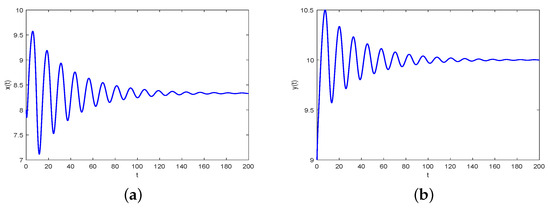
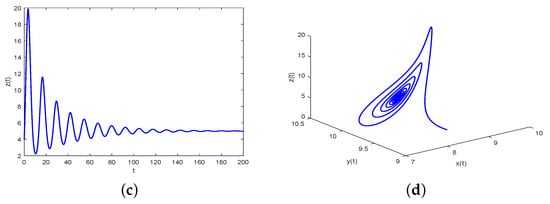 Figure 1. Waveform plots and phase portrait of system (38) with and fixed . (a) represents waveform plot of for system (38). (b) represents waveform plot of for system (38). (c) represents waveform plot of for system (38). (d) represents phase portrait of , and for system (38).
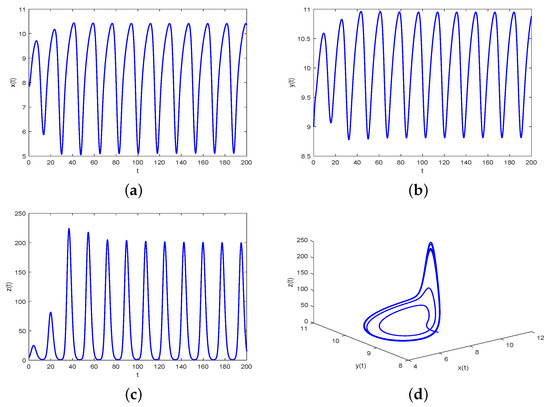 Figure 2. Waveform plots and phase portrait of system (38) with and fixed . (a) represents waveform plot of for system (38). (b) represents waveform plot of for system (38). (c) represents waveform plot of for system (38). (d) represents phase portrait of , and for system (38).
 - Case 2:
- We have that in Case 2 the critical frequency and the bifurcation point are 0.6478 and 0.0409, respectively. According to Theorem 2, when the positive tumor-present equilibrium point is asymptotically stable, as represented in Figure 3. On the flip side, as is increased to pass , loses its stability and a Hopf bifurcation occurs. That is, when the positive tumor-present equilibrium point is unstable, which is displayed in Figure 4.
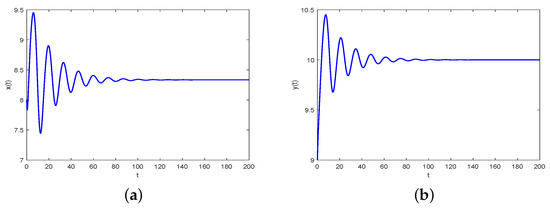
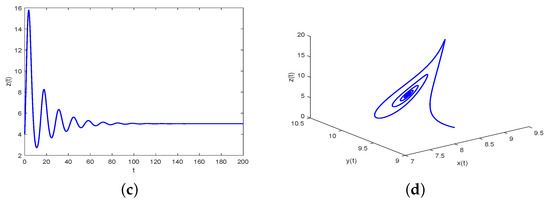 Figure 3. Waveform plots and phase portrait of system (38) with and fixed . (a) represents waveform plot of for system (38). (b) represents waveform plot of for system (38). (c) represents waveform plot of for system (38). (d) represents phase portrait of , and for system (38).
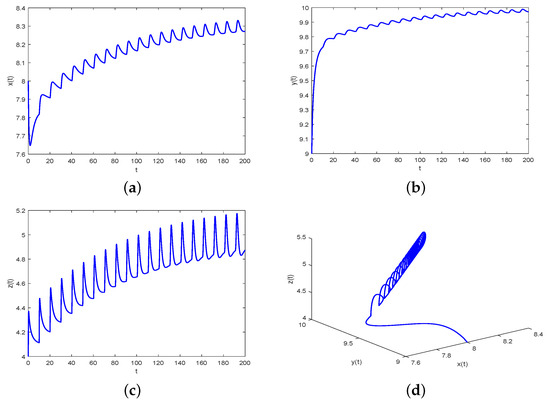 Figure 4. Waveform plots and phase portrait of system (38) with and fixed . (a) represents waveform plot of for system (38). (b) represents waveform plot of for system (38). (c) represents waveform plot of for system (38). (d) represents phase portrait of , and for system (38).
 - Case 3:
- Based on Equations (34) and (35), it is easy to obtain and . Then, we choose . Then, it is easy to find that the critical frequency and the bifurcation point are 0.4296 and 0.5956, respectively. Based on Theorem 3, the positive tumor-present equilibrium point is asymptotically stable when , as revealed in Figure 5. Moreover, as is increased to pass , loses its stability and a Hopf-like bifurcation occurs. For instance, the positive tumor-present equilibrium point is unstable when , which is shown in Figure 6.
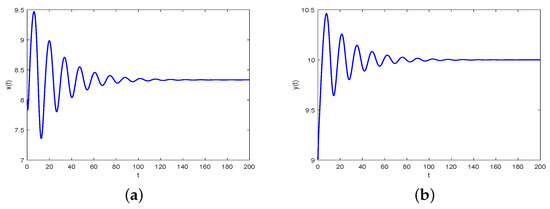
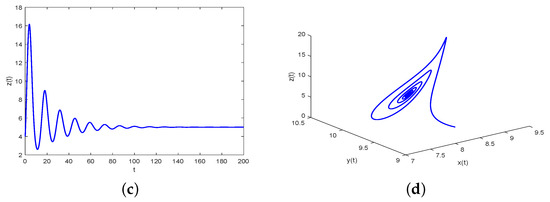 Figure 5. Waveform plots and phase portrait of system (38) with . (a) represents waveform plot of for system (38). (b) represents waveform plot of for system (38). (c) represents waveform plot of for system (38). (d) represents phase portrait of , and for system (38).
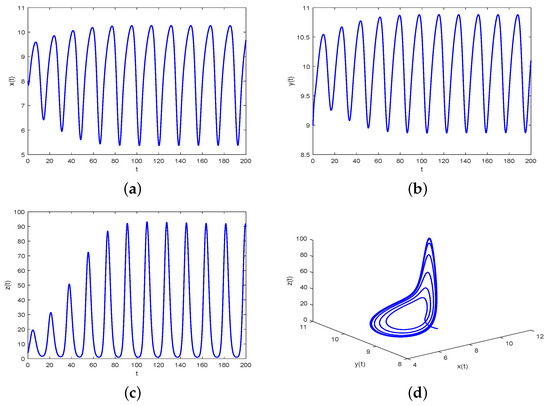 Figure 6. Waveform plots and phase portrait of system (38) with . (a) represents waveform plot of for system (38). (b) represents waveform plot of for system (38). (c) represents waveform plot of for system (38). (d) represents phase portrait of , and for system (38).
Further, considering in system (38), then system (38) clearly develops into the integer-order tumor-lymphatic model, and the critical frequency and bifurcation point can be obtained as and , respectively. It is obvious that , which implies that the onset of bifurcation can lag in system (38). Figure 7 indicates that the equilibrium point of system (38) is unstable and Hopf-like bifurcation occurs when choosing . Figure 7 shows that system (38) has better stability performance than that of the corresponding integer-order ones for the same system parameters. It is not difficult to observe that fractional orders play an important role in postponing the onset of bifurcation for the developed system (38).
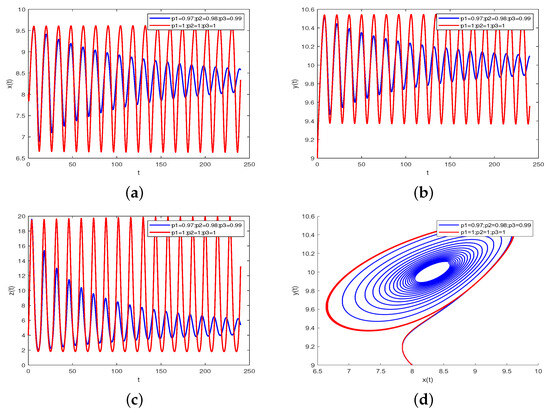
Figure 7.
Comparison of convergence for system (38) with , , , and versus integer-order tumor-lymphatic model. (a) represents waveform plot of for system (38). (b) represents waveform plot of for system (38). (c) represents waveform plot of for system (38). (d) represents phase portrait of , and for system (38).
5. Conclusions
Based on the tumor-lymphatic model proposed by Wang et al. [14], we have proposed the delayed fractional-order tumor-lymphatic model and conducted a thorough analysis of its dynamics. We explored the stability of the positive tumor-present equilibrium point in three different cases by considering two time delays as bifurcation parameters. Furthermore, we derived sufficient conditions for the occurrence of Hopf-like bifurcations within the model. Some numerical simulations have been carried out to confirm the validity and effectiveness of the developed results. The above research results can provide mathematical support for practical clinical research. However, there is a lack of extensive experimental data fitting, and its application to specific actual tumor models is still lacking. Therefore, in-depth research will be conducted on the above content in future work.
Author Contributions
Methodology, X.S., X.C., C.H. and X.Y.; software, X.S., X.C. and A.L.; validation, X.C.; data curation, X.C. and X.Y.; writing—original draft, X.S.; writing—review and editing, A.L.; and supervision, C.H. All authors have read and agreed to the published version of the manuscript.
Funding
The research was supported by the Natural Science Foundation of Jiangsu Higher Education Institutions of China (Grant No. 20KJB110005), the China Postdoctoral Science Foundation (Grant No. 2018M642130), and the Qing Lan Project of the Jiangsu Higher Education Institutions.
Data Availability Statement
No new data were created or analyzed in this study.
Acknowledgments
The authors would like to express their heartfelt thanks to the Editor and anonymous referees for their useful comments and suggestions, which helped to improve the presentation of this paper.
Conflicts of Interest
The authors declare no conflicts of interest.
Appendix A
The expressions , , , and in Equation (17) are as follows:
Appendix B
The expressions , , , and in Equation (26) are as follows:
Appendix C
The expressions , , , and in Equation (37) are as follows:
References
- Borges, F.S.; Iarosz, K.C.; Ren, H.P.; Batista, A.M.; Baptista, M.S.; Viana, R.L.; Lopes, S.R.; Grebogi, C. Model for tumor growth with treatment by continuous and pulsed chemotherapy. Biosystems 2014, 116, 43–58. [Google Scholar] [CrossRef] [PubMed]
- Bi, P.; Ruan, S. Bifurcations in delay differential equations and applications to tumor and immune system interaction models. SIAM J. Appl. Dyn. Syst. 2013, 12, 1847–1888. [Google Scholar] [CrossRef]
- Bi, P.; Ruan, S.; Zhang, X. Periodic and chaotic oscillations in a tumor and immune system interaction model with three delays. Chaos 2014, 24, 023101. [Google Scholar] [CrossRef] [PubMed]
- Deng, W.; Li, C.; Lü, J. Stability analysis of linear fractional differential system with multiple time delays. Nonlinear Dyn. 2007, 48, 409–416. [Google Scholar] [CrossRef]
- Fan, Y.; Huang, X.; Wang, Z.; Li, Y. Global dissipativity and quasi-synchronization of asynchronous updating fractional-order memristor-based neural networks via interval matrix method. J. Franklin Inst. 2018, 355, 5998–6025. [Google Scholar] [CrossRef]
- Li, H.Z.; Liu, X.D.; Yan, R.; Liu, C. Hopf bifurcation analysis of a tumor virotherapy model with two time delays. Phys. A 2020, 553, 124266. [Google Scholar] [CrossRef]
- Liu, Z.; Chen, J.; Pang, J.; Bi, P.; Ruan, S. Modeling and analysis of a nonlinear age-structured model for tumor cell populations with quiescence. J. Nonlinear Sci. 2018, 28, 1763–1791. [Google Scholar] [CrossRef]
- Pang, L.; Liu, S.; Zhang, X.; Tian, T. Mathematical modeling and dynamic analysis of anti-tumor immune response. J. Appl. Math. Comput. 2020, 62, 473–488. [Google Scholar] [CrossRef]
- Pang, L.; Zhao, Z.; Song, X. Cost-effectiveness analysis of optimal strategy for tumor treatment. Chaos Soliton. Fract. 2016, 87, 293–301. [Google Scholar] [CrossRef]
- Ruan, S. Nonlinear dynamics in tumor-immune system interaction models with delays. Discrete Cont. Dyn. B 2021, 26, 541–602. [Google Scholar] [CrossRef]
- Shu, Y.; Huang, J.; Dong, Y.; Takeuchi, Y. Mathematical modeling and bifurcation analysis of pro- and anti-tumor macrophages. Appl. Math. Model. 2020, 88, 758–773. [Google Scholar] [CrossRef]
- Yu, M.; Dong, Y.; Takeuchi, Y. Dual role of delay effects in a tumor-immune system. J. Biol. Dyn. 2017, 11, 334–347. [Google Scholar] [CrossRef]
- Zhou, H.; Wang, Z.; Yuan, D.; Song, H. Hopf bifurcation of a free boundary problem modeling tumor growth with angiogenesis and two time delays. Chaos Soliton. Fract. 2021, 153, 111578. [Google Scholar] [CrossRef]
- Wang, J.; Shi, H.; Xu, L.; Zang, L. Hopf bifurcation and chaos of tumor-Lymphatic model with two time delays. Chaos Soliton. Fract. 2022, 157, 111922. [Google Scholar] [CrossRef]
- Petras, I. Fractional-Order Nonlinear Systems: Modeling, Analysis and Simulation; Springer: New York, NY, USA, 2011. [Google Scholar]
- Jia, J.; Huang, X.; Li, Y.; Cao, J.; Alsaedi, A. Global stabilization of fractional-order memristor-based neural networks with time delay. IEEE Trans. Neural Netw. Learn. Syst. 2020, 31, 997–1009. [Google Scholar] [CrossRef] [PubMed]
- Zhang, L.; Yang, Y. Finite time impulsive synchronization of fractional order memristive BAM neural networks. Neurocomputing 2020, 384, 213–224. [Google Scholar] [CrossRef]
- Fan, Y.; Huang, X.; Wang, Z.; Li, Y. Improved quasi-synchronization criteria for delayed fractional-order memristor-based neural networks via linear feedback control. Neurocomputing 2018, 306, 68–79. [Google Scholar] [CrossRef]
- Fan, Y.; Huang, X.; Wang, Z.; Li, Y. Nonlinear dynamics and chaos in a simplified memristor-based fractional-order neural network with discontinuous memductance function. Nonlinear Dynam. 2018, 93, 611–627. [Google Scholar] [CrossRef]
- Huang, X.; Fan, Y.; Jia, J.; Wang, Z.; Li, Y. Quasi-synchronization of fractional-order memristor-based neural networks with parameter mismatches. IET Control Theory Appl. 2017, 11, 2317–2327. [Google Scholar] [CrossRef]
- Sopasakis, P.; Sarimveis, H. Stabilising model predictive control for discrete-time fractional-order systems. Automatica 2017, 75, 24–31. [Google Scholar] [CrossRef]
- Zamani, A.A.; Tavakoli, S.; Etedali, S. Fractional order PID control design for semi-active control of smart base-isolated structures: A multi-objective cuckoo search approach. ISA Trans. 2017, 67, 222–232. [Google Scholar] [CrossRef] [PubMed]
- Zhang, L.; Yang, Y. Optimal quasi-synchronization of fractional-order memristive neural networks with PSOA. Neural Comput. Appl. 2020, 32, 9667–9682. [Google Scholar] [CrossRef]
- Abdelouahab, M.S.; Hamri, N.E.; Wang, J. Hopf bifurcation and chaos in fractional-order modified hybrid optical system. Nonlinear Dyn. 2012, 69, 275–284. [Google Scholar] [CrossRef]
- Xiao, M.; Zheng, W.X.; Lin, J.; Jiang, G.; Zhao, L.; Cao, J. Fractional-order PD control at Hopf bifurcations in delayed fractional-order small-world networks. J. Franklin Inst. 2017, 354, 7643–7667. [Google Scholar] [CrossRef]
- Bhalekar, S.; Varsha, D. A predictor-corrector scheme for solving nonlinear delay differential equations of fractional order. Int. J. Fract. Calc. Appl. 2011, 1, 1–9. [Google Scholar]
Disclaimer/Publisher’s Note: The statements, opinions and data contained in all publications are solely those of the individual author(s) and contributor(s) and not of MDPI and/or the editor(s). MDPI and/or the editor(s) disclaim responsibility for any injury to people or property resulting from any ideas, methods, instructions or products referred to in the content. |
© 2024 by the authors. Licensee MDPI, Basel, Switzerland. This article is an open access article distributed under the terms and conditions of the Creative Commons Attribution (CC BY) license (https://creativecommons.org/licenses/by/4.0/).