Abstract
In this paper, we extend the invariant subspace method to a class of short pulse-type equations. Complete classification results with invariant subspaces from 2 to 5 dimensions are provided. The key step is to take subspaces of solutions of linear ordinary differential equations as invariant subspaces that nonlinear operators admit. Some concrete examples and corresponding reduced systems are presented to illustrate this method.
1. Introduction
The short pulse (SP) equation
can be used to display the propagation of ultra-short optical pulses in silicon fiber, where represents the magnitude of the optical field. SP and two-component SP equations are obtained as special integrable cases in the negative WKI hierarchy for the first time in Refs. [1,2,3].
In Ref. [4], the authors present a classification of the following SP-type equations
Because of these constants , the dispersion relationship will have variable speeds, and solitons can change the speed, for example, through accelerating. Equation (2) may be a good candidate for accelerating ultra-short optical pulse applications. The purpose of this article is to classify Equation (2) by using the invariant subspace method. In addition, in Ref. [5], the authors considered Lie symmetry analysis for some special SP-type equations.
The invariant subspace method is powerful for studying nonlinear partial differential equations (PDEs). Various invariant subspaces to a number of nonlinear PDEs have been obtained (see [6,7,8,9,10,11,12,13,14,15,16,17,18,19,20,21,22], as well as the references therein). Accordingly, exact solutions stemming from this method play important roles in the study of their asymptotical behavior, blow up and geometric properties, etc. It turns out that the invariant subspace method is closely related to the Lie-Bäcklund symmetry and the conditional Lie-Bäcklund symmetry.
Let us introduce the invariant subspace method briefly [6,7,8,9,10,11,12,13,14,15,16,17,18,19,20,21,22]. Consider the following nonlinear PDEs
where is a sufficiently smooth function of its arguments and (). Let be a finite set of linearly independent functions and denote their linear span . The subspace is said to be invariant under the given nonlinear operator F, namely, F is said to preserve if ; this means
for any . It follows that if the linear subspace is invariant with respect to F, then Equation (3) has exact solutions of the form
where the coefficients satisfy the following dynamical system
Let be defined as the space of solutions to a linear nth-order ordinary differential equation (ODE),
then, the invariant condition with respect to nonlinear operator F takes the form
where denotes equation and its differential consequences with respect to x. Of course, Equation (7) can also be an equation with variable coefficients.
For nonlinear PDEs , there will be a different set of constraint equations. That is, substituting Equation (5) with (7) and (8) into these equations, we can obtain
It is not difficult to notice that . So, the coefficients satisfy the following system
Comparing Equations (6) and (10), we can find that by means of the invariant subspace method, (1 + 1)-dimensional nonlinear equation is reduced to a dynamical system, while the other equation is reduced to a one-dimensional system of equations, which includes constraint equations and a dynamical system. In other words, we extend the application range of solving nonlinear equations by using the invariant subspace method.
There is an important proposition, that is, the maximum dimension estimation of invariant subspaces. Namely, if a linear subspace derived from Equation (7) is invariant under a nonlinear operator F of order k, then
In Refs. [7,8,10], the authors have extended the estimation of the maximal dimension of invariant subspaces to nonlinear vector operators.
2. Invariant Subspaces of the SP-Type Equations
For SP-type Equation (2), we only need to consider cases , , , and , which are obtained by linear ODE (7).
We first analyze the case of . Let
and
a direct computation by using symbolic computation softwares such as Maple. From the invariant condition (8), we have
To remove all the coefficients of Equation (13), we obtain the following over-determined system,
By solving the above system (14), we have four cases,
Let us consider each of these cases in turn.
Subcase 1.1: . Substituting into Case 1, the corresponding solution can be easily obtained and listed as the first entry in Table 1.
Subcase 1.2: .
Subcase 1.2.1: , then . If , it is easy to obtain and , which is represented as the second entry in Table 1. If , it is easy to see that . Then, from , we have three choices,
The results are listed as the fourth to sixth entries of Table 1.
Subcase 1.2.2: . The corresponding classification result is listed as the third entry in Table 1.
3. Some Concrete Examples
In this section, we provide several specific examples to demonstrate the classification results derived from the invariant subspace method.
Example 1.
We consider the following SP-type equation
which is located in the fifth row of Table 1. The operator admits , which is generated by the linear ODE
Thus, an exact solution is provided by
where and satisfy the following reduced system
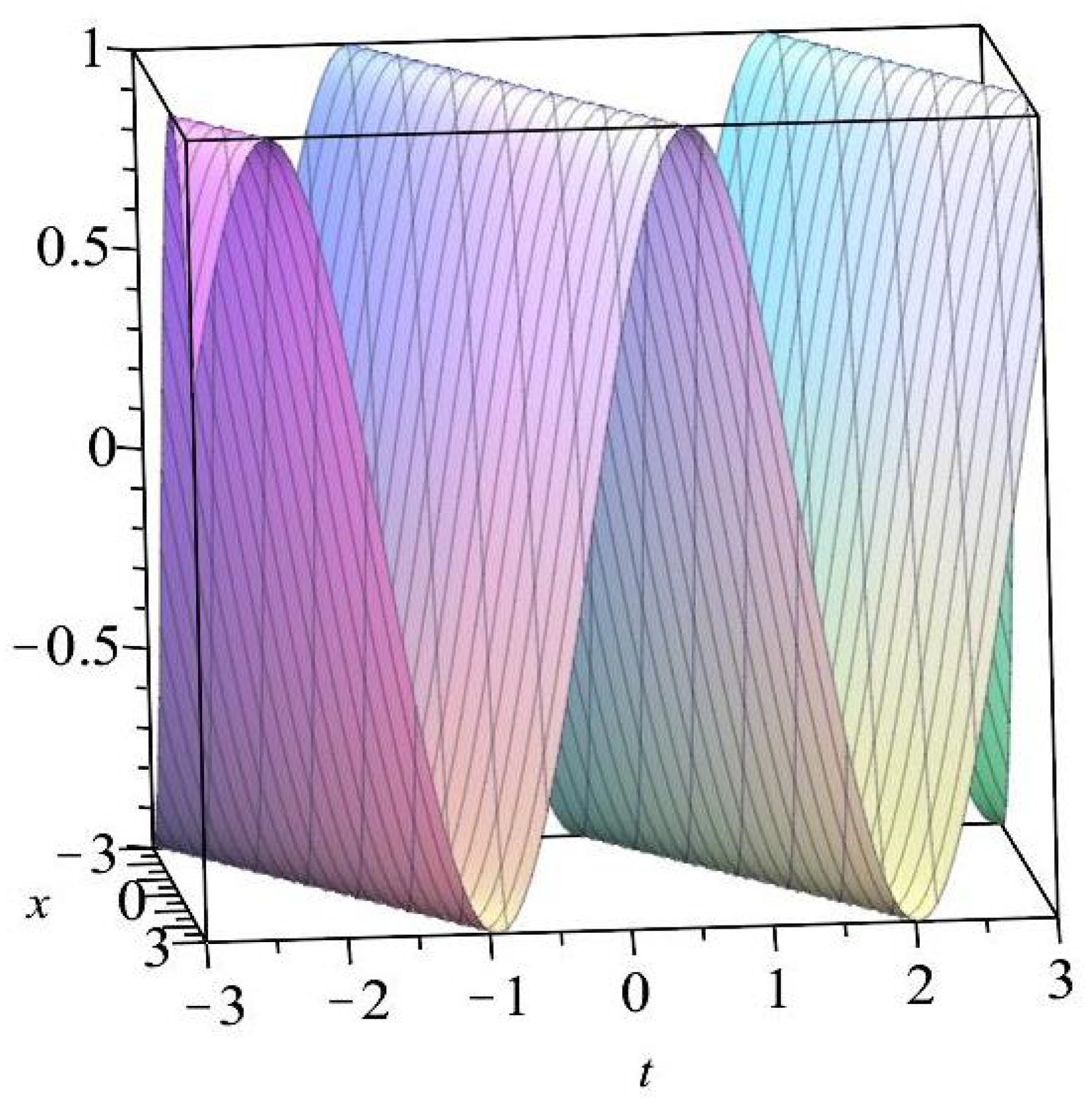
For ease of understanding, these special parameters , have an exact solution of , which is drawn in Figure 1.
Figure 1.
An exact solution of Equation (15) with .
Example 2.
Here, we consider the following SP-type equation
The operator admits the invariant subspace generated by the linear ODE
Case 1: Renaming , when , from , we have the invariant subspace
Thus, an exact solution is provided by
where and satisfy the dynamical system
Case 2: When , from , we have the invariant subspace
Thus, an exact solution is provided by
where and satisfy the dynamical system
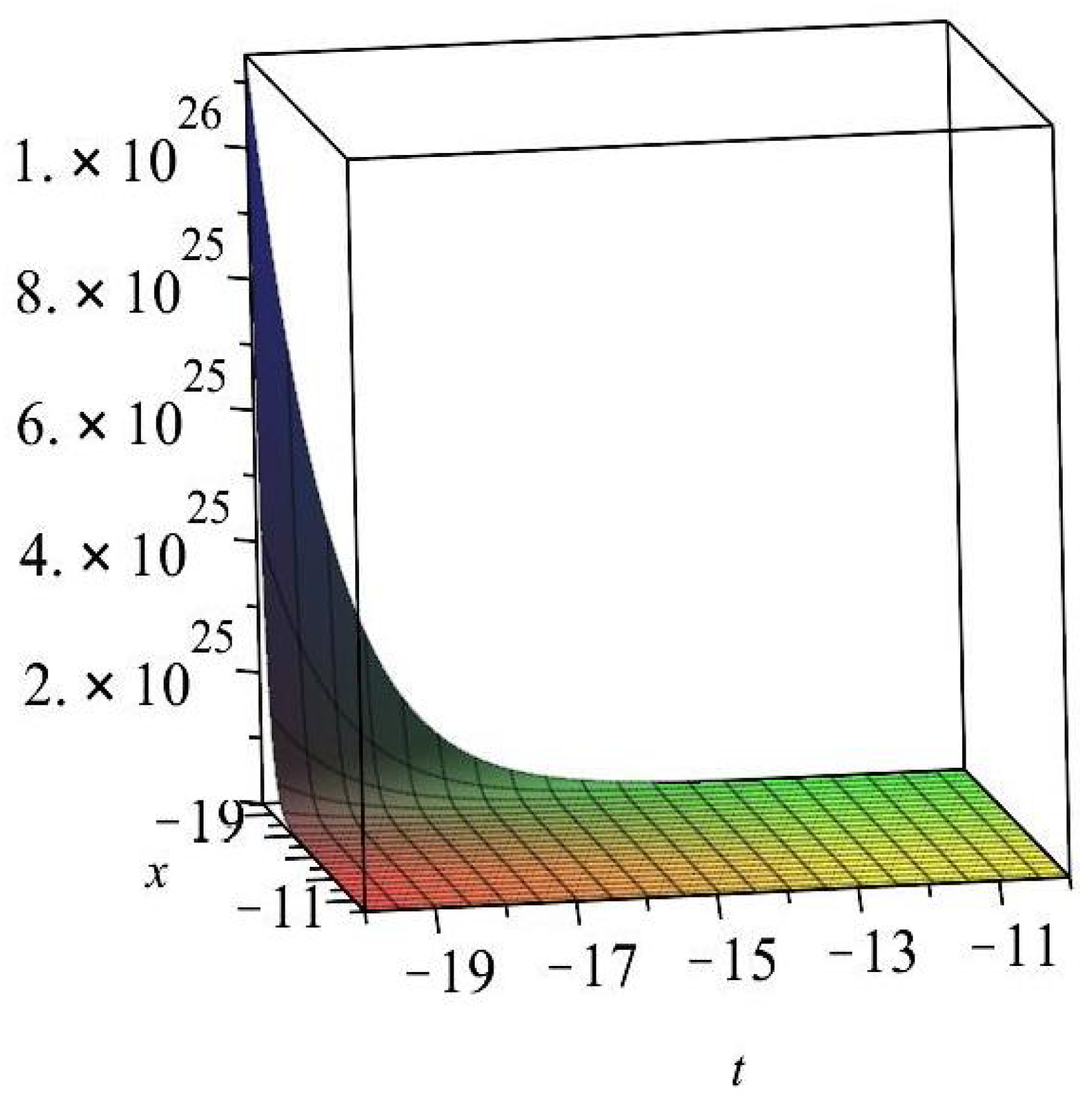
Let these special parameters , have an exact solution
which is drawn in Figure 2.
Figure 2.
An exact solution of Equation (17) with .
Example 3.
Let us consider the following SP-type equation
where the operator admits determined by the linear ODE
Thus, an exact solution is provided by
where and satisfy the following reduced system
Example 4.
We consider the following SP-type equation
The operator admits the invariant subspace determined by the linear ODE
Case 1: Renaming , when , from , we have an invariant subspace
Then, an exact solution is provided by
where , , and satisfy the following reduced system
Case 2: When , from , we have an invariant subspace
Then, an exact solution is provided by
where , , and satisfy the following reduced system
Example 5.
We consider the following SP-type equation
The operator admits determined by the linear ODE
The corresponding exact solution is provided by
where , , , and satisfy the following reduced system
So, an exact solution of the SP-type equation can be obtained as
where is an arbitrary constant.
Example 6.
We consider the following SP-type equation
Here, the operator admits , which is determined by the linear ODE
Thus, an exact solution is provided by
where satisfy the following reduced system
4. Conclusions and Discussions
In this paper, we study SP-type equations by using the invariant subspace method. A class of Equation (2) admitting invariant subspaces generated by Equation (7) are obtained and listed in Table 1 and Table 2. Some concrete examples and corresponding reduced systems are presented to illustrate this method.
In the future, we will consider the classification of two-component SP-type equations. Of course, the extension to the case of nonlocal equations and the case of fractional differential equations should be further investigated.
Author Contributions
G.-H.W.: formal analysis. J.-F.P.: writing—original draft. Y.-Y.J.: supervision. B.R.: writing—review and editing. All authors have read and agreed to the published version of the manuscript.
Funding
This research was funded by the National Natural Science Foundation of China (Grant Nos. 12071431 and 12375006).
Data Availability Statement
The original contributions presented in the study are included in the article.
Acknowledgments
We would like to express our sincere thanks to the referees for their useful comments and timely help.
Conflicts of Interest
The authors declare that they have no known competing financial interest or personal relationships that could have appeared to influence the work reported in this paper.
References
- Qiao, Z.J. Finite-Dimensional Integrable System and Nonlinear Evolution Equations; Chinese National Higher Education Press: Beijing, China, 2002. [Google Scholar]
- Qiao, Z.J.; Cao, C.W.; Strampp, W. Category of nonlinear evolution equations, algebraic structure, and r-matrix. J. Math. Phys. 2018, 44, 701. [Google Scholar] [CrossRef]
- Sakovich, A.; Sakovich, S. The short pulse equation is integrable. J. Phys. Soc. Jpn. 2005, 74, 239. [Google Scholar] [CrossRef]
- Hone, A.N.; Novikov, V.; Wang, J.P. Generalizations of the short pulse equation. Lett. Math. Phys. 2018, 108, 927–947. [Google Scholar] [CrossRef] [PubMed]
- Munir, M.M.; Bashir, H.; Athar, M. Lie symmetries and reductions via invariant solutions of general short pulse equation. Front. Phys. 2023, 11, 1149019. [Google Scholar] [CrossRef]
- Galaktionov, V.A.; Svirshchevskii, S.R. Exact Solutions and Invariant Subspaces of Nonlinear Partial Differential Equations in Mechanics and Physics; Chapman and Hall/CRC: London, UK, 2007. [Google Scholar]
- Qu, C.Z.; Zhu, C.R. Classification of coupled systems with two-component nonlinear diffusion equations by the invariant subspace method. J. Phys. A Math. Theor. 2009, 42, 475201. [Google Scholar] [CrossRef]
- Shen, S.F.; Qu, C.Z.; Jin, Y.Y.; Ji, L.N. Maximal dimension of invariant subspaces to systems of nonlinear evolution equations. Chin. Ann. Math. Ser. B 2012, 33, 161. [Google Scholar] [CrossRef]
- Ma, W.X. A refined invariant subspace method and applications to evolution equations. Sci. China Math. 2012, 55, 1769. [Google Scholar] [CrossRef]
- Song, J.Q.; Shen, S.F.; Jin, Y.Y.; Zhang, J. New maximal dimension of invariant subspaces to coupled systems with two-component equations. Commun. Nonlinear Sci. Numer. Simulat. 2013, 18, 2984. [Google Scholar] [CrossRef]
- Ji, L.N.; Qu, C.Z. Conditional Lie-Bäcklund Symmetries and Invariant Subspaces to Nonlinear Diffusion Equations with Convection and Source. Stud. Appl. Math. 2013, 131, 266. [Google Scholar] [CrossRef]
- Ye, Y.J.; Ma, W.X.; Shen, S.F.; Zhang, D.D. A class of third-order nonlinear evolution equations admitting invariant subspaces and associated reductions. J. Nonlinear Math. Phys. 2014, 21, 132. [Google Scholar] [CrossRef]
- Zhu, C.R.; Qu, C.Z. Invariant subspaces of the two-dimensional nonlinear evolution equations. Symmetry 2016, 8, 128. [Google Scholar] [CrossRef]
- Sahadevan, R.; Prakash, P. On Lie symmetry analysis and invariant subspace methods of coupled time fractional partial differential equations. Chaos Solitons Fractals 2017, 104, 107. [Google Scholar] [CrossRef]
- Liu, H.Z. Invariant subspace classification and exact solutions to the generalized nonlinear D-C equation. Appl. Math. Lett. 2018, 83, 164. [Google Scholar] [CrossRef]
- Zhou, K.; Song, J.Q.; Shen, S.F.; Ma, W.X. A combined short pulse-mKdv equation and its exact solutions by two-dimensional invariant subspaces. Rep. Math. Phys. 2019, 83, 339. [Google Scholar] [CrossRef]
- Chang, L.N.; Liu, H.Z.; Xin, X.P. Invariant subspace classification and exact explicit solutions to a class of nonlinear wave equation. Qual. Theory Dyn. Syst. 2020, 19, 65. [Google Scholar] [CrossRef]
- Prakash, P.; Thomas, R.; Bakkyaraj, T. Invariant subspaces and exact solutions: (1 + 1) and (2 + 1)-dimensional generalized time-fractional thin-film equations. Comp. Appl. Math. 2023, 42, 97. [Google Scholar] [CrossRef]
- Priyendhu, K.S.; Prakash, P.; Lakshmanan, M. Invariant subspace method to the initial and boundary value problem of the higher dimensional nonlinear time-fractional PDEs. Commun. Nonlinear Sci. Numer. Simulat. 2023, 122, 107245. [Google Scholar] [CrossRef]
- Qu, G.Z.; Wang, M.M.; Shen, S.F. Applications of the invariant subspace method on searching explicit solutions to certain special-type non-linear evolution equations. Front. Phys. 2023, 11, 1160391. [Google Scholar] [CrossRef]
- Ma, J.Y.; Cheng, X.Y.; Wang, L.Z. Invariant analysis, exact solutions, and conservation laws of time fractional thin liquid film equations. Phys. Fluids 2024, 36, 027141. [Google Scholar] [CrossRef]
- Thomas, R.; Bakkyaraj, T. Exact solution of time-fractional differential-difference equations: Invariant subspace, partially invariant subspace, generalized separation of variables. Comp. Appl. Math. 2024, 43, 51. [Google Scholar] [CrossRef]
Disclaimer/Publisher’s Note: The statements, opinions and data contained in all publications are solely those of the individual author(s) and contributor(s) and not of MDPI and/or the editor(s). MDPI and/or the editor(s) disclaim responsibility for any injury to people or property resulting from any ideas, methods, instructions or products referred to in the content. |
© 2024 by the authors. Licensee MDPI, Basel, Switzerland. This article is an open access article distributed under the terms and conditions of the Creative Commons Attribution (CC BY) license (https://creativecommons.org/licenses/by/4.0/).