1. Introduction
Nowadays, there are many scholars studying differential equations with delay terms.
The authors [
1] propose a computationally effective numerical solution for a new design of a second-order Lane–Emden pantograph delayed problem. Stochastic delay differential equations (SDDEs) play a significant role in many application fields, such as control [
2], dynamics [
3], epidemic problems [
4,
5] and stock markets [
6]. Ain and Wang [
7] studied an epidemic model for the evolution of diseases utilizing an Itô–Levy stochastic differential equations system. Among these applications, the application of symmetry principles in the realm of SDDEs offers profound insights into the behavior of complex systems, see [
8,
9,
10]. In this paper, we study
d-dimensional SDDEs as follows:
where
is
q-dimensional normally distributed Brownian motion with mean
and variance
, and
is a
-measurable
-valued random variable such that
Here, the constant
and
is a continuous increasing function with the variable delay time
The function
is known as the drift coefficient and
is the diffusion coefficient.
The existence and uniqueness theorems of SDDEs have been proved by the standard technique of Picard iterations in [
11]. Generally, it is difficult to obtain an explicit solution of SDDEs. As a result, many scholars have proposed some numerical schemes for solving SDDEs, such as the Euler–Maruyama scheme [
10,
12,
13,
14],
–Maruyama scheme [
15], split-step
scheme [
16], multistep Maruyama scheme [
17] and Runge–Kutta Maruyama scheme [
18]. The classical Euler–Maruyama scheme for solving SDEs generally achieves a strong order of convergence
, and strong convergence schemes have the stability of absolute moments and mean-square stability. In [
19,
20], the Euler–Maruyama method was employed to solve the stochastic Cahn–Hilliard–Cook equations. Buckwar [
8] proposed the strong Euler–Maruyama scheme for Equation (
1) and proved the mean-square sense convergence theorem under a global Lipschitz condition by using an induction argument on the interval
. Mao [
10,
11,
21] showed that the Euler–Maruyama numerical solution of SDDEs will converge to the true solution under a local Lipschitz condition by using the technique of stopping times and some moment inequalities for the solution of Equation (
1). Subsequently, Mao [
22] obtained the convergence in probability of the Euler–Maruyama scheme under a local Lipschitz condition and Khasminskii-type condition.
Given the application requirements in finance and related fields, there is an increasing interest in studying high-order numerical schemes for solving SDEs. Based on the Itô–Taylor expansion, Kolmogorov backward partial differential equations and some weak approximation properties, Kloeden and Platen [
23] obtained the weak convergence theorem of classical Itô–Taylor weak high-order schemes for SDEs. However, if the scheme contains multiple stochastic Itô-type integrals, it will consume more CPU time and become computationally inefficient for multidimensional SDEs. In order to improve computational efficiency, the simplified weak second-order method [
23] is used to solve multidimensional SDEs, which is highly effective and accurate compared to the classical order 2.0 Itô–Taylor scheme.
In addition, there are also some higher-order numerical schemes for SDDEs. For example, Buckwar and Winkler [
17] constructed a linear multistep Maruyama scheme for SDDEs and proved that the implicit two-step backward differentiation method has an order 2.0 convergence rate with the smallest parameter in the noise term. Meanwhile, the weak order 2.0 stochastic orthogonal Runge–Kutta–Chebyshev (S-ROCK) method is proposed in [
24,
25] for solving SDEs. Then, based on the the S-ROCK method, Guo [
18] developed an explicit Runge–Kutta scheme for SDDEs and studied its stability properties.
In this paper, a new order 2.0 simplified weak Itô–Taylor scheme is put forward to solve SDDEs, which is different from the traditional methods in [
10,
21,
23,
26]. The primary contributions of this paper can be highlighted as follows:
A new order 2.0 simplified weak Itô–Taylor symmetrical scheme is proposed for solving SDDEs, which involves no multiple stochastic Itô-type integrals and can be easily applied to solve multidimensional SDDEs.
Provided that the critical value , we divide the global weak convergence theorem into two steps in the time intervals and . On the basis of the Malliavin space under some reasonable hypotheses, the global weak convergence theorem of the new scheme and the connect inequality are rigorously proven on the time interval Subsequently, based on the theory of Malliavin analysis, using the new weak convergence lemmas and the connection inequality between the two intervals and , we rigorously prove that the new scheme has global weak second-order convergence and mean-square stability.
Several numerical examples, including the Mackey–Glass equation with a multiplicative noise, a nonlinear SDDE about the square of the O-U delay process, a linear SDDE with a time-varying delay and a two-dimensional linear SDDE, are used to illustrate the error and convergence results of the new order 2.0 simplified numerical symmetrical scheme. Additionally, a dedicated discussion section is added to compare our method in detail with other existing methods in terms of computational time and show the global and local convergence rates and mean-square stability property.
The following notations are listed for future reference:
r is a positive constant, and each line may be different.
C is a positive constant, and it relies on the upper bounds of the derivatives of the coefficients .
the set of functions are continuously differentiable with uniformly bounded partial derivatives and for and
the set of functions with uniformly bounded partial derivatives for
This paper is organized as follows. Some fundamental concepts such as the Itô–Taylor expansion and the Malliavin derivative are introduced in
Section 2. In
Section 3, we present a novel order 2.0 simplified weak Itô–Taylor numerical method for solving stochastic delay differential equations (SDDEs) and prove the global weak convergence theorem.
Section 4 provides linear and nonlinear examples to illustrate the impact of the delay coefficient, alongside error and convergence analysis. Finally, in
Section 5, we draw our conclusions.
3. Main Results
In
Section 3.1, we present the new order 2.0 simplified weak numerical method for SDDEs on the basis of the Itô–Taylor expansion and trapezoidal rule. Further, by using the new local weak convergence lemma, we obtain the global weak convergence theorems in
Section 3.2.
3.1. Order 2.0 Simplified Weak Scheme for SDDEs
Note that the continuous increasing function
then for
, we first present the uniform partition on time interval
and
,
and we define
and
In this paper, we use the time discretization
:
with step size
, including all the times
and
Then, we have the
k-th component of explicit solution
of Equation (
1) by the Itô–Taylor expansion
Scheme 1. For and initial value , it takes the formwhere , and andwhere the are independent two-point distributed random variables with for , and for and . Hypothesis 1. Assume the functions satisfy the following conditions:
Lipschitz condition: for , there is a constant with Linear growth condition: for there is a positive constant K with
At the same time, the functions ψ satisfy the following conditions:
The Hölder continuity of the initial data: for all , there exist constants and such that
Let
and
be the solution of Equation (
1) and Scheme 1, respectively. We have the following hypothesis.
Hypothesis 2. Assume the functions , .
Lemma 3. and are the solutions of Equation (
1)
and Scheme 1, respectively. Under Hypotheses 1 and 2, we can obtain and . Proof. Assume
is the explicit solution of following equation:
Using the B-D-G inequality, Gronwall’s inequality and Hypothesis 1, one can show that in reference [
11],
By taking the Malliavin derivative with respect to Equation (
3), we obtain
where
and
Using the elementary inequality
and
, one can further show that
Then using Hölder’s inequality, we have
which by the Gronwall inequality yields
Further, if
,
we obtain that
which yields
. Applying similar techniques as in the proofs of Inequalities (
4) and (
7), under the conditions of the lemma, we deduce
. □
3.2. Weak Convergence Theorems
For the sake of a simple proof, we present a new local weak convergence lemma before presenting the proof of global weak convergence. Next, we give two theorems to prove the global weak convergence theory on the basis of the new weak convergence lemma. In Theorem 1, we utilize the theory of Malliavin analysis and the new lemma to prove Scheme 1 has the global weak second-order convergence rate within . Based on Theorem 1, we prove the global weak convergence theorem within in Theorem 2.
Lemma 4 (Local weak convergence)
. Let and be the solutions of Equation (
1)
and Scheme 1, respectively. Assume . Under Hypothesis 1 and Hypothesis 2, for we haveand Proof. For
, by taking the Malliavin derivative on both sides of Scheme 1 and Equation (
2), we can obtain
for
. Using Lemma 1 (duality formula), we conclude that
Combining Equations (11) and (12) and Corollary 1, for
, we have
Here,
is a function not depending only on time
s, and
where
with the property
On the basis of Equations (
13) and (
14), we immediately obtain that
where
Since
we have
. Using Lemma 1 (duality formula), it follows from Equations (
15) and (
16) that
for
Utilizing Equations (
15), (
17) and (
19), we deduce
Consequently, from the fact
, by Equations (
18) and (
20), we obtain
Applying similar techniques as those used to prove Inequality (
9), we obtain that Inequality (
10) holds.
The proof is completed. □
For the ease of the proof, we consider one-dimensional Wiener process and random variable . Next, we give the proof of global weak convergence (Theorem 1) on .
Theorem 1 (global weak convergence: part I)
. Let Hypotheses 1 and 2 hold. Let and () be the solutions of Equation (
1)
and Scheme 1, respectively. Then, if (), we have Proof. In the case that the time
, it follows from the Taylor formula that
with
Note that
so by virtue of the Itô–Taylor expansion, we can obtain
for
and
For
, it follows from the Taylor formula that
where
. Combining Equations (
23)–(
25), we have
where
From Equation (
26), we deduce the following recursive formula:
where
and
are defined in (27), (28) and (29), respectively, and for
In order to give the estimate with respect to Equation (
30), we give the detailed proof process in three parts. In the first part, let the condition
, so we obtain
Using Lemma 1 (duality formula) and Equation (
32), it yields
It follows from the condition in Hypotheses 1 and 2 that
for
and
which, by combining the Equations (
27) and (
31), yields
Consequently, we can infer from (
33) and (
34) that
In the second part, we give the error estimate with respect to
:
Next, by using Lemma 4, we have
. In the third part, by using Lemma 1 (duality formula), we deduce
Furthermore, by Equation (
36), it is obtained that
Combining Equation (
30), Inequalities (
35) and (
37) and the fact
, we deduce
Further, in a similar way as in proving Inequality (
21), due to
, we have
The proof is completed. □
Next, based on Inequalities (21) and (22), which are the connection between Theorems 1 and 2, we give the proof of global weak convergence on .
Theorem 2 (global weak convergence: part II)
. Let Hypothesis 1 and Hypothesis 2 hold. Let and be the solutions of Equation (
1)
and Scheme 1, respectively. Furthermore, if we have Proof. For the sake of a simple proof, by using the Taylor formula, we have the following equation:
with
For
it follows from the Itô–Taylor expansion that
for
For
and
by the Taylor formula we have
where
Combining Equations (
40)–(
42), we deduce
where
Next, we give the estimate with respect to Equation (
43) in four parts. In the first part, we infer from the conditions in Hypotheses 1 and 2 that
for
and
which, by employing Equations (44) and (45), yields
Therefore, we can infer from
and Inequality (22) in Theorem 1 that
Next, we give the estimate with respect to
in the second part. Utilizing the tower rule and Lemma 1 (duality formula), we have
where
Under the conditions in Hypotheses 1 and 2, note that
; therefore, we deduce
Assume the notation
is a
-measurable function of
and
, which has the estimate
Consequently, combining the fact
and the connection of Inequality (22) in Theorem 1, we can deduce
In the third part, we give the error estimate with respect to
:
Therefore, by combining Equation (
48) and Lemma 4, we deduce the following inequality:
In the fourth part, using Lemma 1 (duality formula), we have
Furthermore, by Equation (
50), we obtain that
Combining Equation (
43) and Inequalities (
46), (
47), (
49) and (
51), we have
Using a similar technique as in the proof of Inequality (
52), we can obtain
for
Then let
in (
53); therefore, we have the following mean-square stability estimation:
The proof is completed. □
Remark 1. It is worth noting that and are obtained under the regularity conditions on , and in Lemma 3. However, under a weaker regularity condition on these coefficients, we might obtain a lower order of convergence of Scheme 1. For example, if , and we can only obtain the following weak order-one convergence: In this case, it is better to use the Euler–Maruyama scheme to solve SDDEs (
1)
. 4. Numerical Experiments
In the following numerical examples, for
, let
and
be the solutions of Scheme 1 and Equation (
1) at time
, respectively. Furthermore, we give the definition of global errors and local errors as follows:
where
is the number of sample tracks, and
is uniform-temporal with the time step by
.
Example 1. Consider the Mackey–Glass equation with a multiplicative noise:where , and b and σ are real parameters. Next, we use Scheme 1 to solve the problem with parameters We approximate the “true solution” using the Euler–Maruyama method with a sufficiently small step size (here,
). In
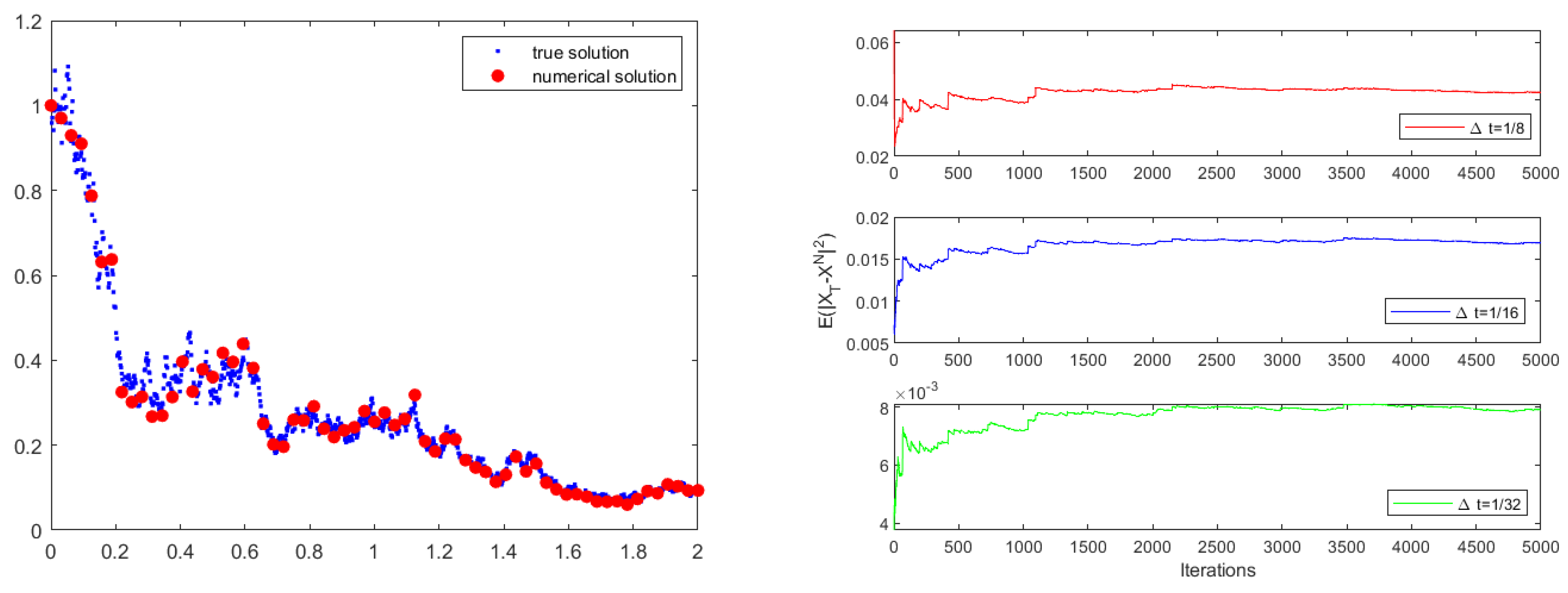
Table 1, we compare the errors, convergence rates (CR for short) and operating time of the Euler scheme, Milstein scheme and Scheme 1. The results demonstrate that Scheme 1 exhibits a superior convergence rate. In the left of
Figure 1, we depict the numerical solution resulting from Scheme 1 with a step size of
, alongside a sample path’s “true solution”. We obtain the mean-square convergence stability result of global errors to test stability in the right of
Figure 1. The numerical results here are consistent with the results we established regarding convergence and stability.
Example 2 (Square of O-U delay process)
. In this example, we consider nonlinear SDDEs. In order to give nonlinear SDDEs, we first study linear SDDEs:with the terminal time . By using the Itô formula with respect to
, we deduce
Assuming
, we have
Therefore, we obtain the following nonlinear models for SDDEs:
Based on the explicit solution of Equation (
55), we have the explicit solution of Equation (
56) on
:
where
has normal distribution
with the mean value
and the variance
Next, we obtain the solution of Equation (
56) on
:
In this experiment, we give nonlinear SDDEs by the (O-U) process for linear SDDEs and study the property of the nonlinear SDDEs with the parameters of
,
and
. In
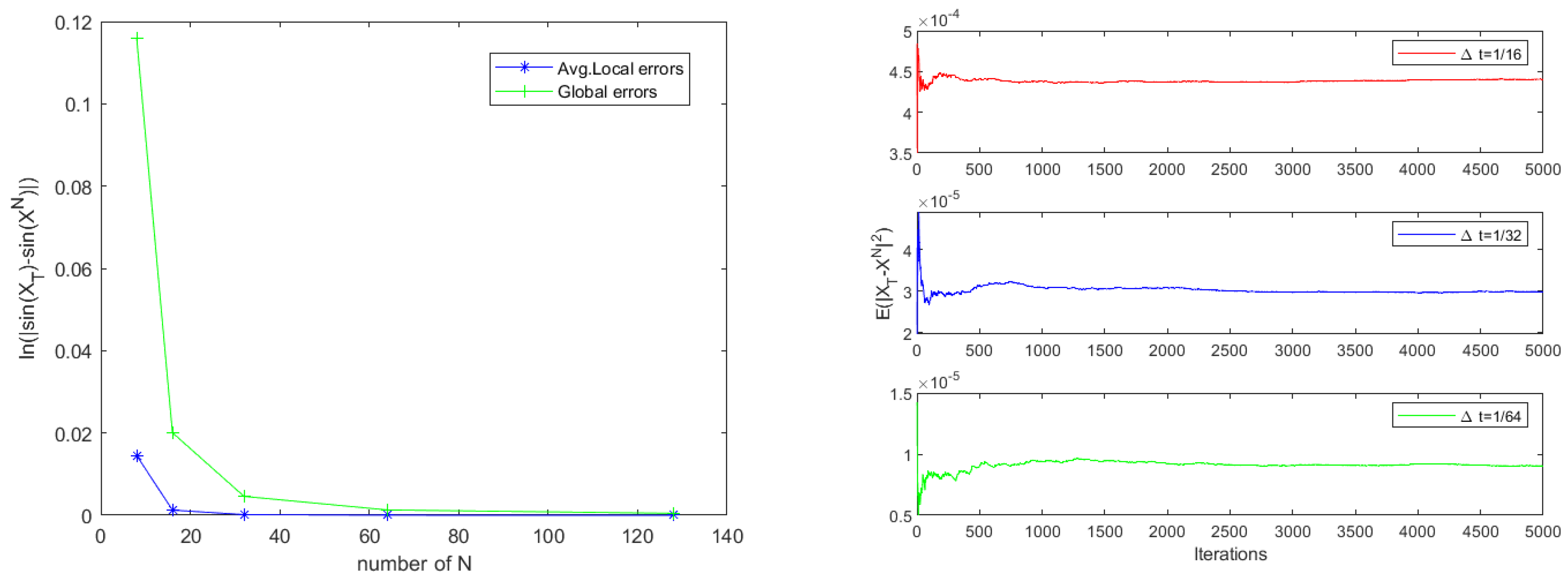
Table 2, we present the error and convergence results for Example 2. For a more intuitive display, the plots of errors result with respect to
N are drawn in the left of
Figure 2, which implies that the experimental results are in agreement with the theoretical results. In addition, we obtain the mean-square convergence stability result of global errors with times steps
,
and
, which are shown in the right of
Figure 2.
Example 3. Consider the linear SDDE with a time-varying delay:where and the terminal time . Next, we give the solution of Equation (
57)
on : Next, we utilize Equation (
58) to obtain a solution on
. Therefore, Equation (
57) has the solution
In this example, we assume
. We test the convergence rate and errors of Scheme 1 by setting the delay function
,
,
,
,
; the error and convergence results are provided in
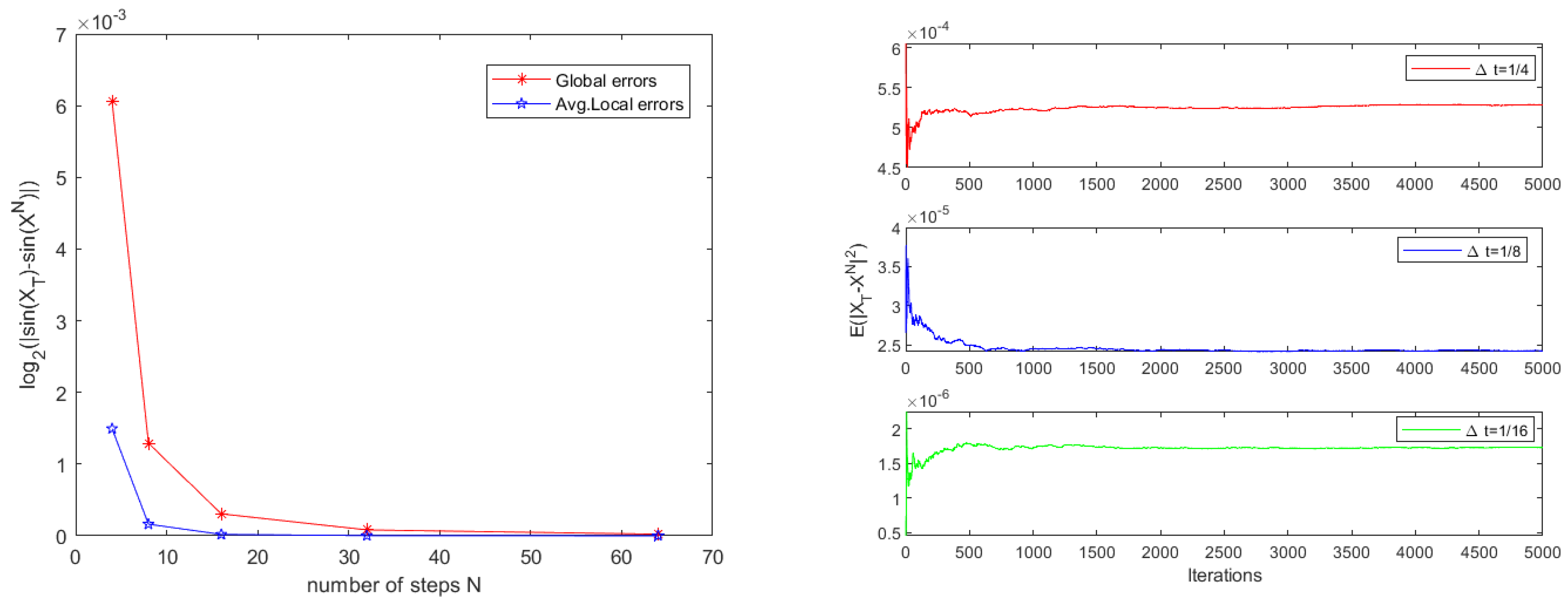
Table 3. As expected, Scheme 1 can obtain global second-order and local third-order convergence rates, which are in agreement with theoretical results. We also plot the lines of average local errors (Avg.Local Errors for short) and global errors with respect to the steps
N in the left of
Figure 3. Furthermore, the figure intuitively displays that the theoretical results are correct. For three different time steps
,
and
, we obtain the mean-square convergence stability result of global errors in the right of
Figure 3.
Example 4. Consider the following two-dimensional linear SDDEs:where and the terminal time . Next, we use Scheme 1 to solve the problem with parameters In this example, it is not a simple decoupled SDDE, so it cannot be regarded as a scalar equation. With an assumption of
, we simulate and calculate the convergence rates and errors of Scheme 1; the error and convergence results are provided in
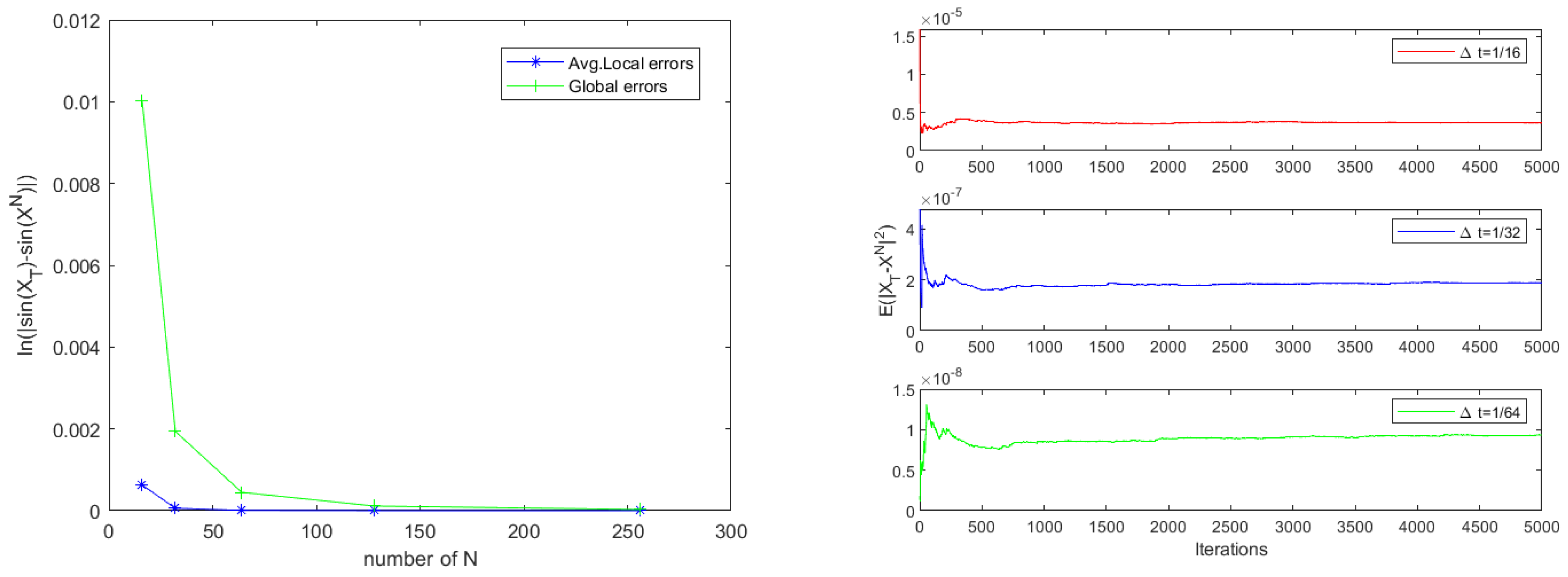
Table 4. It is gratifying that Scheme 1 can obtain global second-order and local third-order convergence rates. We also plot the lines of average local errors (Avg. Local Errors for short) and global errors with respect to the steps
N in the left of
Figure 4. For three different time steps
,
and
, we obtain the mean-square convergence stability result of global errors in the right of
Figure 4. The figure intuitively displays that the theoretical results are correct.