1. Introduction
As a typical nonnegative data dimensionality reduction technology, nonnegative matrix factorization (NMF) [
1,
2,
3,
4,
5] can efficiently mine hidden information from data, so it has been gradually applied to research into high-dimensional data. This method as a data reduction technique appears in many applications, such as image processing [
2], text mining [
6], blind source separation [
7], clustering [
8], music analysis [
9], and hyperspectral imaging unmixing [
10], to name a few. Generally speaking, the fundamental NMF problem can be summarized as follows: given an
data matrix
with
and a predetermined positive integer
, then NMF plans to find two nonnegative matrices
and
such that
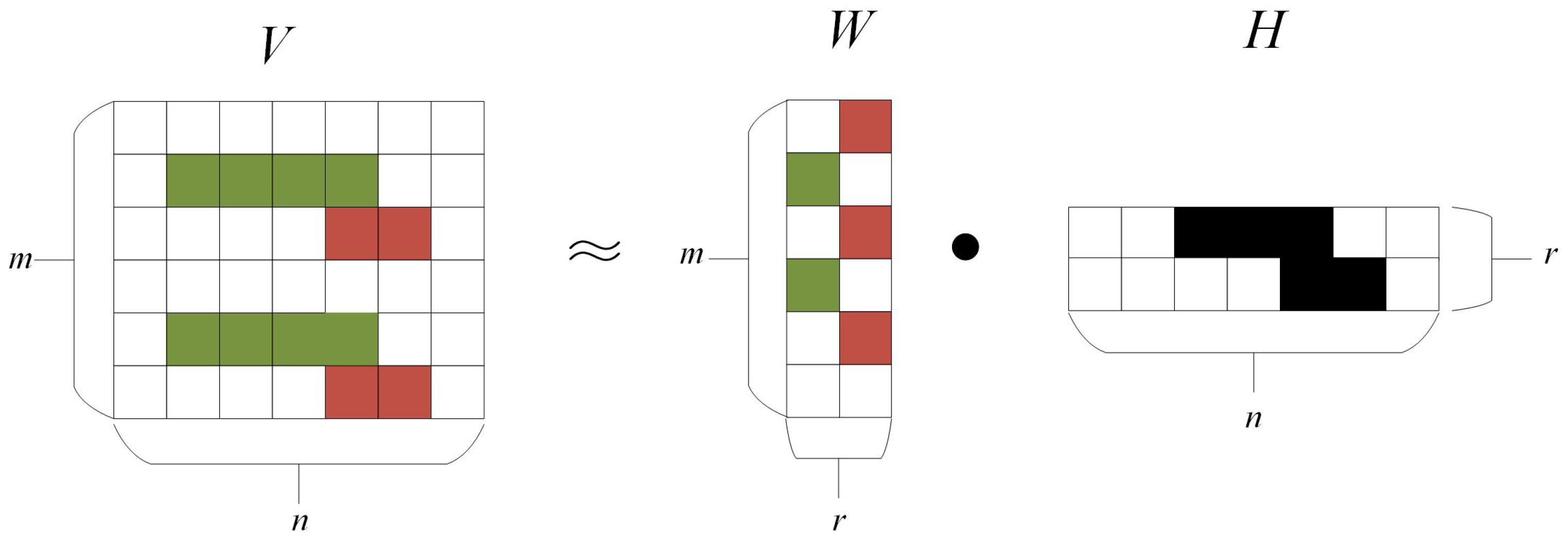
Our visualization illustration of NMF is shown in
Figure 1.
One of the most commonly used models of NMF (
1) is
where
is the Frobenius norm.
The project Barzilai-Borwein (PBB) algorithm is regarded as a popular and effective method for solving (
2) which was originated by Barzilai and Borwein [
11]. In recent years, a large number of studies [
12,
13,
14,
15,
16] have shown that the PBB algorithm is a very effective algorithm in solving optimal problems. The PBB algorithm has the characteristics of simple calculation and high efficiency, so it has been paid attention to by various disciplines. So far, the research results based on the PBB have been widely used in the field of NMF (see [
17,
18,
19,
20,
21]).
In view of the perfect symmetry of the interaction between
W and
H, we will focus on the updating of matrix
W based on the PBB algorithm. Remember that
is an approximate value of
H after
kth update, and there are
At each step for solving (
3), there are three different updates:
where
,
.
Original cost function (
4) is the most frequently used form in the PBB method for NMF and has been widely and deeply researched [
17,
20,
21,
22,
23]. But the major disadvantage of (
4) is that it is not strongly convex [
24,
25,
26,
27,
28], and we can only hope that this method can find a stationary point, rather than a global or local minimizer. To overcome this drawback, a proximal modification of cost function (
4) is presented in [
18,
19], namely, the proximal cost function (5).
At present, the proximal cost function (5) has been used with the PBB method for NMF in [
18,
19]. When the cost function (5) is a strongly convex quadratic optimization problem, their lower bound is zero, so the subproblem (5) has a unique minimizer. In [
18], the authors present a quadratic regularization nonmonotone PBB algorithm to solve (5) and established its global convergence result under mild conditions. Recently, it is revisited in [
19] for the monotone PBB method and is also shown to converge globally to a stationary point of (
3), and through the analysis of numerical experiments, it is proved that the monotone PBB method can win over the nonmonotone one under certain conditions. However, when solving the problems (
4) and (5), the existing gradient methods based on the PBB converge slowly due to the nonnegative conditions. Therefore, this project intends to develop a new fast NMF algorithm.
In this paper, we introduce a prox-linear approximation of at based on which is the cost function (6). And then we propose an active set identification technique. Next, we present a modified nonmonotone line search technique so as to improve the efficiency of nonmonotone line search, in which a new parameter formula is presented to attempt to control the degree of the nonmonotonicity of line search, and thus improve both the possibility of finding the global optimal solution and the convergence speed. By using the active set identification strategy and the modified nonmonotone line search, a global convergent method is proposed to solve (6) based on the alternating nonnegative least squares framework. In particular, in each iteration, identification techniques are used to determine active and free variables. We take or to update some active variables, while using a projected Barzilai-Borwein method to update the free variables and some active variables. The calculation speed is improved by using the method of larger step size. Finally, through the numerical experiments of simulation data and image data, it is proved that the proposed algorithm is effective.
This paper is organized in the following manner. In
Section 3, we introduce our estimation of active set, put forward an efficient NMF algorithm, and present the global convergence results of this method. The experimental results are given in
Section 4. Finally,
Section 5 is the conclusion of the thesis.
2. A Fast PBB Algorithm
In this section, we present an efficient algorithm for solving the NMF and establish the global convergence of our algorithm. Now, let us first introduce some main results of the objective function that we know.
Lemma 1 ([
29]).
The following two statements are valid.- (i)
The objective function of (3) is convex. - (ii)
The gradient
is Lipschitz continuous with the constant . In order to facilitate the discussion, we mainly focus on (6) and then rewrite it. Note that the cost function (7) is closely related to the one in Xu et al. [
30], but has the following difference: matrix
U is
in our cost function (7), however, to [
30] the matrix
U is an extrapolation point in
.
where the fixed matrix
.
According to (ii) of the Lemma 1,
is strictly convex in
W for any given
U. In each iteration, we will first solve the following strongly convex quadratic minimization problem, so as to obtain a
value
Because the objective function of the problem (
8) is strongly convex, the solution of the problem is unique and closed-form
Here, the operator projects all negative terms of X to zero.
Let
, where
is the direction which is obtained by (23) with
being the BB stepsize [
11], whereby we see that the convergence of
can not be guaranteed. Therefore, a global optimization strategy is proposed based on the modified Armiji line search [
31].
Therefore, a globalization strategy based on the modified Armiji line search [
31] has been proposed, that is, we ask for a step size
, so that
here
. Owing to the maximum function, a good function value obtained in any iteration will be discarded, and the numerical performance depends largely on the selection of
M in some cases (see [
32]).
So as to overcome these shortcomings and obtain a large step size in each procedure, we present a modified nonmonotone line search rule. The modified line search is as follows: for the known iteration point
and search direction
at
, we select
, where
,
, where
,
,
, and
, to find a
satisfying the following inequality:
where
is defined as
Similar to
M in (10), the selection
in (12) is an important factor in determining the degree of nonmonotonicity (see [
33]). Thus, to improve the efficiency of a nonmonotone line search, Ahookhosh et al. [
34] choose a varying value for the parameter
by using a simple formula. Later, Nosratipour et al. [
35] decided that
should be related to a suitable criterion to measure the distance to the optimal solution. Thus, they defined
by
However, we found that if the iterative sequence
is trapped in a narrow curved valley, then it can lead to
, from which we can obtain
, so the nonmonotone line search is reduced to the standard Armijo line search, which is inefficient owing to the generation of very short or zigzagging steps. To overcome this drawback, we suggest the following
:
It is obvious that is large when the function value decreases rapidly, and then will also be large, so therefore the nonmonotone strategy will be stronger. However, when is close to the optimal solution, we can obtain which tends toward zero, and then also tends toward zero, so then the nonmonotone rule will be weaker and it tends to be a monotone rule.
As was observed in [
16], the active set method can enhance the efficiency of the local convergence algorithm and reduce the computing cost. There-in-after, we will recommend an active set recognition technology to approximate the right sustain of the solution points. In our context, we deal with the active set which is considered as the subset of zero components of
. Now, we introduce the active set
L as the index set corresponding to the zero component. Meanwhile, the inactive set
F is to be the support of
.
Definition 1. Let and be a stationary point of (3). We define the active set as follows: We further define an inactive set F which is a complementary set of L,where
.
Then, for any
, we define the following approximations
and
as
and
, respectively,
where
is the BB step size. For simplicity, we abbreviate
and
as
and
, respectively. Similar to the Lemma 1 in [
21], we have that if the strict complementarity is satisfied at
, then
coincides with the active set if
is sufficiently close to
.
In order to obtain a well estimate of the active set, the active set is further subdivided into two sets
and
here
is a constant.
Obviously,
is the index set of variables with the first-order necessary condition. Therefore, we have reason to set the variables with indices in
to 0. In addition, because
is an index set that does not satisfy the first-order necessary condition, we further subdivide
into two subsets
and
When a variable is with indices in
, we consider the direction of the form 0. And for the variables of the indexs in
, we consider the direction of the form
, so as to to improve the corresponding components. Thus, through the above discussion, we define this direction in the following compact form:
where
is the BB stepsize.
Finally, we let
where
is the step size which is found by using a nonmonotonic line search (11).
It is known from [
36] that the larger step size technique can significantly accelerate the rate of convergence of the algorithm, so by adding a relaxation factor
s to the update rule of
(24), we modify the update rule (24) as
for relaxation factor
. We show that the optimal parameter
s in (25) is
by number experiments in
Section 4.4.
Based on the above discussion, we develop a nonmonotone projected Barzilai-Borwein method based on the active set strategy proposed in
Section 3 and outline the proposed algorithm in Algorithm 1. We can follow a similar procedure for updating
H.
| Algorithm 1 Nonmonotone projected Barzilai-Borwein algorithm (NMPBB). |
Initialize , , choose parameters , , , , , and . Set . If , stop. Compute . Compute by (12) and compute by (23). Nonmonotone line search. Let be the smallest nonnegative integer m satisfying
where . Set , calculate . Calculate and . If , set ; otherwise, set . Set and go to step 2.
|
Remark 1. According to (11), from the definition of , we obtain Since , we can find that (11) equals If and are close to 0 and 1, respectively, and , then (11) reduces to the Gu’s line search in [33] with and , which implies that the linear search condition of Gu in [33] can be regarded as a special case of (11). In addition, when and , the line search rule (11) can be reduced to the Armijo line search rule. Next, we prove that the improved nonmonotone line search is well-defined. Before presenting this fact, we state the scaled projected gradient direction by
for all
and
.
For each and . The next Lemma 2 is very important in our proof.
Lemma 2 ([
37]).
For each , ,- (i)
,
- (ii)
The stationary point of (3) is at W if and only if
The lemma that follows states that
is true if and only if the stationary point of problem (
3) is the iteration point
.
Lemma 3. Let be calculated by (23), then if and only if is a stationary point of problem (3). Proof. Let
. It is obvious that
is a stationary point of problem (
3) when
. If
, we have
The above inequality implies that
. By the KKT condition, we can find that
is a stationary point of problem (
3). If
, by (ii) of Lemma 2, we know that
is a stationary point of problem (
3).
Assume that
is a stationary point of (
3). From the KKT condition, (17) and (18), we have
By the definition of , we have for all . And then from the (ii) of Lemma 2, we have for all . Therefore, we have for all . For another case, since , for , and is a feasible point, from the definition of , we have . □
The next Lemma 4 is very important in our proof.
Lemma 4. Sequence produced by Algorithm 1, we have Proof. If , it is obvious that holds.
If
, from (i) of Lemma 2, we have
Thus, we now only need to prove that
If
, the inequality (32) holds. If
, for all
, from (21), we have
which lead to
The above deduction implies that the inequality (29) holds for . Combining (13) and (33), we obtain that (29) holds. By means of the Cauchy equality, from (29), we obtain (30). □
The following lemma is borrowed from Lemma 3 [
18].
Lemma 5 ([
18]).
Suppose Algorithm 1 generates and , there is Now, we will show the nice property of our line search.
Lemma 6. Suppose Algorithm 1 generates sequences and , there is Proof. Based on the definition of
, we have
where the last inequality from Lemma 2 and
. From
, it concludes that
, i.e.,
.
Therefore, if
, from (12), we have
where the last inequality follows from (36). Thus, (37) indicates
In addition, if , we have . □
It follows from Lemma 6 that
In addition, for any initial iterate
, Algorithm 1 generates sequences
and
that are both included in the level set.
Again, from Lemma 6, the theorem shown below can be easily obtained.
Theorem 1. Assume that the level set is bounded, so the sequence is convergent.
Proof. First, we show that
. Apparently, according to (35) we have
Therefore, we obtain that for all .
From (39), we can obtain that
that is, the sequence
has a lower bound. Since the sequence
is nonincreasing, the sequence
is convergent. □
Next, we will exhibit that the line search (11) is well-defined.
Theorem 2. Assume Algorithm 1 generates sequences and , so step 5 of the Algorithm 1 is well-defined.
Proof. For this purpose, we prove that the line search stops at a limited value of steps. To establish a contradiction, we suppose that
such that (26) does not exist, and then for all adequately large positive integers
m, according to Lemmas 5 and 6, we have
According to (40), from the definition of
, we have
Since
, we can find that (40) is equivalent to
From Lemmas 5 and 6, we have
Due to
, thus,
According to the mean-theorem, there is a
such that
that is,
When
, we find that
Since , is correct. This is not consistent with the fact that . Therefore, step 5 of Algorithm 1 is well-defined. □
4. Numerical Experiments
In the following content, by using synthetic datasets and real-world datasets (ORL image database and Yale image database (Both ORL and Yale image datasets in MATLAB format are available at
http://www.cad.zju.edu.cn/home/dengcai/Data/FaceData.html (accessed on 26 December 2023))), we exhibit the main numerical experiments to compare the performance of NMPBB with that of the other five efficient methods including the NeNMF [
29], the projected BB method (APBB2 [
17]) (The code is available at
http://homepages.umflint.edu/∼lxhan/software.html (accessed on 26 December 2023)), QRPBB [
18], hierarchical alternating least squares (HALS) [
38], and block coordinate descent (BCD) method [
39]. All of the reported numerical results are performed using MATLAB v8.1 (R2013a) on a Lenovo laptop.
4.1. Stopping Criterion
According to the Karush-Kuhn-Tucker (KKT) conditions optimized by existing constraints, we know that
is a stationary point of NMF (
2) if and only if
and
are simultaneously satisfied, here
and
is also written as shown above. Hence, we employ the stopping criteria shown below, which is also used in [
40] in numerical experiments:
here
is a tolerance. When employing the stop criterion (52), we need to pay attention to the scale degrees of freedom of the NMF solution, as discussed in [
41].
4.2. Synthetic Data
In this section, first the NMPBB method and the other three ANLS-based methods are tested on synthetic datasets. Since the matrix V in this test happens to be a low-rank matrix, it will be rewritten as , and here we generate the L and R by using the MATLAB commands and , respectively.
For NMPBB, in a later experiment we adopt the parameters shown below:
The settings are identical with those of APBB2 and QRPBB. Take
for NMPBB, the reason of selecting relaxation factor
is given in
Section 4.4, and take
for all comparison algorithms. In addition, for NMPBB we choose
and the update
by the following recursive formula
We unify the maximum number of iterations of all algorithms to 50,000. All other parameters of APBB2, NeNMF, and QRPBB are unified as default values.
For all the problems we are considering, casually generated 10 diverse starting values, and the average outcomes obtained from using these starting points are presented in
Table 1. The item iter represents that the number of iterations required to satisfy the termination condition (52) is met. The item niter represents the total number of sub-iterations for solving
W and
H.
is relative error,
is the final value of the projected gradient norm, and CPU time (in seconds) separately measures performance.
Table 1 clearly indicates that all methods met the condition of convergence within a reasonable number of iterations.
Table 1 also clearly indicates that our ANMPBB needs the least execution time and the least number of sub-iterations among all methods, particularly in the case of large-scale problems.
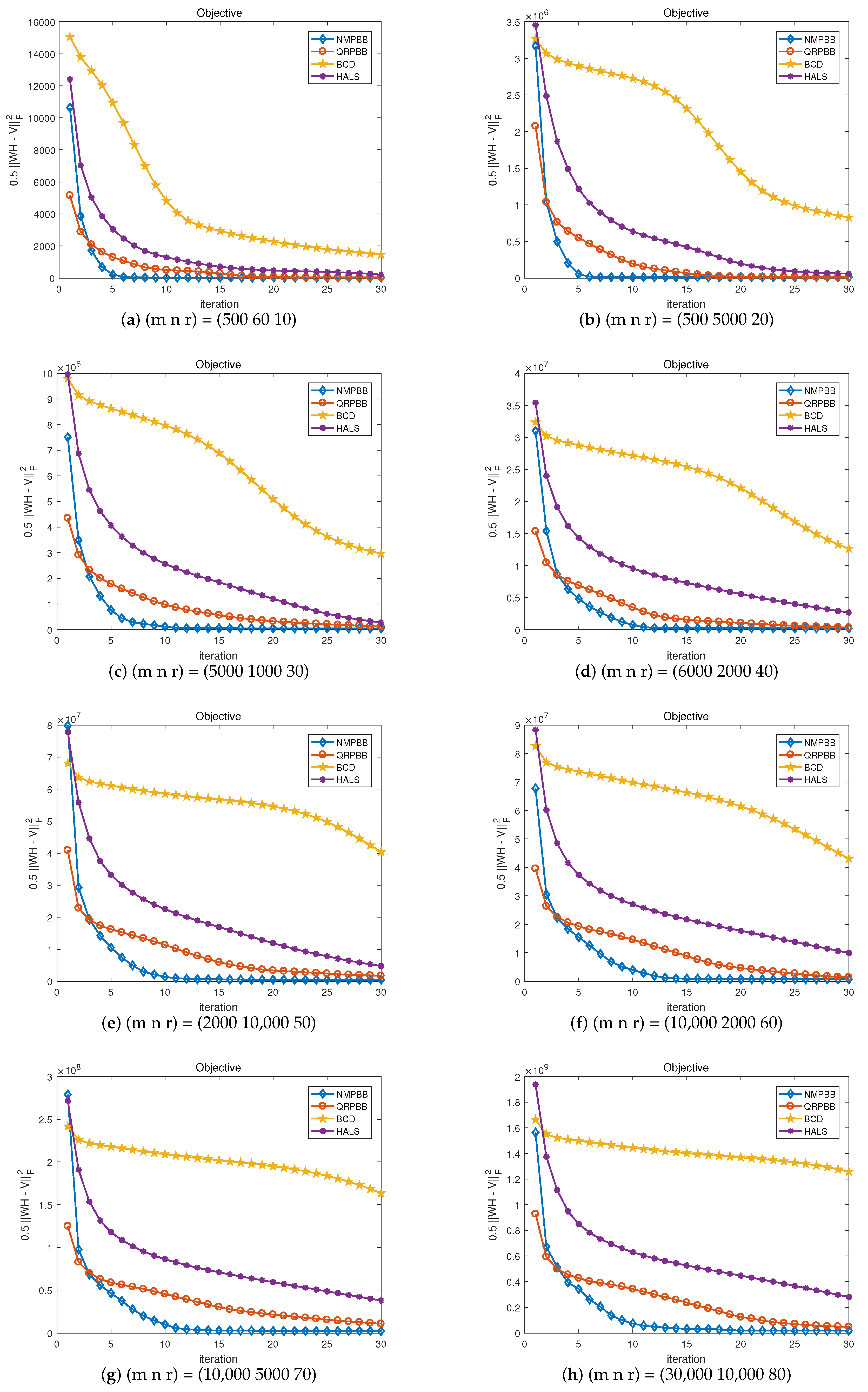
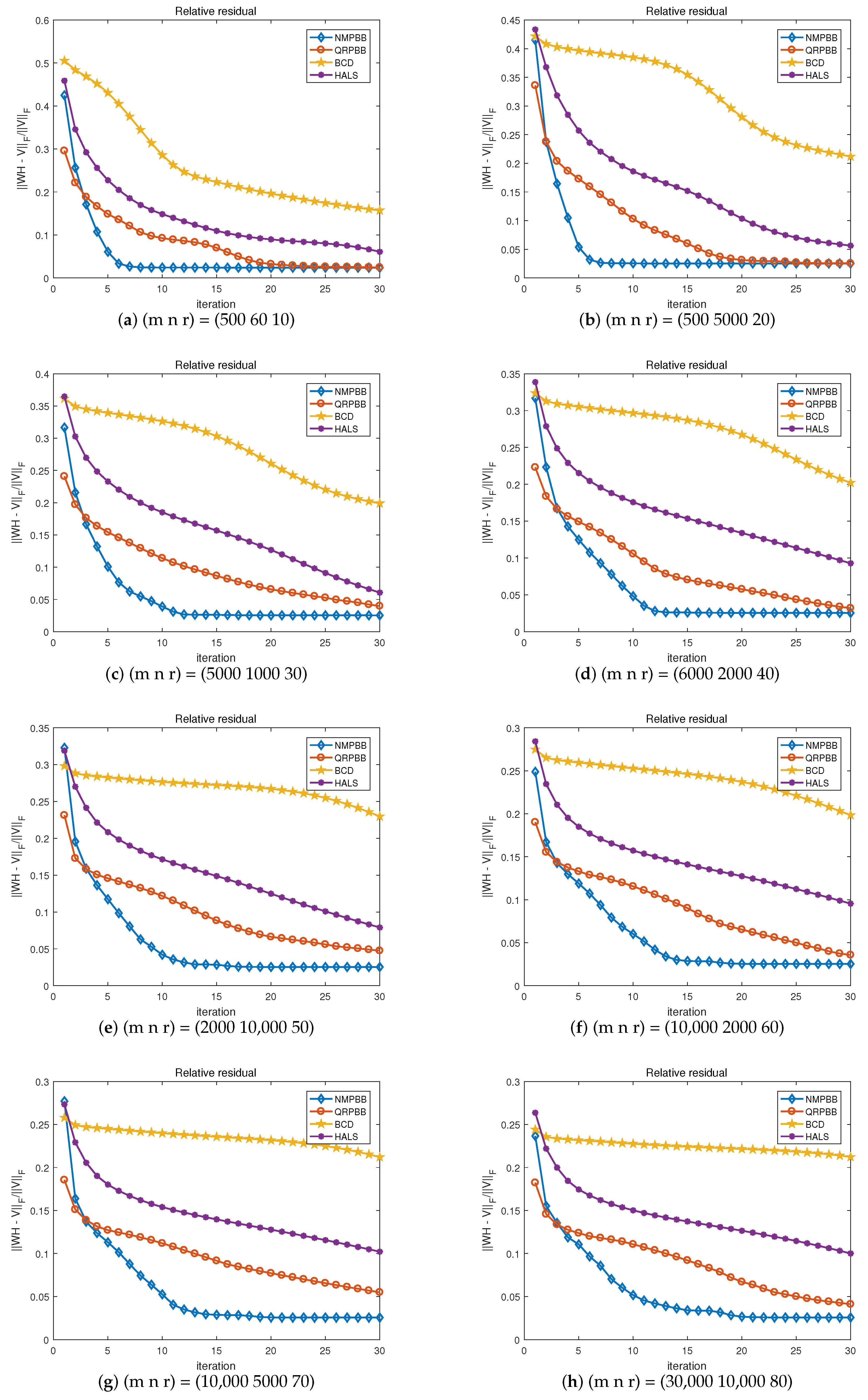
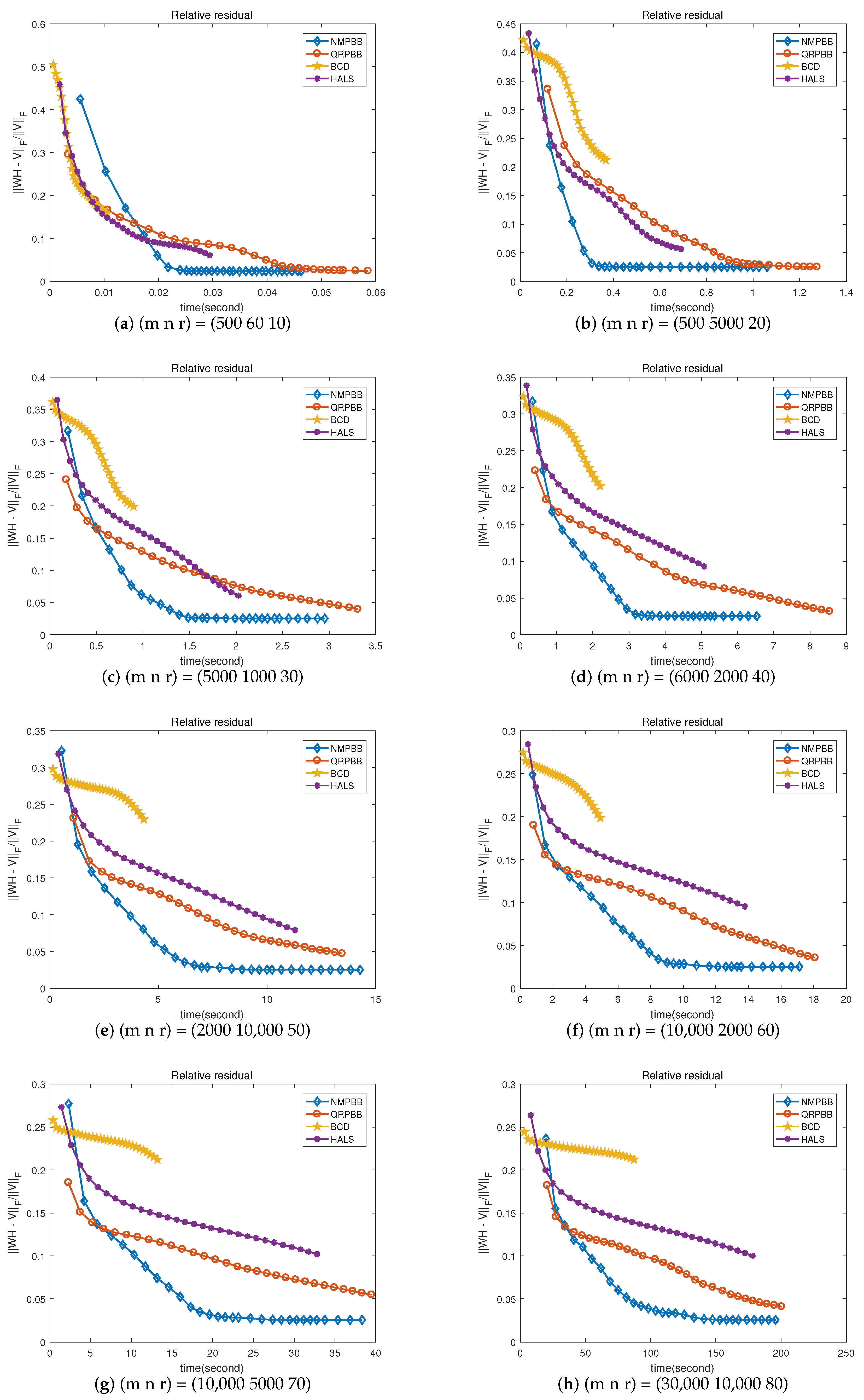
Since the NMPBB method is closely related to the QRPBB method, as we all know that the hierarchical ALS (HALS) algorithm for NMF is the most effective upon most occasions, we use the coordinate descent method to solve subproblems in NMF. We further examine algorithms of NMPBB, QRPBB, HALS, and BCD. We show that these four methods compare on eight randomly generated independent Gaussian noise measures when the signal-to-noise ratio which is 30 dB in
Figure 2,
Figure 3 and
Figure 4 is terminated when the stopping criterion said by the inequality in (52) satisfies
or the maximum number of iterations is more than 30.
Figure 2 shows the value of the objective function compared to the number of iterations. From
Figure 2, for most of the test problems, we will draw a conclusion that NMPBB decreases the objective function much quicker than the other three methods in 30 iterations. This may be because our NMPBB exploits an efficient modified nonmonotone line search and adds a relaxing factor
s to the update rules of
and
. Hence our NMPBB significantly outperforms the other three methods.
Figure 3 shows the relationship between the relative residual errors and the number of iterations.
Figure 4 exhibits the relative residual errors versus CPU time. The results shown in
Figure 3 and
Figure 4 are consistent with those shown in
Figure 2.
4.3. Image Data
The ORL image database is a collection of 400 images of people’s faces belonging to 40 individuals representing 10 each. The dataset includes variations in lighting conditions, facial expressions (including whether they open their eyes, whether they smile), and facial details including whether they wear glasses. Some subjects have multiple photos taken at different times. The images were captured with the subject positioned upright and facing forward (allowing for slight movement to the sides). The background used was uniformly dark and even. All the images were taken against a dark homogeneous background with the subjects in an upright frontal position (with tolerance for some side movement). The pictures used are represented by the columns of the matrix V, and V has 400 rows and 1024 columns.
The Yale face database was created at the Yale Center for Computational Vision and Control. It consists of 165 gray-scale images, with each person in the database having 11 images associated with them. In total, there are 15 people. The facial images in question were captured under different lighting conditions (left-light, center-light, right-light), with various facial expressions (calm, cheerful, sorrowful, amazed, and blinking), and with or without glasses. The pictures used are represented by the rows of the matrix V, and V has 165 rows and 1024 columns.
For all the databases we used in (52), we performed a diverse casually generated starting iteration with
, the maximum number of iterations (maxit) for all algorithms is set to 50,000, and the average results are presented in
Table 2. From
Table 2, we conclude that the QRPBB method converges in fewer iterations and CPU times than APBB2 and NeNMF, and in contrast to QRPBB, our NMPBB method requires 1/4 CPU time to satisfy the set tolerance. Although the residuals by NMPBB are not the smallest among all algorithms appearing for all the databases we use, the results of
mean that solutions by NMPBB are nearer to the point of stationary.
4.4. The Importance of Relaxation Factor s
In the following content, the clear experimental results indicate that relaxation factor
s is used for updating rules of
and
. We implement NMPBB using diverse
s given
on synthetic datasets which are the same as those in
Section 4.2. We set the required maximum number of iterations to 30, and the other parameters required in the experiment will have the same values as those in
Section 4.2.
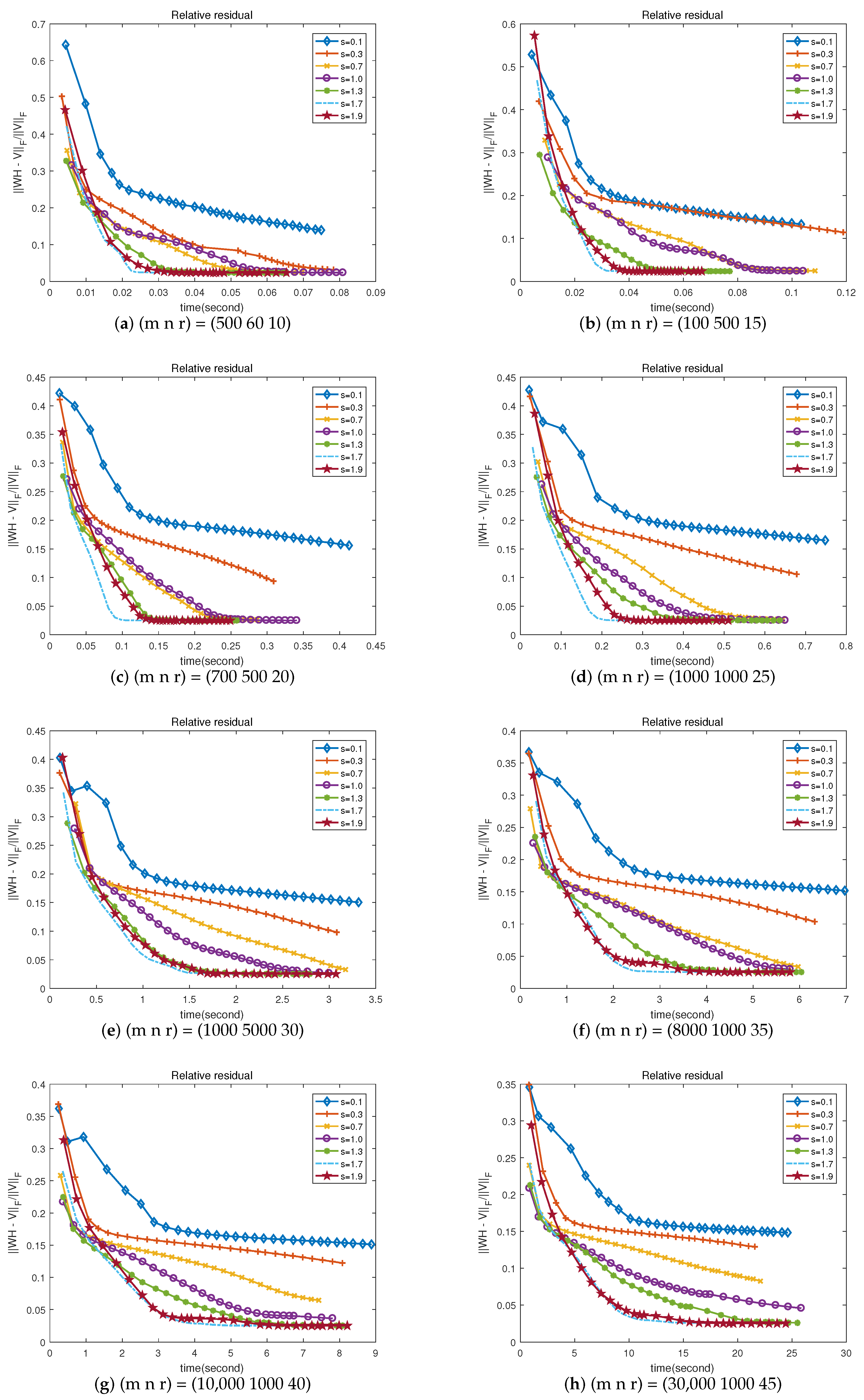
Figure 5 shows the relationship between the relative residuals error and the run-time results. In
Figure 5, we can see that the relaxation factor
s fails to accelerate the convergence when
and increasing constant
s significantly accelerates the convergence when
. As for NMPBB, it seems that
s = 1.7 is the best compared with other experimental values in terms of speed of convergence, and hence
s = 1.7 was used as our NMPBB in all experiments.