5.1. NC-Link Protocol Security Improvements
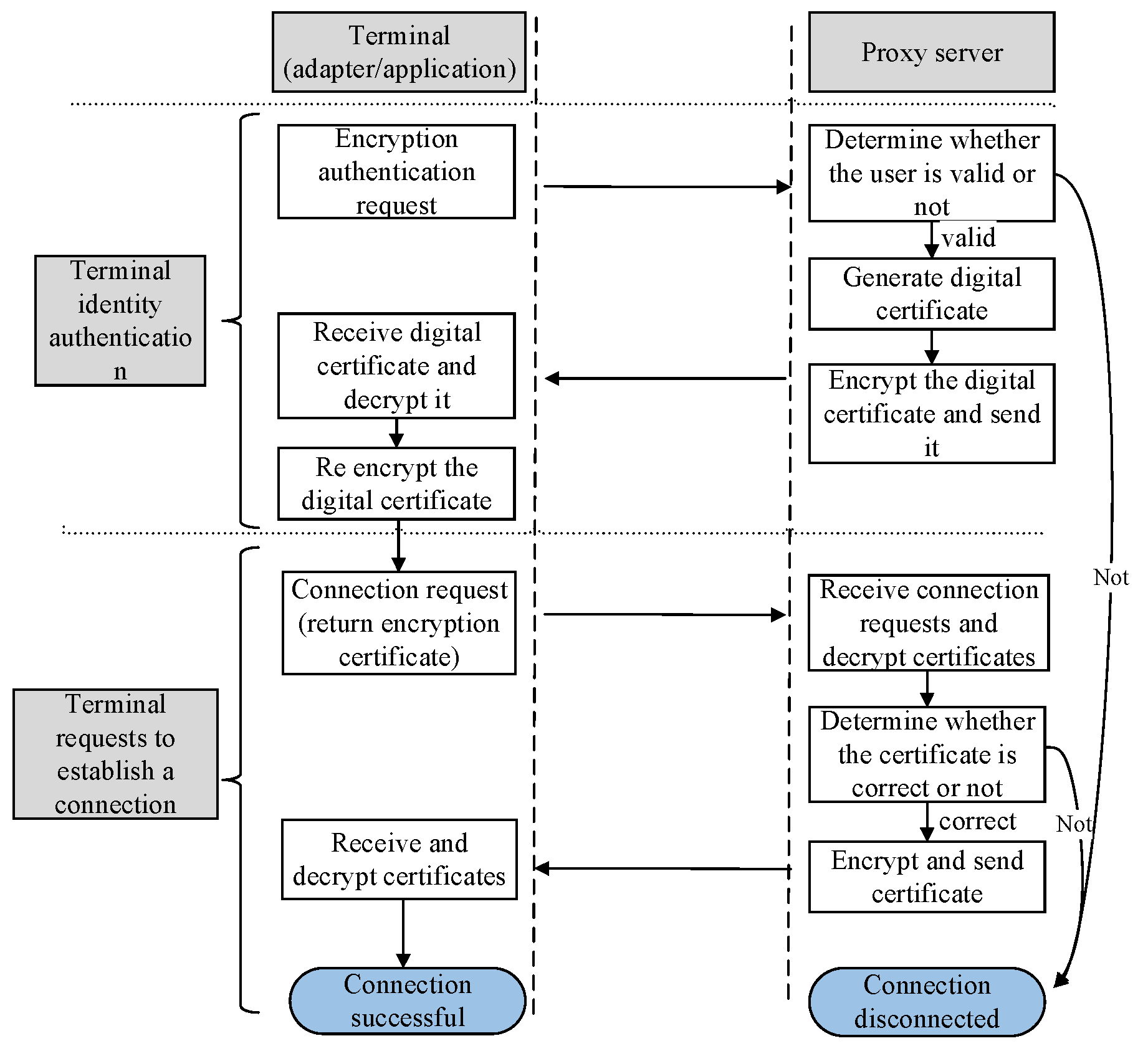
In response to the issues identified in the NC-Link protocol, this study proposes an improved key generation and exchange scheme that incorporates timestamps to counter replay attacks. The improved protocol includes an authentication connection phase and a request interaction phase. In the authentication connection phase, a pre-shared key mechanism is not used; instead, the client generates an RSA key pair based on the device information and achieves key exchange with the server through zero-knowledge authentication. The details of the improved scheme are as follows:
5.1.1. Authentication Connection Phase
Step 1: The client selects two large prime numbers
p and
q (where
p and
q belong to a set of large primes) and calculates the modulus
n.
Calculate Euler’s function
.
The client selects a private key exponent d (such that 1 <
d < ϕ(n) and
d is coprime to
), and then calculates the public key exponent
s.
where
g is the generator calculated based on the client’s ID, satisfying the condition that for any
, there exists an integer
k such that the Equation (15) holds.
The client generates the RSA key pair: the public key () is used for encryption, and the private key () is used for decryption.
Step 2: The client randomly selects a number
r and computes the commitment value
x.
The client generates authentication information based on the commitment value x and signs it using a private key (
SRK).
Here, represents using SRK for signature. The client sends the public key (PRK) and the signed authentication information to the server.
Client → Server: .
Step 3: After receiving the authentication information, the server uses the client’s public key (PRK) to verify the signature. If the verification is successful, the server checks whether the is valid. If valid, the server generates a connection key (KEY) and selects a random challenge value e∈{0,1}. The server encrypts e and KEY using the client’s public key (PRK) and sends it to the client.
Server → Client: .
Step 4: Upon receiving the encrypted information, the client decrypts it to obtain
e and
KEY. Then, the response value
y is calculated based on the challenge
e and Equation (18).
The client encrypts y using the connection key (KEY) and sends it to the server.
Client → Server: .
Step 5: The server decrypts the response value
y.
Verify whether y is correct based on Equation (20).
If the verification is successful, the server confirms the client’s identity and sends the connection key, encrypted as a certificate using KEY, back to the client. The client then decrypts this to confirm that the connection is successful.
5.1.2. Request Interaction Phase
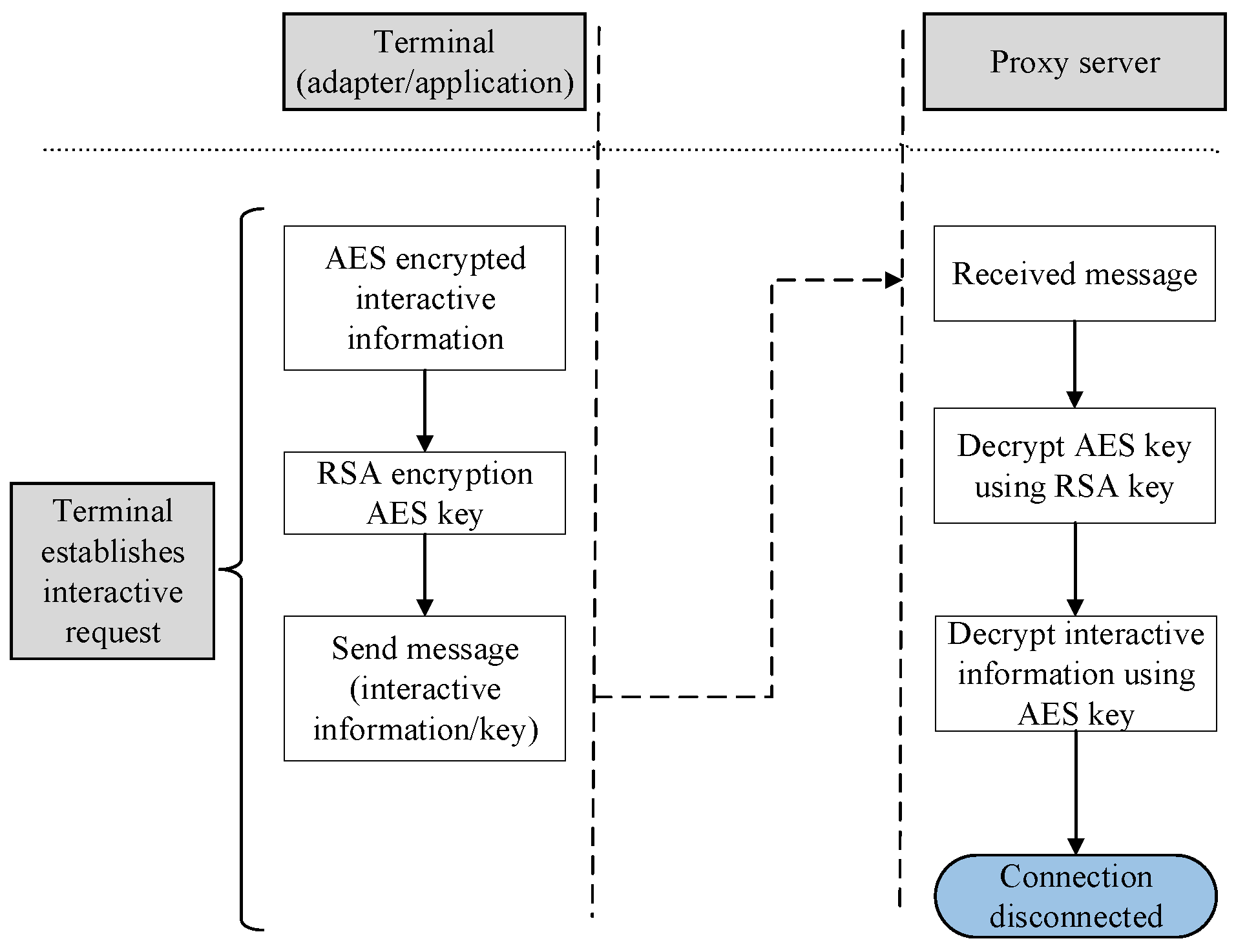
Step 1: The sender dynamically generates an interaction key (KEY2) and an interaction request message. The interaction key (KEY2) is encrypted using the connection key (KEY), and the interaction request information is encrypted with the interaction key (KEY2) along with a timestamp before being sent to the receiver.
Client → Server:
Step 2: Upon receiving the request, the server checks the validity of the timestamp and decrypts the interaction information and the interaction key (KEY2) using the connection key (KEY). The server then uses KEY2 to decrypt the interaction information. The receiver encrypts the reply information with KEY2 and sends it back to the sender.
Server → Client:
Step 3: The client receives the reply information, decrypts it using KEY2, and continues the interaction. All subsequent communication is encrypted using the dynamically generated interaction key (KEY2) to ensure the security of the communication.
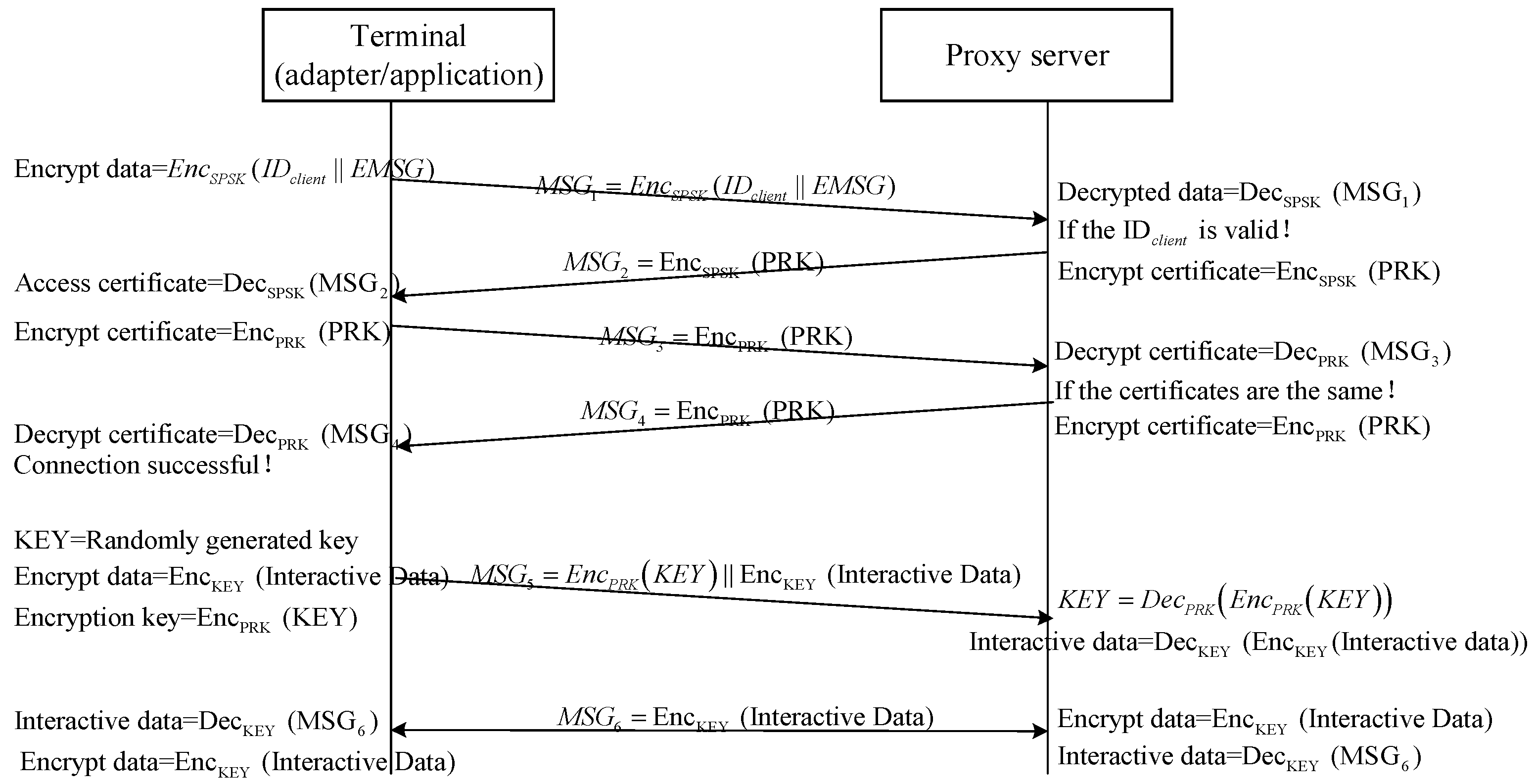
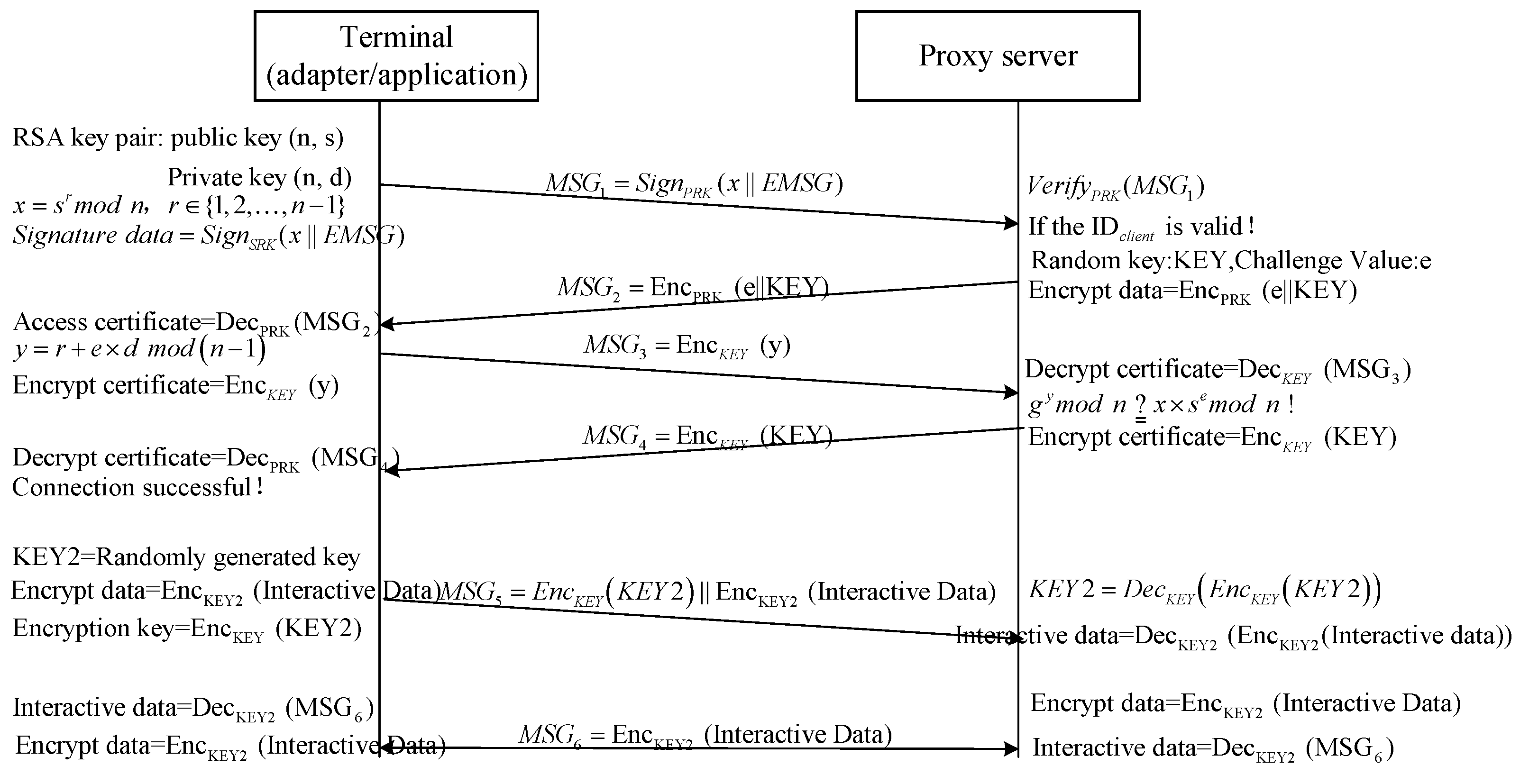
The message flow model of the improved NC-Link protocol is illustrated in
Figure 17.
5.2. CPN Model of the Improved NC-Link Protocol
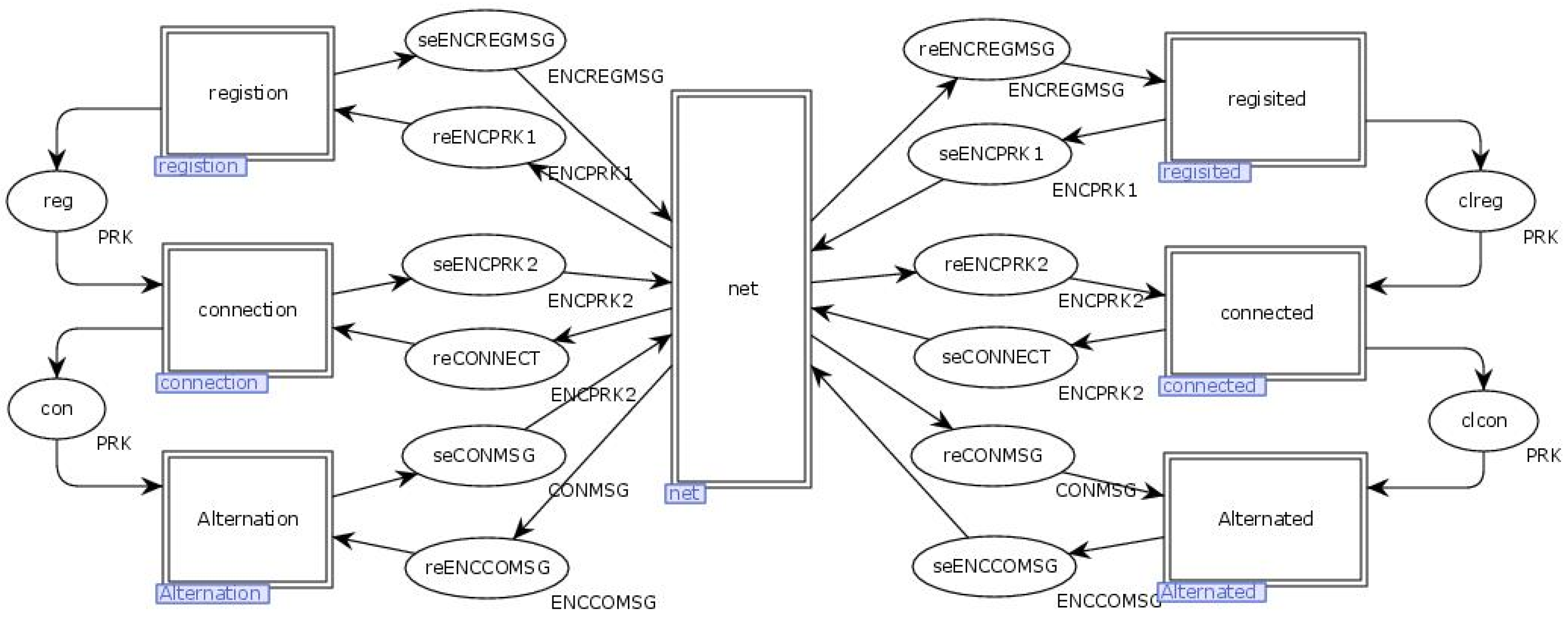
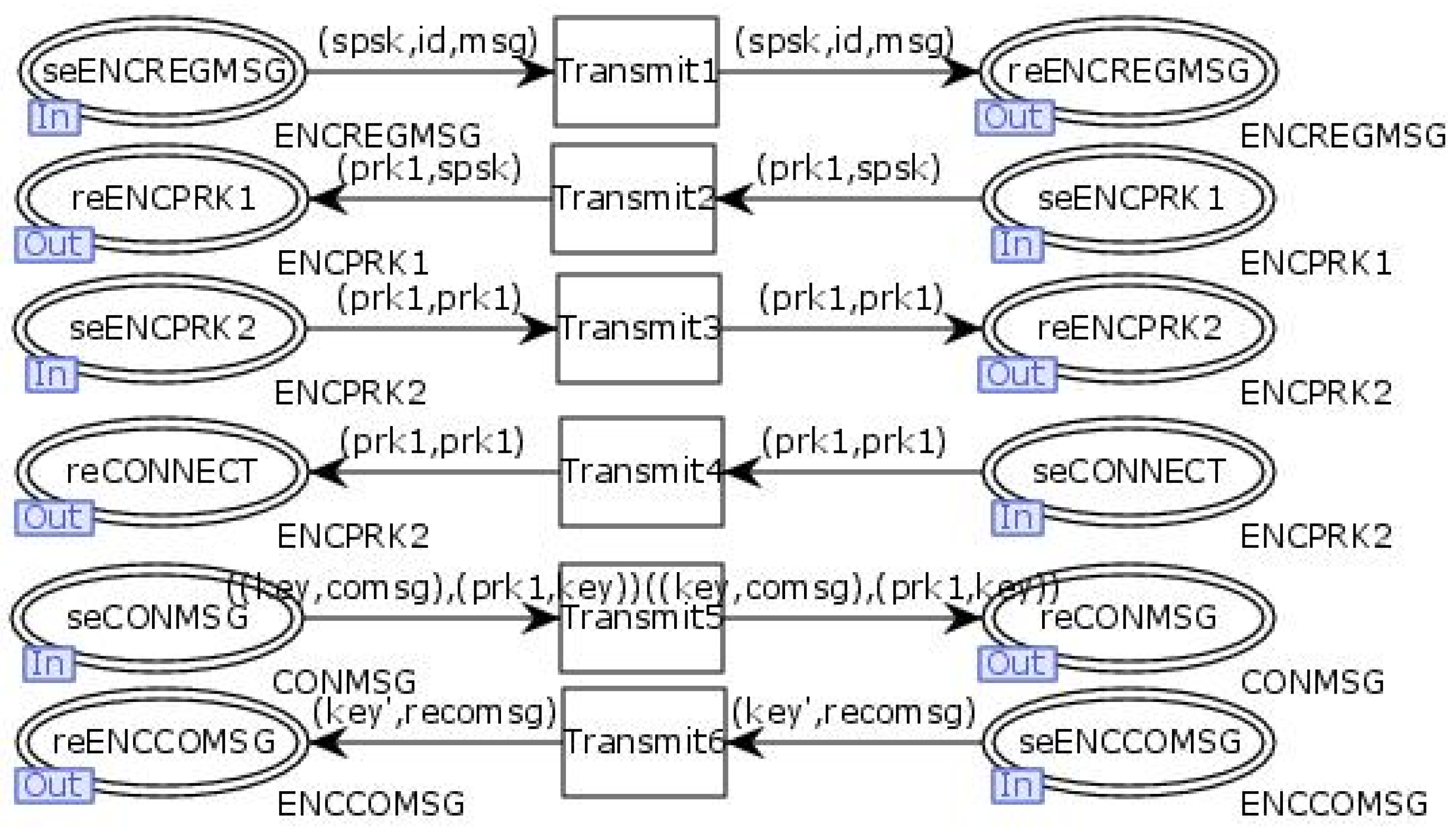
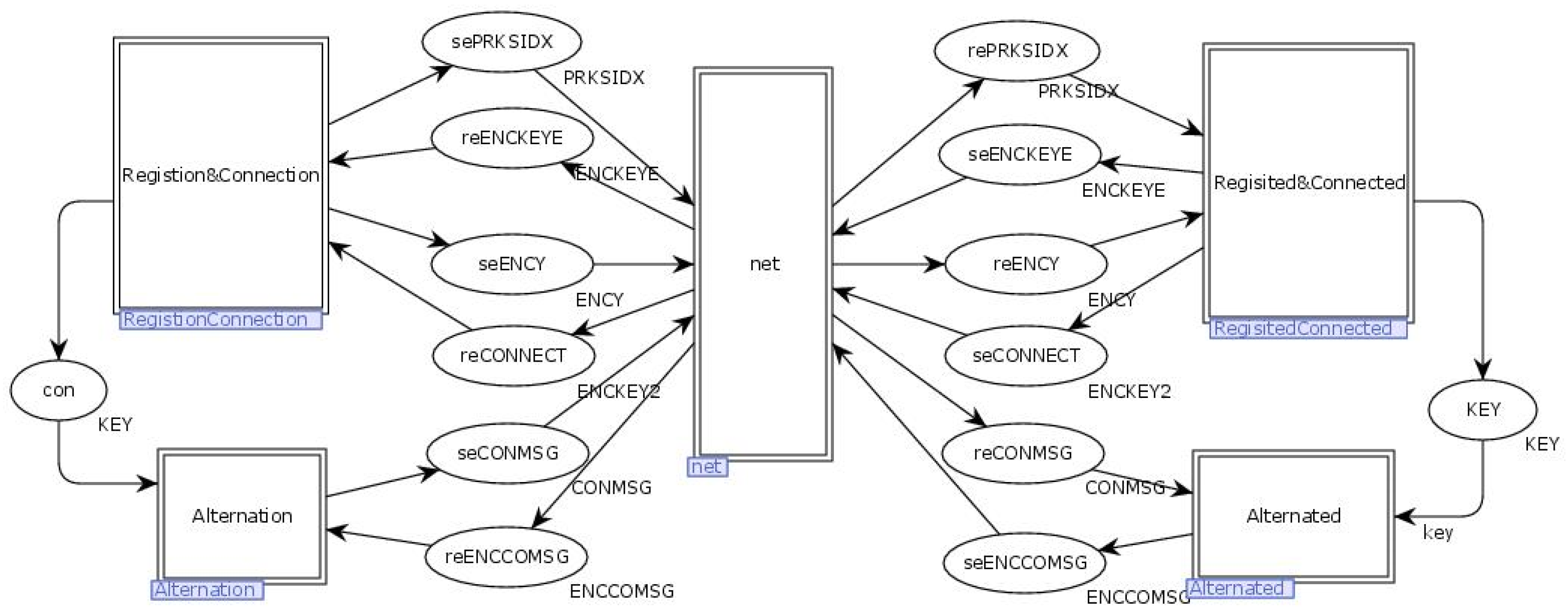
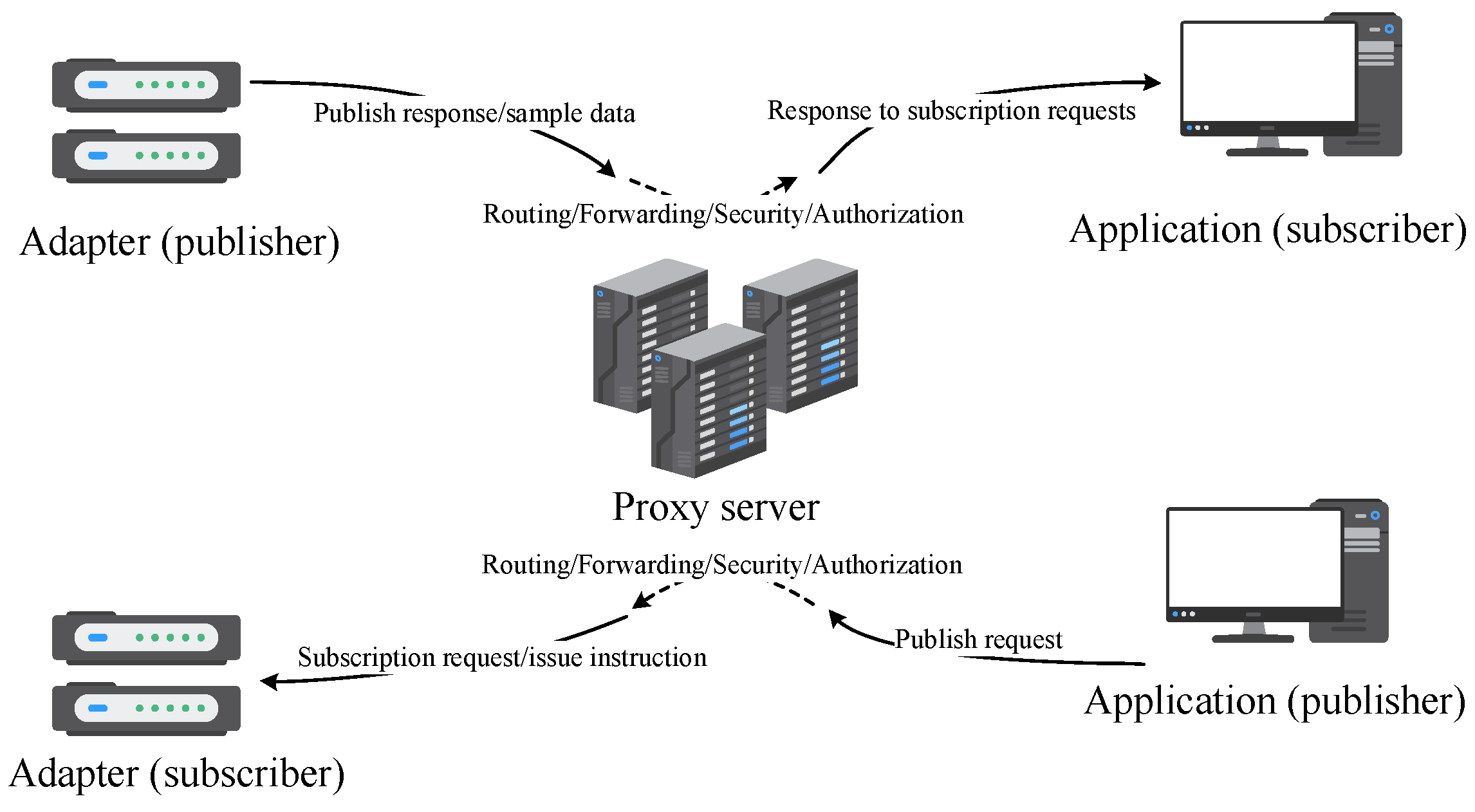
The top-level model of the improved NC-Link protocol consists of five transitions and 16 places. The “Regision and Connection” transitions represent client identity authentication and connection initiation. The “Regisited and Connected” transitions signify server identity verification and connection establishment. The “Alternation” transition indicates the client’s request for interaction, while the “Alternated” transition represents the established connection between the server and the client. The “Net” transition symbolizes the information transmission network. The top-level model of the improved NC-Link protocol is illustrated in
Figure 18.
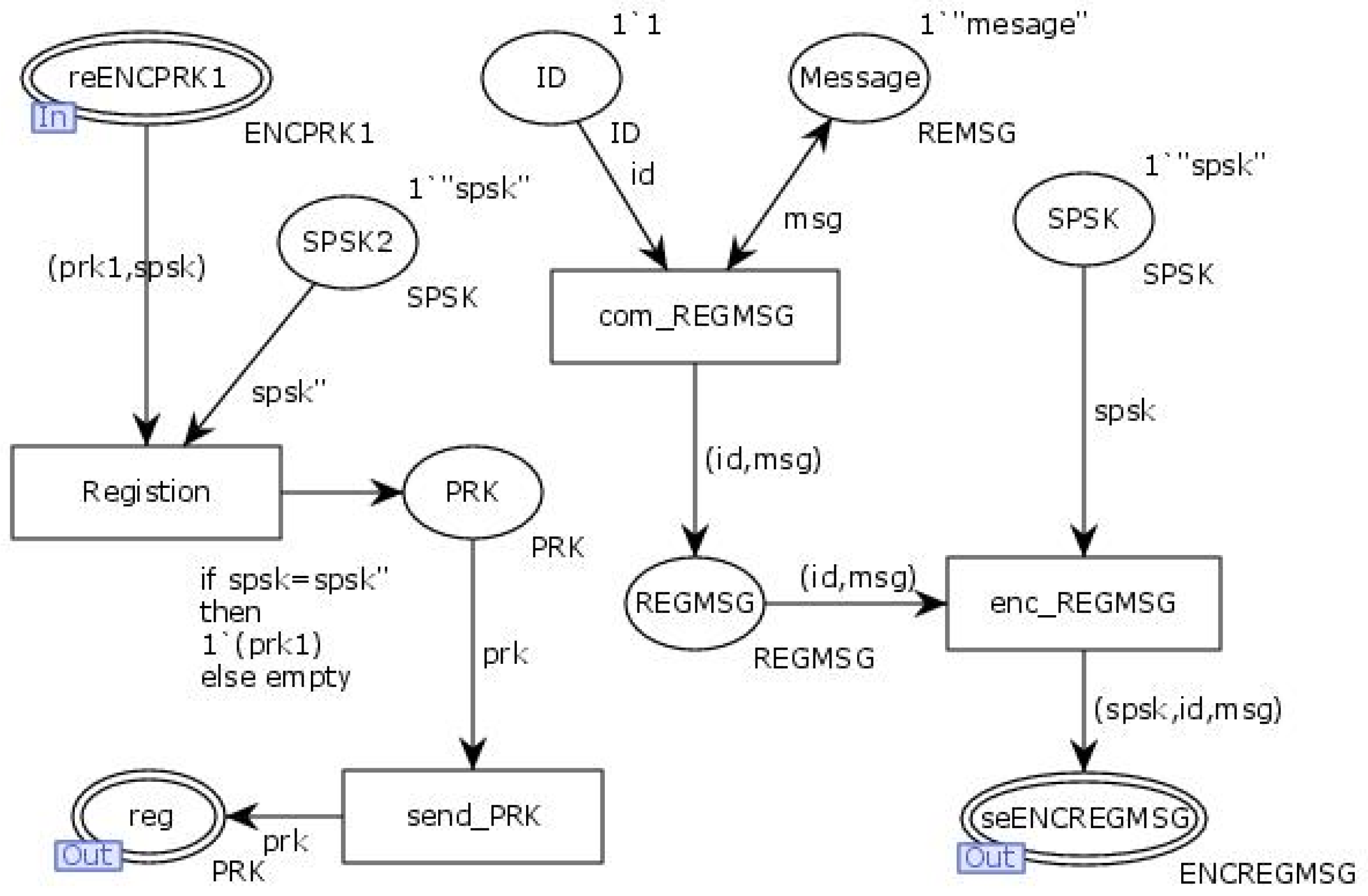
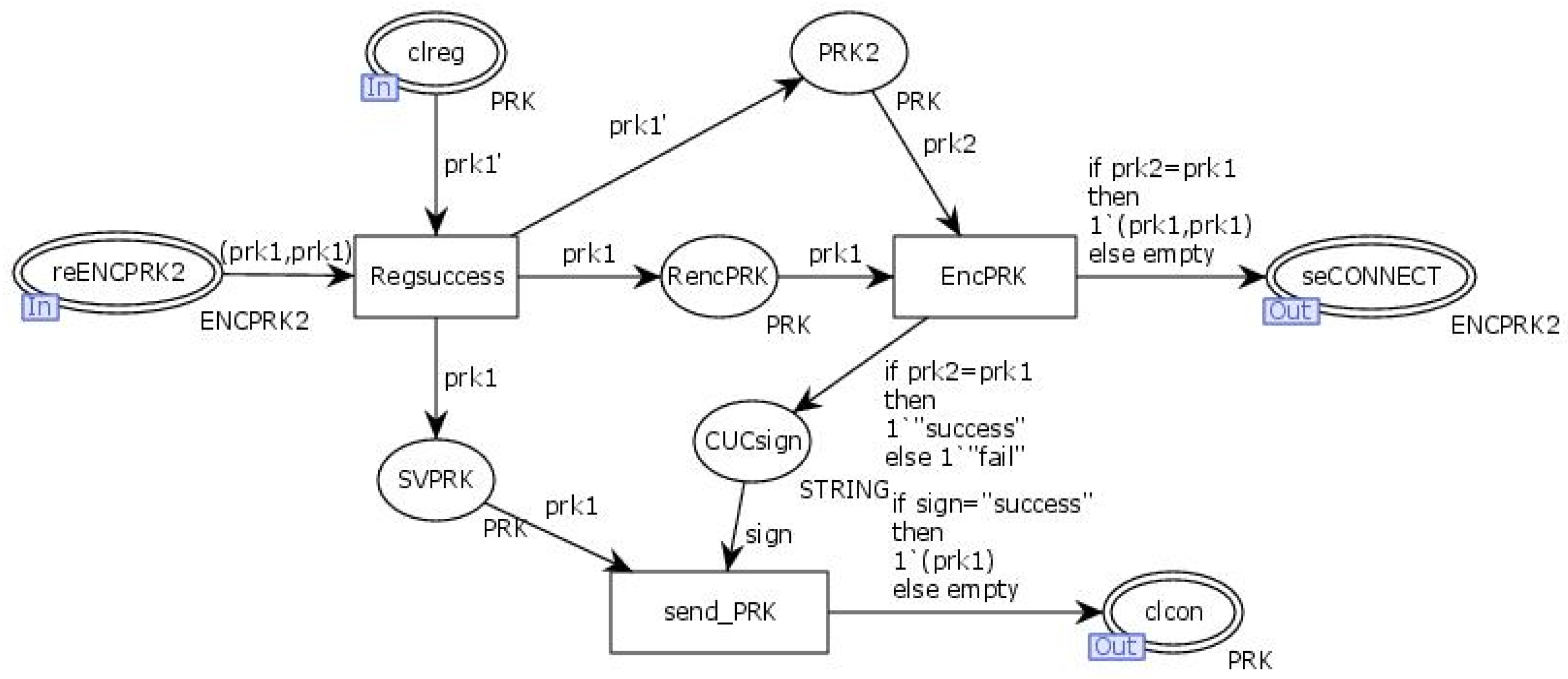
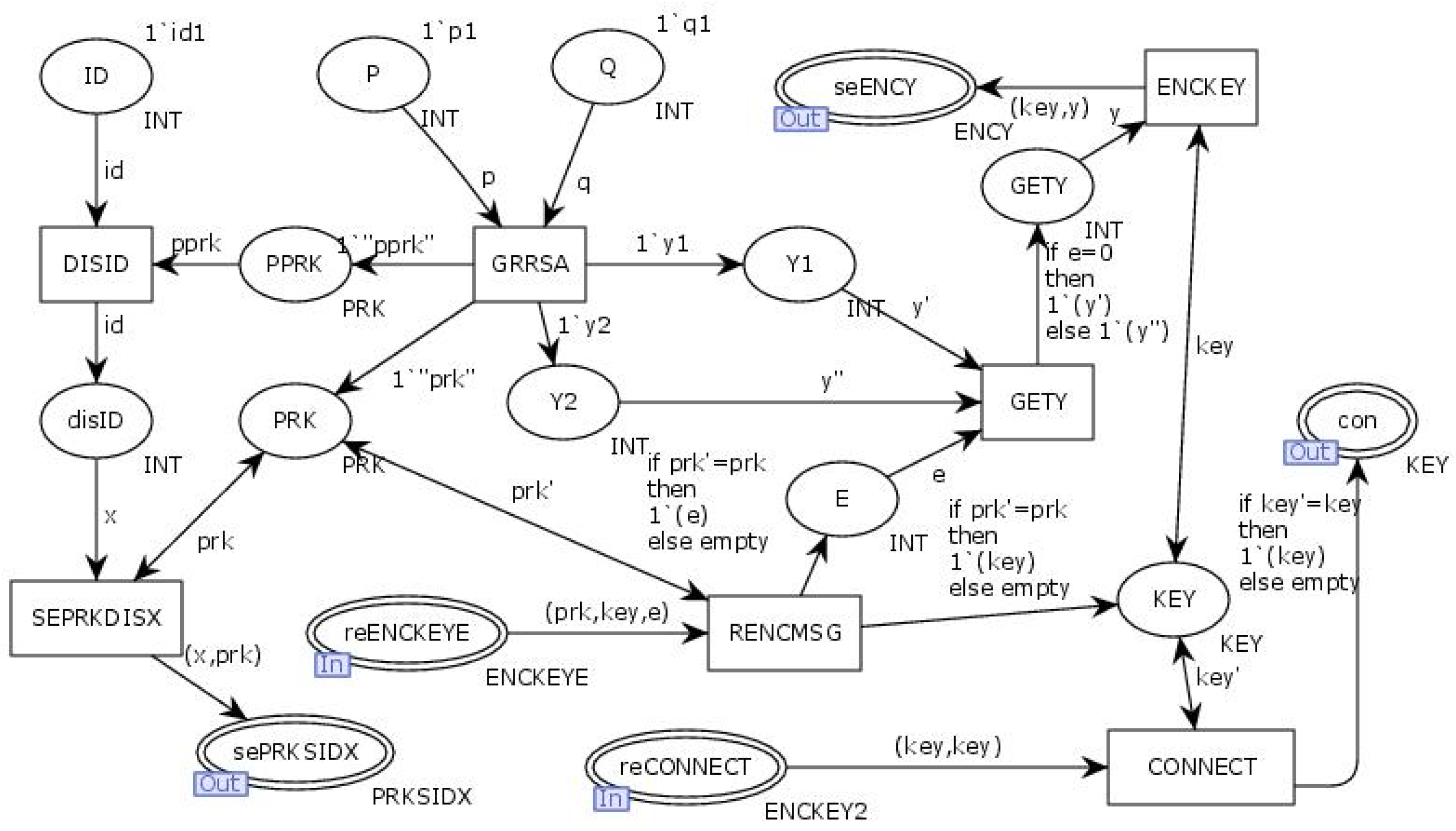
The alternative transitions “Regision and Connection” simulate the process of the client generating an RSA key pair and sending and receiving identity authentication information and connection requests to the server. The internal model of the alternative transitions “Regision andConnection” is illustrated in
Figure 19.
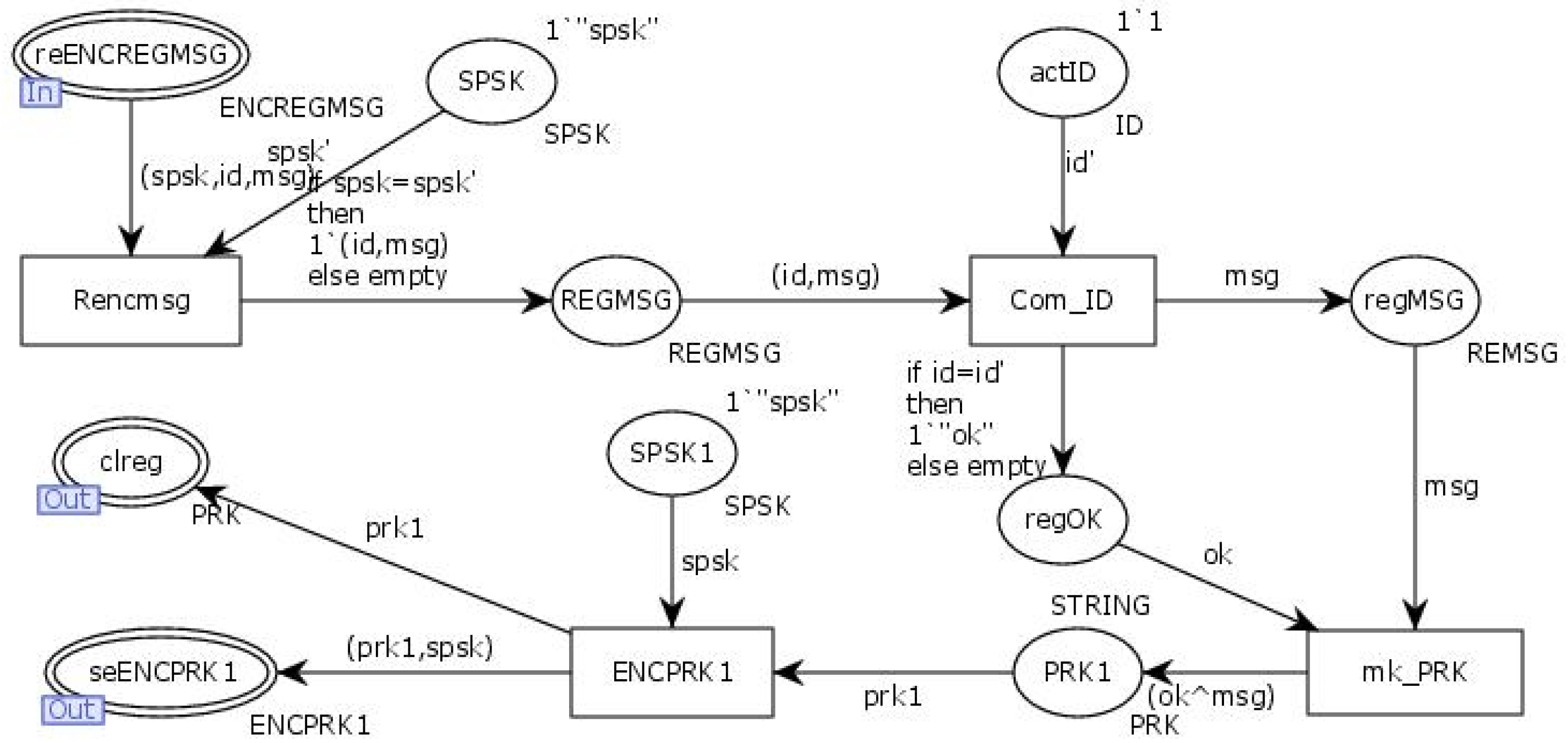
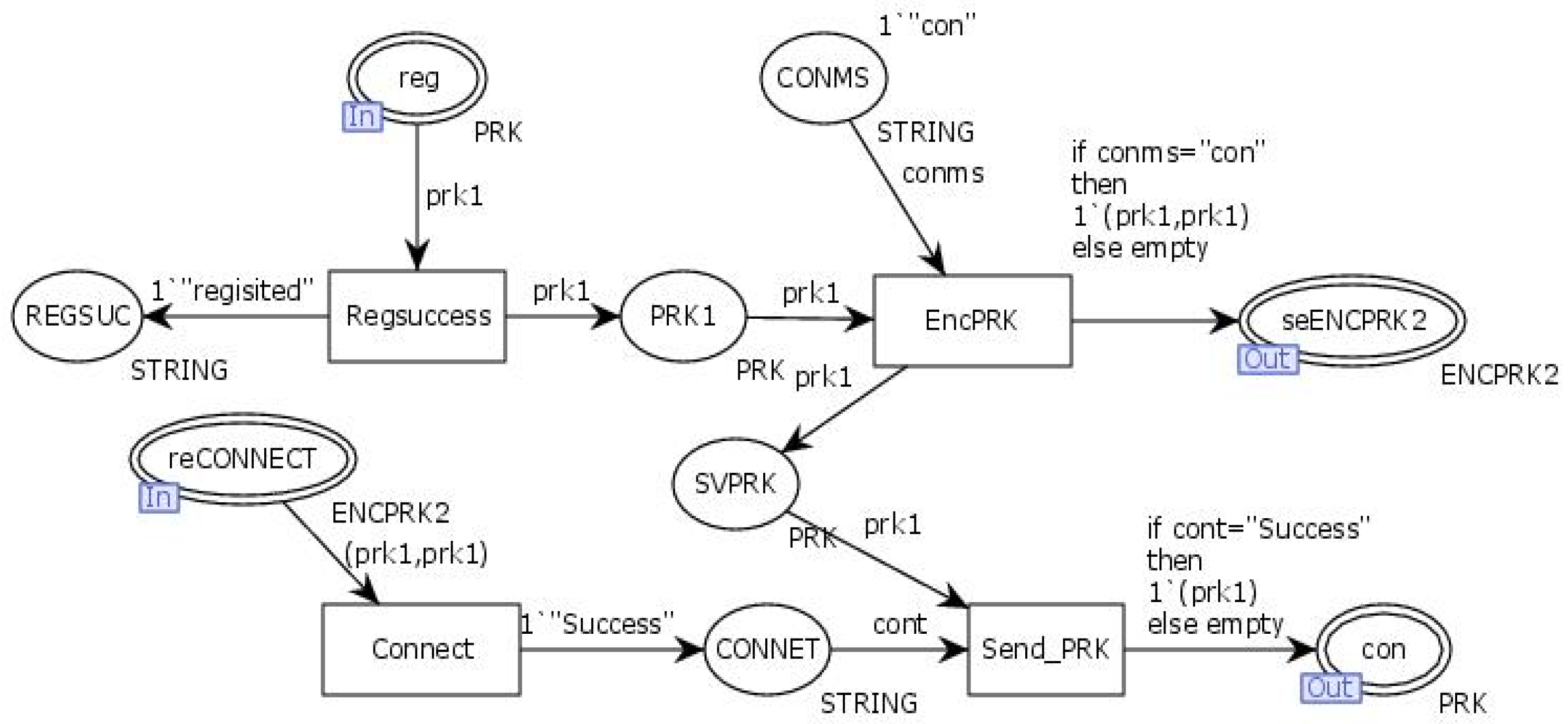
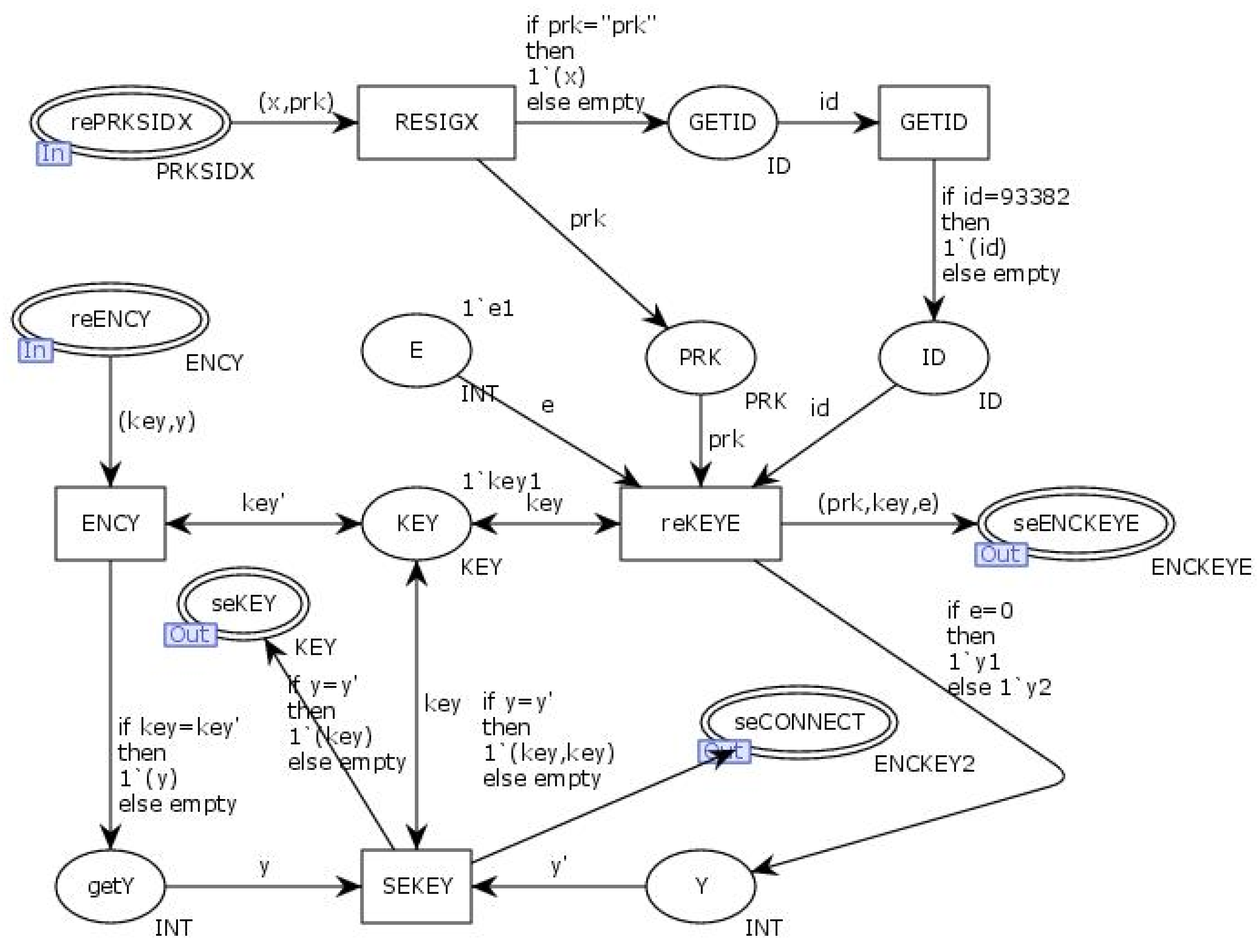
The alternative transitions, “Regisited and Connected”, simulate the process of the server receiving and verifying the client’s authentication information and connection requests, as well as sending replies. The internal model of the alternative transitions “Regisited and Connected” is illustrated in
Figure 20. In
Figure 19 and
Figure 20, the client randomly generates an RSA key and computes the interaction information
X using the transition “IDSID”. The client then signs the interaction information
X with the RSA private key and sends the RSA public key along with the signed
X to the output place “SePRKSIDX” for transmission to the server. The server retrieves the information through the input place “RePRKSIDX”, where it uses the RSA public key to verify the signature of
X and generates the connection key (KEY). Simultaneously, the client generates a random challenge value, e. The transition “ReKEYE” encrypts the challenge value e and the connection key (KEY) using the RSA public key (PRK) and sends the encrypted data through the output place “SeENCKEYE”. Upon receiving this data through the input place “ReENCKEY”, the client uses the transition “RENCMSG” to decrypt the challenge value and the connection key (KEY).The transition “GETY” calculates the challenge response y based on the challenge value e, and the transition “ENCKEY” encrypts the challenge response y with the connection key (KEY) before sending it through the output place “SeENCY”. The server retrieves the challenge response y through the input place “ReENCY” and uses the connection key (KEY) to decrypt it. The transition “SEKEY” checks the correctness of the challenge response y. If correct, the connection key (KEY) is used as a certificate, which is then encrypted and returned to the client through the output place “SeCONNECT”. Upon receiving the certificate through the input place “ReCONNECT”, the client confirms that the connection with the server has been successfully established.
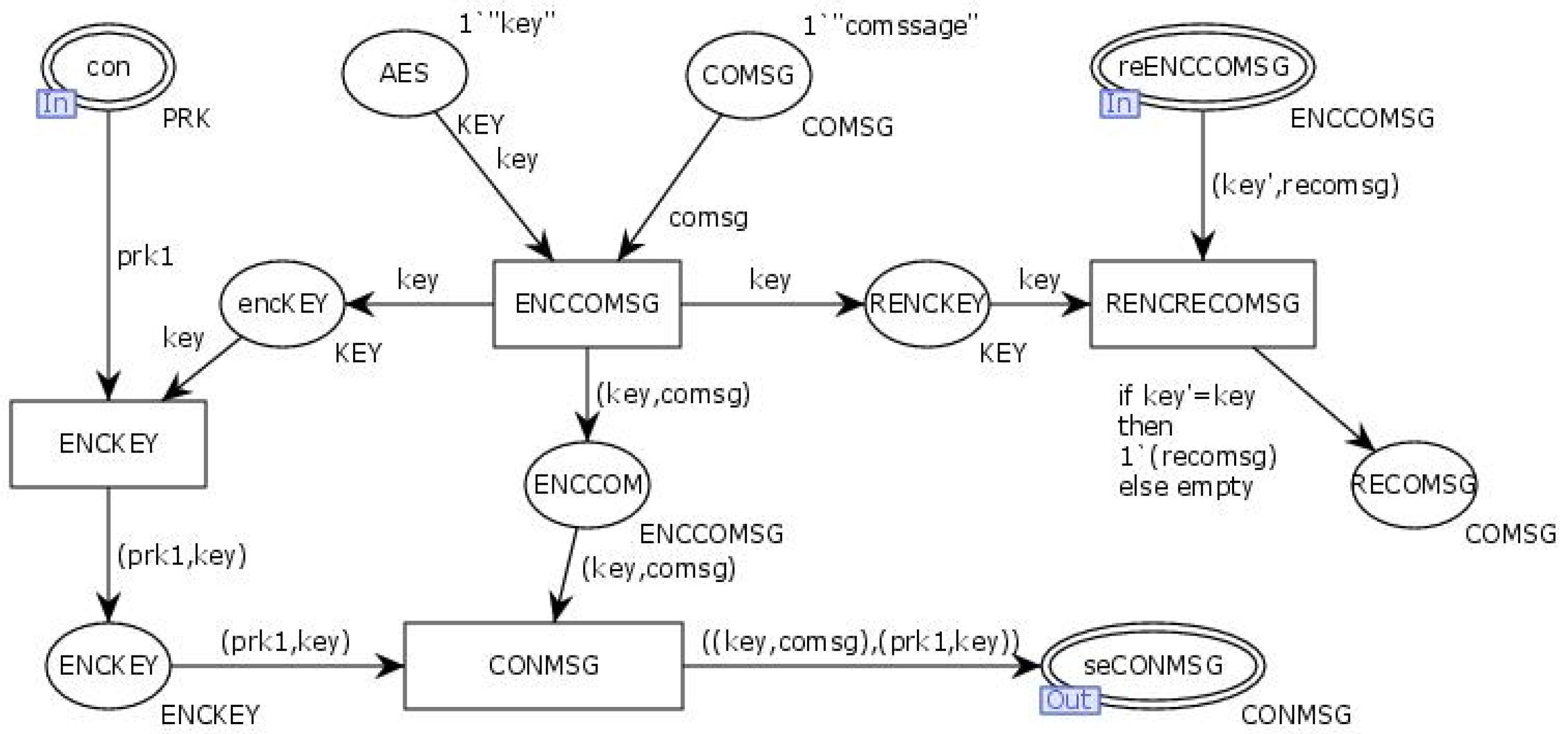
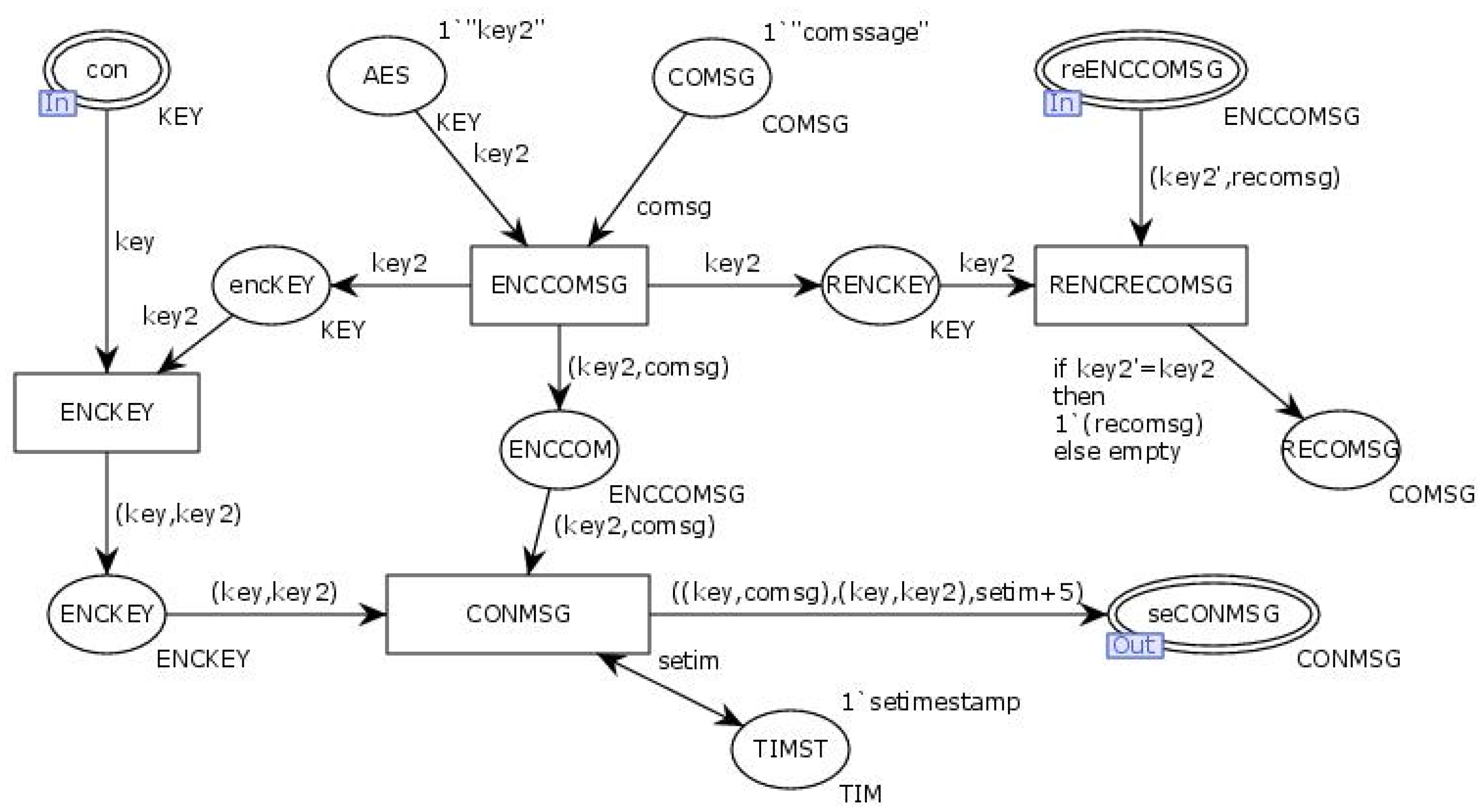
The transition “Alternation” simulates the process of the client initiating an interaction request to the server and receiving a response after establishing a connection. The internal model of the transition “Alternation” is illustrated in
Figure 21.
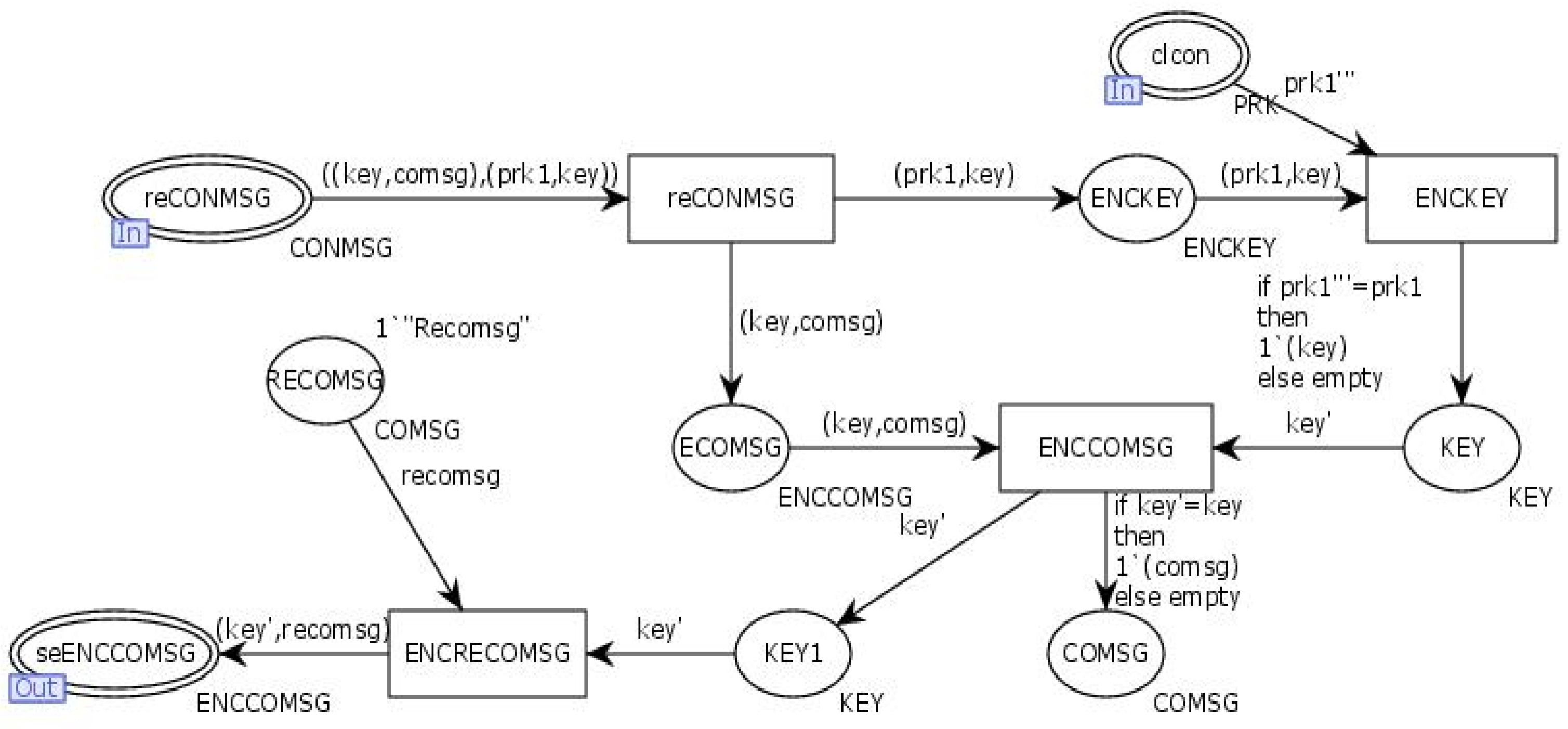
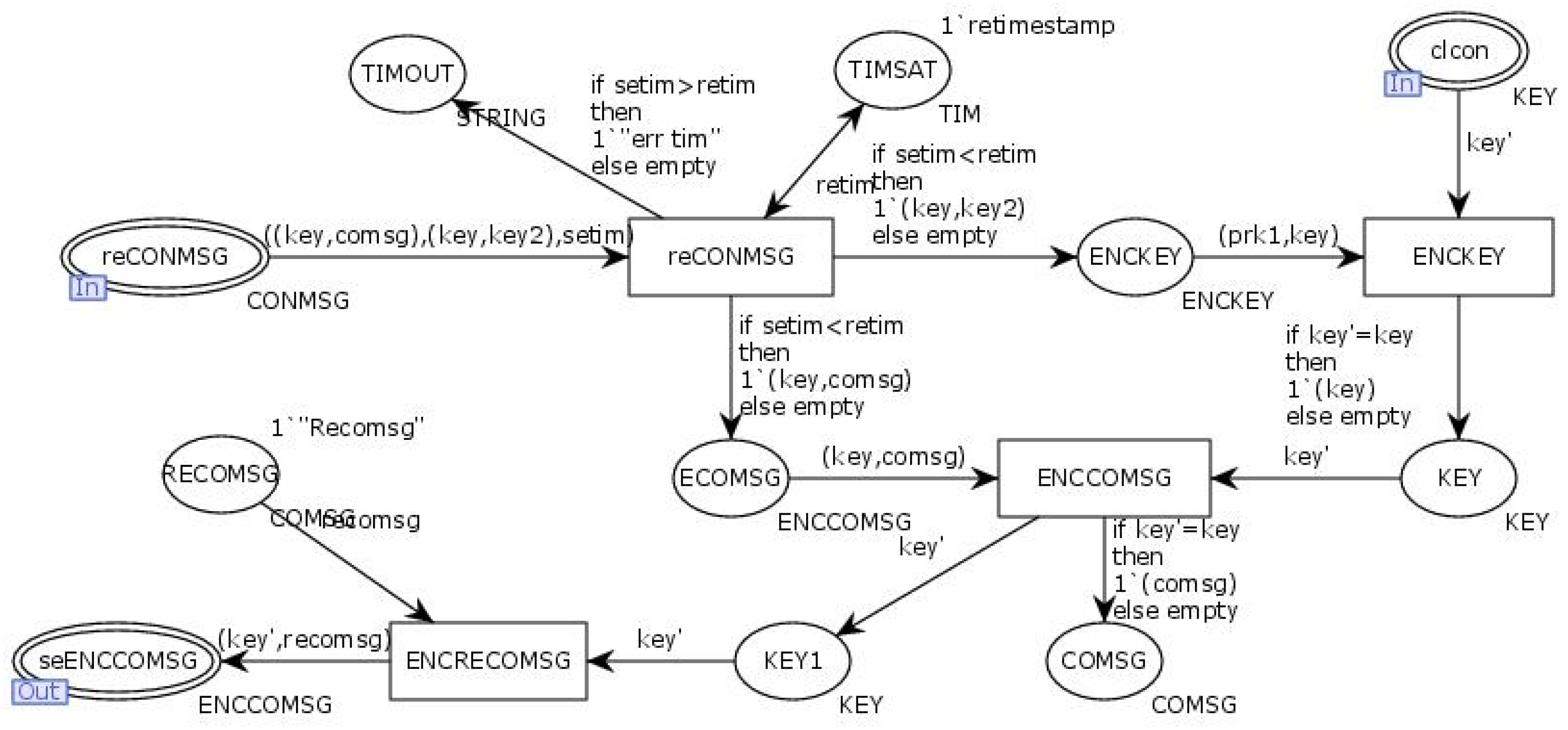
The transition “Alternated” simulates the process of the server receiving the client’s request and sending a reply to the client. The internal model of the transition “Alternated” is illustrated in
Figure 22.
In
Figure 21 and
Figure 22, the client obtains the connection key (KEY) from the input place “Con” and dynamically generates the interaction key (KEY2). The transition “ENCCOMSG” encrypts the interaction information using the interaction key (KEY2), while the transition “ENCKEY” encrypts the interaction key (KEY2) using the connection key (KEY). The encrypted information is then sent to the server through the output place “SeCONMSG”. The server receives the encrypted information via the input place “ReCONMSG”. The transition “ENCKEY” decrypts the interaction key (KEY2) using the connection key (KEY), and the transition “ENCCOMSG” decrypts the interaction information using (KEY2). The transition “ENCRECONMSG” encrypts the reply information using the interaction key (KEY2) and sends it to the client through the output place “SeENCCONMSG”. The client retrieves the reply information via the input place “ReENCCONMSG”, and the transition “RENCReCOMSG” uses the interaction key (KEY2) to decrypt the reply information, establishing the interaction between both parties.
The state-space analysis of the improved model is presented in
Table 4. From the analysis of the state-space results, it can be concluded that in the improved model, the number of state-space nodes, directed arcs, strongly connected nodes, and strongly connected arcs are all the same, indicating that the model does not have state cycles. There is a unique number of dead nodes, and the number of dead transitions is zero, which suggests that the model executes according to the protocol interaction flow, resulting in exactly one termination state.
5.3. Security Analysis of the Improved Protocol
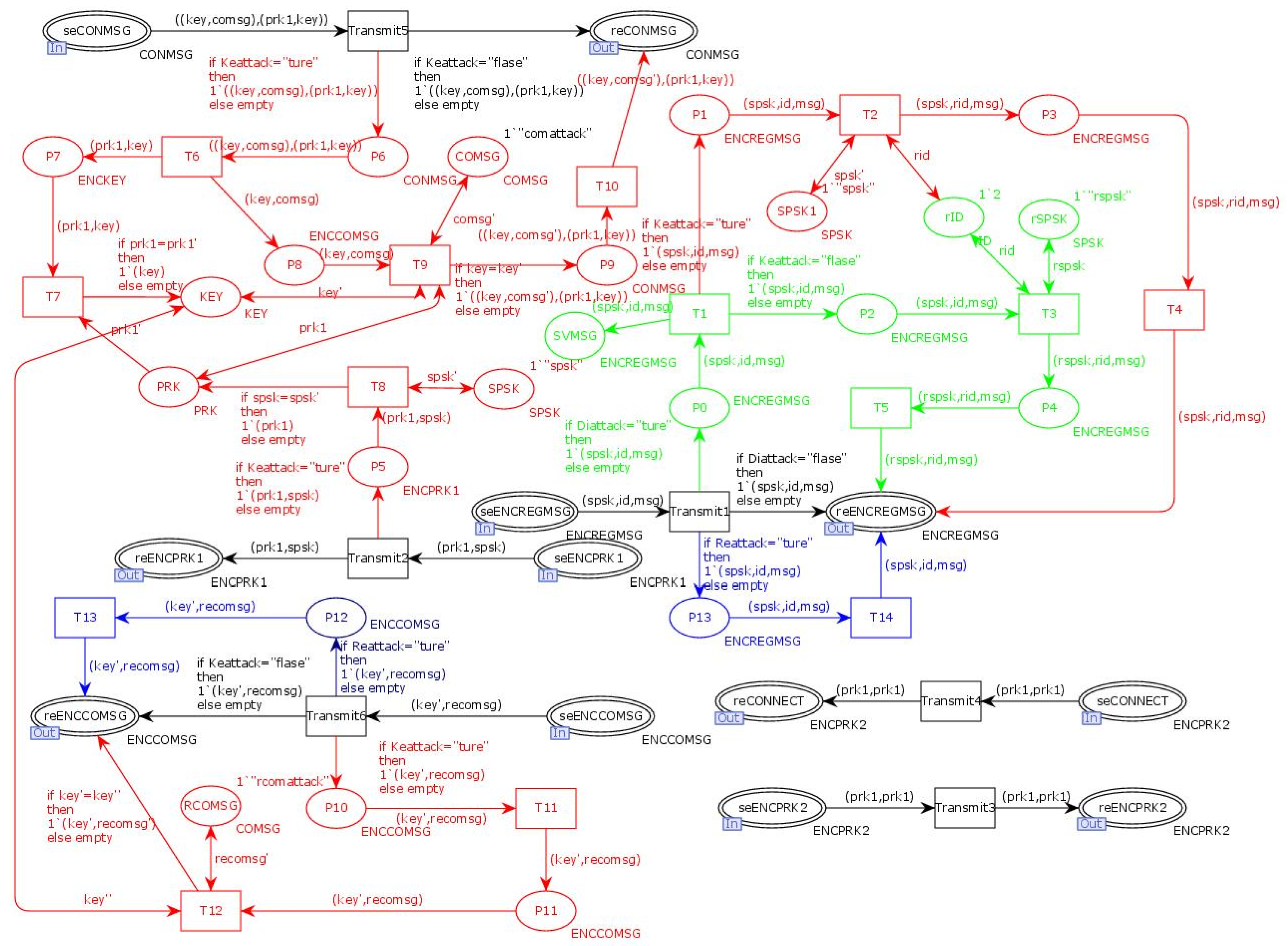
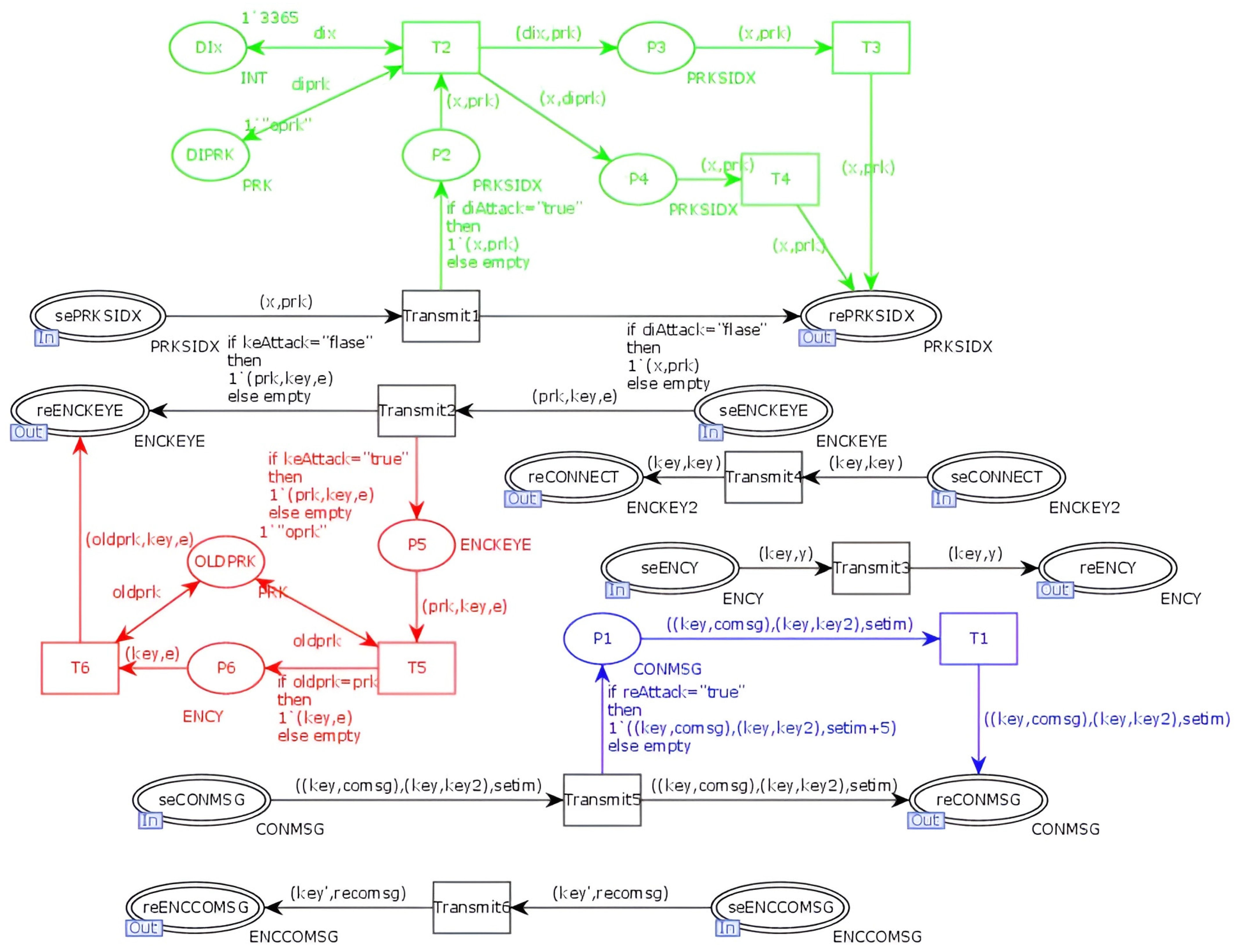
In the improved NC-Link protocol model, an attacker model is introduced at the network transport layer. The NC-Link protocol attacker model is illustrated in
Figure 23. The blue section indicates replay attacks, the green section represents tampering attacks, and the red section denotes key leakage attacks. In the model, when the value of Reattack is set to “true”, the attacker performs a replay attack; when Diattack is set to “true”, a tampering attack is conducted; and when Keattack is set to “true”, a key leakage attack occurs.
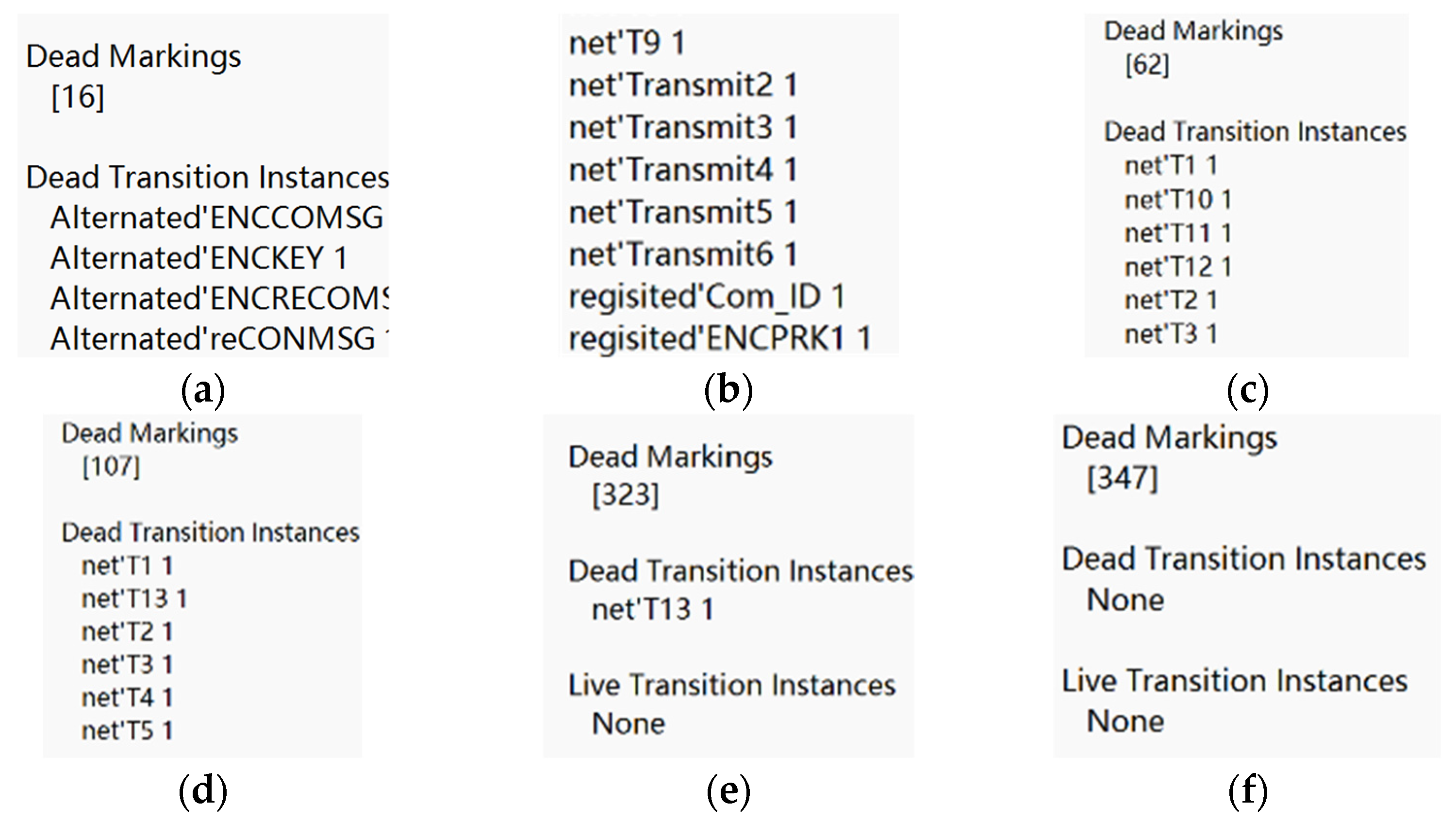
In the improved NC-Link protocol model, replay attacks, tampering attacks, key leakage attacks, and combined key leakage and tampering attacks are introduced. The state space of the model under different attacks is shown in
Table 5.
The state-space analysis report indicates that under various attack scenarios, the attacker cannot successfully execute any attacks on the protocol. When an attacker attempts a tampering attack, the tampered information cannot validate the signature, resulting in all transitions after RESIGX becoming dead transitions. Additionally, due to the inclusion of timestamps in the information, tampering attacks fail, as evidenced by the presence of an “err tim” token in the TIMOUT place. When an attacker conducts a key leakage attack, the generation of a new key for each authentication means that any old keys held by the attacker cannot validate the signature information. The analysis of the state-space report shows that the improved protocol effectively resists various attacks while also mitigating the key leakage risks present in the original protocol’s key generation and management. A comparison of the security performance between the improved protocol and the original protocol is presented in
Table 6.
In the table, “✓” indicates that the protocol can withstand the specified type of attack, while “✗” indicates that it cannot. Comparing the two, it is clear that the improved protocol offers a higher security performance than the original protocol, addressing the issues related to key management that arose from the original protocol’s use of a pre-shared key authentication scheme.
5.4. Comparison of Overheads in the Improved Protocol
The overhead of the NC-Link protocol mainly involves communication overhead, computational overhead, and implementation costs. First, the time complexity and space complexity of the improved protocol method will be analyzed separately. The time complexity of RSA encryption is
, where k is the key size of RSA. During encryption, exponentiation is performed using a public key; therefore, the complexity is cubic. The time complexity of RSA decryption is also
; however, because the private key is larger, decryption is usually slower than encryption. Like encryption, decryption also involves exponentiation. The space complexity of RSA mainly depends on the key storage. For RSA-2048, the space complexity is
, where k is the key size. The ciphertext size is the same as the key size; therefore, the data after RSA encryption or decryption typically occupy
storage space. The signing process involves encrypting the hash value using a private key. Hashing the data using functions like SHA-256 generally has a time complexity of
, where n is the byte length of the data. Signing the hash value with the private key in RSA has a time complexity of
, where k is the key size. The verification process also requires hashing the received data, with a time complexity of
. The time complexity of verifying the signature using the public key is
. The size of RSA signatures and verifications is proportional to the key size. For RSA-2048, the signature size is typically 256 bytes (2048 bits). Therefore, the space complexity is
. The time complexity of AES encryption is
, where n is the byte length of the data. The time complexity of AES decryption is similar to that of AES encryption and is also
. The space complexity of AES encryption and decryption is
, where n is the byte size of the encrypted data. AES generally has a smaller space complexity compared to RSA because its key length is shorter (128 bits or 256 bits), and the encryption/decryption process is symmetric. The time complexity of zero-knowledge authentication is
, similar to RSA, mainly due to the number-theoretic exponentiation. The space complexity, because it is related to RSA, is also
, where k is the key size. The time complexity and space complexity of the improved protocol method are shown in
Table 7.
We will compare the overhead of RSA and AES in terms of key generation and encryption/decryption. In key generation, RSA involves selecting two large prime numbers, p and q, calculating the modulus n, computing the Euler function ϕ(n), and performing modular inversion to calculate the private key exponent d. In contrast, AES only requires generating a key from a high-entropy source and does not involve complex mathematical operations, resulting in a very low key generation overhead, typically taking only a few microseconds. For encryption, the time taken for RSA encryption depends on the size of the public key exponent, e. For example, with RSA-2048, encrypting 128 bits of plaintext usually takes several milliseconds. In comparison, AES-256, with 14 rounds of encryption, can typically complete the same length of ciphertext in less than a microsecond on a CPU. Regarding decryption, RSA decryption is generally slower than encryption because the private key exponent d is usually a large number. For a 2048-bit RSA, decrypting 128 bits of ciphertext may take several tens of milliseconds. In contrast, the AES decryption time is equivalent to the encryption time, which is usually completed within a few microseconds.
Implemented on an Intel Core i5 CPU with a clock speed of 1.1 GHz, using Python and the Crypto library for simulation,
Table 8 shows the average computation times for encrypting 128-bit plaintext for two different encryption methods and RSA signing.
The calculation results indicate that the protocol’s computational overhead mainly consists of RSA key generation, decryption, and verification, while the average AES key generation time is only 0.97 μs, with both encryption and decryption times being less than 0.01 μs. The improved scheme integrates the zero-knowledge proof process during key exchange with RSA key generation, and its additional overhead primarily arises from verification. The calculation time for the verification function run using a Python program is shown in
Table 9, where p and q are two large 1024-bit prime numbers.
From the calculation results, it can be concluded that the computational overhead for zero-knowledge authentication originates primarily from the generation of the commitment value. In the improved scheme, the commitment value is generated based on RSA key data, and the computational overhead for its verification is less than 0.01 μs.
Let Trg denote the RSA key generation overhead, Trc the RSA encryption overhead, Trd the RSA decryption overhead, Trs the RSA signing overhead, Tri the RSA signature verification overhead, and Tag the AES key generation overhead. The overheads for AES encryption, AES decryption, and zero-knowledge verification, all being less than 0.01 μs, are denoted as Tμs. The overhead calculations for the original and improved protocol schemes at different stages are shown in
Table 10.
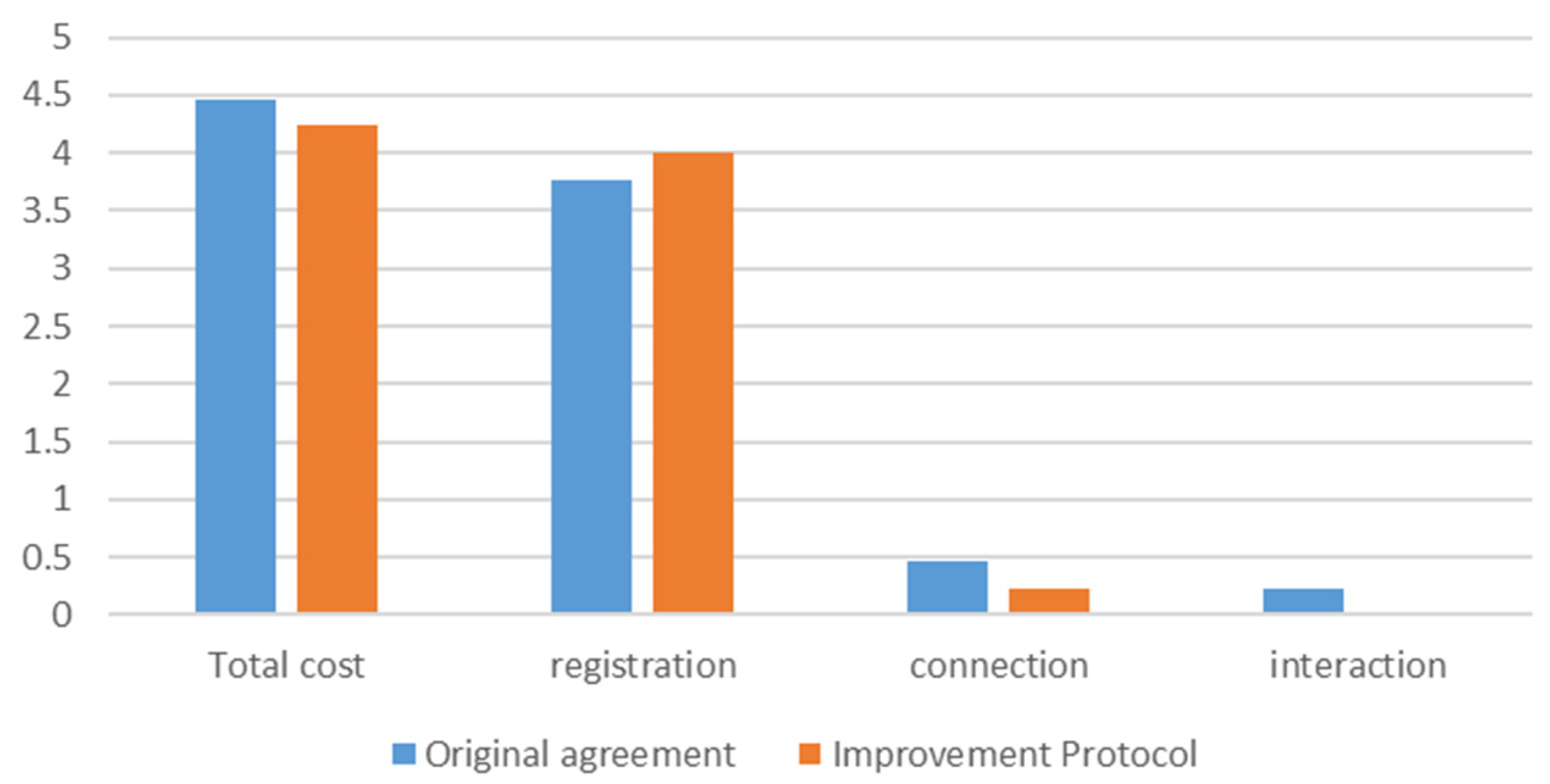
In the calculation process, any overhead below 0.01 μs is uniformly recorded as 0.01 μs. By organizing the overhead formulas for each stage in the table, the computational overheads for different schemes can be derived. Comparing the computational overhead of various schemes yields the results shown in
Figure 24.
By comparing the computational overheads of the different schemes, it can be observed that the improved protocol has a lower computational overhead compared to the original protocol. Notably, the overhead during the interaction phase shows a significant reduction, allowing devices to achieve faster interactions after completing registration and connection. This also facilitates an increased frequency of updating the interaction keys during the interaction phase, further enhancing the security of the protocol.