


Abstract
Many properties of special polynomials, such as recurrence relations, sum formulas, integral transforms and symmetric identities, have been studied in the literature with the help of generating functions and their functional equations. In this paper, we introduce hybrid forms of q-Mittag-Leffler functions. The q-Mittag-Leffler–Bessel and q-Mittag-Leffler–Tricomi functions are constructed using a q-symbolic operator. The generating functions, series definitions, q-derivative formulas and q-recurrence formulas for q-Mittag-Leffler–Bessel and q-Mittag-Leffler–Tricomi functions are obtained. The -transforms and -transforms of q-Mittag-Leffler–Bessel and q-Mittag-Leffler–Tricomi functions are obtained. These hybrid q-special functions are also studied by plotting their graphs for specific values of the indices and parameters.
MSC:
33C45; 05A30; 11B83
1. Introduction
Symmetric identities for special functions often describe relationships between functions that exhibit symmetry in their arguments, which can simplify expressions or provide insights into their properties. These identities are powerful tools for simplifying integrals and series expansions and for solving differential equations involving special functions. For specific classes of q-special functions, the behavior under a change of the parameter q might reveal certain symmetry properties. Bessel functions of the first kind satisfy the symmetry identity, which reflects their even and odd properties under the transformation. The q-Bessel functions, which are deformations of the classical Bessel functions based on the quantum group parameter q, satisfy various symmetry relations. These functions arise in the study of q-special functions and are often used in contexts like quantum algebra, integrable systems, and statistical mechanics. These identities are powerful tools in understanding the structure of q-special functions and play a key role in many areas of mathematical research, from combinatorics to mathematical physics.
The q-calculus, or quantum calculus, is currently an essential topic that is very much relevant to the theory of special functions. There is growing interest in quantum calculus, primarily due to its applications in mathematical sciences, physics, and engineering. In recent years, hybrid forms of q-special functions and polynomials have been investigated by many researchers (see [1,2]).
We recall certain notations and preliminaries of the quantum theory to understand the work properly. For and , the q-analogue of the factorial function is defined by [3,4]:
The corresponding q-exponential functions are defined as [3,4]:
and
where is the q-derivative with respect to u. Also, the q-derivative of the product of two functions, and , is given by
The q-Jackson integrals are specified as [5]:
The respective integral representations of q-gamma functions are given as [4]:
where is given as [4]:
The q-gamma functions and satisfy the following as [4]:
The q-Bessel functions of the first kind are defined by following generating function [6,7]:
Additionally, they have the following series representations:
or, equivalently,
which converges absolutely for .
The q-Tricomi functions are defined as [2]:
and
The series given in Equation (5) converges absolutely for all values of u.
The q-Mittag-Leffler functions are defined as follows [8]:
In [1], authors established the q-Mittag-Leffler function in terms of symbolic definition as follows:
where is the q-symbolic operator, acting on function as
and
Here, the umbral images of the q-Bessel function and 0th-order q-Tricomi-Bessel function are defined as follows:
and
respectively.
The q-Tricomi functions are defined as
where is the shift operator acting on vacuum function as
The symmetry of q-Tricomi functions, like many special functions, typically manifests in their behavior under transformations of variables or parameters. q-Tricomi functions may also exhibit symmetry in relation to other q-special functions. For instance, there might be symmetries with q-hypergeometric functions, q-Bessel functions, or other q-analogues of classical functions, and these symmetries can often be explored through their interrelations and recurrence properties. Symmetry may also manifest in the asymptotic behavior of the q-Tricomi function as certain parameters (such as q) or variables approach their limits.
Motivated by the significance of hybrid q-special functions in diverse fields, in this paper, q-Mittag-Leffler–Bessel and q-Mittag-Leffler–Tricomi functions are constructed in view of symbolic definitions. In Section 2, generating functions, series definitions, and other important properties of these hybrid q-special functions are established. Certain q-natural transforms of q-Mittag-Leffler–Bessel and q-Mittag-Leffler–Tricomi functions are explored in Section 3. In Section 4, q-derivative formulas and q-recurrence formulas are obtained. Using “Wolfram Mathematica”, q-Mittag-Leffler–Bessel and q-Mittag-Leffler–Tricomi functions are studied graphically in Section 5.
2. q-Mittag-Leffler–Bessel Functions and q-Mittag-Leffler–Tricomi Functions
In this section, q-Mittag-Leffler–Bessel functions (qMLBF), denoted by , and q-Mittag-Leffler–Tricomi functions (qMLTF), denoted by , are obtained through convolutions of q-Mittag-Leffler functions with q-Bessel functions and q-Tricomi functions , respectively, using a q-symbolic operator . With the help of relation (6), we receive umbral images of qMLBF and qMLTF as:
Alternatively, in view of relation (8), it follows that
and
or, in view of relation (9), we receive
Theorem 1.
For , the generating functions for qMLBF and qMLTF are given as
and
respectively.
Proof.
Multiply both sides of Equation (11) by and, through taking the summation of both sides, we receive
which in view of relations (3) and (6), yields assertion (15).
Similarly, multiply both sides of Equation (13) by and, through taking the summation of both sides of the resultant equation and then using relations (4) and (6), assertion (16) is obtained.
□
Remark 1.
For in Equation (15), we get
Theorem 2.
For , the following series definitions for qMLBF and qMLTF are given as
and
respectively.
3. Some q-Integral Transforms
The theory of q-integral transforms serves as a core part of q-calculus. The q-analogues of numerous classical integrals have been explored by many researchers (see, for example, [9,10,11,12]. The q-Laplace transforms of a product q-Bessel function are obtained in [12]. Furthermore, Omari [11] established q-analogues of the Natural transform of the first type on some set , which is defined as:
where is given by
The q-analogues of the Natural transform of the second type are defined as [11]:
where is given by
The series expansions for the -transform and -transform are given as [11]:
Remark 3.
Theorem 3.
Let ; , with . Consider a -weighted product of n different qMLBF , then their -transform is given by
where and .
Proof.
Theorem 4.
Let ; , with . Consider a -weighted product of n different qMLBF ; then their -transform is given by
where .
Proof.
Now, we give the -transforms and -transform for the qMLTF .
Theorem 5.
Let ; , with . Consider a -weighted product of n different qMLTF , then their -transform is given by
where and is same as given in Theorem 3.
Proof.
Theorem 6.
Let ; , with . Consider a -weighted product of n different qMLTF , then their -transform is given by
where is same as given in Theorem 4.
Proof.
Special Cases
Corollary 1.
In consideration of and in Theorem 3 and 4, the -transform and -transform for the qMLBF are given as:
and
respectively.
Corollary 2.
In consideration of and in Theorem 5 and 6, the -transform and -transform for the qMLTF are given as:
and
respectively.
4. Miscellaneous Properties
Theorem 7.
The qMLBF satisfies the following identity
Proof.
Theorem 8.
For qMLBF , the following q-recurrence formula holds true:
Proof.
Theorem 9.
For qMLTF , the following q-recursive formula holds:
Proof.
Theorem 10.
For , the qMLTF satisfy the following q-derivative formulas:
Proof.
Corollary 3.
For the qMLTF , the following q-derivative formula holds:
5. Graphical Representation
To explore the properties of and in q-MLBF and q-MLTF, understanding their shapes is crucial. Using software like “Wolfram Mathematica”, we analyze these functions across various index values. Recent advancements in computer software have empowered researchers to swiftly visualize and address numerous mathematical challenges, facilitating pattern recognition and data analysis. This capability significantly enhances mathematicians ability to comprehend fundamental concepts more effectively than ever before.
The graphs of qMLBF are drawn by taking , , , and , respectively, in relation (21) (see Figure 1 and Figure 2):
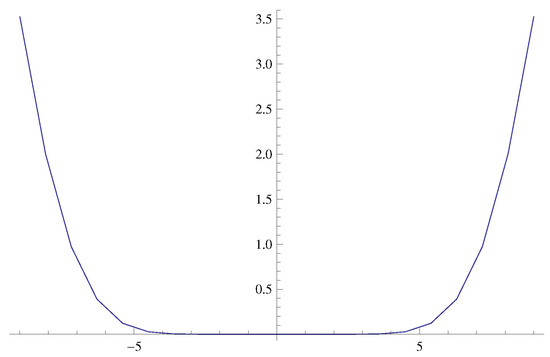
Figure 1.
Shape of .
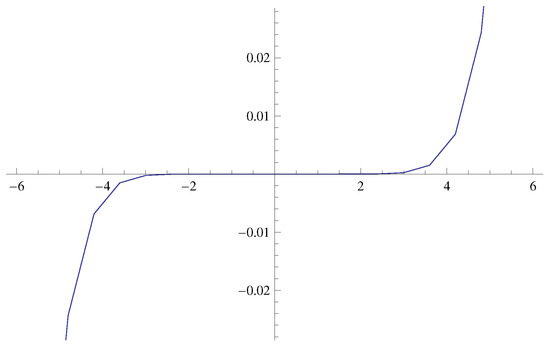
Figure 2.
Shape of .
Again, by choosing , , , and , respectively, in Equation (21), the shapes of qMLBF are plotted in Figure 3 and Figure 4.
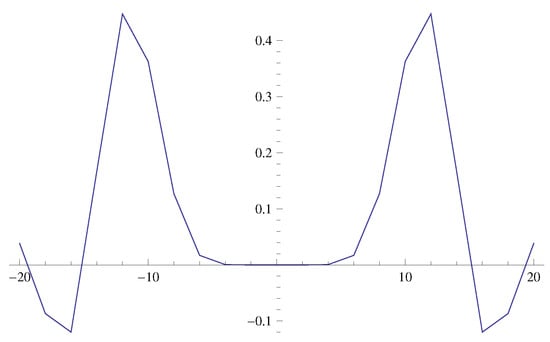
Figure 3.
Shape of .
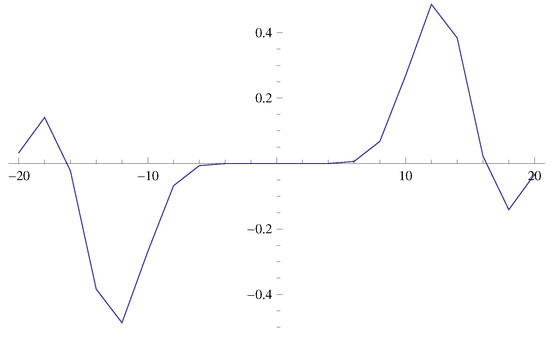
Figure 4.
Shape of .
Now, the graphs of the qMLTF are obtained by taking , , , (Figure 5) and , , , (Figure 6) in Equation (22).
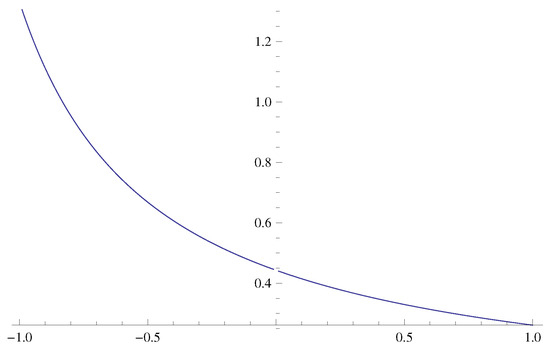
Figure 5.
Shape of .
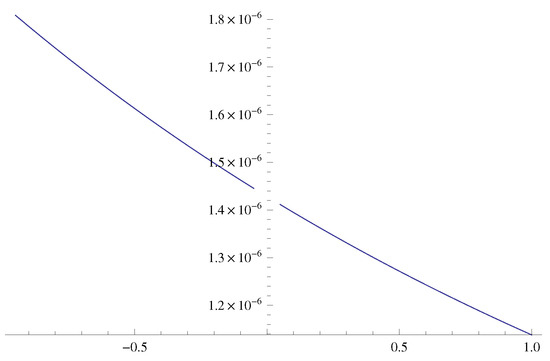
Figure 6.
Shape of .
The graphs show the behaviour of the qMLBF and qMLTF . The investigation regarding the shapes of the hybrid q-special functions will be very helpful for researchers in regard to understanding the properties of these hybrid q-special functions.
Author Contributions
Conceptualization, W.A.K. and T.N.; methodology, W.A.K. and M.A.; software, T.N.; validation, W.A.K., M.A. and T.N.; formal analysis, M.A.; investigation, W.A.K.; resources, M.A.; data curation, T.N.; writing—original draft preparation, W.A.K.; writing—review and editing, W.A.K. and T.N.; visualization, M.A.; supervision, W.A.K.; project administration, M.A.; funding acquisition, M.A. All authors have read and agreed to the published version of the manuscript.
Funding
This work was funded by the Deanship of Scientific Research at Jouf University through the Fast-track Research Funding Program.
Data Availability Statement
Data are contained within the article.
Conflicts of Interest
The authors declare no conflict of interest.
References
- Alatawi, M.S. (Department of Mathematics, Faculty of Science, University of Tabuk, Tabuk, Saudi Arabia); Raza, N. (Mathematics Section, Women’s College, Aligarh Muslim University, Aligarh, India); Kumar, M. (Department of Mathematics, Aligarh Muslim University, Aligarh, India); Khan, W.A. (Department of Mathematics and Natural Sciences, Prince Mohammad Bin Fahd University, Al Khobar, Saudi Arabia) Insights into q-Mittag-Leffler-Laguerre Polynomials: Properties and Operational Identities. 2024, submitted.
- Riyasat, M.; Nahid, T.; Khan, S. q-Tricomi functions and quantum algebra representations. Georgian Math. J. 2021, 28, 793–803. [Google Scholar] [CrossRef]
- Kac, V.G.; Cheung, P. Quantum Calculus; Springer: New York, NY, USA, 2002. [Google Scholar]
- De Sole, A.; Kac, V.G. On integral representations of q-gamma and q-beta functions. Rend. Math. Acc. Lincei 2005, 9, 11–29. [Google Scholar]
- Jackson, F.H. On q-definite integrals. Quart. J. Pure Appl. Math. 1910, 41, 193–203. [Google Scholar]
- Dattoli, G.; Torre, A. q-Bessel functions: The point of view of the generating function method. Rend. Mat. Appl. 1997, 17, 329–345. [Google Scholar]
- Dattoli, G.; Torre, A. Symmetric q-Bessel functions. Le Matematiche 1996, 51, 153–167. [Google Scholar]
- Mansour, Z.S.I. Linear sequential q-difference equations of fractional order. Fract. Calc. Appl. Anal. 2009, 12, 159–178. [Google Scholar]
- Albayrak, D.; Purohit, S.D.; Ucar, F. On q-Sumudu transforms of certain q-polynomials. Filomat 2013, 27, 413–429. [Google Scholar] [CrossRef]
- Albayrak, D.; Purohit, S.D.; Ucar, F. On q-analogues of Sumudu transform. Analele Stiintifice Ale Univ. Ovidius Constanta 2013, 21, 239–260. [Google Scholar] [CrossRef]
- Al-Omari, S.K.Q. On q-analogues of the Natural Transform of Certain q-Bessel Functions and Some Application. Filomat 2017, 31, 2587–2589. [Google Scholar] [CrossRef]
- Purohit, S.D.; Kalla, S.L. On q-Laplace transforms of the q-Bessel functions. Fract. Calc. Appl. Anal. 2007, 10, 189–196. [Google Scholar]
- Horwood, E. Basic Hypergeometric Functions and Applications; Chichester: New York, NY, USA, 1983. [Google Scholar]
Disclaimer/Publisher’s Note: The statements, opinions and data contained in all publications are solely those of the individual author(s) and contributor(s) and not of MDPI and/or the editor(s). MDPI and/or the editor(s) disclaim responsibility for any injury to people or property resulting from any ideas, methods, instructions or products referred to in the content. |
© 2024 by the authors. Licensee MDPI, Basel, Switzerland. This article is an open access article distributed under the terms and conditions of the Creative Commons Attribution (CC BY) license (https://creativecommons.org/licenses/by/4.0/).